Diversity Maximization Under Matroid Constraints
Zeinab Abbassi
Department of Computer Science Columbia University[email protected]
Vahab S. Mirrokni
Google Research, New York[email protected]
Mayur Thakur
Google New York[email protected]
ABSTRACT
Aggregator websites typically present documents in the form of representative clusters. In order for users to get a broader perspec-tive, it is important to deliver adiversifiedset of representative doc-uments in those clusters. One approach to diversification is to max-imize the average dissimilarity among documents. Another way to capture diversity is to avoid showing several documents from the samecategory(e.g. from the same news channel). We model the latter approach as a (partition) matroid constraint, and study diver-sity maximization problems under matroid constraints. We present thefirstconstant-factor approximation algorithm for this problem, using a new technique. Our local search0.5-approximation algo-rithm is also thefirstconstant-factor approximation for the max-dispersion problem under matroid constraints. Our combinatorial proof technique for maximizing diversity under matroid constraints uses the existence of a family of Latin squares which may also be of independent interest.
In order to apply these diversity maximization algorithms in the context of aggregator websites and as a preprocessing step for our diversity maximization tool, we develop greedy clustering algo-rithms that maximize weighted coverage of a predefined set of top-ics. Our algorithms are based on computing a set of cluster centers, where clusters are formed around them. We show the better perfor-mance of our algorithms for diversity and coverage maximization by running experiments on real (Twitter) and synthetic data in the context of real-time search over micro-posts. Finally we perform a user study validating our algorithms and diversity metrics.
1.
INTRODUCTION
Aggregator websites such as news aggregators have become in-creasingly common during the past decade. These websites (e.g., Google News) typically present snippets of documents (e.g., news articles) in the form of clusters. In these clusters, related documents are aggregated and a few of the representative items in that cluster are highlighted to give a glimpse of the documents in that cluster. In order for users to get a broader perspective on different topics, it is important to deliver adiversifiedset of representative documents in those clusters. Presenting a diversified set of documents is also
Permission to make digital or hard copies of all or part of this work for personal or classroom use is granted without fee provided that copies are not made or distributed for profit or commercial advantage and that copies bear this notice and the full citation on the first page. To copy otherwise, to republish, to post on servers or to redistribute to lists, requires prior specific permission and/or a fee.
Copyright 200X ACM X-XXXXX-XX-X/XX/XX ...$10.00.
important in the context of commerce search [2]. There are two ways to capture diversity among documents:
• In the first approach, after defining adistance function`among documents based on some implicit metrics (e.g. their con-tent), we aim to to maximize the average pairwise distance among these documents [9]. This measure has been moti-vated and studied in the context of diversity maximization in recommender systems and commerce search [9, 2]. In partic-ular, Bhattacharya, Gollapudi, and Munagala [2] argue that maximizing this diversity measure is desirable in the context of commerce (or product) search. They validate this claim through a user study. From an algorithmic point of view, this problem is known as the maximum dispersion problem and approximation algorithms are known for it [10, 9, 2].
• Another approach to diversification is based on considering explicitly definedcategoriesof documents such as news chan-nels or product brands. This approach enforces a constraint that no more than one (or two) of the documents from the same category may appear in the output. This more explicit diversity constraint can be modeled using a (partition) ma-troid constraint, i.e., we can define a (partition) mama-troid over the set of documents and aim to find a subset of representa-tive documents that form an independent set of that matroid. In order to model the above ways to capture diversity, we define the diversity maximization problem under matroid constraints: assum-ing that we can show a limited number of representative documents in the output, the goal of the diversity maximization problem under matroid constraints is to choose a subset of a small number of rep-resentative documents with the maximum diversity such that they form an independent set of a matroid constraint (e.g., not more than
1(or2) of the documents belong to the same category).1We study
this problem from an algorithmic perspective as well as experimen-tally using simulations and a user study.
1.1
Our Contributions
Diversity maximization under matroid constraints.As our main technical contribution, we present thefirstconstant-factor approx-imation algorithm for the diversity maximization problem under matroid constraints using a new local search technique. Previ-ous approximation algorithms for diversity maximization (or max-imum dispersion) are based on a greedy approach that does not
1
More generally, we consider the problem of choosing a set of di-versified representative documents inside a given set of (possibly overlapping) clusters, and study theclustered diversity maximiza-tionproblem under matroid constraints (See Section 2 for more details).
handle the matroid constraints [10, 2]. On the other hand, the lo-cal search technique is appropriate for handling such matroid con-straints. Moreover, our algorithm can handle an extra constraint to find representative documents inside a given set of (possibly over-lapping) clusters. Our local search0.5-approximation algorithm is also the first constant-factor approximation for the max-dispersion problem under matroid constraints [10, 9, 2]. Our combinatorial proof technique for maximizing diversity under matroid constraints uses the existence of a family of Latin squares which may find other theoretical applications.
Preprocessing for Clustering.As part of the input to the diversity maximization problem discussed above, we need to pre-compute a set of clusters(C1, . . . , Ck). Such a set of clusters can be found
using many different techniques. While this is not the focus of this paper, we discuss two simple algorithms to produce these clusters. These algorithms will be used as the preprocessing step of the di-versity maximization problem and they will be evaluated in the ex-perimental evaluation section. Both of these algorithms follow the following framework: first compute a subsetS ={d1, . . . , dk}of
topk center documents, and then build a clusterCi around each
centerdi. In other words, we think of each document in this set as
a center document for a cluster around it. In order to find these cen-ters, we associate a set of topics to each document, and in comput-ing the set of centers, we aim to cover a large range of topics. To do so, we define a weighted coverage function, and aim to maximize a weighted coverage of the documents inS. The weighted cover-age of a subsetSis defined as the sum of the weighted coverage of this set for each topic, where theweighted-coverageofSfor each topictis the maximum extent to which any document inS cov-ers topict. Although this weighted coverage problem is different from the previously studied maxk-coverage problems [8], we show that it is a submodular set function and thus a simple greedy algo-rithm gives a1−1
e-approximation to maximize this function. This
greedy algorithm generateskdocumentsd1, d2, . . . , dk by
itera-tively picking a new document that covers the maximum marginal weighted-coverage. After identifying thesekdocuments, we can generatekclustersC1, C2, . . . , Ckby putting documents that are
similar to centerdiin clusterCi. In the next part, we aim to identify
representative documents in each clusterCiby solving a diversity
maximization problem.
Experimental Evaluation. We show the effectiveness of our al-gorithms in practice through experiments and a user study. We perform experiments on both real and randomly generated data to confirm the performance of our algorithms for maximizing diver-sity and weighted-coverage.
Data.The algorithms developed in this paper can be applied to dif-ferent applications of aggregator websites such as news aggregators (like Google News), commerce search [2], and real-time search for online social networks. As for thereal dataset, we focus on the application of developing an aggregator website in the context of real-time search for the stream of Twitter micro-posts. This ap-plication is motivated by fast data generation on online social me-dia sites such as Twitter, Facebook, and Google+ which calls for a quick way of summarizing hot real-time trends in a collection of micro-posts. We extract candidate documents and important topics through careful mining of recent popular queries and their topics. We compute a hotness score for each topic, and also a relevance measure for each micro-post covering a topic (See Section 5 for details). This information can be used to produce a clustering of important micro-posts covering hot topics in a micro-blog environ-ment, and then compute a small number of diversified micro-posts to represent those clusters. We compare the performance of the local search algorithm, a greedy algorithm, and a naive sorting
al-gorithm on these datasets.
Observations.For several of the randomly generated datasets, the diversity of the local search algorithm is more than300%higher than that of the greedy or the naive sorting algorithm. For the real data set, we observe that the greedy algorithm and the local search algorithm consistently outperform the sorting algorithm for maxi-mizing weighted-coverage and diversity respectively: For example, we observe that on average, weighted-coverage of the greedy algo-rithm is78%higher than that of the sorting algorithm, and the local search algorithm achieves28%higher diversity than the sorting al-gorithm.
User Study.Finally, we conduct a user study through Amazon Me-chanical Turk validating our algorithms and our metrics. This user study shows that most users prefer to see a diversified set of docu-ments across clusters in an aggregator website, however, most users prefer a less diversified set of representatives inside the clusters.
Organization. The rest of this paper is organized as follows. Af-ter discussing related work, in Section 2, we define our model, and present formal definitions of the (clustered) diversity maximization problems under matroid constraints. In Section 3, we present our main technical contribution, i.e., a local search0.5-approximation algorithm to maximize diversity subject to matroid constraints. In Section 3.1, we define a variant of the problem generalizing the maximum dispersion problem and observe the first constant-factor approximation algorithm for the max-dispersion problem under ma-troid constraints. Then in Section 4, we present the preprocessing step of computing a set of clusters by choosing a number of cluster centers maximizing their weighted-coverage. In particular, in sub-section 4.1, we present a greedy algorithm to compute the cluster centers maximizing the weighted-coverage, and and show that this objective function is submodular, implying a constant approxima-tion factor of the greedy algorithm for the coverage maximizaapproxima-tion problem. In Section 5, we present our experimental results, show-ing the performance of our algorithms on real and randomly gener-ated data. Finally, we present our user study validating our metrics and algorithms in Section 6.
1.2
More Related Work.
Diversity Maximization Problem. The diversity maximization problem studied in this paper generalizes the maximum dispersion problem [10, 9, 2]. This problem has been explored in the con-text of diversity maximization for recommender systems [9], and commerce search [2]. A1/2-approximation greedy algorithm has been developed for the unconstrained variant of this problem [10], and the variant with knapsack constraints [2]. None of these greedy algorithms gives a constant-factor approximation for this problem under matroid constraints. By developing a local search algorithm and a different proof technique, we get the first1/2-approximation algorithms for the maximum dispersion problem under matroid con-straints. Such matroid constraints are also natural in the context of product search and can be directly applied to similar problems stud-ied in [2].
Diversity in Recommender Systems and Web SearchRanking and relevance maximization along with diversification have been extensively studied in recommender systems, web search, and database systems. While these results differ from our work in various as-pects, we point out some related work in this extensive literature which implies the importance of diversification in these applica-tions.
In the context of web search, maximizing diversity has been ex-plored as a post-processing step [3, 24]. Other papers explore rank-ing while takrank-ing into account diversity by a query reformulation for ranking the top searches [19] or by sampling the search
re-sults by reducing homogeneity [1]. Other methods are based on clustering results into groups of related topics [15], or expectation maximization for estimating the model parameters and reaching an equilibrium [20]. Moreover, in the context of recommender sys-tems, diversification has been explored in various recent papers [26, 17, 13, 25]. For example, topical diversity maximization is disscused in [26], and explanation-based diversity maximization is explored in [25]. From the information retrieval perspective, more realtime diversification ranking methods have been developed ex-ploiting user browsing behaviors [7] or exex-ploiting query reformula-tions for web search results [21]. This topic has been also explored in database systems [6, 14]. For example, notions of diversity has been suggested based on presenting decision trees to users [6]. Also computing diverse query results for online shopping has been stud-ied in [23]. Most of the above work consider other types of diversity metrics, and to the best of our knowledge, our diversity maximiza-tion problem subject to matroid constraints has not been explored formally prior to our results.
2.
PRELIMINARIES
2.1
Diversity Maximization Problems
Documents and Distance Function. Our model consists of a set of documentsDand pairwise distance function`:D×D →R
capturing the dissimilarity among documents. Throughout this pa-per, we assume that the distance function`is a metric satisfying the triangle inequality, i.e., for any three documents,`(d1, d3) ≤ `(d1, d2) +`(d2, d3). In our main application, we will use the weighted Jaccard Distance as the pairwise dissimilarity between documents which is a metric. For more details on this, see Sec-tion 2.2. The documentsdi ∈ Dmay correspond to various
ob-jects in different applications: in the context of a news aggregator, these documents correspond to news articles; for product search, the documents represent descriptions of a product, and for real-time search, they correspond to online (micro-)posts by users.
Diversity Function.Our main focus in this paper is to find a small set of representative documents maximizingdiversity. Given a set of documentsS⊆D, the diversity of documents inSis defined as the sum of pairwise distances between documents inS, i.e.,
diversity(S) =X
i∈S
X
j∈S
`(i, j).
This diversity measure has been motivated and studied in the context of recommender systems and commerce search [9, 2]. For example, Bhattacharya, Gollapudi, and Munagala [2] argue that maximizing this diversity measure is desirable in the context to commerce search, and validate this claim through a user study. The simplest version of the diversity maximization problem is to choose a setSofkdocuments with maximum diversity. Below, we discuss more general variants of this problem in the presence of a (possibly overlapping) clustering of document and also under matroid con-straints.
Clustered Diversity Maximization.Given a set of clusters
C= (C1, C2, . . . , Ck), find a setSofprepresentative documents
ri1, ri2, . . . , ripin each clusterCimaximizing diversity(S).
Note that in the definition of the problem above, clustersC1, . . . , Ck
need not to be disjoint, and can be arbitrary overlapping subsets of nodes. In particular, each cluster may include the whole set of documents, i.e,Ci=D. For this special case, the diversity
max-imization algorithm is to choose a set ofpknodes in the graph to maximize diversity (independent of their coverage). Since the dis-tance function`satisfies triangle inequality [4], this special case of
the clustered diversity maximization problem is equivalent to the maximum dispersion problem [10].
Motivation for Matroids.In order to identify diversified represen-tative documents, a natural requirement is to retrieve documents from different categories. In settings that such categories are ex-plicitly given, this constraint might be enforced in addition to max-imizing the diversity function defined above. One example of such constraints is as follows: Consider a partitioning of documentsD
intoqsubcategoriesD1, D2, . . . , Dq, whereD=∪1≤i≤qDiand
Dis are disjoint sub-categories of documents. For example, in the
context of news aggregators, each categoryDimay correspond to
a news domain; for product search, the subcategoryDimay
cor-respond to a specific brand, and in the context of real-time search, a subcategory may correspond to online posts from the same user. We would like to find a subset of documents maximizing total di-versity such that at most one document from each categoryDiis
present in the whole set (or each given clusterCi). The constraint
of not having more than one document from each subcategory can be captured as a special matroid constraint, calledthe partition ma-troid constraint. Here, we first define a matroid constraint, then define the diversity problem under a general set of matroid con-straints.
Matroid Constraints.A matroidMis defined as a family of sub-sets of the ground set of documentsE(M) =D, called indepen-dent sets. The set of indepenindepen-dent setsSof a matroidMis denoted by I(M). For a given matroid M, the associatedmatroid con-straintisS ∈ I(M). As is standard,Mis auniform matroidof rankrifI(M) :={X⊆ E(M) : |X| ≤r}. Apartition matroid is the direct sum of uniform matroids. Note that uniform matroid constraints are equivalent to cardinality constraints, i.e,|S| ≤ k. For more details about matroids, see [22].
Now, we formally define the problem:
Clustered Diversity Maximization Under Matroid Constraints.
LetMbe a matroid over the set of documentsDwith a family of independent setsI(M). Given a set of clustersC= (C1, C2, . . . , Ck),
our goal is to find an independent setRi ∈ I(M)ofp
represen-tative documentsRi={ri1, r2i, . . . , rpi} ⊆Ci(1≤i≤k) while
maximizing diversity(∪1≤i≤kRi).
A special class of matroids is a partition matroidM: Given a partitioning of documentsDtoqsubsets(D1, D2, . . . , Dq), a
sub-setS ⊂Dis an independent set of partition matroidMiffShas at most one document from each subsetDjfor each1 ≤j ≤q.
As discussed earlier, our main motivation for studying matroid con-straints is partition matroids.
2.2
Topics and Distance Function
As discussed earlier, the distance function`between documents for our main application is defined based on the generalized Jaccard distance function. In this section, we define the Jaccard distance function and other preliminaries related to the distance function.
Topics. In order to define the distance function between docu-ments, we consider a set of topicsT. The topicst∈Tcorrespond to important themes or subjects of those documents, e.g. they may correspond to hot news or micro-post topics for news aggregators or micropost real-time search; or to their brand and their features for the product search application.
Pairwise relevance and edge weightsw(d, t).For each document
d ∈ Dand any topict ∈T, the weightw(d, t)models the rele-vance of a topictto a documentd, i.e., it represents the extent to which a document is related to a topict∈T. The larger the weight
w(d, t)is, the more relevant documentdis to topict. Throughout the this paper, we assume that the weights are given and computed
in advance2For the theoretical part we assume that the weights are given.
We construct an edge-weighted bipartite topic-document bipar-tite graphG(D, T, E) between documents and topics with edge weightsw(d, t). Our goal is find a set of clusters with a set of rep-resentative documents in each cluster covering a large portion of topics while maintaining diversity. A central property that we need to satisfy in this paper is matroid constraints.
Generalized Jaccard Distance. To further investigate the diver-sity of a set of documents, we define the following generalized Jac-card distance between documents: Given an edge-weighted bipar-tite graphG(D, T, E), for two documentsd1andd2, the general-ized Jaccard distancebetweend1andd2is defined as:
`(d1, d2) = 1− P t∈Tmin(w(d1, t), w(d2, t)) P t∈Tmax(w(d1, t), w(d2, t)) .
This distance function is a natural generalization of the Jaccard distance functions over sets with weighted elements. This gen-eralized Jaccard distance has been studied already and it has been shown that it satisfies the triangle inequality [4], i.e, for any three documents,`(d1, d3)≤`(d1, d2) +`(d2, d3).
3.
DIVERSITY MAXIMIZATION UNDER
MATROID CONSTRAINTS
Here, we present a local search algorithm to choose a set of di-versified representatives in each cluster under a (partition) matroid constraintM. We prove that it achieves an approximation ratio of 1
2 in the worst case. Roughly speaking, the algorithm starts
from an arbitrary setRiof representative documents in each
clus-ter, and at each step, it considers all pairs(d, d0) ∈ Ri×Ci\Ri
of documents inside and outside of the representatives such that
Ri\{d} ∪ {d0} ∈ I(M), and examines swapping these two
doc-uments, i.e, removing documentdand adding documentd0to the set of representatives. If this swap increases the total diversity of the documents by a factor of1 +
n, i.e, if it increases the sum of
pairwise distances of representatives by that factor, we make this swap, i.e, we letRi=Ri\{d} ∪ {d0}.
Local search algorithm to choose diversified representatives Input:A set of clustersC= (C1, C2, . . . , Ck)over
a set of documentsD, a matroidMover documents, and and a distance function`among documents.
Output:For each clusterCi(1≤i≤k), a set ofpdocuments
Ri={ri1, ri2,· · ·, rip} ∈ I(M)whereRi⊆Ci.
Goal:Find a set of representatives maximizing total diversity, i.e.,P 1≤i≤k,1≤j≤p P 1≤i0≤k,1≤j0≤p`(rji, r i0 j0).
1.Initialize:LetRibe a set of top documents inCi.
2.Whilethere exists a local improvementdo
3. Forany pair of documents(d, d0)∈Ri×Ci\Ri
such thatRi\{d} ∪ {d0} ∈ I(M)do
4. IfremovingdfromRiand addingd0toRiincreases
the total diversity by a factor of1 + n, i.e.,
ifg(S\{d} ∪ {d0})>(1 +
n)g(S)then
5. LetRi:=Ri\{d} ∪ {d0}.
One desirable property of this local search algorithm is its flexi-bility to optimize other objective functions in the case where there
2
These weights can be computed in different ways for different applications. In Section 5, we describe one specific way to compute those weights for the real-time application.
are more than one choice for local improvements. Examples of these objective functions are quality or coverage of the documents or the popularity of the news channels. To optimize a different ob-jective function, one can try the sequence of local operations in the order of that objective, for example, we initialize the representa-tives to the set of documents with the highest quality score, and consider swapping other documents with these documents in the order of their quality score. This quality score may take into ac-count the reliability and coverage of each document, or the popu-larity of owner of the micro-post. We first prove that the algorithm achieves a good guaranteed approximation ratio, and then we study its computational time complexity.
Approximation Factor.Here, we show that the exact local search algorithm achieves a guaranteed approximation ratio of1/2. Such a proof for the exact local search algorithm simply implies a guar-anteed approximation of0.5−
n for the approximate local search
algorithm above. This proof is based on the existence a class of diagonal Latin squares, and thus this technique may find other the-oretical applications.
THEOREM 3.1. Given a set of clustersC= (C1, C2, . . . , Ck),
the above local search algorithm is a1/2-approximation algorithm for the problem of choosing a set ofprepresentativesRi∈ I(M)
for each clusterCi, maximizing the total diversity of the
represen-tatives.
PROOF. Consider an optimum solution O = {O1, . . . , Ok}
whereOi = {Oi1, . . . , Opi} ∈ I(M). Let the output of the
lo-cal search algorithm beL={L1, L2, . . . , Lk}where
Li={Li1, . . . , L
i
p} ∈ I(M). Our goal is to show that
L= X 1≤i≤k,1≤j≤p X 1≤i0≤k,1≤j0≤p `(Lij, L i0 j0) ≥ 1 2 X 1≤i≤k,1≤j≤p X 1≤i0≤k,1≤j0≤p `(Oij, O i0 j0) = 1 2OPT
To prove this, we need to employ a useful exchange property of matroids (see [22]). Intuitively, this property states that for any two independent setsIandJ, we can add any element ofJto the set
I, and kick out at most one element fromIwhile keeping the set independent. Moreover, each element ofIis allowed to be kicked out by at most one element ofJ.
PROPOSITION 3.2. [[22]] Let M be a matroid and I, J ∈ I(M) be two independent sets. Then there is a mapping π :
J\I→(I\J)∪ {φ}such that:
1. (I\π(b))∪ {b} ∈ I(M)for allb∈J\I.
2. |π−1(e)| ≤1for alle∈I\J.
Applying Proposition 3.2, we may consider a mappingπi
be-tween each subsetLiandOisuch thatLi\Lij∪Oiπi(j)∈ I(M).
Without loss of generality, we may assumeπi(Lij) =Oji, and thus
from Proposition 3.2,Li\Lij∪Oij∈ I(M). Now consider
remov-ingLijfromLjand addingOijtoLj. Using the local optimality of
Land sinceLi\Lij∪O i
j∈ I(M), we know that for any1≤i≤k
and1≤j≤p: X 1≤i0≤k,1≤j0≤p `(Lij, L i0 j0)≥ X 1≤i0≤k,1≤j0≤p `(Oij, L i0 j0)
p, we get: L= X 1≤i≤k,1≤j≤p X 1≤i0≤k,1≤j0≤p `(Lij, L i0 j0) ≥ X 1≤i≤k,1≤j≤p X 1≤i0≤k,1≤j0≤p `(Oij, L i0 j0)
For ease of notation, letoi=O
bi kc+1
(i−kbi kc)+1
, i.e, forn=kp, and leto0, o2, . . . , on−1 correspond to the set of all representatives in
the optimal solutionOji’s for1≤i≤kand1≤j≤p. Similarly,
letl0, l2, . . . , ln−1 correspond to the set of representatives in the
local optimal solutionLij. In this new notation, we can re-write the
above inequalities as:
L= X 0≤i≤n−1 X 0≤j≤n−1 `(li, lj) ≥ X 0≤i≤n−1 X 0≤j≤n−1 `(oi, lj)
In order rewrite the above inequalities, we use a pattern similar to a family of Latin squares. Consider ann×ndiagonal Latin square, with elementsaijfor0≤i≤n−1and0≤j≤n−1. This Latin
square has the following properties (that are useful later to finish the proof): In each row and column of Latin square, each number
0,1,2, . . . , n−1appears exactly once, andaii=i. The existence
of such Latin squares have been already proved [12]. Therefore, the summationP
0≤i≤n−1
P
0≤j≤n−1`(oi, lj)appeared in the above
formula may be rewritten as
1 2 X 0≤i≤n−1 X 0≤j≤n−1 `(oi, laij) +`(oj, laij).
Now consider the following set of triangle inequalities among the documents:`(oi, laij) +`(oj, laij)≥`(oi, oj). Using the struc-ture of the Latin square, and by putting it all together, we get:
L= X 1≤i≤k,1≤j≤p X 1≤i0≤k,1≤j0≤p `(Lij, L i0 j0) ≥ X 1≤i≤k,1≤j≤p X 1≤i0≤k,1≤j0≤p `(Oji, L i0 j0) = 1 2 X 0≤i≤n−1 X 0≤j≤n−1 `(oi, laij) +`(oj, laij) ≥ 1 2 X 0≤i≤n−1 X 0≤j≤n−1 `(oi, oj) = 1 2 X 1≤i≤k,1≤j≤p X 1≤i0≤k,1≤j0≤p `(Oij, O i0 j0) = 1 2OPT
This completes the proof.
Running time of the local search algorithm. It can be seen that this algorithm converges as the value of the metric increases at each step. In fact, this algorithm has a polynomial running time, since a swap only is done if the metric increases by a factor of1 +
nfor an
appropriately small constant >0. To show this, first we observe that by starting from a setSincluding two furthest documents, we haveg(S)≥ OPT
k2 for the initial setS. Starting from such a set,
and using theapproximate local improvements, it follows that if the algorithm performstlocal improvements, then(1 +
n)
t≤k2
since at each step, the metric increases by1 +
n factor and the
value of the metric is upper bounded byk2times the initial value of the metric. It follows thatt≤O(log1+
n(k
2)) =O(n
log(k)).
Therefore the algorithm finishes at most afterO(n
log(k))local
improvements, and thus it runs in polynomial time.
3.1
Diversity Maximization Under
Global Matroid Constraints
As another variant of the diversity maximization problem, one can consider the matroid constraint over all representatives (instead of having the matroid constraint for the representatives in each clus-ter). In this variant, we find a set ofprepresentativesRi ⊆ Ci
such that the whole set∪1≤i≤kRiis an independent set in the
ma-troid. For example, we may enforce the constraint that at most one representative in∪1≤i≤kRican be chosen from eachDjfor
1 ≤j ≤ q. The significance of this variant is that it generalizes the max-dispersion problem under matroid constraints. To see this, consider this problem with all equal clustersCi =Dandp= 1.
Therefore, a 12-approximation algorithm for this problem implies a1
2-approximation algorithm for the max-dispersion problem with
matroid constraints. In the following, we formally define this vari-ant.
Clustered Diversity Maximization Under Global Matroid Con-straints.LetMbe a matroid over the set of documentsDand fam-ily of independent setsI(M). Our goal is to find an independent setRi⊂Ciofprepresentative documentsRi={ri1, r2i, . . . , rpi}
for each clusterCi(1≤i≤k) such that∪1≤i≤kRi∈ I(M), and
maximize diversity(∪1≤i≤kRi).
The local search algorithm can be easily modified to solve this new variant. To see this, consider a local search algorithm in which at each step, we only allow swap operations that keep the whole set of representatives an independent set of the matroid. One can easily check that the above proof can be adapted to show that such a local search algorithm gives a 1
2 −-approximation algorithm.
This, in turn, implies the first constant-factor approximation for the maximum dispersion problem under matroid constraints.
4.
PREPROCESSING FOR CLUSTERING
As part of the input to the diversity maximization problem dis-cussed above, we need to pre-compute a set of clusters(C1, . . . , Ck).
Such a set of clusters can be found using many different techniques. While this is not the focus of this paper, for the sake of complete-ness, we discuss two simple algorithms to produce these clusters. We will also evaluate these algorithms in the experimental evalua-tion secevalua-tion. The ideas behind both of these algorithms are based on finding a subsetS ={d1, . . . , dk}of topkcenter documents,
and then building a cluster around each centerdi. In other words,
we think of each document in this set as a center document for a cluster around it, i.e., after computing these center documents, we construct a clustering C = (C1, C2, . . . , Ck) of documents
wheredi ∈ Ci by associating each documentd ∈ Dto one or
moreclosecenter documents inS. In computing the set of cen-tersS, we aim to cover a large range of topics, and we take two approaches: maximize a weighted-coverage function of the docu-ments inS, and maximize the diversity(S)while taking into ac-count their coverage. We will first define the weighted-coverage function, and then algorithms aiming to optimize it.
4.1
Greedy Algorithm for Coverage
Maximiza-tion
In this section, we define the weighted-coverage function and present an algorithm for the maximum weighted-coverage problem.
Weighted-coverage. Given a set of documentsDand topics T, and an edge-weighted bipartite graph
subsetS ⊆Dis the sum of the weighted coverage of topics cov-ered by documents inS, where the weighted coverage of each topic
tismaxd∈Sw(d, t)i.e., the extent to which this itemtis covered.
More formally, the weighted-coverage of documents inSis equal to:
coverage(S) =X
t∈T
max
d∈Sw(d, t).
Maximum weighted-coverage problem. Given a parameter k
(i.e., the number of documents) and an edge-weighted bipartite graphG(D, T, E), the goal of the maximum weighted-coverage problemis to choose a subsetSofkcenter documents maximizing the weighted-coverage coverage(S).
Note that this problem is different from the well-studied set cover or the maximumk-coverage problem [8], but it is still NP-hard, since the same problem with 0/1 as edge weights is equivalent with an unweighted version of maximumk-coverage problem [8] which is NP-Hard.
Greedy Algorithm for Coverage Maximization. Given the def-inition of the coverage function, thegreedy algorithmto choose the topkdocuments is as follows: start from an empty setS of documents, at each step choose a documentdwith the maximum marginal increase in function coverage (i.e,maxcoverage(S∪{d})−
coverage(S), and add this document to setS. Repeat this greedy selection procedure untilkelements are picked.
By proving the submodularity of the weighted-coverage function defined above, we can prove thatgreedy algorithmabove achieves at least1−1
eof the optimum of the maximum weighted-coverage
problem [18]. A proof of this fact can be found in appendix.
4.2
Combined Heuristic for Center Selection
One way of choosing the set of centers in the clusters is to find
kcenter documents with maximum diversity. However, other than the diversity metric, one may care about other objective functions such as relevance, weighted-coverage, and popularity of the micro-posts in the set of centers to form the clusters. A desirable property of the local search algorithm for maximizing diversity is its flexi-bility in choosing the order of local improvements, and the initial set of documents to start with. For example, if we want to simul-taneously maximize the weighted coverage and diversity metrics, we can start with a set of documents with high weighted coverage, and then run the local search algorithm as a post-processing step. Also in running the local search algorithm, we should try to swap documents with higher weighted-coverage at each step. We use this guideline in the implementation of the local search algorithm. As an alternative approach to find the clusters, we also study the following heuristic for choosing the initialkcenters by combin-ing ideas for maximizcombin-ing coverage and diversity. The algorithm is described in Figure 4.2.
Note that the algorithm in Figure 4.2 is a simple heuristic algo-rithm combing the ideas behind the greedy and the local search al-gorithms for maximizing weighted-coverage and diversity. While we do not prove a worst-case approximation factor for this com-bined heuristic, we will show its reasonable performance on real and random data in our experimental evaluations.
5.
EXPERIMENTAL EVALUATION
In order to evaluate our algorithms in practice, in this section, we perform experiments on real world data (from Twitter) and on randomly generated data. More specifically, we examine the practi-cal performance of our algorithms and their variants by comparing them with each other and a with baseline algorithm. We begin by describing the data and our metrics.
Combined Heuristic (for Coverage and Diversity of Centers) Input:The edge-weighted bipartite graph G(D,T,E)
with edge weightsw(d, t)for eachd∈Dandt∈T.
Output:A setSofkdocumentsS={d1, d2,· · ·, dk}.
Goal:Find a setSof cardinalityk. 1.Initialize:S=∅
2.SortdocumentsDin the non-increasing order of weighted-coverage, i.e., in order ofP
t∈Tw(d, t)
3.Letthe sorted documents be(d1, d2, . . . , d|D|) 4.Forifrom1to|D|do
5. if|S|< kthen 6. LetS:=S∪ {di}.
7. elseifswappingdiwith anydjforj < iincreases diversity, then
8. LetS:=S\{dj} ∪ {di}.
Figure 1: Combined Heuristic for Cluster Center Selection Real Data from Twitter.We run our experiments on 61 families of twitter posts, each of which is constructed as follows: We consider 10,000 to 25,000 top queries for Google real-time search, and for each query, we consider 30 top micro-posts returned for that query. This ranking is done based on various criteria such as the relevance of those twitter posts as well as their popularity and importance for the topic of the query. For each dataset, this process results in tens of thousands of documents, and a mapping of those top queries to thousands of topics. We construct the edge-weighted bipartite graph between these documents and topics using the algorithm de-scribed in Section 5. As a result, we get 61 edge-weighted bipartite graphs with an average of 1,277 topics and average of 12,500 doc-uments. For this data set, the categoriesDiforming the (partition)
matroid constraints are sets of micro-posts from the same Twitter user. We consider identifying 10 or 20 centers and clusters with three representatives in each cluster.
Processing Twitter data.An important source of identifying hot topics in the online micro-blogging environment is the set of popu-lar queries by users. As a first step of identifying important micro-posts, we identify popular queries that have been searched more often recently by users, and use these queries to retrieve a set of micro-posts matching those queries. In this setting, since tweets do not contain many terms, there is less need to discount term fre-quency by inverse document frefre-quency (as in TF-IDF). We assume that a real-time search engine is available and one can identify the most relevant documents for those queries.
LetQbe the set of top queries on a real-time search engine. Each query has a query score query_score(q), representing the popular-ity of this query, e.g., the number of users who searched for this query. For eachqinQ, letDqbe a ranked list of toplmicro-posts
or documents forq, and for each documentd∈Dq, we also have
a relevance_score(q, d).
For eachqinQ, letTq ⊂T be the set of topics corresponding
toq. We transform each queryqto a set of topicsTq, and construct
an edge-weighted bipartite graphG(D, T, E)between documents
D = ∪q∈QDqand all topics T = ∪q∈QTq. The weight of the
edge between a topict∈T and and a documentd∈Dis denoted byw(d, t)and is computed as follows: for each queryq∈Qand each topict ∈ Tq, we associate a weight weight(q, t) which is
proportional to the score of the query normalized by the number of topics associated with this queryq, e.g,
weight(q, t) = query_score(q)
|Tq|
Now the weightw(d, t)in the topic-document bipartite graph is
w(d, t) = X
q:t∈Tq
weight(q, t)relevance_score(q, d).
This weight captures the extent to which online entrydcovers topic
tmodeling the relevance of this topic to the micro-post. Intuitively, these topics represent the main topics of hot trends over the on-line environment. After forming the above edge-weighted topic-document bipartite graph, our goal is find a set of top topic-documents covering the maximum amount of topics.
Randomly generated data. We generate the underlying bipartite graph between documents and topics at random. In particular, we generate families of random bipartite graphs each with 20000 doc-uments and 2000 topics. We examine random bipartite graphs in which each edge is present with probabilitypindependent of all other edges. We consider six values for the probabilityp, i.e.,
p = 0.1%,0.5%,1%,2%,5%,10%for having each edge in the bipartite graphs. The categoriesDifor the partition matroid
con-straint are generated at random among 100 categories. We consider identifying 10 or 100 centers and clusters with three representatives in each cluster.
Metrics.We divide the practical evaluation of our algorithms into two main parts: 1) evaluation of the center selection algorithm for clustering, 2) evaluation of diversity maximization for representa-tive selection given a set of clusters. For each part of the evaluation, we use an appropriate set of metrics. The main metrics are related to diversity and weighted-coverage as defined in this paper, and other metrics are inspired by thek-median andk-means problems with and without outliers [5]. Some of the metrics for evaluating both first and second parts are as follows:
• Weighted-coverage (W-COVERAGE): For a subsetSof doc-uments, the weighted-coverage ofSisP
t∈Tmaxd∈Sw(d, t).
• Diversity (DIVERSITY): For a subsetS of documents, the diversity ofSisP d∈S P d0∈S`(d, d 0 ).
• Average distance to the centers (DIST-ALL): For a setS =
{c1, c2, . . . , ck)of centers, the DIST-ALL objective function
is the sum of distances of each document to the closest center, i.e.,
X
d∈D
min
1≤i≤k`(d, ci).
A smaller DIST-ALL implies better coverage of the set of centers.
• Percentage of documents covered in clustering (PERC): For a family of clustersC = (C1, C2, . . . , Ck), this metric is
simply the percentage of documents covered in this cluster-ing, i.e.,|∪1≤i≤kCi|
|D|. A larger PERC indicates a larger
cover-age for the set of clusters.
• Average distance of covered documents to the centers (DIST-COVERED): For a set of clustersC= (C1, C2, . . . , Ck)and
a centerci ∈ Cifor each1≤i≤k, we define the
mean-distance DIST-COVERED to centers as
X
1≤i≤k
X
d∈Ci
`(d, ci).
A smaller DIST-COVERED implies better coherence for these clusters.
W-COVERAGE and DIVERSITY can be defined for any set of documents, e.g. a set of centers for clusters, or union of sets of
0 100000 200000 300000 400000 500000 600000 1 3 5 7 9 11 13 15 17 19 21 23 25 27 29 31 33 35 37 39 41 43 45 47 49 51 53 55 57 59 61 GREEDY COMBI-‐H SORT
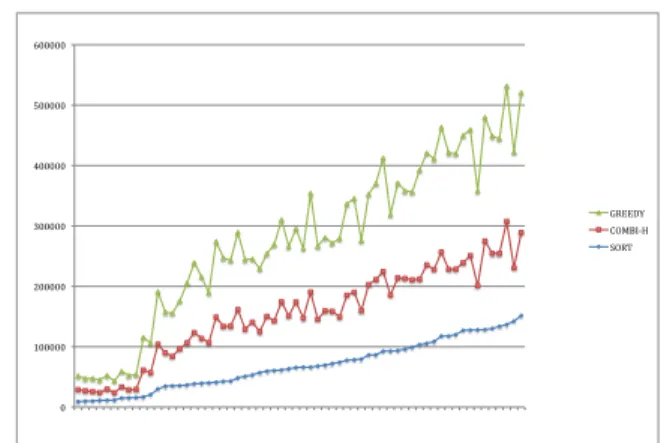
Figure 2: Vectors of the W-COVERAGE metric for all the in-stances. X-axis corresponds to instances, and Y axis corre-sponds to the coverage metric. From top to bottom, curves correspond to GREEDY, COMB-H, and SORT algorithms. In-stances are ordered based on the coverage value of the output for SORT algorithm.
Table 1: Percent-coverage (PERC) of documents vs. the av-erage distance of covered documents to the centers (DIST-COVERED) for three algorithms. The X axis represents PERC and Y axis corresponds to DIST-COVERED.
Algorithm Diversity N-Diversity Coverage N-Coverage
Comb-H 189.99 99% 86130 125%
GREEDY 189.90 99% 122981 178%
SORT 145.82 77% 68755 100%
representatives from each cluster. We say a documentdis covered by a subset of documentsS, if at least for one documentd0 ∈S, the distance`(d, d0)is less than 1. The PERC function is an un-weighted variant of the W-COVERAGE, and the DIST-ALL and DIST-COVERED metrics correspond to the coherence of clusters, i.e, the closer the documents are to the centers (in terms of their`
distance), the smaller the DIST-ALL and DIST-COVERED func-tions are, and thus we have more coherent clusters. While ALL captures the average distance of all documents, the DIST-COVERED captures the average distance of documents covered by the centers.
One other metric for evaluating the second part (i.e, diversity maximization for choosing representative documents inside each given cluster) is as follows:
• Intra-cluster diversity (INTRA-DIVERSITY): For a family of clustersC = (C1, C2, . . . , Ck)and a subsetRi ⊆Ciof
representatives inside each cluster, we define the intra-cluster diversity as follows: X 1≤i≤k X d,d0∈R i `(d, d0).
Experiments.In the first part, we explore the following three algo-rithms and compare them in terms of diversity, weighted-coverage, and other metrics:
0.815 0.82 0.825 0.83 0.835 0.84 0.845 0.85 0.855 0 0.02 0.04 0.06 0.08 0.1 0.12 0.14 0.16 0.18 COMB-‐H GREEDY SORT
Figure 3: Average of DIVERSITY, normalized DIVERSITY, W-COVERAGE, and normalized W-COVERAGE of the initial set of centers various algorithms. DIVERSITY is normalize compared to the maximum possible diversity, i.e., m2
, where mis the number of documents. W-COVERAGE is normalized based on the coverage of the SORT algorithm.
Table 2: Average percentage of documents covered by each al-gorithm (PERC), average of average GJD distance of covered documents to the centers(DIST-COVERED), and average of av-erage GJD distance of all documents to the centers(DIST-ALL).
Algorithm PERC DIST-COVERED DIST-ALL
Comb-H 0.152 0.82 0.97
GREEDY 0.160 0.85 0.98
SORT 0.06 0.82 0.99
• Sort-based Algorithm [SORT]: Sort documents based on the total weight of topics connected to them in the edge-weighted bipartite graph.
• Greedy algorithm [GREEDY]: The greedy algorithm described in Section 4.1.
• The combined heuristic [COMB-H]: The combined heuris-tic algorithm, combining the local search and greedy algo-rithms, described in Section 4.2.
In the second part, we compare different algorithms for diver-sity maximization for representative selection in each cluster. We assume that given a set of center documents, clusters have been formed by putting each document in the cluster associated with the closest center. Documents that are not overlapping their set of top-ics with the any of the centers are thrown away, i.e., if the minimum generalized Jaccard distance (`) of a document to centers is 1, then this document is not in any cluster. In particular, we compare the performance of the following three algorithms in terms of diversity, weighted-coverage, intra-cluster diversity, clustering coverage.
• A baseline sort heuristic [BASE]: In this algorithm, we choose the representatives as follows: In each cluster, the first repre-sentative is the center of the cluster from which this cluster was made. The rest of thep−1representatives arep−1
documents with the maximum total weight of covering top-ics.
• The local search algorithm maximizing diversity of represen-tatives [LOCAL] described in Section 3.
Table 3: Average of W-COVERAGE, DIVERSITY, and INTRA-DIVERSITY of the set of representatives for six algo-rithms on real data sets.
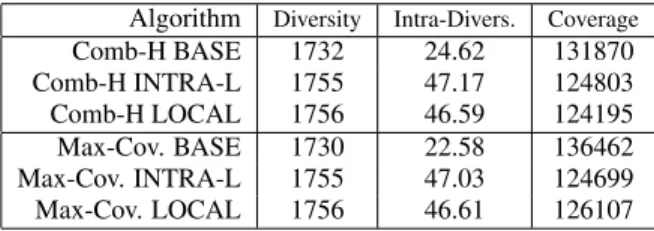
Algorithm Diversity Intra-Divers. Coverage Comb-H BASE 1732 24.62 131870 Comb-H INTRA-L 1755 47.17 124803 Comb-H LOCAL 1756 46.59 124195 Max-Cov. BASE 1730 22.58 136462 Max-Cov. INTRA-L 1755 47.03 124699 Max-Cov. LOCAL 1756 46.61 126107
• A modified local search algorithm maximizing the intra-cluster diversity [INTRA-L]: In this algorithm, we slightly modify the local search algorithm to optimize the intra-cluster diver-sity as opposed to total diverdiver-sity of all representatives. In particular, we swap a document outside of the set with a doc-ument inside only if it increases the distance of this docdoc-ument to the set of documents in the same cluster.
Observations.Our experiments on both real and randomly gener-ated data confirm the better performance of our algorithms for max-imizing diversity and weighted-coverage. The better performance of the local search algorithm for diversity maximization compared to the greedy algorithm is more clear for randomly generated data sets.
For the real data, we report statistics for the set of 20 centers, or the 20 clusters based on these 20 centers, and the set of 60 represen-tative documents in these clusters. First we observe that GREEDY and Comb-H algorithms consistently outperform the SORT algo-rithm for maximizing the weighted-coverage and diversity met-rics respectively. For example, Figure 2 shows that the weighted-coverage of these two algorithms outperform that of SORT for each of the instances. Moreover, Table 1 shows that on average, cover-age of GREEDY is78%higher than that of SORT, and coverage of Comb-H is25%higher than the coverage of SORT. Also the cover-age of GREEDY is42%higher than that of Comb-H. In addition, Figure 1 shows that on average, diversity of both GREEDY and Comb-H is28%higher than diversity of SORT. Although we ex-pect the diversity of Comb-H to be better than that of GREEDY, our real datasets do not show a significant difference between the di-versity of GREEDY and Comb-H. However, we will observe such a difference on the random datasets (See Figure 4).
Other than the coverage and diversity metrics for the 20 centers, we also construct 20 clusters out of these centers by assigning each document to the closest center and report clustering metrics like PERC and DIST-COVERED, as well as the DIST-All metrics for these centers and clusters (See Figures 5 and 2). Intuitively, we expect algorithms with good coverage and diversity to have high percentage of covered documents, and small average distance of other documents to clusters, i.e., smaller DIST-ALL. We observe that GREEDY and Comb-H achieve comparable PERC and DIST-ALL. They both have larger PERC and smaller DIST-All compared to SORT. On the other hand, GREEDY has a slightly larger DIST-COVERED, implying that since GREEDY covers more topics, the resulting clusters may end up being less coherent, and thus there seem to be tradeoff between the coverage of the centers of the clus-ters and the coherency (DIST-COVERED) of the clusclus-ters. Figure 5 depicts this tradeoff. Finally, we report the average of Diversity, Intra-Diversity, and Coverage for the set of 60 representatives for the six algorithms combining Comb-H. and GREEDY (or
Max-0 5000 10000 15000 20000 25000 30000 35000 40000 45000 50000 1 2 3 4 5 6 "Comb-‐H Intra-‐L" Comb-‐H LOCAL "Max-‐Cov. Intra-‐L" "Max-‐Cov. LOCAL"
Figure 4: Average diversity metric for four algorithms on six random family of networks. On the X axis, from left to right, the bars correspond to random networks with probabilities p= 0.1%,0.5%,1%,2%,5%,10%on the edges of the bipartite graph.
Table 4: Average of W-COVERAGE, and DIVERSITY of two algorithms for six families of random graphs.
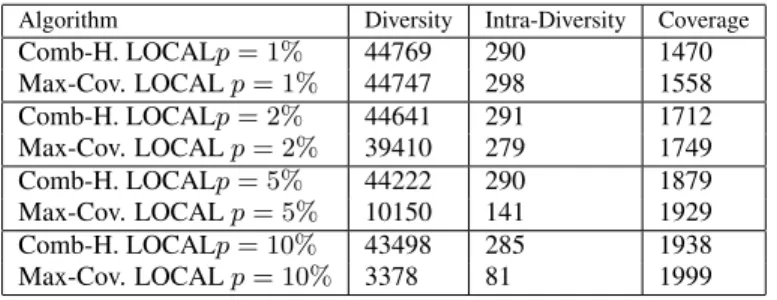
Algorithm Diversity Intra-Diversity Coverage Comb-H. LOCALp= 1% 44769 290 1470 Max-Cov. LOCALp= 1% 44747 298 1558 Comb-H. LOCALp= 2% 44641 291 1712 Max-Cov. LOCALp= 2% 39410 279 1749 Comb-H. LOCALp= 5% 44222 290 1879 Max-Cov. LOCALp= 5% 10150 141 1929 Comb-H. LOCALp= 10% 43498 285 1938 Max-Cov. LOCALp= 10% 3378 81 1999
Cov.) to find the centers and BASE, LOCAL, and INTRA-L to find the representative inside clusters (See Figure 3). The results from this part are similar to previous part, i.e., the coverage of Max-Cov. algorithm is larger, but the diversity of all the algorithms are com-parable. The Intra-diversity of representatives for the algorithms using Intra-L is larger than the other algorithms.
The results for randomly data sets are similar in most aspects. Here, we discuss the main difference: while, for real data sets, the diversity metric for the output of GREEDY (or Max-Cov.) algo-rithm was comparable to that of Comb-H, we have observed fami-lies of instances of random data sets in which the average diversity of the output of Comb-H which is aiming to maximize the diversity is much higher. This is particularly significant for dense instances in which the probability of an edge in the document-topic bipartite graph is large, e.g.p= 5%orp= 10%. For instance, forp= 5%, the Diversity of the output of Comb-H. is more than300%higher than that of GREEDY (See Figure 4). For brevity, we report the details of these metrics for a subset of algorithms (See Figure 5), but the results for other algorithms follow the same pattern.
6.
USER STUDY
We conducted a user study with the goal to validate our metrics and algorithms. In this section, we describe the user study along with the results and observations.
The user study was designed in the form of a survey on Ama-zon’s Mechanical Turk simulating a trends’ aggregator website. Amazon’s Mechanical Turk (MTurk) is a crowdsourcing online marketplace whererequestersuse human intelligence ofworkers
to perform certain tasks, also known as HITs (Human Intelligence Tasks). Workers browse among existing tasks and complete them for a monetary payment set by the requester [16]. Once a worker completes the task, the requester can decide whether to approve it. In particular, if the requester believes that the worker completed the task randomly, she can reject her work. In that case, the worker does not get paid for the particular task and her approval rate is de-creased. For our studies, we only hired workers that had approval rates of over 95%, that is, workers who had performed well in the past.
Our survey contains two categories of questions: The first ques-tion is how much people prefer seeing a diversified set of clusters, and the second question is to validate inter-cluster versus intra-cluster diversity, i.e, while showing a diversified set of intra-clusters, do people want to see a diversified set of representatives inside each cluster or not.
For each category, we present four questions each with two op-tions where each option is a set of clusters. The user is then asked which option she liked to see if she visited a realtime trends aggre-gator website. For the first category , the two options differed in the degree of diversity in them, e.g., one is generated by the diversity maximization algorithm and the other one is generated by the base-line sorting algorithm. In the second category, both options consist of clusters with a high diversity, but in one of them each cluster consists of a diversified set of representatives and in the other one, each cluster consists of a less diversified set of representatives. In each survey, we repeated two of the questions with the answers in reverse order for validity check. If the answers to those ques-tions were inconsistent, we discarded the survey answers from that user. Overall, 130 out of 300 respondents had answered these two questions inconsistently. Therefore, we analyzed the remaining 170 valid responses.
Each question consists of two main parts: 1)“Which one do you prefer?"and 2)“Which one do you think others prefer?"The an-swer to the first question provides information on how a particular user likes diversity, and the answer to the second question shows how users expect an aggregator to look like. Moreover, we in-cluded the second question in the survey for two reasons. First, by asking the second question the subjects felt that the survey’s goal was to study how people think their decisions are similar to the oth-ers, weakening the reactivity effect [11]. Second, we offered three bonus payments ($5 each, which is 50 times the amount we paid for each HIT) to the three workers whose answers to the second question was closest to the others’ answers to the first question in order to deter workers from answering randomly.
Observations.We report the answers to questions 1 and 2 in each of the two categories as follows:
• For the first category, on average (over 4 questions) 65% of the respondents preferred to see a more diversified see of clusters. Moreover, 69% of the respondents thought that most people would like to see a diversified set of clusters.
• For the second category of questions, on average (over 4 questions) 72% of the respondents preferred to see less di-versified representatives inside each cluster (intra diversity), while seeing a set of diversified clusters. Moreover, 76% of the respondents thought that most people would like to see lower intra diversity representatives.
Overall, we conclude that while most users would prefer to see a more diversified set of clusters in the aggregator website, many users prefer to see a less diversified set of items inside each cluster. This implies that the most appropriate metric and algorithm from
the users’ point of view is to maximize diversity among representa-tives of different clusters, but present more coherent representarepresenta-tives inside clusters.
7.
CONCLUSION
In this paper, we study the diversity maximization problem un-der matroid constraints which is useful in a range of applications – in news aggregators, for aggregating trending topics in a micro-blogging environment, and in commerce search [2]. On the theo-retical side, we present the first constant-factor approximation al-gorithm for this problem applying a new local search technique which implies the first constant-factor approximation algorithm for the maximum dispersion problem subject to matroid constraints. From the practical perspective, we show reasonable performance of these algorithms by running a user study validating our metrics, and by running experiments on synthetic and real data. From an algorithmic perspective, it would be interesting to design approxi-mation algorithms that simultaneously maximize the diversity and weighted-coverage functions discussed in this paper. From a prac-tical standpoint, it would be nice to apply these ideas in the context of commerce search [2] where matroid constraints are also relevant.
8.
REFERENCES
[1] A. Anagnostopoulos, A. Z. Broder, and D. Carmel. Sampling Search-Engine Results. InWWW, 2006.
[2] S. Bhattacharya, S. Gollapudi, and K. Munagala.
Consideration set generation in commerce search. InWWW, pages 317–326, 2011.
[3] J. Carbonell and J. Goldstein. The use of MMR, diversity-based reranking for reordering documents and producing summaries. InSIGIR, 1998.
[4] M. Charikar. Similarity estimation techniques from rounding algorithms. InSTOC, pages 380–388, 2002.
[5] M. Charikar, S. Khuller, D. M. Mount, and G. Narasimhan. Algorithms for facility location problems with outliers. In SODA, pages 642–651, 2001.
[6] Z. Chen and T. Li. Addressing Diverse User Preferences in SQL-Query-Result Navigation. InSIGMOD, 2007. [7] Z. Cheng, B. Gao, and T.-Y. Liu. Actively predicting diverse
search intent from user browsing behaviors. InWWW, pages 221–230, 2010.
[8] U. Feige. A threshold of ln for approximating set cover.J. ACM, 45(4):634–652, 1998.
[9] S. Gollapudi and A. Sharma. An axiomatic approach for result diversification. InWWW, pages 381–390, 2009. [10] R. Hassin, S. Rubinstein, and A. Tamir. Approximation
algorithms for maximum dispersion.Oper. Res. Lett., 21(3):133–137, 1997.
[11] P. Heppner, B. Wampold, and D. Kivlighan.Research design in counseling. Brooks/Cole Pub Co, 2008.
[12] A. J. W. Hilton. On double diagonal and cross latin squares. Journal of London Mathematical Sociecy, 2-6:679–689, 1971.
[13] J. A. Konstan. Introduction to recommender systems. In SIGIR, 2007.
[14] G. Koutrika, A. Simitsis, and Y. Ioannidis. Précis: The Essence of a Query Answer. InICDE, 2006.
[15] K. Kummamuru, R. Lotlikar, S. Roy, K. Singal, and R. Krishnapuram. A Hierarchical Monothetic Document Clustering Algorithm for Summarization and Browsing Search Results. InWWW, 2004.
[16] W. Mason and S. Suri. Conducting behavioral research on amazonâ ˘A ´Zs mechanical turk.Behavior Research Methods, pages 1–23, 2010.
[17] S. McNee, J. Riedl, and J. A. Konstan. Being Accurate Is Not Enough: How Accuracy Metrics Have Hurt Recommender Systems. InCHI, 2006.
[18] G. L. Nemhauser, L. A. Wolsey, and M. L. Fisher. An analysis of approximations for maximizing submodular set functions, 1978.
[19] F. Radlinski and S. T. Dumais. Improving Personalized Web Search using Result Diversification. InSIGIR, 2006. [20] D. Rafiei, K. Bharat, and A. Shukla. Diversifying web search
results. InWWW, pages 781–790, 2010.
[21] R. L. T. Santos, C. Macdonald, and I. Ounis. Exploiting query reformulations for web search result diversification. In WWW, pages 881–890, 2010.
[22] A. Schrijver.Combinatorial Optimization. Springer-Verlag, Berlin, 2003.
[23] E. Vee, U. Srivastava, J. Shanmugasundaram, P. Bhat, and S. Amer-Yahia. Efficient Online Computation of Diverse Query Results. InICDE, 2008.
[24] D. Xin, H. Cheng, X. Yan, and J. Han. Extracting
Redundancy-Aware Top-k Patterns. InSIGKDD 2006, 2006. [25] C. Yu, L. Lakshmanan, and S. Amer-Yahia.
Recommendation diversification using explanations. In ICDE, 2009.
[26] C.-N. Ziegler, S. M. McNee, J. A. Konstan, and G. Lausen. Improving recommendation lists through topic
diversification. InWWW, 2005.
APPENDIX
A.
SUBMODULARITY OF THE
WEIGHTED-COVERAGE FUNCTION
THEOREM A.1. The weighted-coverage functioncoverageis a submodular set function, and thus the greedy algorithm is a1−1
e
-approximation for the maximum weighted-coverage problem. PROOF. A set functiongis submodular if and only if for any two subsetA⊆Band any elementi6∈B,
g(B∪ {i})−g(B)≤g(A∪ {i})−g(A).Consider two subsets
A ⊆B of documents and a documenth6∈ B. For the weighted coverage function coverage, the difference in the value before and after addinghto setsAandBis equal to
P
t∈Tmax(0, w(h, t)−(maxd∈Aw(d, t))),and
P
t∈Tmax(0, w(h, t)−(maxd∈Bw(d, t))),respectively.
There-fore, in order to show
coverage(B∪{h}−coverage(B)≤coverage(A∪{h}−coverage(A),
we may prove the inequality for each corresponding termt, i.e, it is sufficient to prove that for each termt∈T,
max(0, w(h, t)−(max
d∈Aw(d, t)))≥max(0, w(h, t)−(maxd∈Bw(d, t)))
To see the above inequality, first note that sinceA ⊆ B, we have(maxd∈Aw(d, t))≤(maxd∈Bw(d, t)). Also, by a simple
case analysis we can see that ifx ≤y, thenmax(0, M −x) ≥
max(0, M −y). Thus, the above inequality follows from that fact.