Shanna R.Daly
,
Erika A. Mosyjowski
,
and Colleen M.Seifert
University of MichiganAbstract
BackgroundThe ability to engage in a creative process to solve a problem or to design a novel artifact is essential to engineering as a profession. Research indicates a need for cur-ricula that enhance students’ creative skills in engineering.
PurposeOur purpose was to document current practices in engineering pedagogy with regard to opportunities for students’ creative growth by examining learning goals, instruc-tional methods, and assessments focused on cognitive creative skills.
Design/MethodWe conducted a critical case study of engineering pedagogy at a single university with seven engineering courses where instructors stated the goal of fostering crea-tivity. Data included instructor and student interviews, student surveys, and course materi-als. For qualitative analysis, we used frameworks by Treffinger, Young, Selby, and Shepardson and by Wiggins and McTighe.
ResultsOne aspect of creativity, convergent thinking (including analysis and evaluation), was well represented in the engineering courses in our case study. However, instruction on generating ideas and openness to exploring ideas was less often evident. For many of the creative skills, especially those related to divergent thinking and idea exploration, assessments were lacking.
ConclusionsAn analysis of pedagogy focused on goals, instruction, and assessments in the engineering curriculum revealed opportunities for growth in students’ creative skill develop-ment. Designing assessments that motivate students to improve their creative skills and to become more aware of their own creative process is a key need in engineering pedagogy.
Keywordscreativity; design; engineering pedagogy
Introduction
The ability to engage in a creative process to define or solve a problem or design a novel arti-fact is essential to engineering as a profession, and especially to future engineers (Prahalad & Ramaswamy, 2003). Numerous reports emphasize the need to support engineering students in their ability to think creatively (Felder, Woods, Stice, & Rugarcia, 2000; National Academy of Engineering, 2004; Sheppard, Macatangay, Colby, & Sullivan, 2009). Standard designs are appropriate and necessary in many situations, but their outcomes result in maintaining the sta-tus quo (Howard, Culley, & Dekonick, 2008). Many variables affect solution success or failure, but individual or team creative thinking within the environment is a key source of innovative ideas (Cropley, 2006; Harvard Business School Press, 2003; Soosay & Hyland, 2004). Journal of Engineering Education VC 2014 ASEE. http://wileyonlinelibrary.com/journal/jee July 2014, Vol. 103, No. 3, pp. 417–449 DOI 10.1002/jee.20048
The dependence of engineering progress on creativity is evident in the design focus of many engineering programs. Through creative design, engineers are able to innovate in ways that improve our quality of life and the state of the world (Amabile, 1996; Charyton & Merrill, 2009; Howard et al., 2008; Mumford & Gustafson, 1988). Innovation requires the ability to generate novel and useful concepts, discover problems, identify design opportunities, and reconcile contradictions (e.g., Altshuller, 1984; Amabile, 1996; Cropley, 2006; Nickerson, 1999; Sternberg, 1998; Torrance, 1962; Treffinger, Young, Selby, & Shepardson, 2002).
Felder (1987) stated, “It would seem to be our responsibility to produce some creative engineers – or at least not to extinguish the creative spark in our students” (p. 222). Yet a study by Kazerounian and Foley (2007) found that engineering students felt their instructors did not value creativity, while the instructors reported that they did value it, but found it lacking in their students. The study also concluded that, across fields, engineering has the most room for improvement in supporting creative skill development. In engineering, the word “creativity” may evoke discomfort because it seems subjective and ambiguous. As a result, engineering students may not feel risk taking and creative skills are a valued part of their education.
The goal of our work was to document how engineering courses currently incorporate pedagogy for students’ creative skills by examining learning goals, instructional methods, and assessments focused on cognitive creative skills. We used a critical case study approach and focused on a single university (Creswell, 1994; Flyvbjerg, 2001; 2006; Patton, 1990). Inter-views with instructors and students, student surveys, and course documents were collected from seven engineering courses at a major Midwestern university’s engineering college. Five of these courses were design oriented; the others were a laboratory course and a technical application course. We examined the pedagogy in these courses to find how they fostered creativity, the extent to which current course practices took advantage of known creative techniques, and where there might be opportunities for further development of creative peda-gogy within engineering courses.
Background and Theoretical Foundation
Defining Creativity
Creativity has been described as a type of novel thinking, where people redefine problems, see gaps in knowledge, generate ideas, analyze ideas, and take reasonable risks in idea devel-opment (Gardner, 1993; Sternberg et al., 1999; Sternberg, 2001; Torrance, 1974; Treffinger, Isaksen, & Dorval, 2000; Weisberg, 1986). Creative thinking has also been defined as the ability to combine and connect ideas in new ways (such as across concepts and fields, among existing projects, ideas, or experiences; Finke, Ward, & Smith, 1992). One of the most widely accepted definitions of a creative outcome is that it is both novel and useful (Amabile, 1996). In the field of engineering, definitions of creativity are similar (Besemer & O’Quinn, 1987; Cropley, 2006; Larson, Thomas, & Leviness, 1999; Nickerson, 1999; Weisberg, 1986, 1999) and emphasize the need to meet functional requirements in a novel way by using the phrase “functional creativity” (Cropley & Cropley, 2005, p. 171)
While some engineers believe they are not creative people (Kazerounian & Foley, 2007), this belief does not mean that they cannot be taught to act creatively (Scott, Leritz, & Mumford, 2004). Creativity is not an attribute or ability that one either has or does not have (Kirton, 2003); rather, all individuals are capable of exhibiting it in different ways, at differ-ent levels, and in differing times and circumstances (Cropley, 2001; Rhodes, 1961; Sternberg
& Lubart, 1995; Treffinger et al., 2002). Students’ creative skills can be developed and fos-tered, just as practice in any specialized domain can lead to improvements in skills (Ericsson, Krampe, & Tesch-R€omer, 1993). A university course can improve students’ creative skills by aligning course content, instruction, assessments, and the environment towards creativity-focused learning goals.
Theories and studies of creativity provide insight on how courses can affect the develop-ment of students’ creative skills. Some models of creativity emphasize environdevelop-mental condi-tions (Dewulf & Baillie, 1999; Rhodes, 1961; Treffinger et al., 2002; Sternberg & Lubart, 1995) or the interaction of the person and situation (Woodman & Schoenfeldt, 1990) in the production of creative outcomes. A meta-analysis of 70 studies concluded that successful training programs involved careful instruction focused on the cognitive processes involved in creativity (Scott et al., 2004). Across studies, training and practice of specific cognitive skills led to increased creative outcomes. While a wide variety of potential factors, including social and environmental contexts, were included in the meta-analysis, training on cognitive skills was found to be the critical active ingredient in improvements on students’ creativity assess-ment scores. Scott and colleagues concluded that a focus on cognitive skills for improving creativity is the most effective.
Cognitive processes in creativity are defined as the thinking patterns, traits, and mechanisms that guide and direct creative tasks (Fink, Ward, & Smith, 1992). Mumford, Mobley, Uhlman, Reiter-Palmon, and Doares’s (1991) model also focuses on thinking patterns through specific stages in a creative process, including problem finding, information gathering, information organization, conceptual combination, idea generation, idea evaluation, implementation plan-ning, and solution monitoring. Treffinger et al. (2002) focus on the cognitive operations that underlie the creative process as a whole. This framework synthesizes over 100 studies on crea-tivity (Amabile, 1983; Getzels & Csikszentmihalyi, 1976; Csikszentmihalyi, 1996; Gardner, 1993; Guilford, 1967; Rhodes, 1961; Torrance, 1962; Sternberg, 2000).
Treffinger et al.’s (2002) framework consists of four primary categories:
Generating Ideas – also referred to as divergent thinking (e.g., Guilford, 1967; Runco, 1991; Wallach, 1970)
Digging Deeper into Ideas – known as convergent thinking (e.g., Guilford, 1967; Finke et al., 1992)
Openness and Courage to Explore Ideas– involves specific personal characteristics (e.g., Rhodes, 1961)
Listening to One’s Inner Voice – also known as reflection or metacognition (e.g., Flavell, 1979; Sch€on, 1993)
By breaking down creativity into its cognitive components, Treffinger et al. resolve some of the ambiguity in defining creativity and provide a more practical understanding of crea-tivity and the ways it can be taught and assessed. Specific categories and indicators of creacrea-tivity from this framework are discussed in the Methods section.
Creativity Pedagogy in Engineering
While some university courses provide explicit creativity instruction (Bull, Montgomery, & Baloche, 1995), few are situated in the engineering context (Charyton & Merrill, 2009; Dewulf & Baillie, 1999; Kazerounian & Foley, 2007; Stouffer, Russel, & Oliva, 2004).
A common instructional approach in engineering education is open-ended projects, where the target product is not defined in order to allow creative opportunities. Projects often involve real-world problems with actual stakeholders, and students work in teams to generate solutions (Dewulf & Baillie, 1999; Stouffer et al., 2004). The instructors may also allow students to select their own project topics. Students sometimes select project topics by investigating personal challenges (e.g., Baillie & Walker, 1998). Instructors may provide tools to guide students, such as methods to better understand potential users of designed products (e.g., Antonucci, 2011) and idea templates with guidelines to help students con-sider important aspects of a problem (e.g., Dewulf & Baillie, 1999). Because open-ended projects have multiple possible solutions, they provide students with the opportunity to gen-erate creative ideas.
One argument in favor of open-ended projects is that students will reflect on their own creative processes as they work through a project, and thereby see ways to improve their crea-tivity (Baillie & Walker, 1998; Ishii, Suzuki, Fujiyoshi, Fujii, & Kozawa, 2006; Jablokow, 2001). The aim is to support students’ metacognitive skills (reflection on one’s thought processes), a recognized method to support deeper learning (Bransford, Brown, & Cocking, 1999; Brown, 1987; Chi, Bassok, Lewis, Reimann, & Glaser, 1989; Chi, de Leeuw, Chiu, & LaVancher, 1994; Sch€on, 1993). However, some studies suggest that in practice, engi-neering courses rarely teach directed metacognitive activities related to creativity (Baillie & Walker, 1998; Ishii et al., 2006; Jablokow, 2001).
The learning environment within a course has also been shown to affect the creativity of student outcomes. Studies have shown that when risk taking is supported in the classroom, students’ creativity increases (Sternberg & Williams, 1996; Thousand, Villa, & Nevin, 1994; Wilde, 1993). Other classes have supplied structures to guide students, such as assigning the task of generating three different solutions and requiring interaction with other students, in order to encourage and promote creativity (Baillie & Walker, 1998; Dewulf & Baillie, 1999). While some efforts are underway to implement these methods in traditional engi-neering courses, in the academy, change is always slow, and as a discipline, engiengi-neering is particularly conservative.
Many engineering programs face inherent challenges in teaching creativity due to a lack of instructional materials in the engineering context, limited time within demanding curric-ula, and lack of instructor knowledge on how to support students in developing these skills (Felder, 1987; Grasso, Brown Burkins, Helble, & Martinelli, 2008; Kazerounian & Foley, 2007; Klukken, Parsons, & Colubus, 1997; Pappas & Pappas, 2003; Richards, 1998; Tolbert & Daly, 2013). Nonetheless, studies have shown general creative skills can be improved with cognitive training (Scott, Leritz, & Mumford, 2004). Within the context of engineer-ing, several studies have shown increased student performance on specific tasks related to creativity. For example, Cropley and Cropley (2000) found that engineering undergraduates who received feedback after taking a creativity assessment had more creative outcomes on a machine development task compared with students who did not participate in the feedback sessions. Chen, Jiang, and Hsu (2005) researched the effect of a three-course sequence on students’ divergent thinking skills and found significant improvement as measured by the Torrance tests of creative thinking (Torrance, 1974). In a study of the effect of a project-based course on engineering students’ creativity, Seng (2000) found students made significant gains on cognitive abilities as measured by discovering concept relationships and flexibility of thinking. These studies suggest that opportunities for creative practice may improve students’ creativity in engineering contexts.
Research Design
Research Goal
The goal of our work was to document how engineering pedagogy currently incorporates pedagogy for growth of students’ creative skills by examining learning goals, instructional methods, and assessments focused on cognitive creative skills. The scope of the study included instructors’ planned pedagogical approaches and their implementation in classes, but did not involve assessing the creative outcomes for students. Examining these elements allowed us to consider how the course design provided opportunities for students’ creative development.
Case Study Methodology
A case study is an in-depth examination of a distinct instance of a class of phenomena, such as an event, an individual, a group, an activity, or a community (Abercrombie, Hill, Turner, & Erofeev, 1984; Shepard & Greene, 2003). Our unit of analysis was engineering pedagogy at a single university. To investigate our research question, we chose a critical case study approach; thus we selected courses with strategic relevance to creativity in engineering at one university (Creswell, 1994; Flyvbjerg, 2001, 2006; Patton, 2001). The critical case approach is a qualitative approach that has an interpretivist epistemological perspective. This perspec-tive recognizes that the outcomes depend on the context, and the context is integrated in the analysis of findings (Creswell, 1994; Patton, 2001; van Note Chism, Douglas, & Hilson, 2008). The goal of the approach is to gather data that facilitate logical deductions rather than generalizations.
Case and Light (2011) highlighted case study methodology as a research approach that can increase knowledge in engineering education, but warned that a common misunder-standing is that the small sample size means the research lacks significant value. The value of case study research is in the detailed, concrete, and practical data situated within a particu-lar context (Flybjerg, 2001). Case and Light (2011) also emphasized that case study methods are particularly appropriate for studies related to “specific application of initiatives or innova-tions to improve or enhance learning and teaching” (p. 191). Rather than proving the effec-tiveness of any particular instructional method, the case study method allows the careful examination of the use of pedagogy within a particular course along with the overall course culture. In the present study, using the case methodology allowed the exploration of how creative skills instruction is built into existing engineering courses. Some instances of creativity pedagogy may remain unobserved because they were not a part of the specific courses sampled.
Case Study Sample
We chose to focus on a Midwestern public university with a Carnegie Classification as a research university with very high research activity (RU/VH). Its college of engineering enrolls over 8,000 students and offers degrees in a variety of departments and multidiscipli-nary programs.
The sample size for case study research is traditionally small; a single case is commonly acceptable (Baxter & Jack, 2008; Flyvbjerg, 2011; Gerring, 2005; Thomas, 2011; Yin, 2009). Our case study included data collected from seven separate engineering courses to capture mul-tiple places within the curriculum where creative skills may be incorporated into pedagogy. The specific courses included in the study were identified as having a focus on creative skills by an associate dean in the College of Engineering, a faculty committee for enhancing creativi-ty on campus, and professional staff who advise faculcreativi-ty on instructional techniques. Our main
concern was to maximize our likelihood of capturing creative opportunities integrated into engineering courses. Of the nine courses identified, instructors of seven agreed to participate in the study, and they confirmed that creativity was a learning objective for their course.
Of these seven engineering courses, five had titles and descriptions explicitly emphasizing design. Design courses are often cited as providing opportunities for creativity, so it was not surprising that these courses were recommended. Two of the seven courses were undergradu-ate introductory engineering (100- and 200-level) courses, three were upper-level (300- and 400-level) undergraduate courses, one was a combined graduate and undergraduate course, and one was an introductory graduate course. Including this range of courses allowed for the observation of creative skill pedagogy across levels of instruction. Two of the design courses were cross-disciplinary and drew students from various disciplines in engineering as well as from other colleges within the university. The other five courses provided domain-specific instruction across a range of disciplines, including biomedical engineering, electrical and computer engineering, materials engineering, and mechanical engineering. The courses took place during the same semester.
Data Collection
In line with the case study approach, a variety of data types and collection methods were used (Case & Light, 2011; Creswell, 1994; Flyvbjerg, 2001, 2006; Patton, 2001; Punch, 1998). We interviewed each instructor and up to two students in each course, surveyed the entire class toward the end of the semester, and gathered key course materials (e.g., sylla-bus, assignments, lecture materials, and project descriptions). This diverse dataset allowed us to gain a comprehensive understanding of course requirements and activities, the instructor’s goals and pedagogical approaches, and the perspectives and experiences of stu-dents in each course.
During the instructor interviews, we asked instructors to describe the goals of the course associated with creativity along with the related instruction and assessments. The interviews were semistructured, lasted approximately an hour, and were audio-recorded. To facilitate the flow of the interview, we used the term “creative process” to indicate all of the related activities involved in creative skills. The interview protocol was pilot-tested with two instructors of non-engineering courses to ensure that the questions were understandable, and that they facilitated a flow of information pertinent to our research questions. Example questions were:
Can you describe to me a situation that would demonstrate a student is engaged in a successful creative process in your course? What are key components in a successful creative process?
When students leave your course, what do you want them to know about the creative process? Can you describe a technique or lesson or project that you do as part of your class that you think is important in helping students develop their knowledge and skills of a crea-tive process? What makes it successful?
How do you know if students are successful in improving their creative process skills? How successful do you think the course is in helping students with their creative process? Student interviews were conducted and focused on gathering the same types of information as in the instructor interviews about students’ experiences in the courses. We aimed to interview two students in each course, and recruited them through an e-mail message inviting volunteers
and offering a $15 incentive. Confidentiality was guaranteed to participants; thus instructors did not know which students participated. We piloted the protocol with two students to ensure they understood the questions about how the course goals, instruction, and assessments affected their creative growth. Example questions in the protocol were:
What do you think your instructor wanted you to learn about creative processes? Can you tell me about a specific experience in class where you think your creative pro-cess skills improved?
How did the instructor teach about creative processes?
In what ways did your instructor give feedback on your creative process skills development?
What do you think helped most in developing your creative process?
The final survey provided a more complete picture of how the class as a whole viewed course activities and their relationship to creativity development. The survey was short and required approximately 20 minutes to complete. We piloted this instrument with 50 students taking a course that was not part of our case study population. Revisions were made accord-ing to clarification questions students asked as they were completaccord-ing the survey as well as their responses to the questions. Example items in the final survey that were used to gather additional student perspectives were:
How much do you think your creative process skills developed as a result of this course? List the three projects/activities/lectures/assignments, etc. that you think most impacted your creative process skill development. Please also explain why and how they affected your development.
Are there any elements that you felt were missing from the course that you think would have benefitted your creative process skills? What are they? Why do you think they would have helped?
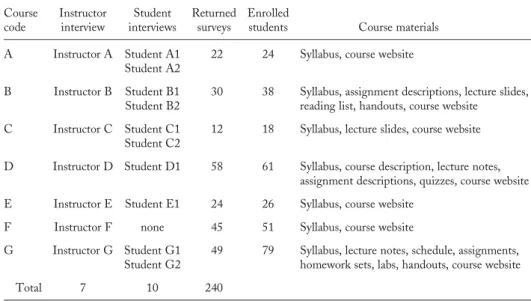
We collected course materials for seven courses, completed seven instructor interviews and ten student interviews, and collected survey data from 240 students (shown in Table 1). In Courses D and E, we were able to recruit only one student from each to interview. In Course F, we did not complete student interviews at the request of the instructor. All stu-dents present on the day we gave the survey agreed to participate.
Data Analysis
For each course, the instructor and student interviews, open-ended student surveys, and course materials were grouped together for analysis. The grouping method treated all of the materials for each course as a collection to provide a more complete understanding of the goals of the course, instructional methods, and assessments. The data triangulation provided a way to establish validity by analyzing the research question from multiple perspectives as well as providing the means to uncover deep meaning in the data (Patton, 2002).
We used a deductive coding approach, where the four thematic categories (see Defining Creativity above) were pre-identified (Fereday & Muir-Cochrane, 2006) These four catego-ries were selected for the analysis on the basis of evidence that training programs focusing on cognitive skills prove successful at improving creativity (Scott et al., 2004). We did not
include other categories from the Treffinger framework that described biographical (self-descriptive) interests and personality traits such as tenacity and work ethic (Treffinger et al., 2002). We omitted these categories because they are static individual difference measures that do not change much over one’s lifetime (Roberts, Walton, & Viechtbauer, 2006), and so are unlikely to be affected by a semester-long course. The resulting coding scheme is shown in Table 2 with working definitions of the categories.
To organize our course analysis, we identified three separate components of courses using the backward design framework (Wiggins & McTighe, 2005). This framework breaks down course design into three components: desired results, learning plan, and assessment evidence. Wiggins and McTighe (2005) proposed that these three components should be aligned so that desired results are clearly stated, assessments are based on evidence of obtaining the desired results, and then a learning plan is constructed to support students in achieving the desired results (cf. Biggs, 2003). For each of the courses in the study, we assessed each of the creativity indicators as to whether it was included in all three of these course compo-nents: as a learning goal, practiced or discussed in instruction, and included in assessments.
A team of independent raters separately coded the data after completing a training sequence in which they read Treffinger et al. (2002), practiced coding one case of data, and compared and discussed this practice coding with the team of coders. A rater first reviewed the data collected for each course and then coded according to the 18 separate indicators in Treffinger et al.’s (2002) four major categories as well as the three components of the design framework (Wiggins & McTighe, 2005). Then, a second rater reviewed the raw data and then the first rater’s coding to identify any gaps or discrepancies, and kept track of any changes to the original coding. Once raters completed coding, they discussed disagreements to reach consensus. Finally, a third rater reviewed all of the coded data for the seven courses to confirm consistency in the raters’ interpretation of the coding scheme. This procedure using two independent coders and a final third coder supported dependability of our findings. Table 1Data Collected for Each Course
Course code Instructor interview Student interviews Returned surveys Enrolled
students Course materials
A Instructor A Student A1 22 24 Syllabus, course website Student A2
B Instructor B Student B1 Student B2
30 38 Syllabus, assignment descriptions, lecture slides, reading list, handouts, course website
C Instructor C Student C1 Student C2
12 18 Syllabus, lecture slides, course website
D Instructor D Student D1 58 61 Syllabus, course description, lecture notes, assignment descriptions, quizzes, course website E Instructor E Student E1 24 26 Syllabus, course website
F Instructor F none 45 51 Syllabus, course website
G Instructor G Student G1 Student G2
49 79 Syllabus, lecture notes, schedule, assignments, homework sets, labs, handouts, course website
Findings
In the following section, we discuss the data as a collection and provide specific examples of the evidence collected within each category. Table 3 provides a summary of our findings, with each course mapped by evidence for the Treffinger et al. (2002) creativity indicators and divided into the three course components of the backward design framework (Wiggins & McTighe, 2005). The letters A through G represent the courses, and “none” indicates there was no evidence in any of the classes for the coding combination.
This analysis revealed that the engineering courses focused on convergent creative skills (Digging Deeper into Ideas), evident in the desired results, learning plans, and assessment evidence for these skills. Engineering curricula are especially strong in analytical skills; thus, it was not surprising that analysis, redefinition (iteration), and evaluation were cornerstones for the courses in our study. For example, in Course A, the value of redefinition (iteration) was clearly articulated, as evident in the course syllabus, student interviews and surveys, and instructor interview. The desired result was that students practice this process of redefinition (iteration) and become aware of its importance in problem solving and design. The learning Table 2Coding Scheme for
Cognitive Aspects of Creativity
Indicator Working definition
Generating Ideas
Fluency Generating a large number of ideas in response to an open-ended question Flexibility Shifting the direction of one’s thinking or changing one’s point of view Originality Generating new and unusual ideas
Elaboration Adding details and expanding ideas
Metaphorical thinking Using comparison or analogy to make new connections Digging Deeper into Ideas
Analyzing Breaking down an idea into components to understand them Synthesizing Combining two different themes within an idea
Reorganizing or redefining Revisiting information to change its form Evaluating Appraising the potential value of ideas Seeing relationships Drawing connections between different ideas Desiring to resolve
ambiguity/bringing order to disorder
Organizing disparate components
Openness and Courage to Explore Ideas
Problem sensitivity Seeking out and identifying problems
Aesthetic sensitivity Attempting to make pleasing formulations of ideas Fantasy and imagination Considering “unreal” or “impossible” ideas Tolerance for ambiguity Allowing openness to uncertainty within a problem Intuition Drawing upon an internalized understanding Integration of dichotomies
or opposites
Incorporating opposing ideas
Listening to One’s Inner Voice
Metacognition Combining (a) reflecting on the cognitive processes underway (introspection) and (b) awareness of creativity
plans involved multiple rounds of building representations, testing ideas, presenting ideas, and gathering feedback, and also included post-presentation discussions on how the pro-posed outcome changed over time and what next steps could be taken to make it better. Stu-dents were assessed for their level of experimentation, thorough investigation of design ideas, and level of iteration at the end of the semester through the use of a rubric.
Another trend was the presence of desired results and learning plans related to divergent thinking (Generating Ideas), most often related to fluency, flexibility, and originality. In a few cases, course structures also included assessment evidence related to divergent thinking. For example, Course B had clearly articulated desired results related to idea fluency. Fluency
Table 3Summary of Course Alignment with Treffinger et al. (2002) Framework
Creativity operator Desired results Learning plan Assessment evidence Generating Ideas Fluency A, B, C A, B, C, E B, C Flexibility A, B, C, E, F, G A, B, E, F none Originality B, C, D, E D, E D
Elaboration none C, D none
Metaphorical thinking G F none
Digging Deeper Into Ideas
Analyzing A, B, C, D, E, F, G B, C, F, G A, B, C, D, E, F, G Synthesizing C, E, G D, E A Reorganizing or redefining A, B, C, D, E, F, G A, B, C, D, E, F, G A, B, C, D, E, F Evaluating A, C, F A, B, C, D, E, F A, B, C, D, E, F, G
Seeing relationships none none none
Desiring to resolve ambiguity/bringing order to disorder
A, C C none
Openness and Courage to Explore Ideas Problem sensitivity A, B, C, D,
E, F, G
A, B, C, D, E, F
none
Aesthetic sensitivity D none A
Fantasy and imagination A, C A, E, G none Tolerance for ambiguity A, C, D, F A, C, F none
Intuition C, F none none
Integration of dichotomies or opposites
none none none
Listening to One’s Inner Voice
Metacognition A, B, E A, B, C,
E, F
was discussed by the instructor, evident in the course materials, and affirmed by the students in interviews and the open-ended survey. The learning plan related to fluency involved mul-tiple exercises, where the instructor would give students a time limit and a quantity goal for idea generation. Students were assessed through regular reports in which they listed a certain number of ideas in order to receive full credit.
Problem sensitivity, in Openness and Courage to Explore Ideas, was also prominent in the desired results and learning plans. For example, in Course C, the instructor had a clear, desired result for students to understand the problem context. The learning plan required students to interview potential customers in order to more deeply probe and shape the con-straints of their problem. This desired result was also evident in Course E, whose learning plan included regularly bringing in stakeholders to work with students on identifying an existing problem. While there was some evidence regarding tolerance for ambiguity, it and other creative indices were observed less frequently within this category.
The final category, Listening to One’s Inner Voice, was not often expressed as a desired result, but five of the courses included occasions for students to reflect on their processes as part of the learning plans. In Course F, the instructor devoted time in multiple class sessions for students to investigate personal biases and their effect on the choices made in problem-solving approaches, data collection, and interpretation of findings. The activity helped stu-dents evaluate their decision-making processes, and become more aware of their approaches and how they made decisions.
These findings, though, also show that many categories of creative skills were not addressed by any of the courses, and for many of the creative skills, the desired results, learning plans, and assessment evidence did not align. For example, the convergent skill of synthesizing was a goal for three courses; yet, only one of the three courses which cited synthesizing as a goal included instruction in it, while another included instruction in it without a clear learning goal, and a third included assessment related to the ability to synthesize, yet did not state a learning goal or include instruction focused on synthesis. These omissions are discussed further in the Discussion section. The following sections provide more detail about how instructors stated goals, provided lessons and activities, and assessed student learning related to creative skills. Multiple examples are presented to demonstrate the various ways instructors incorpo-rated creative skills in their courses, and to suggest ways to use these practices in other courses. The appendix presents additional examples of comments observed within each category in Table 2. Instances of categories that lacked data support are discussed in a later section.
Generating Ideas
The generation of ideas is often considered an example of divergent thinking, where differ-ent answers are generated for a given problem (Guilford, 1967). In the engineering courses in our study, students were primarily generating ideas for solutions, but in two of the courses, idea generation also took place as students were exploring possible problems for which they would later generate solutions. Thus, we considered both generating ideas for solutions and generating ideas for problems in our analysis.
Desired results All of the instructors expressed learning goals related to at least one aspect of idea generation in their courses. In the design courses, instructors often focused on the desired result of students’ ability to suggest multiple solutions for design. Only two instructors explicitly articulated desired results related to flexibility in generating ideas. Of these two, one instructor explained that he wanted students to learn to “let go” of previous bias and consider problems in new ways:
Coming up with. . .optimal solutions that, not too constrained by bias, previous bias. (Instructor interview, Course C)
Likewise, the other instructor taught a technical disciplinary engineering course with rela-tively structured content. He described flexibility as a desired result in that he wanted students to be able to apply knowledge from other domains to their understanding of the course mate-rial. Only one instructor described the desired result of metaphorical thinking, emphasizing drawing connections between the concepts and relationships within a specific engineering discipline to similar relationships in other fields:
Whenever they see a circuit, I’d like to have them see the underlying input/output rela-tionships between what signals might be doing before they go through that circuit and what they’re going to be doing when they come out. I would then also like them to be able to see that same input/output relationship could be explained using mechanical components, using chemical components, using economic components, using social psych components, using whatever. (Instructor interview, Course G)
Learning plan In all of the courses except Course G, there was evidence of learning plans related to Generating Ideas. The indicator fluency was often observed in strategies to help students with the flow of ideas. Course E placed a heavy emphasis on fluency and used class time and structured assignments to help students generate multiple possibilities. The instructor implemented traditional brainstorming methods, but also provided students with a variety of information-gathering experiences (with clients, doing research, etc.) to seed additional idea generation:
I’ve been a part of several brainstorming sessions. So with the class I’m taking, we had to do that about eight times.. . .So a clinician, a doctor, would come in and tell us a problem that he had, and we’d brainstorm solutions to his problem. (Student inter-view, Course E)
In other classes, information-gathering experiences took place, but were rarely paired with additional activities, instruction, or assignments to facilitate using that knowledge to increase fluency. Some instructors encouraged students to consider the problem from differ-ent perspectives. For example, in Course A, the instructor stated that flexibility was facili-tated by using reverse engineering both to initiate a solution to a problem and to find a new problem. In one multidisciplinary design class, Course B, the instructor had students work through classic problems designed to “drive them crazy because the answer should be obvious.” The students then discovered why their conventional approaches may be limiting by “defining the problem either differently or too narrowly.” Adding differing perspectives by working in teams with students from other disciplines was another method used in two courses. While many instructors listed originality as a desired result, there was rarely any evi-dence of explicit instruction associated with these stated goals. Most frequently, instructors relied upon learning plans that included open-ended problems as the method for generating original solutions. One instructor described such an open-ended approach:
Allow students to do whatever they wish. Provide guidelines but make them fairly broad and general. (Instructor interview, Course D)
Evidence of elaboration during idea generation (such as elaborating on possible problems) was seen in Courses C and D. Learning plans focused on collecting observational data
related to the problems under consideration, as well as talking with stakeholders. Metaphori-cal thinking was evident in the learning plan of only one course. Using comparison or analo-gies to make connections and formulate new ideas can be a very powerful creative tool, although only two instructors alluded to the use of analogies as a tool in their classrooms.
Assessment evidence Although all instructors expressed desired results and most de-scribed learning plans related to idea generation, there was very little use of assessment evi-dence in the courses. In two of the courses (Courses B and C), it was specified on assignments that students should include a specific number of concept ideas to receive full points. But in all other classes, none of the materials indicated that instructors used any method to assess the fluency of student ideas. Only one class (Course D) explicitly included assessment evidence of students’ originality as points contributing to grades, where students’ final project received one to five points (out of 100) on the basis of the originality of the design. In the other classes, instructors often gave feedback on students’ ideas; they presum-ably were influenced by how original they thought students’ ideas were. Assessment evidence of originality was not explicitly present in any of the other assignment documents or data collected about the courses. Additional data for the indicators in the Generating Ideas cate-gory are included in the appendix.
Digging Deeper into Ideas
Convergent thinking involves identifying solutions that fit many constraints at once (e.g., Brophy, 2006; Cropley, 2006; Finke et al., 1992; Guilford, 1967). A traditional view of engi-neering expertise would include a heavy emphasis on these analytical skills. While instructors and students explicitly linked divergent thinking activities to the development of creative skills, rarely did they link convergent indicators to creativity. Yet convergent thinking skills are an important aspect of the creative process, and there was a great deal of evidence for convergent skill building in the courses.
Desired results Analyzing was a key desired result for each of the courses in our study. Analysis, such as breaking a problem into subparts and determining relationships among them, was apparent in all of the courses. Each had desired results aimed at supporting stu-dents’ ability to think deeply about the problems, contexts, and ideas, and how data could be collected to inform their approach to addressing a problem. Desired results related to analy-sis also included developing students’ ability to determine which aspects of problems were important and their ability to compare ideas they had generated to existing products in the marketplace. Likewise, many of the courses included desired results for students to synthe-size ideas, information, and perspectives. Reorganizing or redefining was evident as a learn-ing goal, specified as iteration, or repeated attempts to solve a problem.
Evaluating was another convergent creativity indicator that played a central role in the courses in our study. Desired results for students’ skills in evaluation came in multiple forms, including the ability to develop tests to evaluate the effectiveness of a product, material, or function; identifying gaps and strengths in one’s own ideas or other existing ideas; and build-ing a case to prove to someone else that an idea is worth the investment. Resolvbuild-ing ambigu-ity was only rarely reflected in desired results across courses.
Learning plans Instructors in all of the courses described learning plans that allowed stu-dents to engage in activities where they developed and practiced the convergent skills related to Digging Deeper into Ideas. In many of the courses, students presented their ideas along with an analysis of why they chose the idea that they did, and why that idea was different from others already in existence. A key component for many of the courses was analyzing data collected
through self-designed experiments to test ideas. For one of the non-design classes, this focus also meant that much of the class time was spent practicing and discussing analysis.
Only two of the courses (D and E) contained evidence of explicit learning plans related to synthesis. In one course, the instructor had project teams share interesting features of their designs, and other teams were then supposed to synthesize some of these aspects with their own projects:
We’ll have a “how’d they do that” session. And a “how they do that session” is that you saw on somebody else’s [project] that they had blinking blue lights in the back-ground.. . .So that group will stand up and say, you know, “how we did the blinking blue lights is. . .blah.” And then they explain the process, and it’s, okay, we’ll incorpo-rate that; we’ll put a little bit of a different twist on it. You know, we’ll have blinking red lights instead of blue lights, but we’re going to use that methodology somehow. (Instructor interview, Course D)
In the other course, synthesis had a significant role because the instructor asked students to merge characteristics of multiple ideas together. As a learning plan, the instructor had student teams submit their ideas on a wiki so everyone could see the ideas. They then spent time in class synthesizing those ideas, guided by the instructor.
Many courses also included learning plans related to reorganizing or redefining, in terms of iteration and redefining ideas, even in the two nondesign courses. Check-in points, feedback sessions, critique, and prototyping were common in the learning plans related to iteration. Many types of learning plans had students engage in evaluation in multiple contexts, such as gaining the ability to develop metrics and use the outcomes to evaluate choices and then make decisions, building prototypes to evaluate if targeted functions were successful, evaluating their own ideas and those of their classmates, and designing reviews. Students engaged in evaluation activities that required them to specify the value of an idea by generating evidence to show that an idea would be a better competitor than other potential ideas or existing products:
The course was also. . . coming up with a model to prove that your product would beat competitors so . . . how do you figure out analytically whether your product is better than another product? It essentially comes down to weights of different attrib-utes. (Student interview, Course B)
Only one course specified an explicit learning plan to resolve ambiguity in problem solving. Assessment evidence In the design courses, assessing students’ analysis skills was often tied to their own evaluation of the feasibility of their designs and justification of choices. Written reports and oral presentations were required, but there were no explicit evaluations in the grading rubrics for these analytical reports. In the two nondesign courses, homework problems and laboratory reports played a similar role.
Only one course included assessment evidence related to synthesis. In Course A, a project-based course, an instructor specifically noted students would be assessed for their projects’ form as it relates to its function:
Design Criteria: How was your team able to synthesize the form, function and behav-ior of the surface? (Syllabus, Course A)
Synthesis was an expressed criterion for assessment, but how success in synthesis was equated with specific scores was unclear from the materials.
Assessment evidence of students’ ability to reorganize and refine (iterate) occurred through periodic reports or presentations of design ideas. Students were expected to present an updated version of their idea based on additional information gathered, feedback received, and data collected from tests of their prototypes. Grading rubrics for project milestones listed aspects of iteration as components that composed the final grade. In many classes, project requirements specified that students build multiple prototypes during the course.
Assessment evidence of students’ ability toevaluateideas was implied in assignments in all of the courses that required students to evaluate their own and others’ work. However, there was no mention of specific assessment criteria for the content of students’ evaluation. Additional data for the indicators in the Digging Deeper into Ideas category are given in the appendix.
Openness and Courage to Explore Ideas
This category includes characteristics related to exploration of problems and solutions. Learning to go beyond the immediate impression to investigate conflicting ideas, continuing through repeated attempts, and responding to failure are important in creative endeavors (Treffinger et al., 2002).
Desired results All of the instructors expressed desired results for students related to at least one skill in Openness and Courage to Explore Ideas. The notion of problem sensitivity is related to “problem finding,” where one identifies specific problems to solve (Getzels, 1975, p. 13). This was mentioned as a goal in all the courses studied. Some instructors expressed a desire for their students to develop problem identification strategies as a starting point for their design work, while others specifically emphasized the ability to identify valua-ble provalua-blems, not necessarily within expected constraints:
The thing is, you know, we say, “well okay, that’s what you can work on,” and then there’s the high-value problem. So what’s the highest value problem for your team? And that might not be the most complex thing. It might not be the most beneficial thing. (Instructor interview, Course A)
Very few engineering instructors mentioned desired results related to aesthetic sensitivity. In one computer game design course, the instructor explained students had the option of adding art to their projects; however, he did not explicitly identify aesthetic sensitivity as a goal, or as something he actively tried to facilitate through instruction. Similarly, fantasy and imagination may seem, on the surface, far from the realm of engineering, yet creativity may require identifying possibilities that are currently impossible or not yet experienced. In sev-eral classes, instructors specifically expressed desired results in terms of students’ ability to play and explore things that interested them, regardless of practical considerations.
Many of the engineering instructors expressed desired results of students’ development of tol-erance for ambiguity, or comfort with exploring new, ill-defined ideas as a result of their experi-ences. Several engineering instructors explained that, unlike other engineering courses in which answers are known or knowable, it was their goal to help students learn by exploring topics where little was known or defined. Several instructors acknowledged that students are often at least ini-tially uncomfortable with exploring the unknown. One instructor asserted that promoting dis-comfort was his goal, and that he saw disdis-comfort as a sign of students’ growth in creativity:
I think I want them to feel uncomfortable, and if they are feeling very uncomfortable, it’s because they are doing something new and, I think, exploring new areas that they would not do outside this course. (Instructor interview, Course C)
Intuition is an internal sense of direction based on accumulated experience that is often difficult to describe in rational terms (Klein, 1998, 2003). Knowing when to follow intuition is likely a difficult skill to teach; however, several instructors described their desired result in terms of developing their students’ intuition through knowledge of the field and helping stu-dents internalize their understanding of how to approach challenges.
Learning plans All of the courses included learning plans meant to develop students’ skills related to Openness and Courage to Explore Ideas. There were many learning plans intended to help students gain greater problem sensitivity. In some design courses, instructors introduced students to potential stakeholders so they could learn more about their target users. The cus-tomer orientation surfaced frequently in interviews with instructors:
I do in a very organized way, using this axiomatic design process. That first goal for the students is to . . . find out what the potential customers are, who they are. And then to interview them to try to find out what the project is about and then have a formal list of requirements, and then one stage initially is just a more qualitative list of requirements, and then to quantify those, and then go into what are the functions that they have to implement to satisfy the customers. (Instructor interview, Course C) Several courses also included learning plans related to students’ capacity for fantasy and imagination. Instructors reported addressing capacity for imagination in their learning plans through encouraging students to explore topics that interested them, and by doing what they could to facilitate exploration:
So by creating the opportunity, funding the projects, you, know, get leverage in them, access to the facilities, you know? This being a special type of experience and there’s also a skunk works phenomena, you know. Then I think it helps them invest to a cer-tain point. (Instructor interview, Course A)
Learning plans focused on tolerance for ambiguity presented students with opportunities to explore undefined problems, or problems where the solution was not previously determined.
Assessment evidence There was very little explicit assessment evidence related to stu-dents’ exploring new concepts and ideas in the courses studied. One course (Course A) included an assessment of aesthetic success in the final product. Additional data for the indi-cators in the Openness and Courage to Explore Ideas category are included in the appendix.
Listening to One’s Inner Voice
The ability to reflect on the course of one’s efforts and make corrections or consider new steps is a key to developing creative skills. The characteristics that compose the Listening to One’s Inner Voice category (Treffinger et al., 2002) were combined in the analysis to include both reflection and awareness of one’s own creative process. Metacognition is defined as “reflective thinking” to capture this self-knowledge of cognitive processes (Flavell, 1979, p. 908).
Desired results Although many instructors described learning plans intended to facilitate students’ metacognition about their work and their own creative processes, very few expressed desired results in these terms. One instructor described his intentional approach to teaching students about creativity as a way to make students conscious of their own creative process:
I have a main creativity lecture mostly to get them to think about it in a conscious way. (Instructor interview, Course B)
Learning plans Instruction and course activities related to metacognition varied greatly. In one course, the instructor felt that simply making it known that a creative outcome was required would force students to explore their own creative abilities. In several design courses, learning plans on metacognition involved written assignments such as course blogs or a paper requiring students to reflect on their work, design approaches, and interests. One instructor asked students to identify their own biases and how they may affect their work:
We do draw comparisons between whether something is potentially easier to do or something that’s potentially more robust or more accurate. We do. . .spend a lot of time thinking about where our bias is in the sort of measurements that we actually do generate. (Instructor interview, Course F)
In another course, the instructor had students perform self-awareness exercises and take a behavioral assessment in order to get a better understanding of their own interests and work styles. The instructor identified these reflective exercises as a way to facilitate better team-work, which is frequently a critical part of the creative design process in engineering:
Midway through the year, I do a self-awareness exercise which is basically using the DiSC analysis, which is a behavioral assessment, and the idea is, the DiSC assessment basically tells you a little bit about who you are and your behavioral preferences when you are working in teams. [. . .] The idea is, if you understand what your behavioral lan-guage is, and you understand that of your partner or your teammates, then you might be more likely to communicate with them better. (Instructor interview, Course E) Assessment evidence Although there was a significant amount of student work related to metacognition, little assessment evidence was evident in the data. In two courses, students were required to keep blogs, and in one, the instructor explained that one grading criterion was reflection. Otherwise, there was no explicit mention of assessment as it related to meta-cognition in the data. Additional data for the indicators in the Listening to One’s Inner Voice category are included in the appendix.
Discussion
The detailed analysis in the previous section described observations about creative pedagogy as reflected in these existing engineering courses. In this section, we turn to the gaps in the categories from the analysis where no evidence was observed. Then, we discuss ways to increase opportunities for the development of students’ creative skills in engineering. Finally, we address the study’s limitations and directions for future work.
What Is Missing in the Findings
Our findings revealed that the pedagogy for many of the courses included convergent think-ing skills such as analyzthink-ing, reorganizthink-ing, and evaluatthink-ing. The results also highlight some gaps in creative skills instruction in engineering courses. Of course, other courses not included in our sample may address these gaps; however, because the instructors of the sampled courses cited fostering creativity as a goal, the absence of data in some areas of crea-tive skills is informacrea-tive. At the least, the gaps suggest areas where engineering curricula could be further developed.
While convergent skills were most often addressed in all of the courses, one Digging Deeper into Ideas skill, seeing relationships, was not evident in the desired results, learning
plan, or assessment evidence in any of the courses. In the Generating Ideas category, the processes of elaboration and metaphorical thinking were rarely emphasized. Many skills in the category Openness and Courage to Explore Ideas were also not addressed across the courses; for instance, developing intuition and a tolerance for ambiguity are important skills within creative activities, because they most often involve risk taking and decision making under uncertainty. Arguably, aesthetic sensitivity is important for the tangible artifacts cre-ated by engineers, and its rare appearance in the data suggests more awareness and integra-tion of aesthetics along with technical engineering content is possible.
Another gap across the dataset was the lack of assessments offered for many of the crea-tive skills, including divergent thinking skills in most of the courses, and also for the skills in the Openness and Courage to Explore Ideas category. For example, originality was rarely explicitly assessed in any of the courses. This result is especially interesting because originali-ty is a critical component of most operational definitions of creativioriginali-ty. Four instructors emphasized the idea of originality in their desired results, but only two of their courses had specific learning plans related to it, and only one course included an assessment.
The analysis also revealed a lack of alignment in the desired results, learning plans, and assessment evidence for many of the creative skills (Wiggins & McTighe, 2005). Many times, there was clear evidence for one or two of the course building blocks from the back-ward design framework but no evidence of the third building block. While most often the missing piece was assessment, there were cases where no alignment occurred because of a lack of a clear learning goal or learning plan to address the creativity skill.
Implications for Pedagogy
Instructors could better support their students’ development of creative skills by communicat-ing clear learncommunicat-ing goals in their courses. As best practices in instructional design would suggest (Wiggins & McTighe, 2005), these specific creative goals should be carefully aligned with learning plans and appropriate assessments to provide a more complete learning experience.
Also, instructors could incorporate more assessments of specific creative skills and provide feedback to their students on improving these skills. Assessing creativity is not straightfor-ward, but by breaking creativity into its component skills (Treffinger et al., 2002), assess-ments can be developed or adapted from existing assessassess-ments (e.g., Charyton & Merril, 2009; Guildford, 1959; Kaufman, Plucker, & Baer, 2008; O’Quin & Besemer, 1989; Shah, Vargas-Hernandez, & Smith, 2003; Torrance, 1974, 1981). For example, rubrics could be developed to evaluate students’ levels of openness, actions taken to explore ideas, and depth of reflection. Because assessments play an important role in students’ motivation to learn, omitting creative skill assessments from courses may limit the effect of instruction that does occur. Students may interpret a lack of assessment as an indicator of its lack of importance. Omitting assessment also limits instructors by preventing them from recognizing areas where students could benefit from additional support and development. One direction for assessment is to address specific learning about the creative process itself, rather than solely focusing on the specific project outcome. Students’ explicit knowledge of cognitive indicators of creativity and self-awareness of the use of creative skills can be assessed, and would help to focus students’ attention on these learning goals.
In addition to incorporating assessments of specific creativity indicators, this study revealed opportunities for improvements in instruction related to creative skills. In practice, instructors may rely on open-ended projects to provide opportunities for creativity. While project-based learning has been shown to be an effective pedagogy to support student engagement (Prince,
2004; Smith, Sheppard, Johnson, & Johnson, 2005), without explicit course design elements related to creative skills within these projects, this project-based approach may not actually improve creativity. In other words, an opportunity to be creative through an open-ended pro-ject is not equivalent to careful planning of specific desired results, learning plans, and assess-ment evidence of the creative skills to be developed.
Incorporating occasions for the development of students’ creative skills throughout engi-neering curricula does not require an instructor to incorporate an open-ended project. Instead, an instructor can focus on one or more specific creative skill (guided by Treffinger et al.’s framework) and connect the goals, instruction, and assessments within the existing course material. Felder (1985, 1987, 1988) described multiple ways he incorporated creative skills in the technical engineering courses he taught, for example, by including a homework question in which students had to suggest multiple ways a technical problem could be approached, thus providing practice and assessment in divergent thinking skills. Crismond and Adams’s (2012) work provides multiple examples of classroom instruction to support both divergent and convergent thinking throughout design processes. Fogler and LeBlanc’s (2013) textbook also describes many strategies to support students in creative problem solving.
We suggest additional ways to incorporate creative skill development in engineering courses. Generating Ideas More attention could be given to instruction on originality, elabora-tion, and metaphorical thinking. Instruction related to originality could make use of practice with various ideation tools, e.g., Design Heuristics (Daly, Yilmaz, Christian, Seifert, & Gonzalez, 2012a, 2012b; Design Heuristics, 2012; Yilmaz & Seifert, 2011), morphological analysis (Allen, 1962; Zwicky, 1969), and SCAMPER (Eberle, 1995; Osborn, 1953). Instruction might include having students rate the originality of existing approaches or arti-facts. An approach in art history is to examine a set of well-known exemplars to provide stu-dents with a sense of the scope of the field (Efland, 1990). Additionally, stustu-dents could compare their own ideas to a pool of ideas gathered from the class as a whole; or they could be asked to generate ideas over a period of time and compare the originality of their early ideas to their later ideas. These methods could help students develop an awareness of the diversity of possible solutions. To develop elaboration skills, instructors could have students engage in a group ideation session where each person in the group adds an additional detail to a target concept. To support metaphorical thinking, Smith and Linsey (2011) propose ways to help students use analogies to specify the functions of a product (e.g., a design arti-fact) or process (e.g., a way to measure something, a procedure for solving a complex prob-lem), and re-represent these functions with similar words. Such methods help students learn to create analogies back to their original task. Developing metaphorical thinking may require specific practice in the classroom with multiple examples (McKeogh et al., 1985).
Digging Deeper into Ideas Synthesizing and seeing relationships were two key skills not explicitly taught or practiced. An improvement of these skills through instruction could include having students compare and contrast multiple concepts, identify the best features of multiple ideas, and suggest ways to use these best features to develop new and improved ideas, rather than selecting just one idea with which to move forward. Performing an analysis of a range of exemplars, such as types of products, would allow students to see relationships across categories.
Openness to Explore Ideas Instruction related to aesthetic sensitivity could include giv-ing examples of product aesthetics and data about their impact on adoption and marketabili-ty. Students could also be asked to gather aesthetic data on their own prototypes. Instruction on intuition could include giving students exposure to a large body of existing approaches,
products, and processes, thus helping students develop an implicit understanding of the vari-ety of possibilities within a given domain. The accumulation of a corpus of past solutions could serve as a basis for intuition on future projects.
Listening to One’s Inner Voice A practice common in artistic and literary fields is to keep a journal record of thinking as a project unfolds. Writing exercises appeared to be less common in engineering classes, yet may serve as a method to encourage reflection about the creative process. Another method is to build in specific moments of reflection into the proj-ect process, when the group might meet specifically to discuss what has occurred during the development process. Alternatively, instructors might propose that students try a task by approaching it in different ways and reflecting on how those approaches affected their out-comes (Daly, Adams, & Bodner, 2012). By focusing attention on choices made and the work-flow during a project, the opportunity to make alternative choices in the future, or to recognize the need to do so, may become more apparent to students.
All of these learning activities provide an opportunity for instructors to use best practices in engineering education (e.g., Prince, 2004; Smith et al., 2005). For example, having stu-dents take five minutes in class to see how many different ideas they can generate for solving a problem provides an occasion for students to engage in active learning. Asking students to compare their approaches with each other makes use of group work. By considering learning activities to address a specific creative skill, instructors may more clearly see opportunities to build these into their course sessions and to facilitate student engagement.
Implications of this research include the provision of a common ground for definitions of creative skills along with which skills engineering programs should aim to develop in students. Perhaps some of the inconsistency in how courses implement training in creativity follows from instructors who have different ideas of what creativity means and how it can be assessed. For some engineering educators, creativity may remain an implicit process observed within an outcome, and not a cognitive skill that can be developed. Treffinger et al.’s (2002) framework is a starting place for discussions on the role of creativity instruction in engineering courses.
While a single course may not be able to incorporate all of the creative skills, or even all four categories of skills in this analysis, more careful program-level planning could add crea-tive skills over time. By including goals, instruction, and assessment components for creacrea-tive skills in courses, creative skills can be improved. As with all cognitive skills, considerable deliberate and intentional practice in creative skills may be required for students to reach the highest levels of expertise (Ericsson, Krampe, & Tesch-R€omer, 1993).
Study Limitations and FutureWork
We aimed to identify evidence of creativity pedagogy in a sample of engineering courses identi-fied as exemplars of creativity education within the college. The study was not intended to evalu-ate the quality of the courses nor to assess students’ creative outcomes as a result of taking the courses. Each course had a different teaching approach, but the collection of courses allowed some conclusions about the opportunities they offered for students’ development of creative skills. The present study did not, though, examine the effect of different forms of pedagogical approaches on students’ actual development of creative skills.
The structure provided by the backward design model (Wiggins & McTighe, 2005) could be a useful tool for designing creative skill pedagogies that align desired results, learning plans, and assessment evidence. For many of the creative skills in the study, instructors reported only one or two of the three components of course design, and careful attention to including all three components for each skill could have a significant positive effect on
students’ depth of learning. Further work is needed to identify specifically how to support educators in improving the interrelationships between these three course building blocks.
Evidence in our study was limited to course materials, interviews with instructors and stu-dents, and a written survey of students; as a consequence, these courses may include instruc-tion on creative skills that were not captured in our findings. Other courses in engineering not in our sample may include alternative methods to support creative skill development. Our systematic description of these courses provides a substantial amount of evidence, and allows some important conclusions about ways to improve creative skills in engineering education.
For future work, we hope to use this case study as a foundation for a broader understanding of creative skills instruction. We suggest that examining pedagogy across disciplines may identify alternative methods that may prove practical in the engineering classroom and other settings.
Conclusions
The case study presented here has demonstrated the existence and nature of pedagogical efforts to develop students’ creative skills within engineering courses. Our findings indicate that aspects of creative skill development are often missing from even exemplary engineering courses, and suggest that other courses are also likely failing to provide opportunities for students to develop their creative skills. While convergent thinking was well represented in engineering courses, divergent thinking skills require the development of further instructional techniques. Another area of potential pedagogical development is encouraging students to become open to explor-ing, rather than solvexplor-ing, problems. Methods to encourage students to embrace ambiguity, avoid premature closure, and increase reflection may greatly improve their creative skills. Developing assessments that will motivate students to improve their creative skills and increase awareness of their personal creative process is a key need in engineering pedagogy.
Acknowledgments
We are thankful to the following research assistants who helped with data analysis on this project: Amber Bellazaire, Christopher Johnson, Katie Korinek, Carly Sheridan, Emily Williams, and Tyler Zimmerman. Sam Goodman assisted with the data collection efforts on the project. We are grateful for project funding provided by the Office of the Vice Provost for Research, the School of Education, the College of Literature, Science, and Arts, the Department of Psychology, and the College of Engineering. We also thank James Holloway, Marvin Parnes, Theresa Reid, Crisca Bierwert, and Aileen Huang-Saad for their help in ini-tiating this project.
References
Abercrombie, N., Hill, S., Turner, B. S., & Erofeev, S. A. (1984).The Penguin dictionary of sociology. Harmondsworth, UK: Penguin.
Allen, M. (1962).Morphological creativity: The miracle of your hidden brain power. Englewood Cliffs, NJ: Prentice-Hall.
Altshuller, G. (1984).Creativity as an exact science. New York, NY: Gordon and Breach. Amabile, T. M. (1983).The social psychology of creativity. New York, NY: Springer-Verlag. Amabile, T. M. (1996).Creativity in context: Update to the social psychology of creativity.
Boul-der, CO: Westview Press.