
Calhoun: The NPS Institutional Archive
Faculty and Researcher Publications Faculty and Researcher Publications
2014
A construction of Boolean functions with
good cryptographic properties
Chung, Jong H.
Monterey, California: Naval Postgraduate School.
A construction of Boolean functions with good
cryptographic properties
Jong H. Chung1, Pantelimon St˘anic˘a1, Chik-How Tan2, and Qichun Wang2
1
Department of Applied Mathematics, Naval Postgraduate School, Monterey, CA 93943–5216, USA??
{jhchung,pstanica}@nps.edu
2 Temasek Laboratories, National University of Singapore, 117411, Singapore
{tslwq,tsltch}@nus.edu.sg
Abstract.
The two important qualities of a cipher is security and speed. Frequently, to satisfy the security of a Boolean function primitive, speed may be traded-off. In this paper we present a general construction that addresses both qualities. The idea of our construction is to manipulate a crypto-graphically strong base function and one of its affine equivalent functions, using concatenation and negation. We achieve security from the inher-ent qualities of the base function, which are preserved (or increased) and obtain speed by the simple Boolean operations. We present two applica-tions of the construction to demonstrate the flexibility and efficiency of the construction.
Keywords: Cryptographic Boolean functions, avalanche characteristics, re-siliency, algebraic immunity, nonlinearity, hidden weighted bit function.
MSC 2010:94C10, 94A60, 11T71
1
Introduction
A stream cipher typically employs at least one Linear Feedback Shift Register (LFSR) to generate a secret key stream. Due to the linear nature of LFSR, the raw bits from LFSRs can not be used to encrypt a message, since the encrypted message is vulnerable to linear cryptanalysis and other forms of attacks. There-fore, the stream cipher filters an LFSR or combines multiple LFSRs to generate stronger secret key stream bits, via a Boolean function as a nonlinear filter or combiner, respectively. Two key factors in designing cryptographic Boolean func-tions are security and speed. We achieve security by having good measures in as many cryptographic properties as possible for the Boolean function in a cipher, such as balancedness to resist statistical attacks, high nonlinearity to address linear cryptanalysis on block ciphers (or correlation attacks on stream ciphers), high algebraic degree against algebraic attacks (although, this is not sufficient), high correlation immunity and resilience to deal with correlation attacks, and
??
Current address for J.H. Chung: Department of Mathematical Sciences, United States Military Academy, West Point, NY
high algebraic immunity to resist (fast) algebraic attacks. Speed is another im-portant aspect in a cipher, since we desire fast encryption and decryption. For example, the Carlet-Feng function has good cryptographic properties, but it is not simple to generate, which may affect certain ciphers to underperform. Here we present some ideas to construct good cryptographic Boolean functions using a cryptographically strong base function, and three simple Boolean operations, namely concatenation, affine transformation, and negation. One of the significant benefits from this construction is the flexibility to choose an appropriate base function with known cryptographic properties (and we propose several such). This means we can customize our function, focusing on certain cryptographic properties. The other benefit is that our function is easy to construct due to the three previously mentioned basic operations.
The paper is organized as follows. In Section 2, the necessary background is established. We then present a construction of functions based on concate-nation, affine transformation, and negation in Section 3. In Section 4, we give applications for our construction.
2
Preliminaries
LetFn2 be then-dimensional vector space over the binary fieldF2, and Bn the set of alln-variable Boolean functions defined onFn
2.
Any Boolean functionf ∈ Bn can be uniquely represented as a multivariate polynomial inF2[x1, . . . , xn], called the algebraic normal form (ANF),
f(x1, . . . , xn) = X K⊆{1,2,...,n} aK Y k∈K xk.
The algebraic degree off, denoted by deg(f), is the number of variables in the highest order term with nonzero coefficients.
A Boolean function isaffineif there exists no term of degree strictly greater than 1 in the ANF and the set of all affine functions is denoted byAn. Letf ∈ Bn
andEbe any flat (that is, a coset of a vector subspace). If the restrictionf|E of
f toE is constant (respectively affine), thenEis called a constant (respectively affine) flat forf.
Let
1f ={x∈Fn2|f(x) = 1}, 0f ={x∈Fn2|f(x) = 0},
be the support of a Boolean functionf, respectively, its complement. The car-dinality of 1f is called theHamming weightoff, and will be denoted by wt(f).
TheHamming distancebetween two functionsf andgis the Hamming weight of
f+g, and will be denoted byd(f, g). We say that ann-variable Boolean function
f isbalanced ifwt(f) = 2n−1.
Letf ∈ Bn. Thenonlinearityoff is its distance from the set of alln-variable
affine functions, i.e.,
nl(f) = min
g∈An
The nonlinearity of ann-variable Boolean function is bounded above by 2n−1− 2n/2−1, and a function is said to bebent if it achieves this bound. Clearly, bent functions exist only for even n and it is known that the algebraic degree of a bent function is bounded above by n2 [13].
A Boolean functionf ∈ Bnis calledk-normal(respectivelyk-weakly-normal) if there exist ak-dimensional constant (respectively affine) flat forf. Ifk=dn
2e,
f is simply called anormal(respectivelyweakly-normal) function.
For anyf ∈Bn, a nonzero functiong ∈ Bn is called anannihilator off if
f g is null, and thealgebraic immunityoff, denoted byAI(f), is the minimum value ofdsuch thatf orf+ 1 admits an annihilator of degreed[25]. It is known that the algebraic immunity of ann-variable Boolean function is bounded above bydn
2e[12].
To resist algebraic attacks, a Boolean functionf should have a high algebraic immunity, which implies that the nonlinearity of f is also not very low, since, according to Lobanov’s bound [23]:
nl(f)≥2 AI(f)−2 X i=0 n−1 i .
To resist fast algebraic attacks, a high algebraic immunity is not sufficient. If we can findg of low degree andhof algebraic degree not much larger thann/2 such thatf g=h, thenf is considered to be weak against fast algebraic attacks [11, 17]. The higher order nonlinearities of functions with high (fast) algebraic immunity is also not very low [6, 26, 37].
TheWalsh transformof a given functionf ∈ Bnis the integer-valued function overFn 2 defined by Wf(u) = X x∈Fn 2 (−1)f(x)+u·x, where u ∈ Fn
2 and u·x is an inner product, for instance, u·x = u1x1+
u2x3+· · ·+unxn, where u = (u1, . . . , un),x = (x1, . . . , xn). A functionf is said to be resilient of orderr ifWf(u) = 0, for 0≤wt(u)≤r. It is easy to see that a Boolean functionf is balanced if and only if Wf(0) = 0. Moreover, the nonlinearity off can be determined by
nl(f) = 2n−1−1
2umax∈Fn2
|Wf(u)|.
The autocorrelation function off ∈ Bn is defined by
Cf(u) = X
x∈Fn
2
(−1)f(x)+f(x+u).
Also,f satisfies the strict avalanche criterion (SAC) ifCf(a) = 0, forwt(a) = 1.
We say thatf, g∈ Bn are affine equivalent if there exists ann×ninvertible
matrixAover the finite fieldF2and vectorsb,c∈Fn2 such thatg(x) =f(Ax+
b) +c·x. Iff is a Boolean function innvariables andHis a flat (a coset of some vector subspace) inFn
2, we letf|H to be the (restriction) functionf|H :H →F2 byf|H(x) =f(x), forx∈H.
3
The construction and its cryptographic properties
We next introduce a construction based on balanced functionsfi∈ Bn−2,i= 1,2 (||denotes concatenation).
Construction 1.For{i, j}={1,2}, we define the functions f onFn2:
f =fi||fj||fi||f¯j =xn−1xn+xn−1(fi+fj) +fi,
which is affine equivalent tofi||fj||fi||fj¯ ;fi||fj¯||fi||fj; ¯fi||fj||fi||fj;
f =fi||fj||fj||fi¯ =xn−1xn+xn−1(fi+fj) +xn(fi+fj) +fi, which is affine equivalent tofi||fj||f¯j||fi;fi||f¯j||fj||fi; ¯fi||fj||fj||fi.
We could have definedf =fi||fj||fi||¯ fj¯ =xn−1(fi+fj) +xn+fito also fulfil resiliency, but, unfortunately, a few of the other properties get slightly weaker. Some of the cryptographic properties, like algebraic immunity, or strict avalanche criterion are not (fully) affine invariants, so we prefer to list all concatenations for completeness, but we shall prove our results motivating whenever necessary, the relevant differences between the various classes of functions.
Variations of this construction have appeared in literature and some of their properties have been investigated. Most notably, bent, resiliency and the nor-mality properties of a concatenation (based upon bent functions) were looked at in [5, 8,?], and the normality of f1||f2||f2||f¯1 for arbitrary fi with i = 1,2
is addressed in [16] (see also [29] for other properties). We will also prove the normality result later on for all these classes. We mention also the paper of Pasalic [27], which introduces the notion ofhigh degree product(HDP) to mea-sure the ability of Boolean functions to be resistant to fast algebraic attacks:
f ∈ Bn satisfies theHDP of order n if for any non-annihilating function g of degree e with 1 ≤e ≤ dn/2e −1, the degree d= deg(gf) satisfiese+d≥ n. Unfortunately, the construction of [27] based upon a four function concatenation does not always produce almost optimalHDP functions, and this was observed in [39].
We next generalize a known lemma that relates the Walsh–Hadamard coef-ficients of g (in some dimension) to the Walsh–Hadamard coefficients of its 2r
(r≥1) concatenation parts. Lemma 1 If g(x, xn+1, . . . , xn+r) =f1(x)kf2(x)k · · · kf2r(x) = 2r k i=1 fi(x), then Wg(u, un+1, . . . , un+r) =Wf1(u) + (−1) un+1W f2(u) +· · ·+ (−1) un+1+···+un+rW f2r(u) = 2r X k=1 (−1)a(k)·u0Wfk(u),
where r ∈ N, a(k) is the kth lexicographically ordered vector in Fr2, and u0 = (un+1, . . . , un+r).
Proof. We show our result by induction onr. Ifr= 1, we compute Wg(u, un+1) = X (x,xn+1)∈Fn2+1 (−1)g(x,xn+1)+u·x+un+1xn+1 = X x∈Fn2 (−1)g1(x)+u·x+ (−1)un+1 X x∈Fn2 (−1)g2(x)+u·x =Wg1(u) + (−1)un+1Wg 2(u).
In general, assuming that Wg(u, un+1, . . . , un+r) =
2r P k=1 (−1)a(k)·u0Wfk(u), then forg00(x, xn+1, . . . , xn+r+1) =f1(x)kf2(x)k · · · kf2r+1(x) =gkg0= 2r+1 k i=1 fi(x), whereg0=f2r+1(x)kf2r+2(x)k · · · kf2r+1(x), we have Wg00(u, un+1, . . . , un+r+1) =Wg(u, un+1, . . . , un+r) + (−1)un+r+1Wg0(u, un+1, . . . , un+r) =Wf1(u) + (−1)un+1Wf 2(u) +· · ·+ (−1) un+1+···+un+r+1Wf 2r+1(u) = 2r+1 X k=1 (−1)a(k)·u0Wfk(u),
which shows our claim. ut
Lemma 2 (Proposition 1 of [7]) Let g1, g2 be two Boolean functions in the
variablesx1, . . . , xn withAI(g1) =d1,AI(g2) =d2, and letg= (1 +xn+1)g1+
xn+1g2∈ Bn+1. Then, the following hold:
1. Ifd16=d2, thenAI(g) = min{d1, d2}+ 1.
2. If d1 =d2(=:d), then d≤ AI(g)≤d+ 1. Further, AI(g) = dif and only
if there exists f1, f2 ∈ Bn of algebraic degrees d that either both annihilate
g1, g2, or both annihilate ¯g1,g¯2, anddeg(f1+f2)≤d−1.
For our next result, we let f1 ∈ Bn−2 in Construction 1 be any balanced function and f2(x) = f1(Ax+b), whereA is an (n−2) by (n−2) invertible matrix over the finite field F2 and bis an (n−2) dimensional vector overF2. Clearly, f1 and f2 are affine equivalent, deg(f1) = deg(f2), AI(f1) = AI(f2) andnl(f1) =nl(f2).
Theorem 3 Let f be given by Construction 1, with f1, f2 nonconstant and
affine equivalent. Then f is balanced, deg(f) = max{deg(f1),deg(f1+f2) + 1}, AI(f1) + 2≥AI(f) ≥ min{AI(f1||f2),AI(f1||f¯2)} ≥ AI(f1). Moreover,
nl(f) = 2n−2+ 2nl(f1).
Proof. We take f = f1||f2||f1||f¯2 as an example (the other cases equivalent to this one in Construction 1 are similar). Clearly, deg(f) = deg(f1||f2) = max{deg(f1),deg(f1+f2) + 1}. Since f1||f2 is affine equivalent to f1||f¯2 (pre-cisely, (f1||f¯2)(x) = (f1||f2)(x) +xn) we have|AI(f1||f2)− AI(f1||f¯2)| ≤1 (by
[7, Lemma 1]). IfAI(f1||f2) =AI(f1||f¯2), by Lemma 2,AI(f)≥ AI(f1||f2)≥
AI(f1). If |AI(f1||f2)− AI(f1||f¯2)| = 1, then Lemma 2 shows that AI(f) = min{d, d+ 1}+ 1 =d+ 1, where min{AI(f1||f2),AI(f1||f¯2)}=d.
Iff =f1||f2||f2||f¯1 (the other cases equivalent to this one in Construction 1 are similar), then deg(f) = max{deg(f1||f2),deg((f1+ ¯f2)||(f2+ ¯f1)) + 1}, and since deg((f1+ ¯f2)||(f2+ ¯f1)) = max{deg(f1+ ¯f2),deg(f1+ ¯f2 +f2+ ¯f1) + 1} = max{deg(f1 + ¯f2),1} ≤ deg(f1), we get that deg(f) = deg(f1||f2) = max{deg(f1),deg(f1+f2) + 1}, in this case, as well. The algebraic immunity computation does not change in this case.
To find the nonlinearity, we first considerf =f1||f2||f1||f¯2of Construction 1 (the others are similar). Using Lemma 1, we obtain
Wf(u, un−1, un) =Wf1(u) + (−1) un−1Wf 2(u) +(−1)unWf 1(u) + (−1) un−1+unW ¯ f2(u) = (1 + (−1)un)W f1(u) + (−1) un−1(1−(−1)un)W f2(u). Thus, Wf(u, un−1,0) = 2Wf1(u) and Wf(u, un−1,1) = 2(−1) un−1W f2(u). It follows that max (u,un−1,un)∈Fn2 |Wf(u, un−1, un)|= 2 max u∈Fn2−2 |Wf1(u)|= 2n−1−4nl(f1)). Therefore,nl(f) = 2n−2+ 2nl(f1). ut
Remark 4 In most cases,deg(f1(Ax+b) +f1) = deg(f1). That is,deg(f) = deg(f1)+1. As can be seen from Proposition1of [7], in many cases,AI(f1||f2) =
AI(f1) + 1, and so,AI(f)≥ AI(f1) + 1. Further,nl(f)is obviously higher than nl(f1). In fact, the fast correlation attack on f has an on-line complexity
pro-portional to 1 2 , where=1 2− nl(f)
2n is the so-called bias [24]. We have
1 2− nl(f) 2n = 1 2− 1 4 − nl(f1) 2n−1 = 1 2 1 2 − nl(f1) 2n−2 ,
that is, the bias off is half of the bias off1.
Remark 5 Using Proposition 1 of [27], we infer that if one takes f1, f2 ∈ Bn
(neven) of maximumAI, with the property that for any functiong of algebraic degree 1 ≤ e ≤ dn/2e −1, we have deg(f1g) = d ≥ AI(f1) and e+d ≥ n,
then f =f1||f2||f¯1||f2 has maximum AI. Such functions f1 are called perfect algebraic immune (PAI). The authors of [22] showed (in their Theorem7) that if f1 is a balanced PAI thenn= 2k+ 1, for some k; if f1 is unbalanced, then
n= 2k, for somek.
Next, we are concerned with normality issues of our construction. References [8, 16] contain secondary constructions of normal, or non-normal functions based upon some of the functions of Construction 1, namelyf1||f2||f2||f¯1, wherefiare bent or have some normality properties.
Theorem 6 Let fi,fj ∈ Bn−2. If fi or fj, whichever is not complemented in Construction1, is k-normal, then the functionsf of Construction1are at least
(k+ 1)-normal.
Proof. Due to the affine equivalence tofi,fj isk-normal. Iffi is invariant, say
0 on a k-dimensional flat, then ¯fi is constant and equal to 1 on the same flat,
which shows that ¯fi isk-normal. We prove the casef =fikfjkfikfj¯ only, since other cases can be shown by similar arguments. We show the existence of a (k+ 1)-dimensional affine subspace where f(x) is a constant. Let z1, . . .zk ∈ be kdistinct, linearly independent vectors in Fn2−2,d= (d1, d2, . . . , dn−2) be a vector in Fn2−2, and ai ∈ F2 be for 1≤ i ≤k. We define a k-dimensional flat
G={x∈Fn2−2|x=a1z1+a2z2+· · ·+akzk+d, ai=F2,1≤i≤k}such that
fi|G= 0. We now construct a (k+ 1)-dimensional flat in the following way. Let
zl= (zl1, zl2, . . . , zl(n−2)) where 1≤l≤k. We setz0l= (zl1, zl2, . . . , zl(n−2),0,0), z0k+1= (0, . . . ,0,1), andd0= (d1, d2, . . . , dn−2,0,0) wherez0k+1, d0∈F n 2. Then G0={x0∈ Fn2 |x0=a1z01+a2z02+· · ·+ak+1z0k+1+d0, ai=F2,1≤i≤k+1}. If a vectorx0 ∈G0 witha
k+1= 0, thenf equals the firstfiin the construction. If
a vectorx0∈G0 withak+1= 1, thenf has the same value as the thirdfi in the
construction. Therefore,G0 is a (k+ 1)-dimensional flat such thatf|G0 = 0. ut
Generally, it is difficult to establish a proper limit to the normality of a function. Letfi orfj, whichever is not complemented in Construction 1, be k -normal but not (k+1)-normal, and we show that the functionfof Construction 1 cannot have a constant function value on thek+2-dimensional flatH ={a1ei1⊕
· · · ⊕ak+2eik+2⊕d}, where d= (y1, . . . yn) is a fixed vector in F
n
2 and eim =
(x1, . . . , xn) is an elementary vector such thatxj= 1 if and only ifj =imwith 1≤im≤n. We assumef =fikfjkfikf¯j, since the other cases can be shown by
similar arguments. Let us also assume that H exists such thatf|H is constant. We observe thatyim is irrelevant (whether it is 0 or 1) due toeim, so we setd
withyi1=. . .=yik+2= 0. To illustrate better, we rewrite the restriction of our
function toH as follows:
f(x)|H = (¯xn−1fi⊕xn−1fj)k(¯xn−1fi⊕xn−1f¯j)|H
= ¯xn(¯xn−1fi⊕xn−1fj)⊕xn(¯xn−1fi⊕xn−1fj¯)|H = ¯xn−1(¯xnfi⊕xnfi)⊕xn−1(¯xnfj⊕xnfj¯)|H
=fi⊕xn−1fi⊕xn−1fj⊕xn−1xn|H.
Without loss of generality, we assumef(x) = 0 for allx= (x1, . . . , xn)∈H, and we examine the following cases, depending upon the values ofxn−1andxn.
Case 1: n−1, n /∈ {i1, i2, . . . , ik+2}. Then xn−1 = dn−1, and dn = xn. We
observe that for all possible values forxn−1andxn,f|H is one of the functions, fi,fj, or ¯fj. Since each function is onlyk-normal, there exists at least onex∈H
such thatf(x)|H= 1, which is a contradiction.
Case 2:n−1∈ {i/ 1, i2, . . . , ik+2}andxn∈ {i1, i2, . . . , ik+2}. Thenxn−1=dn−1. Ifxn−1= 0, then regardless of the value ofxn,f|H equals the functionfi. We
note that we can only increase the normality to k+ 1 using xn, sincefi is k -normal. Therefore, there exists at least onex∈H such that f(x)|H = 1, which
is a contradiction. If xn−1 = 1, f|H equals the function fj with xn = 0 or ¯fj
withxn= 1. Clearly,f|His at mostk-normal, since ¯fj=fj⊕1. So, there exists
at least onex∈H such thatf(x)|H = 1, which is a contradiction.
Case 3: n /∈ {i1, i2, . . . , ik+2} and xn−1 ∈ {i1, i2, . . . , ik+2}. Then dn = xn. If
xn= 0, thenf|Hequals the function,fikfj. Also, ifxn = 1, thenf|Hequals the functionfikfj¯. In both instances, we can only increase the normality tok+ 1, sincefi,fj and ¯fj arek-normal.
Case 4: xn−1, xn ∈ {i1, i2, . . . , ik+2}. In this case f|H equals fikfjkfikf¯j|H,
and any two vectors x0, x00 ∈ H in the forms of x0 = (a1, . . . , an−2,1,0) and
x00 = (b1, . . . , bn−2,1,1) with ai, bi ∈F2, 1≤i≤n−2 have opposite function
values. Therefore, we have a contradiction.
Under what conditions the functions of Construction 1 is exactly (k+ 2)-normal remains an open problem.
Theorem 7 If the base functionsf1 andf2 in Construction1 satisfy the strict
avalanche criterion, then f satisfies the strict avalanche criterion.
Proof. For every vector y ∈ Fn
2, write y = (y0, yn−1, yn) with y0 ∈ Fn2−2. We shall show the claim in the casef =f1||f2||f1||f¯2, as all the other possibilities are similar. Leta∈Fn
2 of weightwt(a) = 1. We consider three cases.
Case1.Takea= (0, . . . ,0,1). Then
f(x) +f(x+a) = (f1||f2)(x0, xn−1)¯xn+ (f1||f¯2)(x0, xn−1)xn +(f1||f2)(x0, xn−1)xn+ (f1||f¯2)(x0, xn−1)¯xn
= (f1||f2)(x0, xn−1) + (f1||f¯2)(x0, xn−1) = 02n−1||12n−1,
hence balanced.
Case 2.Takea= (0, . . . ,1,0). Then
f(x) +f(x+a) = (f1||f2)(x0,xn¯ −1)¯xn+ (f1||f¯2)(x0,xn¯ −1)xn +(f1||f2)(x0, xn−1)¯xn+ (f1||f¯2)(x0, xn−1)xn =f1(x0)xn−1¯xn+f2(x0)¯xn−1xn¯ +f1(x0)xn−1xn+ ¯f2(x0)¯xn−1xn +f1(x0)¯xn−1x¯n+f2(x0)xn−1x¯n+f1(x0)¯xn−1xn+ ¯f2(x0)xn−1xn =f1(x0)¯xn+f2(x0)¯xn+f1(x0)xn+ ¯f2(x0)xn =f1(x0) +f2(x0) +xn,
Case 3.Takea= (a0,0,0), with wt(a0) = 1. Writex0+a0 =x00. Then, f(x) +f(x+a) = (f1||f2)(x0, xn−1)¯xn+ (f1||f¯2)(x0, xn−1)xn +(f1||f2)(x00, xn−1)¯xn+ (f1||f¯2)(x00, xn−1)xn =f1(x0)¯xn−1x¯n+f2(x0)xn−1x¯n+f1(x0)¯xn−1xn+ ¯f2(x0)xn−1xn +f1(x00)¯xn−1¯xn+f2(x00)xn−1¯xn+f1(x00)¯xn−1xn+ ¯f2(x00)xn−1xn = (f1(x0) +f1(x00))¯xn−1x¯n+ (f2(x0) +f2(x00))xn−1x¯n +(f1(x0) +f1(x00))¯xn−1xn+ ( ¯f2(x0) + ¯f2(x00))xn−1xn = (f1(x0) +f1(x00))¯xn−1+ (f2(x0) +f2(x00))xn−1,
which is balanced, sincef1, f2satisfy the strict avalanche criterion, and so, both
f1(x0) +f1(x0+a0) andf2(x0) +f2(x0+a0) are balanced.
4
Two particular cases, based on the HWBF and
Carlet-Feng function
In 2002, Krause [18] introduced another attack using Binary Decision Diagram (BDD). Later research [19, 33] showed the effectiveness of BDD-based attacks on stream ciphers (albeit, they generally require a large amount of memory). Krause notes that one of the effective ways to disrupt BDD-based attacks is for the Boolean function combiner of the stream cipher is to have a robust BDD. There are many constructions of Boolean functions with high algebraic immu-nity [1, 7, 9, 10, 14, 15, 20, 21, 28, 30–32, 34–36, 38, 40]. However, none of these pa-pers (except for [38]) took BDD-based attacks into consideration. Interestingly, Bryant (see [2, 3]) showed that the Hidden Weighted Bit Function (HWBF) has exponential size BDD.
Below, we give more exact results on the cryptographic properties of functions in our construction if the base functions are variations of the hidden weighted bit function (HWBF), which is defined by
hn(x) =
(
0 ifx= 0
xwt(x) otherwise.
It is known [38] that hn ∈ Bn is balanced, with the optimum algebraic degree, satisfying the strict avalanche criterion, maxu∈Fn2|Whn(u)|= 4
n−2 dn−2 2 e and alge-braic immunityAI(hn)≥ bn3c+ 1.
Let φ be the left-rotation symmetric operation on vectors of arbitrary di-mension, say φ(x1, x2, . . . , xn) = (x2, . . . , xn, x1). It was shown previously in [38] that the hidden weighted bit (HWBF) function is a concatenation which can be iterated (writex= (x2, . . . , xn−2)∈Fn2−3), as shown in the next formula
hn(x1,x, xn−1, xn) =hn−1(x1,x, xn−1)||(hn−1◦φ)(x1,x, xn−1)
=hn−2(x1,x)||(hn−2◦φ)(x1,x)||hn−2(x, xn−1)||(hn−2◦φ)(x, xn−1)· · ·. (1)
Theorem 8 Letn≥3andf1||f2=hn−1be an(n−1)–variables HWBF. Then,
all of the functions f from Construction1 are balanced of degreemax{n−2,2}, have nonlinearity nl(f) = 2n−1 −4 n−4
d(n−4)/2e
, and have algebraic immunity ≥n+2
3
.
Proof. Certainly, all functions in Construction 1 are balanced. Furthermore, for any concatenationg1||g2, the degree deg(g1||g2) = max{deg(g1),deg(g1+g2)+1}. Thus, since deg(f1||f2) = deg(hn−1) =n−2, we obtain
deg(f1||f2||f1||f¯2) = max{deg(f1||f2),deg((f1||f2) + (f1||f¯2)) + 1} = max{n−2,deg(02n−212n−2) + 1}
= max{n−2,2}
(we write 0s, or 1s, for the corresponding bit repeatedstimes).
Next, we will do the computation for only one case, say f = f1||f2||f1||f¯2. We will show that max
w∈Fn2+2 |Wf(w)|= 8 n−4 dn−4 2 e .
Using Lemma 1, with g1 = hn−1 = f1||f2, g2 = f1||f¯2, f1 = hn−2, and
f2=hn−2◦φ, as in the proof of Theorem 3 we obtain
Wf(u, un−1, un) = (1 + (−1)un)Wf1(u) + (−1) un−1(1−(−1)un)W f2(u). Thus,Wf(u, un−1,0) = 2Wf1(u) andWf(u, un−1,1) = 2(−1) un−1Wf 2(u). Since
f1(u) =hn−2(u) andf2(u) =hn−2(φ(u)) and maxu∈F2n|Whn(u)|= 4
n−4 dn−4 2 e , it follows that max (u,un−1,un)∈Fn2 |Wf(u, un−1, un)| = 2 max ( max u∈Fn2−2 |Whn−2(u)|, max u∈Fn2−2 |Whn−2(φ(u))| ) = 8 n−4 dn−4 2 e .
We obtain that the nonlinearity of the functions in Construction 1 is nl(f) = 2n−1−4 n−4
dn−4 2 e
.
We now deal with the computation of the algebraic immunity for the consid-ered functions. By Theorem 4 of [38],AI(hn) =:dn≥n
3
+ 1. We observe that
h0n(x1, x2, . . . , xn) =hn(x2, x3, . . . , xn, x1), and certainlyAI(hn) =AI(h0n). By
the definition of algebraic immunity, we observe that AI(g) = AI(g) for any Boolean function g, and also, that AI(fi||fj) = AI(fj||fi), and AI(fi||fj¯) =
AI( ¯fi||fj),i= 1,2. So without loss of generality, we will only consider the case off =f1||f2||f1||f¯2.
Let g = g1||g2||k1||k2 6= 0 be an annihilator of f. Thus, g1, k1 are both annihilators of f1; and, g2, respectively, k2 are annihilators off2, respectively,
¯
f2,not all zero.
First, sinceg1||g2is an annihilator off1||f2=hn−1, it follows that deg(g1||g2) = 0, if bothg1=g2= 0, or deg(g1||g2)≥dn−1. Also, observe that deg(g1+k1) is
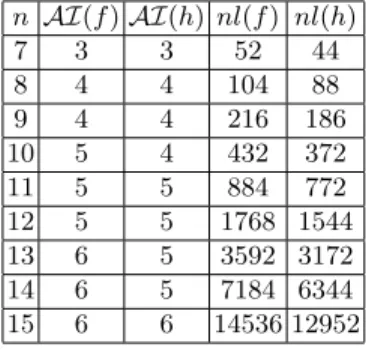
Table 1.Algebraic immunity and nonlinearity of the HWBF-basedfand the HWBFh n AI(f)AI(h) nl(f) nl(h) 7 3 3 52 44 8 4 4 104 88 9 4 4 216 186 10 5 4 432 372 11 5 5 884 772 12 5 5 1768 1544 13 6 5 3592 3172 14 6 5 7184 6344 15 6 6 14536 12952
Table 2.Behavior of the HWBF-based functionfagainst Fast Algebraic Attacks
n 7 8 9 10 11 12 13 (d, e) (1,3) (1,5) (1,5) (1,7) (1,7) (1,9) (1,9) (2,4) (2,4) (2,4) (2,5) (2,6) (2,8) (2,8) (3,3) (3,4) (3,4) (3,5) (3,5) (3,6) (3,6) (4,5) (4,5) (4,6) (4,6) (5,6)
either 0, if g1=k1, or ≥dn−1 (since g1+k1 is an annihilator off1). Now, the degree of the concatenationg=g1||g2||k1||k2 is
deg(g) = max{deg(g1||g2),deg((g1+k1)||(g2+k2)) + 1}.
Next, deg(g1||g2) = max{deg(g1),deg(g1+g2)+1}, and deg((g1+k1)||(g2+k2)) = max{deg(g1+k1),deg(g1+g2+k1+k2) + 1}.
It is rather obvious that the worst case is when g1 = k1, g2 = ¯k2. Then, deg(g) = max{deg(g1||g2),1} ≥ n−13 + 1 = n+23 , which proves the first
claims. ut
Letf =f1||f2||f1||f¯2withf1f2=hn−1, the HWBF. In Table 1, one can find the algebraic immunity and nonlinearity off, compared to the same parameters for the HWBFh. Let f g =h, deg(g) =d and deg(h) =e. In Table 2, we give the lowest possible values of (d, e), as needed for the fast algebraic attack.
There are other cases where our construction is quite strong, improving upon the parameters of other existing constructions. LetCF ∈Bn be the Carlet–Feng
function whose support is{0,1, α, . . . , α2n−1−2
}, whereαis a primitive element of the fieldF2n. We now consider our construction with the base functions that
are variations ofCF, and give some experimental results.
Letf1∈ B10 be the Carlet–Feng function with the primitive polynomial
Table 3. Algebraic immunity and nonlinearity of the CF-based functionf and the functionT CT introduced by [35] n AI(f)AI(T CT) nl(f) nl(T CT) 8 4 4 112 108 10 5 5 480 476 12 6 6 1992 1982 14 7 7 8076 8028 16 8 8 32532 32508 andf2(x) =f1(Ax), where A= (e1,e2,e3,e4,e5,e10,e6,e7,e8,e9)
and ei ∈ F102 is the unit column vector with 1 on the i-th position. Let f =
f1||f2||f1||f¯2 ∈ B12. Then AI(f) = 6 and nl(f) = 1992. The nonlinearity of the 12-variable Carlet-Feng function discussed by [35, 36] is only 1970. Also, the balanced function T CT : F2k ×F2k → F2 constructed by [35] which is
based on the Carlet–Feng function has the nonlinearity 1982, when 2k = 12. Clearly, our function f has optimum algebraic immunity and the nonlinearity of our function is also higher than the ones mentioned, in addition to satisfying other cryptographic properties. Let f1∈ Bn−2 be the Carlet–Feng function and
f2(x) =f1(Ax). For n= 8,10,12,14,16, in Table 3, we give the algebraic im-munity and nonlinearity off, compared to the same parameters for the function
T CT introduced by [35].
As it was also motivated in [38] for the HWBF, for the same number of vari-ables, the algebraic immunity and nonlinearity of our construction may be lower than the ones of the Carlet-Feng function. However, since our functions can be implemented very efficiently in hardware (LFRSs are better suited for hardware), we can use more variables, thus increasing the cryptographic properties of the combiner.
Acknowledgements.The authors express their appreciation for the insight-ful and constructive comments of the referees and the editor, which improved the quality of the paper.
References
[1] A. Braeken and B. Preneel, “On the algebraic immunity of symmetric Boolean functions,”Progress in Cryptology–Indocrypt 2005, LNCS 3797, Springer–Verlag, 2005, pp. 35–48.
[2] R.E. Bryant, “On the complexity of VLSI implementation and graph represen-tations of Boolean functions with application to integer multiplication,” IEEE Trans. Comput.40:2 (1991), 205–213.
[3] R.E. Bryant, “Symbolic Manipulation with Ordered Binary Decision Diagrams,” ACM Computing Surveys24:3 (1992), 293–318.
[4] C. Carlet, Comment on “Constructions of Cryptographically Significant Boolean Functions Using Primitive Polynomials”,IEEE Trans. Inf. Theory57:7 (2011), 4852–4853.
[5] C. Carlet, “On secondary constructions of resilient and bent functions,” Cod-ing, Cryptography and Combinatorics, Progress in Comp. Sci. and Applied Logic, Birkhauser– Verlag, Basel23(2004), 3–28.
[6] C. Carlet, “On the higher order nonlinearities of algebraic immune functions,” Adv. in Crypt. – CRYPTO 2006, LNCS 4117, Springer–Verlag, 2006, pp. 584– 601.
[7] C. Carlet, D. K. Dalai, K. C. Gupta and S. Maitra, “Algebraic immunity for cryptographically significant Boolean functions: analysis and construction”,IEEE Trans. Inf. Theory52:7 (2006), 3105–3121.
[8] C. Carlet, H. Dobbertin, G. Leander, “Normal extensions of bent functions,” IEEE Trans. Inf. Theory50:11 (2004), 2880–2885.
[9] C. Carlet and K. Feng, “An infinite class of balanced functions with optimal algebraic immunity, good immunity to fast algebraic attacks and good nonlinear-ity,”Adv. in Crypt. – ASIACRYPT2008, LNCS 5350, Springer–Verlag, 2008, pp. 425–440.
[10] C. Carlet and K. Feng, “An Infinite Class of Balanced Vectorial Boolean Functions with Optimum Algebraic Immunity and Good Nonlinearity,”IWCC 2009, LNCS 5557, Springer–Verlag, 2009, pp. 1–11.
[11] N. Courtois, “Fast algebraic attacks on stream ciphers with linear feedback,”Adv. in Crypt. – CRYPTO2003, LNCS 2729, Springer–Verlag, 2003, pp. 176–194. [12] N. Courtois and W. Meier, “Algebraic attacks on stream ciphers with linear
feed-back,”Adv. in Crypt. – EUROCRYPT2003, LNCS 2656, Springer–Verlag, 2003, pp. 345–359.
[13] T.W. Cusick, P. St˘anic˘a, “Cryptographic Boolean Functions and Applications”, Elsevier–Academic Press, 2009.
[14] D.K. Dalai, K.C. Maitra and S. Maitra, “Cryptographically significant Boolean functions: Construction and analysis in terms of algebraic immunity,”Proceedings of FSE 2005, LNCS 3557, Springer–Verlag, 2005, pp. 98–111.
[15] D. K. Dalai, S. Maitra and S. Sarkar, “Basic theory in construction of Boolean functions with maximum possible annihilator immunity,” Designs, Codes and Cryptography 40:1 (2006), 41–58.
[16] S. Gangopadhyay and D. Sharma, “On construction of non-normal Boolean func-tions,”Australasian J. Combinatorics38 (2007), 267–272.
[17] P. Hawkes and G.G. Rose, “Rewriting Variables: The Complexity of Fast Alge-braic Attacks on Stream Ciphers,”Adv. in Crypt. – CRYPTO2004, LNCS 3152, Springer–Verlag, 2004, pp. 390–406.
[18] M. Krause, “BDD–Based Cryptanalysis of Keystream Generators,”Adv. in Crypt. – EUROCRYPT2002, LNCS 2332 (2002), pp. 222–237.
[19] M. Krause, D. Stegemann, “Reducing the Space Complexity of BDD–based At-tacks on Keystream Generators”, Fast Software Encryption, 13th International Workshop, FSE 2006, Graz, Austria, March 15–17, 2006, LNCS 4047, pp. 163– 178, Springer, 2006.
[20] N. Li and W.F. Qi, “Construction and analysis of Boolean functions of 2t+ 1 variables with maximum algebraic immunity,” Adv. in Crypt. – ASIACRYPT 2006, LNCS 4284, Springer–Verlag, 2006, pp. 84–98.
[21] N. Li, L. Qu, W. Qi, G. Feng, C. Li and DuanQiang Xie, “On the Construction of Boolean Functions With Optimal Algebraic Immunity,”IEEE Trans. Inf. Theory 54:3 (2008), 1330–1334.
[22] M. Liu, Y. Zhang, D. Lin, “Perfect Algebraic Immune Functions,”Adv. in Crypt. – ASIACRYPT2012, LNCS 7658, 2012, pp. 172–189.
[23] M. Lobanov, “Tight bound between nonlinearity and algebraic immunity,” Cryp-tology ePrint Archive, 2005/441. Available: eprint.iacr.org/2005/441.
[24] W. Meier and O. Staffelbach, “Fast correlation attacks on stream ciphers,”Adv. in Crypt. – EUROCRYPT 1988 , LNCS 330, Springer–Verlag, 1988, pp. 301–314. [25] W. Meier, E. Pasalic and C. Carlet, “Algebraic Attacks and Decomposition of Boolean Functions,”Adv. in Crypt. – EUROCRYPT2004, LNCS 3027, Springer– Verlag, 2004, pp. 474–491.
[26] S. Mesnager, “Improving the Lower Bound on the Higher Order Nonlinearity of Boolean Functions With Prescribed Algebraic Immunity,” IEEE Trans. Inf. Theory 54:8 (2008), 3656–3662.
[27] E. Pasalic, “A design of Boolean functions resistant to (fast) algebraic cryptanaly-sis with efficient implementation,”Cryptography and Communications4:1 (2012), 25–45.
[28] E. Pasalic, “Almost Fully Optimized Infinite Classes of Boolean Functions Resis-tant to (Fast) Algebraic Cryptanalysis,”Proceedings of ICISC 2008, LNCS 5461, Springer–Verlag, 2009, pp. 399–414.
[29] E. Pasalic, S. Maitra, T. Johansson, and P. Sarkar, “New constructions of resilient and correlation immune Boolean functions achieving upper bounds on nonlinear-ity,” in Workshop on Coding and Cryptography – WCC2001, Paris, France, Jan. 8–12, 2001. Published in Electronic Notes in Discrete Mathematics, Amsterdam, The Netherlands: Elsevier Science, vol. 6, 2001.
[30] E. Pasalic and Y. Wei, “On the Construction of Cryptographically Significant Boolean Functions Using Objects in Projective Geometry Spaces,”IEEE Trans. Inf. Theory 58:10 (2012), 6681–6693.
[31] L. Qu, K. Feng, F. Liu, and L. Wang, “Constructing symmetric Boolean functions with maximum algebraic immunity,”IEEE Trans. Inf. Theory55:5 (2009), 2406– 2412.
[32] P. Rizomiliotis, “On the resistance of Boolean functions against algebraic at-tacks using univariate polynomial representation,”IEEE Trans. Inf. Theory56:8 (2010), 4014–4024.
[33] D. Stegemann, “Extended BDD–based Cryptanalysis of Keystream Generators”, 14th International Workshop on Selected Areas in Cryptography, SAC 2007, Au-gust 16–17, 2007, Ottawa, Canada, LNCS 4876, pp. 17–35, Springer, 2007. [34] C. Tan and S. Goh, “Several Classes of Even-Variable Balanced Boolean Functions
with Optimal Algebraic Immunity,”IEICE Trans.E94.A:1 (2011), 165–171. [35] D. Tang, C. Carlet and X. Tang, “Highly Nonlinear Boolean Functions with
Op-timal Algebraic Immunity and Good Behavior Against Fast Algebraic Attacks,” IEEE Trans. Inf. Theory 59:1 (2013) 653–664.
[36] Z. Tu and Y. Deng, “A conjecture about binary strings and its applications on constructing Boolean functions with optimal algebraic immunity,”Designs, Codes and Cryptography 60:1 (2011), 1–14.
[37] Q. Wang, T. Johansson and H. Kan, “Some results on fast algebraic attacks and higher-order non-linearities,”IET Information Security 6:1 (2012), 41–46. [38] Q. Wang, C. Carlet, P. St˘anic˘a, C.-H. Tan, “Cryptographic Properties of
the Hidden Weighted Bit Function,” to appear in Discrete Apppl. Math.; http://dx.doi.org/10.1016/j.dam.2014.01.010.
[39] W. Wang, M. Liu, Y. Zhang, “Comments on ‘A design of Boolean functions resistant to (fast) algebraic cryptanalysis with efficient implementation’,” Cryp-tography and Communications5:1 (2013), 1–6.
[40] X. Zeng, C. Carlet, J. Shan and L. Hu, “More Balanced Boolean Functions with Optimal Algebraic Immunity, and Good Nonlinearity and Resistance to Fast Al-gebraic Attacks,”IEEE Trans. Inf. Theory 57:9 (2011), 6310–6320.
![Table 3. Algebraic immunity and nonlinearity of the CF -based function f and the function T CT introduced by [35] n AI(f ) AI(T CT ) nl(f ) nl(T CT ) 8 4 4 112 108 10 5 5 480 476 12 6 6 1992 1982 14 7 7 8076 8028 16 8 8 32532 32508](https://thumb-us.123doks.com/thumbv2/123dok_us/10212572.2924823/13.918.347.574.216.323/table-algebraic-immunity-nonlinearity-based-function-function-introduced.webp)
