Dynamic Resource Provisioning for Data
Center Workloads with Data Constraints
by
shen li
DISSERTATION
Submitted in partial fulfillment of the requirements for the degree of Doctor of Philosophy in Computer Science
in the Graduate College of the
University of Illinois at Urbana-Champaign, 2016
Urbana, Illinois
Doctoral Committee:
Professor Tarek F. Abdelzaher, Chair Professor Indranil Gupta
Dr. Jie Liu, Microsoft Research Professor Lui Sha
Abstract
Dynamic resource provisioning, as an important data center software building block, helps to
achieve high resource usage efficiency, leading to enormous monetary benefits. Most existing
work for data center dynamic provisioning target on stateless servers, where any request can
be routed to any server. However, the assumption of stateless behaviors no longer holds for
subsystems that subject to data constraints, as a request may depend on a certain dataset
stored on a small subset of servers. Routing a request to a server without the required
dataset violates data locality or data availability properties, which may negatively impact
on the response times.
To solve this problem, this thesis provides an unified framework consisting of two main
steps: 1) determining the proper amount of resources to serve the workload by analyzing
the schedulability utilization bound; 2) avoiding transition penalties during cluster resizing
operations by deliberately design data distribution policies. We apply this framework to
both storage and computing subsystems, where the former includes distributed file systems,
databases, memory caches, and the latter refers to systems such as Hadoop, Spark, and
Storm. Proposed solutions are implemented into MemCached, HBase/HDFS, and Spark,
and evaluated using various datasets, including Wikipedia, NYC taxi trace, Twitter traces,
Acknowledgments
My Ph.D. journey was a joyful one. I would like to sincerely express my deepest gratitude
to my advisor, Professor Tarek F. Abdelzaher, for his invaluable support. This thesis would
not even be possible without him. It was his encouraging guidance thats lead me through
the challenges I encountered. His passion and vision in research motivates me to pursue a
career in the research community. I learnt a whole lot from him in every aspect, and will
always look up to him as my lifetime role model.
I would like to cordially thank my thesis committee members, Professor Indranil Gupta,
Dr. Jie Liu, and Professor Lui Sha. It is my honor to have chances to work with great
schol-ars and researchers. Their constructive suggestions and comments helped me significantly
improve my thesis.
I would like to extend my gratitude to the professors, researchers, and colleagues I
col-laborated with when working on my thesis. In particular, I would like to thank Professor
Maria Kihl, Professor Anders Robertsson, Professor Marco Caccamo, Professor Gul Agha,
Professor Lu Su, Richard Pace, Yong Yang, Shaohan Hu, Shiguang Wang, Yunlong Gao,
Hengchang Liu, Md Tanvir Amin, Hongwei Wang, Yiran Zhao, Shuochao Yao, Huajie Shao,
Chris Xiao Cai for valuable discussions and suggestions.
I am fortunate to have chances to work at IBM Research, Yahoo, and Facebook during
my Ph.D. journey. Thus, I want to express my special thank to my mentors and managers
whole lot of experiences working on real-world research projects and engineering products.
Also, I would like to thank various funding agencies and institutions, such as National
Sci-ence Foundation, Army Research Laboratory, and IBM Research, for their financial support
and assistance.
Lastly, and most importantly, I wish to thank my father Kunyu Li, my mother Wei Pan,
and my wife Xiaoxiao Wang, for their continuous love, understanding, and support. They
are with me all these years, backing me up through difficulties and sharing my happiness.
Table of Contents
List of Figures . . . viii
List of Tables . . . x
List of Algorithms . . . xi
Chapter 1: Introduction . . . 1
1.1 Policy: Make Provisioning Decisions . . . 3
1.1.1 Distributed Storage Systems . . . 3
1.1.2 Distributed computing Systems . . . 4
1.2 Manager: Handle Resizing Penalties . . . 4
1.2.1 Distributed Storage Systems . . . 4
1.2.2 Distributed Computing Systems . . . 5
Chapter 2: Principles and Contributions . . . 7
Chapter 3: Policy For Distributed Computing Clusters . . . 10
3.1 Task Model and Basic Concepts . . . 11
3.1.1 The Generalized Parallel Task Model . . . 11
3.1.2 Assumptions . . . 12
3.1.3 Packing Servers . . . 12
3.1.4 Conversion Bounds . . . 13
3.1.5 The Main Result . . . 14
3.2 Generalized Packing Server . . . 14
3.2.1 Deriving Server Parameters . . . 16
3.2.2 The Conversion Bound . . . 19
3.2.3 Computing the Optimal Beta . . . 22
3.2.4 Impact on Schedulability Analysis . . . 23
3.3 Evaluation . . . 24
3.3.1 Effect ofϕ . . . 26
3.3.3 Effect of DAG Topology . . . 28
3.4 Discussion . . . 30
3.5 Related Work . . . 31
Chapter 4: Manager For Randomly Partitioned Storage Systems . . . 33
4.1 Problem Formulation and Assumptions . . . 34
4.2 Load Balance under Dynamics . . . 36
4.2.1 Fixed Provisioning Order . . . 37
4.2.2 Optimal Number of Virtual Nodes . . . 37
4.2.3 Virtual Node Placement . . . 39
4.2.4 Algorithm Analysis . . . 40
4.2.5 Fault Tolerance . . . 41
4.3 Smooth Provisioning Transition . . . 42
4.3.1 MemCached Digest . . . 42
4.3.2 Bloom Filter Configuration . . . 44
4.4 Performance Evaluation . . . 46
4.4.1 Load Balancing under Dynamics . . . 47
4.4.2 False Positive and False Negative . . . 48
4.4.3 Response Time . . . 49
4.4.4 Power Consumption . . . 51
Chapter 5: Manager For Ordered Partitioned Storage Systems . . . 52
5.1 Design Overview . . . 54 5.1.1 Background . . . 55 5.1.2 Assumptions . . . 56 5.1.3 Architecture . . . 56 5.2 System Design . . . 57 5.2.1 Geometry Translation . . . 58 5.2.2 Multi-Scan Optimization . . . 59 5.2.3 Block Grouping . . . 64 5.3 Implementation . . . 69 5.3.1 Moore Encoding . . . 69 5.3.2 Multi-Scan Optimization . . . 70 5.4 Evaluation . . . 72
5.4.1 NYC Taxi Data Set Analysis . . . 73
5.4.2 Moore Encoding . . . 74
5.4.5 Response Time and Throughput . . . 78
5.5 Related Work . . . 80
Chapter 6: Manager For Distributed Computing Clusters . . . 82
6.1 Design Overview . . . 83 6.1.1 Spark Background . . . 84 6.1.2 Architecture . . . 85 6.2 System Design . . . 86 6.2.1 Locality Manager . . . 86 6.2.2 Group Manager . . . 91 6.2.3 Checkpoint Optimizer . . . 97 6.3 Implementation . . . 99 6.3.1 Locality Manager . . . 100 6.3.2 Group Manager . . . 100 6.3.3 Checkpoint Optimizer . . . 101 6.4 Evaluation . . . 101 6.4.1 Experiments Setup . . . 101 6.4.2 Data Co-Locality . . . 102 6.4.3 Extendable Partitioning . . . 103 6.4.4 Failure Recovery . . . 105
6.4.5 Throughput and Delay . . . 107
6.5 Related Work . . . 109
Chapter 7: Conclusion and Future Work . . . 110
7.1 Summary . . . 110
7.2 Future Research . . . 111
List of Figures
1.1 Dynamic Resource Provisioning Framework . . . 2
3.1 Packing Server Overview . . . 15
3.2 Bound Tightness . . . 21
3.3 Varying Stretch ϕ . . . 25
3.4 Varying Budget Utilization Cap . . . 26
3.5 Unfavorable DAGs for GEDF and Federated Scheduling . . . 27
4.1 Simplified Information Flow . . . 35
4.2 An example of virtual node placement . . . 38
4.3 WikiPedia Workload . . . 47
4.4 Load Balancing . . . 47
4.5 Hit Ratio vs Cache Size . . . 49
4.6 False Positive vs Bloom Filter Size . . . 49
4.7 False Negative vs Bloom Filter Size . . . 49
4.8 Response Time . . . 50
4.9 Power Consumption . . . 50
4.10 Total Energy . . . 51
5.1 Pyro Architecture . . . 54
5.2 Spatial Encoding Algorithms of Resolution 2 . . . 58
5.3 Translate Geometry to Key Ranges . . . 59
5.4 Moore Curve . . . 60
5.5 Moore Encoding Unit . . . 60
5.6 Storage Media Profile . . . 62
5.7 Block Layout in a StoreFile . . . 63
5.8 Split Example . . . 64
5.9 Unavailability Probability . . . 68
5.10 Geometry Translation Delay . . . 69
5.13 Row Key . . . 71
5.14 Reducing the Number of Range Scans . . . 74
5.15 Read Amplification Phenomenon . . . 75
5.16 Block Read Aggregation . . . 76
5.17 Response Time at Splitting Event . . . 77
5.18 1Km×1Km Geometry Response Time . . . 78
5.19 100m×100m Geometry Response Time . . . 78
5.20 100m×100m Geometry Throughput . . . 80
6.1 Stark Architecture . . . 84
6.2 Example of Violating Co-Locality . . . 87
6.3 Data Locality Benefits . . . 88
6.4 CoGroup Two RDDs in Spark . . . 89
6.5 CoGroup Two RDDs in Stark . . . 89
6.6 Time-varying distribution of NYC taxi pick-up/drop-off events in 2013 . . . . 91
6.7 Partition Number Trade-Off . . . 92
6.8 Extendable Partition Groups for NYC Taxi Data . . . 93
6.9 Task Scheduling Algorithms . . . 95
6.10 Checkpoint Example . . . 97
6.11 Co-locality Job Delay . . . 102
6.12 Co-locality Task Delay . . . 102
6.13 Task Input Data Size . . . 102
6.14 Job Delay under Skewed Distribution . . . 103
6.15 Task Delay under Skewed Distribution . . . 103
6.16 Application Lineage Graph . . . 106
6.17 Estimate Checkpoint Size . . . 106
6.18 Total Checkpoint Size . . . 107
6.19 System Throughput . . . 108
List of Tables
1.1 Categorization and Sections Summary . . . 2
3.1 Packing Server Notation . . . 12
3.2 Examples of Improved Bounds (m, ϕ1, β = 5) . . . 24
4.1 Bloom Filter Parameters and Descriptions I . . . 44
List of Algorithms
4.1 Virtual Node Placement . . . 40
4.2 Data Retrieval . . . 43
5.1 A3 Algorithm . . . . 64
Chapter 1:
Introduction
Data centers have been serving as the foundation for the prospering Internet era for more than a decade. Explorations of digital data and applications drive data centers to rapidly grow in both its scale and population. Due to data centers’ enormous monetary value, both industry and academia vigorously seek solutions to improve data center cost efficiency by increasing the amount of served workloads or reducing the operational expenses. Advances on both directions may benefit from resource proportionality which requires the data center to consume a proportional amount of resources (e.g., power, number of servers, etc.) in accordance with the amount of workloads. Under shared circumstances, resource propor-tionality helps to pack a larger amount of heterogeneous workloads into a single data center in a staggering and opportunistic fashion [1–5], generating higher revenue. In dedicated clusters that serve a fluctuating amount of workloads, resource proportionality saves energy by allowing the cluster to adaptively power off a subset of servers at non-peak load [6–10], considerably reducing the operational expenses.
Data centers are complex systems composed of multiple subsystems, there is no single solution to arm all subsystems with the ability of resource proportionality. However, various solutions can be summarized into a common framework as shown in Figure 1.1. In this framework, thesystem is the target to enable dynamic provisioning. Thesensor component monitors key performance metrics (e.g., response time, CPU utilization, Free disk space, etc.) of the system, and reports system status to the policy. The scalingpolicy calculates the resource demand based on the given workload, and the scaling manager gracefully increases
System
Policy Manager
Provision
Figure 1.1: Dynamic Resource Provisioning Framework
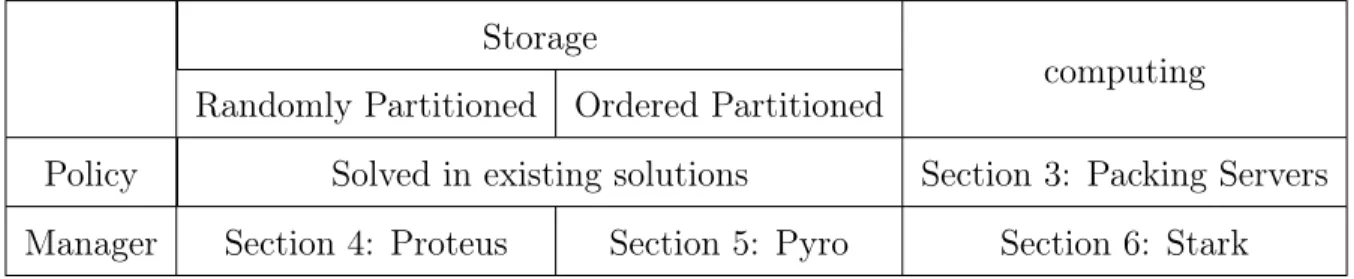
Plenty of work have proposed dynamic resource provisioning solutions for stateless web servers [11–13], where any request can be routed to any web server. However, the assumption of stateless behaviors no longer holds for subsystems that subject to data constraints. We coarsely categorize those subsystems into two classes, storage and computing. The former includes distributed file systems, databases, memory caches, and the latter refers to systems such as Hadoop [14, 15], Spark [16–18], and Storm [19]. In these systems, properties such as data locality and availability significantly impact response times. Due to the huge disparities between these systems, each of them calls for specifically tailored solutions to achieve resource proportionality. As summarized in Table 1.1, chapters of this thesis design policies and managers for the storage and computing systems respectively. Below, we elaborate the characteristics and design requirements of storage and computing systems for the policy and manager components respectively.
Storage
computing Randomly Partitioned Ordered Partitioned
Policy Solved in existing solutions Section 3: Packing Servers Manager Section 4: Proteus Section 5: Pyro Section 6: Stark
1.1
Policy: Make Provisioning Decisions
Effective resource provisioning is the cornerstone for delivering resource proportionality. The policy collects monitoring information of the entire cluster, and makes estimations on what is the right amount of resources to reach given Quality of Services (QoS) objectives. Underesti-mation would overload the service cluster, leading to unacceptably long response times, while overestimation would under-utilize the cluster, unnecessarily wasting valuable resources. As the amount of workloads fluctuates over time, the resource provisioning solution should ac-commodate these dynamics adaptively. The decisions could be scaling CPU frequencies, workload scheduling constraints, power on/off servers, etc.
In systems enforcing response times as QoS objectives, one solution would be to monitor the system response time and increase (decrease) the number of running servers accordingly when the response time rises (drops). Though effective for storage systems that answer IO requests within milliseconds, this solution is inapplicable to distributed computing systems such as Hadoop and Spark. The reason is that the response times of jobs in these systems range from milliseconds to hours or even days, whose sheer value is inadequate to faithfully indicate cluster resource utilization. Hence, the solutions for the storage and the computing systems differ to a large degree. Therefore, policies need to be designed for the two different types of systems accordingly.
1.1.1 Distributed Storage Systems
Data center distributed storage systems usually aim at serving IO requests with low response times. Though distributed storage systems cover a wide spectrum of applications, such as memory cache, distributed file systems, NOSQL database, the request complexities within the same application vary within a small range. For example, getting a key-value pair from memcached [20] takes a few millisecond, while reading an HBase [21, 22] block (64KB by
number of concurrent requests, queue length, etc.), and tune the cluster capacity accordingly in real time. Many existing solutions [11–13] have already solved this problem. So, this thesis skips exploring this area.
1.1.2 Distributed computing Systems
As mentioned before, jobs in the same distributed computing system may diverse to a large extend. Some of them may finish within hundreds of milliseconds, while others may last a few hours or even days. Therefore, this information can neither be collected in real time nor faithfully represent the cluster utilization. Moreover, as some jobs may occupy a huge amount of resources for a relatively long period of time, it is preferred to estimate the amount of required resources before executing the job, so that the system may provision resources proactively. This thesis tackles this problem in Section 3 by introducing the theory of Packing Servers that bridges the scheduling problem in distributed computing systems to the abundance set of theory advances in the Real-time community.
1.2
Manager: Handle Resizing Penalties
Apart from stateless web servers, resizing storage and computing systems subjects to consid-erable performance penalties. The reason is that distributed storage and computing systems usually closely bind with data, where resizing the cluster could destroy amiable properties such as data availability and data locality, negatively impacting the site performance.
1.2.1 Distributed Storage Systems
In distributed storage systems, data is associated with identifiers, where the identifier can be the path to a file, the ID of a block, a key for a key-value pair, the primary key for a row in a database, etc. Based on how the system distributes data into servers, they can be categorized into randomly partitioned and ordered partitioned data storage systems. The former randomly distributes data into servers. The latter divides the data into ranges based
on their identifiers such that all identifier in the same range are hosted by the same server. Disparities in key distribution policies lead to different types of performance penalties.
Randomly Partitioned Data Storage
Randomly partitioned data distribution policies work well for applications operating on individual data pieces. In this case, the key distribution policy directly affects cluster load balancing. Under static scenarios, one could achieve load balancing by randomly mapping data identifiers to a large integer range using a consistent random function, and then applying the modulo operator to wrap it to a valid cache server ID. However, this solution makes it painful when resizing a cluster. For example, in ann-server cache cluster, if one more server is added, this simple solution re-maps nn+1 identifiers into different servers. Consistent hashing alleviates the problem to some degree. Nevertheless, how to balance load under dynamics and how to make dynamic server provisioning smooth enough still remain unsolved. Section 4 presents Proteus which creates an uneven amount of virtual nodes for physical servers, and optimally places those virtual nodes on the consistent hashing ring to balance loads.
Ordered Partitioned Data Storage
In ordered partitioned storage systems, each server handles a continuous range of iden-tifiers. This design helps to reduce the overhead of range queries by avoiding sending every query to all servers in the cluster. The initial range boundaries are usually derived from historical data or estimations on data distributions. During run time, systems resize the cluster by splitting and merging ranges. Nevertheless, splitting and merging ranges destroy the data locality benefits, leading to larger response times. The Pyro system described in Section 5 tackles this problem by making use of data replications in lower layer distributed file systems.
1.2.2 Distributed Computing Systems
tions such as join and cogroup. Therefore, besides data locality properties, maintaining data co-locality also significantly benefits the performance. In this case, splitting and merging operations affects multiple co-located datasets. This thesis discussed this problem using the in-memory computing system Spark as the context, and proposed an evolved system named Stark in Section 6 that solves the aforementioned problems.
Chapter 2:
Principles and Contributions
In this thesis, we apply three principles to achieve dynamic resource provisioning in data center:
• Reducing Parallelism: High parallelism is generally considered as a merit in distributed systems that allows job executions to embrace resources from a cluster of servers. While increasing parallelism usually helps to accelerate job execution, it may on the other hand drive job makespans to become unpredictable, due to resources contentions among multiple jobs. This unpredictability hinders the policy module from estimating the proper amount of resources to satisfy job deadlines. Therefore, in Chapter 3, we explore the trade-off between individual job parallelism and job makespan predictability. Our model considers job graphs with deadlines, where edges in the graph represent the precedence constraints among jobs. We develop the theory of packing server that limits the execution of each job into the minimum parallelism without violating the deadline. The reduced parallelism allows the scheduler to treat job graphs as independent jobs with bounded utilization penalty, and derives schedulability utilization bounds that beat best known results.
• Grouping Replicas: In distributed storage systems, data blocks are usually replicated and randomly distributed to achieve fault tolerance. Besides this original and common usage, we claim that data replicas may also help to deliver elasticity if grouped prop-erly. Grouping replicas means that instead of randomly distributing data replicas into
are stored in the same server. This design creates opportunities for higher layer ap-plications to move computations to data when the computations require multiple data pieces, avoiding the overhead of moving data around. In Chapters 5 and 6, we discuss this principle in detail using HBase/HDFS stack and Spark as examples.
Chapter 5 presents the Pyro system developed based on the HBase/HDFS stack. Pyro organizes HDFS block replicas into groups, which helps the higher layer HBase to split/merge regions without losing the data locality benefits. Chapter 6 describes the Stark systems built based on Spark. Stark organizes RDD partitions into groups, which allows immutable RDDs to alter partitioning boundaries without re-construct the entire dataset.
• Extending Hashes: Hash functions are widely used in data center subsystems to ef-ficiently and evenly allocate both computation and data (keys) into servers (hashes). To cope with the fluctuating volume of workload, hash functions need to be able to extend/shrink the base of their hashes (i.e., turn on/off servers) based on the amount of received workload. This extendability can help the Manager module minimize the penalty when resizing the cluster. Chapters 4 and 6 evaluate two solutions that organize the hashes into a ring structure and a tree structure respectively.
Chapter 4 introduces the Proteus memory cache system that tunes the virtual node placement policy on consistent hashing rings to guarantee that workloads are evenly distributed into all running servers during join and leave events. The Stark system presented in Chapter 6 organizes RDD partition hashes into a tree structure, such that leaf nodes represent partitions and internal nodes represent groups. In Stark, each task process all data of a group, where a group may split into two children or merge with its sibling into a parent group. The ability of extending/shrinking groups helps to avoid excessively large task input dataset induced by the inconsistency between partitioning scheme and dynamic input data distribution, keeping job makespans within a reasonable range.
We introduce and evaluate the above three principles into Hadoop, HBase, MemCached, and Spark, resulting in several novel software systems with improved dynamic resource pro-visioning performance. The contributions of this thesis can be summarized as follows:
• This thesis introduces the generalized packing server, which allows deriving schedula-bility utilization bound for precedence-constrained tasks using existing techniques for independent tasks. The utilization bound helps to efficiently determine the minimum amount of resources to meet deadlines of all tasks, which can be used as a policy module to make provisioning decisions.
• We propose and develop the first power proportional memory cache cluster by exploring the virtual node placement schemes in the consistent hashing ring, which guarantees minimum volume of data transferring during cluster resizing events.
• This thesis applies the same extendable hashing mechanism to both storage systems and computing systems, which allows data distribution mechanisms to adapt to data volume and request intensity dynamics, preserving data locality properties in the best effort manner.
• This thesis develops Pyro as ordered-partitioned spatial-temporal data storage system by introducing the extendable hashing mechanism to HBase/HDFS software stack. It may split and redistribute a dataset multiple times without moving data around, delivering both elasticity and data locality.
• This thesis also designs and implements Stark based on Spark, as an optimized in-memory batch-processing system for dynamic dataset collections. We inject the extend-able hashing mechanism to Spark’s data partitioning and caching modules, granting immutable RDDs the ability to react to data and request dynamics.
Chapter 3:
Policy For Distributed
Computing Clusters
This chapter introduces the generalized packing server, which allows converting generalized parallel tasks into a corresponding set of independent tasks for the underlying scheduler. Hence, any schedulability results, previously derived for independent tasks on multiprocessors become applicable to analyze the schedulability of generalized parallel tasks.
The generalized parallel task model was studied extensively in recent literature [23–30]. It refers to tasks that are described by workflow graphs, where some subtasks can execute in parallel subject to precedence constraints. The new server packs computation time of these tasks into budgets, while respecting precedence constraints. The resulting budgets, however, can be treated by the underlying scheduler as independent tasks. To ensure that the packing server can always successfully pack the original task set into budgets, we show that the sum of the budgets should be larger by a certain factor than the sum of the original computation times. As a result, a conversion factor is derived between schedulability bounds derived in prior literature for independent tasks on multiprocessors (that therefore apply to the budgets) and the corresponding bounds that apply to the schedulability of generalized parallel tasks. The new bounds derived using the aforementioned conversion approach for the generalized parallel tasks are shown to be better in many cases than the corresponding best-known bounds for this task model.
The generalized packing server, described in this chapter, can use any work-conserving scheduling policy to pack tasks into server budgets. Hence, results derived for this server are
broadly applicable.
3.1
Task Model and Basic Concepts
Recent work introduced the generalized parallel task model, drawing an increasing amount of attention to its expressiveness and broad applications [26–29]. The chapter addresses the schedulability of generalized parallel tasks on multiprocessors, composed of a number of identical processing elements (or cores). We first review the task model, then formalize the notions of packing servers and conversion bounds, and finally outline the main result of the chapter.
3.1.1 The Generalized Parallel Task Model
We adopt the generalized parallel task model, proposed by Baruah et al. [31]. In this model, each task, τi, is represented by a Directed Acyclic Graph (DAG), denoted by G(Ni, Ei),
where the set of nodes, Ni, represents a set of jobs comprising a single instance of the task,
and the set of edges, Ei, represents their precedence constraints. Let the number of jobs
|Ni|, in τi, be denoted by ni, and let the total number of recurrent tasks be denoted by n.
The worst case execution time (WCET) of the jth job is cj
i. A job can be preempted and
then resumed on the same or a different core. The jth job of an instance of τ
i can only
start after all its predecessor jobs on the DAG have finished. Every Ti time units, a new
instance of task τi is released with relative deadline Di. In this chapter, we assumeDi ≤Ti.
The utilization ui of task τi is thus the total amount of computation over its deadline (i.e.,
P
j∈Nic
j i
Ti ). The set of recurrent generalized parallel tasks, denoted by τ ={τ1, τ2, ..., τn}, runs
on a platform of m cores.
LetLi denote the critical path length of taskτi. The critical path is the longest execution
path in the DAG. Hence, Li = maxpathk∈DAG P
j∈pathkc j
i. We define the stretch of a
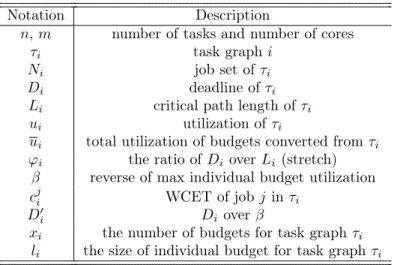
Notation Description
n,m number of tasks and number of cores
τi task graph i
Ni job set ofτi
Di deadline ofτi
Li critical path length ofτi
ui utilization of τi
ui total utilization of budgets converted fromτi
ϕi the ratio ofDi overLi(stretch)
β reverse of max individual budget utilization cji WCET of jobj inτi
D0
i Di overβ
xi the number of budgets for task graphτi
li the size of individual budget for task graphτi
Table 3.1: Packing Server Notation
3.1.2 Assumptions
As the first approach to pack precedence-constrained tasks to independent tasks, this chapter makes three assumptions to simplify the problem:
• Tasks can be preempted and resumed with no penalties.
• The WCET of each individual task can be estimated a priori to its execution.
• Data locality does not affect task execution times.
These assumptions help us to derive neat theorems with concise proofs. Future works of relaxing these assumptions will be presented in the discussion section.
3.1.3 Packing Servers
A packing server is a construct that allows the underlying scheduler to ignore precedence constraints among jobs in the above model and focus on scheduling server budgets as in-dependent entities. Each task, τi, in the above model, is assigned its own server that is
characterized by two parameters; a budget size, li, and a concurrency level, xi. The server
time, li. These tasks (i.e., server budgets) can be scheduled independently on the
multipro-cessor (on the same or different cores) according to the underlying multipromultipro-cessor scheduling policy. When the underlying scheduler invokes any of the server budgets, the server looks for jobs of task, τi, whose predecessors are finished and runs them within its budget(s). When
a budget expires, the underlying scheduler stops executing it. This chapter shows that if xi and li are appropriately chosen, the packing server always manages to fit all jobs of the
original task, τi, within its budgets, while respecting precedence constraints, regardless of
how the budgets are scheduled by the underlying scheduler. Hence, as long as the budgets finish before the deadline of τi, the task is schedulable. Note that, analyzing schedulability
of server budgets is an independent task scheduling/schedulability analysis problem. Thus, the server allows converting the original problem of scheduling generalized parallel tasks on multiprocessors to the problem of scheduling independent tasks (the server budgets).
An analogy can be made between packing servers and servers for aperiodic tasks. Since aperiodic tasks were harder to analyze than periodic ones, real-time scheduling literature introduced the idea of aperiodic task servers [32–34], such that aperiodic tasks can be sched-uled inside these servers, while the servers themselves appear to be periodic tasks to the underlying scheduler. Scheduling and analysis techniques for periodic tasks could then be extended to aperiodic task servers.
By analogy, the generalized packing server is introduced because scheduling tasks with precedence constraints is more difficult than scheduling independent tasks. The server allows scheduling and analysis techniques for independent tasks to be applied to generalized parallel tasks.
3.1.4 Conversion Bounds
The “catch" in converting generalized parallel tasks to independent server budgets is that, as we show in this chapter, the sum of server budgets assigned to task τi needs to be
appro-ting all jobs of a task within the corresponding server budgets, while respecappro-ting precedence constraints, regardless of how these budgets are scheduled by the underlying multiprocessor scheduler.
We call the ratio of the sum of execution times of jobs in τi to the sum of resulting
budgets, the conversion bound. The lower the bound, the less efficient the packing server. This chapter introduces the simplest packing server and its conversion bound. Possible improvements that may lead to better bounds are mentioned in the discussion section.
3.1.5 The Main Result
We show that, for the generalized packing server introduced in this chapter, the conversion bound is equal to ϕ−ϕβ, where ϕ is as defined earlier in Section 3.1.1 and β is a tunable parameter that controls the upper bound of the maximum individual server budget utilization umax = li/Ti, such that umax ≤ β1. We prove that if the utilization bound for scheduling of independent tasks by the underlying multiprocessor scheduling policy, is UB, then the
generalized parallel task set is schedulable when its utilization does not exceed UB · ϕ−ϕβ.
The observation allows us to map bounds for independent tasks to those for generalized parallel tasks, essentially discovering new schedulability bounds for the latter in several cases. As mentioned in the introduction, the chapter generalizes our prior work [35] which derived a similar result for a special-case packing server that required a clairvoyant underlying scheduler.
3.2
Generalized Packing Server
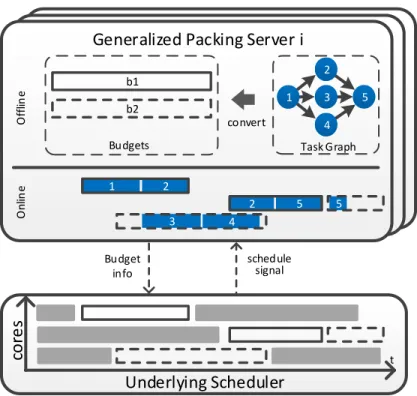
Figure 3.1 illustrates the high-level idea of the generalized packing server. The user must create a server for every generalized parallel task. The underlying scheduler runs some independent task scheduling algorithm, such as Global EDF (GEDF) [36] or EDF First Fit (EDF-FF) [37]. When the underlying scheduler executes a budget, much like the case with aperiodic task servers, the corresponding packing server executes jobs of the original
b1 b2
convert
Generalized Packing Server i
Budgets Budget info schedule signal 1 2 4 3 5 Task Graph Underlying Scheduler t co re s 3 4 5 5 1 2 2 O ff lin e O n lin e
Figure 3.1: Packing Server Overview
workflow task within that budget using any work-conserving scheduling policy. The policy respects precedence constraints by assigning jobs whose predecessors are finished to the running budgets. We show that this scheduler always succeeds at fitting all jobs into the budgets, as long as the budgets are sized as described in this chapter.
When a server budget of taskτi is invoked, if no job of τi is ready to execute in it (which
can happen if the number of budgets invoked concurrently exceeds the level of concurrency ofτi), the budget remains unutilized. We say that the budget, in this case, runsidle. In this
chapter, we analyze a very simple version of the packing server, where budgets that run idle continue to occupy the CPU (i.e., the budget busy-waits) and continue to be decremented, just as if they were executing jobs ofτi. When a budget is depleted, it stops running. Should
a job become ready at any point prior to budget depletion, it can use the leftover. If a job finishes before the underlying budget depletes, the server picks another ready job to feed into that budget.
uler in the server can always finish the input task graph inside the budgets. Section 3.2.2 derives the resulting conversion bound achieved by the generalized packing server. Notations are introduced near their first usage, and are also summarized in Table 3.1.
3.2.1 Deriving Server Parameters
Many existing utilization bounds for schedulability of independent tasks are a function of granularity of individual tasks, often measured by the maximum individual task utiliza-tion. When individual tasks have a lower maximum utilization, a higher utilization bound can be derived for schedulability of various scheduling algorithms (e.g., EDF-FF [37] and GEDF [29]). Translating to the context of server budgets, the above observation suggests that it is preferable to have a smaller budget size, li. Therefore, we introduce a parameterβ
to restrict budget size by imposing the constraint: li ≤min{Di,Tβi}. The constraint bounds
the maximum budget utilization at β1. Later we shall determine the optimal value of β. Hence, it is useful to define a modified deadline, D0i as:
Di0 = min{Di,
Ti
β} ≤ Di
β . (3.1)
The following theorem states how to set the budget parameters of a packing server such that any work-conserving scheduling policy, executed by the server, will always succeed to pack the original task graphs within the available budgets, no matter how these budgets are invoked by the underlying scheduler.
Theorem 1. Any work-conserving application scheduler can always fitτi into itsxi identical
budgets of size li, regardless of how the underlying scheduler schedules those budgets, if:
xi = & P j∈Nic j i −Li Di0−Li ' (3.2) li = Li+ 1 xi X j∈Ni cji −Li ! . (3.3)
Proof. To prove the theorem, consider an execution schedule that maps jobs of task τi onto
xibudgets of lengthlieach. We do not make any assumptions on when individual budgets are
executed by the underlying scheduler. We merely assume that whenever a budget becomes available, the server assigns jobs of task τi to it, in a work-conserving fashion, subject to
their precedence constraints. Let tstart be the first time that a job of τi started executing in
a budget, and let tf inish be the time thatτi finished. Let us compute the maximum amount
of idle server budgets accrued between tstart and tf inish. Recall that a budget is said to
be “running idle" if it is invoked by the underlying scheduler but not used by the packing server (to run a job of τi). In our implementation, such a budget simply busy-waits. This
happens if the underlying scheduler invokes more budgets than the number of jobs ofτi that
are currently eligible (i.e., whose predecessors finished). Let us divide the time[tstart, tf inish]
into three types of intervals:
• (A) Intervals where no budgets belonging to τi are running.
• (B) Intervals where budgets are running and at least one budget is idle. Let the sum of those intervals be denoted by I1.
• (C) Intervals where budgets are running and no budget is idle.
Note that, idle budgets exist only during intervals of type (B) above. The question is: what is the maximum amount of idle budget execution that may be incurred?
To answer this question observe that when a budget is idle, it must be that the number of available budgets exceeds the number of eligible jobs ofτi (i.e., those jobs whose predecessors
in the task graph are finished). Accordingly, all eligible jobs of τi must be running at that
time. This condition is indistinguishable from runningτi on a machine of infinite parallelism
(one that has infinite cores). Thus, the total time interval for which this condition can hold (i.e., the sumI1) cannot be longer than Li (the length of the critical path ofτi). This is true
Clearly, in our schedule, intervals where a budget is idle (i.e., intervals of type (B)) are interleaved with intervals of type (A) and (C). However, these other intervals do not increase the workload and do not change the graph. Hence, the sum I1 remains bounded by what would be enough for a machine with infinite parallelism to finish the original task graph.
In summary, the total duration of time during which at least one budget is idle cannot exceed Li. Also, since the schedule used by the packing server is work conserving, at least
one budget must be busy as long as the task has not terminated. Hence, the number of simultaneously idle budgets cannot exceed xi −1. The maximum total idle budget time is
thus:
(xi−1)Li. (3.4)
Therefore, by the time task τi terminates, it would have consumed budgets for a total
duration P j∈Nic
j
i (to run all its jobs), and a total budget time of no more than (xi−1)Li
would have been left idle. This adds up to the following maximum total needed budget time:
xili = X
j∈Ni
cji + (xi−1)Li. (3.5)
By dividing both sides with xi, we arrive at the li formula shown in Equation (3.3).
As suggested by Equation (3.5), there are multiple pairs of valid xi and li combinations.
However, as shown in Equation (3.4), the value ofxi directly affects the amount of utilization
penalties introduced during the budget construction. Largerxi leads to larger penalties. On
the other hand, excessively small xi leads to larger li, which might violate the deadline D0i
constraints. Given the above two considerations, xi needs to be set to the smallest value
that respects the deadline Di0. Quantitatively, it means that using xi budgets respects Di0,
Li+ 1 xi X j∈Ni cji −Li ! ≤D0i (3.6) Li+ 1 xi−1 X j∈Ni cji −Li ! > D0i (3.7)
Expressing xi using Equations (3.6) and (3.7) respectively, we have:
P j∈Nic j i −Li Di0−Li ≤xi < P j∈Nic j i −Li Di0−Li + 1. (3.8)
As xi has to be an integer, Equation (3.2) follows.
Next, we prove the resulting conversion bound.
3.2.2 The Conversion Bound
Task graphs can always fit within their budgets, when the budgets are parameterized as described above. Hence, if the underlying scheduler can schedule all budgets by the original task deadlines, then all tasks will be schedulable. The budget schedulability problem is one of analyzing schedulability of independent tasks, for which utilization bounds have been derived in literature. Let the utilization bound for schedulability independent tasks (by the underlying scheduler) be UB. The utilization of the original task set must be smaller than
UB because the sum of budgets is larger than the sum of the original job execution times.
In this section, we use this observation to derive a utilization bound for the original task set, such that the resulting budgets remain under the utilization bound, UB. We prove the
following theorem:
Theorem 2. If the underlying scheduler achieves a utilization bound of UB, the generalized
the modified deadline,D0i. Hence, by construction, decreasing budgets to (xi−1) will violate
the modified deadline D0i. This results in:
Li+ 1 xi−1 X j∈Ni cji −Li ! > Di0 ≥ ϕ β ·Li (3.9)
By reorganizing Equation (3.9), we have:
P j∈Nic j i xi−1 > P j∈Nic j i −Li xi−1 > ϕ β −1 Li (3.10)
Then, we can represent the lower bound on the total execution time of the original task graph as: X j∈Ni cji ≥(xi−1)( ϕi β −1)Li (3.11)
As the amount of idle budget contributed by a task graph is upper bounded by (xi−1)Li,
we can compute the upper bound ratio of idle budget over original task graph total WCET:
xili−ui ui = (xi−1)Li P j∈Nic j i ≤ (xi−1)Li (xi−1)(ϕβi −1)Li Inequality (3.11) = β ϕi−β (3.12) Finally we have: X i ui ≥ ϕ−β ϕ X i xili, ϕ= min{ϕ1, ϕ2, ..., ϕn} (3.13)
Equation (3.13) agrees with the conversion bound claimed in Theorem 2.
This conversion bound matches the one derived in literature [35]. However, compared to literature [35], we completely remove the claivoyance requirement on the underlying sched-uler, thereby promoting the packing server technique to a broader spectrum of applications.
Li-ɛ ɛ
(a) Input Task Graph
...
(b) Budgets
Li-ɛ Di’-Li+ɛ
Figure 3.2: Bound Tightness
The conversion bound ϕ−ϕβ applies to all work-conserving schedulers used by the packing server, with deadline equals to its period (Di =Ti). One natural question to ask is whether
the conversion bound is tight. For example, when proving the conversion bound, we do not make use of proactive preemptions at all, whereProactive Preemption is the job preemption issued by the application-level scheduler when the corresponding budget is not preempted by the underlying scheduler. Hence, it is meaningful to know whether the conversion bound can be further improved if the application scheduler is allowed to proactively preempt job executions using some judicious algorithms.
Intuitively, proactive preemptions may help reduce the amount of required idle budget
(xi−1)Li. For example, by enforcing a PFair-like scheduling policy in the application,
packing servers no longer need to worry about depleting a job too soon to preserve enough parallelism to occupy all budgets. However, it turns out that the bound is still tight even if the application scheduler uses unlimited proactive preemptions.
Consider a task graph τi as depicted in Figure 3.2 (a). The WCET of the first job is
c1
i. The remaining (Di0−c1
i)x
jobs share the same WCET , and are all successors of the first
job. After converting task graph τi into xi budgets, we compute the ratio of the additional
xili−ui ui = (x−1)c 1 i (D0i−c1 i)x+c1i ≈ (x−1)Li ϕi β −1 Lix+Li as Li =c1i +≈c1i ≈ β ϕi−β . when xis large (3.14)
In this example, proactive preemptions cannot help, as the conversion bound in this case is still ϕ−ϕβ. Hence, the bound shown in Equation (3.13) is the optimal conversion bound regardless of how the application scheduler fits jobs into budgets.
3.2.3 Computing the Optimal Beta
Using the conversion bound, shown in Equation (3.13), requires one to determine the value of β that preferably yields the highest utilization bound. We demonstrate this process by using GEDF-FF [37] and GEDF [29] as two examples.
Generalized packing servers may use any work-conserving independent task scheduling policy in the underlying scheduler. As proven above, they achieve a utilization bound of UB· ϕ−ϕβ for task graphs, where UB is the utilization bound of the underlying independent
task scheduler. The survey [38] summarizes UB for both GEDF and EDF-FF. The value
of β affects the utilization bound in two competing directions: 1) Schedulability bounds for the underlying scheduling algorithms usually favor smaller individual task utilization, and hence largerβ; 2) The conversion bound prefers a smaller β. Therefore, it is desired to find an optimal β that balances these two requirements. Substituting forUB with the utilization
bound for schedulability of GEDF, the optimal β maximizes:
UB·
ϕ−β
ϕ =
(ϕ−β)(mβ−m+ 1)
mϕβ . (3.15)
bound for the packing server over GEDF is achieved at:
β = r
ϕ(m−1)
m . (3.16)
Similarly, one can show that the highest utilization bound for the packing server over EDF-FF is achieved at:
β= r
(ϕ+ 1)(m−1)
m −1. (3.17)
The derived value of β determines the modified deadline Di0, which in turn affects the budget size as shown in Equation (3.3). Packing servers use the optimal β to set D0i and configure budgets accordingly.
3.2.4 Impact on Schedulability Analysis
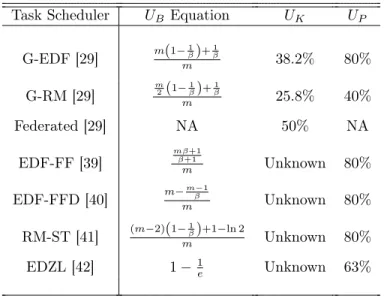
The generalized packing server can cooperate with various independent task schedulers, which not only improves task graph utilization bounds for some algorithms, but also unlocks task graph utilization bounds for many more algorithms. We compare the utilization bounds achieved with and without generalized packing servers. Table 3.2 presents the utilization bounds (UB) for algorithms summarized in literature [38]. Assume the configurations satisfy
high platform parallelism (m 1) and large task graph stretch (Di Li). For simplicity,
instead of computing the optimal β and presenting task graph utilization bound formulas, we further assume that β is set to 5 for packing servers, which allows direct comparisons against existing results. LetUK and UP denote the best Known utilization bounds [29] and
the bounds achieved by Packing servers respectively.
Table 3.2, shows that packing server significantly improves the best known utilization scheduling bound for G-EDF and G-RM. Moreover, with packing server, schedulers such as EDF-FF, EDF-FFD, RM-ST, and EDZL embrace task graph utilization bounds which were not available before.
Task Scheduler UB Equation UK UP G-EDF [29] m(1− 1 β)+β1 m 38.2% 80% G-RM [29] m 2(1−β1)+β1 m 25.8% 40% Federated [29] NA 50% NA EDF-FF [39] mβ+1 β+1 m Unknown 80% EDF-FFD [40] m− m−1 β m Unknown 80% RM-ST [41] (m−2)(1− 1 β)+1−ln 2 m Unknown 80% EDZL [42] 1−1 e Unknown 63%
Table 3.2: Examples of Improved Bounds (m, ϕ1, β= 5)
3.3
Evaluation
This section compares existing task graph schedulers, namely GEDF and Federated, to packing servers using GEDF (independent tasks) and EDF-FF as the underlying schedulers. Moreover, we evaluate how the stretchϕ, the reverse of maximum individual task utilization β, and task graph topology affect the accepted utilizations when using packing servers. The evaluated schedulers are described as below:
• Packing/GEDF: The generalized packing server over GEDF as the underlying sched-uler.
• Packing/EDF-FF: The generalized packing server over EDF First Fit (EDF-FF) [37] as the underlying scheduler.
• GEDF: Global EDF is a well-known and widely used scheduler. It assigns the highest priority to the workflow with the earliest absolute deadline. Its best-known utilization bound is 3+2√
5 ≈38.2% [29].
• Federated: Federated scheduling is the state-of-the-art generalized parallel task schedul-ing algorithm [29]. It achieves the highest-known utilization bound of 50% for
gener-0.4 0.5 0.6 0.7 0.8 0.9 1 1.1 0.4 0.5 0.6 0.7 0.8 0.9 1 Submitted Utilization Accepted Utilization (a)ϕ= 20 0.4 0.5 0.6 0.7 0.8 0.9 1 1.1 0.4 0.5 0.6 0.7 0.8 0.9 1 Submitted Utilization Accepted Utilization (b)ϕ= 30 5 10 15 20 25 30 0.2 0.4 0.6 0.8 1 Stretchϕ
Maximum Accepted Utilization
Packing/GEDF Packing/GEDF Bound Packing/EDF−FF Packing/EDF−FF Bound GEDF GEDF Bound Federated Federated Bound (c) Summary
Figure 3.3: Varying Stretchϕ
alized parallel tasks, when the stretch ϕ surpasses 2. The algorithm partitions tasks based on their utilizations. For every task τi with utilization at least one (i.e., ui ≥1),
the algorithm allocates dCi−Li
Di−Lie dedicated cores to τi, where Ci = P
jc j
i. All other
lower-utilization tasks share the remaining cores.
The simulations emulate 50 cores. In all figures, the shown utilization is divided by the number of cores in the system to normalize it to a per-core value.
The DAG generation program generates task graphs using parameters that include the number of hops on the critical path, the job WCET, the number of jobs in each DAG, and the tightness of deadline. Detailed task graph generation policies will be described close to corresponding experiments.
A large family of DAGs are generated first for each experiment. When load is increased on the horizontal axis, more DAGs are drawn from the set. If there are unfinished jobs when a DAG reaches its deadline, all remaining jobs are preempted and discarded, and the experiment records the deadline-violation event. The experiments enforce no admission controls.
The following experiments use the optimal β values to configure the packing server ac-cording to the underlying scheduling policy, unless otherwise stated.
0.4 0.5 0.6 0.7 0.8 0.9 1 1.1 0.4 0.5 0.6 0.7 0.8 0.9 1 Submitted Utilization Accepted Utilization (a) β= 5 0.4 0.5 0.6 0.7 0.8 0.9 1 1.1 0.4 0.5 0.6 0.7 0.8 0.9 1 Submitted Utilization Accepted Utilization (b) β= 10 1 5 10 15 20 25 30 0 0.2 0.4 0.6 0.8 1 Beta β
Maximum Accepted Utilization
Packing/GEDF Packing/GEDF Bound Packing/EDF−FF Packing/EDF−FF Bound GEDF GEDF Bound Federated Federated Bound (c) Summary
Figure 3.4: Varying Budget Utilization Cap
3.3.1 Effect of ϕ
This section evaluates how the key parameter ϕ in the conversion bound affects the per-formance of the generalized packing servers. During the task graph generation process, the program first generates a random topology. Then, the deadline of the task graph is set to the product of its critical path length Li and the given stretch ϕ(i.e., Di =Li·ϕ). In this
case, varying the parameter ϕ also affects the task utilization, which we shall show later in Section 3.3.3 is an important parameter for the Federated scheduling policy. Tuning two key parameters in the same experiment would cause confusion about which one is the true driving factor of observed results. Therefore, we compensate by adding more jobs to keep individual task around the same utilization.
We vary the value ofϕfrom5to30with step5, and compute optimalβfor each different ϕusing Equation (3.16) and (3.17). The results show that, although packing server does not dominate other algorithms for every ϕ value, it beats the best-known generalized parallel task utilization bound when ϕ is larger than 8. Moreover, to the best of our knowledge, Packing/EDF-FF introduces the first known bound of 70% for EDF-FF algorithm with ϕ= 30.
Figure 3.3 (a) depicts the ϕ= 20 case, where the utilization bounds for Packing/EDF-ff and Packing/GEDF are 64% and 60% respectively, beating the best-known bound of 50%. The generalized packing servers over EDF-FF and GEDF start to miss deadlines when the submitted utilization surpasses 68% and 90% respectively. When ϕ is set to 30 as shown
0 0.02 0.04 0.06 0.08 0.1 0 0.02 0.04 0.06 0.08 0.1 Submitted Utilization Accepted Utilization (I) 0.6 0.7 0.8 0.9 1 1.1 0.6 0.7 0.8 0.9 1 Submitted Utilization Accepted Utilization (II) 0.1 0.3 0.5 0.7 0.9 1.1 0 0.2 0.4 0.6 0.8 1 Submitted Utilization Accepted Utilization Packing/GEDF Packing/EDF−FF GEDF Federated (III)
Figure 3.5: Unfavorable DAGs for GEDF and Federated Scheduling
in Figure 3.3 (b), the theoretical schedulability utilization bound for packing servers over EDF-FF and GEDF further improve to 70% and 67% respectively.
The curves using GEDF-related schedulers dip at higher utilization to a value below the bound. This is because no admission control is used. In the absence of admission control, EDF suffers a domino effect when the system gets overloaded causing a sharp decline in the utilization of tasks that actually meet deadlines. If admission control was used, all tasks would meet their deadlines as is clear from the point on the x-axis where the submitted utilization is equal to the bound.
Figure 3.3 (c) summarizes, in general, how the parameter ϕ affects the maximum ob-served accepted utilization. The curves without markers indicate the theoretical utilization bound for Packing/EDF-FF and Packing/GEDF respectively. For randomly generated task graphs, both generalized packing servers accept higher utilizations at larger ϕ values, fol-lowing the same trend shown by the theoretical bound. Additionally, comparing the bound computed to the empirically obtained maximum schedulable utilization, we can conclude that Packing/EDF-FF leads to the least degree of pessimism when scheduling randomly generated workflows.
3.3.2 Effect of β
servers behave when using different β values. Figure 3.4 plots how β influences accepted utilizations, with β varying from 1 to 30 and ϕ fixed at 30. The optimal β values are 4.56 and 5.47 for Packing/EDF-FF and Packing/GEDF respectively. In Figure 3.4 (a) where β = 5, Packing/EDF-FF and Packing/GEDF both achieve considerably high utilization bounds, as β is close to the optimal value. Empirically, they also accepts more than 80% utilization. The accepted utilization of Packing/EDF-FF dramatically drops to 65% when β increases to 10, as shown in Figure 3.4 (b). The results confirm that β fundamentally impacts accepted utilizations. As summarized in Figure 3.4 (c), there is a clear trend of ascending followed by descending whenβ increases from1 to30. The pinnacle in the bound curve conforms to the optimal beta value of 4.56 and 5.42. Again, Figure 3.4 shows that the utilization bound for Packing/EDF-FF achieves the least degree of pessimism.
3.3.3 Effect of DAG Topology
In experiments using randomly generated task graphs, GEDF performs well, and accepts more than 90% utilization in most cases. However, there are also cases where the generalized packing servers significantly outperforms GEDF and Federated scheduling policies. Consider three sets of implicit-deadline parallel tasks.
• Task set (I): Task τ1 consists of 100 parallel jobs , each with length ci1 = 1. Task τ2 contains a single job of length c12 = 100. The deadlines for the two workflows are D1 = 101, andD2 = 102 respectively.
• Task set (II): Compared to Task set I, the only difference is thatci
2 shrinks to 25. • Task set (III): Task τ1 consists of 27 parallel jobs, each with WCET ci3 = 3. The
deadline D1 is set to 80.
In the above three task sets, τ1 can be copied an arbitrary number of times to achieve a desired task set utilization.
Task sets (I) and (II) represent unfavorable task graphs for the GEDF scheduler. Fig-ure 3.5 (I) plots the simulation results for task set (I). In this case, the GEDF scheduler starts to miss deadline at a utilization of 4%, while generalized packing server servers accept up to 99% task set utilizations. In this task set, τ2 contains a large job of length c12 = 100, and subjects to a slightly larger deadline of D2 = 102, compared to other tasks. So, GEDF schedules other tasks prior to τ2, forcing τ2 to miss its deadline at a very low task set uti-lization. Packing servers handle these input tasks well due to the result of consolidating jobs into less parallelism. By setting β = 1, every task is packed into a single budget, allowing τ2 to enjoy its execution opportunity when the task set utilization is below 99%. Task set (I) is out of the scope considered in literature [29], as the stretch ϕ is smaller than 3+
√ 5 2 . Task set (II) presents tasks with larger stretches where the 3+2√
5 ≈38.2% utilization bound is applicable. Figure 3.5 (II) elucidates the result. GEDF and Federated schedulers miss deadlines when task set utilization reaches 76%, whereas packing servers accept all tasks when the total utilization stays below 97%.
Task set (III) is unfavorable for the Federated scheduler. The simulation results are presented in Figure 3.5 (III). The accepted utilization of the Federated scheduling policy stays at 50%, which is its theoretical schedulability utilization bound. It is because, under this configuration, Ci−Li
Di−Li =
81−3 80−3 =
78
77 is slightly larger than1, forcing the Federated scheduler to allocate 2 cores to each task. As a result, half of the resources in the platform are wasted. From this perspective, Federated scheduling algorithm prefers higher individual task utilizations. Generalized packing servers accept 72% task set utilization. GEDF does not miss any deadline when the task set utilization is smaller than 90%.
These measurements convey that no single scheduler dominates all others. Therefore, systems without prior knowledge of the DAG topology can only turn to the theoretically utilization bound for schedulability guarantees.
3.4
Discussion
The generalized packing server is a novel solution to schedule task graphs using independent job scheduling algorithms. This chapter presents a simple packing server. It can be improved along several directions.
• Non-Identical Budgets: The generalized packing server described in this chapter cre-atesidentical budgets. However, this requirement may not be necessary. Non-identical budgets may potentially help reduce the amount of idle budget during execution, which in turn improves the conversion bound. This is because the degree of concurrency in the task graphmay differ from one point in execution to another.
• Budget Priority Exchange: In our model, every budget is dedicated to one task. If a budget is invoked when no eligible job is left, the budget is completely wasted. One possible improvement is to borrow the idea of Priority Exchange [33, 43, 44] from earlier aperiodic server literature, which allows servers to loan unused capacity to others. Similarly, an improved packing server could loan idle budgets to another packing server, which would help reduce the total amount of idle budget over the entire task set.
• Optimized Application Scheduler: This chapter presents a general result that allows the server to useany work-conserving scheduling algorithm to determine which jobs to run next. We prove that the bound is tight in the worst case if budgets are constructed using our theorems. However, outside the worst case, or if budgets are configured differently (e.g., are not identical), some scheduling algorithms might be superior to others. In this case, it would be meaningful to develop scheduling algorithms that help the packing server further improve the conversion bound.
• Distinguish Large and Small Stretch: As suggested by the conversion bound, the stretchϕis a critical parameter that significantly affects the resulting conversion bound. For simplicity, we use the minimum stretch of all task graphs to calculate the conversion
bound. Inspired by the Federated scheduling algorithm [29], treating tasks with large and small utilization differently would increase the schedulability bound. Similarly, the conversion bound could also be improved by categorizing stretch into tight and loose classes, and distinguish them during scheduling. The above improvements are left for future work.
3.5
Related Work
The generalized parallel task scheduling problem has been recently studied on multiproces-sor platforms. Baruah et al. [27] prove that EDF can achieve a 2X speedup bound for a single recurrent workflow. Saifullahet al.[26] propose to arrange a workflow into stages, and then the workflow’s deadline is split and assigned to each stage. If some optimal algorithm can successfully schedule the original workflow, their solution is guaranteed to satisfy the same deadline with 4X (speedup bound) speed processors. When the workflow is restricted to a fork-join model [45, 46], Lakshmanan et al. [47] improve the speedup bound to 3.42. Li et al. [28] develop a capacity augmentation bound of 4− 2
m for workflows, which
im-mediately leads to a simple and effective schedulability test. More recently, Li et al. [29] improve the capacity augmentation bound to 2 using the federated scheduling algorithm for implicit deadline workflows. They then prove the same result for stochastic parallel tasks [48]. Analysis from literature [23] shows a speedup bound for the federated scheduling algorithm to be 4− 2
m
when using arbitrary-deadline sporadic DAG models. Fonseca et al. [24] further introduce conditional executions into the generalized parallel task models to capture the conditional constructs, such as if-then-else clauses. Baruah et al. [25] later prove a speedup factor of 2− 1
m
for the conditional sporadic generalized parallel tasks. These efforts study the generalized parallel task scheduling problem by directly analyzing its behavior on multiprocessor platforms.
gener-original task set into independent tasks. Unlike other conversion-based approaches, in pack-ing servers the resultpack-ing independent tasks (server budgets) are subject to the same original end-to-end deadlines. Since the deadlines are not broken into per-segment deadlines, no arti-ficial deadline constraints are introduced, which improves schedulability. Our prior work [35] analyzes the workflow scheduling problem under the assumption of a clairvoyant scheduler. Specifically, the previous approach required that the packing server know the exact future task execution timeline, in order to determine the exact time intervals when one of the budgets will be scheduled on one of the resources in the future. This was accomplished by simulation, which made the previous approach of limited applicability. In particular, it ap-plied to Map/Reduce scheduling [49], where all execution it batched (and hence predictable) and where schedulers are heavy-weight application-layer entities burdened by layers of cloud middleware (making it possible to accommodate the overhead of simulating the execution of the workload batch into the future to compute future start and end times of tasks). Clearly, in the context of embedded computing, schedulers must be lighweight and efficient. More-over, models such as sporadic tasks, or tasks that can finish early (before expiration of their worst-case execution time) cannot be accommodated by prior work because they make it impossible to predict exact future start and end times of tasks.
The generalized packing server, described in this chapter, no longer requires scheduler clairvoyance. Instead, it can use any work conserving scheduling policy to pack tasks into server budgets. Hence, results derived for this server are much more broadly applicable. With the generalized packing server techniques, the generalized parallel task scheduling problem will continuously benefit from the rich body of existing and future advances of independent task scheduling algorithms and analysis.
Chapter 4:
Manager For Randomly Partitioned
Storage Systems
The previous chapter assumes that the workload can be distributed to any server with no penalty. Though this assumption is valid in statless web servers, the memory cache cluster cannot enjoy this simplicity.
The memory cache cluster usually sits in front of the database or distributed file system tier to offer fast in-memory data access by running Memcached instances. The cache layer is playing a very important role. For example, Facebook reported that their cache hit ratio is higher than 95% [50], which significantly reduces the database workload. (Below, we use cache and Memcached interchangeably.) In industry data centers, workload seen by the clus-ter varies over time, and the peak workload can be as much as twice the valley workload [51]. This property offers us golden opportunities to apply dynamic server provisioning policies, such that when the workload is light, a subset of the servers is turned off to save energy. As the cache cluster may consist of hundreds or thousands of servers[52], the monetary benefits brought by energy management could be large.
Dynamic server provisioning, a common energy management methodology, is widely used for both stateless web servers and distributed replicated file systems. Unfortunately, due to distinct characteristics of cache clusters, directly applying dynamic server provisioning will suffer from severe performance degradation during provisioning dynamics (i.e., when servers are turned on or off). For stateless web servers, a reasonable assumption is that one
assumption does not hold for the cache cluster. If one request is directed to some cache server that does not have the requested data, the request will have to reach the database tier (or DFS), which induces high response time. For distributed File systems, requests are usually directed by using deterministic load distribution policies. Many current designs employ master server [53], name node [54], or meta servers [55] to store the data chunk location information. One request will first reach the master server to look up the corresponding chunk server address, and then communicate with the chunk server to fetch data. However, given that the cache servers are designed for fast in-memory data access for a large number of data items, similar look-up operations, which involve one or more disk seeks, are too slow to serve the cache tier.
Under static scenarios, achieving load balancing is trivial: The web server can simply hash the requested data ID to a large integer range, and then apply the modulo operator to wrap it to a valid cache server ID. Reddit, a popular social news website, did use this scheme before. However, they soon experienced the pain of expanding cache clusters for capacity upgrades [56]. This is because, in an n-server cache cluster, if one more server is added, this simple solution will re-map nn+1 data IDs to cache servers where the requested data is not in-memory. Therefore, in expectation, n+1n of the requests will reach the database tier simultaneously, and the databases are easily overloaded. The same problem happens when dynamic server provisioning is used to turn servers on or off. Consistent hashing alleviates the problem to some degree. Nevertheless, how to balance load under dynamics and how to make dynamic server provisioning smooth enough are still problems that are yet to be solved.
4.1
Problem Formulation and Assumptions
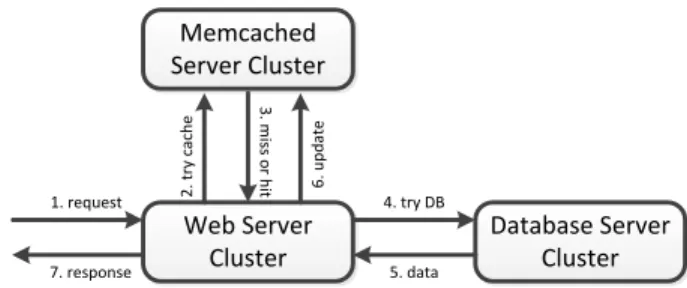
Along this direction, we aim at eliminating the performance penalties caused by dynamic cache cluster provisioning in a 3-tier server cluster as shown in Fig. 4.1. Time is divided into slots. Let N denote the total number of cache servers, and n(t) denote the number of
Web Server Cluster Memcached Server Cluster Database Server Cluster 1. request 7. response 2 . t ry c ac h e 3. m is s o r h it 4. try DB 5. data 6 . u p d at e
Figure 4.1: Simplified Information Flow
running cache servers in thetthtime slot. The data keykeydcan be a page title in Wikipedia, a user ID in Facebook, etc. With keyd, the web server cluster fetches corresponding data d from either the cache server md or the database tier, and then presents the response to
users. Cache servers store data in the form of (key, data) pairs. We define a piece of data as “hot” if it is touched at least once during the pastT T L seconds. Please note that, we do not make any assumptions on the cache eviction strategy (LRU, fixed expiration duration, etc.). At one time instance, a cache server is called active if it hosts “hot” data and serves requests. Otherwise, it is called inactive, and operates in low power status.
Assumptions
• Each object in cache is of the same size. Even though the size of pages or user accounts would vary considerably, they can be divided into fixed-size pieces. One piece is con-sidered as the basic unit of objects in cache. Actually, modern storage clusters already employ such idea [53–55].
• The load of requests have temporal behavior, and the gap between the peak and the nadir load is huge. Our study of Wikipedia’s traces supports this assumption.
Objectives
• Balance load distribution in cache tier under dynamics: We define the load as the amount of data objects served by the cache cluster. In static environments, the load can be easily balanced by using hash and modular operations. We pursue the same