Chapter 3
Elementary statistical concepts
Demetris KoutsoyiannisDepartment of Water Resources and Environmental Engineering
Faculty of Civil Engineering, National Technical University of Athens, Greece
Summary
This chapter aims to serve as a reminder and synopsis of elementary statistical concepts, rather than a systematic and complete presentation of the concepts. Statistics is the applied branch of probability theory which deals with real world problems, trying to draw conclusions based on observations. Two major tasks in statistics are estimation and hypothesis testing. Statistical estimation can be distinguished in parameter estimation and prediction and can be performed either on a point basis (resulting in a single value, the expectation), or on an interval basis (resulting in an interval in which the quantity sought lies, associated with a certain probability or confidence). Uses of statistical estimation in engineering applications include the estimation of parameters of probability distributions, for which several methods exist, and the estimation of quantiles of distributions. Statistical hypothesis testing is also an important tool in engineering studies, not only in typical decision making processes, but also in more analytical tasks, such as in detecting relationships among different geophysical, and particularly hydrological, processes. All this concepts are briefly discussed both in a theoretical level, to clarify the concepts and avoid misuses, and a more practical level to demonstrate the application of the concepts.
3.1 Introductory comments
Statistics is the applied branch of probability theory which deals with real world problems, trying to draw conclusions based on observations. The conclusions are only inferences based on induction, not deductive mathematical proofs; however, if the associated probabilities tend to 1, they become almost certainties. The conclusions are attributed to a population, while they are drawn based on a sample. Although the content of term population is not strictly defined in the statistical literature, loosely speaking we consider that the term describes any collection of objects whose measurable attributes are of interest. It can be an abstraction of a real world population or of the repetition of a real experiment. The population can be finite (e.g. the population of the annual flows of the hydrologic year 1990-91 for all hydrologic basins of earth with size greater than 100 km2) or infinite and abstractively defined (e.g. the population of all possible annual flows of a hydrologic basin). The term sample describes a collection of observations from the particular population (see definition in section 3.2.1).
An important concept of statistics is the estimation. It is distinguished in parameter estimation and prediction. In order to clarify these concepts, we consider a population that is
represented by a random variable X with distribution function FX(x; θ) where θ is a parameter.
A parameter estimation problem is a problem in which the parameter is unknown and we seek an estimate of it. A prediction problem is a problem in which the parameter is known and we seek an estimate of the variable X or a function of X. As we will see below, these two problems are dealt with using similar methods of statistics, and thus they are both called estimation problems. The results of the estimation procedures are called estimates.
An estimate can be either a point estimate, i.e. a numerical value, or an interval estimate, i.e. one interval that contains the value sought with a given degree of certainty. Conversely, for a given interval, statistics can calculate the corresponding degree of certainty or, on the contrary, the degree of uncertainty, that the quantity sought lies within the interval.
Another important area of statistics is hypothesis testing that constitutes the basis of the decision theory. The process of hypothesis testing requires the formulation of two statements: the basic H0, that is referred to as the null-hypothesis, and the alternative hypothesis H1. We
start the process of testing by considering that the null hypothesis is true and we use the observations to decide if this hypothesis should be rejected. This is done using of statistical methods. Although the hypothesis testing is based on the same theoretical background as the estimation, the difference lies in the examination of two alternative models, while in the estimation we use only one model.
The background for all these concepts is described in this chapter while in the next chapters several additional numerical examples are given. Of course, statistics include many other areas, such as the Bayesian analysis, but these are not covered in this text.
3.2 Concepts and definitions
3.2.1 Sample
We consider a random variable X with probability density function f(x). The variable is defined based on a sample space Ω and is conceptualized with some population. A sample of X of size (or length) n of is a sequence of n independent identically distributed (IID random variables X1, X2, …, Xn (each having density f(x)) defined on the sample space Ω n = Ω × … × Ω (Papoulis, 1990, p. 238). Each one of the variables Xi corresponds to the possible
results of a measurement or an observation of the variable X. After the observations are performed, to each variable there corresponds a numerical value. Consequently, we will have a numerical sequence x1, x2, …, xn, called the observed sample.
The concept of a sample is, therefore, related to two types sequences: an abstractive sequence of random variables and the corresponding sequence of their numerical values. It is common in engineering application to use the term sample indistinguishably for both sequences, omitting the term observed from the second sequence. However, the two notions are fundamentally different and we should be attentive to distinguish each time in which of the two cases the term sample refers to.
3.2 Concepts and definitions 3
In statistics it is assumed that the construction of a sample of size n or the sampling is done by performing n repetitions of an experiment. The repetitions should be independent to each other and be performed under virtually the same conditions. However, in dealing with natural phenomena and in engineering it is not possible to repeat the same experiment, and thus sampling is a process of multiple measurements of the a natural process at different times. As a consequence, it is not possible to ensure that independence and same conditions will hold. Nonetheless, for certain situations we can assume that the previous conditions are approximately valid (an assumption equivalent to simultaneously assuming independence, stationarity and ergodicity, cf. chapters 2 and 4) and thus we can use classical statistical methods of statistics to analyse them. However, there are cases where these conditions (the independence in particular) are far from holding and the use of classical statistics may become dangerous as the estimations and inferences may be totally wrong (see chapter 4).
3.2.2 Statistic
A statistic is defined to be a function of a sample’s random variables, i.e. Θ = g(X1, …, Xn) (in
vector notation, Θ = g(X), where X := [X1, …, Xn]T is known as the sample vector; note that
the superscript T denotes the transpose of a vector or matrix). From the observations we can calculate the numerical value of the statistic, i.e. θ = g(x1, …, xn). Clearly, the statistic Θ is not
identical with its numerical value θ. In particular, the statistic, as a function of random variables, is a random variable itself, having a certain distribution function. Whereas the numerical value of the statistic is simply calculated from the mathematical expression g(x1, …, xn) using the sample observations, its distribution function is deducted based on
theoretical considerations as we will see in later sections. Typical examples of commonly used statistics are given below.
3.2.3 Estimators and estimates
A statistics is used to estimate a population parameter. For any population parameter η, there exists one or more statistic of the form Θ = g(X1, …, Xn) suitable for the estimation of this
parameter. In this case we say that Θ = g(X1, …, Xn) is an estimator of the parameter η and
that the numerical value θ = g(x1, …, xn) is an estimate of η.
There is not a unique criterion to decide if a statistic can be used for the estimation of a population parameter. Often the mathematical expression g(X1, …, Xn) is formulated as if η
was a population parameter of a finite sample space identical with the available sample. For example, if we wish to find an estimator of the mean value η≡ mX of a variable X, based on
the sample (X1, …, Xn) with observations (x1, …, xn), we can think of the case where X is a
discrete variable taking values (x1, …, xn), each with the same probability P(X = xi) = 1/n. In
this case, by definition of the mean (eq. (2.21) - (2.23)) we find that η = (x1 + … + xn)/n. If in
the latter equation we replace the numerical values with the corresponding variables, we obtain the statistic Θ = (X1 + … + Xn)/n. As we will see, this is the estimator of the mean
value of any random variable, it is named sample mean and it is typically denoted as X . However, this empirical approach does not give always a good estimator.
Whereas an estimator is not defined by in a strict mathematical procedure in the general case, several estimator categories have rigorous definitions. Thus:
1. A statistic Θ is an unbiased estimator of the parameter η if E[Θ] = η. Otherwise, it is a biased estimator and the difference E[Θ] – η is called bias.
2. An estimator is Θ is a consistent estimator of the parameter η if the estimation error Θ – η
tends to zero with probability 1 as n →∞. Otherwise, the estimator is inconsistent.
3. A statistic Θ is the best estimator of the parameter η if the mean square error E[(Θ – η)2] is minimum.
4. A statistic Θ is the most efficient estimator of the parameter η if it is unbiased and with minimum variance (where due to unbiasednees the variance equals the estimation error). It is easy to show that the estimator X of the previous example is an unbiased and consistent estimator of the population mean mX (see section 3.3.1). Moreover, for certain
distributions functions, it is best and most efficient.
In practice, efforts are taken to use unbiased and consistent estimators, while the calculation of the best and most effective estimator is more of theoretical interest. For a certain parameter it is possible to find more than one unbiased or consistent estimator. Often, the determination of unbiased estimators is difficult or impossible, and thus we may content with the use of biased estimators.
3.2.4 Interval estimation and confidence intervals
An interval estimate of a parameter η is an interval of the form (θ1, θ2), where θ1 = g1(x1, …,
xn) and θ2 = g2(x1, …, xn) are functions of the sample observations. The interval (Θ1, Θ2)
defined by the corresponding statistics Θ1 = g1(X1, …, Xn) and Θ2 = g2(X1, …, Xn) is called the
interval estimator of the parameter η.
We say that the interval (Θ1, Θ2) is a γ-confidence interval of the parameter η if
P{Θ1 < η < Θ2} = γ (3.1)
where γ is a given constant (0 < γ < 1) called the confidence coefficient, and the limits Θ1 and Θ2 are called confidence limits. Usually we choose values of γ near 1 (e.g. 0.9, 0.95, 0.99, so
as the inequality in (3.1) to become near certain). In practice the term confidence limits is often (loosely) used to describe the numerical values of the statistics θ1 and θ2, whereas the
same happens for the term confidence interval.
In order to provide a general manner for the calculation of a confidence interval, we will assume that the statistic Θ = g(X1, …, Xn) is an unbiased point estimator of the parameter η
3.3 Typical point estimators 5
calculate two positive numbers ξ1 and ξ2, so that the estimation error Θ – η lies in the interval
(–ξ1, ξ2) with probability γ, i.e.
P{η – ξ1 < Θ < η + ξ2} = γ (3.2)
and at the same time the interval (–ξ1, ξ2) to be the as small as possible.* Equation (3.2) can be
written as
P{Θ – ξ2 < η < Θ + ξ1} = γ (3.3)
Consequently, the confidence limits we are looking for are Θ1 = Θ – ξ2 and Θ2 = Θ + ξ1.
Although equations (3.2) and (3.3) are equivalent, their statistical interpretation is different. The former is a prediction, i.e. it gives the confidence interval† of the random
variable Θ. The latter is a parameter estimation, i.e. it gives the confidence limits of the unknown parameter η, which is not a random variable.
3.3 Typical point estimators
In this section we present the most typical point estimators referring to the population moments of a random variable X irrespectively of its distribution function F(x). Particularly, we give the estimators of the mean, the variance and the third central moment of a variable. We will not extend to higher order moments, firstly because it is difficult to form unbiased estimators and secondly because for typical sample sizes the variance of estimators is very high, thus making the estimates extremely uncertain. This is also the reason why in engineering applications moments higher than third order are not used. Even the estimation of the third moment is inaccurate for a small size sample. However, the third moment is an important characteristic of the variable as it describes the skewness of its distribution. Moreover, hydrological variables are as a rule positively skewed and thus an estimate of the skewness is necessary.
Apart form the aforementioned moment estimators we will present the L-moment estimators as well as the covariance and correlation coefficient estimators of two variables that are useful for the simultaneous statistical analysis of two (or more) variables.
3.3.1 Moment estimators
The estimators of raw moments (moments about the origin) of one or two variables, i.e. the estimators of and (where r and s are chosen integers), formed according to the empirical method described in section 3.2.3, are given by the following relationships:
) (r X m (rs) XY m
* If the distribution of Q is symmetric then the interval (–ξ
1, ξ2) has minimum length for ξ1 = ξ2. For non-symmetric distributions, it is difficult to calculate the minimum interval, thus we simplify the problem by splitting the (3.2) into the equations P{Θ<η–ξ1}= P{Θ>η+ξ2} = (1–γ)/2.
† The terms confidence limits, confidence interval, confidence coefficient etc. are also used for this prediction
n Y X M n X M n i s i r i rs XY n i r i r X
∑
∑
= = = = 1 ( ) 1 ) ( , ~ ~ (3.4) It can be proved (Kendall and Stewart, 1968, p. 229) that[ ]
~( ) ( ),[ ]
~( ) (rs) XY rs XY r X r X m EM m M E = = (3.5)Consequently, the moment estimators are unbiased. The variances of these estimators are
[ ]
( )[
(2 )( )
( ) 2]
[ ]
~( ) 1[
(2,2)( )
( ) 2]
Var , 1 ~ Var rs XY s r XY rs XY r X r X r X m m n M m m n M = − = − (3.6)It can be observed that if the population moments are finite, then the variances tend to zero as n →∞; therefore the estimators are consistent.
Typical central moment estimators, i.e. estimators of and of one and two variables, respectively, are those defined by the equations
) (r X µ (rs) XY µ
(
)
(
) (
)
n Y Y X X M n X X M n i s i r i rs XY n i r i r X∑
∑
= = − − = − = 1 ( ) 1 ) ( , ˆ ˆ (3.7)These have been formed based on the empirical method described in section 3.2.3.These estimators are biased (for r + s > 1).
3.3.2 Sample mean
The most common statistic is the sample mean. As we have seen in section 3.2.3, the sample mean is an estimator of the true (or population) mean mX = E[X] and is defined by
∑
= = n i i X n X 1 1 (3.8) which is a special case of (3.4) for r = 1. Its numerical value∑
= = n i i x n x 1 1 (3.9) is called the observed sample mean or simply the average. The symbols X and x should notbe conceptually confused with each other nor with the true mean of the random variable X, i.e. mX = E[X], which is defined based on the equations (2.20) or (2.21) and (2.23). Nevertheless,
these three quantities are closely related. Implementation of equations (3.5) and (3.6) gives
[ ]
[ ]
[ ]
[ ]
n X X X E X E = , Var = Var (3.10)regardless of the distribution function of X*. Thus, the estimator is unbiased and consistent.
* However, Var[X] depends on the dependence structure of the variables X
i; the formula given in ( ) holds
only if Xi are independent. On the other hand, the formula for E[
3.10
3.3 Typical point estimators 7
3.3.3 Variance and standard deviation
A biased estimator of the true (population) variance 2 is: X σ
(
)
n X X S n i i X∑
= − = 1 2 2 (3.11)It can be proved (Kendall and Stewart, 1968, p. 277) that
[ ]
[ ]
(
)
3 4 ) 4 ( 2 4 ) 4 ( 4 ) 4 ( 2 2 2 3 2 2 Var 1 n σ µ n σ µ n σ µ S σ n n S E X X X X X X X X X − + − − − = − = (3.12)where (4) is the fourth central population moment. The two last terms in the expression of X
µ
[ ]
2VarSX can be omitted for large values of n. From the expression of
[ ]
2 X SE in (3.12) we observe that multiplication of 2 by n/(n – 1) results in an unbiased estimator of , i.e.
X S 2 X σ
(
)
1 1 2 2 * − − =∑
= n X X S n i i X (3.13) 2 * XS is known as sample variance. For large sample sizes, the two estimators and are practically the same. If the population is normally distributed, it can be shown that
2 X S *2 X S
[ ]
(
)
[ ]
(
)
1 2 Var , 1 2 Var 4 2 * 2 4 2 − = − = n σ S n σ n S X X X X (3.14)The standard deviation estimators in common use are the square roots of the variance estimators, namely the SX and SX* and are not unbiased. Thus (Yevjevich, 1972, p. 193.
Kendall and Stewart, 1968, p. 233),
[ ]
[ ]
⎟ ⎠ ⎞ ⎜ ⎝ ⎛ + − = ⎟ ⎠ ⎞ ⎜ ⎝ ⎛ + = (4) 2 4 12 4 Var , 1 n O n σ σ µ S n O σ S E X X X X X X (3.15)where the terms O(1/n) are O(1/n2) are quantities proportional to 1/n and 1/n2, respectively, and can be omitted if the sample size is large enough (n ≥ 20).
If the population is normally distributed, the following approximate equations can be used for SX
[ ]
[ ]
n σ S n n σ S E X X X X 2 Var , 1 2 ≈ − ≈ (3.16)For n ≥ 10 the errors of these equations are smaller than 2.5% and 2.7% respectively, while for n ≥ 100 are practically zero. The corresponding equations for * are*
X S
[ ]
[ ]
(
)
1 2 Var , 2 * * − ≈ ≈ n σ S σ S E X X X X (3.17)Finally, one of the two following estimators of the coefficient of variation can be used: X S C X S C X v X vX X * * ˆ , ˆ = = (3.18)
If the variable X is positive, then it can be shown that these estimators are bounded from above (Cˆ ≤ n−1
X
v ) while the same does not hold for the corresponding population parameters. Obviously, this introduces bias.†
3.3.4 Third central moment and skewness coefficient
A biased estimator of the true (population) third central moment (3) is given by X µ
(
)
n X X M n i i X∑
= − = 1 3 ) 3 ( ˆ (3.19)for which it can be shown (Kendall and Stewart, p. 278-281) that
[ ]
(
)(
)
(3) 2 ) 3 ( 1 2 ˆ X X µ n n n M E = − − (3.20)It immediately follows that an unbiased (and consistent) estimator of µX(3) is
(
)
(
1)(
2)
ˆ 1 3 ) 3 ( * − − − =∑
= n n X X n M n i i X (3.21)For large sample size n, the two estimators are practically the same.
The estimation of the skewness coefficient is done using the following estimator
X s C 3 ) 3 ( ˆ ˆ X X s S M C X = 22)
* More accurate approximations are given by
[ ]
[ ]
(
)
4 3 2 * 4 3 4 5 * 2 , − ≈ − − ≈ n σ S Var n n σ S E X X X Xthe errors of which for n≥ 10 are less than 0.005% and 0.2%, respectively. The precise equations are
[ ]
( )( )[ ]
( )( )⎥ ⎦ ⎤ ⎢ ⎣ ⎡ − = = − − − − 21 2 21 2 2 2 * 21 21 2 * , 1 n n n X X n n n X X Γ Γ σ S Var Γ Γ σ S E† The expression of the estimator’s variance is quite complex and is omitted (cf. Kendall and Stewart, 1968, p.
233). If X follows a normal distribution then
[ ]
VarC$vX ≈CvX/
3.3 Typical point estimators 9
which is not unbiased. The bias does not originate only from the fact that the two moment estimators (numerator and denominator) are not unbiased themselves, but also (mainly) from the fact that C^sX is bounded both from above and from below, whilst the population CsX is not
bounded. This is due to the finite sample size n, which determines the upper and lower limit. Thus, it has been shown (Kirby, 1974; Wallis et al., 1974) that |C^sX| ≤ (n – 2) / n – 1.
Several approximate bias correction coefficients have been proposed in the literature to be multiplied by C^s
X estimated from (3.22) to obtain a less biased estimate. None of them leads to
a rigorous unbiased estimator of the coefficient of skewness. The four most common are:
(
)
2 1 − − n n n ,(
)(
)
2 1 2 − − n n n(
)
⎟ ⎠ ⎞ ⎜ ⎝ ⎛ + − − n n n n 8.5 1 2 1 , 2 2 2 ˆ 77 . 6 48 . 1 20 . 20 51 . 6 1 CsX n n n n ⎟⎠ ⎞ ⎜ ⎝ ⎛ + + ⎟ ⎠ ⎞ ⎜ ⎝ ⎛ + + (3.23) ,The first is obtained if in (3.22) the biased moment estimators are replaced by the unbiased ones. The second results if in (3.22) we replace the biased third moment estimator with the unbiased one (Yevjevich, 1978, p. 110). The third one has been proposed by Hazen and the last one has been proposed by Bobée and Robitaille (1975), based on results by Wallis et al. (1974).
3.3.5 L-moments estimates
Unbiased estimates of the probability weighted moments are given by the following relationship (Landwehr et al., 1979):
) (r X b (r) X β = ) (r X b ⎟⎟ ⎠ ⎞ ⎜⎜ ⎝ ⎛ − ⎟⎟ ⎠ ⎞ ⎜⎜ ⎝ ⎛ −
∑
− = r n x r j n n r n i i 1 1 1 ) ( = () 1 ( 1)( 2)...( ) ) 1 )...( 1 )( ( 1 i r n i x r n n n r i n i n i n n∑
− = − − − + + − − − − (3.24)where n is the sample size, and x(i) the ordered observations so that x(n) ≤ … ≤ x(2)≤ x(1)*. The estimates† of the first four probability weighted moments are:
= ) 0 ( X b
∑
= n i i x n 1 ) ( 1 = x = ) 1 ( X b 2 () 1 1 1 i n i x n i n n∑
− = − − = ) 2 ( X b 2 () 1 ( 1)( 2) ) 1 )( ( 1 i n i x n n i n i n n∑
− = − − − − − (3.25) * Notice that x(1) is the largest observation; the equations are somewhat simpler if the observations are ordered from smallest to largest but it has been the rule in engineering hydrology to put the observations in descending order.
† The estimators of the same quantities are obtained by replacing x(i) with the variable X(i), the so called order
= ) 3 ( X b 3 () 1 ( 1)( 2)( 3) ) 2 )( 1 )( ( 1 i n i x n n n i n i n i n n
∑
− = − − − − − − − −Accordingly, the estimates of the first four L moments are calculated by the equations relating L moments and probability weighted moments (see equation (2.32)), i.e.,
= (= ) 1 ( X l (0) X b x) = 2 – ) 2 ( X l (1) X b (0) X b = 6 – 6 + (3.26) ) 3 ( X l (2) X b (1) X b (0) X b = 20 – 30 + 12 – ) 4 ( X l (3) X b (2) X b (1) X b (0) X b
3.3.6 Covariance and correlation
A biased estimator of the covariance σXY of two variables X and Y is:
(
)(
)
n Y Y X X S n i i i XY∑
= − − = 1 (3.27)It can be shown (e.g. Papoulis, 1990, p. 295) that
[ ]
XY σXYn n S
E = −1 (3.28)
Therefore, an unbiased (and consistent) estimator of σXY is
(
)(
)
1 1 * − − − =∑
= n Y Y X X S n i i i XY (3.29)known as sample covariance*.
The estimator of the correlation coefficient ρXY is given by the next relationship, known as
the sample correlation coefficient:
(
)(
)
(
) (
∑
)
∑
∑
= = = − − − − = = = n i i n i i n i i i Y X XY Y X XY XY Y Y X X Y Y X X S S S S S S R 1 2 1 2 1 * * * (3.30)The precise distribution function of this estimator and its moments are difficult to determine analytically; however, this estimator is regarded approximately unbiased.
3.4 Typical confidence intervals 11
3.4 Typical confidence intervals
3.4.1 Mean – known population variance
Let X be a random variable with mean µX and standard deviation σX. According to the central
limit theorem and equation (3.10), the sample mean X (the average of n random variables) will have normal distribution N
(
µX,σX / n)
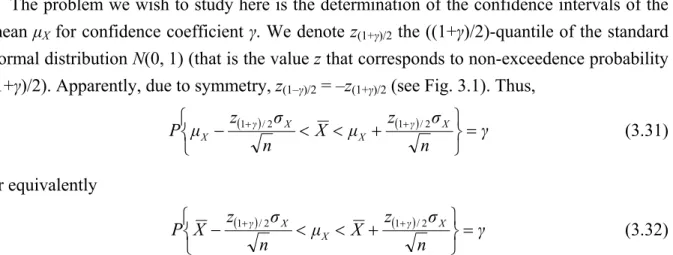
, if n is large enough. Moreover, it will have precisely this normal distribution irrespectively of the size n, if the random variable X is normal.The problem we wish to study here is the determination of the confidence intervals of the mean µX for confidence coefficient γ. We denote z(1+γ)/2 the ((1+γ)/2)-quantile of the standard
normal distribution N(0, 1) (that is the value z that corresponds to non-exceedence probability (1+γ)/2). Apparently, due to symmetry, z(1–γ)/2 = –z(1+γ)/2 (see Fig. 3.1). Thus,
( ) ( ) γ n σ z µ X n σ z µ P γ X X X γ X = ⎭ ⎬ ⎫ ⎩ ⎨ ⎧ + < < − 1+ /2 1+ /2 (3.31) or equivalently ( ) ( ) γ n σ z X µ n σ z X P γ X X X γ = ⎭ ⎬ ⎫ ⎩ ⎨ ⎧ + < < − 1+ /2 1+ /2 (3.32)
Equation (3.32) gives the confidence intervals sought. For the numerical evaluation we simply replace the estimator X in (3.32) with its numerical value x.
For convenience, Table 3.1 displays the most commonly used confidence coefficients and the corresponding normal quantiles z(1+γ)/2. We observe that as the confidence coefficient tends
to 1, which means that the reliability of the estimate increases, the confidence interval becomes larger so that the estimate becomes more vague. On the contrary, if we choose a smaller confidence coefficient, a more “compact” estimate will result. In this case, the confidence interval will be narrower but the uncertainty will be higher.
Area = γ Area = (1–γ)/2 Area = (1–γ)/2 x
( )
fX x µX γ σ X z n + (1+ )/2 µX γ σ X z n + (1− )/2 µ XTable 3.1 Typical values of the normal quantiles z(1+γ)/2 useful for the calculation of
confidence intervals.
γ 0.90 0.95 0.99 0.999
(1+γ)/2 0.95 0.975 0.995 0.9995 z(1+γ)/2 1.645 1.960 2.576 3.291
We observe from (3.32) that the only way to increase the accuracy without increasing the length of the confidence interval is to increase the sample size n by taking additional measurements.
The previous analysis was based on the assumption of known population variance, which in practice it is not realistic, because typically all our information comes from a sample. However, the results are of practical interest, since (3.32) provides a good approximation if the sample size n is large enough (> 30) and if we replace the population variance with its sample estimate.
3.4.2 Mean – unknown population variance
The analysis that we present here can be used for unknown population variance and for any sample size. However, this analysis has a restrictive condition, that the random variable X is normal, N(µX, σX). In this case the following conclusions can be drawn:
1. The sample mean has a normal distribution N
(
µX,σX / n)
. This conclusion is a consequence of a basic property of the normal distribution, specifically the normal distribution is closed under addition or, else, a stable distribution.2. The function of the sample variance
(
1)
*2/ 2 X X σ Sn− follows the χ2(n – 1) distribution. This is concluded by the theorem of section 2.10.4, according to which the sum of the squares of a number of standard normal variables follows the χ2 distribution.
3. The random variables X and are independent. This results form a statistical theorem (see e.g. Papoulis, 1990, p. 222).
2 * X S 4. The ratio (X µ )/(S* / n) X X
− follows the Student t(n – 1) distribution. This results by a theorem of 2.10.5.
We denote t(1+γ)/2 the [(1+γ)/2]-quantile of the Student t(n – 1) distribution (that is the point
t that corresponds to exceedence probability (1+γ)/2, for n – 1 degrees of freedom). Because of the symmetry, t(1–γ)/2 = –t(1+γ)/2. Thus,
( ) t( ) γ n S µ X t P γ X X γ = ⎭ ⎬ ⎫ ⎩ ⎨ ⎧ < − < − 1+ /2 * 1+ /2 / (3.33) or equivalently
3.4 Typical confidence intervals 13 ( ) ( ) γ n S t X µ n S t X P γ X X X γ = ⎪⎭ ⎪ ⎬ ⎫ ⎪⎩ ⎪ ⎨ ⎧ + < < − + 1+ /2 * * 2 / 1 (3.34)
Equation (3.34) provides the confidence interval sought. For its numerical evaluation we simply replace in the interval estimators of (3.34) the estimators X and with the corresponding sample estimates
* X S x and * . X s
Even though (3.32) and (3.34) are considerably different regarding their theoretical grounds and the assumptions they rely upon, from a computational perspective they are quite similar. Furthermore, for large n (>30) they practically coincide taking into account that
(more precisely 2 / ) 1 ( 2 / ) 1 ( γ z γ
t + ≈ + t(1+γ)/2 ≈ z(1+γ)/2 (n−1)/(n−3), for n – 1 degrees of freedom). The two previous analyses do not include the case of a small sample size, unknown variance and non-normal distribution. This case is not covered in statistics in a general and rigorous manner. However, as an approximation, often the same methodology is also used in these cases, provided that the population distribution is bell shaped and not too skewed. In general, the cases where precise confidence intervals can be determined based on a consistent theoretical procedure, are the exception rather than the rule. In most of the following problems we will use just approximations of the confidence intervals.
3.4.3 A numerical example of interval estimation of the mean
From a sample of annual inflows to a reservoir with length 15 (years), the sample mean is 10.05 hm3 and the sample standard deviation 2.80 hm3. We wish to determine (1) the 95% confidence interval of the annual inflow and (2) the sample size for 95% confidence coefficient that enables 10% precision in the estimation of the annual inflow.
(1) We assume that the annual inflows are IID with normal distribution (section 2.10.2) and we use the equation (3.34). Using the table of the Student distribution (Appendix A3) or any computational method (see section 2.10.5) we find that for n – 1 = 14 degrees of freedom t(1+γ)/2 = t0.975 = 2.14. Consequently, the 95% confidence interval is*
10.05 – 2.14 × 2.80/ 15 < µX < 10.05 + 2.14 × 2.80/ 15 (in hm3)
or
8.50 < µX <11.60 (in hm3)
For comparison, we will calculate the confidence interval using equation (3.32), even though this is not correct. From Table 3.1 we find z(1+γ)/2 = z0.975 = 1.96. Thus, the 95%
confidence interval is
* It would not be mathematically correct to write (3.34) replacing the estimators with their estimates, i.e.
P{10.05 – 2.62 × 2.80/ 15 < µX < 10.05 – 2.62 × 2.80/ 15 } = 0.95
We note that µX is a (unknown) parameter (i.e. a number) and not a random variable, so it does not have a
distribution function. Moreover, it is not correct to say e.g. that “with 95% probability the mean value lies in the interval (8.16, 11.94)”. The correct expression would be “with 95% confidence”.
10.05 – 1.96 × 2.80/ 15 < µX < 10.05 + 1.96 × 2.80/ 15 (in hm3)
or
8.63 < µX <11.47 (in hm3)
The confidence interval is this case is a little smaller.
(2) Assuming that n ≥ 30 we can use (3.32). The following equation must hold
1.96 × 2.8 / n= 10% × 10.05
so n = 30. We observe that the condition we have assumed (n ≥ 30) is valid. (If it were not valid we should proceed with a trial-and-error procedure, using equation (3.34)).
3.4.4 Variance and standard deviation
As in the section 0, we will assume that the random variable X has a normal distribution N(µX, σX). As mentioned before, in this case the function of the sample variance
follows the χ2(n – 1) distribution.
(
1)
*2/ 2 X X σ S n−We denote and the [(1+γ)/2]- and [(1–γ)/2]-quantiles, respectively, of the
χ2(n – 1) distribution (the two are not equal because the χ2 distribution is not symmetric). Thus, we have 2 2 / ) 1 ( γ χ + 2 2 / ) 1 ( γ χ − ( )
(
n σ)
S χ( ) γ χ P γ X X γ = ⎭ ⎬ ⎫ ⎩ ⎨ ⎧ < − < + − 2 21 /2 2 * 2 2 / 1 1 (3.35) or equivalently(
)
( )(
)
( ) γ χ S n σ χ S n P γ X X γ X = ⎪⎭ ⎪ ⎬ ⎫ ⎪⎩ ⎪ ⎨ ⎧ − < < − − + 21 /2 2 * 2 2 2 / 1 2 * 1 1 (3.36) Equation (3.36) gives the confidence interval sought. It is easily obtained that confidenceinterval of the standard deviation is given by
( ) ( ) γ χ S n σ χ S n P γ X X γ X = ⎪⎭ ⎪ ⎬ ⎫ ⎪⎩ ⎪ ⎨ ⎧ − < < − − + 21 /2 * 2 2 / 1 * 1 1 (3.37)
3.4.5 A numerical example of interval estimation of standard deviation
We wish to determine the 95% confidence interval of the standard deviation of annual inflow in the problem of section 3.4.3.
The sample standard deviation is 2.8 hm3. With the assumption of normal distribution for the inflow, we utilize equation (3.37). Using the χ2 distribution table (Appendix 2) or any computational method (see section 2.10.4) we find that for n – 1 = 14 degrees of freedom
χ2(1+γ)/2 = χ20.975 = 26.12 and χ2(1–γ)/2 = χ20.025 = 5.63. Thus, the 95% confidence interval is
63 . 5 80 . 2 * 14 12 . 26 80 . 2 * 14 < < X σ (in hm3)
3.4 Typical confidence intervals 15
or
2.05 < σX < 4.41 (in hm3)
3.4.6 Normal distribution quantile – Standard error
In engineering design and management (in engineering hydrology in particular), the most frequent confidence interval problem that we face, concerns the estimation of design values for quantities that are modelled as random variables. For instance, in hydrological design we may wish to estimate the reservoir inflow that corresponds to a non-exceedence probability 1%, that is the 1% quantile of the inflow. Let X be a random variable with distribution FX(x)
representing a natural quantity, e.g. a hydrological variable. Here we assume that FX(x) is a
normal distribution N(µX, σX), which can be easily handled, whereas in Chapter 6 we will
present similar methods for a repertoire of distributions being commonly used in engineering applications. For a given non-exceedence probability u = FX(x), the corresponding value of
the variable X ( symbolically xu, the u-quantile) will be
X u X u µ z σ
x = + (3.38)
where zu the u-quantile of the standard normal distribution N(0, 1). However, in this equation
the population parameters µX and σX are unknown in practice. Using their point estimates, we
obtain an estimate xˆu = x+zusX, that can be considered as a value of the random variable X
u u X z S
Xˆ = + (3.39)
This latter equation can be used to determine the confidence interval of xu. The precise
determination is practically impossible, due to the complexity of the distribution function of . Here we will confine our analysis in seeking an approximate confidence interval, based on the assumption that has normal distribution.
u Xˆ
u Xˆ
The mean of is given from equation (2.59), which can be combined with (3.10) and (3.15) to give
u Xˆ
[ ]
Xu E[ ]
X zuE[ ]
SX µX zuσX xuE ˆ = + ≈ + = (3.40)
assuming that n is large enough and omitting the term O(1/n) in E[SX].* Likewise, the variance
of Xˆu is given by equation (2.61), which can be written as
[ ]
Xˆu Var[ ]
X zuVar[ ]
SX 2zuCov[
X,SX]
Var = + 2 + (3.41)
Given that X has normal distribution, the third term of (3.41) is zero (as mentioned before, the variables X and SX are independent). Combining (3.10) and (3.16), we write (3.41) as
* The analysis here has an approximate character, thus we do not discriminate between the estimators S
X and ,
because for n large enough the two estimators are virtually identical.
[ ]
⎟⎟ ⎠ ⎞ ⎜⎜ ⎝ ⎛ + = + ≈ 2 1 2 ˆ Var := 2 2 2 2 2 2 X X u u X u u z n σ n σ z n σ X ε (3.42)The quantity εu is known in literature as standard quantile error or simply as standard error.
Assuming that has a normal distribution N(xXˆu u, εu) we can write γ z ε x X z P γ u u u γ = ⎭ ⎬ ⎫ ⎩ ⎨ ⎧ < − < − (1+ )/2 ˆ (1+ )/2 (3.43)
where γ is the confidence coefficient. Equivalently,
{
X z ε x X z ε}
γP ˆu − (1+γ)/2 u < u < ˆu + (1+γ)/2 u = (3.44) Replacing in the previous equation the term εu from (3.42), and then the standard deviation σX
with its estimator, we obtain the following final relationship
γ n S z z X x n S z z X P u X γ u u X u γ u = ⎪⎭ ⎪ ⎬ ⎫ ⎪⎩ ⎪ ⎨ ⎧ + + < < + − + + 2 1 ˆ 2 1 ˆ 2 2 / ) 1 ( 2 2 / ) 1 ( (3.45)
The latter equation is an approximation, whose accuracy is increased a n increases. Moreover, it is valid only in the case of normal distribution. However, (3.44) is also used for other distributions of the variable X, but with a different expression of the standard error εu
and a different calculation method. The interested reader for a general expression of the standard error may consult Kite (1988, p. 33-38).
The estimates of the confidence limits are
n s z z x x n s z z x x u X γ u u X u γ u u 2 1 ˆ ˆ , 2 1 ˆ ˆ1 = − (1+ )/2 + 2 2 = + (1+ )/2 + 2 (3.46) Clearly these estimates are functions of u or, equivalently, of the exceedence probability, 1 –
u. The depictions of those functions in a probability plot placed on either side of the xu curve
are known as confidence curves of xu.
3.4.7 A numerical example of interval estimation of distribution quantiles
Further to the numerical example of section 3.4.3, we wish to determine the 95% confidence interval of the annual inflow that has exceedence probability (a) 1% and (b) 99%. We note that, because of the small sample size, we will not expect a high degree of accuracy in our estimates (recall that the theoretical analysis assumed large sample size).
We will calculate first the point estimates (all units are hm3). For the annual inflow with exceedence probability F* = 0.01 we have u = 1 – F* = 0.99 and zu = 2.326. Thus, the point
estimate of = 10.05 + 2.326 × 2.80 = 16.56. Likewise, for the annual inflow with exceedence probability F* = 0.99 we have u = 1 – F* = 0.01 and zu = –2.326, thus = 10.05
– 2.326 × 2.80 = 3.54. u
xˆ
u
3.4 Typical confidence intervals 17
We can now proceed in the calculation of the confidence limits. For γ = 95% and z(1+γ)/2 = 1.96, the limits for the inflow with exceedence probability 1% are:
29 . 19 15 80 . 2 2 326 . 2 1 96 . 1 56 . 16 ˆ 83 . 13 15 80 . 2 2 326 . 2 1 96 . 1 56 . 16 ˆ 2 2 2 1 = + + = = + − = u u x x
Likewise, the limits for exceedence probability 99% are:
27 . 6 15 80 . 2 2 326 . 2 1 96 . 1 54 . 3 ˆ 81 . 0 15 80 . 2 2 326 . 2 1 96 . 1 54 . 3 ˆ 2 2 2 1 = + + = = + − = u u x x 3.4.8 Correlation coefficient
To calculate the confidence limits of the correlation coefficient ρ of a population described by two variables X and Y, we use the auxiliary variable Z, defined by the so-called Fisher transformation: Z e e R R R Z Z Z tanh 1 1 1 1 ln 2 1 2 2 = + − = ↔ − + = (3.47)
where R the sample correlation coefficient. We observe that for –1 < R < 1 the range of Z is –∞ < Z < ∞, while for R = 0, Z = 0. It can be shown that if X and Y are normally distributed, then Z has approximately normal distribution N(µZ, σZ) where
[ ]
[ ]
3 1 Var , 1 1 ln 2 1 2 − ≈ = − + ≈ = n Z σ ρ ρ Z E µZ Z (3.48)As a consequence, if ζ(1+γ)/2 is the (1+γ)/2-quantile of the standard normal distribution, we
obtain γ n ζ µ Z n ζ µ P γ Z γ Z = ⎭ ⎬ ⎫ ⎩ ⎨ ⎧ − + < < − − + + 3 3 2 / ) 1 ( 2 / ) 1 ( (3.49) or equivalently γ n ζ Z µ n ζ Z P γ Z γ = ⎭ ⎬ ⎫ ⎩ ⎨ ⎧ − + < < − − + + 3 3 2 / ) 1 ( 2 / ) 1 ( (3.50)
Replacing µZ from (3.48) into (3.50) and solving for ρ, and also taking into account the
monotonicity of the transformation (3.47), we obtain
P{R1 < ρ < R2} (3.51)
R R Z n ζ Z Z Z e e R e e R γ Z Z Z Z − + = − ± = ⎭ ⎬ ⎫ + − = + − = + 1 1 ln 2 1 3 1 1 1 1 2 / ) 1 ( 1 2 2 2 2 2 2 1 2 2 1 1 (3.52)
To numerically evaluate the confidence limits we implement equations (3.52) replacing the estimators with the corresponding estimates (e.g. R = r, etc.).
3.5 Parameter estimation of distribution functions
Assuming a random variable X with known distribution function and with unknown parameters θ1, θ2, …, θr we can denote the probability density function of X as a function
fX(x; θ1, θ2, …, θr.). For known x, this, viewed as a function of the unknown parameters, is
called the likelihood function. Here, we will examine the problem of the estimation of these parameters based on a sample X1, X2, …, Xn. Specifically, we will present the two most
classical methods in statistics, namely the moments method and the maximum likelihood method. In addition, we will present a newer method that has become popular in hydrology, the method of L moments.
Several other general methods have been developed in statistics for parameter estimation, e.g. the maximum entropy method that has been also used in hydrology (the interested reader is referenced to Singh and Rajagopal, 1986). Moreover, in engineering hydrology in many cases, other types of methods like graphical, numerical, empirical and semi-empirical have been used. Examples of such methods will be given for certain distributions in chapter 6. 3.5.1 The method of moments
The method of moments is based on equating the theoretical moments of variable X with the corresponding sample moment estimates. Thus, if r is the number of the unknown parameters of the distribution, we can write r equations of the form
(3.53) r k m m k X k X ˆ , 1,2, , ) ( ) ( K = =
where are the theoretical raw moments, which are functions of the unknown parameters and are given by
) (k X m (3.54)
(
∫
∞ ∞ − = x f x θ θ dx mk k X r X , 1, , ) ( K)
whereas ˆ(k) are the estimates, calculated from the observed sample according to X m
∑
= = n i k i k X x n m 1 ) ( 1 ˆ (3.55)3.5 Parameter estimation of distribution functions 19
Thus, the solution of the resulting system of the r equations gives the unknown parameters
θ1, θ2, …, θr. In general, the system of equations may not be linear and may not have an
analytical solution. In this case the system can be solved only numerically.
Equivalently, we can use the central moments (for k > 1) instead of the raw moments. In this case, the system of equations is
r k µ µ x µ k X k X X , ˆ , 2, , ) ( ) ( K = = = (3.56)
where (1) is the population mean, X
X m
µ = ˆ(1)
X m
x= the sample mean, the theoretical central moments given by the
) (k X µ (3.57)
(
) (
)
∫
∞ ∞ − − = x µ f x θ θ dx µ k X r X k X ; 1, , ) ( Kand ˆ(k) the corresponding sample estimates calculated by the relationship X µ
(
∑
= − = n i k i k X x x n µ 1 ) ( 1 ˆ)
(3.58)We recall that the raw moments in (3.55) are unbiased estimates, while the central moments in (3.58) are biased estimates. Nevertheless, unbiased central moment estimates are often used instead of the biased. Regardless of using biased or unbiased estimates for moments, in general the method of moments does not result in unbiased estimates of the parameters θ1, θ2, …, θr (except in special cases).
3.5.2 Demonstration of the method of moments for the normal distribution
As an example of the implementation of the method of moments, we will calculate the parameters of the normal distribution. The probability density function is:
(
)
( 2) 2 2 2 1 , ; σ µ x X e π σ σ µ x f − − = (3.59)and has two parameter, µ and σ. Thus, we need two equations. Based on (3.56), these equations are 2 2 , X X X x σ s µ = = (3.60)
where in the latter equation we have denoted the theoretical and sample variance (that is, the second central moment) of X, by the more common symbols and , respectively. We know (see section 2.10.2) that the theoretical moments are
2 X σ 2 X s (3.61) 2 2 , σ σ µ µX = X = Consequently, the final estimates are
(
)
∑
∑
= = − = = = = n i i X n i i x x n s σ x n x µ 1 2 1 1 , 1 (3.62)This estimation of σ biased, while that of µ is unbiased. If in the last equation we used the unbiased estimate of the variance, then we would have in the denominator (n-1) instead of n. Even in this case, the estimate of the σ would not be unbiased, for reasons explained in section 3.3.3.
As we have seen in this example, the application of the method of moments is very simple and this extends to other distribution functions.
3.5.3 The method of L moments
The logic of the method of L moments is the same as in the method of moments. If the distribution has r unknown parameters, we can write r equations of the form
λk = lk, k =1, 2,…, r (3.63)
where λk are the theoretical L-moments, which are functions of the unknown parameters, and
lk their sample estimates. Solving this system of equations we obtain the L-moment estimates
of the unknown parameters of the distribution. Because L moments are linear combinations of the probability weighted moments, (3.63) can be written equivalently as
βk = bk, k =0, 2,…, r – 1 (3.64)
where βk is the probability weighted moment of order k and bk is its estimate (see section
3.3.5).
Estimates based on L-moments are generally more reliable than those based on classical moments. Moreover, the L-moment estimators have some statistically desirable properties e.g. they are robust with respect to outliers, because contrary to standard moments, they do not involve squaring, cubing, etc., of the sample observations. In hydrology, the L moments have been widely used as descriptive statistics and in parameter estimation of several distributions. Examples of applications of the method can be found, among others, in Kjeldsen et al. (2002), Kroll and Vogel (2002), Lim and Lye (2003) and Zaidman et al. (2003).
3.5.4 The maximum likelihood method
Let X be a random variable with probability function fX(x, θ1, θ2, …, θr) where θ1, θ2, …, θr
are parameters, and X1, X2, …, Xn a sample of the variable. Let be
the joint distribution function of the sample vector X := [X1, X2, …, Xn]T. Our entire observed
sample can be thought of as single observation of the vector variable X. The idea behind the
maximum likelihood method is that the probability density
(
n r)
X X x x θ θ f n K K K, 1, , ; 1, , 1( )
n X Xf 1,K, at this single point will be as high as possible (it is natural to expect an observation to lie in an area with high probability density). We can thus find θ1, θ2, …, θr, so that the function have a
value as high as possible at the point (x1, x2, …, xn).
( )
n X X f , , 1KIn a random sample, the variables X1, X2, …, Xn are independent and the joint probability
3.5 Parameter estimation of distribution functions 21 (3.65)
(
)
∏
(
= = n i r i X r n X X x x θ θ f x θ θ f n 1 1 1 1 , , , , ; , , , 1K K K K)
and, viewed as a function of the parameters θ1, θ2, …, θr (for values of random variables equal
to the observations x1, …, xn) is the likelihood function of these parameters.
Assuming that is differentiable with respect to its parameters, the condition that maximizes it is
( )
n X X f , , 1K(
)
r k θ θ θ x x f k r n X X n 0, 1, , ∂ , , ; , , ∂ 1, , 1 1 K K K K = = (3.66)Using these r equations, the r unknown parameters will result. However, the manipulation of these equations may be complicated and, instead of maximizing the likelihood, we may attempt to maximize its logarithm
(3.67)
(
)
(
)
∑
(
= = = n i r i X r n X X r n θ θ f x x θ θ f x θ θ x x L n 1 1 1 1 , , 1 1,K, ; ,K : ln 1K ,K, ; ,K ln ; ,K)
The function L( ) is called the log-likelihood function of the parameters θ1, θ2, …, θr. In this
case, the condition of maximum is
(
)
(
)
(
θ)
k r θ θ x f θ θ x f θ θ θ x x L n i k r i X r i X k r n ; , 0, 1, , , ; 1 ∂ , ; , , ∂ 1 1 1 1 1 K K K K K = = ∂ ∂ =∑
= (3.68) Solving these r equations we obtain the values of the r unknown parameters.3.5.5 Demonstration of the maximum likelihood method for the normal distribution We will calculate the parameters of the normal distribution using the maximum likelihood method. The probability density function of the normal distribution is
(
)
( 2) 2 2 2 1 , ; σ µ x X e π σ σ µ x f − − = (3.69)Based on (3.65) we form the likelihood function
(
)
=(
)
∑= ( ) − − n i i µ x σ n n e π σ σ µ x x f 1 2 2 2 1 1 2 1 , ; , ,K X (3.70)and taking its logarithm we form the log-likelihood function:
(
)
( )
∑
(
= − − − − = n i i n x µ σ σ n π n σ µ x x L 1 2 2 1 2 1 ln 2 ln 2 , ; , ,K)
(3.71)Taking the derivatives with respect of the unknown parameters µ and σ and equating them to 0 we have
(
)
1(
)
0 ∂ ∂ , 0 1 ∂ ∂ 1 2 3 1 2 − = =− + − = =∑
∑
= = n i i n i i x µ σ σ n σ L m x σ µ L (3.72)and solving the system we obtain the final parameter estimates:
(
)
X n i i n i i x x s n σ x x n µ=∑
= =∑
− = = = 1 2 1 1 , 1 (3.73) The results are precisely identical with those of the section 3.5.2, despite the fact that thetwo methods are fundamentally different. The application of the maximum likelihood method is more complex than that of the method of moments. The identical results found here are not the rule for all distribution functions. On the contrary, in most cases the two methods yield different results.
3.6 Hypothesis testing
A statistical hypothesis is a hypothesis related to the value of one or more parameters of a statistical model, which is described by a distribution function. The hypothesis testing is a process of establishing the validity of a hypothesis. The process has two possible outcomes: either the hypothesis is rejected or accepted (more precisely: not rejected).
In this section we present very briefly the related terminology and procedure, while in next chapters we will present some applications. The reader interested for a more detailed presentation of the theory should consult statistics books (e.g. Papoulis, 1990, p. 321-387, Freund et al., 1988, p. 310-542), while for a presentation for hydrological applications is referenced to Hirsch et al. (1993, p. 17.11-29).
3.6.1 Terminology
• Null hypothesis is the hypothesis to be tested (symbolically H0). Usually, it is a hypothesis
of the form θ = θ0, where θ is parameter related to a distribution function of a given
variable and θ0 is a numerical value.
• Alternative hypothesis is a second hypothesis that should not be true at the same time with the null hypothesis (symbolically H1). It can be simple, such as θ = θ1, or (more
commonly) composite, such as θ≠θ0, θ > θ0 or θ < θ0.
• Test statistic is an appropriately chosen sample statistic, that is used for the test (symbolically Q).
• Critical region is an interval of real values. When the test statistic value lies in the critical region then the null hypothesis is rejected (symbolically Rc; see Fig. 3.2).
• One-sided test is a test where the alternative hypothesis is of the form θ > θ0 or θ < θ0. In
this case the critical region is a half line of the form (q > qC) or (q < qC), respectively.
• Two-side test is a test where the alternative hypothesis if of the form θ≠θ0. In this case the
3.6 Hypothesis testing 23 Area = α/2 Area = β
( )
f q Q , θ H 0 0: θ θ = R c q q L = q α/ 2 qU= q1–α/2 H1:θ θ ≠ 0 Critical region Critical region Rc Region of non rejection (a) Area = α/2 Area = β( )
f q Q , θ H 0 0: θ θ = q qC = q1− α H1:θ θ > 0 Critical region Rc Region of non rejection(b)
Area = α
Fig. 3.2 Explanatory sketch of the concepts related to statistical testing: (a) a two-sided test, (b) an one-sided
test.
• Parametric is a test whose hypotheses include specification of the population distribution function.
• Non parametric is a test valid for every population distribution function. • Decision rule is the rule to reject or not the null hypothesis, expressed as:
reject H0 if q ∈ Rc
• Type Ι error is the rejection (based on the decision rule) of a true null hypothesis. • Type ΙΙ error is the acceptance (based on the decision rule) of a false null hypothesis
• Significance level of a test is the probability of type I error, namely the probability to reject a true null hypothesis. Symbolically
{
Q R |H0}
Pα= ∈ c (3.74)
• Power of a test is the probability of rejecting a false null hypothesis. Symbolically,
{
| 1}
1 β P Q R H
where β is the probability of type II error, that is
{
Q R |H1}
Pβ= ∉ c (3.76)
3.6.2 Testing procedure
The testing procedure consists of the following steps:
1. Formulation of the null hypothesis H0 and of the alternative H1.
2. Choice of the test statistic Q = g(X1, …, Xn) and determination of the probability density
function of the fQ(q; θ).
3. Choice of the significance level α of the test and determination of the critical region Rc.
4. Calculation of the value q = g(x1, …, xn) of Q from the sample.
5. Application of the decision rule and rejection or acceptance of H0.
6. Calculation of the power p of the test.
The last step is usually omitted in practice, due to its complexity. All remaining steps are clarified in the following section.
3.6.3 Demonstration of significance testing for the correlation coefficient
As an example of the above procedure we will present the significance testing of the correlation coefficient of two random variables X and Y, according to which we can decide whether or not the variables are linearly correlated.
If the variables are not linearly correlated then their correlation coefficient will be zero. Based on this observation, we proceed in the following steps of the statistical testing.
1. The null hypothesis H0 is ρ = 0 and the alternative hypothesis H1 is ρ≠ 0. As a
consequence we will proceed with a two-sides test. (If we wanted to decide on the type of correlation, positive or negative, the alternative hypothesis would be formulated as ρ > 0 or
ρ < 0, and we would perform an one-sided test). 2. We choose the test statistic as
3 3 1 1 ln 2 1 − = − ⎟ ⎠ ⎞ ⎜ ⎝ ⎛ − + = n Z n R R Q (3.77)
where R is the sample correlation coefficient and Z is the auxiliary Fisher variable (section 3.3.6), which, if H0 is true, has approximately a normal distribution with mean 0 and
standard deviation 1 / n−3. Consequently, Q has standard normal distribution N(0, 1). 3. We choose a significance level α = 0.05. If z1–α/2 is the (1–α/2)-quantile of the normal
distribution, then the corresponding critical region Rc is the |q| > z1–α/2 or |q| > z0.975, or