P O L I C Y P A P E R S E R I E S Forschungsinstitut zur Zukunft der Arbeit IZA Policy Paper No. 8
Importing a Successful System?
Simulating Different Regimes of Financing
Social Security for Germany
Caroline Dieckhoener Andreas Peichl
Importing a Successful System?
Simulating Different Regimes of
Financing Social Security for Germany
Caroline Dieckhoener
EWI, University of Cologne
Andreas Peichl
IZA and ISER
Policy Paper No. 8
May 2009
IZA P.O. Box 7240 53072 Bonn Germany Phone: +49-228-3894-0 Fax: +49-228-3894-180 E-mail: [email protected]The IZA Policy Paper Series publishes work by IZA staff and network members with immediate relevance for policymakers. Any opinions and views on policy expressed are those of the author(s) and not necessarily those of IZA.
IZA Policy Paper No. 8 May 2009
ABSTRACT
Importing a Successful System? Simulating Different
Regimes of Financing Social Security for Germany
*In Germany, there is an ongoing debate about how to increase the efficiency of the social security system. The aim of this paper is to simulate different financing systems for Germany with its typical Conservative welfare state regime. For our analysis, we rely on the European static multinational microsimulation model EUROMOD, which provides the opportunity to implement the financing systems of other European countries in Germany (policy swap). The introduction of a Liberal British or the Southern Greek financing system increases inequality and poverty, as well as labour supply incentives. The introduction of the Social-democratic Danish financing system decreases inequality of incomes and leads to ambiguous incentives effects. Our results suggest that there is scope for efficiency increasing reforms in Germany although we do not simulate behavioural responses.
JEL Classification: C81, D31, H24
Keywords: social security, welfare states, comparative analysis, EUROMOD
Corresponding author: Andreas Peichl IZA P.O. Box 7240 53072 Bonn Germany E-mail: [email protected] *
This paper uses EUROMOD version C13. EUROMOD is continually being improved and updated and the results presented here represent the best available at the time of writing. EUROMOD relies on micro-data from twelve different sources for fifteen countries. This paper uses data from the European Community Household Panel (ECHP) User Data Base made available by Eurostat; the public use version of the German Socio Economic Panel Study (GSOEP) made available by the German Institute for Economic Research (DIW), Berlin; the Greek Household Budget Survey by the National Statistical Service of Greece; and the Family Expenditure Survey (FES), made available by the UK O ce for National Statistics (ONS) through the Data Archive. Material from the FES is Crown Copyright and is used by permission. Neither the ONS nor the Data Archive bears any responsibility for the analysis or interpretation of the data reported here. An equivalent disclaimer applies for all other data sources and their respective providers. This paper is based on work carried out during a visit to the European Centre for Analysis in the Social Sciences (ECASS) at the Institute for Social and Economic Research (ISER), University of Essex, supported by the Access to Research Infrastructures action under the EU Improving Human Potential Programme. We are grateful for financial support by the Fritz Thyssen foundation. We would like to thank Clemens Fuest, Judith Niehues, Thilo Schaefer and Sebastian Siegloch for helpful comments and suggestions. We are indebted to all past and current members of the EUROMOD consortium for the construction and development of EUROMOD.
1
Introduction
”Reforming Social Security to restore its financial balance is one of the most important public policy issues of the 21st century” (Clark (2004), p. 182). This is not only true for the US but almost every developed country as well. For instance, in Germany, there is an ongoing debate about how to increase the efficiency of the social security system and especially its financing. It is argued that due to the open European markets a lot of downward pressure weighs on the social security system, which leads to a race to the bottom. The German economist Hans-Werner Sinn noted in an interview with the German newspaper ’Die Zeit’1 that more financial means are needed for redistribution in order to compensate the losers of globalisation. Further on, demographic change will put additional pressure on the social security system over the next years (see also Sinn (2000)). A decreasing number of contributors will have to finance an increasing number of benefit recipients. Demographically induced labor shortages could be aggravated by the negative work incentives inherent in higher social security contributions. But on the other hand, it is getting more and more difficult to raise public funds. Some argue that more privatisation of the social insurance system is necessary to make the system financially viable. They refer to the economic growth and high labour market participation in Anglo-Saxon countries to point out the success of privatisation. Others argue that the financing of the welfare state is not a matter of financing per se but of the financing structure, pointing out that the Scandinavian countries with much higher tax burdens also display high growth rates, low unemployment and additionally less inequality of incomes (see Becker (2007)).
In this context, Germany’s financing system of social security is often compared to other welfare state systems and their financing structures. Concerning the comparison of welfare state systems, there are four types mentioned in the literature for the EU15 countries (see, e.g., Arts and Gelissen (2002)): the Conservative model based on social-contributions, the tax-financed Social-democratic welfare states with extensive public social security systems, the Liberal market-based model and the Southern model. Comparing the German financing structure to the Scandinavian or to the British system, the argument arises that too much costs on labour are caused by social contributions, which increases unemployment. Apparently, the German system of financing welfare has many disadvantages. The Harvard economist Stefan Collignon even claimed in the above-mentioned article of ’Die Zeit’ that the Conservative model of welfare provision has failed. It seems as if Germany’s European neighbours manage to finance their social insurance systems much better than the Germans and that a lot of progress is necessary to make the welfare state financially viable. Predominantly, these topics and the comparison of different financing structures are analysed on the macro-economic level, but what
is happening on the micro-economic level?
In this paper, we analyse the micro-level effects of implementing three representative proto-types of different welfare state regimes in Germany. With its socio-economic and demographic structure, Germany - Europe’s largest economy - can be seen as a typical Western European democracy. Therefore, the qualitative results of our analysis are of interest to a wider range of countries.2 To the best of our knowledge, this has not been analysed before in the literature. Thogersen (2001) simulates the intergenerational welfare effects of alternative funding strategies for Norway. Galasso and Profeta (2004) simulate the political sustainability of social security systems in 6 OECD countries with population ageing. Immervoll et al. (2007) use the European multinational microsimulation model EUROMOD to analyse the effects of introducing in-work benefits in 15 EU countries. For our analysis, we also rely on EUROMOD, which provides the opportunity to implement the financing systems of other European countries in Germany (policy swap). In doing so, the following questions will be raised: How are the income tax burden and the social contributions payments distributed between different households? What are the effects on inequality and poverty of different financing structures? How does the finan-cing structure affect the labour costs and the work incentives of different households? In this context, does the German welfare state manage to keep up with its European neighbours? Our results suggest that the Conservative German social security regime is quite successful with respect to equity targets but in terms of work incentives there is scope for efficiency gains.
The outline is as follows: In section 2, the financing structure of the respective welfare states is displayed as well as the detailed financing systems of each respresentative country of the four clusters. Section 3 starts with an introduction to the microsimulation model EUROMOD and the methodology used for the calculations that follow. The substitution of the German financing system by the systems of the other three representative countries of the previous section, namely Denmark, the United Kingdom and Greece, is simulated in section 4. Subsequently, the effects of these simulations on the income distribution, on labour costs and on labour supply incentives are summarised. Section 5 concludes.
2
Financing Systems in Europe
Arts and Gelissen (2002) present an overview of the literature on welfare state regimes following the seminal publication of Esping-Andersen (1990). In comparison to Esping-Andersen (1990)’s holistic point of view on a welfare state, this section will follow Kasza (2002)’s advice to focus on a specific domain of the welfare state to compare the welfare state systems, which will be 2It has to be taken into account, though, that the structures of the tax benefit systems do vary considerably
the financing structure. This section will present the design, structure and relevance of social contributions and income taxation in the four welfare state clusters and it will present these aspects in four representative countries to give a more detailed example and to introduce the parts of the financing systems that will be simulated for Germany later on. The main features of the four welfare state clusters are summarised in table 1
Conservative Social-democratic Liberal Southern Level of Income Taxes Intermediate High Low Low/ Intermediate
Level of Social Contributions High Intermediate/ Low Low Intermediate
Main Financial Source of Public Social Insurance Contributions Taxes Taxes Contributions
Degree of Privatisation of Social Insurance Intermediate Low High Intermediate
Table 1: Financing of Social Insurance in Europe
The financing objectives of a welfare state are miscellaneous and can have different functions such as distribution, allocation or stabilisation, whereas the ranking of the importance of these functions depends on the society’s preferences as well as the main sources of public funds (Musgrave and Musgrave (1989)). There are different means to finance a welfare state such as direct and indirect taxes, social insurance contributions or fees and charges. Some tax breaks or allowances are similar to transfers to the affected tax unit. Thus these instruments have a social expenditure function and an influence on the resulting income distribution, especially when considering tax reforms. The way of finance and the balance between different financing instruments reveal who pays for welfare and, concerning the social security system, also how welfare is distributed.
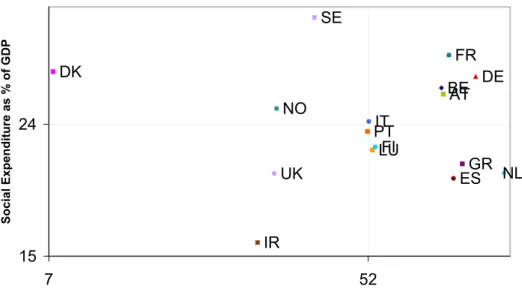
Bonoli (1997) focused on the financing structure of welfare states and clustered the countries according to the level of social protection expenditure and the importance of social contributions in the financing mix. The resulting Bonoli-matrix, as shown in figure 2, considers, on the one hand, the level of welfare provided and, on the other hand, the financing structure of the welfare system.
The four clusters of welfare states can be differentiated in this manner: the Nordic cluster with a high level of welfare provision in terms of social expenditure and a low percentage of social expenditure financed through contributions, the Conservative countries featuring a high percentage of social contributions and a high percentage of social expenditure, the Liberal cluster with low percentages for both dimensions and finally the Southern countries exhibiting a high level of social contributions like the Conservative countries, but a low level of social expenditure ascribed to their rudimentary state in the previous section.
Concerning the financing structure, the different countries within each type of welfare state have a lot of characteristics in common, but it is difficult to build an ideal-type for each welfare type in matters of financing. Therefore, representatives of each cluster will be taken,
BE DK DE IR GR ES FR IT LU AT PT FI SE UK NO NL 15 24 7 52
Social Contributions as % of Social Expenditure
Social Expenditure as % of GDP
Figure 1: Bonoli-Matrix
Source: Own calculation using data from Eurostat and OECD for 2003.
whose financial structure are noticeably different from the German one. Denmark, the UK and Greece have been chosen, because they display comparatively large distances from the German financing system in the Bonoli-matrix.3 Denmark with its large proportion of tax financing is outstanding. The UK represents the typical Liberal European welfare state and Greece is chosen because it is less developed than other Southern European welfare states, and thus represents a more rudimentary welfare state. This might seem to be a very simplified approach, but the aim of the simulation will not be to make general assumptions about the establishment of a different welfare system in Germany, but to see some tendencies and effects of changes in the financing system, which are derived from the respective countries and thus another welfare state type.
2.1
The Conservative Model of Financing
The Conservative welfare states provide a high level of public support and are relying especially on compulsory contributions to finance social security (Bismarckian idea). These contributions are paid to governmental institutions, which provide social security benefits, and can be either a fixed amount or a percentage of the wages. Employers usually also have to pay additional percentages to the contributions of employees.The entitlements for social insurance benefits 3Ireland could have been chosen instead of the UK, but since it is often argued that Ireland is just a
lacked-behind-system, and since the UK are always considered as the main representative of the Liberal welfare states in Europe, the UK seemed to be more adequate.
are mainly conditional on the contribution record and on employment. The insurance funds are often augmented by government transfers from the budget. In the European context, the Conservative states are characterised by an intermediate tax burden. The total tax revenue in per cent of GDP in these countries is close to the EU average of about 40%.4
The German Income Tax: In Germany, the taxable income includes salaries, wages,
self-employment income, investment income, rental income, income from farming and forestry and other income sources. The German income tax system is a progressive system with rates ranging from 19.9% to 48.5% in 2003. 7,235 e per year are tax-exempt in 2003. The tax schedule is formula-based.5 The income tax liability for married couples holds marital status tax relieves which are considered when applying the income splitting method.6 There is a child tax allowance of 3,648eper child in 2003. Expenses that have been made to obtain the taxable income are deductible. This includes all the expenses that are necessary to earn and maintain the taxable income. In addition, some special expenses are deductible, including church tax, tax consultant’s fees and interest payments as well as regular payments to dependants, education costs or donations. Further on, all expenses incurred in provision for the future, i.e. social insurance contributions or expenses such as for life insurances, are partially deductible from the tax base up to a certain ceiling.
Social Contributions in Germany: Unemployment benefits, health insurance,
long-term-care benefits, disability benefits, old age pensions, and survivor benefits are financed through compulsory contributions which are paid half by the employer and half by the em-ployee. The amount of total social security contributions is limited by a monthly or annual ceiling. Earnings that exceed this ceiling remain free of social contributions, which yields a re-gressive distribution of the burden (Peichl and Schaefer (2008)). The average health insurance contributions rates in 2005 amounted 13.3% and the annual ceiling for these contributions was 42,750 e. In addition, the social security system is subsidised by the Federal Budget. In case of employment injuries or occupational diseases, financial support is paid by employer’s contri-butions. Family allowances are financed through taxation. Contributions at a rate of 19.5% to pensions and disability and 6.5 per cent to unemployment insurance are compulsory for an income above 400 eper month. The contribution ceiling is set at the upper earnings threshold of 3,850 e for East and 4,600 e for West Germany per month. Under certain conditions, self-employed can opt out of the compulsory social insurance system.
4Cf. European Commission (2007).
5For a definition of the formula to determine the tax liability, see OECD (2007), p. 229.
6The splitting method allows the following: To determine the tax liability of jointly assessed spouses, the
2.2
The Social-Democratic Model of Financing
The Bonoli-matrix reflected the high level of social expenditure as percentage of GDP in the Scandinavian countries, which presumes a high level of financing. In 2005, Denmark and Sweden featured the highest shares of total tax revenue including social contributions in per cent of GDP in the EU. Denmark having a share of 50.3% and Sweden featuring 51.3%, these two countries were the only ones exceeding a share of 50%. The universal welfare states of the Scandinavian countries are mainly financed by general taxes in order to secure a minimum protection irrespective of a person’s participation in the labour market. They do not only exhibit the most elevated overall tax ratios but also show the highest personal income tax rates.7 Denmark had a top rate of 59% in 2006. Sweden followed with 56.6%. Finland’s top statutory personal income tax rate was 50.9%. The Danish tax structure stands out in several respects. In particular, the heavy reliance on direct income taxation in financing the public sector, while social contributions play a minor role, is incisive.
The Danish Income Tax: The taxable income is the sum of personal and capital incomes
such as wages, company profits, benefits, pensions, allowances, and capital income. Contribu-tions to private insurances are deductible to give people an incentive to accumulate savings. Income is taxed on an individual basis, however, spouses can transfer unused allowances to the partner. There are three taxation levels: the state, the county and the municipality level. Low income earners only pay municipal taxes and bottom-bracket tax to the state, those with slightly higher incomes additionally pay the middle-bracket tax, and those with the highest incomes additionally pay the top-bracket tax on the upper part of their income. The local tax rates are different across municipalities and counties. The average local tax rate in 2001 of 33.2% included a church tax of 0.7 per cent. State taxes are paid on income that exceeds the respective tax allowance. There are three income brackets. In 2001 income from 4,486.59e to 23,897.13 e is taxed at 6.25%, income from 23,897.13 to 37,195.69 e is taxed at additionally 6% and income above 37,195.69 e is taxed at 15% on top. In addition, income from shares, i.e. yield and profits, which have been held since at least three years, is taxed at a rate of 25% for an income up to 5,171.67 e and at a rate of 43% above this amount. An unused threshold can also be transferred between partners. The taxation ceiling without church tax and taxes on income from shares is 59%.
Social Contributions in Denmark: There are two types of contributions, i.e. most
importantly the general contributions from the insured employees and self-employed at a level of 8% of the salary or the gross earnings. In addition, employers pay 2%. Second, there are the contributions for special pension savings paid to the special saving scheme. The contribution 7Not being implemented in EUROMOD, indirect taxation is neglected in this paper, although it plays a
for the supplementary pension scheme paid by employees depends on the hours worked. For less than 9 hours of work per week no contributions are paid. For a full time work with at least 27 hours per week the contribution was 120.09 efor the year.8
2.3
The Liberal Model of Financing
Returning to the Bonoli-matrix, the residual character of the financing structure of the Liberal welfare states is shown by the low level of social expenditure in a Europe-wide comparison. The UK and Ireland are relying more on income taxation than on social contributions and they display low tax wedges between total labour costs to the employer and the corresponding net take-home pay at average earnings levels.9 The total tax revenue of the UK for 2005 of 37% falls slightly below the GDP-weighted EU average, whereas the Irish total tax revenue is much lower at 30.8% in the respective year.10 The Liberal tax schedules are simplified and transparent with a broad tax base and comparatively low tax rates on average. Concerning the top statutory personal income tax rate, the UK (40%) and Ireland (42%) are situated below the average EU-15 level but above the EU-25 average.
The Income Tax in the UK: The income tax system in the UK is an individual system.
For married couples, each spouse is taxed independently. The personal allowance was 4,615 pounds (6,632 e) per year in 2003. For people aged over 65, the personal allowances is higher (6,610 pounds or 9,499e in 2003) and even higher for those above the age of 75 (6,720 pounds or 9,657 e in 2003). The tax system is characterised by a comparatively broad base. Taxable income includes earnings from employment, earnings from self-employment, most pension in-come, i.e. state, company and personal pensions, interest on most savings, income from shares (dividends), rental income and income paid from a trust. The tax schedule is unified and thus practical. It consists of three rate bands with the rates 10%, 22% and 40%.
The Working Tax Credit (WTC) and the Child Tax Credit (CTC) are part of the British tax system, although they have the characteristics of benefits. The WTC is a tax credit for singles or couples who are employed or self-employed and work at least 16 hours per week. The WTC consists of several elements: A basic adult element of 2,191.51 e and extra elements which are paid e.g. if one household member works a total of 30 hours or more a week or for childcare. If a person qualifies for the child care element of WTC, this will always be paid alongside payments of CTC.
Social Contributions in the UK: In the UK there are overall contributions paid for
different social insurances. These contributions are a financial source comprehensively for si-8For 9 to 18 hours 1/3 of 120.09eand for 18 to 27 hours per week 2/3 of this amount have to paid. 9Cf. OECD (2007), pp. 11-14.
ckness and maternity, invalidity, old-age, survivors, and unemployment benefits. However, sickness and maternity are to a larger extent financed by taxation. Employment injuries and occupational diseases as well as family allowances are completely financed through taxes and also the unemployment insurance has additionally sources established by tax financing.11 Social contributions in the UK, namely National Insurance contributions, consist of four classes. Class 1 contributions are payable by employees earning more than 89 pounds, i.e. 127.9 e per week in 2003. Self-employed are subject to Class 2 and class 4 contributions which only entitle to basic retirement pension but not to short-term benefits. The ceiling of 3,664.4eper month for individuals that have to pay both self-employment and employment contributions is the same as for the employees. The classes differentiate between individuals that are contracted-out, i.e. who are privately insured, and those who are not. The Class 1 contribution rate is set at 11% if contracted-in plus 12.8% paid by the employers and at 9.4% plus 9.3% employer contribu-tions if contracted out. Self-employed that are subject to Class 2 contribucontribu-tions pay 8%. Class 3 contributions are paid on a voluntary base mainly by persons living abroad to keep their contribution record.
2.4
The Southern Model of Financing
Referring to the Bonoli-matrix , it can simplistically be said that the Southern model of finan-cing is characterised by a comparatively low level of social expenditure mainly financed in the Bismarckian way through social contributions. Thus, the financial sources needed to finance the expenditures are also lower than in other European countries, which is displayed by lower tax and contribution payments.
The Greek Income Taxation: In the Greek income tax system, the tax unit is the
individual, and the spouse’s income is taxed separately. However, there are some exceptions, i.e. several allowances and tax credits that are jointly assessed on the basis of a broader tax unit including the married couple and the dependent children. Social contributions are exempted from the tax base which covers taxable income minus various tax allowances. The tax schedule is graduated and progressive, including three tax bands with lower limits of 8,400 e, 13,400 e and 23,400 e. The respective tax rates are 15, 30 and 40%. Additionally, the upper limit of the first tax bracket could be extended by 1600 e maximum for tax payers with income from employment earnings and retirement benefits. As mentioned before, the Greek tax system comprises a number of tax credits and tax allowances, e.g., for charitable donations and private insurance payments, and a child allowance depending on the number of children.
Social Contributions in Greece: In Greece, social insurance programmes are mainly
funded by employees’ and employers’ contributions. Since 1993, some social insurance funds receive additional state subsidies and social sources.12 All individuals have to be members of a social security organisation. The majority of employees and workers in the private sector are directly and compulsorily insured with IKA.13All members of IKA are subject to contributions at a flat rate of 15.9% of their wages. In addition, employers pay 27.66% of these earnings. For ’hazardous’ workers, i.e. blue-collar workers who have to do heavy, unhealthy or dangerous work, extra contributions at 3.45% of the workers’ earnings are due, plus 2.15% paid by the employer, because these workers are entitled to a pension five years earlier. Civil servants and other public sector workers are covered by a separate scheme. Their contributions are set at a flat rate of 16.22%. Pensioners have to pay a flat rate of 4% for sickness insurance.14
Self-employed are covered by TEBE and are subject to lump-sum contributions depending on the insurance class. In TEBE there are ten insurance classes that are applied for individuals first employed before 1993 and there are additional five classes for later entrants to the labour market, all according to the pre-estimated self-employment income. For all individuals active in agriculture or in related sectors such as fishing that are residents in rural areas, a membership in the agricultural social insurance organisation OGA is compulsory. The OGA scheme is applied to employees and self-employed. Contributions are set according to seven different levels of theoretical income. The amount of contributions for the different classes was defined at about 8.5 of theoretical income, which included 7% for pension insurance and 1.5% for sickness insurance. Since contributors could choose their insurance class themselves, more than 75% were in the first category in 2003.15
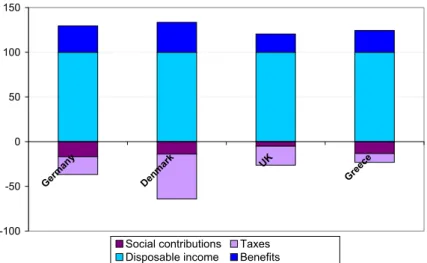
To sum up some aspects of this section, figure 2 displays the taxes, employee social contri-butions and benefits that would lead to a disposable income of 100ein the four countries that have been presented in detail. Concerning the quantity of welfare that is provided and the amounts that are levied from the original income, Denmark is in front, followed by Germany and then Greece. The financing structure of Germany and Greece is characterised by a large proportion of social contribution payments. Contrarily, the system of the UK and Denmark rely more on income taxation.
12The state gives subsidies to the social insurance institutions to finance sickness and maternity, invalidity,
old-age benefits, benefits for survivors and benefits paid for persons being affected by employment injuries or occupational diseases.
13IKA is the largest Social Insurance Organisation in Greece and covers about 5.5 million employees. 14Cf. European Commission (2006a) and Matsaganis and Tsakloglou (2004) and OECD (2007). 15Cf. Matsaganis and Tsakloglou (2004) and OECD (2007).
-100 -50 0 50 100 150 Ger man y Denmar k UK Greece
Social contributions Taxes Disposable income Benefits
Figure 2: Composition of 100 e Disposable Income, Average Source: Own calculations using EUROMOD C13.
3
Data and Methodology
EUROMOD is a static tax-benefit microsimulation model covering the EU15 countries. The model can be used for a wide range of applications, such as the exploration of the effects of different prospective or hypothetical changes in social and fiscal policy on the income distribu-tion and on labour incentives. One of the main ideas of EUROMOD is the comparability of the effects of social policies across nations within a common framework. However, there are some shortcomings: The model is static. Therefore it does not allow for the computation of dynamic or long-term changes in policy instruments such as pension policy. Moreover, information on social contribution histories is not present in the underlying database. According to this, only a partial simulation of social benefit receipts that are contributory is possible. Further on, EUROMOD does not incorporate the effects of behavioural changes.16
EUROMOD offers the possibility to simulate a policy swap, which means that parts of a country’s tax and benefit system can be implemented in another country to simulate the results of an introduction of the underlying policy. This allows to simulate different systems with Ger-man data instead of just comparing the systems in the respective countries to see first, what the effects are for the German population, and second, what happens if just implementing another country’s financing system without introducing its benefit system.17 The simulated reform sce-narios are not revenue-neutral. To establish revenue-neutral scesce-narios, some parameters would
16Cf. Sutherland (2001) for more information on EUROMOD.
17This approach was chosen to see the separate effects of different financing systems. It has to be kept in
mind that the tax and transfer systems often interact in reality. Atkinson (1999) analyses the effects of transfer programs on economic growth and employment.
need to be changed in the original system, which would change the original structure of the respective financing system. Moreover, there are many possibilities to build a revenue-neutral scenario, e.g. the tax rates could be changed or the tax base could be broadened. Therefore, the financing systems are left in their original structure for the simulation.
The disposable income of the simulated systems is compared using two different definitions. The first definition is the standard one of EUROMOD:
HH DisposableY =HH OriginalY −HH EESIC−HH T ax+HH Ben (1) whereHH DisposableY is disposable household income,HH OriginalY is the original house-hold income, andHH EESIC are employee contributions, HH T axtaxes paid, andHH Ben benefits received by the household. The second definition additionally accounts for the employer contributions of the different financing systems as they are part of the labour costs:18
HH DisposableY(ERSIC) = LabourCosts−HH ERSIC −HH EESIC
−HH T ax+HH Ben (2)
whereHH DisposableY(ERSIC) is disposable household income accounting for the employer contributions HH ERSIC, and the values of LabourCosts are computed adding the original employers contributions to the original income of the German system of 2003.
The average effective tax rate (AETR) measures the tax burden on total labour income as a fraction of the tax base. For the calculation of the AETR, only employees in the working age, i.e. between 16 and 64, are considered to compare the labour costs of the different systems (Immervoll (2004)). Social insurance payments of employees and employers are included in the tax burden. Thus, the computation of the AETRs is:
AET R = (EESIC+ERSIC+T axes)/(T axableY +ERSIC) (3) where EESIC are employee contributions, ERSIC employer contributions, T axes income taxes paid by the individual, and T axableY is taxable income. Hence, the AETR is a measure for the tax and contribution wedge on total labour income. The AETR reflects the participation decision of a worker to enter the labour market (extensive margin).
The marginal effective tax rate (METR) serves as a measure of labour supply incentives for the increase of work intensity along the intensive margin. It takes all benefits, taxes and social contributions into account that are paid by the individual. Benefits are also included, because 18This exercise is done to account for changing employers SIC under the assumption that the labour costs
they affect a person’s current cash disposable income and are accounted for, when the person decides to extent working hours. Similar to the computation of the AETRs, the METRs are only computed for employees as follows:
M ET R = 1−(4DisposableY /4OriginalY) (4)
where 4DisposableY is the change of disposable income, i.e. the change of post-tax-benefit income, and4OriginalY is the margin by which the original income increases, which is chosen here as an additional 3% of employment income (see Immervoll (2004)).
4
Simulating Different Financing Scenarios for Germany
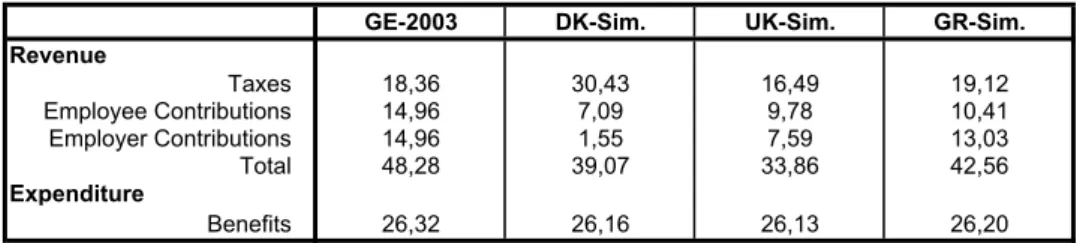
The revenue of each simulated system (per month) is displayed in table 2. As explained above, the simulated scenarios are not revenue-neutral, which needs to be kept in mind when inter-preting the results of each scenario. The revenue of GE-2003 is much higher than the revenue of the other systems. In DK-Sim, the tax revenue is the highest of all systems at 30.43 billion
e. The low level of the British revenue points out the residualism of the British welfare state and the importance of private social insurance. Due to the low income thresholds of GR-Sim, as explained in section 4.2.1, the level of the revenue components is distorted.
GE-2003 DK-Sim. UK-Sim. GR-Sim.
Revenue Taxes 18,36 30,43 16,49 19,12 Employee Contributions 14,96 7,09 9,78 10,41 Employer Contributions 14,96 1,55 7,59 13,03 Total 48,28 39,07 33,86 42,56 Expenditure Benefits 26,32 26,16 26,13 26,20
Table 2: National Budget, in billione per month. Source: Own calculations using EUROMOD C13.
4.1
Effects on the Income Distribution
4.1.1 Implementing the Danish Financing System
Figure 3 presents the tax payments per decile for the baseline and the simulated systems. In DK-Sim, the deciles five to ten pay much higher taxes than in every other system. Due to the high Danish tax rates, e.g. a top rate of 60.45%, a household pays 309 emore on average taxes than in the baseline system GE-2003 and the highest decile even pays 927 e more per month.
Also the lower income deciles pay higher taxes but the absolute growth of the tax payments from the baseline to the simulated Danish system DK-Sim is especially high for the upper deciles. On average, the taxes increase by 65.75%. The change of tax payments shows that more redistribution takes place in the tax system of DK-Sim. These results can be ascribed to the high tax rates applied to high and low income earners on the one hand, and to the low tax-free amount of the Danish system, on the other hand. The tax-exempt amount is 4,487
e, compared to 7,235 e in the German system. The Danish tax rate of the lowest bracket is 39.45%, whereas the German one constitutes 19.9%.
0 500 1000 1500 2000 2500 3000 3500 1 2 3 4 5 6 7 8 9 10
GE-2003 DK-Sim. UK-Sim. GR-Sim.
Figure 3: Income Taxes per Decile Source: Own calculations using EUROMOD C13.
Considering the employee social contributions paid per decile completely changes the picture (figure 4). The amount of contributions an average household has to pay in the baseline system (383e) is more than twice as high as in the Danish system (181e). The low rate of the Danish general contributions of 8% yields almost no contribution payments for the lower income deciles, although there is no income threshold in DK-Sim, below which no contributions have to be paid. Contrarily, in GE-2003, employees pay 21% of their employment income. In DK-Sim, almost no employer contributions have to be paid, i.e. just 40 e on average, compared to 383 e in GE-2003, which results from the very low rate of 2%, whereas in GE-2003 again 21% are levied. The distribution of the disposable incomes in figures 5 and 6 shows that a lot of redistribution takes place in DK-Sim: Despite the lower revenue generated in DK-Sim, the disposable income of the upper deciles is comparatively low. Without accounting for the employer contributions, it is even lower than in GE-2003 and in figure 6, it is just slightly above the disposable income of GE-2003. Independent of the employer contributions, the disposable income of the lower deciles is higher in DK-Sim
0 100 200 300 400 500 600 700 800 900 1000 1 2 3 4 5 6 7 8 9 10
GE-2003 DK-Sim. UK-Sim. GR-Sim.
Figure 4: Employee Social Contributions per Decile Source: Own calculations using EUROMOD C13.
Greve (1996) argued that a welfare state financed out of general taxation seems to have the best possibility in achieving the goal of greater equity. This argument can be supported referring to the Gini-coefficient of the disposable income listed in tables 3 and 4, which is lower for the Danish system compared to the baseline scenario. However, introducing the Danish financing system - without the corresponding benefit system - leads to greater poverty. The German benefit system does not compensate (as much as the Danish one) for the higher taxation of the lower income groups. The same argument holds for the high child poverty rate. Especially families with low incomes are affected by the high rates of the lowest tax bracket and are not compensated within the German benefit system. The poverty rate of the elderly decreases from 15.8% in the baseline to 12% in table 3. This can be attributed to the exemption of pension incomes in the Danish taxable income. In Denmark, just private pensions are part of the tax base to increase the advantages of public social security. Contrarily, German pensioners have to pay contributions for the public health and the statutory long-term care insurance.19
The implementation of the Danish instead of the German benefit system would result in high costs, which becomes obvious when considering the disposable income especially of the richer households of the simulated Danish system. In 2001, an average Danish household receives benefits at a level of 874 e per month, which is far above the EU15 average of 630 e and the 19Accounting for the employer contributions and keeping the poverty line fixed yields an even lower poverty
rate for the elderly and lower poverty rates for all simulated systems. This effect results from the higher disposable income of the simulated systems, although they also realise smaller revenue. On the other hand, adapting the poverty line to the higher disposable incomes overestimates the poverty rates, especially in DK-Sim, where almost no employer contributions have to be paid. This increases the disposable incomes and thus the poverty line even more.
0 1000 2000 3000 4000 5000 6000 1 2 3 4 5 6 7 8 9 10
GE-2003 DK-Sim. UK-Sim. GR-Sim.
Figure 5: Disposable Income per Decile Without Accounting for Employer Contributions Source: Own calculations using EUROMOD C13.
highest level of all EU countries listed in these tables. Greve (1996) underlines that a universal welfare state such as the Scandinavian model will have more difficulties in the future due to open borders, market competition and the resulting pressure put on high-tax-countries. Madsen (1999) alludes to potentially resulting internal problems for the Danish welfare state that also exist in other welfare states, but could be worse in Denmark due to the high tax burden, such as tax evasion, tax resistance and incentives for the black economy. He also mentions that the increased mobility of goods, services and factors of production could lead to fiscal pressure due to the mobility of the tax base, and towards a harmonisation of tax rates across borders among the EU countries.
To sum up, in DK-Sim, more redistribution takes place than in GE-2003, due to the impor-tance of tax payments in the revenue structure. The upper deciles pay much more taxes, which reduces inequality of incomes measured by the Gini-coefficient. Contributions paid in DK-Sim are comparatively low which reduces the redistributive effect.
4.1.2 Implementing the British Financing System
In UK-Sim, the first four deciles pay almost no taxes as in GE-2003. For the fifth and sixth decile, tax payments are higher than in GE-2003, which is the other way around for the highest deciles. These results can be ascribed to the more progressive tax schedule of GE-2003. The taxes paid by an average household in UK-Sim are 48elower than in GE-2003. The composition of the national budget of UK-Sim points out the relative importance of the taxes in the financing structure. Despite the much lower total revenue of UK-Sim, the revenue generated through
0 1000 2000 3000 4000 5000 6000 1 2 3 4 5 6 7 8 9 10
GE-2003 DK-Sim. (ERSIC)
UK-Sim. (ERSIC) GR-Sim. (ERSIC)
Figure 6: Disposable Income per Decile Accounting for Employer Contributions Source: Own calculations using EUROMOD C13.
taxes is almost as high as in GE-2003.
The average employee contributions paid decrease by 35%. Referring to the much lower contribution rates of 11% paid in UK-Sim in contrast to 21% in GE-2003, this result was foreseeable. Contrarily to the contributions paid in GE-2003, the lowest four deciles almost pay no contributions, due to the higher income threshold of 127.9 e per week which corresponds to 548 e per month, below which no contributions are levied. This amount is always exempt from contributions irrespective of a persons’ income. In the German system, an income below 400 e a month is free of contributions, but on every income above this allowance, the flat-rate contributions are levied on every single e, which increases the payments of the poor.
Figure 4 shows that the relative increase of contribution payments of the upper five deciles is higher than in GE-2003. This increase can be attributed to the fact that the self-employed in GE-2003 do not have to pay contributions, whereas in UK-Sim they have to, and many self-employed are high income earners. The distribution of the employer contributions in UK-Sim is quite similar, except that the increase of contributions paid by the upper deciles is not as high as for the employee contributions, since there are no employers contributions for the self-employed.
The disposable income in UK-Sim has risen in comparison to the baseline system and is not much below the original income. The lower tax and contribution payments and the high benefits received by an average household give rise to a high disposable income. The residual UK welfare state provides fewer benefits on average than the German one and thus needs less financing. For the average British earner in 2003 the average benefits were 564 e per month,
compared to 673 e for the German 2003 system. The disposable income increases especially with the upper deciles compared to GE-2003.
These increases in disposable income yield a higher Gini-coefficient of UK-Sim (0.2779) than of the baseline system GE-2003 (0.2682). Thus inequality has increased due to the British financing system. Similarly, poverty has augmented from 13 to 15.7% (or 16.2%, when accoun-ting for employers contributions) of the population having an equivalised disposable income of less than 60% of the median. Especially child poverty has increased from 15.5 to 20.6%. These effects are due to the lower social contribution and tax payments made on average in UK-Sim This results in higher disposable incomes and therefore a higher median and a higher poverty threshold. However, these effects can also be attributed to the higher progressivity of the financing system of GE-2003.
Poverty (Headcount) GE-2003 DK-Sim. UK-Sim. GR-Sim.
Population 13,0% 13,9% 15,7% 15,3%
Children 15,5% 18,4% 20,6% 19,6%
Working Age (WA) 11,5% 13,1% 14,0% 13,5%
WA Econ. Act. 7,2% 9,6% 9,4% 8,9%
Elderly 15,8% 12,0% 16,3% 16,9%
Inequality (Gini) GE-2003 DK-Sim. UK-Sim. GR-Sim.
Original Income 0,4936 0,4936 0,4936 0,4936
Disposable income 0,2682 0,2496 0,2779 0,2816
Table 3: Poverty and Inequality of the Baseline and the Simulated Systems Without Accounting for Employer Contributions
Source: Own calculations using EUROMOD C13.
As mentioned in section 2, the Liberal welfare states just provide a residual public social security. Their approach of social insurance is more market-based, and less income is distributed from the rich to the poor by the public system. Thus, the introduction of a Liberal financing system increases inequality and poverty.
4.1.3 Implementing the Greek Financing System
The quantity of welfare provided by the Greek system is low compared to other European coun-tries. Just considering the financial part of the welfare system and keeping the German benefits thus results in a high disposable income that is close to the baseline income. Surprisingly, the tax payments in the simulated Greek system are even slightly higher, and they are almost similarly distributed among the deciles as those of GE-2003. Referring to the comparatively low tax payments of the original Greek system of 2003 this outcome was not predictable. Only the tenth decile pays lower taxes because of the higher top rate in GE-2003.
Poverty (Headcount),
Fixed Poverty Line GE-2003 DK-Sim. UK-Sim. GR-Sim.
Population 13,0% 11,1% 9,8% 14,3%
Children 15,5% 14,2% 12,8% 19,4%
Working Age (WA) 11,5% 10,3% 8,7% 13,4%
Elderly 15,8% 10,8% 10,4% 12,0%
Poverty (Headcount),
Adapted Poverty Line GE-2003 DK-Sim. UK-Sim. GR-Sim.
Population 13,0% 16,4% 16,2% 16,5%
Children 15,5% 20,9% 21,1% 22,2%
Working Age (WA) 11,5% 14,9% 14,1% 15,3%
Elderly 15,8% 16,9% 18,2% 14,6%
Inequality (Gini) GE-2003 DK-Sim. UK-Sim. GR-Sim.
Original Income 0,4936 0,4936 0,4936 0,4936
Disposable income 0,2682 0,2600 0,2711 0,2884
Table 4: Poverty and Inequality of the Baseline and the Simulated Systems Accounting for Employer Contributions
Source: Own calculations using EUROMOD C13.
The simulation of the Greek financing system, based on German data, changes the structure of the system completely. Average social contribution payments in the original Greek system of 2003 are much higher (207 e) than the average tax payments (147 e). Due to the German population, average contributions of 274 e are higher in GR-Sim, but lower than the average tax payment of 486 e. One minor reason for the high tax payments might be the inclusion of pension in the Greek tax base, but the major reason is the lower standard of living in Greece. The tax schedule, being adjusted to the lower level of wages in Greece, sorts more households into the upper tax brackets, when realised on the basis of German data. The opposite distortions as to the tax schedule apply to the social contribution schedule.
The social contributions of the Greek financing system, implemented in Germany, are com-paratively low, which can be ascribed to three causes: First, the employee contribution rate of GR-Sim is lower than the German one. A Greek employee has to pay 16% plus 3.45% for hazardous workers. These are blue collar workers in certain occupations which are less repre-sented in the German than in the Greek database. Therefore, in GR-Sim, more people just pay the 16% than in GR-2003, in which 40% of the employees contribute 19.45%. Second, the income ceiling for the assessment of contributions in GR-Sim is far below the ceiling in GE-2003, i.e. 1,960.25 e in GR-Sim, and 3,450 e in Germany for the health insurance, and even 3,850eEastern German and 4,600eWestern German income ceiling for the pension and disability insurance. Due to the lower market incomes of the Greek population, less burden is loaded on the Greek population. In particular the Greek social contribution schedule is adap-ted to the lower economic status of the population. In GE-2003, the average market income
is much higher. Thus, the richer households now have to pay less contributions and only on income up to the lower ceiling.20 Third, contributions paid by the self-employed in GR-Sim are comparatively high and the number of self-employed and farmers in the German population is low compared to the Greek one. There are 1,916 self-employed in the Greek database and 514 in the German one. The distribution of the employee contribution payments is quite simi-lar to the distribution of GE-2003. The increase of contribution for the upper deciles is just slightly lower due to the lower income ceiling in the GR-Sim. Considering the distribution of the employer contributions, unlike in GE-2003, no contributions are paid by the lower deciles. The employer contributions paid in the GE-2003 are those for the health insurance paid by the pension fund. The distribution of the employer contributions in the upper deciles in GR-Sim has a more concave trend because of the lower income ceiling and the higher contribution rate of 28% plus 3.15% for hazardous workers compared to 21% in GE-2003.
The Gini-coefficient in the simulated Greek system is the highest of all four systems. Regar-ding the change of disposable income from GE-2003 to GR-Sim, gives the explanation. In terms of disposable income, the lower income earners are the losers and the upper income earners the winners. Therefore, the richer households save more money now, which is mainly due to the lower rate and lower income ceiling for the contribution payments. Less redistribution takes place which yields to higher inequality.
Table 4 shows an increase of the overall poverty from 13 to 16.5 %. The same explanations as for the growth of inequality are valid to explain this result. In addition, due to the higher disposable incomes, the poverty threshold has risen, which also explains the higher tax amount paid by the poor. Especially the poverty rate of the elderly has grown which results from the different tax base. In Germany, only civil servants’ pensions are part of the taxable income, whereas the Greek system levies taxes on all pensions.
Regarding the shares of social contributions and taxes paid per decile in each system, as presented in figure 7, shows that there are some tendencies concerning the distribution of shares according to whether a system relies more on taxes or social contributions. The shares of the Bismarckian systems of GE-2003 and GR-Sim are comparatively higher for the lower deciles and lower for the upper deciles. This could lead to the conclusion that concerning the financing structure, Beveridgean systems such as DK-Sim and UK-Sim have more potential to redistribute. However, because of the low tax and contribution rates, and the lower revenue generated, inequality increases in UK-Sim.
20It could be considered as a drawback that the structure of the Greek financing system has not been adopted
to German standards, but this has not been done on purpose. As mentioned in previous sections, the Southern countries feature a financing structure that is close to the structure of the conservative countries, but they provide a lower level of welfare. Therefore the system has been implemented with all its default values.
0,00% 5,00% 10,00% 15,00% 20,00% 25,00% 30,00% 35,00% 40,00% 45,00% 1 2 3 4 5 6 7 8 9 10 GE-2003 DK-Sim. (ERSIC)
UK-Sim. (ERSIC) GR-Sim. (ERSIC)
Figure 7: Share of Social Contributions and Taxes Paid per Decile Source: Own calculations using EUROMOD C13.
4.2
Effects on Labour Costs and on Labour Supply Incentives
After having analysed the distributional effects of the three simulated reform scenarios, the effects on labour costs measured by the AETRs and on intensive labour supply incentives in terms of the METRs are evaluated for the simulated financing systems.21 The evaluation of the effective tax rates will mainly focus on the median rates since they are less sensitive to extreme values. Similar to the analysis above, the results of the simulated systems are compared to the baseline system GE-2003. For the interpretation of the AETRs and METRs later on, it should be kept in mind that they result from simulated systems, which are combinations of the German benefit system and the financing systems of the respective countries, and cannot be compared to the rates of the real systems.
4.2.1 AETRs and METRs of the Danish Financing System
The overall median AETR of DK-Sim is by eleven percentage points lower than the one of GE-2003, although the tax payments of the Danish system are significantly higher, as displayed in figure 3. The high level of the average German AETR can be attributed to the higher contributions paid by the employees and the employers in Germany, which imposes higher costs on labour than the Danish income tax just paid by the employees. The difference of the median AETRs of the two systems is much bigger for the lower than for the upper income 21One should note that there will always be behavioural reactions when introducing new taxes, or elevating,
or lowering, existing ones. These reactions should not be underestimated and it has to be kept in mind that they are not covered by EUROMOD.
deciles. For the first two deciles, the AETRs of GE-2003 are three times higher than the Danish ones. This result supports the point of view that especially low income receivers are charged by the high tax and contribution wedge in Germany (see, e.g., Sinn (2005)). It can be concluded that DK-Sim imposes lower labour costs on lower income workers and increases their incentive to participate in the labour market. Due to the high top income tax rate of DK-Sim, the median AETR of the last decile is higher than in GE-2003. Since in DK-Sim, a lower revenue is realised, it can be assumed that the AETRs would be higher in general when considering a revenue-neutral reform scenario.
GE-2003 DK-Sim. UK-Sim. GR-Sim.
0,52 0,41 0,33 0,39
GE-2003 DK-Sim. UK-Sim. GR-Sim.
0,47 0,46 0,38 0,40
Overall Median METR Overall Median AETR
Table 5: Overall Median Effective Tax Rates Source: Own calculations with EUROMOD.
Regarding the intensive labour supply incentives in terms of the METRs changes the picture somewhat. The overall median METR of DK-Sim (0.46) is almost the same as the METR of GE-2003 (0.47). Taking a closer look at the distribution along the deciles reveals that the deciles nine and ten of DK-Sim are confronted with much higher METRs, i.e. 0.65, than the respective deciles of GE-2003 (0.49 and 0.47). Consequently, an additional hour of work leaves an high-income employee in DK-Sim with less additional disposable income than in GE-2003. This results from the fact that the Danish financing system mainly relies on income taxation, whereas in the German system social contributions play a major role. In DK-Sim, high-income earners have to pay additional taxes on the marginal increase of their wage. Contrarily, social insurances in GE-2003 are only paid up to an income ceiling and thus have a regressive schedule. The first two deciles are also affected by an increase of the METRs due to the high tax rate of 39.45% of the lowest tax bracket of DK-Sim. To sum up, the financing system DK-Sim, relying more on income taxation, increases (decreases) the extensive (intensive) labour supply incentives.
4.2.2 AETRs and METRs of the British Financing System
The simulation of the British financing system yields the lowest overall median AETRs and METRs. Due to the low social contribution payments and the low tax payments of the em-ployees in UK-Sim, the labour costs, i.e. the extensive labour supply incentives, are on a low
0 0,1 0,2 0,3 0,4 0,5 0,6 1 2 3 4 5 6 7 8 9 10
GE-2003 DK-Sim. UK-Sim. GR-Sim.
Figure 8: Median Average Effective Tax Rates per Decile Source: Own calculations using EUROMOD C13.
level compared to the other systems. As a result of the high tax-exempt income and the relati-vely high contribution-free amount, labour costs are especially low for the low-income earners. For the same reason, the intensive labour supply incentives are very high for the lowest two deciles. The AETRs increase slightly with the higher deciles. The median METRs vary a bit between the different deciles but remain almost on the average level of 38%. Thus, the incen-tives for an employee to augment hours of working are almost the same for every income earner. Consequently, the decision to work more is not distorted between different wage levels. The intensive labour supply incentives are especially high for the first two deciles and slightly lower for the last decile compared to the constant level of the METRs of the deciles four to nine.
4.2.3 AETRs and METRs of the Greek Financing System
On the basis of the higher wage level in the German population, the relation of tax and contri-bution payments in GR-Sim has distorted the structure of the original Greek financing system. This leads to AETRs and METRs that are just partially comparable with the effective tax rates of those that would result from the original Greek system. The comparatively low level of AETRs mainly results from the lower level of financing that takes place in GR-Sim. Despite these drawbacks, it is interesting to see how a drastic reduction of social contribution payments affects the labour costs. The structural distribution of the AETRs of GR-Sim is similar to the AETRs of GE-2003, but on a lower level. Only the deciles two and three show larger differences between the labour costs because of the lower tax-exempt amount of GE-2003 and the higher tax rate of the first tax bracket.
0 0,1 0,2 0,3 0,4 0,5 0,6 0,7 1 2 3 4 5 6 7 8 9 10
GE-2003 DK-Sim. UK-Sim. GR-Sim.
Figure 9: Median Marginal Effective Tax Rates per Decile Source: Own calculations using EUROMOD C13.
The intensive labour supply incentives do not change for the first three deciles because of the high tax-exempt income amount of GR-Sim, which explains the large step between decile three and four. The following deciles are also confronted with additional tax payments when extending working hours. Compared to GE-2003, the first decile of GR-Sim is confronted with a higher METR and thus fewer incentives to work more, which results from the fact that in GR-Sim social insurance contributions have to be paid already on the first Euro earned.
To sum up, the labour costs in terms of the AETRs in the original German system are the highest on average, and they are especially high for the lower income deciles. A reduction of social contribution payments yields lower labour costs, in particular for the lower income earners. A high level of income taxation as in DK-Sim reduces overall labour costs on the one hand, but increases the METRs for the lower and upper deciles. The simulated Liberal British financing system displays the lowest labour costs and gives the highest incentives to labour supply to increase working hours, but it also generates the lowest revenue of all the simulated systems. Concerning the distribution of the AETRs, their level is lower for the lower deciles in a financing system relying more on income taxation, i.e. DK-Sim and UK-Sim, and it increases more for the upper deciles than in the Bismarckian systems GE-2003 and GR-Sim. Regarding the distribution of the METRs, there seems to be a tendency that the Beveridgean systems DK-Sim and UK-Sim provide comparatively low rates for the lower income deciles but higher rates for the upper deciles. However, considering the Danish case, for which the METRs of the lower deciles are elevated, this effect also depends strongly on the tax-exempt amount and the lowest tax rate.
5
Policy conclusions
The aim of this paper was to analyse different financing systems for Germany. When inter-preting the results, several qualifications have to be taken into account: First, the simulated reform scenarios are not revenue-neutral. Second, the benefit side of the welfare state, which might enhance or dampen these effects, has been kept unchanged. Third, the simulated sys-tems do not account for behavioural reactions of the economic agents, such as tax evasion, and for adjustment processes. Fourth, tax competition could put pressure on the level of income taxes. Fifth, interactions with business taxation are not considered. Despite these constraints the following policy conclusions can be drawn:
The introduction of the Social-democratic Danish financing system decreases inequality of incomes, but does not necessarily lead to less poverty. Tax payments are extremely high, whereas social contribution payments are relatively low. As a result, the distribution of the household disposable income shows comparatively high levels for the lower deciles and low levels for the upper deciles. These results demonstrate the strong redistributive effects of the Danish financing structure. The labour costs measured in terms of AETRs decrease, especially for low-income earners, but are higher for the highest decile. Contrarily, the intensive labour supply incentives, displayed by the high level of the METRs, decrease for low and high-income earners.
The introduction of a Liberal British financing system reduces equality and increases po-verty. The revenue generated by this system is the lowest of all simulated systems. Since the Liberal welfare states heavily rely on private insurance, social contributions are comparatively low. The extensive labour supply incentives are high on average (low AETRs) and especially for the lower deciles. The intensive labour supply incentives are almost constant and on a comparatively high level, except for the first two deciles where they are extremely high, and for the last decile, where they are slightly lower (higher METR).
The introduction of the Southern Greek system yields higher inequality and poverty due to the low income thresholds, which lead to higher disposable incomes of the rich and lower disposable incomes of the poor. The average extensive and intensive labour supply incentives are higher for the simulated Greek system than for the original German one, which can be ascribed to the lower revenue generated by the Greek financing system. The distributional structure of the effective tax rates along the deciles shows similarities to the original German system just on lower levels.
In general, some tendencies can be seen, which result from the existing financing structure: The share of contribution and tax payments is higher for the upper decile groups and lower for the first deciles in the systems relying more on income taxation, i.e. the Danish and British Beveridgean systems, in comparison to the Bismarckian financing systems of Germany and
Greece. Thus, they have a higher potential to redistribute, but, as it can be seen in the case of the British financing system, the level of redistribution also depends strongly on the level of payments. Concerning the distribution of the AETRs, their level is higher for the lower deciles in the Bismarckian systems, and it increases less for the upper deciles than in the Beveridgean systems. According to this, fewer extensive labour supply incentives for the lower income groups prevail in the Conservative and Southern financing systems. Regarding the distribution of the METRs, there seems to be a tendency that the Beveridgean systems provide comparatively high rates for the upper deciles compared to the Bismarckian systems. Due to the fact that tax schedules are progressive and social contribution schedules are linear or even regressive, changing a financing system towards more income taxation increases the extra payments of the richest of the population for an additional hour of work.
To sum up, our simulation results suggest that Conservative welfare states are quite suc-cessful with respect to the levels of welfare and inequality as well as poverty. But regarding labour costs and labour supply incentives, the structures of the financing systems have deficits. Especially the regressive design of the German social insurance contributions scheme in com-bination with a rather generous social assistance scheme reduces the participation incentives for low wage earners. In the end, the existing system has the same impacts like an additional tax on labour. The resulting high unemployment of especially low skilled workers remains one of the main challenges for German policy makers. To overcome these problems, reforms are needed, not only on the financing, but also on the benefit side of the welfare state (see, e.g., Zimmermann et al. (2008)). When looking at Germany’s neighbours in Europe, our analysis identifies two main issues: First, as an important step towards a more viable financing struc-ture, social insurances must be relieved from redistributive tasks. This is a lesson to be learned from our Nordic neighbours with their Social-democratic welfare state regimes. Benefits not related to insured risks ought to be financed primarily through taxes. Redistributive tasks should be handled through direct transfers. This allows to reduce the marginal contribution rate and increase work incentives. Further on, the contribution base should be extended to other income sources besides labour as well. Second, to further promote the employment of low-skilled workers, workfare principles, i.e. government benefits are tied to the participation in work or vocational training programs - like in the Anglo-Saxon Liberal welfare state regimes - should be implemented in social security. These reform steps increase work incentives for low-skilled workers and put the financing of social security on a solid ground as they turn benefit recipients into tax and contribution payers.
References
Arts, W. and Gelissen, J. (2002). Three Worlds of Welfare Capitalism or More? A State-of-the-Art Report, Journal of European Social Policy 12 (2): 137–158.
Atkinson, A. B. (1999). The Economic Consequences of Rolling Back the Welfare State, The MIT Press, Cambridge, Massachusetts.
Becker, U. (2007). The Scandinavian Model: Still an Example for Europe?, Internationale Politik und Gesellschaft 4: 41–47.
Bonoli, G. (1997). Classifying Welfare States: A Two-Dimension Approach, Journal of Social Policy 26: 351–372.
Clark, R. L. (2004). Social security financing: Facts, fantasies, foibles, and follies, AEA Papers and Proceedings94(2): 182–186.
Esping-Andersen, G. (1990). The Three Worlds of Welfare Capitalism, Blackwell Publishers Ltd., Oxford.
European Commission (2006a). MISSOC - Comparative Tables - Part 2: Greece, Spain, France, Ireland, Iceland, http://ec.europa.eu/employment{_}social/missoc/2007/
tables{_}part{_}2{_}en.pdf [accessed on 03/08/2008, at 12.40].
European Commission (2006b). MISSOC - Comparative Tables - Part 6: Slovakia, Finland, Sweden, United Kingdom, http://ec.europa.eu/employment{_}social/missoc/2007/ tables{_}part{_}6{_}en.pdf[accessed on 03/08/2008, at 12.40].
European Commission (2007). Taxation Trends in the European Union - Data for the EU Member States and Norway, http://ec.europa.eu/taxation{_}customs/resources/ documents/taxation/gen{_}info/economic{_}analysis/tax{_}structures/
Structures2007.pdf [accessed on 03/08/2008, at 10.36].
Galasso, V. and Profeta, P. (2004). Lessons for an ageing society: the political sustainability of social security systems, Economic Policy 19: 63–115.
Greve, B. (1996). Comparative Welfare Systems: The Scandinavian Model in a Period of Change, Ways of Financing the Welfare State and Their Distributional Consequences, St. Martin’s Press, Inc., New York, pp. 67–86.
Immervoll, H. (2004). Average and Marginal Tax Rates Facing Workers in the EU. A Micro-Level Analysis of Micro-Levels, Distributions and Driving Factors, EUROMOD Working Paper
No. EM6/04.
Immervoll, H., Kleven, H., Kreiner, C. and Saez, E. (2007). Welfare Reform in European Countries: A Micro-Simulation Analysis, The Economic Journal 117 (516): 1–44.
Kasza, G. J. (2002). The Illusion of Welfare ’Regimes’, Journal of Social Policy31: 271–287. Madsen, P. K. (1999). Denmark: Flexibility, Security and Labour Market Success, ILO
Em-ployment and Training Papers 53.
Matsaganis, M. and Tsakloglou, P. (2004). EUROMOD Country Report Greece
(2001 Tax-Benefit System),http://www.iser.essex.ac.uk/msu/emod/documentation/
countries/greece/cr01gr0205.pdf [accessed on 03/16/2008, at 15.20].
Musgrave, R. and Musgrave, P. (1989). Public Finance in Theory and Practice, McGraw-Hill, New York.
OECD (2007). Taxing Wages 2006-2007, OECD - Organisation for Economic Co-operation and Development.
Peichl, A. and Schaefer, T. (2008). Wie progressiv ist Deutschland? Das Steuer- und Transfer-system im europ¨aischen Vergleich.
Rudzio, K. and Uchatius, W. (2005). Der wankende Staat, Die Zeit22/2005.
Sinn, H.-W. (2000). The threat to the german welfare state, CESifo Working Paper No. 320. Sinn, H.-W. (2005). Ist Deutschland noch zu retten?, Ullstein Buchverlage GmbH, Berlin. Sutherland, H. (2001). Final Report - EUROMOD: An Integrated European Benefit-Tax Model,
EUROMOD Working Paper No. EM9/01.
Thogersen, O. (2001). Reforming social security: Assessing the effects of alternative funding strategies, Applied Economics 33: 1531–40.
Zimmermann, K. F., Burda, M. C., Konrad, K., Schneider, F., Schneider, H., von Hagen, J. and Wagner, G. G. (2008). THE PETERSBERG DECLARATION - Guidelines for a Future-Oriented Labor Market Policy, IZA Policy Paper.