Research Papers Graduate School
2012
SYRINGE AND NEEDLE EXCHANGE
PROGRAMS: A VALUABLE HARM
REDUCTION TECHNIQUE IN THE BATTLE
AGAINST INJECTION DRUG USE
Stephanie M. Woods
Southern Illinois University Carbondale, [email protected]
Follow this and additional works at:http://opensiuc.lib.siu.edu/gs_rp
This Article is brought to you for free and open access by the Graduate School at OpenSIUC. It has been accepted for inclusion in Research Papers by an authorized administrator of OpenSIUC. For more information, please [email protected].
Recommended Citation
Woods, Stephanie M., "SYRINGE AND NEEDLE EXCHANGE PROGRAMS: A VALUABLE HARM REDUCTION TECHNIQUE IN THE BATTLE AGAINST INJECTION DRUG USE" (2012).Research Papers.Paper 254.
SYRINGE AND NEEDLE EXCHANGE PROGRAMS:
A VALUABLE HARM REDUCTION TECHNIQUE IN THE BATTLE AGAINST INJECTION DRUG USE
by
Stephanie M. Woods
B.S., Austin Peay State University, 2010
A Research Paper
Submitted in Partial Fulfillment of the Requirements for the Master of Science
Department of College of Education and Human Services Southern Illinois University Carbondale
RESEARCH PAPER APPROVAL
SYRINGE AND NEEDLE EXCHANGE PROGRAMS:
A VALUABLE HARM REDUCTION TECHNIQUE IN THE BATTLE AGAINST INJECTION DRUG USE
By
Stephanie Marie Woods
A Research Paper Submitted in Partial Fulfillment of the Requirements
for the Degree of Master of Science in the field of Rehabilitation
Approved by:
Stacia Robertson, Chair
Graduate School
Southern Illinois University Carbondale April 13, 2012
i
AN ABSTRACT OF THE RESEARCH OF
STEPHANIE WOODS for the MASTER SCIENCE degree in REHABILITATION
COUNSELING, presented on April 13, 2012, at Southern Illinois University Carbondale. TITLE: SYRINGE AND NEEDLE EXCHANGE PROGRAMS: A VALUABLE HARM REDUCTION TECHNIQUE IN THE BATTLE AGAINST INJECTION DRUG USE
MAJOR PROFESSOR: Dr. Stacia Roberston
In the last two decades there has been a growing interest surrounding the topic of clean needle exchange programs, the effects they have on injection drug users, their effectiveness in the prevention and spreading of HIV, AIDS and other blood borne pathogens, the cost surrounding the operation of NEPs and SEPs, and their
beneficialness on society as a whole. The objective of this research paper is to examine all the aforementioned facets as well as other benefits that stem from NEPs and SEPs. Since injection drug use is driving HIV epidemics in many countries and accounts for almost a third of new infections outside of sub-Saharan Africa, it seems this knowledge is imperative.
ii TABLE OF CONTENTS CHAPTER PAGE ABSTRACT ... i FIGURES………...iii CHAPTERS CHAPTER 1 – INTRODUCTION ... 1
Background of the Problem………..2
Synopsis of SEP Advantages……….5
Significance of the Study………..6
Purpose and Objectives of the Paper ………6
CHAPTER 2 – SURVEY OF THE LITERATURE ... 8
Introduction of Harm Reduction………..8
Syringe and Needle Exchange Programs……….9
Benefits of SEPs: Harm Reduction & Cost Effectiveness………11
Behavioral Benefits of SEPs……….13
CHAPTER 3 – DISCUSSION AND IMPLICATIONS ... 14
Recommendations for the field of Rehabilitation………...15
Conclusion………...17
REFERENCES ... 19
iii
LIST OF FIGURES
FIGURE PAGE
CHAPTER 1
INTRODUCTION
Once thought to be a disease explicitly affecting homosexual Caucasian males in the U.S., HIV/AIDS has spread to other populations, most notably injection drug users (IDUs) (Ksobiech, 2006). In 2003, the Center for Disease Control and Prevention (a) estimated 26% of AIDS diagnoses among people aged 13 years and over were associated with exposure to intravenous drug use, (b) linked over one-third (36%) of U.S. AIDS cases to injection drug use, either directly or indirectly and (c) concluded that females and minority populations were disproportionately impacted (e.g. injection drug use was associated with 57% of all AIDS cases reported among women, as well as 26% of African American cases and 31% of Hispanic cases) (Ksobiech, 2006; Patel, 2007). According to Kerr et al., (2010) “cities throughout the world are increasingly experiencing HIV epidemics among injection drug users (IDUs) as a result of sharing contaminated injecting equipment” (p. 1449). However, the strong connection between injection drug use and HIV/AIDS is not restricted only to the U.S. (Ksobiech, 2006).
“Explosive HIV epidemics among injecting drug users have been witnessed in almost all regions,” states Ball (2007) (p.684). And with an estimated 13 million injecting drug users globally, HIV epidemics have touched diverse countries such as China, Estonia, Indonesia, Kazakhstan, Central and Eastern Europe and the countries compromising the former Soviet Union (Ball, 2007; Wodak & Cooney, 2006). In fact, between 80% - 90% of officially recorded HIV cases are among IDUs in Russia
(Ksobiech, 2006). Likewise, the phenomenon of higher HIV prevalence among minority drug users is decidedly not limited to the United States (Kosbiech, 2006; Kerr et al.,
2010). Substantially higher HIV prevalence has been found among disadvantaged ethnic minority IDUs in many different areas of the world, including the First Nations in Canada, Germans in the Netherlands, Vietnamese in Australia, Roma in Eastern
Europe, ethnic Russians in Estonia, “hill tribes” (Zhuang, Tay, Nung) in Southeast Asia, and Uighurs in Southwest China (Des Jarlais et al., 2009a).
Background of the Problem
In response to the abovementioned increasing HIV epidemics, various harm reduction initiatives such as providing legal access to sterile injection equipment through needle and syringe exchange programs (NEPs or SEPs) or pharmacy sales have been established to prevent transmission of HIV and other blood borne illnesses (e.g.
hepatitis B and hepatitis C) among injection drug users (Bluthenthal, Heinzerling, Anderson, Flynn & Kral, 2008; Davidson, Scholar & Howe, 2011; Des Jarlais et al., 2009a; Gindi, Rucker, Serio-Chapman, & Sherman, 2009; Kerr et al., 2010). Yet despite syringe and needle exchange programs being a highly effective and well-proven public health response to HIV and other blood-borne illnesses among IDUs, lack of federal government support, intense political opposition and the congressional prohibition on federal funding for these programs have hindered their implementation in the United States (Bluthenthal et al., 2008; Davidson et al., 2011; Des Jarlais et al., 2009b; Kidorg & King, 2008). However, because of advocacy by activists and public health
professionals, along with changes in state and local laws, and changes in viewpoint, there has been a steady, if slow, increase in the numbers and geographic availability of SEPs (Bluthenthal et al., 2008, p.278).
“Still, many drug users in the United States do not have access to SEPs, suggesting that wider implementation is needed,” states Bluthenthal et al. (2008) (p. 278). However achieving wide dissemination of effective prevention strategies is a persistent problem in public health, especially when lack of any national plan for syringe exchange has led to great diversity in programs (Bluthenthal et al., 2008; Des Jarlais et al., 2009b). For example, according to Des Jarlais et al. (2009b),
“Most (66%) US programs do not adhere to a ‘one-for-one’ policy (in which a participant is to obtain only the same number of new syringes as he or she brought to the program at that visit). Forty-nine percent of the programs provide ‘start-up packs’ (syringes and other materials given to participants at their first visit). Thirty-three percent provide a minimum of new syringes regardless of the number of used syringes returned to the program at that visit. Seven percent of the programs operate on a ‘distribution’ model in which the participant receives the number of syringes requested, regardless of the number of syringes being returned. A very large majority of US SEPs (89%) permit ‘secondary exchange’ in which an individual participant is permitted to exchange for peers (who do not necessarily attend the exchange)” (p. 1442-43).
“These various state-level approaches to SEP implementation are likely to affect program availability and performance,” states Bluthenthal et al. (2008) (p.278). For instance, Kerr et al. (2010) found “many local IDU have historically experienced difficulty accessing sterile syringes as a result of policy and programmatic factors such as limited hours of SEP operation and a rigid one-for-one syringe exchange policy” (p. 1449). In contrast, studies have revealed the negative effects of one-for-one exchange policies
and have suggested that SEPs are most effective when the focus of services is on distribution, not exchange (Kerr et al., 2010).
So then why are there not more syringe and needle exchange programs focused on distribution? Simply put: lack of funding. In 2007, U.S. SEPs encountered a variety of operational problems, the most common being ‘lack of funding/lack of resources’,
reported by 56% of the programs (Des Jarlais et. al, 2009b). And seeing as how the U.S. federal government has refused to provide any federal funding for syringe exchange, most SEPs are funded by state and local governments (Des Jarlais et al., 2009b).
With merely half of all U.S. exchanges currently receiving state or local funding, it would be impossible for them to finance every syringe and needle exchange program with unlimited supplies of sterile needles let alone be able to afford operating costs and continue to offer other preventative, medical or social services (Des Jarlais et al., 2009b). Yet it is believed that politicians are more willing to look at the broader picture when making decisions regarding, say, drug classification, the roles & responsibilities of statutory agencies, promotion of formal and informal support networks and reducing the impact of illicit substance use on society as a whole (Patel, 2007, p. 738).
Likewise he goes on to state that the issue of needle exchanges and access to drug paraphernalia has historically been one which legislators have been reluctant to debate in a pragmatic manner and thus it has led to a hardening of opposing views with some being strong advocates of such schemes and others vehemently against (Patel, 2007, p. 738).
The advantages of NEPs and SEPs are unmistakable. In addition to the
aforementioned benefits, almost all needle exchange programs provide sterile syringes, condoms, alcohol pads, HIV counseling and testing, referrals to substance abuse
treatment and education about HIV, hepatitis A virus (HAV), hepatitis B virus (HBV), and hepatitis C virus (HCV), condom use, vein care, abscess prevention, wound care, and other medical or social services (Des Jarlais et al., 2009b; Gindi et al., 2009; Green et al., 2010; Kidorf & King, 2008; Rudolph et. al., 2010). These programs aim to reduce the risk of contracting blood borne viruses, improve reintegration back into society, and reduce the level of exposure of the individual to criminality (Patel, 2007). Not to mention the money these preemptive measures save in the long run.
It was estimated that SEPs averted 87 infections and saved the U.S. $1.82 million in HIV treatment costs in New York State in 1996. Conversely, lack of comprehensive national SEPs in the United States is estimated to have resulted in 4,000 to 9,000 new infections and a cost to society of $240-$500 million between 1987 and 1995 (Lorvick et al., 2006, p. 866).
So why when more than a decade of research documents that injection drug users who use syringe exchange programs have a reduced risk of HIV infection and are less likely to share injection paraphernalia than non-SEP users is there no federal funding for these programs (Lorvick et al., 2006)?
Significance of the Study
The fact of the matter is, it has been more than twenty-five years since the initial discovery of AIDS among injection drug users and more than twenty years since the first implementation of SEPs, yet the rates of HIV/AIDS amongst this population is still
climbing (Des Jarlais et al., 2009b). A 2009 CDC report shows 5,189 diagnoses of AIDS among IDUs (CDC report, slide 16 & 17). Thus one might venture to think there is a need for rehabilitation.
Purpose and Objectives of the Paper
Therefore it seems a re-examination of the literature on syringe and needle exchange programs is of importance in helping to better understand the
advantageousness of such harm reduction techniques, their effectiveness in the prevention of contracting and spreading HIV/AIDS amongst IDUs and justifications for additional implementation. It is my intent to encourage policymakers and those who may have often discounted injection drug use as a societal concern, seeing it rather as an individual problem, to reconsider the beneficialness of syringe and needle exchange programs. In this day and age, with the knowledge we now have on SEPs, funding should be increasing as well as the number of programs nationwide.
The purpose of this paper is to identify the different aspects and factors related to the success of clean needle exchanges as a harm reduction technique for injection drug users. These factors include cost effectiveness and behavior modification. In addition, the influencing factors include ‘word-of-mouth’ and SEP availability. A study conducted by Kidorf & King (2008) found “SEP participation is associated with increased use of sterile syringes, reduction in other drug injection behaviours that convey great risk of transmitting HIV and other blood-borne diseases, and with lower incidence of HIV seroconversion, without increasing rates of drug use or criminal activity in either SEP participants or in the environments bordering the program” (p. 489).
CHAPTER 2
SURVEY OF THE LITERATURE
For one to understand the importance of syringe and needle exchange programs, it is pertinent they first understand how injection drug use affects not only the individual, but society. In this section, I will introduce the concept of harm reduction, give a brief history of syringe and needle exchange programs, and discuss their benefits to IDUs and society in the areas of harm reduction, cost effectiveness, and behavior.
Introduction to Harm Reduction
As suggested in the work of Ksobiech (2006):
Evolving problems, issues, and diseases that primarily affect the powerless, the “marginalized”, or those perceived by the population at large as deviant do not become a major concern for public policy makers or the media until and unless they “crossover” and impact the established, more powerful, and “normal” institutions and population (p. 1379).
Hence, it was not until 1973 that there was a call for the primacy of public health over drug control internationally (Ball, 2007). According to Ball (2007), “in that year, ‘harm reduction’, as a concept, was recommended as a viable alternative to a drug control approach by the 20th World Health Organization (WHO) Expert Committee on Drug Dependence” (p. 685).
Generally speaking, harm reduction is the idea that those who engage in injurious activities and/or behaviors are unlikely to stop immediately; therefore, immediate harm should be minimized (Ksobiech, 2006). It is not a new concept as it clearly predates the discovery of AIDS among injection drug users (Des Jarlais et al.,
2009b; Patel, 2007). Yet few terms in the world of drug policy evoke such extremes of emotion due to the lack of a clear definition as ‘harm reduction’ (Ball, 2007).
“In the early 1980s, harm reduction referred to policies and programs directed mainly at reducing the adverse health consequences of illicit drugs,” states Patel (2007) (p. 737). More recently, however, the term has been used to assume all measures that might reduce drug-related harm, including but not limited to interventions intended to reduce the supply and demand for drugs (Patel, 2007). Des Jarlais et al. (2009b), on the other hand, believes “syringe exchange programs (SEPs)—in which sterile needles and syringes are exchanged for used, potentially HIV-contaminated needles and syringes— have come to symbolize harm reduction programming for drug users” (p.1441).
Syringe and Needle Exchange Programs
According to Wodak & Cooney (2006), “it did not take that long after recognition in 1981 of the epidemic soon to be called “AIDS” for public health practitioners around the world to start thinking about measures that could control HIV” (p. 777). In fact, they go on to state that, “in most developed countries where there were large numbers of IDUs, NSPs were established in the 1980s and then expanded rapidly to prevent the spread of HIV among and from drug-injecting populations” (Wodak & Cooney, 2006, p.779).
According to Wodak & Cooney (2008), “by the beginning of the 1990s, evidence of the effectiveness and safety of NSPs in reducing HIV spread among IDUs was already compelling and well summarized in seven previous reviews conducted by or on behalf of U.S. government agencies” (p.779). However, in the United States where the prevailing zero-tolerance frame of the “war on drugs”, the societal stigma associated
with drug use, and entrenched beliefs for criminal justice approaches to drug policy are dominant, syringe exchange began rather late (Des Jarlais, 2009b; Heller & Paone ,2011). As a result, large numbers of AIDS cases occurred in the United States shortly after AIDS was first identified and doubled approximately every 6 months in the initial years (Des Jaralis et al., 2009b). It is Wodak & Cooney’s (2006) belief that “the failure of these reviews to influence the policymaking process in the United States has to be considered from the perspective of an unusual national drug policy sustained over many decades” (p. 779).
Consequently, policies such as the Comprehensive Crime Control Act of 1984, which declared drug use as a criminal pathology rather than an illness, and the Health Omnibus Program Extension Act of 1988, which established support for investment in HIV prevention, testing and education but specifically stated none of the funds shall be used to provide hypodermic needles, had a devastating impact on IDUs (Heller &
Paone, 2011). According to Heller & Paone (2011), “though the NYC health department initiated discussions for a pilot syringe exchange program in 1984—1985, the effort was ultimately derailed by strong opposition from law enforcement and some community leaders” (p.141). “That many drug users were members of ethnic minority groups both increased stigmatization of drug users and made opposition to syringe exchange by minority community leaders more intense,” states Des Jarlais et al. (2009b) (p. 1444).
In 1988, a second attempt to initiate syringe exchanges was made by NYC health commissioner, Stephen Joseph (Heller & Paone, 2011). He proposed to support five syringe exchange sites in the community (Heller & Paone, 2011). His proposal “was met with fervent opposition, even surpassing the response a few years prior” states
Heller & Paone (2011) and abridged to a one site clinical trial (p. 142). Hence, the development and adoption of NSPs in the United States has been late (e.g. well after HIV had already infected large numbers of IDUs in the country) and implementation slow (Des Jarlais et al., 2009; Wodak & Cooney, 2006).
Therefore, the first pilot syringe exchanges did not surface in the United States until the early 1990s (Des Jarlais et al., 2009c; Heller & Paone, 2011). These programs were the first legal means for injection drug users to exchange used syringes and needles for new, sterile ones, effectively reducing the average circulation time of used, contaminated syringes and needles and lowering the probability of their reuse (Belani & Muennig, 2008).
“While the newfound legal status of syringe exchange was cause for celebration, it also gave rise to shifting roles and other new challenges,” according to Heller & Paone (2011) (p.143). For instance, “following legalization, syringe exchange programs
simultaneously experienced a rapid increase in program participation and a more burdensome array of fiscal and regulatory tasks” states Heller & Paone (2011) (p. 143). Not surprisingly, SEP authorization mandated stringent reporting and evaluation
requirements which absorbed an inordinate amount of time and effort (Heller & Paone, 2011).
As a result, it wasn’t until studies noted high enrollment rates, large numbers of transactions, and a significantly lower HIV infection rate among program participants that programs were able to secure more funding, both from AmFAR, and the NYS health department (Heller & Paone, 2011). Thus in late 1992, large-scale
approved and funded by State Health Department (e.g. the annual number of syringes exchanged increased from 250,000 to 3,000,000) (Des Jaralis et al., 2009c). However, it was not until the early to mid- 1990s that SEPs in the United States expanded rapidly (Des Jarlais et al., 2009b).
Following was a period of very fast growth in the number of programs, cities and states with programs, syringes exchanged and budgets (e.g. the mid to late 1990s) (Des Jarlais et al. 2009b). That of which lead to a significant reduction in HIV incidence among IDUs in the city, from 4/100 person-years in 1990-93 to 1/100 person-years in 1998-2002 (Des Jarlais et al., 2009c). Subsequently, new HIV diagnoses declined by approximately 10% per year during 2001-05 (Des Jarlais et al., 2009b).
Benefits of SEPs: Cost Effectiveness
Aside from increasing the access to sterile syringes and reducing the incidence and prevalence of HIV, SEPs have been credited with having an abundance of
advantages not only for injection drug users but also for society (Lorvick et al., 2006; Patel, 2007; Rudolph et al., 2010). For instance, they provide IDUs with prevention supplies (e.g. condoms, alcohol pads, bleach, narcan, buprenorphine), clothes, food, and hygiene items; screenings for blood borne viruses and STDs, vaccinations, on-site medical care and delivery services; education on: HIV/AIDS prevention, HAV/HBV/HCV prevention, safer injection, vein care, STD prevention, abscess prevention, condom use; and if needed referrals to substance abuse treatment (Des Jarlais et al., 2009b; Gindi et al., 2009; Green et al., 2010; Kidorf & King, 2008; Lorvick et al., 2007; Patel, 2007; Rudolph et al., 2010).
Mathematical modeling and research carried out in the U.S. suggests NSE programs would prevent thousands of HIV cases (Patel, 2007). Hence, the costs of starting up and maintaining such programs would be dwarfed by the amount of money saved in relation to the lifetime treatment costs of infected individuals (Patel, 2007). Belani & Muenning (2008) decided to test that theory.
Thus, Belani & Muennig (2008) created a decision-analysis model using TreeAge Pro 6.0 comparing two strategies: participation in NSE versus no participation in NSE to determine the cost effectiveness of needle and syringe exchanges (p. 232). After the decision-analysis model was created, they obtained the costs associated with needle and syringe exchange for the year 2005 from the Lower East Side Harm Reduction Center (LESHRC), one of the nine NSE programs operating in New York City (Belani & Muennig, 2008, p. 234). Early on, Belani & Muenning (2008) discovered participation in NSE was associated with a lower probability of contracting HIV, but, individuals in this group incurred the costs of NSE (Belani & Muennig, 2008, p.232). Conversely, no participation in NSE was associated with a higher probability of contracting HIV, but individuals in this group did not incur NSE program costs (Belani & Muennig, 2008).
According to Belani & Muennig (2008) “the costs associated with HIV infection were calculated for life, using life expectancy estimates for an HIV-positive IDU on treatment” (p. 234). And as 75% of LESHRC’s 1,484 needle and syringe exchange clients were enrolled in Medicaid, they were able to obtain the costs associated with HIV infection from the New York Department of Health’s 2002 reported annual Medicaid expenditures per enrollee with HIV/AIDS (Belani & Muennig, 2008, p.234). “The
average life expectancies for both a HIV-negative and a HIV-positive IDU were obtained from a recent study by Paltiel et al. (2005)” states Belani & Muennig (2008) (p. 235).
Belani & Muennig (2008) study found a) NSE was the dominant strategy as it was both cost and life-saving, b) for the year 2005, the program resulted in an estimated savings of about $1,300—$3,000 per client, and c) NSE resulted in a total savings of $1.3 million per 1,000 clients which is the cost associated with approximately four cases of HIV averted, at a cost of $502 per client or $125,000 per case of HIV averted (p. 235).
Nevertheless, while Belani & Muennig (2008) study proved needle and syringe exchanges to be a cost effective HIV prevention intervention, it had a number of
limitations (p. 238). For starters, “there is no good estimate of NSE efficacy,” according to Belani & Muennig (2008) (p. 238). Likewise, a number of unforeseen ecological confounders such as receptiveness to health education programs could muddle small-area analyses (Belani & Muennig, 2008). Furthermore, “longitudinal studies are
potentially confounded by temporal effects” states Belani & Muennig (2008) (p. 238).
Behavioral Benefits of SEPs
At present, several studies have recognized syringe exchanges to be a cost-effective method in reducing the risk of contracting blood-borne viruses such as HIV, HAV, HBV, and HCV and the transmission of HIV when compared with the costs of treating individuals with HIV/AIDS (Allgood, Silva, Shah & Whitman., 2009; Belani & Muennig, 2008; Green et al., 2010; Lorvick et al., 2006; Patel, 2007; Strike et al., 2011). By the same token, SEPs have been credited with providing advantages to society by
altering the behavior(s) of injection drug users. And a growing body of research has confirmed the expected public health benefits of SEPs (Kidorf & King, 2008).
A study by Ksobiech (2006) used a variety of methods to “locate potential quantitative studies dealing with NEP outcome measures via use of needle exchange programs and syringe exchange programs as key words” (p. 1383). After eliminating unrelated studies, studies with irretrievable, incomplete and no new data, Ksobiech (2006) included “thirty-one studies, with a total of 86 separate measures of 36
dependent variables,” in her study (p.1379). “Because combining all results into a single meta-analysis would be inappropriate, dependent variables were placed into five
categories for five separate meta-analyses: risky contexts, injection frequency, sharing drug paraphernalia, drug preparation and syringe use” states Ksobiech (2006) (p. 1384).
Of the 31 studies to be used in the meta-analyses, a) nineteen were from the United States while twelve were initiated elsewhere, b) eight took place in less than six months, seven spanned 6-11 months, four were 12-13 months in length, four were between 24-35 months in length and five had a span of 36 months or longer, c) fifteen were longitudinal, thirteen were cross-sectional, three compared frequent vs. infrequent NEP attenders, and two employed two separate research designs (Ksobiech, 2006).
From her five meta-analyses Ksobiech (2006) determined the following. One, “there was a moderately negative correlation between NEP use and drug preparation behaviors, suggesting that NEP attendance is associated with a decline in risky drug preparation behaviors, certainly a desirable outcome” (Ksobiech, 2006, p.1388). Two, “NEP attenders were less likely to repeatedly reuse syringes, a positive societal
outcome, and were also slightly less likely to share drug paraphernalia” (Kosbiech, 2006, p.1388). And three, “providing clean needles to IDUs does not lead to higher rates of drug injection” (Ksobiech, 2006, p. 1388).
Yet “use of meta-analysis to summarize NEP evaluation studies was limited by a variety of problems” states Ksobiech (2006) (p. 1388). For instance, many of the
quantitative studies regarding NEP effectiveness “had considerable variety in the
operation definition of concepts and measurements indices utilized” and “were primarily descriptive, often lacking comparison/change data,” according to Ksobiech (2006) (p. 1388).
Holtzman et al. (2009) also conducted a study examining the behavioral benefits of SEPs. However, unlike the aforementioned study, Holtzman et al. (2009) used a different means to obtain her data. She used the Collaborative Injection Drug Users Studies (CIDUS), a collection of three independent, but similar multi-site studies of young adult IDUs taking place in select cities in the U.S. from 1994 to 2004 (Holtzman et al., 2009, p. 69). According to Holtzman et al. (2009), these studies were “designed primarily to identify sexual and injection risk behaviors and perceptions associated with human immunodeficiency (HIV), hepatitis B virus (HBV), and HCV infection” (p. 69).
To be eligible to participate, one must be between the ages of 18 and 30 and report injecting drugs in the past six (CIDUS II and III) or twelve (CIDUS I) months (Holtzman et al., 2009). Upon acceptance, data was collected on socioeconomic demographics and HCV-related risk behaviors during the previous three to six months (Holtzman et al., 2009). Afterward, participants were asked about their access to, usage of and frequency at NEPs in the last six months (Holtzman et al., 2009). Their answers
were then coded and the Homer and Lemeshow Goodness-of-fit test was used to assess model fit (Holtzman et al., 2009). “All statistical analyses were conducted with SAS version 9.1”, according to Holtzman et al. (2009) (p. 70).
Holtzman et al. (2009) results support the hypothesis that those who participated in an NEP were less likely to engage in injection risk behaviors and as a result were less likely to have or acquire HCV infection (p. 71). Also, “those who reported
participation in an NEP were less likely to share needles and less likely to share other injection paraphernalia,” states Holtzman et al. (2009) (p. 71).
Like most studies, Holtzman et al. (2009) also had limitations. For starters, they could not determine which occurrence came first, program use or injection risk behavior (Holtzman et al., 2009). And secondly, as data was self-reported, one must take into consideration the possibility that participants may have under-or-over reported (Holtzman et al., 2009).
According to Patel (2007), “it has been suggested that a large number of
intravenous drug users who use needle and syringe exchange programs will informally provide information about health maintenance and risk reduction to other drug users outside the exchange program,” (p.740). Therefore one might infer SEPs are not merely effective at reducing harm, saving money and modifying behavior, but that they produce a protective effect.
With over one million persons in the United States living with HIV, it is crucial that we as a society take the necessary steps towards correcting this national problem (Allgood et al., 2009). SEPs and NEPs are the proactive measures we need to embrace in order to start moving in the right direction. In this day and age, one should be able to
overlook their preconceived notions and realize the extent of the impact syringe exchanges have made in the past twenty years.
CHAPTER THREE
DISCUSSION AND IMPLICATIONS
Since their implementation over twenty years ago, the voluminous benefits of syringe exchanges have been corroborated in numerous studies. Yet it appears more research is needed to further prove that SEPs are the best route to go. However that does not mean that existing syringe exchanges are without their faults. As a matter of fact, several changes need to be implemented.
For starters, SEPs need increased and stable sources of funding for their programs (Des Jarlais et al., 2009b). As aforementioned syringe exchanges currently rely on local and state funding. And present day funding is what accounts for the inconsistency among syringe exchanges. For example, existing SEPs differ in the number of services offered, the policies used, the quantity of clean syringes exchanged and subsequently the number of IDUs reached.
According to Patel (2007), “the task for those involved in the care and
management of individuals involved in intravenous drug use is to persuade politicians, on a national and/or regional level, to fund the setting up and running of such programs” (p.744). Therefore, through increased and stable funding numerous changes could occur. The most pertinent being a change in policies.
As mentioned before, “restrictive SEP policies are associated with lower sterile syringe coverage and elevated injection-related risk behavior,” according to Kerr et al. (2010) (p. 1452). And studies have revealed one-for-one exchange (e.g. participant is to obtain only the same number of new syringes as he or she brought to the program at that visit) as a shortcoming of syringe and needle exchanges while depicting the
distribution model as the most effective (e.g. participant receives the number of syringes requested, regardless of the number of syringes being returned) (Des Jarlais et al., 2009b; Kerr et al., 2010). Therefore in order to maximize the benefits of SEPs, efforts must be made to guarantee that policies and program limitations do not undermine SEP effectiveness (Kerr et al., 2010). This can be done by making a change in current
needle exchange programs policies (e.g. shifting from syringe exchange to syringe distribution).
With a shift in program policy from one-for-one exchange to the distribution model, more sterile injecting equipment would be available to IDUs; thus resulting in a further reduction in the possibility of sharing needles, re-using needles, HIV incidence and HIV prevalence. But that is not the only change that would occur. According to a recent study, program effectiveness also improves when policies shift from syringe exchange to syringe distribution (Kerr et al., 2010).
Recommendations for the field of Rehabilitation
Per the aforementioned changes, SEPs and NEPs could become invaluable tools for the field of rehabilitation, specifically for those working in addiction and
substance abuse. According to Kidorf & King (2008), “SEPs attract substance users that often have limited and (or) unsuccessful contact with the formal treatment community, and for many provide the first contact with any community-based intervention,” (p. 490). For that reason alone, they are vital. They would provide those working in the areas of addiction and/or substance abuse a way to reach individuals who in the past might have been passed over or had no access to services.
For instance, working with this population could help those in the rehabilitation field identify factors which have led to intravenous drug use in current and/or previous IDUs. In turn, possibly identifying what could lead to intravenous drug use for those currently not injecting. Thus programs aimed at preventing injecting could become more of a possibility in the future. “The prevention of transition to injecting by young people is an important health issue,” states Brener et al. (2010) (p. 161).
Similarly, with SEPs providing opportunities for participants to enroll in substance abuse treatment, this could help establish a “bidirectional continuum of services and create a more responsive and effective set of services and service delivery system,” states Kidorf & King (2008) (p. 488). Moreover, they believe
“development of more functional bridges between SEP and drug abuse treatment settings and participation can have an enormous impact on the people suffering from chronic drug dependence and the families and communities that share the burden of this severe but highly treatable disorder” (Kidorf & King, 2008, p. 488). And reaching this population is of the utmost importance, as injection drug users along with their partners and children account for approximately one-third of the AIDS cases (Allgood et al., 2009).
Conclusion
In spite of all the potential good SEPs and NEPs have to offer injection drug users and society, several damaging notions have evolved. First, it has been theorized that syringe exchanges undermine traditional values and drug control (Ball, 2007). Secondly, it has been suggested that SEPs encourage illicit drug use by sanitizing and legitimizing the practice (Patel, 2007). And third, “it has also been argued that these
programs are prohibitively expensive to set up and run and are likely to have the effect of attracting other intravenous drug users and drug dealers to the area,” according to Patel (2007) (p.742). Therefore it comes as no surprise that persistent and powerful rationales remain arguing that while implementing syringe exchange programs will reduce the threat of HIV/AIDS they will subsequently lead to increases in injecting drug use (Des Jarlais et al., 2009c).
Yet there is no evidence that supports this potential causal chain of events (Des Jarlais et al., 2009c).On the contrary, the majority of research carried out shows that SEPs do not increase illicit drug use by attracting individuals to the area or initiate new individuals into becoming IDUs (Patel, 2007). In fact, there have been a number of former studies showing no increase in drug injecting following implementation of syringe exchange in areas with moderate to high HIV prevalence (Des Jarlais et al., 2009c; Patel, 2007).
For instance, Des Jarlais et al. (2009c) examined the data on route of
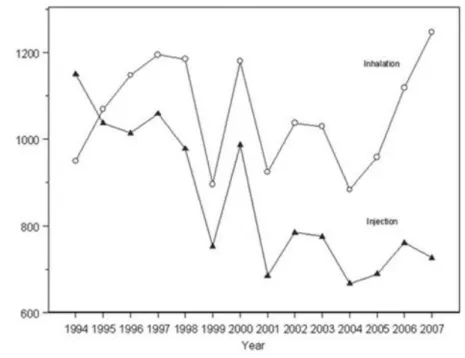
administration for primary drug of abuse among entrants of the Beth Israel methadone maintenance program from 1995 to 2007 (p.155). The program averaged 7,000 patients at any point over the 12 year time period and approximately 2,000 new admissions per year (Des Jarlais et al., 2009c). According to Des Jarlais et al. (2009c), “addiction to an opioid drug is an eligibility requirement for program entry” and “admissions include both people who are new to methadone treatment and those with previous experience in methadone treatment” (p. 156). “Figure 1 shows the numbers of new methadone program entrants reporting injecting and intranasal use as their route of drug administration” states Des Jarlais et al. (2009c) (p.156).
Figure 1. Number of methadone maintenance programs. Adapted from “Syringe
Exchange, Injecting and Intranasal Drug Use” by Des Jarlais et al., 2009c, Addiction, 105, p.157. Copyright 2009 by Society for the Study of Addiction. Adapted with permission.
“The data in Figure 1 are clearly inconsistent with the hypothesis that
implementation of large-scale syringe exchange and reduction in the threat of HIV/AIDS will lead to a substantial increase in drug injecting,” according to Des Jarlais et al. (2009c) (p.156). “During the same period in which syringe exchange programs were expanding greatly—from 250,000 syringes exchanged per year in 1993 to 3,000,000 syringes exchanged per year in 2002—the ratio of injecting to intranasal heroin decreased” states Des Jarlais et al. (2009c) (p. 156). As stated by Des Jarlais et al. (2009c), “if removal of the threat of HIV/AIDS causes increased drug injecting, then one would have expected the percentage of injectors to have increased” (p.156).
In brief, all the vilification surrounding syringe and needle exchanges have been refuted. Moreover, SEPs have proven themselves to be a valuable harm reduction technique in the battle against injection drug use that should be utilized more often. With the pro1per funding and adjustments made in policies, syringe and needle exchange programs could be have an even greater impact on IDUs, society and the field of rehabilitation than they already have.
REFERENCES
Allgood, K. L., Silva, A. & Shah, A. (2009). HIV testing practices and attitudes on prevention efforts in six diverse Chicago communities. The Publication for Health
Promotion and Disease Prevention, 34(6), 514-522. doi: 10.1007/s10900-009-9177-1
Ball, A.L. (2007). HIV, injecting drug use and harm reduction: A public health response. Addiction, 102(5), 684-690. doi: 10.1111/j.1360-0443.2007.01761.x
Belani, H.K. & Muenning, P.A. (2008). Cost-Effectiveness of needle and syringe exchange for the prevention of HIV in New York City. Journal of HIV/AIDS & Social
Services, 7(3), 229-240. doi: 10.1080/15381500802307492
Bluthenthal, R. N., Heinzerling, K. G., Anderson, R., Flynn, N. M. & Kral, A. H. (2008). Approval of syringe exchange programs in California: Results from a local approach to HIV prevention. American Journal of Health, 98(2), 278-283. doi: 10.2105/AJPH.2005.080770
Center for Disease Control and Prevention (2010). HIV surveillance in injection drug users. [Date file] Retrieved from
http://www.cdc.gov/hiv/idu/resources/slides/slides/idu.pdf
Davidson, P. J., Scholar, S. & Howe, M. (2011). A GIS-based methodology for improving needle exchange service delivery. International Journal of Drug Policy, 22(2), 140-144. doi: 10.1016/j.drugpo.2010.10.003
Des Jarlais, D.C., Arasteh, K., Hagan, H., McKnight, C., Perlman, D.C., & Friedman, S.R. (2009a). Persistence and change in disparities in HIV infection among injection drug users in New York City after large-scale syringe exchange programs.
American Journal of Public Health, 99(S2), S445-S451. doi: 10.2105/AJPH.2008.159327
Des Jarlais, D.C., McKnight, C., Goldblatt, C. & Purchase, D. (2009b). Doing harm reduction better: Syringe exchange in the United States. Addiction, 105(9), 1441-1446. doi: 10.1111/j.1360-0443.2008.02465.x
Des Jarlais, D.C., Arasteh, K., McKnight, C. Ringer, M. & Friedman, S.R. (2009c). Syringe exchange, injecting and intranasal drug use. Addiction, 105(1), 155-158. doi: 10.1111/j.1360-0443.2009.02747.x
Des Jarlais, D.C. (2010). Learning from HIV epidemics among injecting drug users. International Journal of Drug Policy, 21(2), 97-99. doi:
10.1016/j.drugpo.2009.11.001
Gindi, R.M., Rucker, M.G., Serio-Chapman, C.E. & Sherman, S.G. (2009). Utilization patterns and correlates of retention among clients of the needle exchange program in Baltimore, Maryland. Drug and Alcohol Dependence, 103(3), 93-98. doi: 10.1016/j.drugalcdep.2008.12.018
Green, T.C., Bluthenthal, R.N., Singer, M., Beletsky, L., Grau, L.E., Marshall, P. & Heimer, R. (2010). Prevalence and predictors of transitions to and away from syringe exchange use over time in 3 US cities with varied syringe dispensing policies. Drug and
Alcohol Dependence, 111(1-2), 74-81. doi: 10.1016/j.drugalcdep.2010.03.022
Heller, D. & Paone, D. (2011). Access to sterile syringes for injecting drug users in New York City: Politics and perceptions. Substance Use & Misuse, 46, 140-149. doi: 10.3109/10826084.2011.523319
Holtzman, D., Barry, V., Ouellet, L.J., Des Jarlais, D.C., Vlahov, D., Golub, E.T., Hudson, S.M. & Garfein, R.S. (2009). The influence of needle exchange programs on injection risk behaviors and infection with hepatitis C virus among young injection drug users in select cities in the United States, 1994-2004. Preventive Medicine, 49(1), 68-73. doi: 10.1016/j.ypmed.2009.04.014
Kerr, T., Small, W., Buchner, C., Zhang, R., Li, K., Montaner, J., & Wood, E. (2010). Syringe sharing and HIV incidence among injection drug users and increases access to sterile needles. American Journal of Public Health, 100(8), 1449-1453. doi: 10.2105/AJPH.2009.178467
Kidorf, M. & King, V. L. (2008). Expanding the public health benefits of syringe exchange programs. The Canadian Journal of Psychiatry, 53(8), 487-495.
Ksobiech, K. (2006). Beyond needle sharing: Meta-analyses of social context risk behaviors of injection drug users attending needle exchange programs. Substance Use
& Misuse, 41(10-12), 1379-1394. doi: 10.1080/10826080600846219
Lorvick, J., Bluthenthal, R.N., Scott, A., Gilbert, M.L., Riehman, K.S., Anderson, R.L., Flynn, N.M. & Kral, A.H. (2006). Secondary syringe exchange among users of 23 California syringe exchange programs. Substance Use & Misuse, 41(6-7), 865-882. doi: 10.1080/10826080600669041
Patel, K. (2007). Research note: Drug consumption rooms and needle and syringe exchange programs. Journal of Drug Issues, 37(3), 737-748.
Rudolph, A.E., Standish, K., Amesty, S., Crawford, N.D., Stern, R.J., Badillo, W.E.,Boyer, A., Brown, D., Ranger, N., Garcia Orduna, J.M., Lasenburg, L., Lippek, S., & Fuller, C.M. (2010). A community-based approach to linking injection drug users with
needed services through pharmacies: An evaluation of a pilot intervention in New York City. AIDS Education and Prevention, 22(3), 238-251.
Strike, C., Watson, T.M., Lavigne, P., Hopkins, S., Shore, R., Young, D., Leonard, L., & Millson, P. (2011). Guidelines for better harm reduction: Evaluating implementation of best practice recommendations for needle and syringe programs (NSPs). International Journal of Drug Policy, 22, 34-40. doi:
10.1016/j.drugpo.2010.03.007
Wodak, A. & Cooney, A. (2006). Do needle syringe programs reduce HIV infection among injecting drug users: A comprehensive review of the international evidence. Substance Use & Misuse, 41, 777-813. doi: 10.1080/10826080600669579
VITA
Graduate School Southern Illinois University
Stephanie M. Woods
Austin Peay State University
Bachelor of Science, Sociology, May 2010
Research Paper Title:
Syringe and Needle Exchanges Programs: A Valuable Harm Reduction Technique in the Battle Against Injection Drug Use