_________________
Received: 22 September 2012 / Accepted: 20 November 2012 ISSN 2241-1925
© ISAST
Study of Usage Pattern of Information Retrieval
Features of Online Databases in University Libraries
in India
Dr. Projes Roy*
Dr. Shailendra Kumar**
*Dr. Projes Roy, Librarian, Shaheed Rajguru College of Applied
Sciences for Women (University of Delhi), Jhilmil Colony, Vivek
Vihar, Delhi-110095.
**Dr. Shailendra Kumar, Associate Professor, Department of Lib.
& Inf. Sc. , University of Delhi, Delhi-110007.
Abstract.Most of the Indian University Libraries are presently based on the model of providing access to organized collections, assist the users in information search and circulate documents within the stipulated period of time. Though every university library functions and undergoes changes according to its own mission, objectives, environmental scanning, funding, leadership and staff. With 294 universities/institutions, 13150 affiliated colleges, 88.21 lakh students and 4.27 lakh teachers, it is a great challenge to ensure effective coordination and communication. Under this initiative UGC is modernizing the University Campuses with state-of-the-art campus wide networks and setting up its own nationwide communication network named UGC-INFONET. The UGC-Infonet, INDEST consortium radically changed the conceptual literature search service in the present libraries. The routine users education program, changed the attitude of information search through the online databases among the library users. The present study intended to see different IR features of online databases, response pattern of users on IR features of online databases, users response among the available online databases in Indian university, response rates on subject based online databases and of users response on IR features of online databases. The universities are selected through the frequency bandwidth utilization, it has grouped from lower to higher, and from the each group single university has been chosen. The online databases are selected on the basis of the total; users response. Different Retrieval Features are recorded by analyzing the online databases and accordingly it is also categorization in common to specific. The user’s response has been taken through the laboratory testing as well as questionnaire. The analysis of the response data has been done though statistical methods, the t-test has also conducted for the fulfilment of the requirement of the hypothesis. The major finding has been taken into account Information Retrieval features and its impact on subject based online databases and its users.
1.1 INTRODUCTION
Indian University Libraries are presently based on the model of providing access to organized collections, assist the users in information search and circulate documents within the stipulated period of time. Some have automated their operations for greater efficiency and provide additional facilities for use of the Internet and e-journals. These services are not enough to meet the information service requirements of emerging knowledge society (Jansen, 2005). Moreover, university libraries now have no monopoly for providing academic information, as alternatives are available for accessing academic information. University libraries are thus also facing fierce competition from alternative information services (Diercks,2003).
Though every university library functions and undergoes changes according to its own mission, objectives, environmental scanning, funding, leadership and staff, there are some common developmental strategies which can be adopted for metamorphosis of these libraries into knowledge resource and service centers.
1.2 ONLINE DATABASES
Indian Universities constitute one of the largest higher education systems in the world. With 294 universities/institutions, 13150 affiliated colleges, 88.21 lakh students and 4.27 lakh teachers, it is a great challenge to ensure effective coordination and communication. Fast changing curricula and frequent introducing of new subjects impose a great demand on the system in general. Indian Universities need to be given the required thrust to enter the third millennium with a leading edge. Technology is a driving force in the contemporary education systems. University Grant Commission has launched an ambitious programme to bring about a qualitative change in the academic infrastructure, especially for higher education. Under this initiative UGC is modernizing the University Campuses with state-of-the-art campus wide networks and setting up its own nationwide communication network named UGC-INFONET
The Ministry of Human Resource Development (MHRD) set up the “Indian National Digital Library in Engineering Science and Technology (INDEST) Consortium". The Ministry provides funds required for providing differential access to electronic resources subscribed for the consortium to the core members through the consortia headquarters set-up at the IIT Delhi. The total number of members in the consortia has now grown to 115. The INDEST Consortia subscribes to over 4000 electronic journals from a number of publishers and aggregators.
This study is confined to a select old and established eight central university libraries access the length and breadth of the country.
Assam University (AU, 1994), Silchar Banaras Hindu University (BHU, 1916, UP Delhi University (DU, 1992) NCR
Indira Gandhi National Open University (IGNOU, 1985) NCR Jamia Millia Islamia (JMI, 1969) NCR
Jawaharlal Nehru University (JNU, 1969) NCR Pondicheery University (PU, 1985) Poducheery Viswa Bharti University (VBU, 1951) WB
Of these eight universities the four namely, DU, IGNOU, JMI and JNU are in the National capital Region with others represent South (PU),North –East (AU), and North central (BHU). At the time of study there was no central university in the North West India. This gives fair representation to all the regions of the country. Further these eight universities were chosen on the basis of ranking and grouping their bandwidth utilization (as taken from the Inflibnet, Ahmedebad websites < www.Inflibnet.ac.in>.Two universities in each group representing the highest and the lowest network communication bandwidth were selected.
BANDWIDTH UTILIZATION RAKING
S.NO . NAME OF THE UNIVERSITY ABBREVI ATION BANDWITH UTILIZATION % OF UEAGE BINAR Y % 1. ASSAM UNIVERSITY AU 137.6 kb/s 6.7% 0.2 2. Mizoram University MU 140.8 kb/ 6.9% 0.8 3. Maulana Azad National
Urdu University
MANUV 157.8 kb/s
7.0% 1.2 4. Indira Gandhi National
Open University
IGNOU 16.4 kb/s 0.8% 4.6 5. Vishwa Bharati University VBU 161.1
kb/s
7.7% 6.7 6. Hyderabad University HU 163.1
kb/s
7.2% 6.9 7. Aligarh Muslim University AMU 213.6
kb/s
10.4 %
7 8. Banaras Hindu University BHU 24.9 kb/s 1.2% 7.2 9. Jawaharlal Nehru University JNU 3240.0 b/s 0.2% 7.7 10. Mahatma Gandhi Antarrashtriya Hindi Vishwavidyalay MGAHV 427.4 kb/s 19.0 % 10.4 11. Babasaheb Bhimrao Ambedkar University BBAU 639.0 kb/s 31.2 % 19 12. Jamia Mallia Islamia
University JAMIA 647.9 kb/s 30.9 % 30.9
13. Delhi University DU 649.1 kb/s
31.0 %
31 14. North Eastern Hill
University NEHU 70.8 kb/s 4.6% 31.2 15. Tezpur University TU 782.5 kb/s 38.2 % 38.2 16. Pondicherry University PU 808.1 kb/s 38.5 % 38.5
Table 1.1 Bandwidth utilization by the Universities
1.3 METHODOLOGY
Since the study is a maiden attempt, it has taken only 8 central universities out of 18 in India. When this study (Roy, Projes, 2009) started in 2006 there were only 16 central universities subscribed online databases. The present study has been conducted on a sample of eight central universities which are quite old and well established, these eight universities have been chosen on the basis of their bandwidth utilization ranking and grouping (table 1.1). Two universities in each group which represent the highest and lowest bandwidth have been chosen. Out of 8, there are 4 Central Universities are in Delhi, 1 from West Bengal, 1 from Pondicherry, 1 from Assam and 1 from Uttar Pradesh. In the said universities 116 databases are being used by clientele. The major research objective is to identify the difference among the search of users with success in searching from the common databases. One approach might be to look at the results of searches, and relate process to result: this is part of the present research.
The variables selected for study are of quantitative measures. The purpose of using these quantitative measures is that the computer can monitor them automatically and unobtrusively. Thus, if it can be shown that they are related to search performance, they could provide extremely convenient measures of performance.
The population of this study consists of research scholars and faculty members of the university libraries. There are eight universities covered in this study, each university having 40 participants. Of the actual population only 298 participated instead of 320. A separate questionnaire was also prepared for the university librarians, but in most of the university libraries, the information scientists have filled up the questionnaire.
The pilot study has also done to ensure reliability of the study i.e. use of simple language, standardization of questions and also to know the existing defect and ambiguities in the questionnaire. Accordingly the present study conducted a preliminary study in University of Delhi. There 20 users were chosen with utmost care to prevent flaws in the chosen tools of data collection. The population was randomly selected for pre-testing. The pilot study therefore helped the researcher to such discrepancies in the questionnaire. The questionnaires were modified for final distribution on the basis of the opinions
and suggestions made by the library professionals, Information Scientists and users of the online database.
1.4 SELECTION OF DATABASES
The first phase of study was conducted in accordance with the online databases available in the eight central universities in India. The Universities in India is subscribing the online databases on the basis of their needs in different subjects. Therefore, the databases are varying from university to university. The Seven Universities, out of eight are the members of UGC Infonet Consortia, on the other hand, the only one university i.e. IGNOU is subscribing their Online databases of their own.
The first step was to take all the online databases being used in all the eight universities from their university websites and through personal communications. The INFLIBNET web site is being used here as a tool. It is found that there are 116 databases used by the said universities (Including full text, bibliographic and e-books). As per the availability of the databases, the databases are being ranked in four categories. In the first category are the most common databases which vary from 100% to 80% availability. In second stage are the more common databases, which vary from 79% to 60% , the third stage is common databases, which is vary from 59% to 30% and special category vary from 29% to 10%. All the most common databases have been evaluated thoroughly. The study has categorized all the retrieval features under the following three basic categories i.e. Basic retrieval features, advanced retrieval features and unique retrieval features. And the features have been taken for analysis and interpretation like difficulties faced in using the features; and the features expected by users and missed by the database providers etc.
The users were asked about their use of different online databases. Data regarding preference of online databases has been scrutinized of the eight central universities in India as shown in the table 1.2.
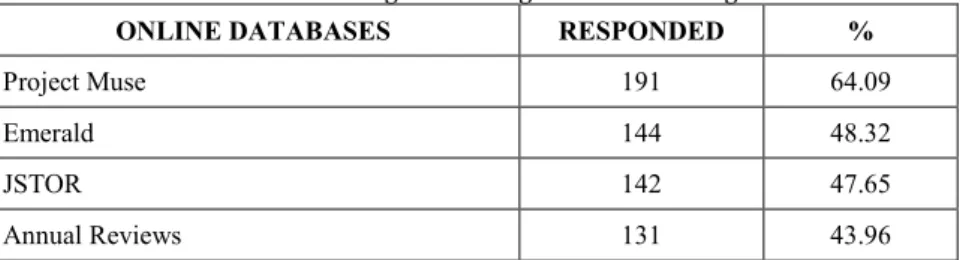
The online databases summarized and ranked in the Table 1.3 are based on percentage of use at the eight central universities in India. Online database Project Muse is being used by most of the respondents, with 64.09 percent of the total usage, and Project Euclid has recorded the lowest usage rate with a mere 1.34 percent.
Table 1.3 Ave rage Percentage Data bases Usage
ONLINE DATABASES RESPONDED %
Project Muse 191 64.09
Emerald 144 48.32
JSTOR 142 47.65
Wiley Interscience 111 37.25
American Chemical Society 107 35.91
American Institute of Physics 103 34.56
American Physical Society 101 33.89
Taylor & Francis 98 32.89
Institute of Physics 92 30.87
Elsevier 89 29.87
Blackwell Publishing 81 27.18
Cambridge University Press 81 27.18
Oxford University Press 72 24.16
Royal Society of Chemistry 63 21.14
IEEE/IEE Online Library 51 17.11
Nature 48 16.11
Portland Press 46 15.44
EBSCO Research Databases 34 11.41
American Society for Microbiology 30 10.07
Encyclopedia Britannica 30 10.07
Biological Abstract 24 8.05
SciFinder Scholar 21 7.05
Credo Reference 15 5.03
American Society of Civil Engineering 10 3.36 BIOSIS Biological Abstract Database Online 10 3.36 American Society of Mechanical Engineering 9 3.02
Authorama 8 2.68
Bartleby.com 8 2.68
Bibliomania 8 2.68
Sage- E - Books collections 8 2.68
Complete Works of William Shakespeare 7 2.35
Alex Catalogue of Electronic Texts 6 2.01
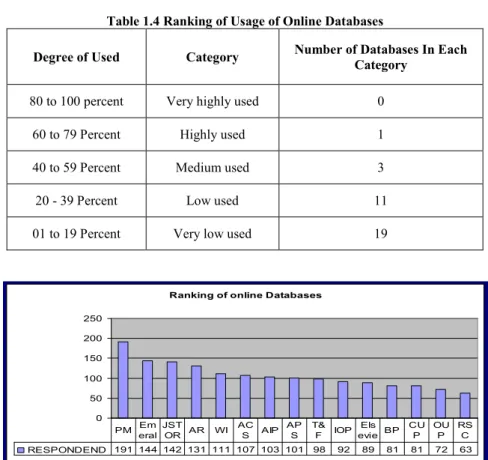
On the basis of the Table 1.3 the study can be categorized into different levels of use of online databases in the said university libraries in India. It has been found that a highly used online database is Project Muse and least used online database is Project Euclid. From the above the below given table has been prepared on the basis of the usability. The study has been restricted to the highly used online databases to lowest used databases as shown in the table 1.4.
Table 1.4 Ranking of Usage of Online Databases
Degree of Used Category Number of Databases In Each
Category
80 to 100 percent Very highly used 0
60 to 79 Percent Highly used 1
40 to 59 Percent Medium used 3
20 - 39 Percent Low used 11
01 to 19 Percent Very low used 19
Ranking of online Databases
0 50 100 150 200 250 RESPONDEND 191 144 142 131 111 107 103 101 98 92 89 81 81 72 63 PM Em eral JST OR AR WI AC S AIP AP S T& F IOP Els evie BP CU P OU P RS C
Figure 1.1 Ranking of Online Databases on the Basis of Users Response
From the above figure 1.1, it has been observed that is the category of highly used online databases in the Eight Central Universities in India is Project Muse (64.09%) is highly used, Emerald (48.32%) , JSTOR (47.65%), Annual Review (43.96%) are in the category of medium used, Wiley Interscience (37.25%), American Chemical Society (35.91%), American Institute of Physics (34.56%), American Physical Society (33.89%), Taylor & Francis (32.89%), Institute of Physics (30.87%), Elsevier (29.87%), Blackwell Publishing (27.18%), Cambridge University Press (27.18%), Oxford University Press (24.16%), Royal Society of Chemistry (21.14%) are least used online databases in the Eight Central Universities in India.
Out of the eight universities surveyed seven are members of the UGC-Inflibnet consortia where the IGNOU is subscribing to 17 databases of its own, and is not a member of the above consortia. The 116 databases are of the following form: Bibliographic – 15
E-Books - 29 Full text Journals- 72 ---
Total = 116
These databases are from the following Venders/ Publishers; American Chemical Society (ACS) American Institute of Physics (AIP)Annual Reviews (AR), Black well Publishing (BWP), Cambridge University Press(CUP), Institute of Physics(IOP), Institute of Studies in Industrial Development (ISID), J-Gate customs Context Consortia (JCCC), JSTOR, Oxford University Press (OUP), Royal Society of Chemistry (RSC), Society for Industrial and Applied Mathematics (SIAM), Springerlink (SL), and Taylor & Francis (T&F) of the 116 databases strangely enough only one database, namely, project muse <muse.inu.edu>, which 69 database were subscribed by only one university each. For the academic libraries the two most important consortia are UGC-Inflibnet and AICTE- Indest. All the libraries except the IGNOU, have Consortia based database and some have self-subscribed, to DU and JNU have in-house grown databases. The DU is also a member of the AICTE-Indest consortia. Though it is mostly meant for professional and engineering institutes. All the universities use commercial as well as open source databases; net server and CD-ROM mirror server were very popular among the universities, now university libraries under study are no more offering CD-ROM services. Multimedia databases are available only in DU and JNU, while all the eight libraries own and provide access to fulltext and bibliographic databases .All libraries have self subscribed as well as consortia based databases, whereas the DU and JNU have also developed in –house databases .All the members of the UGC –Infonet library being traditional and general universities under the preview of the UGC, whereas the DU is also a member of the AICTE indent consortia. The study found that only DU, BHU, IGNOU and JNU are hosting open access databases on their websites. Most of the universities allow online access to databases either through their intranet or directly from the www. Experienced librarians prefer campus wide facility for providing access to databases. The AU, IGNOU, Jamia, JNU and Viswa Bharti allow access through campus wide intranet or internet with identification and password. Desk-top remote access to university resources is preferred by busy scholars .Further it was found that AU, BHU, DU, JNU, PU, Viswa Bharti and IGNOU allow IP enabled access.
1.5 OBJECTIVES OF THE STUDY
- to identified different IR features of online databases
- to identified response pattern of users on IR features of online
databases.
- to evaluate users response among the available online databases in
Indian university
- to identified response rates on subject based online databases
- comparison of users response on IR features of subject based online databases
1.6 BASIC DATA RETRIEVAL FEATURES OF SUBJECT
BASED ONLINE DATABASE
The study gone through different retrieval features of online databases available in Indian universities, bedside this the literature review also taken into consideration to determine the basic retrieval features. After analyzed both aspect, the study render some of the features can be grouped in the basic retrieval features, i.e. Entering a Search, Navigation within the results list, Displaying an article from the result list, Searching for a particular journal Issues, Link to “Related Internet links”, Finding the relevance rating for each article, Using the “go to best part” feature and Displaying the definition of a word in an article. The above retrieval features are included into the questionnaire to measure the users response of the different subject based online databases available in Indian universities. The result of the each categories subject response again tested in the t- test (Table 1.5) to see the exact result of the user’s response on science, social sciences and multi disciplinary subject.
Table 1.5 Paired Samples Statistics of Basic Data Retrieval Features among Subject Based Online Databases
Performance Variable t-value Degree of Freedom p-value
Sciences Vs. Multi Disciplinary 2.693 7 .03 Multidisciplinary Vs. Social Science 3.044 7 .01 Social Science Vs. Sciences .326 7 .75
The above table 1.5 shows that there is a significant difference in the basic retrieval features among the science and multidisciplinary users and Social science and multidisciplinary users but there is no significant difference among the science and social science users.
1.7
ADVANCE DATA RETRIEVAL FEATURES AMONG
SUBJECT BASED ONLINE DATABASES
As discuss in previous, the study also determine the different data retrieval features as advances data retrieval features of the online databases. For that some of the retrieval features are grouped and tested on the sciences, social sciences and multi disciplinary online databases i.e. Boolean Operator, Field specific searches, Have rules of precedence with nested queries, Limit field
searches, Match of exact words/phrases, Phases Searching, Proximity search, Range searching, Save search, Search history, Stemming, Subject search, Truncation, Use of thesaurus or permuted index for searching and Wildcard. The above retrieval features are included into the questionnaire to measure the users response of the different subject based online databases available in Indian universities. The result of the each categories subject response again tested in the t- test (Table 1.6) to see the exact result of the user’s response on science, social sciences and multi disciplinary subject.
Table 1.6 Paired Samples Statistics of Advance Data Retrieval Features among Subject Based Online Databases
Performance Variable t-value Degree of Freedom p-value
Sciences Vs. SOS/HUM -.676 14 .510
Science Vs. Multidisciplinary -2.435 14 .029 Social Science Vs. Multidisciplinary -3.157 14 .007
The Table 1.6 shows that there is a significant difference in the advanced retrieval features among the science and multidisciplinary users and Social science and multidisciplinary users but there is no significant difference among the science and social science users.
1.8
UNIQUE DATA RETRIEVAL FEATURES AMONG SUBJECT
BASED ONLINE DATABASES
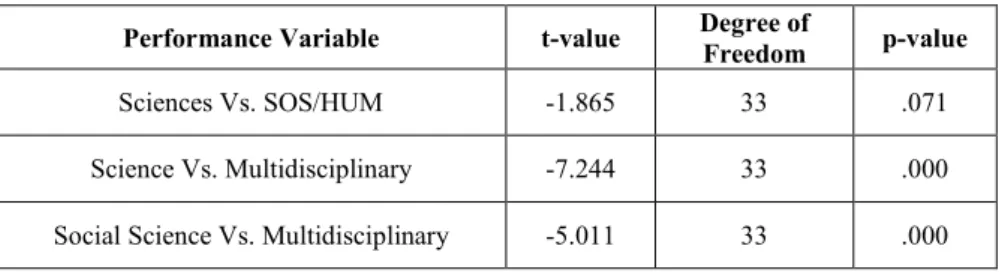
The data retrieval features again studied and grouped into unique data retrieval features, the features are unique in nature and available in the chosen few online databases i.e. Article locater, Article types, Automatic Translation Software, Citation Search, Classification code, Cross Reference Search, Custom Links, Density of Terms, Explode/Expand Search, E-mailing an Article from the Result List, E-mailing Citations from the Result List, Frequency of terms, Fuzzy Searching, Google Custom Search, Help Menu/Online Tutorial/Guide, Hyphen, Journal Browsing, Lateral Searching, Mapping, Nested Queries, Persistent Links, Punctuation Marks, Query by Example, Reference Link, Searching for Common Phrases, SMART Links, Sort Order, Special Characters, Spell Check, Stop Word, Subject Authority, Suggest Subject Headings, Table of Content and Times Cited. The above retrieval features are included into the questionnaire to measure the users response of the different subject based online databases available in Indian universities. The result of the each categories subject response again tested in the t- test (Table 1.7) to see the exact result of the user’s response on science, social sciences and multi disciplinary subject.
Table 1.7 Paired Samples Statistics of Unique Data Retrieval Features among Subject Based Online Databases
Performance Variable t-value Degree of
Freedom p-value
Sciences Vs. SOS/HUM -1.865 33 .071
Science Vs. Multidisciplinary -7.244 33 .000 Social Science Vs. Multidisciplinary -5.011 33 .000
The table 1.7 shows that there is a significant difference in the unique retrieval features among the science and multidisciplinary users and Social science and multidisciplinary users but there is no significant difference among the science and social science users.
1.9 CONCLUSION
The above study intended to find out the scalability of online databases through its specific group of users, the online databases on sciences are popular in Indian university libraries, but that study find that the social sciences online databases are similarly popular in Indian universities. But the multi disciplinary online databases are not so popular in real sense. As it has not specified by the database vendor for the specific user’s community.
As far as the different retrieval features is concerned, it has found that the science and social science users are smarter enough to know and responded the different retrieval features, where multi-user databases usres are are not so concerned with the different data retrieval features.
Challenges remain in balancing print and online resources to meet the needs of various groups, organizing resources, and educating users to select resources based on information needs as well as format or convenience. The findings of this study suggest that databases complex user’s interface will have lower use. Promotion of the online catalog as the point of access to online journals will encourage use based on need rather than convenience. A simple and informative user’s interface is very much acceptable by the users. Likewise, libraries also need to consider selecting databases that provide full-text links to their online collections in a seamless manner. Furthermore, database vendors need to be proactive in facilitating access to full-text journals to its users
The multi-user database needs to do more handwork to attract the users community. Users would benefit from a quick, visual online guide that can be accessed from the login screen or the University homepage. A number of universities in the study had this kind of guide that could be used to help orientate users when they first use the tool. Federated search tools can function on different levels and users can engage with the tool and its functionality to
varying amounts. It would be sensible to have guides to Library home pages that are aimed at different levels of users, or different depths of engagement.
REFERENCE
Chakravarty, R and Singh, Sukhwinder, (2005), “EResources for Indian Universities: New Initiatives” SRELS Journal of Information Management, Vol. 42, No. 1, Paper D. p57-73.
Chandrakar, Rajesh (2003) Barriers of bibliographic databases creation in Indian university libraries: the INFLIBNET experience. The Electronic Library.Vol. 21, No. 4, pp310-315.
Diercks, T. (2003), “Database evaluation report: Expanded Academic ASAP vs Academic Search premier”, available at:
http://libweb/hawaii.edu/uhmlib/news/surveys/ eai_asap.htm. (Last Accessed 30-12-08).
Electronic Collections Committee (1993), “Evaluation of UMI’s Proquest Education Complete”, available at: www.fcla.edu/sulc/ecc/97_99/umieval.html (Last Accessed 23-12-2010).
Griffiths, J.R. & Brophy, P. (2002). “Student searching behaviour in the JISC Information Environment”. Ariadne [Online], (33).
http://www.ariadne.ac.uk/issue33/edner/intro.html (Last accessed 7 -07-2008]. Hoelscher, C(1998), How Internet Experts Search for Information on the Web, paper presented at the World Conference of the World Wide Web, Internet, and Intarnet, Orlando,FL. Association for the Advancement of Computing in Education, www.aace.org.pubs/ (last accessed 31-08-1010)
Jansen, B.J., Spink, A. and Saraoevic, T. (2000), “A study of user queries on the Web”, Information Processing and Management (Special Issue: Web research and IR), Vol. 36 No.2, pp207-27.
Kelly, D., Shah, C., Sugimoto, C. R., Bailey, E. W., Clemens, R. A., Irvine, A. K., Johnson, N. A., Ke, W., Oh, S., Poljakova, A., Rodriguez, M. A., van Noord, M. G., & Zhang, Y. (2008). Method bias? The effects of performance feedback on users' evaluations of an interactive IR system. UNC SILS Technical Report #TR-2008-01.Available online at: http://sils.unc.edu/research/techreports.html (Last Accessed 20-01-1010).
Koh, C. (2003). “Reconsidering services for the postmodern student”. Australian Academic and Research Libraries [Online], 34(3).
http://www.alia.org.au/publishing/aarl/34.3/full.text/koh.html ( last accessed 03-06- 2008).
Prabhu, Margaret. Crothers, Stephen and Sullivan, Shirley. (2002). “Electronics journal access in an academic library revisited”. The Australian Library Journal. Vol. 51, No. 3. http://alia.org.au/publishing/alj/51.3/full.text/electronic.journals.html
Ray, K. & Day, J. (1998). “Student attitudes towards electronic information resources”. Information Research [Online], 4 (2). http://informationr.net/ir/4-2/paper54.html [last accessed 01-08-2004].
Roy, Projes (2009) “A study of Data Retrieval Techniques of Online Databases available in libraries of Central Universities in India”. Thesis (Ph. D) – University of Delhi, 2009.
Tenopir ,Carol.(2008) Peiling Wang Yan Zhang, Beverly Simmons and Richard Pollard. “Academic users’ interactions with ScienceDirect in search tasks: Affective and cognitive behaviors”. Information Processing & Management, Vol. 44 No.1, pp105-121.
Xie, Hong Iris (2004). ‘Online IR system evaluation: online databases versus web search engines”, .Online information review. Vol.28, No.3, p. 211–219.
Xie, H. (2003), “Supporting ease-of-use and user control: desired features and structure of Web-based online IR systems”, Information Processing and Management, Vol. 39 No. 6, pp. 899-922.
Xie, H. and Cool, C. (2000), “Ease of use versus user control: an evaluation of Web and non-Web interfaces of online databases”, Online Information Review, Vol. 24 No. 2, pp. 102-15.
Zabed ahmed, S. M., Mcknight, Cliff., Oppenheim, Charles (2006). “The use of a heuristic process to evaluate an online information retrieval interface”. library and information research news .Vol. 9, No.95, pp3-9.