to improve the quality of the product
Abstract:This work aims to present the importance of knowledge for companiesespecially at a time in which competition ignores frontiers. Knowledge has become the main resource for what a company produces. Quality, cost and competitiveness matters boil down to a more fundamental matter: companies’ inability to learn and to avoid sistematically repeating the same mistakes. Organizational knowledge makes the development of competence possible, raising the quality standard of goods, services and methods. The price most products and services depends on how intangible knowledge-based factors are developed. Tacit knowledge, which has a subjective nature and is highly personal and hard to describe, is the basis of organizational knowledge. The effi-ciency of knowledge creation can be measured by the ability of the company to transform tacit knowledge into explicit knowledge. Thus, the creation of new knowledge is the result of an inten-sive interaction among the members of the company. The growing importance of knowledge in operational processes requires a behavioral change in the company in order to manage this new resource. The role of the company in this process is to provide the appropriate context to facilitate group activities in order to create and store knowledge at the organizational level. So, knowledge management must focus not on the allocation of power and resources, but on the flow of knowl-edge, sight, confidence, and communication. It is necessary to change the idea and concept of traditional work in order to manage these collaborations.
Key-words: project, knowledge, competence, quality.
Luiz Veriano O. Dalla Valentina Universidade do Estado de
Santa Catarina – UDESC [email protected]
Osmar Possamai Universidade Federal de Santa Catarina – UFSC [email protected]
1. Introduction
Global competitive pressure has made companies find new ways to better assist their clients' needs, to reduce costs, and to increase productivity. Constant quality improvement has also been necessary for companies'dealing strategies. Quality and competitiveness matters boil down to a more fundamental matter: organizations' inability to learn, and to avoid repeating the same mistakes.
We have been watching a revolution in the world economy, a change for an economy based on knowledge. In the “knowl-edge society” (DRUCKER, 1995), traditional production fac-tors, such as work, capital and land, have become secondary and knowledge is now the most important resource. Stewart (1998) reinforces this idea saying that in the new “information
era”, the main resources are not natural resources or physical work, but knowledge and communication. This transforma-tion is apparently irreversible and uncontrollable.
The creation of organizational knowledge is the key-ele-ment to differ one company from another. The improvekey-ele-ment of the quality of products and services is the result of an adequate development process focused on the creation and internalization of knowledge, associated with the application of tools and quality methodologies. “The creation of organi-zational knowledge shows the capacity a company has to generate knowledge, to spread it inside the company, and to incorporate it into products, services and systems” (NONAKA & TAKEUCHI, 1995). So, competitive success derives from the capacity to create new knowledge.
Andre H. Futami
Universidade Federal de Santa Catarina – UFSC
The traditional organizational structure shows exhaustion signs when dealing with the knowledge factor. Such a struc-ture is no longer adequate to manage people and processes. The general idea traditional organozations have of knowl-edge is related to Taylor’s “Scientific Management”, which is not able to deal with value or belief matters, halting the cre-ation of both new ideas and a new value system. Techniques and conceptual structures which are mainly developed in companies nowadays give emphasis especially to logical and analytic thinking. Companies use basically the quantitative and scientific approach to elaborate strategies, ignoring the main element in the knowledge creation process: human re-source. Tacit knowledge, experience, and insights, generally highly personal and inherent to human beings, are neglected by the formal structures of organizations.
Thus, this article aims to contribute to the development of NADLER & GERSTEIN'S (1994) model, incorporating knowledge management into the Process of Project, focus-ing on quality improvement of industrial product projects.
2. Project quality and organizational knowledge
Organizational knowledge generates competitive benefits, raising the quality level of goods, services and methods. Quinn (apud NONAKA & TAKEUCHI, 1997) states that the value of most products and services depends on how the “intan-gible factors based on knowledge”– such as the technologi-cal know-how, the product project, the marketing presenta-tion, the client’s comprehension, personal creativity and in-novation – are developed.
The value of a product is present not in its physical con-tent, but in its intelectual one (STEWART, 1998). As a re-sult, the notions of production and product need to be reconceptualized, because knowledge has become the most important ingredient in order to plan, perform, and produce. Knowledge is the main element of any process involving product development. Developing a product which is “ap-propriate to use” (JURAN, 1992) is the main objective of any company producing consumption goods.
3. The importance of tacit knowledge
NONAKA & TAKEUCHI (1997) say that knowledge is defined in two different ways: tacit and explicit. Explicit and tacit knowledge are basic structural units which complement and interact with each other, being interaction the main point for the creation of organizational knowledge.
Explicit knowledge can be expressed in words and num-bers, being easily processed, communicated and shared as gross data, scientific formulae, codified procedures or universal prin-ciples. According to NONAKA & TAKEUCHI (1997), Western organizations consider knowledge as merely “explicit”, formal and systematic. Thus, the company is treated like a machine apt “to process information” and knowledge is treated like syn-onymous with a computer code; a chemical formula or a gen-eral set of rules. This is an approach with a historical origin based on Taylor’s management theory. So, explicit knowledge is simply a small visible part of knowledge as a whole.
NONAKA & TAKEUCHI (1997) state that tacit knowl-edge is an important source of competitiveness, affirming that it is also the main generating factor of competitiveness and innovation in Japanese companies in the 1980s. NONAKA & TAKEUCHI (1997) criticize Western management scholars who are simply interested in processing information, acquir-ing, storacquir-ing, and using previous knowledge, not considering the company as an entity which generates new knowledge.
The absence of an approach directed to the process knowl-edge creation makes tacit knowlknowl-edge invisible for the company.
4. The process of product development
The process of contemporary product development has become an intensive process of knowledge application. The effective production of quality is systematically associated with knowledge application on the different phases of a project. JURAN (1992) defines product development as “an ex-perimental process of choosing those products'characteristics which correspond to clients' needs”. He also defines product projects as “the process of defining the characteristics of prod-ucts necessary for achieving clients’ needs”.
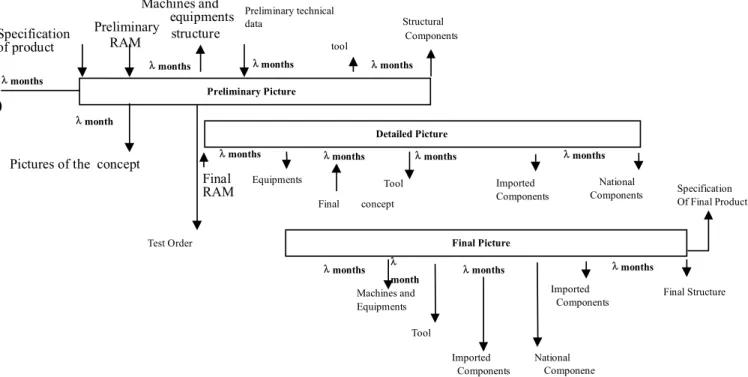
The development of a product consists of a process of information change (PAHL and BEITZ apud SELL, 1997). A project activity must be seen as an empirical-theoretical outline, constrained by time, in which a set of information is treated, modified and sent on to another activity at adequate time (see figure 1).
Information does not simply come in the beginning of the activity, leaving by the end of it: the information flow is continuous.
Knowledge is created by the interaction which occur among people while performing these activities. The information flow
occurs in a chaotic way during this process. The tacit knowl-edge which comes from this interactive process is the basis for the creation process of organizational knowledge.
The decisions made according to the information and knowledge created and available in the process will deter-mine, for example, the type of product to be developed and the corresponding quality level. The initial phases of the project are of extremely importance if analysed under the viewpoint of product quality, because they define the information which will be passed on.
Methodologies, just like competitive engineering and QFD, favour, to a higher degree, the use of knowledge in the devel-opment process. The structuring of these tools provides a productive field for the information flow which is necessary for generating and creating knowledge.
The potential contribution of tacit knowledge is still un-derestimated, mainly because of the out-dated structure which is still present in organizational culture. Knowledge transmis-sion channels privilege both the explicit and formal sides, and logical transmission processes. This causes a gap when establishing the value creation of a product, keeping its defi-ciencies up to the end of the project and generating a direct impact on the quality of the developed product.
5. Models of organizational learning
Several scholars have proposed different definitions for organizational learning and most of them are related to knowl-edge acquisition and continuous improvement. Organizational learning can be defined as the process of identifying and correcting mistakes (ARGYRIS apud GARVIN, 2001), as a self-developing and self-changing ability (STARKEY, 1992) or as an ability to acquire knowledge through experience (SHAW & PERKINS, 1994).
The importance of SHAW & PERKINS' (1994) model of organizational knowledge (see figure 2) is related to the in-corporation of a system of beliefs as the basis for the model functioning. Such a model starts with the system of beliefs, which is a combination of values, knowledge and experi-ence. The system of beliefs influences people's behaviour, working as “lenses” through which the world is perceived, molding the way we act.
HEIJST et al.’S Model (1996) introduces the concept of lessons learned as a process of organizational learning (see figure 3). The authors define the term ‘lessons learned’ as the experiences or insights, negative or positive, which can be used in order to improve the performance of the organiza-tion in the future.
0 Detailed Picture Equipments λ months λ months Tool λ months Imported Components λ months National Components λ months λ months Preliminary Picture Machines and equipments structure tool λ months Structural Components λ months Final Picture Machines and Equipments Tool λ months λ month Imported Components λ months Final Structure λ months Final RAM Preliminary RAM
Pictures of the concept
λ month Preliminary technical data Final concept Test Order Specification of product Imported Components National Componene ts Specification Of Final Product
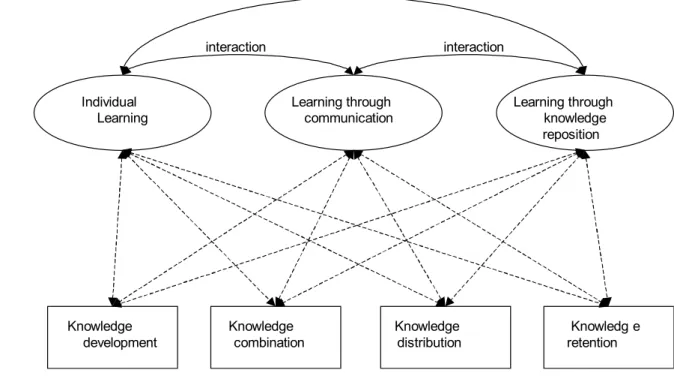
The model above is important for showing the interac-tions and connecinterac-tions among individuals, the communica-tion and repository on the process of organizacommunica-tional learning. Individual learning is a pre-requisite for learning through com-munication, being communication a pre-requisite for the development of a repository.
6. The network system as a knowledge-gener-ating tool
In a relatively recent past, some of the organizational ini-tiatives were connected to the development of working sys-tems based on teams. Team structure offers greater potential to create a more producitve and more creative working envi-ronment. The network system, which presents a more
de-veloped stage if compared to teams, reinforces interaction and information flow, generating a productive field for knowledge creation.
The net is a conceptual model of how people work to-gether in order to achieve organizational aims.
LIPNACK & STAMPS (1999) consider virtual teams and net organizations as the last stage in a company evolution. The authors argue that in team-based organizations, nets may help to avoid the feeling of fragmentation and isolation. The basic principles of LIPNACK & STAMPS’ (1999) virtual team have three sides: purpose, people and connections (see figure 5).
Figure 4 – Virtual team model (LIPNACK & STAMPS ,1999).
System ofConfidence Action Results Reflection Know -ledge
Dissemination
Figure 2. Model of organizational learning (SHAW & PERKINS ,1994).
Knowledge Process Individual Learning Learning through communication Learning through knowledge
reposition Learning
Process Knowledge development Knowledge
combination Knowledge distribution Knowledg e retention interaction interaction interaction
Figure 3 – Types of learning, their interactions, and the relation to the knowledge process (HEIJST ET AL ,1996).
PeoplePurpose
Purpose: purpose is a very important factor for any company. However, it is a critical factor when referring to teams and virtual organizations. It is the “glue” which sticks members together. Virtual teams work around a given purpose, and require cooperative aims, independent tasks and concrete results;
People: people are the basis of virtual teams. The first aspect is the independence of members, who feel autono-mous and self-confident. However, at the same time, they are also able to work inter-dependantly. The second as-pect is the shared leadership. Everybody must be able to become a leader in some phase of the process. The third aspect is the level integration. Virtual teams must be ar-ticulated not only horizontally; they must also have verti-cal connections in the organization.
Connections: connections involve face-to-face or tech-nological conversation. Results require interaction to pro-duce relations, and relationships involving confidence are long-lasting ones. Having determined the purpose and people, it is time to decide the type of more useful con-nections in order to interlink those people who can achieve previously determined aims.Knowledge creation starts with the individual and the tacit knowledge – the basis for the knowledge formation, which is hard to pass on. The use of a more interactive working sys-tem tends to suppress fragmentation and isolation problems, maximizing the individual knowledge growth amplification at group and organization levels. Davenport and Prusak (1998) state that “knowledge works more efficiently through human channels”, and that “information supply over these nets is a good way to make knowledge explicit”.
Network systems have become possible because of the recent progress in the computer science area and in telecom-munication technology. New technologies offer broad col-laborative equipment solutions, raising both the interaction capacity and the effective network.
7. General model for the creation of a network system
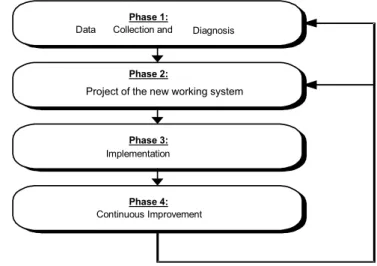
The general model for the creation of organizational ar-chitecture based on nets, and aiming to trigger knowledge, consists of four main phases, as described in picture 6.
Figure 5 – The project process of a net organization.
The first phase, data collection and diagnosis, consists in four sub-phases, as presented below:a) Phase 1.1 – The client’s, environment’s and strate-gies’ needs analysis;
b) Phase 1.2 – The working process analysis; c) Phase 1.3 – Social system analysis; d) Phase 1.4 – Identifying opportunities;
The main objective of the second phase, which is the making of the project of the new working system – the orga-nization of the network – is to plan a system which allows other groups of people, who work together, to produce and deliver products and services which satisfy the external de-mands in the competitive context analysed on the previous phase. This consists of five sub-phases:
a) Phase 2.1 – Purpose definition;
Phase 1:
Data Collection and Diagnosis
Phase 2:
Project of the new working System
Phase 3:
I Implementation
Phase 4:
Continuous Improvement
b) Phase 2.2 – Work unit definition (group);
c) Phase 2.3 – Connection definitions (net), see figure 7;
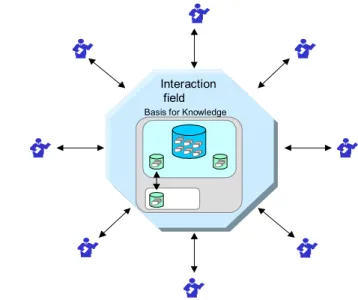
Figture 6 – Net knowledge connecting people from a number of places.
d) Phase 2.4: A Knowledge Basis Construction (see figure 8);Figure 7 – Basis for Knowledge Work.
e) Phase 2.5: Definition of the Technology to be used. Phase 3, related to implementation, refers to the operation of a network model, extending the new conception of work connected to knowledge, and implementing the knowledge basis and the technology chosen for a working unit (see figure 8).
In order to make the work system work, the groupware technology of Lotus Notesâ was used, providing interaction among the members of the system. Two additional fields were created: the Knowledge Net and the Explicit Knowledge Repository (see figure 9). The Knowledge Net is the
interac-tion field in which the individual tacit knowledge may be expressed, shared and amplified to higher ontological levels. The second field is directed to explicit knowledge, in which every single type of explicit knowledge generated is organized in order to facilitate search, access and recovery. The great advantage of Lotus Notesâ is to integrate the communica-tion system with knowledge basis in a space of shared work, connecting the members of the system among themselves through a net of knowledge and through the repository of Explicit Knowledge.
Figure 9 – The main window of lotus notes integrating personal
mes-sages, the knowledge net, the explicit knowledge, and the personal
messages file, respectively, in the same working space.
Department 2 Department 3 Unit 1 Factory ground plan 2 Factory ground plan 1 Unit 3 Department 1 Unit 2 Interaction Field Explicit Knowledge Electronic Messages Informal Knowled KnowledgeTacit ÍÎExplicitBasis for Knowledge
• Reports •Documents •Technical Artickes • Studies of Analysis •Mathematical Models •Simulation de Programs •Concepts • Historical of Messages • data • Information • Context • Shared Knowledge • Combined Knowledge • Internalized Knowledge • Experience •Know-how • Links Learned • Contextual Knowledge
• Comments , Suggestions, insights
Interaction field
Basis for Knowledge
Andre H Futami Mensagens Rede de Conhecimento Conhecimento Explícito Andre H Futami Arquivo Mensagens
Messages Knowledge Net Explicit
Knowledge MessagesFile
Figure 8 – Conceptual model of the network system, aiming to raise
knowledge work.
Some windows of the software developed on the Lotus Notes basis are presented next, being connected to the Internet and to e-mail messages, focusing on the development of the refrigeration system.
The Knowledge Net operation is similar to the resorts used by the Internet: the visualization of a determined activity is made through links. Group members can “navigate” through all the areas of the organization, working with related projects and activities, starting from the main window.
The Knowledge Net is subdivided in areas which are also subdivided in activities. Finally, these activities are subdivided in topics. Individual comments are stored in the topics.
Figure 10 presents the main window of the Knowledge Net. In this window, the number of activities, the total num-ber of comments per area and date and time of the last comment can be observed.
Figure 10 – Knowledge net’s main window contaning registered areas.
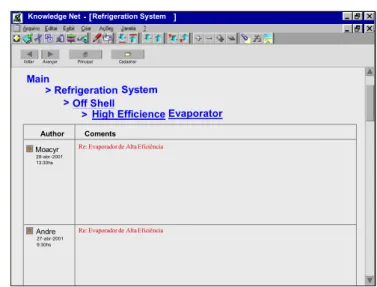
The refrigeration system has four activity groups, as seen in figure 11. By expanding the Off Shell activities, the topics related to these activities can be unfold, as seen in figure 12. All windows have the register function, allowing people to insert comments referring to the point in question. Figure 13 shows a relation of comments referring to high efficiency va-porizer. Such comments consist mainly of suggestions, expe-riences (successful or failing), insights and general opinions.Figure 11 – Main activities related to the refrigeration system.
Figure 12 – Window having topics related to the off shell items.
Figure 13 – Window having assembled comments by arrival order.
K l Knowledge Net - [ Refrigeration System ]
Area Activities Comments
4 22 Ap-22-01 13:30 5 34 Ap-23-01 14:30 5 21 Ap-24-01 15:30 5 56 Ap-25-01 16:30 6 40 Ap-26-01 17:30 8 76 Ap-27-01 18:30 4 54 Ap-28-01 19:30 Final Comments > Main Refrigerati on d System Platform 1 Platform 2 Platform 3 Set ofProject 1 Set of Project 2 Set of Project 3
Voltar Avançar Principal Cadastrar
Activities Nº Tópics Nº Coments Criated by
4 22 Andre 22-Abr-01 13:30 5 34 Marco 23-Abr-01 14:30 5 21 Alexandre 24-Abr-01 15:30 5 56 Moacyr 25-Abr-01 16:30 Last Coment Projetos de Prateleira Projetos de Pesquisa com Universidades Estudos e Análises Simulações Computacionais
Voltar Avançar Principal Cadastrar
- [
Knowledge Net Refrigeration System ]
Main
> Refrigeration System
- [ ]
Subject Comments Created by Fro
m 22 Andre Ap-28-01 13:30 Moacyr 34 Marco Ap-27-01 14:30 Alexandre 21 Alexandre Ap-26-01 15:30 Moacyr 56 Moacyr Ap-20-01 16:30 Rodrigo 40 Alexandre Mar-31-01 17:30 Rücker 76 Rodrigo Mar-28-01 18:30 Moacyr 54 Marco Mar-21-01 19:30 Andre
Final Comment Main
> Refrigeration System >Off Shell Evaporador de Alta Eficiência Algoritmo Overcooling Symp Gás Refrigerante SUVA 9000 Compressor Rotativo H Condensador Inclinado Damper Eletrônico SS Condensador Elipsoidal FH
Voltar Avançar Principal Cadastrar
Knowledge Net Refrigeration System
- [ ]
> System
>
>High Efficience Evaporator
Author Coments
Re: Evaporador de Alta Eficiência
Moacyr 28-abr-2001 13:30hs Andre 27-abr-2001 9:30hs
Re: Evaporador de Alta Eficiência
Voltar Avançar Principal Cadastrar
Knowledge Net Refrigeration System
Main
Refrigeration Off Shell
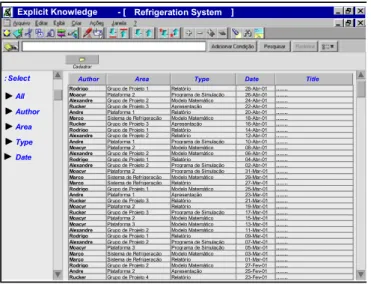
Explicit knowledge include certain materials, such as re-ports, documents, presentations, image files, softwares and models. Accessing the icon “register” on the upper part of the window shown in figure 14, it is possible to register gener-ated knowledge.
The software was configured to in order to allow the fil-tering of subjects according to author, area, type and date. After selecting a filter, it is also possible to organize the subject per area, type and title, either in alphabetical or chronological order.
The search for a determined subject can also be made by key-words. The filter and order resources can also be used inside the set of documents found.
In order to register knowledge, after accessing the cadaster screen, it is necessary to fill in the spaces containing the title of the work, the area in which the work has been developed, the type of knowledge created, a summary with the key points of the work, the name, and, finally, the place where the whole file is stored in the common directory.
Figure 14 – Window shows the generated knowledge.
At the moment, this software is being tested and the re-sults have turned out to be beyond the initial expectations.Phase 4, the one involving continuous improvement, con-sists of a critical analysis about the working system in order to certify that renewal occurs, and also in order not to miss the capacity of reconfiguring the working project due to changes in the environment, in clients'needs or in the work-ing technology.
8. Conclusion
The recognition of the fact that knowledge is the main resource in an organization puts human beings once again in the center of all organizational improvement processes. Com-panies must start to pay careful attention to their workers’ more abstract characteristics, as, for example, loyalty, moti-vation, determination and risk disposition, among others. These factors, which are inherent to the individual who creates knowledge, are regarded as complex and influence work productivity.
Network system is proper for processes involving knowl-edge creation. Network system covers the needs and require-ments of an organization which is interested in the creation of a new conception of work, which is competitive before the challenges of the 21st century. The network model focuses on knowledge production and is a concrete mechanism to turn people’s tacit knowledge into explicit knowledge, pro-moting the process of “spiral” conversion.
Technology has a fundamental role in any kowledge man-agement model. Nowadays, if one wants to talk about knowl-edge managent, one has to talk about technology. However, in this process, it is necessary to change the organization culture concerning knowledge. One of the greatest challenges of this new era is the behavioural change, because of the fact that cooperative systems will not be able to work in non-cooperative organizations.
One of the factors limiting the application is the strong dependance of the model in relation to the culture directed to knowledge. The net organization model does not take culture into account. However, without this culture, the resulting work system will simply be a net with no purpose or connection, lacking the flow of knowledge necessary to raise competence. One of the main points of the net organization model is its possibility to be operated together with the formal structure of the organization, being able to coexist, formal or informally, with the active structure. The structuring of the net does not depend on the geographic localization of its members. This characteristic is very useful in globalized companies which need broad cooperation among workers from several units.
Explicit Knowledge - [ ] Cadastrar Select : All Author Area Type Date
Author Area Type Date Title
Rodrigo Grupo de Projeto 1 Relatório 28-Abr-01 …….
Moacyr Plataforma 2 Programa de Simulação 26-Abr-01 …….
Alexandre Grupo de Projeto 2 Modelo Matemático 24-Abr-01 …….
Rucker Grupo de Projeto 3 Apresentação 22-Abr-01 …….
Andre Plataforma 1 Relatório 20-Abr-01 …….
Marco Sistema de Refrigeração Modelo Matemático 18-Abr-01 …….
Rucker Grupo de Projeto 3 Apresentação 16-Abr-01 …….
Rodrigo Grupo de Projeto 1 Relatório 14-Abr-01 …….
Alexandre Grupo de Projeto 2 Relatório 12-Abr-01 …….
Andre Plataforma 1 Programa de Simulação 10-Abr-01 …….
Moacyr Plataforma 2 Modelo Matemático 08-Abr-01 …….
Alexandre Grupo de Projeto 2 Modelo Matemático 06-Abr-01 …….
Rodrigo Grupo de Projeto 1 Relatório 04-Abr-01 …….
Alexandre Grupo de Projeto 2 Programa de Simulação 02-Abr-01 …….
Moacyr Plataforma 2 Programa de Simulação 31-Mar-01 …….
Marco Sistema de Refrigeração Modelo Matemático 29-Mar-01 …….
Marco Sistema de Refrigeração Relatório 27-Mar-01 …….
Rodrigo Grupo de Projeto 1 Modelo Matemático 25-Mar-01 …….
Andre Plataforma 1 Apresentação 23-Mar-01 …….
Rucker Grupo de Projeto 3 Relatório 21-Mar-01 …….
Moacyr Plataforma 2 Relatório 19-Mar-01 …….
Rucker Grupo de Projeto 3 Programa de Simulação 17-Mar-01 …….
Moacyr Plataforma 2 Modelo Matemático 15-Mar-01 …….
Moacyr Plataforma 3 Modelo Matemático 13-Mar-01 …….
Alexandre Grupo de Projeto 2 Modelo Matemático 11-Mar-01 …….
Rodrigo Grupo de Projeto 1 Relatório 09-Mar-01 …….
Alexandre Grupo de Projeto 2 Programa de Simulação 07-Mar-01 …….
Moacyr Plataforma 3 Programa de Simulação 05-Mar-01 …….
Março Sistema de Refrigeração Modelo Matemático 03-Mar-01 …….
Março Sistema de Refrigeração Relatório 01-Mar-01 …….
Rodrigo Grupo de Projeto 2 Modelo Matemático 27-Fev-01 …….
Andre Plataforma 2 Apresentação 25-Fev-01 …….
Rucker Grupo de Projeto 4 Relatório 23-Fev-01 …….
9. References
DAVENPORT, T. H., PRUSAK, L. Conhecimento Empresarial: como as organizações gerenciam o seu capi-tal intelectual. Rio de Janeiro: Campus, 1998.
DRUCKER, P.F. Administrando em tempos de grandes mudanças. São Paulo: Pioneira, 1995.
GARVIN, David A. Construindo a organização que aprende. Gestão do conhecimento. Harvard Business Review. Rio de Janeiro: Campus, 2001.
HEIJST, G. van; SPEK, R. van der e KRUIZINGA, Eelco. Organizing corporate memories. Proceeding 10th banff workshop on knowledge acquisition for knowledge-based systems (KAW’96). SRDG Publications: Calgary, Canada, 1996.
JURAN, J.M. A qualidade desde o projeto: os novos passos para o planejamento da qualidade em produtos e serviços. São Paulo: Pioneira, 1992.
LAUDON, K.C. Management information systems: new approaches to organization and technology–5th ed. New Jersey: Prentice Hall, 1998.
LIPNACK, J.; STAMPS, J. Virtual teams: the new way to work. IEEE – Engineering Management Review, v. 27, n. 4, p.90-95. Winter, 1999.
NADLER, D.A. Arquitetura organizacional: metáfora para mudança. In: NADLER, David A., GERSTEIN, Marc S., SHAW, Robert B. et al. Arquitetura organizacional: a chave para a mudança empresarial. Rio de Janeiro: Cam-pus, 1994.
NADLER, D.A.; GERSTEIN, M.S. Projetos de sistemas de trabalho de alto desempenho: como organizar pessoal, trabalho, tecnologia e informação. In: NADLER, David A.; GERSTEIN, M.S.; SHAW, R.B. et al. Arquitetura organizacional: a chave para a mudança empresarial. Rio de Janeiro: Campus, 1994. p. 95-114.
NONAKA, I.; TAKEUCHI, H. Criação de
conhecimento na empresa: como as empresas
japonesas geram a dinâmica da inovação. Rio de Janeiro: Campus, 1997.
PORTER, M.E., MILLAR, V.E. Como a informação lhe proporcina vantagem competitiva. In: McGOWAN, William G. Revolução em tempo real: gerenciando a tecnologia da informação. Rio de Janeiro: Campus, 1997.
QUINN, J.B. O software detona uma série de inovações.
Gazeta Mercantil, São Paulo, 28 jul. 1998. O domínio da globalização, p. 11-14.
RUGGLES, R. Knowledge tools: using technology to manage knowledge better. Working paper, Ernst & Young. Disponível em: <www.businessinnovation.ey.com/mko/ tools.pdf>. Acesso em: out. 1997.
SELL, I. Projeto de Produto. Notas de aula, PPGEP, UFSC, 1997.
SHAW, R.B.; PERKINS, D.N.T. Ensinar as organizações a aprender: o poder dos fracassos produtivos. In: NADLER, David A.; GERSTEIN, M.S.; SHAW, Robert B. et al.
Arquitetura organizacional: a chave para a mudança empresarial. Rio de Janeiro: Campus, 1994, p.157-172. STARKEY, K. Como as organizações aprendem: relato do sucesso das grandes empresas. São Paulo: Futura, 1992. STEWART, T. Capital intelectual: a nova vantagem competitiva das empresas. Rio de Janeiro: Campus, 1998.
Address for mailing
Andre H. Futami – Programa de Pós–Graduação em Engenharia de Produção; Universidade Federal de Santa Catarina – UFSC – CEP 88040-900.
Luiz Veriano O. Dalla Valentina – Universidade do Estado de Santa Catarina – UDESC – CEP 88040-900. Osmar Possamai – Programa de Pós-Graduação em Engenharia de Produção; Universidade Federal de Santa Catarina - UFSC – Florianópolis - SC. (048) 331 7038