NORMATIVE SOCIAL INFLUENCE AND ONLINE REVIEW HELPFULNESS:
POLYNOMIAL MODELING AND RESPONSE SURFACE ANALYSIS
Hyunmi Baek
Department of Information Sociology Hanyang University
55 Hanyangdaehak-ro, Sangnok-gu, Ansan, Gyeonggi-do, 426-791, Korea [email protected]
Saerom Lee
College of Business Administration Seoul National University
1 Gwanak-ro, Gwanak-gu, Seoul, 151-916, Korea [email protected]
Sehwan Oh
School of Business Administration Kyungpook National University 80 Daehak-ro, Buk-gu, Daegu, 41566, Korea
[email protected] JoongHo Ahn* Graduate School of Business
Seoul National University
1 Gwanak-ro, Gwanak-gu, Seoul, 151-916, Korea [email protected]
ABSTRACT
Many consumers who are in the process of making purchasing decisions overcome the limitations of e-commerce through online reviews. Overcoming such limitations requires them to reduce the information overload presented by the overwhelming number of online reviews. Many studies have examined the factors that may influence review helpfulness. This study explores the relationship between rating extremity and review helpfulness from the perspective of normative social influence. Online reviews on Amazon.com and Yahoo! Movies are analyzed through the response surface methodology to determine whether review helpfulness increases when review ratings are consistent with the average product ratings. The findings suggest that consumers tend to consider a review helpful when its rating is close to the average rating of a product, thereby demonstrating the effect of normative social influence. We expect this study to help online marketers understand the characteristics of helpful reviews and create a strategy that decreases the information overload caused by online reviews. This study can also serve as a starting point for solving the inconclusive findings of existing studies on the relationship between review rating and review helpfulness.
Keywords: Online review; Review helpfulness; Normative social influence; Response surface methodology 1. Introduction
Consumers encounter difficulties in making online purchase decisions because product information is limited in the online market [Dimoka et al. 2012]. Online reviews, defined as “product information created by users based on personal usage experience” [Chen & Xie 2008], are important sources of information that can help consumers make purchase decisions [Basuroy et al. 2003; Chen et al. 2008; Chevalier & Mayzlin 2006; Dellarocas et al. 2007; Duan et al. 2008]. Therefore, consumers consult online reviews, written by other consumers who have bought the product, to reduce the uncertainty of their purchase decision.
However, online reviews are not always valuable. Online markets that use online reviews to increase their sales volume must identify the helpful reviews among a huge number of online reviews. Many online markets, such as
Amazon.com, have attempted to measure the helpfulness of online reviews to provide their consumers with the most informative ones, thereby reducing the information overload caused by rapid increase of reviews.
Previous studies on the factors that determine the helpfulness of online reviews have considered several factors; such as review rating [Cao et al. 2011; Ghose & Ipeirotis 2007; Mudambi & Schuff 2010], reviewer credibility [Baek et al. 2012; Forman et al. 2008], word count [Baek et al. 2012; Kim et al. 2006; Mudambi & Schuff 2010], subjectivity [Ghose & Ipeirotis 2011], and readability [Ghose & Ipeirotis 2011; Zhu et al. 2014]. Many studies have been conducted to determine the effect of review ratings (i.e., review extremity) on review helpfulness [Cao et al. 2011; Ghose & Ipeirotis 2007]. However, these studies have provided inconclusive findings regarding the relationship between the helpfulness of online reviews and rating extremity. Several studies have proposed that reviews that offer extreme ratings are more helpful compared with reviews that provide moderate ratings [Cao et al. 2011; Ghose & Ipeirotis 2007]. Mudambi and Schuff [2010] determined that review ratings influence review helpfulness, but the relationship between review helpfulness and review rating is not consistent. To explain this result, they suggested that the type of product (either an experience good or a search good) has a moderating effect on the relationship between rating extremity and review helpfulness.
Owing to their limited opportunities to experience e-commerce products, people tend to form their viewpoints on these products based on the opinions of others. Online reviews usually provide a large number of opinions, thereby establishing attitudes toward a product of the majority easily. The present research suggests that these attitude-creating mechanisms can be explained through normative social influence, which is “the influence to conform to the positive expectations of another” [Deutsch & Gerard 1955]. This study uses the normative social influence concept and posits that online reviews that provide a rating similar to the average product rating, which is an intensive form of customer opinion, are helpful. Average rating, one of the important variants of group decision making (such as voting, consensus, averaging, and prediction market) and a type of collective intelligence [Malone et al. 2010], is defined as “the capacity of human collectives to engage in intellectual cooperation in order to create, innovate, and invent” [Lévy 2010]. This study demonstrates through the perspective of normative social influence that previous studies have provided inconsistent findings because these have failed to consider that consumer attitudes to product quality can be affected by product average rating.
To this end, this study collects 15,059 online review data on various goods sold on Amazon.com, examines the relationship between review rating and review helpfulness, and investigates how this relationship changes depending on the average product rating. This study also performs a sentiment analysis of online review contents and compares the review helpfulness of positive reviews with that of negative reviews for each average rating range. In addition, this study collects 31,227 samples of online movie reviews from Yahoo! Movies and examines the moderating effect of review helpfulness on the relationship between review ratings and movie revenues to identify how such a relationship changes depending on review helpfulness.
This study can serve as a basis for the development of new perspectives on the effect of consumer attitudes to product quality through the relationship between review ratings and review helpfulness. The findings of this study can also help online market owners create strategies that can reduce information overload by providing understanding of the characteristics of helpful online reviews.
The remainder of this paper is organized as follows. Section 2 reviews the relevant literature and presents the hypotheses development. Section 3 describes data collection and variables, which includes the process of collecting the data from Yahoo! Movies, BoxOfficeMojo.com, and Amazon.com. Section 4 explains the results of the empirical analysis. Section 5 discusses the results, presents the limitations of the study, and suggests areas of future research. 2. Background and Related Work
The current research seeks to show that the average ratings of products (as set by the majority of the consumers) influence the judgments of review helpfulness as a normative social influence. People who purchase over the Internet are influenced by the information that others provide, when they have never used the product. In media where many people provide opinions, these opinions are mostly critical. Average product ratings can be easily found and read by anyone looking for information on a product; their value is obtained through the multiple people who have provided the ratings, which then influence purchasing behavior. This study considers the formation of consumer attitudes and behaviors through the judgment and behavior of others to be represented by product ratings as a case of normative social influence. According to social psychology theory, consumers confirm their opinion by the product rating previously provided by other consumers. In this stage, similarities of product ratings on a certain review to average rating of product will influence helpfulness of the review. Therefore, our study precisely revisits the effect of review helpfulness and role of average rating of products reflecting normative social influence. There is relatively little
research that examines the role of social influence in product rating and review in the Internet [Danescu-Niculescu-Mizil et al. 2009; Hong & Li, 2013]. This study extends the research streams on review helpfulness and normative social influence.
2.1. Helpfulness of Online Review
Purchasing goods online has a limitation: Consumers cannot experience the goods before purchasing, but both sellers and consumers can use several methods to overcome this limitation. Consumer decision making is aided by the information provided by those who have already experienced the goods. Previous studies have determined that consumers consult online reviews when making a purchase decision [Chen et al. 2008; Dellarocas 2003]. Online reviews are helpful for purchasing; however, owing to their increasing number, consumers have reached a crucial juncture where they cannot decide which online reviews are useful [Jones et al. 2004; Yin et al. 2014].
In many online markets, such as Amazon.com, consumers can review the helpfulness of online reviews. This system reduces information overload by identifying which among the massive number of reviews are helpful [Thomas & Sinha 2014]. Of the many definitions of “review helpfulness”, this study adopts the definition proposed by Mudambi and Schuff [2010], which states that a helpful review is a “peer-generated product evaluation that facilitates the consumer’s purchase decision process.” A helpful online review strongly influences product sales by reducing the information overload of consumers [Chen et al. 2008]. Therefore, many researchers have sought to identify the factors that may determine the helpfulness of online reviews [Baek et al. 2012; Cao et al. 2011; Forman et al. 2008; Ghose & Ipeirotis 2007; Ghose & Ipeirotis 2011; Mudambi & Schuff 2010].
This study reviews the existing research on factors that influence review helpfulness from three perspectives: rating extremity, reviewer characteristics, and review contents. One of the factors that influence the helpfulness of online reviews is the product rating extremity (i.e., star rating) given by the reviewers. Many studies have proposed that reviews that offer extreme ratings for goods are more helpful compared with reviews that provide moderate ratings [Cao et al. 2011; Ghose & Ipeirotis 2007]. Mudambi and Schuff [2010] attempted to show that the product types (search goods vs. experience goods) moderate the relationships between review helpfulness and review extremity.
Another factor that may have an influence on review helpfulness is the characteristics of the reviewers. Given that an online review is a kind of user-generated content, reviewer characteristics can be an important factor in evaluating review helpfulness [Ghose & Ipeirotis 2011]. Most e-commerce sites display reviewer information for easy identification, so consumers can click the IDs of the reviewers to see their reviews through hyperlinks. This feature allows the consumers to consult earlier reviews written by a particular reviewer and consequently determine the credibility of the reviewer. For example, Baek et al. [2012] found that reviewer credibility factors, such as real name exposure and reviewer ranking, determine review helpfulness. Ghose and Ipeirotis [2011]claimed that the average helpfulness value of past reviews influence the current ratings of reviewers. In the same context, Otterbacher [2009] considered reviewer reputation as an independent variable in review helpfulness. Moreover, other studies considered reviewer expertise [Liu et al. 2008a; 2008b], reviewer identities [Lu et al. 2010], and engagement characteristics using the recency, frequency, and monetary value of reviews [Thomas & Shinha 2014] as factors that influence review helpfulness.
Finally, review characteristics, such as length of review, number of errors, and percentage of negative words are other factors to influence review helpfulness. Many studies have determined that review length has an influence on review helpfulness [Baek et al. 2012; Kim et al. 2006; Mudambi & Schuff 2010]. Others indicated that negativity has a positive relationship with review helpfulness [Baek et al. 2012; Basuroy et al, 2003; Cheung & Lee 2008]. Ghose and Ipeirotis [2011] determined that the review characteristics that influence helpfulness include subjectivity level (the relative proportions of objective and subjective statements), readability, and the number of spelling errors. Yin et al. [2014] determined that the emotionality of a review, particularly anxiety and anger, influences review helpfulness. 2.2. Normative Social Influence
Social influence, a major research subject in social psychology, denotes how an individual is influenced by others [Jahoda 1959]. Cialdini [2009] discussed examples of the social influence people may experience while purchasing a product. In a representative example of social influence, someone may decide based on the authority of a wine expert when purchasing wine. Likewise, the product reviews of experienced consumers on e-commerce websites influence consumer behavior. Reviews written by several experienced consumers reflect collective opinion. According to the dual process theory suggested by Deutsch and Gerard [1955], social influence is divided into informational social influence and normative social influence. It argues that informational social influence is an “influence [that] arises from information obtained as evidence about reality,” whereas normative social influence is the “influence to conform to the positive expectations of another” [Deutsch & Gerard 1955]. For example, the influence felt when purchasing wine is a case of informational social influence, whereas the influence exerted by a consumer group on an e-commerce
Kelman [1961] reported that social influence comprises three processes. First, compliance is the acceptance of the influence of someone to gain his or her favor; this process occurs when someone wants to obtain feedback to confirm that the right decision has been made [Kelman 1961]. The second process, identification, occurs when a certain behavior is “associated with a satisfying self-defining relationship to the person or group” [Kelman 1961]. When the self-image of an individual can be fulfilled through a relationship with another, the influence of others is accepted to establish or maintain the desired relationship. Finally, internalization is the acceptance of an external influence that is “inherently conductive to the maximization of values” [Kelman 1961]. People seek information and knowledge by setting the results of observation as reference points [Park & Lessig 1977]. Burnkrant and Cousineau [1975] classified the three processes described by Kelman [1961] according to the type of social influence proposed by Deutsch and Gerard [1955]. Internalization can be classified as informational social influence, which adds information to the store of knowledge of someone who is seeking to obtain additional knowledge [Burnkrant & Cousineau 1975]. Normative social influence can be explained through both compliance and identification [Burnkrant & Cousineau 1975]. Public acts are connected to compliance: outward acts are influenced by the decisions and opinions of others because of the desire to be evaluated positively by an individual or group in such undertakings as product purchases and evaluations.
Latane [1981] explained that normative social influence is determined by three factors: strength, immediacy, and number of sources. Strength denotes the importance of an influential group to a person; the position, age, and experience play important roles in social influence. Immediacy refers to the spatial proximity between influencing and influenced people. Finally, number of sources refers to the number of influencing people. In the context of online reviews, the product ratings of those who have already experienced a particular product are highly influential on consumers who want to buy a product. Immediacy is also high; given that e-commerce opinions are shared via the Internet, these opinions transcend time and space. The average ratings of products also have a strong influence, given that they are often determined by large numbers of consumers.
Studies in various fields have been conducted on normative social influence [Deutsch & Gerard 1955; Kaplan & Miller 1987; Rook & Fisher 1955]. Studies on information systems (IS) research, subjective norm [Karahanna et al. 1999; Venkatesh & Morris 2000; Taylor & Todd 1995] and interchangeably normative social influence [Green 1998] have focused mainly on IS adoption. Research interest in this issue within e-commerce has recently increased [Cheung et al. 2009; Huang & Chen 2006; Kwahk & Ge 2012]. Cheung et al. [2009] determined that normative social norm plays an important role in e-commerce purchase decisions by influencing the perceived credibility of online consumer recommendations.
2.3. Hypotheses Development
Many studies have examined the effect of online reviews on product revenue [Basuroy et al. 2003; Chen et al. 2008; Chevalier & Mayzlin 2006; Dual et al. 2008]. However, not all online reviews have the same influence on purchase decisions. In the persuasion process, an early key stage is the judgment of information credibility of a receiver [Cheung et al. 2009, Wathen & Burkell 2002]. Several studies have also indicated that the most important factor in electronic word-of-mouth (eWOM) adoption is eWOM credibility [Cheung et al. 2009; McKnight & Kacmar 2006; Nabi & Hendriks 2003]. A consumer who thinks an online review is helpful feels confident about adopting it.
Recognizing the importance of eWOM credibility in purchase decision making, online markets, such as
Amazon.com, implemented a feature that enables users to vote on the helpfulness of reviews. In academia, researchers have become interested in review helpfulness, but the focus is placed on its influencing factors [Baek et al. 2012; Cao et al. 2011; Forman et al. 2008; Ghose & Ipeirotis 2007; Ghose & Ipeirotis 2011; Kim et al. 2006; Mudambi & Schuff 2010]. In general, prior studies have concluded that the effect of helpful reviews on consumer purchase decision is stronger than less helpful reviews [Chen et al. 2008; Chevalier & Mayzlin 2006; Ghose & Ipeirotis 2011]. However, the influence of helpful reviews on sales has not been researched adequately. Owing to the difficulty in obtaining sales data, only limited studies have investigated empirically whether helpful reviews affect sales significantly. For example, with a sample of online reviews at Amazon.com, researchers used sales rank for a proxy measure of sales instead of actual sales information, and the effects of helpful reviews on sales were estimated [Chen et al. 2008; Forman et al. 2008]. In this study, we try to reexamine the influence of review helpfulness on sales by using actual sales data of movies to overcome the weakness of previous research. At the start, we hypothesize that the influence of the ratings of highly helpful reviews on product revenue is stronger than that of the ratings of other reviews.
Hypothesis 1 (H1): Review helpfulness will moderate the relationship between review rating and product revenue: The influence of the ratings of high helpfulness reviews on product revenue is stronger than that of the ratings of low helpfulness reviews.
Numerous studies have attempted to determine message credibility from the perspective of message extremity. However, inconsistent findings have been observed regarding message credibility of one-sided versus two-sided messages. In terms of advertising effects, Eisend [2006] ascertained that two-sided messages significantly enhance the perceived credibility of sources, reduce negative cognitive responses, and promote brand attitude and purchase intention. Golden and Alpert [1987] contended that two-sided arguments can elicit positive perceptions of the form of communication used, including an increase in message believability. Kamins and Marks [1987] observed that using a two-sided reputational appeal seems to enhance the credibility of the advertiser. On the contrary, Hunt and Smith [1987]observed that two-sided messages are less effective than one-sided messages in promoting seller credibility and message acceptance in the personal selling context. In the context of online reviews, several studies have proposed that reviews that offer extreme ratings for goods are more helpful compared with reviews that provide moderate ratings [Cao et al. 2011; Ghose & Ipeirotis 2007]. On the other hand, Mudambi and Schuff [2010] focused on the interaction of product type and review extremity and observed that no significant relationship exists between review extremity and review helpfulness for search goods and that the review helpfulness for experience goods increases when the rating is moderate.
In this study, we pay attention to the moderating role of consumer attitudes toward the products by extending the previous research on the relationship between message credibility (helpfulness) and message extremity (or rating). Previous studies have proven that consumer attitude toward a product affects the relationship between message sidedness and information credibility [Crowley & Hoyer 1994; Schlosser, 2005]. Crowley and Hoyer [1994] determined that the consumer attitude toward the advertised stimulus affects the effectiveness of a two-sided message. Schlosser [2005] also determined that consumer attitudes to a movie influence the effectiveness of the credibility and persuasiveness of two-sided messages in online movie reviews. In the online context, the average product rating is considered as the product quality evaluation of the majority, which is a type of collective intelligence [Malone et al. 2010].
Given that consumer attitudes to product quality tend to be formed through average product rating, we expect that consumers place trust in online reviews following the majority opinion. We argue that normative social influence, “the influence to conform to the positive expectations of another” [Deutsch & Gerard 1955] affects the formation of consumer attitudes regarding product quality. Consequently, consumers tend to believe that reviews with ratings close to the average rating of a product are helpful. In this regard, several studies have been conducted on the effects of message consistency on message credibility [Cheung et al. 2009; Zhang & Watts 2003]. Zhang and Watts [2003] reported that the consistency of messages positively affects knowledge adoption in communities. Cheung et al. [2009] proved that the consistency of eWOM recommendations with other eWOM recommendations is positively related to eWOM credibility in online consumer discussion forums.
Therefore, we argue that review helpfulness will increase if consumer attitudes toward products follow the normative social influence. Consumer attitudes toward a product can be operationally measured not only by review rating but also through review contents. Using sentiment analysis can be considered to capture the subjective evaluation of consumers on review contents. As one of the emerging research fields in IS, sentiment analysis (or opinion mining) has been utilized to analyze subjective data, such as attitude, opinion, and intention of people. Recent IS research have attempted to analyze consumer reviews with sentiment analysis [Agarwal et al. 2015; Baek et al. 2012; Zhang et al. 2013; Zhang et al. 2014].
In Hypothesis 2a (H2a), we quantitatively measure consumer attitude toward a product with review rating and test whether review helpfulness will increase, if a reviewer's star rating follows a product's average rating of a product. For Hypothesis 2b (H2b), we qualitatively measure consumer attitude toward a product through sentiment mining on review contents. In this study, we determine that if the average product rating of an online review is high (i.e., when most consumers have evaluated the product quality highly), the review with positive contents has a higher degree of helpfulness. If the average product rating is lower (i.e., when most consumers have evaluated the product quality poorly), the review with negative contents has a higher degree of helpfulness.
H2a: If the consumer attitude toward a product measured by the star rating of a review follows normative social influence measured by the average rating of a product, review helpfulness will be increased.
H2b: If the normative social influence measured by the average rating of a product is high, review helpfulness increases when the review contents are positive. If the normative social influence measured by the average rating of a product is low, review helpfulness increases when the review contents are negative.
3. Research Methodology 3.1. Data Collection
To obtain generalization of product type, reviews on various goods of Amazon.com were analyzed to verify H2a and H2b. However, there is no revenue information on the products of Amazon.com. Thus, to verify H1, we analyzed online reviews in Yahoo! Movies, by setting limits to the movie domain from which information on the revenue can be obtained from BoxOfficeMojo.com.
For H1, we collected online review data for 145 films released from February 2012 to August 2012 from Yahoo! Movies, the most popular online movie review sites. Film was selected as the research domain for H1 because revenue information about movies is easy to obtain. In this research, a crawler developed through Python 2.6 was used to scrape online review pages on Yahoo! Movies. Another Python-based system was used to parse HTML web pages into a database. Yahoo! Movies was selected as the source of online review data because it is the most popular online movie review site. It also has a well-organized design that enables easy information collection, which optimally reduces data collection errors [Liu 2006]. Previous research used data from Yahoo! Movies to investigate the influence of online reviews on box office revenue [Dellarocas et al. 2007; Duan et al. 2008; Liu 2006; Moon et al. 2010]. Consumers were asked, “Was this review helpful?” for each review, to which they can answer either “Yes” or “No.” We excluded reviews with five or less than five answers (total votes) to these questions because their helpfulness (the proportion of helpful votes to total votes) is not significant [Kim et al. 2006; Wu et al. 2011]. Thus, we obtained 31,227 online reviews from Yahoo! Movies.
We also collected data on the weekly revenues of films from BoxOfficeMojo.com. Previous research used data from BoxOfficeMojo.com to investigate the influence of eWOM on box office revenue [Dellarocas et al. 2007; Duan et al. 2008].
For H2a and H2b, online review data covering October 2010 were also collected from Amazon.com. Another web crawler developed through Python 2.6 was used to scrape web pages containing online review information. To verify H1, we used reviews posted on Yahoo! Movies and movie sales data from BoxOfficeMojo.com, which are limited to the movie domain. However, to obtain generalization of product type, we included various kinds of products offered on Amazon.com to test H2a and H2b. We selected 23 types of products in various product categories from Amazon.com
and obtained 4,613 reviewers who have provided reviews for these products. We collected 75,226 reviews written by the reviewers. Using the abovementioned criteria, reviews with five or less than five answers were excluded. Ultimately, 15,059 reviews were obtained.
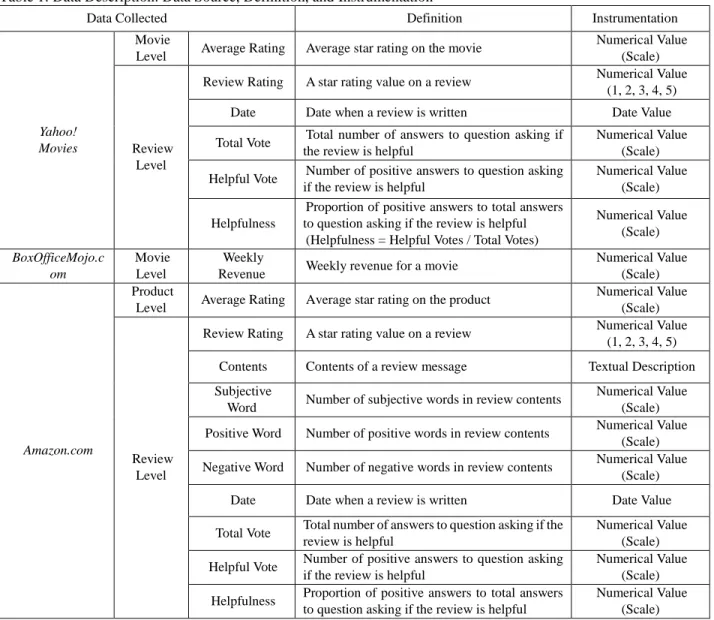
Collected data, shown in Table 1, contain average movie ratings, individual review ratings, dates, review helpfulness, and weekly movie revenue from Yahoo! Movies and average product ratings, individual ratings, dates, review contents, and review helpfulness from Amazon.com. Review helpfulness (“helpfulness”) refers to the percentage of people who have indicated that the review is helpful. Helpfulness was measured as the proportion of helpful votes to total votes.
3.2. Sentiment Analysis for Review Contents
For H2b, we performed a sentiment analysis to quantify the subjective opinions in the reviews [Lee et al. 2008] and quantified number of positive and negative words in each review. To conduct a sentiment analysis, machine learning approach [Matsumoto et al. 2005; Pak & Paroubek, 2011; Pang et al. 2002; Xia et al. 2011] and lexicon-based approach [Baccianella et al. 2010; Pennebaker et al. 2003; Taboada et al. 2011; Thelwall et al. 2010; Thelwall et al. 2012; Wilson et al. 2005] are largely used to distinguish positive opinion from negative opinion. Recently, the scope of sentiment analysis has broadened to include English and other languages [Xie et al. 2014] and new algorithms that consider contexts are being developed [Zhang et al. 2014]. Many researchers have focused on consumer opinion on products among the major research fields of sentiment analysis [Agarwal et al., 2015; Baek et al. 2013; Ghose & Iperitos, 2011; Zhang et al. 2013, Zhang et al. 2014]. For example, Zhang et al. [2014] improved the accuracy of sentiment analysis through the algorithms that show high accuracy based on the reviews on the digital camera and TV of Amazon, which expressed customer sentiments. Furthermore, researchers analyzed comments on particular brands in social media through sentiment analysis to measure brand reputation [Zhang et al. 2013].
In this research, we quantified the degree of subjective words (both positive and negative) in review contents by detecting emotional words through SentiWordNet [Lee et al. 2008], a library based on WordNet that evaluates the degree of subjectivity and objectivity of words. In SentiWordNet, words are measured from negative to positive with 1.0 as the maximum to enable a comparison between these measurements.
3.3. Variables
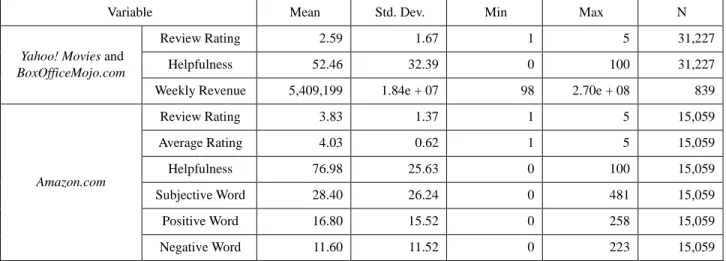
The data collected from Yahoo! Movies consist of review data and revenue data regarding 91 movies in total. The average review rating of the data collected from Yahoo! Movies is 2.59, and the mean helpfulness is 52.46%. The average weekly movie revenue is USD 5,409,199, as shown in Table 2. The average review rating of the data collected from Amazon.com is 3.83, and the mean value of the average product rating is 4.03. Thus, the average helpfulness is
76.98%. Table 2 also shows that, on average, positive words are used 16.8 times, whereas negative words are used 11.6 times in each of the collected Amazon.com reviews, indicating that reviewers use positive words more frequently than negative words.
Table 1: Data Description: Data Source, Definition, and Instrumentation
Data Collected Definition Instrumentation
Yahoo! Movies
Movie
Level Average Rating Average star rating on the movie
Numerical Value (Scale)
Review Level
Review Rating A star rating value on a review Numerical Value
(1, 2, 3, 4, 5)
Date Date when a review is written Date Value
Total Vote Total number of answers to question asking if the review is helpful
Numerical Value (Scale) Helpful Vote Number of positive answers to question asking
if the review is helpful
Numerical Value (Scale) Helpfulness
Proportion of positive answers to total answers to question asking if the review is helpful
(Helpfulness = Helpful Votes / Total Votes)
Numerical Value (Scale) BoxOfficeMojo.c om Movie Level Weekly
Revenue Weekly revenue for a movie
Numerical Value (Scale)
Amazon.com
Product
Level Average Rating Average star rating on the product
Numerical Value (Scale)
Review Level
Review Rating A star rating value on a review Numerical Value
(1, 2, 3, 4, 5)
Contents Contents of a review message Textual Description
Subjective
Word Number of subjective words in review contents
Numerical Value (Scale) Positive Word Number of positive words in review contents Numerical Value
(Scale) Negative Word Number of negative words in review contents Numerical Value
(Scale)
Date Date when a review is written Date Value
Total Vote Total number of answers to question asking if the review is helpful
Numerical Value (Scale) Helpful Vote Number of positive answers to question asking
if the review is helpful
Numerical Value (Scale) Helpfulness Proportion of positive answers to total answers
to question asking if the review is helpful
Numerical Value (Scale)
Table 2: Descriptive Statistics of Online Reviews
Variable Mean Std. Dev. Min Max N
Yahoo! Movies and BoxOfficeMojo.com
Review Rating 2.59 1.67 1 5 31,227
Helpfulness 52.46 32.39 0 100 31,227
Weekly Revenue 5,409,199 1.84e + 07 98 2.70e + 08 839
Amazon.com Review Rating 3.83 1.37 1 5 15,059 Average Rating 4.03 0.62 1 5 15,059 Helpfulness 76.98 25.63 0 100 15,059 Subjective Word 28.40 26.24 0 481 15,059 Positive Word 16.80 15.52 0 258 15,059 Negative Word 11.60 11.52 0 223 15,059
Table 3 represents a comparative analysis of rating difference between product average rating and review rating. Four-point review shows the least score difference with product average rating, given that the score difference is 0.42. One-point review shows the highest score difference with product average rating, given that the score difference is 2.50.
Table 3: Rating Difference between Product Average Rating and Review Rating
Review Rating 1 2 3 4 5
Rating Difference 2.50 1.77 0.98 0.42 0.74
N 1,636 1,321 1,964 3,171 6,967
F-value 5461.71***
Note: *p < .05, **p < .01, ***p < .001, ANOVA, online reviews in Amazon.com
4. Analysis Results
4.1. Influence of Helpful Review on Movie Revenue
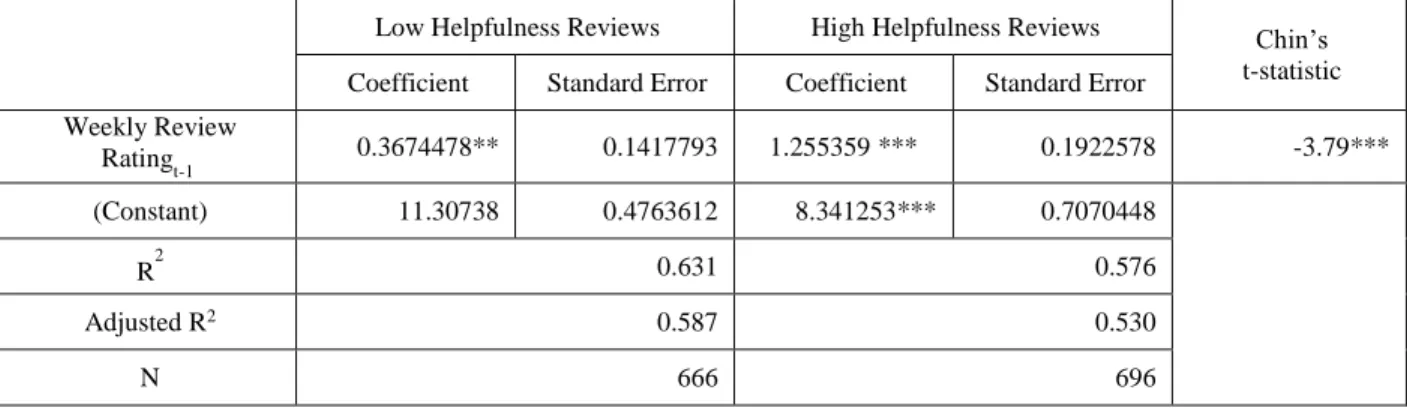
In H1, we tried to identify the role of review helpfulness as moderator between review rating and movie revenue. For the relationship between review rating and movie revenue, we expected that review ratings in previous week will affect this week's movie revenue. Previous studies on the impact of review ratings (or review valence) have used a lagged variable for weekly review ratings [Ghose & Iperitos, 2011; Rui et al. 2013].We applied LSDV (Least Square Dummy Variable) estimation method to control for any movie idiosyncratic factors which could affect movie revenue, such as budget, distributor, genre, and MPAA ratings. To verify H1, we used Chin’s formula [2004]. The reviews were divided into two groups: high-helpfulness and low-helpfulness groups. The helpfulness of the former exceeds 52% (which is the mean value), and that of the latter is less than 52%. Chin’s t-test was used to determine whether the influence of review ratings on movie revenue differs significantly between the two groups.
t = plow− phigh
√ (nlow− 1)2
(nlow+ nhigh− 2) ∗ SElow2 +
(nhigh− 1)2
(nlow+ nhigh− 2) ∗ SEhigh2 ∗ √nlow1 +nhigh1
In the aforementioned formula proposed by Chin [2004], plow (phigh) refers to the coefficient value between the weekly review rating and the weekly movie revenue in the group of low helpfulness reviews (group of high helpfulness reviews), and SE indicates standard error. n indicates sample size for each group.
By using Chin’s t-statistic, we determined that the moderating effect of review helpfulness on the relationship between review ratings and movie revenue is significant (Table 4). Chin's t-statistic is -3.79, which suggests that there is a significant difference at the significant level of 0.01 (t=2.58), in terms of the difference in coefficient between two groups. In other words, the review rating of the group of high helpfulness reviews has more influence on movie revenue than that of the group of low helpfulness reviews.
Table 4: Moderating Effect of Review Helpfulness on the Relationship between Rating and Revenue (Testing H1)
Low Helpfulness Reviews High Helpfulness Reviews Chin’s
t-statistic
Coefficient Standard Error Coefficient Standard Error
Weekly Review Ratingt-1 0.3674478** 0.1417793 1.255359 *** 0.1922578 -3.79*** (Constant) 11.30738 0.4763612 8.341253*** 0.7070448 R2 0.631 0.576 Adjusted R2 0.587 0.530 N 666 696
Note: *p < .05, **p < .01, ***p < .001, LSDV, dependent variable: ln(weekly movie revenue)
4.2. Relationship between Review Rating and Review Helpfulness
The influence of review ratings and average product ratings on review helpfulness (H2a) was verified as follows. First, the explanatory power of each analysis was compared to verify whether the first-order linear equation or the second-order quadratic equation is appropriate. Before this analysis, outliers were screened with Cook’s D, and no outliers were found. To reduce the risk of multicollinearity, all variables were centered based on the criterion midpoint before analysis [Edwards & Parry 1993].
The results of the analysis suggested that the explanatory power of the second-order quadratic equation is significantly increased by 3.8% compared with that of the first-order linear equation (Table 5). In addition, as a result of 10-folder cross validation, the mean absolute error in the second-order quadratic equation is 22.30%, which is relatively lower than that in the first-order linear equation (22.84%). Therefore, the second-order quadratic equation is more appropriate. In this paper, Ravg is the mean-centered average review rating, Rind is the mean-centered individual review rating, Rdif is the difference between the average review rating and individual review rating, and H is the mean-centered review helpfulness.
Table 5: Predicting Review Helpfulness through Star Rating and Average Rating
First-order Linear Equation Second-order Quadratic Equation
Dependent
Variable Independent Variable B Independent Variable B
Review Helpfulness (Constant) 90.996 *** (Constant) 26.170*** Rdif −14.185*** Rind 1.484*** Ravg −3.820*** Rind2 −1.896*** RindRavg 6.973*** Ravg2 −1.802*** R2 0.206 0.244 Adjusted R2 0.206 0.244 R2 Increase 0.206*** 0.038*** N 15,059 15,059
Note: *p < .05, **p < .01, ***p < .001, dependent variable: H
this methodology to calculate three major surface features, namely, stationary point, principal axes, and shape of the surface, as expressed by three-dimensional polynomial model. Given that these features can express the relationship between independent and dependent variables in three dimensions, then this analysis is helpful in developing and verifying complex and sophisticated hypotheses [Kang et al. 2006]. The quadratic polynomial equation for this study is presented as e R b R R b R b R b R b b
H avg ind avg avg ind ind 2 5 4 2 3 2 1 0
The standard errors and significance levels on the stationary points and slopes were estimated with the jackknife method, a general nonparametric procedure that calculates the standard error of an expression [Efron & Gong 1983]. A three-dimensional graph was schematized with MATLAB, and the significance test through jackknife was analyzed with SAS 9.3. Figure 1 schematizes the relationship between two independent variables (i.e., the individual review rating and the average product rating) and the dependent variable of review helpfulness in a three-dimensional graph. The response surface for review helpfulness is concave, and the stationary point (the point at which the slope of the surface is zero in all directions) for the surface close to the origin is (0.106, −0.382). The stationary points and principal axes, which are related to hypothesis testing and the main features drawn by response surface methodology, are shown in Table 6.
Figure 1: Response Surface for Average Product Rating and Individual Review Rating Predicting Helpfulness Table 6: Stationary Points and Principal Axes
Estimates (t-value)
Stationary Point
X0 0.106*** (0.186)
Y0 −0.382*** (0.095)
First Principal Axis
P10 −0.490*** (0.131) P11 1.012*** (0.069) Second Principal Axis P20 −0.277*** (0.260) P21 −0.987*** (0.067)
The slope of the response surface deviates when the individual review rating differs from the average product rating in any direction. Therefore, the slope of the surface is positive when the individual review rating is higher than the average product rating. In the opposite case, the slope of the surface is negative. The second principal axis (
0 21 0 20 Y p X
p ) is also parallel to the disconfirmation axis (X = −Y). Accordingly, H2a is supported if, in testing
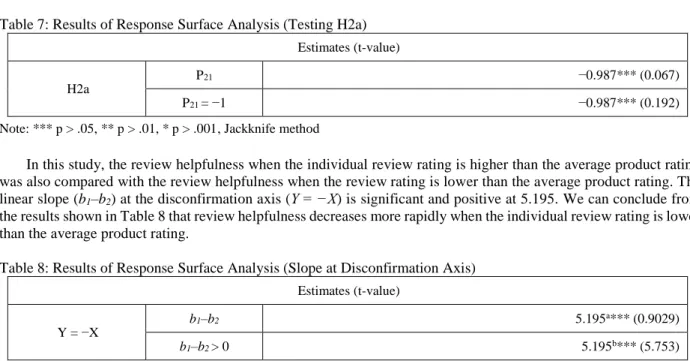
whether the value of P21 is significant, we prove that this value is not significantly different from −1. Our conclusion is that P21 = −0.987 is not significantly different from −1: the secondary principal axis is parallel to the disconfirmation axis. Thus, H2a is supported (Table 7).
Table 7: Results of Response Surface Analysis (Testing H2a)
Estimates (t-value)
H2a
P21 −0.987*** (0.067)
P21 = −1 −0.987*** (0.192)
Note: *** p > .05, ** p > .01, * p > .001, Jackknife method
In this study, the review helpfulness when the individual review rating is higher than the average product rating was also compared with the review helpfulness when the review rating is lower than the average product rating. The linear slope (b1–b2) at the disconfirmation axis (Y = −X) is significant and positive at 5.195. We can conclude from the results shown in Table 8 that review helpfulness decreases more rapidly when the individual review rating is lower than the average product rating.
Table 8: Results of Response Surface Analysis (Slope at Disconfirmation Axis)
Estimates (t-value)
Y = −X
b1–b2 5.195a*** (0.9029)
b1–b2> 0 5.195b*** (5.753)
Note: a: *** p > .05, ** p > .01, * p > .001, b: * p < .05, ** p < .01, *** p < .001, Jackknife method
4.3. Relationship between Polarity of Review Text and Review Helpfulness
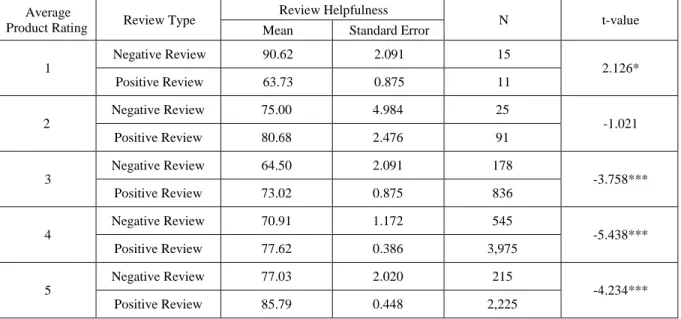
This study also investigated whether the helpfulness of the negative reviews and positive reviews differ significantly depending on the average product rating (H2b). The analysis was limited to reviews with more than five subjective (positive or negative) words. Dividing reviews without extreme review polarity into positive review and negative one was difficult. Therefore,5,874 moderate reviews1 were also excluded from our analysis. Consequently, the remaining 8,116 reviews (7,138 positive and 978 negative) were analyzed.
A t-test was used to investigate whether the helpfulness of the positive and negative reviews differ significantly depending on the average product rating. As mentioned earlier, the focus of analysis is only on the extreme positive and negative reviews. Thus, we conducted the t-test, which centered on the extreme values of one-point and five-point. When the average product rating is 1, the helpfulness of the negative review is significantly higher than that of the positive review; however, when the average product rating is 5, the helpfulness of the positive review is significantly higher than that of the negative review (Table 9). The results differ depending on the average product rating, thereby confirming H2b.
1 2 . 0 ) _ _ ( ) _ _ ( rd negativewo Num rd positivewo Num rd negativewo Num rd positivewo Num
Table 9: t-test Results for Review Helpfulness (Testing H2b)
Average
Product Rating Review Type
Review Helpfulness
N t-value
Mean Standard Error
1 Negative Review 90.62 2.091 15 2.126* Positive Review 63.73 0.875 11 2 Negative Review 75.00 4.984 25 -1.021 Positive Review 80.68 2.476 91 3 Negative Review 64.50 2.091 178 -3.758*** Positive Review 73.02 0.875 836 4 Negative Review 70.91 1.172 545 -5.438*** Positive Review 77.62 0.386 3,975 5 Negative Review 77.03 2.020 215 -4.234*** Positive Review 85.79 0.448 2,225 Note: * p < .1, ** p < .05, *** p < .01
5. Discussion and Conclusions
Consumers read online reviews to reduce purchase risk because reviews are the opinions of those who have already experienced the product. However, information overload occurs when we have an increasing number of online reviews. Thus, the helpful reviews should be recognized to reduce information overload.
Numerous studies on the influence of rating extremity of reviews on review helpfulness are inconclusive; thus, in this study, the reason for these inconclusive results is determined from the perspective of normative social influence. We have offered several key findings. First, the moderating effect of review helpfulness on the relationship between review ratings and movie revenue is significant: reviews considered highly helpful are more influential than low helpfulness reviews. The helpfulness of reviews as determined by consumer voting is also an influential factor in product revenue.
Second, consumers appear to have confidence in reviews with ratings similar to the average product ratings, which represent the majority (of other consumers). In addition, if the individual review rating is lower than the average product rating, review helpfulness decreases further. From the sentiment analysis of review contents, we also determined that consumers tend to write more positive reviews than negative ones. This study also showed that a positive review is helpful if the average rating of a product is high, whereas a negative review is helpful if the average rating of a product is low. Contrary to the findings of previous research, our results showed that review helpfulness does not always improve along with increasing or decreasing rating extremity.
This study makes an important contribution to research. First, previous studies on the relationship between review extremity and review helpfulness have failed to consider consumer perception of product quality, thereby producing inconsistent findings. We determined that consumer perception of product quality is determined by the average product ratings in online reviews. This finding may serve as a starting point for the development of new perspectives regarding the effect of consumer attitudes to product quality on the relationship between review ratings and review helpfulness. Particularly salient is our discussion on how attitudes to products are formed based on normative social influence. Our theoretical lens helps fill the gap between current research and reality. Consumers obtain only limited product information on e-commerce websites. Thus, product ratings, which are given by consumers who have already experienced the product, influence the non-experienced consumers. Given this situation, average product ratings may affect consumers' perceptions of product quality. Consumer attitudes formed through the influence of average product ratings play an important role in judgments of review helpfulness. This study contributes theoretically by empirically explaining normative social influence in the context of online reviews through actual online review data drawn from
Amazon.com.
Second, this research contributes to practice. Our findings should help online market owners create strategies that can reduce information overload by suggesting the characteristics of helpful online reviews. For example,
most helpful but critical reviews, at the top of their web pages. This study showed that placing reviews with ratings similar to the average product ratings at the top of a web page also facilitates consumer purchase decisions.
Third, this research contributes to methodology. This study clarified the relationship among individual review ratings, average product ratings, and helpfulness by mapping the data on a three-dimensional graph using 15,059 online reviews collected from Amazon.com and by employing a response surface model to verify the statistical significance of the relationship for a polynomial model. This study also used a sentiment analysis to classify online reviews into “positive” and “negative” groups prior to verifying if helpfulness voting is performed through normative social influence in review contents as well as in review ratings.
This study can be improved by enhancing its generalizability through an expanded data collection. In this study, data were collected from a representative online movie review site, Yahoo! Movies, and a representative online market,
Amazon.com. This study analyzed two different datasets to complement the limitations in acquiring revenue data. However, such an analysis was not based on the same contexts, which may not control for interrelationship of consumer behavior on different platforms. This study has limitations in excluding the influence of platforms. Therefore, in the future study, verification is needed to establish if the same conclusion can be drawn by using data obtained from other online review sites or markets.
REFERENCES
Agarwal, B., S. Paria, N. Mittal, A. Gelbukh, and A. Hussain, “Concept-Level Sentiment Analysis with Dependency-Based Semantic Parsing: A Novel Approach,” Cognitive Computation, Vol. 7, No. 4:487-499, 2015.
Baccianella, S., A. Esuli, and F. Sebastiani “Sentiwordnet 3.0: An Enhanced Lexical Resource for Sentiment Analysis and Opinion Mining,” In proceedings of Seventh Conference on International Language Resources and Evaluation, Malta. Retrieved May. Valletta, Malta, 2010.
Baek, H., J.H. Ahn, and Y. Choi, “Helpfulness of Online Consumer Reviews: Readers' Objectives and Review Cues,”
International Journal of Electronic Commerce, Vol. 17, No. 2:99-126, 2012.
Basuroy, S., S. Chatterjee, and S.A. Ravid, “How Critical Are Critical Reviews? The Box Office Effects of Film Critics, Star Power, and Budgets,” Journal of Marketing, Vol. 67, No. 4:103-117, 2003.
Burnkrant, R.E., and A. Cousineau, “Informational and Normative Social Influence in Buyer Behavior,” Journal of Consumer Research, Vol. 2:206-215, 1975.
Cao, Q., W.J. Duan, and Q.W. Gan, “Exploring Determinants of Voting for the ‘Helpfulness’ of Online User Reviews: a Text Mining Approach,” Decision Support Systems, Vol. 50, No. 2:511-521, 2011.
Chaiken, S., and Y. Trope, Dual-process Theories in Social Psychology, Guilford Press, 1999.
Chen, P., S. Dhanasobhon, and M.D. Smith, All Reviews Are Not Created Equal: The Disaggregate Impact of Reviews and Reviewers at Amazon.com, Working paper. H. John Heinz III School of Public Policy and Management, Carnegie Mellon University, 2008.
Chen, Y., and J. Xie, “Online Consumer Review: Word-of-Mouth as a New Element of Marketing Communication Mix,” Management Science, Vol. 54, No. 3:477–491, 2008.
Cheung, C.M.K., and M.K.O. Lee, “Online Consumer Reviews: Does Negative Electronic Word-of-Mouth Hurt More?,” In I. Benbasat and A.R. Montazemi (eds.), Paper presented at the Fourteenth Americas Conference on Information Systems, Toronto: Association for Information Systems, 2008.
Cheung, M.Y., C. Luo, C.L. Sia, and H. Chen, “Credibility of Electronic Word-of-Mouth: Informational and Normative Determinants of On-line Consumer Recommendations,” International Journal of Electronic Commerce, Vol. 13, No. 4:9-38, 2009.
Chevalier, J.A., and D. Mayzlin, “The Effect of Word of Mouth on Sales: Online Book Reviews,” Journal of Marketing Research, Vol. 43, No. 3:345-354, 2006.
Chin, W.W. “Frequently Asked Question-Partial Least Squares & PLSGraph,” Retrieved from http://disc-nt.cba.uh.edu/chin/plsfaq.htm, 2004.
Cialdini, R.B., Influence: Science and Practice, Boston, MA, Pearson Education, 2009.
Crowley, A.E., and W.D. Hoyer, “An Integrative Framework for Understanding Two-sided Persuasion,” Journal of Consumer Research, Vol. 20, No. 4:561-574, 1994.
Danescu-Niculescu-Mizil, C., G. Kossinets, J. Kleinberg, and L. Lee, “How Opinions Are Received by Online Communities: A Case Study on Amazon.com Helpfulness Votes” In Proceedings of the 18th International Conference on World Wide Web, pp. 141-150, 2009.
Dellarocas, C. “The Digitization of Word of Mouth: Promise and Challenges of Online Feedback Mechanisms,”
Deutsch, M., and Gerard, H.B., “A Study of Normative and Informational Social Influences upon Individual Judgment,” The Journal of Abnormal and Social Psychology, Vol. 51, No. 3:629-636, 1955.
Dimoka, A., Y. Hong, and P.A. Pavlou, “On Product Uncertainty in Online Markets: Theory and Evidence,” MIS Quarterly, Vol. 36, No. 2:395-426, 2012.
Duan, W., B. Gu, and A.B. Whinston, “Do Online Reviews Matter? An Empirical Investigation of Panel Data,”
Decision Support Systems, Vol. 45, No. 4:1007-1016, 2008.
Edwards, J.R., and M.E. Parry, “On the Use of Polynomial Regression Equations as an Alternative to Difference Scores in Organizational Research,” The Academy of Management Journal, Vol. 36, No. 6:1577-1613, 1993. Efron, B., and G. Gong, “A Leisurely Look at the Bootstrap, the Jackknife, and Cross-validation,” The American
Statistician, Vol. 37, No. 1:36-48, 1983.
Eisend, M. “Two-sided Advertising: A Meta-analysis,” International Journal of Research in Marketing, Vol. 23, No. 2:187-198, 2006.
Forman, C., A. Ghose, and B. Wiesenfeld, “Examining the Relationship between Reviews and Sales: the Role of Reviewer Identity Disclosure in Electronic Markets,” Information Systems Research, Vol. 19, No. 3:291-313, 2008.
Ghose, A. and P.G. Ipeirotis, “Designing Novel Review Ranking Systems: Predicting Usefulness and Impact of Reviews,” Paper presented at the International Conference on Electronic Commerce (ICEC), Minneapolis, Minnesota: ACM, 1–7, 2007.
Ghose, A., and P.G. Ipeirotis, “Estimating the Helpfulness and Economic Impact of Product Reviews: Mining Text and Reviewer Characteristics,” IEEE Transactions on Knowledge and Data Engineering, Vol. 23, No. 10:1498-1512, 2011.
Golden, L.L., and M.I. Alpert, Comparative Analysis of the Relative Effectiveness of One and Two-sided Communication for Contrasting Products,” Journal of Advertising, Vol. 16, No. 1:18-28, 1987.
Green, C.W. “Normative Influence on the Acceptance of Information Technology: Measurement and Effects,” Small Group Research, Vol. 29, No. 1:85-123, 1998.
Hong, Y. and C. Li, “Cultural Effect in User-Generated Content: Evidence from Online Reviews” Available at SSRN 2494646, 2013.
Huang, J.H. and Y.F. Chen, "Herding in Online Product Choice," Psychology & Marketing, Vol. 23, No. 5:413-428, 2006.
Hunt, J.M. and M.F. Smith, “The Persuasive Impact of Two-sided Selling Appeals for an Unknown Brand Name,”
Journal of the Academy of Marketing Science, Vol. 15, No. 1:11-18, 1987.
Jahoda, M., “Conformity and Independence: A Psychological Analysis,” Human Relations, Vol. 12:99-120, 1959. Jones, Q., G. Ravid, and S. Rafaeli, “Information Overload and the Message Dynamics of Online Interaction Spaces:
a Theoretical Model and Empirical Exploration,” Information Systems Research, Vol. 15, No. 2:194-210, 2004. Kamins, M.A., and L.J. Marks, “Advertising Puffery: The Impact of Using Two-sided Claims on Product Attitude
and Purchase Intention,” Journal of Advertising, Vol. 16, No. 4:6-15, 1987.
Kang, S., M.S. Kim, and H.D. Yang, “Polynomial Regression Analysis and Response Surface Methodology in Task-technology Fit Research: the Case of GSS (Group Support Systems),” Asia Pacific Journal of Information Systems, Vol. 16, No. 2:47-67, 2006.
Kaplan, M.F., and C.E. Miller, “Group Decision Making Versus Informational Influence Effects of Type of Issues and Assigned Decision Rule,” Journal of Personality and Social Psychology, Vol. 53, No. 2:306-313, 1987. Karahanna, E., D.W. Straub, and N.L. Chervany, “Information Technology Adoption across Time: A Cross-sectional
Comparison of Pre-adoption and Post-adoption Beliefs,” MIS Quarterly, Vol. 23, No. 2:183-213, 1999. Kelman, H.C., “Processes of Opinion Change,” Public Opinion Quarterly, Vol. 25:57-78, 1961.
Kim, S.M., P. Pantel, T. Chklovski, and M. Pennacchiotti, “Automatically Assessing Review Helpfulness,” Paper presented at the 2006 Conference on Empirical Methods in Natural Language Processing, Sydney, Australia. 2006.
Kwahk, K.Y. and X. Ge, “The Effects of Social Media on E-commerce: A Perspective of Social Impact Theory,” in proceedings of 45th Hawaii International Conference on Systems Science, USA, Hawaii, 2012.
Latane, B., “The Psychology of Social Impact,” American Psychologist, Vol. 36, No. 4:343-356, 1981.
Lévy, P., “From Social Computing to Reflexive Collective Intelligence: The IEML Research Program,” Information Sciences, Vol. 180, No. 1:71-94, 2010.
Lee, D., O.R. Jeong, and S. Lee, “Opinion Mining of Customer Feedback Data on the Web,” Paper presented at the
2nd International Conference on Ubiquitous Information Management and Communication, Suwon, Korea, 2008.
Liu, Y. “Word of Mouth for Movies: Its Dynamics and Impact on Box Office Revenue,” Journal of Marketing, Vol. 70, No. 3:74-89, 2006.
Liu, Y., X. Huang, A. An, and X. Yu, “HelpMeter: A Nonlinear Model for Predicting the Helpfulness of Online Reviews,” Paper presented at the 2008 IEEE/WIC/ACM International Conference on Web Intelligence and Intelligent Agent Technology, 793-796, 2008a.
Liu, Y., X. Huang, A. An, and X. Yu, “Modeling and Predicting the Helpfulness of Online Reviews,” Paper presented at the ICDM’ 8th IEEE International Conference on Data Mining, Pisa, 443-452, 2008b.
Lu, Y., P. Tsaparas, A. Ntoulas, and L. Polanyi, “Exploiting Social Context for Review Quality Prediction,” in proceedings of WWW 2010, Raleigh, North Carolina, USA.
Malone, T.W., R. Laubacher, and C. Dellarocas, “The Collective Intelligence Genome,” MIT Sloan Management Review, Vol. 51, No. 3:20-32, 2010.
Matsumoto S, H. Takamura, and M. Okumura, “Sentiment Classification Using Word Sub-sequences and Dependency Sub-trees” In: Proceedings of PAKDD, 301-311, 2005
McKnight, H., and C. Kacmar, “Factors of Information Credibility for an Internet Advice Site,” Paper presented at the 39th Annual Hawaii International Conference on System Sciences, Hawaii, 2006.
Moon, S., P.K. Bergey, and D. Iacobucci, “Dynamic Effects among Movie Ratings, Movie Revenues, and Viewer Satisfaction,” Journal of Marketing, Vol. 74, No. 1:108-121, 2010.
Mudambi, S.M., and D. Schuff, “What Makes a Helpful Online Review? A Study of Customer Reviews on Amazon.com,” MIS Quarterly, Vol. 34, No. 1:185-200, 2010.
Nabi, R.L., and A. Hendriks, “The Persuasive Effect of Host and Audience Reaction Shots in Television Talk Shows,”
Journal of Communication, Vol. 53, No. 3:527-543, 2003.
Otterbacher, J. “Helpfulness in Online Communities: A Measure of Message Quality,” Paper presented at the CHI’ 09 Proceedings of the SIGCHI Conference on Human Factors in Computing Systems, Boston, Massachusetts, USA. 955-964, 2009.
Pak A, and P. Paroubek, “Text Representation Using Dependency Tree Sub-graphs for Sentiment Analysis,” DASFAA workshop, 323-332, 2011.
Pang B, L. Lee, and S. Vaithyanathan, “Thumbs up? Sentiment Classification Using Machine Learning Techniques,”
In: Proceedings of EMNLP, 79-86, 2002.
Park, W.C., and P.V. Lessig, “Students and Housewives: Differences in Susceptibility to Reference Group Influence,”
Journal of Consumer Research, Vol. 4:102–110, 1977.
Pennebaker, J. W., M. R., Mehl, and K. G. Niederhoffer, “Psychological Aspects of Natural Language Use: Our Words, Our Selves,” Annual Review of Psychology, Vol. 54, No. 1:547–577, 2003.
Rook, D.W., and R.J. Fisher, “Normative Influences on Impulsive Buying Behavior,” Journal of Consumer Research,
Vol. 22, No. 3:305-313, 1955.
Rui, H., Y. Liu, and A. Whinston, "Whose and What Chatter Matters? The Effect of Tweets on Movie Sales," Decision Support Systems, Vol. 55, No. 4:863-870, 2013.
Schlosser, A.E. “Source Perceptions and the Persuasiveness of Internet Word-of-Mouth Communication,” Advances in Consumer Research, Vol. 32:202-203, 2005.
Taboada, M., J. Brooke, M. Tofiloski, K. Voll, and M. Stede, “Lexicon-based Methods for Sentiment Analysis,”
Computational Linguistics, Vol. 37, No. 2:267–307, 2011.
Taylor, S. and P.A. Todd, “Understanding Information Technology Usage: A Test of Competing Models,” Information Systems Research,” Vol. 6, No. 2:144-76, 1995.
Thelwall, M., K. Buckley, G. Paltoglou, D. Cai, and A. Kappas, “Sentiment Strength Detection in Short Informal Text,” Journal of the American Society for Information Science and Technology, Vol. 61, No. 12:2544–2558, 2010.
Thelwall, M., K. Buckley, and G. Paltoglou, “Sentiment Strength Detection for the Social Web,” Journal of the American Society for Information Science and Technology, Vol. 63, No. 1:163–173, 2012.
Thomas, L. N. and A.P. Shinha, “The Influence of Reviewer Engagement Characteristics on Online Review Helpfulness: A Text Regression Model,” Decision Support Systems, Vol. 61:47-58, 2014.
Venkatesh, V., and S. Goyal, “Expectation Disconfirmation and Technology Adoption: Polynomial Modeling and Response Surface Analysis,” MIS Quarterly, Vol. 34, No. 2:281-303, 2010.
Venkatesh, V. and M. Morris, “Why Don’t Men Ever Stop to Ask for Directions? Gender, Social Influence, and Their Role in Technology Acceptance and Usage Behavior,” MIS Quarterly, Vol. 24, No. 1:115-139, 2000.
Wilson, T., J. Wiebe, and P. Hoffmann, “Recognizing Contextual Polarity in Phrase-level Sentiment Analysis.” In the Proceddings of the conference on Human Language Technology and Empirical Methods in Natural Language Processing, 347-354, 2005.
Wu, P. F., H. Heijden, and N. Korfiatis, “The Influences of Negativity and Review Quality on the Helpfulness of Online Reviews,” Paper presented at the 32nd International Conference on Information Systems, Shanghai, 2011. Xia, R. C. Zong, S. Li, “Ensemble of Feature Sets and Classification Algorithms for Sentiment Classification,”
Information Science, Vol. 181, No. 6:1138-1152, 2011.
Xie, Y., Z. Chen, K. Zhang, Y. Cheng, D. K. Honbo, A. Agrawal, and A. N. Choudhary, “MuSES: Multilingual Sentiment Elicitation System for Social Media Data,” IEEE Intelligent Systems, Vol. 29, No. 4:34-42, 2014. Yin, D., S.D. Bond, and H. Zhang, “Anxious or Angry? Effects of Discrete Emotions on the Perceived Helpfulness of
Online Reviews,” MIS Quarterly, Vol. 38, No. 2:539-560, 2014.
Zhang, K., Y. Xie, Y. Yang, A. Sun, H. Liu, and A. Cloudhary, “Incorporating Conditional Random Fields and Active Learning to Improve Sentiment Identification,” Neural Networks, Vol. 58:60-67, 2014.
Zhang, W., and S. Watts, “Knowledge Adoption in Online Communities of Practice,” Paper presented at the 24th International Conference on Information Systems, Seattle, Washington, 2003.
Zhang, K., D. Downey, Z. Chen, Y. Xie, and Y. Cheng, “A Probabilistic Graphical Model for Brand Reputation Assessment in Social Networks,” in proceedings of 2013 IEEE/ACM International Conference on Advances in Social Networks Analysis and Mining, Niagara, Ontario, Canada, 223-230, 2013.
Zhu, L., G. Yin, and W. He, “Is This Opinion Leader's Review Useful? Peripheral Cues for Online Review Helpfulness,” Journal of Electronic Commerce Research, Vol. 15, No. 4:267-280, 2014.
APPENDIX
The response surface methodology can be used to calculate three major surface features, namely, stationary point, principal axes, and shape of the surface, as expressed by the three-dimensional polynomial model. First, this method can determine the stationary point, in which the slope of the surface is zero in all directions [Edwards & Parry 1993]. If the quadratic polynomial equation is
e
R
b
R
R
b
R
b
R
b
R
b
b
H
0
1 1
2 2
3 12
4 1 2
5 22
,then the stationary points are defined as [Edwards 2002] ) 4 2 , 4 2 ( ) , ( 2 4 5 3 3 2 4 1 2 4 5 3 5 1 4 2 0 0 b b b b b b b b b b b b b b Y X
.
Second, this method can be used to obtain the first and second principal axes, which are perpendicular to each other and intersect at the stationary point [Edwards & Parry 1993]. The first principal axis is the line along which the slope of a concave surface is at its minimum, and the second principal axis is the line along which the slope of a concave surface is at its maximum [Venkatesh & Goyal 2010].
The equation for the first principal axis is presented by Edwards [2002]
X p p Y 10 11 4 2 4 2 5 3 3 5 11 ) ( b b b b b b p 0 11 0 10 Y p X p
The equation for the second principal axis is presented by Edwards [2002]
X p p Y 20 21 4 2 4 2 5 3 3 5 21 ) ( b b b b b b p 0 21 0 20 Y p X p
Third, the method can be used to determine the shape of the surface along the lines in the X- or Y-plane [Edwards 2002].
References
Edwards, J.R. Alternatives to Difference Scores: Polynomial Regression Analysis and Response Surface Methodology, San Francisco: Jossey-Bass, 2002.
Edwards, J.R., and M.E. Parry, “On the Use of Polynomial Regression Equations as an Alternative to Difference Scores in Organizational Research,” The Academy of Management Journal, Vol. 36, No. 6:1577-1613, 1993. Venkatesh, V., and S. Goyal, “Expectation Disconfirmation and Technology Adoption: Polynomial Modeling and