A
Sinorhizobium meliloti
RpoH-Regulated Gene Is Involved in
Iron-Sulfur Protein Metabolism and Effective Plant Symbiosis under
Intrinsic Iron Limitation
Shohei Sasaki, Kiwamu Minamisawa, Hisayuki Mitsui
Graduate School of Life Sciences, Tohoku University, Katahira, Aoba-ku, Sendai, Japan ABSTRACT
InSinorhizobium meliloti, RpoH-type sigma factors have a global impact on gene expression during heat shock and play an es-sential role in symbiosis with leguminous plants. Using mutational analysis of a set of genes showing highly RpoH-dependent expression during heat shock, we identified a gene indispensable for effective symbiosis. This gene, designatedsufT, was located downstream of thesufBCDShomologs that specify the iron-sulfur (Fe/S) cluster assembly pathway. The identified transcription start site was preceded by an RpoH-dependent promoter consensus sequence. SufT was related to a conserved protein family of unknown molecular function, of which some members are involved in Fe/S cluster metabolism in diverse organisms. AsufT mu-tation decreased bacterial growth in both rich and minimal media, tolerance to stresses such as iron starvation, and activities of some Fe/S cluster-dependent enzymes. These results support the involvement of SufT in SUF (sulfur mobilization) system-medi-ated Fe/S protein metabolism. Furthermore, we isolsystem-medi-ated spontaneous pseudorevertants of thesufTmutant with partially recov-ered growth; each of them had a mutation inrirA. This gene encodes a global iron regulator whose loss increases the intracellular iron content. Deletion ofrirAin the originalsufTmutant improved growth and restored Fe/S enzyme activities and effective symbiosis. These results suggest that enhanced iron availability compensates for the lack of SufT in the maintenance of Fe/S pro-teins.
IMPORTANCE
Although RpoH-type sigma factors of the RNA polymerase are present in diverse proteobacteria, their role as global regulators of protein homeostasis has been studied mainly in the enteric gammaproteobacteriumEscherichia coli. In the soil alphaproteobac-teriumSinorhizobium meliloti, therpoHmutations have a strong impact on symbiosis with leguminous plants. We found that sufTis a unique member of theS. melilotiRpoH regulon;sufTcontributes to Fe/S protein metabolism and effective symbiosis under intrinsic iron limitation exerted by RirA, a global iron regulator. Our study provides insights into the RpoH regulon function in diverse proteobacteria adapted to particular ecological niches and into the mechanism of conserved Fe/S pro-tein biogenesis.
B
acteria of the phylumProteobacteriahave very diverse shape, metabolic capacity, and ecological significance and are adapted to diverse environments. The alphaproteobacterium Sinorhizobium melilotiinhabits the soil and engages in nitrogen-fixing symbiosis with its compatible legume hosts (genera Medi-cago,Melilotus, andTrigonella), in which bacterially fixed nitrogen is exchanged for host photosynthates and enables the host to grow without a nitrogen supply.S. melilotielicits the formation of nod-ules from the root cortex and invades the developing nodule cells through a host-derived structure termed an “infection thread.” The internalized bacteria terminally differentiate to become nitro-gen-fixing bacteroids; their differentiation is driven by a family of host-derived antimicrobial peptides called NCR peptides (1,2).Bacterial transcription is directed by the multisubunit RNA polymerase, in which the sigma factor confers promoter recogni-tion and transcriprecogni-tion initiarecogni-tion on the core enzyme with a sub-unit composition of␣2=(3). In bacteria, a single housekeep-ing sigma factor recognizes the majority of promoters, and an additional “alternative sigma factor(s),” which replaces the house-keeping one, redirects RNA polymerase to a specialized set of genes in response to physiological or environmental cues. Among these sigma factors,32(RpoH) initiates transcription of genes encoding molecular chaperones and proteases in the
gammapro-teobacteriumEscherichia coli (3,4). The intracellular level and activity of32increase in response to a temperature increase or other stresses that destabilize and denature proteins, so that the upregulated regulon members, termed heat shock proteins (Hsps), refold stress-denatured proteins, prevent protein aggrega-tion, or target terminally misfolded proteins for proteolytic deg-radation (5); together, these processes are referred to as the heat shock response. RpoH homologs are widespread within the Pro-teobacteria, and the view that RpoH is a global regulator for
re-Received7 April 2016Accepted9 June 2016
Accepted manuscript posted online13 June 2016
CitationSasaki S, Minamisawa K, Mitsui H. 2016. ASinorhizobium meliloti
RpoH-regulated gene is involved in iron-sulfur protein metabolism and effective plant symbiosis under intrinsic iron limitation. J Bacteriol 198:2297–2306.
doi:10.1128/JB.00287-16.
Editor:A. Becker, Philipps-Universität Marburg
Address correspondence to Hisayuki Mitsui, [email protected]. Supplemental material for this article may be found athttp://dx.doi.org/10.1128 /JB.00287-16.
Copyright © 2016, American Society for Microbiology. All Rights Reserved.
on January 29, 2021 by guest
http://jb.asm.org/
sponding to heat shock and other stresses has prevailed among researchers studying various proteobacteria (6–12).
TheS. melilotigenome encodes the housekeeping sigma factor SigA (also called RpoD) and 14 alternative sigma factors, includ-ing RpoN, RpoH1, RpoH2, and extracytoplasmic function sigmas (RpoE1 to RpoE10 and FecI) (8,13,14). The presence of multiple RpoHs is common to many alphaproteobacteria, including other legume-symbiotic bacteria (11,12,15). InS. meliloti, anrpoH1 mutation reduces the expression of more than 300 genes during heat shock or acidic pH stress; these genes include homologs of the E. coli 32 regulon members that encode major chaperones or proteases such as ClpB, DnaK, GroEL, and Lon (16–19). AnrpoH2 mutation affects the expression of at least 44 genes during late stationary-phase growth, but none during heat shock (19). In ad-dition, therpoHmutations cause notable symbiotic defects inS. meliloti; therpoH1mutant elicits nodules with no nitrogen-fixing activity (Fix⫺phenotype) (8,13,16). TherpoH2mutant shows no notable phenotypic changes, whereas symbiotic defects are more severe in therpoH1 rpoH2double mutant than in therpoH1single mutant and include the lack of nodule formation (Nod⫺ pheno-type); this indicates a partially redundant role of RpoH2 in sym-biosis (8,13, 16, 17). Thus, it appears that the cellular role of RpoHs has been diversified in the distinct lifestyles of bacteria; however, none of the known regulon members explain the sym-biotic role of RpoH inS. meliloti.
In almost all organisms, metalloproteins containing iron-sul-fur (Fe/S) clusters (inorganic cofactors consisting of ferrous or ferric iron and sulfidic sulfur) participate in diverse cellular pro-cesses such as respiration, metabolism, DNA replication and re-pair, and regulation of gene expression (20,21). The well-con-served systems responsible for Fe/S protein biogenesis in both prokaryotes and eukaryotes are the SUF (sulfur mobilization) sys-tem and the ISC (iron-sulfur cluster) syssys-tem (22–25). In the for-mer, the SufS-SufE complex serves as a sulfur donor, and the SufB-SufC-SufD complex acts as a scaffold that allows iron and sulfur to form a cluster; the iron donor remains unclear. These proteins thus serve forde novoassembly of Fe/S clusters. SufA is an A-type carrier suggested to have a [4Fe-4S] cluster-specific func-tion (26,27). InS. meliloti, homologs of those SUF components are encoded by the gene clustersufBCDS-SMc00302-sufA (Fig. 1A) and the separate genesufE(SMc00118) (14); interestingly, expression of SMc00302 andsufAincreases in an RpoH-depen-dent manner during heat shock or acidic pH stress (18,19). Ap-parently,S. melilotidoes not have the ISC system. Here, we con-ducted mutational analysis of the RpoH regulon inS. melilotiand identified SMc00302 as a gene that is necessary for effective sym-biosis; it is likely involved in metabolism of Fe/S proteins. This work reinforces a central role of the RpoH regulon in the mainte-nance of protein homeostasis.
MATERIALS AND METHODS
Bacterial growth conditions and plant nodulation assay.Escherichia coli strains were grown at 37°C in rich medium (Luria-Bertani [LB] medium) (28);S. melilotistrains were grown at 25°C in LB medium, LB medium supplemented with MgCl2(2.5 mM) and CaCl2(2.5 mM) (LB-MC me-dium) (29), or minimal medium (M9 medium) (28) supplemented with a carbon source (e.g., sucrose) to 0.1% for liquid medium or 0.2% for solid medium (unless indicated otherwise), biotin (1g ml⫺1), and CoCl2(10 ng ml⫺1) (called M9-sucrose, etc., here). Agar was added to 1.5% for the solid media. The antibiotics streptomycin (Sm), gentamicin (Gm), neo-mycin (Nm), kananeo-mycin (Km), spectinoneo-mycin (Sp), tetracycline (Tc),
and chloramphenicol (Cm) were used at the concentrations previously described (8). Clones ofS. melilotiharboringsacBwere counterselected on solid LB-MC medium containing 5% sucrose. For nodulation assays, seeds of alfalfa (Medicago sativa) were surface sterilized in 1% sodium hypochlorite solution for 15 min, rinsed in sterilized water, and germi-nated on a 1% agar plate for 2 days. The seedlings were transferred onto vermiculite soaked with Jensen’s nitrogen-free medium (30) in an assem-bly of two 300-ml plastic containers (following the Leonard jar) (30).S. meliloticells that were grown to an optical density at 660 nm (OD660) of 0.3 to 1.0 in liquid LB-MC medium were collected, washed with 0.85% saline, and resuspended in sterilized water to an OD660of⬃0.02. The suspension (5 ml) was added to a jar assembly containing five seedlings, which was then placed in a growth chamber held at 25°C with a photope-riod regime of 16 h of illumination and 8 h of darkness.
Genetic techniques.Plasmids were transferred by conjugation from E. coliDH5␣intoS. melilotistrains by triparental mating with the mobi-lizing strain MT616 (31). General transduction ofS. melilotiwas con-ducted using phageM12 (29).
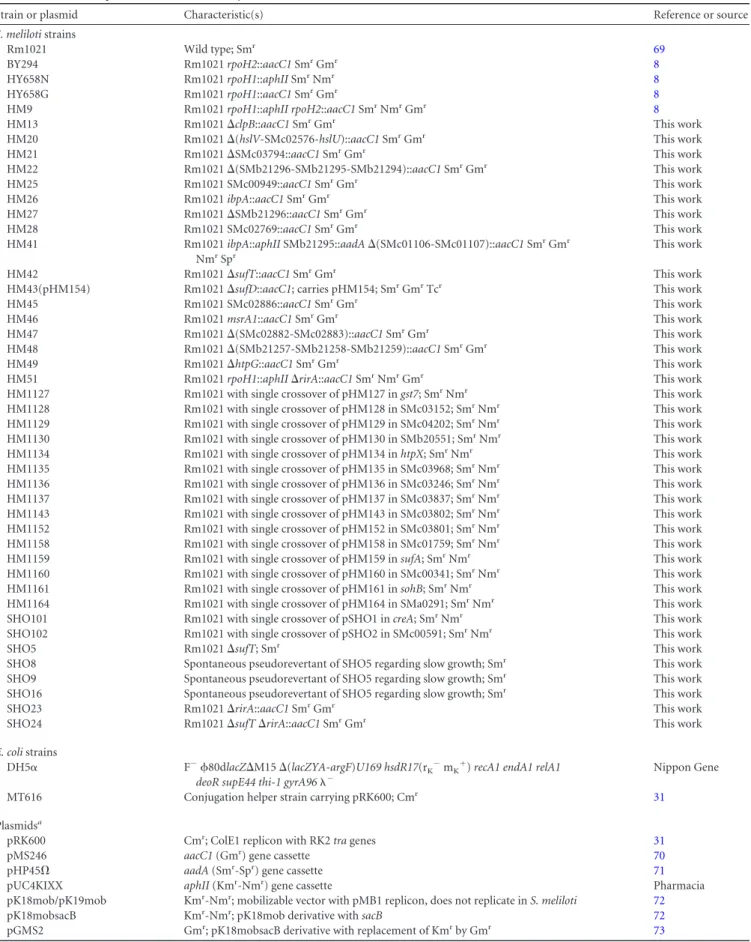
Strain and plasmid construction.Bacterial strains and plasmids used in this work are listed inTable 1(see also Tables S2 to S4 in the supple-mental material). PCR primers are listed in Table S1 in the supplesupple-mental material. The following plasmids were generated from pFAJ1702 by clon-ing PCR-amplified fragments: pHM153 carried a 725-bp region coverclon-ing thesufTopen reading frame (ORF) and the associated RpoH promoter
HM43(pHM154) SMc00528 sufTsufA 1 kb Gmr HM42 SHO5 pHM153 pHM154
SufT 29 LSDDIIAALKTVYDPEIP-ADIFELGLIYKIDI---EDDRMVKIDMTLTA
TM0487 7 TKEDVLNALKNVIDFELG-LDVVSLGLVYDIQI---DDQNNVKVLMTMTT
PaaD 11 QVHEIWALLSQIPDPEIPVLTITDLGMVRNVTQ---MGEG-WVIGFTPTY
FAM96B 42 DAREIFDLIRSINDPEHP-LTLEELNVVEQVRVQVSDPESTVAVAFTPTI
HCF101 79 SEKDVLKALSQIIDPDFG-TDIVSCGFVKDLGIN--EALGEVSFRLELTT
SufT 75 PGCPVAGEM-PGWVENAVGTVEGVSGVEVSMTFDPPWTPDRMSEEAQVAL
TM0487 53 PMCPLAGMI-LSDAEEAIKKIEGVNNVEVELTFDPPWTPERMSPELREKF
PaaD 57 SGCPATEHL-IGAIREAMTT-NGFTPVQVVLQLDPAWTTDWMTPDARERL
FAM96B 91 PHCSMATLIGLSIKVKLLRSLPQRFKMDVHITPGTHASEHAVNKQLADKE
HCF101 126 PACPVKDMF-ENKANEVVAALPWVKKVNVTMSAQP--AKPIFAGQLPFGL Gmr
sthA nifS sufB sufC sufD sufS
A
B
C
TCTTGAAACGGTTCGGCGTCACCTCCACATGCCGGGCGTCCTTCGGTCTTTACAATACCCGGGCCGA GGTCGATGCGCTGGCGGACGCGCTGGAACACGCACGCAAGTTTTTCGCTTAGGGAGACGGACATGGG
16 nt
sufT sufS
FIG 1Sinorhizobium melilotiSMc00302/sufT. (A) Schematic representation of the chromosomalsufregion (RefSeq accession numberNC_003047) and the regions deleted from the chromosome or cloned into the plasmids in this study. Gmr, a gentamicin-resistance gene cassette inserted into the chromo-some. (B) Multiple alignment of amino acid sequences ofS. melilotiSufT (126 amino acids in total;CAC46310) and other DUF59 family members: Thermo-toga maritimaTM0487 (103 amino acids;1WCJ_A),E. coliPaaD (165 amino acids;P76080), human FAM96B (163 amino acids;Q9Y3D0), andArabidopsis thalianaHCF101 (532 amino acids;Q6STH5). Red, identical amino acids; blue, amino acids with similar properties. Circles above the alignment indicate residues that form the putative active site in TM0487 (67). A closed circle indicates a hyperreactive cysteine residue predicted in FAM96B (68). (C) Nu-cleotide sequence upstream ofsufT. The 3=-terminal and 5=-terminal regions of thesufSandsufTORFs, respectively, are shown with dashed lines. A flag sign indicates the terminus of the longestsufTcDNA obtained by 5=RACE. Nucleotides matching the consensus for the RpoH1-dependent promoter (CTTGAA-N15–16-CCTATAT) (19) are shown in red.
on January 29, 2021 by guest
http://jb.asm.org/
TABLE 1Strains and plasmids used in this study
Strain or plasmid Characteristic(s) Reference or source
S. melilotistrains Rm1021 Wild type; Smr 69 BY294 Rm1021rpoH2::aacC1SmrGmr 8 HY658N Rm1021rpoH1::aphIISmrNmr 8 HY658G Rm1021rpoH1::aacC1SmrGmr 8 HM9 Rm1021rpoH1::aphII rpoH2::aacC1SmrNmrGmr 8
HM13 Rm1021⌬clpB::aacC1SmrGmr This work
HM20 Rm1021⌬(hslV-SMc02576-hslU)::aacC1SmrGmr This work
HM21 Rm1021⌬SMc03794::aacC1SmrGmr This work
HM22 Rm1021⌬(SMb21296-SMb21295-SMb21294)::aacC1SmrGmr This work
HM25 Rm1021 SMc00949::aacC1SmrGmr This work
HM26 Rm1021ibpA::aacC1SmrGmr This work
HM27 Rm1021⌬SMb21296::aacC1SmrGmr This work
HM28 Rm1021 SMc02769::aacC1SmrGmr This work
HM41 Rm1021ibpA::aphIISMb21295::aadA⌬(SMc01106-SMc01107)::aacC1SmrGmr
NmrSpr
This work
HM42 Rm1021⌬sufT::aacC1SmrGmr This work
HM43(pHM154) Rm1021⌬sufD::aacC1; carries pHM154; SmrGmrTcr This work
HM45 Rm1021 SMc02886::aacC1SmrGmr This work
HM46 Rm1021msrA1::aacC1SmrGmr This work
HM47 Rm1021⌬(SMc02882-SMc02883)::aacC1SmrGmr This work
HM48 Rm1021⌬(SMb21257-SMb21258-SMb21259)::aacC1SmrGmr This work
HM49 Rm1021⌬htpG::aacC1SmrGmr This work
HM51 Rm1021rpoH1::aphII⌬rirA::aacC1SmrNmrGmr This work
HM1127 Rm1021 with single crossover of pHM127 ingst7; SmrNmr This work
HM1128 Rm1021 with single crossover of pHM128 in SMc03152; SmrNmr This work
HM1129 Rm1021 with single crossover of pHM129 in SMc04202; SmrNmr This work
HM1130 Rm1021 with single crossover of pHM130 in SMb20551; SmrNmr This work
HM1134 Rm1021 with single crossover of pHM134 inhtpX; SmrNmr This work
HM1135 Rm1021 with single crossover of pHM135 in SMc03968; SmrNmr This work
HM1136 Rm1021 with single crossover of pHM136 in SMc03246; SmrNmr This work
HM1137 Rm1021 with single crossover of pHM137 in SMc03837; SmrNmr This work
HM1143 Rm1021 with single crossover of pHM143 in SMc03802; SmrNmr This work
HM1152 Rm1021 with single crossover of pHM152 in SMc03801; SmrNmr This work
HM1158 Rm1021 with single crossover of pHM158 in SMc01759; SmrNmr This work
HM1159 Rm1021 with single crossover of pHM159 insufA; SmrNmr This work
HM1160 Rm1021 with single crossover of pHM160 in SMc00341; SmrNmr This work
HM1161 Rm1021 with single crossover of pHM161 insohB; SmrNmr This work
HM1164 Rm1021 with single crossover of pHM164 in SMa0291; SmrNmr This work
SHO101 Rm1021 with single crossover of pSHO1 increA; SmrNmr This work
SHO102 Rm1021 with single crossover of pSHO2 in SMc00591; SmrNmr This work
SHO5 Rm1021⌬sufT; Smr This work
SHO8 Spontaneous pseudorevertant of SHO5 regarding slow growth; Smr This work
SHO9 Spontaneous pseudorevertant of SHO5 regarding slow growth; Smr This work
SHO16 Spontaneous pseudorevertant of SHO5 regarding slow growth; Smr This work
SHO23 Rm1021⌬rirA::aacC1SmrGmr This work
SHO24 Rm1021⌬sufT⌬rirA::aacC1SmrGmr This work
E. colistrains
DH5␣ F⫺80dlacZ⌬M15⌬(lacZYA-argF)U169 hsdR17(rK⫺mK⫹)recA1 endA1 relA1 deoR supE44 thi-1 gyrA96⫺
Nippon Gene
MT616 Conjugation helper strain carrying pRK600; Cmr 31
Plasmidsa
pRK600 Cmr; ColE1 replicon with RK2tragenes 31
pMS246 aacC1(Gmr) gene cassette 70
pHP45⍀ aadA(Smr-Spr) gene cassette 71
pUC4KIXX aphII(Kmr-Nmr) gene cassette Pharmacia
pK18mob/pK19mob Kmr-Nmr; mobilizable vector with pMB1 replicon, does not replicate inS. meliloti 72
pK18mobsacB Kmr-Nmr; pK18mob derivative withsacB 72
pGMS2 Gmr; pK18mobsacB derivative with replacement of Kmrby Gmr 73
(Continued on following page)
on January 29, 2021 by guest
http://jb.asm.org/
consensus sequence; pHM186, a 685-bp region covering therirAORF; and pAS1, a 253-bp region containinggroES1p. Two plasmids were gen-erated from pAS1 by cloning PCR-amplified fragments: pHM102 con-tained a 932-bp region covering therpoH1ORF and pSHO6 contained a 553-bp region covering thesufTORF (neither of the two regions con-tained a promoter). pHM154 was generated by PCR amplification of a 2,689-bp region covering thesufDSORFs and cloning it into pHC41.
Some RpoH-dependent genes were disrupted using plasmids gener-ated by PCR amplification of internal portions of their ORFs and cloning the PCR fragments into pK18mob or pK19mob (see Table S2 in the sup-plemental material). Each of the resulting plasmids was transferred by conjugation into Rm1021, and the cells were selected for Smrand Nmrto obtain a single-crossover insertion of the plasmid into the genomic region corresponding to the cloned region.
Gmr, Nmr, or Smr-Sprgene cassette insertions or corresponding resis-tance-marked deletions in some RpoH-dependent genes were generated by cloning a restriction fragment from total S. meliloti DNA into pK18mob, pK19mob, or pGMS2 and then inserting the cassette into a restriction site(s) within the ORF of the target gene (see Table S3 in the supplemental material). Gmrcassette insertions or corresponding resis-tance-marked deletions in other RpoH-dependent genes,rirA, andsufD were generated by PCR amplification of a pair of flanking regions of the gene, cloning the two regions together into pK18mob, pK19mob, or pK18mobsacB, and then inserting the Gmrcassette into a synthetic re-striction site between the cloned two regions (see Table S4 in the supple-mental material). The Gmrcassette was excised from pMS246, the Nmr cassette from pUC4KIXX, and the Smr-Sprcassette from pHP45⍀. Except for the case ofsufDdisruption, each resulting plasmid was transferred by conjugation into Rm1021 (or BY294 when the Smr-Sprcassette was used), and cells were selected for Smr(or Gmrwhen BY294 was used as a recip-ient), resistance conferred by the inserted cassette, and Nm sensitivity (or sucrose resistance when pK18mobsacB or pGMS2 was used) to obtain double crossover between the plasmid and the genomic region corre-sponding to the cloned region. Then, Rm1021 was transduced with a M12 lysate of the resistant clone. One of the resulting strains, SHO23, was further transduced with a lysate prepared from therpoH1mutant (HY658N) to yield HM51 (Nmr). ForsufD, the plasmid generated (de-rived from pK18mobsacB) was transferred by conjugation into Rm1021, and an SmrGmrNmrtransconjugant was selected for single-crossover insertion of the plasmid into the flanking region ofsufDon the chromo-some. Next, pHM154 was also transferred by conjugation into the selected clone, and a transconjugant showing sucrose resistance and Smr, Gmr, Tcr, and Nm sensitivity was selected for double-crossover insertion of the Gmrcassette intosufDon the chromosome in the presence of pHM154.
A marker-free deletion insufTwas generated by PCR amplification of the upstream and downstream flanking regions and cloning the two frag-ments into pK18mobsacB; the inserts replaced 72 nucleotides (nt) of the ORF with GATC (see Table S4 in the supplemental material). The result-ing plasmid was transferred by conjugation into HM42 (⌬sufT::Gmr). An SmrNmrtransconjugant was selected for single-crossover insertion of the plasmid into a flanking region ofsufTon the chromosome, grown in LB-MC medium lacking Nm, and rescreened for sucrose-resistant
colo-nies. The clones selected were further screened for Nm and Gm sensitivity, yielding SHO5. SHO24 was obtained by transducing SHO5 with an SHO23 lysate (Gmr).
All generated strains were checked by PCR using the primers listed in Table S1 in the supplemental material to confirm the proper marker in-sertions or deletions.
Doubling time measurements and hydrogen peroxide sensitivity as-says.A single colony was transferred from solid LB-MC or M9-sucrose medium into the corresponding liquid medium. The culture was grown to an OD660of 0.3 to 0.4 and then diluted to an OD660of 0.01 with the same medium with no antibiotics. The growth was followed by monitoring the OD660every 30 min for LB-MC cultures or every 1 h for M9-sucrose cultures. The doubling time was calculated from the OD660values, rang-ing from 0.05 to 0.16.
To test for hydrogen peroxide (H2O2) sensitivity, an LB-MC culture grown to an OD660of 0.1 was diluted 1:200 with M9-sucrose medium, resulting in a density of⬇4⫻105CFU ml⫺1. Then H
2O2was added to an indicated concentration, and the culture was incubated at 25°C with shak-ing. We determined the CFU of the culture immediately before and 30 min after H2O2addition by plating it on solid LB-MC medium and incu-bating the plates for 5 days at 25°C.
Enzyme assays.Sinorhizobium meliloticells were grown in liquid M9-sucrose medium (containing 0.2% M9-sucrose) to an OD660of 0.3, chilled on ice, and collected by centrifugation. Cell pellets were resuspended in a 1.3% volume of cold 50 mM Tris-HCl (pH 7.65) supplemented with complete EDTA-free protease inhibitor cocktail (Roche Applied Science) under nitrogen gas and lysed by sonication in a sealed tube using acoustic solubilizer (Covaris). The lysate was centrifuged at 17,000⫻gfor 5 min, and the supernatant was frozen in liquid nitrogen and stored at⫺80°C until use. Total protein was quantified using the protein assay dye reagent (Bio-Rad) with bovine␥-globulin as a standard. The activity of 6-phos-phogluconate dehydratase (6-PGDH) was examined with 6-phosphoglu-conate (6-PG) as a substrate as follows: (i) 6-PGDH converts 6-PG into 2-keto-3-deoxygluconate 6-phosphate (KDGP), and then KDGP aldolase (both enzymes are present in the cell lysate) converts KDGP into pyruvate and glyceraldehyde 3-phosphate; and (ii) the amount of pyruvate is quan-tified using lactic dehydrogenase and NADH (32). In parallel, the assay was performed with KDGP as a substrate to verify that the rate-limit-ing enzyme for pyruvate production was 6-PGDH. Aconitase activity measurements were based on the formation of cis-aconitate from isocitrate (33). Glutamate synthase (GltS) activity was measured by the rate of NADPH oxidation in the presence of 2-oxoglutarate andL -glu-tamine (34). Malate dehydrogenase activity was measured by the rate of NADH oxidation in the presence of oxaloacetate (35). To ensure the de-tection of oxygen-labile activity, we used a glove box into which nitrogen gas flowed from a high-pressure gas cylinder for all the enzyme assays at room temperature (⬇22°C), except that pyruvate was quantified under ambient air. 6-PG, isocitrate, 2-oxoglutaric acid,L-glutamine, and oxala-cetic acid were purchased from Wako Pure Chemical Industries. NADH, NADPH, lactic dehydrogenase (bovine heart), and KDGP were purchased from Sigma-Aldrich.
TABLE 1(Continued)
Strain or plasmid Characteristic(s) Reference or source
pFAJ1702 Tcr; IncP broad-host-range vector 74
pHC41 Tcr; IncP broad-host-range vector 75
pAS1 Tcr; pFAJ1702 derivative with thegroES1promoter This work
pHM102 Tcr; pAS1 derivative withgroES1p-rpoH1 This work
pHM153 Tcr; pFAJ1702 derivative withsufT⫹ This work
pHM154 Tcr; pHC41 derivative withsufDS⫹ This work
pSHO6 Tcr; pAS1 derivative withgroES1p-sufT⫹ This work
pHM186 Tcr; pFAJ1702 derivative withrirA⫹ This work
aPlasmids used for gene disruption in Rm1021 are listed in Tables S2 to S4 in the supplemental material.
on January 29, 2021 by guest
http://jb.asm.org/
Whole-genome resequencing.Total DNA was processed using the Nextera DNA sample preparation kit (Illumina) to generate a shotgun library with unique index adapters. The libraries from strains Rm1021, SHO5, SHO8, SHO9, and SHO16 were sequenced on a MiSeq system (Illumina), yielding the following numbers of 250-bp paired-end reads: 2.7⫻106, 2.3⫻106, 2.5⫻106, 2.3⫻106, and 2.5⫻106, respectively. We used a 21-nt window to scan the reads for sequence variants versus the referenceS. melilotiRm1021 genome sequence in the GenBank database (RefSeq accession numbersNC_003037,NC_003047, andNC_003078) by using the “missingk-mer” tool of ShortReadManager (36). Using each of the retrieved sequences, we collected all of the reads containing a 20-nt sequence adjacent to the variation point by using ShortReadManager and aligned the sequences of those reads in Microsoft Excel. If all, or all but one, of at least 15 collected reads had the same variant, we concluded that the corresponding mutation was present in the strain. Mutations found only in SHO8, SHO9, or SHO16 were sorted from ones common between these three strains and Rm1021 or SHO5. The resulting mutations were derived from the variants found in all of the 18 to 62 reads that were collected above individually in SHO8, SHO9, and SHO16.
RESULTS
Symbiotic phenotypes ofS. melilotistrains with mutations in RpoH-dependent heat shock-induced genes.On the basis of global transcription profiling of the wild type versus single or dou-blerpoHmutants (growth, 30°C; heat shock, 42°C, 15 min), Bar-nett et al. reported a list of RpoH-regulon members inS. meliloti (19). We independently performed a transcriptome analysis with differences in the temperatures for growth (25°C) and heat shock (37°C, 10 min) and in analysis methods (see Materials and Meth-ods in the supplemental material). From the list of Barnett et al. (19), we selected 35 presumed operons or solitary genes whose expression decreased most strongly in therpoH1 rpoH2double mutant (strain HM9) compared to that in the wild type (strain Rm1021) in our analysis (see Table S5 in the supplemental mate-rial). Most of these transcription units also respond to heat shock in wild-type cells (19); in 26 of the transcription units, RpoH-dependent promoter consensus sequences precede the transcrip-tion start sites (16,19,37) (see Table S5). We disrupted 29 of the transcription units individually by using insertions of antibiotic resistance cassettes or resistance-marked deletions and confirmed operon disruption by PCR (see Table S5); mutants lackinggroEL4 andgroESL5have been documented to be Fix⫹(16,17). A triple mutant lacking the small Hsp homologs SMc04040 (ibpA), SMb21295, and SMc01106 (strain HM41) was also generated. In nodulation assays with alfalfa plants, all of the generated mutants except the one with a mutation in SMc00302 (see Table S5) sup-ported healthy plant growth and formation of pink cylindrical nodules, indicating a Fix⫹ phenotype. These included a strain with a mutation insufA, the gene immediately downstream of SMc00302 (Fig. 1A). In contrast, mutants with deletions in SMc00302 (strain HM42, a Gmr-marked deletion, and strain SHO5, a nonpolar marker-free deletion) (Fig. 1A) were unable to support normal plant growth, and small white nodules were formed, indicating a Fix⫺phenotype (see Fig. S1A in the supple-mental material, plant in the middle). The Fix⫹phenotype was restored when HM42 (data not shown) or SHO5 (see Fig. S1A) was complemented with SMc00302 introduced intrans on the pHM153 plasmid (Fig. 1). Therefore, SMc00302 is indispensable for effective symbiosis.
SMc00302/SufT belongs to a conserved protein family re-lated to Fe/S protein metabolism.The amino acid sequence of SMc00302 is similar to the sequences of the members of the
DUF59 (domain of unknown function 59) family, which is wide-spread in prokaryotes and eukaryotes (Fig. 1B). Some of its mem-bers are involved in Fe/S protein metabolism. For example, PaaD serves for maturation of PaaE, a [2Fe-2S]-containing reductase component of phenylacetate-coenzyme A monooxygenase, in di-verse bacteria (38). FAM96B, also known as MIP18 or CIA2B, is a component of the CIA (cytosolic iron-sulfur protein assembly) targeting complex, which interacts with target apoproteins and delivers Fe/S clusters to them in the cytosol of eukaryotic cells (39). InArabidopsis thaliana, HCF101 serves for maturation of [4Fe-4S] cluster-containing proteins in the chloroplast (40). Genes encoding proteins of the DUF59 family are located in the sufoperons of some bacteria such asMycobacterium tuberculosis (41); such genes were recently namedsufT(25). Thus, we postu-lated that the function of SMc00302 is repostu-lated to the SUF system, and this gene is here referred to assufT.
To clarify whether asufTmutant would have the same pheno-type as othersufmutants, we introduced a Gmr-marked deletion into chromosomalsufDin the presence of plasmid-bornesufDS genes, yielding strain HM43(pHM154) (Fig. 1A). Then we exam-ined the frequencies of transduction of Rm1021 and its pHM154-carrying derivative (i.e., a merodiploid forsufDS) for Gmrusing a
M12 lysate of HM43(pHM154). Rm1021(pHM154) gave rise to 1.5⫾0.3⫻10⫺7colonies per PFU (mean⫾standard deviation; n⫽5) at 25°C on Gm-containing LB medium; a Gmr-marked deletion insufDon the chromosome was confirmed by PCR in some of these colonies (data not shown). Under the same condi-tions, Rm1021 gave rise to 4.2⫾3.4⫻10⫺9colonies per PFU (n⫽ 5) that grew slowly; we regarded them as false positives because they had a wild-typesufDallele but not the Gmrcassette (data not shown). This indicates thatsufDdisruption is lethal (which one might expect from the absence of the ISC system) or, less likely, that it interrupts the transduction. Transduction of Rm1021 using an HM42 (⌬sufT::Gmr) lysate produced 2.2⫾0.2⫻10⫺7Gmr colonies per PFU (n⫽3) under the same conditions. Taken to-gether, these data suggest that SufT is distinct from the core SUF components and ancillary to the SUF system.
RpoH1-dependent transcription ofsufT.Heat shock or mu-tations inrpoH1significantly affect the expression ofsufTandsufA but not that ofsufBCDS(19). Using quantitative reverse transcrip-tion-PCR, we verified thatsufTexpression was increased by heat shock in the wild type and therpoH2mutant but not in therpoH1 mutant orrpoH1 rpoH2double mutant (see Fig. S1B in the sup-plemental material); 5=rapid amplification of cDNA ends (RACE) also detected asufTtranscript that appeared during heat shock in the wild type but not in therpoH1 rpoH2double mutant (see Fig. S1C in the supplemental material). Sequencing of the RACE prod-uct allowed us to map the transcription start site at nucleotide position 92 upstream of thesufTstart codon, i.e., within thesufS ORF; transcription beginning at this position had been missed by the previous global studies. This site was preceded by an RpoH-dependent promoter consensus-like sequence (Fig. 1C). To exam-ine whether ectopic expression ofsufT alleviates the symbiotic defects of therpoHmutant, we expressedsufTunder the control of the RpoH-independentgroESL1promoter (16). We introduced the pSHO6 plasmid carrying agroESL1p-sufTfusion into HY658N and SHO5 and assayed the strains obtained for plant nodulation. The Fix⫺phenotype of SHO5 but not that of HY658N was rescued by pSHO6, indicating thatsufTwas expressed from pSHO6 at a level sufficient for effective symbiosis. The Fix⫹phenotype was
on January 29, 2021 by guest
http://jb.asm.org/
restored in HY658N by pHM102 carrying agroESL1p-rpoH1 fu-sion. Therefore, the requirement for RpoH for effective symbi-osis cannot be attributed solely tosufTupregulation, and some other key target(s) of RpoH for symbiosis remains to be iden-tified.
Loss of SufT affects free-living growth and Fe/S cluster-de-pendent enzymes. The sufT mutant grew significantly more slowly than the wild type at 25°C in both LB-MC and M9-sucrose liquid media (Table 2). ThesufTmutant also grew poorly on solid M9 medium containing sucrose, glucose (data not shown), or sodium succinate (Fig. 2); growth appeared similar for each car-bon source (data not shown) regardless of the route of its catabo-lism. Sucrose and glucose are catabolized initially via the Entner-Doudoroff pathway (42), while succinate is an intermediate of the tricarboxylic acid cycle. A growth defect is plausible if SufT func-tions in the maintenance of Fe/S proteins involved in central met-abolic pathways (e.g., 6-PGDH in the Entner-Doudoroff pathway and succinate dehydrogenase and aconitase in the tricarboxylic
acid cycle), respiratory chains, or biosynthesis of amino acids and cofactors (22). In comparison with the wild type, thesufTmutant was more sensitive to high temperature (39°C), acidic pH (6.2), or an iron chelator which causes intracellular iron depletion (250
M dipyridyl) when grown on LB plates (Fig. 2); all of these changes were reversed by pHM153 carryingsufTbut not by the empty vector. Addition of FeCl3(37M) did not affect the differ-ences in growth phenotypes except dipyridyl sensitivity between Rm1021 and SHO5 (data not shown). On the other hand, the survival rate of the wild type andsufTmutant did not significantly differ after a 30-min exposure to H2O2during exponential growth (⬃100% at 100M H2O2and⬃10% at 250M H2O2). ThesufT mutant and therpoH1mutant sensitivities to acidic pH appeared similar (Fig. 2E). However, therpoH1mutant was more sensitive to high temperature (Fig. 2B) and less sensitive to dipyridyl (Fig. 2C) than thesufTmutant and grew on M9 medium indistinguish-ably from the wild type as described previously (8) (Fig. 2F). The latter two properties imply thatsufTis still transcribed at a basal TABLE 2Impact of thesufTandrirAmutations on growth rates and enzyme activities ofSinorhizobium melilotia
Strain
Doubling time (h) in: Activity (U mg⫺1of total protein) LB-MC
medium
M9-sucrose
medium 6-Phosphogluconate dehydrataseb Aconitasec
Glutamate
synthased Malate dehydrogenasee
Rm1021 (wild type) 3.2⫾0.5 6.2⫾0.2 102⫾12 64⫾10 12.9⫾1.1 149⫾19
SHO5 (⌬sufT) 5.7⫾0.4f 14.9⫾0.4f 10⫾10f 29⫾11f 6.5⫾2.2f 239⫾39f
SHO23 (⌬rirA) ND 9.5⫾0.8f 80⫾6 106⫾16f ND ND
SHO24 (⌬rirA⌬sufT) ND 8.6⫾0.8f,g 92⫾28g 109⫾9f,g ND ND
aValues are means⫾SD from three or four independent measurements; ND, not determined. b
Expressed as nanomoles of pyruvate formed per minute. KDGP aldolase activity was 222⫾35 in Rm1021 and 77⫾18 in SHO5 (see Materials and Methods).
cExpressed as nanomoles ofcis-aconitate formed per minute. d
Expressed as nanomoles of NADPH oxidized per minute.
eExpressed as nanomoles of NADH oxidized per minute. f
Significantly different from Rm1021 (ttest,P⬍0.05).
gSignificantly different from SHO5 (ttest,P⬍0.01).
FIG 2Growth ofSinorhizobium melilotimutants on solid media. Tenfold serial dilutions (5l) of exponentially growing cultures (with an OD660of 0.05 to 0.07) of strains Rm1021 (wild type), SHO5 (sufTmutant), SHO5 (harboringsufT⫹in the pHM153 plasmid), SHO5 (harboring the empty vector pFAJ1702), and HY658N (rpoH1mutant) were spotted and grown as follows: (A) LB-MC medium; 38°C for 2 days; (B) LB-MC medium; 39°C for 2 days; (C) LB medium supplemented with 2,2-dipyridyl to 250M; 25°C for 4 days; (D) LB medium adjusted to pH 7.0 with 35 mM 2-(N-morpholino)ethanesulfonic acid (MES); 25°C for 3 days; (E) LB medium adjusted to pH 6.2 with 35 mM MES; 25°C for 3 days; and (F) M9-sodium succinate medium; 25°C for 8 days. M9-sucrose and M9-glucose were also used and gave results similar to those shown in panel F (not shown in the figure). The same cultures grown with LB-MC medium were used for spots in panels A to E), and the same cultures grown with M9 medium were used for spots in panel F and on M9-sucrose and M9-glucose plates. Each of the four biological replicates gave essentially the same results in each assay.
on January 29, 2021 by guest
http://jb.asm.org/
level, supposedly from a promoter ofsufBCDS, in therpoH1 mu-tant.
To assess an effect of the sufT mutation on cellular Fe/S proteins, we compared the activities of 6-PGDH, aconitase, and GltS in the wild type andsufTmutant. We postulated that these activities are produced by Fe/S proteins inS. meliloti, as in E. coli(22), because proteins encoded by theE. coliandS. meliloti genes are highly conserved:edd(6-PGDH; 59% identity; RefSeq accession numbersP0ADF6andCAC45274for the sequences in E. coliandS. meliloti, respectively),acnA(aconitase; 62%;P25516
and CAC47808), gltB (␣ subunit of GltS; 45%; P09831 and
CAC47390), and gltD ( subunit of GltS; 38%; P09832 and
CAC47389) (14). The activity of each of these enzymes was
signif-icantly lower (to a various extent) in thesufTmutant than in the wild type (Table 2). In contrast, the activity of malate dehydroge-nase, a non-Fe/S enzyme, was increased significantly in thesufT mutant (Table 2). 6-PGDH and aconitase employ solvent-ex-posed labile [4Fe-4S] clusters as Lewis acid catalysts (43), whereas GltS has shielded [3Fe-4S] and [4Fe-4S] clusters buried in the polypeptide chains, which function in intramolecular electron transfer (44). Thus, our data suggest that SufT serves for the main-tenance of various Fe/S proteins, although [2Fe-2S] cluster-con-taining proteins remain to be examined in this respect. An in-crease in malate dehydrogenase activity might be a general symptom of metabolic perturbation caused by Fe/S protein de-fects; indeed, this activity is markedly increased inE. colimutants unable to build Fe/S clusters (27).
Loss of RirA suppresses phenotypic defects caused by the sufTmutation.Several rounds of culture and dilution of SHO5 cells with liquid M9-sucrose medium led to the isolation of spon-taneous revertants (strains SHO8, SHO9, and SHO16) that formed visible colonies on solid M9-sucrose medium more rap-idly than the original SHO5. The doubling time of these revertants (11.7 to 13.6 h) was intermediate between those of Rm1021 and SHO5 in liquid M9-sucrose medium. A deletion insufTin these strains was confirmed by PCR (data not shown); therefore, we presumed that a second-site mutation suppressed the growth de-fect caused by thesufTmutation. To search for this mutation, we used whole-genome resequencing. The mutations identified are summarized in Table S6 in the supplemental material; indepen-dent deletions inrirAwere detected in all three strains. This gene encodes an Rrf2 family transcriptional repressor inRhizobiaceae, which senses the iron status possibly through the binding of the Fe/S cluster (45); accordingly, RirA serves for iron homeostasis similarly to the role of Fur proteins in many other Gram-negative and some Gram-positive bacteria (46–48). Iron overload leads to excessive generation of reactive oxygen species, and diverse bacte-ria tightly regulate intracellular free iron to maintain it below toxic levels (49). InS. meliloti, RirA represses more than 80 operons, including those involved in iron uptake under iron-replete condi-tions, and therirAnull mutation leads to iron overload that in-creases the sensitivity to oxidative stress (47).
To examine whether SufT and RirA are phenotypically linked, we deletedrirAin thesufTmutant background (see Fig. S2A and B in the supplemental material). In the resulting strain SHO24, 6-PGDH activity was significantly higher than that in SHO5, and aconitase activity was significantly higher than that in SHO5 and even the wild type (Table 2). SHO24 grew more rapidly than SHO5 in M9-sucrose medium (Table 2) and showed a Fix⫹ phe-notype (see Fig. S2C in the supplemental material)
indistinguish-able from that of the wild type in the plant nodulation assay. Plants inoculated with an SHO24 derivative harboring pHM186 (carry-ing rirA) exhibited a Fix⫺phenotype (poor growth and small white nodules, except for a few plants that also formed a single cylindrical pink nodule), whereas plants inoculated with an SHO24 derivative harboring the empty vector exhibited a Fix⫹ phenotype. Therefore, we concluded that the loss of RirA sup-pressed the phenotypic defects caused by thesufTmutation. ArirA single mutant (strain SHO23) is Fix⫹(47); the growth rates and Fe/S enzyme activities of therirAsingle mutant and therirA sufT double mutant were similar (Table 2; see also Fig. S2C in the supplemental material). Unlike thesufTmutant, therpoH1 mu-tant was not rescued by therirAdeletion; therirA rpoH1double mutant (strain HM51) showed a Fix⫺phenotype with small white nodules (data not shown). This result is consistent with the idea of some other key target(s) of RpoH for effective symbiosis, although we cannot rule out the possibility that not RirA but some other regulator acts onin plantairon metabolism in therpoH1mutant. DISCUSSION
Using mutational analysis, we identifiedsufTas a RpoH-depen-dent heat shock gene inS. melilotithat is indispensable for effec-tive symbiosis. In contrast, none of the individual mutants in RpoH-dependent genes encoding major chaperones or proteases (such as ClpB, HslUV, HtpG, HtpX, and IbpA) showed apprecia-ble symbiotic defects, as reported for the mutants lackinggroEL4 andgroESL5(each encoding a chaperonin GroEL) (16,50). The absence of phenotypic effects is likely due to the ability of different groups of chaperones and proteases to compensate for the loss of one of these proteins and thus maintain proteome integrity. DnaK, the major Hsp70 in bacteria, is a central organizer of the chaperone network inE. coliand serves for folding of the nascent polypeptides (51). We failed to disruptdnaKinS. meliloti(data not shown), whereas this gene was not selected according to a fold change of its expression in therpoH1 rpoH2mutant compared with that in the wild type in this study. The RpoH-independent operongroESL1is the only one sufficient for both viability and effective symbiosis among the five chaperonin-encoding operons inS. meliloti(50). Thus, it remains to be clarified whether an RpoH-dependent elevation, if any, of the overall chaperone/pro-tease activities is necessary for symbiosis.
We conclude thatsufTplays a unique role inS. meliloti, most probably through the maintenance of cellular Fe/S protein levels. Unlike inS. meliloti, its soleE. colihomologpaaDis neither regu-lated by32nor linked to thesuflocus; however, the RpoH regu-lon is involved in Fe/S protein metabolism in both species (4). For example,E. coliNfuA acts downstream of both the ISC and the SUF scaffolds to transfer Fe/S clusters to particular apoproteins under stress conditions, and its expression is regulated by32(52,
53). Therefore, rather than indicating the specificity of theS. meli-lotiRpoH, our findings emphasize the general role of the RpoH-type sigma factors in the maintenance of protein homeostasis; these sigma factors ensure not only the proper folding and degra-dation of proteins but also the sufficient flux of Fe/S clusters or efficient repair of damaged Fe/S clusters in complex cellular pro-teins (4). The spectrum of Fe/S cluster types affected by SufT is an interesting subject for future research.
Among the components of the SUF system, the expression of only SufT and SufA is regulated by RpoH inS. melilotiduring heat shock and acidic pH stress (18,19). This suggests that SufT
on January 29, 2021 by guest
http://jb.asm.org/
ulates the SUF system in response to heat and other stresses that impair Fe/S protein homeostasis. InE. coli, the loss of the two A-type carriers, SufA and IscA, is lethal under aerobic conditions (54), whereas the loss of the only known A-type carrier, SufA, still allowed for effective symbiosis inS. meliloti. It is not known how the loss of SufA is compensated for inS. meliloti; SMc02705, which contains a sequence that is partially similar to that of SufA (17% identical and 66% similar in the 51-amino acid portion; RefSeq accession numbersCAC46946andCAC46309for SMc02705 and SufA, respectively), is a candidate with the overlapping function. Alternatively, the A-type carrier might be dispensable for aerobic growth and symbiosis in this species.
Our study demonstrates a close relationship between the func-tional roles of SufT and RirA in both free-living growth and sym-biosis. We consider two possible explanations for the suppression ofsufTmutant phenotypes by therirAmutation. First, the loss of the SufT function may be compensated for by increased levels of other SUF components, as the expression ofsufBCDSTAis in-creased in theS. meliloti rirAmutant (47). It is not known whether sufexpression is directly regulated by RirA or is affected by oxida-tive stress generated as a result of therirAmutation. To evaluate this explanation, it is necessary to examinesufBCDSTAexpression in thesufTmutant background and the effect of RirA-indepen-dent overexpression of the core SUF components and SufA on the phenotype of thesufTmutant. The second explanation is that a large iron pool in therirAmutant increases iron flow into the SUF system, thereby compensating for the lack of SufT. We showed that the depletion of the intracellular iron pool with dipyridyl rendered SufT indispensable for the growth in rich medium. Therefore, we propose that SufT serves to balance the intrinsic iron limitation exerted by RirA so that SufT function becomes crucial under conditions adverse to iron homeostasis. In this case, the effect of SufT on iron acquisition by the SUF system would be indirect, because its homologs, such as human CIA2B, appear to act at a late step of the Fe/S protein biogenesis pathway, i.e., trans-fer of preassembled Fe/S clusters to target apoproteins (39). Yet, this explanation does not appear consistent with the findings inE. coliand some other bacteria, in which, despite the lack of a SufT ortholog, the SUF system appears to build and transfer Fe/S clus-ters in a more oxidant-resistant way than the housekeeping ISC system and is induced and replaces ISC as the main pathway under adverse conditions (24,55–58). It would be important to examine whether the function of each SUF component varies betweenS. melilotiandE. coli. Interestingly, SufD is much less conserved (29% identity; RefSeq accession numbersCAC46312andP77689
for the sequences inS. melilotiandE. coli, respectively) than SufB (59%;CAC46314andP77522) and SufC (58%;CAC46313and
P77499) between these organisms. Since SufD was shown to
con-tribute to iron acquisition by the scaffold inE. coli(59), the differ-ence in the SufD structure might affect the entrance of iron into the SUF system so that Fe/S clusters could be assembled efficiently without SufT inE. colibut not inS. meliloti.
From a viewpoint of the relationship between RpoH and iron metabolism, it is noteworthy that expression of the rhizobactin synthesis genesrhbABCDEFand the rhizobactin transporter gene rhtAis increased, while expression of the transcriptional activator generhrAis decreased, in therpoH1mutant compared with that in the wild type under a neutral pH and no heat shock condition (18). Rhizobactin is anS. meliloti-produced siderophore, which binds to ferric iron for iron acquisition, and its synthesis and
transport genes are transcribed with the action of RhrA, whose expression is repressed by RirA in turn (47). Expression of the rhizobactin-related genes might be affected by perturbations in iron homeostasis as a result of the failure to increasesufT expres-sion in therpoH1mutant. Examination of an effect of the loss of RpoH1 or SufT on the Fe/S cluster-binding status of RirA will possibly provide a clue to the puzzling pattern of rhizobactin-related gene expression.
Why is thesufTmutant deficient in symbiosis? First, a larger variety ofS. melilotiFe/S proteins participate in symbiosis than in free-living growth in rich media. For optimal nodulation and in-fection,S. melilotineeds to synthesize branched-chain amino ac-ids (isoleucine, valine, and leucine) (60), and their biosynthesis involves Fe/S proteins such as IlvD and LeuC (22). An active ni-trogenase complex contains a [4Fe-4S] cluster and more complex clusters such as the P cluster [8Fe-7S] and the iron-molybdenum cofactor [7Fe-9S-1C-1Mo-homocitrate] (61). Second, interac-tions with the plant may adversely affect iron homeostasis inS. meliloti. The absence of deleterious iron overload in therirA mu-tant during symbiosis suggests thatS. melilotiacquires only a lim-ited amount of iron from the host (47). In addition,S. melilotiis exposed to reactive oxygen and nitrogen species, which are pro-duced by the host as modulators of nodule development and byS. melilotiowing to the high respiration rates necessary for nitrogen fixation (62).Sinorhizobium melilotineeds to compensate for the oxidative loss of Fe/S clusters caused by those reactive species (43). Therefore, chronic oxidative stress under iron limitation might necessitate the function of SufT, although thesufTmutation did not affect survival after short-term H2O2treatment in our exper-iments. We conclude thatS. melilotineeds SufT to produce suffi-cient amounts of Fe/S proteins during symbiosis. A decrease in symbiotic performance possibly linked to Fe/S cluster metabolism has also been reported for anS. melilotimutant lacking the mono-thiol glutaredoxin SmGRX2, which is attenuated in nitrogen fix-ation capacity (63). Monothiol glutaredoxins have been suggested to serve for delivery of [2Fe-2S] clusters in some bacteria and eukaryotes (23).
In addition to Fe/S protein biogenesis, the RpoH regulon also affects redox control using glutathione through its members gshB1(encoding glutathione synthetase) andgrxC(encoding the dithiol glutaredoxin SmGRX1) (18,19). ThegshB1mutant dis-plays early senescence of bacteroids (64). SmGRX1 contributes to protein deglutathionylation, and its null mutant is defective in nodule development and bacteroid differentiation (63). The ex-pression ofrpoH1and several RpoH-regulated genes, including sufTandgrxC, is increased by NCR peptides (65,66), suggesting that these genes are incorporated into a complex regulatory net-work that allows bacteria to adapt to the host cell environment. Thus, the RpoH function serves for the robustness of symbiosis whenS. melilotiis exposed to Fe/S cluster-damaging oxidative stress.
ACKNOWLEDGMENTS
We thank Yoshiyuki Ohtsubo for advice on the use of ShortReadManager, Kaori Kakizaki for advice on the use of MiSeq, and Akiko Kudo and Akemi Saito for technical assistance in strain construction.
This work was supported by Grants-in-Aid for Scientific Research (grants 22380048 and 16K07654) to H.M. from the Japan Society for the Promotion of Science.
on January 29, 2021 by guest
http://jb.asm.org/
FUNDING INFORMATION
This work, including the efforts of Hisayuki Mitsui, was funded by Japan Society for the Promotion of Science (JSPS) (16K07654 and 22380048). REFERENCES
1.Gibson KE, Kobayashi H, Walker GC.2008. Molecular determinants of a symbiotic chronic infection. Annu Rev Genet42:413– 441.http://dx.doi .org/10.1146/annurev.genet.42.110807.091427.
2.Oldroyd GED, Murray JD, Poole PS, Downie A. 2011. The rules of engagement in the legume-rhizobial symbiosis. Annu Rev Genet45:119 – 144.http://dx.doi.org/10.1146/annurev-genet-110410-132549. 3.Feklístov A, Sharon BD, Darst SA, Gross CA.2014. Bacterial sigma
factors: a historical, structural, and genomic perspective. Annu Rev Mi-crobiol68:357–376. http://dx.doi.org/10.1146/annurev-micro-092412 -155737.
4.Guisbert E, Yura T, Rhodius VA, Gross CA. 2008. Convergence of molecular, modeling, and systems approaches for an understanding of the Escherichia coliheat shock response. Microbiol Mol Biol Rev72:545–554. http://dx.doi.org/10.1128/MMBR.00007-08.
5.Kim YE, Hipp MS, Bracher A, Hayer-Hartl M, Hartl FU.2013. Molec-ular chaperone functions in protein folding and proteostasis. Annu Rev Biochem 82:323–355.http://dx.doi.org/10.1146/annurev-biochem -060208-092442.
6.Nakahigashi K, Yanagi H, Yura T.1995. Isolation and sequence analysis ofrpoHgenes encoding32homologs from Gram negative bacteria: con-served mRNA and protein segments for heat shock regulation. Nucleic Acids Res23:4383– 4390.
7.Nakahigashi K, Ron EZ, Yanagi H, Yura T. 1999. Differential and independent roles of a32homolog (RpoH) and an HrcA repressor in the heat shock response ofAgrobacterium tumefaciens. J Bacteriol181:7509 – 7515.
8.Ono Y, Mitsui H, Sato T, Minamisawa K.2001. Two RpoH homologs responsible for the expression of heat shock protein genes in Sinorhizo-bium meliloti. Mol Gen Genet264:902–912.http://dx.doi.org/10.1007 /s004380000380.
9.Slamti L, Livny J, Waldor MK.2007. Global gene expression and phe-notypic analysis of aVibrio cholerae rpoHdeletion mutant. J Bacteriol 189:351–362.http://dx.doi.org/10.1128/JB.01297-06.
10. Ueki T, Lovley DR.2007. Heat-shock sigma factor RpoH fromGeobacter sulfurreducens. Microbiology 153:838 – 846. http://dx.doi.org/10.1099 /mic.0.2006/000638-0.
11. Dufour YS, Imam S, Koo B-M, Green HA, Donohue TJ.2012. Conver-gence of the transcriptional responses to heat shock and singlet oxygen stresses. PLoS Genet8:e1002929.http://dx.doi.org/10.1371/journal.pgen .1002929.
12. Martínez-Salazar JM, Sandoval-Calderón M, Guo X, Castillo-Ramírez S, Reyes A, Loza MG, Rivera J, Alvarado-Affantranger X, Sánchez F, González V, Dávila G, Ramírez-Romero MA.2009. TheRhizobium etli RpoH1 and RpoH2 sigma factors are involved in different stress re-sponses. Microbiology 155:386 –397.http://dx.doi.org/10.1099/mic.0 .021428-0.
13. Oke V, Rushing BG, Fisher EJ, Moghadam-Tabrizi M, Long SR.2001. Identification of the heat-shock sigma factor RpoH and a second RpoH-like protein inSinorhizobium meliloti. Microbiology147:2399 –2408.http: //dx.doi.org/10.1099/00221287-147-9-2399.
14. Galibert F, Finan TM, Long SR, Puhler A, Abola P, Ampe F, Barloy-Hubler F, Barnett MJ, Becker A, Boistard P, Bothe G, Boutry M, Bowser L, Buhrmester J, Cadieu E, Capela D, Chain P, Cowie A, Davis RW, Dréano S, Federspiel NA, Fisher RF, Gloux S, Godrie T, Goffeau A, Golding B, Gouzy J, Gurjal M, Hernandez-Lucas I, Hong A, Huizar L, Hyman RW, Jones T, Kahn D, Kahn ML, Kalman S, Keating DH, Kiss E, Komp C, Lelaure V, Masuy D, Palm C, Peck MC, Pohl TM, Portetelle D, Purnelle B, Ramsperger U, Surzycki R, Thébault P, Vandenbol M, Vorhölter F-J, Weidner S, Wells DH, Wong K, Yeh K-C, Batut J.2001. The composite genome of the legume symbiontSinorhizobium meliloti. Science293:668 – 672.http://dx.doi.org/10.1126/science.1060966. 15. Narberhaus F, Krummenacher P, Fischer H-M, Hennecke H. 1997.
Three disparately regulated genes for32-like transcription factors in Bra-dyrhizobium japonicum. Mol Microbiol24:93–104.http://dx.doi.org/10 .1046/j.1365-2958.1997.3141685.x.
16. Mitsui H, Sato T, Sato Y, Ito N, Minamisawa K.2004.Sinorhizobium melilotiRpoH1 is required for effective nitrogen-fixing symbiosis with
alfalfa. Mol Genet Genomics 271:416 – 425. http://dx.doi.org/10.1007 /s00438-004-0992-x.
17. Bittner AN, Oke V.2006. MultiplegroESLoperons are not key targets of RpoH1 and RpoH2 inSinorhizobium meliloti. J Bacteriol188:3507–3515. http://dx.doi.org/10.1128/JB.188.10.3507-3515.2006.
18. de Lucena DK, Pühler A, Weidner S.2010. The role of sigma factor RpoH1 in the pH stress response ofSinorhizobium meliloti. BMC Micro-biol10:265.http://dx.doi.org/10.1186/1471-2180-10-265.
19. Barnett MJ, Bittner AN, Toman CJ, Oke V, Long SR.2012. Dual RpoH sigma factors and transcriptional plasticity in a symbiotic bacterium. J Bacteriol194:4983– 4994.http://dx.doi.org/10.1128/JB.00449-12. 20. Beinert H, Holm RH, Münck E. 1997. Iron-sulfur clusters: nature’s
modular, multipurpose structures. Science277:653– 659. http://dx.doi .org/10.1126/science.277.5326.653.
21. Lill R.2009. Function and biogenesis of iron-sulphur proteins. Nature 460:831– 838.http://dx.doi.org/10.1038/nature08301.
22. Py B, Barras F.2010. Building Fe-S proteins: bacterial strategies. Nat Rev Microbiol8:436 – 446.http://dx.doi.org/10.1038/nrmicro2356. 23. Roche B, Aussel L, Ezraty B, Mandin P, Py B, Barras F.2013. Iron/sulfur
proteins biogenesis in prokaryotes: formation, regulation and diversity. Biochim Biophys Acta1827:455– 469.http://dx.doi.org/10.1016/j.bbabio .2012.12.010.
24. Boyd ES, Thomas KM, Dai Y, Boyd JM, Outten FW.2014. Interplay between oxygen and Fe-S cluster biogenesis: insights from the Suf path-way. Biochemistry53:5834 –5847.http://dx.doi.org/10.1021/bi500488r. 25. Outten FW.2015. Recent advances in the Suf Fe-S cluster biogenesis
pathway: beyond the proteobacteria. Biochim Biophys Acta1853:1464 – 1469.http://dx.doi.org/10.1016/j.bbamcr.2014.11.001.
26. Tan G, Lu J, Bitoun JP, Huang H, Ding H.2009. IscA/SufA paralogues are required for the [4Fe-4S] cluster assembly in enzymes of multiple physiological pathways inEscherichia coliunder aerobic growth condi-tions. Biochem J420:463– 472.http://dx.doi.org/10.1042/BJ20090206. 27. Tanaka N, Kanazawa M, Tonosaki K, Yokoyama N, Kuzuyama T,
Takahashi Y.2016. Novel features of the ISC machinery revealed by char-acterization ofEscherichia colimutants that survive without iron-sulfur clusters. Mol Microbiol99:835– 848.http://dx.doi.org/10.1111/mmi .13271.
28. Miller JH.1992. A short course in bacterial genetics: a laboratory manual and handbook forEscherichia coliand related bacteria. CSHL Press, Cold Spring Harbor, NY.
29. Finan TM, Hartwieg E, LeMieux K, Bergman K, Walker GC, Signer ER.1984. General transduction inRhizobium meliloti. J Bacteriol159: 120 –124.
30. Somasegaran P, Hoben HJ.1994. Handbook for rhizobia: methods in legume-rhizobium technology. Springer-Verlag, New York, NY. 31. Finan TM, Kunkel B, De Vos GF, Signer ER.1986. Second symbiotic
megaplasmid inRhizobium meliloticarrying exopolysaccharide and thia-mine synthesis genes. J Bacteriol167:66 –72.
32. Fraenkel DG, Horecker BL.1964. Pathways ofD-glucose metabolism in Salmonella typhimurium. J Biol Chem239:2765–2771.
33. Henson CP, Cleland WW.1967. Purification and kinetic studies of beef liver cytoplasmic aconitase. J Biol Chem242:3833–3838.
34. Miller RE, Stadtman ER.1972. Glutamate synthase fromEscherichia coli. An iron-sulfide flavoprotein. J Biol Chem247:7407–7419.
35. Kitto GB.1969. Intra- and extramitochondrial malate dehydrogenase from chicken and tuna heart. Methods Enzymol13:106 –116.http://dx .doi.org/10.1016/0076-6879(69)13023-2.
36. Ohtsubo Y, Maruyama F, Mitsui H, Nagata Y, Tsuda M.2012. Com-plete genome sequence ofAcidovoraxsp. strain KKS102, a polychlorinat-ed-biphenyl degrader. J Bacteriol194:6970 – 6971.http://dx.doi.org/10 .1128/JB.01848-12.
37. Schlüter J-P, Reinkensmeier J, Barnett MJ, Lang C, Krol E, Giegerich R, Long SR, Becker A.2013. Global mapping of transcription start sites and promoter motifs in the symbiotic␣-proteobacteriumSinorhizobium meli-loti1021. BMC Genomics14:156.http://dx.doi.org/10.1186/1471-2164 -14-156.
38. Teufel R, Friedrich T, Fuchs G.2012. An oxygenase that forms and deoxygenates toxic epoxide. Nature483:359 –362.http://dx.doi.org/10 .1038/nature10862.
39. Stehling O, Mascarenhas J, Vashisht AA, Sheftel AD, Niggemeyer B, Rösser R, Pierik AJ, Wohlschlegel JA, Lill R.2013. Human CIA2A-FAM96A and CIA2B-FAM96B integrate iron homeostasis and
on January 29, 2021 by guest
http://jb.asm.org/
tion of different subsets of cytosolic-nuclear iron-sulfur proteins. Cell Metab18:187–198.http://dx.doi.org/10.1016/j.cmet.2013.06.015. 40. Lezhneva L, Aman K, Meuer J.2004. The universally conserved HCF101
protein is involved in assembly of [4Fe-4S]-cluster-containing complexes inArabidopsis thalianachloroplasts. Plant J37:174 –185.http://dx.doi.org /10.1046/j.1365-313X.2003.01952.x.
41. Huet G, Daffé M, Saves I.2005. Identification of theMycobacterium tuberculosisSUF machinery as the exclusive mycobacterial system of [Fe-S] cluster assembly: evidence for its implication in the pathogen’s survival. J Bacteriol187:6137– 6146.http://dx.doi.org/10.1128/JB.187.17 .6137-6146.2005.
42. Fuhrer T, Fischer E, Sauer U. 2005. Experimental identification and quantification of glucose metabolism in seven bacterial species. J Bacteriol 187:1581–1590.http://dx.doi.org/10.1128/JB.187.5.1581-1590.2005. 43. Imlay JA.2008. Cellular defenses against superoxide and hydrogen
per-oxide. Annu Rev Biochem 77:755–776.http://dx.doi.org/10.1146 /annurev.biochem.77.061606.161055.
44. Vanoni MA, Curti B.1999. Glutamate synthase: a complex iron-sulfur flavoprotein. Cell Mol Life Sci 55:617– 638.http://dx.doi.org/10.1007 /s000180050319.
45. Mettert EL, Kiley PJ.2015. Fe-S proteins that regulate gene expression. Biochim Biophys Acta1853:1284 –1293.http://dx.doi.org/10.1016/j .bbamcr.2014.11.018.
46. Todd JD, Wexler M, Sawers G, Yeoman KH, Poole PS, Johnston AWB. 2002. RirA, an iron-responsive regulator in the symbiotic bacterium Rhi-zobium leguminosarum. Microbiology148:4059 – 4071.http://dx.doi.org /10.1099/00221287-148-12-4059.
47. Chao T-C, Buhrmester J, Hansmeier N, Pühler A, Weidner S.2005. Role of regulatory generirAin the transcriptional response of Sinorhizo-bium melilotito iron limitation. Appl Environ Microbiol71:5969 –5982. http://dx.doi.org/10.1128/AEM.71.10.5969-5982.2005.
48. Viguier C, Cuív PO, Clarke P, O’Connell M. 2005. RirA is the iron response regulator of the rhizobactin 1021 biosynthesis and transport genes inSinorhizobium meliloti2011. FEMS Microbiol Lett246:235–242. http://dx.doi.org/10.1016/j.femsle.2005.04.012.
49. Touati D.2000. Iron and oxidative stress in bacteria. Arch Biochem Bio-phys373:1– 6.http://dx.doi.org/10.1006/abbi.1999.1518.
50. Bittner AN, Foltz A, Oke V.2007. Only one of fivegroELgenes is required for viability and successful symbiosis inSinorhizobium meliloti. J Bacteriol 189:1884 –1889.http://dx.doi.org/10.1128/JB.01542-06.
51. Calloni G, Chen T, Schermann SM, Chang H-C, Genevaux P, Agostini F, Tartaglia GG, Hayer-Hartl M, Hartl FU.2012. DnaK functions as a central hub in theE. colichaperone network. Cell Rep1:251–264.http://dx .doi.org/10.1016/j.celrep.2011.12.007.
52. Nonaka G, Blankschien M, Herman C, Gross CA, Rhodius VA.2006. Regulon and promoter analysis of theE. coliheat-shock factor,32, reveals a multifaceted cellular response to heat stress. Genes Dev20:1776 –1789. http://dx.doi.org/10.1101/gad.1428206.
53. Py B, Gerez C, Angelini S, Planel R, Vinella D, Loiseau L, Talla E, Brochier-Armanet C, Serres RG, Latour J-M, Ollagnier-de Choudens S, Fontecave M, Barras F.2012. Molecular organization, biochemical func-tion, cellular role and evolution of NfuA, an atypical Fe-S carrier. Mol Microbiol 86:155–171. http://dx.doi.org/10.1111/j.1365-2958.2012 .08181.x.
54. Vinella D, Brochier-Armanet C, Loiseau L, Talla E, Barras F. 2009. Iron-sulfur (Fe/S) protein biogenesis: phylogenomic and genetic studies of A-type carriers. PLoS Genet5:e1000497.http://dx.doi.org/10.1371 /journal.pgen.1000497.
55. Nachin L, Hassouni ME, Loiseau L, Expert D, Barras F.2001. SoxR-dependent response to oxidative stress and virulence ofErwinia chrysan-themi: the key role of SufC, and orphan ABC ATPase. Mol Microbiol 39:960 –972.http://dx.doi.org/10.1046/j.1365-2958.2001.02288.x. 56. Outten FW, Djaman O, Storz G.2004. Asufoperon requirement for Fe-S
cluster assembly during iron starvation inEscherichia coli. Mol Microbiol 52:861– 872.http://dx.doi.org/10.1111/j.1365-2958.2004.04025.x. 57. Tokumoto U, Kitamura S, Fukuyama K, Takahashi Y. 2004.
Inter-changeability and distinct properties of bacterial Fe-S cluster assembly systems: functional replacement of theiscandsufoperons inEscherichia coliwith thenifSU-like operon fromHelicobacter pylori. J Biochem136: 199 –209.http://dx.doi.org/10.1093/jb/mvh104.
58. Jang S, Imlay JA.2010. Hydrogen peroxide inactivates theEscherichia coli Isc iron-sulphur assembly system, and OxyR induces the Suf system to
compensate. Mol Microbiol78:1448 –1467.http://dx.doi.org/10.1111/j .1365-2958.2010.07418.x.
59. Saini A, Mapolelo DT, Chahal HK, Johnson MK, Outten FW.2010. SufD and SufC ATPase activity are required for iron acquisition during in vivo Fe-S cluster formation on SufB. Biochemistry49:9402–9412.http: //dx.doi.org/10.1021/bi1011546.
60. de las Nieves Peltze M, Roques N, Poinsot V, Aguilar OM, Batut J, Capela D.2008. Auxotrophy accounts for nodulation defect of most Si-norhizobium melilotimutants in the branched-chain amino acid biosyn-thesis pathway. Mol Plant Microbe Interact21:1232–1241.http://dx.doi .org/10.1094/MPMI-21-9-1232.
61. Peters JW, Broderick JB.2012. Emerging paradigms for complex iron-sulfur cofactor assembly and insertion. Annu Rev Biochem81:429 – 450. http://dx.doi.org/10.1146/annurev-biochem-052610-094911.
62. Ribeiro CW, Alloing G, Mandon K, Frendo P.2015. Redox regulation of differentiation in symbiotic nitrogen fixation. Biochim Biophys Acta 1850:1469 –1478.http://dx.doi.org/10.1016/j.bbagen.2014.11.018. 63. Benyamina SM, Baldacci-Cresp F, Couturier J, Chibani K, Hopkins J,
Bekki A, de Lajudie P, Rouhier N, Jacquot J-P, Alloing G, Puppo A, Frendo P.2013. TwoSinorhizobium melilotiglutaredoxins regulate iron metabolism and symbiotic bacteroid differentiation. Environ Microbiol 15:795– 810.http://dx.doi.org/10.1111/j.1462-2920.2012.02835.x. 64. Harrison J, Jamet A, Muglia CI, Van de Sype G, Aguilar OM, Puppo A,
Frendo P.2005. Glutathione plays a fundamental role in growth and symbiotic capacity ofSinorhizobium meliloti. J Bacteriol 187:168 –174. http://dx.doi.org/10.1128/JB.187.1.168-174.2005.
65. Tiricz H, Szu˝cs A, Farkas A, Pap B, Lima RM, Maróti G, Kondorosi E, Kereszt A.2013. Antimicrobial nodule-specific cysteine-rich peptides in-duce membrane depolarization-associated changes in the transcriptome ofSinorhizobium meliloti. Appl Environ Microbiol79:6737– 6746.http: //dx.doi.org/10.1128/AEM.01791-13.
66. Penterman J, Abo RP, De Nisco NJ, Arnold MFF, Longhi R, Zanda M, Walker GC.2014. Host plant peptides elicit a transcriptional re-sponse to control theSinorhizobium meliloticell cycle during symbiosis. Proc Natl Acad Sci U S A111:3561–3566.http://dx.doi.org/10.1073/pnas .1400450111.
67. Almeida MS, Herrmann T, Peti W, Wilson IA, Wüthrich K.2005. NMR structure of the conserved hypothetical protein TM0487 fromThermotoga maritima: implications for 216 homologous DUF59 proteins. Protein Sci 14:2880 –2886.http://dx.doi.org/10.1110/ps.051755805.
68. Weerapana E, Wang C, Simon GM, Richter F, Khare S, Dillon MBD, Bachovchin D, Mowen K, Baker D, Cravatt BF. 2010. Quantitative reactivity profiling predicts functional cysteines in proteomes. Nature468: 790 –795.http://dx.doi.org/10.1038/nature09472.
69. Meade HM, Long SR, Ruvkun GB, Brown SE, Ausubel FM. 1982. Physical and genetic characterization of symbiotic and auxotrophic mu-tants ofRhizobium melilotiinduced by transposon Tn5mutagenesis. J Bacteriol149:114 –122.
70. Becker A, Schmidt M, Jäger W, Pühler A. 1995. New gentamicin-resistance andlacZpromoter-probe cassettes suitable for insertion mu-tagenesis and generation of transcriptional fusions. Gene162:37–39.http: //dx.doi.org/10.1016/0378-1119(95)00313-U.
71. Prentki P, Krisch HM.1984. In vitro insertional mutagenesis with a selectable DNA fragment. Gene29:303–313.http://dx.doi.org/10.1016 /0378-1119(84)90059-3.
72. Schäfer A, Tauch A, Jäger W, Kalinowski J, Thierbach G, Pühler A. 1994. Small mobilizable multi-purpose cloning vectors derived from the Escherichia coliplasmids pK18 and pK19: selection of defined deletions in the chromosome ofCorynebacterium glutamicum. Gene145:69 –73.http: //dx.doi.org/10.1016/0378-1119(94)90324-7.
73. Maseda H, Hashida Y, Konaka R, Shirai A, Kourai H.2009. Mutational upregulation of a resistance-nodulation-cell division-type multidrug ef-flux pump, SdeAB, upon exposure to a biocide, cetylpyridinium chloride, and antibiotic resistance inSerratia marcescens. Antimicrob Agents Che-mother53:5230 –5235.http://dx.doi.org/10.1128/AAC.00631-09. 74. Dombrecht B, Vanderleyden J, Michiels J.2001. Stable RK2-derived
cloning vectors for the analysis of gene expression and gene function in Gram-negative bacteria. Mol Plant Microbe Interact14:426 – 430.http: //dx.doi.org/10.1094/MPMI.2001.14.3.426.
75. Cheng H-P, Walker GC.1998. Succinoglycan is required for initiation and elongation of infection threads during nodulation of alfalfa by Rhizo-bium meliloti. J Bacteriol180:5183–5191.