Manual
1
Overview2
Description of the Architecture3
Where to Obtain HelpGlossary
C79000-G8976-C107 Release 1
SIMATIC NET is a trademark of Siemens Siemens Aktiengesellschaft
Angaben in der Druckschrift werden jedoch regelmäßig überprüft. Notwendige Korrekturen sind in den nachfolgenden Auflagen enthalten. Für Verbesserungsvorschläge sind wir dankbar. Technische Änderungen vorbehalten.
der Patenterteilung oder GM-Eintragung.
Copyright © Siemens AG 1996 All Rights Reserved
We have checked the contents of this manual for agreement with the hardware described. Since deviations cannot be precluded entirely, we cannot guarantee full agreement. However, the data in this manual are reviewed regularly and any necessary corrections included in subsequent editions. Suggestions for improvement are welcome.
Technical data subject to change.
The reproduction, transmission or use of this document or its contents is not permitted without express written authority. Offenders will be liable for damages. All rights, including rights created by patent grant or registration of a utility or design, are
reserved.
C79000-G8976-C107
Copyright © Siemens AG 1996 All Rights Reserved
Nous avons vérifié la conformité du contenu du présent manuel avec le matériel et le logiciel qui y sont décrits. Or, des divergences n'étant pas exclues, nous ne pouvons pas nous porter garants pour la conformité intégrale. Si l'usage du manuel devait révéler des erreurs, nous en tiendrons compte et apporterons les corrections nécessaires dès la prochaine édition. Veuillez nous faire part de vos suggestions.
Nous nous réservons le droit de modifier les caractéristiques techniques.
Toute communication ou reproduction de ce support d’informations, toute exploitation ou communication de son contenu sont interdites, sauf autorisation expresse. Tout manquement à cette règle est illicite et expose son auteur au versement de dommages et intérêts. Tous nos droits sont réservés, notamment pour le cas de la délivrance d'un brevet ou celui de l'enregistrement d'un modèle d'utilité.
Copyright © Siemens AG 1996 All Rights Reserved
Siemens Aktiengesellschaft Elektronikwerk Karlsruhe
Introduction S7-1413
We would further point out that, for reasons of clarity, these operating instructions cannot deal with every possible problem arising from the use of this device. Should you require further information or if any special problems arise which are not sufficiently dealt with in the operating instructions, please contact your local Siemens representative. General
This device is electrically operated. In operation, certain parts of this device carry a dangerously high voltage.
WARNING !
Failure to heed warnings may result in serious physical injury and/or material damage.
Only appropriately qualified personnel may operate this equipment or work in its vicinity. Personnel must be thoroughly familiar with all warnings and maintenance measures in accordance with these operating instructions.
Correct and safe operation of this equipment requires proper transport, storage and assembly as well as careful operator control and maintenance.
Personnel qualification requirements
Qualified personnel as referred to in the operating instructions or in the warning notes are defined as persons who are familiar with the installation, assembly, startup and operation of this product and who posses the relevant qualifications for their work, e.g.:
− Training in or authorization for connecting up, grounding or labeling circuits and devices or systems in accordance with current standards in safety technology;
− Training in or authorization for the maintenance and use of suitable safety equipment in accordance with current standards in safety technology;
− First Aid qualification.
!
1
Contents
1 Overview... 3 1.1 What is S7-1413 ... 4 1.2 Using S7-1413 ... 5 1.3 User Experience ... 61.4 Guide to the Documentation ... 7
2 Description of the Architecture... 9
2.1 SIMATIC NET Communication Networks ... 10
2.2 SIMATIC NET for Industrial Ethernet ... 11
2.3 Computer Structure of the Soft and Hardware Components ... 12
2.4 SAPI-S7 ... 13
2.5 SEND/RECEIVE Programming Interface ... 15
3 Where to Obtain Help... 17
3.1 Help with Technical Questions ... 18
3.2 Contacts for SIMATIC NET Training ... 19
2
Notes for the User
Documentation The documentation for this products S7-1413/Windows 95 and
S7-1413/Windows NT consists of three volumes with the following titles: • “Introduction S7-1413” (this volume),
• “Configuring the S7 mode with COML S7” • “S7 programming interface”.
• “SEND/RECEIVE programming interface “
Conventions The following symbol is used in the text.
3
1 Overview
SIEMENS developed the SIMATIC NET communications for automation engineering. This is a system of high-performance Local Area Networks (LANs), for example SIMATIC NET for Industrial Ethernet, SIMATIC NET for PROFIBUS and SIMATIC NET for AS-Interface.
S7-1413 supports both the ISO Transport protocol in accordance with ISO 8073 as well as the TCP/IP protocol with the RFC 1006 supplement. The user interface remains unaf-fected.
In the world of SIMATIC NET communication, SAPI S7 is used for communication be-tween personal computers or programming devices and the components of SIMATIC S7.
4
1.1 What is S7-1413
Function With the SIMATIC NET S7-1413 product, you can attach personal com-puters (PCs) and programming devices (PGs) to SIMATIC S7 systems via the Industrial Ethernet industrial communication ne twork.
SAPI S7 Interface The interface to the user program implemented by S7-1413 is known as SAPI S7. This has the following features:
• It is a simple C programming interface.
• It provides access to S7 services on PCs and PGs.
• It is available as a C library and is operated with SIMATIC NET driv-ers and SIMATIC NET communications processors.
Adapter S7-1413 can only be operated with the network card SIMATIC NET CP 1413.
Simultaneous operation of more than one network card is possible with a suitable hardware configuration.
Operating System S7-1413 can only be operated under Microsoft Windows 95 or Windows NT, Version 4.0 or higher.
5
1.2 Using S7-1413
Environment S7-1413 can be used in all PCs or PGs in which a CP 1413 can be operated.
PG Operation on Industrial Ethernet
To operate S7-1413 on Industrial Ethernet, you can use the standard SIMATIC NET components, such as:
• Transceivers • Drop Cables • Fan-out units etc.
S7-1413 S7-1413 is the basis for communication for application programs with the following tasks:
• Detecting and modifying machine statuses • Keeping production statistics
• Archiving process data • Visualizing process
6
1.3 User Experience
User Groups The product is used mainly by two user groups: • Users of S7 applications
• Programmers of S7 applications
• Programmers of SEND/RECEIVE applications
Required Experience
The user group broadly labeled “Users of S7 Applications” does not, of course, require the same depth of knowledge as “Programmers of S7 Applications”.
The following table indicates the experience required by the user groups. Necessary Experi-ence Users of S7 or SR Applications Programmers of S7 or SR Applications
Familiar with PCs yes yes
Familiar with the SIMATIC S5 or S7 systems yes yes Experience with a programming lan-guage no yes (C programming la n-guage an advantage)
7
1.4 Guide to the Documentation
For All Users We recommend all users to read the following documentation: • This manual (S7-1413)
• The Installation Instructions S7-1413/Windows 95 or S7-1413/Windows NT
• The Product Information S7-1413/Windows 95 or S7-1413/Windows NT
• “Configuring the S7 Mode with COML S7” manual.
For Programmers of S7 Applications
We also advise programmers of S7 applications to read the “S7 Pr o-gramming Interface” manual.
For Programmers of SEND/RECEIVE Applications
We also advise programmers of SEND/RECEIVE applications to read the “SEND/RECEIVE Programming Interface” manual.
8
9
2 Description of the Architecture
The following chapter describes the properties and functions of the S7-1413 software package.
The chapter contains the following:
• An overview of the various communications networks available from Si emens • Basic information about SIMATIC NET for Industrial Ethernet
• An overview of SAPI S7
10
2.1 SIMATIC NET Communication Networks
The Areas of Application of SIMATIC NET
SIMATIC NET is an open, heterogeneous communication system with a variety of Local Area Networks (LANs) providing various ranges of pe r-formance for manufacturing and process automation in industry. It is based on national and international standards according to the ISO/OSI reference model.
SIMATIC NET Communication Networks
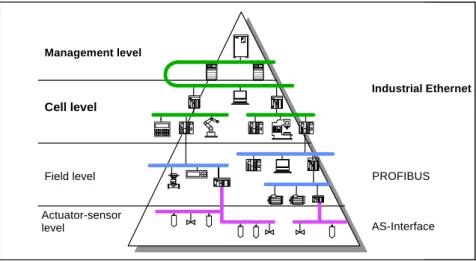
SIMATIC NET provides the following communications networks for different requirements ( Figure 2-1):
• Industrial Ethernet - a cell and management network based on IEEE 802.3.
• PROFIBUS (Process Field Bus) - a cell and field level communic a-tion network based on DIN 19245, Parts 1, 2 and 3.
• AS-i (Actuator Sensor Interface) - a communication network for the actuator and sensor level.
Management level Cell level Field level Industrial Ethernet PROFIBUS AS-Interface Actuator-sensor level
11
2.2 SIMATIC NET for Industrial Ethernet
Area of Application of SIMATIC NET for Industrial Ethernet
The cell and area network Industrial Ethernet is an industrial commun i-cation network designed for use in manufacturing and in industrial plants. It provides a wide range of network components for electrical and optical transmission of data.
Basis The cell and area network Industrial Ethernet is based on the
IEEE 802.3 (Ethernet) standard. It operates using t he CSMA/CD access technique (Carrier Sense Multiple Access with Collision Detection).
Network Components
Industrial Ethernet network segments implement electrical networks using single shielded coaxial bus cables (triaxial cable).
Optical Network Components
The optical network components implement optical networks using fiber optic cables.
The advantage of optical networks is that optical network segments are immune to electrical interference and that large distances can be covered.
12
2.3 Computer Structure of the Soft and Hardware Comp
o-nents
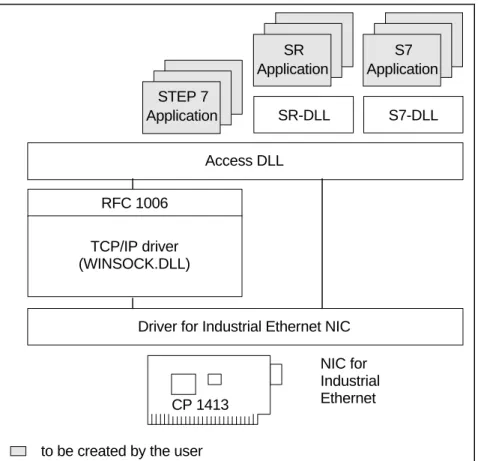
The Software and Hardware
Components under Windows 95, Windows NT
Driver for Industrial Ethernet NIC
NIC for Industrial Ethernet
to be created by the user
SR-DLL S7-DLL Application STEP 7 Application SR Application S7 RFC 1006 TCP/IP driver (WINSOCK.DLL) Access DLL CP 1413
Figure 2-2 Software and Hardware Components under Windows 95, Win-dows NT
13
2.4 SAPI-S7
What Does SAPI-S7 Mean?
The acronym SAPI-S7 stands for the following: • SAPI - Simple Application Programmers Interface
• S7 - the Layer 7 communications protocol of SIMATIC S7 systems
What is SAPI-S7? SAPI-S7 has the following features: • It is a simple C programming interface.
• It provides access to the S7 services on PCs and PGs.
• It is available as a C library and is operated with SIMATIV NET driv-ers and communications processors.
Communications with SIMATIC S7 Programmable Controllers
Communication with SIMATIC-S7 is best handled with the S7 programming interface. The call structure and the sequence of communication with the SIMATIC S7 programmable controllers are described in detail in the "S7 Programming Interface" ma nual.
Advantages of the
SAPI-S7-Programming Interface
The SAPI-S7 programming interface has the following advantages: • SAPI-S7 is a simple but nevertheless flexible and high-performance
interface.
• The SAPI-S7 programming interface is designed for asynchronous operation.
• SAPI-S7 handles sequential services automatically such as active or passive S7 connection establishment.
• SAPI-S7 supports troubleshooting with an integrated trace fun ction. • The SAPI-S7 programming interface is compatible with other SAPI
programming interfaces.
• The SAPI-S7 programming interface can also be used by other pr o-grams for example Visual Basic or Pascal proo-grams.
• The S7 programming interface offers significantly more user-friendly communications functions than the SEND/RECEIVE programming interface; for example "Read/write variables".
Compatibility The SAPI-S7 programming interface of S7-1413 is also available for communication on PROFIBUS.
All programs equipped with the SAPI-S7 interface therefore have un i-form access to SIMATIC S7 syst ems.
14
Programmer Support
To make it easier for programmers to familiarize themselves with the use of SAPI-S7 in the software packages of S7-1413, the following is provided in addition to the documentation already mentioned:
• Sample programs • A call library
Sample Programs Sample programs are provided with S7-1413. They are written in the "C" programming language.
The mode of operation of the interface can be discerned from the program context of the sample programs. Also, sections of the sample programs can be taken over in analogous contexts.
Call Library Of further help is the call library for SAPI-S7 interface function calls, written in "C" and included in the scope of supply.
For "C" programmers, this means:
• the call library can be integrated direct into your own software • the related calls can be used direct, as described in detail in the
sample programs
The sample programs and functions calls provide a second practical description, in addition to the explanation in the manual, of the data structures required.
15
2.5 SEND/RECEIVE Programming Interface
SEND/RECEIVE It is a C programming interface, which provides access to the SEND/RECEIVE services on PCs and PGs.
Compatibility The SEND/RECEIVE programming interface is a layer 4 (Transport layer) interface.
Communications with SIMATIC S5 Programmable Controllers
There is easy problem-free communication with the data handling blocks of the SIMATIC-S5 programmable controllers via the calls of the SEND/RECEIVE programming interface. The call structure and the sequence of communication with the SIMATIC S5 programmable controllers are described in detail in the "SEND/RECEIVE Programming Interface" manual.
Advantages of the SEND/RECEIVE Programming Interface
All programs equipped with the SEND/RECEIVE interface have easy access to SIMATIC-S5 programmable controllers.
Programmer Support
To make it easier for programmers to familiarize themselves with the use of SEND/RECEIVE in the software packages of S7-1413, the following is provided in addition to the documentation already mentioned:
• Sample programs • A call library
Sample Programs Sample programs are provided with S7-1413. They are written in the "C" programming language.
The mode of operation of the interface can be discerned from the program context of the sample programs. Also, sections of the sample programs can be taken over in analogous contexts.
16
Call Library Of further help is the call library for SEND/RECEIVE interface function calls, written in "C" and included in the scope of supply.
For "C" programmers, this means:
• the call library can be integrated direct into your own software • the related calls can be used direct, as described in detail in the
sample programs
The sample programs and functions calls provide a second practical description, in addition to the explanation in the manual, of the data structures required (request block in the case of SEND/RECEIVE).
17
3 Where to Obtain Help
This chapter lists SIMATIC NET contacts: • Contacts for technical questions
18
3.1 Help with Technical Questions
Documentation You will find information about topics related to using this software in the following sources:
• In the relevant printed documentation
• In the help system integrated in the software (F1 key) • In text files on the diskette(s) supplied
Who to Contact If you have technical questions about using the software and your problem is not dealt with in the documentation or in the integrated help system, please contact your Siemens representative or dealer.
The addresses are listed in the following: • in our Catalog IK 10
• in CompuServe (go autforum > library area SIMATIC NET) • on the Internet (http://www.aut.siemens.de)
Common Questions
Our customer support on the Internet provides useful information and answers to common questions. Under FAQ ( Frequently Asked Questions), you will find a variety of information about our entire range of products.
The address of the AUT homepage in the worldwide web of Internet is: http://www.aut.siemens.de/net
Hotline If you have problems, you can also contact our hotline: • Telephone: 0911 - 895 - 7000 (from abroad +49 - 911 - 895 - 7000) • Telefax: 0911 - 895 - 7001 (from abroad +49 - 911 - 895 - 7001) • E-Mail: [email protected] • Mailbox (BBS, analog/ISDN, 8N1): 0911 - 895 - 7100 (vom Ausland +49 - 911 - 895 - 7100)
19
3.2 Contacts for SIMATIC NET Training
Course Enrollment Siemens AG
Trainings-Center für Automatisierungstechnik AUT 959 Kursbüro Östliche Rheinbrückenstraße 50 76181 Karlsruhe • Telephone 0721 - 595 - 2917 from abroad +49 - 721 - 595 - 2917 • Fax 0721 - 595 - 6987 from abroad +49 - 721 - 595 - 6987
20
Glossary
AS-i Actuator-Sensor Interface - a cable for direct connection of simple b i-nary sensors and actuators (transmission of small amounts of inform a-tion - previously: SINEC S1).
COML Configuration Management local - Configuration software for SIMATIC NETC communications processors.
CSMA/CD Carrier Sense Multiple Access/Collision Detection - access technique for bus systems complying with IEEE 802.3 (Ethernet).
CP Communications Processor - module for installation in computers or programmable logic controllers.
DB Database - the local database describes the communication network from the point of view of the local system. The database is accessed by system routines when the connection is established.
DPRAM Dual-Port Random Access Memory - allows simultaneous access by two devices (CP and CPU) to one memory chip (RAM).
Driver Software required for the data transfer between applications and the -> CP.
ESD Guidelines Electrostatically sensitive devices - guidelines for handling electrostat i-cally sensitive devices.
FO Fiber Optic
IEEE Institute of Electrical and Electronics Engineers
Industrial Ethernet Cell network complying with the international standard IEEE 802.3 (Ethernet) designed for use in an industrial environment (previously SINEC H1).
IRQ Interrupt Request
ISA Industrial System Architecture - PC bus standard; ISA Bus - expansion bus for XT and AT computers.
ISO International Standards Organization - international organization based in Geneva responsible for creating general standards particularly in the filed of data transmission.
LAN Local Area Network for direct connection of computers.
MAC Media Access Control - techniques for controlling access by a station to a common transmission medium.
21
MAC Address Address to distinguish different stations on a commonly used transmi s-sion medium.
MMS Manufacturing Message Specification - user interface of MAP.
Multicast Address The multicast address is an address for a particular group of stations.
Network A network consists of one or more interconnected subnets with any number of stations. Several networks can exist side by side. There is a common node table for every subnet.
PC Personal Computer
PG Programming device - a programming device of the SIMATIC product range produced by Siemens AG; used for programming and configur a-tion and for maintenance and service.
PDU Protocol Data Unit - user data plus control information belonging to a layer of the ISO 7-layer model.
PROFIBUS Process Field Bus - a field bus complying with DIN 19245 (previously SINEC L2).
Protocol A set of rules governing data transmission. Using these rules, both the formats of the messages and the data flow during transmission can be specified.
RFC 1006 RFC 1006 is an international standard that describes the mode of operation of ISO layer 4 on TCP.
SAPI S7 C programming interface, which provides access to S7 services on PCs and PGs.
S7 PLC Abbreviation for a programmable logic controller of the SIMATIC pro d-uct range produced by Siemens AG.
Services Services provided by a communication protocol.
SIMATIC NET New name of the SINEC range of products.
SIMATIC NET for Industrial Ethernet
SIMATIC NET bus system for industrial applications based on Ethernet.
SIMATIC NET or PROFIBUS
SIMATIC NET bus system for industrial applications based on PROFIBUS.
System All the electrical equipment within a system. A system includes, among other things, programmable logic controllers, devices for operation and monitoring, bus systems, field devices, actuators, supply lines.
SR Interface SEND/RECEIVE programming interface, also known as the PC -E-S5 programming interface.
22
TCP/IP Transmission Control Protocol/Internet Protocol - standardized protocol of the transport layer or network layer (OSI) for communications between programs of different DP systems.
TF Technological Functions - MMS-compatible user services in SIMATC NET.
TPDU Transport Protocol Data Unit - presentation of a message from the transport system (layer 4) of the sender to the transport system of the receiver (layer 4).
TSAP Transport Service Access Point - identifies an access point for the services of the transport protocol in individual stations.