Nursing Theses and Capstone Projects Hunt School of Nursing
2012
Second-Year Associate Degree Nursing (ADN)
Self-Efficacy in Relation to Simulation Lab
Experiences
Sarah W. TateGardner-Webb University
Follow this and additional works at:http://digitalcommons.gardner-webb.edu/nursing_etd Part of theMedical Education Commons,Nursing Administration Commons, and the Occupational and Environmental Health Nursing Commons
This Thesis is brought to you for free and open access by the Hunt School of Nursing at Digital Commons @ Gardner-Webb University. It has been accepted for inclusion in Nursing Theses and Capstone Projects by an authorized administrator of Digital Commons @ Gardner-Webb University. For more information, please [email protected].
Recommended Citation
Tate, Sarah W., "Second-Year Associate Degree Nursing (ADN) Self-Efficacy in Relation to Simulation Lab Experiences" (2012). Nursing Theses and Capstone Projects.Paper 145.
SECOND-YEAR ASSOCIATE DEGREE NURSING (ADN) SELF-EFFICACY IN RELATION TO SIMULATION LAB EXPERIENCES
By Sarah W. Tate
A thesis submitted to the faculty of Gardner-Webb University School of Nursing In partial fulfillment of the requirements for the
Degree of Master of Science in Nursing
Boiling Springs 2011-2012
Submitted by: Approved by:
_______________________ _______________________
Sarah W. Tate Mary Alice Hodge, PhD, RN
_______________________ _______________________
ii
Abstract
Second-Year Associate Degree Student (ADN) Self-Efficacy in Relation to Simulation Lab Experiences utilized a convenience sample of second-year associate degree nursing students to conduct a survey of their perceptions of an increase in efficacy or self-confidence in relation to their simulation lab experiences. Albert Bandura’s theory of self-efficacy was the theoretical framework for the study. Students who have high levels of self-efficacy have been shown to handle obstacles with less stress, perseverance, and success. In this study, 85% of the students agreed that simulation lab experiences were beneficial in increasing their confidence to perform safely in their preceptorship and as new graduate nurses.
iii
Table of Contents Chapter I
Introduction ...1
Statement of the Problem ...1
Purpose ...3 Background ...3 Significance to Nursing...4 Theoretical Framework ...4 Definition of Terms...7 Research Question ...8 Conclusion ...8 Chapter II Review of the Literature ...9
Introduction ...9
Literature Review...10
Summary ...16
Chapter III Method ...18
Setting & Subjects...18
Sampling ...18
Instruments ...18
Procedures ...19
iv
Data Collection & Data Analysis Procedures ...20
Chapter IV Results ...21
Statistical Presentation ...23
Preparation for precepted experience results ...23
Roles and critical thinking results ...24
New nurse graduate responses ...24
Chapter V Discussion ...27
Interpretation of Findings ...27
Implications for Nursing ...28
Implications for Further Research ...28
Conclusion ...29
References ...30
Appendices Appendix A: Simulation Experience Questionnaire ...34
Appendix B: Introduction to Survey ...40
Appendix C: Simulation Experience Survey Consent ...42
v
List of Figures
vi
List of Tables
Table 1: Second-Year Associate Degree Student (ADN) Self-Efficacy in Relation to Simulation Lab Experiences ...21 Table 2: Descriptive Statistics ...22
Chapter I Introduction Statement of the Problem
Patient safety is one of the highest priorities in nursing care whether in acute care facilities, non-acute facilities or in the community. Educators of nursing students must provide opportunities for students to learn how to provide safe care. Simulation
experiences allow educators to provide a safe environment for students to practice care, learn to handle changes in patient conditions, and manage potential adverse events (Gore, Hunt, & Raines, 2008). Nursing students need to be able to experience situations with patients they may encounter during clinical rotations and after graduation from nursing school as new graduate nurses. Learning how to respond in these situations through clinical simulations can provide a safe environment in which to practice physical skills, develop clinical judgment, and critical thinking skills.
Simulation is about the whole learning experience – not just the mannequin. It incorporates “theory, assessment, pharmacology, pathophysiology, and psychomotor skills – all of which lead to the development of clinical judgment” (Gore et al., 2008, p. 58). Simulation can be described as low-fidelity to high-fidelity with low-fidelity including such things as case studies or role-play, low-technology mannequins for
practicing psychomotor skills such as an intravenous (IV) arm or a static head, and trunk to practice airway management or urinary catheter insertion, and high-fidelity
mannequins that are connected to computers. The military and the field of aviation began using simulation in the 1970’s for training purposes, and health educators have learned from their experiences (Jeffries, 2007).
Simulation technology has evolved into a level of sophistication and realism in which the learner can experience a wide range of scenarios that can help in “making sound decisions in unpredictable health care situations” (Macedonia, Gherman, & Satin, 2003, as cited in Jeffries, 2007). Herm, Scott, and Copley, (2005) found that a simulation experience to assess the synthesis of knowledge of their students during clinical rounds provided important insights for the instructors and the students. Some students who were thought to have a good grasp of the required behaviors and thought processes did not, and vice versa. One student commented, “I learned more from this simulation exercise than any other test or paper I’ve written” (p.29). Another student verbalized an understanding of now I know “what I’m supposed to be doing in clinical” (p.29). The purpose of the study, Second-Year Associate Degree Nursing (ADN) Student Self-Efficacy in Relation to Simulation Lab Experiences, was to examine the second year ADN’s perception of whether simulation experiences during their two-year program of study prepared them for their clinical preceptorship at the end of their course of study, and for becoming safe and confident new nurse graduates.
New graduate nurses in the acute care arena have many new roles to adapt to, perhaps with some expectations in conflict with what they have practiced as a student (Duchscher, 2008). Duchscher describes transition shock experienced by new nurses as they acclimate to acute care employment, including stress, frustration, discouragement, disillusionment, and the high rate of new nurses who change their place of employment or leave nursing in the first year (2008). Newly graduated nurses who have a high sense of self-efficacy may be more successful in this journey of transition. Simulation
opportunities. High self-efficacy can help the new nurse to recover from the frustrations and discouragement of the first years as a practicing nurse (Bandura, 1994).
Purpose
Nursing is a challenging and rewarding field where much preparation is required to become a safe and knowledgeable new graduate nurse. There can be opportunities to build skill and confidence with simulations as the student practices in scenarios before and during patient contact. The purpose of this study was to measure the second year student ADN’s perceived positive or negative influence of simulation experiences on their confidence level in relation to preparing them for a preceptorship and becoming safely practicing new nurse graduates.
Background
Albert Bandura, psychologist, author, and professor, is the founder of Social Cognitive Theory and the Theory of Self-Efficacy. Bandura (2004) described efficacy beliefs of students as having an influence over goals and aspirations, how obstacles are handled, and the level of perseverance to overcome and be successful. “The stronger the perceived self-efficacy, the higher the goals people set for themselves and the firmer their commitment to them . . .” (p. 145). Bandura’s theory supports the reasoning behind the use of simulation – to increase student self-efficacy, to help them believe in themselves and have the confidence to be successful in their clinical encounters and as new nurses.
Simulations can be as simple as a body part used to practice a specific skill, such as an arm to practice inserting an intravenous (IV) catheter, or as complicated as a room full of high fidelity mannequins that speak and respond with programmed body functions (Gore et al., 2008). The experience can enhance learning or merely be one more
assignment in the long list of nursing school requirements. The quality of the experience may depend on the instructors, the design of the simulation, and on the preparation of the students (Smith & Roehrs, 2009).
Significance to Nursing
Self-efficacy is the belief in oneself, the belief that obstacles can be overcome, that through perseverance, goals are met. Strong self-efficacy supports a can-do attitude that provides assurance of being able to control threatening situations, and reduces personal stress (Fritscher, 2009). Bandura’s theory states that the most effective means of influencing self-efficacy is through mastery experiences (1994).
Simulation can offer the opportunity to master skills, or situations with patients that could likely occur in the clinical setting. Self-efficacy can be gained through practice of new skills when the student masters the skills and through social modeling, or
watching others in similar circumstances succeed (Bandura, 1994). Simulation offers both options when the student is in the primary caregiver role or in the observer role. The question is whether the ADN student nurse perceives simulation experiences as adding to their sense of confidence in relation to practicing safely in the clinical preceptorship and as a new nurse graduate.
Theoretical Framework
Albert Bandura’s Theory of Self-Efficacy was chosen for Second-Year Associate Degree Nursing (ADN) Student Self-Efficacy in Relation to Simulation Lab Experiences because this theory defines how people or students regulate their behavior based on their self-efficacy or “their beliefs in their own capabilities” (Pajares, 2004, para. 28). Within this framework, efficacy is shown to influence decisions, affect performance, thinking,
motivation and success (1994). The use of simulation exercises to promote high levels of self-efficacy include not only the reinforcement of mastering the skill or situation through practice, but also vicariously through watching others successfully master the skill or situation, and by allowing the student to make mistakes without judgment and to practice until mastery is achieved (Bandura, 1994). In educational research, it has been shown that students with positive self-efficacy “work harder, persist longer, persevere in the face of adversity, have greater optimism and lower anxiety, and achieve more” (Pajares, 2004, para. 29).
There are four major psychological processes involved in self-efficacy. Cognitive processes involve thought processes. Those with high self-efficacy develop skills to process information that includes many ambiguities and uncertainties, setting challenging goals and using analytic thinking (Bandura, 1994). Motivational processes involve forming beliefs about what can be accomplished and planning courses of action based on these beliefs. Those with high self-efficacy state that their failures are due to lack of effort, while those with low self-efficacy state that their failures are due to low ability (Bandura, 1994). Affective processes involve stress reactions, depression, fear, and anxiety. Mastery experiences that are integral to simulation practice help to conquer these feelings and develop higher self-efficacy. Selection processes involve beliefs in personal efficacy shaping the course taken in life. People undertake activities and situations they feel capable of handling (Bandura, 1994).
In this study, Second-Year ADN Student Self-Efficacy In Relation to Simulation Lab Experiences, students were evaluated for their perceptions of self-efficacy. Bandura discussed the importance of self-belief in determining successful outcomes for the future.
Students may not feel confident in their abilities as new nurses due to the reality of high patient acuities, shorter patient stays and critical staffing shortages, and causes high stress atmospheres for learning (Jeffries, 2007). Simulation practice in clinical lab affords students the opportunity to practice in safety, both for them and for the patient. Skills learned in simulation lab practice can be perfected with repetition. Affective processes of stress and anxiety can be reduced with practice and repetition. The student can gain in self-efficacy with practice that allows mastery of the skill or situation. Simulation can help to develop cognitive processes by having students think their way through situations. Experiencing many different kinds of experiences will expand the thought processes needed to work through situations. Having productive experiences in simulation lab can improve motivation to continue and reach further through active learning (Jeffries, 2007).
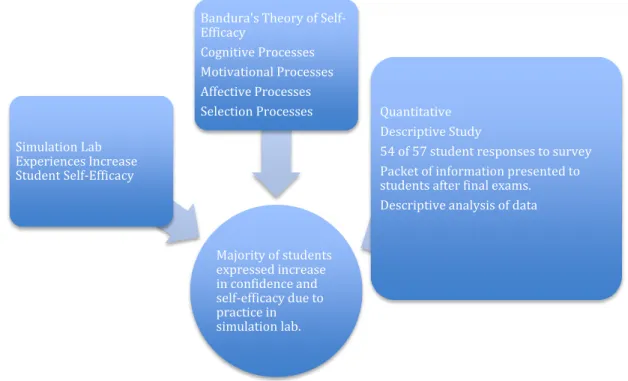
The concept-theory-empirical research method diagram reveals the relationships
between Bandura’s theory of self-efficacy and this study of simulation experiences and increased self-efficacy.
Figure 1. Concept-Theory-Empirical Research Method Model (CTE) Definition of Terms
Self-efficacy is the confidence in oneself to be able to persevere in unfamiliar and possibly threatening situations, and to see challenges as opportunities (Bandura, 1994).
The Associate Degree Nurse (ADN) program is a demanding two-year course of
study culminating in graduation and the expectation to successfully complete the nursing board exam and become employable as a Registered Nurse (Gardner-Webb University Academic Programs, 2012).
Simulation is using an artificial object or fabricated situation to practice actual skills and scenarios (Gore et al., 2008).
Majority of students expressed increase in confidence and self-efficacy due to practice in simulation lab. Simulation Lab Experiences Increase Student Self-Efficacy
Bandura's Theory of Self-Efficacy
Cognitive Processes Motivational Processes Affective Processes
Selection Processes Quantitative Descriptive Study
54 of 57 student responses to survey Packet of information presented to students after final exams. Descriptive analysis of data
Research Question
The purpose of this study, Second-Year Associate Degree Nursing (ADN)
Student Self-Efficacy in Relation to Simulation Lab Experiences, is based on the question of whether second- year ADN students perceived that simulation experiences in clinical laboratory practice increased their self-efficacy for safely practicing in a preceptorship and as new nurse graduates.
Conclusion
Simulation exercises can provide a means for nursing students to master a skill needed in the clinical arena without jeopardizing the safety of patients. Bandura’s theory of self-efficacy supports the use of simulation exercises to promote self-confidence in nursing students in dealing with new experiences, new skills and new situations in a productive manner that will lead to successes. The question to be answered was whether this group of graduating student nurses’ perceived simulation exercises as beneficial to increasing self-efficacy for completing a preceptorship and for entering the workforce and practicing safely as a new nurse graduate.
Chapter II
Review of the Literature Introduction
The literature reveals several studies that have examined the use of high fidelity simulation (HFS) and the relation to student satisfaction and self-confidence (Bambini, Washburn, & Perkins, 2009; Bearnson & Wiker, 2005; Feingold, Calaluce, & Kallen, 2004; Goldenberg, Andrusyszyn, & Iwasiw, 2005; Henneman & Cunningham, 2005; Smith & Roehrs, 2009), student anxiety reduction with simulation (Bremner, Aduddell, & Amason, 2008), and improving therapeutic communication skills (Kameg, Howard, Clochesy, Mitchell, & Suresky, 2010). These studies were conducted in relation to specific areas, such as critical care, medical-surgical, obstetrics, mental health, and postoperative patients. They were all conducted with baccalaureate (BSN) level students early in their nursing course of study, with the exception of Kameg et al. (2010) who did not identify participants other than as nursing students.
High-fidelity simulation includes mannequins that are the most realistic and life-like, are interactive with pulses, breath sounds, bowel sounds, voices, and other attributes, and scenarios where the equipment and room most resemble an actual clinical situation. The simulation experience in these instances minimizes the need to pretend that
equipment is available or that the patient has a certain response; however, a complete high-fidelity simulation lab with several high-technology mannequins and fully stocked hospital rooms and equipment can cost in the millions of dollars (Jeffries, 2007).
The focus was different in Second Year Associate Degree Nursing (ADN) Student Self-Efficacy in Relation to Simulation Lab Experiences, where the second-year
associate degree nursing student (ADN) was giving their perception of the overall simulation experience from the previous two years and how it related to self-confidence in participating in a preceptorship experience, and preparing for the role of new nurse graduate. These students compared their simulation experiences as a whole instead of evaluating only their most recent simulation experience. The type of mannequin or simulation was not figured into the survey and could have been a limiting factor in the outcome of the survey.
Literature Review
Smith and Roehrs (2009) found a relationship between the design characteristics of the simulation and the level of satisfaction of the student. These design characteristics included objectives, support, problem solving, guided reflection and fidelity. Among these characteristics, problem solving (0.558) and objectives (0.573) were most important in contributing to self-confidence at a significance level of 0.01. The other characteristics were significant at a lower rate: support (0.508), guided reflection (0.447) and fidelity (0.430). This research suggests that the design of the simulation is a very important aspect of the satisfaction and the self-confidence gained by the student. The limitations of this study were, a small sample size (68), and it was limited to a group of junior BSN students in their first medical-surgical course.
Bambini et al. (2009) suggested that simulations improve responses to complex situations and promote student confidence to deal with ever-changing patient scenarios. Bandura’s framework of self-efficacy is utilized to explain student gains in self-efficacy when utilizing simulated experiences in lab settings. Self-confidence in performing a post-partum exam was measured in this group of students who were preparing for their
first clinical experience. The simulation included the skills of performing vital signs, breast exam, assessing the fundus, assessing lochia, and patient teaching. All were found to have a significant positive increase for the students in relation to preparation for the clinical experience. These students expressed an increase of confidence in being able to communicate with the patient, with the physical skills needed for the assessment of the patient, and in the ability to recognize priorities of care. A limitation of this study was the variability of student experiences due to individual interactions during the simulations that may have caused different learning outcomes. Also, with no control over who chose to participate in the study, validity could be compromised due to selection threat.
Bremner et al. (2008) found that students expressed a reduction in anxiety for their first clinical experience when they practiced scenarios with a simulator. The
simulation experience presented a non-threatening atmosphere for practice for these first-year BSN students. Findings included a need for well-articulated learner outcomes that clearly related to the course offerings and the clinical objectives.
Kameg et al. (2010) studied student self-efficacy in relation to improving therapeutic communication skills before students were to participate in a mental health clinical rotation. The researchers used Bandura’s self-efficacy theory as the theoretical structure, finding that students often have difficulty and anxiety related to communicating with mentally ill patients and simulation could bridge the gap in preparation for these encounters. The survey data of this study showed that the students were generally in favor of the simulation experience; that it was a valuable learning experience, it should be included in the curriculum and that the knowledge could be transferred to the clinical setting. These students did not believe it should be a replacement for experiences in the
clinical setting. Limitations of this study included the inability of the simulator manikin to show facial expressions, which are an integral component of personal communication, and small sample size of 38.
Radhakrishnan, Roche, and Cunningham (2007) designed a study to measure clinical skills using a simulation evaluation tool. This study was quasi-experimental with a control group. The results found a correlation between clinical sessions with
simulations and improved performance in properly identifying patients and assessing vital signs (p=.001 and p=.009 respectively).
Gore et al. (2008) completed a study using mock hospital rooms and simulation experiences over a four-hour session. The students were given the chart information for each patient that included history, laboratory reports, EKG results, radiology reports, physician orders, medication records, progress notes, nurse’s notes, and interdisciplinary notes. Each student cared for one patient except, for a post trauma patient that had two students assigned. One notable incident occurred when a student left her room to help another student but left the patient bed in a high position with bed rails lowered. The instructors disconnected the patient from all tubing and placed the patient on the floor. The student returned and moved the patient back to the bed and reconnected the IV, urinary catheter, and oxygen, then reported to the instructor charge nurse. These students learned how to complete an incident report and passed their information along to other classes about the importance of patient safety. The instructors had no other issues with patients falling from bed. These students learned through what Bandura would call modeling. They did not have to experience it themselves to learn the significance.
Students have differing learning styles, and Fountain and Alfred (2009) studied which learning styles were most conducive to simulation experiences. This was a post-test study using a convenience sample of 76 baccalaureate-nursing students and showed that two learning styles were most associated with satisfaction using simulation – the social learning and solitary learning styles. Social learning styles comprise interacting with others, comparing and listening and were supported by 76% of the students. The study supported simulation to be an effective learning tool for students with differing learning styles. Limitations of this study include small sample size limited to one school of nursing and potential group perception bias.
Lee, Lee, Wong, Tsang, and Li (2010), established an integrated skills training center in Hong Kong. Within this training center were high-fidelity simulators, low-fidelity simulators, virtual reality simulators and static simulators. The researchers found the static and low-fidelity simulators useful to hone psychomotor skills, the high-fidelity simulators more useful in integrating critical thinking skills and consolidation of
information, and the virtual reality simulators useful in the mental health arena due to the student being able to see what the patient sees to get an understanding of care needed. The researchers expressed the importance of faculty buy-in and adequate training on an ongoing basis. These researchers recognized the importance of evaluating the impact on student learning and outcomes and formed a group for those means.
Paskins and Peile (2010) studied final year medical students’ views on
simulation-based teaching. Findings included the importance of feedback, integration into the curriculum, repetitive practice, confidence, and increased self-efficacy, anxiety, realism, and teamwork. Over half of the 28 medical school students from the United
Kingdom who participated in this study, discussed the technical limitations of the
medium-fidelity simulators. Teamwork was found to be beneficial for those who usually did not choose the team leader role to be in a position of delegating tasks, and for those natural leaders to be in the supportive positions helped them to gain a sense of those roles’ needs. The researchers found that some students felt the simulation exercises were more stressful than a real-life emergency, and that feedback could profoundly affect positive or negative confidence levels. Some students were found not to like the role-play aspect of simulations, where others felt it helped them to grow in their learning styles. The researchers felt an independent researcher for analysis could possibly improve reliability and further expressed limitations due to single institution and single clinical group results. The researchers felt, “further work is needed to expand on the effect of simulation-based teaching on confidence, anxiety and self-efficacy particularly” (p. 576).
Anthony, Carter, Freundl, Nelson, and Wadlington (2012) discussed the need for nursing students to become proficient in the care of veterans, who often have special needs that relate to experiences during tours of duty. Nurses will encounter veterans in locations other than at veteran’s hospitals, and there is a need for some specialized knowledge relating to effects of environmental conditions or chemicals the veterans may have been exposed to, and to their mental states. Many veterans may experience post- traumatic stress disorder (PTSD), depression, ill effects from traumatic brain injuries, substance abuse issues, diabetes, Chronic Obstructive Pulmonary Disease (COPD), congestive heart failure, Parkinson’s disease, ischemic heart disease, prostate cancer, and other conditions. While most of these conditions also occur in the general population,
there may be unique combinations in veterans. There is a movement in the American Nurses Association since 2008 to increase awareness of veterans’ needs among nurses.
Anthony et al. (2012) devised a simulation scenario to be used to disseminate information to improve the quality of care for veterans. The researchers’ scenario was developed to help nursing students increase awareness of veteran’s needs, improve prioritization in planning and implementing veteran centered care, apply principles of patient safety, identify symptoms of PTSD, interpret lab values and diagnostic tests, and communicate effectively with the interdisciplinary team. A difference with this
simulation study mentioned roles of a family member and the voice of the patient, in addition to the nurse and the nurse reporting to the student. The study gave the whole scenario including the information given to the student, roles, what the patient says, what the family says, and the expectations of the student. Debriefing was in a non-threatening atmosphere using open-ended questions from the faculty, then challenging the students to identify opportunities for improvement, and finally re-examined for the scenario’s
relation to the nursing process. The scenario developed by the researchers can help to provide culturally aware care for nursing students and practicing nurses.
Reinhardt, Mullins, De Blieck, and Schultz (2012) studied whether high-fidelity simulation increased the ability of students to insert an intravenous catheter (IV) over a task trainer IV arm. Ninety-four junior baccalaureate nursing students were included in this experimental, randomized, controlled study. Findings included no significant difference between simulation models (p= .7), and no significant difference in student confidence score between simulation models. As well, the ability to insert an IV into a live patient did not correlate with either instruction method.
Wilt and King (2012) developed a curriculum of simulation labs for an accelerated BSN program, discussing the obstacles overcome and the inspirations for future improvements. Two of the challenges overcome included timing and scheduling for this accelerated program and the amount of time to orient these students to the simulation experience. These were overcome by adding another mannequin, scheduling the students on the other half of the day they had clinicals, and providing video
orientation on Blackboard to decrease the time it took to orient the students to the simulation lab and process. A goal of this study was to fully involve clinical faculty in the simulation activities, including developing scenarios and offering feedback to students. Summary
There are a number of studies that address using simulation as an adjunct to preparation for clinical experiences. Overall these studies have shown popularity among nursing students for this method of teaching and learning, and have been shown to be perceived as increasing self-efficacy in early clinical experiences, individual clinical experiences for specific specialties such as medical-surgical, mental health, veterans, post-operative and obstetrics patients, and communication with patients. Second-Year Associate Degree Nursing Student Self-Efficacy in Relation to Simulation Lab
Experiences studied the perceptions of ADN graduating nursing students in relation to their self-efficacy from simulation experiences in preparation for preceptorship and as new nurse graduates.
This study differed from the previous studies in the placement of the evaluation in relation to the location in the course of study, and in the focus of the study. The group of students in Second-Year ADN Self-Efficacy in Relation to Simulation Lab Experiences
had completed their two-year course of study. Their evaluation of simulation was a cumulative view of overall experiences with simulation. The focus was based on whether the students experienced an increase in self-efficacy due to their simulation experiences.
Chapter III Method Setting and Subjects
Second-Year Associate Degree Nursing (ADN) Student Self-Efficacy in Relation to Simulation Lab Experiences involved responses from a subset of nursing students in a private university in the Piedmont region of North Carolina. This university offers pre-licensure, post-licensure and graduate degrees in nursing. The subjects for this study were enrolled in the pre-licensure, specifically the associate degree program. The ADN
program was selected due to this class readying for graduation, having finished their course of study. This class had experienced two years of simulation lab assignments and was evaluated for their perceptions of increased confidence due to the practice in those labs.
Sampling
The convenience sample of second-year ADN students, who were readying to graduate and prepare for their nursing board exam and their first position as new nurse graduates, were of various ages and both genders. Demographic information was not collected during the study. The survey questionnaire was offered to the entire class after completion of their final examinations at the end of the semester. The class consisted of 57 potential research subjects of which 54 participated (95% return rate).
Instruments
A survey tool was designed by the researcher and evaluated by content experts for relevance and content validity. After revision based on feedback, the survey consisted of twelve questions with a Likert-type scale (Trochim, 2006), including categories from 1-5,
strongly disagree, disagree, undecided, agree and strongly agree, respectively, and a section at the end of the survey for additional comments. The tool was designed to measure students’ perceptions of whether simulation experiences during lab sessions prepared them for their preceptorship, for becoming a new graduate nurse, for
administering medications safely, giving a nursing report, learning patient assessments, communicating with physicians, and enhancing learning (see Appendix A). The survey data were scored according to the answer chosen from 1 – 5, with equal intervals between the numbers representing the scores, with 5 as the highest positive score and 1 as the lowest positive score. The open-ended comments were evaluated for common themes. Procedures
The study was presented to the students as a packet of information after they completed final exams, but while still in the classroom (see Appendices A, B, C). The instructors who were present to proctor the student exams offered the information to each student. The researcher was not present during the survey. The packet included an
introduction to the study and to the researcher with contact information, a consent form with an area for a request of the results of the study that could be detached for anonymity, a debriefing statement with instructions on how to complete the survey, and the twelve-question survey. Envelopes were provided to each student and students were asked to seal the envelopes before turning them in.
Prior to beginning the study, students were presented with the informed consent document as part of the survey packet (see Appendix C). The informed consent form detailed the purpose of the study and the rights for participating in the study. Each student had the opportunity to read and have explained the information on the consent form. At
any time during the survey, the subject could have declined to participate in the study. The consent discussed the anonymity of each participant. No identifying information was included on the survey and if the participant requested results, they could detach the sheet with their contact information and turn it in separately.
At the completion of the survey, the instructor collected the sealed envelopes in a folder provided by the researcher. The completed surveys were held in a locked office for researcher retrieval.
Ethical Considerations
Prior to survey administration, approval was received from the Institutional Review Board (IRB) of Gardner-Webb University and consent was obtained from each study participant. It was determined by the researcher that there was no risk involved for the participants due to complete anonymity. The researcher had no involvement with the study participants.
Data Collection and Data Analysis Procedures
Surveys were numbered for reference and data was entered in spreadsheet format in Microsoft Excel and in Statistical Package For Social Sciences (SPSS, vs.20) software for analysis. The responses for each question were aggregated according to Likert
categories of, 0=No Answer, 1=Strongly Disagree, 2=Disagree, 3=Undecided, 4=Agree, 5=Strongly Agree. Survey data were analyzed to obtain item descriptive statistics including mean, standard deviation, frequency and percentage of student responses per response category and question. The additional comments at the end of each survey were analyzed for frequency of common themes (See Appendix D).
Chapter IV Results
Statistical Presentation
Table 1 shows the breakdown of answers to the survey by question and by
response category. Each question has six possible answer categories when “no answer” is added for calculation purposes. There was one question by one respondent with no answer. There was only one response of strongly disagree to one question. Table 2 shows the Mean, which is the hypothetical estimate of the “typical” score or the center of a distribution of scores, the Standard Deviation, which is an estimate of the average variability or spread of a set of data, and the Skewness, or measure of the symmetry of a frequency distribution. Symmetrical distributions have a skew of 0. Negative skew shows that frequent scores are clustered at the higher end of the distribution of scores (Field, 2009).
Preparation for precepted experience results. Ninety percent of respondents answered with either agree or strongly agree, that their simulation experiences in this nursing school prepared them for their precepted experience in a clinical location. Questions 3, observing the preceptor make a physician call and feeling confident in performing this skill due to simulation practice and Question 4, feeling confident giving report during clinical due to practicing the Situation, Background, Assessment,
Recommendations (SBAR) method during simulation, were answered with seventy-six and ninety-four percent respectively, agreeing or strongly agreeing with the question. Task oriented questions 5, concerning administering medications, 6, involving performing nursing skills, and 7, performing patient assessments, showed agree and strongly agree percentages of eighty-four percent, eighty-eight percent and ninety-eight percent respectively.
Roles and critical thinking results. A majority of respondents (82%) felt that the roles used during simulation exercises such as Primary Nurse, Secondary Nurse and Recorder were beneficial. Seventy-eight percent answered with agree or strongly agree that simulation was beneficial in learning how to assess a worsening situation in a live patient. Eighty-seven percent responded with agree or strongly agree that simulation experiences prepared them to analyze an unfamiliar situation and use sound nursing judgment to work through it.
New nurse graduate responses. Eighty-three percent of respondents answered agree or strongly agree that simulation prepared them to confidently perform safely as a new nurse graduate. Eighty-four percent responded with agree or strongly agree that without the simulation lab experiences, they would not have the same level of confidence about nursing skills as a new nurse graduate.
The findings of Second-Year Associate Degree Student (ADN) Self-Efficacy in Relation to Simulation Lab Experiences overwhelmingly supported positive perceptions and experiences of simulation lab with a combined 85% of student respondents
answering that they agreed or strongly agreed with the positive statements in the survey. Questions 3-7 were task oriented and showed the highest percentage of positive answers (88%), and the highest combined average mean (4.27). This indicated a strong perception by the students that simulation is beneficial for task-oriented practice, as found in the literature (Jeffries, 2007). Among those tasks, Question 3 had the lowest agreement (76%), concerning observing a preceptor making a call to the physician and feeling comfortable with it due to simulation practice. This skill practice may warrant further evaluation since communication with physicians can be intimidating as a new nurse.
In another form of communication within the task questions, simulation practice for the SBAR tool appeared to be beneficial for the students. With a mean of 4.44 and percentage of positive answers being 94%, this indicated the distribution of scores was on the higher end of the scale with increased agreement to the question. The majority of students felt that practicing using the SBAR in simulation lab prepared them to give report during their preceptorship. The highest scoring task-oriented question was number seven. This question involved using simulation to learn to perform patient assessments. Ninety-eight percent of respondents answered positively, (mean=4.61), indicating near group consensus that simulation was beneficial in learning patient assessments.
The general question 9 indicated that several students were unsure or disagreed that simulation experiences enhanced learning in areas they did not get to experience in their preceptorship. Twenty percent (mean=3.94) disagreed or were unsure of whether they agreed with the statement. Further development of scenarios where students can experience rare or unusual situations that might not occur during clinical could be added to the simulation lab. Eighty-two percent felt that roles of the participants in simulation scenarios (Primary Nurse, Secondary Nurse, Recorder) were helpful in the learning experience. Of the two critical thinking questions, number 2 and 11, one indicated a high agreement level with 87% agreeing that their experiences in the simulation lab had
prepared them to analyze an unfamiliar situation and use sound nursing judgment to work through it. In the other question 78% agreed that their simulation experience was
beneficial in learning how to assess a worsening situation in a live patient during the preceptorship. Scenarios for simulation can be developed to lead students through
changing situations with patients; however, every possible worsening health situation cannot be prepared for.
The two new graduate nurse questions, 10 and 12 were answered with 83% and 84% positive agreement respectively. A majority of these student nurses agreed that their experiences in simulation lab prepared them to confidently perform safely as a new graduate nurse and that without the simulation lab, they would not have the same level of confidence about their nursing skills. This, along with the 90% agreement of simulation lab experiences preparing the student for their precepted experience indicates that a majority of this ADN class experienced an increase in self-efficacy due to experiences in the simulation lab.
The students were able to write comments at the end of the survey and 13 respondents commented on improvements for simulation, what they did not like about simulation, and what they approved of. These comments are found in their entirety in Appendix C. Common constructive criticism themes in the comments included feeling stressed and judged during simulation with no opportunity to discuss what is going on or ask questions, simulation not being realistic enough, lack of equipment and need to pretend, the need to discuss pre-lab assignments for full understanding, not knowing by a grade exactly what part of the simulation was not acceptable, not enough time for repeat simulations, only using for check off of a skill. Common positive comments included the experience that simulation lab allowed students to explore situations unlikely to happen in preceptorship, and assessment skills improved greatly.
Chapter V Discussion Interpretation of Findings
This group of students overall felt that simulation was a beneficial tool to learn skills that are needed in the clinical arena. One area of dissimilar agreement was between questions 2 and 11, which were very similar in content but received unequal amounts of agreement. Eighty-seven percent agreed that simulation prepared them to analyze an unfamiliar situation and use sound nursing judgment to work through it, where as 78% agreed that their simulation experience was beneficial in learning how to assess a worsening situation in a live patient. An unfamiliar situation and a worsening situation would have similarities, although student nurses with limited experiences may not have compared them as such.
According to Bandura’s theory of self-efficacy, mastery experiences are the most important tool to increase confidence, along with watching someone else with whom the student identifies (Bandura, 1994). Simulation offers both types of experiences depending on whether the student performs as the Primary Nurse, Secondary Nurse or Recorder in the simulation exercise. As the Primary Nurse, the student has the opportunity to actually perform the skill, which leads to the mastery of the skill if enough practice is allowed. Mistakes can be learned from without harming a live patient. Others in the assigned group can learn both from skills performed well and mistakes made during observation. Due to these experiences, students can be better prepared and therefore more confident in their actions and decisions as they grow in knowledge.
Implications for Nursing
Even though the majority of participants in this class of second-year ADN students felt that simulation experiences increased their confidence, there were some valid points in the comments that should be used for further development of this simulation lab and the experiences provided. Nursing education can benefit from this technology, to provide students with the practice needed to build a sense of self-efficacy. Confident nurses are more prepared to weather the constant changes in the healthcare field, experience less stress, less transitional shock in moving from a student situation to a work situation (Duchscher, 2008). Simulation has an important role in the education of nurses and in raising the skill level and confidence level of students in preparation for the role of nurses in the workforce.
Implications for Further Research
Second-Year Associate Degree Student (ADN) Self-Efficacy in Relation to
Simulation Lab Experiences supported the question of students gaining self-confidence or self-efficacy from their simulation experiences. There were limitations involving the sample size (54), although 54 out of 57 students was a high percentage for a return rate of a survey (95%). These students completed the survey immediately after completing final exams, before leaving the room. The fatigue factor did not appear to have a negative impact in the results. A larger sample size including multiple year students might create more opportunity to gather insights concerning simulation scenarios or methods that could best work to increase self-efficacy. This study was limited to one site and one group of participants at one point in time. The fidelity level of the simulations, including the realism involved was not measured. There were no demographics of the students
recorded for comparison between male and female, age groups, level of prior involvement with technology or learning styles. Further study should include a comparison between the use of low fidelity and high fidelity in relation to students’ perceptions of what is learned. A focus on standardization of the best means to conduct simulations for the most productive outcomes for students would benefit all nursing programs.
Conclusion
This study of second-year ADN students’ perceptions of simulation experiences was similar to what was found in other studies. Realism of the simulation is important for some students to be able to transfer that knowledge to a live situation. Several students commented on pretending, expressing a desire for complete and plentiful equipment instead of acting as if the equipment is present. Simulation is useful for increasing confidence in skill performance and can be made an even better experience with more opportunities to practice in a non-judgmental atmosphere.
References
Anthony, M., Carter, J., Freundl, M., Nelson, V., & Wadlington, L. (2012). Using simulation to teach veteran-centered care. Clinical Simulation in Nursing. 8(4), e145-e150. doi:10.1016/j.ecns.2010.10.004
Bambini, D., Washburn, J., & Perkins, R. (2009). Outcomes of clinical simulation for novice nursing students: communication, confidence, clinical judgment. Nursing Education Perspectives, 30(2), 79-82.
Bandura, A. (2004). Health promotion by social cognitive means. Health Education & Behavior, 31(2), 143- 164.
Bandura, A. (1994). Self-efficacy. In V. S. Ramachaudran (Ed.), Encyclopedia of Human Behavior (Vol. 4, pp. 71-81). New York: Academic Press. (Reprinted in H. Friedman [Ed.], Encyclopedia of Mental Health. San Diego: Academic Press, 1998). http://www.des.emory.edu/mfp/BanEncy.html
Bearnson, C.S., & Wiker, K.M. (2005). Human patient simulators: A new face in baccalaureate nursing at Brigham Young University. Journal of Nursing Education, 44(9), 421-425.
Bremner, M., Aduddell, K., & Amason, J. (2008). Evidence-based practices related to the human patient simulator and first-year baccalaureate nursing students’ anxiety.
Online Journal of Nursing Informatics, 12,1.
http://ehis.ebscohost.com.ezproxy.gardner-webb.edu
Duchscher J. B. (2008) Transition shock: the initial stage of role adaptation for newly graduated Registered Nurses. Journal of Advanced Nursing.
Feingold, C.E., Calaluce, M., & Kallen, M.A. (2004). Computerized patient model and simulated clinical experiences: Evaluation with baccalaureate nursing students.
Journal of Nursing Education, 43(4), 156-163.
Field, A. (2009). Discovering statistics using SPSS. (3rd ed.). London, England: Sage. Fountain, R.A., & Alred D. (2009). Student satisfaction with high-fidelity simulation: Does
it correlate with learning styles? Nursing Education Perspectives. 30(2), 96-98. doi: 10.1043/1536-5026-030.002.0096
Fritscher, L. (March 2009). Social cognitive theory. Understanding the effects of social cognitive theory on phobias. About.com.
http://phobias.about.com/od/causesanddevelopment/qt/socialcogtheory.htm Gardner-Webb University. (2012). In online academic catalog.
http://gardner-webb.edu/academics/academic-programs/undergraduate-programs/schools/school-of-nursing/programs/adn/index.html
Goldenbery, D., Andrusyszyn, M.A., & Iwasiw, C. (2005). The effect of classroom simulation on nursing students’ self-efficacy related to health teaching. Journal of Nursing Education, 44(7), 310-314.
Gore, T., Hunt, C., & Raines, K. (2008). Mock hospital unit simulation: A teaching strategy to promote safe patient care. Clinical Simulation in Nursing. 4(3). doi:10.1016/j.ecns.2008.08.006
Henneman, E.A., & Cunningham, H. (2005). Using clinical simulation to teach patient safety in an acute/critical care nurse course. Nurse Educator, 30(4), 172-177. Herm, S., Scott, K., & Copley, D. (2005). “Sim”sational revelations. Clinical Simulation
Jeffries, P.R. (Ed.). (2007). Simulation in nursing education. New York, NY: National League for Nursing.
Kameg, K., Howard, V. M., Clochesy, J., Mitchell, A. M., & Suresky, J. M. (2010). The impact of high fidelity human simulation on self-efficacy of communication skills. Issues In Mental Health Nursing, 31(5), 315-323.
doi:10.3109/01612840903420331
Lee, L.Y.K., Lee, J.K.L., Wong, K.F., Tsang, A.Y.K. & Li, M.K. (2010). The
establishment of an integrated skills training centre for undergraduate nursing education. International Nursing Review. 57, 359-364.
Pajares, F. (2004). Albert Bandura: Biographical sketch.
http://des.emory.edu/mfp/bandurabio.html
Paskins, Z., & Peile, E. (2010). Final year medical students’ views on simulation-based teaching: A comparison with the Best Evidence Medical Education Systematic Review. Informa Healthcare. 32, 569-577.
Radhakrishnan, K., Roche, J.P., & Cunningham, H. (2007). Measuring clinical practice parameters with human simulation: A pilot study. International Journal of Nursing Education Scholarship, 4(1), 1-11.
Reinhardt, A.C., Mullins, I.L., De Blieck, C., & Schultz, P. (2012). IV insertion
simulation: Confidence, skill, and performance. Clinical Simulation in Nursing.
8(5), e157-e167. doi: 10.1016/j.ecns.2010.09.001
Smith, S. J., & Roehrs, C. J. (2009). High-fidelity simulation: Factors correlated with nursing student satisfaction and self-confidence. Nursing Education Perspectives, 30(2), 74-78.
Trochin, W. M. K. (2006). Research Methods Knowledge Bassed.
www.socialresearchmethods.net/kb/scallik.php.
Wilt, K.E., & King, M. (2012). Time well spent: Integrating simulation into an accelerated 1-year BSN program. Clinical Simulation in Nursing. 8(3), e103-e107. doi: 10.1016/j.ecns.2010.10.002
Appendix A
Simulation Experience Questionnaire
By completing this questionnaire, you are agreeing to participate in this research study.
The final report will not include any personally identifiable information such as your name. You are encouraged to ask any questions you may have. You are not obligated in any way to take this survey, and your grade will not be compromised if you decline. Please turn in the survey to your instructor before leaving, sealed in the provided envelope. Thank you very much for taking the time to complete this survey.
Please answer the following questions based on your perceptions and experiences with the use of simulation labs in your nursing curriculum.
Use the following scale to rate your answers. Please circle your response. 1 = strongly
disagree
2 = disagree 3 =undecided 4 = agree 5 = strongly
Simulation Experience Questionnaire Please circle your response.
1. My simulation experiences at GWU prepared me for my precepted
experience. 1 = strongly disagree
2 = disagree 3 = undecided 4 = agree 5 = strongly
agree
2. My simulation experiences at GWU were beneficial in learning how to assess a worsening situation in a live patient during my preceptorship.
1 = strongly disagree
2 = disagree 3 = undecided 4 = agree 5 = strongly
agree
3. When I observed my preceptor making a physician call during my preceptorship, I was confident that I would know the procedure due to prior practice in the simulation lab.
1 = strongly disagree
2 = disagree 3 = undecided 4 = agree 5 = strongly
agree
4. I feel using SBAR during simulation prepared me to give report during my preceptorship.
1 = strongly disagree
2 = disagree 3 = undecided 4 = agree 5 = strongly
5. I feel administering medications during simulations prepared me to safely administer medications during my preceptorship.
1 = strongly disagree
2 = disagree 3 = undecided 4 = agree 5 = strongly
agree
6. I feel practicing nursing skills during simulations increased my confidence to perform nursing skills during my preceptorship.
1 = strongly disagree
2 = disagree 3 = undecided 4 = agree 5 = strongly
agree
7. The simulation experience at GWU was a beneficial tool to learn to perform patient assessments.
1 = strongly disagree
2 = disagree 3 = undecided 4 = agree 5 = strongly
agree
8. The roles of participants during the simulation exercises were helpful in in the learning experience. (i.e. Primary nurse, Secondary nurse, Recorder)
1 = strongly disagree
2 = disagree 3 = undecided 4 = agree 5 = strongly
9. The experiences I had in the simulation lab enhanced my learning in areas that I did not get to experience in my preceptorship.
1 = strongly disagree
2 = disagree 3 = undecided 4 = agree 5 = strongly
agree
10. I feel that my experiences in the simulation lab have prepared me to confidently perform safely as a new graduate nurse.
1 = strongly disagree
2 = disagree 3 = undecided 4 = agree 5 = strongly
agree
11. I feel that my experiences in the simulation lab have prepared me to analyze an unfamiliar situation and use sound nursing judgment to work through it.
1 = strongly disagree
2 = disagree 3 = undecided 4 = agree 5 = strongly
agree
12. I feel that without the simulation lab experiences, I would not have the same level of confidence about my nursing skills as a new graduate nurse.
1 = strongly disagree
2 = disagree 3 = undecided 4 = agree 5 = strongly
Thank you for completing this survey about your simulation lab experiences. Please add any comments you feel appropriate concerning your simulation experiences
________________________________________________________________________ ________________________________________________________________________ ________________________________________________________________________ ________________________________________________________________________
Appendix B Introduction to Survey
Simulation Experience
My name is Sarah Tate. I am working to complete my MSN at Gardner-Webb University with a concentration in education. This survey is a vital part of my Thesis. My contact email is [email protected], if you have any questions. I would greatly appreciate your participation in this brief survey. It involves 12 questions about your experiences with the simulation lab while attending GWU School of Nursing, and an area for further comment if you so choose to add comments.
This survey is totally anonymous. I will not know your name. I only will know that you are a second year ADN nursing student, getting ready to graduate and become a new nurse. I wish you the best of luck in your career, and in passing the nursing board exam.
Thank you for your participation. If you would like to know the results of this survey, please use the consent page to list your email and I will send the results when my thesis is complete. By detaching this sheet from the survey, I will not be able to identify you in relation to your survey or even know if you completed the survey.
Appendix C
Simulation Experience Consent
This student survey will be used to collect information concerning how you feel about your simulation experiences while in nursing school. You may decline to
participate in the survey if you wish. This survey information will be used in a research study that will look at student self-efficacy in relation to simulation experiences.
No personally identifiable information will be used in the study. The results will be given as anonymous group results. You are under no obligation to complete a survey. The final report will not include any personally identifiable information such as your name. You are not obligated in any way to take this survey, and your grade will not be compromised if you decline.
If you choose to complete the survey, please turn in the completed survey in the provided sealed envelope to the instructor. Thank you for your assistance in this study.
You may request information about the results of this study by writing your name, address, and/or telephone number and email on this paper and the researcher will be in contact with you after this study is complete.
I would like to know the results of this study:
Name: ________________________________________________________
Address: _______________________________________________________________ Telephone: ________________________________
Email: _____________________________________ Preference to be contacted:
Appendix D Comments from Students
Comments from students:
"I was always more stressed in lab than in clinical, so I learned infinitely more through clinicals than labs. Because all of our simulations were graded and we couldn't ask questions, I never felt I learned much through them."
"I like the idea of different roles but I often felt like one person did all the work. If my group members didn't know how to do a head-to-toe assessment, I would be penalized, yet if I had been Primary, I would have completed the entire
assessment. In general, I think the Primary has a lot of pressure on them in each situation."
"I feel like my preceptorship was more beneficial to me than simulation. I believe after I completed my preceptorship that I was more confident in lab simulation."
"The grading with simulation the last semester of nursing school should be the same throughout all of the simulations. It would allow you to be more aware of errors."
"I feel that simulation is vital to nursing school and should be an
assessment/learning tool. However, the environment should be a learning
environment not judgmental and stressful. How can I learn if every week is a test, but I still don't know how to properly set up a PCA pump? I think that each week should be a simulation that is conducted where questions can be asked and we are taught new assessment and critical thinking skills. Then have quarterly "test" simulations." This student answered undecided for questions about assessing a worsening situation and administering medications due to feeling those topics were not fully addressed.
"Lab simulations are not real life. They do not prepare you for your preceptorship. I would much rather practice nursing skills and become proficient at those instead of learning them one time and never using them again."
"Labs still don't seem realistic enough for me. A lot of the time we didn't have certain meds or equipment that we needed and often ‘pretended' that we did. I think that we still need more time and experience with skills. It's hard to
remember exactly how to do something when you only do it once for a check off then never again. There are many skills I did not get to perform in clinical and I think the professors assume that every student gets a chance to perform most skills, not always true."
" I feel that the current simulations are not yet up to optimum learning experience. Right now we learn through bad grades and after the fact. If it was more inductive [sic] to instructor/student interactions before and during the simulations, I believe we would learn better from our mistakes by correcting them when they happen rather than just seeing a bad grade and not knowing exactly what we did wrong at what point. Also, I think it would be better if the prelab was fully discussed before the simulations so a better understanding of the situation would help drive our knowledge on what to do."
"Simulation lab allowed students to experience many situations that we would not have likely had the opportunity to see in clinical. Many simulations were needed to become accustomed to the process. I feel like everyone's assessment skills improved greatly! The lab can be quite nerve-wracking at times but is beneficial to students."
"A little more PCA practice would be useful. But overall, simulation was a good skill-practicing and confidence-building experience."
"I really liked how our teachers made us come at different times throughout the semester so we could get to experience everything from the beginning to the end."
"I believe simulation could be very helpful if they were always fully stocked with equipment and we never had to 'fake' a skill or giving a med."
"Labs still need work. Med room still has problems. Too much pretending. Need to go over lab pre-work before lab or at least post answers so we know where we went wrong."