3209 Virginia Avenue, Fort Pierce, Florida 34981-5596
Surgical Technology
Student Handbook
Program Location
Main Campus
Brenda & Vernon Smith Center for Medical Education
Office: Room 217
Classroom/Lab: Room 223
772-462-7054
Program Director: Kathy Gelety R.N., CNOR, CST email: [email protected]
INDIAN RIVER STATE COLLEGE Surgical Technology Program
This is to acknowledge that I have received, and read, my personal copy of the Surgical Technology Student Handbook. I have read and understand the contents thereof. I hereby agree to abide by its regulations. I understand that this form needs to be submitted to the Nursing Department prior to the first week of school.
I agree to have my education, health and background records released to professional/health care agencies requesting that information, and other agencies as designated by IRSC who have a legitimate interest in your student records.
I agree to have information regarding my attendance and performance released for financial aid purposes.
I understand that I may not participate in the IRSC Surgical Technology program until I have all my records on file in the Nursing Department (physical exam, immunizations, drug screen and background checks) and that these records must be kept updated or I could be withdrawn from the program.
I understand that information that has been disclosed to me from the patient’s records is protected for confidentiality by state and federal laws. These laws prohibit me from making any disclosure of such information without the specific written consent of the person to whom such information pertains, or as otherwise permitted by state and federal laws. A general authorization for the release of medical or other information is not sufficient for this purpose.
I understand that orientation to clinical facilities is mandatory. Absence for any reason will result in withdrawal from the course.
I further understand that my certificate of completion will not be issued until I have met all the competencies of the program.
I know that the National CST exam is administered as a group per AST (Association of Surgical Technology) at the end of the program here at IRSC. This is mandatory.
Attendance is mandatory at the graduation ceremony, it is the completion date of the program.
I give the College permission to contact my employer after graduation and share my personal information to gather post graduate data for institutional research and reporting.
SIGNATURE
PREFACE
Welcome to the beginning of a rewarding and challenging new career! This handbook has been prepared to help orient you to the College and the Surgical Technology program and regulations. We will do all in our power to make this educational experience both pleasant and profitable. Please feel free to call upon us for help at any time.
The Surgical Technology (ST) program functions as a part of the Division of Health Sciences of Indian River State College, Fort Pierce, Florida 34981-5596 and is given direction by the State Department of Education.
The Surgical Technology student is subject to the program regulations presented in this handbook as well as the policies in the Indian River State College Student Handbook/Planner.
The provisions of this publication are not to be construed as a contract between the student and Indian River State College. The College reserves the right to change any provision or requirement when such action will serve the interests of the College or its students. The College further reserves the right to ask a student to withdraw when it considers such action to be in the best interest of the College.
This handbook is reviewed annually and ongoing as indicated. The updated handbook will display the last date of review or changes.
Date of Last Review: 9/2015 EA/EO STATEMENT
Indian River State College does not discriminate on the basis of race, color, national origin, ethnicity, sex, religion, age, disability, sexual orientation, marital status, veteran status or genetic information in its programs and activities. The following person has been designated to handle inquiries regarding non-discrimination policies:
Anthony J. Iacono, Ph.D.
Vice President of Academic Affairs/Equity Officer/Title IX Coordinator IRSC Main Campus ▪ 3209 Virginia Ave. ▪ Fort Pierce, FL 34981
(772) 462-7215
ACCREDITATION
The Surgical Technology program is accredited by the Commission on Accreditation of
Allied Health Education Programs (www.caahep.org) upon the recommendation of the
Accreditation Review Council on Education in Surgical Technology and Surgical Assisting ARC/STSA (arcst.org)
Commission on Accreditation of Allied Health Education Programs (CAAHEP)
TABLE OF CONTENTS
Philosophy of the Surgical Technology Program ... 1
Description of the Profession ... 1
PROGRAM GOALS AND OUTCOMES: MINIMUM EXPECTATIONS Program Goals and Outcomes ... 1
Objectives of the Surgical Technology Program ... 2
Statement of Ethics ... 2 Surgical Conscience ... 2 Professionalism ... 3 Standards of Conduct ... 3 Confidentiality ... 3 Behavioral Expectations ... 4
Program Learning Outcomes ... 5
Core Performance Standards for Admission and Progression ... 6
Admission to the Program ... 8
Retention Regulation ... 8
Readmission/Transfer Guideline - Surgical Technology ... 9
Documentation for Re-entry/Transfer Students ... 10
Curriculum ... 10
Classroom and On Campus Lab Standards ... 11
Clinical Rotation/Experience Standards ... 12
Unsafe and Unprofessional Clinical Practice Defined ... 14
Surgical Rotation Case Requirements ... 15
Grades ... 19
Uniform Dress Code... 20
Supplies ... 22
Attendance ... 23
Student Files ... 25
Health Requirements ... 25
Health Insurance ... 26
Drug Screening ... 26
Criminal Background Checks ... 27
Health /Medical Record ... 27
Student Drug Screen, Background Check and Medical Records ... 27
Expenditures ... 27
Graduation ... 27
Advisory Committee ... 28
COLLEGE RESOURCES AND GENERAL INFORMATION Student Disability Services ... 29
Hurricane/Disasters ... 29 Student Activities ... 29 Financial Aid ... 29 Scholarships ... 29 APPENDICES Appendix A: Forms ... 31 Readmission/Transfer Request ... 33
Semester Summary Report ... 35
Student Conference ... 37
Probation Form ... 39
Change in Health Status Form ... 41
Philosophy of the Surgical Technology Program
The philosophy of the Surgical Technology program is consistent with those expressed in the Mission Statement of Indian River State College.
The Philosophy of the Surgical Technology Faculty is to provide a dynamic, behavioral and highly technical process directed toward the classroom learning, clinical application and active participation of the surgical team member.
The focus of our care team is concern and awareness of the patient. Program Description
This program provides the student with the technical ability, knowledge, and skills required for entry-level employment as a member of the healthcare team in the operating room, outpatient surgery center, central sterile processing department and other related positions. The Surgical Technology program provides the student with a strong foundation in the essentials of health care, anatomy, physiology, medical language and pharmacology. Specialty didactic, laboratory and clinical courses in surgical technology prepare the student to become an entry-level surgical technologist.
Description of the Profession
The surgical technologist is an integral member of the surgical team who works closely with surgeons, anesthesiologists, nurse anesthetists, registered nurses and other surgical personnel delivering patient care before, during, and after surgery. Scrub, circulation and second assisting surgical technologists have primary responsibility for maintaining the sterile field and being constantly vigilant that all members adhere to aseptic technique.
Program Goals and Outcomes: Minimum Expectations.
1. To prepare competent entry-level surgical technologists in the cognitive
(knowledge), psychomotor (hands-on-skills), and affective (professional behavior; conduct) learning domains.
2. Students will demonstrate knowledge, skills, and behavior expectations
based on the (IRSC) Indian River State College mission, program performance standards, program philosophy and ethics, and the (AST) Association of Surgical Technology’s most current Core Curriculum for Surgical Technology through successful passing of all course requirements within the program.
Objectives of the IRSC Surgical Technology program are to provide:
A safe and caring environment, in which the student, working as a part of
the surgical team, can assist in providing an optimal outcome for the patient.
An environment which encourages individual motivation and growth.
Stimulation of technical, behavioral and critical thinking for situational
actions and reactions.
Identification, encouragement and demonstration of best practices in all
related areas of healthcare, especially in the surgical setting.
Instill ownership for continuing education and best practices performance.
Stimulation of leadership and professional qualities and abilities.
Statement of Ethics
A code of ethics indicates a profession’s acceptance of the responsibility and trust with which it has been vested by society. Upon entering a health care profession, each healthcare professional inherits a measure of both the responsibility and the trust that have accrued to healthcare over the years, as well as the corresponding obligation to adhere to the professions, code of conduct and relationships for ethical practice.
Upon entering Indian River State College, each student inherently agrees to accept the responsibility and trust granted to the Surgical Technology profession by society. When a particular behavior is questioned, the student must be able to justify all behavior as ethical. Failure to do so may result in disciplinary action which may include dismissal from the program.
Surgical Conscience
All surgical team members must strictly adhere to the principles of asepsis and the practice of sterile technique. The honesty and moral integrity necessary to uphold
these standards is called surgical conscience. Each individual must be
conscientious enough to recognize and correct breaks in sterile technique, whether committed alone or in the presence of others. Each surgical team member who hesitates or refuses to admit a break in the sterile technique has no place in the operating room.
There is no compromise of sterile technique. Sterility cannot be taken for granted; it must constantly be checked and maintained. Surgical team members constantly monitor their own technique, as well as that of other team members. Breaks in sterile technique are identified and corrective measures are taken. Each team member must be expecting and able to accept critique from others. The safety and well-being of the patient must come first. Any lapse in sterile technique may put the patient at risk for surgical site infection (SSI) that could potentially lead to death.
(Surgical Technology for the Surgical Technologist, Association of Surgical Technologist).
Surgical Conscience includes specific aspects of professionalism. Professionalism
All IRSC Surgical Technology students are representatives of the Health Science programs and are expected to consistently demonstrate qualities of professionalism both on campus and in the clinical setting. These qualities include professional appearance, honesty, respect for others, accountability (ownership), a non-judgmental attitude, trustworthiness, caring, confidentiality, tact and teamwork. Students should conduct themselves in a professional manner. Problem solving should always be based on optimism and not destructive. Failure to consistently demonstrate qualities of professionalism will result in dismissal from the program. Refer to IRSC Student Handbook/Planner.
Standards of Conduct
Students enrolled at IRSC assume an obligation to conduct themselves in a manner compatible with the College’s function as an educational institution. Standards of conduct occur face-to-face or through some other means. Disciplinary action for misconduct will follow the Indian River State College Policies. Students are responsible to know and follow the policies in the IRSC Student Handbook/Planner. Every student is expected to promote an atmosphere for learning.
Confidentiality
Students will not under any circumstances discuss any patient, hospital or staff information outside the confines of the classroom, clinical or post-conference area and/or without the direction and guidance of the respective instructor or other nursing faculty or Program Director supervision. If at any time a student has a concern regarding an occurrence in the clinical setting, the student is to discuss the concerns with the clinical instructor, or the Program Director. Failure to comply with confidentiality guideline will result in dismissal from the program and possible legal proceedings.
Behavioral Expectations
These objectives foster the spirit of professionalism, cooperation, and courtesy within our program and hospital. Achievement of these objectives will enhance the effectiveness of the learning experience of all students. Each student will:
2. Conduct his/herself in a professional manner.
3. Respect the patient.
4. Refer to peers and all others respectfully.
5. Act polite toward all patients, physicians, students and other surgery staff.
6. Address instructors and professional staff as Mr./Ms./Miss./Mrs./Dr.
7. Arrive on time.
8. Wear proper attire, to either class or clinical site.
9. Accept the physician as the prime authority in the OR and act accordingly,
having due recourse to the Clinical Instructor, Charge Nurse or Program Director.
10. Adhere to Sterile Technique.
11. Remain in the assigned areas unless excused or reassigned.
12. Be present and prepared for cases assigned in his/her room during clinical.
13. Confine smoking to designated areas and only during break periods (most
hospital campuses are smoke-free, which includes all the property i.e. parking lots).
Smoke smells are offensive to patients and peers.
14. Active participation in class activities and lab practices.
15. Assure that personal communication devices do not interrupt classes and
clinical.
16. Social Media sites such as Facebook, Instagram, Twitter etc. are subject to
the same professional standards related to HIPPA, FERPA and clinical affiliation confidentiality. Violations of this nature will be subject to the same disciplinary action as Section 2.01 Health Science Statement of Ethics in the Health Science Division Student Handbook.
16. Each student is expected to display professionalism by taking ownership in creating and supporting an atmosphere for learning; during classroom lecture, lab exercises and at clinical sites.
Program learning outcomes: Students will be able to:
- Demonstrate knowledge of surgical anatomy and physiology.
- Demonstrate a “surgical conscience.”
- Demonstrate the principles of aseptic technique.
- Demonstrate knowledge and skills in the roles of a team member working
in the first scrub and 2nd circulator role.
- Demonstrate knowledge of proper procedures for patient care in the
pre/inter/post-operative phases.
- Demonstrate effective communication utilizing appropriate medical
terminology.
- Advocate for surgical best practices and be knowledgeable of resources for
research of best practices.
- Recognize patient, equipment and facility safety issues related to surgical
services.
- Demonstrate healthcare cost consciousness, when using supplies and
caring for equipment.
CORE PERFORMANCE STANDARDS FOR ADMISSION AND PROGRESSION*
During the basic coursework phase of the program, the student gains knowledge, upon which the remainder of his/her performance is based. Therefore, the student must demonstrate, in the clinical practice, a satisfactory command of the basic concepts.
The clinical rotations provide the student with in-depth knowledge and application of operative procedures. Faculty provides the student guidance in acquiring skills in the performance of nursing functions during the preoperative, intraoperative, and postoperative phases of patient care.
The following is a list of standards for admission and progression in the program:
Performance Standards Examples of Necessary Activities
(not all inclusive)
Critical Thinking/ Coping ability sufficient
for clinical judgment. situations, synthesize, integrate, and prioritize Identify cause-effect relationships in clinical all aspects of patient care in a prompt, timely fashion; display good coping mechanisms; ability to make fast decisions in stressful situations in a professional manner with a high degree of flexibility.
Retention Progressively and consistently applies
knowledge base. Displays increased knowledge in both didactic and clinical performance.
Interpersonal Skills sufficient to interact with individuals, and groups from a variety of social, emotional, cultural and
intellectual backgrounds.
Establish professional rapport with patients. Display respect for colleagues and others; demonstrate sensitivity to individual differences.
Communication abilities sufficient for interaction with others in verbal and written form with clear and effective use of English.
Give directions and explanations to patients, explain procedures to colleagues, initiate physician preferences, document, interpret and implement plans to include patient responses in a timely professional manner. Mobility sufficient to move from room to
room and within the operating room; to be able to lift heavy objects.
Stand at operating room table during a case; move around in the operating room with ease; administer cardiopulmonary resuscitation. Gross and fine motor skills sufficient to
provide safe and effective nursing care. Position patients; pass surgical instruments; use equipment, safely and in timely manner per AST standards.
Auditory ability sufficient to assess needs. Hear blood pressure accurately; hear emergency alarms, accurately hear instructions in a noisy environment Visual ability sufficient for observation
and assessment necessary to maintain a surgical field.
Read and administer medications accurately; differentiate colors on the surgical field. Manipulative/Tactile skills sufficient to
feel for assessment of task being performed.
Turn dials; press keyboards; operate special equipment; feel temperature changes; insert catheter; handle small sutures.
Height must be appropriate/or able to be adapted to perform skills.
Strength/Stamina sufficient stamina to provide patient care and related
responsibilities for extended periods of time (8-12 hours).
Adapt to shift work. Lift, without restrictions, from standing position; stand for long periods of time; administer cardiopulmonary
resuscitation. Respect for Others: Interactions are
appropriate Interacts with respect, consideration, and tolerance. Resolves conflicts appropriately.
Demonstrates ability to cope with anger, fear, or hostility of others as well as differing opinions in a calm and professional manner.
Admission to the Program
Individuals interested in the Surgical Technology program can obtain information on the application procedures from Educational Services at any campus. The Health Science Admissions Program Booklet for Surgical Technology is published online for each class admitted. The booklet contains details on the criteria for admission, a checklist for students to follow and application forms. The advisement form must be initiated and completed with an advisor. Individual advisement is available at all campus sites. Falsification of information in the application process may result in rejection or invalidation of the application. Admissions booklets are available through the IRSC website: www.irsc.edu.
Attendance of a Surgical Technology Information Session is required before applying
to the program. Surgical Technology Information Sessions are held every 4th. Tuesday
of each month, unless the college is closed. Sessions are held at 4:00 p.m.in the Surgical Technology classroom/lab in the Brenda & Vernon Smith Center for Medical Education building, Main campus, second floor, room 223.
Retention Regulation
Retention of students is a high priority for the IRSC Surgical Technology faculty. The commitment to retention is reflected in the open door policy of your program instructors and Program Director, and referrals for counseling and academic support, when difficulties arise. Whenever a student experiences academic difficulty he/she is counseled by the instructor for that course and a referral is made to the Program Director before withdrawal is considered. A student counseling form is initiated and some form of remediation is recommended depending on the difficulty. The program consists of frequent written feedback methods, so that input on progress, is optimized for the student.
The College has an active Retention Committee, which addresses student retention issues and needed resources on a college-wide basis.
Students in a professional healthcare program must take ownership for their educational progress and success. Faculty, open lab practices and college support programs are allies and tools for your success. Identify any weakness early so that it can be addressed. If you find that your educational goals should change, or that you are not a “right fit” for your initial educational choice, contact an advisor.
Readmission/Transfer Guideline – Surgical Technology Program
Written request to be readmitted/transferred into the Surgical Technology program should be addressed to the Surgical Technology Program Director. Students requesting readmission/transfer must complete the Surgical Technology Readmission/Transfer request form and submit along with the personal letter requesting readmission or transfer. Letters must be submitted by 60 days preceding the academic year in which readmission/transfer is requested. Approval of readmission/transfer will be made by the Surgical Technology Program Director, based on the following:
1. Students who withdraw for personal/health reasons, or students who withdrew
with an average grade below 76% or students who have failed a course will be readmitted/transferred subject to the following:
a. Meeting of admission requirements for the College and Surgical
Technology program.
b. Submission of written request for readmission/transfer.
c. Availability of space in the Surgical Technology program.
d. All course prerequisites must be met.
e. Demonstration of technical skills for all previous Surgical Technology
courses.
f. Redemonstration of theoretical knowledge.
g. Clearance through Financial Aid Office.
h. Updated health record, drug screen and FDLE on file with the Nursing
Department.
i. Start at the beginning of the appropriate semester.
2. Students who have failed the clinical part of any Surgical Technology course by
placing the health and safety of patients in jeopardy will not be readmitted into the Surgical Technology program.
3. Students who have UNSUCCESSFULLY repeated a Surgical Technology course
will NOT be readmitted into the Surgical Technology program.
4. Any student who has been out of Surgical Technology classroom and/or clinical courses for 13 months, or who is unable to complete the total program within two program academic years must apply to the Surgical Technology program as a new student.
5. Final readmission/transfer decision will be made by the Program Director and
Assistant Dean of Nursing and approved by the Dean of Health Sciences. Readmission must be in the next semester the course is offered. Repeating the co-requisite for the course may be required.
Skills Documentation for Re-entry/Transfer Students
A student that has been granted permission to re-enter/transfer into the Surgical Technology program must complete documentation of clinical skills competencies, take a Pharmacology proficiency test and didactic retention assessment exams. Additional fees are required for clinical competency testing and additional hours for placement on student transcript.
CURRICULUM
Surgical Technology Program
1330 Clock-hours
Course
SUMMER II
HSC V405 Cardiopulmonary Resuscitation ... 5 STS V003 Introduction to Surgical Technology ... 140
STS V008 Pharmacology for the Surgical Technologist ... 67
FALL
STS V155C Surgical Techniques and Procedures ... 260 STS V255L Surgical Procedures Clinical ... 253
SPRING
STS V120 Surgical Specialties ... 280 STS V256L Surgical Clinical ... 325
Classroom and On Campus Lab Standards
Note: Failure to adhere to any classroom, campus lab or clinical standards may result in dismissal from the program.
1. NO food is allowed in the classroom. Clear drinks ONLY. This is a privilege.
2. Prompt and regular attendance is expected at all class and clinical days.
Accurate records of attendance are kept for class and clinical laboratory. Orientation to clinical facilities is mandatory.
3. Only students enrolled in the class are permitted in the classroom. No children
are allowed in class or clinical facilities.
4. All cell phones, PDA’s and any other type of technical equipment are to be on vibrate only. This is allowed for emergency contact only. Breaks are given and personal calls are to be made then. Class disruptions due to cell phones will be cause for (1) warning, (2) probation.
5. Audio recording devices may be used in the classroom only with the instructor’s permission. Under no circumstances are visual devices or cameras to be used in the classroom or clinical setting.
6. Laptops are not permitted in the classroom or clinical sites.
7. Students are to notify their Surgical Technology instructor at least one hour
prior to absence in class.
8. Student communication boards are located in the Surgical Technology lab.
Students are responsible for reading all notices.
9. Students are requested to provide appropriate family members, friends,
schools, baby sitters, etc., with a detailed accounting of their schedules, including course names, room numbers, hospitals assigned units, etc., in case of an emergency.
The Surgical Technology Department cannot and will not handle routine calls and messages for students. Direct family members, etc., are not to call the College except for a true emergency.
10. Students wearing inappropriate attire will be counseled and will enter the
disciplinary process.
11. During class breaks and before and after class, students are asked to use the outside of the building or the specified student lounge areas as loitering in the hallways is disruptive to the other classes in session. No smoking is permitted in any college building or on any walkways. Smoking on campus is required to be in designated smoking areas only.
12. Leave classroom neat and clean at the end of each class day.
13. All students are required to participate in lab clean up. All students are responsible to maintain the organization of the classroom/lab.
14. OPEN LAB hours are posted each semester. Students are expected to take ownership of their educational opportunities and sign up for practice of lab skills as needed. You can request a specific skill to be reviewed with you by an instructor. You may also use OPEN LAB hours to practice skills independently. OPEN LAB time is provided as a tool for you to use to help you succeed. A skills request form and in/out time form are provided.
Clinical Rotation/Experience Standards
Students will be assigned clinical rotation to area healthcare facilities. Convenience of a clinical site will be given when possible. However, clinical experience is vital in the completion of the program objectives. Final decisions on clinical placement will be made by the Program Director.
1. Students are expected to exhibit conduct in accordance with the established
qualities of professionalism at all times. A student may be given a failing grade in a clinical component if the student does not meet the course competencies.
2. Students must adhere to the concept of confidentiality regarding the patients
and their records. Information about patients may not be shared with other persons nor with staff who are not assigned to their case. Patient or hospital records may not be photocopied. Students are not allowed access to patients’ records other than those of assigned patients. HIPAA regulations and “need to know only” are enforced.
3. Students are required to adhere to the policies and procedures of each
institution according to the contractual agreement between the College and health care institution.
4. In order to participate in clinicals, students must hold and maintain current
CPR certification and must have current health records on file in the nursing department at all times. (CPR for Health Care Providers.)
5. Students are required to utilize course packets, specify their learning
objectives and actively participate in self-evaluation.
6. Attendance is mandatory at all clinical facility orientations.
7. Clinical assignments will be made by the clinical instructor. Students are
8. Students are not permitted patient contact, except as assigned by the clinical instructor. This rule applies to students going to the hospital for assignments or for other reasons.
9. Students are expected to arrive 15 minutes prior to the assigned start time.
Students are required to check in with their instructor on arrival and report to both their assigned nurse and instructor when leaving the floor for any reason. Break (15 minutes) and lunch (30 minutes) times may be designated by the instructor.
10. Written objectives for the clinical courses are shared with agency staff. The instructor may confer with the health care agency staff on the progress of each student as necessary.
11. Students are to be well-rested prior to beginning a clinical shift as fatigue can impair a person's ability to learn or can cause mistakes/compromise patient safety. Hence, students who work in a hospital or other 24-hour facility are not to work a shift 11:00 p.m. to 7:00 a.m. prior to an assigned clinical. Students deemed to be unsafe will be dismissed from clinical.
12. Written evaluations are discussed with and signed by each student at the end of each week’s rotation. Clinical evaluations will be conducted at other times as deemed appropriate by the instructor. All Evaluations are kept in the student’s file in the IRSC nursing office.
13. Students are required to notify instructors of absence from clinical at least 30 minutes before scheduled time of arrival. “No call, no show” will result in probation; second offense, student will be dismissed.
14. Make-up work for absences will be assigned at the discretion of the clinical instructor. The cost of the additional instructional time, if required, will be the responsibility of the student.
15. Students will not be called from the unit to the telephone unless there is an emergency. Pagers and cell phones are not permitted while on duty.
16. Students are requested to take as little money, keys, notebooks, purses, wallets, etc., as possible into the agency and to store things at the agency in the designated place.
17. In courses that contain a clinical component, students must receive a passing grade in both theory and clinical in order to pass either course.
18. Students not successful in return demonstration skills competencies in lab will not be eligible to attend clinical courses, resulting in dismissal from program.
19. A student involved in an accident or injury to self or to a patient must notify instructor immediately.
The Program Director must be informed of any incident involving a student ASAP, no later than 24 hours.
20. IRSC students WILL double glove for ALL procedure that they scrub in on.
The Surgical Technology student will scrub for surgical procedures only under the direct supervision of the staff technologist (preceptor). The student may be the primary scrub as long as the staff technologist (preceptor) is in close proximity. The staff technologist must not leave the department when students are the primary scrub. At no time may the surgical technology student be utilized as “staff” to meet staffing standards.
Unsafe and Unprofessional Clinical Practice Defined
UNSAFE CLINICAL PRACTICE shall be deemed to be behaviors demonstrated by the student which threaten or violate the physical, biological or emotional safety of the patient, staff, peers or others. The following are examples, which may serve as regulations for the student’s understanding of unsafe clinical practices. Examples are not inclusive.
Physical Safety: Inappropriate use of side rails, wheelchairs, positioning straps and equipment, lack of proper protection of the patient which potentates falls, lacerations, fractures, burns, etc., UNSAFE MEDICATION USE PRACTICES AND COMPETENCIES.
Biological Safety: Fails to recognize errors in aseptic technique, attends clinical site while ill, performs technical actions without appropriate supervision, fails to seek help when needed, etc.
Emotional Safety: Threatens patient, makes patient fearful; provides patient with inappropriate or incorrect information, fails to seek help when needed, demonstrates unstable emotional behavior.
UNPROFESSIONAL PRACTICE shall be deemed to be behaviors demonstrated by the student which are inappropriate to the student-instructor, student-personnel or student-patient interactions which may be taken to be unsafe practice or to reflect negatively upon the Surgical Technology program or Indian River State College.
Examples of unprofessional practice (not inclusive)—verbal or non-verbal language, actions or voice inflection which compromise rapport or working relations with patients, family members, staff, physicians, or instructors, contractual agreements or with clinical affiliates, or constitutes violations of legal or ethical standards.
Surgical Rotation Case Requirements
Taken directly from the Core Curriculum for Surgical Technology: Sixth edition. Page 173, 174, 175.
The following changes have been noted due to regional availability: only 2 vaginal delivery cases maximum are available to our students for the second scrub role, therefore the remaining three cases were moved to ‘Surgical Specialties’, where they would have more opportunity.
Students have both clinical courses to complete the surgical rotation case requirements as outlined by the AST (Association of Surgical Technology).
Indian River State College program rubic: Successful Completion of both clinical courses; combines all the requirements for completion of both clinical courses (STSV 225L and STSC 256L).
Rubic: Successful Completion of both clinical courses STSV 255L Surgical Procedures and STSV 256L Surgical Specialties
Completion of both clinical courses is based on Pass/Fail of the following components successfully:
Program Director is responsible for final decision relating to successful completion of components.
STUDENT NAME:
Passing grade in co-requisites (theory); 76% or above Pass/Fail STSV 155C Surgical Techniques and Procedures:
Cognitive (knowledge)/Psychomotor (skills). STSV 120 Surgical Specialties:
Cognitive (knowledge)/Psychomotor (skills). Progression shown in the
skills/competency skills sheet: per semester
Cognitive, psychomotor, and affective (knowledge), (skills), and (behavior; conduct, problem solving) STSV 255L Surgical Procedures End of semester demonstrates progression and
knowledge of all ‘B’ (Beginner level) skills and demonstrates knowledge and skills progressing toward ‘I’ (Intermediate) and ‘A’ (Advanced). STSV 256L Surgical Specialties Consistently demonstrates ‘B’ (Beginner level) skills
and demonstrates over 90% of ‘I’ (Intermediate) and ‘A’ (Advanced) skills consistently.
Demonstrates Professionalism in the work place/and in all
interactions.
Affective (Behavior; conduct, problem solving) is passing.
Forms: Student Timeline and Evaluation; Professional Growth and Behavior
Attendance is passing No absences in a course of more than 20 hours/60 hours per program.
No incidence of “No call-No show”.
Affective (Behavior; conduct, problem solving) is passing.
Completes case requirements as defined by the most recent Core Curriculum for Surgical
Technology.
See next page: Clinical Requirements
Rubic: Successful Completion of both clinical courses STSV 255L Surgical Procedures and STSV 256L Surgical Specialties
Completion of both clinical courses is based on Pass/Fail of the following components successfully:
Program Director is responsible for final decision relating to successful completion of components.
Core Curriculum Case Requirements: 6th edition
** Case experiences accumulate over two semesters and during courses STSV 255L (Surgical Procedures) and STSV 256L (Surgical Specialties)
A clinical case log is kept. A final electronic printed copy must be submitted for approval and completion of program. Student demonstrates meeting or exceeding the minimal case rotation requirements.
See attached outlines
and explanations Case requirement sheet will be discussed at the beginning of each clinical course.
Pass/Fail Minimal Total cases
scrubbed 120 varied
First scrub role 80
20-in general surgery 60-in varied specialties
Must perform complete case duties interop-100%
Pre-op/interop/post-op must be 90-100% minimally to count.
Second scrub role 40
10-general surgery 33-Surgical Specialties 10-diagnostic endoscopies 2-vaginal deliveries.
40-second scrub cases that can be applied to overall 120. Numbers show maximum in an area, but only 40 would count toward completion case count. However, remember you MUST achieve 80 cases minimal in the first scrub role.
Observation cases must
Surgical Rotation Case Requirements
Surgical Specialty Total # of Cases
Required Minimum # of First Scrub Cases Required Maximum # of Second Scrub Cases that can be applied towards 120 cases General Surgery 302 202 10 Surgical Specialties: • Cardiothoracic • ENT • Eye • GU • Neuro • Ob-Gyn • Oral/Maxillofacial • Orthopedics • Peripheral vascular • Plastics • Procurement/Transplant 903 603 33 Diagnostic Endoscopy: • Bronchoscopy • Colonoscopy • Cystoscopy • EGD • ERCP • Esophagoscopy • Laryngoscopy • Panendoscopy • Sinoscopy • Ureteroscopy 10 diagnostic
endoscopy cases may be applied toward the second scrub cases. 5
Labor & Delivery 2 vaginal delivery cases may be applied toward the second scrub cases.5
Totals 1201-7 80 40
1. The total number of cases the student must complete is 120.
2. Students are required to complete 30 cases in General Surgery. Twenty of
the cases must be in the First Scrub Role.
3. Students are required to complete 90 cases in various surgical specialties.
Sixty of the cases must be in the First Scrub Role and evenly distributed between a minimum of 5 surgical specialties. However, 15 is the maximum number of cases that can be counted in any one surgical specialty.
4. The surgical technology program is required to verify through the surgical
rotation documentation the students’ progression First and Second Scrubbing surgical procedures of increased complexity as he/she moves towards entry-level graduate abilities.
5. Diagnostic endoscopy cases and vaginal delivery cases are not mandatory. But up to 10 diagnostic endoscopic cases and 2 vaginal delivery cases can be counted towards maximum number of Second Scrub Role cases.
6. Observation cases must be documented, but do not count towards the 120
required cases.
7. Counting Cases
o Cases will be counted according to surgical specialty. Examples:
• Trauma patient requires a splenectomy and repair of a Lefort I
fracture. Two cases can be counted and documented since the splenectomy is general surgery specialty and repair of LeFort I is oral-maxillofacial surgical specialty.
• Patient requires a breast biopsy followed by mastectomy. It is one
pathology; breast cancer, and the specialty is general surgery; therefore, it is counted and documented as one procedure – one case.
First and Second Scrub Role and Observation First Scrub Role
The Student surgical technologist shall perform the following duties during any given surgical procedure with proficiency. The following list is provided to identify the items that must be completed in order to document a case in the first scrub role. A student not meeting the five criteria below cannot count the case in the first scrub role and the case must be documented in the second scrub role or observation role.
• Verify supplies and equipment needed for the surgical procedure.
• Set up the sterile field with instruments, supplies, equipment, medication(s)
and solutions needed for the procedure.
• Perform counts with the circulator prior and before the incision is closed.
• Pass instruments and supplies to the sterile surgical team members during
the procedure.
• Maintain sterile technique as measured by recognized breaks in technique
Second Scrub Role
The second scrub role is defined as the student who is at the sterile field who has not met all criteria for the first scrub role, but actively participates in the surgical
procedure in its entirety by completing any of the following:
• Sponging
• Suctioning
• Cutting suture
• Holding retractors
• Manipulating endoscopic camera
Observation Role
The observation role is defined as the student who is in the operating room
performing roles that do not meet the criteria for the first or second scrub role. These observation cases are not to be included in the required case count, but must be documented by the program.
Grades
1. Grading practices and regulations in Surgical Technology reflect the high
level of competence required for the Certified Surgical Technologist.
2. Grading regulations are the same throughout the program.
3. A grade of 76% or better is required in all theoretical course components
and a satisfactory evaluation in clinical competencies are needed in order to progress to the next sequence of the Surgical Technology curriculum.
4. Surgical Technology Department Grading System (non-negotiable) the
grades will be recorded on the IRSC Vocational Transcript. No rounding up or down of grades is done.
A = 93 - 100 B = 85 - 92 C = 76 - 84 F = 75 and below
5. Students with ANY absence are subject to a 10% deduction for late
assignments or makeup tests.
Tests are announced ahead of time, quizzes may not be announced.
6. Clinical grades are determined by competency; based on progressive
7. A minimum of one paper to be completed in APA format will be assigned.
8. During the progress of any course, a theory grade below 76% requires a
conference with the Program Director.
9. An unsatisfactory grade in clinical will require a conference with the
Program Director and the Assistant Dean of Nursing and may result in the student's dismissal from the program.
10. Failure of any course during the program will result in dismissal from the program.
11. A course evaluation sheet must be completed at the end of EACH course before grades will be posted. Evaluation is required before course completion.
Uniform Dress Code
The personal appearance and demeanor of the Surgical Technology student at IRSC reflects the College and the Surgical Technology program standards and are indicative of the student’s interest and pride in the profession. Students are required to be in uniform for on-campus classes and specific clinical activities. Students must appear neat and professional at all times. Information regarding the regulation uniform worn by the IRSC Surgical Technology student will be distributed to students during orientation to the program. Students are responsible for obtaining the proper size uniform before entering the program. Students will not be permitted on hospital units unless they are in correct uniform. Violations of the uniform code will be dealt with on an individual basis. A student may be dismissed from clinical site for inappropriate attire.
1. All students must purchase the following:
a. 1 pair of duty white shoes (no open-toe or open-heel shoes) b. Scrubs: at least 2 sets (per uniform requirements)
c. White ¾ mid-thigh length, buttoned lab coat
d. Support knee high socks, or hose (both men and women)-recommended
e. Eye Shields/protection-past classroom discussion
f. Scrub (warm-up) jacket for cool days or classroom (recommended)
2. Students are expected to dress in a professional manner for all classes
and any field trips.
3. The student will wear their scrubs and scrub jacket for lab and class.
The student will wear a lab coat buttoned, going to and from the main operating room department at all times.
4. Each clinical affiliate facility has its own dress code. Students will comply with the facility dress code requirements.
5. Best Practices for O.R. dress code, taught in the program will be followed by the student at all times.
6. Caps (head covers) are to be worn by anyone entering the O.R. These
caps are discarded after use. The cap must cover all hair at all times. Students with beards must wear hoods.
7. Non-disposable head covers may not be worn.
8. Masks are worn in any area in which sterile supplies are opened.
Masks are changed after each case. Masks are not to hang around the neck. Masks are either on or off.
9. The IRSC name badge/student identification card will be worn and be
visible at all times when the student is in class or clinical. Hospital name badge, if the facility requires one, must be worn.
10. Small pierced earrings are permitted if completely covered by the cap. 11. No necklaces are allowed.
12. Fingernails: must be short, neat and clean. Clear, unchipped polish is acceptable. No artificial gel polishes will be worn.
13. a. Proper personal hygiene, including mouth care, must be
practiced.
b. Men are to be clean shaven.
c. Hair is to be neat and clean.
d. Conservative make-up may be worn.
e. No colognes or perfumes will be worn. Smoking odors should not
be noticeable.
14. Scrub suits provided by the hospital for their surgery suite MUST NOT be worn out of the hospital.
15. During your clinical experience nails are to be kept short and clean. No polish is to be worn. No artificial nails, of any type, are permitted.
16. School uniform is to be worn to class and clinical sites only. Professionalism dictates that wearing a medical/school uniform in any other establishment is inappropriate.
“LATEX ADVISORY” - latex based products are used in all
health care facilities; IRSC lab is NOT a LATEX FREE LAB.
Supplies
- Textbooks and any required supplies are required on the first day of class.
- Booklist, uniform requirements and supply lists are given out at initial
orientation for each new class.
All courses in the Surgical Technology program contain blended coursework. This requires the student to have access to a computer and the internet throughout the program.
Attendance
1. An accurate record of attendance is kept for class and clinical.
2. Students are required to be in attendance in the classroom and/or clinical
setting up to ten (10) hours a day on assigned days except during posted holidays and vacations.
3. Students must notify the instructor or Surgical Technology Program Director
prior to absence from class or clinical. Students must notify the instructor and the healthcare facility of intended absence prior to clinical. A “NO CALL, NO SHOW” will result in probation and may be grounds for failure or dismissal.
4. Absence of more than three (3) successive days due to illness will require a
Doctor's approval to return to class.
5. Absences due to mandated court appearance, college mandated meetings or
death in the immediate family will be excused up to a 3 day limit with prior notification of faculty and verification of reason for absence.
Absences will be reviewed on an individual basis with proper documentation by the Program Director.
6. Permission to make-up absences must be discussed with the instructor. It is
the student's responsibility to arrange for make-up time. All absences from clinical in specialty areas (e.g. neuro, ortho) must be made up, in that specialty. Make-up time will be arranged by the faculty for the student on a space available basis. The cost of the additional instructor, if required, will be the responsibility of the student.
7. All class absence make-ups must be approved by the classroom instructor.
Make-up of absences must be completed within each course.
8. All school work (information and assignments) missed will be the responsibility
of the individual student.
9. Tardiness in excess of ten minutes will be considered as absent time.
Tardiness of 3 or more times will result in a conference. Continued tardiness may result in dismissal from the program.
10. Leaving class early will be classified as absent time in the same manner as tardiness.
11. Excessive absences may be grounds for dismissal from the program. Individuals will be evaluated on their grades, clinical performance, attitude, reasons for absence as well as the total number of absent hours. The
instructor will require a counseling session for any student absences. Twenty (20) hours of absence during any course will result in a failing grade for that course.
12. Tardiness and absences are cumulative throughout the program. Students who are absent 60 or more hours will be dismissed from the program, and are not eligible for readmission.
Student Conferences
Because of the varied demands of the practice of Surgical Technology, the program requires considerable communication between the instructors and the students. Feedback comes in the form of grades, academic competency exams, clinical performance preceptor evaluations, and student conferences. There will be a weekly clinical conference in which the student and instructor will discuss the previous week’s clinical performance. Students who are having difficulties in the clinical setting may be required to meet with the clinical instructor more often. Individual conference may be required for the student experiencing academic, attendance, or contact difficulties.
15. Students must adhere to the concept of confidentiality regarding all tests/examinations. Information about the nature of or items on any exam may not be shared with other individuals.
16. Cheating or plagiarism is not permitted. Anyone found doing so will result in failure, removal from the program and ineligible for re-entry.
17. Students making poor progress in a course or who have irregular attendance will be given written notice of unsatisfactory progress and will be required to meet with the Program Director.
18. Students who fail to meet the course objectives due to absences or poor academic performance will be required to withdraw.
19. Students may withdraw from any course and have a “W” recorded for that course provided certain conditions are met: the withdrawal must occur before the deadline noted in the College Calendar and the withdrawal must be officially completed through the Educational Services Division. Students who simply do not attend class and who do not officially withdraw from the course will receive a failing grade.
20. Access on Indian River State College computer equipment of materials of a sexual or ethnically derogatory nature is a violation of the College policy on harassment, which assures a positive learning environment. Violation may result in disciplinary action or dismissal.
Student Files
1. Confidentiality of each student’s record is a must. (FERPA)
2. Students do not have the right to examine other student’s information.
3. Family members will not be allowed access to the student’s files.
4. Students must sign a release to have file items released or have other persons
present at conferences. Health Requirements
Students must be able to perform all skills and competencies required to complete the Surgical Technology core curriculum.
1. Good physical and mental health is required for safe patient care by clinical
facilities; therefore, all Surgical Technology students must provide assurance that they are in good physical and mental health upon entrance into the program.
2. The assurance shall be from a licensed physician or A.R.N.P. who conducts a
physical examination and reports his/her findings on the Student Health Record. The physical exam must be dated no earlier than six months prior to the start of classes and must be on file in the nursing department by the required deadline. Falsification of any document would be grounds for dismissal from the program. Physical and TB are required to be updated every year and must not expire within the semester they are registering for.
(The required physical form will be provided.)
3. Upon entrance to the Surgical Technology Program, students must have
records on file verifying: (Required Forms Will Be Provided.)
a. Evidence of a negative tuberculin test
b. Documentation of two MMR immunization or of a MMR titer greater
than 1:8
c. Documentation of or signed declination for Hepatitis B vaccine
d. Documentation of Varicella status
e. Documentation of negative TB result and Tetanus immunization within
past 8 years
g. Documentation of medications/drugs taken, dosage and route
h. Recommendations for unlimited physical activity
i. Evidence of negative drug screen
4. The medical examination tests and immunizations will be conducted at the
student’s expense.
5. Changes in criminal history, medical condition and/or drug regimen should be
promptly reported in writing to the Nursing Department, failure to do so may result in dismissal from the program.
6. CPR will be taken while in the program. The Program Director will facilitate
scheduling of this course
7. The IRSC Surgical Technology Department recognizes that a student who is not
physically or mentally well can pose a threat to patient safety and/or the functioning of the health care team.
a. Students who have a change in health status while enrolled in the
program will be expected to complete the Change in Health Status form and give to the instructor and/or the Surgical Technology Director.
b. Any student who exhibits symptoms of illness, which pose such a threat
and/or who is under the influence of alcohol or illegal drugs may be immediately removed from the class or clinical area and will be referred to their private physician. IRSC regulations will be followed as outlined in the Substance Use/Abuse Guideline, included in this handbook.
Health Insurance
All students admitted into the program must have continuous healthcare insurance. Proof of insurance will be required at the time of acceptance. You can obtain health insurance as a student through the College. Details will be presented at orientation. Drug Screening
Refer to the IRSC website at www.irsc.edu. Click Programs and Careers and then Health Science Programs. In the Resources box, select Drug/Background Checks.
Criminal Background Checks
Refer to the IRSC website at www.irsc.edu. Click Programs and Careers and then Health Science Programs. In the Resources box, select Drug/Background Checks.
Health/Medical Record
A completed medical health form must also be submitted and approved by the Program Director. This health record will contain results from a physical examination and laboratory tests including immunization records.
Student Drug Screen, Background Check and Medical Records
When submitted, these records will become the property of the College, and will not be available for copying or for use to meet requirements of outside employers. Any changes to these records must be reported to the Program Director immediately.
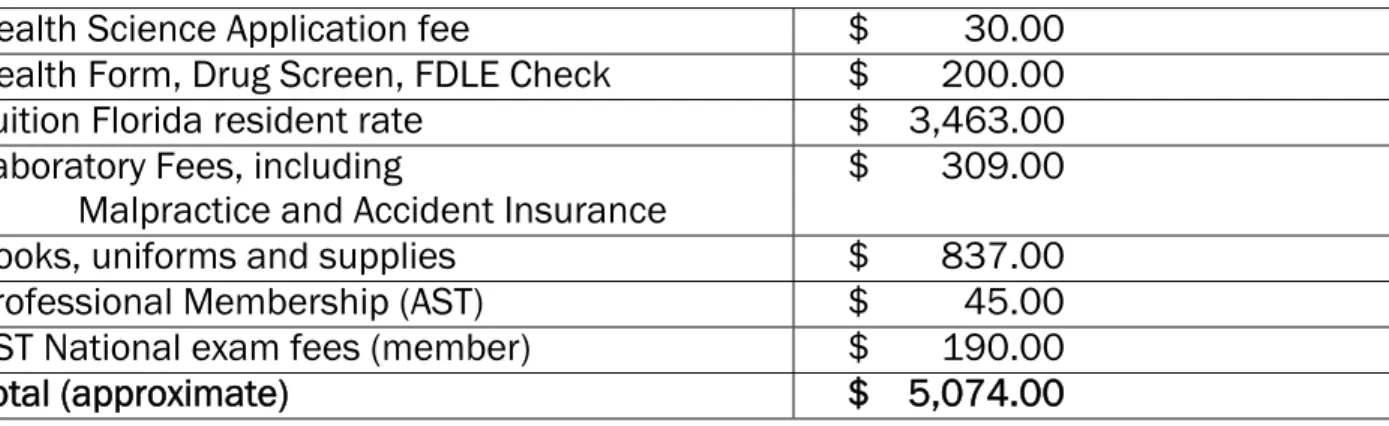
Expenditures
The following is a list of approximate costs and are subject to change. In addition to these costs, the student provides their own room/board, transportation, personal living expenses and preclinical physical examination.
Health Science Application fee $ 30.00
Health Form, Drug Screen, FDLE Check $ 200.00
Tuition Florida resident rate $ 3,463.00
Laboratory Fees, including
Malpractice and Accident Insurance $ 309.00
Books, uniforms and supplies $ 837.00
Professional Membership (AST) $ 45.00
CST National exam fees (member) $ 190.00
Total (approximate) $ 5,074.00
Graduation
In order to obtain the certificate of completion, the student must meet the following requirements:
- Successfully complete program requirements.
TABE requirements must be met for program completion date.
certificate of completion from Indian River State College.
IRSC is an approved testing site for the CST exam. The exam is given at the end of the program. Participation is mandatory.
The College provides a formal ceremony to recognize the graduates’ completion of the Surgical Technology program. Students will be notified of the date, time and place when it is set by the College. Attendance is mandatory. This is the official completion date.
Dress requirements: program uniform with buttoned and pressed white lab coat. You will be receiving your college certificate cover and Surgical Technology pin.
Advisory Committee
The Surgical Technology Advisory Committee assists the Program Director in maintaining a program of continuing development. The Committee also assists with the coordination of effective clinical relationships with staff and other allied health educational programs of study. The committee works to develop understanding and support of practicing physicians and nurses, reviews curriculum and assist with program evaluation. The committee reviews, evaluates and recommends surgical technology student policies, procedures and regulations.
COLLEGE RESOURCES AND GENERAL INFORMATION
Student Disability Services
Indian River State College strives to provide all possible forms of assistance to students with disabilities. Self-identified students with documented disabilities may wish to visit the Student Disability Services office located in Crews Hall (W-143) on the Main Campus.
Hurricanes/Disasters
As hurricanes are a possibility in our area, students are advised to monitor the IRSC radio station, WQCS, 88.9FM or the IRSC website www.irsc.edu for status reports regarding Indian River State College closing and opening. If the College is closed, some classes may have to be rescheduled and/or additional days may be added. All students are advised that they must prepare themselves and their families in advance of any storm. Hurricanes can involve an extended time period without electricity and without access to phone communication. Preparation includes: water and non-perishable food for at least three days; battery operated flashlights, lantern, and radio plus additional batteries; full tank of gasoline; and sufficient cash. Additional information is available in area newspapers during hurricane season.
Students in the Surgical Technology program will not report to class or clinicals if the college is closed for any emergency.
Student Activities
Surgical Technology students are encouraged to participate in on-going activities. A list of college activities are located in the College Student Handbook/Planner available online.
*At least one community service class project will be required in the program. Financial Aid
Various loans are available through the IRSC financial aid office. Students are advised to check with that office for a more complete listing and for deadline dates. Scholarships
Appendix A
Indian River State College Surgical Technology Department
READMISSION/TRANSFER REQUEST FORM
Be advised that readmission/transfer into the Surgical Technology program is based on the attached regulation and is based on space availability. It is the student’s responsibility to complete this form and submit it to the Surgical Technology Program Director. Students will be notified of their status when the request is reviewed and space available is determined.
Readmission & Transfer students, complete the following
Student’s Name _________________________ Student ID# _________________________________ Permanent Address __________________________________________________________________ Home Phone _____________________________ Cell Phone _________________________________ IRSC Email __________________________________________________________________________
Transfer students ONLY, complete the following
Present/Previous Surgical Technology School _____________________________________________ Dean/Director of Nursing ______________________________________________________________ Address ____________________________________________________________________________ Phone #: ___________________________ Email: ___________________________________________ Date first enrolled in Surgical Technology program _________________
Date last enrolled in Surgical Technology program _________________ Reason for Leaving: ___________ Withdrawal __________ Failure
Requesting Transfer into: Surgical Technology Course ___________ Semester ___________
Comments:
Student Signature: ___________________________________________________________________ Date: ______________________________________________________________________________
34
INDIAN RIVER STATE COLLEGE SURGICAL TECHNOLOGY
MIDTERM & SEMESTER SUMMARY REPORT
Student Semester
Midterm
Date Final
The report represents the faculty’s general evaluation of your performance for the indicated semester. It is a descriptive evaluation intended to help you identify your progress, strengths, and areas of needed improvement. You are to keep one copy of the evaluation and sign and return the other.
Classroom Performance for course .
A B C unacceptable
Strengths:
Weaknesses:
The area in which we would like to see the most improvement:
36
INDIAN RIVER STATE COLLEGE SURGICAL TECHNOLOGY
Student Conference
Name of Student Date
Course Reason for Conference
Length of Conference Date of Previous Conference
Topics Discussed:
Recommended Actions/Decisions:
Follow-up Appointment With: Date
Instructor’s Signature: Date
Student’s Signature: Date
Original goes to Student File in Program Office. Copy: Student
38
INDIAN RIVER STATE COLLEGE SURGICAL TECHNOLOGY PROGRAM
PROBATION FORM
Student Date
Reasons for probationary status:
Probation begins Probation ends
Conditions of probation:
No further absences
No failing grades on tests
Demonstration of attitudinal change
Other
Program Director Faculty Member
Surgical Technology
Student
Original goes to student file in Program Office. Copy: Student
40
Indian River State College Surgical Technology Program
Change in Health Status
______________________________________________ _________________________
Student’s Name Student ID
This above-mentioned student is presently enrolled in the Surgical Technology program at Indian River State College. The role of the Surgical Technologist in the various healthcare settings requires academic, physical, mental and environmental work/demands. Due to the nature of the program, the student will be exposed to health hazards demonstrating the ability to make appropriate judgment decisions in emergency and non-emergency situations. In order to determine the appropriate precautions, we need the following information:
(1) Diagnosis ________________________________________________________
(2) Date of Onset _____________________________________________________
(3) Present Health Status ______________________________________________
(4) Do you recommend him/her continuation in the enrolled program?
_____Yes _____No
(5) Recommended date Clinical Education may resume: _____________________
(6) Recommended date for continuation of didactic lectures with co-requisite laboratories:
________________________________________________________________
(7) Do you recommend any limitation to regular duties? _____Yes _____No
If yes, please explain.
_____________________________________ ___________________________
42
Appendix B
Health Science Division
Student Handbook
44
3209 Virginia Avenue, Fort Pierce, Florida 34981-5596
Health Science Division
Student Handbook
INDIAN RIVER STATE COLLEGE
This is to acknowledge that I have received my personal copy of the Health Science Division Student Handbook; I have read and understand its contents. I agree to abide by its regulations. I understand that this form needs to be submitted to the Program Department Chair prior to the first week of school (during program orientation).
I agree to have my educational, health and background records and social security number (see reverse side) released to professional organizations/health care agencies requesting that information as part of placement at any agency.
I agree to have information regarding my attendance and performance released for financial aid purposes.
I understand that I may not participate in any Health Science program until I have all my records (health, CPR, health insurance, drug screen and background checks) on file in the Health Science Department and that these records must be kept updated, or I could be withdrawn from the program.
I understand that orientation to health care facilities is mandatory. Absence for any reason may result in withdrawal from the course.
I understand that information disclosed to me for the patient’s privacy is protected by state and federal law. State law prohibits me from making any disclosure of medical information without the specific written consent of the person to whom such information pertains, or as otherwise permitted by federal, state or local law.
Changes may be made to departmental, division or college policies/regulations at any time. Should a change occur, students will be notified verbally and in writing as to what the change entails and the date it will take effect. Students will be given a copy of the change to keep for their records and one to sign which will be included in their file.
SIGNATURE
PRINT NAME