Two Projects, One Challenge:
Presented
by
J.
Stephen
Downie
Acknowledgements
• Most of today’s slides are directly drawn (aka
copied) from the slides presented at the HTRC
UnCamp events in Bloomington, Indiana and
Champaign, Illinois.
• Today’s talk summarizes four days of excellent
presentations and demonstrations!
• We thank the HTRC team and the UnCamp
presenters for the use of their very informative
Agenda
• Introduce MIREX
• Introducing the HathiTrust
• Non‐Consumptive Research
– MIREX and NEMA
– HTRC Software Architecture
• Workset Creation for Scholarly Analysis
In
the
Beginning…
• Work began on MIREX in Bloomington, Indiana in
2001
– The “Indiana Manifesto”
• 2001‐2003
– Fact‐finding meetings, planning meetings, and
workshops funded by Mellon and NSF
– Large‐scale funding from NSF and Mellon 2003
• Audio Description Contest at ISMIR 2004
• MIREX first run at ISMIR 2005 in London
MIREX
Model
• Based upon the TREC approach:
– Standardized queries/tasks
– Standardized collections
– Standardized evaluations of results
• Not like TREC with regard to distributing data
collections to participants
– Music copyright issues, ground‐truth issues,
IMIRSEL:
First
Principles
1. Security for the music materials
2. Accessibility for international, domestic and
internal researchers
3. Sufficient computing and storage
infrastructure for the computationally‐ and
data‐intensive MIR/MDL techniques
IMIRSEL
Model
Supercomputer Virtual Research Lab-2 (VRL-2) Supercomputer Virtual Research Lab-1 (VRL-1) Supercomputer Virtual Research Lab-n (VRL-n) Supercomputer Virtual Research Lab-4 (VRL-4) Supercomputer Virtual Research Lab-3 (VRL-3) Terascale Datastore-4 Terascale Datastore-3 Terascale Datastore-2 Terascale Datastore-1 Terascale Datastore-n Rights-RestrictedTerascale MIR Multi-Modal Test Collections (Audio, Symbolic, Graphic, Metadata, etc.)
NCSA Music DataSecure Zone Super-Bandwith I/O Channel
Real-World Research Lab-1 (London?) Real-World Research Lab-2 (Barcelona?) Real-World Research Lab-n (?) Real-World Research Lab-3 (Tokyo?) Real-World Research Lab-4 (Urbana?) Command/Control/Derived Data traffic via Internet
Legend: Other Rights-Restricted Music Collections / Services Other Open-Source Music Collections / Services Connection to International MIR Grid Proposed International Music Information Retrieval Grid
MIREX
Overview
• Began as MIREX in 2005
• Tasks defined by community debate
• Data sets collected and/or donated
• Participants submit code to IMIRSEL
• Code rarely works first try
• Huge labour consumption getting
programmes to work
MIREX
Model
• Based upon the TREC approach:
– Standardized queries/tasks
– Standardized collections
– Standardized evaluations of results
• Not like TREC with regard to distributing data
collections to participants
– Music copyright issues, ground‐truth issues,
IMIRSEL:
First
Principles
1. Security for the music materials
2. Accessibility for international, domestic and
internal researchers
3. Sufficient computing and storage
infrastructure for the computationally‐ and
data‐intensive MIR/MDL techniques
IMIRSEL
Model
Supercomputer Virtual Research Lab-2 (VRL-2) Supercomputer Virtual Research Lab-1 (VRL-1) Supercomputer Virtual Research Lab-n (VRL-n) Supercomputer Virtual Research Lab-4 (VRL-4) Supercomputer Virtual Research Lab-3 (VRL-3) Terascale Datastore-4 Terascale Datastore-3 Terascale Datastore-2 Terascale Datastore-1 Terascale Datastore-n Rights-RestrictedTerascale MIR Multi-Modal Test Collections (Audio, Symbolic, Graphic, Metadata, etc.)
NCSA Music DataSecure Zone Super-Bandwith I/O Channel
Real-World Research Lab-1 (London?) Real-World Research Lab-2 (Barcelona?) Real-World Research Lab-n (?) Real-World Research Lab-3 (Tokyo?) Real-World Research Lab-4 (Urbana?) Command/Control/Derived Data traffic via Internet
Legend: Other Rights-Restricted Music Collections / Services Other Open-Source Music Collections / Services Connection to International MIR Grid Proposed International Music Information Retrieval Grid
MIREX
Participation
MIREX
Participation
2005 2006 2007 2008 2009 2010 2011 2012 2013
Datasets 10 13 12 18 26 31 32 35 37
Individuals 82 50 73 84 138 152 156 109 116
MIREX
2013
• 116 researchers
• More than 29 countries
• 37 datasets
• 24 tasks
MIREX 2013 TASKS
Audio Artist Identification Audio Onset Detection
Audio Beat Tracking Audio Tag Classification
Audio Chord Detection Audio Tempo Extraction
Audio Classical Composer ID Multiple F0 Estimation
Audio Cover Song Identification Multiple F0 Note Detection
Audio Drum Detection Query-by-Singing/Humming
Audio Genre Classification Query-by-Tapping
Audio Key Finding Score Following
Audio Melody Extraction Structural Segmentation
Audio Mood Classification Symbolic Genre Classification
Audio Music Similarity Symbolic Key Finding
MIREX
Participation
Total
Runs:
2037!
2005 2006 2007 2008 2009 2010 2011 2012 2013 Datasets 10 13 12 18 26 31 32 35 37 Individuals 82 50 73 84 138 152 156 109 116 Runs 86 92 122 169 289 337 312 302 328Introducing
the
Partnership
Allegheny College Arizona State University Baylor University
Boston College Boston University Brown University
California Digital Library Colby College Columbia University Cornell University Dartmouth College Duke University Emory University Florida State University Getty Research Institute Harvard University Library Indiana University
Johns Hopkins University Lafayette College
Library of Congress
Massachusetts Institute of Technology
McGill University`
Michigan State University New York Public Library New York University North Carolina Central
University
North Carolina State University
Northwestern University The Ohio State University The Pennsylvania State
University Princeton University Purdue University Stanford University Temple University Texas A&M University Tufts University
Universidad Complutense de Madrid
University of Alberta
University of British Columbia University of Arizona University of Calgary University of California Berkeley Davis Irvine Los Angeles Merced Riverside San Diego San Francisco Santa Barbara Santa Cruz
The University of Chicago University of Connecticut
University of Delaware University of Florida University of Houston University of Illinois
University of Illinois at Chicago The University of Iowa
University of Maryland University of Massachusetts University of Miami University of Michigan University of Minnesota University of Missouri University of Nebraska-Lincoln The University of North
Carolina at Chapel Hill University of Notre Dame University of Oklahoma University of Pennsylvania University of Pittsburgh University of Queensland University of Tennessee,Knoxvile University of Utah University of Virginia University of Washington University of Wisconsin-Madison Utah State University
Wake Forest University Washington University Yale University Library
Mission
To contribute to the common good by collecting,
organizing, preserving, communicating, and sharing
HathiTrust “Wow”
Numbers
• 10,924,244 total volumes • 5,719,252 book titles • 285,776 serial titles • 3,823,485,400 pages • 490 terabytes • 129 miles • 8,876 tons• 3,565,657 volumes(~33% of total) in the
Content
Sources
Michigan 45% California 33% Wisconsin 5% Cornell 4% NYPL 3% Princeton 3% Indiana 2% Columbia 1% Harvard 1% LC 1% Madrid 1% Minnesota 1% Chicago 0% Duke 0% Illinois 0% NCSU 0% Northwestern 0% Penn State 0% Purdue 0%UNC‐Chapel Hill 0% Utah State 0% Virginia 0% Yale 0%
Content
Distribution
In‐copyright or undetermined 70% Public Domain (worldwide) 15% U.S. Federal Government Documents (worldwide) 4% Public Domain (US) 10% Open Access .1% Creative Commons .01% "Public Domain” 30%PD
Research
Collection
• Public Domain Materials of the HatihTrust
– 2,592,097 Volumes
– Gigabytes
• 2.3 TB in raw OCR’d text
• 3.7 TB of managed OCR’d text
• 1.85 TB solr Index
– Monthly Updates
• And irregular data ‘take down’ requests
Total volumes Public Domain volumes
Non
‐
Consumptive
Non
‐
Consumptive
Research
Paradigm
• No action or set of actions on part of users,
either acting alone or in cooperation with
other users over duration of one or multiple
sessions can result in sufficient information
gathered from collection of copyrighted works
to reassemble pages from collection.
• Definition disallows collusion between users,
or accumulation of material over time.
Differentiates human researcher from proxy
Non
‐
Consumptive
Research
Paradigm
Bring
the
COMPUTATION
to
the
Researcher 1 Researcher 2 Researcher 3
MIREX DIY OMRAS2 TWM
jMIR myExperiment
Grid‐based feature extraction tools (M2K, jAudio, OMRAS@Home, etc.)
Music database 1 Music database 2 Music database 3 Grid‐based feature extraction tools
(M2K, jAudio, OMRAS@Home, etc.)
Grid‐based feature extraction tools (M2K, jAudio, OMRAS@Home, etc.)
Web service calls (Only features returned)
(Data passed internally)
Greenstone Maestro Music Ontology
NEMA’S SEASR Framework
NEMA Portal
OMEN
Results Aggregators Classification Modules
(ACE, M2K, OMRAS2) Data Cleaning Tools (MusicMetadataManager)
Data Exchange Tools
(ACE XML, M2K, RDF)
High Level Services Low Level Services Discovery &
Sharing Services Web Front Ends Wikis Code Repositories Mail Archives
31
Networked Environment for Music Analysis
32
Networked Environment for Music Analysis
33
HTRC Architecture
Data API access interface
Portal Access Direct programmatic access (by programs running on HTRC machines) Security (OAuth2) Audit Cassandra cluster volume store Solr index Algorithms Result Sets Meandre Workflows Registry (WSO2) Compute resources Storage resources Agent Job Submission Collection building Collections Blacklight Solr Proxy
HTRC Architecture
Data API access interface
Portal Access Direct programmatic access (by programs running on HTRC machines) Security (OAuth2) Audit Cassandra cluster volume store Solr index Algorithms Result Sets Meandre Workflows Registry (WSO2) Compute resources Storage resources Agent Job Submission Collection building Collections Blacklight Solr Proxy Portal Access HTRC Portal Blacklight
HTRC Architecture
Data API access interface
Portal Access Direct programmatic access (by programs running on HTRC machines) Security (OAuth2) Audit Cassandra cluster volume store Solr index Algorithms Result Sets Meandre Workflows Registry (WSO2) Compute resources Storage resources Agent Job Submission Collection building Collections Blacklight Solr Proxy Agent HTRC Agent Job Submission Collection building
HTRC Architecture
Data API access interface
Portal Access Direct programmatic access (by programs running on HTRC machines) Security (OAuth2) Audit Cassandra cluster volume store Solr index Algorithms Result Sets Meandre Workflows Registry (WSO2) Compute resources Storage resources Agent Job Submission Collection building Collections Blacklight Solr Proxy 1 HTRC Registry Algorithms Result Sets Meandre Workflows Registry (WSO2) Collections
HTRC Architecture
Data API access interface
Portal Access Direct programmatic access (by programs running on HTRC machines) Security (OAuth2) Audit Cassandra cluster volume store Solr index Algorithms Result Sets Meandre Workflows Registry (WSO2) Compute resources Storage resources Agent Job Submission Collection building Collections Blacklight Solr Proxy
Secure Data API
• RESTful Web Service
– Language agnostic
– Clients don’t have to
deal with Cassandra
• Simple OAuth2
authentication
• HTTP over SSL
• Audits client access
• Protected behind
firewall, accessible
only to authorized IPs
HTRC Architecture
Data API access interface
Portal Access Direct programmatic access (by programs running on HTRC machines) Security (OAuth2) Audit Cassandra cluster volume store Solr index Algorithms Result Sets Meandre Workflows Registry (WSO2) Compute resources Storage resources Agent Job Submission Collection building Collections Blacklight Solr Proxy Solr Proxy
RFS distributed file system
Solr proxy
Solr service
Data Capsules VM Cluster Provide secure VM Scholars Remote Desktop Or VNC Submit secure capsule map/reduce Data Capsule images to FutureGrid. Receive and review results FutureGrid Computation Cloud HTRC Volume
Store and Index
• Web-based UI
• Components and
flows are retrieved from server
• Additional locations of
components and flows can be added to
server
• Create flow using a
graphical drag and drop interface
• Change property
values
• Execute the flow
Workset Creation
for
Workset Creation
for
Scholarly
Analysis:
Prototyping
Project
• Collection analysis and prototype tools &
services to facilitate work‐set creation
– J. Stephen Downie, Tim Cole, Beth Plale
– Andrew W. Mellon Foundation
– 1 July 2013 ‐ 30 June 2015
• Proposal Narrative:
WSCA
Project
Goals
• The Workset Creation for Scholarly Analysis: Prototyping
Project (WCSA) seeks to address three sets of tightly
intertwined research questions regarding:
1. Enriching the metadata describing the HathiTrust corpus
through mining of the resources themselves and
leveraging end‐user annotations;
2. Augmenting string‐based metadata with URIs to leverage
external services and Linked Open Data to facilitate
discovery and the process of organizing HathiTrust
resources into collections and worksets; and,
3. Formalizing the notion of collections and worksets in the
Motivation
&
Models
Collections, corpora, worksets, ...:
• Aggregations of items brought together in some context:
– Archival
– Curatorial
– Experimental
– Referential
– Thematic (for research) Carl Spitzweg. 1850
Grand
Motivation
• The ability to slice through a massive corpus
constructed from many different library
collections, and out of that to construct the
precise workset required for a particular
scholarly investigation, is an example of the
What
is
a
Workset?
1. A workset is an aggregation of materials brought together for the
purpose of analysis.
2. Worksets are conceptual and must be expressible in a variety of
ways
• Need to allow creation outside of HathiTrust
• Need to facilitate inclusion of resources beyond HathiTrust
• Need to facilitate the inclusion of resources at many different
levels of granularity beyond the book
3. Worksets encapsulate the specific materials that underwent
analysis.
• Need to capture provenance information
• Possible recording of parameters
4. Worksets should be able to spawn descendants but otherwise
Dimensions
of
Workset Creation
(Illustrative)
My work‐set should contain (inspired by 2012 UnCamp):
• Volumes pertaining to Japan / in Japanese
• All volumes relevant to the study of Francis Bacon
• Music scores or notation extracted from HT volumes
• Images of Victorian England extracted from HT vols.
• Volumes in HT similar to TCP‐ECCO novels
• 19th c. English‐language novels by female authors
• Representative sample (by pub date & genre) of
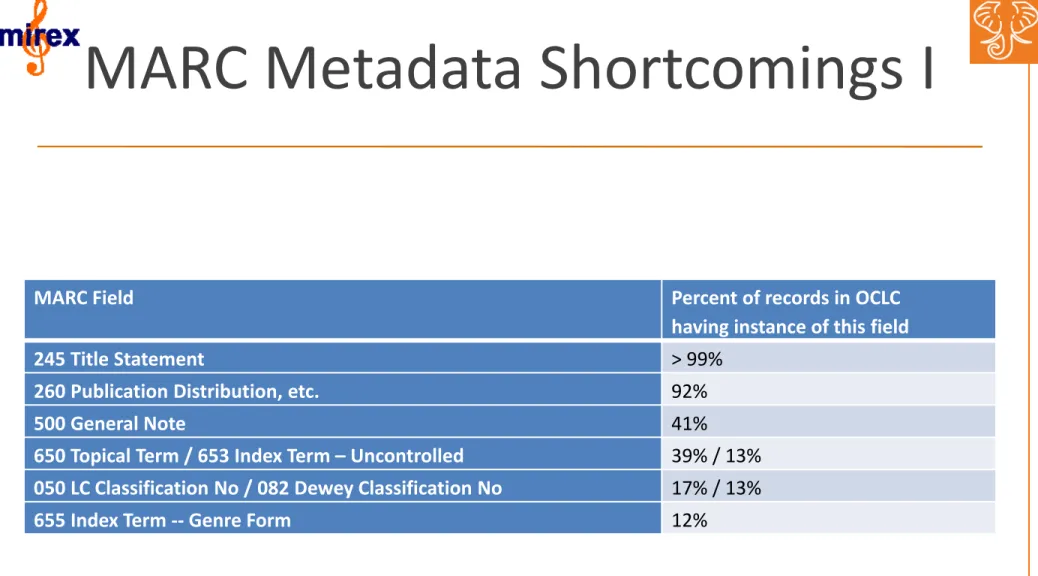
MARC
Metadata
Shortcomings
I
MARC Field Percent of records in OCLC having instance of this field 245 Title Statement > 99%
260 Publication Distribution, etc. 92%
500 General Note 41%
650 Topical Term / 653 Index Term – Uncontrolled 39% / 13%
050 LC Classification No / 082 Dewey Classification No 17% / 13%
655 Index Term ‐‐Genre Form 12%
MARC
Metadata
Shortcomings
II
MARC Field Percent of British Novel MARC records
having instance of this field
650 Topical Term 6%
050 LC Classification No / 082 Dewey Classification No 27% / 4%
655 Index Term ‐‐Genre Form 5%
Table 3. Frequency of MARC fields used in 2,386 descriptions
Why
Worksets?
• The result of a first‐level, rough filter
• Better scale for intensive analytics
• Provides essential scope for certain analytics
– Word frequency scope over Bacon’s essays
• Some tools (are trained to) work best on a
narrow, homogeneous work‐set
• Eliminate noise that would otherwise arise by
Research
Questions
(Illustrative
only)
• Can we enrich the HathiTrust corpus metadata by distillinganalytics over full text?
• Can we augment string‐based metadata with URIs for
recognized entities – e.g., names, subjects, publication
location, etc. ‐‐ and by doing so can we leverage external
services to facilitate discovery and clustering of resources?
• Can we leverage existing, well‐defined external corpora to
identify complementary subsets of HT volumes, and having
done so can we demonstrate the ability to create and
perform analytics over an integrated workset that includes
Key
Workset Questions
• Can we formalize the notion of collections and
worksets in the HTRC context?
• What are the necessary elements of a “collection”?
What are the necessary elements of a “workset”?
• How can we balance rigor with extensibility and
flexibility?
• What roles do “data”, “metadata”, “annotations”,
“tags”, “feature sets”, and so on, all play in the
conception, creation, use and reuse of collections
Two
Project
Streams
• Workset formal structures and semantics
– Work in conjunction with Center for Informatics
Research in Science and Scholarship at the
Graduate School of Library and Information
Science
• WCSA Prototyping Projects
– Four projects funded by the grant but conducted
WCSA
Timeline
• July 2013: Project Start
• Q1: User needs assessments / focus groups
• Q2: HT Corpus characterization
Request For Prototype Proposals
• Q3: RFP Finalist Workshop (Chicago) February 20 Prototype experiment funding awarded
• Q4‐6: Prototype experiments done
Metadata workflow & work‐set modeling
• Q7‐8: Planning for prototype to production Report out
Prototype
Grants
As part of project, HTRC will make 4 sub‐awards
• $40K awarded to each of 4 non‐HTRC teams
• HTRC will collaborate with each team
– Access to representative test data / metadata set
– Collaborate on work with HT / HTRC APIs, etc.
– Provide code librariesRFP & Sub useful‐Award Schedule across all 4 projects
2013‐11‐15 RFP Available
2013‐12‐16 Letters of Intent Due (preferred) 2014‐01‐15 Final Proposals Due
2014‐02‐20 Finalist Meeting
WCSA
Summary
• Worksets are fundamental to the scholarly
computational analysis enterprise
• We need a better understanding of their:
– Constituent parts
– Creation
– Manipulation
– Use and reuse
• Prototypes to lead to deeper tool
Personal
Goals
for
HTRC
• Engage in more collaborative projects
• Expand to have truly international
partnerships
• Make sure to move beyond text
Redux:
Ongoing
Challenges
How do we actually unlock the potential of
3 billion pages of human knowledge?
• Data quality issues
• Data structure challenges
• Metadata shortcomings
• Overcoming copyright barriers to research – Non‐consumptive research
– Computation to the data
• Moving beyond text
Questions?
Comments?
Suggestions?
Special thanks to: