Masters of Education in Teaching and Learning ACU Student Research, Theses, Projects, and Dissertations
Spring 5-12-2018
Motivation: Why are Students Taking Dual-Credit
Courses
Chyenne Haden
Follow this and additional works at:https://digitalcommons.acu.edu/metl
Part of theEducational Assessment, Evaluation, and Research Commons,Higher Education Commons, and theSecondary Education Commons
This Manuscript is brought to you for free and open access by the ACU Student Research, Theses, Projects, and Dissertations at Digital Commons @ ACU. It has been accepted for inclusion in Masters of Education in Teaching and Learning by an authorized administrator of Digital Commons @ ACU.
Recommended Citation
Haden, Chyenne, "Motivation: Why are Students Taking Dual-Credit Courses" (2018).Masters of Education in Teaching and Learning. 8.
Motivation: Why are Students Taking Dual-Credit Courses Chyenne Haden
Abstract
With a growing number of high school students taking advantage of dual-credit courses, the need to understand what motivating factors are at play is more important than ever. This study was conducted within an 11th grade dual-credit history class for the purpose of discovering what motivated those students to enroll in a college level course while still in high school. Participants in the study were given the opportunity to reflect on their decision to enroll in dual-credit through a focus group and individual interviews as well as a survey. The data collected through these methods was analyzed using the constant comparative method and coding as well as descriptive statistics. After the completion of data analysis, four major themes became apparent including, the desire to challenge oneself, the ability to earn college credit, receiving encouragement, and an understanding of the benefits that one could receive.
Motivation: Why are Students Taking Dual-Credit Courses
“Why do students want to take these classes?” This is the question that I asked myself while watching groups of 16 and 17-year-old students listen to what would be expected of them over the course of the semester on the first day of their junior year of high school. While some of them looked eager and excited, as much as one can be on the first day back from summer
vacation, others looked leery and unsure. Yet, each of these students had made the choice, the previous spring, to enroll in this dual-credit class and possibly others as well. Surely, I thought, they thought this decision through before signing up; this kind of class cannot be taken on a whim; there must be some motivation driving these students to want to take an upper level class like this. As I watched these students adjust to these new expectations and pondered over what I wanted my research to be on this year, this question came back to me time and time again, until I finally set my mind on the prospect of finding the answer to this question.
Purpose
Webster High School, which is a part of the Andrews Independent School District (all names have been replaced with pseudonyms), is located in a small West Texas city. The district is one of two public school districts in the city and serves roughly 4,300 students across its six campuses. The breakdown of the student population for the district is as follows: 70% White, 17.9% Hispanic, 6.8% African American, 4.05% Asian, and 1.39% Native American. Webster is the only high school in the district, and it serves about 1200 high school students ranging in age from 13 to 19. Along with its regular courses, Webster HS offers its students the opportunity to enroll in dual credit courses. Among the dual-credit courses offered are courses in English, history, government, economics, psychology, math, and agricultural mechanics. Over the years, Webster has seen more and more of its juniors and seniors participating in and taking advantage
of these courses.
This research was conducted during my time as a graduate clinical teacher at Webster High School while I was working on my M.Ed. in Teaching and Learning. While there, I worked in an American history classroom alongside a teacher who not only taught general high school history, but also served as a dual-credit teacher. This gave me the opportunity to work with students who were enrolled in a class that was both a high school and college course rolled into one. It was while working in these classes that I decided that I wanted to know what motivated these students to enroll in these types of courses. To do this, I set out the following questions to guide my study:
1. Why do high school students choose to take college level, dual-credit classes starting their junior year?
a. Sub-question: What factors are taken into consideration when making this decision?
Through the process of working to answer these questions, students were asked to reflect on their own personal motivations. By doing this, I was not only able to come to a better
understanding of why my students chose to enroll in these courses, but my students were also able to come to a better understanding for themselves as to why they were taking these courses. Now this understanding can serve as a further motivation for them to continue on the path they have started.
Related Literature
Many high schools have begun to partner with local junior colleges and universities to offer their students the opportunity to take college level courses while still in high school known as dual-credit courses. In a report by Tobolowsky and Allen (2016), they define dual-credit
courses as “individual courses or a complete curriculum of courses high school students can take where they earn both college and high school credit simultaneously without having to take a standardized test to earn the credits” (p. 8). These programs allow high school students to, in a small way, begin their college career while still in high school. Loveland (2017) reports that dual enrollment, or dual-credit, courses offer students an array of benefits when it comes to college readiness such as self-advocation and syllabus navigation skills. Over the last decade these programs have become more prevalent in schools across the country. Stimpson (2016) reports that in 2010-11 82% of public high schools in the US reported students taking dual-credit courses and that there has been an annual 7% growth of these programs from the year 2000 to 2015. Along with the increase in program availability, there has been an increase in the number of studies on dual-credit programs.
Some studies have sought to find out what role dual-credit courses have played in student outcomes. An (2015) studied the performance of college students who had taken either
Advanced Placement (AP) or dual-credit courses while in high school as compared to those who had not participated in those courses. In his study he found that students who had participated in these programs on average had a 0.14 higher first-year GPA as compared to first-year students who had not and showed higher academic motivation through a higher percentage of study group attendance. Gaini, Alexander, and Reyes’ (2014) found a positive correlation between dual-credit enrollment and post-secondary performance, and found that the more courses students took the more beneficial their participation was. Furthermore, Allen and Dadgar (2012) again found that students who enrolled in New York’s College Now program for dual-credit in high school had a 0.16 higher GPA and were 5% more likely to reenroll for a third semester.
dual-credit. Some students who become eligible to enroll in dual-credit courses will elect not to take them. O’Connor and Justice (2008) found that financial reasons were the most often cited reason, 22% of the time, that students decided not to enroll in dual-credit courses. Other reasons include scheduling conflicts and misinformation. On the other hand, O’Connor and Justice (2008) also found that the incentives made available to students through dual-credit as the top reason for students deciding to enroll in dual-credit courses. Mansell and Justice (2014) interviewed
students in traditional and early college high schools to learn the reasons for their choice to enroll or not enroll in dual-credit courses in these schools. They found that students cited the ability to earn college credit as the largest reason for enrollment and low self-esteem and AP course options as reason for not enrolling. Johnson and Brophy (2006) also studied motivations of high school students for enrolling in dual-credit courses in rural Washington high schools. They identified four factors that influenced the students’ decisions; academics, finances, social, and choice.
With the increase in dual-credit program availability and student enrollment, it is more important than ever for teachers and schools to understand why students are electing to enroll in these courses. Moreover, when teachers understand what motivates students to take these courses they will be better prepared to serve these students because they will know why these students are there. As such, the teacher can gear the teaching in such a way as to appeal to the students who are in the class. This study adds to a growing library of research on what motivates students to enroll in dual-credit courses. Unlike the studies above, this study did not collect information by following students during the decision process, but rather asked students, in their second semester of dual-credit, to reflect on their decision to enroll in the course. It also took into account factors that have encouraged students to remain in the courses and continue to enroll in
them in the future. All of this helped me to collect a list of motivating factors that students like these take into account when making the decision to take college level courses while still in high school.
What I Did
In what follows is a description of an action research study conducted in an eleventh-grade dual-credit history class at Webster High School, including participant descriptions, data collection methods, and data analysis methods.
Participant Selection
For this study, student participants were selected from five class periods of an eleventh-grade dual-credit history course at Webster HS. The students enrolled in this course were all classified as juniors. As such, the students ranged in age from 16-18 years old. The participating students were also of mixed ethnicity and gender, representing the diversity of the student population who were enrolled in these college level courses. Participation was solicited from each of the 105 students enrolled in the course. However, participation in the study was not required and so only the students who wished to be a part of the study were included during the data collection process.
In order for a student to be accepted into the study, they first had to receive parental permission. Before the study began, every student enrolled in the dual-credit course was given an informational letter and a consent form to be taken home to their parent or guardian. The
students then had to return the signed consent forms to me in order to participate in the study. They also had to sign an assent form in which they agreed that they were also assenting to the research process. Every student who completed both of these tasks were accepted for
copy of their consent and assent forms to keep for their own records.
Of the assenting student participants, a total of eleven were selected to participate in interviews. Five of these students participated in a focus group interview at the beginning of the study. These students were selected purely on a volunteer basis and represented each of the five class periods included in this study. They were also representative of the gender and ethnic make-up of the course and their classes. The remaining six interviewees participated in an
individual interview. These students were selected based on their survey answers and willingness to participate. The survey responses were used to ensure that multiple “highly influential”
motivations were being explored. These eleven students, along with the rest of the participating students also filled out a student survey on their motivations to enroll in dual-credit courses.
Data Collection
Data collection in this study consisted of three different types of data. The first of these was documents. At the beginning of the study, documents were collected from the teacher and the school on the dual-credit program. The data collected from these documents was used to further inform me on the initial requirements that students needed to meet to enroll in dual-credit. Student motivation could not begin to play a role until the students were eligible for enrollment in dual-credit courses. The information gathered from these documents was also used to make any necessary changes and editions to the interview protocols and surveys that were given to the students as necessary.
Secondly, data on students’ motivations was collected through student interviews. The study utilized two types of interviews for data collection. The first was a focus group interview, which was approximately ten minutes. This interview consisted of five student participants. At least one participant was selected from each of the five class periods. The selected students not
only represented each of the classes, but also the gender and ethnic diversity of the classes. This interview took place at the very beginning of the study. While its primary purpose was to collect data on the students’ motivations to enroll in dual-credit courses, it was also used inform the survey and individual interview questions. While these documents were prepared prior to the study, the information I learned during the focus group interview was used to change and update the aforementioned documents to ensure that I was collecting additional data on things that I learned during the initial focus group.
The study also utilized individual interviews. These interviews occurred at the end of the study. Each interview lasted from four to nearly seven minutes. Six students were selected to participate in the individual interviews. These participants were selected based on their responses to the surveys (which were given ahead of the individual interviews) and willingness to
participate. The students selected also represented the diversity of the student population. By using this variety of criteria, I was able to interview a wide range of students.
The last form of data collection used in this study was a survey (see Appendix A). This survey was give out to every student who has assented to the study. The survey used a
combination of Likert Scales and short answer questions related to motivation to take dual-credit courses. The Likert Scale questions measured the students’ agreement with series of statements, while the short answer questions allowed the students to provide me personal answers in a response to each question (Hendricks, 2017). As stated above, the questions included in this survey were influenced by information found during the focus group interview.
Data Analysis
After all of the data was collected, it needed to be analyzed. In this study, I used the constant comparative method to analyze the data, which is described by Tracy (2013) as the
method for comparing data applicable to the codes to continually modify the codes being created. However, before this could be done all the interviews, both the focus group and individual interviews, were transcribed. Then from these transcriptions and the short answer portion of the surveys, I analyzed the data using coding. Coding is the process of organizing data into themes or sets (Tracy, 2013). The coding for this study was done manually, without the use of any computer programs for assistance. During the coding process I created a codebook listing the level one and two codes that were created out of the data (Hubbard & Power, 2003; Tracy, 2013). Level one codes are described by Tracy (2013) as descriptive words showing the basic and sometimes broad information in the data. During this study, the level one codes were created using the first 20% of the data collected and described seventeen themes in the data. Using these level one codes, I created a list of four level two codes, which are described by Tracy (2013) as interpretive concepts of organized and synthesized codes from the earlier coding process. These codes can be seen in both the codebook, which can be found in Appendix B and in my findings below. I also used descriptive statistics to analyze the surveys. This method of data analysis was used to look at the percentage of student responses for each Likert scale question (Hendricks, 2017). The combination of these two forms of data analysis helped to understand what the data found on the students’ motivation to enroll in dual-credit courses.
What I Found
In the following pages, I will describe what the data showed to be four of the most
motivating factors for students enrolled in dual-credit courses. These factors include the desire to challenge oneself, receiving encouragement, the ability to earn college credit, and an
understanding of the benefits one can receive from these courses. Included in this section are charts and samples of the students’ responses for a more visual and comprehensive
understanding of the findings.
I Can Challenge Myself
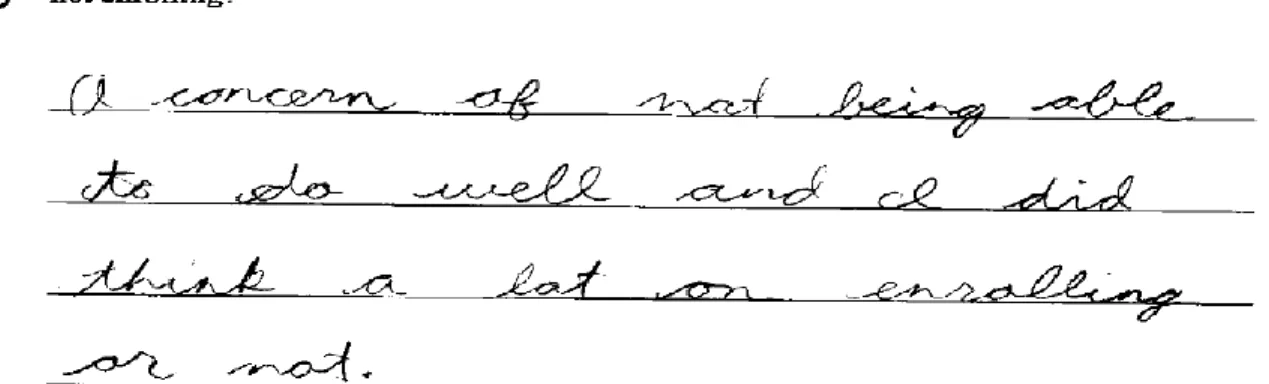
Prior to enrolling in dual-credit courses, students have to take into account all the pros and cons that might be associated with it. Although, it would seem logical that the pros would provide the most motivation for enrollment in dual-credit courses, this particular category of motivation stemmed from what the students perceived as the cons of these courses. While the purpose of this research was to find out what motivates students to enroll in dual-credit courses, I chose to include a short answer prompt on the survey that asked the following questions, “Were there any concerns you had about taking this course? Did they make you consider not enrolling?” For six of the thirty-eight students participating in this study, the answer to this question was no, there were no concerns. However, for many other students, thirty-two to be exact, their concerns were that the course may present challenges that they were not ready for. For some samples of student survey responses to this question, view Figures 1 and 2.
Seven of these students mentioned that they were concerned that the courses would require them to put in a lot of time, time that they may not have. As with any college course, students in dual-credit are required to buy textbooks and are often asked to read through the textbook on their own time. They are also assigned projects and papers that require more time to complete then the projects that they have been assigned in the past. One student wrote on her survey that she once considered dropping the class because she felt she could not find enough time to devote to the class, but in the end, chose to stick it out. Another concern these students had was that the course might be too academically challenging and that they may not excel like they had before. In fact, this was a concern for thirteen of the participating students. Many of the students who enroll in dual-credit are students who, in the past, have been successful
academically and the thought of not doing as well as they have in the past is concerning for them. Of the students who voiced these concerns on their surveys, three admitted that they had considered not enrolling in the course due to their concerns over these possible challenges.
Figure 1. Portion of student survey. “A concern of not being able to do well and I did think a lot
on enrolling or not.”
Figure 2. Portion of student survey. “Even though I had heard that this class was very beneficial,
I also heard that it was very challenging. This was a major concern for me, because I was afraid I would fail.”
Through this line of questioning, it became apparent that dual-credit courses had some deterrents associated with them. However, it also became clear as I continued to analyze the data,
that for the students who ultimately choose to enroll in these courses that there was something more at play in their decision-making process. It is true that they were concerned and had their doubts, but these students chose to overlook those doubts and enroll because they knew they were up for the challenge. While I was analyzing the data I had collected, I noticed that while many students mentioned their concerns, most concluded those statements with ones stating that those feelings of concern did not affect their ultimate decision to enroll. Others even went a step further. Maddi wrote that she “always told [her]self [she]’d take dual-credit when [she] could” despite the concerns she had about the courses. She also told me during her interview that she viewed dual-credit courses as “tough, but worth it.” Another student, Joe, wrote, “I was kind of hesitant, but I took the chance.” However, the student comment that ultimately led me to the understanding that these students were motivated to enroll by their desire to challenge
themselves, was Kaelyn. On her survey she wrote, “I mostly wanted to challenge myself and feel smart.” This comment introduced me to the idea that these students saw these courses as a challenge, one that they could ultimately overcome. During her interview, I asked her about this response, and she told me, “I’m always trying to benefit myself and push myself to do different things;” which in this case meant taking an upper level course that might present challenges.
While dual-credit courses can present challenges, ones that do ultimately deter some students who may have been considering enrollment, for those who do enroll it appears that these challenges can serve as a form of motivation. These students seem to understand that a challenge is not something to fear, but something to overcome. With this knowledge, motivation, and a little hard work these students will be prepared to succeed in this setting.
The Encouragement I Receive
to increase your motivation to do something that might otherwise be too frightening or
overwhelming, and I believe that this is very true for some students who are debating whether or not to enroll in dual-credit. During her interview, Landry made this statement, “I just think that dual-credit, along with that tag comes this, ‘oh my gosh, it’s gonna be so hard.’ … [but] like talking to people and them saying you can handle it and it’s fine… it was like ‘Okay, I can handle this.’” Statements like this one, showed me just how much encouragement influenced and motivated students to enroll in dual-credit courses. This encouragement did not come from a single group of people, but from many different people in these students’ lives who influenced them. For some, it was their parents who gave them encouragement, while for others it was their fellow students and friends who encouraged them to enroll in dual-credit. When asked if she talked to anyone before enrolling in dual-credit, Sierra told me, “I talked to all of my friends and my parents and everyone.” It seems that no matter where it comes from, encouragement of some form found its way to many of the students who participated in this study.
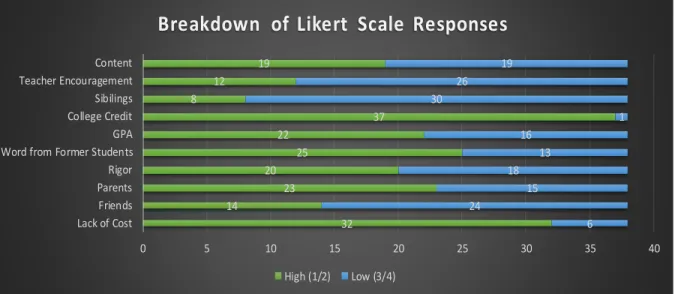
For some students, the people who encouraged to enroll in dual-credit courses this year were their parents. On the Likert scale portion of the survey, which asked students to rank potential motivational factors on their influence in the students’ decision to enroll in dual-credit, I included a choice named “my parents wanted me to take the class.” Of the 38 participating students in this study, 23 of them ranked their parents as an influential motivating factor in their decision. To see how this choice ranked against the other options on the Likert scales, view Figure 4. To find out more about who the students received encouragement from, during the individual interview portion of the research I asked the students, “Did you discuss this decision with anyone one else before signing up? Friends, family? Why or why not?” Many of the interviewees said that they had talked to their parents about enrolling in the class. When asked
this question, Landry told me, “Yeah, I talked to my mom about it, and she was like ‘it’s college credit, you should take it’ you know. But she wasn’t adamant about.” Another student, Kaelyn said, “My parents encouraged me to take [dual-credit] cause they thought I was really smart.” In Kaelyn’s case, her mother also did not allow her to drop out when she got cold feet about the course at the beginning of the year, a decision which she is grateful for now.
For other students, the answer to this question was that they had talked to their friends about enrolling in the course. Some of these students wanted to know if their friends would be enrolling as well so that they wouldn’t be alone. This particular sentiment was expressed by four out of the six students who participated in the individual interviews and during the focus group interview as well. Mutual assurance of enrollment between friends was encouraging to these students who did not want to go through this experience alone. However, on the survey only 14 students ranked this choice on the Likert scale as influential. Still, this form of encouragement was a source of motivation for those 14 students.
These grade level friends were not the only ones however who had encouraged these students to enroll in dual-credit this year. Throughout the data analysis process, I found that often times older students played a role in encouraging these students to take dual-credit as well. During the interviews, I asked students if they had talked to upper classman who had already taken the class to see what they thought about it. Many of students said that they had and that a good word from them meant a lot. When asked this question, Maddi informed me that “if they were hating it every day and couldn’t handle it, I wouldn’t be taking it.” This statement showed me just how motivating a good word of encouragement from an older student could be for students who were trying to decide whether or not to enroll in dual-credit and at the same time how much a discouraging comment could steer them in the opposite direction.
Lastly, I had wondered if previous teachers had encouraged students to enroll in dual-credit. However, only one student brought up this form of encouragement in their interview, and only 12 students ranked it as influential on their survey. While this does show that some students felt encouraged by teachers to enroll, I had hoped to see higher numbers on this particular
motivational factor. Yet, when combined with all of the other forms of encouragement that were discussed throughout this study, it helps to reinforce the fact that students are motivated to enroll in dual-credit when they receive encouragement from those around them to do so.
Collecting College Credit
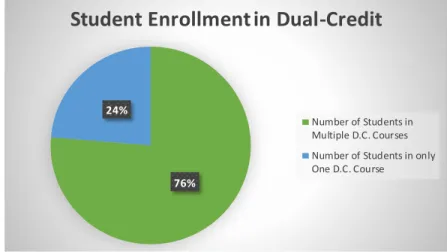
One of the perks of enrolling in dual-credit courses is the ability to earn college credits. In fact, students can earn three hours of college credit for every class that they take. For example, the students in my US History class will receive a total of six hours of credit by the end of the year. However, many of my students are also enrolled in at least one, if not two, other dual-credit courses, giving them the opportunity to earn a total of 12 to 18 hours of college credit during their junior year of high school alone. See Figure 3 for the breakdown of the number of students from the study who were enrolled in multiple dual-credit courses.
Figure 3. Pie Chart.
When analyzing the Likert scale portion of the survey I was not surprised to find that the
76% 24%
Student Enrollment in Dual-Credit
Number of Students in Multiple D.C. Courses Number of Students in only One D.C. Course
choice named “Opportunity to get college credit in high school” had received an extremely high rank from the students. In fact, this particular choice received the highest ranking out of all ten choices on the Likert scale, receiving a “Highly Influential” or “Slightly Influential” ranking from 37 out of 38 student participants. This high ranking showed just how important of a motivational factor receiving college credit is for students planning to enroll in dual-credit courses. Figure 4 shows the breakdown of high and low scores for each of the Likert scale choices.
Figure 4. Stacked bar chart of Likert scale responses displaying the high and low scores of the survey.
Dual-credit courses are one of the only options students have to earn college credit while in high school. Unlike Advanced Placement (AP) courses, which require students to pass a test to receive college credit, a student only needs to receive a passing grading in a dual-credit course to receive both high school and college credit for that course. This makes the “Opportunity to get college credit in high school” a motivational factor that is pretty unique to dual-credit. This topic was brought up time and again during the interview process as well. One question that I asked each student who participated in an interview was “If you had to choose your top reason for
32 14 23 20 25 22 37 8 12 19 6 24 15 18 13 16 1 30 26 19 0 5 10 15 20 25 30 35 40 Lack of Cost Friends Parents Rigor Word from Former Students GPA College Credit Sibilings Teacher Encouragement Content
Breakdown of Likert Scale Responses
taking this class, what would it be and why?” Of the eleven students who participated in the focus group and individual interviews, four of them cited getting college credit as their top reason for enrolling in dual-credit. These responses, combined with the results of the Likert scale portion of the survey, showed just how motivating it is for students to have the opportunity to get college credit while still in high school.
I’m in it for the Benefits
This last factor of motivation is quite broad but sums up an idea that appeared all throughout the data. While analyzing the data, I came across different ideas of what students thought they would get from dual-credit. One of the biggest things of course was college credit, but that was such an important theme that I choose to make its own category. However, there were other inherent benefits, as I will call them, that students brought up through the data
collection process. Figure 5 shows a quote from a student who was motivated to take dual-credit because she knew she would benefit from it.
Figure 5. Quote from Kaelyn during her individual interview.
One of the great benefits of dual-credit courses is that they often cost far less than college courses at a university. In the case of the dual-credit programs offered at Webster High, the university that sponsors their programs pays for them through a scholarship fund, allowing students to take them for free. For many students, this complete lack of cost proved to be a highly motivating factor. In fact, 32 of the 38 student participants ranked it as an influential motivating factor for them on their survey. When asked on the survey if there were any
simply writing, “since the class was free, I felt urged to take advantage of it.” By taking advantage of the opportunity to take dual-credit courses, Tod and other students will be able to save money in the future by getting their basic courses done for free in high school.
For other students, the motivational benefit of these courses was knowing that it would benefit them in college. The credits earned in this class may not transfer to every university, but there are other things that these courses can give students. For example, students were motivated by the chance to see what college classes would be like in the future. Among those students was Diego, who told me he decided to enroll in dual-credit for “the chance of understanding more about how college classes work.” Figure 6 also shows another quote from Diego on his views on the benefits of dual-credit. Comments like these were made 23 times throughout the data. While dual-credit courses are not quite as rigorous as true college courses, they do provide high school students with the opportunity to see what kinds of things will be expected of them in college. Other students were motivated to enroll simply for the chance to get ahead and build a
foundation for college. As discussed earlier, these students have the opportunity to earn multiple college credits while still in high school, credits that will build the foundation of their college career. Dual-credit courses provide students with experiences which help them grow and prepare for the future.
No matter what benefits students hope to receive from in these courses, they will all walk away with having benefitted in some way. For most, it will be that they have been able to save money through taking these courses. Some may walk away feeling that they have benefitted from the knowledge they have gained and the foundation they have built. The knowledge that they could gain these things from dual-credit courses served as a motivator for these students when choosing whether or not they would enroll in dual-credit courses.
Figure 6. Quote from Diego during the focus group interview.
Implications for Teachers
Throughout this research I have come to appreciate dual-credit courses in new ways and have learned so much about what motivates students to take these classes. I found that the students who are choosing to enroll in dual-credit are motivated to do so by their desire to
challenge themselves, the encouragement they have received, the ability to get college credit, and their knowledge of the other benefits the courses offered them. Students know that when they enroll in an upper level course that there will be challenges, and dual-credit is no different. So, the students who enroll in these courses need to be motivated to challenge themselves and know that they are capable of overcoming challenges. They also need to be encouraged to take on these challenges and know that there are people who believe in them. This encouragement can come from a range of influential people in the student’s life, including family, friends, and teachers. Students enrolling in dual-credit are also motivated by the opportunity to receive college credit and other benefits, such as experience and the ability to save money. However, this study has only scratched the surface on subjects like dual-credit courses and student motivation.
“I’m glad that they let us get the opportunity to take [dual-credit] in high school so we can be more ahead in college.” For me, this quote from Joe, a student taking dual-credit, displays how important it is for schools to give students the opportunity to take these types of upper level classes. There will always be students who are motivated to take them and appreciate what they learn from them. I think that the findings of this research could help schools discover meaningful
ways to market these programs to students. The findings of this study are based on what motivated students to enroll in dual-credit and sharing these motivations with students who are contemplating enrolling could help them reflect on their personal motivations for taking the course. This research could also help provide schools that might be considering adding dual-credit programs to their school with data on what attracts students to these programs and the things that students think are beneficial about dual-credit courses.
This information could also be useful for teachers. It is important for teachers of all grade levels and content areas to understand what motivates their students. This study sheds some light on the things that not only motivate dual-credit students but could be applied to many high school students from all across high school campuses. Another important finding that could be taken away by teachers is the low student ranking of teacher encouragement. While for some, teacher encouragement might just be low on the totem pole of motivation, I worry that for others teacher encouragement was not voiced. After seeing how influential encouragement was on student motivation, I can only imagine how much it would mean if more students felt encouraged by their teachers to enroll in these courses. Teachers have a special role in students’ lives. They are the ones that are with students throughout most of their waking hours, and I think that their encouragement could do a lot to motivate students to step up to challenges and help motivate them to enroll in courses such as dual-credit.
There is still so much more to be explored and learned about student enrollment in dual-credit courses and student motivation. While seeking to answer my questions about students’ motivation to enroll in dual-credit, I also begin to wonder the following things:
• What concerns ultimately affect students’ decisions to not enroll in dual-credit?
courses?
• How might schools encourage more students to take advantage of dual-credit opportunities?
• How do these motivations affect student enroll in courses like Advanced Placement (AP) and/or International Baccalaureate (IB) courses?
It would be interesting to conduct some research on these questions, and maybe one day I will have the opportunity to spend some time researching them. For now, however, I want to focus on my teaching and use what I have learned about student motivation to help motivate students to take on challenges through encouragement and help them look to the future.
References
Allen, D., & Dadgar, M. (2012). Does dual enrollment increase students’ success in college? Evidence from a quasi-experimental analysis of dual enrollment in New York City. New Directions for Higher Education, 2012(158), 11–19.
An, B. P. (2015). The role of academic motivation and engagement on the relationship between dual enrollment and academic performance. Journal of Higher Education, 86, 98–126. Giani, M., Alexander, C., & Reyes, P. (2014). Exploring variation in the impact of dual-credit
coursework on postsecondary outcomes: A quasi-experimental analysis of Texas students. High School Journal, 98, 200–218.
Hendricks, C. C. (2017). Improving schools through action research: A reflective practice approach (4th ed.). Boston, MA: Pearson.
Hubbard, R. S., & Power, B. M. (2003). The art of classroom inquiry: A handbook for teacher-researchers (Rev. ed.). Portsmouth, NH: Heinemann.
Johnson, T., & Brophy, M. (2006). Dual enrollment: Measuring factors for rural high school student participation. Rural Education, 28(1), 25–32.
Loveland, E. (2017). Moving the needle: Dual enrollment us fast becoming the norm. Journal of College Admission, (236), 32–36.
Mansell, N., & Justice, M. (2014). Learning from the past: Dual credit. Administrative Issues Journal: Education, Practice & Research, 4(1), 30–39.
O’Connor, K. B., & Justice, M. C. (2008). Evaluating dual credit enrollment at selected rural Northeast Texas high schools. Southeastern Teacher Education Journal, 1(1), 27–34. Stimpson, J. D. (2016). Dual credit in Texas: Challenges and opportunities for libraries. Texas
Tobolowsky, B. F., & Allen, T. O. (2016). On the fast track: Understanding the opportunities and challenges of dual credit. ASHE Higher Education Report, 42(3), 7–105.
Tracy, S. J. (2013). Data analysis basics: A pragmatic iterative approach. In Qualitative research methods: Collecting evidence, crafting analysis, communicating impact. West Sussex, UK: Wiley-Blackwell.
Appendix A
Student Survey
Student Information:
Student Name: _____________________________ Class Period: ______
# of Dual-Credit Courses Currently Enrolled in: ____
Outside Extracurricular Activities: _________________________________________________ _____________________________________________________________________________
After reading each of the following statements, please select the ranking that best describes what role each played in your decision to take this course. (Circle a number or mark through the box)
Highly Influential 1 Slightly Influential 2 Considerable 3 Not Considered 4
The lack of cost for the
class 1 2 3 4
My friends were taking
the class 1 2 3 4
My parents wanted me to
take the class 1 2 3 4
I wanted to take a course
with more rigor 1 2 3 4
I had heard good things about the course from former students
1 2 3 4
I heard it wouldn’t affect
my GPA 1 2 3 4
Opportunity to get college credit in high school
My siblings took it
before me 1 2 3 4
I was encouraged by my teacher(s) to take the course
1 2 3 4
I really enjoy the content
Short Answer:
Read through each of the following questions and answer each in complete sentences. If a question does not apply, answer N/A.
1. Were there any other influential factors that were not listed above that you considered before enrolling in this course? If yes, please explain.
________________________________________________________________________
________________________________________________________________________
________________________________________________________________________
2. How did your involvement in extracurricular activities effect your decision to enroll in a dual-credit course?
________________________________________________________________________
________________________________________________________________________
________________________________________________________________________
3. Were there any concerns you had about taking this course? Did they make you consider not enrolling? ________________________________________________________________________ ________________________________________________________________________ ________________________________________________________________________ ________________________________________________________________________
**Please note that this survey is subject to change following the focus group interview should any new information be brought up that the researcher feels is important to add.**
Appendix B
Codebook
Codes
Level
Definitions
Example
Impact on my pocketbook
1 Comments about how the cost
of the class effected motivation. (Child code of “I’m in it for the benefits”)
“Since the class was free, I felt urged to take
advantage of it.” How does this affect
my grade?
1 Comments made by students
about the potential effect on their grade.
“I was concerned that if I didn’t, if I took dual-credit and not AP that I wouldn’t get that extra ten-point bump” Am I ready to
participate?
1 Comments made about
students’ preparedness to participate in a higher-level course.
(Child code of “I can challenge myself”)
“The main concern was if I would excel in dual-credit courses as well as I had in regular courses.”
Entry Requirements 1 Requirements that must be met
prior to being able to enroll.
“ASU has a minimum GPA required junior DC students who plan to continue as senior DC students.”
Getting College Credit
1 Comments students made about
the ability to get college credit through the course.
(Child code of “Collecting College Credit”)
“Probably that I am mostly likely going to get a little bit of credit for it in college when I get there. I think that’s, it’s just cool that you’re able to do that. So, yeah for sure, that I’m going to get credit for it.”
I know I’ll need it 1 Comments about how the
students will use the classes in the future.
(Child code of “I’m in it for the benefits”)
“They do. I, my main plan is to go to Texas A&M University and they take all of the English classes, the history classes, the pre-calculus, and the government classes.” Getting ready for the
future
1 Comments about how students
thought that this choice could affect their future.
(Child code of “I’m in it for the
“I think I wanted to like get ahead. I don’t know I like wanted to already have that foundation, um,
benefits”) when I went to college.”
Is there extra work? 1 Comments on the amount of
work that would be required of them in this course and these
“I don’t want to take English though, I think that English is a lot of work to be honest. Like we haven’t done as much work as you did, like not even close.”
Can I keep my extra-curriculars?
1 Comments made about
extra-curriculars and dual-credit enrollment.
“Due to the amount of absences that (I) would have made me skeptical about joining the class, but if you try, you can easily do both.”
Learning Experience 1 Comments about the possibility
of gaining experience through pre-college, college courses. (Child code of “I’m in it for the benefits”)
“The chance pf understanding more about how college classes work.” Parental
Encouragement
1 Comments about how parents
played a role in the students’ motivation.
(Child code of “The encouragement I receive”)
“And my parents, I don’t think my sister took it in high school, but my parents encouraged me to because they thought I was really smart.”
What’s the word? 1 Comments about the
information provided by prior dual-credit students.
(Child code of “The encouragement I receive”)
“Yeah, there were two girls on the golf team and they were both in it and I could kinda see like every day, like they were like “Oh this is hard” or “We’re doing this right now.””
Friends Help Friends 1 Comments made about the
encouragement of friends and the ability to go through the experience together.
(Child code of “The encouragement I receive”)
“Um… my friends. They kind of encouraged me to do it. And my parents. Well, just my friends I guess. I’d say mainly my friends, I didn’t want to be alone in not doing it.”
Competitive Drive 1 Comments on the students’
desire to be academically competitive.
“I’m kind of competitive, so I was like “I wanna do better than them in this class.””
What are my options?
1 Comments about the option of
AP versus dual-credit.
“There wasn’t really an AP course for me to take
and I just wanted to see if maybe dual-credit was a little bit harder”
Will it be too hard? 1 Comments on the students’
concern of the possible difficulty of the class.
(Child code of “I can challenge myself”)
“Yeah, cause I don’t know, I just think that dual-credit along with that tag came this “oh my gosh, it’s gonna be so hard”. And so, I was concerned that it would just be really hard.”
Do I have time? 1 Comments about the time the
class would consume.
(Child code of “I can challenge myself”)
“Not having enough time to study. I almost decided to drop this class because I couldn’t find time to study enough, but I decided to stick with it.” I Can Challenge
Myself
2 Any comments about difficulty,
challenges, and uncertainties that could have hindered enrollment.
“I mostly wanted to challenge myself and feel smart.”
Collecting College Credit
2 Any comments about getting to
get college credit through the class.
“And then also that I was going to get college credit. And I knew that some people said that certain colleges didn’t accept it but I just wasn’t really concerned with it.” The Encouragement I
Receive
2 Any comments about receiving
encouragement to take the class.
“And my teachers from last year, Mrs. Parker, thought I would be good. So, I guess that’s why I did it.”
I’m in it for the Benefits
2 Any comments about what
students can take away or benefit from through the course.
“I just think it’s like, um, a good practice for knowing what college classes will be like.”