INSTALLATION
and OPERATION
MANUAL
MANUAL
DLS1012 / DLS1014
DLS1012 / DLS1014
10,000 LB.
(SYMMETRICAL)
READ THIS INSTRUCTION MANUAL THOROUGHLY BEFORE
INSTALLING, OPERATING, SERVICING OR MAINTAINING THE
LIFT. SAVE THIS MANUAL.
Table of Contents
1.0 OWNER / EMPLOYER OBLIGATIONS ... 4
2.0 IMPORTANT SAFETY INSTRUCTIONS ... 5
3.0 SAFETY AWARENESS ... 8
4.0 SPECIFICATIONS ... 9
5.0 PACKING LIST ... 10
6.0 INSTALLATION REQUIREMENTS AND TOOLS ... 11
6.1 FOUNDATION ... 11 6.2 TOOLS ... 11 7.0 INSTALLATION INSTRUCTIONS ... 12 7.1 UNPACKING PROCEDURE ... 12 7.2 BAY LAYOUT ... 13 7.3 CROSSMEMBER INSTALLATION ... 14
7.4 SAFETY SHUT-OFF BAR INSTALLATION ... 16
7.5 ROUTING OF EQUALIZATION CABLE ... 17
7.6 ARM INSTALLATION ... 21
7.7 SAFETY RELEASE CABLE ROUTING AND ADJUSTMENT ... 22
7.8 POWER PACK INSTALLATION ... 24
7.9 HYDRAULIC SYSTEM INSTALLATION ... 25
7.10 HYDRAULIC SYSTEM BLEEDING ... 28
7.11 TOWER POSITIONING AND ANCHORING ... 29
7.12 POSITION AND ANCHORING OF REMAINING TOWER ... 31
7.13 SAFETY SHUT-OFF BAR ADJUSTMENT ... 33
7.14 FINAL CHECK OF ASSEMBLED LIFT ... 35
8.0 OPERATING INSTRUCTIONS ... 35
8.1 OPERATION TEST WITH VEHICLE ... 37
9.0 MAINTENANCE GUIDELINES ... 38
9.1 SAFETY INSTRUCTIONS ... 38
9.2 PERIODIC MAINTENANCE ... 38
10.0 WIRE ROPES ... 39
10.1 WIRE ROPE CONDITION GUIDE ... 39
10.2 WIRE ROPE REPLACEMENT CRITERIA: ... 40
10.3 WIRE ROPE INSPECTION ... 40
10.4 WIRE ROPE LUBRICATION ... 41
10.5 WIRE ROPE ADJUSTMENT ... 41
12.0 TROUBLESHOOTING GUIDE ... 43
13.0 LOCK OUT AND TAG OUT INSTRUCTIONS ... 44
13.1 SHUT DOWN PROCEDURE: ... 44
13.2 ISOLATION AND VERIFICAITON PROCEDURES: ... 45
13.3 RETURNING TO SERVICE: ... 46
14.0 EMERGENCY OPERATION: ... 47
14.1 IF THE MECHANICAL LOCKS ARE NOT ENGAGED: ... 47
14.2 IF THE MECHANICAL LOCKS ARE ENGAGED: ... 47
15.0 PARTS LIST ... 48
15.1 LIFT ASSEMBLY ... 48
15.2 TOWER ASSEMBLY ... 51
15.3 CROSSMEMBER PULLEY BRACKET ASSEMBLY ... 52
15.4 LIFTING ARM ASEMBLY ... 53
15.5 HYDRAULIC SYSTEM ... 54
15.6 POWER PACK PARTS LIST: TYPE 1 ... 56
15.7 POWER PACK PARTS LIST: TYPE 2 ... 58
1.0 OWNER / EMPLOYER OBLIGATIONS
1. The Owner/Employer shall ensure that lift operators are qualified and that they are trained in the safe use and operation of the lift using the
manufacturer’s operating instructions; ALI/SM 93-1, ALI Lifting it Right safety manual; ALI/ST-90 ALI Safety Tips card; ANSI/ALI ALOIM-2008,
American National Standard for Automotive Lifts - Safety
Requirements for Operation, Inspection and Maintenance; ALI/WL
Series, ALI Uniform Warning Label Decals/Placards; and in the case of frame engaging lifts, ALI/LP-GUIDE, Vehicle Lifting Points/Quick
Reference Guide for Frame Engaging Lifts.
2. The Owner/Employer shall establish procedures to periodically inspect the lift in accordance with the lift manufacturer’s instructions or ANSI/ALI ALOIM-2008, American National Standard for Automotive Lifts -
Safety Requirements for Operation, Inspection and Maintenance; and
the Employer shall ensure that the lift inspectors are qualified and that they are adequately trained in the inspection of the lift.
3. The Owner/Employer shall establish procedures to periodically maintain the lift in accordance with the lift manufacturer’s instructions or ANSI/ALI ALOIM-2008, American National Standard for Automotive Lifts -
Safety Requirements for Operation, Inspection and Maintenance; and
the Employer shall ensure that the lift maintenance personnel are qualified and that they are adequately trained in the maintenance of the lift.
4. The Owner/Employer shall maintain the periodic inspection and
maintenance records recommended by the lift manufacturer’s instructions or ANSI/ALI ALOIM-2008, American National Standard for Automotive Lifts - Safety Requirements for Operation, Inspection and
Maintenance.
5. The Owner/Employer shall display the lift manufacturer’s operating
instructions; ALI/SM 93-1, ALI Lifting it Right safety manual; ALI/ST-90
ALI Safety Tips card; ANSI/ALI ALOIM-2008, American National Standard for Automotive Lifts - Safety Requirements for Operation, Inspection and Maintenance; ALI/WL Series, ALI Uniform Warning Label Decals/Placards; and in the case of frame engaging lifts, ALI/LP-GUIDE, Vehicle Lifting Points/Quick Reference Guide for Frame Engaging Lifts in a conspicuous location in the lift area convenient to the operator.
6. The Owner/Operator shall provide necessary lockout/tagout means for energy sources per ANSI Z244.1-1982 (R1993), Safety Requirements for the Lockout/Tagout of Energy Sources, before beginning any lift repairs and maintenance.
7. The Owner/Employer shall not modify the lift in any manner without the prior written consent of the manufacturer.
2.0 IMPORTANT SAFETY INSTRUCTIONS
1. When using this lift, basic safety precautions should always be followed, including the following:
2. Read all instructions in this manual and on the lift thoroughly before installing, operating, servicing or maintaining the lift.
3. Care must be taken as burns can occur from touching hot parts.
4. Do not operate equipment with a damaged cord or if the equipment has been dropped or damaged – until it has been examined by a qualified service person.
5. Do not let a cord hang over the edge of the table, bench, or counter or come in contact with hot manifolds or moving fan blades.
6. If an extension cord is necessary, a cord with a current rating equal to or more than that of the equipment should be used. Cords rated for less current than the equipment may overheat. Care should be taken to arrange the cord so that it will not be tripped over or pulled.
7. Always unplug equipment from electrical outlet when not in use. Never use the cord to pull the plug from the outlet. Grasp plug and pull to disconnect.
8. Let equipment cool completely before putting away. Loop cord loosely around equipment when storing.
9. To reduce the risk of fire, do not operate equipment in the vicinity of open containers of flammable liquids (gasoline).
10. Adequate ventilation should be provided when working on operating internal combustion engines.
11. Keep hair, loose clothing, fingers, and all parts of body away from moving parts.
12. To reduce the risk of electric shock, do not use on wet surfaces or expose to rain.
13. Use only as described in this manual. Use only manufacturer’s recommended attachments.
14. ALWAYS WEAR SAFETY GLASSES. Everyday eyeglasses only have
impact resistant lenses, they are not safety glasses.
15. Inspect lift daily. Do not operate if it malfunctions or problems have been encountered.
16. Never attempt to overload the lift. The manufacturer’s rated capacity is shown on the identification label on the power side column. Do not override the operating controls or the warranty will be void.
17. Before driving vehicle between the towers, position the arms to the drive-through position to ensure unobstructed clearance. Do not hit or run over arms as this could damage the lift and/or vehicle.
18. Only trained and authorized personnel should operate the lift. Do not allow customers or bystanders to operate the lift or be in the lift area.
19. Position the lift support pads to contact the vehicle manufacturers recommended lifting points. Raise the lift until the pads contact the vehicle. Check pads for secure contact with the vehicle. Check all arm restraints and insure they are properly engaged. Raise the lift to the desired working height.
20. Some pickup trucks may require an optional truck adapter to clear running boards or other accessories.
21. NOTE: Always use all 4 arms to raise and support vehicle.
22. Caution! Never work under the lift unless the mechanical safety locks are engaged.
23. Note that the removal or installation of some vehicle parts may cause a critical load shift in the center of gravity and may cause the vehicle to become unstable. Refer to the vehicle manufacturer’s service manual for recommended procedures.
24. Always keep the lift area free of obstruction and debris. Grease and oil spills should always be cleaned up immediately.
25. Never raise vehicle with passengers inside. 26. Before lowering check area for any obstructions.
27. Before removing the vehicle from the lift area, position the arms to the drive-thru position to prevent damage to the lift and /or vehicle.
28. Do not remove hydraulic fittings while under pressure.
For additional safety instructions regarding lifting, lift types, warning labels, preparing to lift, vehicle spotting, vehicle lifting, maintaining load stability, emergency procedures, vehicle lowering, lift limitations, lift maintenance, good shop practices, installation, operator training and owner/employer responsibilities, please refer to “Lifting It Right” (ALI/SM) and “Safety Tips” (ALI/ST) and vehicle lift points for service garage lifting SAE J2184.
For additional instruction on general requirements for lift operation, please refer to “Automotive Lift-Safety Requirements For Operation, Inspection and Maintenance” (ANSI/ALI ALOIM).
Installation shall be performed in accordance with ANSO/ALI ALIS, Safety Requirements for Installation and Service of Automotive Lifts.
ATTENTION! This lift is intended for indoor installation only. It is prohibited to install this product outdoors. Operating environment temperature range should be 41 – 104 °F (5 – 40 °C). Failure to adhere will result in decertification, loss of warranty, and possible damage to the equipment.
3.0 SAFETY AWARENESS
REFERENCE: AUTOMOTIVE LIFT INSTITUTE (ALI)
SAVE THESE INSTRUCTIONS
Note: Some images in this manual are generic and may not
resemble the lift you have purchased.
4.0 SPECIFICATIONS
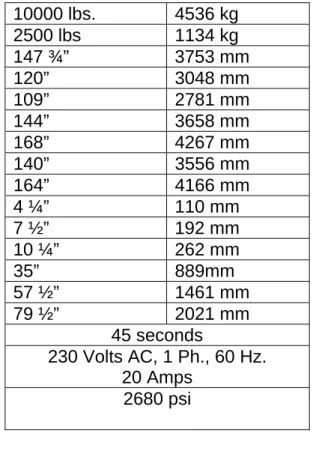
Capacity: 10000 lbs. 4536 kg
Capacity per arm: 2500 lbs 1134 kg
Overall Width: 147 ¾” 3753 mm
Width Between Columns: 120” 3048 mm
Drive-Thru Width: 109” 2781 mm
Overall Height (12 ft Model) 144” 3658 mm Overall Height (14 ft Model) 168” 4267 mm Under bar Clearance (12 ft Model) 140” 3556 mm Under bar Clearance (14 ft Model) 164” 4166 mm Height to Lowered Lift Pads 4 ¼” 110 mm Height to Lift Pad (3” Adapter): 7 ½” 192 mm Height to Lift Pad (6” Adapter): 10 ¼” 262 mm
Rear Arm Retracted Length: 35” 889mm
Rear Arm Extended Length: 57 ½” 1461 mm Maximum Lifting Height (6” Adapter): 79 ½” 2021 mm
Lift Time: 45 seconds
Power Requirements (Standard): 230 Volts AC, 1 Ph., 60 Hz. 20 Amps
Maximum Operation Pressure @ Rated Load:
2680 psi
5.0 PACKING LIST
The complete lift is contained in two (2) packages:
1. The main structural components are packed in a steel frame. 2. The remaining parts are packed in an accessory box.
5.1 Main Structural Components
1pc. - Power side tower and carriage assembly 1pc. - Slave side tower and carriage assembly 1pc. - Crossmember
1pc. - Actuator Bar w/ foam
5.2 Accessory Box
4pcs. - Locking Arm Assembly w/arm pins 2pcs. - Safety Covers w/Decals
1pc. - Hardware Package w/Packing List 1pc. - Actuator Extension
1pc. - Actuator Mounting Bracket 1pc. - Power Pack
4pc. - Arm Restraint
1pc. - Safety Release Cable 1pc. - Hydraulic Hose (Long) 1pc. - Hydraulic Hose (Short) 2pcs. - Equalizing Cable w/Hex Nuts 1pc. - ALI manual “Lifting It Right” 1pc. - Automotive Lift Safety Tips
1pc. - Automotive Lift, Operation, Inspection and Maintenance manual 1pc. - “ALI” Quick Reference Guide
1pc. - Owner’s manual
6.0 INSTALLATION REQUIREMENTS AND TOOLS
6.1 FOUNDATION
IMPORTANT: It is the user’s responsibility to provide a satisfactory installation area for the lift. Lifts should only be installed on level concrete floors with a minimum thickness of six inches (6") or 152 mm. Concrete must have a minimum strength of 4000 psi or 28 MPa and should be aged thirty (30) days prior to
installation. Please consult the architect, contractor or engineer if doubt exists as to the strength and feasibility of the floor to enable proper lift installation and operation.
A qualified person should be consulted to address seismic loads and other local or state requirements.
It is the user’s responsibility to provide all wiring for electrical hook-up prior to installation and to insure that the electrical installation conforms to local building codes. Where required, it is the user’s responsibility to provide an electrical isolation switch located in close proximity to the lift that will enable emergency stop capability and isolate electrical power from the lift for any servicing
requirements.
6.2 TOOLS
a. 16ft. Measuring Tape b. Chalk Line
c. Rotary Hammer Drill
d. 3/4” diameter Masonry Drill Bit e. Hammer
f. SAE Wrenches and Ratchet Set g. 2ft. Level h. 4ft. Level i. Crow Bar j. 12ft. Step Ladder k. Side Cutters l. Screwdrivers
m. 4” x 4” Wooden Blocks (for unpacking) n. 4 gal. Hydraulic Fluid
o. Impact Wrench p. Torque Wrench
n. Wherever LOCTITE symbol is shown, apply LOCTITE #242 on required fasteners. If fasteners are removed reapply LOCTITE before re-installing.
7.0 INSTALLATION INSTRUCTIONS
When the lift arrives on site:• Read the owner’s manual and make sure the installation instructions are fully understood.
• Check for any freight damages.
• Check the contents of the accessory and hardware boxes to make sure no parts are missing.
• Gather all the tools listed above.
7.1 UNPACKING PROCEDURE
7.1.1 Important!Place the main structural components on wooden blocks so that the steel shipping frames can be removed.
7.1.2 Remove the plastic wrapping.
7.1.3 Remove the crossmember, and the actuator bar. 7.1.4 Unbolt the steel shipping frames.
7.1.5 Lay each tower on the floor with the carriage side up.
7.1.6 Check the installation area for obstructions. (Lights, Heating Ducts, Ceiling, Floor Drains, etc.)
7.2 BAY LAYOUT
7.2.1 Prepare the bay by selecting the location of the lift relative to the walls. 7.2.2 Clear the installation area of all packaging materials to avoid trip
hazards.
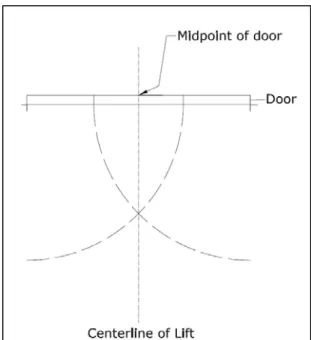
7.2.3 Measure midpoint of door.
7.2.4 Using measuring tape, scribe two arcs, equal distance from the midpoint.
7.2.5 The centerline of the lift occurs between the intersection of the arcs and the midpoint of the door.
Note: Leave any additional room for any desired aisle or work area. Recommended minimum clearance around lift is three feet (3 ft) and above lift is four inches (4”).
Ensure clearance conforms to local building and fire codes.
7.2.6 Measure the specified distance (126”) to draw a second chalk line at 90° for locating the lift towers. Refer to Figure 3.
7.2.7 The lift is centered between the door and the walls of the area.
139 ¼” (3537 mm)
108 ¼” (2749 mm)
7.3 CROSSMEMBER INSTALLATION
7.3.1 Install the cross member bracket to the two towers. While they are still on the floor.
7.3.2 Stand towers in the position shown.
½”-16UNC x 1 ½” lg. hex head bolts (6-0291) Flat Washer, ½”ID SAE (6-0248)
Lock Washer, ½”ID (6-0059) Hex Nut, ½”-13 UNC (6-0035)
Crossmember Brackets (2-2834, 2-2835) 10K Symmetric Pulley Assy (2-2971)
Slave Tower Power Tower
7.3.3 Using a stepladder, insert two 8” long screwdrivers into brackets and place crossmember on top of screwdrivers
7.3.4 Locate crossmember to the correct holes in the bracket and install fasteners.
½”-13 UNC 1” LG. HEX BOLT (6-0045) ½”-13 UNC Flat Washer (6-0248)
½” Lock Washer (6-0059) ½”-13 UNC Hex Nuts (6-0035)
7.4 SAFETY SHUT-OFF BAR INSTALLATION
The safety shut off will disconnect the power to the power pack when an
obstruction touches the padded bar or the carriages reach their maximum height. The safety shut off switch is factory pre-wired.
7.4.1 Attach the Actuator Mounting Bracket (1-1378) to the crossmember
7.4.2 Attach the Microswitch Assembly (2-2024) to the crossmember.
Note: Install bracket on Slave side.
Actuator Mounting Bracket (1-1378) ¼” NC x 3/4” lg. hex head bolt (6-0178) ¼”ID lockwasher (6-0056)
¼” NC hex nut (6-0032)
Microswitch Assembly (2-2024)
¼” NC x 1” lg. hex head bolt (6-0008) ¼”ID lockwasher (6-0056)
7.4.3 Slide the Actuator Bar through the Switch Bracket.
7.4.4 Attach the Actuator Bar to the Actuator Mounting Bracket.
7.5 ROUTING OF EQUALIZATION CABLE
7.5.1 Manually lift the carriages to the first safety latch.
7.5.2 Remove equalizing cables (1-1786) from the accessory kit
box, and 8 ½”- 13UNC nuts from a polybag in the hardware kit box. ¼” NC x 1 ½” lg. hex head bolt (6-0205)
¼”ID lockwasher (6-0056)
¼” NC hex nut (6-0032) Actuator Bar (2-2140)
7.5.3
7.5.4 Pull the cable back down on to the carriage bottom plate.
7.5.5 At the bottom of the column, remove the hitch pin, pulley pin and pulley from the base plate.
Insert the short threaded stud through the 9/16”dia. hole at the bottom of the carriage.
Pass the cable until it reaches the top of the carriage. Tighten a ½”-13UNC nut to the center of the stud, and then
firmly tighten a second nut up against it using two wrenches.
Transparent view of Carriage from Front.
Pulley Assembly (1-1898)
Head Pin (1-887) Hitch Pin, 1/8” dia. (6-1841)
7.5.6 Route equalizing cable around pulley and reassemble the pulley to the tower.
IMPORTANT – Hitch pin must be installed securely.
7.5.7 Route Cable as shown.
Route Up through column. Route around pulley.
7.5.8
7.5.9
7.5.10
7.5.11 Repeat steps for other cable. Use a wrench to hold the top of the threaded stud to prevent it from rotating.
Hand tighten (2) ½”-13 UNC nuts onto the threaded stud enough to remove all visible cable slack
Hold the top of the threaded stud using wrench.
Tighten the first nut approximately 1 ½” to tension cable.
Tighten the second nut firmly against the first one.
7.6 ARM INSTALLATION
7.6.1 Remove the four (4) 5/16”-18UNC x 3/4”LG. hex head bolts that are holding the arm pins to the arm. Install the arms on the carriages. 7.6.2 Grease and insert arm pins. Align the notch on each arm pin with the
tapped hole on the arm, and using the 5/16”-18UNC x 3/4”LG. hex head bolt removed in previous step, reinstall and tighten securely.
NOTE: Make sure the hex head bolts, 5/16” dia. x 3/4” lg. (6-0801), is lock tight into arms.
7.6.3 Insert arm restraint weldment through holes in carriage weldment. Arm restraints must pass through holes in top and bottom of carriage.
7.6.4 With carriage on the first safety position, slide the spring onto the arm restraint pin closer to the inside of the lift.
7.6.5 Insert roll pin to retain the spring.
7.6.6 Repeat the above steps for remaining Arm Assemblies and Arm Restraints.
7.7 SAFETY RELEASE CABLE ROUTING AND ADJUSTMENT
The mechanical safety automatically engages. To release the mechanical safety, you must first raise the lift approximately 2”, then pull the safety release lever down. This disengages the power side safety dog and activates the safety cable to release the slave side safety dog.
7.7.1 Install the safety release handle (1-1113) onto the power side safety dog.
7.7.2
Slave Side Power Side
Start routing here on slave side.
Pull cable out through the opening in tower and route under large pulley.
Guide the cable up under the large pulley on the power side.
Over the small pulley towards the safety dog.
7.7.3 Fix the collar of the safety release cable to the shoulder bolt on the safety dog.
7.7.4
Do not tighten fully at this stage.
7.7.5 Adjust the cable length so that both safety dogs travel from full engagement position to full release position when the safety release handle is pulled.
Tighten both wire rope clips firmly when adjustment is completed.
NOTE: Make sure shoulder bolt, 3/8” dia. x 1 ½” lg. (6-0801), is lock tight to safety dog.
Power Side Slave Side
Wrap around the Thimble (6-2074)
3/8” x 1 1/2” lg. shoulder bolt (6-0801)
(4) 5/16” ID lock washers (6-0674)
(4) 5/16” ID flat washers (6-0295) (4) 5/16”-18UNC hex nuts (6-0294) 7.8 POWER PACK INSTALLATION
7.8.1 Remove the red plastic cap located at the rear of the power pack, and install the "T" fitting located in the hardware kit.
7.8.2 Bolt power pack to the mounting bracket on the power side tower using hardware from the kit. Do not tighten.
7.8.3 Remove the filler cap from the powerpack and fill the reservoir with approximately 4.5 Gal. (18L) of ISO32 hydraulic oil (10 wt. hydraulic oil).
T-Fitting (6-1506)
(4) 5/16”-18UNC x 1”LG. hex head bolts (6-0293)
7.8.4 A certified electrician must connect the 230Volt/1Ph power to the motor.
7.9 HYDRAULIC SYSTEM INSTALLATION
7.9.1 Connect long hose to the top port on “T” fitting.
Electrical Diagram
7.9.2 Connect short hose to the other end of the “T” fitting.
7.9.3 Remove the plastic cap from the bottom of the power side cylinder and connect the short hose to the cylinder.
7.9.4
45° End of Short Hose (2-1230)
90° End of Hose
Loop the hydraulic hose up the power side tower, across the overhead and down the slave side tower.
7.9.5 Remove the plastic cap from the bottom of the slave side cylinder and connect the long hose to the cylinder.
7.9.6
90° End of Hose
Use 6 tube clamps to secure the long and short hydraulic hoses to the Towers. 1/4”-20UNC x 3/8”lg. round head screws (6-1353)
#10 x 3/8” LG. Self Tapping (6-0169)
7.10 HYDRAULIC SYSTEM BLEEDING
7.10.1 Crack the bleeder valve located at the top of both cylinders (approx. ¼ turn)
7.10.2 Power up 2”-3”. You should hear air escaping around the bleeder valve. Repeat 3 – 4 times or until only oil is coming out of the bleeder valve. 7.10.3 Tighten the bleed screw and lower the lift.
7.11 TOWER POSITIONING AND ANCHORING
WARNING! Failure to follow these instructions may cause an unsafe
operating condition.
WARNING! Before proceeding with installation, review Section 4:
Installation & Tools.
7.11.1 Determine which column is higher using a 4ft level.
7.11.2 Check if high column is level in the vertical position.
Ensure that the base plate is completely supported by shims including near the
center where it does not contact the floor.
7.11.3 Refer to Bay Layoutto ensure that the column is still in the proper position.
Place 4 ft. Level.
Place 2 ft. Level.
Note: Use shims under baseplate to level the column.
7.11.4 Prior to installing anchors, assemble the nut and washer onto anchors. A minimum of six threads must be visible below the surface of the nut. Refer to the figure below while reading through the following instructions.
7.11.5 Using a ¾” concrete drill bit and rotary hammer drill, drill ¾” holes for the anchor bolts on the high side column. Drill through the concrete floor. (In case longer anchors are required, supplied anchors can be hammered through concrete).
7.11.6 Clean out the drilling dust from the holes and hammer in the anchor bolts until they make contact with the baseplate. Hand tighten all anchor bolts.
Check that the column is level front to rear and side to side. Adjust shims as required.
7.11.7 Torque all anchor bolts to 150 ft-lbs. (203 Nm), continually checking that the column is level as you proceed.
If anchor bolts do not tighten to 150 ft-lbs. OR project more than 2 ¼” above the concrete surface due to floor slope, the concrete should be replaced by an
appropriate concrete pad. (Consult Product Manufacturer / Supplier for further details).
7.12 POSITION AND ANCHORING OF REMAINING TOWER
7.12.1 Level the low side column by shim underneath the baseplate.
Ensure that the baseplate is completely supported by shims where it does not contact the floor.
Use 4 ft. level on cross member.
Use 2 ft level on column.
NOTE:
The 3/4” × 5 ½” lg. wedge anchor bolts supplied must have a minimum embedment of 3¼” into concrete floor.
7.12.2 Refer to Bay Layout above to ensure that the column is still in the proper position.
7.12.3 Prior to installing anchors, assemble the nut and washer onto anchors. A minimum of six threads must be visible below the surface of the nut. Refer to the figure below while reading through the following instructions.
7.12.4 Using a ¾” concrete drill bit and rotary hammer drill, drill ¾” holes for the anchor bolts on the high side column. Drill through the concrete floor. (In case longer anchors are required, supplied anchors can be hammered through concrete).
7.12.5 Clean out the drilling dust from the holes and hammer in the anchor bolts. Hand tighten all anchor bolts.
Check that the column is level front to rear and side to side. Adjust shims as required.
7.12.6 Torque all anchor bolts to 150 ft-lbs. (203 Nm), continually checking that the column is level as you proceed.
If anchor bolts do not tighten to 150 ft-lbs. OR project more than 2 ¼” above the concrete surface due to floor slope, the concrete should be replaced by an appropriate concrete pad. (Consult Product Manufacturer / Supplier for further details).
7.12.7 Verify that the entire lift is level both horizontally and vertically to ensure optimum lifting performance. NOTE: Perform a monthly inspection and torque all anchor bolts to 150 ft-lbs. (203 Nm).
7.13 SAFETY SHUT-OFF BAR ADJUSTMENT
7.13.1 When the lift is fully installed, leveled and
operational, extend the carriages to their full upper limit.
7.13.2 Lower the carriages about ¼” to ½”.
7.13.3 Attach a ¼ bolt and nut to actuator extension.
¼” NC x 2” lg. hex bolt (6-0741)
Actuator extension (1-1379) ¼” NC hex nut (6-0032)
NOTE:
The 3/4” × 5 ½” lg. wedge anchor bolts supplied must have a minimum embedment of 3¼” into concrete floor.
7.13.4 Bolt the Actuator Extension onto the open end of actuator bar.
7.13.5 Adjust the ¼” NC x 2” lg. hex bolt so that the end of the bolt is in contact with the carriage. Tighten the ¼” NC hex nut on the bolt.
Actuator Extension
Actuator Bar
¼” NC x 1 ¼” lg. hex head bolts (6-0027)
¼” ID lockwashers (6-0056) ¼” NC hex nuts (6-0032)
7.14 FINAL CHECK OF ASSEMBLED LIFT
1. Final dimension check after anchoring 2. Check for hydraulic leaks.
3. Ensure cables are properly routed and free from obstructions.
4. Check jam nuts on cables are tightened.
5. Check that LOCTITE has been applied to all hardware where required.
6. Check adjustment of safety release cable to ensure both sides
7. working properly.
8. Re-check level of towers. 9. Check torque of anchor bolts.
10. Check all fasteners, tighten if necessary.
11. Check shut off at top of stroke to ensure lift shuts off. 12. Check proper operation of arm restraints.
13. Operate lift to full stroke then lower to ground while checking for proper functionality.
14. Check proper operation of arm restraints.
15. Ensure Customer Care Kit is complete and given to operator. 16. Operation Manual
17. ANSI / ALI Lift It Right Manual 18. ANSI / ALI Safety Tip Card
19. ANSI / ALI ALIS Safety Requirements for Installation 20. ANSI / ALI Quick Reference Guide
21. Train end user on operation of lift.
8.0 OPERATING INSTRUCTIONS
Read and understand all safety and operation labels on the lift. Refer to the "Lifting it Right" manual and "Safety Tips" card supplied to you for additional important instructions and information.
NOTE: Some vehicles may have the manufacturer's Service Garage Lift Point locations identified by triangle shape marks on its undercarriage (reference SAE J2184). Also, there may be a label located on the right front door lock face showing specific vehicle lift points. If the specific vehicle lift points are not
identified, refer to the "Typical Lift Points" figure below or the ANSI/ALI Lift Point Guide included with your lift.
1. Position arms to drive-thru position (see figure 49).
2. Refer to supplied literature prior to loading vehicle. Center the vehicle between the lift post.
3. Only lift the vehicle on the manufacturers recommended lift points. Refer to supplied lift points guide (reference ANSI/SAE J2184-1992).
4. Locate lift pads on auto manufacturer's recommended lift points. Once you have correctly positioned the lift arms, ensure that all arm restraints are properly engaged.
5. Raise the vehicle by pushing the "UP" button on the powerpack until the vehicle's suspension has left the ground.
6. Inspect to make sure there are no interference with any objects and for proper engagement of the lifting pads.
7. Shake vehicle moderately by pushing on either the front or rear bumper. Visually inspect the lifting pads again. If the vehicle starts slipping on the lifting pads, or otherwise appears unstable on the lift, you have positioned the swing arms and adapters incorrectly. Carefully lower the lift and start over.
8. When satisfied, continue lift the vehicle to the desired working height, lower onto the mechanical safety using the lowering lever.
9. Once vehicle is ready to be removed, raise lift so that the mechanical safety can be released. Pull down and hold the mechanical safety release lever, then press the hydraulic lowering lever until the lift has fully
collapsed to the grounds and the arm restraints are disengaged.
10. Swing the lift arms to the drive-thru position prior to moving the vehicle.
8.1 OPERATION TEST WITH VEHICLE
Prior to starting this section, please refer to Section 2 of this manual for important safety instructions.
1. Lower lift to ground.
2. Drive vehicle on to lift and locate the arms as per the “Lift it Right” manual. 3. Raise lift to and lower onto 3-4 lock positions during full rise to ensure all
locks are working correctly.
4. Re-adjust cables if necessary while vehicle is on. 5. Check lowering speed and smooth decent rate. 6. Lower lift to ground and drive vehicle off lift.
If any problems occur during the final checkout or operation of the lift please contact customer service at 1-800-268-7959
9.0 MAINTENANCE GUIDELINES
9.1 SAFETY INSTRUCTIONS
Refer to Section 2 for more Safety Instructions. Read operating and safety manuals before using any lift. Do not operate a lift that has been damaged or is in disrepair. Proper inspection and maintenance is necessary for safe operation.
9.2 PERIODIC MAINTENANCE
DAILY:
1. Check all hydraulic lines and fittings for pinch points , damage , cracks or leaks 2. Check all electrical wiring for pinch points , cracks or damage
3. Check all moving parts for uneven or excessive wear
4. Repair or replace all damaged, defective, worn or broken components immediately. 5. Check the telescopic arms for movement. Clean any grease or oil from the lifting
adapters.
6. Raise and lower the lift at the beginning of each shift, without a vehicle on, to verify the lift is leveled and operating properly.
EVERY TWO MONTHS:
1. Clean and re-grease slide block channels inside of both columns 2. Grease arm pins
3. Lubricate safety dogs and check safety release cable adjustment 4. Check arm restraints and lubricate
5. Check anchor bolts and re-torque if required
EVERY FOUR MONTHS:
1. Dismantle and clean inner arms 2. Lubricate cable pulleys
3. Check equalizing cable adjustment
EVERY YEAR:
1. Inspect lift as per Automotive Lift Operation, Inspection and Maintenance (ALOIM)
EVERY TWO YEARS:
1. Change hydraulic fluid
LUBRICATION:
Where grease is required > multi-purpose lithium grease
Where lubricating oil is required > multi-purpose SAE 30 lubricating oil Where hydraulic oil is required > ISO 32 10W - non detergent hydraulic oil
NOTE: If the lift locks, while in the fully raised position this will indicate that the
hydraulic system has not been inspected or maintained as recommended. This is a safety back-up system. If you are unclear call your local
10.0 WIRE ROPES
• Wire ropes are critical to safe and reliable performance of your lift.
• Cables are expendable items and should be replaced as a set.
10.1 WIRE ROPE CONDITION GUIDE
(Pictures above are of a 4-Post Lift, conditions still apply to 2-Post Lifts)
Typical good cable
Rust on sheave stack and ropes Corrugated sheave groove
Cable with necking Broken wires
10.2 WIRE ROPE REPLACEMENT CRITERIA:
If any cable is found to be in need of replacement, the entire cable set, pulleys and safety rollers must be replaced
immediately. See 10.1, cable conditions guide.
In the following table, "lay" means the distance measured along a line parallel to the axis of the rope in which the strand makes one complete turn about the axis of the rope, or the wires make a complete turn about the axis of the strand.
10.3 WIRE ROPE INSPECTION
Inspect wire rope cables for wear or damage. Wipe cables with a rag to detect hard to see small broken or frayed cable strands. See chapter 9.2, Fig.75 and ANSI/ALI ALOIM standard.
The wire rope must be removed from service if one or more of the following criteria are met:
1. More than six randomly distributed broken wires in one rope lay or 6×d length. 2. More than three broken wires in one strand in one rope lay or 6×d length. 3. Three or more broken wires at rope terminations.
4. One outer wire broken at the point of contact with the core of the rope which has worked its way out of the rope structure and protrudes or loops out from the rope structure
5. Heavy rusting, corrosion, or pitting. A light surface corrosion on outer wires is normal.
6. Wear or scraping of one-third of the original diameter of outside individual wires
7. Excessive stretch. It is normal for new cable to require adjustment during “break-in”, after which small periodic adjustments may be required. However, if a cable that has been in service for 6 months should suddenly require frequent adjustments or has used all the cable adjustment available, all cables must be replaced immediately.
8. Deformed strands, kinking, crushing, bird-caging, or any other damage or distortion of wire rope structure
9. Variations in diameter (necking) or any change from normal appearance
10. Reductions from nominal diameter of more than 1/32" (for cables 3/8" to 1/2" dia. inclusive)
10.4 WIRE ROPE LUBRICATION
Lubricate wire ropes with lift in both lowered and raised position, by spraying them with wire rope lubricant (i.e. 2001 MONOLEC®) and wiping the cable down.
10.5 WIRE ROPE ADJUSTMENT
Adjust cables if lifting is uneven or lift is not level (See chapter 7.15.3). Never make adjustments with weight on lift. If running out of adjustment threads, cables need to be replaced. Do not add washers or other spacers to re-use previously used adjustment threads.
Wire rope tension adjustment should be performed when installing the lift and every three months.
11.0 MAINTENANCE SCHEDULE
Maintenance and Training
Performed Date By Notes
12.0 TROUBLESHOOTING GUIDE
PROBLEM REASON SOLUTION
Power Pack (Motor) not running.
Bad Fuse or Circuit breaker. Replace bad fuse or reset circuit breaker.
Incorrect voltage to motor. Provide proper voltage to motor. Improper wiring. Have certified electrician check
wiring. Power Pack up switch not
functioning.
Replace Power Pack up switch. Overhead Mircoswitch not
functioning.
Replace overhead Microswitch. Power Pack motor burned out. Replace motor.
Power Pack (Motor) runs but lift does not go up.
Low oil level. Fill reservoir with proper hydraulic oil.
Oil valve remains open. Repair or replace oil valve. Pump sucking air. Tighten all fittings and suction
lines. Lift goes up slowly or oil
coming out from filler cap.
Air in hydraulic fluid lines Bleed hydraulic lines (Call installer).
Lift doesn’t come down. Dirt in directional valve Call installer to clean valve. (Do not attempt to open hydraulic lines unless vehicle is secure) Safety Dog does not engage. Safety Dog jammed. Oil or replace pin to free Safety
Dog.
Check or replace spring. Safety Dog does not
disengage.
Safety dog is being limited Check for any obstructions. Lift goes up unlevel. Equalizing cables are loose. Adjust equalizing cables to
correct tension.
Floor unlevel. Shim lift to make towers level. (Do not exceed ½” of shimming). Lift goes up with chatter or
does not fully rise.
Low oil level. Fill reservoir to correct level with proper hydraulic oil.
Air in hydraulic fluid lines/cylinder.
Bleed hydraulic lines. (Call installer).
Anchor bolts do not stay tight. Holes are too large. Relocate lift using proper size drill bit.
Incorrect concrete floor specification (Thickness and holding strength).
Break existing floor and pour new pad for lift.
Noticeable Deflection of Arm or arm dragging on floor.
Lift out of plumb. Plumb columns.
Unlevel floor. Replace floor of shim columns. Worn arm or carriage holes. Replace parts.
Worn carriage slide blocks. Replace side blocks. Bent arm (Overloaded). Replace arm. Also check
13.0 LOCK OUT AND TAG OUT INSTRUCTIONS
IMPORTANT: This machine does not have integral devices that will isolate the electrical, pneumatic, stored and hydrualic energy source. Appropriate isolation or blocking devices must be used that have the provisions to be switched in the off position and locked in that position.
ALL MAINTANANCE AND SERVICE MUST BE PERFORMED BY A QUALIFIED PERSON.
ALL MAINTANANCE AND SERVICE MUST BE PERFORMED WITH THE LIFT UNLOADED.
IT IS THE SHOP OWNERS RESPONSIBILITY TO ENSURE ENERGY ISOLATING DEVICES ARE:
• Accessible
• Conveniently located to facilitate the application of lockout devices during service and maintenance
• Located outside any hazardous area.
• At a convenient manipulating height (i.e. not overhead, on ladders or under machinery)
• Adequately labeled or marked. Identification shall include machine ID, energy type and magnitude.
• Capable of being locked or otherwise secured in an effective isolating position.
Effective hazardous energy control procedures will protect employees during machine and equipment servicing and maintenance where the unexpected energization, start up or release of stored energy could occur and cause injury, as well as while working on or near exposed de-energized electrical conductors and parts of electrical equipment. Hazards being guard against include being caught in, being crushed by, being struck by, being thrown from, or contacting live electrical circuits/parts.
In preparation for lockout, an initial survey must be made to locate and identify all energy isolating devices to be certain which switch, valve, or other energy
isolating devices apply to the machine / equipment to be locked out. More than one energy source (electrical, hydraulic, pneumatic, or others) may be involved.
13.1 SHUT DOWN PROCEDURE:
• Notify all affected employees that a lockout or tagout system is going to be utilized and the reason for. The authorized employee shall know the type
and magnitude of energy that the lift utilizes and shall understand the associated hazards.
• ELECTRICAL: Located at the user control panel, press the “E-STOP” button to disconnect the raise and lower functions.
13.2 ISOLATION AND VERIFICAITON PROCEDURES:
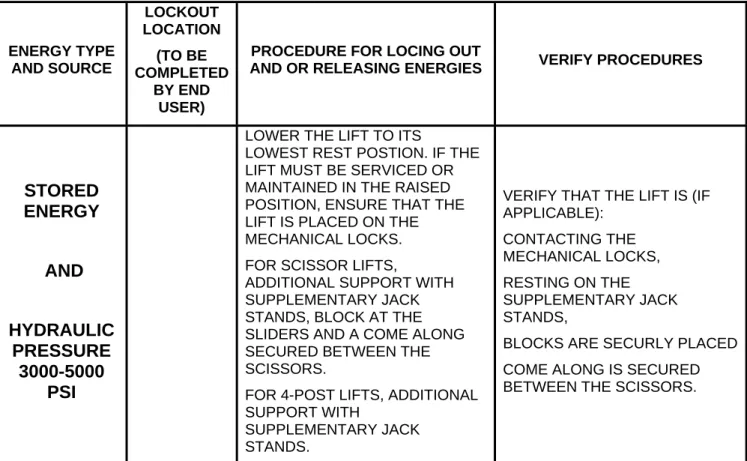
Table 1: ISOLATION AND VERIFICATION PROCEDURES:
ENERGY TYPE AND SOURCE LOCKOUT LOCATION (TO BE COMPLETED BY END USER)
PROCEDURE FOR LOCING OUT
AND OR RELEASING ENERGIES VERIFY PROCEDURES
STORED ENERGY AND HYDRAULIC PRESSURE 3000-5000 PSI
LOWER THE LIFT TO ITS
LOWEST REST POSTION. IF THE LIFT MUST BE SERVICED OR MAINTAINED IN THE RAISED POSITION, ENSURE THAT THE LIFT IS PLACED ON THE MECHANICAL LOCKS. FOR SCISSOR LIFTS,
ADDITIONAL SUPPORT WITH SUPPLEMENTARY JACK STANDS, BLOCK AT THE SLIDERS AND A COME ALONG SECURED BETWEEN THE SCISSORS.
FOR 4-POST LIFTS, ADDITIONAL SUPPORT WITH
SUPPLEMENTARY JACK STANDS.
VERIFY THAT THE LIFT IS (IF APPLICABLE): CONTACTING THE MECHANICAL LOCKS, RESTING ON THE SUPPLEMENTARY JACK STANDS,
BLOCKS ARE SECURLY PLACED COME ALONG IS SECURED BETWEEN THE SCISSORS. ELECTRICAL ENERGY IS STILL PRESENT AT THE LIFTS
ELECTRICAL PANEL WHEN THE EMERGENCY STOP BUTTON IS PRESSED. ELECTRICAL ENERGY MUST BE TURNED OFF AND ISOLATED AT THE DISCONNECT PANEL PRIOR TO PERFORMING SERVICE OR MAINTANANCE ON THE LIFT.
ELECTRICAL 240VOLTS
AT THE LIFT, PRESS THE EMERGENCY STOP BUTTON COMPLETELY TO DE-ENERGIZE THE CONTROL BUTTONS (IF APPLICABLE).
AT THE DISCONNECT PLANEL, PLACE THE DISCONNECT HANDLE IN OFF POSITION. ATTACH A MULTIPLE LOCUOUT DEVICE. LOCK AND TAG.
DANGER: LINE SIDE OF DISCONNECT REMAINS ENERGIZED
ATEMPT TO RESTART THE SYSTEM, THE SYSTEM MUST NOT START. VISUALLY VERIFY OPEN DISCONNECTS AND LOCKING DEVICE INSTALLED.
PNEUMATIC UPTO 160PSI
SLOWLY CLOSE LOCKOUT VALVE TO RELEASE AIR PRESSURE GRADUALLY. ATTACH MULTIPLE LOCKOUT DEVICE, LOCK AND TAG.
DANGER: LINE SIDE OF DISCONNECT REMAINS PRESSURIZED
VERIFY THE VALVE IS CLOSED AND LOCKOUT DEVICE IS PROPERLY ATTACHED. OPERATE THE PNEUMATIC SYSTEM TO ENSURE THE SYSTEM IS DE-ENERGIZED. IT MAY BE NECESSARY TO BLEED THE SYSTEM OF REMAINING COMPRESSED AIR, THIS CAN BE PERFORMED AT THE BASE OF THE WATER SEPARATOR BOWL.
13.3 RETURNING TO SERVICE:
• Check the lift and the immediate area around the lift to ensure that nonessential items,, tools and parts are removed and that the lift components are operationally intact.
• Check the work area to ensure that all employees have been safely positioned or removed from the work area.
• Notify all employees that the lockout/tagout is going to be removed and the lift is going to restarted.
• Remove the lockout/tagouts in the reverse order as the installation. • Verify the proper operation of the equipment.
• Notify affected employees that the maintenance/service is completed and the machine is ready for operation.
14.0 EMERGENCY OPERATION:
If the lift becomes inoperative in the raised position, it is best to wait until the electrical power is restored before lowering the vehicle. However, if it’s critical to safety that the lift be lowered, the following steps should be taken.
NOTE: Safely performing this process requires 3 people. All personnel should stay clear of the path of the lift. All tools and other non-secured items should be removed from the surface of the ruways.
1) Survey the area surrounding the lift; remove any items and personnel from area before proceeding with this procedure.
2) Perform the appropriate lockout/tag out procedure on the electrical energy.
3) Use a second person standing at a safe distance away from the lift to keep watch on the area, lift, vehicle and other personnel throughout the process. This person should signal the person performing the procedure to stop if necessary.
4) Use a caution tape or similar to barrier the area around the lift to avoid personnel from accidently entering the area while this process is being performed.
5) Do not proceed with this procedure if you are unfamiliar with the lift or its function.
14.1 IF THE MECHANICAL LOCKS ARE NOT ENGAGED:
1) Pull safety release lever simultaneously pressing the descent lever on the powerpack.
2) Keep a close eye on the movement of the lift and the position of the vehicle; release descent lever if any abnormal movement is detected. 3) Continue until the lift is fully lowered.
4) Once power is restored follow the lockout/tag out procedure to return the lift back into service.
14.2 IF THE MECHANICAL LOCKS ARE ENGAGED:
Various methods can be used to raise the lift in order to get sufficient clearance to disengage the mechanical locks. The safest method would employ temporary electrical power to the lift using a portable power generator. Any electrical
connections should be done by a licensed electrician; lockout/tag out procedures should also be employed at this time.
This process should only be performed by a trained professional. Contact customer service or a local service professional for further assistance.
WARNING: DO NOT LOOSEN OR REMOVE HYDRAULIC CONNECTIONS OR FITTINGS UNDER PRESSURE. SERIOUS INJURY OR DEATH COULD OCCUR.
15.0 PARTS LIST
15.1 LIFT ASSEMBLY
REPLACE WORN, DAMAGED OR BROKEN PARTS WITH PARTS APPROVED BY THE ORIGINAL EQUIPMENT MANUFACTURER ONLY
Item# Part # Description Qty. 1 4-1378 TOWER ASSEMBLY POWER SIDE 1 2 4-1379 FORMED CARRIAGE WELDMENT 2
3 2-0772 SLIDER BLOCK 4
4 2-2971 10K SYM. EQUALIZING PULLEY ASSY. 2 5a 2-2835 SYMMETRIC CROSSMEMBER BRKT 1 5b 2-2834 SYMMETRIC CROSSMEMBER BRKT 1
6 2-2323 CROSSMEMBER CHANNEL 1 7 4-1380 TOWER ASSEMBLY SLAVE SIDE 10K 2N1 12FT 1
8 1-2012 ADAPTER HOLDER 2
9 6-0056 Lock Washer, 1/4" I.D. 10 10 6-1353 Round HD. MACH. Screw 1/4"-20 x 3/8" LG. 10 11 1-1378 ACTUATOR MOUNTING BRACKET 1 12 6-0178 Hex Bolt, ¼" x ¾" LG. 1 13 6-0032 Hex Nut, 1/4"-20UNC 7 14 2-2024 Microswitch Assembly 1 15 2-1143 LIMITING SWITCH BRACKET 1
16 6-0916 Microswitch 1
17 6-1403 Electrical Utility Box 1 18 6-1133 Cable Connector 1 19 6-1173 Elec. Cable 12/3 x 117" LG. 1 20 6-1466 6/32 Screw (Electrical Box) 2 21 2-1240 Actuator Bar with Foam 1
22 1-1439 ACTUATOR BAR 1 23 6-1404 Foam Guard 1 24 6-0205 Hex HD. Bolt ¼" NC x 1 ½" LG. 1 25 1-2143 ACTUATOR EXTENTIONS 1 26 6-0027 Hex HD. Bolt ¼" NC x 1 ¼" LG. 2 27 6-0741 Hex HD. Bolt ¼"NC x 2" LG. 1 28 6-0069 Shoulder Bolt, 3/8" DIA. X 5/8" LG. 2 29 6-0294 HEX NUT, 5/16-18 UNC 6 30 1-1116 SAFETY CABLE PULLEY 2 31 6-1379 Wedge Anchor 3/4" x 5 1/2" LG. (c/w Washer & Nut) 10 32 6-2055 Power Pack, 208-230 V, 1 PH 1 33 6-0295 FLAT WASHER, 5/16" I.D. 4 34 6-0674 LOCK WASHER, 5/16 I.D. 4 35 6-0293 Hex Bolt, 5/16"-18UNC x 1" LG. 4 36 6-0248 Flat Washer, ½" ID SAE 16 37 6-0045 Hex HD Bolt, 1/2"-13UNC x 1" LG 8 38 6-0059 Lock Washer, 1/2" 16 39 6-0035 NUT, 1/2-13 UNC, HEX 16 40 6-0291 Hex Bolt,1/2"-13UNC X 1 1/2 LG. 8 41 0-0204 Safety Cover c/w Decals, Power Side 1 42 0-0203 Safety Cover c/w Decals, Slave Side 1 43 2-1580 Stack Pad Adapter - 6" 4 44 1-3280 Stack Pad Adapter - 3" 4 45 1-1113 SAFETY RELEASE HANDLE 1
46 6-1135 Plastic Knob 1
47 1-2040 HYDRAULIC HOSE (12FT) 1 1-2004 HYDRAULIC HOSE (14 FT) 1
48 2-1230 SHORT HYD. HOSE ASS'Y 1 49 6-1111 Serial Number Plate 1 50 4-1381-6 Symmetric Arm Assembly (Stack Pads) 4 54 2-2942 Arm Restraint Weldment 4 55 1-4033 Spring, Arm Restraint 4 56 9-0114 Spring Pin, 4.5mm x 30mm 4 57 1-3278 Stack Pad Assembly 4 58 6-3039 Lift Operations Decal 1 59 6-1759 Electrical Cable Clip, 5/8" ID 3 60 6-0536 TUBE CLAMP, 1/2" 6 61 1-2039 Equalizing Cable - 12 ft. 2 1-2003 Equalizing Cable - 14 ft. 2 62 1-2058 Safety Release Cable 1 63 6-0008 Hex Bolt, ¼" x 1" LG. 2
15.2 TOWER ASSEMBLY
Item# Part # Description Qty. 1 4-1012 TOWER WELDMENT POWER 1 2 3-0621 Hydraulic Cylinder Assembly (PATRIOT) 1
3 4-1379 FORMED CARRIAGE WELDMENT 1
4 6-1510 Flow Control 1 5 6-2095 Male Nipple, ¼" NPT 1 6 2-0772 SLIDER BLOCK 4 7 6-0000 Grease Nipple 2 8 1-1898 PULLEY ASSEMBLY 1 9 1-1887 HEADED PIN 1
10 6-1841 Hitch Pin, 1/8" DIA. 1
11 2-1901 SAFETY DOG 1
12 6-3965 MACHINE SCREW, #8 X 1" LG 1
13 1-1115 SAFETY SPRING 1
14 6-0206 Shoulder Bolt, 3/8" DIA. X 1" LG. 2 15 1-0415 SAFETY CABLE PULLEY 1 16 1-1116 SAFETY CABLE PULLEY 1
17 1-2657 SHIM SLIDER BLOCK 6
18 6-1766 Capacity Decal 1
19 1-2337 SAFETY LOCK PIN 1
20 6-2445 Snap Ring ¾" EXT 2
15.3 CROSSMEMBER PULLEY BRACKET ASSEMBLY
Item# Part # Description Qty. 1 1-4067 CROSSMEMBER BRACKET COVER 1 2 1-3178 COMMON PULLEY PIN 1 3 6-0978 CENTER PIN, 1/8 DIA. X ½ LG. 1 4 6-0738 FLAT WASHER 3/4" SAE 6
5 1-3495 CABLE RETAINER 2
6 1-1898 PULLEY ASSEMBLY 2 7 1-1626 CROSSMEMBER PULLEY PIPE 1-3/4” LG. 1
15.4 LIFTING ARM ASEMBLY
Item# Part # Description Qty. 1 3-1136 LONG OUTER ARM WELDMENT 1 2 3-1128 LONG INNER ARM WELDMENT 1
3 2-1594 ARM PIN 1
4 6-0423 Hex Bolt, 5/16" - 18UNC x ¾" LG. 1 5 6-0062 Flat Washer, 3/8" ID SAE 1 6 6-0058 LOCK WASHER, 3/8" 1 7 6-0030 Hex Bolt, 3/8 UNC x ¾" LG. 1 8 6-3369 3/8” Nylon Jam Nut 1 9 1-3278 STACK PAD ASSEMBLY 1
Item Part # Description Qty 1 6-2055 Power Pack, 208-230V, 1 PH 1
6-2665 Power Pack, 208-230V, 3 PH
2 6-3039 “Lift Operation” Decal 1 3 6-0294 Hex Nut, 5/16”-18 UNC 4 4 6-0674 Lock Washer, 5/16” I.D. 4 7 6-2095 Male Nipple, ¼” NPT 2 8 6-3666
6-4083
Bleeder Valve (Holmac) Bleeder Valve (HWF Eagle)
2 2
9 6-1510 Flow Control 2
11 6-3162 6-3914
Gland & Piston Seal Kit (Holmac Cylinder) Gland & Piston Seal Kit (HWF Eagle Cylinder)
2 2 12 6-0295 Flat Washer, 5/16” I.D. 4 13 6-0293 Hex Bolt, 5/16”-18 UNC x 1” LG. 4
14 6-1506 Branch Tee 1
15 1-2040 Hydraulic Hose (12 ft) 1 1-2004 Hydraulic Hose (14 ft) 1 16 2-1230 Hydraulic Hose (Short) 1 3-062101 Cylinder Assembly (Not INCL. Flow Control) * 3PH Power Pack Includes the Following (Not Shown)
* 6-1575 Contactor Box 1 * 2-1130 Contactor Bracket 1 * 1-1369 Cover Plate 1 * 6-0008 Hex Bolt, ¼” –NC x 1” LG 2 * 6-0056 Lock Washer, ¼” 4 * 6-0032 Hex Nut, ¼” – NC 2 * 6-0094 Strain Relief 2 * 8-0287 Cable, 14/4 2 ft.
46.832.17.0004 230 V / 1 PH / 60 HZ
Item Part # Description
Qty
1 6-3442 PUMP 6.7G, 17 GEAR 1
2 6-3443 SUCTION PIPE 3/8” 1
3 6-3444 SUCTION FILTER 3/8” FEMALE 15 L/MIN 1
4 6-3445 RETURN PIPE 1
5 6-3446 PLASTIC TANK 12L 1
6 6-3447 MOTOR SHAFT COUPLING PUMP 1
7 6-3448 MANUAL VALVE 1
8 6-3452 START UP VALVE 1
9 6-3449 TANK BRACKET WITH SCREWS 1
10 6-3450 MOTOR BRACKETS 1
11* 6-3451 PUSH BUTTON WITH MICROSWITCH
#6-2055 (AB-1381) 208-230V/1PH/60Hz #6-2665 (AD-1044) 208-230V/3PH/60Hz
Item Part # Description Qty 1 6-1087 VALVE CARTRIDGE CHECK 1 2 6-2136 LABEL INSTALLATION AUTOHOIST 1 4 6-1376 BREATHER CAP & BLADDER 1 6 6-2139 MOTOR AC 208-230V, 2HP/1PH/60Hz, BLK 1 6-1079 MOTOR AC 208-230V, 2HP/3PH/60Hz, BLK 1 7 6-2149 LABEL WARNING AUTOHOIST 1 9 6-2151 SPRING 0.480" X 0.063" X 0.42" COMP 1 10 6-2152 RETURN HOSE 3/8" ID X 21.5" 1 11 6-2153 COMPRESSION TUBE NUT 1 12 6-2154 COMPRESSION TUBE SLEEVE 1 13 6-2155 ENDHEAD UNIVERSAL AUTOHOIST 1 14 6-1958 PUMP ASSY 2.5 CC/REV, SHORT SLINE 1 15 6-1319 RELIEF ASSEMBLY AC 1PH FENNER 1 16 6-0880 VALVE CARTRIDGE RELEASE MANUAL 1 17 6-2156 WIRING ASSEMBLY AC 1PH FENNER 1 18 6-1090 BOLT 5/16"-24 X 3.00" TORX G8 2 19 6-0774 COUPLING SAE 9T-20/40 1.260" 1 20 6-2157 PLUMBING PLUG 9/16" SAE 1 21 6-2158 SEAL SHAFT 0.500" X 1.00" X 0.25" 1 22 6-2159 WASHER 0.338" X 0.625" X 0.060" STEEL 1 24 6-2161 PLUMBING PLUG 3/8" NPT 1 25 6-2162 PLUMBING MAGNET 1 27 6-2164 SCREW TAPTITE M6 X 1.0 12MM TORX 2 28 6-2165 COVER ASSY SUCTION 1 29 6-2166 PLUMBING CLAMP HOSE ADJ. INLET 1 30 6-1392 BOLT 5/16"-18 X 1.00" SHCS 1 31 6-2167 NUT 3/4"-16 X 1" HEX X 0.25" STEEL 1 32 6-2168 WASHER 3/4" INT. TOOTH LOCK 1 33 6-0776 BRACKET - HANDLE ASSY REL BLACK 1 34 6-2169 BOLT M6 X 1.0 35MM SOC HD 4 35 6-2170 WASHER 1/4" LOCK HI-COLLAR 4 37 6-1091 BOLT #12-24 X 0.50" HEX HD WASHER 4 38 6-0786 PLUMBING ASSY INLET 17.24 (3) 1 39 6-1089 RELIEF VALVE CAP ASSEMBLY 1 40 6-1399 TANK PLASTIC 6.7 OS 22.50" BLK 1 41 6-1846 CABLE TIE 8" LONG WHITE 1 42 6-0875 O-RING 2-348 BUNA 1
16.0 AVAILABLE ACCESSORIES
Flip Pad Accessories
Poly Pad Adapter (set of 4)
High Lift Truck Extension Mid-Rise / 2-Post (set of 2)
3000 lb max capacity each 2500 lb max capacity each
Stack Pad Accessories
Stack Pad Adapter w/ Checker Plate Top
(set of 4)
Stack Pad Ass’y w/ 3” &6”
Adapters (set of 1)
3000 lb max capacity each 3000 lb max capacity each 1 ½” Stack Pad
Assembly Kit
4 ½” Stack Adapter Kit
3000 lb max capacity each 3000 lb max capacity each
Common Accessories
Tool Tray Kit for 2-Post
Secondary Adapter Pad Kit (Used On Outer Arms)
3000 lb max capacity each Air / Electric
Service Station for 2-Post & 4-2-Post (90-110 psi 110 Volts Required) Foam Door Protector Kit 24” Tower Extension
Accessories may not be available for all models. Contact supplier for availability and part numbers.