An Enhanced Brain Storm Sine
Cosine Algorithm for Global
Optimization Problems
CHUNQUAN LI 1,2, ZU LUO1, ZHENSHOU SONG 1, FENG YANG1, JINGHUI FAN1, AND PETER X. LIU 1,2, (Senior Member, IEEE) 1School of Information Engineering, Nanchang University, Nanchang 330029, China
2Department of Systems and Computer Engineering, Carleton University, Ottawa, ON K1S 5B6, Canada
Corresponding author: Jinghui Fan ([email protected])
This work was supported in part by the National Natural Science Foundation of China under Grant 61503177, Grant 81660299, and Grant 61863028, in part by the China Scholarship Council through the State Scholarship Fund under Grant 201606825041, in part by the Science and Technology Department of Jiangxi Province of China under Grant 20161ACB21007, Grant 20171BBE50071, and Grant 20171BAB202033, and in part by the Education Department of Jiangxi Province of China under Grant GJJ14228 and Grant GJJ150197.
ABSTRACT The conventional sine cosine algorithm (SCA) does not appropriately balance exploration and exploitation, causing premature convergence, especially for complex optimization problems, such as the complex shifted or shifted rotated problems. To address this issue, this paper proposes an enhanced brain storm SCA (EBS-SCA), where an EBS strategy is employed to improve the population diversity, and by combining it with two different update equations, two new individual update strategies [individual update strategies (IUS): IUS-I and IUS-II] are developed to make effective balance between exploration and exploitation during the entire iterative search process. Double sets of benchmark suites involving 46 popular functions and two real-world problems are employed to compare the EBS-SCA with other metaheuristic algorithms. The experimental results validate that the proposed EBS-SCA achieves the overall best performance including the global search ability, convergence speed, and scalability.
INDEX TERMS Sine cosine algorithm (SCA), brain storm optimization (BSO), metaheuristic algorithm, global optimization.
I. INTRODUCTION
In the real world, many scientific and engineering prob-lems are inevitably transformed into global optimization problems. To solve global optimization problems, many researchers have developed various optimization algorithms. In general, those optimization algorithms are divided into traditional mathematical optimization algorithms and meta-heuristic algorithms. Traditional mathematical optimization algorithms such as gradient descent mathematical [1] are usu-ally employed to solve convex optimization problems. How-ever, they are not suitable for solving complex optimization problems that are highly nonlinear, non-differentiable, and non-convex. Therefore, researchers are depending on meta-heuristic algorithms to address such complex optimization problems.
The associate editor coordinating the review of this manuscript and approving it for publication was Honghao Gao.
Metaheuristic algorithms are competitive approaches that can conduct stochastic search and achieve the optimal solu-tion by simulating various biological behaviors or physical phenomena. Since metaheuristic algorithms own simple con-cepts, easy implementation, and promising performance in a variety of scientific and engineering applications, they are becoming increasingly prevalent.
In accordance with different inspiration sources, meta-heuristic algorithms can be normally separated into four groups. The first group is referred to swarm intelligence algorithms inspired by the social behaviors of animal, such as ant colony optimization (ACO) [2], particle swarm opti-mization (PSO) [3], artificial bee colony (ABC) [4], firefly algorithm (FA) [5], bat algorithm (BA) [6], and fruit fly optimization algorithm (FOA) [7]. The second is enlightened by the phenomenon of natural evolution such as the genetic algorithm (GA) [8], culture algorithm (CA) [9], differential evolution (DE) [10], and covariance matrix adaptation evolu-tion strategy (CMA-ES) [11]. The third group is motivated by VOLUME 7, 2019
2169-35362019 IEEE. Translations and content mining are permitted for academic research only.
physic rules in the real world such as the simulated annealing (SA) [12], gravitational search algorithm (GSA) [13], and water cycle algorithm (WCA) [14]. The fourth comes from other source of inspirations like the brain storm optimiza-tion (BSO) [15], harmony search (HS) optimizaoptimiza-tion algo-rithm [16], flower pollination algoalgo-rithm (FPA) [17], state of matter search (SMS) [18], fireworks algorithm (FWA) [19], Negatively Correlated Search (NCS) [20], and estimation of distribution algorithm (EDA) [21].
However, none of the metaheuristic algorithms can provide excellent performance for solving all optimal problems so far. Some metaheuristic algorithms can conduct much better for some optimal problems, but worse for other problems. For instance, PSO performs well on unimodal problems, however, it is prone to encounter premature convergence when dealing with multimodal problems. To enhance the adaptability of metaheuristic algorithms to different problems, a variety of modified metaheuristic algorithms are developed, such as MIIBSO [22] and SBSO-PQLS [23] that can provide the different strategies for enhancing the performance of the original BSO. On the other hand, to address various differ-ent optimal problems, many new metaheuristic algorithms with different inspiration sources are also proposed, such as MFO [24].
Most recently, inspired by the mathematical technique, Mirjalili [25] proposed a novel metaheuristic algorithm, named sine cosine algorithm (SCA), which randomly ini-tialize a group of individuals as candidate solutions in the solution space, and then simulates the sine and cosine func-tion fluctuating inward and outward around the abscissa to continuously update the individuals and acquire the global optimal solution. Reference [25] has demonstrated that SCA can provide the promising performance compared with other metaheuristic algorithms such as FA [5], BA [6], GSA [13], PSO [26], and GA [8] in 19 benchmark func-tions. Furthermore, as a competitive metaheuristic algorithm, SCA has been also successful in resolving various real sci-entific and engineering problems, involved in many research fields such as image process [27], feature selection [28], power control system [29], multi-objective optimization [30], neural network [31], electricity market planning prob-lem [32], and solar energy devices [33].
However, in the original SCA, all individuals can learn from the global best solution obtained so far in the entire swarm, resulting in premature convergence. In order to address this issue, many SCA variants have recently been proposed. Kumaret al. [33] introduced Weibull and Pareto distribution function into SCA algorithm, inhibiting the loss of population diversity as well as avoiding the pre-mature convergence. Furthermore, Kumar et al. [34] also proposed a novel Cauchy and Gaussian sine cosine optimiza-tion (CGSCO) algorithm, which introduces the Cauchy and Gaussian combination operator to avoid premature conver-gence. Bairathi and Gopalani [35] proposed an opposition-based Sine Cosine algorithm (OSCA) by using the opposition based learning (OBL) to improve the global
search performance. Similarly, Elazizet al. [36] proposed a novel opposition-based Sine Cosine algorithm (OBSCA), which also introduces the opposition based learning (OBL) to balance the exploration and exploitation performance. Rizk-Allah [37] proposed a multi-orthogonal search SCA algorithm (MOSCA), which integrates the advantages of SCA and Multi-Orthogonal Search (MOS) technique to balance the exploration and exploitation performance. Sindhu et al. [38] invented an improved sine cosine algo-rithm (ISCA) by using elite strategy and optimal individual update mechanism to enhance the global search performance. Reference [39] proposed an adaptive SCA algorithm, which combines the regenerative operator and differential evolution mutation operator to improve the global search performance. Li et al. [40] proposed a Levy-flight-based sine cosine algorithm (LSCA). In LSCA, the Levy-flight operator is employed to improve the algorithm’s global and local search ability when individuals may fall into local optima.
Furthermore, various hybrid metaheuristic algorithms are also introduced into SCA to compromise the global and local search performance. Reference [41] incorporated the grey wolf optimizer into the original SCA algorithm to improve the global search performance for SCA. Nenavath and Jatoth [42] introduced a differential evolution technique as a local search operator to avoid premature convergence. Furthermore, Nenavath et al. [43] proposed a hybrid SCA-PSO algorithm, which uses the Pbest and Gbest component of PSO as an internal historical memory to guide the entire search process and improve the premature convergence.
In fact, to achieve a global optimal solution to a problem, SCA variants mentioned above should possess two search behaviors, namely exploration and exploitation [44]; the for-mer indicates the global search that explores all over the search space to discover promising domains; on the other hand, the latter denotes local search that exploits the ascer-tained promising domains to refine the search accuracy for the optimal solution. Too much emphasis on exploration may spend time in searching inferior domains in the entire solution space, which declines the convergence speed and weakens the accuracy of the solution. Conversely, too much emphasis on exploitation may suffer from the loss of popula-tion diversity too early during the search procedure, thereby resulting in the premature convergence. Thus, it is critical for SCA algorithms to implement a reasonable compromise between exploration and exploitation of the search space. However, the SCA algorithms mentioned above do not achieve enough effective compromise between exploration and exploitation. For instance, CGSCO can provide the promising exploration and exploitation capability for dealing with the basic optimal problems [45], whereas it is vulnerable to premature convergence in tackling the complicated optimal problems [46].
To further improve the balance between exploration and exploitation, this paper proposes a hybrid SCA algorithm, called enhanced brain storm sine cosine
algorithm (EBS-SCA). In EBS-SCA, inspired by the BSO algorithms, a new enhanced brain storm (EBS) strategy is first developed to increase the population diversity and improve the premature convergence; then, two different indi-vidual update strategies (IUS), namely IUS-I and IUS-II are constructed via hybridizing the new EBS strategy with two different individual update equations, which can suf-ficiently balance the exploration and exploitation. Specif-ically, the entire iterative search process is separated into the exploration and exploitation phase; for the exploration phase, EBS-SCA performs IUS-I in each iterative search to enhance the exploration performance and improving the global search ability; however, for the exploitation phase, EBS-SCA executes IUS-II in each iterative search to enhance the local search ability and accelerate the convergence speed. To summarize, by IUS-I and IUS-II, EBS-SCA can reach reasonable balance between exploration and exploitation and achieve the promising global search ability.
This paper is arranged as follows: the related work involv-ing SCA and BSO are illustrated in Section II and EBS-SCA is demonstrated in Section III. In Section IV, the performance of EBS-SCA algorithm is experimented using benchmark test suites and compared with other state-of-art SCA and other metaheuristic algorithms. Discussions and conclusions with future works on EBS-SCA are detailed in section V.
II. RELATED WORKS
A. ORIGINAL SCA ALGORITHM
The original SCA is a novel metaheuristic algorithm, proposed by Seyedali Mirjalili [25] in 2016. In SCA, each individual is randomly initialized and then updated based on the mathematical models of sine and cosine function, that is, the updated individual can fluctuate outward or toward the global optimal solution. The details of the original SCA algorithm are detailed below.
ForD-dimensional problem space, it is assumed that there are N individuals in the entire swarm of SCA; each indi-vidual is called a candidate solution described as Xit =
xit1,xit2,· · · ,xiDt
, where i ∈ {1,2,· · · ,N}, and t stands for the current iteration number. Note that xijt denotes the jth dimension of theith candidate solutionXit;xijt ∈ lj,uj
, j ∈ {1,2,· · ·,D}, wherelj anduj denote the minimum and
maximum boundaries of the jth dimensional search space, respectively. The best-so-far individual among the entire swarm is defined asGt =gt1,gt2,· · · ,gtD.
For the next iteration, thejth dimension of theith candidate solution is updated as follows:
xijt+1=
(
xijt +λ1sin(λ2)|λ3gtj−xijt|, λ4<0.5 xijt +λ1cos(r2)|λ3gtj−xijt|, λ4≥0.5.
(1) Here,tandt +1 are the current and next iteration number, respectively;|·|denotes the absolute value.
In particular, as the individual update equation of SCA, (1) covers four important parameters:λ1,λ2,λ3, andλ4; their roles in (1) are described as follows.
FIGURE 1. Changes of the sine cosine dynamic range atρ=2 [25].
FIGURE 2. Sine or cosine with the range in [-2, 2] allows a solution outward or around to the best solution [25].
First, λ1 is a linearly decreasing variable from ρ to 0, described as
λ1=ρ−t
ρ
T (2)
wheret is the current iteration number;T is the maximum iteration number;ρis a constant, generally set to 2. As shown in Fig. 1,λ1can enable (1) to linearly attenuate the dynamic range of sine and cosine with the number of iterations increas-ing. In other words,λ1ensures that (1) provides exploration and exploitation in the early and latter iteration, respectively. Second, λ2 denotes a random number uniformly dis-tributed between the interval [0,2π], which determines how far the movement of the updated xijt should be towards or outwardsgtij, shown in Fig. 2. Specially, if the absolute value ofλ1sin(λ2)orλ1cos(λ2)varies between [1, 2],xijtfluctuates outwards gtij; on the other hand, if the absolute value of
λ1sin(λ2)orλ1cos(λ2)varies between [0, 1],xijt fluctuates between itself andgtij.
Third, λ3 is a random number uniformly distributed between the interval [0,2], denotes the destination weight, and stochastically emphasizes (λ3>1) or weakens (λ3<1) the effect ofgtijin describing the distance
λ3g t ij−xijt . Finally, λ4 is a random number uniformly distributed between the interval [0, 1], which is employed to equally switches between the sine and cosine component.
For each individual of the entire swarm, the aforementioned (1) is executed repeatedly in the specified multiple iterations until some specific termination conditions are matched.
B. ORIGINAL BSO ALGORITHM
Since Osborne [47] first proposed the concept of brainstorm-ing in 1939, brainstormbrainstorm-ing has been extensively employed to inspire creative thinking. Specifically, a brainstorming pro-cess is a special creative exercise where a crowd of people
with diverse backgrounds can cluster together and dedicate their best thoughts to solve a specific issue. Inspired by such a process, Shi [15] put forward a new metaheuristic algorithm, named the original BSO (OBSO) algorithm, which contains three major processes: the brain storm (BS) strategy, ideas update, and ideas selection as follows.
1) BRAIN STORM STRATEGY
The BS strategy includes two different procedures: ideas grouping and ideas generation mechanism.
a: IDEAS GROUPING
Assume that the entire swarm includes N ideas (individ-uals) called candidate solutions in D-dimensional problem space, expressed as Xit = xit1,xit2,· · ·,xiDt , where i ∈ {1,2,· · ·,N}, andt stands for the current iteration number. Note thatxijt indicates thejth dimension ofXit;xijt ∈ lj,uj
, j ∈ {1,2,· · · ,D}, where lj anduj represent the minimum
and maximum value of the jth dimensional search space, respectively.
For each iterative search, OBSO first dividesN ideas into M different groups through the K-means grouping strategy. Then, the optimal idea in each groupm ∈ {1,2,· · ·,M}is selected as the group centerCmt =
cti1,cti2,· · ·,ct iD
. Thus, M centers are described as
C1t,C2t,· · ·,CMt . b: IDEAS GENERATION MECHANISM
OBSO employs ideas generation mechanism (IGM) to gen-erate different new ideas, which can improve the population diversity.
Ifr1<pr1wherer1andpr1denote a uniform distribution random number within [0, 1] and a predetermined probability, respectively, a new ideaXnewt _i,i∈ {1,2,· · ·,N}is generated by randomly selecting one idea from one group as follows:
Xnewt _i=
(
Xat,r11≥pr11 Cat,r11<pr11
. (3)
Here, Xat is one idea randomly selected from group a; Cat is the center of groupa; the groupa,a ∈ {1,2,· · ·,M}
is randomly selected from M groups; r11 andpr11 denote a uniform distribution random number within [0, 1] and a predefined probability, respectively.
Ifr1≥pr1, the new idea new ideaXnewt _i,i∈ {1,2,· · ·,N}
is generated by randomly selecting two ideas from two differ-ent groups as follows:
Xnewt _i=
(
R⊗Xat+(1−R)⊗Xbt,r12≥pr12 R⊗Cat+(1−R)⊗Cbt,r12<pr12
(4) where Cat and Cbt are the group centers that are randomly selected fromC1t,C2t,· · ·,CMt ; Xat andXbt are two ideas that are randomly selected from groups a and b, respec-tively where a,b ∈ {1,2,· · ·,M} and a 6= b; R rep-resents a positive vector [r1,r2,· · ·,rD] where each rj,
j ∈ {1,2,· · ·,D} indicates a uniformly distributed ran-dom number within [0, 1]; ⊗ denotes hadamard product;
t denotes the current iteration number; r12 and pr12 are also a uniform distribution random number within [0, 1] and a predefined probability, respectively.
2) IDEAS UPDATE
For each iterative search, the OBSO algorithm adopts the following ideas update equation:
Xit+1=Xnewt _i+N(µ, σ) 8 (t) (5) where N(µ, σ) represents a Gaussian random vector, [n1(µ, σ) ,n2(µ, σ) ,· · · ,nD(µ, σ)]; each nj(µ, σ), j ∈
{1,2,· · ·,D} indicates a Gaussian random number with
mean µ and variance σ. 8 (t) is a step size vector, described as [φ1(t) , φ2(t) ,· · · , φD(t)] where each φj,
j∈ {1,2,· · ·,D}is defined as
φj(t)=rjlogsig
(0.5×T −t)η. (6) Here, T and t denote the maximum iteration number and current iteration number, respectively;ηis used for switching the slope of logsig[·] function and improving the global and local search capability; eachrj,j∈ {1,2,· · ·,D}indicates a
uniformly distributed random number within [0, 1] 3) IDEAS SELECTION
The OBSO algorithm adopts ideas selection strategy to pick out all competitive solutions in the entire swarm. More pre-cisely, the fitness value ofXit+1,i ∈ {1,2,· · ·,N}is com-pared with that ofXit,i ∈ {1,2,· · · ,N}. The idea with the better fitness value is selected for the next iterative update.
Without loss of generality, we consider solutions for mini-mization. Thus, the ideas selection is given as
Xit+1= ( Xit+1, f[Xit+1]<f[Xit] Xit, f[Xit+1]≥f[Xit], (7) wheref h Xit+1 i
andf Xit denote the fitness value of the ideaXit andXit+1, respectively. The ideas selection strategy is for the purpose of achieving the essence of each idea in each iteration.
Once the OBSO algorithm has executed the ideas selection strategy for all individuals in each iteration, the stop crite-rion for OBSO will be identified. If such a critecrite-rion is true, OBSO will stop the iteration search process. Otherwise, the iteration search process will continue.
C. IDEAS GENERATION MECHANISM BASED ON DIMENSION UPDATE SCHEME
In [48], a global BSO algorithm (GBSO) was presented, where an ideas generation mechanism based on individual dimension update scheme (IGM-IDUS) is developed to fur-ther enhance the population diversity. IGM-DUS is detailed below.
If r1 < pr1, where r1 and pr1 denote a uniform distribution random number within [0, 1] and a pre-determined probability, respectively, as a new idea
Xnewt _i =
h
xnewt _i1,xnewt _i2,· · ·,xnewt _iD i
, its each dimension xnewt _ij,j∈ {1,2,· · · ,D}is created through the correspond-ing dimension xajt of Xat = xat1,xat2,· · · ,xaDt , or ctaj of Cat =cta1,cta2,· · ·,ctaDas follows: xnewt _ij = ( xajt , r11≥pr11 ctaj, r11<pr11 . (8)
Note that in (8), for eachxnewt _ij,j∈ {1,2,· · ·,D}, group a, a∈ {1,2,· · ·,M}is randomly selected fromMgroups; then, Xatis randomly selected from group a, andCat is the center of group a; finally,xajt ofXatorcajt ofCatis used to updatexnewt _ij. If r1 ≥ pr1, for the new idea new idea Xnewt _i, i ∈ {1,2,· · ·,N}, its each dimensionxnewt _j,j ∈ {1,2,· · ·,D}
is created according to the combination of xajt andxbjt cor-responding toXat andXbt, respectively, or that ofctaj andctbj corresponding toCat andCbt, respectively as follows:
xnewt _ij= ( rjxtaj+ 1−rjxbjt , r12 ≥pr12 rjctaj+ 1−rj ctbj, r12 <pr12 . (9)
Note that in (9), for eachxnewt _ij,j ∈ {1,2,· · ·,D}, groups a and b, a,b∈ {1,2,· · · ,M} are first randomly selected fromM groups; then,Xat = xat1,xat2,· · ·,xaDt andXbt =
xbt1,xbt2,· · · ,xbDt are randomly selected from groups a and b, respectively; Cat = cta1,cta2,· · · ,ct aD and Cbt = ctb1,ctb2,· · · ,ctbD
correspond to the centers of groups a and b, respectively; rj,j ∈ {1,2,· · ·,D}indicates a
uni-formly distributed random number within [0, 1];r12andpr12 are also a uniform distribution random number within [0, 1] and a predefined probability, respectively.
Particularly, due to the utilization of individual dimension update for Xnewt _i in (8) and (9), the IGM-IDUS of GBSO can further enhance the population diversity compared with IGM of OBSO that only adopts individual update scheme in (3) and (4).
D. RANDOM GROUPING STRATEGY
Recently, [49] developed a random grouping (RG) strategy to replace the k-means grouping, decreasing the computational cost of the OBSO algorithm. The RG strategy is simple and effective, demonstrated as follows.
All N ideas of the entire swarm are written as
X1t,X2t,· · · ,XNt ; they are then randomly sorted as
X1t,X2t,· · · ,XNt ; those ideas are further separated into M groups; each group includes δ ideas where δ is equal to NM. For the mth group, its δ ideas is described as nX(tm−1)δ+1,X(tm−1)δ+2,· · ·,X(tm−1)δ+δo,m ∈ {1,2,· · ·,M}, where the idea with the best fitness value is chosen as the group centerCmt ∈C1t,C2t,· · ·,CMt .
III. PROPOSED EBS-SCA ALGORITHM
SCA allows each individual to simulate sine and cosine func-tions fluctuating inward and outward the global best solution obtained so far in the entire swarm, which can result in rapid
information interactions between the global best solution and other individuals. Due to rapid information interactions, SCA fails to effectively ensure the balance of exploration and exploitation during the entire iterative search process. In other words, rapid information interactions are unable to enable the individuals to substantially explore the promising domains that include the global optimal solution. More specially, rapid information interactions cause different individuals to gather quickly so that they trend to become prematurely similar to the global best individual. Once the global best individual is trapped into the local optima, other individuals will also be attracted towards the local optima, resulting in the premature convergence of SCA.
Furthermore, various SCA variants have been devel-oped for improving the performance of exploration and exploitation during the entire iterative search process. However, those SCA variants fail to consider the suffi-cient balance between exploration and exploitation. Thus, those SCA variants still cannot effectively deal with some complex optimal problems such as CEC2013 test suite [46]. For instance, CGSCO offers the worse perfor-mance than SCA on the CEC2013 test suite [46] (see details Section IV-B), although it has better performance than SCA for dealing with the optimal problems [45] (see details in Section S-II of Supplementary File).
To effectively balance the exploration and exploitation, a new EBS-SCA algorithm is developed. In EBS-SCA, the EBS strategy is first developed for improving the popula-tion diversity; then, by combing the EBS strategy with two different individual update equation, two different individ-ual update strategies are developed to generate the effective balance between exploration and exploitation for EBS-SCA. Such details are given as follows.
A. ENHANCED BRAIN STORM STRATEGY
In the OBSO algorithms, the BS strategy adopts the K-means strategy to perform individuals grouping. However, the K-means grouping strategy owns the high computational cost, which affects the computational efficiency of the OBSO algo-rithm. In order to decline the computational cost, [49] pro-posed a random grouping BSO (RGBSO) algorithm, where the random grouping (RG) strategy is allowed to replace the k-means grouping method.
Furthermore, IGM of the OBSO algorithm fails to pro-vide the sufficient diversity of population, which leads to premature convergence. To overcome the disadvantage over the OBSO algorithm, [48] proposed the GBSO algorithm, which adopts IGM-IDUS to further enhance the diver-sity of population. However, too-frequent utilizations of IGM-IDUS may provide the excessive population diversity so that the GBSO algorithm executes meaningless and pur-poseless exploration, degenerating its search efficiency.
Based on the above analysis, we develop an EBS strategy that includes two parts: the RG strategy and the modified individual generation mechanism (MIGM). First, we adopt the RG strategy [49] to perform the individuals grouping,
enhancing the population diversity and decreasing the computational cost. Second, more importantly, we pro-pose MIGM that makes a compromise between IGM and IGM-IDUS to offer the reasonable diversity of the popu-lation, overcome the premature convergence, and enhance search efficiency. The implementation of the EBS strategy is described below.
1) RG STRATEGY
The RG strategy (see details in part D of Section II) divides all N individuals of the entire swarm into M groups, and each group includes δ=NM individuals. Note that the RG strategy can randomly select various ideas for each group in each iterative search, so it effectively increases the diversity of population for the EBS strategy.
2) MIGM
MIGM supplies the reasonable diversity of population by compromising IGM and IGM-IDUS as follows.
a) If both r1 < pr1 and r11 ≥ pr11 are true, where both r1 and r11 are uniform distribution random numbers within [0, 1], and both pr1 and pr11 denote two predeter-mined probability values, a new ideaXnewt _i is generated by randomly selecting two ideas from one group as follows:
Xnewt _i=R⊗Xat1+E1−R⊗Xat2. (10) Here, both Xat1 and Xat2 are two ideas randomly selected from group a, a ∈ {1,2,· · ·,M}; specially, group a is randomly selected from M groups; R is a positive vector [r1,r2,· · ·,rD] where eachrj,j ∈ {1,2,· · ·,D}represents
a uniformly distributed random number within [0, 1];1 rep-E resents a D-dimensional vector with 1 for per dimensional element;⊗denotes hadamard product;t denotes the current iteration number.
Note that in (10),Xnewt _i will be equal toXat1,Xat2, orR⊗
Xat1+1E−R⊗Xat2(any combination ofXat1andXat2) if R = E1, R = E0, orR = [r1,r2,· · · ,rD], whereE0 denotes
a D-dimensional vector with 0 for per dimensional element. For instance, ifXat1=Cat withR= E1,Xnewt _iis equal toCat; ifXat1=Xat withR= E1,Xnewt _iis equal toXat. Consequently, (10) can not only provide the same individual as (3) in IGM of OBSO, but it also does more potential new ideas compared with (3).
b) If both r1 < pr1 and r11 < pr11 are true, for a new idea Xnewt _i = hxnewt _i1,xnewt _i2,· · · ,xnewt _iDi, its each dimensionxnewt _j,j∈ {1,2,· · ·,D}can be generated via the corresponding dimensionctajofCat =cta1,cta2,· · ·,ctaDas follows:
xnewt _ij=ctaj. (11) Note that for each xnewt _ij, j ∈ {1,2,· · ·,D}, Cat is first randomly selected fromC1t,C2t,· · ·,CMt , and then the cor-responding dimensionctajofCatis employed to updatexnewt _ij. Thus, (11) adopts the dimension update scheme forXnewt _i.
c) If both r1 ≥ pr1 and r12 ≥ pr12 are true, where r12 andpr12 are also a uniform distribution random number within [0, 1] and a predefined probability, respectively, a new ideaXnewt _iis generated by randomly selecting two ideas from two different groups, respectively as follows:
Xnewt _i=R⊗Xat+E1−R⊗Xbt. (12) Here,XatandXbtare two ideas that are randomly selected from groupsaandb, respectively wherea,b∈ {1,2,· · ·,M}and a6=b; groupsaandbare randomly selected fromMgroups. Particularly, (12) is equivalent to the first row of (4) in IGM of OBSO. Actually, (12) will be also equivalent to the second row of (4) ifXat =Cat andXbt =Cbt. Thus, (12) is equivalent to (4) of the OBSO algorithm.
d) If both r1 ≥ pr1 and r12 < pr12 are true, for a new ideaXnewt _i = hxnewt _i1,xnewt _i2,· · ·,xnewt _iDi, its each dimensionxnewt _ij,j∈ {1,2,· · ·,D}can be generated via the corresponding dimensionxajt ofXat =xat1,xat2,· · ·,xaDt as follows:
xnewt _j=xajt . (13) Note that for each xnewt _ij, j ∈ {1,2,· · ·,D}, group a,
a ∈ {1,2,· · · ,M} is randomly selected from M groups;
thenXatis randomly selected from group a; finally, the corre-sponding dimensionxajt ofXat is used to updatexnewt _ij. Con-sequently, like (11), (13) also utilizes the dimension update scheme for creatingXnewt _i.
Note that (11) and (13) are equivalent to (8) of IGM-IDUS in GBSO. Specifically, (11) can enrich the diversity of group centers and avoid the premature of the group centers through dimensional update scheme; (13) aims to heighten the diver-sity of ideas (individuals) in the entire swarm. Particularly, the proposed MIGM does not consider (9) of IGM-IDUS in GBSO. This is due to the fact that (9) may cause too frequent dimension updates, which may lead to meaningless exploration and makes search efficiency drop.
It should be noted that in [52], bothpr11andpr12 are set to 0.7, andpr1is linearly decreasing between 0.9 and 0.2 to balance the exploration and exploitation during the entire iter-ative process. The EBS strategy uses the same configurations ofpr1,pr11, andpr12as [52].
The pseudocode for the EBS strategy is shown in Algorithm 1.
In summary, the proposed MIGM implements the reason-able compromise between IGM and IGM-IDUS by com-bining (10)-(12), which not only enhances the diversity of population in IGM, but also avoids the excessive exploration caused by the too frequent dimension update in IGM-IDUS.
B. MODIFIED INDIVIDUALS UPDATE STRATEGIES
Two new individual update strategies (IUS) including IUS-I and IUS-II are presented to sufficiently balance the explo-ration and exploitation. Actually, by setting the value of$, the entire iterative search process is separated into the explo-ration phase (1 ≤ t ≤ $T) and exploitation phase
Algorithm 1EBS Strategy 1: /∗RG∗/ 2: Randomly sort X1t,X2t,· · ·,XNt as X1t,X2t,· · · ,XNt ; 3: δ=NM; 4: form=1toM 5: nX(tm−1)δ+1,X(tm−1)δ+2,· · · ,X(tm−1)δ+δoof X1t,X2t,· · · ,Xt
N are assigned into themth group;
6: Cmt=arg[min{f[X(tm−1)δ+1],f[X(tm−1)δ+2],· · ·, f[X(tm−1)δ+δ]}]; 7: end for 8: /∗MIGM∗/ 9: fori=1toN 10: ifr1<pr1 11: ifr11≥pr11
12: Randomly select group a, n
X(ta−1)δ+1,X(ta−1)δ+2,· · ·,X(ta−1)δ+δo; 13: Randomly select two individualsXat1andXat1
from group a,a∈ {1,2,· · · ,M};
14: Xat1,Xat2∈nX(ta−1)δ+1,X(ta−1)δ+2,· · ·,X(ta−1)δ+δo; 15: Xnewt _i=R⊗Xat1+E1−R⊗Xat2;
16: else
17: forj=1toD
18: Randomly select a center Cat∈C1t,C2t,· · ·,CMt ; 19: xnewt _ij=ctaj; 20: end for 21: end if 22: else 23: ifr12≥pr12
25: Randomly select group a, n
X(ta−1)δ+1,X(ta−1)δ+2,· · · ,X(ta−1)δ+δo; 26: Randomly select group b,
n
X(tb−1)δ+1,X(tb−1)δ+2,· · · ,Xt
(b−1)δ+δ o
;
27: Randomly select two individualsXat1andXbtfrom groups a and b, respectively,
a,b∈ {1,2,· · · ,M},a6=b; 28: Xnewt _i=R⊗Xat+1E−R⊗Xbt; 29: else
30: forj=1toD
31: Randomly select group a, n
X(ta−1)δ+1,X(ta−1)δ+2,· · · ,X(ta−1)δ+δ o
; 32: Randomly select an individualXat from group
a,a∈ {1,2,· · · ,M}; 33: xnewt _j=xajt; 34: end for 35: end if 36: end if 37: end for
($T <t ≤T);tandT denote the current iteration number and maximum iteration number, respectively;$ denotes a constant factor, satisfying the condition: 0 < $ < 1. IUS-I
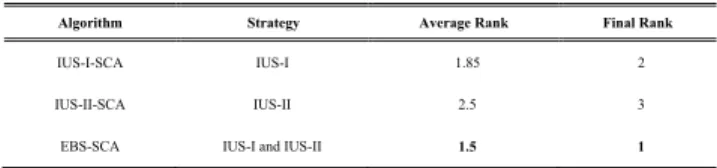
and IUS-II are performed in the exploration and exploitation phase, respectively. More specifically, for the exploitation phase (1≤ t ≤ $T), EBS-SCA employs IUS-I to explores all over the search space to discover promising domains; on the other hand, for the exploitation phase ($T < t ≤ T), EBS-SCA adopts IUS-II to refine the search accuracy for the optimal solution. Therefore, by selecting the reasonable value of$, EBS-SCA can effectively combine the IUS-I and IUS-II to balance the global exploration and local exploitation and provide the competitive performance. The details for the IUS-I and IUS-II are described as follows.
1) IUS-I
IUS-I is executed in the exploration phase, that is, 1 ≤ t
≤ $T. First, IUS-I uses the EBS strategy (see details in part A of section III) to generate the correspondingXnewt _i, i∈ {1,2,· · ·,N}for each individualXit.
Second, IUS-I generates the new individualXit+1via a new individual update equation as follows:
xijt+1=
(
xnewt _ij+λ1sin(λ2) λ3|xnewt _ij−xijt|, λ4<0.5 xnewt _ij+λ1cos(λ2) λ3|xnewt _ij−xijt|, λ4≥0.5
(14) wherexijt+1,xijt andxnewt _ij,j∈ {1,2,· · · ,D}are thejth dimen-sion ofXit+1,Xit, andXnewt _i, respectively;tandt+1 are the current and next iteration number, respectively;|·|denotes the absolute value; the definitions ofλ1,λ2,λ3, andλ4see details in part A of section II.
Finally, IUS-I applies the selection strategy (see equation (7) for details) for each updatedXit+1in (14), which aims to determine whetherXit needs to be replaced byXit+1. Therefore, eachXit+1of (14) is constantly regarded as its own individual historical best solution.
Note that in the IUS-I, we specifically develop the new individual equation (14) to match the EBS strategy. Owing to the EBS strategy with (14), eachXnewt _i,i ∈ {1,2,· · · ,N}
can generate a variety of potential solution information in different iterations. Consequently, by the collaboration of Xnewt _i andXit in (14),Xit+1 can have enough opportunities to explore the promising domains betweenXnewt _iandXit for the global optimum. Thus, IUS-I can highlight more towards exploration that heartens all the individuals to wander via the entire solution space without gathering around local optima. 2) IUS-II
IUS-II is conducted in the exploitation phase, that is,
$T < t ≤ T. In this case, IUS-II constantly uses equation (1) to update the current individualXitif the best-so-far individualGt among all individuals does not suffer from
3consecutive stagnations.
Otherwise,Gt is considered to be trapped in local optima. Then, IUS-II executes the EBS strategy for once by using the individual best solutions of the entire swarm to cre-ate N individuals nXnewt _1,Xnewt _2· · · ,Xnewt _No. For each
FIGURE 3. Framework of EBS-SCA.
Xnewt _i, i∈ {1,2,· · · ,N}, it is substituted into Xit of (1) to updateXit+1.
Note that for the IUS-II, eachXit,i∈ {1,2,· · ·,N}directly interacts with Gt according to (1), so each Xit+1 acquires enough opportunities to search the domains between Xit and Gt. This can lead Xit+1 to cluster quickly around Gt. To avoid the premature convergence, IUS-II will conduct the EBS strategy for all individuals if Gt constantly ceases improving for a certain number of iterations. Therefore, IUS-II not only emphasizes more on exploitation that can accelerate the convergence speed toward the global optimum, but also applies the EBS strategy to avoid the premature convergence.
The pseudocode for IUS-I and IUS-II is shown in Algorithm 2.
Particularly, because IUS-I conducts the selection strategy between Xit+1 andXit (see details in the lines 12 to 16 of Algorithm 2),Xit+1of equation (14) generally preserves the individual historical best solution for the next iterative update. Conversely, in the absence of the selection strategy,Xit+1of equation (1) cannot do that. To conduct the EBS strategy by utilizing the individual historical best solutions of the entire swarm, the IUS-II can provide the individual historical best solution through the lines 30 to 32 of Algorithm 2 when the persistent stagnations ofGt stagnation occurs.
In summary, by combining IUS-I with IUS-II, EBS-SCA obtains the effective balance between exploration and exploitation.
C. PROCEDURE OF EBS-SCA
Fig. 3 show the framework of EBS-SCA, its implementation procedure demonstrated as below.
Step 1:In EBS-SCA, the random initialization is conducted for all individuals {X1,X2,· · ·,XN}in the search space; the
global historical best solutionGis also done;
Step 2:For each iteration, if the current iteration numbert is less than or equal to $T, EBS-SCA executes IUS-I, where the EBS strategy (see details in Algorithm 1)
Algorithm 2 1: /∗IUS-I∗/ 2: ift ≤$T
3: CreateNindividualsnXnewt _1,Xnewt _2,· · ·,Xnewt _No byAlgorithm 1; 4: fori=1toN 5: forj=1toD 6: ifλ4<0.5 7: xijt+1=xnewt _ij+λ1sin(λ2) λ3 x t new_ij−xijt ; 8: else 9: xijt+1=xnewt _ij+λ1cos(λ2) λ3 x t new_ij−xijt ; 10: end if 11: end for 12: iff hXit+1i<fXit 13: Xit+1=Xit+1; 14: else 15: Xit+1=Xit; 16: end if 17: Xtemp_i=Xit+1; 18: end for 19: /∗IUS-II∗/ 20: else 21: fori=1toN 22: forj=1toD 23: ifλ4<0.5 25: xijt+1=xt ij+λ1sin(λ2) λ3g t j−x t ij ; 26: else 27: xijt+1=xt ij+λ1cos(λ2) λ3g t j −xijt ; 28: end if 29: end for 30: iff hXit+1i<fXtemp_i 31: Xtemp_i=Xit+1; 32: end if 33: end for 34: Gt+1=arg[min{f[X1t+1],f[X2t+1],· · · ,f[XNt+1]}]; 35: iff Gt+1<f Gt 36: Gt+1=Gt+1; 37: sg=0; 38: else 39: Gt+1=Gt; 40: sg=sg+1; 41: end if 42: ifsg==3 43: {X1t+1,X2t+1,· · · ,XNt+1}
= {Xtemp_1,Xtemp_2,· · · ,Xtemp_N};
44; CreateNindividualsnXnewt+1_1,Xnewt+1_2,· · ·,Xnewt+1_No byAlgorithm 1;
45; nX1t+1,X2t+1,· · · ,XNt+1o
=
n
Xnewt+1_1,Xnewt+1_2,· · ·,Xnewt+1_N o
; 46: sg=0;
47: end if 48: end if
is first performed on
X1t,X2t,· · · ,XNt to create n
Xnewt _1,Xnewt _2,· · ·,Xnewt _No; then X1t,X2t,· · ·,XNt and n
Xnewt _1,Xnewt _2,· · ·,Xnewt _No are substituted into equation (14) to generate nX1t+1,X2t+1,· · · ,XNt+1o; other-wise EBS-SCA executes IUS-II, where
X1t,X2t,· · ·,Xt N
and Gt are substituted into equation (1) to gener-ate nX1t+1,X2t+1,· · ·,XNt+1o; if Gt ceases improving for
3 iterations, the EBS strategy adopts the individual his-torical best solutions of nX1t+1,X2t+1,· · ·,XNt+1o to gen-erate nXnewt+1_1,Xnewt+1_2,· · · ,Xnewt+1_No that is used to replace n
X1t+1,X2t+1,· · ·,XNt+1ofor the next iteration;
Step 3:Step 2 is conducted repeatedly in the specified iterations until the specific termination condition is satisfied. Notice that as fori∈ {1,2,· · ·,N}andj∈ {1,2,· · · ,D}, thexijt ofXitis constrained to minnuj,max
n lj,xijt
oo
wherelj
andujdenote the minimum and maximum boundaries of the
jth dimensional search space, respectively.
The pseudo code of the above process is given in Algorithm 3.
Algorithm 3EBS-SCA 1: /∗Initialization∗/
2: EachXi,i∈ {1,2,· · ·,N}is randomly initialized;
3: Evaluatef [Xi],i∈ {1,2,· · · ,N};
4: G=arg [min{f [X1],f [X2],· · · ,f [XN]}];
5: while(cease condition is not satisfied)do 6: k=k+1;
7: ConductAlgorithm 2;
8: Gt+1=arg[min{f[X1t+1],f[X2t+1],· · · ,f[XNt+1]}]; 9: end while
D. COMPUTATIONAL COMPLEXITY OF EBS-SCA
Note thatD,N, andT are the individual dimension, the pop-ulation size, and the maximum iterative number, respec-tively. As for SCA, its computational complexity essentially involves three parts including the individual initialization (tii), individual update (tiu), and individual evaluation (tie)
for all individuals. Hence, the total computational cost of SCA can be written as
tSCA =tii+tiu+tie (15)
=DN+DNT+DNT
where DN, DNT, and DNT represent tii, tiu, and tie
of SCA, respectively. Consequently, the total computational complexity of SCA is described asO(DNT).
In terms of the EBS-SCA algorithm, its computational complexity also covers the individual initialization (tii),
indi-vidual update (tiu), and individual evaluation (tie). Like
tii and tie of SCA, those of EBS-SCA are assessed as
DN andDNT, respectively. Particularly, individual update
(tiu) of EBS-SCA includes two different update equations
tiu_1and the EBS strategy consisting of the RG mecha-nism tiu_2
and MIGM tiu_3
. Considering the worst case, we assume that both the RG mechanism tiu_2
and MIGM tiu_3
are executed in each iteration. Thus,tiu_1,tiu_2, and tiu_3 can be assessed as DNT, NM, and DNT. The total computational cost of EBS-SCA can be given as
tEBS−SCA =tii+tiu+tie (16)
=DN+(DNT+NM+DNT)+DNT.
Therefore, the total computational complexity of EBS-SCA is also described asO(DNT).
From the above analysis, EBS-SCA has higher com-putational cost than SCA. This is due to the fact that EBS-SCA involves some extra computational cost such as the RG mechanism tiu_2 and MIGM tiu_3 compared with SCA. However, the computational cost of EBS-SCA does not increase significantly in comparison with that of SCA. Their computational complexity is stillO(DNT).
IV. EXPERIMENTAL EVALUATIONS AND COMPARISONS
A. EXPERIMENTAL ESTABLISHMENT
1) TWO SETS OF POPULAR BENCHMARK SUITES
Two sets of popular benchmark suites comprising a total of 46 benchmark functions are executed to systematically appraise the performance of EBS-SCA.
The first is a basic function test suite including 18 basic benchmark functions [45] listed in Table s1 of Section S-I of Supplementary File, due to space constraints. Functions F1-F13 belong to high-dimensional benchmark functions; F1-F7 are attached to unimodal functions and each of them owns only one global optimal value without local optima; F6 is a discontinuous step function with one minimum; F7 is a noisy quartic function; F8-F13 are affil-iated with multimodal functions and each of them includes many local minimums whose number depends on the dimen-sion number of the corresponding problem. Conversely, F14-F18 are affiliated with low-dimensional benchmark functions with multiple local minimums.
The second comprises 28 popular CEC2013 benchmark functions [46] including the complex shifted or shifted rotated benchmark functions listed in Table s2 of Section S-I of Sup-plementary File, due to space constraints. Functionsf1–f5, functionsf6–f20, and functionsf21–f28 belong to unimodal, multimodal, and composition functions, respectively. They are executed to evaluate the diverse algorithms in extremely complex cases.
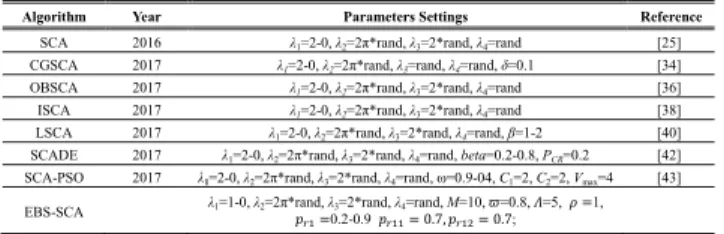
2) COMPARED VARIOUS METAHEURISTIC ALGORITHMS First, the proposed EBS-SCA first is compared with seven peer SCA algorithms: the original SCA [25], CGSCO [34], OBSCA [36], ISCA [38], LSCA [40], SCADE [42], and SCAPSO [43] on two sets of popular benchmark suites with 30-D problems. Actually, in the literature, the above seven SCA algorithms have rendered the promising performance
TABLE 1. Parameter settings for all comparative SCA algorithms.
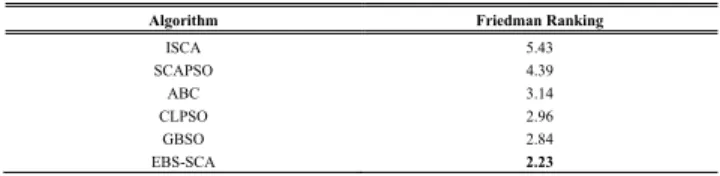
TABLE 2. Parameter settings for EBS-SCA and the other nine metaheuristic algorithms.
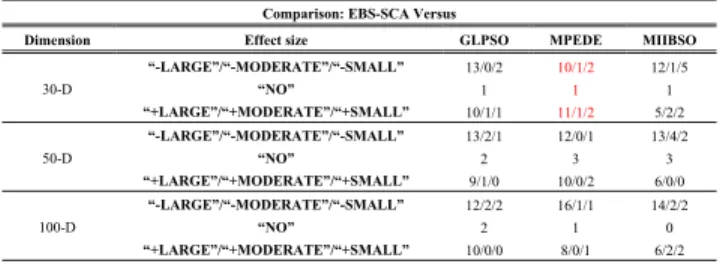
TABLE 3. Parameter settings for GLPSO, MPEDE, and MIIBSO.
and their parameter settings are listed in Table 1. Particularly, due to space limitation, four main parametersM,ρ,$, and
3for EBS-SCA are discussed on Section S-IX of Supple-mentary File. In general, M = 10,$ = 0.8,ρ = 1, and
3 = 5 can offer the promising performance for EBS-SCA, thus recommended in this paper. Specially, due toρ =1,λ1 in (2) is linearly decreasing between 1 and 0.
Second, to further reveal the advantages of EBS-SCA, we provide the comparisons between it and the other nine popular metaheuristic algorithms, involving OBSO [15], GBSO [48], RGBSO [49], PSO [26], DE [10], ABC [4], CMA-ES [11], the comprehensive learning PSO (CLPSO) [51], and WCA [14] on the second test suite (CEC2013 bench-mark test suite) with 50-D problems. Table 2 shows these algorithms’ parameter settings.
Finally, three state of the art of metaheuristic algorithms are applied to further evaluate the proposed EBS-SCA on the 28 CEC2013 functions with 30-D, 50-D, and 100-D. Particularly, the three metaheuristic algorithms involve GLPSO [53], MPEDE [54], and MIIBSO [22], which are the recently proposed new PSO, DE, and BSO variant, respec-tively and have the excellent global search capability. Follow-ing the references [53], [54], and [22], their parameter settFollow-ings are listed in Table 3.
To provide fair comparisons among the 20 algorithms, we independently execute each of the 20 algorithms 30 times on every benchmark function with the same maximum num-ber of fitness evaluations (MaxFEs) set to 10000D. In general,
the population size for each algorithm is set toN =50. For CMA-ES, however, its population size is set to 4+3lnbDc, counting on the dimension of the problem being solved. Addi-tionally, PSO and DE are executed on the global version and the DE/rand/1/bin version, respectively. In addition, the max-imum iterative number (T) is set based onT =MaxFEs/N.
All the above algorithms are programmed in MATLAB R2017a, then performed on a PC with Intel Core (TM) CPU i7-4790U CPU @ 3.60 GHz with 8 GB RAM.
3) PERFORMANCE INDEX
As a general performance index, error mean value (Mean) is defined as the mean value of the difference between the best fitness value (f [X]) obtained by an algorithm and the global optimum fitness value (fmin
X∗) over 30 independent oper-ations on each benchmark function as follows:
Mean= 30 X k=1 f [X]−fmin X∗ 30 (17) where X and X∗ represent the best solution acquired by an algorithm and the global optimal solution, respectively. Another general performance index is the standard deviation value (Std), defined as Std= 2 v u u t 30 X k=1 [f [X]−Mean]2.(30−1) (18)
Furthermore, with a significance level of 0.05, six non-parametric statistical tests involving Wilcoxon signed-rank test [50], Friedman’s test [50], Nemenyi’s test [50], Holm’s test [50], Shaffer’s test [50], and Bergmann-Hommel’s test [50] are executed to identify the difference property between a pair of different algorithms at the sta-tistical level. Once the p-value generated by the above tests is smaller than 0.05, a remarkable difference between two different algorithms will be reflected in the corresponding benchmark function.
The ‘‘Cohen’s d’’, which is defined as the difference between two means divided by a standard deviation for the data [59], [60], is also employed to evaluate the effect size between the proposed EBS-SCA and each compared algo-rithm listed in on each test function.
4) LIST OF EXPERIMENTS FOR EVALUATING EBS-SCA Comprehensive experimental evaluations are established to check the efficiency of the proposed EBS-SCA algorithm and these experiments are listed in the following Table 4.
B. EXPERIMENTAL COMPARISONS WITH SEVEN SCA ALGORITHMS
We compare the proposed EBS-SCA algorithm with seven SCA algorithms on the first and second benchmark suite. Due to space constraints, the results and analysis for these SCA algorithms on the first basic benchmark suite are placed in Section S-II of Supplementary File. Here, we provide only
TABLE 4. The list of experiments for evaluating EBS-SCA.
the analysis of the algorithms on the second benchmark suite (CEC2013 benchmark suite), which are extremely compli-cated and thorny to solve.
The error mean and standard deviation values on the 28 30-D CEC2013 functions are used for ranking all SCA algo-rithms. Due to space constraints, those results are also shown in Table s7 of Section S-III of Supplementary File.
1) SOLUTION QUALITY COMPARISONS a: OVERALL RANK
Table s7 of Section S-III of Supplementary File shows that EBS-SCA wins the first rank on 24 out of all the 28 bench-mark functions exceptf15,f16,f23, andf26. Furthermore, EBS-SCA offers the second rank onf15 andf23, the third onf16, and the seventh onf26, respectively. SCAPSO gives the best results on f15 and f23; ISCA wins the best on f16 and f26, respectively. Therefore, EBS-SCA wins the best overall and final rank among the eight SCA algorithms. SCAPSO offers the second-best overall and final rank, fol-lowed by ISCA. However, CGSCO only achieves the second worst overall and final rank on the 28 CEC2013 functions.
b: UNIMODAL, MULTIMODAL, AND COMPOSITION FUNCTIONS
Table s7 of Section S-III of Supplementary File shows that EBS-SCA achieves the first rank on all unimodal functions f1-f5; SCAPSO does the second on f1-f5; SCADE wins the third on f1 and f5, the fourth onf2 and f3, and the sixth on f4; ISCA does the third on f2-f4 and the sixth on f1 and f5. Therefore, EBS-SCA, SCAPSO, SCADE, and ISCA achieve the first, second, third, and fourth final rank on all the unimodal functions, respectively. However, CGSCO obtains the second worst rank, because it has the seventh rank onf1-f5.
On multimodal functionsf6-f20, Table s7 of Section S-III of Supplementary File shows that EBS-SCA wins the first rank on 13 out of the 15 functions apart fromf15 andf16, so it achieves the first final rank on multimodal functions. Moreover, SCAPSO and ISCA do the second and third final rank, respectively, however, CGSCO still does the second worst rank.
In terms of composition functions f21-f28, Table s7 of Section S-III of Supplementary File shows that EBS-SCA wins the first rank on six out of eight functions excluding f23 andf26. Thus, it obtains the first rank on all the com-position functions. Furthermore, SCAPSO and ISCA pro-vide the second and third final rank, respectively. Note that
TABLE 5.Comparisons between EBS-SCA and each of seven SCA algorithms on the second benchmark suite with 30-D by Wilcoxon signed-rank test.
CGSCO still does the second worst. Briefly, amongst all SCA algorithms, EBS-SCA has the best performance on uni-modal, multiuni-modal, or composition functions, respectively. c: STATISTICAL ANALYSIS
Due to space constraints, the detailed results of the Wilcoxon signed-rank test between EBS-SCA and each of the other compared SCA algorithms onf1−f28 have been added to Table s8 of Section S-III of Supplementary File. Table 5 only shows the number of notably better performance (sign ‘‘1’’), no notable difference (sign ‘‘0’’), and notably worse perfor-mance (sign ‘‘-1’’) of the Wilcoxon test between EBS-SCA and each SCA algorithm onf1−f28. Interestingly, EBS-SCA offers considerably better solutions than each SCA algorithm on most functions.
We also calculate the Effect Size (ES) between EBS-SCA and each of seven SCA algorithms on second benchmark suite by using ‘‘Cohen’sd’’ [59], [60]. Due to space constraints, the Cohen’sd and ES are listed in Table s9 of Section S-III of Supplementary File. The results indicate that EBS-SCA outperforms the seven SCA algorithms.
These further confirm that EBS-SCA wins the best overall performance amongst the eight SCA algorithms.
2) CONVERGENCE ANALYSIS
The convergence curves of eight SCA algorithms are employed to visually express their convergence characteris-tics. Due to space limitation, these convergence curves are sketched in Fig. s2 of Section S-III of Supplementary File, where EBS-SCA acquires the best promising convergence performance on 24 of the 28 benchmark functions apart fromf15,f16,f23, andf26 amongst the eight algorithms. Furthermore, EBS-SCA has the second and third best con-vergence performance onf15 andf23, andf16 among all the algorithms. Particularly, EBS-SCA also has the second worst convergence performance onf26; however, its convergence performance on f26 does not show significant difference than that of ISCA that has the best convergence performance onf26 among the eight SCA algorithms.
C. EXPERIMENTAL COMPARISONS WITH NINE METAHEURISTIC ALGORITHMS
We further compare EBS-SCA with nine popular metaheuris-tic algorithms listed in Table 2 on the second benchmark suite (28 CEC2013 functionsf1-f28). The error mean and standard deviation values on the 28 50-D CEC2013 func-tions are used for ranking these algorithms. Due to space constraints, these results are shown in Table s10 of Section S-IV of Supplementary File.
FIGURE 4. Boxplots of the result of EBS-SCA, and nine Metaheuristic algorithms on 28 CEC2013 functions with dimension 50.
Boxplots of the result of EBS-SCA and nine popular meta-heuristic algorithms on the CEC2013 benchmark suite with dimension 50 are shown in Fig. 4, where the horizontal and
vertical axis represent the algorithms and the corresponding error values, respectively. Note that S0, MA1, MA2, MA3, MA4, MA5, MA6, MA7, MA8 and MA9 mean EBS-SCA,
OBSO, RGBSO, PSO, CLPSO, CMA-ES, ABC, DE and WCA, respectively.
1) SOLUTION QUALITY COMPARISONS a: OVERALL RANK
Fig. 4 and Table s10 of Section S-IV of Supplementary File show that both EBS-SCA and ABC obtain the best results on six out of the 28 functions; CMA-ES does the best on five; both DE and RGBSO do the best on three; both GBSO and CLPSO do the best on two; either OBSO or WCA does the best on one. Particularly, both DE and EBS-SCA win the best results on functionf5. Furthermore, EBS-SCA, GBSO, and CLPSO all win the second best rank on five out of the 28 functions; ABC obtains the second best results on four; either RGBSO or DE does the second best on two; OBSO, PSO, CMA-ES, and WCA all achieve the second-best on only one. Moreover, EBS-SCA owns the third best results on seven of the 28 functions; GBSO does the third best on six; DE does the third best on five; both OBSO and CLPSO do the third best on three; PSO, CMA-ES, ABC, and WCA all obtain the third best on only one. From the above analysis, an interesting thing is that amongst all the ten algorithms, EBS-SCA is the only one algorithm that wins the largest number of the first, the second and the third best results on the 28 functions.
Furthermore, another interesting thing is that amongst all the ten algorithms, EBS-SCA is the only one algorithm that does not achieve the worst and the second worst results on any of the 28 functions. Thus, EBS-SCA possesses the best overall performance on the second benchmark suite among all the ten algorithms.
b: UNIMODAL FUNCTIONS AND MULTIMODAL FUNCTIONS On unimodal functions f1-f5, Fig. 4 and Table s10 of Section S-IV of Supplementary File show that EBS-SCA receives the first, second, and fifth rank once, and the third rank twice, respectively. CMA-ES wins the first rank twice. However, it receives the seventh rank twice, and the tenth once, respectively. Both RGBSO and WCA receive the first rank once. But, RGBSO receives both the sixth and eighth rank once, and WCA receives the sixth, eighth, and ninth rank once, respectively. Accordingly, EBS-SCA wins the best overall performance on unimodal functions f1-f5 among all the ten algorithms.
On multimodal functionsf6-f20, Fig. 4 and Table s10 of Section S-IV of Supplementary File show that EBS-SCA is ranked the first for four times, the second for once, the third for four times, the fourth for three times, the fifth, sixth, eighth for once, respectively. CMA-ES is ranked the first for three times, however, it also receives the worst rank three times, respectively. CLPSO wins both the first and second rank twice, whereas it receives the worst rank once, the eighth rank once, and the sixth rank twice, respectively. RGBSO also obtains both the first and second rank twice, while it has the worst rank five times. Consequently, EBS-SCA achieves the best overall rank on multimodal functionsf6-f20 among all the algorithms.
On composition functionsf21-f28, Fig. 4 and Table s10 of Section S-IV of Supplementary File show that EBS-SCA achieves the first, second, third, fourth, and fifth rank on one, three, one, two, and one out of the eight composition functions, respectively. ABC achieves the first rank on four, however, it also has the sixth and seventh rank on one, respectively. DE receives the first rank on two, while it has the sixth, seventh and tenth rank on one, respectively. CLPSO has the second rank on three, whereas it also does the sixth and seventh rank on one, respectively. From the above illustrations, both EBS-SCA and ABC win the best overall performance on composition functionsf21-f28, among all the algorithms.
c: STATISTICAL ANALYSIS
The Wilcoxon signed-rank tests are still utilized to execute comparisons between EBS-SCA and one of the nine popular metaheuristic algorithms on the 50-D 28 functions. Due to space limitation, the results of the Wilcoxon test between EBS-SCA and each algorithm on functionsf1−f28 are listed in Table s11 of Section S-IV of Supplementary File. These results confirm that compared with each of nine algorithms, EBS-SCA has better performance.
Effect Size (ES) is also further executed to identify the statistical difference between EBS-SCA and each of the nine metaheuristic algorithms. Due to space constraints, the Cohen’sd and ES are listed in Table s12 of Section S-IV of Supplementary File. The results indicate that EBS-SCA wins the better overall performance than the other nine meta-heuristic algorithms.
In brief, EBS-SCA generates considerably better results on most of the 28 CEC2013 benchmark functions compared with each of the other nine algorithms, further verifying that EBS-SCA can provide the promising overall performance.
2) CONVERGENCE ANALYSIS
We also use convergence curve graphs to evaluate the ten algorithms on the 28 functions with 50-D problems. Due to space limitation, all the convergence curves are sketched in Fig. s3 of Section S-IV of Supplementary File, where EBS-SCA has the most number of the fastest conver-gence speed on the 28 functions, concerningf5,f12,f13, f18,f20 andf25 amongst all the algorithms. Furthermore, EBS-SCA also wins the most number of the second, third, fourth fastest speed amongst the ten algorithms on the 28 benchmark functions, corresponding to five (f1,f7,f23, f24 andf27), seven (f3,f4,f9,f11,f17,f19 andf21), and five (f6,f10,f14,f22 andf28), respectively.
Besides, we also compare the convergence property between EBS-SCA and each of the other nine algorithms on the 28 benchmark functions. Fig. s3 of Section S-IV of Supplementary File shows that EBS-SCA wins the more number of faster convergence speed than each of the other nine algorithms. As an example, EBS-SCA has faster con-vergence speed than GBSO on 16 out of the 28 benchmark
![FIGURE 1. Changes of the sine cosine dynamic range at ρ = 2 [25].](https://thumb-us.123doks.com/thumbv2/123dok_us/9225029.2806880/3.864.462.782.97.208/figure-changes-sine-cosine-dynamic-range-ρ.webp)