58
THE USE OF BOOKKEEPING IN THE FADN SYSTEM DATA COLLECTION IN THE REPUBLIC OF
SERBIA
Mirjana Bojčevski1, Bilјana Grujid2, Radojica Sarid2
1
Ministry of Agriculture, Forestry and Water Management of Republic of Serbia 2
Institute of Agricultural Economics Belgrade Corresponding author: [email protected] Abstract
Establishment of the Serbian Farm Accountancy Data Network - FADN system based on the use of bookkeeping with the additional information necessary to meet the specific needs of the system from the methodological point of view. FADN system data collection are covered by commercial farms, which according to existing legal regulations in the Republic of Serbia are obliged to use of bookkeeping in two cases. The first case is if the farm has an entrepreneurial status, which has a binding character through the submission of tax returns to the competent tax authority. The second case is if the registered farm payer of value added tax. This paper analyzes the use of bookkeeping in the FADN system data collection in the Republic of Serbia through the appropriate methodological model. The main objective of this paper is to highlight the importance of bookkeeping records on commercial farms in the Republic of Serbia, which contributes to the rationalization and efficiency of data collection for the FADN system.
Keywords: bookkeeping, commercial farm, FADN system, a methodological model, rationalization and efficiency of data collection.
Introduction
The aim of the paper is to point out the connection between FADN evidency (Farm Accountancy Data Network) and the bookkeeping records. The research led to the conclusion that the bookkeeping records can provide only information on production values, while information on quantities, as well as basic and general data concerning consumption on the farm itself, must be provided from the FADN system. The participation of agricultural holdings in the FADN survey is voluntary and legal and natural persons, as well as those who lead or are not in charge of accounting, can be involved. The subject of this paper will be agricultural holdings that already carry out accounting records. The paper will provide a schematic representation of a methodological model that facilitates the collection of data and the completion of questionnaires by FADN experts from such farms.
Material and methods
The basis of research and writing of work are officially published laws and by-laws on the level of the Republic of Serbia and at the level of the European Union (EU). Also, were used official statistical data which Statistical Office of the Republic of Serbia publish every year. The method of work is based on the use of internet research to review the opinions of experts competent to deal with this issue. The main method used is the descriptive, but the analysis and synthesis method is inevitable. Reasons for the introduction of fadn system in Serbia
Given that there is currently no official system for collecting accounting data from agricultural holdings in Serbia, there is a need for designing a new or introducing an existing system that is successfully implemented in the countries of the European Union (EU). One of the potential sources of collecting accounting data from agricultural holdings is the publication Economic Accounts of Agriculture in the Republic of Serbia 2007-2014 whose publisher is Statistical Office of the Republic
59 of Serbia (SORS)1. The Study states that the Economic Accounts for Agriculture (EAA) are part of the international statistical system and their primary purpose is to monitor and evaluate the effects of agricultural policy. It should also provide the basis for the analysis of the agricultural production process and the earned income in agriculture. In addition, they allow international comparability with other countries, but also comparison with other activities within the national economy. The economic accounts include the following groups of agricultural producers (SORS, 2015):
a) family farms with at least 0.5 ha of agricultural land they are cultivated;
b) family farms with less than 0.5 ha of agricultural land in which they perform some form of agricultural production (including areas under greenhouses) and intended for the market, as well as fish farming, cultivation of snails, mushrooms, bees etc;
c) companies, agricultural cooperatives, entrepreneurs, institutions and other organizational forms with the status of a legal entity whose agricultural activity is predominant.
A special challenge for Serbia is the establishment of the FADN system. The purpose of applying the FADN system is multiple:
a) Collecting accounting data (income and expenses) from agricultural holdings; b) assessment of the efficiency of agricultural production and
c) analyzing support of agricultural policy.
Establishment of the FADN system is regulated by Article 33 of the Law on Agriculture and Rural Development (Official Gazette of RS, No. 41/2009, 10/2013 and 101/2016). The aforementioned Law defines the FADN system as "a set of data on the structure, production, income and expenditures of agricultural holdings that are obtained on the basis of the annual survey in agricultural holdings in accordance with special regulations". The legal framework for the implementation of the FADN system measures is carried out under the following laws:
a) Law on incentives in agriculture and rural development (Official Gazette of RS, No. 10/2013, 142/2014, 103/2015 and 101/2016),
b) Law on the performance of advisory and expert activities in the field of agriculture (Official Gazette of RS, No. 30/10) and
c) Law on Personal Data Protection (Official Gazette of RS, No. 97/2008, 104/2009, 68/2012 and 107/2012).
Agricultural holding in FADN system is a commercial farm holding income in agricultural activity, volunteering in the FADN system and recording data collected by FADN research. Commercial agricultural holdings are those agricultural holdings that are large enough to ensure the main activity of farmers and the amount of income sufficient to maintain the personal existence and the existence of the family. There is currently no legislation in the Republic of Serbia that obliges farmers to keep accounting. However, in some cases, there are legal solutions that still bind farmers:
a) The Law on Income Tax of Citizens2 and b) The Law on Value Added Tax 3.
There is a certain group of agricultural producers that are obligated to keep accounting, which are precisely defined by these laws. Natural persons - farmers who earn income from the activities of agriculture and forestry, that is, income from agricultural and forest products, have the obligation to keep accounting in certain cases, such as:
1According to the Calendar, the publication of SORS study was published in December 2015 and available is on
the following link:
http://pod2.stat.gov.rs/ObjavljenePublikacije/G2015/pdf/G20159083.pdf
2 Official Gazette of RS, No. 24/2001, 80/2002, 80/2002, 135/2004, 62/2006, 65/2006, 31/2009, 44/2009, 18/2010, 50/2011, 91/2011, 7/2012, 93/2012, 114/2012, 8/2013, 47/2013, 48/2013, 108/2013, 6/2014, 57/2014, 68/2014, 5/2015, 112/2015, 5/2016 and 7/2017.
3 Official Gazette of RS, No. 84/2004, 86/2004, 61/2005, 61/2007, 93/2012, 108/2013, 6/2014, 68/2014, 142/2014, 5/2015, 83/2015, 5/2016, 108/2016 and 7/2017.
60 1) if the holder of the agricultural holding voluntarily decides to have the status of an entrepreneur - that the holder of the agricultural holding should be granted the status of an entrepreneur must fulfill two conditions:
a) that the farm is registered in the Register of Agricultural Holdings and b) must keep the business books.
If the physical person - holder of the agricultural holding does not fulfill the two conditions mentioned above, does not have the status of an entrepreneur. It is important to mention that in Serbia, acquiring the status of entrepreneur has a voluntary character. Farmers who acquire the status of entrepreneur, according to Article 32 of the Law on Personal Income Tax, become taxpayers of value added tax. Taxpayer on income from agriculture and forestry is a natural person - holder of a family agricultural holding registered in the Register of Agricultural Holdings. According to the same Law (Article 32), entrepreneurs are obliged to keep business books and to present business changes in the manner prescribed by this Law. Entrepreneurs keep books on a simple and dual bookkeeping system in accordance with the law governing accounting and auditing. In the books on the system of simple bookkeeping, data on revenues, expenditures, fixed assets, tools and inventory, as well as other data, are provided in accordance with the Law on Personal Income Tax. 2) if the registered agricultural holding is a taxpayer of the value added tax - the registered agricultural holding becomes a taxpayer of value added tax if in the previous 12 months there was a turnover of goods and services exceeding 8 mln. RSD4 (Law on Value Added Tax, Article 34). In this case the farmer is obliged to keep the books and records prescribed by the Law on Value Added Tax and the obligation to keep books in this case is mandatory and it is created "by force of law". Agricultural holdings can be voluntarily identified and recorded in the VAT system if they have a turnover of less than 8 mil. Din. If they estimate it is convenient for them. The said holdings are kept by the business books according to the system of simply or dual bookkeeping. Based on data from the publication Agricultural Census 2012 (implemented by SORS) in 2012, there were 631,552 registered farms owned by natural and legal persons. Of the total number of registered farms, 0.5% (about 3,158) are holdings that are legal entities and entrepreneurs by legal form. The FADN system in Serbia includes physical and legal persons, that is, agricultural holdings that run and do not keep accounting. The only condition for selecting agricultural holdings is to cross the lower limit of an economic size of EUR 4 thousand. Because the decision of the National Board for the FADN system, these farms form the field of research of the FADN system in Serbia.
Networking accounting and fadn methodology
In the EU countries the obligation of accounting is defined by the document International Financial Reporting Standards5, which is applied to different type of entity: Public interest entity (PIE), Large, medium and small entities and Microentities. Definition of micro-entities in EU are companies which their balance sheet dates do not exceed the limits of two of the three following criteria (micro-entities):
a) balance sheet total 350,000 EUR; b) net turnover 700,000 EUR and
c) average number of employees during the financial year 106.
The application of the FADN methodology in Serbia should be created to include holdings that use and don’t use accounting. Accordingly, a methodological model for data collection has been developed that is in compliance with the current EU regulations 220/20157. This methodological
4According to the middle exchange rate of the National Bank of Serbia on June 19, (1 EUR = 122.1076 RSD) RSD 8 mln. is
about EUR 65 thousand.
5 Officially translated in Serbia and published as "International Financial Reporting Standard (IFRS) for small and medium entities" (Official Gazette of RS, No. 117/2013)
6 Directive 2012/6/EU of the European Parlament and the council of 14 March 2012.
7 Corrigendum to Commission Implementing Regulation (EU) 2015/220 of 3 February 2015 laying down rules for the application of Council Regulation (EC) No 1217/2009 setting up a network for the collection of accountancy data on the incomes and business operation of agricultural holdings in the European Union.
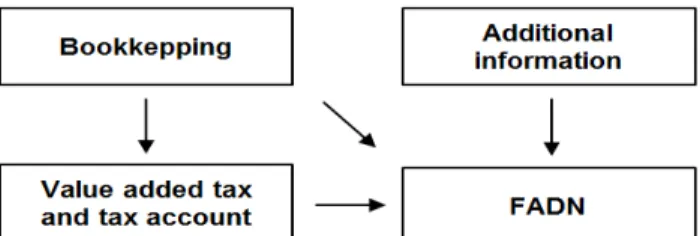
61 model enables the use of already existing accounting data on agricultural holdings that accompany them, based on two sources (Figure 1):
1. Bookkeeping data already done on the holding 8;
2. Additional information needed to meet the FADN methodology.
Figure 1.Schematic representation of the methodological model for data collection
Source:Author's illustration according to FADN documentation
The National Coordination Group for Data Collection Methodology has prepared an additional Data Collection Guide for FADN agricultural holdings that have bookkeeping. The purpose of this guide is to establish ways to save time so that the data collection process is maximally efficient. The structure of the instructions should describe the link between the information that can be obtained from the bookkeeping (chart of accounts). Thus, all the tables in the questionnaire are linked to show that the relevant fields can be filled in with data from the appropriate accounts. The bookkeeping records can only provide information about the values, while information on the quantities, basic and general information must be provided from the FADN system. It is defined that as many fields are associated with the values between the accounts and the selected fields of the FADN questionnaire. On the other hand, this increases the risk that we will not have all the information from the bookkeeping records, if the agricultural producer and his accountant use double-digit accounts. Also, in order to obtain more precise relevant data, a three-digit or four-digit account can be used (xxx or xxxx). The data collection guide is based on the relevant FADN questionnaire for the current year, using the relevant regulations for holdings accounting and set of regulations under the accounting law9 (Table 1).
Table 1.Relationship between FADN questionnaires and bookkeeping records
FADN questionnaires Bookkeeping records
The number and name of the table of indicators to be monitored
Description of the
indicator Comments Bookkeeping account Comments
Source:Author's illustration according to FADN documentation
The data collection process implies that an agricultural producer collects data in accordance with an agreement with an advisor and bookkeeper. The counselor is obligated to visit the farm four times a year, and the accountant provides information to the advisor once a year, prepared with the help of
8
Accounting law (Official Gazette of RS, No. 62/2013) and Law on Accounting and Auditing (Official Gazette of RS, No. 46/2006, 111/2009, 99/2011, 62/2013).
9 Rulebook on the Chart of Accounts and Contents of Accounts in the Chart of Accounts for Companies, Cooperatives and Entrepreneurs (Official Gazette of RS, No. 95/2014), Rulebook on the content and form of financial reporting forms for companies, cooperatives and entrepreneurs (Official Gazette of RS, No. 95/2014 and 144/2014), Rulebook on the manner of recognition, evaluation, presentation and disclosure of positions in the individual financial statements of micro and other legal entities (Official Gazette of RS, No. 118/2013 and 95/2014) and Rulebook on the form and content of the statistical report for companies, cooperatives and entrepreneurs (Official Gazette of RS, No. 127/2014).
62 the Instruction. The obligation arising from the law is to provide accounting information and accounting reports arising from accounting data processing. The financial statements include balance sheets, which show the "picture" of the holding at a certain point, and the profit and loss accounts that represent the result of the business of the household at a particular moment, i.e. revenues and expenditures. The financial statements may also include reports on changes in equity and cash flows, and the like.
Conclusions
Although the implementation of accounting in agricultural holdings is not a mandatory activity in Serbia, the FADN methodology highlights its benefits arising from their implementation. The most important conclusions that represent the purpose of the research are:
1. rationalization of the time in recording FADN data, because the existing data from the holdings are used (in case the holding has conducted the accounting);
2. Considering that accounting only monitors the value, the FADN methodology includes information on the quantities produced and/or delivered;
3. Significant inclusion of larger agricultural holdings with the form of legal entities and entrepreneurs.
In general, the networking of accounting with FADN methodology provides a more complex picture of the standard of living of the agricultural holding, its potentials to produce and market its products and the result of operations.
Acknowledgements
Paper is result of research on Project III 46006 “Sustainable agriculture and rural development in
function of Republic of Serbia strategic goals achievement within the Danube region”, financed by
the Ministry of science and technological development of Republic of Serbia. References
1. Directive 2012/6/EU, Annual accounts of certain types of companies as regards micro-entities (Text with EEA relevance);
2. European Commision, Regulation (EU) 2015/220, Setting up a network for the collection of accountancy data on the incomes and business operation of agricultural holdings in the European
Union
(http://eur-lex.europa.eu/legal-content/EN/TXT/PDF/?uri=CELEX:32015R0220R(02)&from=EN, 19.06.2017);
3. International Financial Reporting Standard (IFRS) for small and medium entities, Official Gazette of RS, No. 117/2013;
4. Law on Accounting and Auditing, Official Gazette of RS, No. 46/2006, 111/2009, 99/2011, 62/2013;
5. Law on Accounting, Official Gazette of RS, No. 62/2013;
6. Law on Agriculture and Rural Development, Official Gazette of RS, No. 41/2009, 10/2013 and 101/2016;
7. Law on incentives in agriculture and rural development, Official Gazette of RS, No. 10/2013, 142/2014, 103/2015 and 101/2016;
8. Law on Income Tax of Citizens, Official Gazette of RS, No. 24/2001, 80/2002, 80/2002, 135/2004, 62/2006, 65/2006, 31/2009, 44/2009, 18/2010, 50/2011, 91/2011, 7/2012, 93/2012, 114/2012, 8/2013, 47/2013, 48/2013, 108/2013, 6/2014, 57/2014, 68/2014, 5/2015, 112/2015, 5/2016 and 7/2017;
9. Law on Personal Data Protection, Official Gazette of RS, No. 97/2008, 104/2009, 68/2012 and 107/2012;
10. Law on the performance of advisory and expert activities in the field of agriculture, Official Gazette of RS, No. 30/10;
63 11. Law on Value Added Tax, Official Gazette of RS, No. 84/2004, 86/2004, 61/2005, 61/2007, 93/2012, 108/2013, 6/2014, 68/2014, 142/2014, 5/2015, 83/2015, 5/2016, 108/2016 and 7/2017; 12. National Bank of Serbia, Exchange Rate List No.113, Official Middle RSD Exchange Rate Formed on 19/06/2017(http://www.nbs.rs/export/sites/default/internet/english/scripts/kl_srednji.html); 13. Rulebook on the Chart of Accounts and Contents of Accounts in the Chart of Accounts for Companies, Cooperatives and Entrepreneurs, Official Gazette of RS, No. 95/2014;
14. Rulebook on the content and form of financial reporting forms for companies, cooperatives and entrepreneurs, Official Gazette of RS, No. 95/2014 and 144/2014;
15. Rulebook on the form and content of the statistical report for companies, cooperatives and entrepreneurs, Official Gazette of RS, No. 127/2014;
16. Rulebook on the manner of recognition, evaluation, presentation and disclosure of positions in the individual financial statements of micro and other legal entities, Official Gazette of RS, No. 118/2013 and 95/2014;
17. SORS (2013): Census of Agriculture 2012 – Book I, Belgrade, Serbia (http://pod2.stat.gov.rs/ObjavljenePublikacije/Popis2012/PP-knjiga1.pdf);
18. SORS (2015): Economic Accounts of Agriculture in the Republic of Serbia 2007-2014 (http://pod2.stat.gov.rs/ObjavljenePublikacije/G2015/pdf/G20159083.pdf, 19.06.2017)