Chapman University
Chapman University Digital Commons
ESI Publications
Economic Science Institute
7-13-2017
Informed Entry in Auctions
Diego Aycinena
Hernán Bejerano
Lucas Rentschler
Follow this and additional works at:
https://digitalcommons.chapman.edu/esi_pubs
Part of the
Economic Theory Commons, and the
Other Economics Commons
Informed Entry in Auctions
Comments
This is a pre-copy-editing, author-produced PDF of an article accepted for publication inInternational Journal of Game Theory, volume 47, issue 1, in 2017 following peer review. The final publication is available at Springer viaDOI:10.1007/s00182-017-0583-9.
Copyright Springer
Informed entry in auctions
1Diego Aycinena2
Centro Vernon Smith de Econom´ıa Experimental Universidad Francisco Marroqu´ın
6a calle final, zona 10 Guatemala, Guatemala 01010
(+502) 2338-7901 [email protected]
Hern´an Bejarano Economic Science Institute
Chapman University One University Drive
Orange, CA 92866 [email protected]
Lucas Rentschler
Centro Vernon Smith de Econom´ıa Experimental Universidad Francisco Marroqu´ın
6a calle final, zona 10 Guatemala, Guatemala 01010
[email protected] January 13, 2015
1Financial support from the International Foundation for Research in Experimental Economics (IFREE) is
grate-fully acknowledged. IFREE had no further role in this research. Thanks also to Jorge Chang Urrea, Pedro Monz´on Al-varado and Diego Fernandez for outstanding research assistance. We have benefited from comments and suggestions from participants in seminars at Universidad Francisco Marroqu´ın, Florida State University, the Economic Science Institute at Chapman University, CeDEx at the University of Nottingham and the North-American ESA conference.
Abstract
We examine entry decisions in first-price and English clock auctions with participation costs. Potential bidders observe their value and report maximum willingness to pay (WTP) to participate. Entry occurs if revealed WTP (weakly) exceeds the randomly drawn participation cost. While payoffs are higher in English clock auctions, we find no corresponding difference in WTP between auction formats, although males have a higher WTP for first-price auctions. Most surprisingly, in both auction formats WTP is higher when there are more potential bidders, and this difference is not explained by relative payoffs. This result is partially explained by preferences for competition.
JEL Classifications: D44, D80.
1
Introduction
Much of the auction literature studies the bidding behavior and revenue ranking of auctions with a fixed and exogenous set of bidders who do not face entry or participation costs. However, participating in most auctions is costly. Individuals or firms have an opportunity cost of participating in an auction, and often also an explicit cost of preparing a bid. These costs might influence the entry decisions of potential bidders. By neglecting consideration of these costs and the corresponding entry decision, the bulk of the auction literature has restricted attention to a subgame, while ignoring the effects that endogenous entry may have.
It is well known that when there are independent private values, standard auctions generate the same predicted expected revenue, holding the number of bidders constant (see e.g. Myerson (1981) and Heyden-reich et al. (2009)). However, if bidders have preferences over auction mechanisms the number of bidders attracted by an available auction will, in part, be determined by the auction format. Since expected rev-enue is increasing in the number of bidders, the auctioneer’s optimal choice of auction mechanism is not irrelevant, but rather depends crucially on the underlying preferences of potential bidders.
Theorists have informally speculated about the potential ways in which non-pecuniary preferences might influence bidder willingness to participate in various auction formats. For example, Engelbrecht-Wiggans (2001) suggests that oral or ascending auctions may be more attractive for bidders due to lower strategic uncertainty: Bidders in oral auctions may need or want to spend less effort acquiring and interpreting in-formation than in sealed-bid auctions. Thus, it costs less to participate in oral auctions than in sealed-bid auctions. The lower participation cost could make oral auctions more attractive to bidders. Klemperer (2002) on the other hand argues that ascending auctions are vulnerable to predatory behavior on the part of bidders, which might depress entry when there are even small participation costs.
This paper experimentally examines endogenous entry thresholds in independent private value auctions in which there is a cost of participation that is common to all potential bidders, and each bidder knows her value prior to her entry decision. We vary auction format between first-price and English clock on a between-subject basis, and vary the size of the pool of potential bidders on a within-subject basis.
We employ the Becker deGroot Marschak (BDM) procedure to elicit threshold entry decisions (i.e. maximum willingness to pay (WTP) to participate in the auction). More precisely, in each auction, potential bidders are privately informed of their value, and then simultaneously report their maximum WTP to enter the auction, without knowing what the participation cost of the auction is. This common participation cost, which is randomly chosen, is then revealed to them. Those who reported a maximum WTP that (weakly) exceeds the chosen participation cost enter the auction and observe the number of bidders who entered before placing their bids.1 Given the complexity of using a BDM mechanism to determine participation in an auction, we relied on subjects who had previously participated in an experiment that involved directly choosing to enter or not into an auction (see Aycinena and Rentschler (2014)).
We find that WTP for both auction formats is increasing in their private value. We also find that reported WTP systematically exceeds equilibrium predictions and payoffs in both auction formats. This difference exists both when there are three and five potential bidders and is consistent with other experiments on entry (Camerer and Lovallo (1999), Fischbacher and Thoni (2008)).
We also find that men are willing to pay more to enter a first-price auction, and that, in both auction formats, potential bidders are willing to pay more to enter an auction when there are five potential bidders, than when there are only three potential bidders. This last puzzling result is despite that fact that predicted and observed payoffs decrease when the number of potential bidders increases. This result is partially explained by competitiveness: more competitive potential bidders report a higher WTP for auctions with five potential bidders, all else constant.
The remainder of the paper is organized as follows. Section 2 reviews the related literature. Section 3
1
provides theoretical predictions. Section 4 describes our experimental design. Section 5 contains results. Section 6 discusses the implications of our results and Section 7 concludes.
2
Related literature
Early theoretical analysis of endogenous entry has focused on cases where potential bidders observe the common cost of participation, and then decide whether or not to enter. Only after entry do bidders learn their valuation of the good. At this stage bidders also observe the number of bidders who entered the auction. McAfee and McMillan (1987), Levin and Smith (1994) both take this approach for ex ante homogenous and risk neutral bidders in an independent private values framework. Engelbrecht-Wiggans (1993) examines a more general environment in which bidder’s valuations may be interdependent, but maintains the assumption that bidders only observe their signal upon entering the auction. Smith and Levin (1996) examines the independent private values environment for the case of ex ante homogenous risk averse bidders.
Pevnitskaya (2004) generalizes this approach by allowing for heterogeneous levels of risk aversion, where an individual’s degree of risk aversion is private information. As such, bidders hold private informa-tion when making entry decisions, and bidders with a degree of risk aversion above some threshold enter the auction. Palfrey and Pevnitskaya (2008) reports the result of an experiment which demonstrates that bidders with relatively high degrees of risk aversion do self select into a first-price auction.
In a related approach, Li and Zheng (2009) studies procurement auction in which bidders only learn their private cost of supplying the good upon entering, but do not observe the number of actual bidders. This paper then tests the model using data from highway mowing auctions in Texas.
Moreno and Wooders (2011) also examines the case in which bidders learn their private value only after incurring participation costs, but these participation costs are private information and are independently drawn from a common distribution. It is shown that in this environment, a seller wishing to maximize revenue will screen bidders by either their value or their entry cost.
Ye (2004) examines independent private value auctions in which bidders only learn their value after incurring the cost of participation, but allows bidders to also observe signals which provide information about the other bidders’ valuations.
The theoretical literature that is more closely related to our design changes the timing of information revelation in the game slightly. In particular, bidders observe the same commonly known entry cost of participation and their independent private valuation of the good prior to deciding whether or not to enter the auction. As such, their entry decision is contingent on their valuation. Menezes and Monteiro (2000) was, to the best of our knowledge,the first to examine symmetric equilibrium for risk neutral bidders in several auction formats in this environment. Lu (2009) examines optimal auction design when bidders observe their valuations prior to their entry decision, and all bidders have the same opportunity cost of entry. Much of the attention in this literature has focused on second price auctions, as bidders who enter have a weakly dominant strategy to bid their valuation. Campbell (1998) identifies conditions on the distribution of values which guarantees the existence of asymmetric equilibrium in second price auctions when the participation cost is the same for all potential bidders. Tan and Yilankaya (2006) also examines second price auctions in this environment but allows for asymmetric bidders. Miralles (2008) generalizes the results of Tan and Yilankaya (2006). Cao and Tian (2008) generalizes these results by allowing heterogeneous but commonly known participation costs.
Cao and Tian (2010) analyzes the case of homogenous and common knowledge participation costs in the context of independent private value first price auctions, and finds conditions on the distribution of values which guarantee the existence of an asymmetric equilibrium, in addition to symmetric equilibrium.
The case in which both bidders valuations and participation costs are both private information has also been studied. Green and Laffont (1984) and Cao and Tian (2009) both investigate this case in second price
auctions.
Despite the important theoretical progress, that has been relatively little empirical or experimental work on entry in auctions. The existing literature largely focuses attention on the case in which bidders only learn their value after they have incurred in their participation cost.
Smith and Levin (2002) experimentally examines the entry decisions of bidders in which the subsequent auction was simulated and the payoff of a bidder that choose to enter the auction was the expected equilib-rium payoff. This is akin to examining the case in which bidders learn their value after entry had occurred. They find support for the equilibrium in which bidders mix between entering or not entering, rather than the equilibrium in which bidders employ pure entry decisions.
Reiley (2005) reports the results of a field experiment in which the reserve price for online sealed-bid auctions for collectible trading cards was varied. He also finds support for the prediction that bidders employ a mixed strategy entry decision. Furthermore, he finds that a reserve price of zero yields more revenue that a reserve price equal to the seller’s valuation, contrary to theory.
Ivanova-Stenzel and Salmon (2004) examines bidder preferences between ascending bid auctions and first-price auctions. Bidders were asked to choose between these two formats every period. In some periods the participation cost was equalized between the two formats, while in others it differed between formats. They find strong preferences for the ascending bid auction, although bidders were not willing to incur a participation cost for ascending bid auctions sufficient to equalize profits between the two formats.
Ivanova-Stenzel and Salmon (2008b) examines the ability of two hypotheses to explain the low will-ingness to pay for ascending bid auctions. In particular, they examine entry in auctions in which entry is endogenous, but the losing bidders do not pay a participation cost and the winning bidder incurs a “surplus tax” to test the hypothesis that loss aversion may play a role. They also use a second-price sealed-bid auction in place of the ascending bid auction to test the hypothesis that bidders may become impatient for the as-cending auction to end. They find that neither of these hypotheses can explain the results of Ivanova-Stenzel and Salmon (2004).
Ivanova-Stenzel and Salmon (2008a) experimentally examine the question of whether first-price auc-tions of ascending bid aucauc-tions will generate more revenue, given that bidders in Ivanova-Stenzel and Salmon (2004) and Ivanova-Stenzel and Salmon (2008b) demonstrate a preference for ascending clock auc-tions.That is, the two auction formats compete for the same set of potential bidders. They find that bidder preferences for ascending bid auctions restores revenue equivalence between these formats, in contrast to the higher revenue for first-price auctions typically observed when the number of bidders is fixed (see e.g. Kagel and Levin (1993)).
Engelbrecht-Wiggans and Katok (2005) report the result of a similar experiment but find that, while bidders seem to prefer the ascending bid auction, the increased number of bidders in the ascending bid auc-tion is not sufficient to drive observed revenue above that of the first-price aucauc-tion, due to the overbidding in first-price auctions. In what is the closest experimental design to that of this paper, they also report the result of experiments in which potential bidders must choose between participating in either an ascending bid auction or a first-price auction and an outside option. They elicit this choice for a range of possible out-side options using a Becker deGroot Marschak (BDM) mechanism. They found no statistically significant difference in the willingness to pay for these these two auction formats, despite the fact that bidders earn significantly more in the ascending auction. Their design differs from ours in several important ways. First, bidders in this experiment did not observe their value until after entry had occurred. That is, entry decisions were not able to be conditioned on bidder valuations. Second, in their design, auction format was varied on a within-subject basis, whereas we vary this between subjects.2
Ivanova-Stenzel and Salmon (2011) reports experimental results of a design extremely close to that
2
Aycinena and Renstchler (2013) uses within-subject variation on auction formats to examine bidding behavior in auctions with endogenous entry.
of Ivanova-Stenzel and Salmon (2008a) with one crucial difference: the bidder observes her value before making her entry decision. They find that bidders with low valuations are likely to choose the first-price auction, while bidders with high valuation are likely to choose the ascending clock auction. They also find that revenue and efficiency are equal between the two formats. However, bidder payoffs are higher in the ascending bid auctions. To the best of our knowledge, this is the only other experimental examination of endogenous participation in independent private value auctions in which the bidder observes his value before making an entry decision. Our design differs from theirs in that, rather than being asked to choose between auction formats with a given value, bidders choose whether to participate or not in a given auction format by expressing their willingness to pay the participation cost. Interestingly, we do not find any difference in willingness to pay between the two formats for low or high values.
Ivanova-Stenzel and Salmon (2011) finds that bidders with low valuations self select into first-price auctions and that bidders with high valuations self select into English clock auctions in an environment in which there is no cost of participation for either format. Rather, the bidder must choose which of these two formats to enter. This means that bidders with lower values have a relative preference for first-price auctions and bidders with higher values have a relative preference for English clock, a phenomenon that Ivanova-Stenzel and Salmon (2011) dubs the high/low divide. However, we find that when a bidder has a lower value, or has a higher value, there is no difference in willingness to pay between the two formats. This may be because bidders in our design don’t have to participate in an auction and choose the format. Instead they choose whether to incurr a cost and participate in an auction or not. That is, when a bidder’s choice set includes the possibility of not participating an an auction at all, we find no evidence for the high/low divide.
3
Theory
A set of risk neutral players N ≡ {1, ..., n} are potential bidders in an auction for a single unit of an indivisible good. Each potential bidder i ∈ Nprivately observes her value of the good vi, which is an independent draw ofV, with distributionF and support[0, vH]. The seller is presumed to have value of zero. There is a cost of participating in the auction,c∈ [0, vH], which is common to all potential bidders. This cost, n andF are common knowledge. Upon entering the auction, all bidders are informed of the number of entrants,m, prior to choosing their bids.
In the unique symmetric equilibrium, potential bidders enter the auction only if their value weakly exceeds a threshold value, which we denote as vc, for which they are indifferent regarding entry. Since equilibrium bid functions in the subsequent auction are monotonically increasing, a bidder with vi = vc can only win the auction if she is the only entrant, which occurs with probabilityF(vc)n−1. In this case she obtains the good at a price of zero. Thus, the expected payoff of entering the auction withvi = vcis
vcF(vc)n−1, andvcmust satisfy
vcF(vc)n−1=c. (1)
Notice thatvcdoes not vary by standard auction format. Since, in equilibrium, each bidder employs the same cutoff entry strategy, any bidder who has entered must have a valuation abovevc. Thus, the subsequent auction is a standard independent private value auction withmbidders in which each valuation is drawn from
F(v|v≥vc) =
F(vi)−F(vc) 1−F(vc)
. (2)
In an English clock auction, bidders have a weakly dominant strategy to bid their value. As such, their equilibrium bid function isρ(vi) =vi.3 In a first-price auction (following Menezes and Monteiro (2000))
the equilibrium bid function is β(vi) =vi− 1 (F(vi)−F(vc))m−1 Z vi vc (F(t)−F(vc))m−1dt. (3) Menezes and Monteiro (2000) finds that first-price and English clock auctions in this environment are revenue equivalent. This expected revenue,R, is given by
R=n(n−1)
Z vH vc
(1−F(t))tF (t)n−2f(t)dt. (4) That is, theory predicts that the revenue equivalence theorem generalizes to environments with endogenous entry.
4
Experimental design
We employ a2×2design that varies the number of potential bidders in a group within subjects, and varies the auction format between subjects. In particular, in some sessions, the auction format is first-price, and in others it is English clock. Within a given session we alternate the number of potential bidders in a period between three and five in ten period blocks. In order to control for order effects, we vary the order in which subjects face these alternative group sizes. For each auction format, we ran a total of five sessions.
An experimental session has fifteen participants and forty periods. In each period participants are ran-domly and anonymously matched into groups. Each group comprises a set of potential bidders for an auction. Values in each auction are independent draws from a uniform distribution on{0, ...,100}. At the beginning of each period, potential bidderiobserves her value (vi) for that period, which is private infor-mation. The auction format for that period and the number of potential bidders are common knowledge. Likewise, each bidder knows that if she enters the auction she will be informed of the number of entrants (m) prior to choosing her bid.
In each period there is a common cost of entering the auction which is drawn from a discrete uniform distribution on{1, ...,30}, and is not initially observed by potential bidders. The cost of entry was restricted in order to reduce the number of auctions in which the cost of entry was so costly as to preclude any entry. In the first stage of a period, each potential bidder reports her WTP to enter the auction. Afterwards, all potential bidders are informed of the entry cost. If a potential bidder’s WTP is at least as large as the entry cost, then she enters the auction, is informed of the number of entrants, and chooses her bid. Otherwise she does not enter the auction.4 Reported WTP is restricted to be between zero and thirty-one. We opted to allow reported WTP to be either strictly smaller or strictly larger than the possible costs of entry so that participants would have an obvious way to indicate that they would like to enter or not regardless of the realized cost of entry.
This entry mechanism is an asset to our design because it allows us to obtain a much more precise measure of WTP than if potential bidders were simply asked to enter or not after observing their value and the entry cost.5 However, participants may have a difficult time assessing these expected payoffs, since auctions are a complex environment. Indeed, Engelbrecht-Wiggans and Katok (2005) hypothesize that this
4
That is, the Becker DeGroot Marschak (BDM) procedure is used to elicit WTP (Becker et al. (1964)), so that each participant has an incentive to report her true WTP. To see that this entry procedure is consistent with the theory described above, note that anyviis equal to an equilibrium entry threshold for somec. Sincevcis increasing inc, and expected payoffs for a givencare
increasing invi, potential bidders have an incentive to report thecfor which their observed value is the entry threshold as their
WTP.
5Alternatively, we could have elicited the minimum value they required to participate given the cost of entry. We choose to elicit WTP because such assessments are more likely to coincide with decisions faced by participants outside the lab.
drives their results in a similar experiment. Participants may also have a difficult time understanding that they maximize their utility by being truthful in the WTP elicitation.
Our design addresses both these concerns directly. To ensure that inexperience in auction environments does not bias our data, we restricted to participants with previous experience in another experiment (reported in Aycinena and Rentschler (2014)) involving costly entry in auctions.6To ensure understanding of the entry procedure in the current experiment, we carefully explained the procedure in the instructions, and provided examples which illustrated why being truthful was the optimal choice and why deviating from truthful revelation was weakly dominated. Further, we tested understanding of the entry procedure prior to the experiment.7
If a potential bidder does not enter the auction that period, she participates in a pastime while she waits for the auction to end. This pastime does not affect payoffs and is intended to mitigate boredom from inducing participants to report WTP in excess of their financial incentives. However, we also do not want the pastime to be so engaging as to reduce WTP. To this end, the pastime involves participants playing tic-tac-toe against a computer. Note that the pastime as well as the use of the BDM mechanism are consistent across both auction format and the number of potential bidders, so any treatment differences are not driven by the choice of pastime or elicitation mechanism on WTP.
Once the auction for that period has ended, each participant, regardless of whether or not they partici-pated in the auction receives feedback. They are informed of the cost of entry, the number of bidders, the price at which the good was obtained (when applicable), all observed bids (ordered from highest to lowest), as well as their payoff for the period.
All sessions were run at the Centro Vernon Smith Econom´ıa Experimental at Universidad Francisco Marroqu´ın. Subjects were undergraduates of said institution. The computer interface was programmed in z-Tree (Fischbacher (2007)). Subjects were seated at computer terminals for the duration of the experiment. These terminals have dividers to prevent subjects from interacting outside of the computer interface. Once seated, subjects were shown video instructions (they were also provided with a hard copy of the instruc-tions).8 This video contains screen shots of the computer interface in order to familiarize subjects with the environment. Once the video was completed, subjects were asked to complete a short quiz to ensure comprehension. Any remaining questions were then answered in private.
Each session lasted for approximately one and a half hours. Subjects were paid a Q20 ≈ U S$2.50 show-up fee. All other monetary amounts in the experiment were denominated in experimental pesos (E$), which were exchanged for Quetzales at a rate of E$7.5 = Q1. Subjects began the experiment with a starting balance of five hundred experimental pesos to cover any losses. The average payoff wasQ84, with a minimum ofQ36and a maximum ofQ147.
5
Results
5.1 Willingness to pay
Assuming equilibrium beliefs, a potential bidder?s WTP is predicted to correspond to the entry cost at which she is indifferent between participating or not. That is, WTP is predicted to satisfyW T P =vi·F(vi)n−1.
6
In this previous experiment, there were forty-eight periods of auctions with endogenous entry. Potential bidders observed their values and the cost of entry, and then made a binary entry decision. Half of these forty-eight auctions were first-price and the other half were English clock.In this previous experiment we also elicited risk preferences using a procedure similar to that of Holt and Laury (2002), with the exception that participants choose between a certain payment and a lottery in each of the ten decisions. This was done to mimic the auction environment, in which the payoff of not entering the auction is certain.
7
In addition, after each entry decision the screen displayed what would happen if the participation cost were weakly less than their stated WTP as well as what would happen if it was strictly greater, and asked them to confirm (or modify) their decision.
8Instructions for first-price auctions and the risk preferences elicitation, translated from the original Spanish, are in Appendix B and C, respectively.
For the parameters used, this isW T P = vin/100n−1, which ranges from zero to one hundred. However, we restrict reported WTP to fall between zero and thirty-one. Since the entry cost can never be smaller than one, potential bidders with a value such that1> vin/100n−1are predicted to report a WTP strictly less than one and never enter the auction. Likewise, since the entry cost cannot exceed thirty, potential bidders with a value such that30 < vni/100n−1 are predicted to report a WTP (weakly) greater than thirty, and always enter the auction.
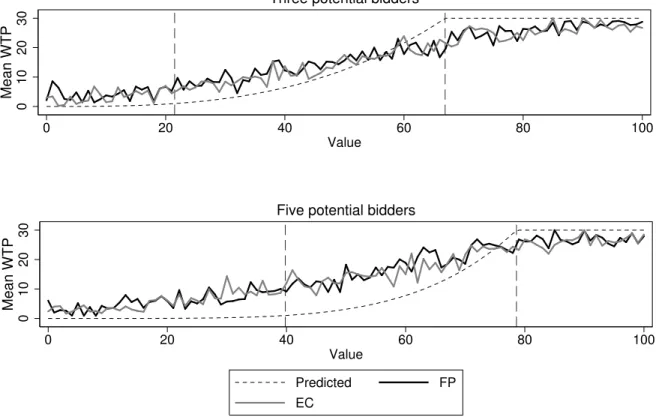
We refer to the interval of values for which a potential bidder is never predicted to enter as region one. The interval of values for which predicted entry depends on the realized entry cost is referred to as region two, and the interval of values such that entry is always predicted is referred to as region three. When the number of potential bidders is three (five), region one consists of values strictly smaller than22(40), region two is22 ≤vi ≤66(40 ≤vi ≤ 78), and region three consists of values strictly above66(78). We focus our analysis on region two, where the entry decision is not predicted to be trivial.9
Theory predicts WTP to be an increasing function of value and that is precisely what we find: reported WTP is increasing in potential bidders’ valuation. This is clearly illustrated in Figure 2, which shows mean reported and predicted WTP by valuation, group size and auction format.
However, revealed WTP exceeds predictions, regardless of auction format or group size.10 This result is further detailed in Table 1, which reports summary statistics for predicted and revealed WTP across auction format and group size. Since reporting WTP in excess of theoretical predictions results in over-entry in expectation, we will refer to this phenomenon as over-entry. Conversely, we refer to WTP below predictions as under-entry.
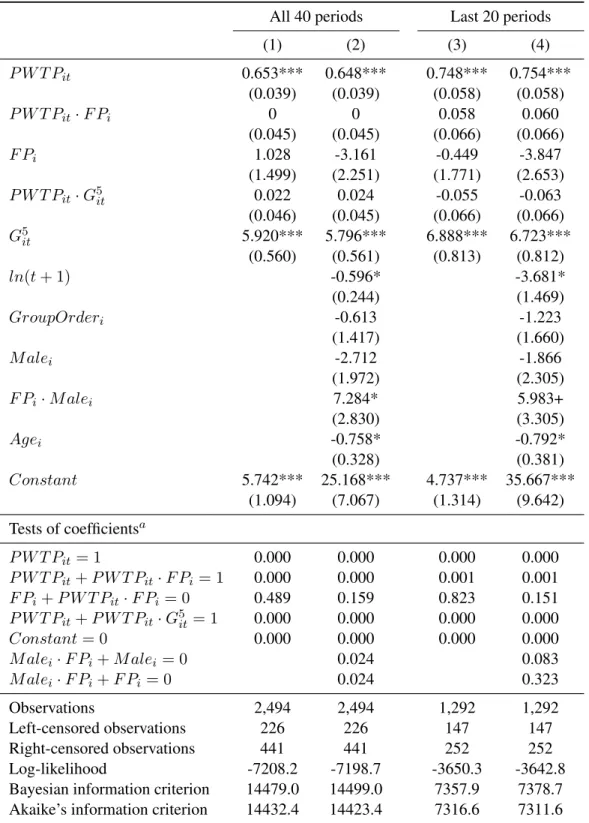
To further investigate how reported WTP compares with Nash predictions we use random effect tobits to control for individual subject effects, and to account for the fact that reported WTP is censored. The dependent variable,W T Pit, is potential bidderi’s reported WTP in periodt. To determine whether or not reported WTP conforms to theory when controlling for additional factors, we include bidderi’s predicted WTP during periodt(P W T Pit).11 Note thatP W T Pitis a function of both value and group size on region two (P W T Pit=vit/cdotF(vit)n−1), so the inclusion of this variable tests whether or notW T Pitresponds to changes in value and group size as predicted by theory. We are also interested in treatment effects. To test whether auction format or group size has a level effect on reported WTP we include dummy variables
F PiandG5itthat indicate whether the auction format is first-price and group size was five, respectively. We also interact these treatment dummies with withP W T Pit. If entry behavior is consistent with theory, then the coefficient onP W T Pitwill equal one, and the remaining coefficients will not differ from zero.
In addition, we report specificatations which include additional controls. Specifically, we control for gender (M alei = 1if participantiis male), age (Agei), learning over the course of the experiment (ln(t+ 1)), an interaction of gender and the first-price auction dummy, and a dummy variable which controls for order effects (GroupOrderi = 1if participantibegan the experiment with a group size of five).12
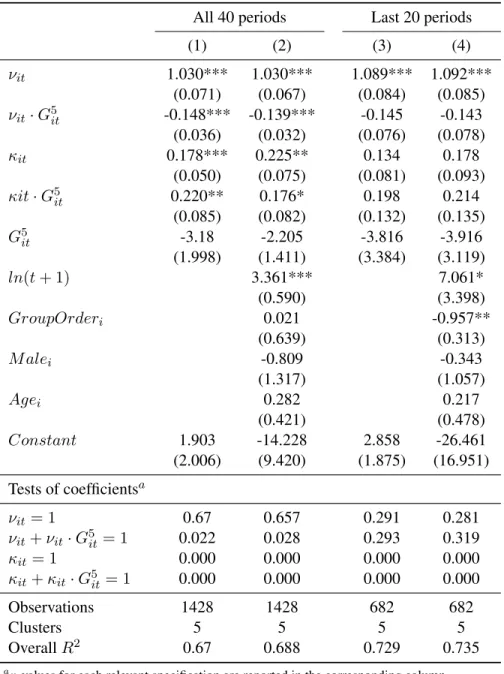
Table 2 contains estimates for region two.13 The first two specifications present results for all periods, both with and without the additional controls, and the last two specifications restrict attention to the second half of the experiment (last twenty periods) as a robustness check.
We find that reported WTP is increasing in predicted WTP, but this responsiveness is less than is
pre-9
Recall that although the maximum possible entry cost is thirty, we allow potential bidders to report WTP greater than thirty so that there is a transparent way to enter the auction regardless of the realized entry cost. In our analysis we censor all such observations to thirty. Likewise, predicted WTP in excess of thirty is also censored at thirty in our analysis.
10
A sign test using session level data to ensure independence of observations yields the same result in all four treatments:w= 5,
p= 0.031. It is important to note that subjects had previously participated in an experiment with endogenous entry in both of these auction formats, so inexperience regarding relative payoffs is unlikely to drive this result.
11BothW T P
itandP W T Pitare censored on the range[0,30].
12
Recall that group size variation is eithern= 5orn= 3for the first ten periods and then switches back and forth in ten period blocks.
13
dicted by theory. To see this, note that in all specifications the coefficient corresponding to P W T Pit is positive and significant, but is also significantly less than one.14 In addition, the coefficient corresponding to the constant is positive and statistically significant, suggesting a level effect of overentry.
There also seems to be learning throughout the experiment, which moves reported WTP closer to theo-retical predictions. To see this, note that when we restrict to the second half of the experiment the sensitivity ofW T Pit toP W T Pit is higher, and the constant is lower, then when using the full sample. This is true even when controlling forln(t+ 1), which is negative and statistically significant.
An important finding is that, as predicted by theory, entry behavior is invariant across auction formats. In particular, the coefficient forF Piis not significantly different than zero in any specification. Furthermore, the sensitivity ofW T Pitto predictions does not vary by auction format, since the coefficients corresponding to the interaction betweenP W T PitandF Pi is not statistically different from zero. This entry threshold invariance across auction format is of interest because Ivanova-Stenzel and Salmon (2004) finds that, in an environment, where bidders do not observe their value before making their entry decision, bidders have a higher WTP for English clock auctions.15 Our results resemble those of Engelbrecht-Wiggans and Katok (2005), which finds no difference in WTP between first-price and English clock auctions in an environment where bidders only observe their value after they enter the auction. As mentioned above, participants in our experiment observe their value prior to entry and have previous experience in an experiment involving endogenous entry in auctions in which the auction format was varied (between first-price and English clock) on a within subject basis.
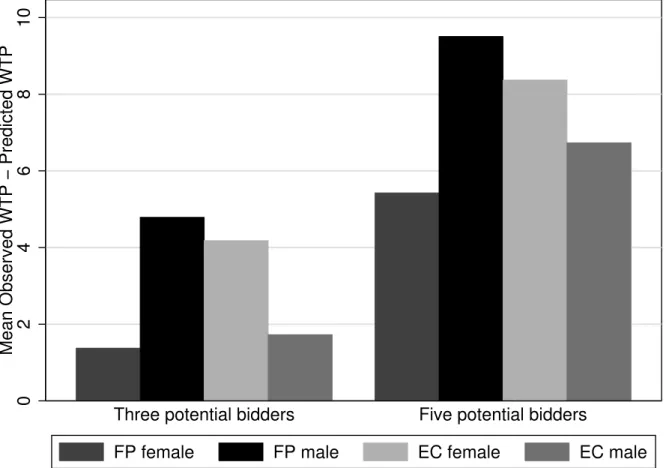
However, entry by auction format is heterogeneous across gender: males report higher WTP for first-price auctions. In particular, although the coefficient onM alei is not significant, the interaction ofM alei withF Piis both positive and significant (marginally in the second half). This result is illustrated in Figure 3, which compares WTP across treatments and gender in region two.16 This suggests that males prefer first-price auctions to English clock auctions, and that this preference is not shared by females. In fact, Figure 3 suggests that this preference ordering may be reversed for females, although the difference is not significant at conventional levels.
Our most surprising result is that reported WTP is increasing in group size. To see this, note that the coefficient forG5itis highly significant and positive in all specifications. Further, the magnitude of these coefficients increases when attention is restricted to the second half. Note that this is a level effect; sensitivity ofW T Pit toP W T Pit is not affected by group size, as the coefficients corresponding to the interaction betweenP W T PitandG5itgroup size is not significant in any specification. This puzzling result is not due to differences in payoffs (see below). However, such behavior is not unique to our experiment. For example, Fischbacher and Thoni (2008) reports similar results in winner-take-all experimental markets. They study winner-take-all markets with groups of seven or eleven potential participants, who face an opportunity cost of entering the market. The expected prize decreases with number of entrants. They report excess entry relative to Nash equilibrium, and the excess entry increases with group size.
5.2 Payoffs
Given the two-stage nature of the game, it is possible that deviations from theoretical entry predictions in the first stage stem from expected non-equilibrium bidding behavior in the auction. Since (beliefs about) bidding behavior should only affect entry decisions through (beliefs about) payoffs, we relegate a detailed analysis
14
Thep-values for tests of coefficients are reported below the relevant specification. 15
Ivanova-Stenzel and Salmon (2008b) and Ivanova-Stenzel and Salmon (2011) both find that bidder will often choose English clock auctions over first-price auctions when bidders do not know their valuation prior to entry. Since all else is equal between the two formats in their design, it is not possible to determine if this choice represents a higher WTP.
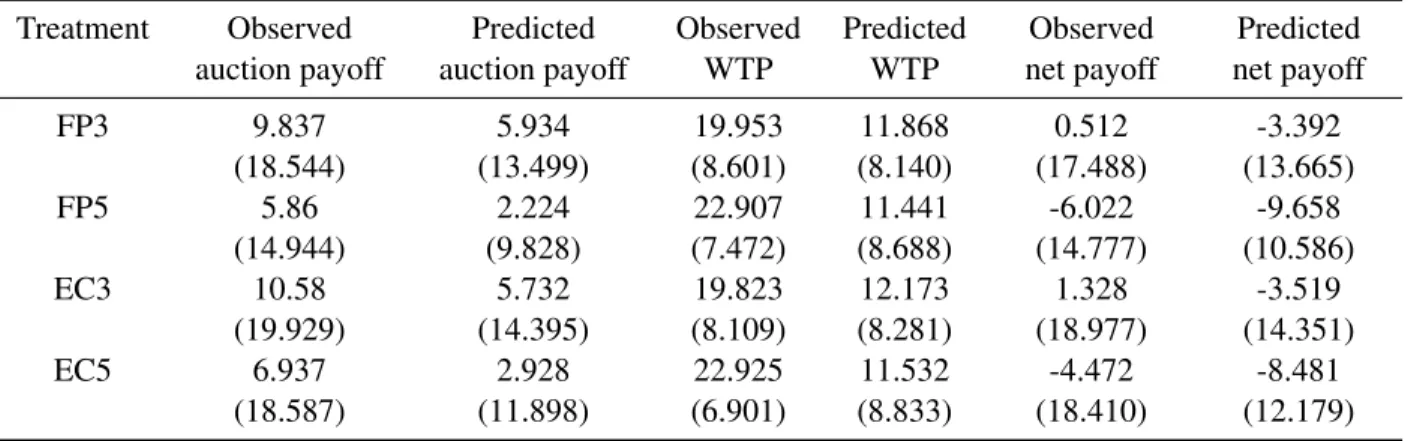
of bidding behavior to Appendix D and focus here on auction payoffs.17 We consider bidder payoffs in the terminal subgame, without accounting for the incurred participation cost, as this is the relevant comparison to WTP.
Table 3 contains summary statistics regarding observed and predicted bidder payoffs, as well as observed WTP for region two.18 Figure 5 illustrates the same.19 Observed payoffs in the auction exceed ex-ante predicted payoffs in all treatments. This is driven by selection; those who enter the auction have higher values. When we condition predicted payoffs on the observed number of entrants we find that bidders earn less than predicted.20
Importantly, note that observed WTP of bidders considerably exceeds their observed payoffs in all treat-ments, and therefore cannot explain overentry.21 Not only are participants over-entering with respect to theory, but with respect to realized payoffs as well. Such overentry relative to payoffs has been documented in other experiments on entry such as Palfrey and Pevnitskaya (2008); Fischbacher and Thoni (2008).
Assuming that potential bidders have higher WTP for environments in which their payoffs are higher, we would expect to find that payoffs are equal across auction formats, and that payoffs are higher when group size is five. However, in both cases we find the opposite. Payoffs are greater in English clock auctions, although the magnitude of this difference is small and not very robust.22 Further, payoffs are greater for groups of three than groups of five.23 The latter result implies that relative payoffs between the two group sizes is unable to explain the higher WTP when group size is five.
Turning attention to gender differences, since males report a higher WTP for first-price auctions, one might expect that their payoffs are higher in the same. However, payoffs for males are actually lower in first-price auctions, although this difference is not significant (sign test,w = 9,p < 0.623). As such, relative payoffs are also unable to explain the male preference for first-price auctions. Further, while males do earn more than females in first-price auctions this difference is not statistically significant (sign test, w = 5,
p <0.187). This result also holds for the pooled sample (sign test,w= 7,p <0.172).
6
Discussion
To recap our results, we find that WTP is increasing in value, although it is less responsive than the risk-neutral Nash prediction. However, there is a positive level effect such that we observe consistent overentry. This level effect is increasing in group size, and this preference for a higher group size cannot be explained by relative payoffs. Both expected and observed payoffs are decreasing in group size.
In addition, we find that, consistent with theoretical predictions, entry threshold strategies are invariant to auction format. That is, reported WTP does not, on average, vary across auction formats. However, we find that males express a preference (revealed by higher WTP) for first price auctions relative to English
17
Our results regarding reported WTP are likely to be driven by expected payoffs in the subsequent auction. This is particularly true since potential bidders have experience in a similar experiment, and are thus likely to have an easier time forming accurate beliefs about relative payoffs than inexperienced participants. This point is particularly important since Engelbrecht-Wiggans and Katok (2005) argues that experimental participants have a difficult time determining expected payoffs in a given auction format.
18
Notice that in contrast to regions one and three, WTP in region two is not truncated and so may be directly compared with payoffs.
19Figure 6 in Appendix E illustrates payoffs in all three regions. 20
This holds true for the pooled data (sign test,w = 10,p = 0.001), as well as analyzing by auction format, group size or auction format and group size (all of these tests yield the same results: sign test,w= 5,p= 0.031).
21This holds true for the pooled data (sign test,w = 10,p = 0.001), as well as analyzing by auction format, group size or auction format and group size (all of these tests yield the same results: sign test,w= 5,p= 0.031).
22Using the robust rank order test,U´ =−1.768,p <0.038. The difference is not statistically significant when restricting to either group size.
23For the pooled data: sign test,w = 9,p= 0.011. The same result holds when considering each auction format separately: sign test,w= 5,p= 0.031.
clock. This cannot be explained by greater male profits in first price auctions.
In the following subsections we discuss and evaluate hypothesis that may explain our results. 6.1 WTP and competitiveness
The literature on auctions has explored the hypothesis that a joy of winning may explain why observed bidding (particularly in first and second-price auctions) exceeds Nash predictions (see e.g. Cox et al. (1988), Cox et al. (1992), Cooper and Fang (2008)). A variant of this hypothesis in which the joy of winning is increasing in the number of people in the auction (or other competitive environment) could explain why we observe that WTP is increasing in group size.
The literature on auctions has explored the hypothesis that a joy of winning may explain why observed bidding (particularly in first and second-price auctions) exceeds Nash predictions (see e.g. Cox et al. (1988), Cox et al. (1992), Cooper and Fang (2008)). It is reasonable to suppose that such a joy of winning is higher for more competitive individuals, and that it is increasing in the number of competitors. If so, we would expect to see higher WTP for more competitive potential bidders, and a higher WTP for larger group sizes among such individuals.
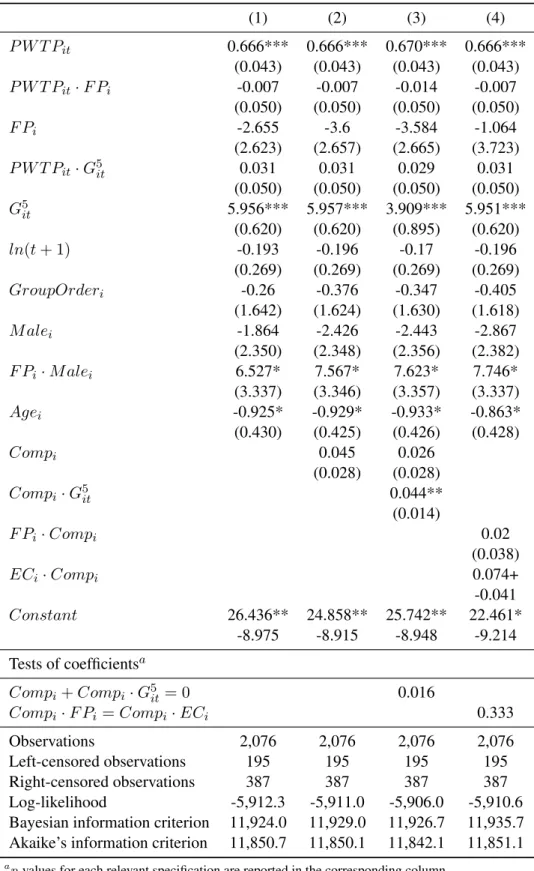
To test these two hypotheses, we examine a subset of our sample (83.2%) for which we have data on preferences for competition from a different experiment. This measure is the weight that a participant places on a tournament payment scheme rather then a piece-rate payment scheme when the tournament is between four subjects over a real effort task. Using this subset of the data, we estimate random effects tobits similar to those reported in Table 2, and include controls for competitiveness (Compi).
Table 7 presents the results. The first specification tests the robustness of the results reported in Table 2) for the sub-sample with competitiveness data. Although coefficient magnitudes change slightly, all coef-ficients have the same sign and statistical significance expect for the coefficient corresponding toln(t+ 1) which, although still negative, it is no longer statistically significant.
Turning attention to specifications including Compi, we find that competitiveness partially explains why WTP is increasing in group size, but find no support for the hypothesis that more competitive potential bidders will have higher WTP overall. To see this, note that when we only addCompi(specification two) we find that it has no significant effect onW T Pit. However, when we add an interaction between Compi andG5
it(specification three), the corresponding coefficient is positive and highly significant. Further, when we include this interaction the coefficient onG5it, although still positive and significant, drops in magnitude by about a third.
6.2 WTP and male preference for first-price auctions
There are several hypothesis could explain why males have higher WTP to participate in first-price auctions than in English clock auctions. One possibility is that this difference may be driven by a relative male pref-erence for competition, provided first-price auctions are perceived as being more competitive than English clock auctions.24 A second possibility is that this could be driven by differences in risk attitudes across gender. Specifically this difference could be due to men being less risk averse than women.25 Finally, the higher WTP for first-price auctions for men could also be due to the fact that first-price auctions have higher strategic uncertainty than English clock auctions, in the sense that English clock auctions have a weakly dominant bidding strategy, while first-price auctions do not. If men prefer environments where there is more strategic uncertainty, then they will tend to have higher WTP in first-price auctions.
We do not find support for the hypothesis that a gender difference in competitiveness drives the higher WTP for first-price auctions among males. Recall that the coefficient forCompi is not statistically
signifi-24
Such a gender difference in preferences for competition has been shown in e.g. Niederle and Vesterlund (2007). 25
cant in specification(2)of Table 7, and controlling for it does not reduce the coefficient on the interaction betweenF Pi andM alei. Furthermore, in specification(4)of the same table we control for the interaction ofCompiwith both auction formats and find no effect of competitiveness on WTP in first-price auctions.26 As such, we conclude that our measure of competitiveness does not explain why men are willing to pay more to participate in a first-price auction.
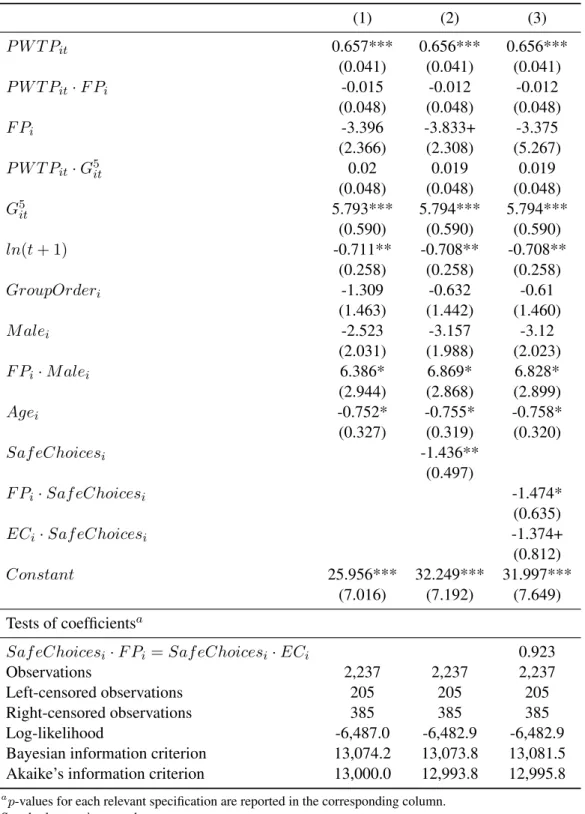
To investigate the possibility that gender differences in risk preferences explains why men have higher WTP for first-price auctions, we examine a subsample of our data (89.7%) for whom we have elicited risk preferences in an earlier experiment.27 In particular, control for risk preferences (Saf eChoicesi equal to the number of safe choices participantichoose in the risk elicitation task) in tobit regressions on WTP, and report results in Table 8.
The first specification confirms the robustness of results without risk preferences for the relevant subsam-ple; the magnitude of coefficients and corresponding statistical significance are very similar. In the second specification we includeSaf eChoicesiand find that the coefficient is negative and statistically significant, suggesting that risk aversion is associated with lower WTP. However, controlling forSaf eChoicesi has no effect on male preferences for first price auctions. The final specification interactsSaf eChoicesi with auction format. For both first-price and English clock auctions, this interaction is negative and statistically significant. However, we cannot reject that the corresponding coefficients are the same (p= 0.923) and the coefficient that captures male preference for first price auction is robust to these controls. Thus, we conclude that risk preferences are unable to explain the observed male preference for first-price auctions.
Our final hypothesis is that the higher WTP for first-price auctions for men could also be due to the fact that first-price auctions have higher strategic uncertainty than English clock auctions. If, all else constant, men prefer environments with strategic uncertainty, perhaps due to greater overconfidence (see e.g. Barber and Odean (2001), Johnson et al. (2006), Niederle and Vesterlund (2007)), then this could explain their higher WTP for first-price auctions. In particular, since English clock auctions have a weakly dominant bidding strategy, there is little to no strategic uncertainty. The same would be true of first-price auctions if bidders behave as predicted (and this is common knowledge). However, in first-price auctions bidders must determine how much to shade their bid and this depends on their beliefs about what others will do. Engelbrecht-Wiggans (2001) identifies this asymmetry in strategic uncertainty, but implicitly assumes it to be homogenous across genders and argues the increased strategic complexity in first-price auctions relative to English clock auctions may drive bidder preferences for English clock auctions. Our findings suggest the opposite might be true for males. Further research is needed to investigate this hypothesis.
7
Conclusion
We experimentally examine threshold entry decisions in independent private value auctions where partici-pation is costly and bidders learn their value before they make their entry decisions. In particular, we elicit WTP using an incentive compatible BDM mechanism. Once each bidder has reported her WTP, a partici-pation cost that is common to all potential bidders is drawn from a uniform distribution. If reported WTP (weakly) exceeds this participation cost then the bidder incurs this cost and enters the auction. Bidders are then told how many bidders there are in the auction and then place their bids.
26
We further test whether there is a gender difference in competition for subjects randomly assigned to first-price auction treat-ment and find only weak evidence for gender difference (robust rank order test,U´ = 1.384, p = 0.083). We do not find any difference in competitiveness between males assigned to the first-price auction and the English clock auction treatments (Robust rank order test,U´= 0.423,p >0.10).
27
This data was collected in the experiment reported in Aycinena and Rentschler (2014). This measure of risk is similar to Holt and Laury (2002) except that the safe lottery in each row is replaced by a certain outcome. Thus, each row features a task that is similar to the entry choice of a potential bidder, in which entry is a lottery, and not entering yields a certain payoff.
We vary the auction format between a first-price auction and an English clock auction on a between-subject basis. In addition we vary the size of the pool of potential bidders between three and five, on a within-subject basis.
In accordance with theory, we find that WTP is increasing in bidder valuation. For the region of values where theory predicts that the entry decision will depend on the realization of the entry cost, we find that WTP increases in value at about2/3of what theory predicts. However, there is a level increase in reported WTP regardless of value, which results in, on average, higher than predicted WTP.
When bidders report WTP in excess of predicted WTP, we say that they are over-entering the auction, because, on average, they will enter the auction more than predicted by theory. The observed over-entry exists in both auction formats, and persists throughout the experiment. This is despite that fact that they are paying more to enter the auction than they earn, on average.
Our most surprising result is that potential bidders have a higher WTP for auctions with a group size of five, than for auctions with a group size of three. This is despite the fact that observed and predicted payoffs are both decreasing in the number of potential bidders. We argue that this result is consistent with a preference for larger competitive environments and show that competitiveness can partially explain this result.
Interestingly, we also find that reported WTP for males is higher for first-price auctions than for English clock auctions. This is interesting because Ivanova-Stenzel and Salmon (2004, 2008b, 2011) all find that bidders seem to prefer English clock auctions, although their experimental design is markedly different than ours. Engelbrecht-Wiggans and Katok (2005), which has a design much closer to ours (although bidders only learn their value after entry) does not find any difference in WTP across these two auction formats.
This result is not explained by risk preferences or competitiveness (although both of these seem to play a role in reported WTP. (As expected, we also find that measures of risk aversion reduce observed WTP and measures of competitiveness increase WTP.) We speculate this might due to men, controlling for risk preferences, preferring environments where there is higher strategic uncertainty. Further research should help to shed light on this finding.
References
D. Aycinena and L. Rentschler. Auctions with endogenous participation and an uncertain number of bidders: Experimental evidence. Working paper, 2014.
Brad M Barber and Terrance Odean. Boys will be boys: Gender, overconfidence, and common stock investment. Quarterly journal of Economics, pages 261–292, 2001.
G. Becker, M. DeGroot, and J. Marschak. Measuring utility by a single-response sequential method. Be-havioral science, 9(3):226–232, 1964.
C. Camerer and D. Lovallo. Overconfidence and excess entry: An experimental approach. American Economic Review, 89(1):306–318, 1999.
C. Campbell. Coordination in auctions with entry. Journal of Economic Theory, 82(2):425–450, 1998. X. Cao and G. Tian. Second-price auctions with differentiated participation costs. Working paper, 2008. X. Cao and G. Tian. Second-price auctions with two-dimensional private information on values and
partic-ipation costs. Working paper, 2009.
X. Cao and G. Tian. Equilibria in first-price auctions with participation costs.Games and Economic Behav-ior, 69(2):258–273, 2010.
David J Cooper and Hanming Fang. Understanding overbidding in second price auctions: An experimental study*. The Economic Journal, 118(532):1572–1595, 2008.
J. Cox, V. Smith, and J. Walker. Theory and individual behavior of first-price auctions. Journal of Risk and Uncertainty, 1(1):61–99, 1988.
James C Cox, Vernon L Smith, and James M Walker. Theory and misbehavior of first-price auctions: Comment. The American Economic Review, pages 1392–1412, 1992.
C. Eckel and P. Grossman. Men, women and risk aversion: experimental evidence. Handbook of Experi-mental Economics Results, 1:1061–1073, 2008.
R. Engelbrecht-Wiggans. Optimal auctions revisited. Games and Economic Behavior, 5(2):227–39, 1993. R. Engelbrecht-Wiggans. The effect of entry and information costs on oral versus sealed-bid auctions.
Economics Letters, 70(2):195–202, 2001.
R. Engelbrecht-Wiggans and E. Katok. Experiments on auction valuation and endogenous entry. Advances in Applied Microeconomics: A Research Annual, 13:169–193, 2005.
U. Fischbacher. z-tree: Zurich toolbox for ready-made economic experiments. Experimental Economics, 10(2):171–178, 2007.
U. Fischbacher and C. Thoni. Excess entry in an experimental winner-take-all market.Journal of Economic Behavior & Organization, 67(1):150–163, 2008.
J. Green and J. Laffont. Participation constraints in the vickrey auction. Economics Letters, 16(1):31–36, 1984.
R. Harstad. Alternative common-value auction procedures: revenue comparisons with free entry. Journal of Political Economy, pages 421–429, 1990.
B. Heydenreich, R. M¨uller, M. Uetz, and R. Vohra. Characterization of revenue equivalence.Econometrica, 77(1):307–316, 2009.
C. Holt and S. Laury. Risk aversion and incentive effects. American Economic Review, 92(5):1644–1655, 2002.
R. Ivanova-Stenzel and T. Salmon. Bidder preferences among auction institutions. Economic Inquiry, 42 (2):223–236, 2004.
R. Ivanova-Stenzel and T. Salmon. Revenue equivalence revisited. Games and Economic Behavior, 64(1): 171–192, 2008a.
R. Ivanova-Stenzel and T. Salmon. Robustness of bidder preferences among auction institutions. Economic Inquiry, 46(3):355–368, 2008b.
R. Ivanova-Stenzel and T. Salmon. The high/low divide: self-selection by values in auction choice. Games and Economic Behavior, 73(1), 2011.
Dominic DP Johnson, Rose McDermott, Emily S Barrett, Jonathan Cowden, Richard Wrangham, Matthew H McIntyre, and Stephen Peter Rosen. Overconfidence in wargames: experimental evidence on expectations, aggression, gender and testosterone. Proceedings of the Royal Society B: Biological Sciences, 273(1600):2513–2520, 2006.
J. Kagel and D. Levin. Independent private value auctions: bidder behaviour in first-, second-and third-price auctions with varying numbers of bidders. Economic Journal, 103(419):868–879, 1993.
P. Klemperer. What really matters in auction design. Journal of Economic Perspectives, 16(1):169–189, 2002.
D. Levin and J. Smith. Equilibrium in auctions with entry. American Economic Review, 84(3):585–599, 1994.
T. Li and X. Zheng. Entry and competition effects in first-price auctions: theory and evidence from procure-ment auctions. Review of Economic Studies, 76(4):1397–1429, 2009.
J. Lu. Auction design with opportunity cost. Economic Theory, 38(1):73–103, 2009.
R. McAfee and J. McMillan. Auctions with entry.Economics Letters, 23(4):343–347, 1987.
F. Menezes and P. Monteiro. Auctions with endogenous participation. Review of Economic Design, 5(1): 71–89, 2000.
A. Miralles. Intuitive and noncompetitive equilibria in weakly efficient auctions with entry costs. Mathe-matical Social Sciences, 56(3):448–455, 2008.
D. Moreno and J. Wooders. Auctions with heterogeneous entry costs. RAND Journal of Economics, 42(2): 313–336, 2011.
R.B. Myerson. Optimal auction design. Mathematics of operations research, 6(1):58–73, 1981.
Muriel Niederle and Lise Vesterlund. Do women shy away from competition? do men compete too much?
The Quarterly Journal of Economics, 122(3):1067–1101, 2007.
T. Palfrey and S. Pevnitskaya. Endogenous entry and self-selection in private value auctions: an experimen-tal study. Journal of Economic Behavior & Organization, 66(3):731–747, 2008.
S. Pevnitskaya. Endogenous entry in first-price private value auctions: the self-selection effect. Working paper, 2004.
D. Reiley. Experimental evidence on the endogenous entry of bidders in internet auctions. Experimental Business Research, pages 103–121, 2005.
J. Smith and D. Levin. Ranking auctions with risk averse bidders. Journal of Economic Theory, 68(2): 549–561, 1996.
J. Smith and D. Levin. Entry coordination in auctions and social welfare: an experimental investigation.
International Journal of Game Theory, 30(3):321–350, 2002.
G. Tan and O. Yilankaya. Equilibria in second-price auctions with participation costs.Journal of Economic Theory, 130(1):205–219, 2006.
A
Derivations of Nash predictions
A.1 First-price auctionsThere arenpotential bidders of which2 ≤ m ≤ nhave entered the auction. Assume thatmis common knowledge. We restrict attention to symmetric equilibrium in which potential bidders employ an entry threshold of0< vω< vH. Thus, allmbidders have values in excess of this threshold.
We proceed by identifying the symmetric equilibrium bidding function,β. Assume that it is both differ-entiable and strictly monotonically increasing. The expected payoff of bidderiwith valuevi ≥vωwho bids
b6=β(vi)(withb ≥β(vω), as this would ensure a payoff of zero), assuming that the otherm−1bidders bid according toβ is given by
πF Pi (b, vi|m) = F β−1(b) −F(vω) 1−F(vω) !m−1 (vi−b). (5)
Taking the partial derivative with respect tob, and setting it equal to zero, and noting that incentive compat-ibility implies thatb=β(vi)in equilibrium we arrive at the following differential equation
(m−1) F(vi)−F(vω) 1−F(vω) m−2 f(vi) 1−F(vω) 1 β0(v i) (vi−β(vi))− F(vi)−F(vω) 1−F(vω) m−1 = 0. (6) Simplifying leaves us with
d dvi β(vi) F(vi)−F(vω) 1−F(vω) m−1 = (m−1) F(vi)−F(vω) 1−F(vω) m−2 f(vi) 1−F(vω) (vi). (7) The initial condition consistent with equilibrium isβ(vω) =vω. Solving forβ(vi)leaves us with
β(vi) = 1 F(vi)−F(vω) 1−F(vω) m−1 Z vi vω (m−1) F(t)−F(vω) 1−F(vω) m−2 f(t) 1−F(vω) (t)dt. (8)
This can be rewritten as
β(vi) =vi− Rvi vω(F(t)−F(vω)) m−1dt (F(vi)−F(vω))m−1 . (9)
Now consider the case in whichm = 1. That is there is only one bidder, and this bidder is aware of this. She will thus submit a bid of zero, and obtain the good.
Plugging the equilibrium bid function into the payoff function shows that the equilibrium payoff of a bidder with valuevi ≥vωandm >1is given by
πiF P(β(vi), vi|m) = Z vi vω F(t)−F(vω) 1−F(vω) m−1 dt. (10)
Note that ifm= 1, then the equilibrium payoff of bidderiis simplyvi.
We now consider the entry decision of a potential bidder who faces a participation cost ofcand hasvi≥
according toβ if they enter is πiF P(β(vi), vi) =viF(vω)n−1+ n X m=2 n! (n−m)!m! Z vi vω (F(t)−F(vω))m−1dt F(vω)n−m. (11) Note that if a potential bidder hasvi = vω, then she will enter the auction. She will then obtain the good at a price of zero, provided she is the only entrant, which occurs with probabilityF(vω)n−1. Setting the associated expected payoff equal tocimplicitly definesvω:
vωF(vω)n−1=c. (12)
Note that this implies that the ex ante expected revenue generated by the auction is
RF P = n X k=2 n! (n−k)!k! F(vω)n−kk Z vH vω β(t) (F(t)−F(vω))k−1 f(t)dt. (13)
Simplifying by integrating by parts leaves us with
RF P =n(n−1) Z vH
vω
(1−F(t))tF (t)n−2f(t)dt. (14)
A.2 English Clock auctions
Assume that potential bidders employ a symmetric entry threshold, which we denote as0< vθ < vH. Note that any bidder who enters will always bid her value, regardless of the number of bidders,m. That is, the bidding function that is consistent with a perfect Bayesian equilibrium isρ(vi) =vi. Thus, we only need to determine value ofvθ.
LetG(·) =F1(·−)−FF(vθ(vθ))m
−1
be the distribution of values, conditional on entry into the auction. Denote the associated density asg = G0. If a bidder with vi ≥ vθ observes that there arem > 1 bidders in the auction, then her equilibrium expected payoff is
πiEC(ρ(vi), vi|m) =G(vi) vi− 1 G(vi) Z vi vθ tg(t)t . (15)
If we simplify and integrate by parts, this becomes
πECi (ρ(vi), vi|m) = Z vi
vθ
G(t)m−1dt. (16)
The equilibrium expected payoff of a potential bidder with valuevi ≥vθis given by
πECi (ρ(vi), vi) =viF(vθ)n−1+ n X m=2 n! (n−m)!m! Z vi vθ (F(t)−F(vθ))m−1dt F(vθ)n−m. (17)
Note the parallel with first-price auctions. Logic identical to the first-price auction shows that vθ is implicitly defined by
vθF(vθ)n−1=c. (18)
Note that the equilibrium entry thresholds are identical in first-price and English clock auctions. Since this implies that the expected payoffs of potential bidders are also identical, the expected revenue between
the two formats is also identical. That is,REC =RF P.
B
Instructions for first-price sessions
The instructions for first-price sessions, translated from the original Spanish, are below. Instructions for the English clock sessions are available upon request.
SLIDE NUMBER 1
Introduction
• The following instructions will explain how you can earn money. The amount of money that each participant earns may vary considerably depending on the decisions the participant makes.
• Participants will interact only through computers. If anyone disobeys the rules, we will terminate the experiment and will ask you to leave without any earnings.
SLIDE NUMBER 2
Earnings in the experiment
• The amounts in the experiment are denominated in Experimental Pesos (E$).
• Each participant will start the experiment with a balance ofE$500. Profits (or losses) are added to (or subtracted from) the balance.
• At the end of the experiment, we will convert your accumulated balance to Quetzales (Q1 =E$7.5), and we will pay it in cash.
SLIDE NUMBER 3
Overview
• The experiment will have 40 rounds. In each round, you will participate in an auction of a good or in a pastime.
• At the beginning of each round you will make a decision regarding whether: 1. you pay the PARTICIPATION FEE, and participate in the auction, or 2. you do not pay anything, and participate in the pastime.
• If you participate in the auction you can make money if you buy the good. If you participate in the pastime you will not earn (or lose) money.
SLIDE NUMBER 4
Value
• At the beginning of each round each potential buyer will know his value of the auctioned good, but the potential buyer will not know how much the good is valued by the other potential buyers.
• The VALUE of the good for each potential buyer will be between E$0 andE$100, and it will be determined randomly. (All the values between0and100have the same probability of being chosen).
• The VALUE of each buyer will be independent from the others; the VALUE is not related to (and probably will be different from) the VALUE of the others.
SLIDE NUMBER 5
• The earnings you can obtain (if you purchase the good in the auction) depend on its VALUE, the PARTICIPATION FEE, and the Price that is paid for the good. If its VALUE is greater than the Price you pay + the PARTICIPATION FEE, you will earn the difference.
• VALUE - Price - PARTICIPATION FEE = Profit (or Loss)
• If the Price you pay is greater than the VALUE, you will lose money. If you do not buy it, you will have to pay the PARTICIPATION FEE.
SLIDE NUMBER 6
PARTICIPATION FEE
• The PARTICIPATION FEE is determined randomly betweenE$1andE$30in each round, and it will be the same for all participants. (All the fees betweenE$1andE$30are equally likely to be chosen). In each round, all the potential buyers will have:
– The same PARTICIPATION FEE, and
– Probably a different VALUE.
SLIDE NUMBER 7
Participation
• Once you have seen your VALUE, and before you know the PARTICIPATION FEE, you will be asked which is the MAXIMUM FEE you would be willing to pay in order to participate in the auction. • The MAXIMUM FEE you enter will not affect the PARTICIPATION FEE, as this is determined
randomly and it is the same for everyone.
SLIDE NUMBER 8
Participation
• If the MAXIMUM FEE that you would be willing to pay is less than the PARTICIPATION FEE you will NOT participate in the auction (you will participate in the pastime), and you will pay nothing. • If the MAXIMUM FEE that you would be willing to pay is greater or equal to the PARTICIPATION
FEE, you will participate in the auction (you will not participate in the pastime), and you will pay the PARTICIPATION FEE.
SLIDE NUMBER 9
Participation Example
• Suppose you have a value of 50 and the MAXIMUM FEE you would be willing to pay in order to participate is 15.
• If the PARTICIPATION FEE for that round is 23, you are not willing to pay the PARTICIPATION FEE. Therefore, you will NOT participate in the auction and you will pay nothing.
• If the PARTICIPATION FEE for that round is 7, you are willing to pay more than the rate. Therefore, you WILL participate in the auction and you will pay the PARTICIPATION FEE (7).
• Notice that the MAXIMUM FEE that you would be willing to pay (15) does not affect the PARTICI-PATION FEE you pay to participate (7).
SLIDE NUMBER 10
MAXIMUM FEE
• Note that if you enter a MAXIMUM FEE which is less than what you are actually willing to pay, it is possible that you may not participate in the auction, even if you would rather preferred to.
• For example, suppose that the maximum that you are actually willing to pay to participate is 15: • If you indicate a MAXIMUM FEE of 10 and the PARTICIPATION FEE is 12, you do not participate
even if you would have rather preferred to pay 12 and participate. If you would have indicated a MAXIMUM FEE of 15, you would have participated and paid 12.
SLIDE NUMBER 11
MAXIMUM FEE
• On the other hand, if you indicate as your MAXIMUM FEE an amount higher than the maximum that you are actually willing to pay, it is possible that you may participate in the auction and pay more than what you were willing to pay.
• Suppose that the maximum that you are actually willing to pay to participate is 15:
• If you indicate a MAXIMUM FEE of 20 and the PARTICIPATION FEE IS 18, you participate and pay 18 even though the maximum you were really willing to pay to participate is 15. If you would have indicated a MAXIMUM FEE of 15, you would have not participated and paid 18.
SLIDE NUMBER 12
MAXIMUM FEE and Participation
• In other words, what you pay to participate in the auction (PARTICIPATION FEE) does not depend on the maximum amount that you are willing to pay (MAXIMUM FEE).
• Therefore, you should indicate the maximum amount that you are willing to pay as the MAXIMUM FEE, as this will determine whether you participate or not, but will not determine how much you pay to participate in the auction.
SLIDE NUMBER 13
Auction
• The person that makes the highest Offer Price will buy the good. (In case of a tie between two or more offers, the purchaser will be determined randomly). The Price paid by the purchaser will be equal to his Offer.
• If you are the only participant in the auction, you will buy the good with any offer you make, even with an offer of 0.
SLIDE NUMBER 14
Earnings in the Auction
• The earnings of the buyer is the difference between the VALUE and the Price, minus the PARTICI-PATION FEE:
• VALUE - Price - PARTICIPATION FEE = Earnings
• Note that you will make money only if the Price at which you buy the good is lower than (VALUE -PARTICIPATION FEE).
• Those who do not buy the good pay the PARTICIPATION FEE.
SLIDE NUMBER 15
Auction Example
• Example: Suppose that your value is 76. If your offer is 61 and the offers of the other participants are 37 and 60, you buy the good and pay the Price (61). Your profit in this round would be:
• 76 - 61 - PARTICIPATION FEE
• If your offer is not the highest, you do not buy the good and you pay the PARTICIPATION FEE.
SLIDE NUMBER 16
Not Participating in the Auction
• If you do not participate you will not have earnings or losses, and you will not pay the PARTICIPA-TION FEE.
• While the auction is being held, you will automatically participate in a pastime: • Tic-tac-toe
– You will play against the computer and you will win if you can place 3 of the symbols (X) in a straight line (horizontal, vertical or diagonal).
– Your result in this hobby will not affect your earnings.
SLIDE NUMBER 17
Potential Buyers in the Auction
• In some rounds, there will be 3 (you and 2 other) potential buyers in the auction. In others, there will be 5 (you and 4 other) potential buyers.
SLIDE NUMBER 18
Rounds
• The experiment will have 40 rounds. In each round, the participants will be randomly reassigned, according to the number of potential buyers.
• That is, you will NOT be participating with the same people in all rounds.
SLIDE NUMBER 19
Summary
• The experiment consists in a series of rounds. In each round:
1. You should enter the MAXIMUM FEE that you are willing to pay to participate in the auction. 2. The PARTICIPATION FEE, which is randomly selected, will determine whether you participate
or not in the auction:
• You will participate (and pay the PARTICIPATION FEE) if the MAXIMUM FEE is higher or equal to the PARTICIPATION FEE.
• You will NOT Participate (and you do not pay anything) if the MAXIMUM FEE is lower to the PARTICIPATION FEE.
SLIDE NUMBER 20
Summary
• If you do not participate in the auction, you will not have earnings or losses, and you will not have to pay the PARTICIPATION FEE.
• If you participate in the auction, you can earn money if you buy the good and your VALUE is higher than the Price + PARTICIPATION FEE.
• Earnings (if you buy the good) = VALUE - Price -PARTICIPATION FEE. • If you do not buy the good, you will pay the PARTICIPATION FEE.
C
Instructions for the risk elicitation task
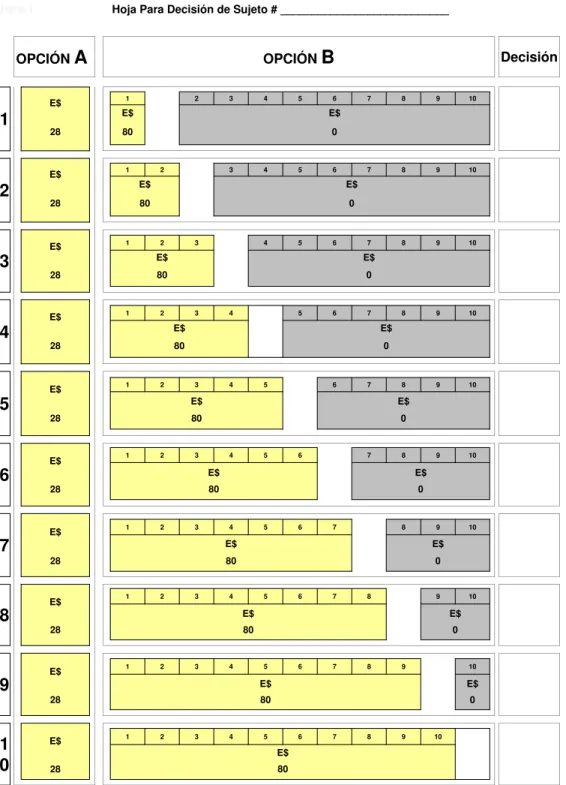
This appendix contains the instructions, translated from the original Spanish, for the risk elicitation task. The decision sheet provided to subjects can be found in Figure 1.
SLIDE NUMBER 1
Welcome. You will be participating in a decision-making experiment. These instructions will explain to you how you may earn money. If you have any questions during these instructions, please raise your hand and we will address them in private. As of right now, it is very important not to talk or try to communicate in any way with the other participants. If you disobey the rules, we will have to end the experiment and ask you to leave without any payment.
Figure 1: Decision sheet used in the risk elicitation task
Your decision sheet shows 10 rows of decisions. Each of them is a selection between two options, Option A and Option B. Option A represents a fixed payment; unlike Option B, whose payment depends on the throw of a 10-sided die.
SLIDE NUMBER 3 Now, please look at the first row at the top of the decision sheet. Option A pays