Contents lists available atScienceDirect
International Journal of Information Management
journal homepage:www.elsevier.com/locate/ijinfomgtInformation system capabilities and firm performance: Opening the black
box through decision-making performance and business-process
performance
☆
Arafat Salih Aydiner
a, Ekrem Tatoglu
b,⁎, Erkan Bayraktar
c, Selim Zaim
daFaculty of Political Sciences, Istanbul Medeniyet University, Kadikoy, Istanbul, 34000, Turkey bSchool of Business, Ibn Haldun University, Basaksehir, Istanbul, 34494, Turkey
cCollege of Engineering and Technology, American University of the Middle East, Kuwait
dCollege of Engineering and Natural Sciences, Istanbul Sehir University, Kartal, Istanbul, 34865, Turkey
A R T I C L E I N F O Keywords:
Information system capabilities Resource-based view Decision-making performance Business-process performance Firm performance Emerging countries A B S T R A C T
This study contributes to the extant literature on information management by investigating the interrelation-ships between information systems (IS)-related capabilities and their effects on firm performance. Using the resource-based view (RBV), a set of hypotheses is formulated to examine these links, considering the role that may be played by decision-making performance and business-process performance as mediating variables. Structural equation modeling (SEM) has been applied to a sample of 204 firms in Turkey. The test results obtained confirm the proposed serially mediating model according to which decision-making performance and business-process performance play a critical mediating role in the human resource and administrative-related IS capabilities, and firm-performance relationships. No support, however, has been found concerning the serial mediation effect between infrastructure-related IS capabilities and firm performance.
1. Introduction
For the survival and growth of many firms in today’s businesses environment, creative use of information technology (IT)/information systems (IS) is essential. IT and IS together provide new opportunities to businesses to redesign their business processes and work practices, while enabling organizational change (Dedrick, Gurbaxani, & Kraemer, 2003). However, a recent survey by McKinsey & Company reveals that nearly half of the IT/IS projects exceed their budgets (Bloch, Blumberg, & Laartz, 2012). Large IT/IS projects overrun their budgets by 45 percent, exceed their allotted time by 7 percent and provide 56 percent less value than predicted. Moreover, 17 percent of IT/IS projects are managed so poorly that they may jeopardize the existence of the company (Bloch et al., 2012). In the absence of proper governance of business processes, IS/IT-enabled process-management practices may also fail (Rahimi, Møller, & Hvam, 2016). Furthermore, according to McKinsey’s research on digital revenue growth, only a small number of firms are doing better in the digital era, while three quarters of them encounter the negative effects of digital competition on a company’s
growth in earnings (Bughin, Catlin, Hirt, & Willmott, 2018).
Considering the amount of money and effort invested in IS projects, as well as the expectations raised for better firm performance, there is a significant concern about whether or not the anticipated value is being realized from IT/IS investments (Carr, 2003; Henderson & Venkatraman, 1993). Therefore, a substantial number of studies has been conducted to investigate the impact of IT/IS on firm performance. To exemplify, Table 1 provides a summary of selected past studies reporting both direct and indirect associations on the relationship between IT/IS capabilities and firm performance using various theoretical perspectives. Some of these studies have captured a direct positive relationship between IT capabilities and firm performance (Bharadwaj, 2000; Devece, Palacios, & Martinez-Simarro, 2017; Devece, Palacios-Marqués, Galindo-Martín, & Llopis-Albert, 2017; Santhanam & Hartono, 2003). Various authors, such asChae, Koh, and Prybutok, (2014), have pointed out that IT capabilities have no positive direct impact on firm performance anymore, since more standardized and homogeneous IS are being implemented through enterprise resource planning (ERP) and web technologies since the 2000s. Many
https://doi.org/10.1016/j.ijinfomgt.2018.12.015
Received 9 July 2018; Received in revised form 4 December 2018; Accepted 24 December 2018
☆We are indebted to the invaluable comments and feedback of Editor Professor Yogesh Dwivedi and two anonymous reviewers. ⁎Corresponding author.
E-mail addresses:[email protected](A.S. Aydiner),[email protected](E. Tatoglu),[email protected](E. Bayraktar), [email protected](S. Zaim).
0268-4012/ © 2018 Elsevier Ltd. All rights reserved.
other studies also highlight the indirect effect of IT/IS capabilities on firm performance that should be investigated further (Dedrick et al., 2003;Gu & Jung, 2013;Huber, 1990;Ravichandran & Lertwongsatien, 2005). Among these studies,Stoel and Muhanna (2009)investigate the role of environmental conditions in the relationship between IT cap-ability and firm performance, whilePérez-López and Alegre (2012)and Garrison, Wakefield, and Kim (2015)consider knowledge management and cloud success, respectively. Many intermediary links, such as customer value (Ainin, Mohd, Salleh, Bahri, & Mohd Faziharudean, 2015;Gu & Jung, 2013), quality of implementation processes (Yeh, Lee, & Pai, 2012), and business-process performances (Gu & Jung, 2013; Mithas, Ramasubbu, & Sambamurthy, 2011), were noted to significantly influence the relationship between IS capabilities and firm performance. While testing the moderating effect of IT implementation levels, Céspedes-Lorente, Magán-Díaz, and Martínez-Ros (2018) find that IT mitigates the negative impact of downsizing on firm perfor-mance. As a moderator, strategic emphasis of IT plays a significant role in the relationship between IT investments and firm performance, though its effect varies significantly (Mithas & Rust, 2016). In their study to investigate the impact of IT capabilities on firm performance, Chae, Koh, and Park, (2018)show that the strategic role of IT varies from industry to industry and IT is really a differentiating factor in the industries where IT fundamentally changes business and industry processes. Consequently, these studies show inconsistent findings about the possible ways that IT/IS capabilities may impact on firm perfor-mance (Gable, Sede, ra, & Chan, 2008) and deviate in the selection of variables and the levels at which those variables are collected (Devaraj & Kohli, 2003).
Many of the previous studies focus on either IT investment or IT capability, which was described by both computer and tele-communications technologies and associated hardware, software, and services (Bassellier, Reich, & Benbasat, 2001; Bharadwaj, Sambamurthy, & Zmud, 1999;Bharadwaj, 2000;Dedrick et al., 2003; Tippins & Sohi, 2003;Santhanam & Hartono, 2003;Stoel & Muhanna, 2009;Pérez-López & Alegre, 2012;Chen, Wang, Nevo, Benitez-Amado,
& Kou, 2015). However, IS are not concerned with IT only, but also deal with business systems, processes and people to manage the information effectively (Checkland & Holwell, 1998). According to Devaraj and Kohli (2003), the actual usage of such systems is important, and it is the missing link between IT/IS and firm performance. Two of the most critical areas indicating the effective usage of IS and its impact on firm performance are the decision-making processes and business processes. Therefore, to explore the strategic role of IS capabilities, this study investigates the relationship between IS capabilities and firm perfor-mance through the mediation of business-process perforperfor-mance and decision-making performance. IS capabilities under consideration in-clude infrastructure (Mithas et al., 2011;Pérez-López & Alegre, 2012; Ravichandran & Lertwongsatien, 2005), human resources (Tippins & Sohi, 2003; Bharadwaj, 2000; Cepeda-Carrion, Cegarra-Navarro, & Jimenez-Jimenez, 2012; Ravichandran & Lertwongsatien, 2005) and administrative capabilities (Pérez-López & Alegre, 2012;Ravichandran & Lertwongsatien, 2005;Yeh et al., 2012). These IS capabilities, which are value-added strategic combinations of resources and competencies, are the complex routines that dynamically define the effective transformation of the inputs into outputs in a firm (Ravichandran & Lertwongsatien, 2005). Thus, IS capabilities create a broader view of a firm by combining the resources and competencies in order to achieve superior performance.
This study contributes to information management (IM) literature in a number of ways. First, specifying IS capabilities with resources and competencies enables the use of the resource-based view (RBV) to better explore the strategic value of IS. Second, a new serial multiple mediator model is designed to consider the influence of decision-making performance and business-process performance on the relationship between IS-related capabilities (i.e., infrastructure, human resources and administrative) and firm performance. It is envisaged that the adoption of this approach creates a distinct epistemology for organizations to have a strategic IS perspective. Third, there is a clear paucity of empirical research about IM within emerging country settings (Aydiner, Tatoglu, Bayraktar, Zaim, & Table 1
Summary of studies between IT/IS capabilities and firm performance.
Related studies on IT/IS
capabilities-firm performance Theoretical perspective used Types of IT/IS capabilities and performance measures Nature of relationship betweenIT/IS capabilities and firm performance
Bharadwaj (2000) Resource-based view IT capability and firm performance Direct relationship
Tippins and Sohi (2003) Resource-based view IT competency, organizational learning and firm performance Indirect relationship
Santhanam and Hartono (2003) Resource-based view IT capability and firm performance Direct relationship
Ravichandran and Lertwongsatien
(2005) Resource-based view IS resources and capabilities, IT support and firm performance Indirect relationship
Stoel and Muhanna (2009) Resource-based view Internal IT capability, external IT capability and firm performance Direct relationship
Mithas et al. (2011) Resource-based view IT-enabled information management capability, organizational
capabilities (customer management capability, process management capability, performance management capability) and firm performance
Indirect relationship
Chen (2012) Resource-based view IT/IS resources (technological, human and complementary
organizational resource), organizational capabilities and financial performance
Indirect relationship
Kim et al. (2009) Resource-based view IS management capability, IS infrastructure capability, IS personnel
capability and firm performance Direct relationship
Pérez-López and Alegre (2012) Dynamic capabilities IT-competency, knowledge management process, market
performance and firm performance Indirect relationship
Gu and Jung (2013) Resource-based view and the
information systems success model IS resources, complementary organizational resources, IScapabilities, business process performance and organizational performance
Direct relationship
Chen et al. (2015) Corporate entrepreneurship
perspective IT capability, corporate entrepreneurship, competitive intensity,innovation performance Indirect relationship
Wang et al. (2015) Resource-based view and systems
theory IT assets, IT management, environmental dynamism and firmperformance Indirect relationship
Peng et al. (2016) Process-based view IT, process management capability, supply chain management
capability and firm performance Indirect relationship
Delen, 2019;Dedrick et al., 2003). Moreover, even a relatively smaller portion of the studies investigates firm-level competitiveness and emphasizes the strategic importance of IT/IS to achieve long-term gains (Avgerou, 2008). Thus, this study contributes to the IM research in emerging countries through examining the case of Turkey, which is undoubtedly a key emerging country that exhibits comparable fea-tures with other sizable emerging countries, such as Brazil, Mexico, Russia, and Poland (Gölgeci, Gligor, Tatoglu, & Arda, 2019).
The remainder of the study is organized as follows. In the next section, we provide background literature and set out the study’s hypotheses. Then, the research methodology is presented in Section3. Section 4 provides the data analyses and results, followed by the discussion of findings. The conclusion is set out in the final section. 2. Theoretical background and hypotheses
The RBV argues that firms possess resources to create a competitive advantage in order to attain a superior performance while examining the link between the internal characteristics of a firm and its perfor-mance (Barney, 1991;Wernerfelt, 1984). The IT/IS resources of a firm are composed of tangible assets such as hardware and software namely IS infrastructure, human assets such as IT/IS employees, their skills and commitment to their jobs, and intangible assets such as corporate culture, IT/IS administrative skills, competencies, and experience (Wheelen, Hunger, Hoffman, & Bamford, 2017). In line with the classification ofBarney (1991), IS infrastructure, IS human resources, and IS administration are defined as main IS resources, referring to physical, human, and organizational capital resources, respectively. If a firm has an ability to exploit these resources (Wheelen et al., 2017), and carries them out to a level of capacity to achieve its tasks and activities (Ravichandran & Lertwongsatien, 2005), a capability can be built up on a certain function. Capabilities are repeatable patterns of actions for the utilization of assets to create, produce, and/or offer products to the necessary environment. Thus, these capabilities involve infrastructure, human capital, processes, managerial abilities and skills (Wade & Hulland, 2004). In this study, drawing on the RBV, IS capabilities are composed of infrastructure, human, and administrative capabilities, so that they develop an ability to exploit IS resources to create a competitive advantage. These heterogeneously distributed, immobile resources and capabilities are considered as the sources of the perfor-mance differences among the competing firms according to RBV (Barney, 2001). There is a vast literature that adopts RBV to explain the source of competitive advantage in IM field. Initial discussions about the adaptation of RBV to IS mainly focused on IT and IT investments (Bharadwaj, 2000;Santhanam & Hartono, 2003;Tippins & Sohi, 2003; Melville, Kraemer, & Gurbaxani, 2004;Wade & Hulland, 2004). There is also a growing literature using RBV to explain the impact of different IT/IS capabilities on firm performance (Duhan, 2007;Gu & Jung, 2013; Luo, Fan, & Zhang, 2012;Ordanini & Rubera, 2010; Ravichandran & Lertwongsatien, 2005;Stoel & Muhanna, 2009;Wang, Shi, Nevo, Li, & Chen, 2015).
2.1. IS capabilities
IS capabilities are key indicators of a firm’s capacity to implement and utilize IT systems effectively. IS capabilities involve the implementation of strategically aligned planning for swift delivery and cost-effective operations and support (Gu & Jung, 2013). Similarly, IS capabilities may be described as a means of classifying and providing access to knowledge that is learned and successfully applied. Cepeda-Carrion et al. (2012)argue that IS capabilities positively increase the knowledge capacity of organizations. Thus, rigorous IS capabilities are likely to produce value in an organization by quickly responding to changes in the business environment (Peppard & Ward, 2004; Wang et al., 2015).
IS capabilities are composed of complicated and multidimensional
facets. The extant literature proposes various perspectives regarding IS capabilities. For instance,Feeny and Willcocks (1998)suggested three perspectives: the design of the IT architecture, the business and IT vision, and the provision of IS services. Amidst these perspectives, IS capabilities have been identified as relationship building, business system thinking, leadership, architecture planning, contract facilitation, contract monitoring, informed buying, and vendor development (Feeny & Willcocks, 1998). In addition, the pertinent IS capabilities by Mclaren, Head, Yufe, and Chan (2011) have been described as operational flexibility, operational efficiency, planning, and external and internal analysis. Furthermore, IS capabilities also comprise three interrelated attributes: business and IS knowledge, flexibility of IT infrastructure, and the effective usage of the processes. IS capabilities are associated with resources and competencies. Resources constitute the stocks of available factors held or controlled by the organization (Peppard & Ward, 2004:175), and tangible IS resources therefore denote the IT infrastructure that is possessed and controlled by an organization. The competencies represent the organization’s cross-functional capacity to organize, exploit, and activate these resources. According toPeppard and Ward (2004), IS competencies include six distinct features: Formulating a strategy, defining the IT capability, defining the IS contribution, delivering solutions, exploitation, and supplying. Both resources and competencies describe the capabilities composed of these domains (Garrison et al., 2015). Hence, IS capabilities are built upon the IS resources and IS competencies and become the basis of a competitive paradigm that provides knowledge to organizations to generate superior performance (Peppard & Ward, 2004;Wang et al., 2015).
For sustained competitive advantage, this study adopts RBV to explain a superior performance for a firm using IS resources classified as physical, human, and organizational capital (Barney, 1991). Accord-ingly, based on the extant literature, three distinct but interrelated capabilities, rather than being hierarchically linked with each other, are explained in the ensuing subsections: IS infrastructure capability, IS human resource capability, and IS administrative capability.
2.1.1. IS infrastructure capability
Infrastructure mainly refers to IT. Therefore, IT and IS are the terms that are used together within the subject of technology. As one of the key firm-specific resources, IT infrastructure is a group of shared technologies necessary for the foundation of all the business applications. It is considered as an indispensable part of a firm’s structure. It establishes the technical platform and the service resources needed to respond swiftly to a firm’s needs and changes. In addition, the IT infrastructure includes the resources, artifacts, and tools that contribute to the acquisition, processing, storage, distribution, and use of information (Pérez-López & Alegre, 2012). Thus, these technical capabilities build up a capacity to affect the firm’s performance by speeding up the necessary business initiatives.
The IT infrastructure provides easy and fast access to the necessary information and enables knowledge transfer. A strong infrastructure enhances the influence of IS capabilities over firm performance by standardizing and automating certain tasks and enabling transfer of tacit knowledge into explicit knowledge (Pérez-López & Alegre, 2012). A flexible IT infrastructure also positively supports IS capabilities by providing a platform ready to access the appropriate data and establishing a network system to communicate with other systems. All of the firm’s units adapt and integrate the IT infrastructure to change the business’s direction and needs. Therefore, the infrastructure becomes part of the IS capabilities to reach every point and cover the range of the firm’s boundaries (Mithas et al., 2011).
Most of the time, it is easy for rival firms to imitate each other’s IT infrastructure, where these physical resources are available to procure without any difficulty. When basic IT is transformed into IS infrastructure capability (IS-IC), which is the distinct capacity to support the IS capabilities, it then becomes a rent-yielding and
inimitable resource. This is in line with VRIO framework analysis drawn from the logic of RBV, which clearly posits that firm performance depends on the extent to which a firm simultaneously possesses valuable (V), rare (R), imperfectly imitable (I) resources or capabilities that are properly organized (O) (Barney, 1991; Rothaermel, 2015). Thus, IS-IC is considered as one of the key resources or capabilities for a firm to gain sustainable competitive advantage.
2.1.2. IS human resource capability
Technical operations require a technical skill set to achieve certain activities at certain performance levels (Tippins & Sohi, 2003). IS human resource capability (IS-HRC) is designed to disseminate technical capacity and make sure that this capacity works efficiently and effectively (Cepeda-Carrion et al., 2012). Thus, IS-HRC makes an important contribution to the development of IS capabilities. There are two distinct characteristics of IS-HRC (Ravichandran & Lertwongsatien, 2005): Skills and specificity. Whereas skills refer to the possession of IS personnel with the required technical and business skills, specificity defines the level of understanding of IS personnel the culture and the routine of the firm. The technical skills of IS-HRC also include pro-gramming, system analysis and design, and competencies in emerging technologies (Bharadwaj, 2000). These characteristics of IS-HRC enable IS staff to communicate quickly and easily and integrate their knowl-edge with that of the business staff by providing rapid troubleshooting when problems occur. Human capabilities also stem from an under-standing of the fundamentals of IT. Thus, IS staff can work within a wide range of system environments based on their knowledge of different programming capacities (Feeny & Willcocks, 1998). Strong IS-HRC has the capability to integrate IS and business processes more effectively; develop more reliable and cost-effective applications; integrate and communicate with the business departments/units more efficiently; and perform proactively to create future business and innovative new technological infrastructures to develop the value of the business (Bharadwaj, 2000).
The ability of firms to provide empowerment and autonomy to teams, improve and share tasks, provide a collaborative work environment, and organize and integrate their work practices creates opportunities in which IS personnel can not only leverage their tech-nical skills but also deliver the assets of the socio-techtech-nical networks effectively to the firms (Bharadwaj, 2000).
2.1.3. IS administrative capability
The IS administrative capability (IS-AC) is the main driver of the identification and development of the IS capabilities that are the most directly associated with a firm’s needs and values (Feeny & Willcocks, 1998; Wang et al., 2015). The idea of administration within IS in-troduces the factors that explain the quality of IS practices and the ability to develop the proper processes needed to sense, gather, organize and disseminate information and to instill the anticipated information behaviors and values in workers (Mithas et al., 2011). The administrative approach is mainly related to IM, performance monitoring, human resource management, planning, asset management and resource allocation (Zwass, 1997). To accomplish these adminis-trative duties, leadership is necessary for the performance of these activities. The IS-AC sets the goals and the direction for each of the IS resources and competencies. The way in which work is carried out in the IS is determined by the IS-AC. The policies and rules of engagement, the strategic perspective and security are parts of the IS-AC (Feeny & Willcocks, 1998). IS planning is the main stream of management activity that ensures that the IS goals and initiatives are aligned with the business strategies and plans. This convergence enables IS capabilities to be implemented strategically and the value of a business to be improved (Ravichandran & Lertwongsatien, 2005). The adminis-trative capability should be able to organize the best emerging tech-nologies, assess the need for technologies and coordinate with external entities when necessary (Chen & Wu, 2011). An effective IS-AC ensures
that there is consistency in the IS policies throughout an organization and decreases the duplication and redundancy in a system and orga-nization (Bharadwaj et al., 1999). This capability creates an enterprise architecture perspective, which acts as a planning and piloting instru-ment that translates strategies into programs and projects (Land, Proper, Waage, Cloo, & Steghuis, 2009).
2.2. IS capabilities and decision-making performance
IS capabilities have a central role in decision-making. Managers and executives face highly unstructured tasks and need to make decisions despite a high degree of uncertainty (Islei, Lockett, Cox, Gisbourne, & Stratford, 1991). Nevertheless, some scholars claim that IS capabilities do not have an important impact on decision-making. To exemplify, Wildavsky (1983) argues that computer systems are only a way of collecting, retrieving, and storing data that concentrates on IS-IC. Thus, formal information systems provide structured data, but decision ma-kers also need to have intangible, unstructured information to make decisions (Molloy, 1990). However, other scholars have supported the positive impact of IS capabilities. For instance,Huber (1984)stated that technology reduces the amount of time that is spent on reviewing information. Without having adequate IS capabilities, firms fall behind in their competitiveness compared with their rivals by not making the necessary decisions in a timely manner. Using technological infrastructure and related systems, the time and effort required to make decisions may be reduced. Thus, IS capabilities increase the effective-ness of managers in decision making to achieve their organizational goals (Huber, 1990). In addition, a large variety of people can partici-pate in the decision-making processes. IS capabilities also reduce the level of hierarchy in an organization during decision-making processes and lead to faster and more accurate identification of problems and/or opportunities. Accurate forecasting critically improves the transparency and ability to make decisions; therefore, managers can concentrate on more critical factors (Islei et al., 1991).
The extant literature posits that a firm’s IS capabilities, including IS-IC, IS-HRC, and IS-AC, are composed of an alignment between business and decision-making processes. Business is a goal-seeking activity that resolves problems through decision-making. Thus, it is evident that the alignment of business with decision making through IS capabilities, namely IS-IC, IS-HRC, and IS-AC, has a positive effect on decision-making performance. This discussion leads to the following multi-part hypotheses.
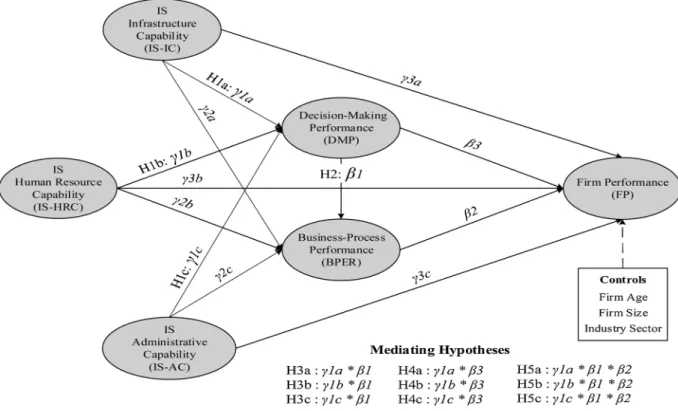
H1a.IS infrastructure capability (IS-IC) is positively associated with decision-making performance.
H1b. IS human resource capability (IS-HRC) is positively associated with decision-making performance.
H1c.IS administrative capability (IS-AC) is positively associated with decision-making performance.
2.3. Decision-making performance and business-process performance Decision-making performance affects managerial choices when identifying the viable courses of action for a firm (James & Mark, 1996), whereas business processes describe the way in which a firm manages its products and services. Therefore, good decision-making performance directs business processes toward the adoption of successful new products and services, and helps to integrate them with new technologies (Baum & Wally, 2003), which lead to better business-process performance. Business-business-process performance measures the financial and non-financial flexibility, reliability, responsiveness and costs/assets of organizational and operational capabilities (Bernhard, Peter, Zoltan, & Maria-Luise, 2006). Likewise, business processes examine operational performance to make improvements. It improves business models so that firms can better compete against their rivals.
Effective decision-making performance enables economies of scale and knowledge synergies in different organizational combinations, and facilitates the exploitation of opportunities in both dynamic and non-dynamic environments. For instance, the prediction of market behavior may ignite organizational learning of business processes and may change performance behaviors (Baum & Wally, 2003). Since business processes involve multidisciplinary and complex situations, they draw knowledge from different resources, such as information systems and their capabilities, decision-making performance and operations man-agement (Bisogno, Calabrese, Gastaldi, & Ghiron, 2016). Thus, we expect a positive relationship between decision-making performance and business-process performance, which leads to the following hypothesis:
H2. Decision-making performance is positively associated with business-process performance.
2.4. Mediating effect of decision-making performance
The impact of IS capabilities on business-process performance has been studied a lot in the literature. Many IS studies have indicated that successful IT infrastructure investments generate substantial changes within business processes leading to superior performance. These sub-stantial changes occur in terms of direct and indirect effects between IS capabilities (IS-IC, IS-HRC, and IS-AC) and business-process perfor-mance. Earlier research byElbashir, Collier, and Davern (2008)reveals that IS help firms to create business value since they have a direct impact on business processes. The impact of IS capabilities may be visible in the improvement of the efficiency and effectiveness measures of business processes (Peng, Quan, Zhang, & Dubinsky, 2016;Rahimi et al., 2016).Gu and Jung (2013)identify six areas of the value chain that IS capabilities support and improve a firm’s core business activities: Production and operations, supplier relations, process planning and support, sales and marketing support, product and service enhance-ment, and customer relations. Operational efficiency, order fulfillment rates, satisfied consumer expectations, and customer intimacy are es-sential indicators of the business-process performance. Despite these claims about the direct effect of IS capabilities on business-process performance, these effects may not be possible to realize without a strong and effective decision-making process. Some of the previous literature state that IS capabilities support superior business-process performance indirectly by applying and leveraging the other resources and capabilities of a firm (Aringhieri, Carello, & Morale, 2016; Luo et al., 2012; Rahimi et al., 2016; Ravichandran & Lertwongsatien, 2005). Superior business-process performance includes not only in-dividual but also operational efficiency, customer service efficiency and product/service development. Operational efficiency aims at devel-oping and delivering efficient and effective products/services across all channels. At this point, IS-IC, IS-HRC, and IS-AC together create op-portunities to reach these channels by using different methodologies, such as websites, enterprise software, or communication utilities, providing and/or developing necessary skill sets, and setting visionary sights. Customer intimacy posits the creation of customer value, which integrates the possession of distinctive market knowledge and sense, and customer relationship within the internal processes of a firm. For the creation of customer value, business intelligence and customer re-lationship management systems are the main resources. Firms with these IS capabilities are more conscious of emerging market opportu-nities and are able to offer new products/services according to their customers’ needs. Meanwhile, identification of new markets and entry into them are decision-making activities, and such decisions may affect the business processes and their performance (Ravichandran & Lertwongsatien, 2005). By improving the existing business processes, practical research results report that IS capabilities help to assess the current business-process performance and improve the decision-making performance (Aringhieri et al., 2016). These two different perspectives
in the literature conclude that IS capabilities are both directly and in-directly related to business-process performance attributes (Luo et al., 2012). Nevertheless, decision-making performance depicts a capacity to decide on a feasible course of action in a firm (James & Mark, 1996). Thus, in this study, we adhere to the indirect notion and argue that decision-making performance creates an indirect link between IS-IC, IS-HRC, and IS-AC, and business-process performance. This is stated more formally in the following set of hypotheses:
H3a.Decision-making performance mediates the relationship between IS-IC and business-process performance.
H3b.Decision-making performance mediates the relationship between IS-HRC and business-process performance.
H3c.Decision-making performance mediates the relationship between IS-AC and business-process performance.
Through IS capabilities, providing accurate and more reliable data, forecasting ability and decision models will increase the effectiveness of the decision makers to make faster comprehensive decisions effectively, then achieve the objective of the organization (Huber, 1990). There-fore, the integration of IS capabilities into decision-making processes helps organizations to improve their performance (Baum & Wally, 2003). IS-IC, IS-HRC, and IS-AC provide the necessary infrastructure, know-hows, skill sets, and organizational abilities to make compre-hensive decisions. Therefore, better decision-making performance enhances the relationship between each of the underlying dimensions of IS capabilities and firm performance, and thus leads to the following multi-part hypotheses:
H4a.Decision-making performance mediates the relationship between IS-IC and firm performance.
H4b.Decision-making performance mediates the relationship between IS-HRC and firm performance.
H4c.Decision-making performance mediates the relationship between IS-AC and firm performance.
2.5. Serial mediating effect of decision-making performance and business-process performance
IS capabilities, in terms of IS-IC, IS-HRC, and IS-AC, can influence business value, and they build the relationship between departments and functions in today’s business world. When they create a link with other firm resources, IS capabilities as a whole provide strategic benefits (Wade & Hulland, 2004). According to Powell and Dent-Micallef (1997), IS capabilities eventually lead to higher firm performance, but they may not contribute directly to the sustaining firm performance. IS capabilities should interact with other firm resources to achieve a sustainable firm performance.
Based on the preceding discussion and confirming evidence reported earlier, the relationship between the facets of IS capabilities (IS-IC, IS-HRC, and IS-AC) and firm performance may be indirectly linked. However, most of the studies have focused on only a single mediation effect at a time or a parallel one (Hu, Chang, & Hsu, 2017; Peng et al., 2016). We posit that there should be more than one mediation impact on firm performance to ensure sustained and im-proved firm performance, and that these multiple mediators may have association with each other as well (Hayes, 2013). Thus, the serial multiple mediator model of decision-making performance and business-process performance may lead IS-IC, IS-HRC, and IS-AC to have a positive effect on firm performance. This is stated more formally in the following multi-part hypotheses.
H5a.Decision-making performance and business-process performance serially mediate the relationship between IS-IC and firm performance. H5b.Decision-making performance and business-process performance
serially mediate the relationship between IS-HRC and firm performance.
H5c.Decision-making performance and business-process performance serially mediate the relationship between IS-AC and firm performance. Fig. 1shows the conceptual framework that depicts the nexus of the relationships between the main constructs discussed above.
3. Research methodology 3.1. Survey setting and data collection
The data for this study was collected through a mail survey using a questionnaire. The design, the development of the measurement items, and the questionnaire were constructed in line with the guidelines that have commonly been mentioned in prior research (Dillman, 2007; Hinkin, 1998). Based on a comprehensive review of the relevant lit-erature, the survey instrument was prepared to measure the following three dimensions of IS capabilities: Infrastructure capability, human resource capability, and administrative capability. Again, relying on the existing literature, the following constructs were developed: Decision-making performance, business-process performance, and firm perfor-mance.
To establish the content validity of the measures used in this study, the procedure suggested by Hair, Money, Samouel, and Page (2007) was employed. First, in-depth interviews were conducted with three chief technology officers (CTOs) in Turkey, who provided us their views of the issues on IS applications and capabilities based on their actual knowledge and experience. Second, an initial version of the survey questionnaire was revised based on discussions with several expert academics. Finally, a pre-test was conducted with six business profes-sionals that provided eventual fine-tuning opportunities to develop an informative, clear, and well-structured survey questionnaire.
We sampled a range of firms from several product-intensive industries located in Turkey to achieve a high level of external validity and generalizability of the survey findings. The respondent firms were selected among medium-size and large-size firms. Thus, small firms of
fewer than 50 employees were excluded from this sample frame, as the small-size firms largely lack the required resources to invest in IS systems and applications.
The targeted respondents who would fulfill the surveys were asked to be senior and executive managers or medium-level managers with relevant knowledge of IS capabilities as well as knowledge of the entire company. A cover letter of the survey clearly indicated the required profile for an acceptable respondent. The respondents who did not meet these criteria were eliminated during the data evaluation process.
The sampling frame was constructed from the members of the TOBB (Union of Chambers and Commodity Exchanges of Turkey). The TOBB database consists of 365 local chambers of commerce, maritime com-merce, and commodity exchange with over one million firms. Following the elimination of firms that did not meet the selection criteria, we randomly sampled 800 firms from this database. Following two waves of data collection and one reminder, a total of 236 questionnaires were returned; of which 204 were usable, representing an effective response rate of 25.5 percent. The remaining 32 questionnaires were eliminated due to missing values, improper respondents/firms and double respondents. A summary of the characteristics of the sample is shown in Table 2.
Non-response bias was tested usingArmstrong and Overton (1977) method. The early respondents to the surveys were compared with the late respondents. We first compared the responses from early and late respondents to the survey and found no statistically significant differ-ences (p> 0.05). Second, a comparison of a randomly selected group of 100 non-respondent firms with 204 respondent firms revealed no significant differences for any organizational level indicators (e.g., number of employees, years of operation, and annual sales). In addition, a relatively high response rate (25.5 percent) meant that the respondent firms were likely to provide a reasonable representation of the total sample, which is another solution to non-response bias (Rose, Sidle, Griffith, Rose, & Griffith, 2007). Therefore, no evidence was found for non-response bias. An additional check was undertaken to verify whether there was any significant variation in the responses stemming from the nature of the respondent manager’s functional area of responsibility (i.e., IT/IS-related vs. non-IT/IS-related) that are likely Fig. 1.Conceptual framework.
to bias the survey findings. The test results revealed no significant differences in the responses between IT/IS-related and non-IT/IS-related managers (p< 0.05) for the following measures used in the study: IS infrastructure capability (t-value = 1.35,p= 0.17), IS human resource capability (t-value = 1.85, p= 0.07), IS administrative capability (t-value = 1.90, p= 0.06), decision-making performance (t-value = 0.27, p= 0.78), business-process performance (t-value =
0.35,p= 0.72) and firm performance (t-value = 0.38,p= 0.70). 3.2. Measurement of the variables
The following are brief descriptions of the main constructs and control variables used in the study. The main constructs are measured through five-point Likert type scales ranging from 1 = “strongly dis-agree” to 5 = “strongly agree.” While it has been claimed that the ideal number of item alternatives appeared to be centered on seven with some situations calling for as few as five or as many as nine (Cox, 1980), the literature suggests that a five-point scale appears to be less con-fusing and to increase response rate and response quality along with reducing respondents’ “frustration level” (Babakus & Mangold, 1992; Devlin, Dong, & Brown, 1993). It should also be noted that five-point scale has been widely used in IM literature (e.g.,Kim, Oh, Shin, & Chae, 2009;Dwivedi, Kapoor, Williams, & Williams, 2013;Kapoor, Dwivedi, Piercy, Lal, & Weerakkody, 2014;Shareef, Kumar, Dwivedi, & Kumar, 2016).
3.2.1. Main constructs
IS capabilities were measured with three constructs in the model. In line with the current IS literature, these were identified as IS infra-structure capability(IS-IC),IS human resource capability(IS-HRC) andIS administrative capability(IS-AC).
IS-IC was adapted from earlier studies (Gable et al., 2008;Mithas et al., 2011; Pérez-López & Alegre, 2012; Ravichandran & Lertwongsatien, 2005). The items comprising IS-IC included: “devel-oping customized applications,” “reliability of solutions and products,” “readiness of IS infrastructure,” “response pace for requests,” “network infrastructure competency,” “infrastructure security,” “data sharing,” and “fast and flexible Internet-based operations.”
The items constituting the IS-HRC were drawn from earlier studies (Bharadwaj, 2000;Cepeda-Carrion et al., 2012;Pérez-López & Alegre, 2012; Ravichandran & Lertwongsatien, 2005; Tippins & Sohi, 2003) and are as follows: “knowledge of IS,” “expertise in IS,’ “ability to learn and apply new technologies,” “skills and knowledge capacity,” “capability of implementing,” “capability of discovering problems,” and “capability of maintaining.”
The items measuring the IS-AC were adapted from the extant lit-erature (Pérez-López & Alegre, 2012;Ravichandran & Lertwongsatien, 2005;Yeh et al., 2012). The items comprising the IS-AC include: “IS strategy,” “IS management authority,” “IS planning capacity,” “IS adaptation to the development process,” “guideline for service requests,” and “IS service quality.”
Decision-making performance(DMP) evaluates the efficiency and ef-fectiveness of the decision-making in a company. The scale for this construct was drawn from the previous literature (Gable et al., 2008; Huber, 1990;Mclaren et al., 2011;Mithas et al., 2011;Tippins & Sohi, 2003). The DMP includes the following items: “organizational communication for effective decision making,” “culture of long-term planning,” “effective decision making,” “speed in analyzing informa-tion,” “time management for decision making,” “reaching accurate and comprehensive information,” “rapid and accurate identification of problems and opportunities,” and “delegation of decision making.”
It is not easy to select a single measure ofbusiness-process perfor-mance(BPER). The extant literature has listed several quantitative and qualitative objectives that have been set to guide BPER (Bayraktar, Demirbag, Koh, Tatoglu, & Zaim, 2009;Elbashir et al., 2008;Luo et al., 2012; Mahmood & Soon, 1991; Mclaren et al., 2011; Mithas et al., 2011). Based on this literature, a subjective approach for the mea-surement of the BPER construct was used, and the following items are included: “customer relationship,” “supplier relationship,” “internal and external coordination,” “purchasing cost,” “delivery time,” “inventory level,” “economies of scale,” “utilization of tools and equipment,” “productivity of labor,” “customer request,” “accessing distribution channels and new markets,” “identifying market trends,” and “differentiated products and services.”
Prior studies have adopted either an objective or a subjective approach to measuringfirm performance(FP). The subjective approach based on executives’ perceptions of performance has been widely used in empirical studies, having been justified by several researchers (e.g., Dess & Robinson, 1984;Venkatraman & Ramanujam, 1986;Geringer & Hebert, 1991;Collings, Demirbag, Mellahi, & Tatoglu, 2010). It should also be noted that the use of objective or quantitative performance measures might be subject to some limitations. To exemplify,Fisher and McGowan (1983)claim that objective measures in company statements are flawed and are not appropriate for research purposes, whileDay and Wensley (1988)suggest an absence of suitable objective measures. Moreover, Turkish firms are not willing to disclose financial data unless they are listed on the stock exchange, hence making access to quanti-tative and objective measures of FP highly difficult. Due to such com-plexities involved, the use of perceptual measures of FP was adopted and the FP adapted here was derived from previous studies (Bharadwaj, 2000;Glaister, Dincer, Tatoglu, Demirbag, & Zaim, 2008;Mahmood & Soon, 1991;Mithas et al., 2011;Ordanini & Rubera, 2010;Pérez-López & Alegre, 2012;Santhanam & Hartono, 2003;Stoel & Muhanna, 2009). This performance dimension includes the following criteria: “return on sales,” “distribution cost,” “market share,” “return on investment,” “administrative expense,” “inventory level,” “staff cost,” and “customer loyalty.”
Table 2
Characteristics of the sample.
Characteristics Number %
Respondent’s position Senior/executive manager 106 52 Middle/first line manager 98 48
Respondent’s functional
area of responsibility IT/IS relatedNon-IT/IS related 13173 35.864.2
Firm size (number of
employees) Medium-size (less than 250)Large-size (equal or more than 87 42
250) 117 58
Firm age (years of
operation) Young firms (equal or lessthan 15) 61 30 Middle age firms (16-30) 80 39 Mature firms (more than 30) 63 31
Annual revenue (Turkish
Lira) Less than 25 million25 million-99 million 3444 1722 100 million-249 million 26 13 250 million-499 million 19 9.3 Equal or more than 500
million 81 40
Industry sectors Food and beverages 16 7.8 Durables, consumer
electronics and machinery 22 11 Chemicals, pharmaceutical
and plastics 15 7.4 Textile, leather and clothing 26 13 Other manufacturing 8 3.9 Investment, banking and
finance 22 11
Transportation,
telecommunication and media 15 7.4 Information systems and
technology services 23 11 Construction and real estate 11 5.4 Health and social services 12 5.9 Wholesale and retail 22 11 Other services 12 5.9
3.2.2. Control variables
The effects of firm-specific characteristics on FP were captured by the following three control variables.
Firm age (AGE) was measured by the number of years since the establishment of the firm. Young firms comprise those whose ages are equal or less than 15 years. Middle-age firms include of those whose ages vary between 16 and 30. Mature firms are the ones whose ages are more than 30 years. Regarding the number of firms in these three age groups, the young firms group consists of 61 firms, while middle-age and mature groups include 80 and 63 firms, respectively.
Firm size(SIZE) was measured by the number of employees. Firms are broadly classified into two categories: Medium-size and large-size firms. The firms with equal or more than 50 and less than 250 em-ployees are defined as medium-size, while those with 250 emem-ployees and more are labeled as large-size firms. This definition is consistent with that of the Turkish Statistical Institute (TUIK, http://www. turkstat.gov.tr/) and the Turkish Small Business Administration (KOSGEB,https://www.kosgeb.gov.tr/). Regarding the number of firms in these two groups, the medium-size group includes 87 firms, while large-size group consists of 117 firms.
To control for the effect ofindustry sector(IND), two broad industry categories were created: Manufacturing and service industries. In terms of the number of firms in these two groups, the manufacturing group includes 87 firms, while the service group includes 117 firms. 4. Data analysis and results
Measurement model validation is performed through confirmatory factor analysis (CFA). Cronbach’s alpha and composite reliability values, convergent and discrete validities are also checked further for the reliability and validity of the model constructs. The potential for common method variance (CMV) is investigated to validate the constructed model. Finally, hypotheses of the proposed model are examined. Details of these data analyses stages are discussed in more detail in the ensuing subsections.
4.1. Measurement model validation
The measurement model considers the relationship between the constructs and their items. To test the measurement model validity in Fig. 1, confirmatory factor analysis (CFA) was applied to the data. The goodness-of-fit indices for the measurement model were found to be satisfactory (χ2/df. = 1.38, the goodness-of-fit index [GFI] = 0.83, the adjusted goodness-of-fit index [AGFI] = 0.80, the Tucker–Lewis coef-ficient [TLI] = 0.92 and the comparative fit index [CFI] = 0.93, RMSEA = 0.043) and confirmed the proposed model. Furthermore, factor loadings were also calculated to specify the degree of corre-spondence between the variables. The factor loadings for each of the constructs were found to be significant (p< 0.01). This validation also approves the presence of IS-IC, IS-HRC, and IS-AC as the constructs to represent a multidimensional measure of IS capabilities. Thus, they are distinct in terms of their unique content but interrelated because of their total effect on IS capabilities. Relying on RBV, they are also critical drivers for FP under the serial multiple mediators model.
In order to address the possibleendogeneity bias, a two-stage least squares (2SLS) regression was adopted (Bellamy, Ghosh, & Hora, 2014; Guide & Ketokivi, 2015). Endogenous variables were instrumented by both AGE and SIZE as instrumental variables, since these two variables were not significantly related to FP (Table 4). After performing the 2SLS method using STATA, we conducted the Durbin–Wu–Hausman post-estimation test of endogeneity for the validity of the instruments (Davidson & MacKinnon, 1993;Liu, Wei, Ke, Wei, & Hua, 2016). The test results confirm the validity of instruments, indicating that the results are unlikely to be influenced by endogeneity.
4.2. Reliability and validity of the constructs
A reliability and validity analysis were conducted to check the internal consistency of the constructs inFig. 1. Unidimensionality of the constructs was measured withCronbach’s alpha. As shown in Appendix A, Cronbach’s alpha values varied between 0.77 and 0.88, which are greater than the threshold value of 0.70 (Hair, Black, Babin, & Anderson, 2010;Nunnally & Bernstein, 1994).
Composite reliability(CR) estimates the extent to which a set of construct items share in their measurement of the construct (Hair et al., 2010). The threshold value of 0.70 for CR specifies sufficient reliability for a construct (Fornell & Larcker, 1981). As shown in Appendix A, the CR measurements are within the recommended thresholds, and each of the constructs in the study is sufficiently reliable.
In addition, average variance extracted (AVE) estimates were also calculated to confirm theconvergent validity. The threshold value of 0.5 for AVE indicates adequate convergent validity for a construct (Fornell & Larcker, 1981; Yusoff, 2011). As shown in Appendix A, the AVE measurements satisfy the recommended thresholds, so each of the constructs in the study is sufficiently reliable and has adequate convergent validity.
Discriminant validitydescribes the degree to which the measures of the different dimensions of all the constructs are different from each other. In Table 3, the results of 15 pairwise tests are shown for discriminant validity. The findings strongly confirm the discriminant validity of each pair.
The descriptive statistics and inter-correlations among the variables are shown inTable 4. During data analysis, it was revealed that some of the variables were not distributed normally. To warrant adequate normality prior to data analysis, these variables were converted to a normal distribution using Templeton's two-step transformation approach (Templeton, 2011).
4.3. Common method variance
Potential for CMV was also investigated to check its influence on structural results. The CMV may lead to erroneous conclusions about the relationships between the variables by inflating or deflating the variance (Craighead, Ketchen, Dunn, & Hult, 2011). The Harman’s single-factor test was used to investigate the CMV in this study. In this single-factor test, all of the items in this study are subjected to an exploratory factor analysis (EFA) (Malhotra, Kim, & Patil, 2006; Podsakoff & Organ, 1986). The number of factors extracted from the EFA is forced to one. The results reveal that the common method variance accounts for 30.41 percent of the total variance. Thus, the CMV is not considered to be statistically significant, since it is below the threshold value of 0.50.
Table 3
Discriminant validity of the measurement model.
Test # Description χ2model χ2unconstrained model Difference*
1 IS-IC→ IS-HRC 204.82 112.14 92.42 2 IS-IC → IS-AC 1070.73 1007.99 62.74 3 IS-AC → IS-HRC 157.16 93.33 63.83 4 IS-IC→DMP 175.96 64.71 111.25 5 IS-IC→BPER 242.32 88.30 154.02 6 IS-IC→FP 191.64 41.40 150.24 7 IS-HRC→DMP 203.07 93.60 109.47 8 IS-HRC→BPER 256.93 118.62 138.31 9 IS-HRC→FP 141.90 79.41 62.49 10 IS-AC→DMP 139.66 61.51 78.15 11 IS-AC→BPER 196.13 59.44 136.69 12 IS-AC→FP 140.98 38.24 102.74 13 DMP →BPER 193.96 77.99 115.97 14 DMP →FP 186.15 70.41 115.74 15 BPER →FP 236.45 95.83 140.62
4.4. Hypothesis testing
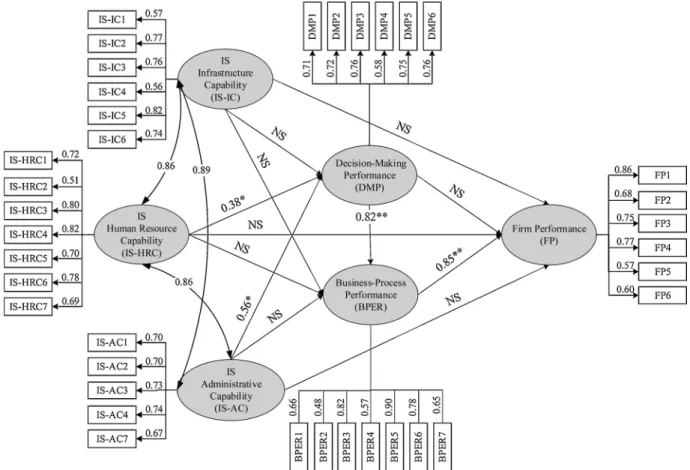
The study examines the structural relationships between the constructs through a path analysis by considering the multiple mediating effects. Path analyses with the AMOS software (Byrne, 2010) were used to test the hypotheses in the conceptual model. The maximum likelihood method was selected to calculate the model parameters, and the results of the analyses are depicted in Fig. 2. In addition to three constructs, comprising IS capabilities (i.e., IS-IC, IS-HRC, and IS-AC), two mediating variables (i.e., DMP and BPER) and three control variables (i.e., firm age, firm size and industry sector) are also included in the model. The goodness-of-fit index of the model is less than the threshold value of 3 (χ2/df = 1.38,p< 0.01). Moreover,
the fit indices for the model are also within the acceptable levels (GFI = 0.83, AGFI = 0.80, TLI = 0.92, CFI = 0.93, RMSEA = 0.043) (Cheung & Rensvold, 2002; Hair et al., 2010; Hooper, Coughlan, & Mullen,
2008). These findings confirm that the model indicates a good fit to the data.
Fig. 2shows that H1a (γ1a) was not supported, indicating that IS-IC has no association with DMP. However, strong support was found for both H1b (γ1b) and H1c (γ1c) that IS-HRC and IS-AC have positive associations with DMP (γ1b= 0.38,γ1c= 0.56,p< 0.05).
H2 (β1), which posits that DMP is positively associated with BPER, received strong support (β1= 0.82, p< 0.01). With respect to the mediating role of DMP between IS-IC and BPER, no support was found for H3a (γ´3a = γ1a*β1) since DMP has no significant association with IS-IC. For testing mediation effect of DMP between the other two IS-related capabilities (IS-HRC and IS-AC) and BPER, their total direct effects were analyzed in the absence of the mediating variable, DMP. These relation-ships for both capabilities were found significant. After re-introducing the mediating variable, DMP, to the structural model, the direct relationship between IS-HRC and BPER, as well as IS-AC and BPER, appeared to be Table 4
Descriptive statistics and inter-correlations.
Variables Definition Mean S.D. 1 2 3 4 5 6 7 8 9
1 IS-IC IS infrastructure capability 4.10 0.60 1
2 IS-HRC IS human resource capability 4.11 0.61 0.73** 1
3 IS-AC IS administrative capability 3.86 0.68 0.71** 0.73** 1
4 DMP Decision-making performance 3.76 0.68 0.44** 0.54** 0.54** 1
5 BPER Business-process performance 4.12 0.47 0.35** 0.44** 0.42** 0.68** 1
6 FP Firm performance 3.76 0.55 0.21** 0.27** 0.34** 0.46** 0.56** 1`
7 AGE Firm age 2.00 0.78 0.02 0.06 0.07 0.05 0.06 −0.01 1 8 SIZE Firm size 0.57 0.49 0.24** 0.18** 0.26** 0.06 0.05 0.09 0.24** 1
9 IND Industry sector 0.42 0.49 −0.11 −0.16 −0.17* −0.05 0.03 0.17* 0.14 0.00 1 * p< 0.05.
** p< 0.01.
Fig. 2.Results of SEM with two serial multiple mediator effects+. +: Standardized regression weights are shown.
insignificant, but an indirect relationship through DMP was found significant for both IS-HRC and IS-AC. This indirect effect between IS-HRC and BPER may be quantified as the product of unstandardized regression weight of IS-HRC on DMP (γ1b) and DMP on BPER (β1), as shown in Table 5a(Hayes, 2013). Similarly, the indirect effect of IS-AC on BPER may be calculated by the product of γ1c and β1, as depicted inTable 5b. Furthermore, the Sobel test was also applied to check whether the med-iation effects of DMP were statistically significant (Baron & Kenny, 1986).
The first row of bothTables 5a and 5bshows that there is support for H3b (γ´3b = γ1b*β1) and H3c (γ´3c = γ1c*β1), respectively (p < 0.05). Therefore, DMP establishes a full positive mediation effect between both IS capabilities (i.e., IS-HRC and IS-AC) and BPER.
To check the mediation effect of DMP between IS-related capabilities and FP as stated in H4a, H4b and H4c (γ´4a = γ1a*β3, γ´4b = γ1b*β3 and γ´4c = γ1c*β3), a series of tests were conducted. First, in the absence of the mediation of DMP, the total effect was tested for each one of the Table 5a
Results of two serial multiple mediations for IS-HRC+.
Paths Relations Unstandardized weights Indirect effect z score Mediation IS-HRC→BPER→FP IS-HRC→BPER 0.078
(0.108) (0.125)0.090 0.719
ξ No support for mediation role of BPER
BPER→FP 1.160 (0.135) IS-HRC→DMP→FP IS-HRC→DMP 0.408
(0.190) −0.076(0.086) −0.879
ξ No support for mediation role of DMP
DMP→FP −0.187 (0.194) IS-HRC→DMP→BPER IS-HRC→DMP 0.408
(0.190) (0.098)0.198 2.016
ξ* Support for full mediation role of DMP between IS-HRC and BPER
DMP→BPER 0.487 (0.083) DMP→BPER→FP DMP→BPER 0.487
(0.083) (0.116)0.564 4.845
ξ*** Support for full mediation role of BPER between DMP and FP
BPER→FP 1.160 (0.135) IS-HRC→DMP→BPER→FP IS-HRC→DMP 0.408
(0.190) (0.117)0.230 1.963
ξξ* Sobel test for serial mediation effect of DMP and BPER between IS-AC and FP
DMP→BPER 0.487 (0.083) BPER→FP 1.160
(0.135)
+Standard errors are indicated within the parentheses. *p< 0.05,**p< 0.01,***p< 0.001.
ξ2-tailz score= 1* 1 / 1 *Se 12 2+ 1 *Se 12 2for single mediation effect.
ξ ξ2-tail =
+ +
z score
Se Se *Se
1* 1* 2
12* 12* 22 12* 22* 12 12* 22 12 for serial multiple mediation effect.
Table 5b
Results of two-serial multiple mediations for IS-AC+.
Paths Relations Unstandardized weights Indirect effect z score Mediation IS-AC→ BPER→FP IS-AC→BPER 0.060
(0.121) (0.140)0.069 0.495
ξ No support for mediation role of BPER
BPER→FP 1.160 (0.135) IS-AC→DMP→FP IS-AC→DMP 0.470
(0.218) −0.087(0.099) −0.879
ξ No support for mediation role of DMP
DMP→FP −0.187 (0.194) IS-AC→DMP→BPER IS-AC→DMP 0.470
(0.218) (0.113)0.228 2.023
ξ* Support for full mediation role of DMP between IS-AC and BPER
DMP→BPER 0.487 (0.083) DMP→BPER→FP DMP→BPER 0.487
(0.083) (0.116)0.564 4.845
ξ*** Support for full mediation role of BPER between DMP and FP
BPER→FP 1.160 (0.135) IS-AC→DMP→BPER→FP IS-AC→DMP 0.470
(0.218) (0.134)0.265 1.969
ξξ* Sobel test for serial mediation effect of DMP and BPER between IS-AC and FP
DMP→BPER 0.487 (0.083) BPER→FP 1.160
(0.135)
+Standard errors are indicated within the parentheses. *p< 0.05,**p< 0.01,***p< 0.001.
ξ2-tailz score= 1* 1 / 1 *Se 12 2+ 1 *Se 12 2for single mediation effect.
ξ ξ2-tail = + + z score * Se Se Se 1 * 1 * 2
IS-related capabilities. The results were found insignificant for IS-IC, but positively significant for IS-HRC and IS-AC. Second, the full model was run to identify the mediating effect of DMP on FP. The test results showed that the link between DMP and FP did not indicate any significant effects. Thus, no support was found for H4a, H4b, and H4c. Fredrickson and Mitchell (1984)note that there is a negative relationship between DMP and FP in an unstable environment, but a positive relationship is expected in a stable environment. However, the results are unable to verify either of these cases. In other words, DMP itself is not enough to mediate the links between IS-related capabilities and FP.
In order to test the serial multiple mediation models denoted by H5a, H5b, and H5c (γ´´5a = γ1a*β1*β2, γ´´5b = γ1b*β1*β2 and γ´´5c = γ1c*β1*β2), we first tested the mediating roles of DMP and BPER separately on the relationship between IS-HRC and FP, as well as IS-AC and FP. They were found not significant, as shown on the first two rows ofTables 5a and 5b, respectively. Then, the total effect of each IC, IS-HRC, and IS-AC on FP in the absence of the mediators (DMP and BPER) in the conceptual model was checked. As noted earlier, the results were found to be insignificant for IS-IC, but positive and significant for IS-HRC and IS-AC. Next, the full serial mediating effects were tested under the presence of the mediators. The direct relationships between IS-related capabilities (IS-IC, IS-HRC, and IS-AC) and FP were found to be insignificant. The indirect effect of IS-IC was also found insignificant since the relationship between IS-IC and DMP was insignificant. Therefore, there is no support for H5a with respect to the serial mediation effect between IS-IC and FP. However, the indirect effects of IS-HRC and IS-AC on FP via DMP and BPER together were noted to be positive and significant. Moreover, the serial mediating effects were calculated by multiplying the unstandardized regression weights of the effects, γ1b∗β1∗β2 = 0.23 for IS-HRC, and γ1c∗β1∗β2 = 0.26 for
IS-AC, as the details are shown in Tables 5a and 5b, respectively (Taylor, Mackinnon, & Tein, 2008). The estimates of the serial multiple indirect mediation effect were found significant (p< 0.05). Thus, these findings support the full serial mediating role of DMP and BPER for H5b and H5c. The distinctive serial relationship of DMP and BPER together establishes a link between IS-HRC and IS-AC, and FP.
As for the control variables, only IND was found to significantly influence FP (p< 0.05) where firms operating in manufacturing industries had a better level of FP as compared to firms in service industries.
A summary of the level of support for the study’s hypotheses is shown inTable 6.
5. Discussion
The past two decades have witnessed a remarkable growth of stu-dies and advances in our understanding of IS resources or capabilities and organizational performance. Recent studies highlight the need to
make further progress in this direction using relevant mediating vari-ables in opening up the black box of the relationship between IS capabilities and performance. To this end, the present study makes a progress in this direction. The novelty of the study lies in the fact that it considers the joint mediating effect of both DMP and BPER in the IS capabilities-FP relationship through a multiple mediation model.
The test results confirm the proposed serially mediating model, according to which DMP and BPER play a critical serial mediating role in the IS-HRC and IS-AC, and FP relationships. No support, however, has been found concerning the serial mediation effect between IS-IC and FP. The results obtained have theoretical as well as practical consequences. 5.1. Theoretical contributions
This study contributes to the adoption of RBV in IM research from many respects. IT/IS infrastructure is an imitable resource easy to access in the market with many substitutes. By itself, building IT/IS infrastructure is not enough for a firm to create sustained competitive advantage. However, IS-HRC and IS-AC are idiosyncratic firm attri-butes. They are valuable and rare, so imperfectly imitable because of the causally ambiguous and socially complex nature of the constructs. Moreover, to remark about the capabilities built on human resources and administrative aspects of IS, they should penetrate to decision-making and business processes of a firm to increase the performance of these processes, as well as the overall FP. The serial mediation model developed in this study makes an original contribution to RBV by opening the black box concerning the relationship between the IS-related capabilities and FP by setting DMP and BPER as the missing keys.
IS capabilities provide firms with access to rapidly available, timely, accurate, and comprehensive information in order to identify their problems as well as seize the market opportunities. Managers who gather information and knowledge and make decisions through the implementation of analytical techniques are more effective than those who do not (James & Mark, 1996). As indicated by this study, IS capabilities are envisaged to enhance the DMP of the firms. However, the study finds out that IS-HRC and IS-AC help to improve DMP but IS-IC does not. This clearly illustrates that IT infrastructure itself develops an ability to disseminate the necessary knowledge within the organization, but this is not sufficient to improve the DMP. Presence of a strong IS-AC and IS-HRC for the entire firm is what really matters for DMP. Consequently, these findings underline the distinctive nature of IT/IS infrastructure as an imitable resource, and thus highlight the importance of IS-HRC and IS-AC for DMP.
The results of the study indicate that superior DMP helps firms to make accurate and timely decisions, and aligns their business processes better with their objectives. Therefore, the improved DMP increases the efficiency and effectiveness of business processes in a firm through Table 6
Summary of support for the study’s hypotheses.
Hypotheses Explanation Level of support
H1a IS infrastructure capability (IS-IC) is positively associated with decision-making performance. Not Supported H1b IS human resource capability (IS-HRC) is positively associated with decision-making performance. Supported H1c IS administrative capability (IS-AC) is positively associated with decision-making performance. Supported H2 Decision-making performance is positively associated with business-process performance. Supported H3a Decision-making performance mediates the relationship between IS-IC and business-process performance. Not Supported H3b Decision-making performance mediates the relationship between IS-HRC and business-process performance. Supported H3c Decision-making performance mediates the relationship between IS-AC and business-process performance. Supported H4a Decision-making performance mediates the relationship between IS-IC and firm performance. Not Supported H4b Decision-making performance mediates the relationship between IS-HRC and firm performance. Not Supported H4c Decision-making performance mediates the relationship between IS-AC and firm performance. Not Supported H5a Decision-making performance and business-process performance serially mediate the relationship between IS-IC and firm performance. Not Supported H5b Decision-making performance and business-process performance serially mediate the relationship between IS-HRC and firm performance. Supported H5c Decision-making performance and business-process performance serially mediate the relationship between IS-AC and firm performance. Supported