Antioch University
AURA - Antioch University Repository and Archive
Dissertations & Theses Student & Alumni Scholarship, including
Dissertations & Theses
2012
Explainers' Development of Science-Learner
Identities Through Participation in a Community
of Practice
Anne E. Richardson Antioch University - New England
Follow this and additional works at:http://aura.antioch.edu/etds
Part of theEducation Commons, and theEnvironmental Sciences Commons
This Dissertation is brought to you for free and open access by the Student & Alumni Scholarship, including Dissertations & Theses at AURA - Antioch University Repository and Archive. It has been accepted for inclusion in Dissertations & Theses by an authorized administrator of AURA - Antioch Recommended Citation
Richardson, Anne E., "Explainers' Development of Science-Learner Identities Through Participation in a Community of Practice" (2012).Dissertations & Theses. 77.
Explainers’ development of science-learner identities through participation in a community of practice
by
Anne E. Richardson
A dissertation submitted in partial fulfillment of the requirements for the degree of
Doctor of Philosophy Environmental Studies
at
Antioch University New England 2011
© 2012 by Anne Richardson All rights reserved.
Department of Environmental Studies DISSERTATION COMMITTEE PAGE The undersigned have examined the dissertation entitled:
Explainers’ Development of Science-learner Identities through Participation in a Community of Practice
presented by Anne E. Richardson, candidate for the degree of Doctor of Philosophy, and hereby certify that it is accepted.*
Committee Chair: Dr. Elizabeth McCann Antioch University New England
Committee Member: Dr. Tania Schusler Antioch University New England Committee Member: Dr. Joe Heimlich Ohio State University
Defense Date: December 4, 2011
Acknowledgements
I am grateful to the wide and wonderful network of family, friends, and colleagues who have helped me make this work possible. First, I’d like to thank my advisor, Dr. Elizabeth McCann for her guidance and patience throughout my doctoral work. I will fondly remember our long conversations about communities of practice! I also thank Dr. Tania Schusler and Dr. Joe Heimlich for taking the time to serve on my committee and providing me with thoughtful and insightful feedback along the way.
The Exploratorium provided me not only with a subject and place for this research, but with an incredible community of inspiring mentors, role models, and partners in exploring anything and everything in the world around us. In particular, I thank my supervisor, Robyn Higdon for her moral support and professional guidance. I thank my colleague, Sylvia Algire, for her thoughtfulness in our practice and partnership in reflection. Special thanks go to all of the former Explainers who gave their time to participate in this research. And to all of the Field Trip Explainers (future, past, and present), thank you for teaching me something new everyday.
I thank my parents, Dr. Barbara Richardson and Dr. Rudy Richardson, for building me electricity and chemistry sets, allowing my enormous rock and seashell collections, stomping through wetlands and forests with me, encouraging me in every way, and setting examples of living a worthwhile life.
Finally, this research was made possible by the unfaltering kindness and support of Daniel Winokur.
Abstract
The urgent environmental issues of today require science-literate adults to engage in business and political decisions to create solutions. Despite the need, few adults have the knowledge and skills of science literacy. This doctoral dissertation is an analytical case study examining the science-learner identity development of Exploratorium Field Trip Explainers. Located in San Francisco, CA, the Exploratorium is a museum of science, art, and human perception dedicated to nurturing curiosity and exploration. Data collected included semi-structured interviews with sixteen former Field Trip Explainers, participant observation of the current Field Trip Explainer Program, and review of relevant documentation. Data analysis employed constant comparative analysis, guided by the communities of practice theoretical framework (Wenger, 1998) and the National Research Council’s (2009) Six Strands of Science Learning. Findings of this research indicate that Exploratorium Field Trip Explainers participate in a community of practice made up of a diverse group of people that values curiosity and
openness to multiple ways of learning. Many participants entered the Field Trip Explainer Program with an understanding of science learning as a rigid process reserved for a select group of people; through participation in the Field Trip Explainer community of practice, participants developed an understanding of science learning as accessible and a part of everyday life. The findings of this case study have implications for research, theory, and practice in informal adult science learning, access of non-dominant groups to science learning, and adult workplace learning in communities of practice.
The electronic version of this dissertation is accessible in the open-access OhioLINK ETD Center (http://etd.ohiolink.edu).
Table of Contents Acknowledgements ... i Abstract ... ii Preface ... 1 I. Introduction ... 3 A. Significance ... 4 B. Statement of Purpose ... 6 C. Definitions of Terms ... 7 D. Chapter Summary ... 8
II. Literature Review ... 10
A. Understanding Museum Learning through Social Learning Theories ... 10
B. Science Literacy and Museum Learning ... 20
C. Identity and Museum Learning ... 24
D. Theoretical Framework: Communities of Practice ... 31
E. Chapter Summary ... 46
III. Methods ... 47
A. Research Questions ... 47
B. Ontological Perspective ... 48
C. Case Study Research ... 50
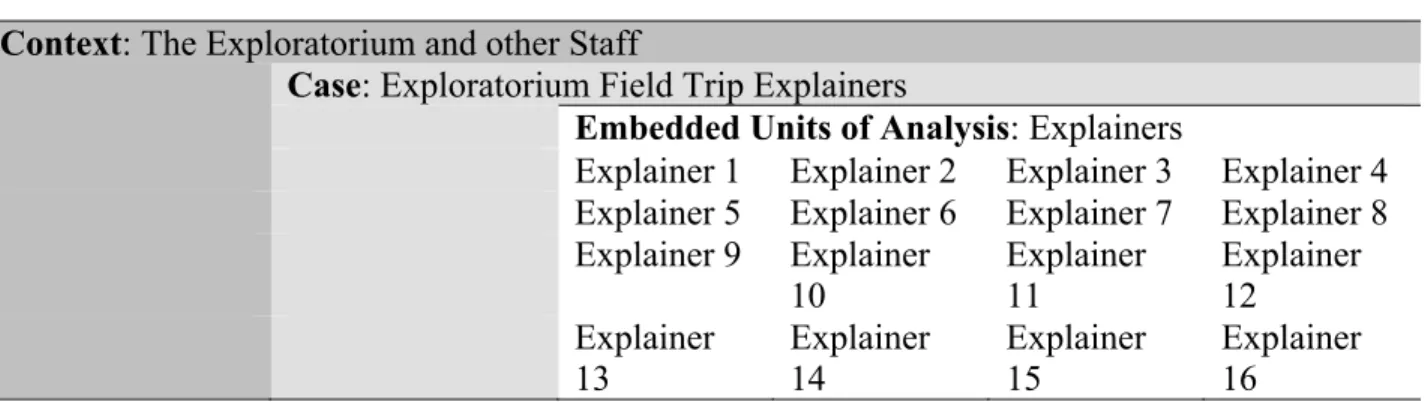
D. Case Selection and Unit of Analysis ... 53
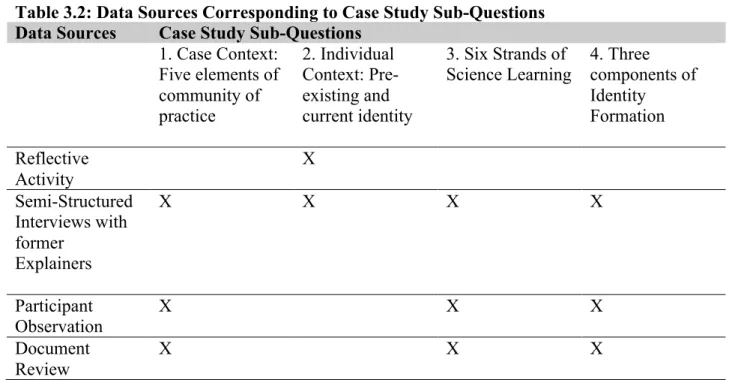
E. Data Collection ... 57
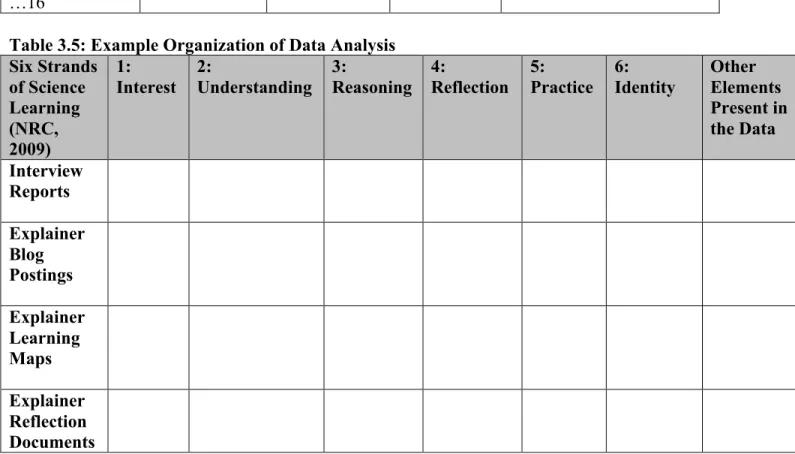
F. Data Analysis ... 65
G. Quality of Research Design: Strengths and Limitations ... 67
H. Chapter Summary and Prologue to the Findings ... 71
IV. Research Context ... 73
C. The School Field Trip Audience ... 76
D. School Field Trip Resources ... 79
E. The Field Trip Explainers ... 81
F. Explainer Training and Professional Development ... 82
G. Hiring the Explainers ... 84
H. A Day in the Life of an Explainer ... 85
I. Chapter Summary ... 94
V. Case Study Question 1: Individual Context ... 95
A. Introduction ... 95
B. Participants’ Identities and Backgrounds before Becoming Explainers ... 95
C. Participants’ Motivations for Becoming Explainers ... 97
D. Changes in Participants’ Understandings of Science Learning ... 98
E. Other Findings: Learning about Themselves ... 104
F. Chapter Summary ... 106
VI. Case Study Question 2: How Identity Manifests in Practice ... 108
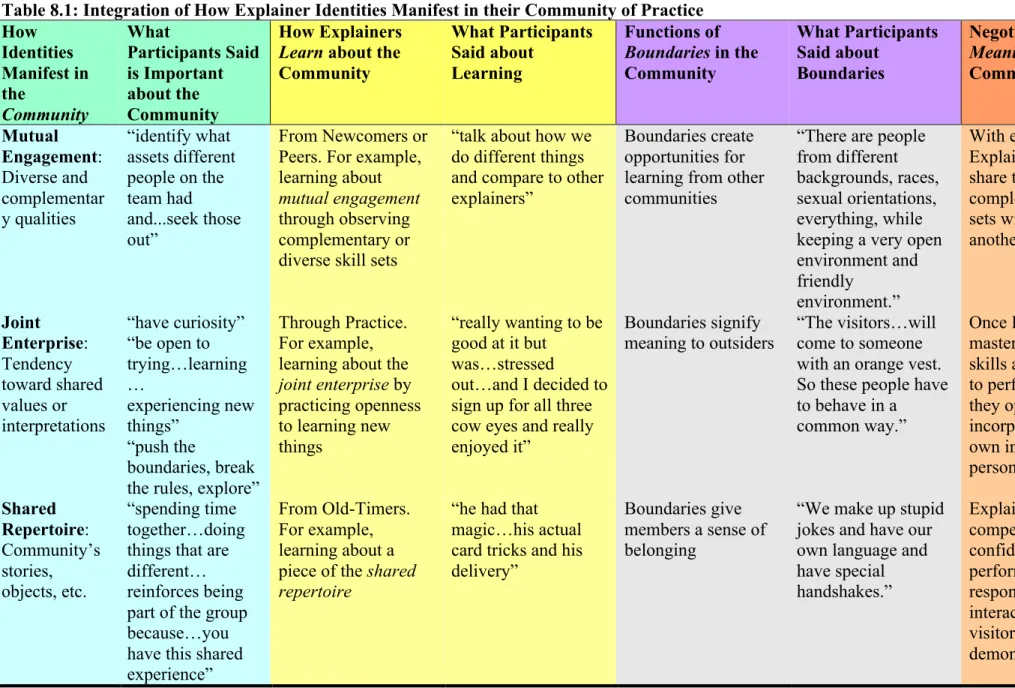
A. Introduction ... 108 B. Meaning ... 109 C. Community ... 115 D. Learning ... 128 E. Boundaries ... 132 F. Locality ... 135
G. Other Findings: Working in a Group ... 136
H. Chapter Summary ... 139
VII. Case Study Question 3: Six Strands of Science Learning ... 141
A. Introduction ... 141
B. Strand One: Developing Interest in Science ... 143
C. Strand Two: Understanding Science Knowledge ... 147
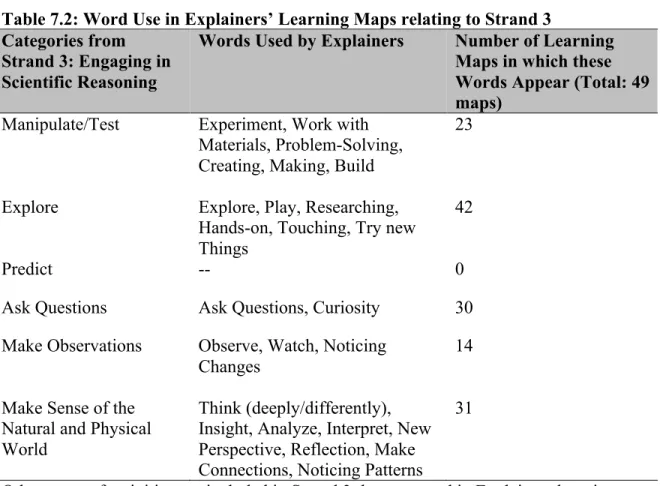
D. Strand Three: Engaging in Scientific Reasoning ... 152
E. Strand Four: Reflecting on Science ... 157
F. Strand Five: Engaging in Scientific Practices ... 159
G. Strand Six: Identifying with the Scientific Enterprise ... 163
VIII. Case Study Question 4: How Identity Develops through Modes of Belonging170
A. Introduction ... 170
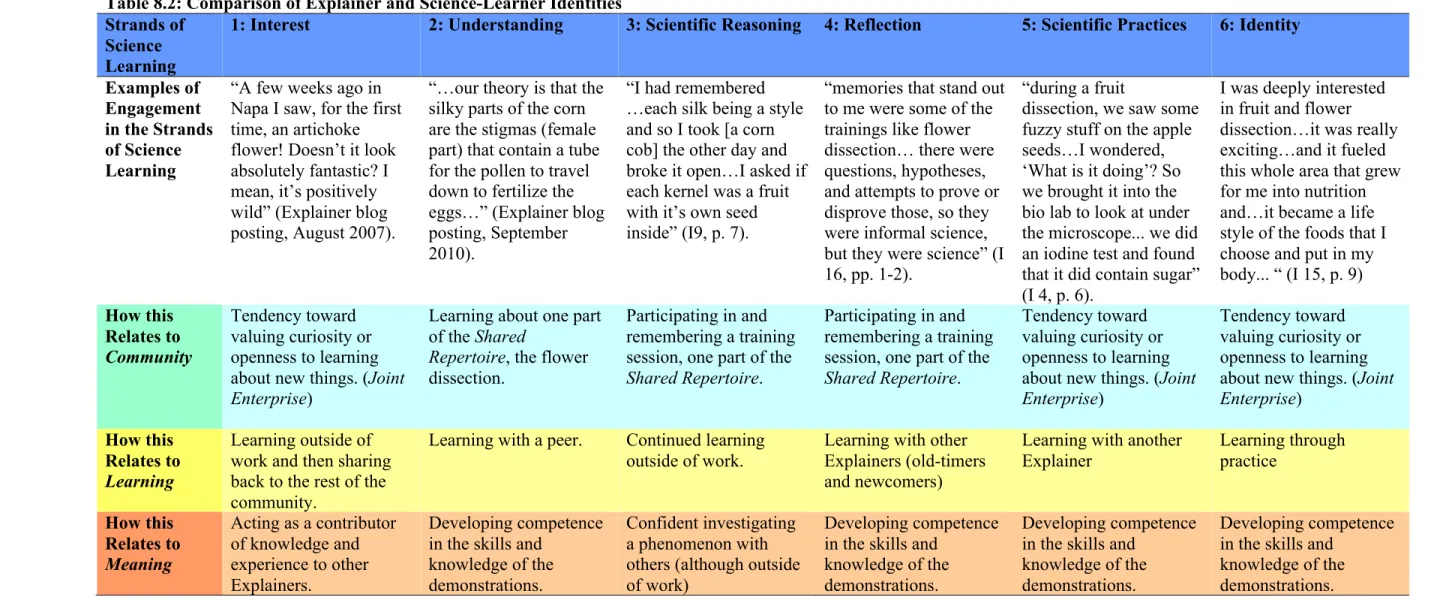
B. Comparison of “Explainer” and “Science Learner” Identities ... 170
C. How Participants Developed Science-Learner Identities ... 174
D. Engagement, Imagination, and Alignment ... 180
E. Chapter Summary ... 185
IX. Discussion and Implications ... 187
A. Introduction ... 187
B. Science Literacy for Adults and Non-Dominant Groups ... 190
C. Adult Workplace Learning ... 194
D. The Communities of Practice Framework ... 201
E. Recommendations for Practitioners ... 206
F. Limitations ... 207
G. Questions for Future Research ... 208
H. Chapter Summary ... 210
References ... 211
Appendices ... 232
Appendix 3.1: Recruitment Letter ... 232
Appendix 3.2: Documentation of Informed Consent ... 234
Appendix 3.3: Reflective Activity Instrument ... 236
Appendix 3.4: Interview Guide ... 237
Appendix 3.5: Sample Explainer Learning Maps ... 240
Appendix 3.6: Reflective Writing on My Expectations ... 242
Appendix 4.1: Example Worksheets ... 245
Preface Explainer blog entry, October 30, 2007:
I feel fortunate to have experienced one of [Senior Artist’s] famous light walks this past September as part of our explainer training for the upcoming school year…For me, the experience was one of those moments where I couldn’t wait to get home to tell other people about my day at work. I wanted to show them how when you cross your fingers and let the light shine through, you can see little circles, or how the sunlight travels through the branches of the trees, or how white light contains all the colors and information…it’s just waiting to be separated out.
But more than anything it was one of those times where I felt genuinely lucky to be a part of such an amazing group of educators and scientists who can explain the secrets of the universe but would rather let you figure them out for yourselves.
This excerpt describes one of the training sessions Field Trip Explainers take part in every morning before school groups arrive at the Exploratorium, and one of the many learning moments in which Explainers seem to be constantly engaged. It was written by an Explainer who studied literature, not science, before coming to the Exploratorium. He was a self-defined, “non-science person”, and actually felt that it was unlikely that the Exploratorium would turn out to be the right fit for him professionally. Four years later, he is working in a permanent, full-time position at the Exploratorium, and says of himself, “I’m totally a science person now! I just didn’t understand what science could be before” (former Explainer, personal communication, May, 2010). Similarly, I was in conversation with an Explainer finishing her second year in the program who said, “Being an Explainer has changed everything about the way I am in the world.
Now everything is a question that can be explored” (former Explainer, personal communication, June, 2010).
These types of statements of science becoming a part of one’s identity are frequently heard in the Field Trip Explainer program, and so I began to wonder—what is going on here? Is it possible that through participation in the Field Trip Explainer Program, a person can develop an identity of a science learner? If so, this seems to me to be an exciting contribution to science education, to individual lives, and to a world that could use more science-literate citizens right now. And then I wondered, if this is happening, then what are the critical elements of the program that make this possible? I have been working in a leadership role in this program for eight years and have been engaging with and reflecting on these questions all the while. This dissertation is an opportunity for me to bring together the worlds of theory and practice to answer questions that are meaningful to me, that I hope will benefit the Field Trip Explainers and their visiting school groups, and that will contribute to a growing body of research in science-museum education.
“Despite the fact that utilization of free-choice environmental education resources through visits to national parks, nature centers, natural history museums, zoos, and aquariums, and similar organizations are at all time highs, few within the environmental community are feeling sanguine. This is because the environmental challenges to the planet, not the least caused by worldwide climate change, seem to grow exponentially, while solutions to these problems lag seriously behind. The urgency to get “good” at what we do has never been greater” (Falk, Heimlich, & Foutz, 2009, p. 3).
I. Introduction
The knowledge and skills of science literacy prepare people to evaluate the credibility of scientific information and to engage in political, personal, and business decisions that impact their lives and the environment. A science literate person has knowledge and understanding of both natural phenomena and the inquiry process, as well as motivation for science learning and a science-learner identity (NRC, 1996, 2009; AAAS, 1993).
The National Science Board’s review of science literacy surveys in the United States and other countries found that most adults do not have the knowledge and skills of science literacy (2006). While there has been considerable research into how K-12 students learn science, there has been comparatively little research into adults’ science learning (Sachatello-Sawyer, Fellenz, Burton, Gittings-Carlson, Lewis-Mahony, & Woolbaugh, 2002). This case study examines the science-learner identity development, through a communities-of-practice lens, of emerging adults who participate in a one to three-year museum program in which they work as “Explainers” at the Exploratorium in San Francisco, CA.
A. Significance
The urgency of environmental issues demands that adults, as well as children, are science literate (as defined above) so that they can participate in current decision-making that impacts the environment. For example, due to human activities, the Earth is now experiencing a rapid loss of biodiversity—the sixth of mass extinctions of species that have occurred in the past 500 million years (Wilson, 1992). Additionally, due to anthropogenic greenhouse gas emissions, global temperatures are significantly higher than any other period in the instrumental or ice core data, sea levels are rising, and snow coverage is decreasing (Pachauri & Reisinger, 2007). Changes in global climate have had, and will continue to have, impact on human life and will require considerable adaptations in water systems, agriculture, infrastructure along coastal areas, and public health (Pachauri & Reisinger, 2007).
Given this level of environmental crises, it is critical to create opportunities for adults, in addition to children, to become science literate citizens so that they may participate immediately in the urgent environmental issues that are impacting the globe today. This research focuses on emerging adults, which are a particularly important group of learners. Emerging adults are generally ages 18-30 years, at a developmental point when their identity and values are
solidifying (Arnett, 2000). At this time, people are old enough to influence environmental issues through their voting and spending decisions.
Among other science-learning activities and venues, science museums play an important role in developing science literacy for visitors (Ballantyne & Packer, 2005; Storksdieck,
Dierking, & Foutz, 2007)1. The role of museums in teaching science is substantial, as approximately 36 million school-age students are served by science museums in the United States each year (IMLS, 2005). However, adults age 18-29 are underrepresented in the museum audience (Sachatello-Saweyer et al, 2002, p. 116), and little research has been done to determine the learning potential in museums for this age group.
The reason for the under representation of emerging adults in museums is likely that this group doesn’t feel that they have time to visit free-choice settings for their own learning (Falk, Heimlich, & Foutz, 2009, p. 29). At the Exploratorium, a word-renowned science center (Cole, 2009) based in San Francisco, CA, a group of adults who do not necessarily have science backgrounds are paid to work as museum educators for a one to three-year period, eliminating the barrier of time for a museum visit. These educators, Field Trip Explainers, are not only museum staff, but are also extended learners in the museum. Their employment includes extensive training and learning through practice.
This research examines the Field Trip Explainer program from a social learning
perspective, using the communities of practice framework (Wenger, 1998) as a lens to study the development of science-learning identities. This group is an important case to examine to determine the potential influence of an extended museum experience within a community of practice on the development of science-learning identities in emerging adults. There is no other research at this point that examines the development of science-learner identities in museum educators from the communities of practice perspective.
1 Science literacy is related to, but distinct from environmental literacy, which includes the knowledge and skills of science literacy. Environmental literacy consists of “personal and civic responsibility, knowledge of environmental
B. Statement of Purpose
Research Question: Do Exploratorium Field Trip Explainers build identities as science learners, and if so, how?
Proposition: Exploratorium Field Trip Explainers build identities as science learners by working within a community of practice (Wenger, 1998).
This case study research is guided by the National Research Council’s (NRC) Six Strands of Science Learning (2009) and the communities of practice theoretical framework (Lave & Wenger, 1991; Wenger, 1998). Science literacy was identified as a priority in the United States in 1983, at which point the American Association for the Advancement of Science (AAAS) began to develop science literacy standards for K-12 students to reach by adulthood (AAAS 1989; 1993). More recently, the NRC (2009) developed a set of learning standards addressing how students should learn science in informal environments. I use these learning standards as an analytical tool to understand the science learning behaviors and identities of the Exploratorium Field Trip Explainers.
Initially coined by Lave and Wenger (1991), the communities of practice theoretical framework was further developed by Etienne Wenger in 1998 as a tool for describing and understanding how people learn in naturally-occurring functional groups. Grounded in theories of social learning, this framework explores learning and identity development as a relationship between individuals and their communities. I use the communities of practice framework as an analytical tool for understanding the learning and identity development of Field Trip Explainers.
The purpose of this study is to create a rich description of the experiences of people who participate in the Exploratorium Field Trip Explainer program during the emerging-adult years of
their lives. The focus of the study is on the ways in which the program reflects the communities of practice model (Wenger, 1998), particularly how the experience influences the Explainers’ development of science-learning identities. The findings will provide an example of how museums can impact science learning for adults, generate further questions for research, and could influence the development of museum programming for this audience.
C. Definitions of Terms
In this section, I provide operands for the terms in the research question, as well as definitions of other, related terms. These operands and definitions will be used to guide the data collection and analysis.
Identity is a concept about which there is a great deal of research (e.g., Dweck, 2000; Gupta, 2009; Clayton & Meyers, 2009; Falk, 2009). For the purpose of this dissertation, I am referring to identity as defined by Wenger (1998, p. 151) as a set of experiences and their social interpretation.
Science-Learning is also a well-researched concept with many definitions (see NRC, 2009). For the purpose of this dissertation, I am using the NRC (2009) definition, which includes the six strands of learning detailed in the Science Literacy section of the Literature Review Chapter.
Science museums are natural history museums, science centers, zoos, aquariums, botanical gardens, arboretums, and nature centers (Falk, 2005, p. 267) whose mission it is to support public engagement with science, thus contributing to the development of a more scientifically literate public (Bevan & Semper, 1996).
Science-museum educators are variously referred to as docents, guides, facilitators, or explainers. They may be paid staff or unpaid volunteers, and may have a wide variety of responsibilities including teaching, marketing, and program coordination (Tran & King, 2007; Bailey, 2006; Grenier & Sheckley, 2008). This study examines the museum educators in the Exploratorium Field Trip Explainer program. Their work includes performing demonstrations, interacting with visitors at exhibits, and orienting school groups. I refer to them as Explainers in this dissertation.
Emerging Adulthood is a term coined by Arnett (2000) defining a developmental level that exists among affluent groups in developed countries. Emerging adulthood is defined by its lack of normative characteristics in terms of work, educational, and marital status. This is a transitional period in which people test out multiple life paths in order to determine what they want to do, and this is generally resolved by around the age of 30 years (Arnett, 2000).
D. Chapter Summary
This dissertation is a case study of participants in the Exploratorium Field Trip Explainer program. I examine whether the Field Trip Explainers work in a community of practice, whether and how participants developed identities as science learners, and the relationship between working in a community of practice and the development of science-learner identities. The significance of this case lies in the urgent need to create effective opportunities for emerging adults to become science-literate citizens so that they may participate in current issues that impact their lives and environment.
The following chapter covers the theoretical underpinnings of the case. I describe how learning in museum environments can be understood through theories of social learning, the
connection between science literacy and learning in museums, understanding identity
development in the museum context, and the communities of practice framework. The research methods, described in the third chapter, include interviews, participant observation, and
document review. Sixteen former Exploratorium Field Trip Explainers participated in this case through semi-structured, 1-2 hour interviews. Observations of the program in action and extensive review of documentation provide rich description of the case and triangulation of the interview data. The research findings are presented in a series of five chapters, organized by case study sub-questions that guided the case. Finally, the dissertation concludes with a discussion of the findings, theoretical and practical implications, and questions for future research.
II. Literature Review
There are four key themes in the literature associated with the main research question of this dissertation: 1) research that has sought to understand museum learning; specifically through social learning theories; 2) science literacy; 3) research on identity development; and 4) the theoretical framework for this dissertation, communities of practice (Lave & Wenger, 1991; Wenger, 1998). I review each of these four themes in the sections below to contextualize this doctoral research and discuss additional contributions to the scholarly literature.
This review begins with the literature on social learning theories and learning in museums to provide a context within which the concepts of science literacy and identity are situated. Finally, I close this chapter with a review of the theoretical framework, communities of practice, the literature that is most specific to this dissertation.
A. Understanding Museum Learning through Social Learning Theories
The learning examined in this study occurs primarily within a museum context. Although the Explainers leave the museum at the end of each day and may continue to engage in related learning practices in social, family, or other work settings, it is the activities that occur in the museum that are the central focus of this research. Museums are unique learning environments that have their own characteristics and body of research. Most of the research that has been done is about the learning of museum visitors, rather than the learning of museum educators. This literature review describes what is known about museum visitor learning, as well as differences between the learning of museum visitors and educators where relevant.
Research on learning, including learning in museums, has been informed by many theories, including social and cognitive constructivism, social cognitivism, humanism, and
behaviorism (Merriam, Caffarella & Baumgartner, 2007; NRC, 2000). The theoretical
framework guiding this study is the communities of practice framework (Lave & Wenger, 1991; Wenger, 1998), which is a social theory of learning. What follows is a description of the
historical relevance of social learning theories to museum-based learning research, and a brief overview of what is known about what visitors learn in museums.
Theoretical Context: How are museum visitors learning, and how do we know? Historically, educational psychology, including research on learning in museums, was dominated by behaviorist theories of learning. Behaviorism (Thorndike, 2008 [1903]) places emphasis on stimulus-response behavior and the transmission-absorption model of teaching and learning. Early museum-based research focused on behavioral outcomes of visitors and visitors’ responses to pre- and post-tests (Falk & Dierking, 2000; Hein, 1998; Melton, Feldman, & Mason, 1936; Storksdieck, 2006, NRC, 2000). Research in museum settings that seeks to understand behavior change, particularly relating to conservation behaviors, employs behavior-change models such as the Theory of Reasoned Action or the Theory of Planned Behavior (Heimlich & Ardoin, 2008).
Cognitivist learning theory built on behaviorism, differing in that learning is examined in terms of patterns, rather than discreet events (Merriam et al., 2007). Cognitivists emphasize the importance of learners making sense out of new experiences through their prior knowledge and experiences (Piaget & Inhelder, 1969), rather than on stimulation alone. Social theories of learning (e.g., Rogoff, 2003) build on cognitivism but focus on the importance of learning as a social, rather than individual, activity. The work of Bandura (1986) served as a bridge between cognitive and social learning theories—his view of learning acknowledges both individual
thought processes and the social nature of thought and action, connecting the learner with his/her environment and social interactions.
Over the past two decades, museum learning researchers have shifted their approach from behaviorism to embrace the complexity of learning in museum settings by emphasizing theories of social learning. In particular, researchers emphasize elements of learning theory that focus on choice, motivation, timing, physical context, and social interactions (Hein, 1998; Falk &
Dierking, 2000; Falk, Dierking, & Foutz, 2007). While there are many theories that describe how people learn, theories of social learning, particularly constructivism and sociocultural theory, have dominated the recent thinking on learning in museums (Hein, 1998; Falk, Dierking, & Foutz, 2007; Rennie & Johnston, 2007). The foundational theorists, John Dewey (1910; 1938), Jean Piaget (1954; 1959; 1981), Lev Vygostky (1978), and Jerome Bruner (1960; 1996) strongly influenced constructivist and sociocultural learning theories, and are frequently cited in the museum learning literature. While the writings of Dewey and Piaget have been criticized (e.g., Carey, 1985; Cohen, 1998; NRC, 2007), they have nevertheless been influential.
Constructivist learning theory is based on the principle that learning is a contextualized and constructive activity carried out by the learner (Fosnot, 2005). This theoretical approach fits well with learning that occurs in museum settings, where learners have a great deal of control over their learning. Central to constructivism is the notion that the learner constructs his/her own version of reality in a non-linear manner. Any new information must be integrated somehow with existing understandings held by the learner. It is the role of the teacher not to provide learners with knowledge, but to provide experiences through which learners may construct meaning for themselves (Fosnot, 2005; Resnick, et al, 1991).
Closely related to constructivism, sociocultural learning theory emphasizes the social and situated nature of learning. This school of thought includes theories of situated learning (Lave & Wenger, 1991), communities of practice (Wenger, 1998), and guided participation (Rogoff, 1995). Rather than the individual or the community driving the learning process, learning occurs as individuals and communities interact and people participate in culturally-relevant activities (Lave & Wenger, 1991; Rogoff, 1995). One way that science literacy can be described is
becoming familiar and facile with the ways of knowing and being of the scientific community so that one can engage in or interface with that community if s/he so chooses. Science museums are an interactive interface between the scientific community and the public. Learners can be
exposed to, practice, and learn these skills and knowledge through visits to museums.
The Contextual Model of Learning (CML) (Falk & Dierking, 2000) is a framework that is frequently referred to in research on learning in museums (e.g., Bamberger & Tal, 2008; Bamberger & Tal, 2006; Cox-Petersen, 2003; Gilbert & Priest, 1997; Tal & Morag, 2007; Vinson, 2006). This framework pulls together various aspects of social learning theories to describe the key factors that influence learning in museums. It was designed as a tool for researchers and museum educators to use in order to better understand, describe, and plan learning experiences in museums. According to the CML, learning in museums is influenced by the learners’ personal, social, and physical contexts interacting over time. This includes the prior knowledge and experiences of visitors, the amount of control visitors have over their learning, the interactions they have with other visitors and museum staff, the layout and design of the exhibition space, and reinforcing experiences that occur after the museum visit (Falk & Dierking, 2000, p. 137).
Falk and Storksdieck (2005) tested the model and found that no single aspect of the CML is enough to account entirely for the learning of a visitor. As the model suggests, Falk and
Storksdieck found that the three contexts of the CML do interact over time to create a unique learning experience for each visitor. Given that, they stress that research methods should be complex enough to account for the multiple factors that influence learning. The purpose of the CML is not to be a predictive model, but a framework that characterizes the learning
environment. The CML describes factors that influence learning, but cannot predict or prescribe what visitors learn in museums, or how the learning happens. Even so, in their discussion of the model within the same book, Learning from Museums (Falk & Dierking, 2000), the authors do make recommendations about what and how visitors learn in museums. The distinctions between the model being predictive and descriptive are sometimes blurred by researchers in their use of the CML (e.g., Bamberger & Tal, 2006; Cox-Petersen, et al, 2003).
Despite its widespread use in museum learning research, the CML is not applicable to this dissertation. The CML was designed with a typical museum visit in mind, which usually occurs over the course of one day. The Field Trip Explainers spend an extended time—20 hours per week—in the museum, making communities of practice a more relevant choice.
The communities of practice framework (Wenger, 1998) is underpinned by situated learning theory (Lave & Wenger, 1991), which is not often applied to museum learning but does have relevance in the case of the Field Trip Explainers. Situated learning involves examination of activities that are dependent on context, social learning, and the production and reproduction of social order. This type of learning occurs over long periods of time, making this theory inadequate for understanding typical museum learning, as most visitors spend only one day per
year in a museum. However, this is not the case for Field Trip Explainers, who spend 20 hours per week at the Exploratorium, for a one to three-year period.
Situated learning happens through engaging in the practice of a community. Over time, newcomers learn the walk and talk of full participants, and gain their own identity as masters. This is what Lave and Wenger (1991) call “legitimate peripheral participation.” It implies that a newcomer is engaged in some level of meaningful practice while interacting with full
participants from whom newcomers may gain new skills or knowledge. Situated learning has been used to help understand adult learning in informal situations such as adapting to a new culture, training in the medical profession, and workplace learning (e.g., Andersson &
Andersson, 2005; Browne-Ferrigno & Muth, 2006; Cope, Cuthbertson, & Stoddart, 2000; Fuller & Unwin, 2003). While a useful framework for understanding how learning occurs in social contexts, researchers have also pointed out that reliance on situated learning as a primary form of training or knowledge sharing can be incomplete and flawed in some instances (Fuller & Unwin, 2005; Hogan, 2002).
Field Trip Explainers engage in daily practice within a group of their peers over extended periods of time, and so I use the lens of situated learning in communities of practice to better understand how and to what extent they build science-learner identities. I describe learning in communities of practice in much greater detail in the Theoretical Framework section later in this chapter. The following section discusses what museum visitors learn, particularly in relation to science literacy and interconnections with this research.
Practical Context: What are museum visitors learning?
It is widely accepted that visitors to science museums are learning something (NRC, 2009). So what do people learn in museums? There have been numerous labels applied to the
types of learning that occurs in museums, but museum learning can be broken generally into three overarching categories: 1) the development of interest or motivation in science learning; 2) the development of science process or inquiry skills; and 3) the development of understanding of natural phenomena. As I will describe in more detail in the section on science literacy, all of these types of learning can be a part of a science-learner identity. I describe what we know about these types of science learning in museums in this section in order to set the stage for
understanding the science-learner identities (or lack thereof) of the Field Trip Explainers. Harkening back to the progressive educational values set forth by John Dewey (1938), some researchers have argued that the development of curiosity, interest, and motivation for learning about science could be the most important role of science museums (Pace & Tesi, 2004; Perry, 1994; Rennie, 1994; Tran, 2006). The development of the desire, or motivation, to learn is categorized as part of the domain of “affective” learning, which encompasses changes in
emotions and attitudes.
The division of learning into the affective and cognitive domains of Bloom’s Taxonomy (1956) is common in the museum-learning literature (e.g., Eshach, 2007), and a substantial portion of recent research on museum learning has measured affective learning outcomes (e.g., Anderson et al., 2002; Ballantyne & Packer, 2005; Bamberger & Tal, 2008, 2006; Cox-Petersen, et al., 2003; Falk & Balling, 1982; Pace & Tesi, 2004; Rennie, 1994). These studies focus on particular dimensions of affect that relate to visitors’ perceptions of museum experiences, their reports of interest in or curiosity about the experiences, their motivation to engage with museum exhibits, or the development of interest or motivation to continue learning about science.
The research interest in the affective domain of learning in museums stems from discussions of the value of museums, in which they are frequently contrasted with schools for
their potential to spark curiosity, interest, and motivation for learning in students (e.g., Ramey-Gassert, et al., 1994; Wellington, 1990). Indeed, museum visitors have shown an increase in interest and motivation for learning science (e.g., Bamberger & Tal, 2008; Falk & Balling, 1982; Orion & Hofstein, 1994; Wilde & Urhahne, 2008) and persistent memories of museum visits tend to be related to affective gains such as happiness or curiosity (Medved & Oatley, 2000; Rennie, 1994; Wolins et al., 1992).
Researchers have used many methods of assessing this type of outcome, including self-reports, analysis of facial expressions, discourse analysis, and observation of engagement in behaviors that indicate an interest (NRC, 2009, p. 3-6). For example, motivation is sometimes measured based on dwell time or on-task behavior (e.g., Bamberger & Tal, 2008), a proxy indicator that Falk (1984) evaluated as an effective indicator of learning if it is examined in the context of other factors. A more detailed approach was taken by Rennie (1994), who identified three types of outcomes relating to intrinsic motivation: learners’ perceptions that they have been successful in what they tried to do, enjoyed what they did do, and thought it was helpful to their learning. More recently, Wilde & Urhahne (2008) employed the Intrinsic Motivation Inventory (Deci & Ryan, 2003), a more formalized scale for measuring indicators similar to those
identified by Rennie (1994).
Several authors (e.g., Griffin, 1994; Koran, et al., 1983; McManus, 1993; Paris et al., 1998; Wellington, 1990) have suggested that the development of intrinsic motivation in learning science is a critical antecedent to learning science concepts. In fact, research has found that people who are interested in a topic or are intrinsically, versus extrinsically, motivated to learn are more likely to pose questions based on curiosity, to use systematic methods to find answers, to use effective learning methods, and to be persistent, invested, and productive in the learning
process (for reviews, see Kaplan & Maehr, 2006 and NRC, 2009). From this standpoint, affective learning objectives are an important precursor to learners achieving the objectives of using inquiry skills and understanding natural phenomena put forth by NSES for science literacy (NRC, 1996).
Learning in museums has also been described as both a process and a product, and some argue that the learning processes in museums are as important as the products (e.g., Dierking et al., 2003; Rennie et al., 2003). One reason for the focus on process is that learning takes time (NRC, 2007; 2009). Understanding a phenomenon may not occur within the timeframe of a museum visit, but an important part of the learning process may occur while interacting with a science exhibit. Further, science involves not only understanding phenomena, but the “habits of mind” (AAAS, 1993) that can be developed and practiced in science museums.
Learners who engage in the inquiry process have been shown to be capable of creating increasingly complex and accurate conceptual models of science concepts (White, 1993).
Conducting research that measures whether museum visitors are engaging in the inquiry process is a relatively new and challenging undertaking. To meet this challenge, researchers are looking for the visitor behaviors that map onto the five elements of inquiry (NRC, 2000b): asking questions, obtaining evidence, explaining, evaluating the explanations (interpreting), and communicating these interpretations with others (Allen, 1997; Allen, 2002; Allen & Gutwill, 2009; Ash, 2003; Crowley & Galco, 2001; Gilbert & Priest, 1997; Gleason and Schauble, 2000; Ostrenko, 2002). To assess for this outcome, researchers often analyze video of participants engaging in learning activities to measure the sophistication and number of occurrences of behaviors such as asking questions, making predictions, or testing hypotheses (NRC, 2009, p. 3-11).
Finally, several authors have found that cognitive gains, or the development of understanding scientific phenemona, do occur for museum visitors (Bamberger & Tal, 2008; Falk & Storksdieck, 2005; Gottfried, 1980; Mortensen & Smart, 2007; Orion & Hofstein, 1994). However, others argue that change in conceptual understanding does not occur from one visit to a science museum; instead museum visits are more likely to reinforce prior understandings (e.g., Anderson, 1999; Roschelle, 1995). This discrepancy may be due to inconsistencies across studies in the way that cognitive leaning is measured. Falk and Dierking (2000) recommend testing whether visitors’ understanding of science concepts is strengthened from a museum visit by measuring change in understanding before and after the visit, rather than comparing visitor self-reports to a predetermined hierarchy of responses. Falk and Storksdieck (2005) measured change in understanding of science concepts from before to after a museum visit, including measurement of various levels of cognitive gain (knowledge, application, synthesis), and comparing learning to multiple influences from the CML. They found that multiple factors do influence learning, and that visitors were able to make significant cognitive gains during their museum visits. One of the Six Strands of Science Learning (NRC, 2009) is that learners understand scientific concepts. Understanding scientific concepts was not measured in this study, however participants’ reports or demonstrations of understanding are included as part of an overall measure of a science-learning identity.
Section Summary
Museums are unique learning environments in which learners exercise choice in their learning behaviors and engage in social interactions with museum educators and other visitors. Research that seeks to build understanding of the learning that occurs in museum settings now focuses on the social and situated nature of learning in these environments. The learning
outcomes for visits to science museums include increasing interest or motivation for science learning, practicing inquiry skills, and developing understanding of scientific concepts.
B. Science Literacy and Museum Learning
In order to understand the development of Explainers’ science-learner identities, I need to first be clear about what counts as science learning. This section describes the historical
development of the concept of science literacy, and concludes with the current, most widely accepted framework for science learning in museums. This framework is used to guide my investigation of Explainers’ science-learner identities.
The development of science literacy has been identified as a national (AAAS, 1993; NRC, 1996) and global (McEneaney, 2003) priority, and as a priority for museums (Bartels, 1999; Bailey & Hein, 2000; Bybee, 1998; Oppenheimer, 1968; Yager & Falk, 2008). Science literacy is a broad, complex, and integrative concept. I describe below the formalized effort in the United States to provide a clear definition, set of standards, and educational instructions for science literacy.
Science literacy gained the attention of scientists and educators in the United States in 1983, when the National Commission on Excellence in Education conducted a study in order to address public concern about the quality of the country’s educational system. The product of this effort, A Nation at Risk (NCEE, 1983), reported that students in the United States were scoring poorly in math and science compared to students in other countries, showing that they were not well prepared for competitive careers in science and technology. In response, the American Association for the Advancement of Science (AAAS) created a program tasked with determining the knowledge and skills that are required for people to gain in order to be science literate by the
time they reach adulthood. The outcomes of this program (AAAS, 1989; 1993) informed the creation of the National Science Education Standards (NSES) (National Research Council [NRC], 1996), resulting in reform efforts for teaching science in K-12 schools.
Among the multiple definitions of science literacy that exist (see Laugksch, 2000 for a review), the NSES have been viewed as the standard (Bailey & Hein, 2000). The desired outcomes of science literacy defined in the introduction to the NSES are 1) The ability to ask, find, or determine answers to questions derived from curiosity about everyday experiences; and 2) The ability to describe, explain, and predict natural phenomena (NRC, 1996, p.22).
The NSES have been criticized for various reasons, including lack of explicit discussion of the theoretical underpinnings (Shiland, 1998); not articulating how to include underserved groups (Rodriguez, 1997); difficulty for teachers to implement in classrooms (Medved & Oatley, 2000); and ignoring the social aspects of science and the needs of citizenship (Lang, et al., 2006). Despite these criticisms, the NSES have represented the most comprehensive set of standards for achieving science literacy in schools, and have also been adopted in museums.
Taking the next step to aid teachers in educating for science literacy, the NRC created a new task force to research how people learn science. The resulting report, Taking Science to School (NRC, 2007), identified four types of practices required for students to become science literate:
1. know, use, and interpret scientific explanations of the natural world; 2. generate and evaluate scientific evidence and explanations;
3. understand the nature and development of scientific knowledge; and 4. participate productively in scientific practices and discourse (p. 36).
These standards and learning strands all focus on science learning that happens in schools, ignoring science learning that happens for both children and adults outside of the K-12
classroom environment. With increasing pressure on museums to justify their education
programs, they have been moving toward using clear and measurable goals to show evidence of learning. Most (87% of) science museums are using the NSES to guide exhibit and program development for school groups (Bailey & Hein, 2000). This approach, however, has been criticized by museum educators who argue that museums are unlike schools in that they can influence positive attitudes about science through open-ended experiences with exhibits (Bailey & Hein, 2000).
A more recent NRC report, Learning Science in Informal Environments (2009) addresses this concern with the addition of science-learning strands that are suited to informal learning environments. This comprehensive report on learning science in informal environments incorporates the four strands generated by Taking Science to School in their list of science-learning activities that are critical to the development of science literacy. The report cautions against using only K-12 standards for defining learning objectives for museum visits, citing the unique nature of the museum learning environment and the fact that many visitors (families and adults) are not in the K-12 system. This set of science learning strands is as follows:
Learners in informal environments:
Strand 1: Experience excitement, interest, and motivation to learn about phenomena in the natural and physical world.
Strand 2: Come to generate, understand, remember, and use concepts, explanations, arguments, models and facts related to science.
Strand 3: Manipulate, test, explore, predict, question, observe, and make sense of the natural and physical world.
institutions of science; and on their own process of learning about phenomena. Strand 5: Participate in scientific activities and learning practices with others, using scientific language and tools.
Strand 6: Think about themselves as science learners and develop an identity as someone who knows about, uses, and sometimes contributes to science (NRC, 2009, p. ES-3). The NRC and the National Science Foundation are now encouraging science museums to incorporate these six strands of science learning into the development, evaluation, and research of science-learning programs (Semper, R., personal communication, November, 2009). This reality makes the NRC strands a relevant baseline definition for science learning.
The research question for this dissertation is: Do Exploratorium Field Trip Explainers build identities as science learners, and if so, how? To address this, strand six, the development of a science-learner identity, is the focus of this dissertation. In particular, “learners in informal environments…think about themselves as science learners and develop an identity as someone who knows about [and] uses…science” (NRC, 2009, p. ES-3). The last piece of this strand, “sometimes contributes to science” represents a very advanced stage of identity development that likely applies to a very small percentage of science museum visitors, and so is not included in the focus of science-learning identity development in this research.
Strands one through five are concrete science-learner activities; my assumption is that someone who has a science-learner identity (strand six) is someone who engages in the activities in strands one through five. In an analytical review of identity-related literature, Rounds (2006) argues that identity and actions are reciprocally intertwined. People enact certain behaviors that they believe to be consistent with, and so reinforce, their identities, and people make sense of their identities by looking back on the behaviors they have already enacted. There are limits to
this assumption; however it is a reasonable approach to understanding the science-learning identities of Explainers since this inquiry is within the context of social learning in science museums, for which the NRC Strands of science learning are relevant. Of course, Explainers might have other ideas about their science-learning identities that do not fit neatly into these categories. While these will be interesting and important to explore, I will use the NRC strands as my official definition to provide some consistency and relevance to the field.
C. Identity and Museum Learning
The development of Explainers’ science-learner identities is examined in this dissertation using the communities of practice (Wenger, 1998) perspective on identity development. I am interested particularly in how (if at all) Explainers’ identities develop within the context of the Explainer community of practice, not independent of it. There is a great deal of literature on the topic of identity, and so this section serves to situate and provide context for this choice of theoretical perspective. Here I briefly review literature that is most closely related to this line of inquiry, particularly research examining identity and science learning in social contexts.
Identity has been explored extensively from both psychological (e.g., Erikson, 1968) and sociological (e.g., Wenger, 1998; Falk, 2009) perspectives in order to better understand a great variety of human issues. Identity is something that has and can be defined by group membership (Tajfel, 1978), ethnicity (Gleason, 1983), role (McCall & Simmons, 1978), personal
development (Erikson, 1959), connectedness to nature (Chawla, 1992), or ability to learn (Dweck, 2000), to name a few. Surrounding all of these possibilities is a potential division between a social or personal definition of identity, and a division between whether identity is changeable or static (state versus trait).
Deaux (1993) challenged the pre-existing dichotomies in social identity theory that separated personally and socially defined identities, and static versus changing identities. Instead, she suggested that social and personal identities define one another for each individual, and can be considered together. She also suggested that identities should be examined in terms of how they are structured, what functions they serve, the context in which they are used or formed, and how they change over time. She acknowledged both the usefulness of fixed categories of
identity, and the possibility that identities can develop. Deaux’ “reconstruction” of social identity theory is very similar to Wenger’s (1998) construction of identity within the communities of practice framework, which emphasizes the integral nature of personal and social identity, and the importance of context and change over time.
If identity is viewed as something that is personally and socially constructed, rather than predefined and static, then no matter what lens is used to examine it, identity is constantly under development. From a psychological perspective, the type of identity explored here is state identity—identity that can change from one context to another. A person enters every learning situation with an existing identity, and probably many interrelated identities that serve the person in the various aspects of his/her life (see Falk, 2006; Rounds, 2006), whether within the family, at work, or in social situations. And then each learning situation has the potential to influence and possibly alter this identity. Both of these parts of identity development are important, as entering identities may influence a persons’ learning experience and potential outcomes, and then the learning experience may in turn influence the outgoing identity.
Classroom learning environments are one place in which researchers have examined the connection between identity and science learning. In this context, the identities of learners can influence their science-learning experiences and level of success. In particular, identity
characteristics relating to gender (e.g., National Science Foundation, 2007) and race (e.g., Tate & Linn, 2005) can have a significant impact on science-learning for students. Furthermore, the identities of K-12 students relating to science can have an impact on their future career choices (e.g., Fadigan & Hammrich, 2004).
Beyond identifiers such as gender and race, people also have identity characteristics relating to their belief in their ability to be a successful learner. The connection between identity and science learning is closely related to goal orientation theory (Kaplan & Maehr, 2006) and intrinsic motivation (e.g., Blumenfeld, 1992; Csikzentmihalyi, & Hermanson, 1995), which have to do with the way that individuals understand themselves, or what Dweck (2000) calls “self-theories.” As I described above in the Understanding Museum Learning section, the
development of intrinsic motivation in learning science is a critical antecedent to learning science concepts (e.g., Griffin, 1994; Koran, et al., 1983; McManus, 1993; Paris et al., 1998; Wellington, 1990). Similarly, Dweck argues that people who view themselves as able to change and learn (versus people who believe that they are either inherently smart or not) are more likely to succeed in learning (2000).
It is not surprising that similar to school students, the pre-existing identities of museum visitors have an influence on their museum learning experiences. Feinberg & Leinhardt (2002) studied the entering identities of museum visitors to determine what impact pre-existing identities of visitors had on their conversations about museum exhibits during their visits. The authors found that visitors whose identities related in some way to the content of the museum visit did engage in more detailed, explanatory talk relating to the exhibition compared to visitors whose identities were not related to the content of the exhibition. In a similar vein, Abu-Shumays & Leinhardt (2002) found that visitors whose identities related in some way to the process of
investigating museum exhibits did engage in deeper-level inquiry process in the exhibitions compared to visitors whose identities were not related to the process of museum learning. In both cases, the entering identities of the visitors shaped their experiences in the museums, just as the existing identities relating to gender, race, motivation, and learning ability influenced K-12 students’ learning success. However, none of these studies address what impact the learning experiences then had on the learners’ identities.
Hull and Greeno’s (2006) literature review on identity in both K-12 and non-school learning takes this one step further. They argue that learning situations and incidents contribute to learners’ identities, both positively and negatively, and ultimately impact the agency of the learners. They also argue that identity formation in non-school environments tends to help
learners develop more agency for science learning compared to the identity formation that occurs in K-12 schools. They attribute this difference to the idea that non-school learning environments often provide examples of “types of people” that participants could become, along with
opportunities to enact those roles, take on positions of leadership, and to engage in discourse that helps them to articulate their changing identities.
These authors propose a conceptualization of identity that includes three components: interpersonal, epistemological, and discursive. They describe the components this way:
Interpersonally, a person’s identity includes her or his interactions with other people, including commitments and the ways in which the person is entitled, expected, and obligated to treat other people in interaction. Epistemologically, a person’s identity includes her or his interactions with the subject-matter contents of activities, including ways the person is committed, entitled, expected, and obligated to have and seek knowledge, understanding, and use of the contents of a subject-matter domain.
Discursively, contexts of identity afford models of self and opportunities to enact selves… (Hull & Greeno, 2006, p. 83).
This conceptualization of identity is not so different from Wenger’s (1998), in that it is social in nature, and derives from participants’ mutual engagement in shared practices. Hull and Greeno applied the communities of practice perspective to a body of existing research, in which they noticed elements that are resonant with the communities of practice framework. This starting point indicates that using the lens of communities of practice to examine how identity develops through learning in a museum setting could be fruitful.
There is also research relating to the identities of museum visitors that does not relate to the communities of practice model. The Museum Visitor Experience Model (MVEM) (Falk, 2009) is a predictive model relating specifically to museum visitors’ temporal identities, which includes and expands upon the CML (Falk & Dierking, 2000). The MVEM is based on an extensive research project conducted at the California Science Center (Falk & Storksdieck, 2004). Unlike the CML, this is a predictive model; Falk posits that the trajectories of museum visits can be roughly predicted based on visitors’ entering identities and perceptions of the museum’s affordances. However, the model does not place much emphasis on how museum visits contribute to the development of visitors’ identities beyond the visit.
Falk (2009) diverges from previous museum research in the way that he defines the identity of visitors. Instead of looking at characteristics such as age, ethnicity, income, frequency of museum visits, and the social arrangement of the visitors, Falk examines visitors’ identity-related motivations for visiting the museum. Falk found that most visitors’ identity-identity-related motivations fall into five categories: explorer, facilitator, experience seeker,
What each visitor actually does during the museum visit is influenced by the three contexts of the CML (personal, social, and physical). However, the trajectories of the visits are predictable and map onto the five identity-related motivations. The explorers and facilitators do not follow pre-set paths, but follow either their own or their social group’s interests and
curiosities once inside the museum. In contrast, the rechargers and professional/hobbyist tend to have specific goals and intentions to see specific exhibits in the museum, and do follow through on those intentions. Finally, the experience seekers visit the most famous museum exhibit, and spend time wandering and exploring. After the visit, the meanings that visitors ultimately construct either strengthen, modify, or extend their entering identities.
Both Falk (2009) and Rounds (2006) argue that a one-day museum visit is unlikely to significantly alter the existing identity of a museum visitor. However, Rounds (2006) discusses the idea of “identity work,” pointing out that visitors collect a variety of new experiences and perspectives that may not instantly transform a visitors’ identity, but will likely contribute to the overall evolution of their identities over longer periods of time. So what, then, would that look like for people who spend everyday in the museum? While the MVEM does not address the complexities of the Field Trip Explainer case and the length of Explainers’ involvement in the museum, communities of practice (Wenger, 1998) provides a more appropriate framework for understanding the identity development of museum learners who are also employees.
Bailey (2006) makes a direct link between the identities of museum educators and the communities of practice (Wenger, 1998) framework. She investigated museum educators’ perceptions of their roles, identity, and practice, and suggested that their identity formation is best understood from the communities of practice (Wenger, 1998) perspective. Wenger defines
identity as a set of experiences and practices that are socially interpreted. It is a link between an individual self and the community, as each defines the other.
The museum educators interviewed for Bailey’s study indicated that their work is integral with their identities. Based on their descriptions of their practices, communities, and values, Bailey posited that it is through working in communities of practice that these educators develop their identities, and it is these identities that sustain them in their work. Wenger describes
identity as being a “kind of person.” In Bailey’s study, the “kind of people” the participants described themselves as were educators working in the museum setting, involving attributes such as flexibility, emotional connection to the work, connection to a higher purpose, creativity, and the ability to learn new things. My dissertation builds on this research to examine more precisely how and to what extent working in a community of practice contributes to the development of Explainers’ identities, particularly as science-learners, what this means to them, and how it changes over time.
Finally, there is a study (Gupta, 2009) that explores the influence of a museum experience specifically on identity development of museum educators, but not using the communities of practice framework. Gupta examined the identity development of museum educators (Explainers) working at the New York Hall of Science (NYHS), using Cultural Historical Activity Theory (CHAT) (see Roth & Lee, 2007) as a theoretical framework. Similar to the communities of practice framework, identity development in CHAT involves an evolving relationship between an individual and his/her collective. CHAT is a theory that grew out of the work of Vygotsky (1978), and so it shares the same historical roots that ultimately led to the development of communities of practice (Wenger, 1998).
The goal of the NYHS Explainer program is for Explainers to develop the knowledge, skills, and practices of teachers and to eventually become K-12 school teachers. This is a slightly different focus from that of the Exploratorium Field Trip Explainer program, which does not have an explicitly-targeted career outcome for the Explainers. Instead, the overarching focus of the Exploratorium’s program is on science learning, for both the Explainers and their visiting audience. The focus of Gupta’s (2009) research was to illustrate the Explainers’ development of teacher identities. She found that through practice and the support of the NYHS community, Explainers did develop identities as teachers and increase their confidence in these identities. (Interestingly, Graven (2004), found that confidence-building was a critical element of teacher learning processes, and argued that it should be added to the communities of practice (Wenger, 1998) framework.) My research is a complement to Gupta’s work, exploring a different aspect of Explainer identity development through a different lens, communities of practice (Wenger, 1998).
D. Theoretical Framework: Communities of Practice
The Explainers’ development of science-learner identities could be viewed from an individual, cognitive perspective. However, I am more interested in looking at the Explainers from a social learning perspective. Wenger (1998) argues that people learn through engaging in sustained practice within communities, and that the learning that occurs is the development of an identity that is mutually negotiated by the community and the individual. This perspective affords a more nuanced view into what I see as a complex identity-development process within the Field Trip Explainer program. In this section, I describe the communities of practice
framework in detail, and highlight its values for my work as well as the potential limitations or difficulties associated with using this framework.
Overview of the Framework
The communities of practice model (Lave & Wenger, 1991; Wenger, 1998) is a
descriptive tool that was designed to facilitate thinking about how people learn and function in their daily lives. Any group of people that engages in the “sustained pursuit of a shared
enterprise” (Wenger, 1998, p. 45) is a community of practice, including families, professional groups, and classrooms. Communities of practice are ubiquitous and usually informal; the practices within the group are developed by participants to “get their jobs done” (p. 6), whatever the “job” may be. Communities of practice can be sustained over long periods of time; the individual participants may change as individuals enter and leave the community, but the community of practice itself is sustained. In the case of the Field Trip Explainers, the program has been in existence since 1970, and approximately 300 people have participated in the constantly shifting group of 15 Explainers.
If communities of practice are ubiquitous, then it may be illustrative to identify what is not a community of practice. For example, the residents of an apartment building see one another in passing on a somewhat regular basis, and share the experience of living in the same building. However, this group of people does not actually engage in a shared enterprise; one tenant’s living practices have very little bearing on another’s. Furthermore, their identities are not formed through engagement with one another. Likewise, the people who are in a shopping mall on one particular day are not a community of practice, nor are the many people around the United States who watch the super bowl on television at the same time. Here I review specific characteristics of groups that are communities of practice in greater detail.
Communities of practice are understood within the context of a social theory of learning, in which social participation is a process of learning and knowing. Wenger uses the framework of situated learning that he and Lave developed (Lave & Wenger, 1991), in which learning happens through “changing participation and identity transformation in a community of practice” (Wenger, 1998, p. 11). Participants in communities of practice are engaged in learning, and this learning may be either desirable or undesirable. For example, Explainers may learn from one another how to present a cow eyeball dissection clearly to a large audience (a desirable learning outcome), and they may also pass down pieces of misinformation to one another (an undesirable learning outcome). The recognition that communities of practice do result in learning (whether planned or not) is valuable to organizers or participants who may want to optimize the learning possibilities in their communities of practice.
Five Elements of a Community of Practice
The first element of a community of practice is meaning. Wenger (1998) defines meaning in practice as something that is constantly negotiated through and about everyday experiences. This occurs through the interaction of what Wenger calls participation and reification.
Participation is defined by the possibility of mutual engagement, although it is not necessarily collaborative. Mutual engagement can be collaborative or competitive, harmonious or conflictive. Participation goes beyond the act of doing something in that it creates the
possibility of transforming both the participant and the community. Furthermore, participation is not bounded by the time spent doing a specific activity, but is a part of participants’ identities.
Reification is the process of giving form to an understanding. For example, the processes of creating a law, a form, a document, a story, or a name are all processes of reification. The objects created through reification serve as tools for completing activities and also signify