Open standard, open source and peer-to-peer tools and
methods for collaborative product development
Hayder Aziz
a, James Gao
a,*
, Paul Maropoulos
b, Wai M. Cheung
ba
Enterprise Integration, Cranfield University, UK
b
School of Engineering, University of Durham, UK
Received 23 October 2003; accepted 2 December 2004
Abstract
This paper reports on a collaborative product development and knowledge management platform for small to medium enterprises. It has been recognised that current product lifecycle management (PLM) implementations are document oriented, have a non-customisable data model and inter-enterprise integration difficulties. To overcome these, an ontological knowledge management methodology utilising the semantic web initiative data formats was added to a PLM and an open source alternative. Shortcomings of centralised architectures are highlighted and a solution using a de-centralised architecture proposed. This is implementable at low cost; the scalability increases in line with user numbers. Ontologies, rules and workflows are reusable and extendable.
#2005 Elsevier B.V. All rights reserved.
Keywords:PLM; Knowledge management; Peer-to-peer; STEP; Collaborative product development
1. Introduction
This paper builds on the initial work carried out by the team as per Gao et al.[1], Cheung et al.[2] and Aziz et al. [3]. The topics of collaborative product development, virtual enterprises (VE) and the tech-nologies associated with implementing them have been the subject of widespread research. Some of these studies tackled problems within single enter-prises, others looked at the problems associated with
creating and managing of VE [4]. Tools such as
product lifecycle management (PLM) enable colla-boration within and between enterprises.
1.1. The lack of support tools for small to medium enterprises (SMEs)
There are a number of facets that the authors consider to be basic flaws in current thinking on the subject. Large enterprises have invariably been the target of software vendors for development of such tools, resulting in centralised applications. These are invariably beyond the means of small to medium
www.elsevier.com/locate/compind Computers in Industry xxx (2005) xxx–xxx
* Corresponding author. Tel.: +44 1234 754271; fax: +44 1234 750852.
E-mail address:[email protected] (J. Gao).
0166-3615/$ – see front matter#2005 Elsevier B.V. All rights reserved. doi:10.1016/j.compind.2004.12.002
enterprises. Even after these efforts had been made, large enterprises face numerous difficulties with PLM. Firstly, enterprises evolve, and an evolving enterprise needs an evolving data management system. With large applications, such configuration changes have to be made at the server level by dedicated staff. The second problem arises when enterprises wish to collaborate with a large number of suppliers and original equipment manufacturer (OEM) customers. Current applications enable collaboration using business-to-business (B2B) protocols. However, these do not take into account that disparate enterprises do not have unitary data models or workflows. This lack of standardisation results in a lot of time and money spent mapping the B2B links. Within the setting of a VE, where alliances can include dozens of enterprises and may often last for only a single project, these costs are prohibitive. This is a strong factor in reducing the abilities of large enterprises to participate in one-off VE partnerships, reducing agility and losing potential business. Other solutions include the use of application service providers (ASP) and also enabling a large enterprise’s data system to function as an ASP to their collaborators. However, the problem with this type of system is the management of intellectual property of the individual enterprises and whether enterprises can give up control of their information to a partner, who may also be collaborating with their competitors simultaneously. Such fears have hindered the formation of VEs.
The enterprises’ prime asset, its knowledge, is not managed coherently, thus perpetuating an ‘invisible’ limit on the company’s knowledge, based on the impulse of knowledge workers’ recollections of previous experience. In addition, the problems for inter-enterprise collaboration are also inherent when enterprises with different level of detail and different nomenclature collaborate. Finally, the prime reason for this investigation is that SMEs have up to now been left out of developments in PLM, knowledge manage-ment and VE developmanage-ments in spite of forming the majority of the world’s engineering community. This negatively affects the ability of SMEs to manage their knowledge, reuse existing expertise, collaborate with other SMEs in the virtual enterprise settings and collaborate with the larger enterprises that form their customer base. This weakness affects not only the SMEs but also the large enterprises that utilise SMEs within their supply chain or VE network.
Smaller engineering enterprises lack the infra-structure and manpower for complex solutions. Additionally, it was found that employees simply do not have the time or the budgetary resources to learn the necessary application functionality and new concepts associated with their operations. It has been observed that rigid procedures and centralisation do not produce the desired results. In fact adherence to the procedures and workflows is generally consid-ered to be a nuisance as knowledge workers, who follow procedures, are detached both from the process of drawing up these procedures and methodologies and from the running and ‘‘control’’ of these processes and tools. This study has focused on the experiences of automotive and discrete machining companies in integrating their product realisation cycles with their supply chains and their customers in real-time, and also to enable the companies to make rapid appraisal and cost-estimation for their customers, from simple concept designs. The system has to be able to reuse the company’s existing base of knowledge and to push the manufacturing knowledge higher up into the design chain to reduce the need for costly and time consuming reworks and engineering changes.
1.2. Specific requirements of SMEs
Based on the above set of problems facing industry, the authors have drawn up three core requirements to codify the needs of SMEs in managing their product and process information, i.e.,
enabling project managers and all knowledge
workers to have access to the applications needed to create and manage knowledge within their domain, according to the agreed nomenclature and ontological representation;
information created has to be in a form that can be queried, reused and transformed into new repre-sentations through the use of rules and agents;
enabling the real-time collaboration between SMEs
and larger partners, by facilitating the fast and cost-less construction of VEs.
To test the requirements and try to meet the obj-ectives the authors took an evolutionary approach by assessing the current technology and methods, and
then constructing three new example applications. The as-is technology used was a web-based commercial PLM system. The aim of the research is to solve the problems of the as-is technology via three test scen-arios: (1) modification of the PLM system for flexible and customisable data model; (2) implementation of a functionally equivalent system based on open source tools; (3) the implementation of a peer-to-peer (P2P)-based system.
1.3. Previous work
Wang et al. [5] wrote an extensive survey of
collaborative design systems, and highlighted eight areas as having scope for development including: system architecture for web-based collaborative design, collaborative conceptual design modelling and data sharing, conceptual design selection and knowledge management in collaborative
environ-ments. Beckett [4] discussed the topic of
commu-nication and understanding in VEs between unfamiliar participants. He discussed the best tools and standards to apply in VE settings for collaboration and knowledge management, and has an overview of various methodologies and applications.
Camarinha-Matos and Afsarmanesh [6] on a similar note,
reviewed current trends in VE developments, and conclude that there is a need to develop a generalised framework for VEs, to enable harmonisation, inter-national collaboration and rapid deployment.
Kim et al. [7] developed a ‘distributed
open-intelligent PDM’ system, which adopts ISO standard STEP, whilst offering standard PDM functions. A dynamic and flexible workflow model is implemented. This could greatly enhance the flexibility of the
system. Zha and Du [8] proposed a STEP-based
application to manage the entire product lifecycle. The information that is not already defined in STEP is modelled in Express. The system is focused primarily on assembly mating features and does not consider the machining requirements of each component. Vasara
et al. [9] proposes Arachne, the adaptive network
strategy to enable integration between 87 enterprises; the authors highlight the benefits of peer-to-peer networks to achieve synergy between collaborators. Their developed methodology called RosettaStone enabled many-to-many integration between enter-prises using a three-tier architecture.
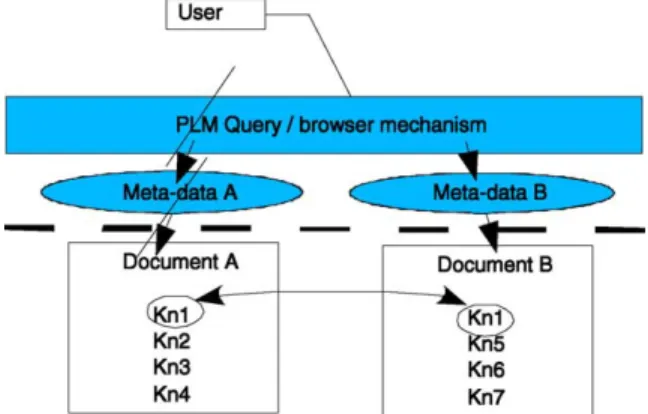
2. Knowledge representation methodology Fig. 1 illustrates the data persistence problem in document oriented PLM. Documents and CAD models contain the company’s knowledge asset with meta-tags to identify the basic purpose of the file. In the figure ‘Kn’ denotes an item of knowledge. Both documents A and B within the system contain unique knowledge. However, Kn1 is stored in both docu-ments. In this example, a user viewing or modifying document A or B will need to be instinctively aware of such data duplication and update both documents Kn1 values. In most instances such ‘simple’ issues cause major problems for larger teams where the volume of documents contained in the vault is too large for individuals to be instinctively aware of it. Addition-ally, the problem of finding knowledge, as opposed to documents, is intrinsic.
The above problem can be solved by knowledge representation in this methodology is split into two identifiable components. The first one is the encoding and nomenclature component with the second component defining the terminology of the knowledge to be represented. This distinction between the encoding and terminology enables the deployment of flexible knowledge bases using different industry schemas whilst retaining the integration of the knowledge base. This has meant that standards such as STEP have to have their schemas translated into the encoding specifications created, as opposed to the original Express schemas. The authors define knowl-edge as the semantically complete definition of a domain’s information that is both machine-readable
and interpretable. Thus, a knowledge base contains an ontology which defines the classes and their relation-ships, instances or objects that form the domain ‘data’, meta-data that constrains the data within a particular domain (transforming it into information), and universal resource identifiers (URI) that allow the global identification and contextual interpretation of the information. These schemas are shared within the collaborative environment of a project involving many parties.
The resource description framework (RDF)http://
www.w3c.orghas been used in this application as the format for encoding the knowledge base, as opposed to eXtensible Mark-up Language (XML). The reasons for this choice are the extra flexibility and ‘machine-understandable’ format of RDF graph triple model as opposed to the simple ‘machine-readable’ XML-based mark-up vocabularies. In effect, any RDF-parser can derive the semantics and context from the URI and metadata attached to every instance.
The STEP AP-224 feature models are defined in Prote´ge´ and use the Java expert system shell (JESS) to define the rules and functions of the standard. In addition, some of the rules have been created using the Prote´ge´ Axiom Language (PAL) and the constraints these impose enable error-checking for the user during the definition of features. However, these constraints can only be applied to individual entities within the STEP model and cannot enforce any constraints between entities/features. Due to the size of the standard, only a subset of AP-224 has been translated from the original Express schema. The definition of the Express (STEP) data types is also contained in the Clips interface. This is very flexible as it allows for the inclusion of STEP data types to other components within the ontology on a need basis without having to have any expertise in Express or any other program-ming language. The above enables the mixing of feature and meta-data information in the knowledge base, meaning that users can access the information stored in STEP models using queries and RDF parsers. This integration at low level between the geometric, feature and ‘meta-data’ within a single environment is intended to reduce repetition and errors, and also enables the reuse of all the data created during the conceptual design process. A STEP AP-224-based
automatic process planner by Sharma[10]generates
plans from concept designs. The aggregate process
planning tool by Cheung et al.[2]generates assembly plans from incomplete models to enable the optimiza-tion of the design for assembly and manufacturing from the early stages.
3. Collaboration on distributed designs
One of the first problems of collaboration (both at system and at user level) is trying to understand what the others say and mean. The previous section showed the methods used to create the data models. This development is interrelated to the problem of collaboration and problems of collaborative design between enterprises of different sizes and complexity, that is, mapping between low and high content data models which results in irretrievable loss of informa-tion from the high content data model. This problem cannot be overcome traditionally by creating a mapping from one data model to another. Instead the authors have sought to create a project oriented ontology that can be created, shared and used by all parties collaborating in an enterprise in real-time. This eliminates the problems faced when low-end suppliers collaborating with advanced enterprises face integra-tion issues. Using the building-block ontologies and STEP standards to describe the terminology. There are various collaboration ‘enabler’ methods available with different strengths and weaknesses. Some are cen-tralised, controlled by a third party or de-centralised.
3.1. B2B integration and application service providers
Business-to-business integration is the traditional method for companies to collaborate and create VE networks. This area includes electronic data inter-change, XML-based messaging and portal solutions. Integrating 15 companies together on a one-to-many basis where a single repository manages the project knowledge and workflows would need 14 separate mappings.
Application service providers can be set up in two ways, either by a large ‘controlling’ enterprise, or through independent third party hosting. These services intend to provide the same utilities as enterprise level systems but in a non-enterprise specific service. ASPs offer project and product data
management vaults where the VE administrator can customise the third-party portal for their own use. It also offers opportunities to contact companies already listed on the ASP who might join the VE if they had required services to offer. The ASPs generally use software very similar to the PLM solutions like Enovia and Windchill. However, they offer them as low cost solutions to some customers with specific needs, which cannot be met by purchasing their own server software. These include: reduced cost for the enterprise as maintenance and backup is delegated. Increased opportunities if customers and VE initiating enterprises seek out partners through the portal. This is a ‘‘Democratic’’ system where no one enterprise controls the VE server and data. It sets down de facto standards for data exchange, to which other enterprises in the same domain will adhere to in order to join the network of enterprises.
There are of course some fundamental disadvan-tages to the use of ASPs, and other centralised systems, for product development, and these include: the bandwidth and server bottleneck problem associated with centralised services. The security fears of intellectual property rights being compro-mised. The potential risks of downtime and data losses in an ‘‘uncontrollable’’ environment and the liability issues associated with it. The difficulty of creating direct interfaces from the enterprise system to the ASPs portal. The exact functionality required for the VE may not be available from the ‘‘generic’’ ASP.
There are already some ASPs operating in the automotive and aeronautical sector enabling supply companies to interact and bid openly for contracts with OEMs and then manage the project/product information on the portal. However, due to the disadvantages highlighted above, the authors sought to find a third way. Whilst traditional client–server systems can operate in a collaborative manner, for example over a LAN or Internet, they are not truly distributed as they are centralised.
3.2. Peer-to-peer systems
Peer-to-peer applications address the needs of de-centralised organisations to collaborate and share knowledge regardless of geographical location. The principle of P2P has been around for a long time, and
is today implemented in a number of applications such
as instant messaging and file-sharing (http://
www.GNUtela.com). There are already a number of P2P PLM in existence. Primarily aimed at the lower end of the market. The two commercial applications
are AutoManager workflow from Cyco (http://
www.cyco.com) and Columbus from Oasys Software (http://www.oasys-software.com). The latter is avail-able for free, and aimed at AutoCAD users within the construction sector. However, they are crude solutions relying on the underlying file system and adding some ‘‘meta tags’’ to files for version control. There is no workflow or process management implemented and access control is via the standard operating system access control functions. As an example of what can be achieved, Alibre is a P2P CAD/PLM and collaboration tool in one. It uses the STEP standard and combines low cost and fast configuration.
The advantages offered by P2P applications are (i) no single point of failure, the network is alive as long as one peer is on-line, (ii) distributed sharing of bandwidth storage and processing power, so the system becomes more powerful as more users attach, (iii) lower running cost due to the lack of servers or high bandwidth central nodes, as well as (iv) maintaining individual control of the shared knowl-edge. P2P groups can be used to create profiles of the peer, and also more importantly of the peer’s list of contacts within different domains. These profiles can be used within the network to search for and assess people’s competences, interests, and memberships of trusted groups, and can aid in the construction of new relationships based on commonalities and third party assessments. There have been a number of issues that reduce the performance of the system using pure P2P architecture. The lack of indexing and routing services in P2P degrades the peer discovery and query functions. In order to leverage the advantages of client–server systems with the independence and interoperability of P2P systems a hybrid system where ‘‘super peers’’ act as peers to the extended P2P network and as a server to the enterprise’s internal peer network is used. In addition, rendezvous peers can be assigned to manage some of the peer information assigned to particular peer nets or projects. This hybrid has been shown to have the best potential for high-performance de-centralised services.
3.3. Inter-enterprise communication architecture
Since no two enterprises are the same, the idea of using XML-based messaging for inter-enterprise collaboration is not easy, as the two company schemas have to be mapped to each other. In order to achieve the speedy interoperability a standard has to be set for basic messaging. There are a plethora of standards in development by various groups including RosettaNet, an endless list of XML schemas and data type definitions. These standards implement different levels of detail in the ontology. Some like STEP PDM attempt to implement the complete information structure of the engineering enterprise. Others like JuxtaPose (JXTA) implement only the ‘‘messaging’’ components. The choice of standards to use depends on the level of ‘‘standardisation’’ that all enterprises can adhere to. In the view of the authors only a very low level subset of all enterprises can be ‘‘standar-dised’’. This small subset should exist only as a medium to enable communication, identification and access control management. All other aspects of the collaborative data environment are enterprise specific (although constructed from a subset of ontological components).
This project uses the two-tier solution shown in
Fig. 2, which enables enterprises to establish connec-tions in real-time between them. Speeding up of the integration process is further enhanced through the use of open standard semantic web enabled ontology formats for storing the information, plus the use of open standards in addition to company ontologies to define those ontology components.
4. Case study
4.1. Commercial PLM system
Windchill is an out-of-the-box PLM system. It uses open source technology for some of its key
components. A traditional, document management tool that stores all manner of data and make revision controls. It does not however have an intelligent method of containing and persisting information in an object oriented format. To alleviate this, the function-ality of the system has been extended to include the management of knowledge in an ontology. The integration with Prote´ge´ was made using Windchill’s bespoke but highly configurable workflow engine.
4.2. Open standard and open source tools
The applications used in this project are the Prote´ge´ ontology editor and Sun’s JXTA peer-to-peer protocol. Both of these tools offer the best usability, portability and cost/performance capability within their niches, and when allied to a scalable open source object/ relational database such as SAP-DB, can offer enterprise level performance for zero capital expen-diture, and low customisation cost. Moreover they free the customer from the clutches of software vendors and the vagaries of obsolescence. Other open source tools used in this work include OPEN-CASCADE, which is a native STEP solid modeller and the open flow tool that forms the foundation of the open source PLM solution.
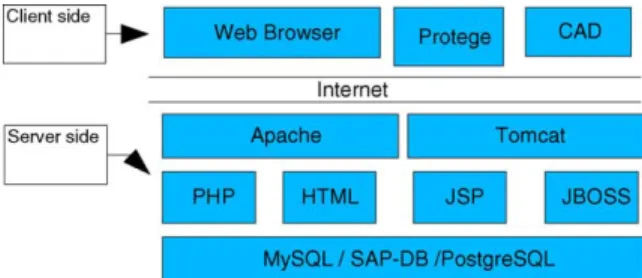
In the application (see Fig. 3) the bottom layer
consists of the database. This can be chosen from the range of relational databases available, and for this test case MySQL was utilised due to its stability, ease of use and close integration with the PHP scripting language that the open source PLM was written in. On top of this layer the two open source gateways, one is Apache web server for serving static and PHP-based web pages and the middle tier is the Tomcat servlet engine, which serves the Java server pages (JSP)-based applications. These three layers (database, web
Fig. 2. The two-tier communication.
Fig. 3. High-level view of open source server and user interface architecture.
server and application server) form the server side of the system.
On the client side, the user has three main applications i.e. (i) the web browser through which interactions with the PLM system are carried out, (ii) the Prote´ge´ Java applet that allows the user to query and manage the knowledge base and (iii) a CAD system to enable the user to create and manipulate the STEP-based models held in the PLM system. This user interface ensures ease of use for the user because the web-browser and its own cad system are already familiar to the user with the only ‘new’ tool for interaction being prote´ge´. This extension also includes the management of STEP entities within the PLM system in an intelligent and object oriented manner. Knowledge is stored as objects within the modified PLM system. This was integrated with the lifecycle management and workflow functions offered by the PLM system.
4.3. Peer-to-peer implementation
The implementation was kept as simple as possible. The simplicity of the architecture is itself a bonus and enabled the researchers to concentrate on the value adding aspects of the project. As mentioned pre-viously, the flexible Prote´ge´ ontology development and user interface environment is used. The back end consists of the open source SAP-DB database with the Java database connectivity (JDBC) connector to Prote´ge´. The knowledge base ontology is defined in a Clips file and the instances are stored in the database. Connectivity is achieved using an open source implementation of JXTA open standard P2P network
protocol (www.jxta.org). The choice was made
because JXTA implements a unique but anonymous identification mechanism for peers and for rendezvous peers. As well as ‘‘advertisement’’ implemented for all peers that give information on the one peer to other peers. Rendezvous peers can act as managers for peer groups and store the peer advertisements for the group for distribution to other P2P networks. Implementa-tion of JXTA is in Java 2 standard ediImplementa-tion, an extension to enable RDF queries and ontologies to be shared over P2P is used to share the Prote´ge´ knowledge base. The second window shows the user interface from where queries, project management of collaborative groups and such widely used items as group chat and
instant messaging are readily implemented by the JXTA protocol. The systems’ settings enable enter-prises and users without static addresses to collaborate using dynamic addressing, and this flexibility as well as the users’ ability to work offline (that cannot be done with web-based systems) empowers users in all possible circumstances.
4.4. Example data
As stated earlier, an automotive enterprise was used to demonstrate the application and collabora-tion methodology. When initiating a collaborative product development project, a list of tasks, users, roles, responsibilities are assigned. Initially this is very sketchy; however, the template ontology (implementing the STEP-PDM entities) as well as the generic-product development ontology contains both the fuzzy early stage and accommodates the updates and refinements as they are entered. The enterprise’s processes were split into lifecycle states and defined in workflow processes. Due to the complexity of the overall processes, only the conceptual design phase was modelled into the ontology and workflows. The sequence of processes for this phase are:
customer request for quotation is submitted
including requirements and associated verification methods;
generation of specifications through analysis of
earlier customer requests and testing against the new verification methods;
creating concept design options from the specifica-tions by pattern matching against earlier concepts developed with similar specifications;
selection of concept and utilising the verification methods.
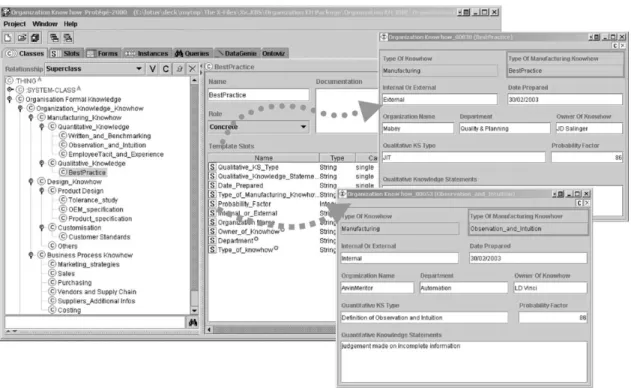
User interaction through the interface as shown in
Fig. 4was straightforward. Workflow sequences acted as widgets, guiding the user through different
config-urations. The example in Fig. 5 assigns budget and
feasibility analysis to actors, manages release of the individual tasks, which are sent for review for appr-oval/rejection.
The retention plate and four item assembly for the
lifecycle. In addition, the full project data including over 300 parts were modelled into the Bill of Material. New components are entered interactively and work seamlessly throughout the lifecycle. The application proved very simple and intuitive to use. The collaboration tools use proven technologies by SUN and worked seamlessly for many-to-many connections.
4.5. Results
The field for the results above were tested empirically using the data and a small inter-enterprise setup described previously. The server was located in Southern England, and users concurrently created the new project, generated new concepts and optimised
Fig. 4. Prote´ge´ user interface for knowledge acquisition.
the design gradually from two remote locations in addition to users at the main site.
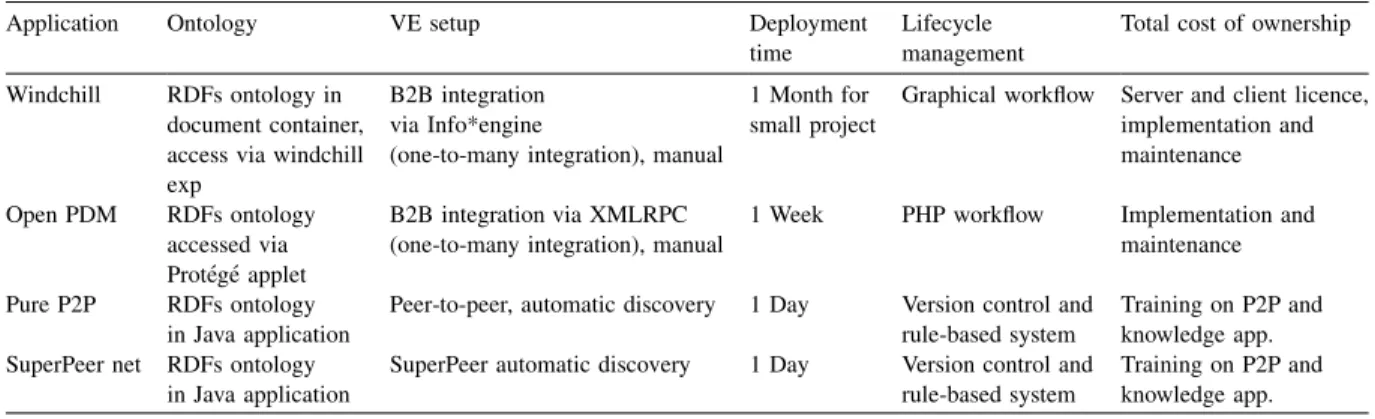
Table 1compares the key features requisite for a collaborative project environment, these were
Ontology: How easy was it to enter, query, and reuse both the ontology and domain knowledge within the collaborative group? Since this is common to all the tools, the only difference was the way in which the ontology was stored within the different systems.
VE setup: How rapidly could the VE be set up and start to operate on all the remote sites?
Deployment time: The time to customise and deploy the entire project including the project management framework (access rules, task lists, workflows), project ontology (sub-ontology selection from the generic ontology) and communications setup.
Lifecycle management: The ability to control the state of a document, manage versioning and history of the data.
Total cost of ownership: The costs of licences, implementation, system integration, training and maintenance.
All ontologies deployed shared a common back end. The applications were tested on identical hard-ware with identical configurations and Internet con-nections. The apparatus were Dell Xeon workstations with 1 GB RAM, 15K rpm disks and 1 MB Internet connection; the operating system was Windows 2000 on all machines.
Due to the small scale of the test it is impossible to gauge anything but the most rudimentary performance benchmarking of the systems as high loads of queries/ updates and multi-peer concurrent access could not be simulated with the available resources of users. However, the test suffices for a small-scale pilot. The test simulated a small scale VE setup through from initiating the VE to running the system within the collaborative network. This setup has a typical VE with a large number of small servers distributed within a common network, a small number of transactions are processed at each node.
Plates 1–3show some performance characteristics of the systems in use, as stated earlier the number of users were not sufficient to fully test the scalability of the applications; however, the distributed nature of the applications means that the number of concurrent transactions are much lower in P2P type applications than centralised programmes. The
peer-Fig. 6. Latch assembly view (courtesy ArvinMeritor).
Table 1
Comparison of key features of tested system
Application Ontology VE setup Deployment time
Lifecycle management
Total cost of ownership Windchill RDFs ontology in
document container, access via windchill exp
B2B integration via Info*engine
(one-to-many integration), manual
1 Month for small project
Graphical workflow Server and client licence, implementation and maintenance Open PDM RDFs ontology accessed via Prote´ge´ applet B2B integration via XMLRPC (one-to-many integration), manual
1 Week PHP workflow Implementation and maintenance Pure P2P RDFs ontology
in Java application
Peer-to-peer, automatic discovery 1 Day Version control and rule-based system
Training on P2P and knowledge app. SuperPeer net RDFs ontology
in Java application
SuperPeer automatic discovery 1 Day Version control and rule-based system
Training on P2P and knowledge app.
based applications showed a base performance lag when compared to the client–server applications due to routing of peer-based systems without an indexing service. Otherwise the performance of the systems in practical use showed no noticeable differences.
5. Discussion
Windchill is inherently centralised, overly com-plex to set up and requires a long period of time for customisation. The system’s main strengths are in the workflow tools. However, even here there is the problem of lock-in. The workflow and any custo-misation carried out cannot be reused on another system. Windchill has a sophisticated application layer for inter-enterprise communications, and inherent in its weakness is the client–server paradigm whereby every enterprise needs to have custom integration between it and its extended enterprises’ systems to function. This has been elaborated on in the previous sections. On another note, the RosettaNet standard, implemented in Windchill, can decrease the amount of customisation needed, but not eliminate it as RosettaNet only provides a subset of the messaging and data models of the inter-enterprise link. In addition, unlike the ontological two-tier system, Windchill’s data models and workflows are neither portable nor standardised.
Other issues encountered were the difficulty in modifying the data models. Windchill has a rather rigid data modelling interface based on the Unified Modelling Language (UML) to model the Java data model classes, and generate SQL scripts for the database. It can be modified by a professional who has to model, program, compile, update the database and integrate the code into Windchill before it can be used. This does not provide for the flexibility and ease of use for modelling ontologies that the project manager needs. The costs of implementation, licences and maintenance are very large by them-selves and only practical when the enterprises involved can share the cost between each other over a long period of co-operation (as in an extended enterprise). However, the case with VEs, in which a partnership is valid for the relatively short period of a single project, this would be unacceptable.
The Windchill and open source systems are the
evolution of product development management
systems from document centric PLM systems to knowledge centric, intelligent systems of the future. However, it had been discovered during the course of the project that centralisation, by its very nature, is an inhibiting factor for one-off inter-enterprise
collabora-Plate 1. Simple query (single term search over the entire KB).
Plate 2. Time to update instance.
Plate 3. Complex query (generating an inferred hierarchy of the KB before processing a result tree).
tion as the only methods available for collaboration in such an environment are B2B schema mapping integration, centralised web-enabled system or use of an application service provider. Portals in this instance would simply be classified as B2B integra-tions as each data source has to be separately mapped into the portal.
The requirements set out in Section1.2are fulfilled by the new methodology, thus:
Requirement 1 is satisfied by the use of domain
specific ontologies distributed to the clients (users) via the P2P network and open standards: elimina-tion of the interoperability issues for product and project knowledge, enabling small enterprises to implement application standards that were beyond their means, such as STEP-PDM, and easier set up for inter-enterprise collaboration.
Requirement 2 is fulfilled through the use of
RDF ontologies that can be queried by agent-based systems and transformed by KIF-agent-based rules. The information contains the URI and meta-data eliminating the ambiguous context of the knowledge. Efficient query and retrieval mechanisms, intelligent agents to function on context aware information and provides an object oriented representation of an enterprise’s data model.
The third requirement is met by de-centralisation:
elimination of centralised bottlenecks in band-width and resources, empowerment of collabora-tors within networks to ‘‘control’’ the knowledge they create, solving the management of intellectual property rights within VEs, elimination of cen-tralised administration that results in reduction in cost and complexity and enable domain profes-sionals to tailor the system. This, however, has a cost in terms of ease of maintenance and centralised control, as well as some query speed problems encountered due to the lack of a complete indexing service.
In addition, the methodology described can be:
Open source: Elimination of software licence costs, a solution to the problem of vendor lock-in in the long term, elimination of unnecessary complexity and freedom to modify the application.
Platform and application independence: Enable the enterprise to concentrate on its work and not be tied in to any vendor, the rapid and complete migration from the proposed system to future applications, empower the enterprise to leverage its existing investments.
6. Conclusion
The methodology described is a suitable solution for collaborating enterprises especially SMEs, to create manage and reuse their knowledge, collaborate within VEs easily and without expense. In view of the author the proposed methodology can achieve the ubiquity required due to the following factors. It enables enterprises to implement STEP-APs. Easy to set up, modular, expandable and establishes rapid B2B connections. There is a lot of work in progress, and final conclusions can only be drawn once the knowledge and communication protocols are inte-grated more completely.
Acknowledgements
The authors would like to thank the project sponsors without whom this research would not be possible. Firstly, the UK Engineering and Physical Science Research Council (EPSRC) for its financial support, in addition to the industrial collaborators ArvinMeritor, LSC Group, Mabey and Johnson and PTC Corporation who provide training, software and valuable case-study material.
References
[1] J. Gao, H. Aziz, P. Maropoulos, W. Cheung, Application of product data management technologies for enterprise integra-tion, International Journal of Computer Integrated Manufac-turing 16 (2003) 491–500.
[2] W. Cheung, P. Maropoulos, J. Gao, H. Aziz, Knowledge-enriched product data management system to support aggre-gate process planning, in: Y. Qin, N. Juster (Eds.), Proceedings of the First International Conference on Manufacturing Research, Advances in Manufacturing Technology, vol. XVII, 2003, pp. 253–258.
[3] H. Aziz, J. Gao, P. Maropoulos, W. Cheung, A design envir-onment for product knowledge management and data exchange, in: Tichkiewitch Serge, Brissaud Daniel (Eds.),
Methods and Tools for Co-operative and Integrated Design, Kluwer Academic Publishers, 2003.
[4] R. Beckett, Determining the anatomy of business systems for a virtual enterprise, Computers in Industry 51 (2003) 127–138.
[5] L. Wang, W. Shen, H. Xie, J. Neelamkavil, A. Pardasani, Collaborative conceptual design—state of the art and future trends, Computer-Aided Design (2002) 981–996.
[6] L. Camarinha-Matos, H. Afsarmanesh, Elements of a base VE infrastructure, Computers in Industry 51 (2003) 139–163. [7] Y. Kim, S.-H. Kang, S.-H. Lee, S.-B. Yoo, A distributed, open,
intelligent product data management system, International Journal of Computer Integrated Manufacturing 14 (2001) 224–235.
[8] X.-F. Zha, H. Du, A PDES/STEP-based model and system for concurrent integrated design and assembly planning, Compu-ter-Aided Design (2001).
[9] P. Vasara, V. Krebs, L. Peuhkuri, E. Eloranta, Arachne— adaptive network strategy in a business environment, Compu-ters in Industry 50 (2003) 127–140.
[10] R. Sharma, J. Gao, W. Bowland, Implementation of STEP application protocol 224 in an automated manufacturing plan-ning system, Journal of Engineering Manufacture B 216 (2002) 1277–1289.
Hayder Azizwas a research assistant at Cranfield University during the reported project period of September 2001– August 2004. Prior to that he was a systems administrator in an international communications company after complet-ing a MSc course in CAD/CAM from Cranfield University in September 2000. Hayder now runs his own consul-tant company in Iraq and travels fre-quently between UK and Iraq.
James Gaois a senior lecturer at Cran-field University and was the principal investigator of the reported project. Dr. Gao has published over 110 papers covering the wide range of design and manufacturing especially knowledge management, new product development, system integration and collaborative pro-duct design. Dr. Gao leads a team of researchers working with international companies and UK government organisations tackling key manu-facturing problems.
Paul Maropoulosis professor of design and manufacturing at the University of Durham and leads this subject area in the School of Engineering. He published 3 edited books and some 140 refereed papers and maintains an active research profile internationally. He is an elected, active member of CIRP and the founder of the International Series of CIRP Con-ferences in ‘‘Digital Enterprise Technol-ogy’’. Prof. Maropoulos is also active in the Regional arena (North East of England), securing funding which resulted in the creation of a new ‘‘Institute for Agility and Digital Enterprise Technology’’.
Wai M. Cheungwas a senior research assistant at the University of Durham working on the Distributed and Colla-borative Product Development Project in collaboration with Cranfield Univer-sity. Prior to his current post he was a research assistant at Loughborough Uni-versity and 2 years as an associate SMT Engineer with IBM (UK).