Automated Session Data Repair for Web Application Regression Testing
Nadia Alshahwan
Mark Harman
National Company for Cooperative Insurance
King’s College London
Central Regional Office
Strand, London
P.O. Box: 52991 Riyadh - 11573, Saudi Arabia
WC2R 2LS, UK
Abstract
This paper introduces an approach to web application regression testing, based upon repair of user session data. The approach is entirely automated. It consists of a white box examination of the structure of the changed web ap-plication to detect changes and a set of techniques to map these detected changes onto repair actions.
The paper reports the results of experiments that explore both the performance and effectiveness of the approach. The effectiveness experiment uses an implementation of the re-pair algorithm applied to the online bookstore application over a series of 10 releases.
Keywords:
Regression Testing, Web Applications.1. Introduction
User session data has been shown to be an effective and valuable resource in web application testing, finding faults not found by other techniques. However, web applications are typically the subject of frequent changes that invalidate some existing session data. This rapid evolution can thus lead to an equally rapid reduction in the value of the ses-sion data. Though much attention has been paid to testing issues for web applications there has been very little previ-ous work that utilizes user session data for web application testing and none that uses session data in regression test-ing of web applications.
Notwithstanding the paucity of previous work on session–based web application testing, the little work that does exist has been very encouraging; revealing that session data may expose faults not found by other white box tech-niques [6]. Session data represents realistic test cases be-cause they are created directly and naturally by the users of the system. Furthermore, it is usually easy to collect ses-sion data due to the server–side execution of much web application functionality and the wide availability of log-ging mechanisms.
However, when a change is made to a web application (for example, introducing a new page, removing a link or changing a parameter set of a dynamic page) some of the
session data becomes potentially obsolete; it will no longer represent a valid session in the new structure of the appli-cation. Therefore, any attempt to exploit the value locked in session data will have to overcome the problem posed by changes that render the sessions invalid. However, it is pre-cisely these ‘newly invalid’ session data that test new func-tionality denoted by changes to the web application.
This paper introduces an algorithm based on the concept of ‘session repair’. Where a session has become newly in-valid due to changes in the application, our algorithm will attempt to repair the session. It constructs a new version of the session that closely resembles the original, thereby re-taining the realism of the original session.
The repair approach mines the session data for suitable parameter values to use in cases where the parameters of an individual request have become modified. It also attempts to find new paths to connect sections of an existing session for which navigation has become impossible due to struc-tural modifications. Where such paths do not exist, the ses-sion is split into two smaller but valid sesses-sions. The first half (subsequence) of such a split is guaranteed to be appli-cable, though, clearly one would prefer to preserve longer sequences, where possible. Since sessions are a sequence of URLs together with associated parameters, the second half of such a split is also potentially valuable.
Of course, it is possible simply to split a session into two sub-sessions as soon as a problem is encountered, but we prefer, to first attempt repair. This approach is based on the philosophy that we should strive to retain as much of the original length of a session as possible. Longer sessions may be required in order to lead the application into spe-cial cases and to establish values for internal state variables. The repair approach requires a pre-processing white box analysis phase that determines the structure of the modified web application. This new structure is then used to drive the search for newly inapplicable parameter sets and newly in-valid sequences of URL requests. One advantage of this ap-proach is that it is entirely automated; the overall algorithm simply takes a (possibly changed) web application and a set of session data (obtained from the original web application)
and produces a repaired set of session data.
In order to assess the effectiveness of the approach, a controlled experiment was performed on a previ-ously well studied web application: the online book-store [6, 10, 11]. The bookbook-store was changed in re-sponse to a set of 10 user-requests for new functionality. These user–requested changes were used to produce a se-ries of ‘releases’ of the application, to which an imple-mentation of the repair algorithm was applied. The results show that the approach can produce substantial improve-ments in regression testing effectiveness by increasing the amount of session data which can be re–used in re-gression testing. The approach also remains effective in the presence of significant numbers of changes with-out the re–collection of updated session data. The primary contributions of this paper are:
1. Algorithm
The paper introduces an algorithm for regression test-ing based on session data repair. This algorithm repre-sents the first session–based approach to web applica-tion regression testing.
2. Effectiveness Study
The paper presents the results of a controlled experi-ment into the effectiveness of the approach when ap-plied to 10 versions of an online bookshop. The re-sults indicate that the approach is effective at recover-ing the value in session data that would otherwise be lost when the web application changes.
Without repair, about one third of the ses-sions would have been unusable in regression test-ing. The repair approach is not only able to retain these, but in the majority of cases it does so with-out recourse to session splitting, thereby retaining the value of the original session as a longer se-quence of realistic and potentially complex transac-tions.
3. Scalability Study
The paper also presents results concerning the scala-bility of the approach, indicating that the performance of the algorithm will allow it to be used even in de-manding scenarios such as those where daily regres-sion testing is required.
The rest of the paper is organized as follows: Section 2 presents the algorithm for repair. Sections 3 and 4 describe the controlled experiment and the results obtained from it using a prototype session repair tool that implements the al-gorithm, whilst Section 5 considers the threats to the valid-ity of the findings. Section 6 presents related work and Sec-tion 7 concludes.
2. The Repair Algorithm
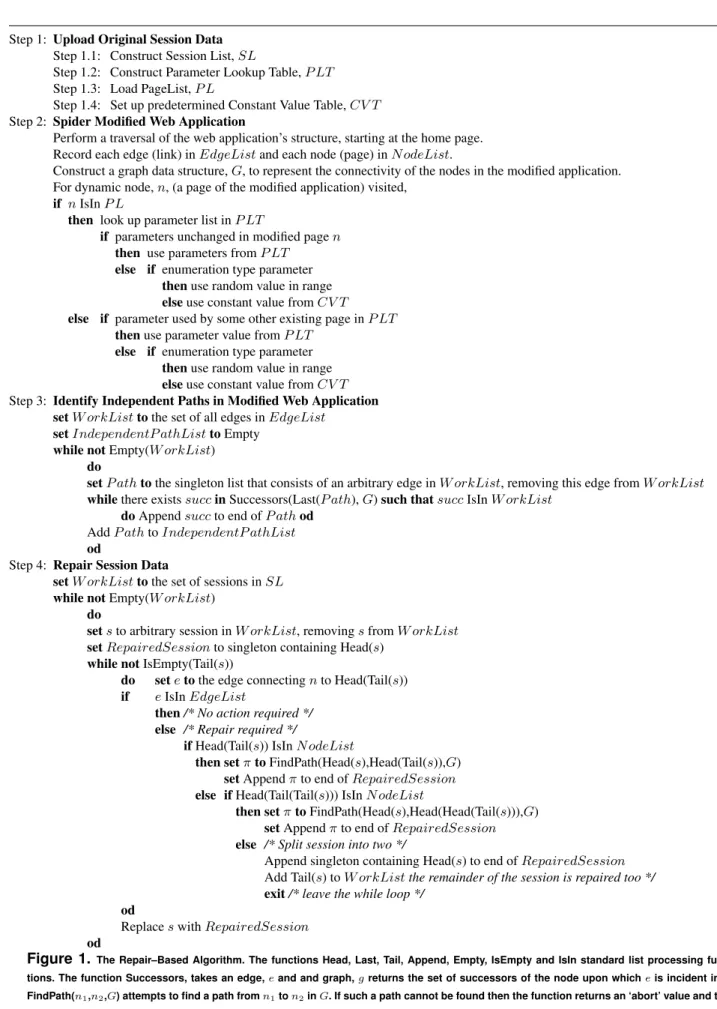
Our overall approach is based on two phases: an analy-sis phase that identifies the changes made to the original ver-sion of the application and a manipulation phase that repairs the sessions rendered invalid by these changes. The overall algorithm is set out in Figure 1. Steps 1,2 and 3 form the analysis phase of the overall approach, whilst Step 4 per-forms the manipulation phase that implements the neces-sary repair actions.
Step 1 is an initialization phase in which three data struc-tures used by the algorithm are constructed from a set of session data. The variableSLis a list of sessions. Each ses-sion is a sequence of node–edge pairs, recording the pages (nodes) visited and the edges (links) followed in order to move from one node to the next. The variableP LTis a Pa-rameter Look up Table; a database relation that allows pa-rameters used in a dynamic page to be indexed by their page identifier and vice versa. The variableP Lis simply a list of page identifiers used in the web application (essentially a node set).
When all else fails and no suitable parameter can be found inP LT, an appropriate value has to be ‘invented’. In order to allow values to be invented for parameters that are not enumeration types, a Constant Value Table,CV Tis constructed. This table provides a valid entry for unbounded variable types (such as strings) that cannot be given a ran-dom enumerated value. Our experience is that such values are seldom used to determine page navigation. Rather, nav-igation parameters are typically offered to the users as a choice from a set of possibilities, thereby ensuring valid in-put.
Step 2 constructs the graph structure of the modified web application as a set of nodes (pages) and edges (links). This phase is essentially a white box analysis phase.
If a webFORMis encountered for which the input param-eters are identical to those in the original web application, then the original parameters are copied into the spider to al-low it to continue navigation. If there is a changed set of pa-rameters, our approach is to check to see if there exist other pages in the original web application that have the same pa-rameter identifiers. Since the new application is a ‘version’ of the old one, it seems reasonable to recoup and reuse such values. In the worst case, where an entirely fresh parame-ter has been introduced, which has hitherto not been used elsewhere in the old version of the application, we invent a value for this parameter. Where the parameter has an enu-merate type value, for example, a menu, check box or radio button, we simply generate a valid random value. Where the parameter type is unbounded (for example a string) we look up a suitable pre–determined value from the Constant Value TableCV T.
The re–used and invented parameters play an important role in the subsequent repair phase which occurs in Step
4. They form the new values for changed and freshly in-troduced parameters that are inserted into the session data. This allows for re-navigation to reconstruct links that have become newly invalid due to web application evolution.
Step 3 is an enabling step for the repair phase that fol-lows. It constructs the set of linearly independent paths from the graph–based data structure constructed in Step 2. The set of linearly independent paths is a set of paths such that each member of the set contains an edge that is not found in any other member of the set. Strictly speaking, the step is not necessary; it is possible to construct the paths required by Step 4 directly from the graph produced in Step 2. How-ever, since repeated paths must be generated in Step 4, it is often more convenient to have sequences of valid paths pre-stored.
Importantly, each edge is contained in precisely one path and all edges are contained in one or other path. This al-lows the repair phase to construct a valid sequence of steps to move from one page to another in the new version of the web application. The final phase implements the repair ac-tions for three kinds of newly invalid link. The repair algo-rithm is at the heart of the approach and it is now described in more detail.
In order to perform repair, two kinds of task have to be accomplished:
1. Individual URL Repair. An individual URL may no longer use the same parameter. Each such individual URL request must be repaired to give meaningful values to any parameters newly introduced.
2. Sequence Repair. Each session may no longer corre-spond to a valid sequence of URL requests in the new ver-sion of the application. Sequences of URLs from the exist-ing session database may contain nodes and edges that no longer exist in the new version of the application. Where possible, these sequences should be repaired to give valid (and hopefully realistic) sessions for the new version of the application. Where it is not possible to build a valid se-quence from an existing session, the session may be decom-posed into smaller valid sequences of URL requests. This may allow some of its original value to be retained.
Consider a URL in the session data (old) and a corre-sponding URL in the new version of the web application (new). Two steps must be performed: First, any parameters inoldno longer required bynewmust be removed. Second, any parameters required bynewbut no longer present inold must be created to result in a request that is both valid and hopefully, realistic. Here ‘realism’ is a property that must come from the implicit domain knowledge trapped in the existing session data, since this is the only resource that we can reliably assume will be available for this purpose.
Turning from repair of individual URLs to the repair of entire sequences of URL requests, three classes of sequence repair are
considered:-Figure 2.An Illustration of Edge Deletion Repair. If the link from node 4 to node 5 is removed, but the nodes remain, then a new path must be found to navigate from node 4 to node 5.
1. Edge Deletion. A link (edge) between two pages is re-moved, but the two pages remain. In this situation, a new path must be found from the source page to the target page that is valid in the new version of the application. This situ-ation is illustrated in Figure 2.
2. Node Deletion. A page (node) could be deleted from the web application so that any link to this page becomes in-valid in the session data. In this situation, it is possible to link the old source page to the next–but–one page in the old session data (so long as the next–but–one page has not also been deleted). This can be achieved by attempting to find a path from the old source page to the old target of the tar-get page. The situation is illustrated in Figure 3. Of course, this process could be repeated for arbitrarily long sequences of deleted pages, but we are likely to receive diminishing re-turns; a long sequence of deleted pages may indicate a sig-nificant shift in functionality. Therefore, we have taken the view in this paper, that we shall stop attempting such re-pair when two or more pages in sequence are missing. 3. Default: Neither of the above applies. It can happen that a sequence of two or more pages are deleted, or that only a single edge or page is deleted, but it is not possible to find a path between the original source and the original tar-get (or tartar-get of the tartar-get) node. In this ‘catch all’ situation, we adopt a ‘damage limitation’ approach, in which the orig-inal session is split into two sessions at the point at which the problem occurs.
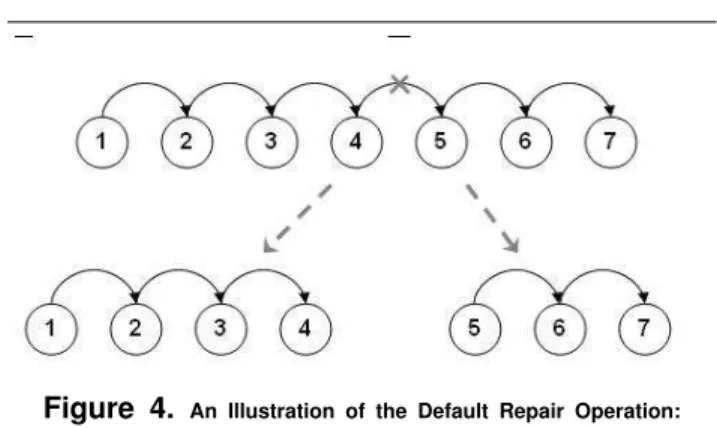
Each session can then be recursively repaired accord-ing to the overall approach. The situation is illustrated in Figure 4. This default approach facilitates some degree of reuse. It loses the value that accrues from continuing test-ing along an extended sequence of URL requests.
3. Experimental Set Up
A prototype regression testing tool was implemented to allow experimentation with the algorithm introduced in Fig-ure 1. The current version of the tool does not implement edge repair (these are currently handled with the default ses-sion repair action of sesses-sion splitting).
Step 1 is achieved using a standard relational database implementation with session data are loaded from an XML
Step 1: Upload Original Session Data
Step 1.1: Construct Session List,SL
Step 1.2: Construct Parameter Lookup Table,P LT Step 1.3: Load PageList,P L
Step 1.4: Set up predetermined Constant Value Table,CV T Step 2: Spider Modified Web Application
Perform a traversal of the web application’s structure, starting at the home page. Record each edge (link) inEdgeListand each node (page) inN odeList.
Construct a graph data structure,G, to represent the connectivity of the nodes in the modified application. For dynamic node,n, (a page of the modified application) visited,
if nIsInP L
then look up parameter list inP LT
if parameters unchanged in modified pagen
then use parameters fromP LT
else if enumeration type parameter
thenuse random value in range
elseuse constant value fromCV T
else if parameter used by some other existing page inP LT
thenuse parameter value fromP LT
else if enumeration type parameter
thenuse random value in range
elseuse constant value fromCV T Step 3: Identify Independent Paths in Modified Web Application
setW orkListtothe set of all edges inEdgeList
setIndependentP athListtoEmpty
while notEmpty(W orkList)
do
setP athtothe singleton list that consists of an arbitrary edge inW orkList, removing this edge fromW orkList
whilethere existssuccinSuccessors(Last(P ath),G)such thatsuccIsInW orkList
doAppendsuccto end ofP athod
AddP athtoIndependentP athList
od
Step 4: Repair Session Data
setW orkListtothe set of sessions inSL
while notEmpty(W orkList)
do
setsto arbitrary session inW orkList, removingsfromW orkList
setRepairedSessionto singleton containing Head(s)
while notIsEmpty(Tail(s))
do setetothe edge connectingnto Head(Tail(s))
if eIsInEdgeList
then/* No action required */
else /* Repair required */
ifHead(Tail(s)) IsInN odeList
then setπtoFindPath(Head(s),Head(Tail(s)),G)
setAppendπto end ofRepairedSession
else ifHead(Tail(Tail(s))) IsInN odeList
then setπtoFindPath(Head(s),Head(Head(Tail(s))),G)
setAppendπto end ofRepairedSession
else /* Split session into two */
Append singleton containing Head(s) to end ofRepairedSession Add Tail(s) toW orkListthe remainder of the session is repaired too */
exit/* leave the while loop */
od
ReplaceswithRepairedSession
od
Figure 1.The Repair–Based Algorithm. The functions Head, Last, Tail, Append, Empty, IsEmpty and IsIn standard list processing func-tions. The function Successors, takes an edge,eand and graph,greturns the set of successors of the node upon whicheis incident ing. FindPath(n1,n2,G) attempts to find a path fromn1ton2inG. If such a path cannot be found then the function returns an ‘abort’ value and this
Figure 3.An Illustration of Node Deletion Repair. If a page (node 5 in this case) should be removed, then a new path must be found to navigate from its predecessor to its successor.
Figure 4. An Illustration of the Default Repair Operation: When no path in the new structure can be found to navigate from node 4 to node 5, then the old session is split into two sub– sequences to which the repair algorithm is recursively applied.
session log. Step 2 is implemented using a version of the popular web-spidering tool,JSpider, tailored to handled forms and dynamic pages in the manner described in Fig-ure 1. Steps 3 and 4 from FigFig-ure 1 are implementation com-ponents constructed specifically for the regression session repair tool.
The evaluation of the approach is concerned with two as-pects of the approach corresponding to two research ques-tions we seek to answer:
1. RQ1: How effective is the approach?
The effectiveness of the approach is measured by con-sidering the percentage of user session data that was reused over a series of changed versions of the applica-tion. For comparison (and as a measure of the level of change from version–to–version) the reusable percent-age using the repair algorithm is compared to the per-centage of session data that would have been reusable were no repair to have been applied.
2. RQ2: Is the approach sufficiently computationally cheap to be applicable?
In order to be applicable, it must be possible to per-form the entire repair process in a period of time that is commensurate with the time allocated to all other regression testing activities. The approach may be
re-quired in situations where web applications are chang-ing on an almost daily basis, requirchang-ing a nightly build-and-test approach to regression testing. In such a sce-nario, the tool must be able to scale to large web appli-cations with performance measured in minutes. The theoretical algorithmic performance of the approach is clearly determined by the size of both the web applica-tion and the session data base. However, it is theoretically linear in both the number of edges in the web application and the number of sessions on the session data base, and so itshouldbe scalable to larger systems. In order to give these theoretical observations some practical interpretation, data will be presented for the run–time performance of our pro-totype implementation. It should be remembered that this is a prototype and that an industrial strength version might rea-sonably be expected to achieve an order of magnitude im-provement in performance. However, real world regression testing problems may also be an order of magnitude larger than those studied here.
Our main focus for experimentation is RQ1, since we are concerned to investigate the way in which the regres-sion testing effort (using repair) degrades over successive releases of the system, when compared to a regression test-ing effort which does not use repair. The experiment was conducted in the following manner:
Web Application Selection
A relatively simple but realistic web application was cho-sen for the study. The application, an online bookstore, is one used by other researchers working on Web Ap-plication Testing [3, 6, 10, 11] and is available from www.gotocode.com. The Web application pro-vides the customer with the ability to register, login, search, browse, purchase books and to use a simple ‘vir-tual shopping cart’. The application also has an ‘admin-istrative user’ feature with different levels of privilege to regular users. The bookstore web application was not al-tered in any way. Initially, there were 22 books in the book database.
Session Collection
The site was set up on an Apache Tomcat server, with a session logging tool. A group of 14 participants was in-vited to use the original version of the web application and the session data they created through this use was stored as the initial session data. The participants were asked to ex-plore the site and to attempt to use all of its features, but they were given no other specific directions on how the site should be used. None of the participants were taught about the structure of the web application, the nature of the ex-periment nor the details of the algorithms for repair. The participants were given neither reward nor tasks to perform on the web application, so that their use would be as un-constrained as possible. The participants were also
uncon-strained as to when and for how long they used the web ap-plication. In total, 40 sessions were logged over a period of 10 days.
Web Application Evolution
A series of 10 changes were made to the web application to implement new functionalities. The changes made were designed to implement realistic functionality enhancement, not mere ‘random mutation’. The changes were cumula-tive, so that each new version of the web application in-volved changing the previous version. The aim was to pro-duce a sequence of releases. The changes applied were not necessarily of the same size. Although each change was im-plemented either by one of the experimentors, creating a potential source of bias, all the changes were implemented in response to change requests from the participants. These requests arose naturally; they were requests for improve-ment in the functionality of the system. The change requests were not filtered in any way and were implemented purely to achieve the additional or changed functionality requested by the participants.
The types of changes made were as follows:
1. Structure: The way pages were linked together was changed.
2. Forms: Parameters were added or deleted and names of parameters were changed.
3. Pages: Pages were deleted and others were added. 4. Files: File names were changed.
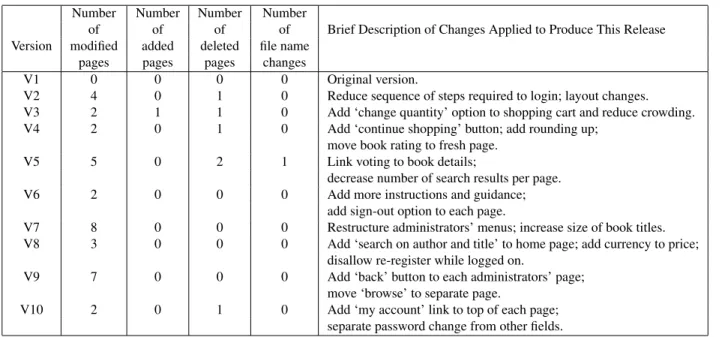
Basic data on the types of changes performed are recorded in Table 1, together with a brief description of the nature of each change performed.
Tool Application
The prototype Regression Testing Tool was applied to each version of the web application using the initial set of ses-sions collected from the execution of the original version of the application. No update of session data was performed between each release. The aim was that the original session data would become increasingly ‘out of date’, presenting a monotonically increasing level of challenge to the repair al-gorithm.
Data Collection
Results were collected for execution times for the four stages of the algorithm, for the percentage of successfully repaired individual URL requests and for the percentage of all session repair operations that were performed in each of the session repair categories.
4. Results
The primary focus of the experiment was upon the effec-tiveness of the approach, for which the results are presented in Section 4.1.
Whilst an approach to regression testing may be effective at increasing the amount of test cases which may be avail-able following a change, it will not be practical if the perfor-mance of any implementation is not commensurate with the time available for regression testing. Our implementation is only a research prototype, so care is required when in-terpreting performance results. Nonetheless, we separately performed an experiment to collect data on its performance over a series of increasingly large session databases and over a set of increasingly large web applications. These re-sults are presented in Section 4.2. To collect these rere-sults, the tool was executed on an Intel Pentium III Mobile CPU, running at 1.19GHz with 256MB RAM.
4.1. Effectiveness
Figure 5 shows the percentage of URLs requested that would be discarded were no repair actions to have taken place and the percentage that the algorithm discards because it is unable to find a suitable repair for the individual URL. As can be seen, without repair, the number of URLs that can be reused, steadily falls as the level of change rises. By contrast, the number of URLs that the repair algorithm is forced to discard is far lower; after the 10 change requests have been implemented, the ‘no repair’ option is forced to abandon four times as many individual requests as the re-pair algorithm.
In determining the number of URLs that would be dis-carded were there to have been no repair, we adopt an ap-proach that gives the most favourable outcome for the ‘no repair’ option. That is, where parameters are merely moved from a URL, no error occurs, so some form of re-gression testing with sessions containing this form of old ‘broken’ URL would be possible. If we also count these ‘de-creased parameter URLs’ as discarded in the ‘no repair’ proach, then the results for the repair algorithm would ap-pear to be better than those reported.
Figure 6 shows the number of sessions repaired using each of the repair approaches, compared to the percentage that would be discarded were there to be no repair. The re-sults for the different categories of repair action are repre-sented as percentages of the overall number of repair oper-ations applied. Therefore, the sum of their values for each release will always be 100%. These results give an indica-tion of how the proporindica-tion of repair operaindica-tions changes over the evolution of the web application’s releases.
Because our philosophy is to retain, where possible, the full length of user sessions, the ‘split session’ repair oper-ation is the least favoured. The results in Figure 6 are ex-tremely encouraging with respect to the number of occa-sions on which a session split was required. For example, throughout the change process, twice as many node repair operations are performed as session splits, indicating that
Number Number Number Number
of of of of Brief Description of Changes Applied to Produce This Release Version modified added deleted file name
pages pages pages changes
V1 0 0 0 0 Original version.
V2 4 0 1 0 Reduce sequence of steps required to login; layout changes. V3 2 1 1 0 Add ‘change quantity’ option to shopping cart and reduce crowding. V4 2 0 1 0 Add ‘continue shopping’ button; add rounding up;
move book rating to fresh page.
V5 5 0 2 1 Link voting to book details;
decrease number of search results per page.
V6 2 0 0 0 Add more instructions and guidance;
add sign-out option to each page.
V7 8 0 0 0 Restructure administrators’ menus; increase size of book titles. V8 3 0 0 0 Add ‘search on author and title’ to home page; add currency to price;
disallow re-register while logged on.
V9 7 0 0 0 Add ‘back’ button to each administrators’ page; move ‘browse’ to separate page.
V10 2 0 1 0 Add ‘my account’ link to top of each page; separate password change from other fields.
Table 1.Basic Data on Web Application Evolution. The on–line bookstore application evolved, through a series of changes according to a set of user requests for additional and changed functionality. The number of modified pages are those which retained their identity, but the content was modified.
the algorithm has the potential to retain a substantial amount of the value of the original sessions in their entirety.
Figure 6 also shows the number of session that would remain valid and, therefore, available for regression test-ing were there to be no session repair (labelled ‘valid ses-sions’). Using the session repair algorithm,allsessions re-main available (though some are split), whereas with no ses-sion repair, the number available quickly falls. In our se-quence of implementations of change requests, there are two points in the application’s evolution that cause an ‘ex-tinction event’ to occur in which a number of sessions be-come invalid. This causes the number of session available with ‘no repair’ to fall, first by a quarter and subsequently, after 5 versions by a third, from those available to the origi-nal version of the website.
Of course, it should be noted that the repairs are being applied to an increasingly altered web application, but al-ways with reference to the original set of session data, col-lected from version 1 of the application. In reality it would be possible to retain repaired session data, constructed part way through the evolution of the web application, thereby improving the repair algorithm’s effectiveness. We have chosen not to do this in our experimentation, because we wish to see how the effectiveness of the repair operation de-grades over a set of increasingly changed versions of the original web application.
Measuring the ‘size’ of a change to a web application is an inherently imprecise activity destined to be ill-defined.
Figure 5.Reuse of URLs in Regression Testing. The percent-age of all URLs that would be discarded with and without repair as the web application increasingly changes.
As a result, we cannot infer any meaning to the slope of the graph of the functions denoting the percentage of each re-pair activity in Figure 6. However, each release is produced by modifying the previous release to add new functionality. Therefore, we can say that the level of change is monoton-ically increasing. This allows us to see how the effective-ness of the repair activities change with an increasing level of change.
4.2. Performance
The performance of Steps 1 and 4 of the algorithm de-scribed in Figure 1 is determined by the size of the session database. Figure 7 shows how the performance (in
execu-Figure 6.Reuse of Sessions in Regression Testing. The fig-ure shows the percentage (of all repair actions performed) that fall into each of the categories of repair. It also shows the per-centage (of all sessions) that would remain valid were no repair actions to be performed. Using the repair algorithm, all sessions are retained (though a proportion of these do become split).
Figure 7.Relationship between Execution Time and Number of Sessions for Steps 1 and 4 of the Algorithm in Figure 1
tion time) varies with the number of sessions in the session data base.
For session databases containing 10 or fewer sessions, the time to process the session is dominated by the initial-ization and startup time of the application. As the results for session sizes show, the application is able to process ses-sions at a reasonable rate, covering all sesses-sions used in the experiment in a matter of seconds on standard computing machinery. This is well within acceptable bounds, even for frequent regression testing scenarios.
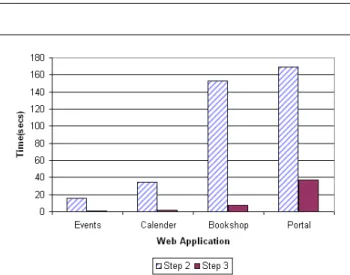
The performance of Steps 2 and 3 of the algorithm de-scribed in Figure 1 is determined by the size of the web ap-plication to which they are applied. In order to asses this performance, steps 2 and 3 were applied to four websites, including the on–line book store used to measure the effec-tiveness of repair in the previous sections.
Table 2 gives a set of size measurements for each of the four web applications. The column ‘files’ records the
num-Figure 8.Relationship between Execution Times and Appli-cation Size for Steps 2 and 3 of the Algorithm in Figure 1
Web Application Files URLs Edges
Events 14 14 49
Calendar 4 29 253
Bookshop 52 145 1210
Portal 30 150 3252
Table 2.Information About the Applications Used for Evalua-tion of the Steps 2 and 3 in Figure 8
ber of files in the application (this number includes image files should they correspond to click-able links). The col-umn ‘URLs’ records the number of statically distinct URLs recorded by the spidering tool and the ‘edges’ are the num-ber of links traversed by the tool. From Table 2 we roughly rank the web applications according to overall size. Figure 8 shows how the performance (in execution time) varies with the overall size of the web application under white box anal-ysis. Naturally the spidering process dominates the overall analysis phase, since every edge must be traversed. As can be seen, the tool is able to complete its entire white box analysis phase within three minutes for all of the applica-tions considered. This suggests that the analysis phase of the algorithm and the tool that implements it are likely to have an acceptable performance, even for the most demand-ing web application regression testdemand-ing scenarios.
5. Threats to Validity
There are two kinds of threats to validity for the experi-ment presented in this paper: internal and external. The pri-mary and most pressing threat to the validity of the work comes from the application of the approach to only a sin-gle web application. Clearly, in order to make more general statements about the behaviour of the algorithm on other web applications, it will be necessary to apply the
tech-niques and algorithms introduced in this paper to more and varied web applications.
In our experiment, we traded a degree of realism for a degree of control, in a carefully planned manner. To pro-mote realism, we allowed independent participants to spec-ify the changes to be made to the web application and we collected session data from unsupervised participants. How-ever, to obtain a degree of control, the changes were all per-formed on the same web application; one which previously has been widely studied by other authors.
There is of course, a danger that the experimentor may make changes in a manner that biases the results of the ap-plication of the repair tool and so we allowed independent web programmers to make some of the changes to see if this produced noticeable differences in results. Furthermore, we ensured that all changes were made only in response to re-quests from the participants.
The experiment is perhaps a little unrealistic in the sense that we did not re–collect session data after any of the changes had been performed. We did this because we were interested in the worst case performance of the approach over a sequence of changes. In a more realistic scenario, it would be possible to augment our session data base throughout the modification process. However, by basing all attempts at repair on the original session data, we are es-sentially applying the notion of ‘testing to destruction’ to our repair algorithm. We wish to see how well it performs with repeated changes and no new session data. In more re-alistic scenarios, the approach would be more effective, be-cause it would be able periodically to update the available session data, resulting in improved effectiveness.
Also, it could be argued that some of the changes were relatively small, corresponding to simple ‘fixes’ requested by the users. Changes of this nature would be unlikely to form the basis for a full scale release. It is only at the point of full release that new user session data would accrue. Therefore, the results presented on effectiveness could be regarded as describing the effectiveness of the repair ap-proach over a series of increasingly large changes.
6. Related Work
Much previous work on regression testing has focused on problems associated with managing the inherent com-plexity of the task of re-executing a large suite of test data on a changed application [2, 4, 5, 12]. However, the con-cern of such work has been with classical implementations of systems, not with web applications. Where work on re-gression testinghasconsidered web applications, the focus has been on white box techniques and design issues [7, 15]; no previous work on regression testing web applications has used session data.
There has also been a larger previous body of work on more general aspects of web application testing, apart from
regression testing issues [11, 13]. Even in this more general body of work, there is a surprising lack of previous work that considers the possibility of exploiting session data. In-deed the first authors to suggest the use of session data in web application testing were Rothermel et al. in 2003 [6, 3], which showed that the use of session data can reveal faults not found by other techniques such as white box techniques. The first authors to suggest the use of session data in web application testing are Tonella and Ricca [14], who present an approach to the statistical testing of web applications. Like Rothermel et al., Tonella and Ricca are not concerned with regression testing. Rather, they suggest session data as one possible source of probabilities for a Markov model in order to determine likely paths traversed to guide test ef-fort.
The results of Rothermel et al. point to the important value denoted by the session data collected from the nor-mal execution of a web–based system. However, their work was concerned with comparing the effectiveness of session– based testing with white box testing for fault finding. It was not concerned with regression testing. The present paper is the first paper to present techniques for regression testing of web applications based on the use and re–use of session data.
The work by Rothermel et al. also combines existing ses-sion data to from new sesses-sion data and so it shares with our work an ‘active’ rather than ‘passive’ approach to the ses-sion data. However, in the work of Rothermel et al., the goal is to generate new valid sequences for the existing web ap-plication, rather than to repair existing sessions.
The closest work to ours on (non–regression based) test-ing of web applications is that of Ricca and Tonella [10, 11], who present automatic support techniques for analysis and testing of web applications. Two tools where developed by Ricca and Tonella for this purpose: ReWeb and TestWeb. ReWeb downloads a web application and creates a UML graph of the relationships between its different parts repre-senting web pages as nodes and links as edges between the nodes. ReWeb also has features to indicate which parts of a web application have been altered and uses a spidering ap-proach, similar to that used in our work and in other web crawling work [8, 9]. However, the ReWeb system does not currently perform any form of regression testing and is not based upon the use of session data.
TestWeb uses the graph produced by ReWeb to gener-ate test suites. The whole process is semi-automatic, with user interventions required at several points. Most notice-ably, the user has to provide the set of required parame-ters and their values for every form encountered by each of the tools. In our work we aim to fully automate the pro-cess of regression testing. Because we have session data available to us, we are able to identify possible candidate parameter values rather than relying upon human
interven-tion. Our approach to pre–determining a system of values for cases where no parameter value can be found is simi-lar to the approach used in VeriWeb [1], which introduces a similar ‘smart-profiles’ concept.
Rothermel et al. [3, 6] also used the ‘Online Bookstore’ web application to evaluate their work from which they ob-tained 85 user sessions from 75 participants. The partici-pants were students, who were given specific tasks to per-form with the promise of a reward. In our study the partici-pants were 14 members of the general public who were nei-ther giving specific task nor reward and from whom we ob-tained 40 sessions. Rothermel et al. removed some of the ad-ministrator functionality that was deemed irrelevant to their study. In our work, the web application was used unaltered, since we did not wish to make assumptions about the kinds of session data would be relevant to the study.
7. Conclusion
This paper has introduced an algorithm for repair of web session data collected from users of the original version of a web application. Repair allows old session data to be re-used when testing changes made to the web application, even when these changes would otherwise render the orig-inal session invalid. The paper represents the first applica-tion of repair algorithms to the problem of maintaining the value of session data as a site evolves.
The paper also reports on the results of controlled exper-iments into the effectiveness and scalability of the repair– based approach. The results show that the approach can be used to recover much of the value locked in otherwise un-usable legacy web sessions, even over multiple evolution-ary changes in which no new session data is created.
References
[1] M. Benedikt, J. Freire, and P. Godefroid. Veriweb: Automat-ically testing dynamic web sites. InProceedings of 11th In-ternational World Wide Web Conference, Honolulu, Hawaii, USA, 2002. Appears in ACM SIGSOFT Software Engineer-ing Notes 29(5):1-10, 2004.
[2] D. W. Binkley. The application of program slicing to regres-sion testing. Information and Software Technology Special Issue on Program Slicing, 40(11 and 12):583–594, 1998. [3] S. Elbaum, G. Rothermel, S. Karre, and M. Fisher II.
Lever-aging user-session data to support web application testing. IEEE Transactions on Software Engineering, 31(3):187– 202, Mar. 2005.
[4] T. Graves, M. J. Harrold, J.-M. Kim, A. Porter, and G. Rothermel. An empirical study of regression test selec-tion techniques. InProceedings of the 20th International Conference on Software Engineering, pages 188–197. IEEE Computer Society Press, Apr. 1998.
[5] R. Gupta, M. J. Harrold, and M. L. Soffa. An approach to re-gression testing using slicing. InProceedings of the IEEE
Conference on Software Maintenance, pages 299–308, Los Alamitos, California, USA, 1992. IEEE Computer Society Press.
[6] S. Karre, S. Elbaum, and G. Rothermel. Improving web ap-plication testing with user session data. InProceedings of the 25th International Conference on Software Engineering, pages 49–59, Portland, Oregon, USA, May 2003.
[7] T. Margaria, O. Niese, and B. Steffen. A practical ap-proach for the regression testing of IP-based applications. In IP Applications and Services 2003: A Comprehensive Re-port, pages 195–208. International Engineering Consortium (IEC), 2002.
[8] R. C. Miller and K. Bharat. Sphinx: a framework for creat-ing personal, site-specific web crawlers. InProceedings of the seventh international conference on World Wide Web 7, pages 373–388, Brisbane, Australia, 1998. Springer–Verlag. [9] S. Raghavan and H. Garcia-Molina. Crawling the hidden web. InIn Proceedings of the 27th International Confer-ence on Very Large Data Bases, pages 129–138, New York, NY, USA, 2001.
[10] F. Ricca and P. Tonella. Analysis and testing of web appli-cations. InProceedings of the 23rd International Confer-ence on Software Engineering, pages 25–34, Toronto, On-tario, Canada, 2001. IEEE Computer Society.
[11] F. Ricca and P. Tonella. Building a tool for the analysis and testing of web applications: Problems and solutions. In Pro-ceedings of the 7th International Conference on Tools and Algorithms for the Construction and Analysis of Systems, pages 373–388. Springer–Verlag, 2001.
[12] G. Rothermel, R. Untch, C. Chu, and M. J. Harrold. Priori-tizing test cases for regression testing.Transactions on Soft-ware Engineering, 27(10):929–948, Oct. 2001.
[13] S. Sprenkle, E. Gibson, S. Sampath, and L. Pollock. Auto-mated replay and failure detection of web applications. In Proceedings of International Conference on Automated Soft-ware Engineering (ASE 2005), pages 253–262, Long Beach, California, USA, 2005.
[14] P. Tonella and F. Ricca. Statistical testing of web applica-tions. Journal of Software Maintenance, 16(1-2):103–127, 2004.
[15] L. Xu, B. Xu, Z. Chen, J. Jiang, and H. Chen. Regression testing for web applications based on slicing. InCOMPSAC, pages 652–656, 2003.