Iron Range Engineering PBL Experience
Ron Ulseth*+, Bart Johnson+
* Itasca Community College, Grand Rapids, Minnesota, U.S + Iron Range Engineering Program, Virginia, Minnesota, U.S. Email: [email protected]@itascacc.edu
Abstract
A new PBL model started in 2010 in Minnesota, United States. The PBL model is upper-division (the last two years of four-year bachelor’s of engineering degree). Entering students are graduates of Minnesota’s community colleges. The Aalborg PBL model served as an inspiration for the program’s development. Unique attributes of the program include industry clients, semester-long projects, emphasis on development of self-regulated learning abilities, dedicated project rooms, technical competence learned in one-credit, small (3-4 student) groups with one academic staff called learning competencies, and an emphasis on continuous improvement. The program has earned ABET accreditation. Seventy-five students have graduated and are employed as engineering professionals. The paper will discuss developmental evolution of the program, the current learning model, and will analyze results of satisfaction surveys of graduates and their employers. A case study was employed to describe the development and attributes of the PBL model. The satisfaction survey is a quantitative instrument based on the expected outcomes of the engineering education and is providing contextual comparison with non-PBL graduates.
Keywords: project-based learning; self-directed learning; professional skill development; continuous improvement;
Iron Range Engineering PBL Experience
Ron Ulseth*+, Bart Johnson+
* Itasca Community College, Grand Rapids, Minnesota, U.S +Iron Range Engineering Program, Virginia, Minnesota, U.S. Email: [email protected]@itascacc.edu
Abstract
A new PBL model started in 2010 in Minnesota, United States. The PBL model is upper-division (the last two years of four-year bachelor’s of engineering degree). Entering students are graduates of Minnesota’s community colleges. The Aalborg PBL model served as an inspiration for the program’s development. Unique attributes of the program include industry clients, semester-long projects, emphasis on development of self-regulated learning abilities, dedicated project rooms, technical competence learned in one-credit, small (3-4 student) groups with one academic staff called learning competencies, and an emphasis on continuous improvement. The program has earned ABET accreditation. Seventy-five students have graduated and are employed as engineering professionals. The paper will discuss developmental evolution of the program, the current learning model, and will analyze results of satisfaction surveys of graduates and their employers. A case study was employed to describe the development and attributes of the PBL. The satisfaction survey is a quantitative instrument based on the expected outcomes of the engineering education and is providing contextual comparison with non-PBL graduates.
Keywords: project-based learning; self-directed learning; professional skill development; continuous improvement;
industry component.
1
Introduction
The Iron Range Engineering program is a new PBL curriculum in Minnesota in the United States. This curriculum was initially adapted from the Aalborg University PBL model in Denmark. The program began development in 2009 and implementation in 2010. Following are descriptions of the model, its development, and results of satisfaction from the graduates of the program as well as their employers.
2
Developmental Evolution
The developmental evolution has two parts: the history leading up to implementation of the model and the evolution of the model from its first day in January 2010 to its current form in 2015.
2.1
History of model
The prime developers of the PBL model were engineering faculty members at a community college that provided students with the first two years of an engineering bachelor’s. Students would then transfer to regional universities to complete the last two years of a bachelor’s degree. The faculty members had implemented active learning into their teaching and found that when students transferred to the final two years where there was no active learning, they reported dissatisfaction with the final two-year experience. Further, the engineering faculty members became more and more dissatisfied with their perception that the entire four-year engineering experience for students developed a skill set that was misaligned with the competences that were expected of new graduates when they entered the engineering workforce. In 1997, ABET first published the ABET 2000 criteria (http://www.abet.org/History/). The engineering faculty found new hope. The student outcomes presented by ABET were much more aligned with the needs of engineering employers (http://www.abet.org/eac-criteria-2014-2015/). However, six years after the adoption of the ABET criteria, these engineering faculty members sensed no change in the alignment of the student engineering experience.
“The initial idea germinated in 2003 as these circumstances collided: continued and accelerated success of the Itasca Community College (ICC) engineering program where the developers taught, frustration by ICC
graduates as they transferred into systems whose focus was not on educating undergraduates, conversations by ICC faculty with many faculty from engineering universities who were frustrated about not being able to focus on undergraduate education, and the large-scale layoffs in a local industry causing an economic downturn for this region. At first, the idea was considered an unrealistic dream…sort of a “what would we do if we won the huge Powerball jackpot?”. It was a conversation with a community leader that turned the idea from a pipe-dream to something that should be considered more realistically. She encouraged us to pursue this dream. Over the course of the next two years, serious conversations took place between ICC faculty, community members, and people from academia. It was decided that a gathering of these constituents should take place to verify the idea and, if verified, chart a future course. Thus, a local foundation funded a planning conference in the summer of 2005 at which leading engineering educators from around the country met to discuss the feasibility of such an idea. This was followed by positive and encouraging discussions with local and regional community leaders.” (Winkel, 2005)
From 2005 to 2009, the original faculty members from the community college and the partners from engineering education around the U.S. continued to refine the idea and seek funding. In April 2009, a regional organization funded the program’s startup (Cole, 2012). An advisory board was formed from among the leaders in U.S. engineering education. Sheri Sheppard, Tom Litzinger, Denny Davis, Jeff Froyd, and Edwin Jones began guiding the program’s development. Their advice led to program directors visiting Anette Kolmos at Aalborg University. In January 2010, the Iron Range Engineering program, a collaboration between Itasca Community College and a degree-granting engineering college at Minnesota State University, Mankato, began delivering the IRE PBL model, an adaptation of the Aalborg model (Johnson and Ulseth, 2014).
2.2
Implementation
Two parallel levels of implementation took place. First, PBL as a curriculum is not widespread in the U.S. The university systems and mentalities were not well prepared for the change in educational practices required for implementing this PBL model. Allendoerfer (University of Washington) and Karlin (South Dakota School of Mines and Technology) undertook an NSF sponsored study of the change management activities that occurred during this start-up phase. Their paper, Leading Large-Scale Change in an Engineering Program (Allendoerfer et al., unpublished) has been submitted to the 2015 annual ASEE conference. Initial findings show the barriers to change to include credentialing issues, ownership, culture clash, and resistance to change. The empowering factors to change were the “importance of having champions at all levels, creating new boxes for the new program, and having translators positioned at key bridging points” (Allendoerfer et al., unpublished).
The second level of implementation was the evolution of the program as feedback from each semester showed which attributes of the model were working and which were not. Early in the implementation, a model of continuous improvement was adopted by the program leaders (Ulseth and Johnson, 2014). In this model, inputs are actively sought from constituents each semester. These constituents are current students, industry partners, visiting engineering education experts (at least one group per semester), and academic staff. At the end of each semester, “Summit 1” is held where the academic staff members organize, categorize, and rank all received inputs. Between summits, program leaders turn the inputted ideas into action plans for implementation. “Summit 2” is held one week before the beginning of the new semester. All action plans are discussed and modified to best allow implementation in the new semester. This process has resulted in great change in the student learning experience. Particular areas of change have been team composition, development of different student competencies, environmental factors, inclusivity and gender equity, scope of industrial projects, and emphases in the engineering design process. The results of this process have been a smooth ABET accreditation process, high levels of ownership in the program by faculty and student groups, low levels of apathy by the faculty and student groups, and a vibrant curriculum that is constantly improving (Ulseth and Johnson, 2014; Bates and Ulseth, 2013).
3
PBL Model
The program can be communicated by considering three different domains of learning: design, professional, and technical.
3.1
Design
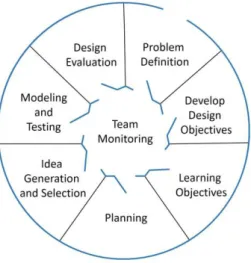
Central to all learning in this model is a semester-long design project. Projects come from either real industry problems that need solution (80%) or entrepreneurial ideas of students (20%). An engineering design process is used to guide students from problem scoping through solution realization.
Figure 1: Iron Range Engineering Design Process
An engineer on the academic staff is the project facilitator, who scaffolds student development through guidance and coaching. Students develop their teams, their approaches to project management, their acquisition of research and technical knowledge, their professional responsibilities, and their approaches to written and verbal technical presentation. Through close interaction with their industrial client, the student teams develop design objectives, generate concepts, model and test solutions, and select final designs. Three times each semester, the teams defend their work at formal design reviews, present their project status to clients, and submit formal design documentation.
Student design team rooms are modeled after the group rooms at Aalborg University (http://www.en.aau.dk/education/problem-based-learning/group-work/). The purpose is to have a physical space where students have their own office; a place where the team has access 24 hours per day, 7 days per week to work on their design project or their individual learning. Figure 2 is a photo of an IRE project room, as well as other design team learning spaces. Weekly design reviews take place in the room. The walls are filled with whiteboards and project oriented posters. Each student has his or her own desk and bookshelf. This proximity provides for substantial team interaction, which empowers team development and project advancement.
Figure 2: Design team learning spaces
3.2
Professional learning
The students emulate the program’s model of continuous improvement, turning it into their own development as professionals (Habibi, Ulseth, and Lillesve, 2014). Upon their entrance into the program, with
the assistance of an academic staff member, the students evaluate themselves on a continuum of novice to expert in each of nine different professionalism areas: written communication, presentation communication, leadership, learning about learning, professional responsibility, inclusivity, ethical practice, teamwork, and knowledge of contemporary issues. Each semester, students attend workshops run by experts in these fields to acquire new knowledge and strategies. They then implement the knowledge and strategies into their daily work on their projects. For example, leading their peers, performing on their team, writing their technical reports, presenting to their clients, dressing appropriately, treating others with respect, etc. They receive continuous feedback from their peers and their instructors on their performance and development in these areas.
At the end of each semester, the students create a professional development plan (PDP) document (Habibi, Ulseth, and Lillesve, 2014). This document has nine chapters, one for each of the development areas. Each chapter details learning in the area that occurred during the semester, a reflection on how well previous goals were met, a current evaluation of the student’s perceived level of performance, goals to be met by the end of the next semester, and an action plan putting forth detailed steps to be taken in an effort to achieve the goals. These chapters of the PDP highlight development in six of the eleven ABET student outcomes (http://www.abet.org/eac-criteria-2015-2016/) that the original developers initially felt were not being adequately addressed in engineering student learning experiences in traditional engineering programs.
3.3
Technical learning
Students have control over which competencies they take each semester with guidance from academic staff. As students decide which competencies to complete each semester, they have two objectives they are trying to meet. The objectives are, first, choosing learning that benefits their semester project and, secondly, choosing learning that is aligned with their desired engineering field. Most often there is overlap between these objectives. Most student projects align with their desired depth emphases. The courses are delivered in 2 half-semester periods called “blocks”. At the beginning of the semester, students decide which 4 competencies to take for the first block. Then, at mid-semester, they select 4 competencies for the second block. The goals of this system are to provide flexibility and student ownership. By choosing what to take, when it makes the most sense for the project, the students have the opportunity to have high levels of contextual relevance.
The first day of each competency is called “syllabus signing day”. In this conversation, the students and the instructor identify their hopes and expectations for the course. Together, they discuss these expectations and design the layout of the course in terms of learning activities, deliverables, and evaluation. A typical competency has 3-6 students and one instructor. The instructor and the students will meet 2-3 hours per week for 8 weeks in “Learning Conversations” (LC). The intent of a learning conversation is to be a place where students and instructors can make conceptual sense of the learning. This is done in a flipped-classroom type of method where students do initial learning on their own between LCs and then use the time together in LCs to ask questions and discuss the relevance of the learning. The three required learning types in any competency are conceptual, process, and metacognitive.
Conceptual learning is focused on connecting all learning to the fundamental principles of engineering. For example, if students were taking a competency in heat transfer, they would learn the concepts of conduction, convection, and radiation. Then they would connect these concepts to broader engineering fundamentals such as the law of conservation of energy and the 2nd law of thermodynamics. Learning activities in conceptual learning include reading, watching on-line videos, working problem sets, creating concept maps, and group discussion.
In process learning, students connect their conceptual learning to engineering practice. They do this by completing a Deep Learning Activity (DLA). Whenever possible, the DLA is work needed to support the student design project such as design, testing, or modeling. For example, in the learning of heat transfer, it is not unusual for IRE project teams to be designing heat exchangers for their clients. The act of completing that design would be a DLA for a heat transfer competency. If a heat exchanger design was not required to support a student project, students might design and conduct an experiment verifying heat transfer using
physical equipment and instrumentation for their heat transfer competency DLA. As the domain of learning spreads across all of engineering, similar type process learning opportunities are found in abundance. During learning conversations, instructors help students make connections between their conceptual learning and their DLA, as well as provide technical assistance to students throughout their DLA.
Metacognitive learning happens through students planning their learning, organizing and reorganizing their factual and conceptual knowledge, reflection, evaluation of their learning, and using the reflections and evaluation to dictate future learning. Each student keeps a learning journal for every competency where they record this planning and organization and write the reflections and judgments. At the end of each block, students write a metacognitive memo analyzing their learning throughout the four competencies and making future learning goals.
4
Graduate and Employer Survey
In an effort to capture the essence of Iron Range Engineering graduates as compared to their peers from traditional engineering learning environments, employers and graduates were asked to rate each group using a 7-point scale: 1-far below expectations, 2-moderately below, 3-slightly below, 4-met expectations, 5-slightly above, 6-moderately above, and 7-far above. A score of 4 - met expectations was explained to be at the level that they believe a new engineer should enter their company to be effective in their work setting.
4.1
Method
There are 75 graduates of the Iron Range Engineering program. All 75 were emailed a request to complete the survey and pass it to their supervisor. 30 graduates took the survey (40% completion) and 18 supervisors took the survey (24% completion).
The questions related to:
Communicating effectively
Acting professionally responsible (prompt, responsive, represent company well)
Ability to design systems, components, or processes to meet needs with constraints
Engaging in entrepreneurial thinking
Ability to use the techniques, skills, and modern engineering tools necessary for engineering practice
Ability to solve engineering problems
Ability to function well on teams
Displaying a recognition of the need for and ability to engage as an efficient learner
Ability to lead and manage people
Ability to lead and manage projects
Respondents were asked to first rate all new engineers in the company who were non-PBL graduates against this scale and then to rate PBL graduates against the scale. Following is a sample question:
“Rate other new engineers (you have supervised [for employer survey], your peers [for PBL graduate survey]): Are professionally responsible (prompt, responsive, represent company well).”
4.2
Results
Table 1 displays the results from the supervisor survey and Table 2 the results from the graduate survey. Figures 3 and 4 represent the same data in graphical form. On the graphs, categories have been arranged from left to right with categories on the left having the greatest deltas between PBL score and non-PBL score.
Table 1: Supervisor survey results (n=18)
Average Score (from 7-point Likert Scale)
Non-PBL Graduate PBL Graduate Delta: PBL - Non-PBL
Communicate Effectively 4.4 4.9 0.6
Professionally Responsible 4.6 5.2 0.6
Entrepreneurial Thinking 4.1 4.6 0.5
Modern Tools Use 4.6 4.6 0.0
Solve Engineering Problems 4.4 4.8 0.4
Perform on Teams 4.3 5.3 0.9
Efficient Learner 4.4 5.0 0.6
Lead and Manage People 4.2 4.4 0.3
Lead and Manage Projects 4.3 5.1 0.8
Table 2: PBL graduate survey results (n=30)
Average Score (from 7-point Likert Scale)
Graduate Non-PBL Graduate PBL Delta: PBL - Non-PBL
Communicate Effectively 4.7 5.5 0.8
Professionally Responsible 3.8 5.6 1.8
Design Systems 4.2 5.1 0.9
Entrepreneurial Thinking 3.5 4.8 1.2
Modern Tools Use 4.0 4.8 0.7
Solve Engineering Problems 4.1 4.8 0.7
Perform on Teams 3.8 5.2 1.4
Efficient Learner 3.8 5.4 1.7
Lead and Manage People 3.4 5.1 1.7
Lead and Manage Projects 3.8 4.8 1.0
Figure 3: Supervisor scores of PBL vs. non-PBL graduate performance (n=18)
4.3 4.3 4.6 4.4 4.4 4.1 4.4 4.2 4.8 4.6 5.3 5.1 5.2 4.9 5.0 4.6 4.8 4.4 5.0 4.6 0.0 1.0 2.0 3.0 4.0 5.0 6.0 Perfo rmon Team s Lead and Man age Proj ects Prof essio nally Resp onsib le Com mun icate Effec vely Effic ient Lear ner Entre pren euria l Thi nkin g Solve Engin eerin g Pro blem s Lead and Man age Peop le Desig nSy stem s Mod ern Tool s Use Non-PBL PBL 3.8 3.4 3.8 3.8 3.5 3.8 4.2 4.7 4.0 4.1 5.6 5.1 5.4 5.2 4.8 4.8 5.1 5.5 4.8 4.8 0.0 1.0 2.0 3.0 4.0 5.0 6.0 Prof essio nally Resp onsib le Lead and Man age Peop le Effic ient Lear ner Perfo rmon Team s Entre pren euria l Thi nkin g Lead and Man age Proj ects Desig nSy stem s Com mun icate Effe cve ly Mod ern Tool s Use Solve Engin eerin g Pro blem s Non-PBL PBL
Figure 4: Graduate scores of PBL vs. non-PBL graduate performance (n=30)
The data was compiled; averages and standard deviations were calculated. A two-tail t-test was conducted comparing PBL vs. non-PBL means for both surveys. The only statistically significant difference between means occurred in the Efficient Learner category on the graduate survey (t=2.154, p<0.05).
Further results can be seen through the following trends and perceptions:
On all 10 of the graduate survey questions and in 9 out of the 10 employer survey questions, the mean score for the PBL graduates was higher than the non-PBL graduates. The one category where this was not true was “use of modern tools” on the employer survey. In this category, the PBL and non-PBL graduates scored the same.
The employers scored all graduates, PBL and non-PBL above 4 (met expectations) in all categories. Whereas the graduates rated themselves above 4 in all categories, but their non-PBL peers below 4 in 5 out of the 10 categories.
Employers found the greatest difference between PBL and non-PBL graduates in “performing on teams,” “lead and manage projects,” and “being professionally responsible.” Whereas, the PBL graduates found the greatest difference between themselves and the non-PBL graduates in “being professionally responsible”, “leading and managing people”, and “being efficient learners.”
Employers rated the PBL graduates highest in “performing on teams,” “being professionally responsible,” and “leading and managing projects.” Whereas, the PBL graduates rated themselves highest in “being professionally responsible,” “communicating effectively,” and “being efficient learners.”
Employers rated the non-PBL graduates highest in “designing systems,” “modern tools use,” and “being professionally responsible.” Whereas, PBL graduates rated their peers highest in “communicating effectively,” “designing systems,” and “solving engineering problems.”
Employers found the least difference between PBL and non-PBL graduates in “leading and managing people,” “designing systems,” and “modern tools use.” Whereas, the PBL graduates found the least difference between themselves and the non-PBL graduates in “communicating effectively,” “modern tools use,” and “solving engineering problems.”
Employers rated the PBL graduates lowest in “modern tools use”, “leading and managing people,” and “entrepreneurial thinking.” Whereas, the PBL graduates rated themselves lowest in “leading and managing projects,” “modern tools use,” and “entrepreneurial thinking.”
Employers rated the non-PBL graduates lowest in “leading and managing people”, “leading and managing projects,” and “entrepreneurial thinking.” Similarly, PBL graduates rated their peers lowest in “leading and managing people,” “leading and managing projects,” and “entrepreneurial thinking.”
4.3
Discussion
The mean-to-mean comparison resulted in only one statistically significant result. That PBL graduates found themselves to be more efficient learners than their non-PBL counterparts. There were 10 survey questions and 2 surveys for a total of 20 possible comparisons. While the other 19 comparisons did not result in statistically significant differences, there are several trends and perceptions worth noting. The trend that 19 out of the 20 questions had PBL graduates rated higher than their non-PBL peers and that all 20 questions rated the PBL graduates above 4-met expectations answers the questions “are the PBL graduates satisfied with their engineering preparation?” and “are employers satisfied with the engineering preparation of the PBL graduates?” Further evidence that the answer to these questions is yes, comes from additional comments made by the respondents:
“I would say on average the students from IRE we have hired have been more mature and have further progressed along the development curve to be effective in real world industry.” Employer
“By a wide margin, I prefer working with the Iron Range graduates because they are so professional.”
“I think that among my peers I am definitely advantaged in my interpersonal skills and people management. I also think that my ability to juggle tasks or multitask is also superior.” Graduate “I have found the feedback loop lacking with many of my peers. They seem to find it acceptable to not communicate the results or outcomes of work or projects. Often if feedback is desired it must be requested using specific details to get the full picture.” Graduate
The least positive comment made by an employer was:
“I think it's fair to say that IRE graduates come to us with better training in the soft skills (inter-personal),
but slightly less thorough training in the hard skills (practice-specific engineering skills). They are excellent overall engineers, but they require a bit more help on the technical side at first. That said, they are quick and eager learners, and I think they understand where their weaknesses are.” Employer The least positive comment made by a graduate was:
“At times, I believe there are areas that I am less proficient at in technical knowledge due to the time spent in other areas such as professionalism. However, I have been told how much more valuable I am than the other engineer who has 10-15 years experience, but is not allowed on certain client properties due to his negative unprofessional attitude. He has an obvious advantage from job specific experience, but I still find that he comes to me for help with technical questions such as statics problems or converting from degree, minute, second to decimal form.” Graduate
The results of perceived highest and lowest performance indicate the trends that leading and managing people and projects, being professionally responsible, being efficient learners, and performing well on teams are all areas where the PBL graduates excel. Areas where the PBL graduates are more evenly perceived with their peers are use of modern tools, entrepreneurial thinking, and designing systems.
Of further note, is the magnitude of differences perceived by the graduates as compared to the supervisors. Graduates showed greater amplitudes when comparing their performance to that of their peers. They also showed greater levels of dissatisfaction with their peers than was noted by the employers.
5
Conclusion
The new PBL curriculum adapted from the Aalborg PBL model has been continually developing over the past 6 years. The history, development trajectory, continuous improvement model, and curricular model have been described. A quantitative satisfaction survey has been deployed and analysed. Results have been communicated. The conclusions from this survey are that the graduates and their employers are satisfied with the engineering preparation of the PBL model. The impact of these conclusions will be that the developers of the program will use the information gained in their continuous improvement model. The root causes of both the areas of strength and areas of needed improvement will be identified. In practice, curricular aspects will be maintained in the case of strengths and improved where needed. For example, the use of modern tools has been highlighted as an area of potential needed growth. The next evolution of the curriculum will include special attention to new activities for students to acquire modern tool use. Future works will include a qualitative approach whereby graduates and their employers will be interviewed.
Acknowledgements – The research results communicated in this paper were funded in part by the National Science Foundation (DUE-1060233). The authors wish to thank Anette Kolmos and Erik de Graaff of Aalborg University for their guidance in the development of the PBL model and the research methods.
6
References
Allendoerfer, C., Karlin, J., Bates, R., Ewert, D., &Ulseth R. (2015) "Leading Large-Scale Change in an Engineering Program,” In Proceedings of the ASEE Annual Conference, Seattle, Washington.
Abet.org,. (2015). ABET - Criteria for Accrediting Engineering Programs, 2014 - 2015. Retrieved 1 February 2015, from http://www.abet.org/eac-criteria-2014-2015/
Bates, R., & Ulseth, R. (2013). Keynote: RosEvaluation Conference 2013. Presentation, Rose Hulman University, March 1.
Cole, J. (2012). No One Does Engineering Like the Range. Hometown Focus. Retrieved from
http://www.hometownfocus.us/news/2012-04-27/Features/no_one_does_engineering_like_the_range.html?print=1
Habibi, M., Ulseth, R., and Lillesve, A. (2014). Personnel Improvement Plan: a professionalism assignment for engineering students. In ASEE Annual Conference and Exposition. Indianapolis: ASEE.
Ieagreements.org,. (2015). International Engineering Agreements. Retrieved 1 February 2015, from http://ieagreements.org
Ire.mnscu.edu,. (2015). Iron Range Engineering Student Outcomes. Retrieved 1 February 2015, from http://www.ire.mnscu.edu/about-ire/outcomes.html
Iron Range Engineering National Advisory Board. (June, 2009) Meeting of the national advisory board at ASEE national conference in Austin, Texas.
Jamison, A., Kolmos, A., & Holgaard, J. (2014). Hybrid Learning: An Integrative Approach to Engineering Education. J. Eng. Educ., 103(2), 253-273. doi:10.1002/jee.20041
Johnson, B. and Ulseth, R. (2014). “Professional Competency Attainment in a Project Based Learning Curriculum: A Comparison of Project Based Learning to Traditional Engineering Education,” In Proceedings of
the FIE Annual Conference, Madrid, Spain.
Ulseth, R. and Johnson, B. (2014). “100% PBL Program: Startup Phase Complete,” In Proceedings of the FIE
Annual Conference, Madrid, Spain.