1877-0428 © 2011 Published by Elsevier Ltd. doi:10.1016/j.sbspro.2011.11.188
Procedia - Social and Behavioral Sciences 28 (2011) 1029 – 1033
WCETR 2011
Relationship between Iranian EFL Learners' Beliefs about Language
Learning, their Language Learning Strategy Use and their Language
Proficiency
Atieh Abedini
a, Ali Rahimi
b*, Abbas Zare-ee
caDepartment of English, Faculty of Humanities, University of Kashan, Kashan, Iran bDepartment of English, Faculty of Humanities, University of Kashan, Kashan, Iran cDepartment of English, Faculty of Humanities, University of Kashan, Kashan, Iran
Abstract
This study aimed at collecting data from a group of 203 Iranian undergraduate learners of English concerning their beliefs about language learning through Horwitz’s (1987) "Beliefs About Language Learning Inventory", concerning their language learning strategy use through Oxford's (1990) "Strategy Inventory for Language Learning" and concerning their general language proficiency through "Michigan English Language Assessment Battery". Some open-ended questions were added to the both questionnaires. Data analyses indicated that EFL learners with more positive and reasonable beliefs, generally, use the strategies more and also have higher level language proficiency. Besides, some findings were reported as the result of doing factor analyses on the both questionnaires.
3XEOLVKHGE\(OVHYLHU/WG
Keywords:beliefs about language learning; language learning strategies; language proficiency
1. Introduction
The necessity in foreign language research and teaching to investigate learner’s affective variables as a means of explaining differences in one’s ability to learn a new language has been emphasized in recent years. Savignon (1983), for example reviewed many affective studies and claimed that affective variables contribute more to the result of foreign or second language learning than do aptitude, intelligence, method of teaching used in the classroom, or time spent learning the language (Cited in Kennedy, Nelson, Odell, and Austin, 2000, p. 279).
"Affect involves variables such as attitudes, motivation, interests, learners’ beliefs, needs, expectations, and prior experiences." (McKenna et al., 1995, cited in Gee, 1999, p.3). As the given definition shows, an overwhelming set of variables is implied in considering the affective side of foreign language learning. Within this complex web of variables are learners’ beliefs, which are the focus of the present study. For instance, a student who believes that learning a new language is basically translating from the new language to his/her mother language will spend most of his/her time and effort on using translation strategies in the hope of improving his/her language proficiency. But a
* Atieh Abedini. Tel.: +98-913-309-9535; fax: +98-361-555-2930
E-mail address: [email protected]
Open access under CC BY-NC-ND license.
student who believes that a special language aptitude has the most important role in learning a foreign language, but that he or she does not possess such an aptitude, may begin language learning with a fairly negative expectation of his/her own ultimate success.
One of the other variables whose possible contribution to the success or lack of success of FL/SL learners' acquisition has long been studied is language learning strategies. As Oxford (1990) emphasized: “learning strategies are important for language learning because they are tools for active, self-directed involvement” (p.1), making learning strategies a crucial element of the learning process. Learning strategies can foster learners’ autonomy in language learning and assist learners in promoting their own achievement in language proficiency (Green & Oxford, 1995; Griffiths, 2003). Learning strategies, therefore, help learners become efficient in learning and using a language. This study is going to examine the relationships between the important variable of language learning strategies and EFL learners' beliefs.
To do a study on the relationship between learners' beliefs and their strategy use, Yang (1999) did a research on 505 EFL university students in Taiwan. Two questionnaires were administered in this study: Horwitz's (1987) Beliefs About Language Learning Inventory (BALLI) to collect information on language learners' beliefs and Oxford's (1990) Strategy Inventory for Language Learning (SILL), to collect information on their learning strategies. As the result of data analysis in this study, the researcher found out that there were direct relationships between some categories in two questionnaires and consequently there was a direct relationship between learners' beliefs and their learning strategy choices.
Among the reported studies, during the relevant history, which had used BALLI or SILL for exploring participants' language learning beliefs and language learning strategy use, respectively, none of them except Yang (1999) had carried out factor analysis on the questionnaires in their studies. As well, a few of them had used both quantitative and qualitative methods for collecting and analyzing data, so they did not attempt to have triangulation. This study is going to make an effort not to have such shortcomings, so it is going to do factor analyses on the both questionnaires which are supposed to be used for collecting data and provide the necessary triangulation by passing both quantitative and qualitative stages.
1.2. Research questions
On the basis of issues pointed out above, this survey was guided by the following research questions:
1) What are Iranian university EFL learners’ beliefs about language learning as measured by the modified form of 'Beliefs About Language Learning Inventory (BALLI)', a questionnaire developed by Horwitz (1987)?
2) What are the language learning strategies reported by Iranian university EFL learners as measured by 'Strategy Inventory for Language Learning (SILL)', a questionnaire developed by Oxford (1990) and six open-ended questions?
3) Is there any relationship between Iranian university EFL learners’ beliefs about language learning and their language learning strategy use?
4) Is there any relationship between EFL learners’ beliefs about language learning and their language proficiency as measured by 'Michigan English Language Assessment Battery (MELAB)' which is a proficiency test?
2. Method
2.1. Participants
The study was done on a group of 203 Iranian undergraduate EFL learners learning English for BA degree. Among them, 116 (57.10%) students were female and 87 (42.90%) students were male. Participants of this study were selected based on judgement sampling. They took the research instruments as their class activities and consented to the collection of data from their responses to the questionnaires.
2.2. Instrumentation
Three instruments were used in this study: The first instrument was the Beliefs about Language Learning Inventory (BALLI, ESL/EFL version) developed by Horwitz (1987). The items on the BALLI assess learners’ beliefs in five areas: 1) the difficulty of language learning (6 items), 2) foreign language aptitude (9 items), 3) the nature of language learning (6 items), 4) learning and communication strategies (8 items), and 5) motivation and
expectations (5 items). The BALLI was translated into Persian by the researcher. Cronbach's alpha reliability of the translated version of the BALLI was 0.68.
The second instrument was the Strategy Inventory for Language Learning (SILL, ESL/EFL 7.0 version) designed by Oxford (1990). The SILL is a self-report questionnaire, and the 50 items in the questionnaire are grouped into six categories of strategies: memory - storing and retrieving information (9 items), cognitive--understanding and producing the language (14 items), compensation -overcoming limitations in language learning (6 items), meta-cognitive - centering and directing learning (9 items), affective - controlling emotions, motivation (6 items), and social - cooperating with others in language learning (6 items).Instead of translating the SILL, the researcher used a Persian version of the SILL inventory which was used and normed for Iranian learners by Tahmasebi (1999) (Akbari and Hosseini, 2008: 148) (See Appendix D). Cronbach's alpha reliability of this Persian version was 0.91.
At the end of both the BALLI and the SILL questionnaires, some open-ended questions were added in order to elicit any additional information or comments from individuals about language learning beliefs and strategy use.
The third instrument was Michigan English Language Assessment Battery (MELAB) which is a proficiency test. This test is developed by the English Language Institute at the University of Michigan. The MELAB which we used in this study has consisted of three parts of Grammar (1 - 40), vocabulary (41 – 80) and reading comprehension (81 – 100). Cronbach's alpha reliability of this test was 0.86.
2.3. Procedure
Before the administration of the instruments, the researcher added six demographic questions including Name, Age, Major, Semester, Average, and Sex (male or female) to the top of the first page of each questionnaire and the proficiency test.
Data were collected during two class hours with the help of their English professors in each of the five mentioned universities. The two questionnaires of the BALLI and SILL were administered at one session and the proficiency test of MELAB was administered at another session. The time-limit for the BALLI, the SILL and the MELAB were respectively 15 minutes, 20 minutes and 90 minutes.
3. Data Analysis and Results 3.1.Factor Analysis
The results of factor analysis on BALLI items identified six factors that constitute learners' beliefs about language learning in the current study: 1. Beliefs about foreign language aptitude, 2. Learning and communicative strategies, 3. Self-efficacy about learning English, 4. Perceived value of learning English, 5. Beliefs about the nature of language and 6. Beliefs about Formal practices.
The results of factor analysis on SILL items identified seven factors for language learning strategies in this study. 1. Memory strategies, 2. Cognitive strategies, 3. Compensation strategies 4. Meta-cognitive strategies, 5. Affective strategies, 6. Social strategies and 7. Functional-practice strategies
3.2.Pearson Correlation Analyses
This part proposes two tables for answering research questions 3 and 4 respectively
.
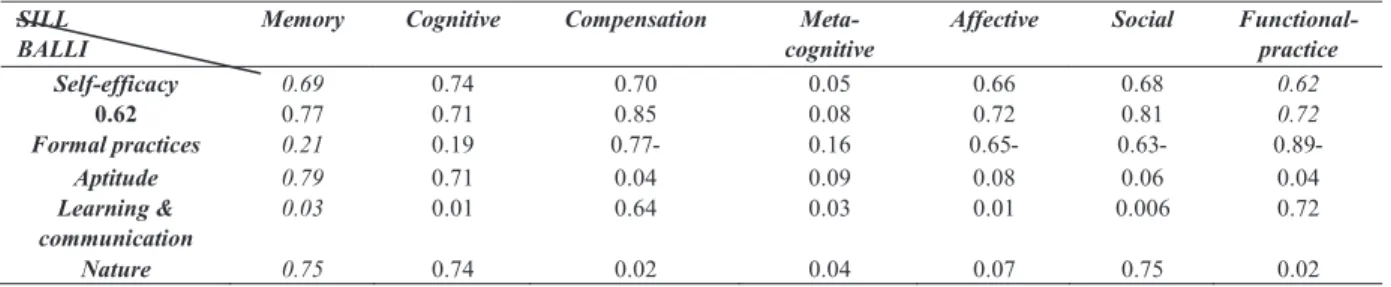
Table 1. Results of Pearson-correlation between factors of the BALLI and factors of the SILL SILL
BALLI
Memory Cognitive Compensation
Meta-cognitive
Affective Social Functional-practice Self-efficacy 0.69 0.74 0.70 0.05 0.66 0.68 0.62 0.62 0.77 0.71 0.85 0.08 0.72 0.81 0.72 Formal practices 0.21 0.19 0.77 0.16 0.65 0.63 0.89 Aptitude 0.79 0.71 0.04 0.09 0.08 0.06 0.04 Learning & communication 0.03 0.01 0.64 0.03 0.01 0.006 0.72 Nature 0.75 0.74 0.02 0.04 0.07 0.75 0.02
Results revealed that language learners' self-efficacy about learning English and the perceived value of language learning were strongly correlated with their use of all types of language learning strategies except that of meta-cognitive strategies, in which the majority of students were weak. The beliefs about formal practices were likely to discourage the use of compensation, affective, social and especially functional-practice strategies by the language learners.
The category of beliefs about foreign language aptitude was positively correlated with memory and cognitive strategies. Besides, learning and communication strategies factor was positively correlated with compensation and functional strategies. In addition, beliefs about the nature of language had positive and significant correlation with memory, cognitive and social strategies.
Table.2 The result of Pearson-correlation between the BALLI scores and the MELAB scores
Total score for the BALLI Total score for MELAB
Pearson-correlation 0.84
Significance 0.00
As it is illustrated in the table 2, the results of Pearson-correlation demonstrated that there were positive and significant correlations between belief scores and proficiency scores.
4. Discussions and Conclusions
Using research questions as a framework, the following section presents the discussion and interpretation of findings. Each response area offers interpretations of findings based on the analysis of the data sources (SILL, BALLI and the open-ended questions).
In order to answer the first research question, the questionnaire of 'Beliefs About Language Learning Inventory (BALLI)' developed by Horwitz (1987) the BALLI and five open-ended questions designed by the researchers were used. The data obtained showed us that the most agreed item (91.1%) was item 18. 'It is important to repeat and practice a lot.' and the least agreed item (6.7) was item 9. 'You shouldn't say anything in English until you can say it correctly.' As the students believe that it isn't important to have errors while speaking, their expectations will not be met if the teacher insists on correct speaking and if (s)he tries to correct every small error that the students make while speaking, so it is really necessary for teachers to become aware of their students' beliefs. The most agreed category was the category of 'Perceived value of learning English' the possible reason is that students in Iran have felt the need for learning English. This need is been felt by people in all over the world more than before. The least agreed category was the category of 'Self-efficacy about learning English.'; this fact shows that although most of these students feel the need for learning English, they do not have much self-efficacy for doing the job.
In order to reply to the second research question, the questionnaire of the SILL and six open-ended questions designed by the researcher were employed. The findings revealed that the most frequent used item (89.2) was item 22. 'I try not to translate word-for-word.' and the least frequently used item (15.9) was item 9. 'I remember new English words or phrases by remembering their location on the page, on the board, or on a street sign.' The researcher herself believes that this strategy is very useful, by experience. They think that the reason is that this strategy is not introduced to them. That may be instructors' duty to introduce all the strategies to the students; in this case students have the opportunity to choose what can help them. The most-preferred strategies were cognitive which involved repeating, analyzing, and summarizing information. Oxford (1990) emphasized that cognitive strategies are typically found to be the most popular strategies with language learners and essential in learning a new language because these strategies not only require but also allow for direct and immediate manipulation or use of input. (p.68) The least-preferred strategies were meta-cognitive which involved trying to find ways for using English, being a better learner and planning a schedule, noticing mistakes and setting goals. Using meta-cognitive strategies is a kind of using self-monitoring and self-evaluating. One possible reason for these students' low frequency of meta-cognitive strategy use accounts to instructors' teaching method. In Iran, teachers are usually the only persons that speak in the class, the only persons who determine what to do or what not to do and the only persons who evaluate students' progress mostly by using academic grading system, which generally rewards discrete-point rule learning rather than communicative competence in the class. In such a condition students don't
learn to take responsibilities for better learning and seeking practice opportunities outside the classroom. So they don't learn to plan and set goals for themselves. This finding of the current study supports Oxford (1990)'s claim that "though meta-cognitive strategies are extremely important, research shows that learners use these strategies sporadically and without much sense of their importance." (p. 136)
To give a response to the third research question 'whether there are relationships between Iranian university EFL learners’ beliefs about language learning and their language learning strategy use' some Pearson-correlations were conducted between factors of the BALLI and those of the SILL. The results sowed us that language learners' self-efficacy about learning English and the perceived value of language learning were strongly correlated with their use of all types of language learning strategies except that of meta-cognitive strategies, at which the majority of students were weak.
The next result was beliefs about formal practices were likely to discourage the use of compensation, affective, social and especially functional-practice strategies by the language learners. When students believed that learning the grammar, vocabulary, and translation were the most important parts of learning a language and felt overwhelmingly that improving the proficiency in that language involves a lot of memorization, they would be unlikely to seek or create opportunities to use or practice the language skills functionally by trying to find better and more feasible methods of improving it. This result supports Horwitz's (1988) argument that certain students' beliefs would likely restrict the range of language learning strategy used.
To respond to the fourth research question, the MELAB was used to measure the participants' language proficiency. Then a Pearson-correlation was performed between total scores of BALLI and MELAB. The findings disclosed that there were positive and significant correlations between belief scores and proficiency scores. This result is in line with Asbjorn's (2000), Huang and Tsai's (2003) and Peacock's (2001) results.
In summary, based on results reported in this study, Iranian EFL learners' beliefs affected their language learning strategy use and language proficiency. This study concluded that learner beliefs can be strong mediating factors in their experience in the classroom. Kern (1995, P. 81) proposes that students are frustrated when classroom methods do not match their expectations. McCargar (1993, pp. 200-1) suggests that frustrated learners may quit a course and look for one that better meets their needs and wishes.
References
Asbjornson, B. (2000). Do beliefs matter in language learning achievement? A pilot
study. Retrieved April 1,2007 from http://www. Tuj.ac.jp/tesol/press/papers0014/asbjornson.htm1.
Bandura, A. (1986). The explanatory and predictive scope of self-efficacy theory. Journal of Social and Clinical Psychology 4, 359-373.
Gabillon, Zehra. (2002). L2 Learner's Beliefs: An Overview. Journal of Language and Learning. 3 (2), p. 233-260. Gee, W. R. (1999). Encounraging ESL students to read. TESOL Journal, 8 (1), 3 – 7.
Green, N. M. & Oxford. R. (1995) A closer look at learning strategies, L2 Proficiency, and gender. TESOL Quarterly, Vol. 29, pp. 261 – 297. Griffiths, C. (2003). Patterns of language learning strategy use. System, 31, 367-383.
Horwitz, E.K.(1987). Surveying student beliefs about language learning. InRubin, Joan & Wenden Anita (Ed). Learner strategies in language learning (pp.119-129). London: Prentice Hall.
Huang, Shennghui Cidny & Tsai, Rumei Rebecca. (2003). A Comparison between High and Low English Proficiency Learners' Beliefs.
Retrieved March, 20, 2007 from http://www.eric.ed.gov/sitemap/html_0900000b8013006a.html
Kennedy, T. J. , Nelson, J. K. , Odell, M. R. L. ,& Austin, L. K. (2000). The FLES attitudinal inventory. Foreign Language Annuals, 33 (3), 278 – 287.
Kern, R.G. (1995). Learner beliefs of language learning revisited. Foreign Lnaguage Teaching, 3 (3), 62-75. McCargar, D.F. , (1993). Teacher and student role expectations: cross-cultural
differences and implications. Modern Language Journal 77 (2), 192 – 207. Oxford, Rebecca. (1990). Language Learning Strategies. :Newbury House.
Peacock, Matte. (2001). The Links Between Learner Beliefs, Teacher Beliefs, and EFL Proficiency. Retrieved March, 20, 2007 from http://
www.Sunzi1.lib.hku.hk/hkjo/view/10/1000134.pdf.
Schunk, D.L.. (1985). Self-efficacy and classroom learning. Psychology in the Schools 22, 208-223.
Wenden, Anita L. (1987). How to be successful language learner: insights and prescriptions from L2 learners. InRubin, Joan & Wenden Anita (Ed). Learner strategies in language learning (pp.103-114). London: Prentice Hall.
Wenden, Anita L. (1987). Conceptual Background and Utility. InRubin, Joan & Wenden Anita (Ed). Learner strategies in language learning
(pp.103-114). London: Prentice Hall.
Yang, Nae-Dong. (1998). Exploring a new role for teachers: promoting learner autonomy. System 26, 127 - 135.Yang, Nae-Dong. (1999). The relationship between EFL learners' beliefs and their learning strategy use. Journal ofSystem. Vol. 27, pp. 515-535.