Volume 8 Issue 1 Article 4
2020
Students as Partners? Exploring Student Union Engagement in the
Students as Partners? Exploring Student Union Engagement in the
Creation of Technological Universities in Ireland
Creation of Technological Universities in Ireland
Sharon Feeney
Technological University Dublin, [email protected] Deirdre Lillis
Technological University Dublin, [email protected] Lynn Ramsey
Letterkenny IT
Follow this and additional works at: https://arrow.tudublin.ie/ijap
Recommended Citation Recommended Citation
Feeney, Sharon; Lillis, Deirdre; and Ramsey, Lynn (2020) "Students as Partners? Exploring Student Union Engagement in the Creation of Technological Universities in Ireland," Irish Journal of Academic Practice: Vol. 8: Iss. 1, Article 4.
doi:https://doi.org/10.21427/kz6f-w389
Available at: https://arrow.tudublin.ie/ijap/vol8/iss1/4
Creative Commons License
This work is licensed under a Creative Commons Attribution-Noncommercial 4.0 License
Students as Partners? Exploring Student Union Engagement in the Creation of Technological Universities in Ireland
Sharon Feeney TU Dublin Lynn Ramsey Letterkenny IT Deirdre Lillis TU Dublin Abstract
This paper interrogates the concept of Student Union engagement in Irish higher education through an examination of the policy and practice related to the creation of Technological Universities (TU). The case study is situated within the emerging policy landscape for both the technological higher education sector and student engagement, and begins with an examination of the nature and scope of the policy landscape. The paper then considers the practice of student engagement in the creation of the first TU in Ireland, Technological University Dublin (TU Dublin). The aim of this paper is to explore student participation in institutional level decision making in the context of the creation of Ireland’s inaugural Technological University. In this exploration, we draw mainly from the ‘Ladder of Citizen Participation’ model as proposed by Sherry Arnstein (1969) to draw insights into the Irish
experience of student engagement in the creation of TU Dublin. The case study provides an understanding of the nature and quality of student engagement and student partnership, raising important questions for policy development in Irish higher education.
Keywords: Arnstein’s Ladder of Citizen Participation, Decision-making,Student Engagement, Technological University.
Introduction
Student engagement in institutional decision-making is coming under increasing scrutiny (Carey, 2018; Buckley, 2014). Ireland’s higher education institutions (HEIs) are grappling with numerous conflicting pressures, including globalisation and changing societal issues, including demographic change, increasing participation rates in higher education (Lillis & Morgan, 2012; Feeney et al., 2017; Lillis, 2016). Thus, HEIs are competing with other public service bodies for further investment and additional resources. Students have historically
been considered as being passive participants in the decision-making structures of HEIs, some often being considered as being consumers rather than partners (Little, Locke, Scesa & Williams, 2009; Zepke, 2014; Westman & Bergmark, 2019). Consequently, the idea that student engagement is an important element of activities that fall outside of the domains of learning and teaching and quality assurance activities is an emergent one (Trowler, 2010). In terms of policy development, many student representatives can be considered to be ‘policy entrepreneurs’ (Hogan & Feeney, 2012) in that they generate new ideas which might arise in a changing and evolving environment.
Student Engagement and Student Participation
Student engagement in HE is a contested concept (Westman & Bergmark, 2019; Carey, 2013), with some calling for a more critical examination of the scope and application of the concept (e.g. Zepke, 2014). Early studies focused on quality assurance systems requiring student feedback on their experience of institutional and programme level issues. These studies relied on consumer behaviour concepts of customer feedback and customer
satisfaction equating universities with businesses and treating students as consumers. Other studies focus on levels of engagement of students’ learning activities in the curriculum (Kuh, 2009; Trowler, 2010) with authentic engagement said to require active participation in which students are co-creators, co-producers and co-designers of their own learning journey (Collis & Moonen, 2005; ESU, 2008; McCulloch, 2009; Bovill & Bulley, 2011). More recent studies have concentrated on ‘Student Voice’ as having possible transformative power in HEIs (e.g. Fielding, 2004; Canning, 2017) and on the potential of student engagement to impact institutional level governance practice (Coates & McCormick, 2014).
Institutional level engagement activities have often relied on formal university structures to facilitate different levels of participation with students tending to engage in the formal students’ union structures. Most institutional level engagement with the student body which develops new policy and systems will use institutional level committees, with elected student representatives to have input and make decisions on behalf of all members (Feeney, 2014).
Student Engagement within Irish Higher Education
While formal policy development around student engagement within Irish HE is relatively recent, active student participation in higher education is arguably long standing. This may be seen for example in the Bologna Stocktaking Report which assessed Irish Higher Education
institutions in terms of quality assurance and identified high levels of student participation in the governance of quality assurance (European Commission, 2009; Feeney, 2014; Feeney & Hogan, 2017). It is also important to acknowledge the existence and importance of informal practices of student engagement.
A more focused policy approach to student engagement emerged in 2014 with the establishment by the Higher Education Authority (HEA) of a working group to examine student engagement in Irish Higher Education. The working group published its report in 2016 and adopted a broad conceptualisation of student engagement encompassing student involvement in governance and management, quality assurance, teaching and learning, and drew extensively from Arnstein’s ‘Ladder of Citizen Participation’ (HEA, 2016; Arnstein, 1969). This multi-dimensional approach echoes the Trowler & Trowler (2011, p. 91) definition of student engagement:
“The investment of time, effort and other relevant resources by both students and their institutions intended to optimise the student experience and enhance the learning outcomes and development of students, and the performance and reputation of the institution.”
The working group recommended that all HEIs adopt a holistic approach and evaluate their formal and informal student engagement practices. The self-evaluation was to reflect ten principles, identified as fundamental to an active culture of student engagement: democracy, students as partners, inclusivity and diversity, transparency, students as co-creators,
collegiality and parity of esteem, professionalism and support, feedback and the feedback loop, self-criticism and enhancement and consistency. The policy response to the working group’s call to action was the establishment in 2016 of the National Student Engagement Programme (NStEP).
Technological University Dublin - Background
Ireland’s first Technological University (TU), TU Dublin, was formally established by law on January 1st 2019. The TU was formed following a merger of three existing Institutes of Technology (ITs) in the Dublin region, Dublin IT, Blanchardstown IT and the IT Tallaght. There are over 28,000 students and 3,000 staff in the University. The establishment of TU Dublin followed some 5 years of preparation and consultation, which involved staff, students, and other stakeholders. The concept of merging the three Institutes into one TU was mirrored
in the Students’ Unions, with three independent Students’ Unions merging to form TU Dublin Students’ Union (TUDSU). All three pre-existing Students’ Unions and the merged TUDSU actively participate in NStEP.
Student participation in institutional level policy and decision-making activities dates back to the mid-1990s in the founding institutions of TU Dublin and are typical of those found in most universities elsewhere. Students were formally involved in programme validation and review activities, as well as other quality assurance and quality enhancement activities (Feeney, 2014). This student participation had central oversight by the Students’ Union and was devolved through distributed system of class representatives/ school representatives. Class representatives were elected by their peers to represent the student voice as it pertains to the programme of study being undertaken by students. All programme committees meet at least once per semester, and membership includes one class representative for each year of the programme (i.e. a four year honours degree programme has at least four class
representatives). In addition to this, the students’ unions have elected sabbatical officers who sit on a range of institutional level committees and each of the students unions that merged to form TUDSU were affiliated with the national students’ union, Union of Students in Ireland (USI). Sabbatical members were members of the Institutions’ Governing Bodies, their Academic Councils and all sub-committees, and other ad-hoc committees and working groups, as appropriate.
Arnstein’s Ladder of Citizen Participation (1969) and Student Engagement in Irish HEIs
The ‘Ladder of Citizen Participation’ model was developed by Sherry Arnstein (1969) in the context of community planning activities. The model was used in the Report of the Working Group on Student Engagement in Irish Higher Education (2016) which is why it was
considered to be useful as a tool to gain an understanding of student participation in the development of TU Dublin. The model proposes eight possible levels of participation that citizens might participate in planning their communities. Each of these eight levels are represented as rungs, with each rung representing increasing levels of participation from manipulation, therapy, informing, consultation, placation, partnership, delegated power, and citizen control, see Figure 1. The model centers around Arnstein’s belief that “participation
without redistribution of power is an empty and frustrating process for the powerless” (1969, p. 216).
Figure 1 Arnstein’s ‘Ladder of Citizen Participation’
Source: Arnstein (1969)
Arnstein (1969) acknowledged a number of limitations to her Ladder model. The most obvious limitation is the simplicity of the model, which has only eight rungs. Many change initiatives will require far more rungs to accurately represent an authentic model of citizen control. Similarly the participation rungs on the ladder analogy are not always equal steps and do not always follow a logical progression in real life. In addition, some significant factors are omitted from the model, including racism, paternalism and resistance of some power holders and the ignorance and disorganization of many lower income communities. The model was developed to address urban, black ghettos for planning matters rather than a range of urban, suburban and rural situations. Most critically, the model was developed for the concept of citizen participation in planning matters - not for measuring higher education students’ level of engagement with policy-making and institutional design. Consequently, the specific context of this study - the development of Ireland’s inaugural TU during a period of change in the Irish HE landscape is not represented in the model; these changes include increasing levels of participation, growing number of students due to demographic trends, constrained funding mechanisms following a period of recession, and a changing appreciation
for the wider social and environmental challenges facing the country. Notwithstanding these (and other) limitations, Arnstein’s ladder provides a model that is useful to determine the extent to which students can be considered as having participated in the development of Ireland’s inaugural TU. Moreover, since the Arnstein model was applied by the HEA working group as the preferred conceptual framework for critiquing the quality of student engagement within the higher education it is appropriate to apply the model to the TU process. The model provides no measure of authenticity of the level of participation by students’ union representatives, nor does it facilitate a detailed discussion of the many feedback loops that occurred in practice, thereby building up many layers of negotiated power and influence on the part of the student union representatives.
Applying Arnstein’s ‘Ladder of Citizen Participation’ to student union engagement and participation in TU Dublin
The authors in this study were involved in making policy at a national level for the
development of TUs in Ireland. In addition, one of the authors had been involved in the TU Planning and Implementation Team for some five years (albeit not on a constant, full-time contract). The data presented in this section derives from institutional records, minutes of meetings, aides memoire, memoranda and letters. All of the data presented is already in the public domain, although not presented in the context of student union engagement in the development of the TU.
Students were involved in all aspects of planning and preparation for the merger of the three Institutes of Technology, and for the designation of TU Dublin as Ireland’s first TU from the planning stages through to the implementation phase. All formal institute level committees, TU planning committees, working groups and pilot project groups included at least one student representative in its membership. Students were considered to be stakeholders of equal standing, as full partner participants in all activities relating to the merger of the three institutes and to the designation of the new merged institution as a TU. Indeed, the
recruitment process for the inaugural President of TU Dublin included a separate Search Committee and Selection Committee. The Presidential Search Committee developed the process and criteria for the competition of the role of President. An external recruitment firm was appointed to assist and manage the process. The membership of the Search Committee included a student representative, a representative from the professional services staff and a representative from the academic staff. All three of these representative members of the
Search Committee had full voting rights and were equally accountable for all decisions taken. Similarly, the Selection Committee comprised nine members, all of whom were on the
interview panel for selecting the President. Again, three different representatives of students and staff were randomly selected to participate, with one student representative, one
professional services staff representative and one academic staff representative. All members of the Selection Committee had full voting rights and were fully accountable for the decision taken in appointing the inaugural President.
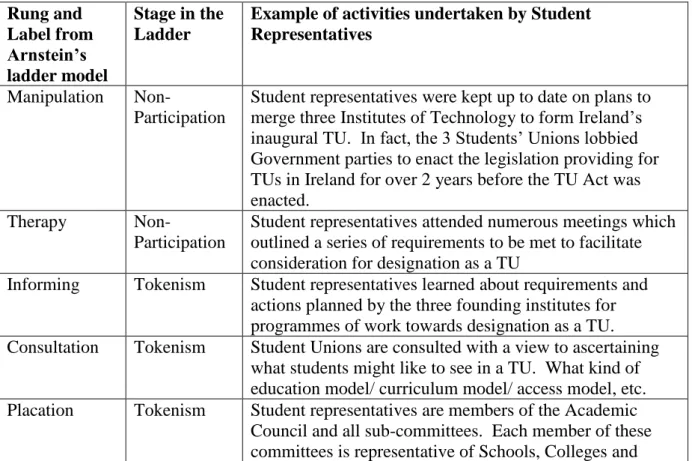
To gauge the authenticity of student engagement in the creation of Ireland’s first TU, Arnstein’s ladder model was selected. Each of the rungs in the ladder model are presented below with examples of the processes and activities that were undertaken in TU Dublin at the preparatory stages towards TU designation. Each rung is presented in turn, starting from the bottom rung and working towards the top level of the ladder. For clarity, the examples presented below may not have taken place (in terms of timing) in the order presented, but are represented in the table in accordance with Arnstein’s ladder model.
Table 1 Applying Arnstein’s Ladder of Citizen Participation to student engagement in the creation of TU Dublin Rung and Label from Arnstein’s ladder model Stage in the Ladder
Example of activities undertaken by Student Representatives
Manipulation
Non-Participation
Student representatives were kept up to date on plans to merge three Institutes of Technology to form Ireland’s inaugural TU. In fact, the 3 Students’ Unions lobbied Government parties to enact the legislation providing for TUs in Ireland for over 2 years before the TU Act was enacted.
Therapy
Non-Participation
Student representatives attended numerous meetings which outlined a series of requirements to be met to facilitate consideration for designation as a TU
Informing Tokenism Student representatives learned about requirements and actions planned by the three founding institutes for programmes of work towards designation as a TU. Consultation Tokenism Student Unions are consulted with a view to ascertaining
what students might like to see in a TU. What kind of education model/ curriculum model/ access model, etc. Placation Tokenism Student representatives are members of the Academic
Council and all sub-committees. Each member of these committees is representative of Schools, Colleges and
Central Services. All committees documented and minuted all student union comments, suggestions and questions. Partnership Citizen
Power
Student Unions began to lobby government and policy makers in their own right. In fact, this activity commenced some 2 years before final enactment of the TU legislation. Student representatives have full voting rights on all planning committees, joint discussion forum boards, planning committees, etc.
Delegated Power
Citizen Power
Student Unions for three institutes work together to plan their own future. External facilitator (former Tanáiste [Deputy Prime Minister]) appointed to assist three unions to merge as a single, independent, autonomous TU Students’ Union which will represent all students on all campuses.
Citizen’s Control
Citizen Power
Student Representative on the Governing Body (the Governing Authority) of the TU (as a full voting member) Student Representative on the Search Committee of the inaugural President of TU Dublin.
Student Representative on the Interview Board for the inaugural President of TU Dublin.
The application of Arnstein’s Ladder of Citizen Participation as a model to investigate student engagement in the creation of TU Dublin provides a useful mechanism to descibe the different ways in which students were engaged. The range of approaches may be categorised as ranging from non-participation, through tokenistic to equal partnership. The TU Dublin experience demonstrates that it is possible to identify instances where students appear to have been treated as partners with the capacity to exercise full ‘citizen power’ throughout the organisational level planning and preparation for designation. The rungs of ‘Partnership’, ‘Delegated Power’ and ‘Citizen’s Control’ may be populated with clear examples of student representatives having full autonomy and power to participate in the creation of TU Dublin. The Students’ Unions in the three founding Institutes of Technology were able to work in solidarity to achieve the status of equal partner throughout the process. The TU Dublin experience provides evidence that student representatives are willing to embrace the
responsibility and accountability that comes with full participation and engagement to work as partners at the most strategic level in a university. The next stage for this research will be to interrogate staff and student experiences of student engagement through a series of semi-structured inteviews to examine their perceptions of the partnership and participation during the creation of technological universities in Ireland.
The limitations of using Arnstein’s Ladder model in the context of this study cannot, however, be ignored. The model is useful as a mechanism to guage participation in the process, it provides little in the way we gain an understanding into the depth and meaningful reality of such participation. Whilst the ladder metaphor is useful in its simplicity for
revealing the power agendas at play and the different forms and strategies that are used as a consequence, there is no opportunity to demonstrate the multi facted and multi-layered approach taken by student union representatives to weave through a tapestry of ongoing negotiation and power brokering with ongoing feedback loops emerging at each stage. Finally, the ladder model places the maximum power with those controlling the process, however, in the case of student union representatives in TU Dublin, the dynamic of power was less clear cut. The 28,000 students being represented by the students’ unions could not be ignored. The hierarchical participation in Arnstein’s model was less prevalent because of this power dynamic of dealing with powerful student union representatives.
Conclusions
There are numerous opportunities for active student participation in policy-making and implementation in universities. It is imperative that universities create attractive and accessible means for doing so. This paper has presented a structured approach of
understanding student participation by using Arnstein’s ‘Ladder of Citizen Participation’ model. The experience of creating Ireland’s inaugural TU with student participation at every level in the process demonstrates that there are clear opportunities in an Irish policy context. The participative approach undertaken from the earliest days of the TU’s existence gives the student body a deeper understanding and an authentic ownership of their university. Further research is needed to evaluate the level of ownership and responsibility the Student Union leaders feel for the university; to explore staff and student experiences of participative management and oversight of the ongoing design of the university, and to investigate implications for student engagement with university and national level policies and
procedures. The challenge remains for TU management to ensure that the student body has greater agency in the ongoing design of this new type of university. Student Engagement is not only about designing formal systems and procedures in universities. Viewing students as partners involves universities developing an engagement culture where all voices are equal (while recognising that the number of students being represented by student union
representatives might skew the power dynamic in the favour of the student views). This will facilitate the move towards a shared vision of what the TU is, what it can achieve and how it
will engage with all stakeholders to create an authentic and meaningful 21st century university experience for students in Ireland.
References
Arnstein, S. R. (1969). A ladder of citizen participation. Journal of the American Institute of Planners, 35(4), 216-224.
Buckley, A. (2014). How Radical Is Student Engagement? (And What Is It For?). Student Engagement and Experience Journal,3(2), 1-24.
Bovill, C., & Bulley, C. J. (2011). A model of active student participation in curriculum design: exploring desirability and possibility. In C. Rust (Ed.) Improving Student Learning (ISL) 18: Global Theories and Local Practices: Institutional, Disciplinary and Cultural Variations (pp.176-188). Series: Improving Student Learning (18). Oxford Brookes University: Oxford Centre for Staff and Learning Development.
Canning, J. (2017). Conceptualising student voice in UK higher education: four theoretical lenses. Teaching in Higher Education, 22(5), 519-531.
Carey, P. (2018). The impact of institutional culture, policy and process on student
engagement in university decision-making. Perspectives: Policy and Practice in Higher Education, 22(1), 11-18.
Carey, P. (2013). Student as co-producer in a marketised higher education system: a case study of students’ experience of participation in curriculum design. Innovations in Education and Teaching International, 50(3), 250-260.
Coates, H., & McCormick, A. (2014). Emerging Trends and perspectives. In H. Coates & A. McCormick (Eds.), Engaging University Students: International Insights from System-Wide Studies (pp.151-158). Dordrecht: Springer.
European Commission (2009). Bologna Process Stocktaking Report. Report from working groups appointed by the Bologna Follow-up Group to the Ministerial Conference in Leuven/Louvain la Neuve, April.
Feeney, S. (2014). Institutional Quality Review in Higher Education in the Republic of Ireland and Northern Ireland: A Comparison of Two Approaches. Doctoral Thesis: University of Sheffield.
Feeney, S., Edge, O., & Quinn, E. (2015). Developing Organisational Design Criteria in the Redesign of an Irish Higher Education Institution. Conference Proceedings: Higher Education in Transformation Conference (pp. 369-373). Dublin, Ireland.
Feeney, S., & Hogan, J. (2017). A Path Dependence Approach to Understanding Educational Policy Harmonisation: Framework for Qualifications in the Higher Education Area.
Higher Education Policy, 30(3), 279-298.
Feeney, S., Hogan, J., & O’Rourke, B.K. (2017). Elite formation in the higher education systems of Ireland and the UK: measuring, comparing and decomposing longitudinal patterns of cabinet members. British Educational Research Journal, 43(4), 720-742.
Fielding, M. (2004). Transformative Approaches to Student Voice: Theoretical
Underpinnings, Recalcitrant Realities. British Educational Research Journal, 30(2), 295-311.
HEA (2016). Enhancing Student Engagement in Decision Making. Report of the Working Group on Student Engagement in Higher Education. Dublin: HEA.
Hogan, J., & Feeney, S. (2012). Crisis and Policy Change - The Role of the Political Entrepreneur. Risk Hazards & Crisis in PublicPolicy, 4(2), 1-16.
Kuh, G. (2009). The National Survey of Student Engagement: Conceptual and Empirical Foundations. New Directions for Institutional Research, 141, 5-20.
Lillis, D., & Morgan, J. (2012). Irish Education and the Financial Crisis. Weiterbildung, 4.
Lillis, D. (2016). Weathering the Storm of Austerity. European Association of Institutional Researchers Conference, Birmingham.
Little, B., Locke, W., Scesa, A., & Williams, R. (2009). Report to HEFCE on student engagement. London: Centre for Higher Education Research and Information, The Open University.
McCulloch, A. (2009). The student as co-producer: learning from pubic administration about the student-university relationship. Studies in Higher Education,34(2), 171-183.
Trowler, V. (2010). Student engagement literature review. York: Higher Education Academy.
Trowler, V., & Trowler, P. (2011). Student engagement toolkit for leaders. Leadership foundation for higher education and Higher Education Research and Evaluation.
Westman, S., & Bergmark, U. (2019). Re-considering the ontoepistemology of student engagement in higher education. Educational Philosophy and Theory, 51(8), 792-802.
Zepke, N. (2014). Student engagement research in higher education: questioning an academic orthodoxy. Teaching in Higher Education, 19(6), 697-708.