9
STATUS OF THESIS
Title of thesis
I AHMAD MUKHLASON
hereby allow my thesis to be placed at the Information Resource Center(IRC) of Universiti Teknologi PETRONAS(UTP) with the following conditions:
1. The thesis becomes the property of UTP.
2. The IRC of UTP may take copies of the thesis for academic purposes only. 3. The thesis is classified as:
If this thesis is confidential, please state the reason:
………-……… The contents of the thesis will remain confidential for …………-………... years. Remark on disclosure: ………-……… Endorsed by Confidential Non-confidential AHMAD MUKHLASON RT 01 RW 05 Wringinpitu,
Plampangrejo Cluring Banyuwangi, Jawa Timur
INDONESIA 68482
DR AHMAD KAMIL MAHMOOD Department of Computer and Information Sciences Universiti Teknologi PETRONAS, Seri Iskandar, Tronoh, Perak MALAYSIA 31750
Date: Date:
SWA-KMDLS : An Enhanced e-Learning Management System Using Semantic Web and Knowledge Management Technology
Signature :
Main Supervisor : Dr Ahmad Kamil Mahmood
Date :
Co-Supervisor 1 : Ms Nooren Izza Arshad
Co-Supervisor 2 : Mr Ahmad Izuddin Zainal Abidin
UNIVERSITI TEKNOLOGI PETRONAS Approval by Supervisor (s)
The undersigned certify that they have read, and recommend to The Postgraduate Studies Program for acceptance, a thesis entitled “SWA-KMDLS : An Enhanced e-Learning Management System Using Semantic Web and Knowledge Management Technology” submitted by Ahmad Mukhlason for fulfillment of the requirements for
the degree of Master of Science.
TITLE PAGE
UNIVERSITI TEKNOLOGI PETRONAS
SWA-KMDLS: An Enhanced e-Learning Management System Using Semantic Web and Knowledge Management Technology
By
Ahmad Mukhlason
A THESIS
SUBMITTED TO POSTGRADUATE STUDIES PROGRAM AS REQUIREMENT FOR THE
DEGREE OF MASTER OF SCIENCE IN INFORMATION TECHNOLOGY
BANDAR SERI ISKANDAR PERAK
DECLARATION
I hereby declare that the thesis is based on my original work except for quotations and citations which have been duly acknowledged. I also declare that it has not been previously or concurrently submitted for any other degree at UTP or other institutions.
Signature :
Name : AHMAD MUKHLASON
DEDICATION
This thesis is dedicated to my parent who always tirelessly support and pray for me. For my sisters Ima, and Iva. For all my teachers anywhere. On every grudge and every fight you are my everlasting inspiration and I miss you all day and night. There is light on every night, there is hope on every fright. I hope this thesis gives a contribution for a better life.
ACKNOWLEDGEMENTS
I would like to thank Allah subhanahu wata’alaa, Muhammad shallahu ‘alaihi wasallam the most
inspiration of my life. This work could not have been possible without the advice and support of
so many people. First and foremost, I Would like to thank my research supervisors the honorable Dr Ahmad Kamil Mahmood, Ms Nooren Izza Arshad, and Mr. Izuddin Zainal Abidin
for their nice and full-dedicated guidance during conducting my research project, Universiti
Teknologi PETRONAS for providing well-equipped facilities to conduct this research.
I am also deeply grateful to my parents, Mujiyono and Rodliyah, whose support went well
beyond kindly words of encouragement and finally become for me an affirmation that I really did
have something worthwhile to contribute for others. I am deeply thankfull to my family and
friends who support me to pursue my master studies. For my soul mate in Indonesia who always
support and pray me every time, my ‘brother’ and ‘sister’ in Indonesia who always keep in touch
and motivate me even though we are so far each other: Andri, Arbi, Fajar, Ibnu, Azis, Iyan,
Mahendra, Ndop, Dhidy, Ley, Nur laili, etc and my friends (room mate : “Isal”; housemate: Kiki,
Candra, Pak Jodi, Bang Surya, Rizal, Aryo, Fikri, Dancom, Arif –Bojon, Teguh-Telor, etc.;
course mate: Pak Arif, Pak Bayu, Bang Oqi, Aini, Pak TBA, Pak Dani, Mbak Lail, Intan, Tito,
Inung, Yunita, Aidel, etc.; country mate –PPI UTP: epul, bastian, ihtatho, etc;) who make my life
in UTP more alive. PGO Staff (Pn. Kamaliah, Kak Aida, Kak Nurul, Cik Burhan, Cik Kahar),
Cik Asfu thanks a lot. Shaqifah and Khail Malik thank for translating my abstrack into Bahasa
Malaysia and to everyone who has given contribution to this thesis directly or indirectly I really
ABSTRACT
In this era of knowledge economy in which knowledge have become the most precious resource, surveys have shown that e-Learning has been on the increasing trend in various organizations including, among others, education and corporate. The use of e-Learning is not only aim to acquire knowledge but also to maintain competitiveness and advantages for individuals or organizations. However, the early promise of e-Learning has yet to be fully realized, as it has been no more than a handout being published online, coupled with simple multiple-choice quizzes. The emerging of e-Learning 2.0 that is empowered by Web 2.0 technology still hardly overcome common problem such as information overload and poor content aggregation in a highly increasing number of learning objects
in an e-Learning Management System (LMS) environment.
The aim of this research study is to exploit the Semantic Web (SW) and Knowledge Management (KM) technology; the two emerging and promising technology to enhance the existing LMS. The proposed system is named as Semantic Web Aware-Knowledge Management Driven e-Learning System (SWA-KMDLS). An Ontology approach that is
the backbone of SW and KM is introduced for managing knowledge especially from
learning object and developing automated question answering system (Aquas) with
expert locator in SWA-KMDLS. The METHONTOLOGY methodology is selected to
develop the Ontology in this research work.
The potential of SW and KM technology is identified in this research finding which will benefit e-Learning developer to develop e-Learning system especially with social constructivist pedagogical approach from the point of view of KM framework and SW
environment. The (semi-) automatic ontological knowledge base construction system (SAOKBCS) has contributed to knowledge extraction from learning object semi-automatically whilst the Aquas with expert locator has facilitated knowledge retrieval
The experiment conducted has shown that the SAOKBCS can extract concept that is the main component of Ontology from text learning object with precision of 86.67%, thus saving the expert time and effort to build Ontology manually. Additionally the experiment on Aquas has shown that more than 80% of users are satisfied with answers provided by the system. The expert locator framework can also improve the performance of Aquas in the future usage.
Keywords: semantic web aware – knowledge e-Learning Management System (SWA-KMDLS), semi-automatic ontological knowledge base construction system (SAOKBCS), automated question answering system (Aquas), Ontology, expert locator.
ABSTRAK
Dalam era k-ekonomi di mana ilmu telahpun menjadi sumber terpenting, kajian telah menunjukkan bahawa penggunaan sistem e-Learning telah meningkat dalam bidang pelajaran dan korporat. Pengunaan e-Learning bukan sahaja bertujuan untuk mendapatkan ilmu tetapi untuk mengekalkan daya saing sama ada untuk individu mahupun organisasi. Namun, potensi awal e-Learning masih belum dapat direalisasikan kerana ia hanya dianggap sebagai handout yang diterbit secara online, ditambah dengan kuiz. Walaupun e-Learning 2.0, yang dibantu teknologi Web 2.0, sudahpun wujud, masalah seperti information overload dan poor content aggregation masih tidak dapat ditangani dalam suasana e-Learning Management System atau LMS.
Tujuan kajian ini adalah untuk mengekstrak potensi Semantic Web (SW) and teknologi Knowledge Management (KM) dengan sepenuhnya. SW dan KM merupakan dua teknologi yang baru dikenalpasti dapat memperbaiki LMS yang sedia ada. Cadangan nama untuk sistem baru in adalah Semantic Web Aware-Knowledge Management Driven e-Learning System (SWA-KMDLS). Pendekatan ontologi yang merupakan tulang belakang SW dan KM dikenalkan untuk mengurus pengetahuan terutamanya daripada objek pembelajaran dan pembangunan sistem penjawab soalan automatik atau dalam Bahasa Inggeris, automated question answering system (Aquas). Kaedah
METHONTOLOGY dipilih untuk membangunkan ontology dalam kajian ini.
Potensi teknologi SW dan KM yang dikenal pasti dalam kajian ini dapat membantu pemaju e-Learning untuk mencipta sistem e-Learning yang menggunakan pendekatan pedagogi constructivist dari sudut pandangan KM dan SW. Sistem semi-automatic
ontological knowledge base (atau SAOKBCS) telah membawa kepada pengekstrakan ilmu daripada objek pembelajaran secara separa-automatik manakala Aquas dengan expert locator dapat membantu pengekstrakan ilmu yang mengalakkan perkongsian ilmu dalam suasana e-Learning.
Eksperimen yang dijalankan menunjukkan bahawa SAOKBCS dapat mengekstrak konsep bahawa komponen utama ontology dari objek pembelajaran yang berasaskan teks
dapat beroperasi dengan ketepatan 86.67%. Hal ini dapat menjimatkan masa dan mengurangkan beban dalam proses membina ontology secara manual. Tambahan lagi, eksperimen yang dijalanakan terhadap Aquas menunjukkan bahawa lebih dari 80% pengguna e-Learning berpuas hati terhadap jawapan yang diberi oleh sistem. Pengunaan
TABLE OF CONTENTS
STATUS OF THESIS... i
TITLE PAGE ... iii
DECLARATION ... iv DEDICATION... v ACKNOWLEDGEMENTS... vi ABSTACT...……….vii ABSTRAK... ix TABLE OF CONTENTS... xi
LIST OF TABLES... xiv
LIST OF FIGURES ... xv
LIST OF ABBREVIATION AND SYMBOL USED ... xvii
LIST OF EQUATIONS ... xix
CHAPTER 1 INTRODUCTION ... 1
1.1 Backgrounds ... 1
1.2 Problem Statement ... 3
1.3 Objectives and Scope... 7
1.4 Thesis Contribution... 7
1.5 Thesis Organization ... 8
CHAPTER 2 LITERATURE REVIEW ... 9
2.1 Emerging Problems and Requirements in e-Learning System ... 9
2.1.1 Emerging Requirement in e-Learning System... 9
2.1.2 Semantic Web and e-Learning... 11
2.1.3 Knowledge Management (KM) and e-Learning... 15
2.1.4 Knowledge Management and Social Constructivism in e-Learning System 18 2.2 e-Learning, SW, and KM Where is their Meeting Point?... 21
2.3 Summary ... 23
CHAPTER 3 METHODOLOGY ... 24
3.1 General Research Design... 24
3.1.1 Development of Ontologies ... 24
3.1.2 Design the Framework and Architecture of SWA-KMDLS... 26
3.1.3 Development and Implementation of SWA-KMDLS ... 26
3.1.4 Experimental testing and evaluation... 26
3.1.5 The Experimental Validation... 29
3.2 Comparative Studies of Ontology Development Methodology... 30
3.3 METHONTOLOGY ... 32
3.3.1 Ontology Development Process... 32
3.3.2 Ontology Life Cycle ... 34
3.3.3 Ontology Development Technique: Ontology Tool and Language... 42
3.4 Summary ... 42
CHAPTER 4 DESIGN FRAMEWORK AND ARCHITECTURE OF SWA-KMDLS .. 44
4.1 Ontological Learning Object Management... 44
4.1.1 SAOKBCS Framework... 45
4.1.3 The Ontology Learning Module ... 47
4.1.4 The Ontology Mapping, Merging and Alignment ... 54
4.2 Automated Question Answering System (Aquas) ... 59
4.2.1 Statistical-based Automatic Question Answering System (S-Aquas) ... 60
4.2.2 Ontology-driven Automatic Question Answering System (Onto-Aquas) 63 4.3 Expertise Finding and Mapping Framework ... 65
4.3.1 Expert Locator Framework... 65
4.3.2 Expert User Ontology ... 66
4.4 Summary ... 67
CHAPTER 5 DEVELOPMENT AND IMPLEMENTATION ... 69
5.1 The Implemented Environment: Moodle e-Learning Management System... 69
5.1.1 Modular Approach in Moodle ... 69
5.1.2 Creating a New Module in Moodle ... 70
5.2 Initial Ontology Development (Ontology Population) ... 71
5.2.1 Initial Domain Ontology Development ... 73
5.2.3 Initial Application Ontology ... 75
5.2.3 Ontology Testing ... 77
5.3 SAOKBCS Implementation... 79
5.3.1 SAOKBCS User Interface ... 79
5.3.2 SAOKBCS Algorithm and Implementation ... 81
5.4 Aquas Implementation... 82
5.4.1 Aquas User Interface... 83
5.4.2 Aquas Algorithm and Implementation... 85
5.5 Expertise Finding and Mapping Framework Implementation ... 90
5.6 Summary ... 92
CHAPTER 6 THE EXPERIMENT, EVALUATION, AND DISCUSSION... 93
6.1 The Experiments ... 93
6.1.1 Experimental Environment ... 93
6.1.2 Experimental Scenarios ... 94
6.1.3 Experimental Result... 94
6.2 Evaluation and Discussion... 101
6.3 Summary ... 103
CHAPTER 7 CONCLUSION... 105
7.1 Addressing the Research Objectives... 105
7.2 Contributions... 107
7.3 Limitations, Challenges and Open Issues ... 108
7.4 Future Works ... 109
REFERENCES ... 111
PUBLICATIONS... 123
APPENDIX I E-LEARNING ... 125
I.1 Definition and Scope of e-Learning ... 125
I.2 e-Learning Standards and Pedagogical Approaches ... 128
I.3 e-Learning Tools and Technologies: State Of The Art ... 130
I.4 e-Learning Technology Trend ... 133
II.1.1 SW Definition ... 135
II.1.2 The SW Vision ... 136
II.1.3 The SW Goals ... 138
II.1.4 The SW Component ... 138
II.2 Ontology... 140
II.2.1 Definition and Scope... 140
II.2.2 Classification of Ontology ... 143
II.2.3 Ontology Representation Languages ... 145
II.3 Tool For SW... 148
II.3.1 Ontology editors... 148
II.3.2 Ontology Management System (OMS)... 149
II.3.3 Annotation Tools... 150
II.3.4 Visualization Tools ... 150
II.3.5 Ontology Search Engines ... 151
II.3.6 Semantic Browser ... 151
APPENDIX III KNOWLEDGE MANAGEMENT ... 153
III.1 Fundamental of KM... 153
III.2 KM Tools and Techniques... 158
III.2.1 Content Management System (CMS) ... 158
III.2.2 Knowledge Taxonomies ... 159
III.2.3 Groupware... 159
III.2.4 Online Communities of Practice (CoP) ... 159
III.2.5 Portals ... 159
III.2.6 Social Network Analysis (SNA) and Design... 160
III.2.7 e-Learning... 160
III.2.8 Storytelling and Narratives ... 160
III.2.9 Wireless Platform for Knowledge Mobilization... 160
III.2.10 Innovation Management Tools ... 160
III.2.11 Inter-Organizational Knowledge Sharing Platforms ... 161
III.3 Knowledge Management System (KMS) ... 161
APPENDIX IV DOMAIN ONTOLOGY... 164
IV.1 Domain Ontology in Class Tree ... 164
IV.2 Domain Ontology in Domain/Range Relation ... 166
IV.3 Domain Ontology in OWL (Web Ontology Language) ... 167
APPENDIX V APPLICATION ONTOLOGY ... 194
V.1 Application Ontology in Class Tree... 194
V.2 Application Ontology in Domain/Range Relation... 196
LIST OF TABLES
Table 2- 1 Differences between Traditional Learning (Training ) and e-Learning ... 10
Table 2- 2 Benefits of using Semantic Web as a technology for e-Learning ... 12
Table 2- 3 Prior Work On Investigating Semantic Web for e-Learning... 13
Table 2- 4 Relationship between KM enablers/techniques and KM Processes in e-Learning ... 16
Table 3- 1 The SAOKBCS experimental scenarios... 26
Table 3- 2 The Aquas Experimental Scenarios... 28
Table 3- 4 Query Result Classification... 29
Table 3- 3 Comparative Studies of Ontology Development Methodologies ... 31
Table 4- 1 Ontology Learning Task based on Ontology Artifact ... 50
Table 4- 2 The Text2Onto Ontology Primitive Model & Gruber Frame Ontology ... 53
Table 4- 3 Algorithm For Primitive Model Extraction... 53
Table 5- 1 Compulsory Files in Each Module in Moodle ... 70
Table 6- 1 Experiment on SAOKBCS Result... 95
Table 6- 2 ANR of Ontology Learning Result... 96
Table 6- 3 Experimental result in finding best-fit answer ... 98
Table 6- 4 Experimental result in finding most-relevant learning material... 99
Table 6- 5 Precision, Recall, and F Measure of SAOKBCS ... 101
Table I- 1 e-Learning Categorization... 127
Table I- 2 Pedagogical Approaches of e-Learning ... 129
Table I- 3 LMS/CMS Features ... 131
LIST OF FIGURES
Figure 1- 1 Research Area ... 3
Figure 2- 1 e-Learning and KM Integration based on Enterprise Content and Knowledge ... 18
Figure 2- 2 e-Learning, Semantic Web, KM: the Meeting Point... 23
Figure 3- 1 General Research Flow Design... 25
Figure 3- 2 Ontology Learning Algorithm... 27
Figure 3- 3 METHONTOLOGY: Ontology Development Process ... 32
Figure 3- 4 METHONTOLOGY: Ontology Development Process Life Cycle ... 36
Figure 3- 5 Methodology, Tool, and Language for Ontology Development... 42
Figure 4- 1 Ontology Approach for Learning Objects Management... 45
Figure 4- 2 SAOKBCS Framework... 46
Figure 4- 3 Prototype LO’s Context Ontology ... 48
Figure 4- 4 Ontology Learning Layer Cake... 49
Figure 4- 5 Text2Onto Architecture ... 51
Figure 4- 6 Ontology Mapping, Merging, and Alignment... 54
Figure 4- 7 Context Ontology Merging Case Scenario ... 56
Figure 4- 8 PROMPT Algorithm ... 57
Figure 4- 9 Proposed Aquas for Knowledge Reusing and Sharing Framework in e-Learning Environment ... 59
Figure 4- 10 S-Aquas Framework... 62
Figure 4- 11 Onto-Aquas Framework... 63
Figure 4- 12 Expert Locator Architecture... 65
Figure 4- 13 Expert User Ontology ... 67
Figure 5- 1 Moodle LMS Front Page... 70
Figure 5- 2 Creating a New Module in Moodle... 71
Figure 5- 3 Protégé –OWL 4.0 Screenshot... 72
Figure 5- 4 Graphical Representation of Domain Ontology in Class Hierarchy Diagram74 Figure 5- 5 Graphical Representation of Domain Ontology in Domain-Relation-Range Diagram... 75
Figure 5- 6 Graphical Representation of Application Ontology in Class Hierarchy Diagram... 76
Figure 5- 7 Execute FaCT++ Reasoning Tool in Protégé ... 77
Figure 5- 8 Racer Reasoning Tool ... 78
Figure 5- 9 Classification and Consistency Testing Using Racer... 78
Figure 5- 10 Add New Learning Resource in IPSP course ... 80
Figure 5- 11 Uploading New Learning Resources ... 81
Figure 5- 12 Ontologies Construction Pseudocode ... 82
Figure 5- 13 User interface Aquas in moodle... 83
Figure 5- 14 User interface AQUAS – entering question... 84
Figure 5- 15 User interface AQUAS – respond from system... 85
Figure 5- 18 TFxIDF Pseudocode... 88
Figure 5- 19 Onto-Aquas Pseudocode ... 88
Figure 5- 20 Ontology Similarity Algorithm Pseudocode... 89
Figure 5- 21 SPARQL Query For expert User ... 90
Figure 5- 22 User interface Aquas – Question alert for expert user ... 91
Figure 5- 23 User interface Aquas – User expert answering question ... 91
Figure 6- 1 Graphics of Experimental SAOKBCS Ontology Learning Result ... 96
Figure 6- 2 Chart of experimental result in finding best-fit answer ... 98
Figure 6- 3 Comparison chart of experimental result in finding best-fit answer... 99
Figure 6- 4 Chart of experimental result in finding the most relevant material ... 100
Figure 6- 5 Comparison chart of experimental result in finding the most relevant material ... 100
Figure 6- 6 Comparison of Precision, Recall, and F Measure for SAOKBCS... 102
Figure I- 1 Evolution of E-learning Technology ... 130
Figure I- 2 Evolution of E-learning Content ... 133
Figure II- 1 Tim Berner Lee, SW Vision ... 137
Figure II- 2 The Semantic Web Layer Cake ... 138
Figure II- 3 Ontologies and Their Relatives ... 141
Figure II- 4 Graphical Ontology Example: Human Resource ... 142
Figure III- 1 KM Life Cycle ... 155
Figure III- 2 Characteristic of KMS ... 162
LIST OF ABBREVIATION AND SYMBOL USED
Aquas Automated question answering system.
§ Section.
CIO Chief Information Officer.
CKO Chief Knowledge Officer.
CMS Content Management System.
CoP Community Of Practice.
CV Characteristic Vector.
ED Euclidian Distance.
FAQ Frequently Asked Question.
GATE General Architecture For Text Engineering. HTML Hyper Text Markup Language.
HTTP Hyper Text Transfer Protocol.
IP Inner Product.
IR Information Retrieval.
ISO International Organization for Standardization.
KM Knowledge Management.
KMS Knowledge Management System.
LCMS Learning Content Management System.
LMS e-Learning Management System.
LO Learning Object.
LOM Learning Object Metadata.
LOR Learning Object Repository.
OMS Ontology Management System.
Onto-Aquas Ontology-driven automatic question answering system.
OWL Web Ontology Language.
RDF(S) Resource description framework (Schema).
RQL RDF Query Language.
SAOKBCS (Semi-)Automatic Ontological Knowledge Base Construction System.
S-Aquas Statistical-based automatic question answering system.
SNA Social Network Analysis.
SWA-KMDLS Semantic Web Aware – Knowledge Management Driven e-Learning System.
TM Topic Map.
URI/L Uniform Resource Identifier/Locator. WWW(C) World Wide Web (Consortium).
LIST OF EQUATIONS
(
tp fp)
tp P + = Eq. 3- 1... 29(
tp fn)
tp R + = Eq. 3- 2... 29(
P R)
PR F + = 2 Eq. 3- 3... 29 j i j i IDF q termj TF TF q Ri∑
∈ ⎟ ⎠ ⎞ ⎜ ⎝ ⎛ + = max , , 5 . 0 5 . 0 , Eq.4- 1... 60 ⎟⎟ ⎟ ⎟ ⎟ ⎟ ⎠ ⎞ ⎜⎜ ⎜ ⎜ ⎜ ⎜ ⎝ ⎛ =∑
= N i j i C N IDFj 1 , log Eq.4- 2... 60 k n k i k i W xW D∑
= = 1 Eq.4- 3... 61(
)
∑
= − = n k Wik Wk Di , 1 2 Eq.4- 4... 61∑
= = m k kj ij ijf
f
W
1 Eq.4- 5... 61 100 x D F T T ANR ⎟ ⎠ ⎞ ⎜ ⎝ ⎛ + + = Eq. 6- 1... 95CHAPTER 1
INTRODUCTION
1.1 Backgrounds
In this era of knowledge economy in which knowledge become the most precious resource, e-Learning makes more sense than ever before as a media not only to acquire knowledge but also maintain competitiveness and advantages for individuals or organizations. e-Learning has become a trend that has also been discussed in the same breath with e-business and e-commerce area. A recent study by International Data Corporation (IDC) reported that the worldwide e-Learning market reached $15.9 billion in 2007 and was predicted to continue growing (Anderson 2008). The American Society for Training and Development (ASTD) estimated that U.S. organizations spent $134.39 billion on employee learning and development in 2007 (Paradise 2008). In corporate sectors such as banking, finance, and insurance, e-Learning is gradually upstaging conventional training methods to gain benefits of e-Learning which offers cost saving and employee productivity.
However, the early promise of e-Learning has yet to be fully realized. e-Learning, for many years, has been no more than a handout which is published online, coupled with simple multiple-choice quizzes (Downes 2007). Users’ feedbacks are rather disappointing and e-Learning investments lack of intangible result in organizations (Brodsky 2008).
The Semantic Web (SW) promises advancement in the intelligent e-Learning systems design and development by enabling more appropriate representation for the learners, in term of learning goals, learning materials, contexts of usage, as well as more efficient access and navigation to the learning resources. The SW and SW technologies offer a new approach to managing information and processes; the fundamental principle of SW
by meaning instead of a search providing a linear list of results. The use of semantic metadata is also crucial in integrating information from heterogeneous sources, within as well as across organization(Davies et al. 2006).
Knowledge Management (KM), on the other hand, has been developed within the business context. The recent interest in organizational knowledge has prompted the use of KM in order to process and manage the knowledge to the organization’s benefit (Alavi and Leidner 2001). KM outcomes fall into three categories: knowledge creation, retention, and transfer (Argote et al. 2003). Knowledge creation occurs when new knowledge is generated in organization. Knowledge retention involves embedding knowledge in a repository so that it exhibits some persistence over time. Knowledge transfer is evident when experience acquired in one unit affects another. These three categories are closely related.
These two new promising approaches, namely SW and KM have driven the interest of implementing them both in an e-Learning system. The integration of e-Learning, SW, and KM proposed to enable the creation of great synergies in organizations and business applications. Thus, the context of this dissertation is the amalgamation of e-Learning, SW, and KM as depicted in Figure 1-1. The SW and KM shall be exploited to improve the legacy e-Learning system in which e-Learning is viewed separately from KM and developed in SW-unaware environment toward SW-aware KM driven e-Learning management system (SWA-KMDLS).
Figure 1- 1 Research Area
1.2 Problem Statement
This research is motivated by the experience of the author as a tutor for programming class at Universiti Teknologi PETRONAS. Although this class has used e-Learning system as supporting media for the actual class, the e-Learning is only used for uploading the learning material presented in class, assignment materials, and assignment mark or test score for the class. Furthermore, during the semester, students continued to question related to the programming class material to the tutor either by messenger or by personal contact. The problem was in many cases students asked the trivial questions that had been presented in learning material or question that had been asked by other students. Indeed, it was a tedious work to answer those kind of questions and this drives the author to imagine an improved e-Learning system to over come this problem, a new system that can answer the students’ question automatically from the latent knowledge in the e-Learning system.
Since e-Learning is yet to be mature in implementation, it faces many problems to be an effective and efficient tool for learning, yet lifelong learning. It will still evolve in the future. Effective and efficient e-Learning methods are generally required to ensure that
Semantic Web
e-Learning
KM
Piccoli et al. identified two major components affected e-Learning effectiveness in virtual learning environment: the human dimension and the design dimension (Piccoli et al. 2001). The technology in this framework is geared toward providing effective e-Learning. For example, content management is one of the factors in the design dimension, which includes factual knowledge, procedural knowledge, and conceptual knowledge that has a positive relationship with e-Learning effectiveness. The design of interaction enhances the knowledge sharing among learners, and between learners and the instructor. This thesis stressed on design and technology dimension, particularly it will highlight on the problems which deals with organizing learning object and knowledge retrieval or reuse in e-Learning.
(i) Organizing Learning Objects
The increasing number and use of learning objects (LO) in e-Learning system make LOs become increasingly valuable and, at the same time, the management of LOs repository becomes complicated. The LOs that are not semantically inter-related one to another caused the problem in LO retrieval more complicated.
The previous work to overcome this problem is by creating learning object metadata (LOM). LOM is a data model, usually encoded in XML, used to describe a learning object and similar digital resources used to support learning. The purposes of LOM initiative are the creation of well structured descriptions of learning resources that will help in facilitating the discovery, location, evaluation and acquisition of learning resources by students, teachers or automated software processes in e-Learning environment such as that (Barker 2005):
• Sharing of learning resource descriptions between resource discovery systems. This should lead to a reduction in the cost of providing services based on high quality resource descriptions.
• Tailoring of the resource descriptions to suit the specialized needs of a community. This may include choosing suitable controlled vocabularies for classification, reducing the number of elements that are described or adding new ones from other resource description schemas.
• Creators and publishers may use the LOM along with other specifications to “tag” learning resources with a description that can be associated with the resource. This will provide information in a standard format similar to that found on the cover and fly-page of a textbook.
There have been metadata standards for learning objects, such as Dublin Core (Core 2008), IEEE Learning Technology Standard Committee (LTSC) (IEEE 2008), and IMS global learning consortium (IMS 2008). These standards are used to represent individual LOs at the collection level, which is similar to library catalogue systems. However, to use LOs to support teaching and learning at the knowledge sharing level for a specific field; knowledge schema must be applied to the LOs repository for the domain. This is because LOs can be organized in a variety of ways depending upon complex intra-context and inter-context.
When a virtual LOs repository is huge and distributed on the Internet, the use of meta-data and keywords only to search the needed LOs is inefficient and ineffective since much potential associations with various learning aspects are bypassed (Wang 2008). Furthermore, although LOM enables the indexing, location management and searching of learning objects in a LO repository by extended sharing and searching features. However, LOM has a deficiency in semantic-awareness capability (Lee et al. 2006). This has lead to approaches to SW applications that model the relationships between learning objects using formal Ontologies.
(ii) Knowledge Retrieval
Since the huge increasing number of LO in e-Learning environment, users face difficulty to find the exact LO that they really need. This situation usually termed as “Information Overload” or “Information Glut”. To cope with this condition there is a need for a system that intelligently understand what the user need and find the LO that matched with the users’ need.
The experiences of e-Learning practice particularly in the university where the researcher is, showed that the question students ask to their lecturer is the very common. The problem is usually student tends to ask the same question which previously has been asked by another student and has been answered by the lecturer. It is a tedious work for lecturer to re answer the same question a “reinventing the wheel” activity. Therefore, there is a need to cope with this kind of problem by providing an automatic question answering system that can answer the question that previously has been asked by student and has been answered by lecturer.
In Workshop On Learning Object Repository as Digital Libraries (Harris and Thom 2006) has identified three major barriers in the retrieval and reuse of LOs: organizational, cultural and technical.Organizational barriers are those that exist because of the structure of institutions. Cultural barriers exist because of the experiences or attitudes of academic staff in terms of the contribution of material to a LO repository (LOR) or to the reuse of material already contributed. Several technical problems also exist; these include design of appropriate user interfaces for both the submission and the retrieval of material; the choice of file formats appropriate for reuse; and the storage of the LOs in a manner that allows for efficient access.
In most information retrieval systems, users’ cognitive ability on what they need is a basic system assumption. However, in e-Learning systems, users may have no idea on what they want and what the LOs' metadata is (Lee et al. 2006). Therefore, there is a need to adopt semantic-aware LO retrieval approach and not only using the traditional keyword-based retrieval.
Considering those problems in existing legacy e-learning system, there are two fundamental questions needing to be answered:
• How SW and KM technology can enhance the legacy LMS?
• How to exemplify and evaluate the benefit of implementation SW and KM technology in LMS?
1.3 Objectives and Scope
The objectives and scope of this thesis are outlined as below:
1. To design framework of the SWA-KMDLS : Semantic Web Aware and Knowledge Management Driven e-Learning System (Chapter 4).
2. To develop and implement the SWA-KMDLS (Chapter 4).
3. To develop Ontology that models the SWA-KMDLS environment (Chapter 5). 4. To develop Ontology that models the knowledge in SWA-KMDLS (Chapter 5). 5. To implement the framework of SWA-KMDLS (Chapter 5).
6. To evaluate and validate the Ontology development using common evaluation measurement (Chapter 6).
7. To test and evaluate the performance of the SWA-KMDLS (Chapter 6).
1.4 Thesis Contribution
The main contributions of this thesis surrounds the exploitation of Semantic Web and KM and its technology to enhance an Learning Management System where the e-Learning is viewed as part of more general framework, Knowledge Management, and developed in Semantic Web environment the promising future of web technology. It will benefit e-Learning developer in designing an e-Learning system from point of view of KM as broader framework as well as SW (the future of web technology)-aware environment. It also benefits the educational practitioner to implement social constructivist pedagogical approach in a courseware development.
The contribution of this thesis also surrounds the implementation of SW and KM technology for enhancing LMS particularly in representing learning material content and organizing learning repositories, enabling shareable LOs and learner models, knowledge representation and retrieval, LOs representation and retrieval, encouraging knowledge sharing in e-Learning environment.
1.5 Thesis Organization
This thesis is divided into Seven chapters. It begins by highlighting some background and motivation of the research followed by objectives, scope and contributions. The structure of the rest of this thesis is as follows:
Chapter Two elaborates on the fundamental concept from literature review in the context of research area where this research is conducted namely e-Learning, SW, and KM. The underlying technology of these concept and selected previous works related to this thesis are also presented. This chapter ends by presenting the emerging problem, limitations and requirements in the existing e-Learning and the technology underlying e-Learning that motivates this thesis to overcome these shortcomings.
Chapter Three explains the methodology how the research is conducted. This chapter presents the general design of research work and highlights on Ontology development and Ontology engineering. Ontology is the heart of this thesis work.
Chapter Four focuses on the design architecture and framework of the proposed SWA-KMDLS framework that is composed of a set of components. Each component is responsible for a key aspect of the framework, and the interactions between these components.
Chapter Five stresses the development and implementation of the proposed system in an LMS that is followed by experimental result and evaluation of the proposed system in Chapter Six. Finally the conclusion of this thesis: contributions, limitations, challenges, open issues, and future works are highlighted in Chapter Seven.
CHAPTER 2
LITERATURE REVIEW
The aim of this chapter is to investigate prior research on the current issues, challenges, emerging problems and requirements in e-Learning. This chapter also discusses how the Semantic Web (SW) and Knowledge Management (KM) as two emerging and promising technology can address the current challenges, emerging problems, and requirements in order to make sense of amalgamation of e-Learning, SW and KM. Before going further in these issues, the fundamental concepts and state of the art underlying technology in e-Learning, SW, and KM are elaborated in Appendix I, Appendix II, and Appendix III respectively.
2.1 Emerging Problems and Requirements in e-Learning System
This section is intended to stress on how the SW and KM technology cope with the emerging problems and requirements in e-Learning system. Firstly, the current issues, emerging problems and requirements from previous works is reviewed (§ 2.1.1 and § 2.1.2). Then, an investigation on how SW and KM technology can potentially be exploited for enhancement of e-Learning will be presented (§ 2.1.3 and § 2.1.4).
2.1.1 Emerging Requirement in e-Learning System
e-Learning system has characteristics that make it different and better with traditional learning. The characteristics of e-Learning comparing with traditional learning are presented in Table 2-1.
Table 2- 1 Differences between Traditional Learning (Training ) and e-Learning (Drucker 2000)
Dimensions Traditional Learning (Training)
e-Learning
Delivery Push – Instructor determines agenda.
Pull – Student determines agenda.
Responsiveness Anticipatory – Assumes to know the problem.
Reactionary – Responds to problem at hand.
Access Linear – Has defined progression of knowledge.
Non-linear – Allows direct access to knowledge in whatever sequence makes sense to the situation at hand. Symmetry Asymmetric – Training occurs as
a separate activity.
Symmetric – Learning occurs as an integrated activity.
Modality Discrete – Training takes place in dedicated chunks with defined starts and stops.
Continuous – Learning runs in the parallel to business tasks and never stops.
Authority Centralized – Content is selected from a library of materials developed by the educator.
Distributed – Content comes from the interaction of the participants and the educators.
Personalization Mass-produced – Content must satisfy the needs of many.
Personalized – Content is determined by the individual user’s needs and aims to satisfy the needs of every user. Adaptivity Static – Content and organization
/ taxonomy remains in their originally authored form without regard to environmental changes.
Dynamic – Content changes constantly through user input.
Elearningeurope Bony Consortium, a well known e-Learning Consortium in Europe, suggest for future work on e-Learning development (elearningeurope 2008). The suggestions include improving the quality of the learning process and content. This improvement can be achieved by selecting the adequate expert for each subject within the community, enhancing intellectual skills and abilities of all participants and making their learning experience more effective as they are active players in the social network.
2.1.2 Semantic Web and e-Learning
As emerging technology that has given a new approach on how information in the Web is represented, SW has great potential to be implemented for enhancing the e-Learning system. Stojanovic et al. (Stojanovic et al. 2001) identified some of SW potentials for realizing the emerging e-Learning requirements (see Table 2-2).
Investigation on exploring Semantic Web for e-learning have been conducted by prior work such have been discussed in Journal of Educational Technology & Society special issues on Ontologies and the Semantic Web for e-Learning (Sampson et al. 2004). Table 2-3 is presented to sum the discussion on this special issues up and to highlight the prior works contribution.
Another suggestion come from Bony Consortium (elearningeurope 2008) that initiated SW potential to improve e-Learning process such as:
1. Ontological representation of content, SW-based approach for knowledge sharing, that allows collaborative creation and maintenance of educational contents.
2. User profiling and intelligent recommending systems, that allow automatic assessment of skills and competences into different areas of interest, so as the automatic definition of a formative path depending on trainees’ objectives and pre-existent knowledge.
3. Social network analysis finalized to the creation of a cooperative model in order to select automatically training or research partners from the established network. This analysis includes research in special algorithms elaboration, creating e-Learning Social Network keys features such as the “Expert Finding” and the “User Reputation system”.
Table 2- 2 Benefits of using Semantic Web as a technology for e-Learning (Stojanovic et al. 2001)
Dimension e-Learning Semantic Web
Delivery Pull – Student determines agenda. Knowledge items (learning materials) are distributed on the Web, but they are linked to commonly agreed ontology(ies). This enables construction of a user specific course, by semantic querying for topics of interest.
Responsiveness Reactionary – Responds to problem at hand. Software agents on the Semantic Web may use commonly agreed service language, which enables co ordination between agents and proactive delivery of learning materials in the context of actual problems. The vision is that each user has his own personalized agent that communicates with other agents.
Access Non-linear – access knowledge in whatever sequence makes sense to the situation at hand.
User can describe situation at hand (goal of learning, previous knowledge) and perform semantic querying for the suitable learning material. The user profile is also accounted for. Access to knowledge can be expanded by semantically defined navigation.
Symmetry Symmetric – Learning occurs as an integrated activity.
The Semantic Web (semantic intranet) offers the potential to become an integration platform for all business processes in an organization, including learning activities.
Modality Continuous – Learning runs in parallel and never stops.
Active delivery of information (based on personalized agents) creates a dynamic learning environment.
Authority Distributed – Content comes from the participants and the educators.
The Semantic Web will be as decentralized as possible. This enables an effective co-operative content management.
Personalization Personalized – Content is determined by the individual user’s needs and aims to satisfy the needs of every user
A user (using personalized agent) searches for learning material customized for her/his needs. The Ontology is the link between user needs and characteristics of the learning material. Adaptivity Dynamic – Content changes constantly
through user input, experiences, new practices, business rules and heuristics.
The Semantic Web enables the use of knowledge provided in various forms, by semantically annotation of content. Distributed nature of the Semantic Web enables continuous improvement of learning materials.
Table 2- 3 Prior Work On Investigating Semantic Web for e-Learning
Prior Work Contribution
(Devedžic 2004) Exploiting SW, interm of Web Intelligent (WI) for tackling new and challenging research problems especially adaptivity and learner comfortability in AIED such as:
• Enabling course sequencing and material presentation not only according to the learner model, but also according to the most up-to-date relevant content from the Web.
• Automatic discovery, invocation, and composition of educational Web services can free the learner from many time-consuming activities that often disrupt the learning process itself.
• Ontology-supported learning process greatly increases automation of a number of learners', teachers', and authors' activities related to Web-based learning environments.
(Cristea 2004) A conversion method from Adaptive Hypermedia to the Semantic Web. It demonstrated how LAOS, an Adaptive Hypermedia (authoring) framework can be used in the context of the Semantic Web.
(Aroyo and Dicheva 2004)
• Identified state-of-the-art research a realistic approach towards the Educational Semantic Web.
• Proposed a modular semantic-driven and service-based interoperability framework and related ontology-driven authoring tools.
• Identified the challenge of the next generation web-based educational systems such as user-friendly, structured and automated authoring, balancing between
exploiting explicit semantic information for agreement and exchange of educational information, and on the other hand, collecting and maintaining the information semantics.
(Yang et al. 2004) Proposed a framework for ontology enabled annotation and knowledge management in collaborative learning environments that consisted of personalized annotation, real-time discussion, and semantic content retrieval.
(Henze et al. 2004) Framework for personalized e-Learning in the semantic web A logic-based approach to educational hypermedia using TRIPLE
(Abel et al. 2004) An ontology building process An Ontology-based Organizational Memory for e-learning
(Moreale and Vargas-Vera 2004)
Proposed an architecture for a student semantic portal providing semantic services, including a student essay annotation service.
(Papasalouros et al. 2004)
CADMOS-D: A Hypermedia Design Method Method for transformation of UML modeling to Semantic Description
Joint Information Systems Committee Centre for Educational Technology Interoperability Standards (JISC CETIS) University of Bolton, UK (Campbell and Currier 2005) in their research report gave recommendations to exploit the potential of SW technologies in e-Learning:
• Explore the applicability of various SW technologies including RDF, SKOS, OWL, TopicMaps, etc. to the teaching and learning domain.
• Establish links between the SW community within the UK and the JISC community of educational practitioners and e-Learning technologists.
2.1.3 Knowledge Management (KM) and e-Learning
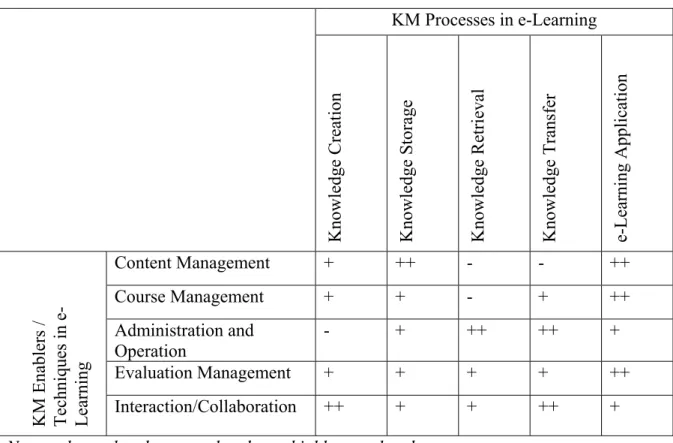
The integration of knowledge management and e-Learning actually is an elaboration of KMS and e-Learning system. This collaboration is designed to support the rapid capture, delivery, and measurement of knowledge in Web-based fashion. Based on (Dongming and Huaiqing 2008) research framework, an e-Learning system is considered as one of KM enablers that provides the infrastructure necessary for the Learning organization to increase the efficiency of knowledge process. However, from a broader point of view, the KM enabler and the KM processes in e-Learning are correlated in different levels as presented by Table 2-4.
The growing synergies between KM and e-Learning and the convergence of work and learning are leading to the importance of e-Learning as knowledge scaffolding in the 21st century. Learning in KM-driven organizations can take place via mentoring in face-to-face CoPs (Community of Practices), e-Learning in digital environments, or blended learning. Web services and next generation Internet technologies will further enmesh knowledge and learning processes. Standardization is proceeding, thanks to consortia like the Workflow Management Coalition, the HR-XML Consortium, OASIS (Organization for the Advancement of Structured Information Standards), and GKEC (the Global Knowledge Economics Council). The blended of KM and e-Learning can change the view of e-Learning from course-centric to knowledge course-centric (Rosenberg 2006).
Table 2- 4 Relationship between KM enablers/techniques and KM Processes in e-Learning (Dongming and Huaiqing 2008)
KM Processes in e-Learning
Knowledge Creation Knowledge Storage Knowledge Retriev
al
Knowledge Transfer e-Learn
ing Application Content Management + ++ - - ++ Course Management + + - + ++ Administration and Operation - + ++ ++ + Evaluation Management + + + + ++ KM Enabler s /
Techniques in e- Learning Interaction/Collaboration ++ + + ++ +
Note : - less related; + correlated; ++ highly correlated
In order to take advantage of knowledge mapping and the functions connected with it, software tools capable of supporting and managing interaction in a network environment is needed. The tool must be designed and created on the basis of guidelines aimed at pursuing not only the ergonomics, efficiency and efficacy of use, but also flexibility and completeness during the phases of construction, updating and analysis of the relational fabric (Pedroni 2007).
Simple development and delivery of learning resources can not satisfy requirements of information society of professionals skills achievement, knowledge sharing and exchange, and gaining competencies in specific domains of science and real life necessary for individuals and organizational success and prosperity. That is why education has to be a process of sharing and acquirement of knowledge, skills and competencies. Advantages of KM are very useful for that process. KM is indivisible part
of teams training so capturing of knowledge process is very similar to the processes related to selection of most appropriate learning content in e-learning. Outcome of effective learning process should be not only knowing facts for a separate subject but having practical skills and developing competency in the given domain so acquiring knowledge is more precise definition of the learning outcomes instead of learning facts for different related to domain topics. Therefore KM processes should be more deeply and successfully integrated in learning content delivery and learning activities support (Yordanova 2007).
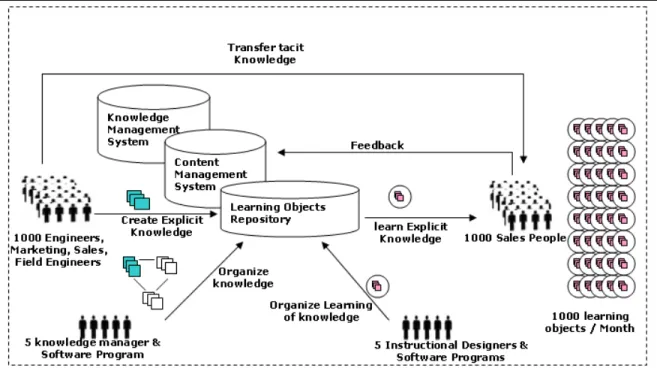
Prior work on implementing KM for e-learning has been conducted by some researchers. (Woelk and Agarwal 2002) proposed a framework to integrate e-Learning and KM based on enterprise content and knowledge (See Figure 2-1). As depicted by Figure 2-1 the proposed framework is consisted of integrated knowledge management system, content management system, and learning object repository. The strength of this proposed framework is the more more intelligent and well organized authoring system. It encouraged employees to create and transfer knowledge with knowledge manager and software program as knowledge organisator and instructional designer as learning of knowledge organisator. In this scenario, knowledge managers and instructional designers will be able to create 1000 LOs per month.
Figure 2- 1 e-Learning and KM Integration based on Enterprise Content and Knowledge (Woelk and Agarwal 2002)
Another prior work on implementing KM for e-Learning is conducted by (Morales et al. 2005). They focused on qualitative research for managing reuseable LO using KM approach. Based on (Morales et al. 2005) there are some aspects that must be must be considered to KM for e-learning systems together with LOs and standars implication namely LOs quality characteristics, LOs normalization, and LOs quality evaluation according to a context.
2.1.4 Knowledge Management and Social Constructivism in e-Learning System Another aspect that needs to be pondered when developing e-Learning system to be successful is the pedagogical approach. One of the pedagogical approach that become emerging perspective on learning, teaching, and technology today is Social Constructivism (Kim 2008). Social constructivism emphasizes the importance of culture
and context in understanding what occurs in society and constructing knowledge based on this understanding (McMahon 1997; Derry 1999). This perspective is closely associated with many contemporary theories, most notably the developmental theories of Vygotsky and Bruner, and Bandura's social cognitive theory (Kim 2008).
Social constructivism is based on specific assumptions about reality, knowledge, and learning. To understand and apply models of instruction that are rooted in the perspectives of social constructivists, it is important to know the premises that underlie them:
• Reality. Social constructivists believe that reality is constructed through human
activity. Members of a society together invent the properties of the world (Kukla 2000). For the social constructivist, reality cannot be discovered: it does not exist prior to its social invention.
• Knowledge. To social constructivists, knowledge is also a human product, and is
socially and culturally constructed (Gredler 1997; Ernest 1999). Individuals create meaning through their interactions with each other and with the environment they live in.
• Learning. Social constructivists view learning as a social process. It does not take
place only within an individual, nor is it a passive development of behaviors that are shaped by external forces (McMahon 1997). Meaningful learning occurs when individuals are engaged in social activities.
Social constructivists see as crucial both the context in which learning occurs and the social contexts that learners bring to their learning environment. There are four general perspectives that inform how the learning within a framework can be facilitated in term of social constructivism namely cognitive tools perspective, idea-based social constructivism, pragmatic or emergent approach, and transactional or situated cognitive perspectives (Gredler, 1997).
Cognitive tools perspective focuses on the learning of cognitive skills and strategies. Students engage in those social learning activities that involve hands-on project-based methods and utilization of discipline-based cognitive tools. Together they produce a product and, as a group, impose meaning on it through the social learning process.
Idea-based social constructivism sets education's priority on important concepts in the various disciplines (e.g. part-whole relations in mathematics, photosynthesis in science, and point of view in literature). These "big ideas" expand learner vision and become important foundations for learners' thinking and on construction of social meaning.
Social constructivists with pragmatic or emergent approach perspective assert that the implementation of social constructivism in class should be emergent as the need arises. Its proponents hold that knowledge, meaning, and understanding of the world can be addressed in the classroom from both the view of individual learner and the collective view of the entire class.
The transactional or situated cognitive perspective focuses on the relationship between the people and their environment. Humans are a part of the constructed environment (including social relationships); the environment is in turn one of the characteristics that constitutes the individual. When a mind operates, its owner is interacting with the environment. Therefore, if the environment and social relationships among group members change, the tasks of each individual also change. Learning thus should not take place in isolation from the environment.
This social constructivism perspective on e-Learning makes sense with the spirit of KM that look at knowledge as a social construct. There are four perspective from KM that support this social constructivism on e-Learning namely ontological, epistemological, commodity, and community perspective (Jakubic 2007).
The ontological perspective suggests that knowledge is concerned with the nature of reality. Criteria of measurement and evaluation have to do with understanding the nature of the knowledge and the reality. Whether external or internal and the objective is. Ontological views of knowledge look at two subcategories: (a) Social (b) Individual.
The epistemological view looks at knowledge management from a scientific perspective, and seeks to develop systems of classification that incorporate the logic(s) of science, including a "grammar" of science. Wheter the knowledge is tacit or explicit.
In commodity case, knowledge is an asset. As such, its value depends on its utility. In this case, instead of relying on the logic(s) of science, one would look at economics, particularly microeconomics.
Community is the most commonly addressed in contemporary discussions of knowledge and knowledge management, this view suggests that knowledge is a function of community interactions. The underpinning concept is the social construction of reality, and the notion that knowledge is socially determined. While this is undoubtedly useful as a knowledge management philosophy, there are limitations, particularly when needing to create classification schemes that respond to an object's usefulness.
KM is a dynamic, quickly evolving field. As collaboration, peer review, sharing, and modification occur in web applications and information manipulation and retrieval, then it will be necessary to develop more schemes and to refine them in an ongoing way.
2.2 e-Learning, SW, and KM Where is their Meeting Point?
E-Learning, SW, and KM as elaborated in Appendix I, Appendix II, and Appendix III, has its own potential. The next question is how to meet these three concept up together. Prior work on collaborated e-Learning, SW, and KM have been conducted by some researchers such as (Qi and Sun 2006) and (Liu and Hu 2006).
Qi and Sun (2006) proposed Ontology approach for knowledge representation and Topics Map to Link Knowledge with Content in e-Learning community. They also proposed
Knowledge Management System (KMS) Based on Semantic Web in e-Learning Community. The proposed KMS is made up of knowledge collecting subsystem, knowledge management subsystem, and knowledge sharing subsystem. The whole proposed KMS provided the support of environment and tools for the management of learner and knowledge as core objects.
Liu and Hu (2006) developed a knowledge management system named R-ELKM for e-Learning. Some SW technologies such as modeling, automatic mining, discovering and processing techniques have been migrated into R-ELKM. R-ELKM offers a multi-model based framework for knowledge management and several intelligent services like automatic knowledge expansion, clustering and dynamic knowledge representation. It meets the requirement of multiple knowledge domains in practical e-Learning environment.
In this research work, the researcher argued that these three concepts should be put together in order to get the maximum benefit of them. Thus, it can be concluded that ideally to be successful in this knowledge age environment e-Learning should be viewed
as part of KM spirit in Organization instead of viewed e-Learning out of concern from KM. KM is viewed as broader framework where e-Learning inside it. E-Learning is considered one of tools to capture, organize, and store knowledge –the most important asset and key competitive success factor for an organization. Then, the SW as future of Web technology which provides a common framework that allows data to be shared and reused across application, enterprise and community boundaries is considered to be the key enabler of the successful KM implementation. In other words, it can be concluded that SW is the technology enabler for KM driven e-Learning implementation in an organization. Figure 2-2 depicts our conclusion: where the meeting point of e-Learning, Semantic Web, and KM is.
Figure 2- 2 e-Learning, Semantic Web, KM: the Meeting Point
Regarding to the amalgamation of three fundamental concept as depicted by Figure 2-2 the proposed e-Learning system is named as Semantic Web Aware- Knowledge Management Driven e- Learning System (SWA-KMDLS).
2.3 Summary
This chapter has reviewed the meeting point of e-Learning, SW and KM. It shown how e-Learning, SW and KM can be integrated to enable better synergies. Current issues, emerging problems and requirement on e-Learning are also reviewed. It is followed by investigation on how the Semantic Web and KM Technology can meet the emerging problems and requirement in the existing e-Learning system.
The following chapter discusses the methodology that is used to conduct this research work. The heart of this research work is the development of Ontology, because Ontology is the fundamental aspects in either SW or KM and the main concern of this thesis. In SW Ontology is the backbone of SW application, where the successful of SW depend on the successful of Ontology development. In KM Ontology is the representation model for modeling knowledge. Therefore, in the following chapter the Ontology development methodology is highlighted.
CHAPTER 3
METHODOLOGY
This chapter presents the methodology how the research is conducted. This chapter is divided into two parts. The first part (§ 3.1) presents the general research design and the second part (§ 3.2 and § 3.3) present the methodology for developing Ontology. Ontology, as described in prior chapter is the backbone of SW and the fundamental aspect in KM for modeling and representing knowledge. In this research work, METHONTOLOGY is selected. METHONTOLOGY is the most mature Ontology development methodology compared with others as it is discussed in § 3.2 METHONTOLOGY framework that includes Ontology development process, Ontology life cycle and Ontology development technique shall be elaborated in § 3.3
3.1 General Research Design
Concisely, Figure 3-1 depicts the general flow of the thesis research work in block digram. As depicted by Figure 3-1, the research flow is consisted of four main steps namely development of Ontology, design the framework and architecture of SWA-KMDLS, development and implementation of SWA-SWA-KMDLS, and Experimental testing and evaluation. The following subsection detail out the rationale, description, purpose, application, assumptions (if applicable), and parameter of each step.
3.1.1 Development of Ontologies
The first step in this research work is Ontologies development. To develop the Ontologies METHONTLOGY methodology is selected . The rationale on why METHONTOLOGY is selected and how the processes of Ontology development using this methodology is detail out in the following section § 3.2 and § 3.3 respectively. The Ontology is developed using tool : Protégé (Protégé 2008).
Development of Ontology METHONTOLOGY
Design the framework and architecture of SWA-KMDLS
Design the framework SAOKBCS
Design the framework of Aquas Design the framework of
S-Aquas
Design the framework of Onto-Aquas
Design the framework of Expert Locator
Development and Implementation of SWA-KMDLS
Development and implementation of SAOKBCS
Development and implementation of AQUAS Development and implementation of S-Aquas Development and implementation of Onto-Aquas
Development and implementation of Expert Locator
Experimental testing and evaluation
3.1.2 Design the Framework and Architecture of SWA-KMDLS
The second step of the research is Designing of the SWA-KMDLS. In this step, the conceptual design of SWA-KMDLS is figured in framework and architecture. The design of SWA-KMDLS is divided into three folds. The first fold is the SAOKBCS for LO management. The second fold is Aquas for information, LO, and knowledge retrieval. Aquas is designed using two approach namely statistical approach (S-Aquas) and Ontological approach (Onto-Aquas). The third fold is Expert Locator that is intended to improve the performance of Aquas and encourage knowledge sharing culture in e-learning environment.
3.1.3 Development and Implementation of SWA-KMDLS
In this step the a prototype based on framework and architecture of SWA-KMDLS is developed and implemented. The SWA-KMDLS is developed using PHP and Java programming language and implemented in Moodle content management system (Moodle 2008). The difference platform between PHP and Java is addressed using PHP-Java bridge.
3.1.4 Experimental testing and evaluation.
The aim of the experiment in this research work is to assess the performance of SAOKBCS and Aquas. The experimental scenario for SAOKBCS and Aquas is presented in Table 3-1 and Table 3-2 respectively.
Table 3- 1 The SAOKBCS experimental scenarios
No. Scenarios
1 Course creator uploads Learning Material 1(LM 1) in Introduction To Problem Solving and Programming (IPSP) Course.
2 Course creator uploads Learning Material 2 (LM 2) in Introduction To Problem Solving and Programming (IPSP) Course.
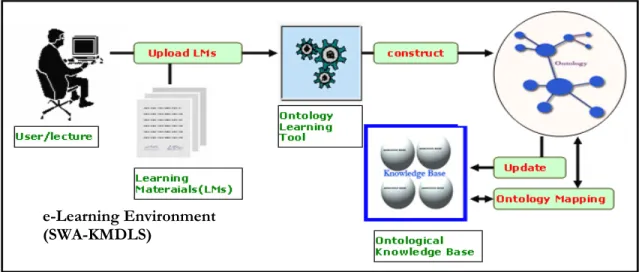
The experiment for SAOKBCS as presented in Table 3-1 involved course creator user in virtual e-Learning system (SWA-KMDLS). The LM1 presented IPSP learning material in which its content explored the fundamental concepts in programming. It is consisted of 285 words and 1697 characters. The LM2 presented IPSP learning material in which its content introduced C Programming concepts. It is consisted of 275 words and 1621 characters. Both LMs are in text format. Usually these text input is named as Corpus.
From these two learning materials, the Ontology Learning engine of SAOKBCS
namely the Text2Onto constructs contextual Ontology (semi-)automatically. The
algorithms that are used by the Text2Onto engine are set up as depicted by Figure 3-2.
Figure 3- 2 Ontology Learning Algorithm
As depicted by Figure 3-2, the Ontology Learning engine extract concepts, instance, similarity between concepts and instance, subclassOf relation between concepts, instanceOf relation between concept and instance, relation and subtopicOf from the
The experiment for Aquas as presented in Table 3-2 is involved students in Introduction To Problem Solving and Programming (IPSP) e-Learning virtual class consist of 62 students. In this IPSP e-Learning class, students are asked to enter their question using Aquas. In which the students’s questions can be classified into three scenarios as presented in Table 3-2.
The experiment was conducted over C Programming FAQs database adopted from (Summit 2008) containing 300 FAQs. The experiment was also conducted over learning resource base containing 100 learning materials. In the experiment, two versions of data were generated from the FAQ database. The first version is the original data from the FAQ database. The second version is classified data based on six interrogative words i.e. “What”, “Who”, “Where”, “When”, “Why”, and “How.
Table 3- 2 The Aquas Experimental Scenarios Scenario Explanation
Scenario 1 (S1)
The student’s entire question is similar to the question in the FAQs database (i.e. such questions have been asked before).
Scenario 2 (S2)
The student’s entire question is quite different to the question in the FAQs database (i.e. such questions have not been asked before, but the answers of the question exist in FAQ database).
Scenario 3 (S3)
The student’s question is randomly selected from Scenario 1 and Scenario 2
This classification intends to measure the performance of Aquas in two different cases. The first case is the student asks a trivial question, a question that has been asked previously and stored in FAQ database. Moreover, the second case is the student asks a non-trivial question, a question has not been asked previously and not stored in FAQ database yet.
3.1.5 The Experimental Validation
The experimental validation for Ontology development has been discussed in the previous section. Ontology development validation is included in evaluation stage as support activities in Ontology development lifecycle. It clearly explained in § 3.3.2 For the other experiment such as automated question answering system, in this research work common evaluation measurement in information or knowledge retrieval namely:
Precision(P), Recall(R), F-Measure(F) are used. Precision is defined as the fraction of
relevant documents that are retrieved. Recall is defined as the number of relevant
documents. F-Measure is defined as a single measure that trades off precision versus
recall is the, which is the weighted harmonic mean of precision and recall (Manning et al. 2008).
Suppose that the result of query is classified into as presented in Table 3-3 below: Table 3- 3 Query Result Classification
Relevant No Relevant
Retrieved True Positive (tp) False Positive (fp) Not Retrieved False Negative (fn) True Negative (tn) The Precision, Recall, and F Measure can be formulated as below: