An Efficient System for Real Time Fatigue Detection
Syed imran Ali , Dr.Prashant Singh*, Hussain Sabir** , Avinash Sharma** Research Scholar Dr.K.N.Modi University Newai, Tonk,Rajasthan
*Project Manager ISC Software Pvt.Ltd, Bhopal **RITS, Bhopal
Abstract
This Paper presents an efficient system for real time fatigue detection. Computer vision and image processing techniques have been used to measure eyes closer count, blinking rate of eye and user yawning as the parameters to conclude user fatigue. Since proposed system is not specific to any particular domain, it can be used in many applications where user attentiveness is a critical factor. First face is detected using Viola Jones algorithm, then abnormality in behavior of eyes and mouth is analyzed to judge fatigue. By monitoring the behavior of eyes and mouth, it is believed that the symptoms of user fatigue can be detected early enough to avoid accidents.
General Terms:Computer Vision, Viola Jones algorithm, Face Detection, Sobel filters.
Keywords: Fatigue detection, eye blinking rate, eye blinking count, Yawning, edge density, threshold value. INTRODUCTION
User inattentiveness is a significant factor in large number of accidents. Statistics estimate that annually more than1, 200 deaths and 76,000 injuries can be attributed to related crashes [25]. The increasing number of accidents all over the world is due to diminished user’s alertness level. Here are few survey as per different agencies, which shows how important user alertness is:
1. As per the American automobile association(AAA),USA, in 2010 17% of fatal cashes are due to inattentiveness of driver.
2. As per Volkswagen, Germany, 5-20% of collision are due to driver feeling asleep. 3. As per NHSTA,USA, 20% of all crashes are due to user fatigue.
4. As per federal highway research institute, Germany, fatigue is the second most frequent cause for serious collisions on highway.
It is a major challenge in the field of accident avoidance systems to develop methods for detecting fatigue in user early enough to avoid accidents.
The user may be a person like computer operator, operating critical operations on distant machines, hands free interaction with computational devices or machines, controlling heavy machineries like cranes or performing time critical operations like air traffic controlling etc, or driver driving motor vehicles on roads or rails.
Many efforts have been reported in the literature for developing an active safety system for reducing the number of accidents due to reduced vigilance level. Detection of fatigue in user can be generally divided into the following categories:
1. Sensing of physiological characteristics of user, 2. Sensing of user operation,
3. Sensing of machine response, 4. Monitoring the response of user.
Among these methods, the best techniques in terms of accuracy are the ones based on Human physiological phenomena [6]. They are implemented in two ways:
a.) measuring changes in physiological signals, such as brain waves, heart rate, and eye blinking and
b.) measuring physical changes such as sagging posture, leaning of the user’s head and the open/closed states of the eyes [6].
The first technique, while most accurate, is not realistic, since sensing electrodes would have to be attached directly onto the user’s body, and hence be annoying and distracting to the user. In addition, long time usage would result in perspiration on the sensors, diminishing their ability to sense accurately. The second technique is well suited for real world conditions since it can be non-intrusive by using optical sensors of video cameras to detect changes.
User operation and machine behavior are good indicator of detecting alertness level of user. These are non intrusive ways of detecting fatigue, but unfortunately are limited to machine type and user conditions. The final technique for detecting fatigue is by monitoring the response of the user. This involves periodically requesting the user to send a response to the system to indicate alertness. The problem with this technique is that it will eventually become tiresome and annoying to the user.
The proposed system is altogether different from discussed techniques. It is based on eyes closer count (blinking rate), duration of eye closure and yawning detection of the user. By monitoring the eyes and mouth, it is believed that the symptoms of user fatigue can be detected early enough to avoid an accident. Blinking rate of normal eye
is 4-5 times per minute. In fatigue state, eye blinking rate either increases or decreases by normal rate. Similarly duration of eye closure is also a significant parameter in detecting fatigue because in fatigue state eye closure duration increases to 3-4 seconds (micro sleeps). But it is difficult to predict alertness level based only on eyes functioning because previous researches have proven that eye detection has several limitations like if user is wearing eyeglasses then eye detection becomes a problem[4],[5,[6]. Also, eye detection is difficult for users having smaller eyes.
Moreover, if we only look at the number of consecutive frames where the eyes are closed, then at that point it may be too late to issue the warning. To overcome this, proposed system also considers yawning detection as a second parameter to detect somnolence. Yawning is a very good indicator to detect fatigue state [6] and if yawning is detected then warning signal may be issued early enough to avoid accident.
This system has been designed to be deployed in real time environment at very less cost because it does not require additional hardware. Previous works requires extra hardware like frame grabbers [4], infra red camera [5] to detect fatigue which increases the cost of system to a great extent. Also, it does not require additional surrounding light sources as required by previous research [4].
Proposed system works efficiently even in the presence of different illumination sources in the background, unlike the previous research [4] which requires that there should be dark background behind the user.
In addition to these qualities, proposed application is very light weight (space and time efficient), does not eat up much CPU execution time.
Ideally any software developed to help us should not affect our normal course of interaction with the system otherwise the usability and acceptability gets hampered adversely like some antivirus softwares make the system responding too slow to the user and even some times disturb the user with their annoying pop ups sometimes disturbs our normal functioning. This system has been proposed by keeping this point into consideration. Therefore, proposed system identifies user fatigue accurately and efficiently while incurring minimized time complexity, space complexity, cost and overheads of using it.
Proposed Methodology
The proposed system continuously captures the image of the user using web camera and detects face region using Viola-Jones technique [2][3], then focuses on eyes and lips using efficient image processing techniques. Abnormality either in behavior of eyes or mouth can be detected to conclude that the subject is falling asleep or having state of fatigue and a warning alarm can be generated so as to make surrounding people alert. The proposed system is based on eyes closer count, blinking rate of eye & yawning detection of the user. The system continuously captures the image of the subject on site and detects face region , then eyes and lips are detected in the face under consideration to determine if eyes are closed or open ,if eyes found to be closed for 4-5 consecutive frames or blinking rate of is found to be abnormal or lips are found to be open for long duration (yawning) ,for 3-4 consecutive frames then it can be concluded that the subject is falling asleep or having state of drowsiness therefore fatigue is detected and a warning alarm should be issued.
In order to develop such system, following algorithm is proposed: 2.1 Proposed algorithm:
1.Take the new image.
2. Identify the face within the image using Viola Jones technique. 3.Convert it into grayscale image.
5. Cut the image of face into two halves horizontally to get image of eyes and mouth separately. 6. For the image of eyes do the following:
a. Find the edges (using Sobel filters) b. Calculate Edge Density.
c. Compare it with threshold value
(i) If edge density < threshold value, then generate alarm. (ii) If edge density > threshold value, then go to step 1. 7. For the image of mouth do the following:
a. Find the edges (using Sobel filters) b. Calculate Edge Density.
Sobel filters are used because they give better results as compared to their alternatives viz. Robert filters and Prewitt filters [1].Moreover; The Sobel masks have slightly superior noise-suppression characteristics than prewitt masks.
2.2 Flowchart of the system
2.3 Working Face Detection:
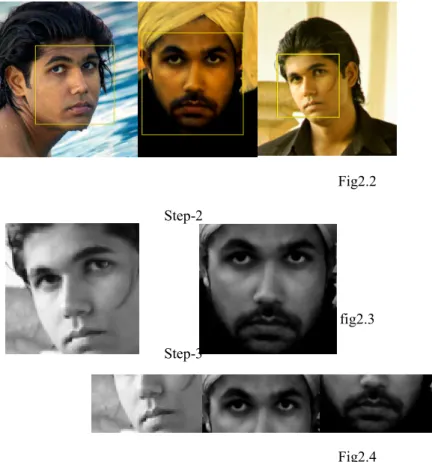
Face detection is one of the most significant achievements in human vision. It has emerged that eigen face, neural network, graph matching, hidden markov model, geometrical feature matching ,template matching, 3D morphable model , line edge map (LEM) , support vector machine (SVM) ,multiple classifier systems (MCSs) are fashionable techniques of face recognition.[26]. This system uses Viola Jones technique for face detection. This technique uses a new image representation called the “Integral Image” which allows the features used by detector to be computed very quickly. Then it uses simple and efficient classifier which is built using the Ada Boost learning algorithm (Freund and Schapire, 1995) to select a small number of critical visual features from a very large set of potential features. Finally it combines classifiers in a “cascade” which allows background regions of the image to be quickly discarded while spending more computation on promising face-like regions[2]. Figure 2.2 some images where face has been detected using Viola Jones algorithm.
Step-1 Fig2.2 Step-2 fig2.3 Step-3 Fig2.4 RESULTS:
The proposed system is implemented in real time and work successfully.It was experimented on 6 different people and gave high accuracy .
All the pictures and results used in this paper are obtained from actual implementation of system. 3.1
Case 3: When Blinking Rate is Abnormal
4. CONCLUSION
In this paper, a user fatigue detection system has been proposed. The proposed system is based on eyes closer, blinking rate of eye & yawning detection of the user. The system continuously captures the image of the subject on site and detects face region , then eyes and lips are detected in the face under consideration to determine if eyes are closed or open ,if eyes found to be closed for 4-5 consecutive frames or blinking rate of is found to be abnormal or lips are found to be open for long duration (yawning) ,for 3-4 consecutive frames then it is concluded that the subject is falling asleep or having state of drowsiness therefore fatigue is detected and a warning alarm issued.
The developed system can be applied to large number of applications like in vehicles to detect drowsiness level of user, in software industries where developers works continuously for 14-15 hours to detect their vigilance level, for computer operators, operating critical operations on distant machines, hands free interaction with computational devices/machines, controlling heavy machineries like cranes etc.
The developed system has following advantages
1. Works in real time without requiring any extra hardware, thus reducing the cost of system to a great extent.
2. Works with users wearing eyeglasses or having smaller eyes also 3. Works even when background is not uniform.
4. Computations are very easy and it is a very lightweight system, does not irritate user while using it and does not disturb user in doing his regular work unlike antivirus softwares.
5. Since it is mainly based on coding, therefore it is durable, does not require maintenance. 5. REFERENCES
[1] “An Efficient System to identify User alertness based on Somnolence Detection” Syed Imran Ali , Mayank Pathak ,Dr. Bhupendra Verma, Dr.Ravindra Patel ,International Journal of Advanced Engineering & Applications, Jan. 2010 .
[2] “Robust Real-Time Face Detection”,Paul Viola, Michael J. Jones, 2nd international workshop on statistical and computational theories ,of Vision-modeling,learning, Computing and sampling Vancauver, Canada, July 13, 2001
[3] “Robust Real-Time Face Detection”,Paul Viola, Michael J. Jones, International Journal of Computer Vision 57(2), 137–154, 2004.
[8]“Intelligent Monitoring System for Driver’s Alertness (A vision based approach)”R.S. Parsai, Dr.P.R.Bajaj, KES2007 International Conf.Sept-07, Italy
[9] “Monitoring Driver Using Facial Analysis Techniques” Singh, Sarbjit and Papanikolopoulos, IEEE Intelligent Transport System Proceedings, 1999, pp. 314-318..
[10] “Driver Detection using Genetic Algorithm.”S. Jin , S.-Y. Park • J.-J. Lee, 11th International Symposium on Artificial Life and Robotics, Oita, Japan, January 23–25, 2006
[11] www.jasonokane.com
[10] “A Robust Skin Color Based Face Detection Algorithm Tamkang Journal of Science and Engineering, Vol. 6, No.4, pp. 227-234 (2003) 227,Sanjay Kr. Singh1, D. S.Chauhan2, Mayank Vatsa3, Richa Singh3*,Department ofComputer Science and Engineering, Institute ofEngineering and Technology, Jaunpur−222002, India
[11] “ Robust Facial Feature Tracking Under Varying Face Pose And Facial Expression”Yan Tonga, YangWangb,
Zhiwei Zhuc, Qiang Jia,,Department of Electrical, Computer, and Systems Engineering, Rensselaer Polytechnic Institute, Troy, NY 12180-3590, USA,2007
[12] “ Eye Location Using Genetic Algorithm ”Jeffrey Huang and Harry Wechsler,Department of Computer Science,George Mason University, Fairfax, VA 22030,2nd International Conference on Audio and Video-Based Biometric Person Authentication (AVBPA), Washington, DC, 1999.
[13] A Comparison Of Face Detection Algorithms,Ian R. Fasel1 and Javier R. Movellan2, Department of Cognitive Science, University of California, San Diego
[14] “Design Of A Neural Networks Classifier For Face Detection”,F. Smach, M. Atri, J. Mitéran and M. Abid, Journal of Computer Science 2 (3): 257 260, 2006,ISSN 1549-3636,© 2006 Science Publications
[15] Weirwille, W.W. (1994). “Overview of Research on Driver Fatigue Definition and Driver Fatigue Detection,” 14th International Technical Conference on Enhanced Safety of Vehicles, pp 23-26.
[16] “Development of fatigue warning System”.K. Yammamoto and S.Higuchi, J.Soc Automotive Eng.Japan,pp. 127-133.
[17] “Development of driver’s fatigue detection technology”.J. Fakuda , K. Adachi and M. Nishida, Toyota,Tech.Rev.vol .45, 1995, pp. 34-40.
[18] “Face detection in color images”.R.L.Hus, M.A.Mottaleb and A.K.Jain,IEEE Trans. Pattern Analysis and MachineIntell. 24, 2003, pp. 696-706
[19] “Detecting faces in images: A survey”,M.Yang, D.J.Kriegman and N.Ahuja, IEEE Trans. Pattern Analysis and machine Intell.24, 2002, pp. 34-58.
[20]www.mathworks.com
[21] Eriksson, M and Papanikolopoulos, N.P. “Eye-tracking for Detection of Driver”, IEEE Intelligent Transport System Proceedings (1997), pp 314-319.
[22] www.idlastro.gsfc.nasa.gov.
[23] Grace R., et al. “A Drowsy Driver Detection System for Heavy Vehicles”, Digital Avionic Systems Conference, Proceedings, 17th DASC. The AIAA/IEEE/SAE, I36/1-I36/8 (1998) vol. 2.
[24] Perez, Claudio A. et al. “Face and Eye Tracking Algorithm Based on Digital Image Processing”, IEEE System, Man and Cybernetics 2001 Conference, vol. 2 (2001), pp1178-1188.
[25] Singh, Sarbjit and Papanikolopoulos, N.P. “Monitoring Driver Using Facial Analysis Techniques”, IEEE Intelligent Transport System Proceedings (1999), pp 314-318.
[26] Ueno H., Kanda, M. and Tsukino, M. “Development of Fatigue Detection System”, IEEE Vehicle Navigation and Information Systems Conference Proceedings (1994), ppA1-3,15-20.
[27] Overview of Research on Driver Fatigue Definition and Driver Fatigue Detection,” 14th International Technical Conference on Enhanced Safety of Vehicles, pp 23-26.