Masters Theses Student Theses and Dissertations
Fall 2015
Steam flooding screening and EOR prediction by using clustering
Steam flooding screening and EOR prediction by using clustering
algorithm and data visualization
algorithm and data visualization
Na Zhang
Follow this and additional works at: https://scholarsmine.mst.edu/masters_theses
Part of the Electrical and Computer Engineering Commons, Petroleum Engineering Commons, and the
Statistics and Probability Commons
Department: Department:
Recommended Citation Recommended Citation
Zhang, Na, "Steam flooding screening and EOR prediction by using clustering algorithm and data visualization" (2015). Masters Theses. 7488.
https://scholarsmine.mst.edu/masters_theses/7488
This thesis is brought to you by Scholars' Mine, a service of the Missouri S&T Library and Learning Resources. This work is protected by U. S. Copyright Law. Unauthorized use including reproduction for redistribution requires the permission of the copyright holder. For more information, please contact [email protected].
STEAM FLOODING SCREENING AND EOR PREDICTION BY
USING CLUSTERING ALGORITHM AND DATA
VISUALIZATION
by
NA ZHANG
A THESIS
Presented to the Graduate Faculty of the
MISSOURI UNIVERSITY OF SCIENCE AND TECHNOLOGY
In Partial Fulfillment of the Requirements for the Degree
MASTER OF SCIENCE IN PETROLEUM ENGINEERING 2015
Approved by
Mingzhen Wei, Advisor Baojun Bai Donald Wunsch II
©2015 Na Zhang All Rights Reserved
ABSTRACT
Enhanced Oil Recovery (EOR) techniques are vitally important in the oil industry because these techniques could not only extend the life of wells, but also produce 10% to 30% additional oil from the reservoir. However, selecting the most suitable EOR techniques for unknown reservoirs is not easy for decision making. Based on literature, EOR screening criteria could help to find the best candidates for unknown projects, which is classified into two categories: conventional EOR screening and advanced EOR screening. In this research, an artificial intelligent (AI) method, hierarchical clustering algorithm, is adapted to analyze both steam flooding projects and worldwide EOR projects for the purpose of new steam flooding screening criteria and the prediction of EOR methods for unknown reservoir conditions.
Data pre-processing process were firstly conducted to ensure the data quality, then the hierarchical clustering algorithm was applied to the worldwide steam flooding projects and the worldwide EOR projects; after that the principal component analysis (PCA) was used to identify the major attributes in all clusters, and to visualize the projects in different clusters in a scatter plot by retaining high variance; and then descriptive statistics of using boxplot and scatter plot were utilized to establish the screening criteria for each cluster.
Three uniqueness were illustrated in this thesis. First, detailed screening criteria has been established based on the hierarchical clustering results. Second, categorical features (formation type) was considered as one of the impact factors for clustering, which none of the existing advanced screening criteria methods included. Third, dimensionality reduction techniques have been applied successfully which clusters are clearly laid out in a two dimensional scatter plot.
ACKNOWLEDGEMENTS
I would like to express my gratitude to my advisor, Dr. Mingzhen Wei, for her guidance and patience throughout the completion of this work; her encouragement and suggestions helped me to become a better researcher and a better engineer. In addition, I would like to thank my committee members, Dr. Baojun Bai and Dr. Donald Wunsch II, for their helpful advice and patient instruction.
I am also thankful to my wonderful research group members and friends. Thanks to Mariwan Qadir Hama for his excellent work in collection of steam flooding projects; to Dao Lam for his patience and time while sharing his knowledge, this work could not be done without his help; and to Yue Qiu, Munqith Aldhaheri, Yandong Zhang, Hao Sum and Chaohua Guo for their useful comments. Thank you all for being with me when I need help.
Last but not least, I would like to express deepest gratitude to my beloved family for their support and understanding.
TABLE OF CONTENTS
Page
ABSTRACT ... iii
ACKNOWLEDGEMENTS ... iv
LIST OF FIGURES ... vii
LIST OF TABLES ... xi NOMENCLATURE ... xii SECTION 1. INTRODUCTION ... 1 2. LITERATURE REVIEW ... 3 2.1. EOR METHODS ... 3 2.1.1. Thermal Methods. ... 3 2.1.2. Non-thermal Methods ... 5
2.2. EOR SCREENING METHODS ... 6
2.2.1. Conventional EOR Screening. ... 7
2.2.2. Advanced EOR Screening. ... 8
2.2.3. Comparison of EOR Screening Methods. ... 9
2.3. APPLICATIONS OF ARTIFICIAL INTELLIGENCE IN OIL INDUSTRY ... 10
3. DATA PRE-PROCESSING ... 13
3.1. RAW DATA ... 13
3.2. DATA QUALITY CONTROL METHODS ... 14
3.2.1. Duplicate Data. ... 15
3.2.2. Missing Data. ... 16
3.2.3. Senseless and Inconsistent Data. ... 17
3.3. CLEANED DATA SETS AND STATISTICS ... 17
4. DATA ANALYSIS METHODS ... 20
4.2. DESCRIPTIVE STATISTICS ... 24
4.3. PRINCIPAL COMPONENT ANALYSIS ... 25
4.3.1. Principal Component Analysis. ... 25
4.3.2. Principal Component Analysis Procedures. ... 27
5. RESULTS FROM STEAM FLOODING DATA SET ... 30
5.1. HIERARCHICAL CLUSTERING RESULTS ... 30
5.2. DESCRIPTIVE STATISTICS ... 37
5.2.1. Correlation Coefficient. ... 37
5.2.2. Box Plots. ... 39
5.2.3. Bar Charts. ... 46
5.2.4. Descriptive Statistics Summaries. ... 50
5.3. PRINCIPAL COMPONENT ANALYSIS ... 53
6. RESULTS FROM THE WORDWIDE EOR DATA SETS ... 58
6.1. HIERARCHICAL CLUSTERING RESULTS ... 58
6.2. DESCRIPTIVE STATISTICS ... 61
6.2.1. Box Plots. ... 61
6.3. PRINCIPAL COMPONENT ANALYSIS ... 66
6.4. VALIDATION AND EOR PREDICTION ... 68
6.4.1. Validation. ... 68
6.4.2. EOR Prediction. ... 72
7. CONCLUSIONS ... 80
BIBLIOGRAPHY ...81
LIST OF FIGURES
Page
Figure 1.1. Flow chart of research ... 2
Figure 2.1. Classification of EOR methods. [Modified, Thomas 2008] ... 3
Figure 2.2. Steam flooding process [Amjad Sha, 2010] ... 4
Figure 2.3. CO2 flooding process [Reference 14] ... 6
Figure 3.1. Decision processes with duplicate data ... 16
Figure 3.2. Pie chart of formation type distributions for steam flooding projects (from 1980 to 2012 Oil and Gas Journal) ... 17
Figure 3.3. Project distributions of EOR methods (from 1996 to 2012 Oil and Gas Journal) ... 18
Figure 3.4. Project distributions of formation type for worldwide EOR projects (from 1996 to 2012 Oil and Gas Journal) ... 19
Figure 4.1. Workflow of data analysis process ... 20
Figure 4.2. Hierarchical clustering ... 21
Figure 4.3. Flowchart of the agglomerative hierarchical clustering algorithm. (Rui Xu and Donald C. Wunsch II, 2010) [Reference 17] ... 23
Figure 4.4. Correlation coefficient (Reference 50) ... 24
Figure 4.5. Effects of different Pearson's Correlation Coefficients [modified, Reference 57] ... 25
Figure 4.6. Dimensionality reduction example ... 26
Figure 4.7. Mono plot explanations ... 29
Figure 5.1. Steam flooding clustering results (from 1980 to 2012 Oil and Gas Journal) ... 30
Figure 5.2. Hierarchical clustering results using hierarchical level of 20 ... 31
Figure 5.4. Cluster characterization of steam flooding applications on sandstone formations. The red colored clusters have less dominating value ranges so that all the detailed categories are presented; the black colored
clusters have dominating categories in respective properties ... 35 Figure 5.5. Cluster characterization of steam flooding applications on
unconsolidated sands formations. The red colored clusters have less dominating value ranges so that all the detailed categories are presented; the black colored clusters have dominating categories in
respective properties. ... 36 Figure 5.6. Porosity ranges in boxplot for steam flooding projects (from 1980 to
2012 Oil and Gas Journal) ... 39 Figure 5.7. Permeability ranges in boxplot steam flooding projects (from 1980 to
2012 Oil and Gas Journal) ... 40 Figure 5.8. Depth ranges in boxplot steam flooding projects (from 1980 to 2012
Oil and Gas Journal) ... 41 Figure 5.9. Gravity ranges in boxplot for steam flooding projects (from 1980 to
2012 Oil and Gas Journal) ... 42 Figure 5.10. Temperature ranges in boxplot for steam flooding projects (from
1980 to 2012 Oil and Gas Journal) ... 43 Figure 5.11. Viscosity ranges in boxplot for steam flooding projects (from 1980
to 2012 Oil and Gas Journal) ... 44 Figure 5.12. Residual oil saturation ranges in boxplot for steam flooding projects
(from 1980 to 2012 Oil and Gas Journal) ... 45 Figure 5.13. Viscosity project records distributions for steam flooding projects
(from 1980 to 2012 Oil and Gas Journal) ... 46 Figure 5.14. Porosity project records distributions for steam flooding projects
(from 1980 to 2012 Oil and Gas Journal) ... 47 Figure 5.15. Depth project records distributions for steam flooding projects (from
1980 to 2012 Oil and Gas Journal) ... 48 Figure 5.16. Permeability project distributions for steam flooding projects (from
1980 to 2012 Oil and Gas Journal) ... 48 Figure 5.17. Temperature project records distributions for steam flooding
Figure 5.18. Oil saturation project records distributions for steam flooding
projects (from 1980 to 2012 Oil and Gas Journal) ... 50
Figure 5.19. Properties summaries for steam flooding (from 1980 to 2012 Oil and Gas Journal) ... 53
Figure 5.20. Mono plot for steam flooding projects (from 1980 to 2012 Oil and Gas Journal) ... 54
Figure 5.21. Steam flooding projects with all clustering results (from 1980 to 2012 Oil and Gas Journal) ... 55
Figure 5.22. Detailed clustering distributions for cluster 1 ... 55
Figure 5.23. Detailed clustering distributions for cluster 2 ... 56
Figure 5.24. Detailed clustering distributions for cluster 3 ... 56
Figure 5.25. Detailed clustering distributions for cluster 4 ... 57
Figure 6.1. Worldwide EOR projects clustering results (from 1996 to 2012 Oil and Gas Journal) ... 59
Figure 6.2. Hierarchical clustering results based on EOR methods at clustering level 20 (from 1996 to 2012 Oil and Gas Journal) ... 60
Figure 6.3. Porosity ranges in boxplot for whole EOR projects (from 1996 to 2012 Oil and Gas Journal) ... 62
Figure 6.4. Permeability ranges in boxplot for whole EOR projects (from 1996 to 2012 Oil and Gas Journal) ... 62
Figure 6.5. Depth ranges in boxplot for whole EOR projects (from 1996 to 2012 Oil and Gas Journal) ... 63
Figure 6.6. Gravity ranges in boxplot for whole EOR projects (from 1996 to 2012 Oil and Gas Journal) ... 64
Figure 6.7. Viscosity ranges in boxplot for whole EOR projects (from 1996 to 2012 Oil and Gas Journal) ... 64
Figure 6.8. Temperature ranges in boxplot for whole EOR projects (from 1996 to 2012 Oil and Gas Journal) ... 65
Figure 6.9. Oil saturation at start ranges in boxplot for whole EOR projects (from 1996 to 2012 Oil and Gas Journal) ... 65
Figure 6.10. Oil saturation at end ranges in boxplot for whole EOR projects
(from 1996 to 2012 Oil and Gas Journal) ... 66
Figure 6.11. Mono plot for whole EOR data set (from 1996 to 2012 Oil and Gas Journal) ... 67
Figure 6.12. Whole EOR projects clustering results with 6 clusters (from 1996 to 2012 Oil and Gas Journal) ... 68
Figure 6.13. Validation process ... 69
Figure 6.14. Clustering centers ... 73
Figure 6.15. Results with 1 new project ... 74
Figure 6.16. Results with 10 new projects ... 75
LIST OF TABLES
Page
Table 2.1. Summary of screening criteria for EOR methods (Taber et al. 1997) ... 8
Table 2.2. Artificial intelligence applications in EOR research area ... 11
Table 3.1. Features of steam flooding projects ... 13
Table 3.2. Features of whole EOR projects ... 14
Table 5.1. Domain knowledge for steam flooding ... 33
Table 5.2. Pearson’s Correlation Coefficients between paired properties for cluster 1 .. 37
Table 5.3. Pearson’s Correlation Coefficients between paired properties for cluster 2 .. 38
Table 5.4. 20 clusters merged into 4 big clusters for steam flooding projects ... 51
Table 6.1. Dendrogram abbreviations for worldwide EOR projects ... 59
Table 6.2. 20 clusters merged into 6 big clusters for whole EOR projects ... 61
Table 6.3. Cluster validation for one testing project ... 70
Table 6.4. Cluster Validation for 30 Testing Projects ... 71
Table 6.5. Cluster centers for cluster 1 ... 73
Table 6.6. Prediction results ... 76
Table 6.7. Percentage of possible EOR methods in Cluster 1 ... 77
Table 6.8. Percentage of possible EOR methods in Cluster 2 ... 77
Table 6.9. Percentage of possible EOR methods in Cluster 3 ... 77
Table 6.10. Percentage of possible EOR methods in Cluster 4 ... 78
Table 6.11. Percentage of possible EOR methods in Cluster 5 ... 78
NOMENCLATURE
Symbol Description
AI Artificial Intelligence
ANFIS Adaptive Neuro Fuzzy Inference System
C Conglomerate CB Combustion CH Chemical CI CO2 Immiscible CM CO2 Miscible cP Centipoise D Dolomite
EOR Enhanced Oil Recovery
ES Expert System F Fahrenheit FL Fuzzy Logic ft Foot HI Hydrocarbon Immiscible HM Hydrocarbon Miscible HW Hot Water L Limestone MB Microbial mD Millidarcy
NI Nitrogen Immiscible
NM Nitrogen Miscible
NN Neural Networks
PC Principal Component
PCA Principal Component Analysis
PO Polymer
S Sandstone
ST Steam
SU Surfactant
Enhanced Oil Recovery (abbreviated EOR) is the implementation of various techniques for increasing the amount of crude oil that can be extracted from an oil field [1]. Normally, by applying different EOR techniques into different oil field, additional 10% to 30% of crude oil could be produced from the reservoir. Therefore, EOR techniques are vitally important in the oil industry, and these techniques have been widely used around the world.
However, which EOR method is a good candidate for a specific reservoir is a hard question to most of the reservoir engineers and oil companies. To solve this problem, valuable EOR screening methods have been applied with the benefit of saving time for decision making, especially for mature reservoirs. These screening methods help reservoir engineers and companies to figure out the most suitable EOR method in a short time.
By far, there are mainly two different kinds of EOR screening methods. One is conventional EOR screening methods, which also been called “go/no-go” approach. In these methods, look-up tables are provided with different reservoir parameter intervals for each EOR method, and these look-up tables are coming from the analysis of the existing EOR projects (Alvarado 2010). Another method is called the advanced EOR screening methods. Artificial intelligence techniques, like neural network, fuzzy logic are implemented as tools to study the hidden knowledge of the data set, and these techniques are used to predict the best candidate of unknown new EOR projects.
The objectives of this research are to establish a new steam flooding screening criteria and to establish a novel framework for EOR prediction by implementing one of the artificial intelligence methods - clustering algorithms. Several tasks have been completed
to fulfil these objective. The major processes for this research are shown in Figure 1.1, which includes data preparation, data mining, data analysis, dimensionality reduction for data visualization, and validation and prediction. All data were collected and cleaned either manually or using data mining techniques before using artificial intelligence techniques. Data were analyzed before and after the application of artificial intelligence techniques.
Figure 1.1. Flow chart of research
The rest of this thesis is organized into following sections. Section 2 is for literature review which summarizes the outcome of literature research; Section 3 presents data pre-processing, which includes both steam flooding data set and the worldwide EOR data set; Section 4 displays the methods used for data analysis, including the implementation of hierarchical clustering algorithms, descriptive statistics, and principal component analysis; Section 5 and 6 are the results get from the data analysis; the last section is the summary and conclusions of this research.
Data Preparation Implementation of AI Techniques Data Analysis Data Visualization Validation and Prediction
2. LITERATURE REVIEW
2.1. EOR METHODS
In the global context of growing energy needs and considering the depletion of oil and gas resources, extending the life of hydrocarbon reservoirs and improve the oil recovery will be a challenge for all petroleum engineers, especially for reservoir engineers. To improve the oil recovery, a number of methodological strategies have been developed over years, which called Enhanced Oil Recovery (EOR) methods. EOR methods refer to any techniques that could increase the recovery factor by the injection of materials which not normally presented in the reservoir, and it is generally classified into two categories: thermal methods and non–thermal methods, as shown in Figure 2.1. In the next few subsections, detailed introduction of EOR methods will be displayed.
Figure 2.1. Classification of EOR methods. (Modified, Thomas 2008)
2.1.1. Thermal Methods. Thermal methods are made up of all the methods that could heat formations. The main mechanism of thermal methods is to increase the
EOR Methods
Thermal
Hot Water Steam
CSS Steam Flood SAGD Conduction Heating Combustion Forward Reverse High Pressure Air Injection Electrical Heating Non-thermal Gas Injection CO2 Nitrogen Hydrocarbon Chemical Alkali Surfactant Polymer Others MEOR Microbial Foam
temperature of reservoir, which leads to the reduction of oil viscosity and the mobility ratio. Therefore, oil in the heated reservoir will be feasible to be displaced towards the production well. According to the Department of Energy, more than 40 percent of EOR projects in U.S. implemented the thermal techniques. Steam flooding and combustion are two primary types of thermal methods.
Steam flooding, sometimes called steam drive, is a process which steam is generated at the surface and being injected continuously into the reservoirs through injection wells. This method is most commonly used to enhance oil production and has a wide applications for light oil, heavy oil, deep reservoirs, and shallow reservoirs, etc. As illustrated in Figure 2.2, when steam enters the reservoir, it not only heats up the oil temperature which reduces the oil viscosity, but also provides the pressure to push heavy move towards production wells.
Figure 2.2. Steam flooding process [Amjad Sha, 2010]
Combustion, also called fire flooding, is the oldest thermal recovery techniques, and has been used for more than nine decades with many economically successful projects
(PetroWiki). The purpose of applying combustion techniques is similar to steam flooding, which is to heat the formation and reservoirs to reduce the oil viscosity, so the mobility ratio will drop down, and the oil will be easier to flow towards the production well. However, combustion method injects oxygen gases to burn the formation directly while steam flooding needs to be heated at the surface.
2.1.2. Non-thermal Methods. CO2 Flooding techniques have been widely implemented worldwide especially in U.S. and Canada. From the Oil & Gas Biannually
EOR Survey, 345 independent EOR projects have been using CO2 flooding method, which
occupies 46% of the total EOR projects. In United States, CO2 flooding has been underway for more than 30 years, starting initially in the Permian Basin and have been expanding to several other regions of the country, particularly the Gulf Coast, Mid-Continent, and Rocky Mountains. The Department of Energy (DOE) has estimated that additional 240 billion barrels (38 km3) of oil could be recovered by the fully use of CO2 flooding method.
Moreover, DOE claims that the CO2 flooding method is the ‘next generation’ of United
States.
Figure 2.3 below depicts the process of CO2 flooding. This process is a closed loop system, where it emerges with the oil separation at the surface, then recycled and re-injected into the formation. Usually, CO2 is injected into developed oil field where it mixes with and produce the oil from the formation, thereby freeing it to move to production wells. Chemical Flooding, is the injection of chemicals into the formation, mainly including polymer, alkaline, surfactant, polymer gels and combinations. The purpose of using polymer is to mix with water, which could increase the viscosity of water, and
increase the sweep efficiency. Alkaline is mainly used to react with crude oil to generate soap, change the wettability and increase pH.
Figure 2.3. CO2 flooding process [Reference 14]
Surfactants are used to lower the interfacial tension between the oil and water, and also change the wettability of the rock. Polymer gels are treating as blocking agent to diverting the flow, which usually used to block the high permeability zone, so the displacing fluids (water) goes to the low permeability zone and displace the oil in that area. Therefore, the overall sweep efficiency is increased.
2.2. EOR SCREENING METHODS
The idea of EOR screening methods have come to reservoir engineers’ mind for a long time. In 1978, Poettman and Hause came up with the idea of micellar-polymer screening criteria and design, which is the first publication about EOR screening. After that, especially from the late 1990s’, EOR screening criteria for broader EOR processes have been discussed by more researchers. For example, Taber et al. provided a look-up table in 1997 with 9 different EOR methods based on the field results and oil recovery mechanism;
Alvarado (2002) implemented the machine learning algorithms to draw the rules for screening; Al-Adasani (2010) updated the look-up table made by Taber (1997) based on 633 EOR projects collecting from 1988 to 2008 SPE publications; and Saleh (2014) updated the screening criteria for polymer flooding based on 481 oilfield projects.
The reason that researchers interest in studying EOR screening is because EOR screening is an effective and useful way to figure out the most suitable EOR methods for new EOR projects. For example, the life for a mature reservoir is really limited, EOR screening methods is a quick way to know the best candidates of EOR methods, which could help companies to save time for decision making, and save the operating costs.
EOR screening methods could be classified into two categories: conventional EOR screening and advanced EOR screening, detailed introductions and comparisons are laid out in the following subsections.
2.2.1. Conventional EOR Screening. The conventional EOR screening methods is also called ‘go/no go’ method, which generally use the ranges or intervals of reservoir parameters to filter out the best EOR candidates. Table 2.1 below is one of the well-known screening table about various EOR methods proposed by Taber et al. (1997). Nine important parameters were considered in the proposed screening process with suitable ranges, which are gravity, viscosity, composition, oil saturation, formation type, net thickness, average permeability, depth, and temperature.
Since the screening criteria table comes from the existing EOR projects and the expert knowledge, the screening criteria updates along with the dramatic increasing of the amount of existing EOR projects. In this case, the screening criteria has been modified to better present various EOR data set; namely, one method is only updating the ranges,
another way is to add more important reservoir parameters to better pair with data set. For example, Hama (2014) and Saleh (2014) updated the screening criteria table for steam flooding and polymer flooding, respectively. They also came up with a complete framework for data cleaning. On the other hand, Bourdarot (2011) consider the potential
ranges of MMP (Minimum Miscible Pressure) for various gas injectants (CO2,
hydrocarbon, N2, H2S), and he summarized all the methods for estimating the MMP.
Table 2.1. Summary of screening criteria for EOR methods (Taber et al. 1997)
2.2.2. Advanced EOR Screening.The advanced EOR screening includes all the methods that applies the Artificial Intelligence (AI) techniques to assist engineers to predict
the most suitable EOR methods for new projects. Neural Networks (NN), Fuzzy Logic (FL), Machine Learning (ML), and Expert System (ES) are the common AI techniques that implemented in oil industry. For example, Alvarado (2002) proposed a methodology by utilizing the machine learning algorithm to draw the rules for EOR screening. Porosity, temperature, pressure, permeability, gravity, and viscosity are the six reservoir parameters that have been used for the algorithm. The results indicate that the EOR data set could be classified into six main clusters, and each cluster has its own rules for applications. Moreover, he also generated a 2D map by applying the space reduction techniques for the purpose of visualizing machine learning results.
2.2.3. Comparison of EOR Screening Methods. By comparing the conventional and advanced EOR screening methods, both screening methods are useful for EOR screening, and they both relies on the reservoir parameters gathered from field projects and the understanding of the characteristics, physics, and chemistry of each EOR projects (Manrique, 2007).
However, the conventional screening method is faster than the advanced method because users only need to go through the screening tables. In addition, the advanced method provides more accurate prediction results, such as the success probability of a certain EOR method.
Since the advanced EOR screening method involves more high techniques, screening methods involved with artificial intelligence techniques will lead the way to the future EOR screening. Therefore, in this research, complete frameworks for advanced steam flooding screening and EOR prediction by implementing hierarchical clustering algorithms has been established.
2.3. APPLICATIONS OF ARTIFICIAL INTELLIGENCE IN OIL INDUSTRY
Artificial intelligence (AI) has a wide applications in oil industry in almost all research areas. For example, neural network and fuzzy logic have applications in the production area. The purposes of using these techniques are to predict the important performance indicators (Mohammadpoor 2012, Al-Amer et al. 2014), to optimize the integrate production system (Park 2006, Popa et al. 2005, Denney 2011, Cirilli et al. 2001), to monitoring and predicting production (Boomer 1995, Rebeschini et al. 2013, Ebrahimi 2010, Ramgulam et al. 2007, Popa et al. 2005), and also optimize the artificial lift systems (Bermudez et al. 2014, Mena et al. 1999).
Artificial intelligence also have numerous applications in well testing and well logging area. These AI techiniques are implemented for the purpose of well testing planning and interpretation (Stewart et al. 1989, Houze et al. 1992, Sung 1996, Aulia et al. 2014, Al-Kaabi et al. 1993), log correlation (Lim et al. 1998, 1999, Olea et al. 1986, and formation evaluation, which includes permeability, porosity, water saturation (Whittaker et al. 1986, Sitouah et al. 2013, 2014, Mohaghegh et al. 1995, Salazar et al. 2001, Anifowose et al. 2012).
There are also a great number of applications in the reservoir engineering. AI could help to predict bottom-hole pressure (Osman et al. 2005), reservoir characterization (Kumar 2012, Anifowose et al. 2012), and identify analogous reservoirs (Perez-Valiente et al. 2014).
Since the scope of this thesis is about EOR projects, we summarized all applications of AI in EOR area, as shown in Table 2.2 below. Sayyad et al. (2013) implemented the Adaptive Neural Network - Particle Swarm Optimization (ANN-PSO) to predict the
Minimal Miscible Pressure (MMP) for CO2 flooding projects by using 9 reservoir parameters, which are reservoir temperatures, mole percentage of oil components, molecular weights of the heavy fraction (C5+), and mole percentage of the non- CO2 components (Cl, N2, H2S, and C2-C4) in the injected gas. Alikhani (2011) uses Adaptive Neuro Fuzzy Inference System (ANFIS) to predict the ultimate oil recovery for microbial method by using porosity, permeability, salinity, temperature, pressure, and pH. Siena (2015), Alvarado (2002), and Babushkina (2013) all use the same physical reservoir parameters (porosity, permeability, depth, temperature, gravity, viscosity) in the whole EOR data set, but the purpose of using clustering algorithm are different. In Siena’s paper, Bayesian Hierarchical Clustering Algorithm was implemented to predict EOR methods for unknown EOR projects and the Principal Component Analysis (PCA) was used for the purpose of data visualization. Alvarado used the machine learning for the same intention to predict EOR methods, but he used a 2D map to present his results. Moreover, Babushkina uses K-means and Hierarchical Agglomerative Clustering Algorithm to predict the oil recovery.
Table 2.2. Artificial intelligence applications in EOR research area
Publications EOR Methods Applications Artificial Intelligence Algorithms Input Parameters Sayyad, H., et al. (2013) CO2
flooding Predict MMP ANN-PSO
Reservoir Temperature, Mole Percentage of Oil Components, Molecular Weights of the Heavy
Fraction (C5+), Mole Percentage of the Non-CO2 components (Cl, N2,
H2S, and C2-C4) in the injected gas
Table 2.2. Artificial intelligence applications in EOR research area (cont.) Alikhani, P., et al. (2011) Microbi al Predict Oil Recovery Adaptive Neuro Fuzzy Inference System (ANFIS) Porosity, Permeability, Salinity, Temperature, Pressure, pH Siena, M., et al. (2015) All EOR Forecasting EOR potential Bayesian Hierarchical Clustering Algorithm Porosity, Permeability, Depth, Temperature, Gravity, Viscosity Alvarado, V., et at. (2002) All EOR Predict EOR Methods Machine Learning Porosity, Permeability, Depth, Temperature, Gravity, Viscosity Babushkina, E. V. (2013) All EOR Multi-dimensional interpolation of recovery factor K-means and Hierarchical Agglomerati ve Clustering Algorithm Porosity, Permeability, Depth, Temperature, Gravity, Viscosity
3. DATA PRE-PROCESSING
As mentioned in literature review section, the agglomerative hierarchical clustering algorithm has been implemented for both steam flooding projects and the whole EOR data set collected from the biannually EOR survey from the Oil and Gas Journal. Before implementing clustering algorithms into these data set, data preprocessing procedures need to be taken for duplicate elimination, missing data prediction and senseless data erasing. With refined data, analysis can be operated in order to decide how the data can be used.
3.1. RAW DATA
The steam flooding data set is collected from 1980 to 2012 Biannually EOR Survey from the Oil and Gas Journal. Eight reservoir parameters were selected for data analysis, including one categorical feature and seven numerical features. The categorical feature is the formation type, and the numerical feature are porosity, permeability, depth, viscosity, API gravity, temperature, and oil saturation before steam flooding, as shown in Table 3.1. The reason for selecting these properties to build up our data set is because they are the main reservoir properties that could describe reservoirs, and these properties are commonly used for EOR projects data analysis.
Table 3.1. Features of steam flooding projects
Properties Features
Formation Type Categorical
Porosity Numerical
Permeability Numerical
Depth Numerical
API Gravity Numerical
Viscosity Numerical
Temperature Numerical
For the whole EOR projects, all the data were collected from the biannually EOR survey from the Oil and Gas Journal from 1998 to 2012. Eighteen reservoir parameters were utilized for data preparation, including two categorical features and sixteen numerical features, as shown in Table 3.2. The two categorical features are the EOR methods and formation type. Besides all the numerical features used in steam flooding projects, the whole EOR projects add one extra feature into selection, which is the oil saturation after the utilization of EOR techniques, and each numerical features have both minimum and maximum values.
Table 3.2. Features of whole EOR projects
Properties Features
EOR Methods Categorical
Formation Type Categorical
Porosity (min, max) Numerical
Permeability (min, max) Numerical
Depth (min, max) Numerical
API Gravity (min, max) Numerical
Viscosity (min, max) Numerical
Temperature (min, max) Numerical
Oil Saturation, start (min, max) Numerical
Oil Saturation, end (min, max) Numerical
3.2. DATA QUALITY CONTROL METHODS
Data quality is important for data analysis. Having the most comprehensive and up to date information could help to ensure that the analyzing result is correct and useful. For the established data sets, three problems were concerned: duplicate data, missing data, and
senseless data. For both data sets, we applied the same methods to improve the quality of the data sets.
3.2.1. Duplicate Data. Duplicate data were the first problem that been concerned during data pre-processing process. Two types of duplicate data were observed. One is the data that is exactly the, another is the data that has slightly different records among the projects. Before analyze the data sets, this problem has to be solved to avoid the redundancy of information, and the biased results. For example, for the worldwide EOR data set, the
data collected includes various EOR methods, like steam flooding, polymer flooding, CO2
miscible flooding, if the data sets have duplicate projects, the percentage of the number of each EOR method will be incorrect. Moreover, in the EOR data prediction part, the success percentage of each EOR method in each cluster will be inaccurate (e.g. change the success percentage of steam flooding from 20% to 50%), which not only leads to the wrong results, but also may change the results of decision making among the selection of EOR methods for unknown projects.
To avoid the problems caused by the duplicate data, a series actions has been conducted, as shown in Figure 3.1. Firstly, the duplicate projects were deleted if projects are with the exact same records. Then for the data with little different records, two different cases were under consideration. If the difference is caused by the missing values in the project and the other values remain the same, project with missing values were deleted. If projects that have just one feature different, the comparison of irrelevant information between projects were conducted (like report year, project locations). If the irrelevant information are the same, the projects were considered as repeating projects; if they have different irrelevant information, the reservoir properties and fluid properties might
coincidentally be the same. Therefore, projects with different irrelevant information were kept in the data sets.
Figure 3.1. Decision processes with duplicate data
3.2.2. Missing Data.Missing data is a common problem in a data set. Since the hierarchical clustering algorithm and the principal component analysis algorithm cannot analyze the projects with missing values, projects with missing values should either to be imputed or delete the whole projects with missing values. Both methods have pros and cons. For imputation, it could help to keep as many projects as possible, but may lead to the biased results (single imputation). However, if the projects with missing data are ignored or deleted, even though data within the data set are real and not biased, it may shorten the size of the data set dramatically. Therefore, choosing appropriate methods dealing with missing data is not an easy decision to make, and it needs a lot of future studies.
In this research, to dealing with this problem, single imputation (mode) were utilized for numerical data, and projects were deleted if any selected categorical feature(s) is not available.
Exact same Delete
Slightly different
Missing value Delete
One different value Irrelevant information same Delete Irrelevant information different Keep
3.2.3. Senseless and Inconsistent Data. Data which is abnormal or does not make sense were considered as a sort of senseless. For example, it is impossible to have an EOR projects under the condition of 0 °F, or with 0 °API. In this case, all zeros in the data sets are treated as missing data, and they were processed as the methods used for missing values.
Inconsistent data is another problem that have been found in the data sets. For the categorical features, like the formation type, the combination of dolomite and tripolitic chert were recorded into several format; for the numerical features, especially for saturations, some of the value were recorded decimals (0.3), and some of them are in percentage (30%). To improve the quality of data sets, all data were changed into a certain format to keep the consistence.
3.3. CLEANED DATA SETS AND STATISTICS
After pre-processed the steam flooding projects, 409 projects were retained, and the formation type distributions are illustrated in Figure 3.2. Sandstone and unconsolidated sand are the most common types for steam flooding projects, which sandstone occupies 88% among all the projects, and unconsolidated sandstone formation type takes 10%.
Figure 3.2. Pie chart of formation type distributions for steam flooding projects (from 1980 to 2012 Oil and Gas Journal)
Sandstone, 361, 88% Unconsolidated Sand, 40, 10% Sandstone+Conglo… Limestone, 2, 1% Sandstone+Dolomite, 1, 0% Dolomite, 1, 0% Fractured Chert-Dolomite, 1, 0% Conglomerate, … Other, 8, 2%
For worldwide EOR projects data set, after the data pre-processing process, 726 EOR projects remained in total, which includes thirteen different EOR methods (Steam flooding, CO2 miscible flooding, CO2 immiscible flooding, hydrocarbon miscible flooding, hydrocarbon immiscible flooding, polymer flooding, nitrogen miscible flooding, nitrogen immiscible flooding, microbial, hot water, surfactant flooding, chemical flooding, and combustion.) and seven formation types (sandstone, dolomite, limestone, tripolitic, unconsolidated sandstone, shale, and conglomerate). Figure 3.3 and Figure 3.4 present the distribution of different EOR projects and the distribution of formation types.
Figure 3.3. Project distributions of EOR methods (from 1996 to 2012 Oil and Gas Journal)
As illustrated in Figure 3.3, CO2 miscible flooding and steam flooding are the two most popular EOR methods, which has 325 projects and 237 projects, respectively, and occupies 75 % of the overall EOR projects in total. For the formation type which shown in Figure 3.4, in contrast with the steam flooding projects, the overall EOR projects are mainly with
CO2 Miscible, 325, 43% Steam, 237, 32% Hydrocarbon Miscible, 53, 7% Polymer, 33, 4%Combustion, 25, … Chemical, 21, 3% CO2 Immiscible, … Nitrogen Immiscible, 12, 2% Hot Water, 7, 1% Surfactant, 6, 1% Hydrocarbon Immiscible, 4, 1% Nitrogen Miscible, 3, 0% Microbial, 3, 0% Other, 23, 3%
the formation type of sandstone and carbonate (dolomite and limestone), which takes 49% and 37% of all the projects, respectively, and not many projects with shale, conglomerate, unconsolidated sand formation type EOR projects were reported in the Oil and Gas Journal
EOR Survey.
Figure 3.4. Project distributions of formation type for worldwide EOR projects (from 1996 to 2012 Oil and Gas Journal)
Sandstone, 418, 49% Dolomite, 221, 26% Limestone, 91, 11% Tripolitic, 44, 5% Unconsolidated Sand, 42, 5% Shale, 18, 2% Conglomerate, 18, 2% Other, 78, 9%
4. DATA ANALYSIS METHODS
After data preparation, hierarchical clustering analysis, descriptive statistics, and principal component analysis were utilized to reveal the hidden relationships among projects; to characterize the clusters; and to visualize the results and to figuring out the governing features in the data sets.
Figure 4.1 is the workflow of data analysis process. Hierarchical clustering algorithms were implemented to study the hidden knowledge in the data sets. The results of this process are dendrograms and clusters which could show the distances and grouping results among projects. Within a cluster, projects are similar with each other, which share the similar characteristics.
Figure 4.1. Workflow of data analysis process
In order to reveal the characteristics of each cluster, descriptive statistics approach comes to the stage for data analysis. Correlation coefficient are used to study the relationships among reservoir properties; statistical graphics, like box plots and bar charts are generated to know the property ranges; and descriptive statistical summaries are used to show the statistical results.
Last but not least, principal component algorithms are also implemented in the clustering results to visualize the results and filter out the dominating reservoir properties
Implementation of Hierarchical Clustering Descriptive Statistics Principal Component Analysis
in the data sets. Mono plots are generated to not only indicates the relationships of reservoir properties, but also presents the most import factors in the data sets; scatter plots are used to show the relationship of projects in a 2D map. The following subsections briefly describe these computational and visualization techniques.
4.1. HIERARCHICAL CLUSTERING ANALYSIS
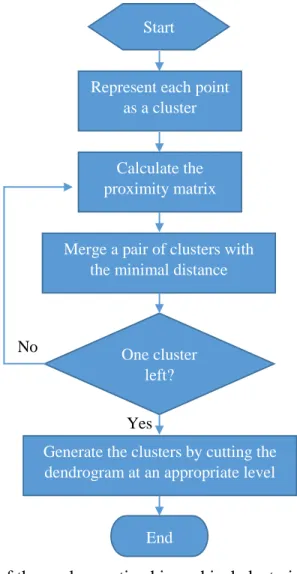
Hierarchical clustering is a method of cluster analysis in data mining, which groups data with a sequence of nested partitions, either from singleton clusters to a cluster including all individuals or vice versa (Xu, Wunsch, 2010). This method is generally divided into two types: agglomerative hierarchical clustering and divisive hierarchical clustering. Figure 4.2 below illustrates the difference between these two clustering. Agglomerative hierarchical clustering is a ‘bottom up’ method where each observation represents as an individual cluster at the beginning, two clusters are then merged in each step until all objects are forced into the same group. Divisive hierarchical clustering is a ‘top down’ method where all observations start in one cluster, and splits are performed recursively as one moves down the hierarchy (Reference 16). For this research, the agglomerative hierarchical clustering was used.
Agglomerative Hierarchical Clustering Divisive Hierarchical Clustering
Agglomerative clustering starts with N clusters, each of which includes exactly one data point. The conduction of merge operation is determined by the computation of distance, which represents the similarities and dissimilarities among clusters. If the distance between two clusters is the shortest, they will merge into a bigger cluster.
In other words, data points within the same cluster are similar to one another, and dissimilar to the data points in other clusters. The greater the similarity or homogeneity within a group and the greater the difference between groups is, the better or more distinct the clusters are. The general agglomerative clustering can be summarized by the following procedure, which is also summarized in Figure 4.3.
There are three main reasons why the clustering algorithm was implemented in the oil industry. First, data set are typically multi-dimensional, it is difficult to know their similarities or relationships. Secondly, by utilizing the clustering algorithm, it is easy to characterize the data after clusters are formed, which means the hidden knowledge and characteristics could be revealed. Last but not least, cluster results provide more information about the data set compared with the ranges, and this makes the results more accurate and reliable.
As mentioned previously, distance is important because it determines how clusters merged each other. In this research, the Manhattan Distance for numerical features dues to this method is commonly used, which is defined as:
d(p, q) = |a1x1− a1x2|+|a2x1− a2x2|+|a3x1− a3x2|+…+|anx1− anx2|
and the distance for categorical feature between p and q is:
𝑑(𝑝, 𝑞) = {1 0
𝑖𝑓 𝐴𝑁𝐷(𝑝, 𝑞) = 0 𝑜𝑡ℎ𝑒𝑟𝑤𝑖𝑠𝑒
After the computation of the Manhattan Distances the distance of each numerical feature was normalized from 0 to 1 to pair with the distance calculated in categorical features, and to ensure that all the features are equally weighted. Moreover, the weighted average linkage was utilized to define the distance function between two clusters.
Another important task is the determination of clustering levels. In this research, the clustering output for both steam flooding and EOR data sets stops at clustering level 20 with dendrograms. With these dendrograms, cluster stability analysis is studied to filter out
Start
Represent each point as a cluster
Calculate the proximity matrix
Merge a pair of clusters with the minimal distance
One cluster left?
Generate the clusters by cutting the dendrogram at an appropriate level
Yes
End
No
Figure 4.3. Flowchart of the agglomerative hierarchical clustering algorithm. (Rui Xu and Donald C. Wunsch II, 2010) [Reference 17]
the outliers and the main clusters. Therefore, by analyzing the stability of clusters, clustering level could be determined.
4.2. DESCRIPTIVE STATISTICS
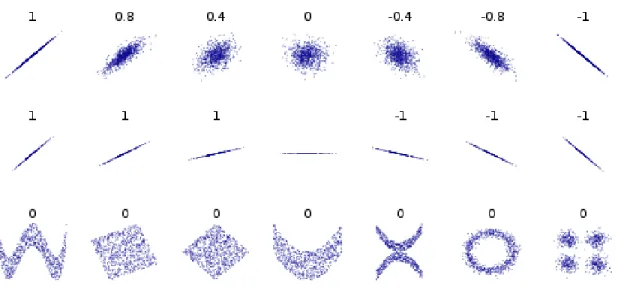
When analyzing reservoir parameters, scatter plots in correlation coefficients can quickly uncover patterns, and reduce large amount of data to a subset of interesting relationships. Correlation describes the strength the relationship between two variables, correlation coefficient ranges from -1 to 1. 1 indicates a perfect positive linear relationship and -1 in the case indicates perfect negative linear relationship. 0 indicates that variables are uncorrelated, and there is no linear relationship. Normally, the correlation coefficient lies between these values.
Figure 4.4 below illustrates the concepts. The top two rows present the linear relationships between two variables, and the bottom row indicates the non-linear relationships, which are in different shapes.
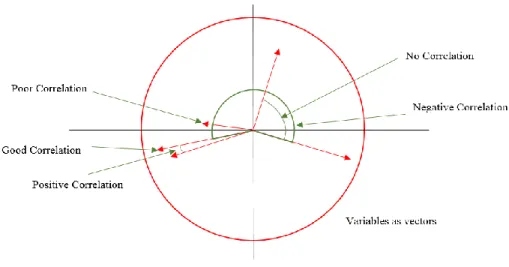
In this research, the Pearson’s Correlation Coefficient has been used to measure the strength of the association between the two properties. The modified effects of different Pearson’s Correlation Coefficients (𝑟) are shown in Figure 4.5 (Reference 57). For 𝑟 falls into the range of -0.3 to +0.3, it means the two properties are not very related to each other; for r from ±0.3 to ±0.5, it shows that the properties are relatively related; and for r equal or greater than ±0.5, it indicates that the two properties are strongly related.
Figure 4.5. Effects of different Pearson's Correlation Coefficients [modified, Reference 57]
4.3. PRINCIPAL COMPONENT ANALYSIS
In this research, Principal Component Analysis (PCA) were implemented for the following purposes: 1) to figure out the dominating factors (reservoir parameters) in the data set; and 2) to present the clustering result in a 2D map, which helps to understand the relationships between clusters and the EOR projects.
4.3.1. Principal Component Analysis. In order to understand the theory behind the PCA method, a simple example is given and shown in Figure 4.6a. For a two-dimensional (2D) data set, if one two-dimensional is the goal to achieve, in another word, reduce from two dimensional to one dimensional, a projection line will be needed to represent the
data (as the red line shown in Figure 4.6b). If the original data were projected onto a red line, green points could be get as shown in Figure 4.6c, and the distance between each point and the projected version is pretty small. Figure 4.6d displays the lower dimensional (1D) results after the dimensionality reduction. The projection line could represents the locations of the each data point with the minimized variance reduction in the original data set.
Figure 4.6. Dimensionality reduction example
Therefore, the PCA method finds a lower dimensional surface (from 2D to 1D in this case) to project the data. In other words, PCA is a method that find the minimized sum
of squares of distance between original data and the projected points. The distance between original data and the projected point is called the projection error. In a general case, for a
𝑛 dimensional data set, any dimensions (𝑘) could be achieve by implementing PCA if n>k>2.
4.3.2. Principal Component Analysis Procedures. In this subsection, the procedures for PCA is presented to help better understand the how to use PCA for a real project, especially for the steam flooding and worldwide EOR projects, which includes data pre-processing, implementation, choosing the number of principal components, and the visualization with mono plot.
Step 1. Data Pre-processing for PCA. It is always important to perform mean normalization, and then depending on the data, maybe perform feature scaling as well. Data should be prepared without missing data, duplicate data, and inconsistent data as mentioned in section 3.
Step 2. Implementation of PCA. After finishing data pre-processing, PCA were implemented. Take Figure 4.6 as an example (from 2D to 1D), there are mainly two things what PCA does. The first one is PCA helps to find the projection line (red line), the second thing is it helps to compute the numbers or the locations of the projection data on the red line. In another case, if a two dimensional data is the goal to achieve from a three dimensional data set, what PCA does is it firstly find the 2D plane with the minimum sum square of distance between the original data and the projection plane, then it needs to calculate the location of projection points in the 2D plane.
Step 3. Choosing the number of principal components. For a 𝑛 dimensional data set, a 𝑛 principal components will be got, which contains the 100% of the information of
the original data. However, to reduce the dimensions, not all principal components need to be utilized. Usually, a PCA algorithm should retain about 90% of the variance for a good result after dimensionality reduction, therefore, the number of principal components could be determined.
In this research, the agglomerative hierarchical clustering algorithm was implemented for both the steam flooding projects and the whole EOR data set. Seven important reservoir parameters were selected for steam flooding projects, and sixteen variables for the whole EOR data set. So multi-dimensional data sets (seven dimensional and sixteen dimensional) need to be presented in a two dimensional or three dimensional in order to visualize and better present our data. Meanwhile, 90% of the variance should be retained.
Step 4. Visualization using mono plot.A two dimensional correlation mono plot of the first two principal components can visualize the relationships between variables, as shown in Figure 4.7. The correlation mono plot shows vectors pointing away from the origin to represent the original variables. The angle between two vectors is an approximation of the correlation between the variables. A small angle indicates the variables are positively correlated, and angle of 90 degrees indicates the variables are not correlated, and an angle close to 180 degrees indicates the variables are negatively correlated. The length for the line and how it closes to the circle indicates how well the variable is represented in the plot.
5. RESULTS FROM STEAM FLOODING DATA SET
In this section, the results of the hierarchical clustering analysis, descriptive statistics, and the principal component analysis are displayed for the steam flooding projects.
5.1. HIERARCHICAL CLUSTERING RESULTS
After the implementation of hierarchical clustering algorithm, 20 clusters were achieved. Figure 5.1 is the compact visualization of the results, and Figure 5.2 indicates the detailed clustering results of clustering level 20.
Figure 5.1. Steam flooding clustering results (from 1980 to 2012 Oil and Gas Journal)
The horizontal axis in Figure 5.1 represents clusters, and the vertical axis indicates the distance between clusters. With the process of clusters merge, the distance between clusters are greater, which means clusters are more dissimilar.
269279276383387337 1253353386385 76156157361355371 7 15153255 82138 87136185 11 16 20 49360370372349 93356363362366167231232244297236180352240305357368374373382358364365359369376381377378379375380384345351354 9 10 21 22324325326 23330323341342347348 17 18 95115104106105117119118120 94238 38 39190319 81133134186184209212211280287 80 84 91 92150160169152161162163168165166235237243207218271277213288254283289286292293294295220224225226229222234298301296124126164291147284290233239299300303304149154221230208241307247 79116 88 90 89204155158159228100101108242256258257302 85 86110 99320331103107125327328332339321334335336333 25 26137 27148227135217195196201223268272281275270316273315317314 45 51 46 47 48200188191122182130 73318388389260 77112113114139142143197202203205179282193194267140145141189199146216285151210144206219274278123183187131259178 58306 2 3 4 5 6198 8 78 83111102127170 74 75 40129264 28 30 31 29 32 33 37 34 35 36 41 50 52 53 56 57 60 61 63 55 62 59 64 65 66329 69 70 67 68 72 71132262265263266322338340 97 98192215214245246 12 13 19 96173174109121176177308310311309 14 24249250367 54171172343346350344175248 42 43 44181252251261312313128 0 0.5 1 1.5 2 2.5
As seen from the dendrogram in Figure 5.2, the hierarchy structure of all the steam flooding data is clearly laid out. Each element in the dendrogram represents the hierarchical clustering result at each clustering level. In this dendrogram, S stands for sandstone formation, D represents dolomite formation, U indicates the unconsolidated sandstone formation, C is the conglomerate formation, and L is the limestone formation. Figure 5.3 is the expressions of one cluster from cluster level 9. C1 (301S+1D+1C) represents the name of this cluster is called cluster 1, and it is the biggest cluster in this level. This cluster includes 301 records with sandstone formation type, 1 record of dolomite formation, and 1 record of conglomerate formation.
Figure 5.3. Expression of the Cluster 1 in cluster level 9
Since the agglomerative hierarchical clustering algorithm were used as indicated before, this dendrogram is a bottom-up structure, which starts at the bottom of the dendrogram and treat each project as an individual cluster. Clusters are merged each other into a bigger cluster at each clustering level by compute and compare the distances until all the projects were formed into the same cluster. In other words, clusters with similar characteristics are tend to merge earlier in the dendrogram, vice versa.
As illustrated in the dendrogram, all the elements are well distributed based on the formation type. Moreover, on the right side of the dendrogram, cluster 17 and cluster 19 formed a quite stabled cluster during the hierarchical clustering process. In this case, cluster 17 and cluster 19 represents were considered as outliers in the data set because they are dissimilar with other clusters so that they are not able to merge with other clusters.
In order to get better understanding of each specific cluster and to study the characteristics for each cluster, the domain knowledge of steam flooding and range for each properties are applied as shown in Table 5.1 based on the study of steam flooding projects data set and the common knowledge for steam flooding.
Table 5.1. Domain knowledge for steam flooding
Property Category Average value range
Oil viscosity (cp)
High ≥5000
Medium [1000, 5000]
Low <1000
Formation porosity (%) High [25,50]
Low <25 Formation permeability (md) High ≥ 5000 Intermediate high [1000, 5000] Intermediate low [100, 1000] Low <100 Formation depth (ft) Deep ≥ 3000 Intermediate deep [1000, 3000] Intermediate shallow [500, 1000] shallow <500
Table 5.1. Domain knowledge for steam flooding (cont.)
Formation temperature (oF)
High ≥ 250
Medium [100, 250]
Low [45, 100]
Oil saturation before steam flooding (%)
High [70, 100]
Medium [30, 70]
Low <30
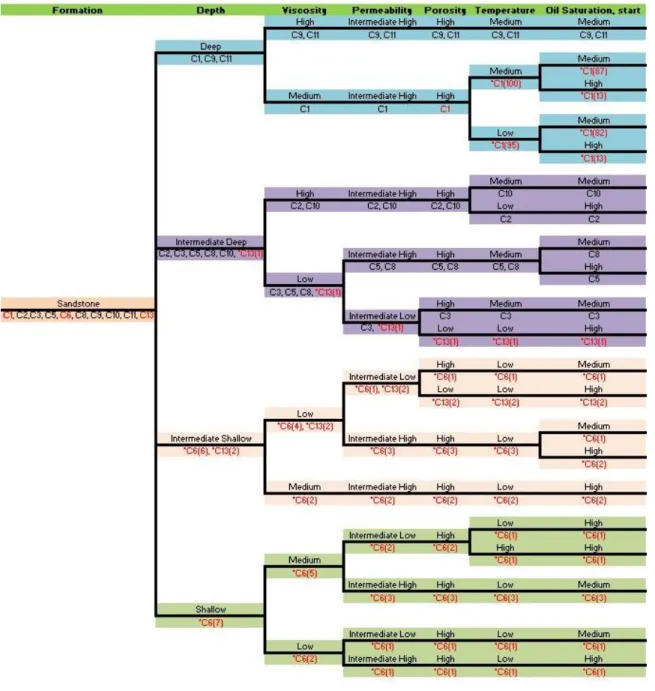
From the dendrogram, the hierarchy structure is very obvious, and each cluster represents one type of the formation type, which means formation type is an important feature that determines whether or not clusters merge into a bigger cluster. Meanwhile, since the formation type was the only categorical feature in the data set, the boundary domain of each formation type is very obvious, and it is easy to identify the difference between compositions of formations. While other numerical features or properties are set into a rough range rather than a specific precise number. Therefore, the formation type is a good indicator for clustering, and the formation type was utilized to study the main characteristics of each cluster. Figure 5.4 and Figure 5.5 below present the characteristics of clusters for sandstone and unconsolidated sandstone, respectively.
In construction of these two diagrams below, small clusters having only one record each or those with the sandstone formation having less than 5 records are considered special clusters. They are analyzed separately. As the two branch charts illustrated, each branch clearly present the characteristics of one cluster. For example, most projects in cluster 1 are in deep formations, which normally deeper than 3000 ft, and they have medium viscosity, intermediate permeability, high porosity, low to medium temperature,
and medium to high oil saturation. In other words, the branch of cluster 1 represents the common reservoir property ranges similarly like the conventional screening methods. However, the other branches also explains different suitable cluster ranges under different reservoir conditions.
Figure 5.4. Cluster characterization of steam flooding applications on sandstone formations. The red colored clusters have less dominating value ranges so that all the detailed categories are presented; the black colored clusters have dominating categories in respective properties
Figure 5.5. Cluster characterization of steam flooding applications on unconsolidated sands formations. The red colored clusters have less dominating value ranges so that all the detailed categories are presented; the black colored clusters have dominating categories in respective properties.
Moreover, steam flooding has a wide application with different reservoir conditions. For sandstone formations, the formation depth varies significantly, from 100 feet to 9000 feet; each depth category reveals different associations among selected properties. For example, deep formation applications correspond to viscous oils, high porosity and intermediate high permeability, initial oil saturation greater than 70%, but there are significant number of applications fall into low temperature range of 45 ~ 100 ˚F; yet
shallow formation applications correspond to the same high porosity but lower permeability formations, lower viscous oils and lower formation temperatures.
Comparing with a simple screening table presents in conventional screening methods, by having these two branch charts, more detailed screening information are displayed. Moreover, for a new project, if the formation type is unconsolidated sandstone, and the depth is intermediate deep, the viscosity falls into the range of low, and has high permeability and high porosity, the ranges of temperature and oil saturation could be achieved.
5.2. DESCRIPTIVE STATISTICS
After the clustering results, descriptive statistics methods were utilized to understanding the relationship between reservoir parameters.
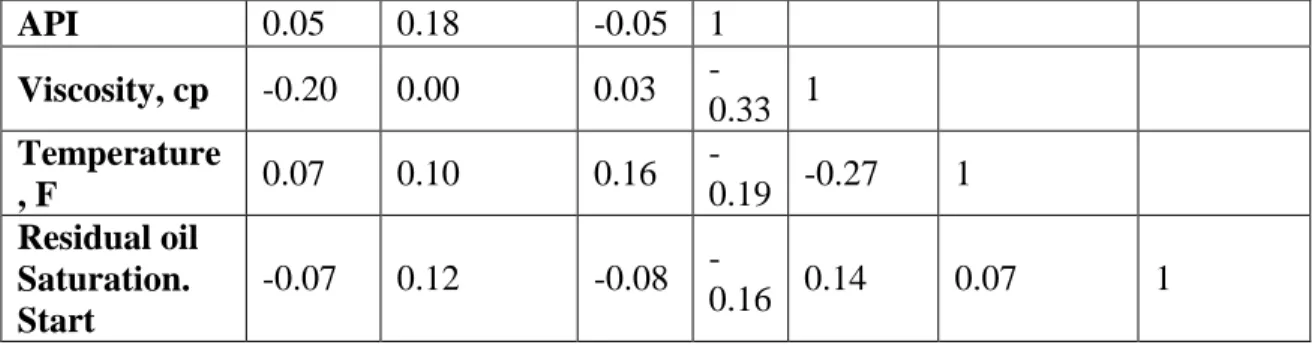
5.2.1. Correlation Coefficient. Tables of 5.2 and 5.3 indicate the Pearson’s Correlation Coefficient between paired properties for the two biggest clusters (cluster 1 and cluster 2), respectively. From cluster 1, the biggest correlation coefficient is between the viscosity and API, which is -0.33; and the least related features are viscosity and permeability. In cluster 2, the strongest relationship is between API and temperature, which is -0.47, and the least related properties are temperature and permeability.
Table 5.2. Pearson’s Correlation Coefficients between paired properties for cluster 1
Porosit y % Permeabilit y, md Dept h, ft AP I Viscosit y, cp Temperatur e, F Residual oil Saturatio n. Start Porosity % 1 Permeabilit y, md 0.06 1 Depth, ft -0.30 0.08 1
Table 5.2. Pearson’s Correlation Coefficients between paired properties for cluster 1 (cont.) API 0.05 0.18 -0.05 1 Viscosity, cp -0.20 0.00 0.03 -0.33 1 Temperature , F 0.07 0.10 0.16 -0.19 -0.27 1 Residual oil Saturation. Start -0.07 0.12 -0.08 -0.16 0.14 0.07 1
Table 5.3. Pearson’s Correlation Coefficients between paired properties for cluster 2
Porosi ty % Permeabili ty, md Dept h, ft AP I Viscosit y, cp Temperatu re, F Residual oil Saturatio n. Start Porosity % 1 Permeabilit y, md -0.29 1 Depth, ft -0.30 0.28 1 API -0.09 -0.39 -0.21 1 Viscosity, cp 0.06 0.20 -0.22 -0.3 2 1 Temperatu re, F 0.31 0.01 0.27 -0.4 7 -0.11 1 Residual oil Saturation. Start -0.06 -0.16 -0.36 -0.1 6 0.23 -0.21 1
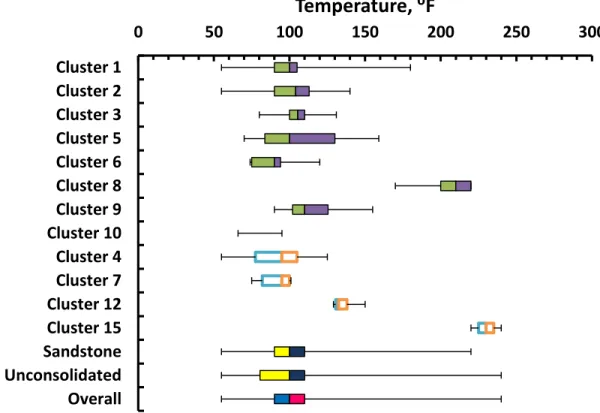
Even though the relationship associations are different in some of the paired properties, for example, in cluster 1, porosity is positively associated with permeability, which is 0.06; while it is negatively associated in cluster 2, which is -0.29, the most of the paired properties have a consistent relationships. For instance, the relationship between API and temperature is always negatively associated, which means with the increase of
temperature, the API drops down. Similarly, saturation vs. porosity, depth, and API; API vs. depth, viscosity, and temperature; and temperature vs. viscosity are all negatively correlated. On the other hand, permeability vs. depth and temperature; temperature vs. porosity and depth; and saturation vs. viscosity are positively associated.
5.2.2. Box Plots. To better understanding the characteristics of each clusters, boxplot and bar charts have been used to represents the ranges of each cluster and the distribution of properties for each cluster. These two sets of plots are generated for both sandstone formations and unconsolidated sand formations.
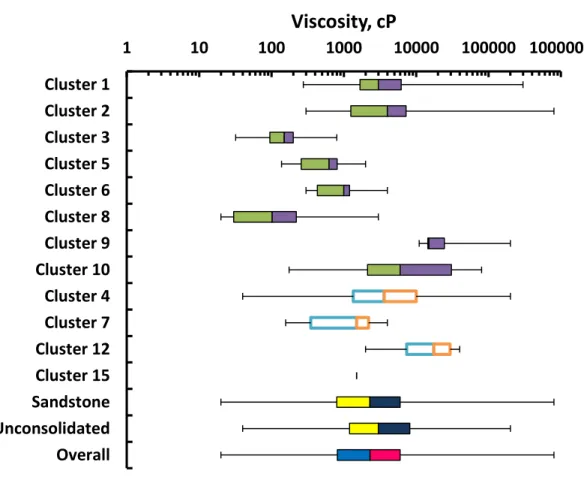
Figures 5.6 to 5.12 present the boxplots of each reservoir parameter, which are porosity, permeability, depth, API gravity, temperature, viscosity and oil saturation at start.
Figure 5.6. Porosity ranges in boxplot for steam flooding projects (from 1980 to 2012 Oil and Gas Journal)
15 20 25 30 35 40 45 Cluster 1 Cluster 2 Cluster 3 Cluster 5 Cluster 6 Cluster 8 Cluster 9 Cluster 10 Cluster 4 Cluster 7 Cluster 12 Cluster 15 Sandstone Unconsolidated Overall
Porosity, %
From this plot, the overall ranges of porosity for steam flooding projects is from 18 to 40.5. The difference between sandstone formation and unconsolidated sandstone formation is not obvious. However, unconsolidated sandstone formation tends to have relatively biased porosity. For example, cluster 7 mainly includes the steam flooding projects with high porosity, while main projects in cluster 12 has low porosity. For both formation type, most projects falls into the porosity ranges from 30 to 35.
Figure 5.7. Permeability ranges in boxplot steam flooding projects (from 1980 to 2012 Oil and Gas Journal)
Figure 5.7 above presents the ranges of permeability for steam flooding projects. The overall ranges of permeability is from 11mD to about 20000 mD, and most of the projects have the permeability from 1000 mD to 3000 mD. For the sandstone formation type, the permeability of cluster 3 seems to have large distance with other clusters because
1 10 100 1000 10000 100000 Cluster 1 Cluster 2 Cluster 3 Cluster 5 Cluster 6 Cluster 8 Cluster 9 Cluster 10 Cluster 4 Cluster 7 Cluster 12 Cluster 15 Sandstone Unconsolidated Overall
Permeability, mD
this cluster involves the majority of the projects with low permeability. Cluster 10 tends to include the projects with high permeability. For the unconsolidated formation type, the ranges of permeability is relatively more concentrated because there are less steam flooding projects with this formation type compared with sandstone formations. As we could see in the plot, most projects in cluster 7 has almost the same permeability values, which is about 1500 mD.
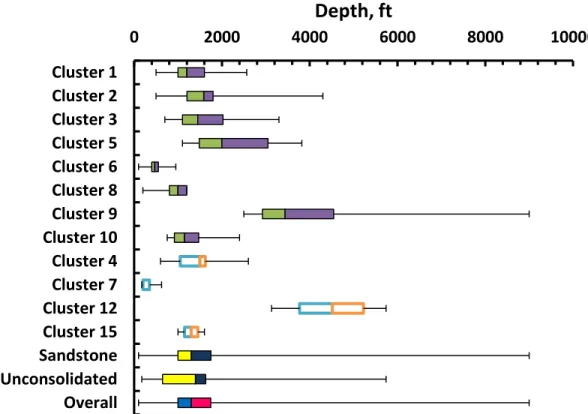
Figure 5.8. Depth ranges in boxplot steam flooding projects (from 1980 to 2012 Oil and Gas Journal)
Figure 5.8 shows the ranges of depth for steam flooding projects. The overall projects have a huge ranges from extremely shallow reservoirs (about 100 ft) to very deep reservoirs (about 9200 ft). Based on the ranges of each cluster, we could find that some of the clusters are very unique, and some of the clusters have similar ranges. For example,
0 2000 4000 6000 8000 10000 Cluster 1 Cluster 2 Cluster 3 Cluster 5 Cluster 6 Cluster 8 Cluster 9 Cluster 10 Cluster 4 Cluster 7 Cluster 12 Cluster 15 Sandstone Unconsolidated Overall
Depth, ft
cluster 6 and cluster 7 are very special in terms of depth among all clusters, both of them includes the projects with extremely shallow reservoirs. Cluster 1, 2, and cluster 3 have similar ranges of depth, which means the distance of depths for these three clusters are very small.
Figure 5.9. Gravity ranges in boxplot for steam flooding projects (from 1980 to 2012 Oil and Gas Journal)
Figure 5.9 illustrates the ranges of API gravity for all clusters, which is from 7 ˚API to 25 ˚API. This ranges indicates that all the steam flooding projects in this data set are heavy oil. What’s more, it is very surprising that the main ranges of gravity for both sandstone formation type and unconsolidated formation type are exactly the same, which shows that the formation type does not have large influence to the oil gravity.
0 5 10 15 20 25 30 Cluster 1 Cluster 2 Cluster 3 Cluster 5 Cluster 6 Cluster 8 Cluster 9 Cluster 10 Cluster 4 Cluster 7 Cluster 12 Cluster 15 Sandstone Unconsolidated Overall
![Figure 2.2. Steam flooding process [Amjad Sha, 2010]](https://thumb-us.123doks.com/thumbv2/123dok_us/10961121.2984446/18.918.301.672.639.903/figure-steam-flooding-process-amjad-sha.webp)
![Figure 2.3. CO 2 flooding process [Reference 14]](https://thumb-us.123doks.com/thumbv2/123dok_us/10961121.2984446/20.918.224.750.201.513/figure-flooding-process-reference.webp)