1
CHALLENGES EXPERIENCED BY PHYSICAL SCIENCES TEACHERS WITH
THE IMPLEMENTATION OF THE CURRICULUM AND ASSESSMENT POLICY
STATEMENT IN SELECTED EASTERN CAPE SCHOOLS
by
MANDLA KOTI
submitted in accordance with the requirements
for the degree of
MASTER OF EDUCATION WITH SPECIALISATION IN CURRICULUM
STUDIES
at the
UNIVERSITY OF SOUTH AFRICA
SUPERVISOR: PROFESSOR JG FERREIRA
FEBRUARY 2016
2 DECLARATION
I, MANDLA KOTI, do hereby declare that this dissertation is the result of my own investigation and research and that it has not been submitted in part or full for any other degree or to any other university.
3 ACKNOWLEDGEMENTS
I take this opportunity to tender my thanks to all the people who assisted me when I was doing this research. That I have completed this investigation is due to this assistance that you gave me. Your help to me was in various forms. These included participating in the interviews and supplying the relevant information that I needed to complete the project, advising and encouraging me to carry on with the investigation, allowing me to do research in your schools, taking time to talk to me when I visited your schools and offices so that this project would be a success; you were really keen to assist me.
It will not be possible for me to name all the people who helped me in this project but I do feel that I should mention my supervisor Prof JG Ferreira without whom I could not have even commenced this investigation. Her wisdom and warmth of personality greatly assisted and spurred me on to complete this research. I also express my thanks to the people of the University of South Africa who work in the library for providing me with everything that I asked them to give me as well as the people who work in the registration offices for the invaluable assistance they gave me. I tender my thanks to the Research Ethical Clearance Committee of the College of Education of the University of South Africa for granting me the opportunity to do this research.
I tender my thanks also to my wife and children who supported me when doing the investigation.
I tender my thanks to God who in Christ gave me the opportunity to complete this project. I thank you all
Sincerely Mandla Koti
4 ABSTRACT
Learners who take Physical Sciences in the Further Education and Training Phase in Eastern Cape schools have been performing poorly in the subject in the final examinations in Grade 12. This raised the concern of the researcher to determine issues that underlie this. In attempting to determine the cause of the poor results, a Physical Sciences subject advisor and six Physical Sciences teachers were interviewed to gather information on this problem. The following issues were considered: the Physical Sciences curriculum, the nature and structure of the Curriculum and Assessment Policy Statement (Physical Sciences), learner performance in Physical Sciences, a review of literature on science teaching, strategies of teaching and learning, the role of science teachers, classroom interaction between teachers and learners and the challenges experienced with science teaching. Data collected through the interviews were analysed leading to the identification of core issues and recommendations on how to address these. Key terms: Further Education and Training; Learning Programme; Physical Sciences Theory; Practical Work; Poor Performance; Curriculum and Assessment Policy Statement; Learner; Educator; Subject; Learning Outcomes.
5 ACRONYMS
CAPS = Curriculum and Assessment Policy Statement CoP = Community of Practice
CTAs = Common Tasks of Assessments DBE = Department of Basic Education FAL = First Additional Language FET = Further Education and Training GET = General Education and Training IKS = Indigenous Knowledge System IP = Intermediate Phase
LTSM = Learning and Teaching Support Materials MTT = Ministerial Task Team
NCS = National Curriculum Statement NDE = National Department of Education NGOs = Non-Governmental Organisations NQF = National Qualifications Framework OBE = Outcomes–Based Education
RNCS = Revised National Curriculum Statement RSA = Republic of South Africa
SASA = South African Schools Act SMT = School Management Team
6
Table of Contents
Declaration
2
Acknowledgements
3
Abstract
4
Acronyms
5
CHAPTER 1 12 ORIENTATION 12 1.1 INTRODDUCTION 12 1.2 CURRCULUM CHANGE 131.3 PHYSICAL SCIENCES AND THE LEARNERS 16
1.4 TEACHING PHYSICAL SCIENCES 18
1.5 THE RESEARCH PROBLEM 21
1.6 THE RESEARCH QUESTION 22
1.7 AIMS AND OBJECTIVES OF THE STUDY 22
1.8 THE RESEAECH DESIGN 23
1.9 SIGNIFICANCE OF STUDY 24
1.1O OUTLINE OF THE CHAPTERS 26
CHAPTER 2 28
7
2.1 INTRODUCTION AND RATIONALE 28
2.1.1 Introduction 28
2.1.2 Rationale for teaching science 28
2.2 CONCEPTUAL UNDERPINNINGS OF THE RESEARCH 29
2.2.1 Context of implementation 29
2.2.2 Research paradigm 32
2.3 CAPS: PHYSICAL SCIENCES 33
2.4 PHYSICAL SCIENCES TEACHING AND LEARNING 36 2.4.1 Strategies of teaching and learning 36 2.4.2 The role of Physical Sciences teachers 39
2.4.3 The role learners 42
2.4.4 Classroom interaction between teachers and learners 48 2.4.5 Challenges experienced with Physical Sciences teaching 49
2.5 CONCLUSION 50
CHAPTER 3 51
RESEARCH METHODOLOGY 51
3.1 INTRODUCTION 51
3.2 RESEARCH DESIGN 51
3.2.1 Defining a research design 51
8
3.2.3 Case study design 53
3.2.4 Interviewing strategy 54
3.3 CONCEPTUALISING SAMPLING 55
3.3.1 Population 55
3.3.2 Sampling 56
3.3.3 Selection of participants 56
3.4 ETHICAL ASPECTS OF RESEARCH 57
3.5 INTERVIEW SCHEDULES FOR DATA COLLECTION 60 3.6 DATA COLLECTION, ANALYSIS AND INTERPRETATION 62
3.6.1 Data collection 62
3.6.2 Data analysis and interpretation 63
3.7 INSTRUMENT RELIABILITY AND CREDIBILITY OF DATA 64 3.7.1 Data reliability and credibility 64
3.7.2 Piloting the study 66
3.7.3 Triangulation 66
3.8 CONCLUSION 67
CHAPTER 4 68
FINDINGS AND DISCUSSION OF FINDINGS 68
4.1 INTRODUCTION 68
4.2 FINDINGS AND DISCUSSION OF FINDINGS 68 4.2.1 BIOGRAPHICAL PROFILE OF PARTICIPANTS 68
9
4.2.1.1 What are your qualifications? 68
4.2.1.2 In which grade/s are you teaching Physical Sciences? 70 4.2.1.3 How long have you been teaching Physical Sciences? 70 4.2.2 HOW WELL DO YOUR PHYSICAL SCIENCES LEARNERS PERFORM? 71 4.2.3 TEACHING THEORY IN PHYSICAL SCIENCES 74 4.2.3.1 What problems do you encounter when teaching theory in Physical Sciences?
74 4.2.3.2 What equipment does your school have which enables you to do your work?
78 4.2.3.3 How do you solve these problems? 79
4.2.4 EXPERIMENTAL ISSUES 81
4.2.4.1 Do you perform experiments in your school? 81 4.2.4.2 Is your laboratory well – equipped for you to do your work well? 83 4.2.4.3 What problems do you encounter when you teach practical work in Physical
Sciences? 84
4.2.4.4 How do you solve these problems? 87 4.2.5 DO YOU GET ANY ASSISTANCE FROM THE SCHOOL MANAGERS IN YOUR
SCHOOL? 89
4.2.6 WHAT ASSISTANCE DOES YOUR DISTRICT OFFICE OFFER YOU THROUGH THE
SUBJECT ADVISOR? 90
4.2.7 IS THE ASSISTANCE YOU ACQUIRE FROM THE SCHOOL MANAGERS AND THE
SUBJECT ADVISOR ADEQUATE? 93
4.2.8 WHAT MORE COULD BE DONE TO ASSIST YOU IMPROVE YOUR WORK? 95 4.2.9 ARE YOU SATISFIED WITH YOUR WORK AS A SCIENCE TEACHER? 97
10
CHAPTER 5 99
CONCLUSIONS AND RECOMMENDATIONS 99
5.1 INTRODUCTION 99
5.2 SUMMARY OF THE RESEARCH 99
5.2.1 BIOGRAPHICAL PROFILE OF PARTICIPANTS 99
5.2.1.1 What are your qualifications? 99
5.2.1.2 In which grade/s are you teaching Physical Sciences? 100 5.2.1.3 How long have you been teaching Physical Sciences? 101 5.2.2 HOW WELL DO YOUR PHYSICAL SCIENCES LEARNERS PERFORM? 101 5.2.3 TEACHING THEORY IN PHYSICAL SCIENCES 101 5.2.3.1 What problems do you encounter when teaching theory in Physical Sciences?
102 5.2.3.2 What equipment does your school have which enables you to do your work? 102 5.2.3.3 How do you solve these problems? 102
5.2.4 EXPERIMENTAL ISSUES 103
5.2.4.1 Do you perform experiments in your school? 103 5.2.4.2 Is your laboratory well – equipped for you to do your work well? 103 5.2.4.3 What problems do you encounter when you teach practical work in Physical
Sciences? 103
5.2.4.4 How do you solve these problems? 104 5.2.5 DO YOU GET ANY ASSISTANCE FROM THE SCHOOL MANAGERS IN YOUR
11
5.2.6 WHAT ASSISTANCE DOES YOUR DISTRICT OFFICE OFFER YOU THROUGH THE
SUBJECT ADVISOR? 105
5.2.7 IS THE ASSISTANCE YOU ACQUIRE FROM THE SCHOOL MANAGERS AND THE
SUBJECT ADVISOR ADEQUATE? 106
5.2.8 WHAT MORE COULD BE DONE TO ASSIST YOU IMPROVE YOUR WORK? 106 5.2.9 ARE YOU SATISFIED WITH YOUR WORK AS A SCIENCE TEACHER? 107
5.3 RECOMMENDATIONS 107
5.3.1 Department of Education 108
5.3.2 The participating schools 109
5.4 REFLECTION ON THE STUDY 109
5.5 LIMITATIONS 110
5.6 REFLECTION ON THE RESEARCH RESULTS 110
5.7 FURTHER RESEARCH 111 5.8 CONCLUSIONS 111 6 REFERENCES 113 7 APPENDIX A 118 8 APPENDIX B 119 9 APPENDIX C 121
12 CHAPTER 1 ORIENTATION
1.1 INTRODUCTION.
Learners in the Eastern Cape have persistently performed unsatisfactorily in terms of results during the past decade. This is particularly the case in science-related subjects. Learners taking Physical Sciences have constantly produced unsatisfactory results. These are predominantly learners from previously disadvantaged schools. The pass rate for Physical Sciences in the Ngcobo District of Eastern Cape Province has averaged below 30% in 2010. For paper 1 the percentage of those who passed was 27,3; and for those who passed paper 2 it was 30,7. (Assessment and Examinations Directorate, 2010:16&22). The Provincial percentage pass for paper 1 was 25,2; and for paper 2 it was 28,4 (Assessment and Examinations Directorate, 2010:16&22). This problem though is seemingly not for the Eastern Cape alone but for South Africa as a whole for Educare (1998:7) states that South African schools are not in a position to be complacent about or proud of the standard of science teaching if the 1997 matriculation examination result in Gauteng is anything to go by because 54% of the learners passed Physical Sciences in that year. Muzah (2011:7) states that corresponding evidence is established from more recent results which shows that of the 724 learners who wrote science at matriculation level in Alexandra Township (Gauteng Province) high schools in the year 2006, only a negligible 5,3 per cent passed science at higher grade. In South African context, a science learner should obtain 30% to pass science while 29% is considered as a fail. Setati (2011:5) states that in a world-wide study on science achievement, the Third International Mathematics and Science Study (TIMSS) report of 1995 and the Third International Mathematics and Science Study report of 1998, South Africa performed worst among 38 participating countries. The grades 7 and 8
13
and grade 12 learners representing South Africa were considered scientifically illiterate; especially female learners from all population groups performed particularly poorly.
Some sort of intervention is therefore necessary and with the implementation of the Curriculum and Assessment Policy Statement (NCS, 2011:iii), it has become necessary to investigate the reasons for poor learner achievement and to identify possible strategies to solve this problem. This research consequently intends to get information from teachers about the problems they experience in their daily work as they implement CAPS Physical Sciences in the Further Education and Training (FET) band in four selected schools of Ngcobo District of the Eastern Cape.
1.2 CURRICULUM CHANGE
The adoption of the Constitution of the Republic of South Africa (Act 108 of 1996) (in 1997) provided a basis for curriculum transformation and development in South Arica. The Constitution states that it aims to heal the divisions of past and establish a society based on democratic values, social justice and fundamental human rights; as well as to improve the quality of life of all citizens and free the potential of each person; and to further education which the State, through reasonable measures, must make progressively available and accessible. (National Curriculum Statement, 2003:1). Gultig, Hoadley and Jansen (2002:30) state that the National Department of Education (NDE) published its first official statement on outcomes-based education in March 1997 with the launch of Curriculum 2005 on 27 March 1997. According to Gultig et al (2002:73) outcomes-based (OBE) education had to be implemented in all grade 1 classrooms across the country in January 1998. By way of definition a learning outcome is a statement of an intended result of learning and teaching (National Curriculum Statement, 2003:7). Outcomes describe knowledge, skills, and values that learners should acquire by the end of the Further Education and Training band (FET). Curriculum 2005 was fraught with challenges due to insufficient teacher training and a rush to effect change (Jansen, 1999). Gultig et al (2002:85) state that although Curriculum 2005 was still being introduced into the Foundation Phase at the time of the research, many of the teachers
14
observed were not yet engaged in implementing the new curriculum; but the investigation revealed a great deal of unfocused and unsystematic teaching which seemingly was in danger of becoming more prevalent and even more confused as a result of widespread misinterpretation of what outcomes – based education was all about. In the South African context, educators had barely achieved stability with Curriculum 2005 when it was amended to the Revised National Curriculum Statement (RNCS) and shortly afterwards the National Curriculum Statement (NCS). Setati (2011:142) states that the failure of the OBE methodology was exacerbated by the introduction of a whole lot of policies which were implemented at the same time without being thought through and without having the proper resources for implementation.
In 2009 the Minister Mrs Angie Motshekga of the Department of Basic Education appointed a Ministerial Task Team (MTT) to review the implementation of the National Curriculum Statement from grades R to 12. Its brief was to identify the challenges and pressure points that impact negatively on the quality of teaching in schools and to propose mechanisms that could address these (Curriculum News, 2011:4). The report of the Ministerial Task Team made several recommendations to improve the curriculum, and on 20 October 2009 the Minister announced her decision to implement the recommendations. The Minister categorized the recommendations into those for the short term and those for the long term (Curriculum News, 2011:4). Recommendations for the short term were implemented in 2010. These were the discontinuation of learner portfolios; the requirement for a single teacher file for planning; the reduction of the number of projects required from learners; and the discontinuation of common tasks of assessments (CTAs). Longer term recommendations were to be implemented between 2012 and 2014 namely the reduction of the number of learning areas in the Intermediate Phase (IP) of the General Education and Training (GET) band; the teaching of English as a First Additional Language (FAL) to be given priority alongside the mother tongue and that it should be taught from Grade 1; regular external systematic assessment of Mathematics, the home language and English First Additional Language in Grades 3, 6 and 9; and the development of the National Curriculum and Assessment Policy Statements (CAPS) per subject (Curriculum News, 2011:4).
15
These actions by the Minister of Basic Education suggest that she identified a problem in the NCS and decided to rectify the situation. This is further inferred in the recommendations that she accepted from the Task Team and henceforth used as a benchmark for future planning. The Minister accepted the recommendations of the Task Team and acted on them as she possibly desired to eliminate uncertainty in policy implementation. Teacher Toolkit (2012:2) has stated that CAPS is not a new curriculum, but an amendment to the NCS Grades R-12 Subject Statements. It therefore still follows the same requirements of process and procedure as described in the NCS Grades R-12. This view is supported by the Minister of Basic Education Mrs Angie Motshekga in NCS (2011:III) where she states that the National Curriculum Statement for Grades R – 12 builds on the previous curriculum but also updates it and aims to provide a clearer specification of what is to be taught and learnt on a term – by –term basis. CAPS is an adjustment to what is taught (curriculum) and not how it is taught (teaching methods). It is the curriculum that has changed and not the teaching methods. There is much debate and discussion about outcomes-based (OBE) being removed, however OBE is a method of teaching and not a curriculum. Nevertheless the way the curriculum is written is now in content format rather than an outcomes format, so it is more prone to traditional teaching methods rather than OBE (Teacher Toolkit, 2012:2).
The Department of Basic Education has stated that the Regulations pertaining to the National Curriculum Statement Grades R-12 represents a policy statement for learning and teaching in South African schools and has CAPS as one of its components for each approved school subject, including Physical Sciences (NCS, 2011:iii). For all subjects, provincial and district subject advisors were trained in preparation for the curriculum changes that would be made and for the implementation of CAPS in the various phases. Core training materials had to be provided to ensure consistency throughout the system. The task of the subject advisors was to then familiarise teachers with the content, assessment, teaching methodology, resources and management of classrooms in CAPS in each of the districts (Curriculum News, 2011:16 – 17). However Setati (2011:141) states that OBE training of educators had not been extensive enough and that outcomes – based education was rushed into South African schools and teachers were inadequately prepared to cope with the curriculum changes.
16 1.3 PHYSICAL SCIENCES AND THE LEARNERS.
For certification purposes a successful learner who has complied with the programme and promotion requirements as stated in CAPS will be issued with the National Senior Certificate (NCS, 2011:28). The National Senior Certificate fulfils a number of goals, namely that it has a defined purpose and provides qualifying learners with applied competence and a basis for further learning; it enriches the qualifying learner and provides benefits to society and the economy; it complies with the objectives of the National Qualifications Framework (NQF); it incorporates integrated assessment, and sets the rules governing the award of the qualification. Against these certification requirements, learners’ performance in Physical Sciences is reviewed and what first prompted the need for this study.
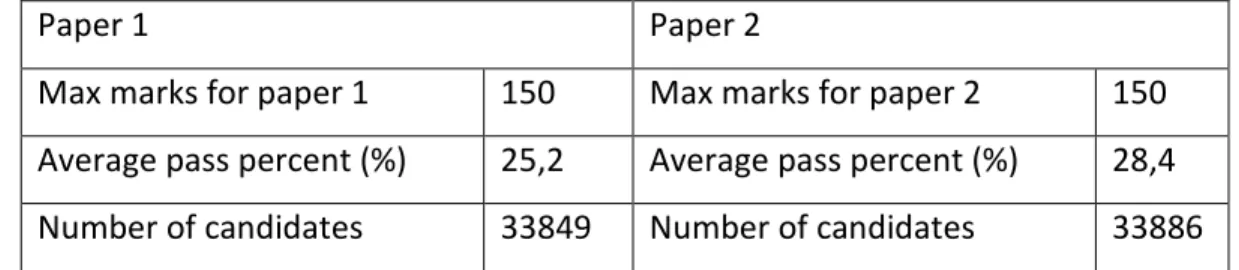
In 2011 the Eastern Cape Department of Education released a document showing the performance of learners who sat for the grade 12 Physical Sciences and Mathematics examinations in 2010. This document indicates the performance of learners in the Province and in the clusters which are made up of various school districts. There are three clusters in the Eastern Cape. Table 1.1 shows the performance of learners in papers 1 and 2 in Physical Sciences in 2010 in the Eastern Cape.
Table 1.1: Physical Sciences results in the Eastern Cape (NCS Mathematics and Physical Science: Question by Question Project Analysis, 2010).
Paper 1 Paper 2
Max marks for paper 1 150 Max marks for paper 2 150
Average pass percent (%) 25,2 Average pass percent (%) 28,4
17
From the table the poor performance of learners is evident. Only 25,2% of the learners who wrote paper 1 passed and 28,4% passed paper 2. The only deduction that can be made out of this is that there is a fundamental problem that underlies this unacceptable performance in the Eastern Cape, because this clearly shows that the learners of the Province were not doing well in Physical Sciences and consequently that this be investigated. The Provincial pass rate for Physical Sciences from 2011 to 2013 reflects an improvement. In 2011, 48,2% of the learners passed ; in 2012, 50,5% passed and in 2013, 53,8% passed. Although the pass rate has improved, what raises concern is the decrease in the number of candidates.
In Table 1.2 the numbers of learners and the percentages of passes per category are set out. Table 1.2: Physical Sciences results in the Eastern Cape 2011-2013 (National Senior Certificate Results 2013 – 07 January 2014) Category 2011 2012 2013 Number of candidates 26 367 25 603 25 218 Fail: 0% - 29% 13663 (51,8%) 12681 (49,5%) 11156 (44,2%) Pass: 30% -39% 5860 (22,2%) 5986 (23,4%) 6527 (25,9%) Pass: 40% - 49% 3079 (11,7%) 3201 (12,5%) 3612 (14,3%) Pass: 50% - 59% 1783 (6,8%) 1799 (7.0%) 1972 (7,8%) Pass: 60%- 69% 952 (3,6%) 945 (3,7%) 1082 (4,3%) Pass: 70% - 79% 568 (2,2%) 622 (2,4%) 531 (2,1%) Pass: 80% - 100% 454 (1,7%) 354 (1,4%) 337 (1,3%)
The statistics in Table .1.2 still shows that very few learners delivered a satisfactory performance in these years. This research therefore endeavours to identify some of the underlying factors that could be responsible for the poor achievement of learners in Physical Sciences particularly in the selected schools of the Ngcobo District of the Eastern Cape.
18
Table 1.3: Physical Sciences results of the Ngcobo District (NCS Mathematics and Physical Science: Question by Question Project Analysis 2010)
Paper 1 Paper 2
Maximum marks 150 Maximum marks 150 Average pass percent 27,3 Average pass percent 30,7 Number of candidates 649 Number of candidates 649
In 2010 in the Ngcobo District only 27,3% of the candidates passed paper 1. Paper 2 had only 30,7% of the candidates passing that year. This shows that there is a problem of poor performance in the District when it comes to Physical Sciences performance.
The preceding discussions focussed on the Physical Sciences CAPS curriculum and learners’ performance in the Eastern Cape to which belongs the Ngcobo District. In an attempt to determine what could be done to address the issue, it is necessary to review literature on the teaching and learning of Physical Sciences in an attempt to determine the causes of poor learner achievement in this field.
1.4 TEACHING PHYSICAL SCIENCES
With the advent of democracy in 1994 the Government felt it necessary to change the curriculum of the country as is stated in National Curriculum Statement (NCS) (2003:1) and that the adoption of the Constitution of the Republic of South Africa (Act 108 of 1996) provided a basis for curriculum transformation and development in South Africa so as to heal the divisions of the past and establish a society based on democratic values, social justice and fundamental human rights, as well as improve the life of all citizens and free the potential of each person. Within that context the subject Physical Sciences was also changed and defined as follows: Physical Sciences focuses on investigating physical and chemical phenomena through scientific
19
inquiry by applying scientific models, theories and laws to explain and predict events (NCS 2003:9).
Outcomes – based education (OBE) forms the foundation for the curriculum in South Africa states NCS (2003:2) and strives to enable all learners to reach their maximum potential by setting the learning outcomes to be achieved by the end of the education process. The National Curriculum Statement builds its learning outcomes for grades 10 – 12 on the critical and developmental outcomes that were inspired by Constitution and developed through a democratic process. Educare (1998:19) states that outcomes – based education is an educational approach which is results – oriented and which requires teachers and learners to focus their attention on the two following aspects:
• First, the focus is on the desired end results of each learning process. These desired end results are called the outcomes of learning and at the end of a period, lesson, study unit or programme learners will need to demonstrate that they have indeed attained these outcomes, and
• Second, the focus on OBE is on the content and processes that guide the learners to the required end results. Content (what is learned) and process (how it can be learned) are both essential ingredients of a balanced outcomes – based learning programme.
In developing science teaching material little attention may have been paid to the ideas that learners bring to the learning task, even though these may have a significant influence on what learners could do or learn from their Physical Sciences lessons. This perspective on learning suggests that it is as important in teaching and curriculum development to consider and understand learners’ prior knowledge and ideas as these give a clear indication of how teaching should be planned and implemented. Besides this point, curriculum dissemination needs to focus on the practicality of curriculum implementation because though Physical Sciences has both a theoretical and practical side, the teaching of the subject should form an integrated whole. Gultig et al (2002:6) state that certain areas of learning mathematics, technology, science, home languages and arts and certain aspects of education and training have either not been equally available to all learners in the past or have been grossly neglected. Muzah
20
(2011:150) states that in the NCS the educators are introduced to new topics based on the principles of outcomes – based (OBE) which describes learning from the perspective of the learner which implies that educators are compelled to use new skills in teaching and learning of science. Some of the skills that are now required in science include the ability to teach and assess the investigative methods and the relationship of science to humankind and the environment. In this regard, even qualified educators lack skills required by this new approach since such skills have never been taught.
Teaching Physical Sciences to learners in the classroom requires skill that will enable the learners perceive the aim behind the lesson. According to Palmer (2007:42) the methods used must be inventive, encouraging, interesting, beneficial, and provide tools that can be applied to the learners’ real life. Some techniques for assuring success is to state the goals and objectives for the lesson, provide simple and clear explanations, ask the learners to express their comments, questions and provide hands-on activities as often as possible. The question can be raised: How does a teacher present a lesson so that the learners are motivated to actively participate in the lesson; ask questions and make comments, and is this practised in the schools in this study? A teacher should also be able to guide learners to appreciate the role of science in society. Learners should also understand that research in science and conceptualization are ongoing processes. How teachers go about involving learners could be the key to improving learner achievement. Consequently, teachers in particular, should be afforded the opportunity to make sense of the intended innovation of a curriculum for their benefit and that of the innovation itself. All key stakeholders, particularly those at the forefront of the implementation process, should be afforded the opportunity to understand and internalise the curriculum changes with due regard to their own environments (Carl, 2012:111; Ndawi & Maravanyika, 2011:71). This will entail the understanding of all relevant science concepts; the development of cognitive and psychomotor skills of learners; the ability to facilitate the undertaking of inquiries by learners; understanding the nature of the scientific enterprise and the relationship between science and society, and the development of a sense of personal worth (Driver, 1983:73). Outcomes – Based Education requires teaching and learning to take place in an integrated way and this is done by learning programmes which serve as guides that allow
21
teachers to be innovative in facilitating learners to achieve desired outcomes (Educare, 1998:20).
The preceding sections set the background to the identified need to modify NCS for Physical Sciences to CAPS currently in use in schools. The origin of the NCS was revealed and the inadequacies mentioned that led to Minister Angie Motshekga to effect change that resulted in the formulation of CAPS. This research therefore stems from a desire to determine the challenges Physical Sciences teachers in the Further Education and Training (FET) band have had to face; how they teach Physical Sciences and how they implement CAPS. It also seeks to identify possible solutions for the under-achievement of Physical Sciences learners in the selected schools of the Ngcobo District of the Eastern Cape.
1.5 THE RESEARCH PROBLEM
According to Creswell (2012:66) a research problem is an educational issue, concern or controversy that the researcher investigates. Curriculum change and implementation is an educational issue warranting investigation to ensure continuous improvement.
Curriculum change in South Africa has implied a complete paradigm shift in the outlook of all stakeholders involved in curriculum development. Beckmann, Klopper, Maree, Prinsloo and Roos (1995:2) state that the introduction of the Constitution of 1993 (Act No. 200 of 1993) signalled a decisive break with the established legal environment in terms of which education was managed and regulated before 27 April 1994 when the first democratic elections were held in South Africa. One cannot dispute that the success or failure of such changes may only be realized years down the line, but the changes are seldom implemented long enough to have the required effect. This is exactly the situation in South Africa. Educators have had to adapt to changes that started from Curriculum 2005, which was underpinned by OBE, the RNCS, the NCS and more recently, CAPS (NCS 2011:iii). This repeated change could be exhausting for teachers who have hardly grasped the tenets of one curriculum, when they are forced to implement
22
further changes. It is therefore necessary to get the input of teachers about their experiences with the implementation of CAPS, particularly those of Physical Sciences teachers.
The problem that this study is going to investigate is that of identifying the challenges experienced by the Physical Sciences teachers as they implement CAPS in the FET band of some schools in the Ngcobo District of the Eastern Cape.
1.6 THE RESEARCH QUESTION.
The main question considered in this research is: What problems do teachers experience with the implementation of CAPS for Physical Sciences in the FET band?
From this the following sub-questions are identified:
• What difficulties do teachers encounter with regard to teaching and learning of Physical Sciences?
• How are classrooms equipped for practical work?
• How do subject advisors and school management teams (SMTs) support teachers and their initiatives?
• What recommendations can be made to address the challenges experienced by Physical Sciences teachers in the implementation of CAPS?
1.7 AIMS AND OBJECTIVES OF THE STUDY
The main aim in this study is to determine the obstacles teachers experience with the implementation of CAPS and how these could be addressed.
The objectives of the study are to:
• Identify particular challenges regarding the teaching and learning of CAPS Physical Sciences in the selected schools,
• Determine whether the selected schools in the District have the required laboratories and equipment to teach Physical Sciences,
23
• Determine the kind of needed assistance that subject advisors and school management teams give to the participating teachers,
• Identify recommendations that can be made to address the challenges experienced by the participating Physical Sciences teachers in the implementation of CAPS in their schools.
1.8 THE RESEARCH DESIGN
McMillan and Schumacher (1993:31) state that the research design refers to the plan and structure of the investigation that is used to obtain evidence to answer research questions. The purpose of a research design is to provide the most valid and accurate answers possible to research questions. Accordingly the current study is planned such that the most reliable and valid findings are obtained through careful investigation in terms of taking into consideration intrinsic and extrinsic factors that affect the implementation of the CAPS in the selected schools.
Mouton (2001:55-56) distinguishes between a research design and a research methodology by saying that these are two different aspects of a research project. A research design focuses on the end product, that is, what kind of study is being planned and what kind of result is aimed at? On the other hand, a research methodology focuses on the research process and the kind of tools and the procedures to be used.
De Vos, Strydom, Fouche and Delport (2002:120) state that the section on research methodology should include a description of the specific techniques to be employed, the specific measuring instruments to be utilized, and the specific series of activities to be conducted in making the measurements. Mouton (2001:100) states that in the human sciences, measuring instruments are referred to as questionnaires, observations schedules, interviewing schedules and psychological tests. In this particular study, the researcher is going to develop semi-structured interview schedules to interview selected participants because the information
24
needed to answer the research question must be obtained through face – to – face dialogues with the participants.
McMillan and Schumacher (1993:14) point out that both qualitative and quantitative research studies are conducted in education, and that the terms are used to identify different approaches to research. The terms refer to distinctions about the nature of knowledge; how one understands the world and the ultimate purpose of the research. The terms also refer to the research methods; how data were collected and analysed; and the type of generalizations that were derived from the data. Quantitative research presents statistical results represented by numbers, whereas qualitative research presents facts in a narration with words. The distinctions, however, are more than in the form of data presentation. Purists suggest that quantitative and qualitative research methods are based on different assumptions and world view, the research purpose, research methods, prototypical studies, the researcher role, and the importance of context in the study. This study will use the qualitative approach because it intends obtaining input from teachers about the problems they experience with the implementation of CAPS Physical Sciences in the FET band through semi-structured interviews. The interview schedule will be developed and will be used to interview each of the participants using an audio - recorder whereupon these interviews will be transcribed and analysed.
De Vos et al (2002:334) state that in qualitative research, sampling occurs subsequent to establishing the circumstances of the study clearly and directively. Sampling or participant selection in qualitative research is relatively limited; is based on saturation; is not representative; its size is not statistically determined; involves low cost and is not time-consuming. The participants in the study will be six Physical Sciences teachers from four different schools in the Ngcobo District in the Eastern Cape. A subject advisor from the district office will also participate. The selected schools are all from a rural setting because it is here that most poor examination results are achieved.
25
The study has potential to provide detailed information about problems teachers may experience with the teaching of Physical Sciences. It could help to determine how curriculum developers’ decisions are interpreted and practiced in the classrooms. Valuable information can be gleaned that could assist decision makers to develop better teaching and learning materials and make these available to all schools. The study could also help to identify the practical challenges faced by Physical Sciences teachers. It hopes to identify potential and actual problems as experienced and recommend possible solutions to improve school results. Thijs and Van den Akker (2009:43) assert that it is critical to gain insight in the existing situation and the possibilities for improvement and innovation. Hence it is imperative to take a look at the implementation of CAPS and address possible problems as soon as possible.
1.10 DEFINITIONS OF TERMS
Moll (1999:42) states that definition and interpretation of terms should be done for the purpose of the study. The study thus defines the following terms:
Further Education and Training (FET): it includes learning programmes that are registered on the National Qualifications Framework (NQF) from levels 2 to 4, and that correspond with the present grades 10 to 12 in the school system and N1 to N3 in the technical college system. A successful FET system provides diversified programmes offering knowledge, skills, attitudes and values South Africans require as individuals and citizens, as lifelong learners and as economically productive members of society. It provides the vital intermediate to higher level skills and competencies the country needs to chart its own course in the global competitive world of the 21st century (Education White Paper 4) (EWP) 1998:6).
Learning programme consists of relevant specific outcomes as well as possible learning materials and methodology by means of which learners can achieve agreed learning outcomes (Educare 1998: 20).
26
Experiment refers to a set of outlined instructions for learners to follow in order to obtain results to verify an established theory (Kelder CAPS:A8).
Practical work (activity) refers to practical demonstrations, experiments or projects that are used to strengthen the concepts being taught (Kelder CAPS:A8).
Poor performance denotes learners who are categorised as having ‘not achieved’ meaning that they obtained pass rates in Physical Sciences in grade 12 of 0% to 29% (NCS 2011:13).
Curriculum and Assessment Policy Statements (CAPS) means the policy documents stipulating the aim, scope, content and assessment for each subject listed in the National Curriculum Statement (NCS) Grades R – 12 (NCS 2011:viii).
Learner (student) means any person enrolled in an education institution (NCS 2011:ix).
Educator (teacher) means any person who teaches, educates or trains other persons at an education institution or assists in rendering education services provided by an education department (National Education Policy Act 27 of 1996) (NEPA)(1996: A – 3).
A subject in an outcomes – based curriculum is broadly defined by learning outcomes and not only by its body of content. Learning outcomes are flexible and make allowances for the inclusion of local inputs. Learning outcomes should by design lead to the achievement of the critical and developmental outcomes (NCS 2003:6).
1.11 OUTLINE OF CHAPTERS
Chapter 1 provides an orientation to the study which includes the introduction and background to the problem; the problem statement; research question and the aims and objectives of the
27
study; curriculum change; Physical Sciences and learners; significance of the study; definition of terms and outline of chapters. The structure of the dissertation is as follows:
Chapter 2 is the literature review which will focus on curriculum change in the South African context; conceptual underpinnings of the research; an outline of CAPS and implementing the new Physical Sciences curriculum, and teaching and learning of Physical Sciences in class.
Chapter 3 describes the research design and methodology; conceptualising sampling; ethical aspects of research; interviewing schedules for data collection; data collection, analysis and interpretation; instrument reliability and credibility of data, along with specific measures to ensure research ethics are respected.
The findings of the research will be presented and will be discussed in Chapter 4. The researcher will attempt to identify patterns and themes from the responses of educators. In Chapter 5 the conclusions and limitations of the study will be presented. Recommendations will be made and hopefully these recommendations will be useful for curriculum developers, other educators and school management teams to improve Physical Sciences teaching and learning.
28 CHAPTER 2 LITERATURE REVIEW 2.1 INTRODUCTION AND RATIONALE
2.1.1 Introduction
This chapter reviews literature that has been written about science teaching in South Africa. This review of literature will also involve an international dimension of science teaching and learning for comparison purposes because our education must be on a par with that which is offered abroad since our country does business with other countries. The literature review should yield the information on activities of Government in preparing the groundwork for planning, formulating, implementing, monitoring and evaluating the process of science teaching and learning in the country. The researcher also intends to gather information on what impact this support has had on schools and especially in terms of improving the performance of science learners. Therefore the next step is to examine the curricular issues and other provisions of Government for Physical Sciences teaching and learning in South Africa.
2.1.2 Rationale for teaching science
South Africa is teaching science in schools because it “aims to develop a high level of knowledge and skills in learners” (NCS 2003:3). Ramnarain and Modiba (2013:66-67) state that a common rationale given for studying science in schools is the achievement of scientific literacy, which refers to being well educated and well informed in science, and implies immersing learners in the authentic questions and processes of science and in real problems and design strategies of technology as opposed to the meaningless memorisation of vocabulary. In the course of this activity Government takes the responsibility to make this possible: it builds schools, provides furniture, textbooks and stationery; other equipment and utensils, and employs teachers
29
(South African Schools Act 84 of 1996: B – 17) [SASA: 1996). Muzah (2011:3-5) states that development in South Africa faces a deepening crisis related to under – achievement in science at secondary school level. This has caused acute shortages of scientific oriented professionals such as engineers, technologies, skilled artisans, technicians, doctors and chartered accountants. The number of scientists and engineers produced by a country is an important indicator of a country’s scientific and technological infrastructure as well as its ability to make a contribution in the scientific and technological world. An army of adequate and well – trained scientific workforce is pivotal for economic growth, social development and improved quality of life for all citizens.
The preceding section dealt with the introduction to the chapter and the rationale for science teaching in schools. The next section will take on conceptual underpinnings of the study.
2.2 CONCEPTUAL UNDERPINNINGS OF THE RESEARCH 2.2.1 Context of implementation
Understanding implementation issues accompanying a change in the curriculum of a country is important. Gultig et al (2002:73) states that the announcement that OBE would be implemented in all grade 1 classrooms in January 1998 triggered a vigorous public debate about, inter alia, the prospects of implementation given the lack of teacher training, the low levels of material support for the new curriculum and the complexity of this curriculum innovation. Physical Sciences in the participating schools in this research has not been performed well by most learners and this would indicate that the preceding statement has some validity. The four schools chosen for this research are in a rural setting of the Ngcobo District of the Eastern Cape where most of the learners are African. This makes the situation for preparedness in terms of acquiring the resources for teaching and learning, as well as the organisation of classroom teaching and the equipping of laboratories with the necessary equipment a challenge. Setati (2011:8-9) states that African schools are located in areas where
30
most Africans live and these are characterised by high levels of poverty and unemployment. Previously designated White schools are located in areas where, previously, White households were located and these are, generally, in better socioeconomic conditions. This racial categorisation of schools provides an indication of difference in infrastructure, qualifications of educators, management, governance of schools, educational culture and resource base of schools; and socioeconomic status of learners. Muzah (2011:78) states that of many researchers who looked at factors associated with poor performance of science in South Africa some agreed on at least the following points: inadequate communication of learners and educators in language of instruction, large classes, lack of qualified science educators, poor teaching methods, inadequate educator knowledge, poor time management, lack of material resources such as textbooks, scientific calculators and laboratory equipment; disruption in class, content coverage and lack of professional leadership. Setati (2011:10) states that since the 1990’s there has been an alarming decline in the level of participation and performance in science in secondary schools. Even with the best of resources, curricula, management and so on, if the learners and educators are unable to communicate effectively, then all the other improvements are in vain. It is now evident that the language of teaching and learning (LoLT) which is English is a barrier to effective learning and teaching especially to the conceptualisation of the intricate science concepts that calls for the mastery of the LoLT. Muzah (2011:87) states that it is believed that the quality of a science educator’s teaching, interaction with learners, the process of learning, satisfaction and active learners’ participation decline with an increase in the size of the class. Achievements in smaller science classes of less than 15 learners exceed achievement in both average science classes of about 25 learners and large science classes of more than 30 learners; while achievement of 25 learners is only marginally better than the achievement of learners in bigger science classes. Muzah (2011:81) also states that in South African public high schools (FET band) data generally indicates that very few science educators are dominant in both content and pedagogical knowledge. Muzah (2011:89) states that a national survey of schools in 2003 revealed high – levels of educator and learner absenteeism and late coming as a widespread problem in South African schools; and that many educators spend less than half their time teaching. Instead of focussing on science learners’
31
usable knowledge and skills during the lesson as stipulated in OBE, educators spend much time completing endless paperwork which does not serve the purpose for the learning process other that the bureaucratic compliance such as formalistic planning documents, extensive and frequent assessment reports and forms required by the new science curriculum.
Howie (2004:44) states that implementation began in 1998 in grade 1, followed by grade 2 in 1999, grades 3 and 7 in 2000, grades 4 and 8 in 2001, and was supposed to be followed by grades 5 and 9 in 2002. Simultaneously, programmes in teacher education and classroom support were implemented, involving national and provincial education departments, NGOs, television and newspapers, higher education institutions and private publishers. There were widespread concerns regarding the implementation of C2005. The basic documents, themselves problematic, also led to a variety of interpretations by the trainers, education department officers, NGOs, and writers of learning materials. This was made worse by the fact that most of the teachers and trainers’ experience and habits were very different from those outlined in C2005. Additionally, very few teachers and trainers had firsthand knowledge of the kinds of curriculum and teaching envisaged, and very few schools had the capacity to manage the changes. In cases where schools and teachers embraced learner – centred education, the original vision of C2005 was lost in the implementation. Because of the attention drawn to integrating learning areas, the progression of concept development from grade to grade was often lost.
NCS (2011:iii) states that in 1997 we introduced outcomes – based education to overcome the curricular divisions of the past, but the experience of implementation prompted a review in 2000. This led to the first curricular revision: the Revised National Curriculum Statement for Grades R-9 and the National Curriculum Statement Grades 10-12 (2002). Ongoing implementation challenges resulted in another review in 2009 and we revised the Revised National Curriculum Statement for Grades R-9 (2002) and the National Curriculum Statement Grades 10-12 to produce this document of CAPS.
32
The foregoing discussion indicates that implementation issues as shown above have had difficulties in education from one curriculum to the next in general and also to the FET Physical Sciences in particular. The researcher is of the view that an understanding of these implementation challenges would help address them leading to improvement of performance for learners in Physical Sciences.
The preceding section highlights the implementation context of this study. The following section delves on the research paradigm of the study.
2.2.2 Research paradigm
De Vos et al (2002:44-45) state that all scientific research is conducted within a specific paradigm which is a way of viewing one’s material. Researchers must therefore decide within what paradigm they are working and spell this out in their report. Accordingly this research has been conducted within the qualitative paradigm which refers to the research that elicits participant accounts of meaning, experience or perceptions. It also produces descriptive data in the participant’s own written or spoken words. It involves identifying the participant’s beliefs and values that underlie the phenomena vis a vis the quantitative approach which is based on testing a theory composed of variables, measured with numbers, and analysed with statistical procedures in order to determine whether the predictive generalisations of the theory hold true. (De Vos et al 2002:79). The researcher talked with some teachers of Physical Sciences pertaining to the implementation of CAPS Physical Sciences, in the FET band, of the Ngcobo District of the Eastern Cape because of the poor performance of learners in the subject. The researcher wanted to know what challenges were encountered by the teachers as they implemented the CAPS and how did they thought these could be addressed. This therefore was an evaluation of the programme of implementing CAPS for Physical Sciences in the FET band. De Vos et al (2002:373-374) state that programme evaluation assumes the prior existence of a programme or intervention designed or developed by someone else; and that evaluation in its more general sense means the general process of weighing or assessing the value of something.
33
Thus currently in this research the researcher is assessing the implementation of CAPS Physical Sciences in the selected schools as to whether it takes place well.
The researcher utilised four selected schools of the Ngcobo District of Education to retrieve information from the six participating teachers that indicated the problems underlying the implementation of CAPS Physical Sciences in their schools. Thus the researcher used the strategy of programme evaluation to unpack issues pertaining to the implementation. De Voss et al (2002:375) state that evaluation research is the systematic application of social research procedures for assessing the conceptualisation, design, implementation and utility of social intervention programmes.
De Vos et al (2002:266) state that once the researcher has determined his paradigm he then selects from literature qualitative strategies (designs) that will be utilised. Thus this current study used the case study design because the investigation is regarded as an exploration that would afford the researcher an opportunity to learn the issues of the implementation of CAPS Physical Sciences in the FET band. McMillan Schumacher (1993:377) state that case study designs are appropriate in evaluation studies when a programme or innovation must be systematically studied before more structured designs can be developed. The four sub – questions formulated for this study form the basis for getting the needed information from the teachers concerning the implementation issues.
The preceding section dealt with the paradigm that would provide the framework for this study. The next section will deal with the CAPS for Physical Sciences.
2.3 CAPS: PHYSICALSCIENCES
In this section the CAPS of Physical Sciences will be reviewed. In order to not only motivate teachers, but also learners, it is necessary to consider the rationale for teaching Physical Sciences knowledge and reflect on methodology, assessment and other issues.
34
National Curriculum Statement (2011:8) states that Physical Sciences investigate physical and chemical phenomena. This is done through scientific inquiry, application of scientific models, theories and laws in order to explain and predict events in the physical environment. It also deals with society’s need to understand how the physical environment works in order to benefit from it and responsibly care for it. All scientific and technological knowledge, including Indigenous Knowledge Systems (IKS), is used to address challenges facing society. Indigenous knowledge is knowledge that communities have held, used or are still using. This knowledge has been passed on through generations and has been a source of many innovations and developments including scientific developments. Some concepts found in Indigenous Knowledge Systems lend themselves to explanation using the scientific method while other concepts do not; this is still knowledge however. Though still relevant, the focus on indigenous knowledge needs to be accommodated and promoted.
According to National Curriculum Statement (2011:8-9) Physical Sciences is made up of six knowledge areas namely: Matter and Materials, Chemical Systems, Mechanics, Wave, Sound and Light, and Electricity and Magnetism. Within these knowledge areas amendments have been made to the Physical Sciences content that is taught in schools in Grades 10 to 12. Some topics have been removed and others have been added; for instance in Grade 10 “Geometric Optics” has been removed and “Reactions in Aqueous Solutions” and “Stoichiometry” have been added. In Grade 11 “Longitudinal Waves” has been removed, and in Grade 12 “Acids and Bases” has been added and “Production of Colour”, “Colour Spectrum” and “Electronics” have been removed (Teacher Toolkit, 2012:6).
To cover the content as prescribed the National Curriculum Statement (2011:7) stipulates that instructional time for Physical Sciences should be 4 hours per week for FET phase. This therefore requires that there is proper weekly planning to ensure that the time is used optimally. Efficient planning requires the Physical Sciences CAPS policy document; a work schedule (which is an annual teaching plan and indicates sequencing of topics); a programme of
35
assessment that shows the number of tests and examinations; practical work, experiments and projects to be given per year to learners; the required textbooks, apparatus, lesson preparation and assessment tasks. Once this planning has been done, the ideal teaching methods should be identified. To achieve the goals that have been set up for Physical Sciences the Department of Basic Education through NCS (2011:12) suggests the following teaching and problem solving methods: Teaching can be done by lecturing or telling, using demonstrations, illustrations, and the correct use of the textbook. For problem solving development of experiments, models, practical investigations, posters and building a device to name but a few, can be used. Muzah (2011:63) states that it is documented that scientific knowledge obtained through observation and experimentation is usually reliable since it is objectively proven knowledge and derived from facts of experience acquired.
Kelder ((CAPS):iv) states that as a teacher at FET your two main resources are: • Your expertise in the subject
• Your teaching experience and knowing how to help learners master the skills and knowledge of the subject.
Moreover the following demands are made on you as a teacher by CAPS ((Kelder (CAPS):iv): • To follow a learning programme that enables learners to develop all the skills,
knowledge, values and attitudes relevant to Physical Sciences
• To have a sound up – to – date knowledge of the content and methods of your subject, and a clear understanding of its social relevance, so that you can act as a guide, facilitator and subject expert in the classroom..
The preceding discussion of CAPS for Physical Sciences provides the framework and guidance to teachers to plan and teach Physical Sciences and highlights what is expected of them in terms of the curriculum. Teachers and learners are enabled to sequence their work within distinct parameters of time; and they also are afforded an opportunity to evaluate and decide on what preparations they should make to achieve the stated goals. The discussion is also important for
36
this research because it is essential to know what CAPS entails and that the expectations of the researcher and the expectations from the participants are in sync.
2.4 PHYSICAL SCIENCES TEACHING AND LEARNING
In this section the literature review looks at science teaching. This discussion will deal with issues and challenges such as teaching and learning strategies that can be used, the availability of apparatus and equipment, the role of learners and the classroom interactions between teachers and learners.
2.4.1 Strategies of teaching and learning
For any teaching situation, it is essential to address clear and appropriate learning goals and objectives, to build concepts and principles in such a way that learners grasp them with ease; to develop skills and to practise dispositions that are valued by the community (Hammerman, 2006:xiv-xv). This can be done by effective lesson planning and learning. Muzah (2011:25) states that literature demonstrates the growing realisation that most learning theories have great value in the organisation of knowledge, have value in the direction of research for new knowledge, are used in the solution of problems, are of importance in understanding how children learn and hence facilitate learning and teaching processes in our daily situation and in classroom in particular.
The point of departure would be to select a topic or theme from the Physical Sciences curriculum and to then research and review the content information about the topic. The set of key concepts and principles to be developed that are appropriate for the grade level and content are then selected. Ideally teachers should then design one or more graphic organisers to show the relationships between concepts or concept categories. Throughout the lesson planning exercise, it is important to consider the development of process skills of science, critical and creative thinking skills, and dispositions to include and emphasise (Hammerman,
37
2006: xiv-xv). This procedure is salient for science educators and their learners to follow as it would facilitate a more effective and structured science lesson planning and learning effort. Hammerman (2006: xiv-xv) states that diversity should be accommodated through meaningful contexts. This can be done by considering various types of contexts for the development of quality instruction and include a cultural context especially when indigenous knowledge is revealed. Ideally varied methods should be used that engage and challenge learners intellectually and address prior learning, misconceptions, and new learning, and embeds strategies that allow learners to develop new or modified thinking frames with links to their own lives, technology, and issues relevant to their communities. It is important to research learning activities and experiences and to modify existing activities or design new activities. A consistent format should be applied to craft each instructional activity and experience, and should include multiple and varied methods and strategies for meeting the needs of learners. Activities and experiences for re-learning and for extended learning should be considered to assist learners with barriers as well as gifted learners. Every Physical Sciences teacher should apply diversity in the lessons by asking questions from the syllabi of previous grades to determine how far the learners are in their understandings of their previous work. In addition, classroom teaching and learning should be complemented by performing practical work in the laboratory.
Instead of only using traditional teaching methods, such as the lecture method, learners could be requested to make models of molecules and other things to improve concept formation through visualisation. Learners could be requested to write projects on selected topics as group work and after an agreed-upon time to report in turn to the whole class and discuss these reports. As an incentive learners could be taken on excursions to institutions of higher learning particularly to their Physics and Chemistry departments to stimulate interest in Physical Sciences and possible career opportunities
38
Besides mastery of content, the development of critical thinking and problem-solving skills need to be considered. This could be done by using questioning and other techniques for learners to make sense of what they are learning (Fisher, 1995:92; Hammerman, 2006:xiv-xv;). A variety of ways should be identified for learners to frame their thoughts and to link new learning to prior learning and in so doing making connections to their lives, technology and society. To do this, learners should have notebooks that reflect what learners design, do, record, write, research and so forth throughout the year. In class learners must take notes in writing of what is taught in a lesson; they must solve problems given to them by the teacher or those found in the textbook and need to actually conduct experiments in the laboratory assisted by the teacher (Laursen, Hunter, Seymour, Thiry & Melton, 2010:39-40).
It is important to use equipment, materials and resources to enhance learning and provide a challenging learning environment. Resources, equipment and materials that will be needed for effective teaching should be considered as well as management strategies and safety issues. Finally a well-designed assessment system should be implemented to monitor and guide the learning process and to provide feedback to learners about their learning. A rich assortment of formative assessments needs to be designed as well as rubrics to enable learners to assess themselves. Assessment data can be used to assess the effectiveness of teaching and learning. Learners need to write tests and sit for examinations, complete assignments and projects. It is always helpful for learners to ask the teacher questions as well as other learners. This enables learners to increase their learning and understanding (Laursen et al, 2010:39-40).
The preceding guidelines could be used by Physical Sciences teachers for effective teaching in the classroom setting. They are quite practical in most learning environments and would make sense to learners too as the intention is to enable learners to become scientific thinkers. Stone (2007:39) states that learners will be good thinkers when they have a deep understanding of key scientific concepts and that good scientific thinking means being able to generate questions for inquiry, develop sound hypotheses, design controlled experiments, collect and present appropriate data, use evidence to support a conclusion, and effectively communicate an
39
experimental process. The acquisition of these skills will not only be useful for the mastery of Physical Sciences, but will also be useful for learners in future irrespective of the careers they follow.
2.4.2 The role of Physical Sciences teachers
Halloun (2006:12) states that science education is concerned with helping learners to develop knowledge about physical realities that are in line with scientific knowledge. The Physical Sciences teacher would therefore involve three major entities, namely the individual learner and his/her knowledge and beliefs about the world and science; the physical realities addressed in the curriculum, and the related scientific knowledge. A brief comment about these entities should explain their relevance.
A Physical Sciences teacher should try always to give individual attention to learners as this would help both the teacher and the learner to understand the extent of knowledge that the learner has in the subject (Fisher, 1995:92). This would enable the teacher and the learner to put remedial measures in place. Physical realities addressed in the curriculum have to be known and both the teacher and learner have to make sense of what these are and how to work with them. The related scientific knowledge such as the work that was done in previous grades has to be put in context in terms of using it in the current lessons and linking prior knowledge to new content. Teachers can use various methods to do so. The previous section briefly referred to the use of a variety of teaching methods to keep learners motivated. Hammerman (2006:76-78) groups these in five so-called strategies:
Expository strategy: In the Physical Sciences classroom expository teaching takes the form of telling facts, giving information, or telling a story as well as by writing on a board or transparency for learners to copy and showing a film or videotape or by reading a text.
40
Discussion strategy: This is effective when learners have had experiences that reach beyond an awareness level and bring a wealth of prior knowledge or general data to the table. In the classroom discussion questions might focus on designs of investigations, processes that were used, data that was collected, and conclusions that were drawn relative to an investigation or research that was undertaken.
Demonstration strategy: A demonstration involves one or more persons that give a presentation to an audience or show practical experiments to the entire class. Demonstrations with interactions allow learners to have input and to ask questions and stimulate visual perception. The exchange of ideas between teachers and learners can be enlightening and informative for all learners.
Guided inquiry: Through inquiry learners design action plans for investigating questions; they make predictions or hypotheses, and engage in activities using a variety of materials and equipment. Inquiry involves the use of process and thinking skills, use of tools and technologies to gather data, analysis and interpretation of data, and posing plausible solutions or conclusions.
Open inquiry or Problem-based learning: This strategy is based on focused experiential learning that is organised around an investigation and resolution of muddled real-world problems. Problem-based learning is both a curriculum organiser and a reading strategy.
The importance of these strategies comes to the fore when teachers need to cater for different learners in a class. Learners in the same class may be at different developmental levels and may have different life experiences that could affect their learning. Versatility in class is necessary as it allows for all the learners to benefit when a particular method is used that best suits them. This understanding of the necessity of using various methods in a class leads one to want to know the character of science.