0
The Republic of Rwanda
MINISTRY OF LOCAL GOVERNMENT
P.O BOX 3445 KIGALI
Website:
www.minaloc.gov.rw
NATIONAL STRATEGY
FOR
COMMUNITY DEVELOPMENT
AND
LOCAL ECONOMIC DEVELOPMENT
National Strategy for Community Development and Local Economic Development
1
EXECUTIVE SUMMARY
The Ministry of Local Government (MINALOC) has formulated this National Strategy for Community Development and Local Economic Development (LED) to contribute to the effective implementation of Vision 2020, EDPRSII, DIP and the Community Development Policy by reinforcing coordination among actors, enhancing focus on Community Development and LED and putting communities and businesses at the forefront of addressing local issues.
AIM OF THE STRATEGY
The strategy aims to mobilize efforts of all actors in a coordinated, inclusive and planned manner in the pursuit of Community Development (CD) and Local Economic Development (LED).
While Community Development and Local Economic Development are clearly two separate agendas, not only do they both aspire to the same overall goals of poverty reduction and improving quality of life, but they require the same basic conditions in order to pursue their respective objectives.
This National Strategy for Community Development and Local Economic Development will be instrumental in achieving the national strategic orientation pillars indicators such as the EDPRS II. The strategy is in line with the thematic areas of the EDPRS II, which are: accountable governance, economic transformation, rural development and youth employment productivity. All that to aim at accelerating the growth of all economic sectors and improve economic status of all the communities
STRATEGIC FRAMEWORK
The overall goal of this National Strategy for Community Development and Local Economic Development is to Promote inclusive local socio-economic development and poverty reduction in Rwanda.
In order to achieve this goal, this National Strategy outlines three pillars: Community Development, Local
Economic Development and Support Systems for CD and LED. Within these three pillars are six strategic
objectives as outlined in the diagram below:
2
The diagram outlines the main outputs /areas of activity that will contribute to the strategic objectives.
► Pillar 1: Community Development with a strategic objective of enhancing Community Empowerment
and Citizen Participation
oDeepen the decentralisation process oIncrease Local Community Empowerment
oSet the National and Local Community Development agendas and support the communities to understand them.
► Pillar 2: Local Economic Development with one strategic objective of improving local capacity for
sustainable economic growth through MSME growth and job creation.
oAchieve awareness and buy in of stakeholders and develop and implement a Capacity Building for LED.
oDistricts are LED ready: Enhance Business Enabling Environments
oParticipation of women, youth and other socially marginalised groups in LED are promoted STRATEGIC OBJECTIVES AND OUTPUTS
PILLARS
OVERALL GOAL
1. Enhance Community Empowerment and Citizen Participation 1.1. The decentralization process is deepened
1.2. Local Community Empowerment is increased
1.3. National and Local Community Development agendas are set and understood by the communities
2. Improve Local Capacity for Sustainable Economic Growth through MSE growth and job creation
2.1. Awareness and buy in of stakeholders is achieved and capacity building for LED is developed and implemented
2.2. Districts are LED ready: Business Enabling Environments are enhanced 2.3. Participation of women, youth and other socially marginalized groups in LED are
promoted
2.4. Value Chain approaches to strategic economic sectors are developed and deepened 2.5. Sustainable sources of funding for LED are secured.
3. Enhance Human Capital and Skills
3.1. The Institutional framework for skills is enhanced 3.2. Community capacity and skills are enhanced
4. Develop appropriate Economic Infrastructure and ICT 4.1. Infrastructure to support LED and CD is improved
4.2. National Policies for rural and urban settlement are implemented
4.3. Effectiveness of information and communication technology infrastructure, skills and use are enhanced
5. Increase Service Delivery in Public and Private Sector
5.1. Partnership in Service Delivery between Local Authorities and Communities is improved
5.2. Transparency, accountability and citizen participation to express views on service delivery is strengthened
5.3.
6. Ensure a coordinated policy, institutional, regulatory framework for CD and LED 6.1. Current National Policy, institutional regulatory frameworks are examined and
adjusted for consistency and inconsistency with the national strategy and the action for CD & LED
6.2. Coordination framework for implementing the national for CD & LED is established and supported
6.3. Participation and Partnership in Planning, Implementation, Monitoring & Evaluation of CD and LED is promoted
Community Development Local Economic Development Support Systems for CD & LED Include Inclusive Local Socio- economic development and Poverty Reduction in Rwanda
National Strategy for Community Development and Local Economic Development
3
oDevelop and deepen the Value Chain approaches to strategic economic sectors oSecure sustainable sources of funding for LED
Ensure participation of stakeholders, particularly the private sector and women, youth and socially marginalized groups in planning, implementation, M&E of the LED initiatives.
► Pillar 3: Support systems for LED & CD contribute to and support Pillars 1 and 2 and include some of
the most important activities which are common in the strategy.
oEnhance human capital and skills- Developing required technical and entrepreneurial skills is central to socio-economic development. To facilitate demand-led skills development, an institution will be established for capturing, monitoring and updating short, medium and long term skills demand and improving skills programs with service providers;
oImprove Infrastructure to support LED & CD. This includes ICT and implementing national settlement and urbanization polices;
oIncrease service delivery in public and private sector. This strategic objective is crucial as stakeholder involvement and participation is paramount to CD & LED.
oEnsure a coordinated policy, institutional and regulatory framework for CD & LED; IMPLEMENTATION FRAMEWORK
In order to ensure effective implementation of the National Strategy and Action Plan for Community Development and Local Economic Development, the following areas must be addressed:
1. Inform the public, disseminate information and mobilize stakeholders.
2. National stakeholders are coordinated for joint planning. This means ensuring that this National Strategy and Action Plan for CD and LED is in line with the strategies and policies of the various ministries and all stakeholders are committed to joint implementation.
3. Roles and responsibilities must be understood and accepted. There are two levels of stakeholder.
Local stakeholders include the community, the private sector, the Civil Society, Local
Authorities and JADF and are central to the processes of CD and LED. Within the Local Government structures, Vice Mayors of Social Affairs and Economic Affairs will be responsible for CD and LED respectively with units also assigned to these agendas.
National Stakeholders include MINALOC, MINECOFIN, other sector ministries and their
agencies, and Development Partners/ NGOs. The National Community and Local Economic Development Strategy requires the commitment and buy-in of many sector ministries for successful implementation. To this end, a National Steering Committee and a National Technical Committee will support implementation.
4. Monitoring and Evaluation systems are in place as an integral part of the implementation framework. 5. Finance is in place to fund the implementation of this Strategy.
If the above implementation framework is in place, it will set the scene for successful implementation of the activities outlined in the logical framework, which, in turn will contribute to achieving the six strategic objectives set and ultimately the overall goal of promoting inclusive local socio-economic development and poverty reduction.
4
TABLE OF CONTENTS
TABLE OF CONTENTS ... 4
LIST OF ABBREVIATIONS ... 6
LIST OF TABLES ... 8
SECTION A: BACKGROUND, AIM AND DEFINITIONS ... 9
BACKGROUND ... 9
AIM OF THE STRATEGY ... 10 RATIONALE FOR INCLUDING COMMUNITY DEVELOPMENT AND LOCAL ECONOMIC DEVELOPMENT IN ONE STRATEGY ... 10 COMMUNITY DEVELOPMENT ... 11
LOCAL ECONOMIC DEVELOPMENT ... 13
SECTION B: SITUATIONAL ANALYSIS ... 16
SWOT ANALYSIS ... 16
SECTION C: STRATEGIC FRAMEWORK ... 22
OVERALL GOAL ... 22
STRATEGIC OBJECTIVE 1: ENHANCE COMMUNITY EMPOWERMENT AND CITIZEN PARTICIPATION ... 23
STRATEGIC OBJECTIVE 2: IMPROVE LOCAL CAPACITY FOR SUSTAINABLE ECONOMIC GROWTH THROUGH MSME GROWTH AND JOB CREATION ... 24
STRATEGIC OBJECTIVE 3: ENHANCE HUMAN CAPITAL AND SKILLS ... 27
STRATEGIC OBJECTIVE 4: DEVELOP APPROPRIATE ECONOMIC INFRASTRUCTURE AND ICT ... 29
STRATEGIC OBJECTIVE 5: IMPROVE SERVICE DELIVERY IN PUBLIC AND PRIVATE SECTOR ... 31
STRATEGIC OBJECTIVE 6: ENSURE A COORDINATED POLICY, INSTITUTIONAL AND REGULATORY FRAMEWORK 32 LOGICAL FRAMEWORK ... 34
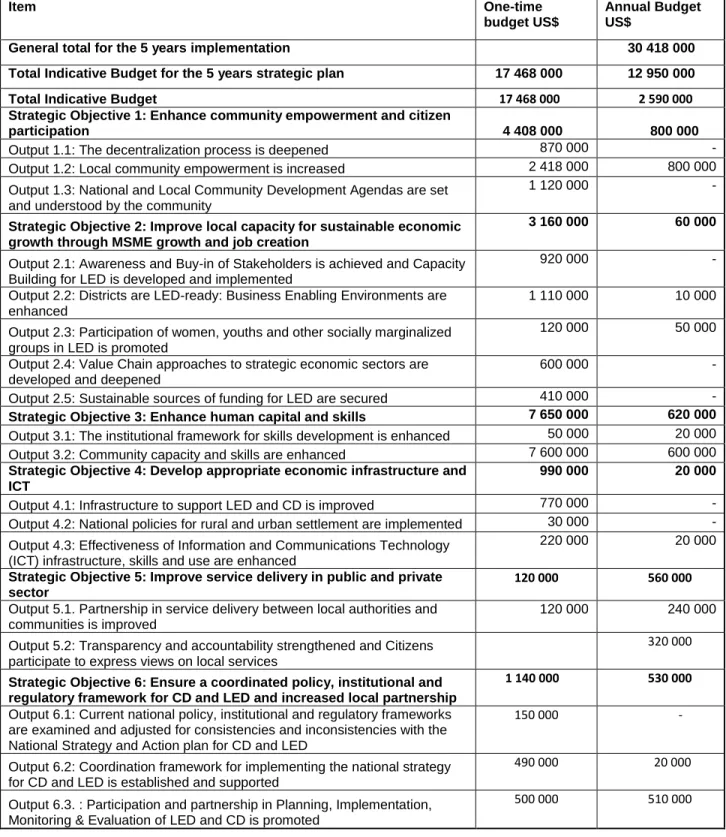
BUDGET OVERVIEW ... 51
SECTION D: IMPLEMENTATION FRAMEWORK ... 52
INTRODUCTION ... 52
INFORMING THE PUBLIC, DISSEMINATING INFORMATION AND MOBILIZING STAKEHOLDERS ... 52
COORDINATION OF STAKEHOLDERS AND JOINT PLANNING ... 52
ROLES AND RESPONSIBILITIES ... 53
MONITORING AND EVALUATION AS AN INTEGRAL PART OF THE IMPLEMENTATION FRAMEWORK ... 59
FINANCING THE STRATEGY ... 60
APPENDIX 1 INTERNATIONAL EXPERIENCE IN COMMUNITY DEVELOPMENT ... 61
APPENDIX 2: INTERNATIONAL LED EXPERIENCES AND APPROACHES IN LED ... 64
APPENDIX 3: REFERENCES ... 66
APPENDIX 4: DETAILED BUDGET FOR THE NATIONAL COMMUNITY DEVELOPMENT AND LOCAL ECONOMIC DEVELOPMENT 2013 – 2017 ... 68
National Strategy for Community Development and Local Economic Development
6
LIST OF ABBREVIATIONS
ACP African, Carribean and Pacific States AGOA African Growth and Opportunity Act
BDC Business Development Centre (Business Development Services) BDF Business Development Fund
BNR National Bank of Rwanda CD Community Development CSOs Civil Society Organizations DDPs District Development Plans
DIP Decentralization Implementation Plan EAC East African Community
EDPRS Economic Development and Poverty Reduction Strategy EICV Integrated Household Living Conditions Survey
EWSA Energy, Water and Sanitation Authority GDP Gross Domestic Product
GMO Gender Monitoring Office
GSP Generalized System of Preferences
ICT Information and Communication Technology IEC Information Education Communication IPRC Integrated Polytechnic Regional Centre JADF Joint Action Development Forum LED Local Economy Development LG Local Government
M&E Monitoring and Evaluation MDGs Millennium Development Goals MIFOTRA Ministry of Public Service and Labour MIGEPROF Ministry of Gender and Family Promotion MINAGRI Ministry of Agriculture and Animal Resources MINALOC Ministry of Local Government
MINECOFIN Ministry of Finance and Economic Planning MINEDUC Ministry of Education
MINICOM Ministry of Trade and Industry MINIJUST Ministry of Justice
MININFRA Ministry of Infrastructure MINIYOUTH Ministry of Youth
MSME Micro, Small and Medium Enterprises NGO Non-Governmental Organization
NICI National Information and Communication Plan NISR National Institute of Statistics of Rwanda NPPA National Public Procurement Agency P, M&E Planning, Monitoring & Evaluation PMO Prime Minister’s Office
PPP Public Private Partnership
National Strategy for Community Development and Local Economic Development
7 PSF Private Sector Federation
RALGA Rwandese Association of Local Government Authorities RCA Rwanda Cooperative Agency
RDB Rwanda Development Board
RDSF Rwanda Decentralization Strategic Framework REMA Rwanda Environmental Management Authority RGAC Rwanda Governance Advisory Council (Now RGB) RGB Rwanda Governance Board
RHA Rwanda Housing Authority
RLSDF Rwanda Local Development Support Fund RNRA Rwanda Natural Resources Authority RwF Rwandan Francs
SACCO Savings and Credit Cooperative SMEs Small and Medium Enterprises
TEVSA Technical and Vocational Schools Association TVET Technical and Vocational Educational Training US$ United States Dollar
VCA Value Chain Analysis VCD Value Chain Development WDA Workforce Development Authority
8
LIST OF TABLES
Table 1: People participation level in Imihigo process vs Imihigo Performance Ranking... 13
Table 2: Rwanda Economic Indicators 2001-2010 ... 14
Table 3: SWOT Analysis ... 16
Table 4: Logical Framework ... 35
Table 5: Budget Overview ... 52
Table 6: Stakeholders and their roles ... 56
National Strategy for Community Development and Local Economic Development
9
SECTION A: BACKGROUND, AIM AND DEFINITIONS
BACKGROUND
“Vision 2020 aspires for Rwanda to become a modern, strong and united nation, proud of its fundamental values, politically stable and without discrimination amongst its citizens.”(Vision 2020). To achieve this, Vision 2020 set out the aim for Rwanda to become a middle income country by the year 2020.
As a major tool for pursuing Rwanda’s growth and development agenda, EDPRSII defines five guiding principles1: Innovation; Strong focus on emerging priorities; Inclusiveness and Engagement; District-led Development; and Sustainability.
Community Development and Local Economic Development are crucial ingredients in achieving both Rwanda’s Vision2020 and the goals of the EDPRS. While the process of EDPRS II is ongoing at the time of writing of this document, it is important to emphasize the importance of this National Strategy and Action Plan in contributing to the achievement of EDPRS II.
Community Development Policy was established in 2001 and revised in 2008, but this policy has been weakly implemented, mainly due to fragmented implementation, insufficient coordination, and lack of effective monitoring and evaluation mechanisms.
To date, while Economic Development and, more recently, Local Economic Development have been core objectives of Rwanda’s guiding policies (Vision 2020, EDPRS and Decentralization Implementation Policy among others), no policy or national strategy specific to Local Economic Development has been developed.
It is in this context that the Ministry of Local Government (MINALOC) in charge of Good governance, Decentralization, Community Development, Local Finance and Social Affairs, formulated this National Strategy for Community Development and Local Economic Development. The Strategy will contribute to the effective implementation of Vision 2020, EDPRSII, DIP and the Community Development Policy by reinforcing coordination among actors, enhancing focus on Community Development and Local Economic Development and putting communities and businesses at the forefront of addressing local issues that affect their needs in terms of development, local resource management, and achieving tangible and sustainable results.
1
10
AIM OF THE STRATEGY
The strategy aims to mobilize efforts of all actors in a coordinated, inclusive and planned manner in the pursuit of inclusive local socio-economic development.
Community Development
For Community Development, the strategy especially aims to mobilize and empower the Rwandan community to exercise its powers in decision making and participate in the development of the local community
Local Economic Development
The ultimate aim for LED is to provide LGs with the necessary tools to create the business enabling environment that each district needs in order to achieve Local Economic Development
The strategy sets out key activities to be carried out in the coming 5 years that will contribute to the overall goal of inclusive Community Development and Local Economic Development.
RATIONALE FOR INCLUDING COMMUNITY DEVELOPMENT AND LOCAL ECONOMIC
DEVELOPMENT IN ONE STRATEGY
While Community Development and Local Economic Development are clearly two separate agendas with two separate objectives, not only do they both aspire to the same goals of poverty reduction and improving the quality of life of the community, but they require similar basic conditions in order to be able to pursue their respective objectives. The conditions include participation of public and public private partnership in planning; Service Delivery; Human Capital and Skills; ICT infrastructure and skills; and basic physical infrastructure.
For these reasons, this strategy has been designed in such a way as to define clear separate agendas for Community Development and Local Economic Development while at the same time setting out their common goal and the common basic conditions required to achieve both sets of strategic objectives and, ultimately, the common goal.
National Strategy for Community Development and Local Economic Development
11
COMMUNITY DEVELOPMENT
Definition
There are many definitions of Community Development but all seem to agree that Community Development involves Community Empowerment and Citizen Participation.
Community Empowerment in this context refers to the capacity of individuals to take action to improve
their own lives through liberalization, participation and mobilization for change; and the capacity of the community to take collective action through solidarity, social networks, social capital, group Capacity Building and organizational strength.
Citizen Participation refers to the level to which citizens are involved in local decision-making processes.
Key elements of Community Development include building active and sustainable communities, based on social justice and mutual respect; changing power structures to remove the barriers that prevent people from participating in the issues that affect their lives; supporting individuals and groups in this process on the basis of certain values and commitments.2
Key values of Community Development include social justice, participation, equality, learning and cooperation.3
The concept of Community Development has evolved since the 18th Century in Britain and the United States and in Africa during the past 40 years including a lot of experience in Tanzania.4 During this time the concept has developed from top-down efforts to develop the population to focus today on participatory processes of Community Development that require empowered communities.
Community Development in the Rwandan Context
During the last decade, Rwanda has made tremendous efforts and registered tangible achievements towards Community Development.
Community Development in Rwanda can be traced back to the 1970s, but a top-down and highly centralized approach limited initial efforts. A number of initiatives in the years after the 1994 genocide against the Tutsi have contributed more positively to Community Development. The list below outlines a number of these5:
Rwanda Vision 2020
The Economic Development and Poverty Reduction Strategy Gender Equity initiatives
Mutual health insurance scheme Civic Education Academy/ Itorero
The Community Rehabilitation and Development project Agricultural programs including the Girinka Program Vision 2020 Umurenge Program
Umurenge SACCO
2Community Xchange, in Nelson et al, 2005 3
Community Xchange, in Nelson et al, 2005
4 For more detailed information on international experience in Community development, see Appendix 1 5
12
Education programmes including increasing teacher training colleges and Technical and Vocational Education and Training (TVET)
Infrastructure improvements
A number of home-grown initiatives related to Rwandan traditions have enjoyed some success including Umuganda – Community public works; Ubudehe; Community Policing; Abunzi; Imihigo; Intekoy’Abutarage; and the Gacaca courts
Perhaps the two most important policies designed to contribute to Community Development were, however, the National Decentralization Policy and the Community Development Policy
The National Decentralization Policy, 2000 includes strategic objectives around Empowerment and encouragement of local participation in decision making; Strengthening transparency and accountability by making the local authority directly responsible to the communities it serves; Increased level of adequacy of public administration to local needs and context; Development of local capacities for planning and management engine; and Strengthening the effectiveness and efficiency of planning, monitoring and service delivery by reducing the weight of the central government6. The related Decentralization Implementation Plans set about achieving these objectives.
The CD Policy was adopted in 2000, with a main objective “to entrench the National Policy of Decentralization by providing ways and means to ensure effective and sustainable participation of the
Community in its development geared towards poverty reduction”7
The policy was then updated in 2008 and its mission now is “to ensure effective and sustainable participation of the community in its own development, in order to achieve poverty reduction and
self-reliance on the sustainable exploitation of available resources”. Specifically the CD Policy “promotes the
engagement of the Rwandan community in action to:
- Analyze their environment;
- Define their individual and collective needs and problems; - Define their individual and collective potentials;
- Design individual and collective plans to meet their needs and solve their problems in a prioritized manner;
- Implement those plans by drawing from the resources of the community;
- Add to those resources if necessary, with support services and resources from government or private organs or any other stokeholds outside the community;
- Monitor and evaluate the implementation of the plans;
- Sustain the activities and make them productive.”(CD Policy, 2008)
Despite the achievements described above, there are still gaps and constraints that need to be addressed in order achieve sustainable Community Development in Rwanda. According to Rwanda Governance Score card of 2010, service delivery scored relatively low more especially, service delivery in local government scored 67.7%, civil society participation scored 54.3%, and access to public information scored 52%. (RGAC, 2010).
Although decentralization established a number of mechanisms such as performance contracts (Imihigo) that offer citizens’ engagement in planning, implementation and monitoring of development of government programs at all levels, in practice, the level of civic participation and engagement is still not yet very
6NDP, 2000, Rwanda Decentralization Strategic Framework-RDSF-, 2007, Decentralization Implementation
Program-DIP, 2007 7
National Strategy for Community Development and Local Economic Development
13
satisfactory and the government remains the main planner, dispenser and evaluator of impact of development and this could jeopardize the citizens’ ownership of policies.
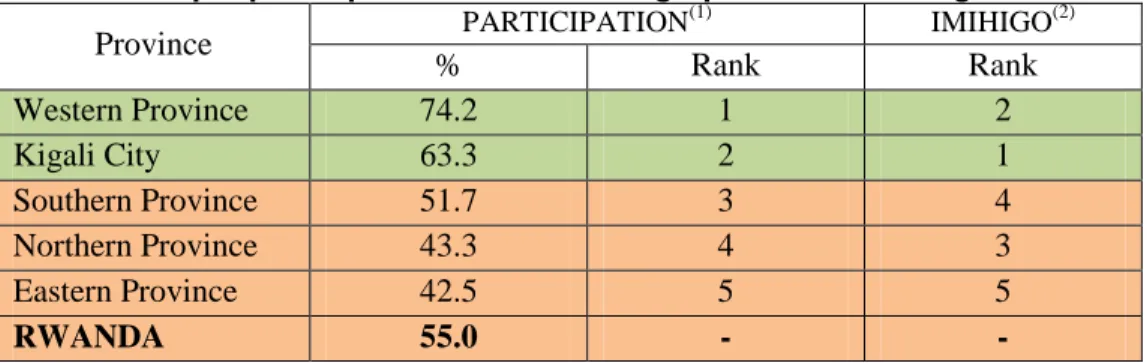
Interestingly, in Rwanda there is a clear positive correlation between the level of local people’s participation in the process of performance contracts (Imihigo) and the ranking of Districts and Provinces in Imihigo performance. (Table 1).
Table 1: People participation level in Imihigo process vsImihigo Performance ranking
Province PARTICIPATION (1) IMIHIGO(2) % Rank Rank Western Province 74.2 1 2 Kigali City 63.3 2 1 Southern Province 51.7 3 4 Northern Province 43.3 4 3 Eastern Province 42.5 5 5 RWANDA 55.0 - -
Source (1): Rwanda Civil Society Platform, 2011: Citizens’ Participation in Imihigo Process
Source (2): MINALOC, 2011: Districts Imihigo Evaluation Report 2010-2011
Many challenges remain for Community Development including resistance to change in the community; poverty and illiteracy rates; the pressure of population growth on land; infant malnutrition and Government budget constraints.
The CD Policy has not been well implemented probably due to lack of CD strategy, implementation plan and an adequate coordination mechanism. The National Strategy for Community Development and Local Economic Development seeks to address this.
LOCAL ECONOMIC DEVELOPMENT
Definition
The purpose of local economic development (LED) is to build up the economic capacity of a local area to improve its economic future and the quality of life for all. It is a process by which public, business and non-governmental sector partners work collectively to create better conditions for economic growth and employment generation8.
LED is a process by which local actors within a defined territory get together to: • analyze their economy,
• establish where its competitive advantages lie,
• and take actions to exploit business opportunities and improve the environment for business within the locality.
The overall goal of LED is to reduce poverty and improve the quality of people’s lives sustainably through economic growth and job creation.
8 GWEN Swinburn et al, Local Economic Development: A Primer, Developing and Implementing LED Strategies and Action Plans,
14
The concept of Local Economic Development has been a focus for economic development in many countries.9 In particular, Rwanda can draw from the experience of South Africa where many tools and methods have been tried and tested and much success has been achieved. The key lesson from international experience is that LED must be locally focused, participatory, owned by the stakeholders and suited to the local context.
Local Economic Development in the Rwandan Context
Rwanda has achieved remarkable development progress since 2000 when it adopted its Vision 2020. This is attributed in large part to government’s efforts to maintain peace and build social solidarity, coupled with a coherent policy framework, determined effort to pursue national development objectives, careful macro-economic management and well coordinated development partner’s support.
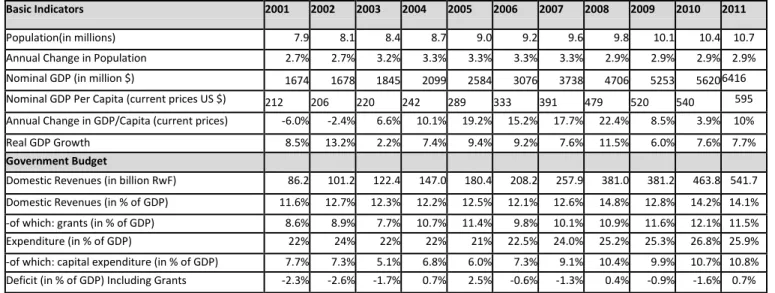
The country’s macroeconomic framework has remained remarkably stable, notwithstanding the harsh conditions of the global economic slowdown, the country’s land-locked situation, heavy dependence on imports and reliance on unstable export markets for foreign exchange earnings. Rwanda’s domestic revenues grew from Rwf 86.2 billion to 541.7 billion over the period 2001 to 2011, a fivefold increase. Domestic sources of revenue grew from 11.6 to 14.1% of GDP, but the share of aid in the national budget is still high.
Table 2. Rwanda: economic indicators 2001-2011.
Basic Indicators 2001 2002 2003 2004 2005 2006 2007 2008 2009 2010 2011
Population(in millions) 7.9 8.1 8.4 8.7 9.0 9.2 9.6 9.8 10.1 10.4 10.7 Annual Change in Population 2.7% 2.7% 3.2% 3.3% 3.3% 3.3% 3.3% 2.9% 2.9% 2.9% 2.9% Nominal GDP (in million $) 1674 1678 1845 2099 2584 3076 3738 4706 5253 5620 6416 Nominal GDP Per Capita (current prices US $) 212 206 220 242 289 333 391 479 520 540 595 Annual Change in GDP/Capita (current prices) -6.0% -2.4% 6.6% 10.1% 19.2% 15.2% 17.7% 22.4% 8.5% 3.9% 10% Real GDP Growth 8.5% 13.2% 2.2% 7.4% 9.4% 9.2% 7.6% 11.5% 6.0% 7.6% 7.7%
Government Budget
Domestic Revenues (in billion RwF) 86.2 101.2 122.4 147.0 180.4 208.2 257.9 381.0 381.2 463.8 541.7 Domestic Revenues (in % of GDP) 11.6% 12.7% 12.3% 12.2% 12.5% 12.1% 12.6% 14.8% 12.8% 14.2% 14.1% -of which: grants (in % of GDP) 8.6% 8.9% 7.7% 10.7% 11.4% 9.8% 10.1% 10.9% 11.6% 12.1% 11.5% Expenditure (in % of GDP) 22% 24% 22% 22% 21% 22.5% 24.0% 25.2% 25.3% 26.8% 25.9% -of which: capital expenditure (in % of GDP) 7.7% 7.3% 5.1% 6.8% 6.0% 7.3% 9.1% 10.4% 9.9% 10.7% 10.8% Deficit (in % of GDP) Including Grants -2.3% -2.6% -1.7% 0.7% 2.5% -0.6% -1.3% 0.4% -0.9% -1.6% 0.7% Source: BNR, NISR, MINECOFIN
The Rwandan government is committed to making public investments that have a direct impact and contribute to creating a favourable environment for businesses, as well as creating jobs and wealth. According to 2012 Doing Business Report, Rwanda has improved in ease of doing business worldwide, from 58th position last year to the 45th this year. The business reforms are part of the government’s extensive efforts to promote Rwanda as an attractive business and investment destination, in order to drive the growth of the private sector and generate wealth. According to the same report, this performance
9
National Strategy for Community Development and Local Economic Development
15
made Rwanda the 2nd most reformed economy in the world over the last five years and the 3rd easiest in Africa, as well as the 1st in EAC.10
The agricultural sector is the country’s main source of employment, accounting for about 80% of the economically active population and contributing to 32% of GDP in 2011. Since 2006, the services sector has overtaken agriculture as the largest contributor to GDP, accounting for 46 per cent in 2011. The share of industrial activities is relatively low, 16% in 2011, but is increasing, boosted in particular by agricultural processing, other value chain activities as well as food, beverages and construction subsectors.11
Poverty has fallen, but needs to fall faster to meet the MDG and vision 2020 targets. As the government strives to continue implementing actions that will further reduce poverty and make Rwanda a middle income country by 2020, it is mindful of the following issues:
Whereas agriculture remains the back bone of Rwanda’s economy, it is not the significant driver of poverty reduction. According to both the EICV2 and EICV3, poverty levels are highest by far among those reliant mainly or heavily on farm wage labour, followed by those working in agriculture. From 2006-2010, poverty fell in almost all categories, but particularly among those reliant on non-farm wage or self-employment work, or transfers. This suggests that non-farm activities, especially for wages, have played an important role in poverty reduction in Rwanda12.
Economic activity is still very low. It is estimated that about 80% of the working adults work on their family farms.13Employment and wealth are created by private enterprises and productive public-private partnerships. The main role of the government is to provide an enabling environment. In a resource-constrained country like Rwanda, coordination, information, and cooperation by all actors - public, private, and non-governmental - is crucial to bring about Local Economic Development.
Emerging drivers of the Rwandan economy are growing stronger. The emergence and growth of off-farm economic activities is a significant opportunity to build upon in creating vibrant local economies, but also indicates that more innovative approaches to making agriculture a profitable sector are needed. This can be done through putting more emphasis on sectors and investments that create more economic benefits for the communities.
10 - http://www.doingbusiness.org/~/media/GIAWB/Doing%20Business/Documents/Annual-Reports/English/DB12-FullReport.pdf. - http://www.rdb.rw/media-centre/press-releases/doing-business-2012-report-rwanda-3rd-easiest-place-to-do-business-in-africa-and-2nd-five-year-top-global-reformer.html 11 NISR(National accounts) 12
The 2010/11 IntegratedHousehold Living Conditions Survey-EICV3 (Enquête Intégrale sur les Conditions de Vie des Ménages.
13
16
SECTION B: SITUATIONAL ANALYSIS
SWOT ANALYSIS
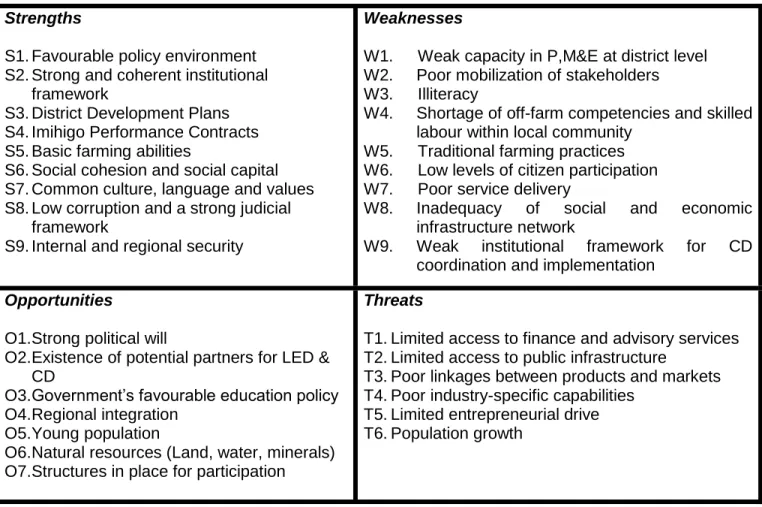
The development of a strategy for Community Development and LED is based on an extensive analysis of the environment under which CD and LED must operate. The analysis, conducted using the SWOT tool, highlights the following strengths, weaknesses, opportunities and threats.
Promoting CD and LED are not mutually exclusive. Strengths, weaknesses, opportunities and threats apply to both elements. Table 3 is a summary of SWOT and the paragraphs below explain how each of these are linked to Community Development and Local Development.
Table 3: SWOT Analysis
Strengths
S1. Favourable policy environment S2. Strong and coherent institutional
framework
S3. District Development Plans S4. Imihigo Performance Contracts S5. Basic farming abilities
S6. Social cohesion and social capital S7. Common culture, language and values S8. Low corruption and a strong judicial
framework
S9. Internal and regional security
Weaknesses
W1. Weak capacity in P,M&E at district level W2. Poor mobilization of stakeholders W3. Illiteracy
W4. Shortage of off-farm competencies and skilled labour within local community
W5. Traditional farming practices W6. Low levels of citizen participation W7. Poor service delivery
W8. Inadequacy of social and economic infrastructure network
W9. Weak institutional framework for CD coordination and implementation
Opportunities
O1. Strong political will
O2. Existence of potential partners for LED & CD
O3. Government’s favourable education policy O4. Regional integration
O5. Young population
O6. Natural resources (Land, water, minerals) O7. Structures in place for participation
Threats
T1. Limited access to finance and advisory services T2. Limited access to public infrastructure
T3. Poor linkages between products and markets T4. Poor industry-specific capabilities
T5. Limited entrepreneurial drive T6. Population growth
Strengths
S1 Favourable Policy Environment
The Government of Rwanda’s policy favours and supports Community Development and Local Economic Development. The six pillars of Vision 2020 all directly support Community Development and LED.
National Strategy for Community Development and Local Economic Development
17
EDPRS also supports Economic Development and participation and the National Decentralization policy seeks to entrust power for planning and decision making in the hands of the local population.
S2 Strong and coherent institutional framework
While challenges remain in building the capacity of institutions in Rwanda, there is a strong framework with a clear linkage between Ministries, Government institutions and decentralized issues and roles and responsibilities are well defined.
S3 District development plans
Due to the existing planning framework, the CD and LED projects can be integrated into the District Development Plans. This will ensure that projects do not stretch the existing capacities of the Districts in terms of planning and implementation.
S4 Performance contracts (Imihigo)
Performance contracts have evolved since 2008 as effective tools for accountability of the leadership towards the population.
S5 Basic farming abilities
Recent improvements in land use management and agricultural productivity indicate that there is now a strong base of farming capability in Rwanda. Furthermore, the issue of population density has made productive farming and land management skills an imperative.
S6 Social cohesion and social capital
In a country relatively free from internal conflict and supported by many social programs like Umuganda, Rwanda boasts considerable social cohesion and social capital relative to its neighbours.
S7 Common culture, language and values
An unusual trait in African countries, having a common culture, language and values is a major strength for Rwanda. It facilitates communication and understanding and reduces the probability of conflict.
S8 Low corruption and a strong judicial framework
Perhaps a sign of trust and respect in leadership, the policy environment and the strong institutional framework, Rwanda’s low level of corruption and efficient judicial and policing network are the envy of the region.
S9 Internal and regional security
Security in Rwanda is not only a strength but a true comparative advantage which not only benefits community welfare but should be leveraged for local economic development.
Weaknesses
W1 Weak capacity in Planning, Monitoring and Evaluation at Local Government level
Whereas it is apparent that local governments know what they want, there is still weak capacity to put together strategies, programs and projects in a coherent and structured way. In particular, the weak understanding of the LED concept among stakeholders makes it difficult to manage the LED process, coordinate the different actors, and mobilize their participation in planning and executing LED.
18 W2 Poor mobilization of stakeholders
CD and LED processes thrive on the tangible and practical cooperation between the public sector, private sector, and non-governmental actors. Whereas the development partners are keen to participate in the JADF, there seems to be a general lack of mobilization of the private sector and other non-state actors. W3 Illiteracy
While literacy programs are on the Rwandan agenda, there is still much to be achieved as literacy of population aged 15 and older is just 39%. Furthermore, while both French and English are spoken in Rwanda, the level of knowledge is relatively low. Regarding economic perspective, there is a lack of financial literacy even for the educated people.
W4 Shortage of off-farm competencies and skilled labour within local community
Lack of skilled labour is caused by few prevailing Technical and Vocational Education and Training (TVET) schools in the country, and lack of community skills building initiatives such as on-job-training that is offered within the community. Public institutional efforts to increase capacity and skills are mainly offered to the public employees without giving much attention to local community’s capacity and skills. W5 Traditional farming practices
Farming practices will need to be improved not only to increase competitiveness of products against imports and on international markets but also to cope with the increasing effects of climate change.
W6 Low ownership and participation of the community in local development issues
Low participation of the community in local development issues impedes community development initiatives. This weakness is as the result of lack of full empowerment to the local community, low levels of education, deep poverty and vulnerability, slow pace of extension services to lower decentralized entities such as Imidugudu and lack of skills of some officials to engage the citizen in a participatory way.
W7 Poor service delivery
There is a lack of service charters or norms/standards and monitoring systems in public and private institutions for service delivery. Some public and private employees are not sufficiently motivated, which both leads to high levels of turn-over and low levels of expertise. A lack of a systematic rewarding system to best performing employees, insufficient coaching and mentoring of subordinates, poor management and communication skills and intimidating attitude of some public and private officials towards their subordinates result in a vicious cycle of handling recruitment processes and new inexperienced employees.
W8 Inadequacy of social and economic infrastructure network
The main reason for inadequate infrastructure is local financial limitations. Moreover, there is an insufficient number of skilled technicians/personnel to provide adequate infrastructure.
W9 Weak institutional framework for CD coordination and implementation
The factors that contributed to insufficient implementation of Community Development Policy include lack of community development strategy and its implementation plan and consecutive lack of coordination of sectoral initiatives towards community development.
National Strategy for Community Development and Local Economic Development
19 Opportunities
O1 Strong political will
The political leadership is non-ambiguous on the basis and foundations for achieving Rwanda’s development aspirations. The achievement of Vision 2020 and EDPRS will also achieve Community Development and Local Economic Development.
O2 Existence of potential partners for LED
The potential partners for LED are divided into three categories; namely, the public, the private, and non-governmental actors. Each category exhibits a range of skills and resources. The skills and resources that each stakeholder category brings to the LED process is paramount. There will be need to streamline working relationships and structures that fully engage all the stakeholders.
O3 Government’s favourable education policy
The government’s key education policy orientation is to put emphasis on courses that are demand-driven and increase job creation opportunities. The target for the government is to have 60 percent of all secondary students under the Technical and Vocational Education and Training (TVET) system.
O4 Regional integration
Rwanda is a member of the East African Community (EAC) COMESA and covered by the European Union’s Everything But Arms initiative, under which all products from developing countries except arms and ammunitions have preferential access to the European Union market. Together with other sub-Saharan African countries, the EAC Partner States also qualify for duty-free access to the US market under the African Growth and Opportunity Act (AGOA). Membership in the African, Caribbean and Pacific States (ACP) and the Generalized System of Preferences (GSP) enables products from Partner States to qualify for preferential tariffs on exports to member countries. Strategically planned locality LED must seek to implement objectives that would increase Rwanda’s private sector to benefit from the opportunities that regional integration brings and mitigating the threats associated with it.
O5 Young population
A young population is more flexible, mobile and willing to learn. In addition to this, a younger population is generally more capable (physically and mentally) to work and less resistant to change.
O6 Natural resources (Land, water, minerals)
While natural resources are limited in Rwanda, land is arable; there are some opportunities in mining minerals; many opportunities exist for hydro power; and tourism opportunities are plentiful due to the contrasting savannah and wildlife of Akagera National Park, rainforest and biodiversity in Nyungwe National Park, volcanic mountains of Volcanoes national park with its rare mountain gorillas; and the serenity and beauty of Lake Kivu.
O7 Structures in place for participation
Although participation levels remain low, there are platforms in place to allow this to grow, specifically Umuganda and the Joint Action Development Forum (JADF).
20 Threats
T1 Limited access to finance and advisory services
Access to appropriate financing and business advisory services is still poor in rural areas. The Business Development Centers are still poorly positioned to be efficient sources of business advice, mentoring and coaching. This threat is compounded by the cost of finance. The performance of BDCs as providers of business advisory services has been minimal.
T2 Limited access to public infrastructure
One of the aspects of a favourable physical environment is conducive public infrastructure such as roads, water, and energy. Whereas the government is handling this issue as a priority, the challenge is enormous to the extent that it will remain for some few years to come.
T3 Poor linkages between products and markets
At present, production seems to be largely based on available raw materials rather than market demand. The motivation for entrepreneurs should be producing what they can sell rather than selling what they can produce through well elaborated Value Chain Analyses (VCAs) and Value Chain Development (VCD). T4 Poor industry-specific capacities
Whereas creating a favourable regulatory framework and supportive physical environment arerelatively straight forward, ensuring availability of skills that various industries require will always remain a significant threat. The critical supplier of skills-the education system - is not aligned to industry and the labour market. T5 Limited entrepreneurial and competitive drive
The culture of entrepreneurship and competition is not well developed. This is partly due to history, where winning and achieving was not celebrated, as well as a patriarchic governance system, prior to 1994, which decided who did what both in public and private spheres. Moreover, the Rwandan education system lacks effective mechanisms to educate for entrepreneurship, promote a competitive culture in schools and learning about practical aspects of business as early as possible.
T6 Population Growth
Population Density is a major threat to Rwanda as it is currently the most densely populated country in Africa and the population continues to grow. This is putting significant pressure on land, leading to over intensification of farming.
Summary of Key Challenges presented by SWOT Analysis
This strategy and action plan aims to build on Strengths, capitalize on opportunities and address the weaknesses and threats outlined.
Key Challenges to be addressed in this Strategy and Action plan are:
Economic Challenges: The strategy needs to address the threats poor linkages between products and markets and limited access to finance and advisory services to ensure that the private sector is capable of availing of economic opportunities. LED Capacity Building, value chain approaches and programs for accessing finance are required.
National Strategy for Community Development and Local Economic Development
21
Skills Gaps: Capacity Building activities are included throughout the strategy in order to enable stakeholders to contribute to Community Development and Local Economic Development in Rwanda. Specific attention is needed for technical (industrial and off-farm) skills and entrepreneurship. Rwanda can build on the opportunities that a favourable education policy and young population provide is addressing these challenges.
Infrastructure Issues: The infrastructural challenges faced in Rwanda must not be underestimated and this Strategy and Action Plan aims to address how to best cope with this issue and plan for the future. Institutional Framework: To promote Community Development and Local Economic Development, it is important to build on the existing strong institutional frameworks and establish and strengthen a suitable institutional framework for Community Development in particular.
Participation and Mobilization: Low levels of citizen participation and weak stakeholder mobilization pose a major challenge for this strategy and action plan. It is important to build on the social cohesion and capital that exist and capitalize on the structures that are already in place for participation in the form of the JADF to ensure inclusive local socio-economic development.
Service Delivery: Service Delivery both in the public and private sector is a weakness in Rwanda. Customer service skills in the private sector can be enhance through training for entrepreneurs but service delivery at Local Government also needs to be addressed.
22
SECTION C: STRATEGIC FRAMEWORK
OVERALL GOAL
The overall goal of Rwanda’s National Community and Local Economic Development Strategy is to:
“Promote inclusive local socio-economic development and poverty reduction in Rwanda”.
This requires the participation of the community and private sector in improving their own quality of life and economic opportunities.
In order to achieve this goal, this National Strategy defines three pillars and six Strategic Objectives: Pillar 1: Community Development
Strategic Objective 1: Enhance community empowerment and citizen participation Pillar 2: Local Economic Development
Strategic Objective 2: Improve local capacity for sustainable economic growth through MSME growth and job creation
Pillar 3: Support Systems for Community Development and LED Strategic Objective 3: Enhance Human Capital and skills
Strategic Objective 4: Develop appropriate economic infrastructure and ICT
Strategic Objective 5: Increase service delivery in public and private sector
Strategic Objective 6: Ensure a coordinated policy, institutional and regulatory framework for CD and LED
Notes:
Capacity Building is a recurrent theme in this national Strategy. While it is dealt with under Strategic Objective 3: Enhance Human Capital and skills, capacity building activities are included in many of the outputs in order to strengthen community, private sector and local authority ability to achieve the required outputs.
Furthermore, the participation of women, youths and other socially marginalized groups is included within both the Community Development and Local Economic Development Pillars rather than under the support pillar as their participation is so important to achieving socio-economic development that it merits being addressed within both agendas.
22 DIAGRAM 1: LOGICAL FRAMEWORK
STRATEGIC OBJECTIVES AND OUTPUTS PILLARS
OVERALL GOAL
1. Enhance Community Empowerment and Citizen Participation 1.1. The decentralization process is deepened
1.2. Local Community Empowerment is increased
1.3. National and Local Community Development agendas are set and understood by the communities
2.Improve Local Capacity for Sustainable Economic Growth through MSE growth and job creation
2.1. Awareness and buy in of stakeholders is achieved and capacity building for LED is developed and implemented
2.2. Districts are LED ready: Business Enabling Environments are enhanced 2.3. Participation of women, youth and other socially marginalized groups in LED are
promoted
2.4. Value Chain approaches to strategic economic sectors are developed and deepened 2.5. Sustainable sources of funding for LED are secured.
3.Enhance Human Capital and Skills
3.1. The Institutional framework for skills is enhanced 3.2. Community capacity and skills are enhanced
4.Develop appropriate Economic Infrastructure and ICT 4.1. Infrastructure to support LED and CD is improved
4.2. National Policies for rural and urban settlement are implemented
4.3. Effectiveness of information and communication technology infrastructure, skills and use are enhanced
5.Increase Service Delivery in Public and Private Sector
5.1Partnership in Service Delivery between Local Authorities and Communities is improved
5.2. Transparency, accountability and citizen participation to express views on service delivery is strengthened
6.Ensure a coordinated policy, institutional, regulatory framework for CD and LED 6.1. Current National Policy, institutional regulatory frameworks are examined and
adjusted for consistency and inconsistency with the national strategy and the action for CD & LED
6.2. Coordination framework for implementing the national for CD & LED is established and supported
6.3. Participation and Partnership in Planning, Implementation, Monitoring & Evaluation of CD and LED is promoted
Community Development Local Economic Development Support Systems for CD & LED Include Inclusive Local Socio- economic development and Poverty Reduction in Rwanda
23
PARTICIPATION
One of the major challenges to Community Development is the low participation of the population in its local development issues. This low participation is a result of the low level of education and slow pace of extension services to lower decentralized entities such as Imidugudu. For effective community development, there is a need for the population to participate in local development issues and allowing them to have an upper hand in determining their social, economic and political destinies.
This should entail development of the community, mainly by deepening the decentralization process; increasing local community empowerment; ensuring the CD Agenda is widely understood by the Rwandan community; setting CD agendas locally; encouraging the population to express views on service delivery; and establishing and supporting coordination frameworks for implementation of local CD agendas.
Output 1.1 The decentralization process is deepened
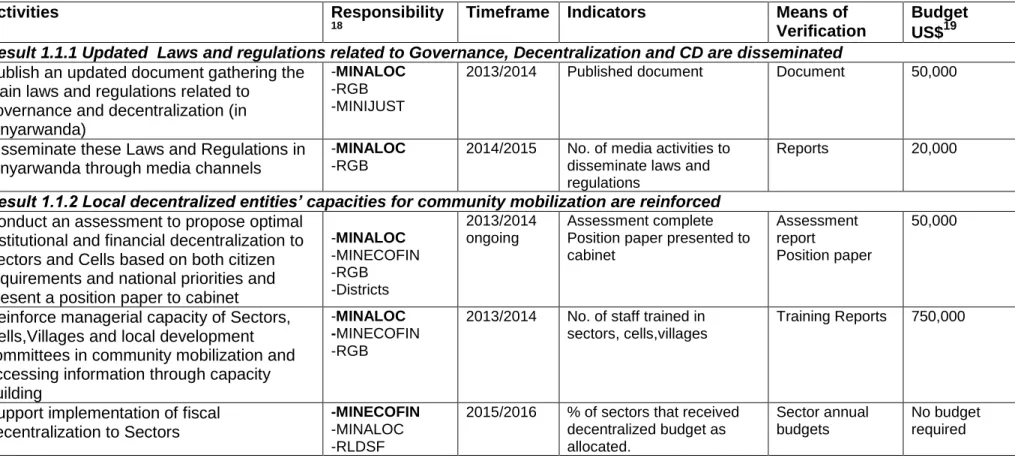
The decentralization process needs to deepen in order to reinforce and empower lowest decentralized entities e.g. Sectors, Cells and Village, through updating laws and regulations.
Interventions
Disseminate updated laws and regulations related to Governance, Decentralization and CD: While
updating laws and regulations is beyond the scope of this National Strategy, the strategy can ensure dissemination of and debate around laws, regulation and policy that have been updated. Dissemination should be targeted at the poorest and most vulnerable citizens in particular and should therefore use radio and ensure any documents are in Kinyarwanda.
Reinforce local decentralized entities’ capacities for community mobilization: by assessing citizen
requirements and national priorities and proposing how to optimize decentralization towards sectors and cells to satisfy both needs and through capacity building of sectors, cells, villages and local committees in accessing information and mobilizing local communities. This output will also include the support implementation of fiscal decentralization to Sectors. In order to deepen the decentralization process it is necessary, that budgets are decentralized to sector level and the funds are made available to support this. This strategy will support this process.
Output 1.2 Local community empowerment is increased
Empowerment of local community will be achieved through these major interventions:
Increasing involvement of Education System (including Civic Education Academy) in CD by
advocating for CD concept to be included in the education curricula at all levels.
Increasing access to public information: using Radio for Town meetings at district level for public
awareness, publishing and disseminating periodically written information on CD, creating local Bulletin and IEC system for local CD process and empowering IEC units in Local Governments
Empowering women, youth and socially marginalized groups in the community: training all CD
stakeholders on gender issues in CD at cell level; facilitating effective participation of women, youths and socially marginalized groups at all levels through effective IEC and awareness; and annual evaluation of participation of women, youths and socially marginalized groups in Community Development activities.
National Strategy for Community Development and Local Economic Development
24
Reinforcing civil society action towards community development through capacity building for
CSOs in Civil society representation and negotiation with Local Government; and conducting JADF workshops to promote fair inclusion of civil society groups in participative processes.
Sharing and celebrating best practices in community empowerment in order to measure the
success of interventions. This can be done at local and national level and for a variety of categories such as women, youths, school-goers and the general public.
Output 1.3 The Community Development Agenda is widely understood by the Rwandan community and Local Community Development Agendas are set
This will be achieved by firstly by Disseminating and discussing CD Agenda documents: mainly in Kinyarwanda through radio and print media, organizing public debates and Town meetings on CD Agenda and on CD progress assessment.
A key element of ensuring Community Development and setting a basis on which to measure progress is setting Community Development agendas at the local level. This should occur at least at sector level, if not also at cell level. Activities will include participatory workshops at the sector level to outline the current status and challenges of CD in the community; workshops to agree or finalize the CD agenda; and dissemination of the local agendas through radio channels and Umuganda.
Sector CD agendas should be coordinated at district level to identify common areas of intervention.
STRATEGIC OBJECTIVE 2: IMPROVE LOCAL CAPACITY FOR SUSTAINABLE ECONOMIC GROWTH
THROUGH MSME GROWTH AND JOB CREATION
In order to achieve the overall goal, the first strategic objective aims to promote inclusive local economic growth and poverty reduction. As is outlined in the outputs, results and activities, this involves building capacity for LED; enhancing local Business Enabling Environments; ensuring active involvement of stakeholders, including women, youth and socially marginalized groups; enhancing value chains; and attracting finance for LED.
Output 2.1 Stakeholder awareness and buy-in is achieved and Capacity Building for LED is developed and implemented
The centre-piece of promoting LED will be a national LED capacity building program linked to the implementation of LED in the Local Governments. RALGA has already begun developing training modules to be applied in Rwanda. These modules shall be approved by MINALOC/RLDSF. The strategy for LED capacity building is a practical one, entailing development of capacity building manual designed as a practical guide, development of “Train the Trainers” materials, delivering the initial sets of training programs for LED coaches and LED practitioners as well as LG authorities. Ten LED coaches will be trained to facilitate districts and drive the LED process in Rwanda.
The roll-out of an LED implementation programme shall be supported by a campaign aimed at explaining the meaning of LED, how it links to national policy, the work of the different national ministries and their implementation agencies, the work of the districts and their service units, the JADFs, the private,
25
community and NGOs sectors. Materials developed for the LED capacity building shall be drawn upon to produce simple, readily accessible and understandable pamphlets and booklets on LED. These materials may be used to publicize LED through the popular media, especially radio. LED shall be implemented in a way that builds national and local capacity, minimizes costs and maximizes synergies.
Interventions:
Enhance LED capacity for LGs
Enhance capacity for non-governments sector LED actors Increase stakeholder awareness and buy-in
Roll out LED process nationally
Output 2.2 Districts are LED-Ready: Business Enabling Environments are enhanced
For districts to be LED ready, participative processes of local economic assessment and LED planning and implementation are required. The interventions below demonstrate how to achieve this. It is imperative that each locality identifies its comparative advantage – what it can do better than other localities- and turns it into a competitive advantage. The focus must be on the competitiveness of the locality.
As part of this process, districts should consider opportunities available as a result of regional integration, particularly in border districts such as Rusizi, Rubavu, Nyagatare, Burera, Kirehe and Bugesera. Here it is important also to consider comparative advantage relative to localities in neighbouring countries.
LED readiness will take a well sequenced process through the following interventions:
Identifying and organizing partners and LED champions- the people, institutions, businesses,
community organizations and other groups with interests in the local economy. The skills and resources that each of these stakeholders bring to the strategy process provide a critical foundation for success.
Conducting local economy assessments- to identify a locality’s unique set of attributes that can
advance, or hinder, local economic development. The aim of the local economy assessment is to identify the locality’s strengths, weaknesses and, most of all, opportunities and comparative advantage.
Developing locality/Local Government specific LED strategy- by implementing a process whereby
all stakeholders collectively participate and are given the opportunity to define what is to be achieved, how it is to be achieved, who will be responsible for what, and the timeframes associated with implementing the LED strategy.14 The key to such a strategy is the shared vision for the community and LED goals, objectives, programs, projects and action plans. The role of the Local Government here is to ensure a Business Enabling Environment to allow the locality gain a competitive advantage.
Making Local Governments (LGs) LED ready implies that LGs have mobilised all LED actors, local economy assessments are conducted, specific LED strategies are developed and ready to commence implementation.
14LED strategy will not be implemented as a standalone strategy. It will be incorporated in the DDP and “Imihigo” to ensure that it is mainstreamed in the existing Districts’ planning and implementation mechanisms.
National Strategy for Community Development and Local Economic Development
26
Output 2.3 Participation of women, youths and socially marginalized groups in LED is promoted
According to the third integrated house hold living conditions survey (EICV 3), the population of Rwanda has grown from 9.5 million people in 2005/6 to an estimated 10.8 million in 2010/11. 54% of the population is aged 19 years or younger. 53% of the population is female. The majority of the population is young, with about 83% still under 40 years of age. Women, youths and socially marginalized groups are widely acknowledged to have inferior access to social and economic opportunities. It is therefore important to ensure their inclusion and participation in LED activities.
Interventions:
Promote women, youths and other socially marginalized groups’ participation in economic planning and action through additional consultations as part of the LED process.
Implement specific economic and employment development initiatives to support women, youths and socially marginalized groups.
Output 2.4 Value Chain approaches to strategic economic sectors are developed and deepened
Value chain analysis (VCA) helps identify opportunities and constraints faced by stakeholders such as farmers and producers, processors, traders and other businesses at multiple levels along a given value chain, while Value chain development (VCD) involves taking all the information generated by the value chain analysis (VCA) and doing something about it. Value chain development provides a range of interventions to exploit the opportunities and address constraints. The ultimate aim is to make the local target sector more competitive and ensure local value chain operators obtain maximum benefits.15
MINICOM has already provided a foundation to build on. Beginning 2012, SMEs product clusters report was validated. The report, through a detailed study, identifies the most competitive SME sectors per District across the country. The objective for MINICOM is to prioritize and provide targeted support such that SMEs can undertake business activity within the most viable and promising sectors in the different districts across the country.
However, the MINICOM report conducted VCAs for only one priority product per District across the country and two priority products in Kigali City. The scope is narrow. More benefits would be accrued by expanding the VCA to at least two priority products per District given the vast nature of Districts in terms of geographical coverage and potentials.
Interventions:
Conduct value chain analyses (VCAs) for second level priority selected products.
Incorporate interventions identified by the VCAs in local and central governments’ plans. Output 2.5 Sustainable sources of funding for LED are secured
A great deal has been written about how to develop local economic strategies, but very little has been written about how to establish the local investment strategies to pay for them. Many local economic strategies are never fully implemented because they did not identify the investment resources in advance and assumed private sector involvement without doing anything to attract it.
15