DOCKET NO: A-98-49
II-B1-7
TECHNICAL SUPPORT DOCUMENT FOR
SECTION 194.23: REVIEW OF WIPP RECERTIFICATION
PERFORMANCE ASSESSMENT COMPUTER CODES
CRA Code Review
U. S. ENVIRONMENTAL PROTECTION AGENCY Office of Radiation and Indoor Air
1310 L Street, NW Washington, DC 20005
March 2006
Note: This document is part of a series of PA code reviews done since the original CCA. This particular review was completed in September 2004 and is reported as part of our CRA decision. Issues noted in this report are finalized in the PABC Code Review, Docket A-98-49 Item II-B1-8 and in the EPA PABC Review TSD, Docket A-98-49 Item II-B1-16.
TABLE OF CONTENTS
LIST OF TABLES ... ii
LIST OF FIGURES ... ii
EXECUTIVE SUMMARY ... iii
1.0 INTRODUCTION ...1
2.0 BACKGROUND ...3
2.1 Software Qualification ...3
2.2 Post CCA SQA Upgrades and Documentation...9
3.0 OVERVIEW OF DOE’S COMPUTER CODE MIGRATION ACTIVITIES...11
4.0 THE AGENCY’S REVIEW APPROACH...14
5.0 SUMMARY OF INDIVIDUAL COMPUTER CODE MIGRATION ...15
5.1 ALGEBRACDB ...15 5.2 BLOTCDB...17 5.3 BRAGFLO...19 5.4 CCDFGF ...23 5.5 CCDFSUM ...26 5.6 CUTTINGS_S...28 5.7 DRSPALL...30 5.8 DTRKMF...34 5.9 EPAUNI...36 5.10 FMT ...38 5.11 GENMESH ...41 5.12 GROPECDB ...43 5.13 ICSET ...45 5.14 LHS ...47 5.15 LHS2STEP...49 5.16 MATSET...51 5.17 MODFLOW2000...53 5.18 NONLIN ...56 5.19 NUCPLOT ...59 5.20 NUMBERS ...61 5.21 NUTS ...64
5.24 PCCSRC ...74 5.25 PEST ...75 5.26 POSTBRAG...79 5.27 POSTLHS ...81 5.28 POSTSECOTP2D ...83 5.29 PREBRAG ...85 5.30 PRECCDFGF...88 5.31 PRELHS...89 5.32 PRESECOTP2D ...92 5.33 RELATE ...95 5.34 SANTOS ...97 5.35 SECOTP2D...99 5.36 SGSIM ...102 5.37 SPLAT ...104 5.38 STEPWISE ...107 5.39 SUMMARIZE...109 5.40 CAM LIBRARIES...111
6.0 SUMMARY AND CONCLUSIONS ...119
LIST OF TABLES
Table 3.1 Computer Codes Reviewed by the Agency ...12LIST OF FIGURES
Figure 1 Major Components of DOE’s Software Development Process. ...4EXECUTIVE SUMMARY
The U.S. Department of Energy (DOE) conducted a Performance Assessment (PA) to show compliance with U.S. Environmental Protection Agency’s (EPA or the Agency) disposal regulations and compliance criteria at 40 CFR 194 as part of the Waste Isolation Pilot Plant F(WIPP) certification process. DOE must demonstrate, on an ongoing basis, that performance assessment computer software is in compliance with regulations outlined in Section 194.23 - Models and Computer Codes and Section 194.22 - Quality Assurance. Since the Agency’s certification of the DOE WIPP Compliance Certification Application (CCA), DOE has added computer hardware and upgraded the computer software. In order to maintain compliance with Sections 194.22 and 194.23, DOE is required to conduct testing on the computer codes to ensure that they still function properly on new hardware and software. The Agency reviewed the testing performed by DOE to demonstrate continued compliance with the addition of computer
hardware and upgraded software. In 2003, two new hardware systems were added to the PA computational cluster, the Compaq ES45 and the Compaq Alpha 8400. This report presents the Agency’s findings with respect to the qualification of the computer codes on the Compaq ES45 and the Compaq Alpha 8400. The Agency concludes that 36 (of the 39) computer codes and three libraries migrated to the Compaq ES45 and 8400 with OpenVMS 7.3-1 are approved for use in compliance calculations for the WIPP performance assessment.
An earlier version of this report (dated March 31, 2004[REF1]) indicated that three codes (i.e., NUMBERS, SANTOS, DRSPALL) were insufficiently documented and tested and that additional reviews would be conducted as part of the Agency’s review and evaluation of the CRA. Specifically, the Agency was to ensure that:
1. DRSPALL 1.0 is regression tested on the Compaq ES45 and 8400; 2. NUMBERS meets the QAP 19-1 requirements; and
3. SANTOS is properly evaluated for accuracy.
The DOE has subsequently provided additional information pertaining to the documentation and testing of DRSPALL and NUMBERS. After reviewing that information the Agency concludes that DRSPALL Version 1.0 is validated on the Compaq ES45 and 8400 with OpenVMS 7.3-1. The Agency also concludes that NUMBERS now meets the QAP 19-1 requirements. With respect to SANTOS, however, the DOE has not provided any additional information related to the accuracy of the SANTOS results.
1.0
INTRODUCTION
This report describes results of the U.S. Environmental Protection Agency (the Agency or EPA) review of performance assessment computer code development and testing activities performed by the U.S. Department of Energy (DOE) in support of their ongoing Performance Assessment of the Waste Isolation Pilot Plant (WIPP). The ability of the WIPP facility to meet the Agency's certification requirements was demonstrated in part through the use of a series of performance assessment computer codes that are documented in the Department's Compliance Certification Application [REF3].
DOE conducted a Performance Assessment (PA) to show compliance with our disposal
regulations as part of the WIPP certification process. DOE must demonstrate on a ongoing basis that performance assessment computer software is in compliance with regulations outlined in §194.22 - Quality Assurance and §194.23 - Models and Computer Codes. Examples of software that must meet the compliance criteria are:
$ scientific or engineering software used to assess the performance of a site,
$ scientific or engineering software used to analyze data for, or produce input (parameters) to, a performance assessment calculation,
$ software that is used in managing information or augmenting mission essential decisions, and
$ software used to collect data (e.g., far-field, near-field, engineered barriers).
DOE executes the PA conceptual models through software applications with parameter value inputs on an infrastructure composed of computers and operating systems that must be
periodically updated. For the original certification application, performance analyses were run on the DEC Alpha Cluster using the OpenVMS operating system, version 6.1. In 1999, the operating system was updated from OpenVMS 6.1 to 7.1, and a year later from OpenVMS 7.1 to 7.2. In the summer of 2001, the FORTRAN compiler available on the cluster was upgraded to version 7.4A. In August 2002, the operating system was upgraded to an Open VMS 7.3-1 operating system.
In addition to software upgrades, the DOE has made hardware changes. The DEC Alpha Cluster was the main platform for performance analyses for the WIPP during CCA. The cluster
consisted of 11 DEC Alpha 2100 computers with 44 processors. In September 2001, a single Compaq Alpha ES40 computer was added to the WIPP PA hardware cluster. In August 2002, the DEC Alphas were replaced by a Compaq ES40. In 2003, two new hardware systems were added to the PA computational cluster, the Compaq ES45 and the Compaq Alpha 8400. For the Compliance Recertification Application (CRA) PA, DOE used Open VMS 7.3-1 as the operating system in conjunction with the Compaq ES40, ES45 and 8400. In June 2003[REF2], the Agency
presented their findings with respect to their review of 27 codes and three libraries that were migrated to the Compaq ES40. The Agency concluded that all of the 27 codes and three libraries that were migrated to the Compaq ES40 with OpenVMS 7.3-1 were approved for use in
compliance calculations for the WIPP performance assessment.
With respect to the Compaq ES45 and 8400 hardware systems, most of the computer codes have undergone regression testing by DOE to ensure that each code will function correctly on the ES45 and 8400 platform running OpenVMS 7.3-1. In March 2004 [REF1], the Agency
concluded that 36 (of the 39) computer codes and three libraries migrated to the Compaq ES45 and 8400 with OpenVMS 7.3-1 were approved for use in compliance calculations for the WIPP performance assessment. As part of this most current technical review of the remaining three codes (e.g., NUMBERS, SANTOS, DRSPALL) the Agency is able to conclude that DRSPALL Version 1.0 is validated on the Compaq ES45 and 8400 with OpenVMS 7.3-1. The Agency also concludes that NUMBERS now meets the QAP 19-1 requirements. With respect to SANTOS, however, the DOE has not provided any additional information related to the accuracy of the SANTOS results.
This report documents the results of the Agency’s assessment performed to determine whether the observed DOE PA code activities comport with the compliance criteria requirements for §194.22 and §194.23. Specifically, the Agency’s evaluation addresses whether these changes have materially affected the Agency's original determination that the computer codes were adequate to support the certification decision.
This report is divided into five sections. Following this Introduction (Section 1), a Background section (Section 2) presents the approach that DOE has taken to meet the compliance criteria requirements for the computer codes. The Background section is followed by a summary of DOE’s code migration approach and conclusions (Section 3). Section 4 presents the general approach that the Agency followed to review DOE’s code migration activities. Section 5
summarizes each of the computer codes and libraries that were reviewed by the Agency. Section 6 provides the summary and conclusions. References are provided at the end of each section.
2.0
BACKGROUND
In §194.22, the Agency required that DOE implement a Quality Assurance program. This program, at a minimum, must meet the requirements of the American Society of Mechanical Engineers' (ASME) "Quality Assurance Program Requirements for Nuclear Facilities" (NQA-1-1989 edition), ASME's "Quality Assurance Requirements of Computer Software for Nuclear Facility Applications" (NQA-2a-1990 addenda, part 2.7 to ASME NQA-2-1989 edition), and ASME's "Quality Assurance Program Requirements for the Collection of Scientific and Technical Information on Site Characterization of High-Level Nuclear Waste Repositories" (NQA-3-1989 edition, excluding Section 2.1(b) and (c)). These ASME documents present criteria which require the establishment and execution of Quality Assurance programs for all aspects of the WIPP disposal system that affect the containment of waste.
2.1 Software Qualification
To demonstrate that computer software is in compliance with disposal regulations outlined in §194.22, the DOE established a life-cycle management process for software used to support their PA. Their qualification approach for the software follows the life-cycle phases outlined in ASME NQA-2a-1990 addenda, part 2.7 which are:
$ Planning,
$ Requirements,
$ Design,
$ Implementation,
$ Validation,
$ Installation and Checkout,
$ Maintenance, and
$ Retirement.
Life cycle phases are implemented using an iterative or sequential approach, following the process flowchart below (Figure 1). Each phase and associated documentation shown in Figure 1 are discussed in the following sections.
Planning Phase
A Software QA Plan (SQAP) is produced during the planning phase for new software
development (Figure1). Software under configuration control and developed within the scope of these QA requirements does not require a stand alone SQAP. Following the development of the SQAP, a strict sequence of performing activities is not required, provided that all specified requirements for each phase are met and the intent of the requirements are not subverted. SQAPs may be written for an individual code or a set of codes.
Requirements Phase
The documents produced during the requirements phase is the Requirements Document and Verification and Validation Plan (RD/VVP)(Figure 1), which is a single document that identifies Figure 1 Major Components of DOE’s Software Development Process
the computational requirements of the code (e.g., MODFLOW2000 must be able to simulate ground-water flow under steady-state conditions). The RD/VVP also describes how the code
U s e r s M a n u a l ( U M ) I n s t a l l a t i o n & C h e c k o u t (I & C ) M a i n t e n a n c e C h a n g e C o n tr o l & S o f t w a r e P r o b l e m R e p o r ti n g S o f t w a r e Q A P la n ( S Q A P ) F u n c t io n a l R e q u i r e m e n t s ( R D ) D e s i g n D o c u m e n t ( D D ) I m p le m e n ta t io n D o c u m e n t (I D ) V e r i fi c a t i o n & V a l id a t io n P la n (V V P ) V a li d a t io n D o c u m e n t ( V D )
Design Phase
The Design document (DD)(Figure 1), produced during the design phase, provides the following information (as applicable):
$ Theoretical basis (physical process represented),
$ Mathematical model (numerical model),
$ Control flow and logic,
$ Data structures,
$ Functionalities and interfaces of objects, components, functions, and subroutines, and
$ Ranges for data inputs and outputs, in a manner that can be implemented in software.
More than one design document may be created during software development. For example, a high-level design may be developed to match the code design to the requirements, and to define the overall architecture of the code (define modules and subroutines and their purpose, data structures, and what routine calls what routine, etc.). Another detailed design document may be developed to define how the modules will function in detail, define call interfaces between routines, defines data types, etc. A detailed design as its name implies, is very detailed down to level of almost writing the code (pseudocode). These design documents may be combined into a single document.
Implementation Phase
The following documents are produced during the implementation phase:
User’s Manual (UM) - describes the code’s purpose and function, mathematical governing equations, model assumptions, the user’s interaction with the code, and the models and methods employed by the code (Figure 1). The User’s Manual generally includes:
$ The numerical solution strategy and computational sequence, including program flowcharts and block diagrams;
$ The relationship between the numerical strategy and the mathematical strategy (i.e., how boundary or initial conditions are introduced);
$ A clear explanation of model derivation. The derivation starts from generally accepted principles and scientifically proven theories. The User’s Manual justifies each step in the derivation and notes the introduction of assumptions and limitations. For empirical and semi-empirical models, the documentation describes how experimental data are used to arrive at the final form of the models. The User’s Manual clearly states the final mathematical form of the model and its application in the computer code;
$ Descriptions of any numerical method used in the model that goes beyond simple algebra (e.g., finite-difference, Simpson’s rule, cubic splines, Newton-Raphson Methods, and Jacobian Methods). The User’s Manual explains the implementation of these methods in the computer code in sufficient detail so that an independent reviewer can understand them; and.
$ The derivation of the numerical procedure from the mathematical component model. The User’s Manual gives references for all numerical methods. It explains the final form of the numerical model and its algorithms. If the
numerical model produces only an intermediate result, such as terms in a large set of linear equations that are later solved by another numerical model, then the User’s Manual explains how the modeluses intermediate results. The
documentation also indicates those variables that are input to and output from the component model.
Implementation Document (ID) - provides the information necessary for the re-creation of the code used in the 1996 WIPP Performance Assessment calculation (Figure 1). Using this information, the computer user can reconstruct the code or install it on an identical platform to that used in the 1996 WIPP PA calculation. The document includes the source-code listing, the subroutine-call hierarchy, and code compilation information. Validation Phase
The validation phase consists of executing and reviewing the test cases identified in the approved VVP to demonstrate that the developed software meets the requirements defined for it in the RD (Figure 1). The Validation Document (VD), produced during this phase, summarizes the results of the testing activities prescribed in the Requirements Document and Verification and
Validation Plan documents for the individual codes and provides evaluations based on those results. The Validation Document contains listings of sample input and output files from computer runs of a model. The Validation Document also contains reports on code verification, bench marking, and validation, and also documents results of the quality assurance procedures. Installation and Checkout Phase
The following documents are produced during the installation and checkout phase:
$ The Installation and Checkout (I&C) Form NP 19-1-8
$ The Access Control Memorandum and
$ The Approved Users Memorandum
is used. Types of changes that may be implemented are:
$ Major changes - include new requirements, new design, new models, new
implementation, require a new baseline (i.e., SQAP, RD, DD, VVP, ID, UM, VD) to be documented. In addition to revising every baseline document a change control form and the Installation and Checkout Form are used.
$ Minor changes - do not affect the requirements or design and can be documented with addenda (no more than three addenda's per baseline document) or page changes to the affected baseline document, in addition to the Change Control form and the Installation and Checkout Form.
$ Patch changes - can be used for very small fixes to the code usually one or two lines of source code or expanding a fields character length etc. Patch changes can be documented and tested with the Change Control Form and Installation & Checkout Form.
System Software and Hardware Change Control
Coding Documentation Standards. Any change to software must be accompanied by
documentation describing the change, the date the change was made, and the name of the person responsible for implementing the change. This documentation should be clearly identified, and placed in the code in the vicinity of the change, as well as at the top of the code prior to the first executable line. The code reviewer shall determine if this documentation is clear and sufficient. Significant System Software or Hardware Changes. The Code Team/Sponsor (single-user systems) or System Administrator (multi-user systems) proposes significant system software or hardware changes using the Change Control Form NP 19-1-9. Examples of significant changes to system software or hardware:
$ changes to the operating system such that the version or level identifier changes
$ changes to the Central Processing Unit (CPU)
$ database management system change
In general, changes are significant if they impact the results generated by production software or cause recompilation of production software.
Software Problem Report (SPR). Whenever a software problem is identified, the Code
Team/Sponsor evaluates the problem to determine if it is indeed a problem (as opposed to user error)(Figure 1). If it is a problem, the SPR process is followed.
The Code Team/Sponsor classifies the problem as major if it could significantly impact previous uses of code or if it will require significant modification to the software; otherwise, it is
classified as minor. For major problems, the Responsible Manager identifies affected users to be notified of the problem, and designate qualified personnel to identify and evaluate the impact of the software problem. The affected analyses is revised, and the evaluation and resolution of the software problem is documented in Part II of the Software Problem Report and Evaluation Form. For minor problems, this evaluation can be performed by the Code Team/Sponsor.
Configuration Management (Configuration Identification and Status Accounting). This section provides the process for defining the configuration of software products, establishing software configuration baselines, and tracking the status of baseline changes. A software configuration baseline consists of the source code and baseline documents, providing objective evidence of technical adequacy.
The SCM Coordinator maintains a Software Baseline List and makes it available upon request. The SCM Coordinator performs a completeness review to ensure compliance with the procedure, and to ensure that necessary components of configuration management are present.
For compliance software, the Software Baseline List contains:
$ code name and version,
$ code version date,
$ code Team/Sponsor name,
$ code classification, $ RD version, $ VVP version, $ DD version, $ ID version, $ UM version, $ VD version,
$ list of approved users (may be listed by name, organization, group, or task, etc...)
$ list of approved system software/hardware configurations,
$ list of outstanding Software Problem Report (SPR) numbers, and
$ status of approved changes which are in process.
$ I&C date Retirement Phase
To retire a code, the Code Team/Sponsor issues a memorandum to the SCM Coordinator requesting that the code be retired, and provide a reason for the retirement.
The System Administrator and/or Code Team/Sponsor take action to prevent the use of the retired code. This could involve removal of the software from the computer or the changing of execution privileges.
2.2 Post CCA SQA Upgrades and Documentation
Since the time of certification, the DOE has implemented upgrades to the software operating systems and computer hardware which are documented in the following reports:
$ Summary of Performance Assessment System Upgrades Since the Compliance Certification Application
$ Analysis Package for AP-042 (documents the upgrade from Open VMS operating software from Version 6.1 to Version 7.1)
$ Analysis Package for Regression Testing the Upgrade to OpenVMS Version 7.2 on the WIPP DEC Alpha Cluster
$ Analysis Package for Regression Testing for the Compaq Alpha ES40 Hardware Upgrade on the WIPP DEC Alpha Cluster
$ Analysis Package for Regression Testing for the upgrade of Operating System to Open VMS 7.3-1 and Hardware to HP Alpha ES45
$ Analysis Report for the ES45 Regression Test
$ Analysis Report for the 8400 Regression Test
For the upgrades to the operating system and hardware on which the PA codes run, regression testing was performed to demonstrate that the codes still produce acceptable output. Regression testing, as a discipline, consists of running a set of one or more tests for a computer program and verifying that the output produced in the tests is within previously specified acceptable limits. The Agency has reviewed the documentation that DOE has developed to assess whether the computer codes still meet the requirements specified in §194.22 and §194.23. In addition to the references cited above, the Agency reviewed User’s Manuals, Validation Documents,
Implementation Documents and Requirements Document & Verification and Validation Plans for each code. Since all of the code modifications that have been made since certification are documented on Change Control, Software Installation and Checkout Forms, these forms have also been reviewed by the Agency.
3.0 OVERVIEW OF DOE’S COMPUTER CODE MIGRATION
ACTIVITIES
In August 2002 the operating system was upgraded to OpenVMS 7.3-1, and the DEC Alpha 2100s replaced by a Compaq ES40. In June 2003 [REF2], the Agency approved the qualification of the computer codes on the Compaq ES40 and the use of the PA computer codes on this
computer. With the exception of NUMBERS, the Agency concluded that all of the remaining 38 codes and three libraries migrated to the Compaq ES40 with OpenVMS 7.3-1 are approved for use in compliance calculations for the WIPP performance assessment (Table 3.1). In January 2003, two new hardware systems were added to conduct performance assessments for the WIPP. A Compaq ES45, and a Compaq Alpha 8400 both running Open VMS 7.3-1. This configuration was used for the Compliance Recertification Application (CRA). Because of these changes, regression testing was conducted by DOE for the software codes and 3 libraries on the Compaq ES45 and 8400 using the OpenVMS 7.3-1 operating system to ensure that each code continues to satisfy all the criteria in its requirements documents.
The requirements documents for each software code specifies the validation criteria for the code and the test cases that demonstrate compliance with these criteria. Sandia National Laboratories used regression testing to determine whether each code could satisfy the criteria in its
requirements documents when run in the current computing configuration. The regression test was conducted by running every validation test for each code in the current computing
configuration (OpenVMS 7.3-1 running on the Compaq ES45 and 8400) and comparing the code’s output to the output from the code’s previous approved validation tests (OpenVMS 7.3-1 running on the Compaq ES40). The differences between the two sets of output were then
analyzed. Any numerical differences between code outputs were evaluated to determine if the code output met the code’s acceptance.
The test methodology and acceptance criteria described in AP-089 [REF4] were implemented by DOE for these regression tests and the results are presented in Section 5 of this document. The regression tests involved running each code on the ES45 and 8400 with OpenVMS 7.3-1. Every test case from each code’s requirements document was run, and the results were compared to test results from the previous validation of that code (i.e., Compaq ES40 with OpenVMS 7.3-1). The result was a comprehensive analysis of every test case and every acceptance criterion for each software code.
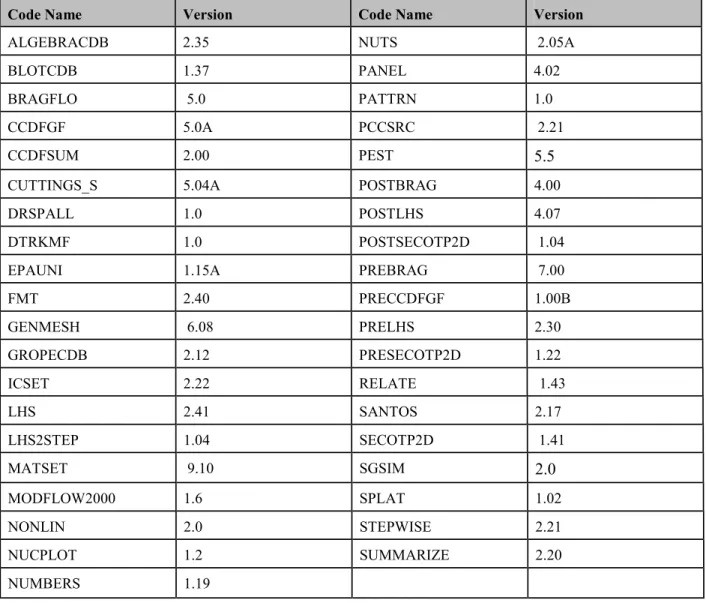
Table 3.1 Computer Codes Reviewed by the Agency
Code Name Version Code Name Version
ALGEBRACDB 2.35 NUTS 2.05A
BLOTCDB 1.37 PANEL 4.02
BRAGFLO 5.0 PATTRN 1.0
CCDFGF 5.0A PCCSRC 2.21
CCDFSUM 2.00 PEST 5.5
CUTTINGS_S 5.04A POSTBRAG 4.00
DRSPALL 1.0 POSTLHS 4.07
DTRKMF 1.0 POSTSECOTP2D 1.04
EPAUNI 1.15A PREBRAG 7.00
FMT 2.40 PRECCDFGF 1.00B GENMESH 6.08 PRELHS 2.30 GROPECDB 2.12 PRESECOTP2D 1.22 ICSET 2.22 RELATE 1.43 LHS 2.41 SANTOS 2.17 LHS2STEP 1.04 SECOTP2D 1.41 MATSET 9.10 SGSIM 2.0 MODFLOW2000 1.6 SPLAT 1.02 NONLIN 2.0 STEPWISE 2.21 NUCPLOT 1.2 SUMMARIZE 2.20 NUMBERS 1.19
In each case, the regression test methodology used the VMS DIFFERENCE command to compare output from the regression testing to output from previous validations. The
DIFFERENCE command compares two files and identifies records that are different in the two files. The DIFFERENCE command was not used to compare binary output data. Binary output data, from both the regression testing and from previous validations, were often processed through other software codes to produce ASCII files that could be compared using the DIFFERENCE command.
Differences that involve dates and times, file and directory names, user names, platform names, system version numbers and execution statistics were termed acceptable. Differences in
numerical output required analysis to determine the origin of the differences and whether the differences affect the code’s performance. Numerical differences were determined to be acceptable if the analysis judged that the output, although different, still met the acceptance criteria for the code.
For several of the computer codes DOE ran the tests outlined in the Validation Plan and after concluding a code meets the acceptance criteria specified in its requirements documents, a Software Installation and Checkout Form was completed for each code. The I&C documents that a code’s regression test results meet the acceptance criteria specified in its requirements
documents, managements approval of the installation of the software and the Software Configuration Management (SCM) Coordinator’s approval of the release of the code as production baseline software.
4.0
THE AGENCY’S REVIEW APPROACH
The Agency's review has been conducted by a team consisting of Agency and contractor personnel. The review was initiated with preparatory activities and assembly of background information. The computer codes are maintained in Carlsbad by the Department's WIPP science advisor, Sandia National Laboratories (SNL).
The Agency's review has been conducted in several stages, recognizing that changes in the assessment approach might be required, depending upon results obtained. The following preparatory activities were conducted before conducting on-site reviews:
$ Tabulation of the Agency’s code acceptance criteria that had been developed by the Agency during the CCA.
$ Preparation of a list of computer code life-cycle documentation (e.g., Verification & Validation Plans, Change Control and Error Reporting forms etc.) that the Agency would like to review.
$ Preparation of a draft checklist for reviewing the ability of the performance assessment codes to meet the quality assurance criteria.
The following on-site review activities were conducted by the Agency:
$ Received an overview presentation by SNL personnel describing the computer code migration activities.
$ Obtained and reviewed the adequacy of documentation describing the computer code migration activities.
$ Reviewed the adequacy of testing performed to demonstrate consistency of code output under different operating/hardware systems.
$ Reviewed and evaluated the traceability of the code migration information.
$ Review the ability of performance assessment codes to accurately reproduce output obtained under the software/hardware configurations in place during the CCA access input parameters from the new database.
In addition to the on-site reviews, off-site activities were conducted that included review of relevant documents (e.g., Change Control and Error Reporting Forms, Code Tracking Sheets, Validation Documents), review of all DIFFERENCE files for all tests cases for each of the computer codes and 3 libraries that DOE tested. The results of these activities are summarized in Section 5, below.
References:
REF1. “Review of WIPP Performance Assessment Computer Code Migration Activities”, March 31, 2004. Environmental Protection Agency, EPA Docket: A-98-49, II-B3-70 REF2. “Review of WIPP Performance Assessment Computer Code Migration”, June 10, 2003,
Environmental Protection Agency, EPA Docket: A-98-49, II-B3-57
REF3. “Department of Energy’s Compliance Certification Application for the Waste Isolation Pilot Plant”, 1996, EPA Docket: A-93-02, II-G-1
REF4. “Analysis Plan for Upgrade of Operating System to OpenVMS 7.3-1 and Hardware to HP Alpha EM45", AP-089, Rev.0, (ERMS #523491), September 11, 2002
5.0
SUMMARY OF INDIVIDUAL COMPUTER CODE MIGRATION
The following section present the results of the Agency’s computer code migration analysis for each individual code examined. Specific software and hardware configurations used in the CRA PA are reviewed, followed by the regression test methodology, the Agency’s analysis of the testing, and the Agency’s conclusion.5.1 ALGEBRACDB
This section presents the regression test results for the ALGEBRACDB Version 2.35 code. ALGEBRACDB is a utility code that adds, removes, or manipulates data on CAMDAT database (CDB) files. The data manipulations to be performed are expressed as algebraic equations involving the existing and/or newly created data.
5.1.1 Introduction
ALGEBRACDB 2.35 was used in the WIPP Compliance Certification Application (CCA) PA. ALGEBRACDB 2.35 was validated in January 1996 on a DEC Alpha 2100 with OpenVMS 6.1 by demonstrating that the results of ten Test Cases (1 through 10) met the acceptance criteria defined in the RD/VVP for ALGEBRACDB 2.35 (document Version 1.00 [2]). In January 1997 ALGEBRACDB was re-evaluated, and DOE determined that several requirements, previously identified as “Functionality Not Tested” in the RD/VVP (document Version 1.00), were in-fact in need of testing. DOE generated five additional Test Cases (11 through 15) to address these parameters and validated on a DEC Alpha 2100 with OpenVMS 6.1 [3] by demonstrating that the results met the acceptance criteria defined in the RD/VVP for ALGEBRACDB 2.35
(document Version 1.01[3]). In order to test new operating systems that were added in 2002-03 (Section 1), regression test results from ALGEBRACDB 2.35 run on the ES40 with OpenVMS 7.3-1 were compared to results from the validation tests of ALGEBRACDB 2.35 run on a DEC Alpha 2100 with OpenVMS 6.1. In June 2003, the Agency completed a report documenting the Agency’s approval with respect to the migration and verification of ALGEBRACDB 2.35 [7] on those operating systems. In January 2003, two new hardware systems were added to conduct performance assessments for the WIPP. A Compaq ES45, and a Compaq Alpha 8400 which are both running Open VMS 7.3-1 [8,9]. The discussion below documents the test methodology, regression test results, and the Agency’s conclusions with respect to ALGEBRACDB on the new hardware systems.
5.1.2 Test Methodology
The tests for this code comprised the fifteen test cases described in the Requirements Document & Verification and Validation Plan for ALGEBRACDB Version 2.35 (RD/VVP) (both
document Versions 1.00 [3] and 1.01 [4]). The first 10 tests are described in document Version 1.00 and the remaining 5 cases are included in document Version 1.01. Regression test results from ALGEBRACDB 2.35 run on the ES40 with OpenVMS 7.3-1 were compared to results from the validation tests of ALGEBRACDB 2.35 run on a DEC Alpha 2100 with OpenVMS 6.1, as documented in the Validation Document for ALGEBRACDB Version 2.35 (VD) (both
document Versions 1.00 [5] and 1.01 [6]). In January 2003, regression test results from
ALGEBRACDB 2.35 run on the ES45 and 8400 with OpenVMS 7.3-1 were compared to results from the validation tests of ALGEBRACDB 2.35 run on a Compaq ES40 with OpenVMS 7.3-1 [8,9].
CAMDAT database files (CDB) are produced in fourteen of the test cases. The output CDB files are converted from a binary, CDB, file to an ASCII file for comparison during the validation process. In the previous ALGEBRACDB 2.35 validation, the CDB files were converted using GROPECDB 2.10. GROPECDB has since been revised to Version 2.12. GROPECDB 2.12 was validated in June 1996 on a DEC Alpha 2100 with OpenVMS 6.1 [5]. GROPECDB 2.12 has also been validated on a Compaq ES45 and 8400 with OpenVMS 7.3-1 as part of the hardware
regression test (see Section 5.10, GROPECDB). For DOE’s regression test, GROPECDB 2.12 is used to convert the CDB output files from ALGEBRACDB 2.35 in OpenVMS 7.3-1 to ASCII text files.
The regression test methodology uses the VMS DIFFERENCE command to compare output from ALGEBRACDB 2.35 on the Compaq ES45 and 8400 with OpenVMS 7.3-1 to the output from the validation of ALGEBRACDB 2.35 on the Compaq ES40 with OpenVMS 7.3-1. The VMS DIFFERENCE command compares two files and identifies records that are different in the two files. Records with differences are grouped into sections; a section begins with a record that is different between the two files, and ends with the first subsequent record where the two files agree. In the output of the DIFFERENCE command, sections are separated by rows of 12
asterisks; inside a section, the records from the two files are separated by a row of 6 asterisks. At the end of the DIFFERENCE output, the utility reports the number of sections and the number of records in which differences were found.
5.1.3 Test Results
The fifteen test cases for ALGEBRACDB 2.35 were executed on the on the Compaq ES45 and 8400 with OpenVMS 7.3-1. Output files from the test cases were compared to the corresponding output files from the validation of ALGEBRACDB 2.35 on the Compaq ES40 with OpenVMS 7.3-1 by using the VMS DIFFERENCE command. DOE believes that all differences found in the output are acceptable; namely, that the differences are limited to code run date and time,
5.1.4 The Agency’s Conclusions
The Agency found that all differences in output are acceptable; namely, that the differences are limited to code run date and time, platform names, system version numbers, the directory and file names. The comparison found no differences in the numerical output of ALGEBRACDB 2.35. The Agency concludes that ALGEBRACDB 2.35 meets the acceptance criteria in the RD/VVP and is validated for WIPP PA use on the ES45 and 8400 with OpenVMS 7.3-1.
5.1.5 References
1. Analysis Report. 2003 “Analysis Report for the VMS 7.3-1 Regression Test” Sandia National Laboratories. WIPP:1.3.5.1.1: SFT: QA-L ERMS #525277.
2. WIPP PA (Performance Assessment). 1995. “Requirements Document & Verification and Validation Plan for ALGEBRACDB Version 2.35” (Document Version 1.00) Sandia National Laboratories. ERMS #228109.
3. WIPP PA (Performance Assessment). 1995. “Requirements Document & Verification and Validation Plan for ALGEBRACDB Version 2.35” (Document Version 1.01) Sandia National Laboratories. ERMS #241863.
4. WIPP PA (Performance Assessment). 1995. “Validation Document for ALGEBRACDB Version 2.35” (Document Version 1.00) Sandia National Laboratories. ERMS #228112. 5. WIPP PA (Performance Assessment). 1996. “Validation Document for ALGEBRACDB
Version 2.35” (Document Version 1.01) Sandia National Laboratories. ERMS #241865. 6. WIPP PA – Validation(Performance Assessment) 1996. “Validation Document for
GROPECDB Version 2.12, May 17, 1996” Sandia National Laboratories. ERMS #237497.
7. EPA, 2003. “Review of WIPP Performance Assessment Computer Code Migration”, June 10, 2003, EPA Docket: A-98-49, II-B3-57. Environmental Protection Agency. 8. WIPP PA – “Analysis Report for the ES45 Regression Test, March 6, 2003" Sandia
National Laboratories. ERMS #530290.
9. WIPP PA – “Analysis Report for the 8400 Regression Test", Sandia National Laboratories. ERMS #527280.
5.2 BLOTCDB
This section presents DOE’s regression test results for the BLOTCDB Version 1.37 code. BLOTCDB 1.37 plots the mesh and results from finite-element and finite-difference analysis programs. BLOTCDB plots all intermediate and final results from all main modules used to perform the WIPP PA. BLOTCDB directly reads a computational database (CDB) file and plots: (1) the computational mesh with contoured analysis results, (2) grid distance versus any variable, and/or (3) any variable versus any other variable. BLOTCDB produces mesh plots with various representations of the analysis output variables and can also produce X-Y curve plots of the analysis variables.
5.2.1 Introduction
BLOTCDB 1.37 was validated in May of 1996 on a DEC Alpha 2100 with OpenVMS 6.1 by demonstrating that the results of six test cases met the acceptance criteria defined in the RD/VVP [1,2]. BLOTCDB 1.37, running on the OpenVMS 6.1 operating system, was validated for use in the Compliance Certification Application (CCA). The code has not been revised since the initial validation. In order to test new operating systems that were added in 2002-03 (Section 1), regression test results from BLOTCDB 1.37 run on the ES40 with OpenVMS 7.3-1 were
compared to results from the validation tests of BLOTCDB 1.37 run on a DEC Alpha 2100 with OpenVMS 6.1. In June 2003, the Agency completed a report documenting the Agency’s
approval with respect to the migration and verification of BLOTCDB 1.37 [3]. In January 2003, two new hardware systems were added to conduct performance assessments for the WIPP. A Compaq ES45, and a Compaq Alpha 8400 which are both running Open VMS 7.3-1[4,5]. The discussion below documents the test methodology, regression test results, and the Agency’s conclusions with respect to BLOTCDB 1.37 on the new hardware systems.
5.2.2 Test Methodology
The tests for this code comprised the six test cases described in the Requirements Document & Verification and Validation Plan for BLOTCDB Version 1.37 (RD/VVP) [1]. Regression test plots from BLOTCDB 1.37 run on the ES40 with OpenVMS 7.3-1 were visually compared by DOE to plots from the validation tests of BLOTCDB 1.37 run on a DEC Alpha 2100 with OpenVMS 6.1 [3]. Validation of BLOTCDB 1.37 running on a Compaq ES40 using OpenVMS 7.3-1 was also accomplished by visually comparing output plot files to the corresponding output plot files from the previous validation of BLOTCDB 1.37 running on a DEC Alpha 2100 using OpenVMS 6.1[3]. In January 2003, regression test results from BLOTCDB 1.37 run on the ES45 and 8400 with OpenVMS 7.3-1 were compared to results from the validation tests of BLOTCDB 1.37 run on a Compaq ES40 with OpenVMS 7.3-1 [4,5]. The regression test methodology uses the VMS DIFFERENCE command to compare output from BLOTCDB 1.37 on the Compaq ES40 running OpenVMS 7.3-1 to the output from ES45 and 8400 with OpenVMS 7.3-1.
5.2.3 Test Results
The six test cases for BLOTCDB 1.37 were executed on the Compaq ES45 and 8400 with OpenVMS 7.3-1. Output files from the test cases were compared to the corresponding output files from the validation of the appropriate version of BLOT 1.37 by using the DIFFERENCE command. DOE believes that the comparison found that all differences in output are acceptable; namely that the differences are limited to code run dates and times, file and directory names. 5.2.4 The Agency’s Conclusions
The Agency found that all differences in output are acceptable; namely, that the differences are limited to code run date and time, platform names, system version numbers, the directory and file names. The comparison found no differences in the numerical output of BLOT 1.37. The Agency concludes that BLOT 1.37 meets the acceptance criteria in the RD/VVP and is validated for WIPP PA use on the ES45 and 8400 with OpenVMS 7.3-1.
5.2.5 References
1. WIPP PA (Performance Assessment). 1996. “Requirements Document & Verification and Validation Plan for BLOTCDB 1.37” Sandia National Laboratories. ERMS #237499.
2. WIPP PA (Performance Assessment). 1996. “Validation Document for BLOTCDB 1.37”, Sandia National Laboratories. ERMS #237502.
3. EPA, 2003. “Review of WIPP Performance Assessment Computer Code Migration”, June 10, 2003, EPA Docket: A-98-49, II-B3-57. Environmental Protection Agency. 4. WIPP PA – “Analysis Report for the ES45 Regression Test” March 6, 2003 Sandia
National Laboratories. ERMS #530290.
5. WIPP PA – “Analysis Report for the 8400 Regression Test” Sandia National Laboratories. ERMS #527280.
5.3 BRAGFLO
This section presents the regression test results for the BRAGFLO Version 5.0 code. BRAGFLO is a program used to study two-phase (brine and gas), three-dimensional isothermal flow in porous media. It has been developed specifically for use in assessing the performance of the WIPP, particularly the flow behavior in the immediate vicinity of the repository. The physical model is described by material balance equations for brine and gas, Darcy’s law, and two phase fluid properties. The numerical model includes a cell-centered finite difference discretization, Newton solution of the nonlinear constitutive equations, and linear equation solvers necessary for the Newton iteration. Various submodels specific to WIPP include a pressure-induced fracture treatment, creep closure of the repository, and gas generation resulting from corrosion and biodegradation of waste components.
5.3.1 Introduction
Since the CCA PA, the BRAGFLO code has undergone a series of revisions. Versions 4.00 and 4.01 of BRAGFLO were used in the WIPP CCA. BRAGFLO 4.00 was used to calculate Salado flow; BRAGFLO 4.01 was used to calculate direct brine releases. These codes were validated on a DEC Alpha 2100 with OpenVMS 6.1 by demonstrating that the results of each test case met the acceptance criteria defined in the RD/VVPs [3, 4, 5, 6].
BRAGFLO 4.10 was created to combine the capabilities of both BRAGFLO 4.00 and
BRAGFLO 4.01 into a single code version. No new functionality was added [1]. BRAGFLO 4.10 was validated on a DEC Alpha 2100 with OpenVMS 6.1 by demonstrating that the results of each test case met the acceptance criteria defined in the RD/VVP [3]. Several changes were made to BRAGFLO 4.10 during its revision to BRAGFLO 5.0. This included removing a
number of parameter assignments from embedded data to input data; moving the porosity surface from embedded data to input data; and changing the input-output format [16].
DOE ran the OpenVMS 7.3-1 tests using the FORTRAN 7.3 Run-Time Library (RTL) instead of the current version of the RTL, version 7.4A. The date and time functions in the RTL changed between version 7.3 and 7.4A, and BRAGFLO 4.10 does not run with the new date and time functions. Accordingly, BRAGFLO 4.10 is run using the FORTRAN 7.3 RTL by implementing the procedure described in [7].
BRAGFLO 4.10 has one open problem report [8]. BRAGFLO 4.10 uses an outdated list-directed I/O format that allows space-padded fields. Many of the input files for the BRAGFLO 4.10 test cases were generated by PREBRAG 6.00 and include space-padded fields. To allow BRAGFLO 4.10 to read these input files, each input file is modified by a conversion script,
EVAL_BF2_CONVERT_INPUT.COM, to remove extraneous spaces from the input file. The test input files for this analysis required the use of this conversion script.
In June 2003, the Agency completed a report documenting the Agency’s approval with respect to the migration and verification of BRAGFLO 4.10 [13] on those operating systems. For the CCA, the DOE has modified BRAGFLO 4.10 to produce BRAGFLO 5.0 to allow the user to input information that was previously included in the BRAGFLO executable file [16].
Beginning with BRAGFLO 5.0, the user will provide various constants and molecular weights as well as information defining the porosity surface, which comes from the SANTOS software (Section 5.33). Changes from BRAGFLO 4.10 to BRAGFLO 5.0 involve input/output issues. In January 2003, two new hardware systems were added to conduct performance assessments for the WIPP. A Compaq ES45, and a Compaq Alpha 8400 which are both running Open VMS 7.3-1[14,15]. The discussion below documents the test methodology, regression test results, and the Agency’s conclusions with respect to BRAGFLO 4.10 and 5.0 on the new hardware systems.
5.3.2 Test Methodology
The tests for this code comprised all twelve test cases described in the Requirements Document & Verification and Validation Plan for BRAGFLO Version 4.10 (RD/VVP) [1]. Results of regression tests performed on BRAGFLO 4.10 run on the ES40 with OpenVMS 7.3-1 and on the DEC Alpha 2100 with OpenVMS 6.1 have been documented by the Agency [13]. In January 2003, regression test results from BRAGFLO 4.10 run on the ES45 and 8400 with OpenVMS 7.3-1 were compared to results from the validation tests of BRAGFLO 4.10 run on a Compaq ES40 with OpenVMS 7.3-1 [14,15]. In March 2003, BRAGFLO 5.0 was tested by performing all 12 test cases presented in the RD\VVP and comparing the results to the acceptance criteria [17].
The regression test methodology uses the VMS DIFFERENCE command to compare output from BRAGFLO 4.10 on the Compaq ES40 with OpenVMS 7.3-1 to the output from the
validation of BRAGFLO 4.10 from ES45 and 8400 with OpenVMS 7.3-1. Test Case 7 required the use of three other WIPP PA codes: POSTBRAG 4.00, SUMMARIZE 2.20, and SPLAT 1.02. These three codes have been validated on a Compaq ES45 and 8400 with OpenVMS 7.3-1 as part of the hardware regression test (see Sections 5.17, 5.27, and 5.25 for POSTBRAG, SUMMARIZE and SPLAT, respectively).
5.3.3 Test Results
The twelve test cases for BRAGFLO 4.10 were executed on the Compaq ES45 and 8400 with OpenVMS 7.3-1. Each test case generated output files, which were compared to the output files from the BRAGFLO 4.10 validation tests, executed on Compaq ES40 with OpenVMS 7.3-1. DOE used the DIFFERENCE command to compare output files. DOE concluded that all other differences in output are acceptable; namely, that the differences are limited to code run date and time, file and platform names. The Agency also found that all other differences in output are acceptable; namely, that the differences are limited to code run date and time, file and platform names.
The twelve test cases for BRAGFLO 5.0 were executed on the Compaq ES45 and 8400 with OpenVMS 7.3-1 [18]. Each test case generated output files, which were compared to the output files from the BRAGFLO 5.0 validation tests, executed on Compaq ES40 with OpenVMS 7.3-1. The differences are limited to code run date and time, file and platform names. DOE concluded that all other differences in output are acceptable; namely, that the differences are limited to code run date and time, file and platform names. The Agency also found that all other differences in output are acceptable; namely, that the differences are limited to code run date and time, file and platform names.
5.3.4 The Agency’s Conclusions
Since all differences are acceptable, the Agency concludes that BRAGFLO 4.10 and BRAGFLO 5.0 meet the acceptance criteria specified in the VVP [1], and thus are validated on the Compaq ES45 and 8400 with OpenVMS 7.3-1.
5.3.5 References
1. WIPP PA (Performance Assessment). 1997. “Requirements Document & Verification and Validation Plan for BRAGFLO Version 4.10” Sandia National Laboratories. ERMS #245227
2. WIPP PA (Performance Assessment). 1997. “Validation Document for BRAGFLO Version 4.10” Sandia National Laboratories. ERMS #245242
3. WIPP PA (Performance Assessment). 1996. “Requirements Document & Verification and Validation Plan for BRAGFLO Version 4.00” Sandia National Laboratories. ERMS #230702
4. WIPP PA (Performance Assessment). 1996. “Validation Document for BRAGFLO Version 4.00” Sandia National Laboratories. ERMS #230705
5. WIPP PA (Performance Assessment). 1996. “Requirements Document & Verification and Validation Plan for BRAGFLO Version 4.01” Sandia National Laboratories. ERMS #238122.
6. WIPP PA (Performance Assessment). 1996. “Validation Document for BRAGFLO Version 4.01” Sandia National Laboratories. ERMS #238135.
7. WIPP PA (Performance Assessment). 2001. “Change Control Form, Compaq/DEC Alpha FORTRAN 7.4A Compiler Upgrade” Sandia National Laboratories. ERMS #519716. 8. WIPP PA (Performance Assessment). 2001. “Software Problem Report 01-002 for
PREBRAG 6.00 and BRAGFLO 4.10” Sandia National Laboratories. ERMS# 519714. 9. Digital Equipment Corporation. 1996. “OpenVMS 7.1 Release Notes, Section 5.8. Digital
Equipment Corporation, Maynard Massachusetts, November 1996”. Order number AA-QSBTA-TE.
10. WIPP PA (Performance Assessment). 1998. “WIPP PA Analysis Package for AP-042” Sandia National Laboratories. ERMS #249786.
11. WIPP PA (Performance Assessment). 2003. “BRAGFLO Test Case 7 Results for the OpenVMS 7.3-1 Regression Test” ERMS #525277.
12. Validation Report for BRAGFLO Version 4.10 Test Case 6 Using OpenVMS 7.3.1 13. EPA, 2003. “Review of WIPP Performance Assessment Computer Code Migration”,
June 10, 2003, EPA Docket: A-98-49, II-B3-57. Environmental Protection Agency. 14. WIPP PA – “Analysis Report for the ES45 Regression Test”, March 6, 2003 Sandia
National Laboratories. ERMS #530290.
15. WIPP PA – “Analysis Report for the 8400 Regression Test" Sandia National Laboratories. ERMS #527280.
16. WIPP PA (Performance Assessment). 2003. “Change Control Form, BRAGFLO” Sandia National Laboratories. ERMS #525869.
17. WIPP PA (Performance Assessment). 2003. “Validation Document for BRAGFLO Version 5.00” Sandia National Laboratories. ERMS #525703.
18. WIPP PA (Performance Assessment). 2004. “Results of Regression Testing for BRAGFLO Version 5.00 Running on the Compaq ES45 and 8400 Platforms” Sandia National Laboratories.
5.4 CCDFGF
This section presents the regression test results for the CCDFGF code. The CCDFGF code assembles the results calculated by the other codes in the WIPP PA system to produce cumulative complementary distribution functions (CCDFs) of releases.
5.4.1 Introduction
Since the Compliance Certification Application (CCA) PA, the CCDFGF code has undergone a series of revisions. CCDFGF 1.01 was used in the WIPP CCA. Version 1.01 was validated on a DEC Alpha 2100 running OpenVMS 6.1 [3]. The validation demonstrated that the results of the four test cases met the acceptance criteria defined in the VVP for Version 1.01 [4]. In 1996, CCDFGF was revised to Version 2.01 to improve and clarify the algorithm by which releases to the Culebra were calculated. CCDFGF 2.01 was validated on a DEC Alpha 2100 running OpenVMS 6.1 [5]. Test Cases 1-4, for the validation of CCDFGF 2.01, were identical to the test cases for the validation of CCDFGF 1.01 [6]. The acceptance criteria for these test cases were satisfied by showing that the output from CCDFGF 2.01 was identical to the output of the CCDFGF 1.01 validation tests.
In 1997, CCDFGF was revised to Version 3.00 to correct an error found in Version 2.01 and to add functionality required for the Performance Assessment Verification Test (PAVT). CCDFGF 3.00 was validated on a DEC Alpha 2100 running OpenVMS 6.1 [7]. Test Cases 1-4, for the validation of CCDFGF 3.00, were not identical to the test cases for the validation of CCDFGF 2.01 [6]. Rather, the test cases for CCDFGF 3.00 were modifications of those used for CCDFGF 2.01. The modified test cases examined the features added to CCDFGF for Version 3.00 and specified additional acceptance criteria for these features. The validation of CCDFGF 3.00 demonstrated by DOE’s analysis that the additional acceptance criteria were met. Consequently, the validation of CCDFGF 3.00 relies the combination of the validation of CCDFGF 2.01 and on the extensions to the test cases for CCDFGF 3.00.
CCDFGF was revised again in 1997 to Version 3.01, to add the capability of producing
intermediate results for releases to and from the Culebra. Test Case 5 was added to validate this additional capability [2]. Since the revision consisted only of code to consolidate existing output of CCDFGF, and previous testing had validated that existing output, the validation of CCDFGF 3.01 only examined Test Case 5 [8]. Consequently, the validation of CCDFGF 3.01 relies on the combination of the validation of CCDFGF 2.01, the extensions to the test cases for CCDFGF 3.00, and the additional test case for CCDFGF 3.01.
In June 2003, the Agency completed a report documenting the Agency’s approval with respect to the migration and verification of CCDFGF 3.01 [8] on those operating systems. In January 2003, two new hardware systems were added to conduct performance assessments for the WIPP. A Compaq ES45, and a Compaq Alpha 8400 which are both running Open VMS 7.3-1[9,10]. In August 2003, CCDFGF Version 3.01 was upgraded to Version 5.0. In March 2004, the format of the open statements were changed and the Version number of CCDFGF was upgraded from 5.0 to 5.0A[12]. The discussion below documents the test methodology, regression test results, and the Agency’s conclusions with respect to CCDFGF testing on the new hardware systems. 5.4.2 Test Methodology
The tests for this code comprised the test cases described in the Verification and Validation Plan for CCDFGF Version 3.00 (VVP) [1], and the additional test case for CCDFGF Version 3.01 in the addendum to the VVP [2]. Regression test results from CCDFGF 3.01 run on the ES45 and 8400 with OpenVMS 7.3-1 were compared to results from the validation tests of CCDFGF 3.01 run on the ES40 with OpenVMS 7.3-1. The regression test methodology uses the VMS
DIFFERENCE command to compare output from CCDFGF 3.01 on the Compaq ES45 and 8400 running OpenVMS 7.3-1 to the output from previous validation tests.
After CCDFGF was upgraded to Version 5.0, all of the tests described in the Validation Plan for CCDFGF Version 5.00 (VP) [13]. Regression test results from CCDFGF 5.0A run on the ES45 and 8400 with OpenVMS 7.3-1 were compared to results from the validation tests of CCDFGF 5.0 run on the ES40 with OpenVMS 7.3-1. The regression test methodology uses the VMS DIFFERENCE command to compare output from CCDFGF 5.0A on the Compaq ES45 and 8400 running OpenVMS 7.3-1 to the output from previous validation tests.
5.4.3 Test Results
The five test cases for CCDFGF 3.01 were executed on the Compaq ES45 and 8400 with
OpenVMS 7.3-1. Each test case generated output files, which were compared to the output files from the CCDFGF 3.01 validation tests, executed on Compaq ES40 with OpenVMS 7.3-1. DOE used the DIFFERENCE command to compare output files. Output files from the test cases were compared to the corresponding output files from the validation of CCDFGF 3.01 by using the DIFFERENCE command. DOE concluded that all other differences in output are acceptable; namely, that the differences are limited to code run date and time, file and platform names. The Agency also found that all other differences in output are acceptable; namely, that the differences are limited to code run dates and times.
The five test cases for CCDFGF 5.0A were executed on the Compaq ES45 and 8400 with OpenVMS 7.3-1. Each test case generated output files, which were compared to the output files from the CCDFGF 5.00 validation tests, executed on Compaq ES40 with OpenVMS 7.3-1. DOE
compared to the corresponding output files from the validation of CCDFGF 5.0A by using the DIFFERENCE command. DOE concluded that all other differences in output are acceptable; namely, that the differences are limited to code run date and time, file and platform names. The Agency also found that all other differences in output are acceptable; namely, that the differences are limited to code run dates and times.
5.4.4 The Agency’s Conclusions
Since all differences are acceptable, the Agency concludes that CCDFGF 3.01, 5.0 and 5.0A meet the acceptance criteria specified in the VVP [1, 2,13], and thus is validated on the Compaq ES45 and 8400 with OpenVMS 7.3-1.
5.4.5 References
1. WIPP PA (Performance Assessment). 1997. “Verification and Validation Plan for CCDFGF Version 3.00”. Sandia National Laboratories. ERMS #245412.
2. WIPP PA (Performance Assessment). 1997. “Addendum to Verification and Validation Plan for CCDFGF Version 3.01”. Sandia National Laboratories. ERMS #245412.
3. WIPP PA (Performance Assessment). 1996. “Validation Document for CCDFGF Version 1.01”. Sandia National Laboratories. ERMS #242042.
4. WIPP PA (Performance Assessment). 1996. “Verification and Validation Plan for CCDFGF Version 1.01”. Sandia National Laboratories. ERMS #242043.
5. WIPP PA (Performance Assessment). 1996. “Validation Document for CCDFGF Version 2.01”. Sandia National Laboratories. ERMS #242772.
6. WIPP PA (Performance Assessment). 1996. “Verification and Validation Plan for CCDFGF Version 2.01”. Sandia National Laboratories. ERMS #242768.
7. WIPP PA (Performance Assessment). 1997. “Validation Document for CCDFGF Version 3.00”. Sandia National Laboratories. ERMS #245415.
8. WIPP PA (Performance Assessment). 1997. “Addendum to Validation Document for CCDFGF Version 3.01”. Sandia National Laboratories. ERMS #245415.
9. EPA, 2003. “Review of WIPP Performance Assessment Computer Code Migration”, June 10, 2003, EPA Docket: A-98-49, II-B3-57. Environmental Protection Agency. 10. WIPP PA – “Analysis Report for the ES45 Regression Test” March 6, 2003 Sandia
National Laboratories. ERMS #530290.
11. WIPP PA – “Analysis Report for the 8400 Regression Test” Sandia National Laboratories. ERMS #527280.
12. WIPP PA – “Analysis Report for CCDFGF Version 5.00A Regression Testing for the Compaq ES45 and 8400 Platforms “ 2004 Sandia National Laboratories.
13. WIPP PA – “CCDFGF Change Control Form from 5.00 to 5.00A” 2003. Sandia National Laboratories. ERMS #531461.
14. WIPP PA (Performance Assessment). 2003. “Validation Document for CCDFGF Version 5.0”. Sandia National Laboratories. ERMS #530042.
5.5 CCDFSUM
This section presents the regression test results for the CCDFSUM Version 2.00 code. The CCDFSUM code plots the cumulative complementary distribution functions (CCDFs) for the releases calculated by the code CCDFGF.
5.5.1 Introduction
Since the Compliance Certification Application (CCA) PA, the CCDFSUM code has undergone a series of revisions. CCDFSUM 1.01 was used in the WIPP CCA. Version 1.01 was validated on a DEC Alpha 2100 running OpenVMS 6.1 under the requirements of QAP 9-1 (now NP 9-1) [2]. In 1996, CCDFSUM was revised to Version 2.00 to accommodate changes made in
CCDFGF 3.00. CCDFSUM 2.00 was validated on a DEC Alpha 2100 running OpenVMS 6.1 [3].
In order to test new operating systems that were added in 2002-03 (Section 1), regression test results from CCDFSUM 2.00 run on the ES40 with OpenVMS 7.3-1 were compared to results from the validation tests of CCDFSUM 2.00 run on a DEC Alpha 2100 with OpenVMS 6.1. In June 2003, the Agency completed a report documenting the Agency’s approval with respect to the migration and verification of CCDFSUM 2.00 [4] on those operating systems. In January 2003, two new hardware systems were added to conduct performance assessments for the WIPP. A Compaq ES45, and a Compaq Alpha 8400 which are both running Open VMS 7.3-1[5,6]. The discussion below documents the test methodology, regression test results, and the Agency’s conclusions with respect to CCDFSUM 2.00 on the new hardware systems.
5.5.2 Test Methodology
The tests for this code comprised the test cases described in the Verification and Validation Plan for CCDFSUMVersion 2.00 (VVP) [1]. Regression test results from CCDFSUM 2.00 run on the ES45 and 8400 with OpenVMS 7.3-1 were compared to results from the validation tests of CCDFSUM 2.00 run on the ES40 with OpenVMS 7.3-1.
The regression test methodology uses the VMS DIFFERENCE command to compare output from CCDFSUM 2.00 on the Compaq ES45 and 8400 running OpenVMS 7.3-1 to the output from the Compaq ES40 running OpenVMS 7.3-1. The VMS DIFFERENCE command compares two files and identifies records that are different between the two files.
5.5.3 Test Results
The VVP for CCDFSUM 2.00 lists a total of nine test cases, however, CCDFSUM is run only in the first test case. The other eight test cases specify comparison of the output of the first test case with different criteria. These test cases do not exercise any function of the code. For this
regression test, DOE believes (and the Agency agrees) that it is sufficient to run only the first test case and compare its output with the output of the previous validation test.
The first test case was executed on the Compaq ES45 and 8400 with OpenVMS 7.3-1. The output files were compared to the corresponding output files from the validation of CCDFSUM 2.00 by using the DIFFERENCE command. DOE concluded that all differences in output are acceptable; namely, that the differences are limited to code run dates and times. The Agency also found that all differences in output are acceptable; namely, that the differences are limited to code run dates and time.
5.5.4 The Agency’s Conclusions
The Agency has found that all differences in output are acceptable; namely, that the differences are limited to code run dates and times. The comparison found no differences in the numerical output of CCDFSUM 2.00. The Agency concludes that CCDFSUM 2.00 meets the acceptance criteria in the VVP and is validated for WIPP PA use on the ES45 and 8400 with OpenVMS 7.3-1.
5.5.5 References
1. WIPP PA (Performance Assessment). 1997. “Verification and Validation Plan for CCDFSUM Version 2.00”. Sandia National Laboratories. ERMS #243920.
2. WIPP PA. 2001. “Nuclear Waste Management Program Procedure 9-1, Analyses” Sandia National Laboratories.
3. WIPP PA. 1997. “Validation Document for CCDFSUM Version 2.00”. Sandia National Laboratories. ERMS #243925.
4. EPA, 2003. “Review of WIPP Performance Assessment Computer Code Migration”, June 10, 2003, EPA Docket: A-98-49, II-B3-57. Environmental Protection Agency. 5. WIPP PA – “Analysis Report for the ES45 Regression Test, March 6, 2003" Sandia
National Laboratories. ERMS #530290.
6. WIPP PA – “Analysis Report for the 8400 Regression Test", Sandia National Laboratories. ERMS #527280.
5.6 CUTTINGS_S
This section presents the regression test results for the CUTTINGS_S Version 5.04A code. The CUTTINGS_S (CUSP) code was written to calculate the quantity of radioactive material (in Curies) brought to the surface from a radioactive waste disposal repository as a consequence of an inadvertent human intrusion through drilling. The code determines the amount of material removed from the repository by several release mechanisms, and decays the material to the time of intrusion.
5.6.1 Introduction
Since the Compliance Certification Application (CCA) PA, the CUTTINGS_S code has undergone a series of revisions. CUTTINGS_S 5.03 was used in the WIPP CCA. Version 5.03 was validated in May 1996 on a DEC Alpha 2100 with OpenVMS 6.1. The validation was accomplished by demonstrating the results of the six test cases met the acceptance criteria defined in the RD/VVP [4].
In July 1997 CUTTINGS_S was revised to Version 5.04 and was validated on a DEC Alpha 2100 with OpenVMS 6.1. Test Cases 1-6 for the validation of CUTTINGS_S 5.04 were identical to test cases for the validation of CUTTINGS_S 5.03. The acceptance criteria for these test cases were satisfied by showing that the output from CUTTINGSS_S 5.04 was identical to the output of the CUTTINGS_S 5.03 validation tests. New Test Cases 7-9 were validated by demonstrating the output of Test Cases 7–9 met the acceptance criteria defined in the RD/VVP for
CUTTINGS_S 5.04 [3].
In January 2001, CUTTINGS_S was revised to 5.04A to remove references to unused libraries. Although, SDBREAD_LIB and the INGRES library, are not used in PA calculations,
CUTTINGS_S 5.04 checks for their availability and will not run if they are absent. Since these libraries are no longer present on the system, it was necessary to eliminate the linkages. The following quotation from the change control form explains the revisions:
“CUTTINGS_S Version 5.04 was mistakenly linked with SDBREAD_LIB and an INGRES library. Although SDBREAD_LIB and the INGRES library are not used, the INGRES system must be installed on the system for Version 5.04 to run. The linked software is no longer available on the system, so CUTTINGS_S will be relinked to remove these libraries.
There are no source changes between CUTTINGS_S Version 5.04A and Version 5.04. The only difference is that CUTTINGS_S Version 5.04A will not be linked with SDBREAD_LIB and the INGRES library. The code will now be linked with the standard libraries CAMDAT_LIB, CAMCON_LIB, and CAMSUPES_LIB. (The library .OLB files that were used for Version 5.04 will not be used for Version 5.04A.” [5]
In order to test new operating systems that were added in 2002-03 (Section 1), regression test results from CUTTINGS_S 5.04A run on the ES40 with OpenVMS 7.3-1 were compared to results from the validation tests of CUTTINGS_S 5.04A run on a DEC Alpha 2100 with OpenVMS 6.1. In June 2003, the Agency completed a report documenting the Agency’s approval with respect to the migration and verification of CUTTINGS_S 5.04A [8]. In January 2003, two new hardware systems were added to conduct performance assessments for the WIPP. A Compaq ES45, and a Compaq Alpha 8400 which are both running Open VMS 7.3-1[9,10]. The discussion below documents the test methodology, regression test results, and the Agency’s conclusions with respect to CUTTINGS_S 5.04A on the new hardware systems.
5.6.2 Test Methodology
The tests for this code comprised the nine test cases described in the Requirements Document & Verification and Validation Plan for CUTTINGS_S Version 5.04 [RD/VVP] [3]. Regression test results from CUTTINGS_S 5.04A run on the ES45 and 8400 with OpenVMS 7.3-1 were
compared to results from the validation tests of CUTTINGS_S 5.04A run on a ES40 with OpenVMS 7.3-1.
The regression test methodology uses the VMS DIFFERENCE command to compare output from CUTTINGS_S 5.04A on the Compaq ES45 and 8400 running OpenVMS 7.3-1 to the output from the Compaq ES40 running OpenVMS 7.3-1. The VMS DIFFERENCE command compares two files and identifies records that are different between the two files.
5.6.3 Test Results
The nine test cases for CUTTINGS_S 5.04A were executed on the Compaq ES45 and 8400 with OpenVMS 7.3-1. Output files from the test cases were compared by DOE to the corresponding output files from the validation of CUTTINGS_S 5.04A on a Compaq ES45 with OpenVMS 7.3-1 by using the VMS DIFFERENCE command. DOE concluded that all differences in output are acceptable; namely, that the differences are limited to code run date and time, file and directory names, platform names, system version numbers and execution statistics. The Agency also found that all differences in output are acceptable; namely, that the differences are limited to code run date and time, file and directory names, platform names, system version numbers and execution statistics.
5.6.4 The Agency’s Conclusions
There were no numerical differences between CUTTINGS_S 5.04A run on the Compaq ES45 and 8400 with OpenVMS 7.3-1 and CUTTINGS_S 5.04 run with ES40 with OpenVMS 7.3-1. Since all differences between the results of CUTTINGS_S 5.04A, are acceptable, the Agency concludes that CUTTINGS_S 5.04A meets the acceptance criteria specified in the RD/VVP [3], and thus is validated on the Compaq ES45 and 8400 with OpenVMS 7.3-1.