Rese aRch Fe aTURe
on such distributed systems.3 In addition, research hasn’t adequately addressed the problems that can arise from combining multiple unrelated systems to perform a single distributed computation. This is a likely scenario, as many scientific users have access to a wide variety of systems.
In itself, each cluster, grid, and cloud provides well-defined access policies, full connectivity, and middleware that allows easy access to all its resources. Such systems are often largely homogeneous, offering the same software configuration or even the same hardware on every node. Combining several systems, however, is apt to result in a distributed system that is heterogeneous in software, hard-ware, and performance. This may lead to interoperability problems. Communication problems are also probable due to firewalls or network address translation (NAT), or simply because the geographic distance between the resources makes efficient communication difficult. More-over, a combination of systems is often dynamic and faulty, as compute resources can be added or removed or even crash at runtime. The use of inherently heterogeneous and unreliable resources such as desktop grids, stand-alone machines, and mobile devices exacerbates these issues.
T
he past two decades have seen tremendousprogress in the application of high-perfor-mance and distributed computer systems in science and industry. Among the most widely used systems are commodity compute clus-ters, large-scale grid systems, and, more recently, economically driven computational clouds and mobile systems. In the last few years, researchers have inten-sively studied such systems with the goal of providing transparent and efficient computing, even on a world-wide scale.1
Unfortunately, current practice shows that this goal re-mains out of reach.2 For example, today’s grid systems are mostly exploited to run coarse-grained parameter-sweep or master-worker programs. For more complex applica-tions, grid usage is generally limited to straightforward scheduling systems that select a single site for execution. This is unfortunate, as many scientific and industrial ap-plications—including astronomy, multimedia, medical imaging, and biobanking—would benefit from distributed compute resources. Optical networking advances also enable a much larger class of applications to run efficiently
The use of parallel and distributed computing systems is essential to
meet the ever-increasing computational demands of many scientific and
industrial applications. Ibis allows easy programming and deployment
of compute-intensive distributed applications, even for dynamic, faulty,
and heterogeneous environments.
Henri E. Bal, Jason Maassen, Rob V. van Nieuwpoort, Niels Drost,
Roelof Kemp, Timo van Kessel, Nick Palmer, Gosia Wrzesi ska, Thilo Kielmann,
Kees van Reeuwijk, Frank J. Seinstra, Ceriel J.H. Jacobs, and Kees Verstoep
Vrije Universiteit, Amsterdam
Real-World
Distributed
Computing
with Ibis
that offer support for fault tolerance and malleability— adding and removing machines on the fly—and that automatically circumvent any connectivity problems. The deployment system should allow for easy deploy-ment and managedeploy-ment of applications, irrespective of connection constitutes a real-world distributed
system, as shown in Figure 1. Writing applications for such systems is notoriously difficult, as applica-tion programmers must take into account all of the problems described above. Deploying the applica-tions is equally hard because each site is likely to have its own middleware and access policies.
The uptake of high-performance distributed computing can be enhanced if these complexities are abstracted away by a single software system that applies to any real-world distributed system. Conceptually, such a system should offer two logically independent subsystems: a programming system, offering functionality traditionally associ-ated with programming languages and communication libraries; and a deployment system, offering functionality associated with operating systems. The programming system should allow applications to be not only effi-cient but also robust by providing programming models
Figure 1. A “worst-case” real-world distributed system consisting of clusters, grids, and clouds as well as desktop grids, stand-alone machines, and mobile devices. Clusters, grids, and clouds are well-organized subsystems that use their own middleware, programming interfaces, access policies, and protection mechanisms.
Grids Clusters
Stand-alone machines Mobile devices
Rese aRch Fe aTURe
where they run. It should also provide support for dis-tributed file management, user authentication, resource management, and interoperability between different middleware systems.
To serve the vast majority of users, ranging from system and application-level software developers to application users, the subsystems should follow a layered approach, with programming interfaces defined at different abstrac-tion levels, each tailored to different users’ needs.
IBIS ARCHITECTURE
Researchers are extensively studying high-performance and distributed computing tools and mechanisms in the field, but no existing single software system covers the full spectrum. Ibis aims to address this deficiency with an in-tegrated system based on a straightforward, user-oriented philosophy: real-world distributed applications should be developed and compiled on a local workstation, and de-ployed from there onto the distributed system.
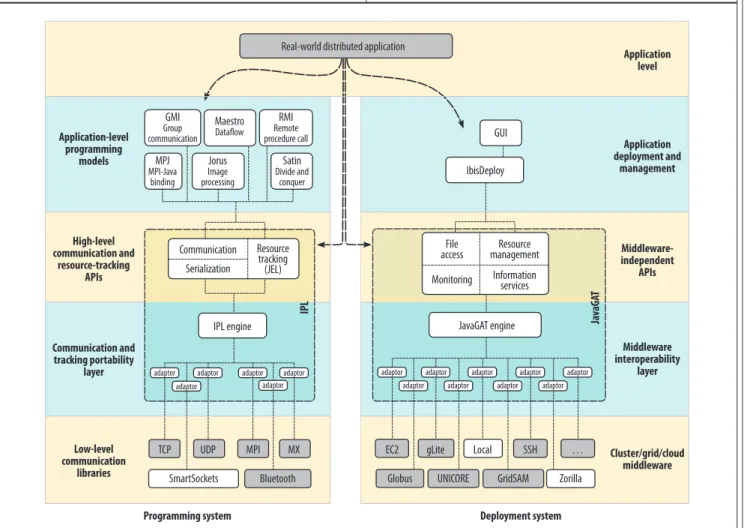
This “write-and-go” philosophy requires minimal as-sumptions about the execution environment. To enable applications to run in a heterogeneous system, Ibis ex-ploits Java virtual machine technology. As Figure 2 shows, the Ibis system architecture follows the dual-subsystem approach. The programming system provides a range of programming models, all implemented on the same communication library: the Ibis Portability Layer (IPL). The deployment system contains a GUI and a library for deploying and managing applications, implemented on a middleware interoperability layer: the Java Grid Applica-tion Toolkit (JavaGAT).
Ibis is modular and flexible, allowing users to select the functionality they require from either Ibis or other software. For example, applications can use the high-level programming models and the deployment GUI, but they can also be implemented directly on the IPL and JavaGAT. Likewise, applications are free to use only one of the two subsystems. For example, the deployment system can be used to deploy C/MPI and other non-Java applications.
Ibis is fully open source and used in various real-world distributed applications such as multimedia computing, spectroscopic data processing (FOM Institute for Atomic and Molecular Physics), human brain-scan analysis (Vrije Universiteit Medical Center), automatic grammar learn-ing, and many others. In addition, Ibis has been used to build high-level programming systems, including a work-flow engine for astronomy applications in D-Grid (Max Planck Institute for Astrophysics), the GridChem gate-way for TeraGrid, and a grid file system (University of Erlangen-Nürnberg).
Ibis has also been applied to enhance existing systems such as ProActive (INRIA), Jylab (University of Patras), and the GRID superscalar framework (Barcelona Supercom-puter Center). The “Related Work” sidebar describes some of these systems and how they differ from Ibis.
Ibis has won prizes in numerous international com-petitions including the International Scalable Computing
Related WoRk
I
bis provides a dual-subsystem solution for real-world dis-tributed programming and deployment. In contrast, most existing systems focus on one of the two subsystems.1ProActive,2 like Ibis, follows a logical dual-subsystem approach.
It contains several grid programming models and provides grid deployment and virtualization components. Whereas the Ibis IPL is small and highly efficient, the core of ProActive is more heavy-weight. ProActive further requires the user to handle all connection setup problems and select the appropriate middleware.
Phoenix3 consists of a general message-passing model that
allows compute nodes to be added to and removed from a running application. It also deals with some of the connection setup prob-lems solved by SmartSockets. Phoenix provides easy-to-use tools that handle common grid operations. However, it can’t automati-cally exploit different grid middleware systems simultaneously.
The GRID superscalar framework4 supports a certain degree of
automatic grid deployment. It consists of an application program-ming interface, a runtime system, and a grid deployment center. It automatically converts a sequential application composed of tasks into a parallel application, allowing independent tasks to be exe-cuted on different grid resources.
The GridRPC specification5 defines an API for remote procedure
calls in grids. Two reference implementations exist, Ninf-G and Net-Solve/GridSolve. In contrast to the JavaGAT, the binding of grid middleware to application objects is entirely static.
The Open Grid Forum is currently standardizing the next-gener-ation grid programming toolkit: a Simple API for Grid Applicnext-gener-ations (SAGA).6 The goal is to provide a simple, uniform, standard
pro-gramming interface for distributed applications, with consistent semantics and style for different grid functionalities. Notably, SAGA’s Java Reference Implementation is implemented directly on top of the JavaGAT.
References
1. I. Foster and C. Kesselman, eds., The Grid 2: Blueprint of a New Computing Infrastructure, 2nd ed., Morgan Kaufmann, 2003. 2. L. Baduel et al., “Programming, Deploying, Composing, for the
Grid,” Grid Computing: Software Environments and Tools, J.C. Cunha and O.F. Rana, eds., Springer, 2006, pp. 205-229. 3. K. Taura et al., “Phoenix: A Parallel Programming Model for
Accommodating Dynamically Joining/Leaving Resources,”
Proc. 9th ACM SIGPLAN Symp. Principles and Practice of Parallel Programming (PPoPP 03), 2003, ACM Press, pp. 216-229. 4. R. Badia et al., “Programming Grid Applications with GRID
Superscalar,” J. Grid Computing, June 2003, pp. 151-170. 5. K. Seymour et al., “Overview of GridRPC: A Remote Procedure
Call API for Grid Computing,” Proc. 3rd Int’l Workshop Grid Com-puting, LNCS 2536, Springer, 2002, pp. 274-278.
6. T. Goodale et al., “SAGA: A Simple API for Grid Applications, High-Level Application Programming on the Grid,” Computa-tional Methods in Science and Technology, vol. 12, no. 1, 2006, pp. 7-20.
Shell (SSH) tunneling.
SmartSockets creates an overlay network with a set of interconnected support processes called hubs. Em-ploying gossiping techniques, the hubs discover which other hubs they can connect to, using SSH tunneling if necessary. This overlay network can be used to help solve connectivity problems or route the application’s network traffic.
When creating a connection, SmartSockets initially tries to set up a regular (direct) TCP connection. If this fails, it uses the overlay network to send a request for a reverse connection setup to the target machine. If this also fails, the library creates a virtual connection that uses
over-lay routing. SmartSockets also handles machines with multiple network addresses via multihoming. During connection setup, it considers all source and target ad-dresses. It uses heuristics to determine the combinations most likely to work and then tries these first. Extra identity checks in the procotol ensure that it reaches the correct target machine. A worldwide experiment5 demonstrated the library’s effectiveness: in 30 realistic connectivity sce-narios, SmartSockets was always capable of establishing a connection, while traditional sockets only worked in six of these.
Ibis programming models
Besides the IPL, Ibis provides a range of programming models, from low-level message passing to high-level di-vide-and-conquer parallelism. It implements the following programming models using the IPL:
• MPJ, the MPI binding for Java; • Satin, a divide-and-conquer model;6
• RMI, object-oriented remote procedure call;
• group method invocation (GMI), a generalization of RMI to group communication, including multicast and all-to-all communication;
• Maestro, a fault-tolerant and self-optimizing dataflow model;7 and
• Jorus, a programming model for data-parallel multi-media applications.8
Billion Triples Challenge at the 2008 International Seman-tic Web Conference (for general innovation).
IBIS PROGRAMMING SYSTEM
The Ibis programming system provides many program-ming models, all implemented on top of the IPL.
IPL
The IPL is a Java-based communication library that provides robust communication and resource-tracking mechanisms. It typically ships with the application as jar (Java archive) files, so no additional preinstalled libraries need be present at any destination machine.
The library provides a range of communication primi-tives including those for point-to-point and multicast communication. It supports streaming communication, which is especially important in high-latency environments as this allows overlapping of serialization, communication, and deserialization of data. The IPL avoids copying over-head as much as possible and uses bytecode rewriting to generate efficient serialization and deserialization func-tions. Consequently, it can significantly outperform Sun remote method invocation (RMI) communication and even C/MPI, in particular for complex data structures.4
The IPL has been designed specifically for real-world distributed environments where resources can be added or removed dynamically. It incorporates a mechanism, Join-Elect-Leave (JEL), that tracks which resources are being used and what roles they have. JEL is based on the concept of signaling: it notifies the application or runtime system when resources are added to or removed from the compu-tation. To select resources with a special role, it includes elections. JEL thus provides the building blocks for fault tolerance and malleability by giving an up-to-date view of available resources, allowing applications and runtime systems to respond to changes when required.
A number of pure-Java IPL implementations are avail-able using the Ibis SmartSockets library, TCP (Transmission Control Protocol), UDP (User Datagram Protocol), and Bluetooth. In addition, we provide implementations using specialized non-Java libraries, such as MX (Myrinet) or MPI. The SmartSockets, TCP, and UDP implementations also work on the Android smartphone platform.
SmartSockets
Running a parallel application on distributed resources is complicated due to connectivity problems that make direct communication difficult or impossible. Incoming traffic at a node may be restricted by a firewall or NAT. The presence of multiple network interfaces and IP addresses can cause addressing problems, as can private network
The IPL has been designed
specifically for real-world distributed
environments where resources can
be added or removed dynamically.
Rese aRch Fe aTURe
technique dynamically forwards application calls on the JavaGAT API to one or more middleware adaptors that implement the requested functionality. Selection occurs at runtime and uses policies and heuristics that auto-matically select the best available middleware, enhancing portability. If an operation fails, the intelligent-dispatch-ing feature will automatically select and dispatch the API call to an alternative middleware. This process continues until a middleware successfully performs the requested operation.
Although such flexibility comes at the cost of some run-time overhead, this is often negligible compared to the cost of the operations themselves. For instance, a Globus job submission takes several seconds, while the overhead introduced by the JavaGAT is less than 10 ms. However, the additional semantics of the high-level API can introduce some overhead. For instance, if a file is copied, the JavaGAT first checks if the destination already exists or is a direc-tory. These extra checks cost time because they require remote operations.
The JavaGAT API isn’t the lowest common denominator of the underlying middleware APIs. Instead, the JavaGAT offers rich default functionality and can combine features of multiple middleware layers with its intelligent-dispatch-ing technique. Consider the followintelligent-dispatch-ing real code example, which copies remote files and entire directories between sites:
1 import org.gridlab.gat.*; 2 import org.gridlab.gat.io.File; 3
4 public class Copy {
5 public static void main(String [] args) throws Exception {
6 GATContext context = new GATContext();
7 URI source = new URI(args[0]); 8 URI dest = new URI(args[1]); 9
10 File file = GAT.createFile(context, source); // Create a GAT file
11
12 file.copy(dest); // The actual file or directory copy
13
14 GAT.end(); // Shutdown the JavaGAT 15 }
16 }
This code is middleware independent and demonstrates the JavaGAT API’s power; equivalent Globus code would take hundreds of lines. The JavaGAT allows programmers The higher-level programming models’ runtime
sys-tems exploit the IPL and JEL to address many distributed programming difficulties. A good example is Satin, which uses JEL resource-tracking mechanisms to make applica-tions malleable and fault tolerant. For example, Satin can reexecute subtasks if a processor crashes. Also, it can dy-namically schedule subtasks on new machines that become available during the computation, and it can migrate sub-tasks if machines leave the computation. Satin’s scheduler also does locality optimizations: divide-and-conquer pro-grams are inherently hierarchical and can therefore be mapped efficiently onto a hierarchical wide-area system such as a grid. Likewise, the scheduler does latency hiding; if it needs to retrieve new jobs from distant machines, it will do that asynchronously, without blocking.6
Satin thus makes these problems transparent to the user and application. Applications written with a lower-level programming model like the IPL must deal with such prob-lems explicitly, but Ibis gives them the necessary low-level mechanisms to do so.
IBIS DEPLOYMENT SYSTEM
The Ibis deployment system consists of a software stack and a graphical user interface for deploying and manag-ing applications. The GUI is implemented on top of the JavaGAT.
JavaGAT
Writing distributed applications using existing mid-dleware APIs is a daunting task. APIs change frequently and are often incomplete and too low-level.9 The JavaGAT provides a high-level API that facilitates development of complex applications. This API is object oriented and offers high-level primitives for access to the distributed system, independent of the middleware that implements this functionality. The primitives provide access to remote data, start remote jobs, and support monitoring, steering, user authentication, resource management, and storing of application-specific data. The JavaGAT uses an extensible architecture, wherein adaptors (plugins) provide access to the different types of middleware.
The JavaGAT also uses intelligent dispatching to integrate multiple middleware systems with different and incom-plete functionality into a single, consistent system. This
The JavaGAT uses intelligent
dispatching to integrate multiple
middleware systems with different
and incomplete functionality into a
single, consistent system.
experiments.
APPLICATION EXAMPLE:
MULTIMEDIA CONTENT ANALYSIS
We illustrate Ibis with an application that performs real-time recognition of everyday objects. Images produced by a camera are processed by an advanced algorithm that extracts feature vectors from the video data, which de-scribe local properties like color and shape. To recognize an object, the application compares the object’s feature vectors to ones stored earlier and annotated with a name.
As this is a compute-intensive problem with soft real-time constraints, a large distributed system performs the analysis.8 A data-parallel application running on a single site processes a single video frame. Calculations over con-secutive frames are distributed over different sites in a task-parallel manner.
The initial application was written in C++/MPI, using TCP and SSH tunnels for wide-area communication. This program used manual deployment, was vulnerable to connectivity problems and partial failures (each caus-ing the entire application to fail), and was frustratcaus-ing to write and maintain on heterogeneous hardware and middleware. Step by step, we replaced all its components with an implementation in Java and Ibis. With the new program, the IbisDeploy GUI makes deployment easy, SmartSockets automatically corrects the connectivity problems, and the JavaGAT accommodates the middle-ware heterogeneity. We provided robustness by adding fault tolerance and malleability support to the application using the IPL-provided mechanisms.
The resulting application is compiled on a desktop ma-chine and easily deployed onto a distributed system. It concurrently uses up to 20 clusters, commonly employ-ing a total of 500 to 800 cores, and a mix of different middleware. The application even runs on the Android smartphone platform, allowing distributed object recogni-tion from mobile devices.
EXPERIMENTAL EVALUATION
To evaluate Ibis’s functionality and performance, we carried out a series of experiments with the multimedia ment infrastructure. Rather, its security interface provides
generic functionality to store and manage security in-formation such as usernames and passwords. Also, the JavaGAT provides a mechanism to restrict the availability of security information to certain middleware systems or remote machines. Currently, the JavaGAT supports many different middleware systems such as Globus, UNICORE (Uniform Interface to Computing Resources), gLite, PBS (Portable Batch System), SGE (Sun Grid Engine), KOALA (a co-allocating grid scheduler), SSH, GridSAM, Amazon EC2 (Elastic Compute Cloud), ProActive, GridFTP, HTTP, SMB (Server Message Block)/CIFS (Common Internet File System), and Zorilla.
Zorilla
Most existing middleware APIs lack coscheduling capabilities and don’t support fault tolerance and malle-ability. To overcome these problems, Ibis provides Zorilla, a lightweight P2P middleware that runs on any real-world distributed system. In contrast to traditional middleware, Zorilla has no central components and is easy to set up and maintain. It supports fault tolerance and malleability by implementing all functionality using P2P techniques. If resources used by an application are removed or fail, Zorilla can automatically find replacement resources. It was specifically designed to easily combine resources in multiple administrative domains.
To create a resource pool, a Zorilla daemon process must be started on each participating machine. Also, each machine must receive the address of at least one other machine to set up a connection. Jobs can be submitted to Zorilla using the JavaGAT or, alternatively, using a com-mand-line interface. Zorilla then allocates the requested number of resources and schedules the application, taking user-defined requirements like memory size into account. The combination of virtualization and P2P techniques thus makes it very easy to deploy applications with Zorilla.
IbisDeploy
Many applications use the same deployment process. Therefore, IbisDeploy provides a simple and generic API and GUI that can automatically perform commonly used deployment scenarios. For example, when a distributed Ibis application is running, IbisDeploy starts the Smart-Sockets hub network automatically. It also automatically uploads the program codes, libraries, and input files ( pre-staging) and automatically downloads the output files (poststaging).
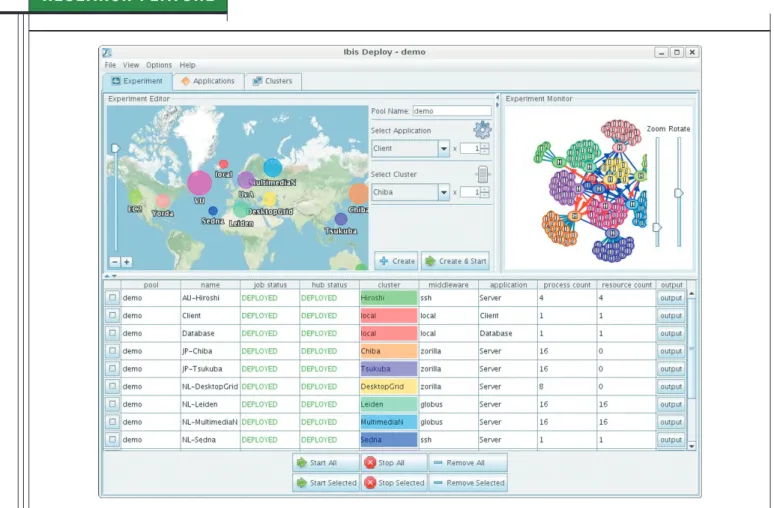
The IbisDeploy GUI, shown in Figure 3, lets a user start, monitor, and stop applications in an intuitive manner and run multiple distributed applications concurrently. The
IbisDeploy provides a simple
and generic API and GUI that can
automatically perform commonly
used deployment scenarios.
Rese aRch Fe aTURe
for task-parallel processing of subsequent images. We used IbisDeploy to start a client on a local machine and to deploy four data-parallel multimedia servers, each on a different DAS-3 cluster (using 64 machines in total). All code was implemented in Java/Ibis, compiled on the client machine, and deployed directly from there. No ap-plication software or libraries were initially installed on any other machine.
Using a single multimedia server resulted in a process-ing rate of approximately 1.2 frames per second. The simultaneous use of two and four clusters led to linear speedups at the client side of 2.5 and 5 frames per second, respectively. Adding additional clusters such as an EC2 cloud, a local desktop grid, and a local stand-alone ma-chine improved the frame rate even further. We thereby obtained a worldwide system using a variety of grid mid-dleware—Globus, Zorilla, and SSH—simultaneously from within a single application.
The SmartSockets hub network circumvented a range of connectivity problems between the sites. Many sites have a firewall, and the Japan and Australia clusters can only be reached using SSH tunnels. In addition, almost all of the applied resources have more than one IP address. application (see www.cs.vu.nl/ibis/demos.html for a video
demonstration). We used the Distributed ASCI Supercom-puter 3 (DAS-3), a five-cluster distributed grid system in the Netherlands; additional clusters in Chicago, Japan (the Chiba and Tsukuba InTrigger sites), and Sydney; the US East Amazon EC2 cloud system; and a desktop grid and single stand-alone machine, both in Amsterdam. Together, these machines comprised a real-world distributed system.
We first compared the performance of Java/Ibis and C++/MPI implementations of the data-parallel process-ing of a sprocess-ingle video frame. On a sprocess-ingle machine the Java program is about 12 percent slower than the C++ version, which is within acceptable limits for a “compile once, run everywhere” application executing inside a virtual ma-chine. On an 80-node DAS-3 cluster with the Myri-10G (Myricom 10-Gbit Ethernet) local network, the Java/Ibis and C++/MPI programs have very similar speedup (scalability) and communication overheads.
In the distributed version of our application, the data-parallel analysis is wrapped in a multimedia server. Client applications can upload an image or video frame to such a server and receive back a recognition result. When multiple servers are available, a client can use these simultaneously
Figure 3. The IbisDeploy GUI lets users load applications and resources (top middle) and keep track of running processes (bottom half). The top left of the figure shows the locations of available resources; the top right shows the SmartSockets network consisting of hubs and compute nodes. A video presentation is available at www.cs.vu.nl/ibis/demos.html.
I
and deploy applications for real-world distributed systems that consist of ad hoc combinations of clusters, grids, clouds, desktop grids, stand-alone machines, and even mobile devices. To achieve this, it integrates solutions to many fundamental distributed computing problems in a single modular programming and deployment system, written entirely in Java.An important lesson learned from Ibis is that resource-tracking functionality is as essential as communication functionality. While communication is among the basic capabilities of any distributed programming system, Ibis is one of the few systems that support resource tracking to implement fault tolerance and malleability. A second important lesson is that direct, two-way connectivity is rare in a real-world distributed system. However, SmartSockets achieves this in a transparent manner. Another lesson is that, for portability, it’s not advisable to implement applications using one particular middle-ware system but to use a middlemiddle-ware-independent API, such as the JavaGAT, instead. Ibis also tries to make dis-tributed programming easier by providing high-level programming models on top of these mechanisms. Satin, for example, makes fault tolerance and malleability transparent and automatically performs locality and latency-hiding optimizations.
Ibis can be downloaded for free at www.cs.vu.nl/ibis.
References
1. I. Foster, C. Kesselman, and S. Tuecke, “The Anatomy of the Grid: Enabling Scalable Virtual Organizations,” Int’l J. High-Performance Computing Applications, Aug. 2001, pp. 200-222.
2. D. Butler, “The Petaflop Challenge,” Nature, 5 July 2007, pp. 6-7.
3. K. Verstoep et al., “Experiences with Fine-Grained Distrib-uted Supercomputing on a 10G Testbed,” Proc. 2008 8th IEEE Int’l Symp. Cluster Computing and the Grid (CCGrid 08), IEEE CS Press, 2008, pp. 376-383.
4. R.V. van Nieuwpoort et al., “Ibis: A Flexible and Efficient Java-Based Grid Programming Environment,” Concurrency and Computation: Practice and Experience, June 2005, pp. 1079-1107.
5. J. Maassen and H.E. Bal, “SmartSockets: Solving the Con-nectivity Problems in Grid Computing,” Proc. 16th Int’l Symp. High Performance Distributed Computing (HPDC 07), ACM Press, 2007, pp. 1-10.
6. R.V. van Nieuwpoort et al., “Satin: A High-Level and Effi-cient Grid Programming Model,” ACM Trans. Programming Languages and Systems, Mar. 2010, article no. 9.
7. C. van Reeuwijk, “Maestro: A Self-Organizing Peer-to-Peer Dataflow Framework Using Reinforcement Learning,”
Proc. 18th ACM Int’l Symp. High Performance Distributed Computing (HPDC 09), ACM Press, 2009, pp. 187-196. 8. F.J. Seinstra et al., “High-Performance Distributed Video
Content Analysis with Parallel-Horus,” IEEE MultiMedia, Oct. 2007, pp. 64-75.
dresses when two sites communicated. Without it, only the DAS-3, desktop grid, and stand-alone machine would have been reachable.
To test Ibis’s fault-tolerance mechanisms, we conducted an experiment in which an entire multimedia server crashed. The resource-tracking system noticed this crash and signaled the application. The client then removed the crashed server from the list of available servers. The ap-plication continued to run, with the client forwarding video frames to the remaining servers.
We also accessed the multimedia servers from an HTC T-Mobile G1 smartphone, which used Ibis to upload pic-tures taken with the phone’s camera and receive back a recognition result. Running the full application on the smartphone itself isn’t possible due to CPU and memory limitations. Using the multimedia servers, however, the phone obtained a result in about three seconds. This clearly shows Ibis’s potential to open up mobile comput-ing to compute-intensive applications. Uscomput-ing IbisDeploy, it’s even possible to deploy the entire distributed application from the smartphone itself.
OPEN PROBLEMS AND FUTURE WORK
The Ibis programming subsystem is mostly useful for applications written in Java or languages that compile to Java source code or bytecode. Java applications can use non-Java libraries through the Java Native Interface and invoke non-Java executables with the Process.exec method. Theoretically, non-Java applications could also use the IPL through the JNI, but this is complicated. Despite these re-strictions, many applications have been programmed on top of Ibis. In addition, the Ibis deployment subsystem has been used to deploy both Java and non-Java applications. We’re currently researching how to integrate support for ac-celerators like GPUs, which requires access to non-Java code. In addition, existing high-level programming models don’t cover all application domains, leaving some appli-cations to use the IPL directly because they must address locality optimizations, fault tolerance, or malleability themselves. We’re thus developing more flexible runtime support in Ibis for a broader range of high-level program-ming models.
Finally, the interoperability layer (JavaGAT) introduces some runtime overhead. In practice, this overhead is in-significant except for operations that provide additional semantics such as remote error checks. More importantly, the JavaGAT’s intelligent-dispatching technique leads to more complex error reporting and debugging if opera-tions fail. Instead of a single error message, the user now gets one error message per middleware layer that the Ja-vaGAT attempted to use. Visual debugging and profiling tools should be developed to help the user address these problems.
Rese aRch Fe aTURe
—George Orwell, “Why I Write” (1947)
All writers are vain,
selfi sh and lazy.
(except ours!)
“
”
The world-renowned IEEE Computer Society Press is currently seeking authors. The CS Press publishes, promotes, and distributes a wide variety of authoritative computer science and engineering texts. It offers authors the prestige of the IEEE Computer Society imprint, combined with the worldwide
sales and marketing power of our partner, the scientifi c and
technical publisher Wiley & Sons.
For more information contact Kate Guillemette,
Product Development Editor, at [email protected].
www.computer.org/cspress
Nick Palmer is a PhD student in the Department of Computer Science at Vrije Universiteit. Contact him at [email protected].
Gosia Wrzesinska is a senior software engineer at VectorWise, where she works on high-performance query processing for database engines, and received a PhD in computer science from Vrije Universiteit. Contact her at [email protected].
Thilo Kielmann is an associate professor in the Department of Computer Science at Vrije Universiteit and a steering group member of the Open Grid Forum and Gridforum Nederland. Contact him at [email protected].
Kees van Reeuwijk is a postdoctoral researcher in the Depart-ment of Computer Science at Vrije Universiteit. Contact him at [email protected].
Frank J. Seinstra is an assistant professor in the Department of Computer Science at Vrije Universiteit. Contact him at [email protected].
Ceriel J.H. Jacobs is a scientific programmer in the Department of Computer Science at Vrije Universiteit and the maintainer of the Ibis software. Contact him at [email protected].
Kees Verstoep is a scientific programmer in the Department of Computer Science at Vrije Universiteit. Contact him at [email protected].
Selected CS articles and columns are available for free at
http://ComputingNow.computer.org.
9. R. Medeiros et al., “Faults in Grids: Why Are They So Bad and What Can Be Done About It?” Proc. 4th Int’l Workshop Grid Computing (GRID 03), IEEE CS Press, 2003, pp. 18-24. 10. R.V. van Nieuwpoort, T. Kielmann, and H.E. Bal, “User-Friendly and Reliable Grid Computing Based on Imperfect Middleware,” Proc. 2007 ACM/IEEE Conf. Supercomputing
(SC 07), ACM Press, 2007, article no. 34.
Henri E. Bal is a full professor in the Department of Computer Science, where he heads the High Performance Distributed Systems research group, at Vrije Universiteit, Amsterdam, the Netherlands. Contact him at [email protected].
Jason Maassen is a postdoctoral researcher in the Depart-ment of Computer Science at Vrije Universiteit and one of the original designers of the IPL and SmartSockets. Contact him at [email protected].
Rob V. van Nieuwpoort is a postdoctoral researcher in the Department of Computer Science at Vrije Universiteit and ASTRON (Netherlands Institute for Radio Astronomy) and one of the original designers of the IPL and the JavaGAT. Contact him at [email protected].
Niels Drost is a postdoctoral researcher in the Department of Computer Science at Vrije Universiteit and the original designer of Zorilla. Contact him at [email protected].
Roelof Kemp is a PhD student in the Department of Computer Science at Vrije Universiteit. Contact him at [email protected].
Timo van Kessel is a PhD student in the Department of Com-puter Science at Vrije Universiteit. Contact him at [email protected].