Message-Passing Parallel Programs
Vasco Thudichum Vasconcelos, Francisco Martins,
Eduardo R. B. Marques, Hugo A. López, César Santos,
and Nobuko Yoshida
DI–FCUL–TR–2015–1
DOI:10455/6902
(http://hdl.handle.net/10455/6902)
January 2015
Published at Docs.DI (http://docs.di.fc.ul.pt/), the repository of the Department of Informatics of the University of Lisbon, Faculty of Sciences.
Parallel Programs
Vasco Thudichum Vasconcelos1, Francisco Martins1, Eduardo R. B. Marques1, Hugo A. López1, César Santos1, and Nobuko Yoshida2
1
LaSIGE, University of Lisbon 2 Imperial College London
Abstract. We present a type-based approach to the verification of the communication structure of parallel programs. We model parallel imper-ative programs where a fixed number of processes, each equipped with its local memory, communicates via a rich diversity of primitives, includ-ing point-to-point messages, broadcast, reduce, and array scatter and gather. The paper proposes a decidable dependent type system incorpo-rating abstractions for the various communication operators, a form of primitive recursion, and collective choice. Term types may refer to val-ues in the programming language, including integer, floating point and arrays. The paper further introduces a core programming language for imperative, message-passing, parallel programming, and shows that the language enjoys progress.
1
Introduction
Parallel programming finds wide demand from the high-performance and sci-entific computing community. One of the major challenges in developing paral-lel applications is ensuring that programs do not engage in undesired races or deadlocks. This constitutes a particularly difficult undertaking, to which non-determinism and different semantics for message passing significantly contribute. The current practice of detecting problematic situations in parallel programming often resorts either to testing or to program debuggers and verifiers. Testing can become quite expensive since meaningful tests must run directly on the mul-ticore or the cluster where the final application will eventually be deployed. Debuggers and verifiers (usually based on runtime testing or model checking) are only of limited assistance, and usually do not scale beyond a small number of processes [8, 22, 26, 27].
Observing the current practice of parallel programming development, one realises that part of the problem relies on the lack of adequate programming support. Development is usually performed in Fortran or C, languages char-acterised by a rather low degree of abstraction in general, and null on what concerns the particular operations of parallel programming, which are usually accessed via dedicated APIs such as MPI [4]. This observation constitutes the de-parting point for our work. We aim at providing the necessary language support
for the safe development of applications composed of a large number of pro-cesses that communicate with each other via different forms of message passing primitives.
The first contribution of this paper is the design of a language for protocol description, embodied as a dependent type language equipped with primitive recursion, and able to capture the usual sort of protocols found in the realm of parallel programming. The type language features specific constructors for the various communication primitives, including point-to-point message passing, broadcast, reduce, array gather and scatter. For example, a typemessage 1 2int denotes a message exchange between process rank 1 and process rank 2 of an integer value, andbroadcast1 x:float array.T denotes an operation whereby pro-cess rank 1 passes a floating point array to all other propro-cesses. The rest of the protocol is captured by type T which may refer to the value passed via vari-ablex. The type language further counts with the dependent product type, and a concrete version of primitive recursion [19], ∀x≤n.T, where zero is theskip type (denoting a computation that does not engage in any communication), and the successor is sequential composition. In addition, a novel collective choice type operator, p?T1:T2, provides for decisions common to all processes, based on a proposition (p) as opposed to explicit communication, a pattern commonly found in parallel programs. Following the practice of DML [29], our types may depend on a domain of index objects, which in our case describe integer, floating point and array values, further refined with the subset datatype{x:D|p}. This choice is in line with the usual requirements of parallel programming, making in addition type checking decidable, for a suitable choice of propositions.
Abstracting processes, term types provide alocal view of computation. Pro-gram types, one the other hand, provide aglobal perspective of programs, that is, vectors of processes. Two major challenges addressed by this work are the identification of the conditions under which a vector of term types constitutes a program type in such a way that code that conform to program types does not deadlock, and the ability to move between global and local perspectives of communication via type equivalence.
A second contribution of this work is the formulation of a simple while lan-guage for imperative parallel programming, and the proof of its properties. The language includes, in addition to the standard constructs usually present in a while language, primitives for each of the communication constructors living at the type level, a for-loop matching primitive recursion, and a novel collective conditional expression, whereby all processes are guaranteed to either take the left or the right branch, without resorting to communication. Each well formed expression is assigned a type that describes its communication behaviour. In our setting, processes (that is, store-expression pairs) are assigned term types, and programs (vectors of processes) are assigned program types. We develop our theory along the lines of intuitionistic type theory [17], demonstrating the soundness of our proposal via two main results: agreement of program reduction and progress for programs.
We have implemented a verifier that checks protocols for good formation, as an Eclipse plugin [18]. We have also tested our type language and core program-ming language on a number of representative examples from the field of scientific computing, including one dimensional diffusion, Jacobi iteration, Laplace solver, N-body simulation,πcalculation, and parallel vector dot product, all taken from standard textbooks such as [5, 7, 21].
The outline of the paper is as follows. The next section describes the language of dependent types for parallel algorithms. Section 3 presents a core language for imperative parallel programming and its main results. Section 4 discusses related work. Section 5 concludes the paper, pointing directions for further work.
2
The type language
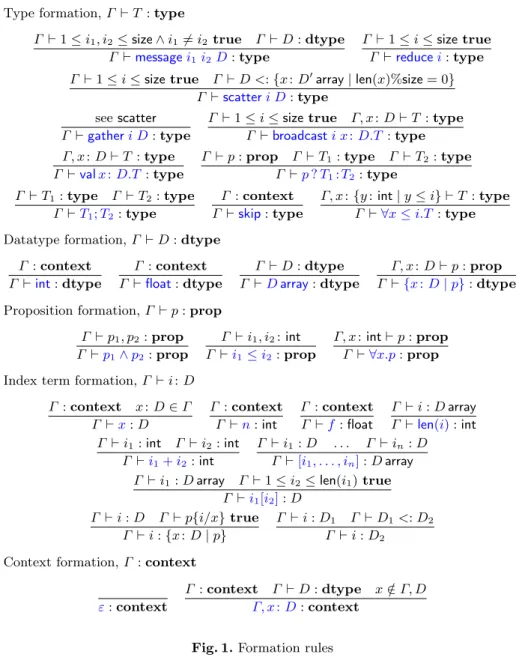
This section introduces the type theory, including the notions of term types (Figure 1), term type equality (Figure 4), and program types (Figure 5).
2.1 Term types
Not all syntax may be judged to be a legal type. For example, one might not want consider “skip;;” a valid piece of syntax. Similarly “broadcast 0 x: float” is not a valid type if considered under a context wherexis not deemed as a variable. We abbreviate the judgment “T is a type under contextΓ” byΓ `T :type. Types depend ondatatypes, hence we abbreviate a judgement “D is a datatype under context Γ” by Γ ` D :dtype. In turn, datatypes rely onpropositions, and so we abbreviate judgements “pis a proposition under contextΓ” byΓ `p:prop. Now, propositions depend on index terms, and so we abbreviate judgements “i is an index term of datatype D under context Γ” by Γ ` i : D. All the above hypothetical judgements depend on datatype contexts Γ, (ordered) lists of the form x1:D1, . . . , xn: Dn. We abbreviate judgements “Γ is a context” by
Γ :context.
Types rely on three base sets: that of variables (denoted x, y, z), that of integer values (k, l, m, n), and that of floating point values (f). There are two distinguished variables:size and rank; we use them to denote the total number of processes and the number of a given process within a collection of processes. It will always be the case that1 ≤rank≤size. The axioms and inference rules for deciding on what counts as a type, a datatype, a proposition, an index term and a context, are in Figure 1. We briefly discuss the various type constructors, starting with index terms.
Index termsdescribe the values types may depend upon. Our language counts with variables, integer and floating-point constants, arithmetic operations, as well as different array operations, namely array values ([v1, . . . , vn]), array ac-cess (i1[i2]) and the array length operation (len(i)). Index terms formation rules further include the standard refinement introduction rule and datatype sub-sumption [6].
Type formation,Γ `T:type
Γ `1≤i1, i2≤size∧i16=i2 true Γ `D:dtype
Γ `messagei1i2D:type
Γ `1≤i≤sizetrue
Γ `reducei:type
Γ `1≤i≤sizetrue Γ `D <:{x:D0array|len(x)%size= 0} Γ `scatteri D:type
seescatter
Γ `gatheri D:type
Γ `1≤i≤sizetrue Γ, x:D`T :type
Γ `broadcasti x:D.T:type
Γ, x:D`T:type
Γ `valx:D.T:type
Γ `p:prop Γ `T1:type Γ `T2:type
Γ `p?T1:T2:type Γ `T1:type Γ `T2:type Γ `T1;T2:type Γ :context Γ `skip:type Γ, x:{y:int|y≤i} `T :type Γ `∀x≤i.T :type Datatype formation,Γ `D:dtype
Γ :context Γ `int:dtype Γ :context Γ `float:dtype Γ `D:dtype Γ `Darray:dtype Γ, x:D`p:prop Γ `{x:D|p}:dtype Proposition formation,Γ `p:prop
Γ `p1, p2:prop Γ `p1∧p2:prop Γ `i1, i2:int Γ `i1≤i2:prop Γ, x:int`p:prop Γ `∀x.p:prop Index term formation,Γ `i:D
Γ :context x:D∈Γ Γ `x:D Γ :context Γ `n:int Γ :context Γ `f:float Γ `i:Darray Γ `len(i):int Γ `i1:int Γ `i2:int Γ `i1+i2:int Γ `i1:D . . . Γ `in:D Γ `[i1, . . . , in]:Darray
Γ `i1:Darray Γ `1≤i2≤len(i1)true
Γ `i1[i2]:D Γ `i:D Γ `p{i/x}true
Γ `i:{x:D|p}
Γ `i:D1 Γ `D1 <:D2
Γ `i:D2 Context formation,Γ :context
ε:context
Γ :context Γ `D:dtype x /∈Γ, D Γ, x:D:context
Fig. 1.Formation rules
Datatypesdescribe integer (int) and floating-point values (float), arrays of an arbitrary datatype (Darray), and refinements of the form{x:D|p}. Refinement datatypes allow to describe integer values smaller than a given index termi, such as {y: int |y ≤ i}, or arrays of a given length n, as in {a: float array| len(a) =
n}. Datatypes rely on propositions. Figure 1 presents a couple of significant examples of propositions. More can be easily added, including further boolean and relational operators.
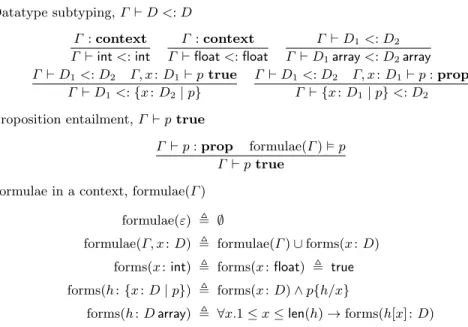
Datatype subtyping,Γ `D <:D Γ :context Γ `int<:int Γ :context Γ `float<:float Γ `D1<:D2 Γ `D1array<:D2array Γ `D1<:D2 Γ, x:D1`ptrue Γ `D1<:{x:D2|p} Γ `D1<:D2 Γ, x:D1`p:prop Γ ` {x:D1|p}<:D2 Proposition entailment,Γ `ptrue
Γ `p:prop formulae(Γ)p Γ `ptrue
Formulae in a context,formulae(Γ) formulae(ε) , ∅
formulae(Γ, x:D) , formulae(Γ)∪forms(x:D) forms(x:int) , forms(x:float) , true forms(h:{x:D|p}) , forms(x:D)∧p{h/x}
forms(h:Darray) , ∀x.1≤x≤len(h)→forms(h[x] :D) Fig. 2.Datatype subtyping and proposition entailment
All the formation rules rely on contexts, intuitively mapping variables into datatypes. Contexts are also subject to formation rules. Symbol εdenotes the empty context. The second rule for context formation ensures that types appear-ing in a context are well-formed with respect to the “initial” part of the context, a standard requisite in dependent type systems. Premisex /∈Γ, Dmeans thatx
does not occur inΓ and inD, that is, ify:D0is an entry inΓ theny is different fromxandxdoes not occur inD0.
A notion ofsubtyping is defined for index terms: we abbreviate judgements of the form “datatype D1 is a sub-datatype of D2 under context Γ” by Γ `
D1 <: D2. The rules, presented in Figure 2, are standard, including those for refinement datatypes [6]. The last rule, for example, allows to conclude thatε` {a:float array|len(a) = 512}<:float array. The notion ofproposition deducibility
is also standard [6]. Theformulaerelation collects the logical refinements present in a given context. They allow, e.g., to extract formula∀1≤y≤len(a).a[y]6=y∧ ∀1 ≤y ≤len(a).1≤b[z]≤sizefrom contexta:{b:{x:int|1≤x≤size}array| ∀1 ≤y ≤len(b).b[y] 6=y}. We rely on an auxiliary judgementformulae(Γ)p
stating that a propositionpis deducible from the formulas in a contextΓ.
We are now in a position to discuss types and type formation. A type of the form messagei1i2D describes a point-to-point communication, from the i1 -ranked process to the i2-ranked process, of a value of datatype D. Both index terms must denote valid ranks, that is they must lie between 1, the first rank, and size, the number of processes. Furthermore, the sending and receiving
pro-cesses must be different from each other.3 A type of the formreduceidenotes a collective operation whereby all processes contribute with values that are used to produce a result (say, the maximum). This value is then transmitted to thei -ranked process, usually known as theroot process. A type of the formscatteri D
describes a collective operation whereby thei-ranked process (the root process) distributes an array among all processes, including itself. The type formation rule requires i to be a valid rank, and the length of the array to divide the number of processes, so that each process receives a sub-array of equal length and the whole array gets distributed. Type gatheri D denotes the inverse op-eration, whereby each process proposes an array of identical length, the con-catenation of which is delivered to the root process. In both cases, the premise
Γ ` D <: {x:D0array|len(x)%size= 0} ensures that D is an array datatype whose length divides the number of processes.
A type of the form broadcasti x: D.T denotes a collective communication whereby the root process transmits a value of typeDto all processes (including itself). The continuation typeT may refer to the value transmitted via variablex. Typevalx:D.T is the dependent product type. In our case, it denotes a collec-tive operation whereby all processes agree on a common value of datatype D, without resorting to communication. Such a value may be referred to, in the con-tinuation typeT, via variablex. Typical applications include program constants and command-line values that protocols may depend upon. A typep?T1:T2 de-notes acollective conditional, whereby all processes jointly decide on proceeding asT1or asT2, again without resorting to communication. TypeT1;T2describes a computation that first performs the operations as described by T1 and then those described byT2. Typeskipdescribes any computation that does not engage in communication.skip-typed processes are not necessarily halted; they may still perform local operations. Finally, type∀x≤i.T is a concrete instance of prim-itive recursion. A recursive sequence ∀x≤i.T uniquely determines an indexed family of typesT{i/x};T{i−1/x};. . .;T{1/x};skip.
In addition to the above type constructors, others could be easily added. For example, a type barrier would work similarly to, say,reduce, except that no value is transmitted. A typeallreducex:float.T, denoting an operation whereby all processes contribute with a floating point number, from which a value is computed and delivered to all process, could be introduced as an abbreviation or else as primitive for efficiency reasons. In the former case, such type could abbreviate reduce1;broadcast1x: float.T, where process rank 1 collects a series of floating points values and then distributes the maximum to all processes (including itself). Similarly, a type allgatherx: D.T could denote an operation whereby all processes contribute with an array, whose concatenation would then be further distributed to all processes:gather1D;broadcast1x:D.T.
The reader may have noticed that types such as message or reduce do not introduce value dependencies, whereas others such as broadcast do. The con-tinuation of a message type, if existent, is captured by sequential composition,
3
This requirement is particularly relevant for synchronous, or unbuffered, communi-cation, where a message from, say, rank 2 to rank 2 would constitute a deadlock.
valn:{x:int|x≥0∧x%size= 0}.
broadcast1m:int.
scatter1{a:float array|len(a)∗size=n};
∀k≤m.(
∀l≤size.(
messagel(l%size+ 1)float;
messagel((l−2 +size)%size+ 1)float); allreducex:float.skip);
gather1{b:float array|len(b)∗size=n}
Fig. 3.The type for the finite differences algorithm
as in message1 2float;message2 1int. That of a broadcast is built into the type constructor itself; as in broadcast1x:int.broadcast1y: {z: int | z ≥x}.skip. The fundamental reason for the difference lies in the target of the values transmitted. In the cases of message and reduce values are transmitted to a unique process, namely processiin typesmessagei0i D andreducei. In that of broadcastall pro-cesses receive a same value. This value may then be safely substituted in the continuation of the types for all processes, thus preserving the natural prop-erties of types for programs. For the same reason, reduce does not introduce a type dependency, whereasallreducemay. Even though all processes receive arrays of equal lengths in a scatter operation, the arrays themselves may be different, hence the type introduces no value dependency.
As a concrete example, consider the finite differences algorithm [5]. Given an initial vectorX0, the algorithm calculates successive approximations to the solutionX1, X2, . . ., until a pre-defined maximum number of iterations has been reached. A type for the algorithm is in Figure 3, where ndenotes the length of the input vector, andmthe number of iterations to be performed. The length of the array must evenly divide the number of processes, so that the root process may divide the whole array among all processes. The problem size is made known via a val type. The number of iterations is disseminated by process rank 1, via a broadcastoperation. The same process then divides the input array among all processes. Each participant is responsible for the calculation of a local part of the solution. Towards this end, in each iteration each process exchanges boundary values with its right and left neighbours. When the pre-defined number of iter-ations is reached, process rank 1 collects the global error via areduce operation and the solution to the problem via a gathertype.
Topology passing is another example attesting the flexibility of our type lan-guage. Datatypes of the form 1D ={b:{x:int | 1≤x≤size}array | ∀1≤y ≤ len(b).b[y] 6=y} encode a one-dimensional network topology. In the below type process rank 1 distributes the topology; each process then exchanges a message
with its neighbour.
broadcast1t: 1D.∀x≤len(t).message x t[x]float
A ring topology (a linear array with wraparound link) of length 5 can be encoded in array[2,3,4,5,1]. A two dimensional topology can be written as 2D={b:1D| len(b) = 2}. A protocol where each node exchanges a message with its east and south neighbours can be written as
broadcast1 t:1D.(∀x≤len(t[1]).messagex t[1][x]float;
∀y≤len(t[2]).messagey t[2][y]float) In this case a 2-D mesh with wraparound (a 2-D torus) of with3×3nodes can be encoded in array [[2,3,1,5,6,2,8,9,3],[4,5,6,7,8,9,1,2,3]]. The two examples above assume that each dimension wraps around, so that all processes have exactly one neighbour in each dimension. If that is not the case, we may control neighbourhood at type level by taking advantage of collective choice, as in
broadcast 1t:int array.(∀x≤len(t).(1≤t[x]≤size?messagex t[x]float:skip)) where messages are exchanged only if the array entry contains a valid process number. In this case, a linear array of length 5 with no wraparound link can be encoded as[2,3,4,5,0].
We now revert to the technical development. Because types may include index terms, they may contain index term variables. We say that types∀x≤i.T, val x:D.T andbroadcasti x:D.T bind the occurrences of variablexin typeT. Datatype {x:D | p} binds the occurrences of xin proposition p. The notions of free and bound variables are derived accordingly. We denote byfv(T)the set offree variables in typeT, and similarly for datatypes, propositions, and index terms.
Before we proceed any further, we must make sure that the above formation rules are valid. For example, before we can talk about T being a type under contextΓ, that is Γ `T :type, we must make sure thatΓ is indeed a context, that is Γ : context. The same applies to the other five judgements our type theory is composed of.
Lemma 1 (agreement for type formation).
Γ `T :type Γ :context Γ `D:dtype Γ :context Γ `p:prop Γ :context Γ `i:D Γ `D:dtype Γ `D1<:D2 Γ `D1:dtype Γ `D2:dtype Γ `ptrue Γ :context
Proof. By simultaneous rule induction on the various hypothesis.
Thesubstitution operation on types, defined in the standard way (based on the variable bindings introduced above) and denoted byT{i/x}, replaces all the
Type equality,Γ `T≡T (Γ `T :type) Γ `T;skip≡T (Γ `T :type) Γ `skip;T ≡T (Γ `T1, T2, T3:type) Γ `(T1;T2);T3≡T1; (T2;T3)
Γ `i <1true (Γ, x:{y:int|y≤i} `T :type)
Γ ` ∀x≤i.T≡skip
Γ `i≥1true (Γ, x:{y:int|y≤i} `T :type)
Γ ` ∀x≤i.T≡(T{i/x};∀x≤i−1.T)
Γ `i1, i26=ranktrue (Γ `1≤i1, i2≤size∧i16=i2 true) (Γ `D:dtype)
Γ `messagei1i2D≡skip Omitting the rules pertaining to congruence and equivalence
Fig. 4.Type equality
occurrences of variable xby index termi in typeT, leaving all other variables untouched. The substitution on datatypes D{i/x}, propositions p{i/x}, and on index terms i1{i2/x}are also defined in the conventional, inductive, way. A standard substitution lemma summarises the main property of the operation (see Section B.1). One can easily show that<:is a preorder (again, see Section B.1).
2.2 Term type equality
Type equality plays a central role in dependent type systems. In our case, type equality includes the monoidal rules for semicolon and skip, the expansion of primitive recursion, and for a form of projection of message types. The rules in Figure 4 determine what it means for two types to be equal under a given context. There are ten congruence rules (see Section B.2). The congruence rule formessagetypes allows, for example, to show the following equality.
size,rank:{x:int|x= 3} `message rank(rank%size+ 1)float≡message3 1float The first pair of rules in Figure 4 provides for the meaning of primitive recursion. The base case represents a terminated computation (from the point of view of communications), denoted by skip. The second premise in the rule ensures that∀x≤i.T is indeed a type, playing no other role in the definition of type equality. In these cases, we enclose the premise in parenthesis. The induction step is a sequential composition made of the first iteration (x=i) and the rest of the iterations (x≤i−1). The two rules, together with the congruence rules allow to show the following equality, where we abbreviate contextsize:{x: int|x= 3} by size = 3. Also, for the sake of brevity we omit the datatype in themessage types.
size= 3` ∀j≤size.(messagej(j%size+ 1))≡message3 1;message2 3;message1 2 The next rule in the figure says that amessage type that plays no role for a given process rank is equal toskip. The rule effectively allows toproject a given
type onto a given rank, a notion introduced in the context of multi-party session types [9], here cleanly captured as type equality. When projecting the above type onto rank2 we obtain the following type equality.
size= 3,rank= 2`
∀j≤size.(messagej(j%size+ 1))≡skip;message2 3;message1 2 Finally, from the monoidal rules we get:
size= 3,rank= 2` ∀j≤size.(messagej(j%size+ 1))≡message2 3;message1 2
2.3 Program types
Program types are vectors of term types. Not all vectors are nevertheless of inter-est. Program types in particular must not deadlock. Below are a few candidates that, albeit composed of term types, cannot be judged as program types. For the sake of brevity we once more omit the datatype in types.
(message1 2),(message2 1) (scatter1),(reduce1)
(message1 3;scatter1),(message1 3;reduce1),(message1 3;scatter1) (message3 1;message1 2),(message1 2;message2 3),(message2 3;message3 1) The first vector of types is blocked for process rank 1 intends to send a mes-sage to rank 2, whereas rank 2 is ready to send a mesmes-sage to rank 1. A variant of the type—(message1 2),(message1 2)—constitutes a program type. The sec-ond vector also describes a deadlocked computation: process rank 1 is trying to distribute an array, whereas rank 2 is not ready to receive its part. The third case involves a 1–3 message that leads to a deadlocked situation, namely (scatter1),(message1 3;reduce1),(scatter1); notice that the second type is equiva-lent toreduce1. The fourth case involves a circular waiting situation: the message between 3 and 1 cannot happen before that of 2 and 3 (see type for rank 3); the 2–3 message cannot happen before the 1–2 (rank 2); and finally, the 1–2 message cannot happen before the 3–1 message (rank 1). We judge such vector of types as not constituting program types, based on the intended synchronous (or unbuffered) message passing semantics.
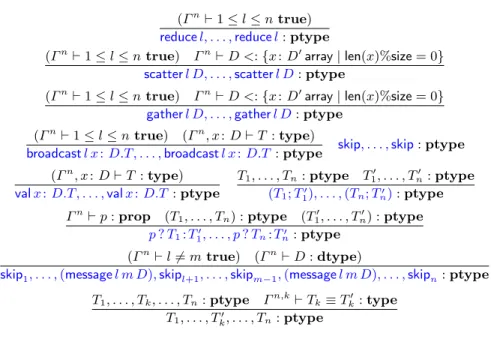
The rules in Figure 5 are meaning determining for assertions of the form
S:ptype. They rely on two abbreviations:Γn for contextsize:{x:int|x=n}, and Γn,k for context Γn,rank: {x: int | x = k}. The indispensable agreement result is Section B.3.
The central intuition of a program type is that it describes a non-deadlocked computation, that is, a computation that is either halted or that may reduce. With this in mind it is easy to understand the rules for the collective operations— reduce,scatter,gather,broadcast, val, if, and skip—they require all types to agree. The premises, in parenthesis, guarantee the validity of the rules: they ensure the good formation of the term types involved. The rule for sequential composition
Program type formation,S:ptype
(Γn`1≤l≤ntrue) reducel, . . . ,reducel:ptype
(Γn`1≤l≤ntrue) Γn`D <:{x:D0array|len(x)%size= 0}
scatterl D, . . . ,scatterl D:ptype
(Γn`1≤l≤ntrue) Γn`D <:{x:D0array|len(x)%size= 0}
gatherl D, . . . ,gatherl D:ptype (Γn`1≤l≤ntrue) (Γn, x:D`T :type)
broadcastl x:D.T, . . . ,broadcastl x:D.T:ptype skip, . . . ,skip:ptype (Γn, x:D`T :type)
valx:D.T, . . . ,valx:D.T:ptype
T1, . . . , Tn:ptype T10, . . . , T
0
n:ptype
(T1;T0
1), . . . ,(Tn;Tn0):ptype
Γn`p:prop (T1, . . . , Tn) :ptype (T10, . . . , Tn0) :ptype
p?T1:T0
1, . . . , p?Tn:Tn0 :ptype (Γn`l6=mtrue) (Γn`D:dtype)
skip1, . . . ,(messagel m D),skipl+1, . . . ,skipm−1,(messagel m D), . . . ,skipn:ptype
T1, . . . , Tk, . . . , Tn:ptype Γn,k`Tk≡Tk0 :type
T1, . . . , Tk0, . . . , Tn:ptype
Fig. 5.Program type formation
requires programs to be composed of two parts, both of which conform to pro-gram types. The rule for the collective conditional requires all propositions to agree, forcing all process to take identical decisions. The rule for messages re-quires the vector of term types to contain two identicalmessagetypes; the “rest” of the vector must itself be composed of skip types. Finally, the last rule allows to replace equal term types in program types.
With these rules in place we can easily check that the following vector of term types is a program type.
(message1 3;message2 4),message2 4,(message1 3;message2 4),message2 4 because
(message1 3;message2 4),(skip;message2 4),
(message1 3;message2 4),(skip;message2 4) is a program type, because both
message1 3,skip,message1 3,skip message2 4,message2 4,message2 4,message2 4 are program types.
Deciding when an arbitrary vector of term types constitutes a program type may not be an easy task. There is however a simple case: that of a vector of
Datatype formation,Γ `D:dtype Γ `D:dtype Γ `Dref:dtype Index formation,Γ `i:D Γ :context r:D∈Γ Γ `r:D Γ `i:D Γ `mkrefi:Dref Γ `i:Dref Γ `!i:D Γ `i1:Dref Γ `i2:D Γ `i1:=i2:D
Context formation,Γ :context
Γ :context Γ `D:dtype r /∈Γ, D Γ, r:D:context
Datatype subtyping,Γ `D <:D
Γ `D1≡D2
Γ `D1 ref<:D2 ref
Fig. 6.Reference formation
identical types. Such a program type is of particular relevance for models of computation where all processes share the same code, hence the same initial term type. Lemma 2 (load). Γn`T :type . . . Γn `T :type T, . . . , T | {z } ncopies :ptype
Proof. A simple analysis on the ten type constructors available, using type equiv-alence in the case of messages and primitive recursion.
3
A core parallel imperative programming language
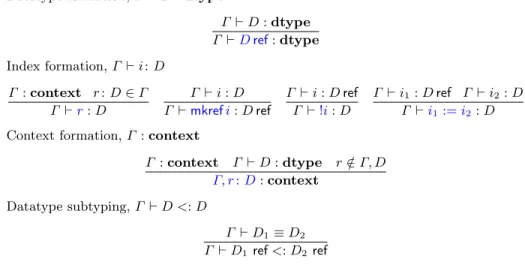
This section introduces our core programming language, including references ex-pressions, stores, processes and programs, as well as the main results of the paper: agreement for programs (Theorem 1) and progress for programs (Theorem 3).3.1 References
To deal with imperative features, we introduce the notion ofreferences. We rely on an extra base set, that ofreference identifiers, ranged over byr. References have impact on datatypes, index terms, contexts, and index subtyping. The rules in Figure 6 extend those in Figure 1. A new datatype,Dref, describes references to values of type D. Four new index terms are introduced: references r, and the conventional operations on references. These includemkrefi, which evaluates
index term i and returns a reference to the value, !i which retrieves the value associated to the reference described by i, andi1:=i2which replaces the value associated with referencei1 by the value of index termi2. We also need a new formation rule forref datatypes. Typing contextsΓ may now contain reference entries r:D in addition to variable entries x: D; the new formation rule is in Figure 6. We can easily check that the various definitions are still well formed (cf. Lemma 1), and that index term subtyping remains a pre-order.
We designed our programming language in such a way that it directly han-dles index terms. The pure index terms of Figure 1 are however extended with effectful operations, such as reference creation and assignment. The meaning of expressions with effects when they occur as index objects to type families is un-determined. For this reason we are careful in requiring index objects appearing in types to remain pure.
3.2 Expressions
The constructors of our language can intuitively be divided in two parts: conven-tional expressions usually found in a while-language and communication-specific expressions. The rules in Figure 7 characterise what it means to be an expres-sion eof a typeT under a contextΓ, abbreviated toΓ `e:T.
In an expression of the formsendi1i2, index termi1(of datatypeint) denotes the target process and index term i2 (of datatypeD) describes the value to be sent. The type of thesendexpression ismessage ranki1D, representing a message from processrankto processi1 containing a value of datatypeD. The premises come naturally if one considers the hypothesis necessary formessage ranki1D to be considered a type under context Γ, namely, i1 must denote a valid process number and must be different from the sender’s rank. The value to be sent, i2, must naturally be of datatype D, so that it conforms to the value themessage is supposed to exchange. An expression of the form receivei1i2 denotes the re-ception of a value (of datatype D) from process i1. The value is stored in the reference (of datatypeDref) denoted by index termi2. The type of the expres-sion is messagei1rankD, expressing the fact that a message is transmitted from processi1 to the target processrank.
Thereduce expression requires three index term arguments: the first is the target process (the one that receives the maximum of the values proposed by all processes), the second is the value each process proposes, and the third is the reference on which the target process saves the maximum of all values. The premises requirei1to denote a valid rank,i2to be of floatdatatype, andi3to be a reference to afloat. The type of the expression is simplyreducei1, for the values transmitted and received are not captured by the type, since it will always be a float.
Thegather expression is similar to reduce on what concerns the meaning of its three arguments. The first is the target process (the one receiving the various subarrays), the second denotes the subarrays proposed by the various processes, and the third is the reference that will hold the concatenation of the subarrays. The premises reflect these conditions; notice how the types for the arrays embody
Γ `1≤i1≤size∧i16=ranktrue Γ `i2:D
Γ `sendi1i2:message ranki1D
Γ `1≤i1≤size∧i16=ranktrue Γ `i2:Dref
Γ `receivei1i2:messagei1rankD
Γ `1≤i1≤sizetrue Γ `i2:float Γ `i3:float ref
Γ `reducei1i2i3:reducei1
Γ `1≤i1≤sizetrue Γ `i2:Darray ref Γ `i3:{x:Darray|len(x) =size∗len(i2)}
Γ `gatheri1i2i3:gatheri1(Darray)
Γ `1≤i1≤sizetrue Γ `i2:{x:Darray|len(i3) =size∗len(x)}ref Γ `i3:Darray
Γ `scatteri1i2i3:scatteri1(Darray)
Γ `1≤i1≤sizetrue Γ `i2:D Γ, x:D`e:T rank∈/fv(i1)
Γ `letx:D=broadcasti1i2ine:broadcasti1x:D.T
Γ `i:D Γ, x:D`e:T Γ `letx:D= valiine:valx:D.T
Γ `p:prop Γ `e1:T1 Γ `e2:T2 rank∈/fv(p)
Γ `ifcpthene1elsee2:p?T1:T2
Γ `e1:T1 Γ `e2:T2
Γ `e1;e2:T1;T2
(Γ :context)
Γ `skip:skip
Γ, x:{y:int|y≤i} `e:T Γ `forx:i..1doe:∀x≤i.T Γ `p:prop Γ `e1:T Γ `e2:T Γ `ifpthene1elsee2:T Γ `p:prop Γ `e:skip Γ `whilepdoe:skip Γ `i:D Γ, x:D`e:T x /∈fv(T) Γ `letx:D=iine:T Γ `e:T1 Γ `T1≡T2:type Γ `e:T2 In all rules,T andDcontain noref datatypes.
Fig. 7.Expression formation
the relation between their lengths, as required by the type formation rule in Figure 1. The rule for thescatter expression is similar, except that the order of the last two parameters is exchanged (i2denotes the subarrays received by each process andi3the array to be distributed), in such a way that the last parameter is evaluated only at the root process.
In abroadcast expression, index term i1 denotes the root process and index term i2 the value to be distributed. The index term denoting the root process cannot refer to the special variablerank, for this has different values at different processes, precluding all processes from agreeing on a common root process. Contrary to the expressions studied so far, where the object of communications is stored in a reference, the value distributed by the root process is collected in a variable xand made available to an explicit continuation expression e. This strategy keeps the expression and the type aligned, as made clear by the type formation rule: variablex(of datatypeD) is moved into the context to type the continuation, while retaining its presence in the dependent type for broadcast. The same applies to expressionval, where the value of the index termiis made
available, via variablex, to the continuation expressione, while being present in theval-dependent type. The rule for the collective conditional expression requires variableranknot to occur in the proposition. The restriction allows all processes to decide equally, given thatrankhas different values in different processes.
The expression formation rule for sequential compositione1;e2 is standard, except perhaps for its type,T1;T2, composed of the types T1 andT2 for expres-sions e1 and e2. Expression skip has type skip as expected, even though many other expressions may have this type. To inhabit the∀-type, the language counts with aforloop. Inforx:i..1doe, variablextakes valuesi, i−1, . . . ,1in each dif-ferent iteration of the loop. The rule for the conditional expression is standard, and so is the one for the while loop. Notice that thewhilep eexpression requirese
to be of typeskip, not allowing the loop to perform any communication action. If communications are required in a loop body, then a for loop must be used. An expression of the formletx:D= iineevaluates index termiand continues as ewith variablexreplaced by the value ofi. The type T of the let is that of the expressione, hence variable x cannot be free inT. The dependent version of this expression is the val expression introduced above. The last expression formation rule introduces type equality. Agreement for expression formation is in Section B.5.
The bindings for expressions are as follows. Variable xis bound in expres-sions letx: D = broadcasti1i2ine, letx: D = valiine, letx: D = iine, and forx:i..1doe. The notion of free variables, fv(e), is defined accordingly. Among all index terms, we callvalues to integer constantsn, to floating point numbers
f, to vectors of values[v1, . . . , vn], and to reference identifiersr, and collectively denote them by v. The notion of substitution, e{v/x}, is defined in the stan-dard, inductive way, from that of free variables. The standard result of term substitution in dependent types is in Section B.5.
Figure 8 presents a schematic implementation of the finite differences algo-rithm in our language. We can show that
size:{x:int|x≥2},rank:{y:int|1≤y≤size} `e:T
where e is the expression in Figure 8 and T the type in Figure 3. It worth pointing out that the internal∀-type in Figure 3 (∀l≤size.) is inhabited by the longfor-loop in the second column in Figure 8. The differentsend/receiveorders, crucial to ensure absence of deadlock, conform to a type that is made equal to the ∀-type via type equality alone. Notice that this sort of code is extremely sensitive to variations, thus reinforcing the potential of the type-based approach to verification of parallel programming.
3.3 Stores
Intuitivelystores are maps from reference identifiers into values. The formation rules are in Figure 9. Stores can be easily converted into contexts; the rules in Figure 9 determine the meaning of assertions ρtoΓ. A store entry of the form
letn:{x:int|x≥0∧x%size= 0}= val<read-the-dimension>in letmax:int ref=mkref0in
letglobal:{a:float array|len(a) =n}ref= mkfloatarraynin
if rank= 1then
max :=<read-max-iterations>;
global :=<read-the-global-array>; letm:int=broadcast1 !max in
letlocal:{b:float array|len(b)∗size=n}
ref=mkfloatarray(n/size)in scatter1local !global;
letleft:{x:int|1≤x≤size}= (rank−2 +size)%size+ 1in letright:{x:int|1≤x≤size}=
rank%size+ 1in
letlRecv:float ref=mkref0.0in letrRecv:float ref=mkref0.0in letgError:float ref=mkref0.0in letlError:float ref=mkref0.0in
fori:m..1do if rank= 1then
sendleft local[1] sendright local[n/size] receiveright !rRecv
receiveleft !lRecv
else if rank=sizethen receiveright !rRecv
receiveleft !lRecv
sendleft local[1] sendright local[n/size] else
receiveleft !lRecv
sendleft local[1] sendright local[size/n] receiveright !rRecv
<compute-next-local-and-lError>
letx:float=allreduce!lError in
gError:=x; gather1 !local global
Fig. 8.The algorithm for finite differences
Stores,ρ:store ε:store ρ:store r /∈ρ ρtoΓ Γ `v:D ρ, r:=v:store Stores as contexts,ρtoΓ (ε:store)to(ε:context) ρtoΓ Γ `v:D (r /∈ρ, Γ, D) (ρ, r:=v)to(Γ, r:Dref)
Fig. 9.Store formation and store-to-context conversion
is transformed in contextΓ andΓ `v:D. We can easily check that agreement holds (see Section B.6).
In the sequel we abuse the notation and writeρwhere a context is expected. For example ρ ` i : D means Γ ` i : D where ρtoΓ. Store update, notation
ρ[r:=v], is the storeρ0, r :=v, ρ00 ifρis of the formρ0, r :=v0, ρ00 andρ0 `r:
(ρ:store) (ρ, m)↓n,k(ρ, m) :int (ρ:store) (ρ, f)↓n,k(ρ, f) :float (ρ:store) (ρ,size)↓n,k(ρ, n) :int (ρ:store) (ρ,rank)↓n,k(ρ, k) :int r:=v∈ρ ρ`v:D (ρ:store) (ρ, r)↓n,k(ρ, r) :Dref (ρ1, i)↓n,k(ρ2, v) :D r /∈ρ2 (ρ1,mkrefi)↓n,k((ρ2, r:=v), r) :Dref (ρ1, i)↓n,k(ρ2, r) :Dref r:=v∈ρ2 (ρ1,!i)↓n,k(ρ2, v) :D (ρ1, i1)↓n,k(ρ2, r) :Dref (ρ2, i2)↓n,k(ρ3, v) :D (ρ1, i1:=i2)↓n,k(ρ3[r:=v], v) :D (ρ1, i1)↓n,k(ρ2, v1) :int (ρ2, i2)↓n,k(ρ3, v2) :int (ρ1, i1+i2)↓n,k(ρ3, v1+v2) :int (ρ1, i1)↓n,k(ρ2, v1) :D . . . (ρn, in)↓n,k(ρn+1, vn) :D (ρ1,[i1, . . . , in])↓n,k(ρn+1,[v1, . . . , vn]) :Darray (ρ1, i1)↓n,k(ρ2,[v1, . . . , vl]) :{x:Darray|len(x) =l} (ρ2, i2)↓n,k(ρ3, m) :{y:int|1≤y≤l} (ρ1, i1[i2])↓n,k(ρ3, vm) :D (ρ1, i)↓n,k(ρ2,[v1, . . . , vn]) :Darray (ρ1,len(i))↓n,k(ρ2, n) :int (ρ1, i)↓n,k(ρ2, v) :D1 ρ2`D2<:D1 (ρ1, i)↓n,k(ρ2, v) :D2 (ρ1, i)↓n,k(ρ2, v) :D Γn,k, ρ2 `p{i/x}true (ρ1, i)↓n,k(ρ2, v) :{x:D|p}
Fig. 10.Index term evaluation
Index terms are evaluated against a store; evaluation also resolves the distin-guished variablessizeandrank. The rules in Figure 10 are meaning determining for assertions of the form (ρ1, i)↓n,k(ρ2, v) :D, abbreviating “index term i of datatype D evaluates under storeρ1, size =n, and rank =k, yielding a value
v of datatype D and a new store ρ2”. The rules are straightforward; we briefly describe them. The two rules for constants (integer and floating point) evaluate the constants to themselves, keeping the store unchanged. The two rules for the special variables (size andrank) read the variables’ values from the parameters
n and k, again keeping the store unchanged. The rules for references and for arithmetic and array operations, should be easy to understand based on the explanations above and their intuitive meaning. The last two rule introduce re-finement types and subtyping, necessary, e.g., to ensure that index termi1[i2]is well-formed in the evaluation rule for array access; they should not be needed when the rules are used in “evaluation” mode. Agreement for evaluation is in Section B.6.
The following result links deducibility to index term evaluation, stating that evaluation succeeds on well formed index terms, thus contributing to the progress result.
(ρ, i)↓n,k (ρ0, v) :D (Γn,k, ρ, x:D`e:T) (x6∈fv(T)) (ρ,letx:D=iine)→n,k(ρ0, e{v/x}) Γn,k, ρ`ptrue (Γn,k, ρ`e1, e2:T) (ρ,ifpthene1 elsee2)→n,k(ρ, e1) Γn,k, ρ` ¬ptrue (Γn,k, ρ`e1, e2:T) (ρ,ifpthene1elsee2)→n,k(ρ, e2) Γn,k, ρ`ptrue (Γn,k, ρ`e:skip) (ρ,whilepdoe)→n,k(ρ,(e;whilepdoe)) Γn,k, ρ` ¬ptrue (Γn,k, ρ`e:skip) (ρ,whilepdoe)→n,k(ρ,skip) Γn,k, ρ`i≥1true (Γn,k, ρ, x:{y:int|y≤i} `e:T) (ρ,forx:i..1doe)→n,k(ρ,(e{i/x};forx:i−1..1doe))
Γn,k, ρ`i <1true (Γn,k, ρ, x:{y:int|y≤i} `e:T) (ρ,forx:i..1doe)→n,k(ρ,skip)
(ρ, e1)→n,k(ρ0, e3) (Γn,k, ρ`e2:T) (ρ,(e1;e2))→n,k(ρ0,(e3;e2))
(Γn,k, ρ`e:T) (ρ,(skip;e))→n,k(ρ, e)
Fig. 11.Process reduction
Lemma 3 (evaluation succeeds).
Γn,k, ρ1`i:D (ρ1, i)↓n,k(ρ2, v) :D
Proof. By rule induction on the hypothesis.
3.4 Processes
Aprocess pis a pair(ρ, e)composed of a storeρand an expressione. The rule below determines the meaning for assertions of the formΓ `q:T.
Γ, ρ`e:T Γ `(ρ, e):T
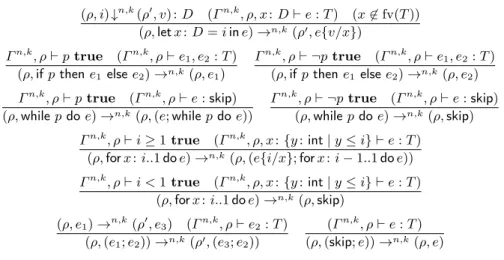
The rules in Figure 11 determine what it means for a processq1toreduceto a processq2given thatsize=nandrank=k, that is, they determine the meaning of assertionsq1→n,kq2. The rules should be self-explanatory. Theletexpression evaluates indexito valuevand proceeds with expressionewithvreplacing vari-ablex. Sinceletis a local (process) operation,xcannot be free inT, as discussed before. The premises in parenthesis guarantee the good formation of the stores and expressions involved. The remaining rules—for conditionals, while and for loops, and sequential composition—are standard. Notice that process reduction does not change the type of the expressions involved. That the definition is well formed follows from the following result.
Lemma 4 (agreement for process reduction).
q→n,kq0
Proof. By rule induction on the hypothesis.
Lemma 5 (process reduction is deterministic).
q1→n,k q2 q1→n,kq3
q2=q3
Proof (sketch). The case for sequential composition follows by a simple induc-tion. All other cases follow from the fact that evaluation is deterministic and from the fact that eitherpor6=pis true.
The following lemma ensures that processes do not get stuck and will play its part in the main result of the paper.
Lemma 6 (progress for processes).
Γn,k, ρ`e:skip e isskip or (ρ, e)→n,kq Γn,k, ρ`i:D Γn,k, ρ, x:D`e:T x6∈fv(T) (ρ,letx:D= iine)→n,kq Γn,k, ρ`p:prop Γn,k, ρ`e 1, e2:T (ρ,ifpthene1elsee2)→n,kq Γn,k, ρ`p:prop Γn,k, ρ`e:skip (ρ,whilepdoe)→n,k q Γn,k, ρ`i:int Γn,k, ρ, x:{y:int|y≤i} `e:T (ρ,forx: i..1doe)→n,k q
Proof (sketch).By analysis of the hypotheses. For example, in theletrule, build-ing from Γn,k, ρ `i : D and the fact that evaluation succeeds (Lemma 3), we obtain(ρ, i)↓n,k(ρ0, v) :D. This, combined with premisesΓn,k, ρ, x:D `e :T andx6∈fv(T)constitute the necessary conditions to apply reduction forlet pro-cesses in Figure 11, obtaining (ρ,letx:D=iine) →n,k (ρ0, e{v/x}). All other cases excepting skip are similar. For Γn,k, ρ ` e: skip, we rely on the inversion lemma for expression formation (cf. proof of Theorem 3) and analyse all expres-sions such thatΓ `e:skip, showing thateis eitherskipor there exists a process reduction rule such that (ρ, e)→n,k(ρ0, e0).
3.5 Programs
Aprogram is a vector of processesq1, . . . , qn. Not all such vectors are of interest to us. The following rule is meaning determining for assertions of the formP:S.
Γn,1`q
1:T1 . . . Γn,n`qn:Tn T1, . . . , Tn:ptype q1, . . . , qn:T1, . . . , Tn
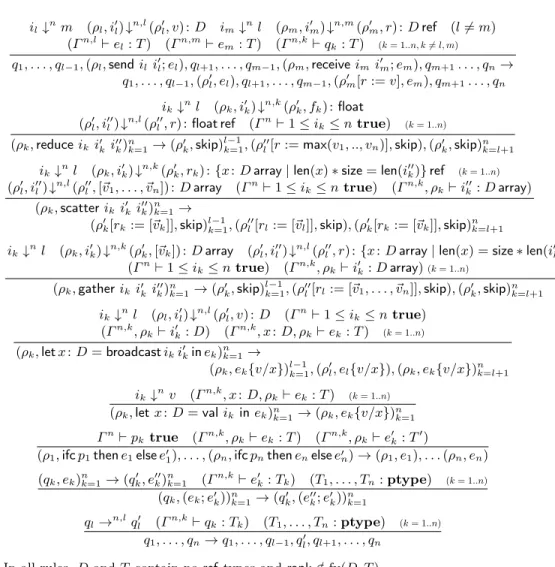
The rules in Figure 12 determine what it means for a programP1toreduce to a program P2, that is, they determine the meaning of assertionsP1→P2. Pro-gram reduction is composed of sixcollective barrier-like rules—for send/receive, reduce, scatter, gather, broadcast, and val—one rule for collective decisions, and one rule that provides for local process reduction. As in the previous cases, the premises to the rule may be divided in two parts: those governing the reduction
il↓nm (ρl, i0l)↓n,l(ρ 0 l, v) :D im↓nl (ρm, i0m)↓n,m(ρ 0 m, r) :Dref (l6=m) (Γn,l`e l:T) (Γn,m`em:T) (Γn,k`qk:T) (k= 1..n, k6=l, m) q1, . . . , ql−1,(ρl,sendili0l;el), ql+1, . . . , qm−1,(ρm,receiveim i0m;em), qm+1. . . , qn→ q1, . . . , ql−1,(ρ0l, el), ql+1, . . . , qm−1,(ρ0m[r:=v], em), qm+1. . . , qn ik↓nl (ρk, i0k)↓ n,k (ρ0k, fk) :float (ρ0l, i 00 l)↓ n,l (ρ00l, r) :float ref (Γ n` 1≤ik≤ntrue) (k= 1..n) (ρk,reduceiki0ki 00 k) n k=1→(ρ 0 k,skip) l−1 k=1,(ρ 00
l[r:=max(v1, .., vn)],skip),(ρ0k,skip) n k=l+1
ik↓nl (ρk, i0k)↓ n,k
(ρ0k, rk) :{x:Darray|len(x)∗size=len(i00k)}ref (k= 1..n)
(ρ0l, i
00
l)↓ n,l
(ρ00l,[~v1, . . . , ~vn]) :Darray (Γn`1≤ik≤ntrue) (Γn,k, ρk`i00k:Darray)
(ρk,scatterik i0ki 00 k)nk=1→ (ρ0k[rk:= [~vk]],skip)lk−=11,(ρ 00 l[rl:= [~vl]],skip),(ρk0[rk:= [~vk]],skip)nk=l+1 ik↓nl (ρk, i0k)↓ n,k (ρ0k,[~vk]) :Darray (ρ0l, i 00 l)↓ n,l
(ρ00l, r) :{x:Darray|len(x) =size∗len(i
0
k)}ref
(Γn`1≤ik≤ntrue) (Γn,k, ρk`i0k:Darray)(k= 1..n)
(ρk,gatheriki0k i00k)nk=1→(ρ0k,skip)lk−=11,(ρ00l[rl:= [~v1, . . . , ~vn]],skip),(ρ0k,skip)nk=l+1
ik↓nl (ρl, i0l)↓ n,l (ρ0l, v) :D (Γ n` 1≤ik≤ntrue) (Γn,k, ρk`i0k:D) (Γn,k, x:D, ρk`ek:T) (k= 1..n) (ρk,letx:D=broadcastiki0kinek)nk=1→ (ρk, ek{v/x})lk−=11,(ρ 0 l, el{v/x}),(ρk, ek{v/x})nk=l+1 ik↓nv (Γn,k, x:D, ρk`ek:T) (k= 1..n) (ρk,letx:D=valikinek)nk=1→(ρk, ek{v/x})nk=1 Γn`p ktrue (Γn,k, ρk`ek:T) (Γn,k, ρk`e0k:T 0 )
(ρ1,ifcp1thene1elsee01), . . . ,(ρn,ifcpnthenenelsee0n)→(ρ1, e1), . . .(ρn, en)
(qk, ek)nk=1→(q 0 k, e 00 k)nk=1 (Γn,k`e 0 k:Tk) (T1, . . . , Tn:ptype) (k= 1..n) (qk,(ek;e0k))nk=1→(q 0 k,(e 00 k;e 0 k))nk=1 ql→n,lq0l (Γ n,k` qk:Tk) (T1, . . . , Tn:ptype) (k= 1..n) q1, . . . , qn→q1, . . . , ql−1, q0l, ql+1, . . . , qn
In all rules,DandT contain noref types andrank∈/fv(D, T) Omitting dual rule for receive-send and theΓ ` ¬pktruerule forifc.
Fig. 12.Program reduction
process itself, and those guaranteeing the good formation of the programs in-volved. The latter are enclosed in parenthesis, as before. Notationi↓n v abbrevi-ates the evaluation of anintindex term under the empty store,(ε, i)↓n(ε, v) :int. The proviso in all rules that types and datatypes do not contain ref datatypes impedes reference passing (and the associated problem of dangling references at the receiving process). A similar reason forbids the rank variable in types, for this variable has a different value in each different process.
The rule for message-passing (the first rule in Figure 12), evaluates both index terms in both the send and the receive process. There is a fundamental
difference between the first and the second parameter in both cases. The first describes a process rank (target or source), the second the value to be passed, or the reference to hold the result. In general, index terms that denote process ranks cannot refer to the store, for these exact indices show up in the type of the processes (messagem ilD, in the send case). In such cases we use the abbreviated evaluation, as inil↓n m. In all other cases, we use evaluation under a generic store, as in (ρl, i0l)↓n,l(ρ0l, v) :D. The send/receiveprocesses reduce to skip (the stores evolve accordingly); the others remain unchanged. The case of the rule for reduce is illustrative of a feature of single-instruction-multiple-data models: the third parameter is evaluated at one site only (namely process l, cf. (ρ0l, i00l)↓n,l(ρ00
l, r) :float ref), yet the source code (index term i00k) appears in all processes. In the rule for broadcast (and let) we follow a strategy slightly different from that of reduce(andscatter/gather). Since a value is transmitted to all processes, thebroadcastexpression features an explicit continuation, allowing to substitute the value directly in the continuation processek(and in its typeT), as opposed to using references.
That the definition is well formed is the theme of the next theorem.
Theorem 1 (agreement for program reduction).
P1→P2
P1:S1 P2:S2
Proof (sketch). By rule induction on assertionP1 →P2. There are eight cases to consider. The case for process reduction follows by agreement for process re-duction (Lemma 4). The cases for collective operations and message passing all follow a similar strategy.P1is (ρk, ek)nk=1,P2is(ρ0k, e0k)
n
k=1. From the premises of the rules for (ρk, ek)nk=1 → (ρ0k, e0k)
n
k=1 we obtain the necessary hypotheses to build the expression typings for Γn,k, ρk ` ek : T and Γn,k, ρ0k ` e0k : T0. From agreement of expression formation we know thatΓn,k, ρ
k `T :type and
Γn,k, ρ0 k `T
0:type. We can eliminateρ
kandρ0k from the contexts (strengthen-ing), given that neitherT norT0 contain references. ThatT, . . . , T :ptype fol-lows from the Load lemma (lemma 2). Showing thatT0, . . . , T0:ptypeamounts to checking that the premises of the appropriate rules in Figure 5 are satisfied for each case.
Program reduction is Church-Rosser. As usual this does not mean that it is strongly normalising: taking advantage of while-loops, processes may engage in infinite computations.
Theorem 2 (Program reduction is Church-Rosser).
P1→P2 P1→P3
P2→P4 P3→P4
Proof (sketch). By rule induction on the first hypothesis. The cases of reduce, scatter,gather,broadcast,val,ifc(both rules) follow from the fact that evaluation is deterministic and that eitherpor6=pis true. WhenP1→P2is obtained with
send/receiverule, we analyse the possibleP1→P3reductions. Given the form of
P1 only two cases may hold. IfP3 is obtained via thesend/receiverule, the two processes involved are different from those involved in theP1 →P2 reduction, otherwiseP1 would not be well formed. Then we can easily see that there isP4 such that P2 → P4 and P3 → P4, both using the send/receive rule. If, on the other hand,P3 is obtained via the process rule, then we know that the process involved is neither thesendnor thereceiveprocess, since these expressions do not reduce via process reduction. Then again, we can easily build a programP4such that P2→P4via the process rule, and P3→P4 via thesend/receiverule.
In preparation for the progress result, we determine the meaning of assertions of the formP haltedusing the following rule.
(ρ1:store) . . . (ρn :store) (ρ1,skip), . . . ,(ρn,skip)halted
We are finally in a position to establish our progress result.
Theorem 3 (progress for programs).
P1:S
P1 halted or P1→P2
Proof (sketch). From the hypothesis and the formation rule for programs, we know that S : ptype. The proof proceeds by rule induction on this assertion. There are nine cases to consider. The case for the type equality rule follows by induction. For the others we establish an inversion lemma for each of the type constructors in our language. For example, ifΓ `e:broadcasti x: D.T theneis either
– letx:D1=broadcasti1i2ine1 andΓ `D1≡D:dtypeandΓ `i1=itrue andΓ `1≤i1≤sizetrueandΓ `i2:D andΓ, x:D`e1:T, or
– lety: D1 = i1ine1 and Γ ` i1 : D1 and y /∈ fv(broadcasti x:D.T) and
Γ, y:D1`e1:broadcasti x:D.T, or
– ifpthene1elsee2 and Γ ` p : prop and Γ ` e1 : broadcasti x:D.T and
Γ `e2:broadcasti x:D.T, or
– e1;e2and Γ `e1:skip andΓ `e2:broadcasti x:D.T.
We then distinguish two cases: a) the expressions in all processes are of the form letx:Dk = broadcastiki0kinek, b) at least one of the expressions is not broadcast. In the former case we show that P1 reduces under the broadcast rule. For the latter, we analyse the three possibilities to conclude that, in each case,
P1reduces under one of the process reduction rules (Lemma 6).
4
Related work
With more than 20 years of existence MPI [4] is thede facto standard for high-performance computing, admittedly the most widely used API for program-ming distributed message-passing applications. The verification effort for MPI
programs centres on debuggers and software verifiers. Tools such as ISP [22], DAMPI [27], and MUST [8] are runtime verifiers that aim at detecting dead-locks, hence are dependent on the quality of the tests. TASS [26] is a bounded model checker that uses symbolic execution to explore C+MPI program execu-tions, verifying safety properties and functional equivalence to serial programs. The approach performs a number of checks besides deadlock detection (such as, buffer overflows and memory leaks), but, as expected, does not scale with the number of processes. MOPPER [3] searches for deadlocks using SAT and a partial-order encoding, offering a more scalable solution. The purpose of our work is not detecting deadlocks; our type checker ensures that programs cannot possibly deadlock.
The type theory here developed is part of a larger effort aiming at a compre-hensive approach to type-based verification of parallel programs [18]. The project includes a toolchain for deductive verification of real world parallel programs written in the C programming language using MPI for inter-process communi-cation. Currently, the toolchain is composed of an Eclipse plug-in, an annotated MPI library, a C annotator, and makes use of the Verifying C Compiler (VCC) and the Z3 SMT solver. The Eclipse plug-in allows for developing protocol spec-ifications (the types in this paper), verifies that protocols are well formed (with the help of Z3 for constraint satisfiability), and generates protocol representa-tions in VCC format. The annotated MPI library contains the contracts of a core subset of MPI primitives, plus the base logic for protocol representation and program-protocol matching. The C annotator is a Clang/LLVM applica-tion that analyses the C+MPI source code and generates VCC annotaapplica-tions. The annotated C+MPI program is then checked by VCC to prove its conformance against the given protocol. A key result is that C+MPI programs can be verified in constant time, independently of the number of processes or values for program inputs, unlike other approaches (e.g., model checking and symbolic execution) that stumble on the state-explosion problem. The Eclipse plugin may also syn-thesise fully functional C+MPI programs that are correct-by-construction. Such code may then be further complemented with user-provided C functions that merely implement the local computations eschewing MPI primitives. We have also transposed the theory presented in this paper to the Why3 language. The Eclipse plugin compiles the protocol into Why3 against which WhyML programs are checked. Details are provided in [10, 14–16, 24].
The rich field of session types [12] provides for a major source of inspira-tion for this work. From the theory of multiparty session types [9], Scribble [11], a concrete protocol specification language, was developed. Scribble protocols describe high level, global, communication patterns. Under this framework, a protocol is first defined that specifies interactions among all principals. From such a protocol, or global type, local types are obtained by end-point projection onto particular principals. Code may then be developed for each end-point, us-ing specific libraries for the Scribble’s message-passus-ing primitives (Session C is one such example [20]). The whole development methodology ensures that the resulting code is exempt from deadlocks. In our case, rather than using two
sep-arate languages for global and local types, we see global types as vectors of local types subject to certain restrictions. The projection operator is cleanly captured in our setting via type equality. Another central distinction is that all our pro-cesses run the same code, as opposed to requiring the separate development for each different kind of participant in a distributed computation.
Among all works on session types, the closest to ours is probably that of Deniélou, Yoshida et al. [1], introducing dependent types and a form of primi-tive recursion into session types. The system here proposed provides for various communication primitives (in contrast to message passing only) and incorpo-rates dependent collective choices. One the other hand, we do not allow passing protocols on messages, a feature not used in the field of parallel programming. At the term level, we work with a while language, as opposed to a variant of the the π-calculus. Kouzapas et al. introduce a notion of broadcast in the setting of session types [13]. A new operational semantics system allows to describe 1-to-n andn-to-1 message passing, where n is not fixed a priori, meaning that a non-deterministic number of processes may join the operation, the others being left waiting. Types, however, do not distinguish point-to-point from broadcast operations. We work on a deterministic setting and provide a much richer choice of type operators.
Following Martin-Löf’s works on constructive type theory [17], a number of programming languages have made use of dependent type systems. Rather than taking advantage of the power of full dependent type systems (that brings un-decidability to type checking), Xi and Pfenning [29] introduce a restricted form of dependent types, where types may refer to values of a restricted domain, as opposed to values of the term language. The type checking problem is then re-duced to constraint satisfiability, for which different tools nowadays are available. Our language follows this approach. Xanadu [28] incorporates these ideas in a imperative C-like language. Omega [25] and Liquid Types [23] are two further examples of pure functional languages that either resorting to theorem prov-ing or do type inference. All these languages are functional; their type systems cannot abstract program’s communication patterns.
5
Conclusion and further work
We developed a type theory for parallel, message-passing, programming. The type language includes constructs matching those usually found in the practice of parallel programming, namely different forms of communication primitives, as well as sequential composition, primitive recursion, and a novel collective choice operator. Type dependency is taken from the domain of integer, floating point and array values, making type checking decidable. We have also introduced a core while language equipped with primitives matching those at the type level. The main result is soundness in the form of agreement for program reduction (akin to subject-reduction) and progress for programs. The theory has been put into to practice in a number of forms, including the verification of real world C+MPI programs.
Even if processes run in parallel, our language is intrinsically deterministic, hence exempt from races. The practice of MPI programming has shown us that “wildcard receives” (whereby a receive process can match any sender targeting the process) are often used, either for efficiency purposes or simply for easing programming. Wildcard receive introduces additional challenges that we want to look at in the future. MPI is equipped with different communication seman-tics, including synchronous (or unbuffered, the one addressed in this paper) and buffered. For the latter case, MPI features non-blocking sends together with a waitoperation that blocks until the memory space associated to the message con-tents can be reused. We believe that our framework can accommodate buffered semantics, at the expense of additional complexity both at the type and the operational semantics level. Finally, control-flow based on transmitted data (as opposed to explicit “control” messages usually found in, say, session types) is ubiquitous in MPI programming. Our type language already supports (depen-dent) collective decisions, but loops (catering for e.g., numerical convergence) introduce additional difficulties which we would like to address.
Acknowledgments. This work is supported by FCT through project Ad-vanced Type Systems for Multicore Programming and project Liveness, Stat-ically (PTDC/EIA-CCO/122547 and 117513/2010) and the LaSIGE lab (PEst-OE/EEI/UI0408/2011). We would like to thank Dimitris Mostrous for his in-sightful comments.
References
1. Deniélou, P., Yoshida, N., Bejleri, A., Hu, R.: Parameterised multiparty session types. Logical Methods in Computer Science 8(4) (2012)
2. FEVS: A functional equivalence verification suite, http://vsl.cis.udel.edu/ fevs/
3. Forejt, V., Kroening, D., Narayanswamy, G., Sharma, S.: Precise predictive analysis for discovering communication deadlocks in mpi programs. In: FM. LNCS, vol. 8442, pp. 263–278. Springer (2014)
4. Forum, M.P.I.: MPI: A Message-Passing Interface Standard Version 3.0. University of Tennessee (2012)
5. Foster, I.: Designing and building parallel programs. Addison-Wesley (1995) 6. Gordon, A.D., Fournet, C.: Principles and applications of refinement types. In:
Logics and Languages for Reliability and Security, pp. 73–104. IOS Press (2010) 7. Gropp, W., Lusk, E., Skjellum, A.: Using MPI: portable parallel programming with
the message passing interface. MIT press (1999)
8. Hilbrich, T., Protze, J., Schulz, M., de Supinski, B.R., Müller, M.S.: MPI run-time error detection with MUST: advances in deadlock detection. In: SC. p. 30. IEEE/ACM (2012)
9. Honda, K., Yoshida, N., Carbone, M.: Multiparty asynchronous session types. In: POPL. pp. 273–284. ACM (2008)
10. Honda, K., Marques, E.R.B., Ng, N., Vasconcelos, V.T., Yoshida, N.: Verification of MPI programs using session types. In: Recent Advances in the Message Passing Interface. LNCS, vol. 7490, pp. 291–293. Springer (2012)
11. Honda, K., Mukhamedov, A., Brown, G., Chen, T.C., Yoshida, N.: Scribbling in-teractions with a formal foundation. In: ICDCIT. LNCS, vol. 6536, pp. 55–75. Springer (2011)
12. Honda, K., Vasconcelos, V.T., Kubo, M.: Language primitives and type discipline for structured communication-based programming. In: ESOP. LNCS, vol. 1381, pp. 122–138. Springer (1998)
13. Kouzapas, D., Gutkovas, R., Gay, S.J.: Session types for broadcasting. In: PLACES. EPTCS, vol. 155, pp. 25–31 (2014)
14. Lemos, F.: Synthesis of correct-by-construction MPI programs. Master’s thesis, Department of Informatics, University of Lisbon (2014)
15. Marques, E.R.B., Martins, F., Vasconcelos, V.T., Ng, N., Martins, N.: Towards de-ductive verification of MPI programs against session types. In: PLACES. EPTCS, vol. 137, pp. 103–113 (2013)
16. Marques, E.R.B., Martins, F., Vasconcelos, V.T., Santos, C., Ng, N., Yoshida, N.: Protocol-based verification of MPI programs. DI-FCUL 5, University of Lisbon (2014)
17. Martin-Löf, P.: Intuitionistic Type Theory. Bibliopolis-Napoli (1984) 18. MPI Sessions,http://gloss.di.fc.ul.pt/MPISessions
19. Nelson, N.: Primitive recursive functionals with dependent types. In: MFPS. LNCS, vol. 598, pp. 125–143. Springer (1991)
20. Ng, N., Yoshida, N., Honda, K.: Multiparty Session C: Safe parallel programming with message optimisation. In: TOOLS Europe. LNCS, vol. 7304, pp. 202–218. Springer (2012)
21. Pacheco, P.: Parallel programming with MPI. Morgan Kaufmann (1997)
22. Pervez, S., Gopalakrishnan, G., Kirby, R.M., Palmer, R., Thakur, R., Gropp, W.: Practical model-checking method for verifying correctness of MPI programs. In: PVM/MPI. LNCS, vol. 4757, pp. 344–353. Springer (2007)
23. Rondon, P.M., Kawaguchi, M., Jhala, R.: Liquid types. In: PLDI. pp. 159–169. ACM (2008)
24. Santos, C.: Protocol based programming of concurrent systems. Master’s thesis, Department of Informatics, University of Lisbon (2014)
25. Sheard, T., Linger, N.: Programming in Omega. In: CEFP. LNCS, vol. 5161, pp. 158–227. Springer (2007)
26. Siegel, S.F., Zirkel, T.K.: Automatic formal verification of MPI-based parallel pro-grams. In: PPOPP. pp. 309–310. ACM (2011)
27. Vo, A., Aananthakrishnan, S., Gopalakrishnan, G., de Supinski, B.R., Schulz, M., Bronevetsky, G.: A scalable and distributed dynamic formal verifier for MPI pro-grams. In: SC. pp. 1–10. IEEE (2010)
28. Xi, H.: Imperative programming with dependent types. In: LICS. pp. 375–387. IEEE (2000)
29. Xi, H., Pfenning, F.: Dependent types in practical programming. In: POPL. pp. 214–227. ACM (1999)
A
Further examples
This section presents a few examples attesting the flexibility of the type language and the programming language.
A.1 Diffusion 1-D
The Diffusion 1-D example calculates the evolution of the diffusion (heat) equation in one dimension over time. The program iterates for a given number of steps, computing at each step the new temperatures at each point in the domain. This example was adapted from the FEVS benchmark suite [2].
The type for the diffusion 1-D example: 1 valmaxIter:{x:nat|x>0}.
2 valn:{x:nat|x%size= 0}.
3 broadcast1a:int.
4 broadcast1b:float.
5 broadcast1c:float.
6 broadcast1d:float.
7 ∀i≤size−1.
8 message1 (i+ 1){x:float array|len(x) =n/size};
9 ∀iter≤maxIter.
10 ∀i≤size−1.
11 message(i+ 1)i float; 12 ∀i≤size−1.
13 messagei (i+ 1)float
The code for the diffusion 1-D example:
1 leton:float= val if rank= 1then0.01else0.0in 2 letomaxIter:float= val if rank= 1then10000else0in 3 letok:float= if rank= 1 then0.01else0.0in
4 letowstep:int= if rank= 1then10else0in 5 letn:int= broadcast1onin
6 letk:float= broadcast1ok in
7 letmaxIter:int= broadcast1omaxIter in 8 letwstep:int= broadcast1owstepin 9 letlocaln:int= n/size in
10 letu:float array ref= mkref mkfloatarraylocaln+ 2in 11 letunew:float array ref= mkref mkfloatarraylocaln+ 2in 12 if rank= 1then
13 letbuf:float array= <fill-buffer> in 14 fori:size−1..1do
15 send(i+ 1)buf
16 else
17 receive1u;
18 letleft:int= rank−1in 19 letright:int= rank+ 1in 20 foriter:maxIter..1do 21 if rank>1then
22 sendleft !u 23 else 24 receiveright u; 25 if rank>1then 26 receiveright u 27 else 28 sendleft !u; 29 <update-unew>
A.2 Jacobi iteration
The Jacobi iteration example solves a linear equation of the form Ax = b
using Jacobi’s method. Each diagonal element is solved for, and an approximate value is plugged in. The example was changed to use a maximum number of iterations in place of the original data convergence method. This example was adapted from the Parallel Programming with MPI book [21].
The type for the Jacobi iteration example:
1 valn:{x:positive|x%size= 0}.
2 valmaxIter:int.
3 scatter1{x:float array|len(x) =n∗n}; 4 scatter1{x:float array|len(x) =n}; 5 allgathera:{x:float array|len(x) =n/size}.
6 ∀i≤maxIter.
7 (allgathera:{x:float array|len(x) =n/size}.
8 skip);
9 gather1{x:float array|len(x) =n/size}
The code for the Jacobi iteration example: 1 letAinitial:int array= n∗nin
2 letbinitial:int array= n in
3 letn:int= val <get-problem-size> in 4 letmaxIter:int= val <get-max-iterations> in 5 letnsplit:int= n/size in
6 letAlocal:float array ref= mkrefn∗nsplitin 7 letxlocal:float array ref= mkrefnsplit in 8 letblocal:float array ref= mkrefnsplit in 9 letxfinal:float array ref= mkrefn in 10 letxtemp2:float array ref= mkrefnin 11 scatter1Alocal !Ainitial;
12 scatter1blocal !binitial; 13 fori:nsplit..1do 14 <initialize-xlocal>;
15 letxold:float array= allgather!xlocal in 16 foriter:maxIter..1do
17 (fori:nsplit..1do 18 <update-xlocal>;