THE UNITED REPUBLIC OF TANZANIA
MINISTRY OF HEALTH AND SOCIAL WELFARE
PUBLIC PRIVATE PARTNERSHIP
TRAINING MANUAL FOR HEALTH AND SOCIAL
WELFARE STAKEHOLDERS
TABLE OF CONTENTS
TABLE OF CONTENTS...i
LIST OF TABLES AND FIGURES...iii
FOREWORD...iv
ACKNOWLEDGEMENT...v
LIST OF ABBREVIATIONS...vi
DEFINITION OF OPERATIONAL TERMS ...vii
INTRODUCTION...1
UNIT 1: THE PUBLIC PRIVATE PARTNERSHIP...2
1.1 Definition of Public Private Partnership...2
1.2 Historical Background of Public Private Partnership in the Health Sector...2
1.3 Rationale for Public Private Partnership...5
1.4 Categories of Public Private Partnership...5
1.4.1 PPP for Operations of existing public assets ...5
1.4.2 PPP for development and operation of new facilities...5
1.5 Benefits of Public Private Partnership...7
1.6 Challenges facing Public Private Partnership...7
REFERENCES...9
UNIT 2: NATIONAL PUBLIC PRIVATE PARTNERSHIP POLICY AND LEGAL FRAMEWORK ...10
2.1 National Public Private Partnership Policy...10
2.2 Public Private Partnership Act 2010...11
2.3 Public Private Partnership Regulations 2011...12
2.4 Health and Social Welfare PPP Policy Guidelines...13
2.5 Service Agreements in the Health sector...13
3.2 Monitoring and Evaluation of PPP Projects...24
3.2.1 Monitoring of PPP Project...24
3.2.2 Evaluation of PPP Project...25
3.2.3 Reporting and Feedback...26
REFERENCES...27
LIST OF TABLES AND FIGURES List of Tables
Table 1: Evolution of Public Private Partnership in the Health Sector...4 Table 2: Options of PPP for Operations of Existing Public Assets...5 Table 3: Options of Public Private Partnership for Development and Operation of New Facilities...6 Table 4: Stages, Activities Involved and Responsible Organization in Establishing and Implementing a Public Private Partnership Project...18
List of Figures
Figure 1: Stages in Establishing and Implementing PPP Project in the Health
FOREWORD
Public Private Partnership is an arrangement between public sector and private sector which aims to join forces together to meet public needs through the most appropriate allocation of resources, risk and rewards. The government recognises the role of private sector in bringing about socio-economic development through investment. Public Private Partnership (PPP) frameworks provide important instrument for attracting investments as it is the case in the health sector, since the government is striving to provide affordable and quality health services. Due to the recognition of PPP in improving the health sector the Government through Ministry of Health and Social Welfare has attempted various efforts since independence to promote PPP health projects.
Recently there has been development of National PPP Policy of 2009, the PPP Act No.18 of 2010 was enacted and it’s Regulations of 2011. The MOHSW like other Ministries is aiming at strengthening implementation of PPP in the Health Sector. The PPP desk/office was established at the MOHSW Headquarters in 2009 to coordinate and spearhead the PPP activities in the health and social welfare sector. Inadequate awareness on PPP issues amongst stakeholders is a challenge for successful implementation of PPP in the health and social welfare sector.
Therefore, the Ministry has seen the need to prepare this PPP training manual which aims at creating awareness and inform health and social welfare stakeholders how PPPs can effectively be implemented in health care service provision, training of healthcare workers, research and health related industries.
Through public private partnerships, the Government can make more efficient use of limited public resources by targeting and meeting the needs of the populations.
Regina L. Kikuli
Ag. PERMANENT SECRETARY
ACKNOWLEDGEMENT
The Ministry of Health and Social Welfare’s Public Private Partnership Training manual for stakeholders is a result of work that began in March 2011. Many people were involved and have made valuable contributions from its inception to its completion. The Ministry of Health and Social Welfare is indebted to all those who contributed towards the development of this training manual.
The Ministry also wishes to thank Danida for their financial support during the preparation of this important training manual.
We acknowledge especially the team of contributors from the public and private sectors mentioned in Appendix one responsible for the development of this manual. In particular we would like to thank colleagues from the PMO, PMO-RALG, MOHSW, CSSC, APHFTA, GIZ/TGPSH (formerly GTZ), CEDHA and other training institutions for participating in the preparation, reviewing of drafts, editing and finalising this training manual. Their discussions and input were exemplary of the genuine interest that currently exists for Public Private Partnership in health and social welfare in Tanzania.
Dr. Donan Mmbando
Ag.CHIEF MEDICAL OFFICER
LIST OF ABBREVIATIONS
APHFTA - Association of Private Health Facilities in Tanzania
BBO - Buy Build Operate
BLT - Build Lease Transfer
BOO - Build Own Operate
BOOT - Build Own Operate Transfer
BOT - Build Operate Transfer
CBO - Community Based Organisation
CDH - Council Designated Hospital
CEDHA - Centre for Educational Development in Health Arusha CHMT - Council Health Management Team
CHSB - Council Health Service Board
Danida - Danish International Development Agency
DB - Design Build
DBFO - Design Build Finance
DBO - Design Build Operate
DBOM - Design Build Finance Maintain DDH - District Designated Hospital DED - District Executive Officer FBO - Faith Based Organizations HSSP - Health Sector Strategic Plan MDGs - Millennium Development Goals
MOFEA - Ministry of Finance and Economic Affairs MOHSW - Ministry of Health and Social Welfare
MoU - Memorandum of Understanding
NGO - Non Government Organization
NSGRP - National Strategy for Growth and Reduction of Poverty
OBA - Output Based Assistance
PBF - Performance Based Financing
PMO–RALG - Prime Minister’s Office Regional Administration and Local PPP - Public Private Partnership
PS - Permanent Secretary
RAS - Regional Administrative Secretary
RfP - Request for Proposal
RHMT - Regional Heath Management Team TIC - Tanzania Investment Centre
UNDP - United Nations Development Programme.
VA - Voluntary Agency
DEFINITION OF OPERATIONAL TERMS
Affordability
Financial commitment to be incurred in relation to agreement between parties Contracting Authority
Ministry, government department or agency, local government authority statutory cooperation
Due diligence
Investigation of PPP partner prior to signing a contract Evaluation
Is a systematic and objective assessment of progress of project toward achievement of outcome
Feasibility study
Analysis and evaluation of proposed project to determine if it is technically, financially and economically feasible
Franchise
A form of business organization in which a firm which already has a successful product or service (the franchisor) enters into a continuing contractual relationship with other businesses (franchisees) operating under the franchisor's trade name and usually with the franchisor's guidance, in exchange for a fee
Monitoring
Is a systematic and continuous tracking of activities and good record keeping ensuring that activities are performed as planned
Partnership
Agreement between a public contracting authority and a private entity in which the private party performs an institutional function on behalf of the institution or acquires the use of public property for its commercial purposes
Pre-feasibility study
Preliminary study undertaken to determine if it would be worthwhile to proceed with feasibility study
Private Sector
Sector other than a public sector including non-profit making non-governmental organisation Procurement
Means buying, purchasing, renting, leasing or otherwise acquiring any goods, works or services by a procuring entity. This includes all functions that pertain to the obtaining any goods, works or services, including description of requirements, selection and invitation of
Project
Means a tasks to be implemented under an agreement entered between private party and contracting authority.
Public Sector
Means a Government Ministry, Department or Agency, Local government authority and any other person acting on behalf of the government ministry, department or agency, or local government authority
Risk
The probability that an actual return on an investment will be lower than the expected return Unsolicited proposal
A written proposal that is submitted to a relevant contracting authority on the initiative of the private part for the purpose of entering into a public private partnership agreement with the government
Non-Core Services
These are services which are not core to particular organization/institution, e.g. Health Sector’s core activity is provision of health services other services like security and cleaning are non-core they are supporting implementation of core activity
INTRODUCTION
Health care service delivery in Tanzania is provided through a decentralized pyramidal pattern of a referral system from community health services to consultant hospitals. All these levels offer curative, preventive and promotive services. The services are provided by both public and private health facilities; public facilities being the majority.
The Regional Administration and Local Government Authorities manage health services offered by public institutions at regional and district levels. Training of human resources for health provision is done by public and private institutions. Most of them are public while Pharmaceutical, medical equipment and supplies production is done by private sector.
Social welfare services concentrates on vulnerable groups in the society. The services are fragmented and institution-based both Public and private.. Most of the services are provided by the government. The private sector (NGOs and FBOs) provides social welfare for vulnerable groups, either in institutions or in communities, for example vulnerable groups are targeted for such support.
At the moment the government aims at promoting more participation of the private sector in the provision of health care and social welfare services, training of human resources for heath and provision of other health related services.
This manual has been prepared for orienting various stakeholders to assist them in the identification and implementation of PPP in the health sector. A wide range of audience will benefit from this manual, including officers in the MOHSW and PMORALG, Regional Health Management Teams, Council Health Management Teams, Health Facility Management Teams, health service boards and facility governing committees, health training institutions, private providers and other stakeholders.
The manual is divided into three units. Unit one highlights issues pertaining to Public Private Partnership; Unit two describes the National PPP Policy, PPP Act, PPP regulations and Service Agreements related to health service delivery in Tanzania. Unit three describes the processes of establishing and implementing PPP projects.
UNIT 1: THE PUBLIC PRIVATE PARTNERSHIP
This Unit gives highlights on meaning, historical background, rationale, categories, benefits and challenges issues pertaining to Public-Private Partnership.
Learning Objectives
At the end of this unit, participants should be able to: 1. Define the meaning of Public Private Partnership
2. Describe historical background of PPP for the health sector in Tanzania 3. Explain the rationale for Public Private Partnership
4. Describe categories of Public Private Partnership 5. Outline the benefits of Public Private Partnership 6. Describe the challenges of Public Private Partnership 1.1 Definition of Public Private Partnership
Public-Private Partnership is a contractual arrangement between public and private sector entities built on the expertise of each partner that best meets clearly defined public needs through the most appropriate allocation of resources, risks and rewards. The cooperation may involve construction, renovation, maintenance, management and provision of services. Public Private Partnership allows the public sector to harness the management and delivery capabilities of private providers and also raise additional funds to support specified services.
1.2 Historical Background of Public Private Partnership in the Health Sector
Public and Private Health sectors have been providing health services in Tanzania before and after independence, public sector being the main provider. Despite their long time existence, the providers of private-for-profit health services have sometimes been restricted in terms of service delivery. For instance in 1977, the Government imposed restrictions on private health care service delivery Given the growing demand for health care services and changing socio-economic and political environment, the Government re-introduced private Health Service practices in 1991.
The private health sector was categorized into “private-not-for-profit service providers”, “private-for-profit service providers” and “Providers of Traditional and Alternative Medicine”. The “private-not-for-profit service providers” included non-Government organizations – mainly religious organizations and voluntary agencies.
Faith Based Organizations (FBOs) health facilities were registered under the auspices of religious organizations. The “private-for-profit service providers”, provided health services for profit. In 1996, the Ministry of Health introduced guideline and standards for health facilities; thus assuring the private health services complement health care services provided by the Government.
The term Public Private Partnership should be distinguished from Private Sector Participation whereby a private sector delivers health and social welfare services including non-core services.
Contractual Agreements between Government and FBOs have been in existence since Colonial times. The Grant in Aid arrangements supported the Government to provide bed grant, salary grant, and other charges to FBO/VA hospitals to offer affordable health services to the surrounding community
In areas where a Council Hospital was not in existence, the Government through the Ministry of Health and Social Welfare entered an agreement with a FBO Hospital to serve as a Council Designated Hospital (the Council Designated Hospital CDH). Through these arrangements, the Government provides running costs of the hospital, while the owner maintains the infrastructure and the additional required resources. Currently, there are 38 CDH hospitals in Tanzania Mainland.
At Zonal level, the government entered in agreement with FBO hospitals to serve as referral hospitals for particular zones. The same arrangement of support was given to these hospitals as in case of DDH/CDH. Examples of these are Kilimanjaro Christian Medical Centre (KCMC) and Bugando, for the Northern and Lake Zone respectively. The other PPP/private sector participation existing in the health sector, include contracting out services like mortuary, security, catering, laundry, and transport. Health and Social Welfare training institutions belong to both public and private sector, but the Pharmaceutical manufacturing industry is mainly operated by the private sector.
Various events have occurred in the Health Sector during evolution of Public Private Partnership in Tanzania as shown in table 1.
Table 1: Evolution of Public Private Partnership in the Health Sector
Period Event
Colonial era Government was the main provider of health services, followed by FBOs and very few Private for profit practitioners.
1961-1976 Nationalization of private Hospitals
1977 Government enacted Private Hospital Act Cap 151 to restrict Private Health practices
1990 Health policy emphasized involvement of other sectors including private sector in provision of health services
1991 Revision of the Private Hospital Act to allow private for profit practice
1994 Health sector reforms emphasized on public private mix in delivery of health care services.
1996 Ministry of Health introduced Guideline Standards for Health Facilities. 2001 District Health management Training manual on promoting partnership in the
district was developed
2007 • A Service Agreement template for provision of Health services between the Government and the private service provider was developed.
• PPP was incorporated in the National Health Policy to enhance collaboration for health services delivery between the public sector and the private sector
• The National PPP Steering Committee (PMO-RALG, MOHSW and Private partners) was formed to promote effective Private Public Partnership for quality health services delivery
2009 • HSSP III (2009–2015) was established, one of its strategies being public private partnership.
• The National PPP Policy was established.
• The PPP office was established at the MOHSW to spearhead coordination of PPP activities in the Health Sector.
2010 • The National PPP Act was enacted by Parliament. • Health sector PPP Strategic Plan was developed 2011 • National PPP regulations established
1.3 Rationale for Public Private Partnership
Health services delivery in Tanzania has been a function of mainly government institutions, the private sector playing a small role. However, since early 1990s a series of major economic, political and social changes have occurred. The population has grown and demand for health services by the population has increased. In view of these changes, new policies have been developed that promote increased participation of the private sector in provision of health care and social welfare services, training of human resource for health and provision of other health related services in order to compliment government efforts.
1.4 Categories of Public Private Partnership There are two categories of PPP which are:
(I) PPP for Operations of existing public assets
(II) PPP for development and operation of new facilities. 1.4.1 PPP for Operations of existing public assets
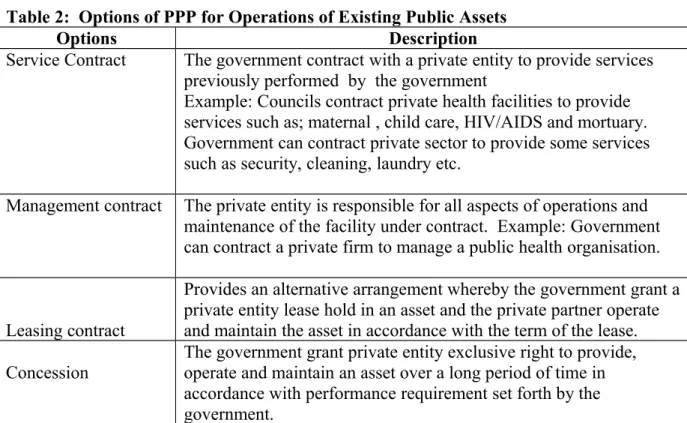
In this category there are four PPP options as described in Table 2. Table 2: Options of PPP for Operations of Existing Public Assets
Options Description
Service Contract The government contract with a private entity to provide services previously performed by the government
Example: Councils contract private health facilities to provide services such as; maternal , child care, HIV/AIDS and mortuary. Government can contract private sector to provide some services such as security, cleaning, laundry etc.
Management contract The private entity is responsible for all aspects of operations and maintenance of the facility under contract. Example: Government can contract a private firm to manage a public health organisation.
Leasing contract
Provides an alternative arrangement whereby the government grant a private entity lease hold in an asset and the private partner operate and maintain the asset in accordance with the term of the lease. Concession
The government grant private entity exclusive right to provide, operate and maintain an asset over a long period of time in accordance with performance requirement set forth by the government.
Source: National PPP Policy 2009
1.4.2 PPP for development and operation of new facilities. In this category there are various options as shown in Table 2.
Table 3: Options of Public Private Partnership for Development and Operation of New Facilities
OPTIONS Description
Design-Build (DB) The Government contracts with the private partner to design and build a facility in accordance with the requirements set by the Government. After completing the facility, the Government assumes responsibility for operating and maintaining the facility.
Design-Build-Operate (DBO)
The Government contracts with the private partner to design and build a facility in accordance with the requirements set by the Government. After completing the facility, the ownership of the facility remains with the public sector while the private partner operates the facility according to public performance requirements. The operator is also responsible for replacing the assets whose life has expired.
Design-Build-Operate-Maintain (DBOM) or Build-Operate-Transfer (BOT)
This combines the responsibilities of design-build procurements with the operations and maintenance of a facility for a specified period by private sector partner. At the end of that period, the facility is transferred back to the Government.
Build-Lease-Transfer
(BLT) After building the asset, the concessionaire rents or leases it from theGovernment and eventually transfers it back to the Government.
Design-Build-Finance-Operate (DBFO) or Design-Build-Finance-Maintain (DBFM)
The private sector designs, builds finances and operates or maintains a new facility under a long term lease. At the end of the lease term, the facility is transferred to the Government.
Build-Own-Operate (BOO)
The Government grants the right to finance, design, build, operate and maintain a project to a private entity, which retains ownership of the project. The private entity is not required to transfer the facility back to the Government.
Build-Own-Operate-Transfer (BOOT)
The Government grants a franchise to a private partner to finance, design, build and operate a facility for a specified period of time. Ownership of the facility is transferred back to the Government at the end of that period.
Buy-Build-Operate
(BBO) This is a form of asset sale that includes a rehabilitation or expansion ofan existing facility. The Government sells the asset to the private sector entity, which then makes the improvements necessary to operate the facility in a profitable manner.
1.5 Benefits of Public Private Partnership
Public Private Partnership has the following benefits;
• Facilitating creative and innovative approaches in stimulating private sector to engage in specific PPPs; with the Government allowing bidders to compete on the basis of their ability to develop unique and creative approaches to the delivery of a required output.
• Enhancing Government’s capacity to develop integrated solutions that effectively address public needs.
• Reducing costs of implementation and realization of quality products and services attributable to economies of scale and operating efficiency
• Accessing technical and managerial expertise, financial resources and technology from the private sector to address public needs.
• Facilitating large scale capital injections while reducing public debt and dependency on aid.
• Facilitating better responsiveness to consumer needs and satisfaction of those needs.
• Fostering economic growth by developing new investment opportunities and increasing provision of public goods and services.
• Ensuring fulfilment of the best interest of the public and private sector through an appropriate allocation of risks and returns.
• Ensuring accessibility and affordability of health care services to the population
1.6 Challenges facing Public Private Partnership The challenges of PPP include;
• Inadequate institutional frameworks that provide clear guidelines and procedures for implementation of Public Private Partnerships.
• Inadequate analytical capacity to assess investment proposals leading to poor projects design and implementation.
• Inadequate enabling environment which includes lack of long-term financing instruments, appropriate risk sharing mechanisms and geographical location.
• Mistrust between Public and Private Sectors which lead to lack of transparency.
• Low purchasing power of the community.
The PPP in health sector is very important as it will lead to improved accessibility, reliability, affordability and equality of health care services.
REFERENCES
The United Republic of Tanzania. Ministry of Health (1990). National Health policy, Dar es Salaam. Government Printer.
The United Republic of Tanzania. Ministry of Health (1994). Proposals for Health Sector Reforms. Dar es Salaam, Tanzania.
The United Republic of Tanzania. Ministry of Health and Social Welfare (2007). Agreement for the Provision of Health Services between the Government and the Service Providers. Dar es Salaam.
The United Republic of Tanzania. Ministry of Health and Social Welfare (2007). National Health Policy. Dar es Salaam, Government Printer.
The United Republic of Tanzania. Ministry of Health and Social Welfare (2009). Health Sector Strategic Plan III, Dar es Salaam, Government Printer.
The United Republic of Tanzania. Ministry of Health and Social Welfare (2010). Public Private Partnership Strategic Plan 2010-2015, Dar es Salaam. Government Printer
The United Republic of Tanzania. Prime Minister’s Office (2009). National Public Private Partnership Policy, Dar es Salaam. Government Printer.
The United Republic of Tanzania (2010). The Public Private Partnership Act, 2010, Dar es Salaam, Government Printer.
World Health Organization (2001). Making a Public-Private Partnership Work: An Insider’s View. Bulletin of the World Health Organization 79(8):795-79
World Health Organization (1999). WHO Guidelines on Collaborations and Partnership with Commercial Enterprise. Geneva.
UNIT 2: NATIONALPUBLIC PRIVATE PARTNERSHIP POLICY AND LEGAL FRAMEWORK
This unit highlights the National PPP Policy 2009, PPP Act 2010, PPP Regulations 2011 and related Service Agreements pertaining to health service delivery in Tanzania.
Learning Objectives
At the end of this unit participants should be able to: 1. Describe the National PPP Policy 2009 2. Describe the PPP Act 2010
3. Describe PPP Regulations 2011
4. Describe health and Social Welfare PPP Policy Guidelines 5. Explain different Service Agreements in the health sector
2.1 National Public Private Partnership Policy
The National PPP Policy was developed in 2009 to guide establishment and implementation of PPPs in Tanzania mainland. Participation in PPPs may take place in both productive and social economic services sectors including, but not limited to the following: Agriculture, Infrastructure, Manufacturing, Education, Health, Land development, Environment and Solid Waste Management, appropriate defence infrastructure, Sports, Communication, Information and Communication Technology (ICT), Trade, Entertainment and Recreation and Irrigation. It describes meaning and scope of PPP, rationale, benefits, category, current status and challenges of PPP in Tanzania.. The National PPP Policy further stipulates Vision, Mission, Goals, objectives and Policy issues as follows:
Vision
Efficient and sustainable PPPs for the delivery of reliable and affordable socio-economic goods and services
Mission
Creating an enabling environment for promoting PPPs to achieve sustainable high and broad-based economic growth
Goal
Contribute to national poverty reduction objective through delivery of competitive and sustainable PPPs.
Main Objective
The main objective is to promote private sector participation in the provision of resources for PPPs enterprises in terms of investment capital, managerial skills and technology.
Specific Objectives
• To implement effective strategies showing specific obligations and rights for various stakeholders;
• To introduce fair, equitable, transparent, competitive and cost-effective procurement processes for PPPs;
• To adopt operational guidelines and criteria for PPPs;
• To attract resources for development of PPPs;
• To develop institutional capacities for technical analysis and negotiation of PPPs and associated contracts; and
• To enhance efficient and quality implementation of PPP
Policy Issues
The National PPP Policy provides 12 policy issues which include:
• Comprehensive policy legal and institutional framework for PPPs.
• Adequacy of resources for PPPs.
• Procurement process for PPPs.
• Feasibility studies of PPPs.
• Negotiation and approval for PPPs.
• Risk allocation mechanism for PPPs.
• Guidelines for widening investment opportunities and promotion of PPPs.
• Awareness creation.
• Capacity building and technology transfer.
• Pricing for PPP.
• PPPs coverage in marginal Areas.
• Empowerment of citizens.
(For details refer National PPP Policy document). 2.2 Public Private Partnership Act 2010
The Public Private Partnership Act no.18 of 2010 provide for the institutional framework for the implementation of PPP Agreements between the public and private sectors; to set rules, guidelines and procedures governing public private partnership procurement development and implementation of public private partnership and to provide for other related matters.
The Act is divided into five parts as elaborated below: Part I: Preliminary provision
This provides preliminary matters which include title of the law, provisions for its commencement, application and interpretation of terms such as meaning of Minister, Contracting Authority as used in the Act.
Part II: Establishment and administration of PPP coordination Unit
This deals with matters relating to involvement of parties in the project, Roles of Public and Private Sector, responsibilities of contracting authority, feasibility studies, procurement process, Public Private partnership Agreement, land acquisition, Project officers, responsibilities of accounting officers, enjoyment of benefits and dispute resolution.
Part IV: Miscellaneous provisions
This is miscellaneous provisions part which includes monitoring and evaluation, conflict of interest, empowerment of the citizens, duties to take care and exercise due diligence, general penalties regulation and saving provisions.
Part V: Consequential amendments to the Tanzania Investment Act
It provides for amendment of Tanzania Investment Act Cap 38 in order to add to the current function of the Tanzania Investment Centre, the functions of promoting private sector participation in the public private partnership project
(For details refer National PPP Act No. 18, 2010).
2.3 Public Private Partnership Regulations 2011
The Public Private Partnership Regulations made under section 28 of the Public Private Partnership Act no. 18 for the enforcement of the Act.
These regulations are divided into eight parts as described below.
Part I: Preliminary provisions
This part provides for preliminary provisions including the citation of the regulations, the application and interpretation of terms used in the Regulations.
Part II: Identification of projects
This part provides for the identification of PPP projects including determination of projects for partnership, pre-feasibility study, funds for feasibility study and feasibility study by public sector. Also it provides for identification of unsolicited proposals, contents of project concept for unsolicited proposals, approval of project concept for unsolicited proposals and rejection of project concept of unsolicited proposal. Furthermore the part provides for project officer, contents of the feasibility study report, committees, selection of the project, consultation with Regulatory Authority, and determination of the project for implementation under PPP.
PART III: Recommendation of projects by the Coordination Unit
This part deals with recommendation of project starting with: submission of projects by contracting authority, formation of committee of the Coordination Unit, consideration of the project by committee, recommendation by the Coordination Unit and recording of the project in a register.
Part IV: Approval of projects by the Finance unit
The part provide for approval of the project by the Finance Unit including evaluation of approved project, committee of finance unit, consideration by finance committee, consideration by finance unit and re- consideration by contracting authority. Also it explain approval of the
project by the minister responsible for finance, initiation of funding process for implementation of the project, suspension of project and refusal of the project.
Part V: Procurement by Contracting Authority
The part guides the procurement process that the contracting authority will employ once a project has been approved including: advertisement for tenders in respect of the projects, qualification for tenderers, roles of selected tenderers and procurement of unsolicited proposal. Part VI: Negotiation, Agreements and Awards
This part deals with negotiations, agreement and award including: entering into agreement with the successful bidder, formation of negotiation team, drafting of agreements, and approval of agreements by finance unit. Also it provide for submission of copy of Agreement to Attorney General for vetting, Procedure for vetting, approval and finalisation of the agreement, signing of agreement, distribution of copies of agreement for record keeping and implementation of the project.
Part VII: Termination of projects
The part explains procedure for termination of projects, condition for termination and remedy. Part VIII: General provisions
The part provides for monitoring and evaluation of the PPP project (For details refer the Public Private Partnership Regulations, 2011)
2.4 Health and Social Welfare PPP Policy Guidelines
The purpose of the Health and Social Welfare PPP Policy Guidelines is to provide guidance for mainstreaming, establishing, implementing, coordinating, mobilizing, monitoring and evaluating partnerships between the Government of Tanzania and the private health and social welfare sector within existing laws, policies and plans. The guidelines complement this training manual. The guidelines seek to support broader national health objectives. More specifically, the guidelines aim to promote recognition and understanding of the complementarities between the public and the private sectors in the provision of health and social welfare services. Furthermore, the guidelines define a health sector institutional framework within which the coordination, implementation, monitoring and evaluation activities enrich these partnerships. The guidelines will foster development of the specific policies for partnership with the different private sub-sectors; and provide the policy makers and stakeholders in the health sector with guidelines for identifying and addressing partnership concerns when taking policy decisions.
These Health and Social Welfare Sector Public Private Partnerships Policy Guidelines confirm the Ministry of Health and Social Welfare’s commitment to collaborate with private sector stakeholders in creating the right regulatory and institutional framework for the implementation and monitoring of public private partnerships in the health and social welfare sector.
Currently, in Tanzania a private party may enter into agreement with the Central or Local government in the health sector to provide services. These could be running a hospital or provide other services. Examples of such agreements are running DDH/CDH hospitals
(District/Council Designated Hospital Agreement), referral hospitals (Bugando, KCMC hospital, CCBRT hospital) (Referral hospital agreement) and provide specific services like delivery and child health (Specific Service Agreement).
District/Council Designated Hospital Agreement
This is an agreement whereby the Local Government desires to use a hospital owned by a private party as a District/Council hospital. The private party has to agree its hospital to be utilized and operated as a District/Council hospital in accordance with the agreement.
Referral hospital agreement
This is an agreement whereby the Central Government desires to use a hospital owned by a private party as a referral hospital. The private party has to agree its hospital to be utilized and operated as a referral hospital in accordance with the agreement.
Specific Service Agreement
This is an agreement whereby the Government desires to use a facility owned by a private party to provide specific services. The private party has to agree its facility to provide specific services in accordance with the agreement. A Service Agreement template is available to facilitate Councils to enter into agreements with private parties.
The government may desire to use other services from private sector such as training of human resource for health and social welfare or manufacture
pharmaceutical supplies and medical equipment. In such cases, the contracting authority will enter into agreement.
REFERENCES
The United Republic of Tanzania, Prime Minister’s Office (2009) National Public Private Partnership, Policy, Dar es salaam Tanzania, The Government printer.
The United Republic of Tanzania, (2010) Public Private Partnership Act, Dar es Salaam, The Government printer.
The United Republic of Tanzania (1977) Private Hospitals Act, Dar es Salaam Tanzania, The Government printer.
The United Republic of Tanzania, (2007) Agreement for the Provision of Health Services between the Government and the Service Providers.
The United Republic of Tanzania, (2011) Public Private Partnership Act, Regulations, Dar es Salaam, The Government printer.
UNIT 3: ESTABLISHING AND IMPLEMENTING PUBLIC PRIVATE PARTNERSHIP PROJECTS
This unit highlights the stages involved in the establishment and implementation of public private partnership projects in Tanzania.
Learning Objective
At the end of this unit, the participants should be able to:
1. Describe stages in establishing and implementing PPP projects
3.1 Establishment and implementation of Public Private Partnership Projects
In establishing and implementing PPP projects there are various stages that are involved as follows:
Preparatory Phase A. Advocacy
B. Pre-feasibility study C. Feasibility study
D. Assessing feasibility study Procurement Phase
E. Preparing RFP documents F. Invite and receive bids G. Evaluating bids
H. Negotiating with preferred bidder I. Agreement signing
Execution Phase
J. Implement the project
K. Monitor and evaluate the project Phasing out/Exit
L. Implement Exit Strategy
Stages
Public Private Partnership Advocacy
In the establishment of PPP, advocacy is very important because it will create/raise awareness sensitization so as to attract more investors and resources. Various methods can be used to create awareness and sensitization. These methods include different channels of communication (e.g. Radio, Television, Posters, Leaflets, Booklets and publishing a notice in Gazette); and fora (e.g. seminars, meetings, conferences and workshops) to present PPP issues. Awareness and sensitization campaign should target decision makers, Parliamentarians, Investors, Sector
Pre-Feasibility Study
Pre-feasibility study will help to guide the contracting authority whether or not to conduct feasibility study, since the feasibility study is very expensive. The pre-feasibility will help to avoid wastage of funds to conduct feasibility study for non viable projects. Pre-feasibility will give an indication about the viability of the project, affordability, and public benefit.
Feasibility Study
Feasibility study is conducted before the implementation of PPP project to asses whether or not the proposed project is viable, has value for money, can be sustained, and a win-win situation can be achieved.
Assessing Feasibility Study
The Contracting Authority shall appoint committee of experts to study the report and make recommendations or advice on the implementation of the project. Upon recommendation of the study report by the expert committee, the report shall be reviewed by the ethical committee for advice. Regulatory Authorities will be consulted to advice on the proposed projects. If both Contracting Authority and ethical committee are satisfied with the report, it will be forwarded to Coordination Unit and Finance Unit for advice.
Preparing Request for Proposal (RfP) Documents
Preparation of RfP document is the initial stage of PPP project procurement. In this stage a document is prepared which will be used to invite interested parties to bid for proposed project. The document will have a brief description of the proposed project.
Invite and Receive Bids
The Contracting Authority shall advertise the approved project for bids, using RfP document, calling upon interested parties from the private sector to apply for bid. The Contracting Authority shall receive the dully completed bids from the private sector.
Evaluate Bids
This process follows receipt of bids. Bids are assessed for the purpose of selecting a successful bidders based on the set criteria. The process will also involve performing due diligence.
Negotiation with the Preferred Bidder
This is the process of both parties agreeing on how best to implement the project and facilitate win-win situation. The accounting officer of the contracting authority will form a negotiation team (multidisciplinary) to negotiate with the private party. The drafting of the agreement will be done after successful negotiation which will then be forwarded to finance unit for minister approval.
Signing of Agreement
Upon consensus by both parties and approval by Minister for Finance, the Agreement will be forwarded to Attorney General for vetting and approval. The agreement will be signed by both the Accounting Officer on behalf of the Contracting Authority and the private party.
Monitoring and Evaluation of the Project These are explained in section 3.2
Exit of the Project
In case of expiring of the agreement period, the handing over of the project and the facilities to the public/private will be arranged as per agreement. The parties shall decide and agree on the way forward. The owner may decide to enter into another agreement or come up with other option.
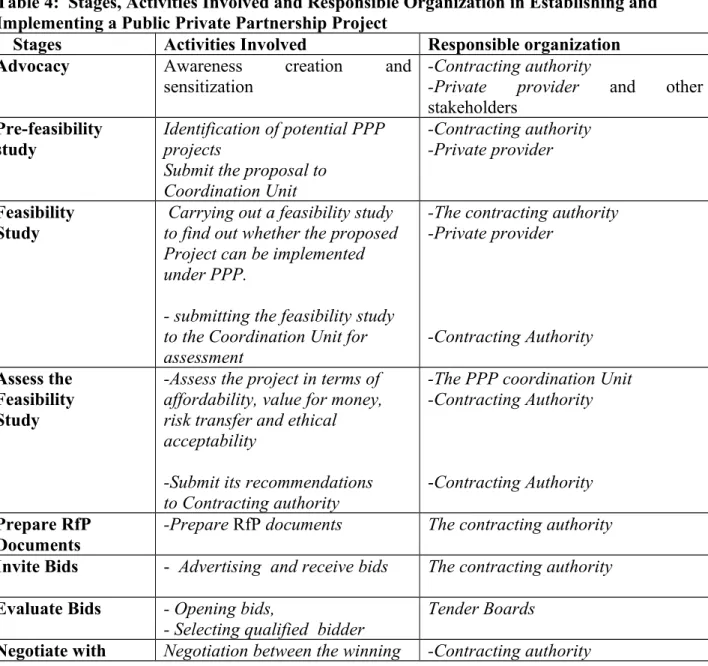
The stages, activities involved and responsible organizations in establishing and implementing a PPP project for each stage are summarized in Table 4.
Table 4: Stages, Activities Involved and Responsible Organization in Establishing and Implementing a Public Private Partnership Project
Stages Activities Involved Responsible organization
Advocacy Awareness creation and
sensitization -Contracting authority-Private provider and other stakeholders
Pre-feasibility
study Identification of potential PPP projects Submit the proposal to
Coordination Unit
-Contracting authority -Private provider Feasibility
Study
Carrying out a feasibility study to find out whether the proposed Project can be implemented under PPP.
- submitting the feasibility study to the Coordination Unit for assessment
-The contracting authority -Private provider
-Contracting Authority Assess the
Feasibility Study
-Assess the project in terms of affordability, value for money, risk transfer and ethical acceptability
-Submit its recommendations to Contracting authority
-The PPP coordination Unit -Contracting Authority
-Contracting Authority Prepare RfP
Documents
-Prepare RfP documents The contracting authority Invite Bids - Advertising and receive bids The contracting authority Evaluate Bids - Opening bids,
- Selecting qualified bidder
Tender Boards
Procurement shall be done through an open competitive bidding process in accordance with the Public Procurement Act No.21 of 2004 and its regulations. The emphasis on having a competitive procurement process is to ensure fair, equitable, transparent, competitive and cost effective procurement.
preferred bidder
bidder and contracting authority -Bid winner -Negotiation team Sign Agreement Signing of Agreement -Contracting authority -Bid winner Implement the
Project Carry out the project
-Private Service provider -Contracting Authority Monitor and
control the project
Supervision, monitoring and evaluation
-Private Service provider -Contracting Authority Exit Implement exit strategy Private Service provider
-Contracting Authority
In the context of Tanzania Health sector, establishment and implementation of PPP Project should be done under the guidance of Ethical Committees to ensure safety of the people. The stages involved are shown below in Figure 1.
Figure 1: Stages in Establishing and Implementing PPP Project in the Health and Social Welfare Sector
Responsibilities of stakeholders in implementation of Public Private Partnership Projects In implementing a PPP project various stakeholders are involved. The stakeholders and their responsibilities are described below:
PPP Coordination Unit (Prime Minister’s Office) Responsibilities
• Promote and Coordinate PPP projects Publish the idea of the project
Feasibility Study Viable Project Not Viable Project Discard/Review Ethical Committee Review Ministry Approval Discard/Review not Ethically Sound Project
Project Worth >threshold will be forwarded to Finance Unit/Coordinating Unit Procurement of PPP Project Implementation Of The Project Project < threshold USDs M&E Pre-feasibility study
Submit coordination unit and finance unit
Approved Not approved
Do not conduct feasibility study
Implement exit strategy Agree on PPP Arrangement for Ethically Sound Project
• Examine requests for proposals to ensure conformity with approved feasibility study
• Advice the Government on administrative procedures and matters relating to public private partnership
• Advice the Contracting Authority on matters relating to public private partnership projects
The PPP Finance Unit (MOFEA) Responsibilities
• Evaluation of approved project for fiscal risk allocation
• Other Financial matters related to the approved projects (e.g.; financing and funding) Contracting Authority
This could be Ministry of Health and Social Welfare, government department or agency, local government authority or statutory corporation
Responsibilities
• Identify a project to be implemented under PPP arrangements.
• Undertake or allow a feasibility study to be undertaken where it considers that the project is suitable for implementation under an agreement
• Submit the proposed project together with the feasibility study to the Coordination Unit for advice
• Prepare a request for proposal document
• Seek approval of the Minister responsible for finance when the project involves public finance
• Invite and receive bids
• Negotiate with preferred bidder
• Signing an agreement
• Supervise, monitor and evaluate the project Attorney General
The Attorney General office will provide legal opinion regarding the intended agreement or project.
Responsibilities
• Vetting of the project agreement PPP coordinator
Is appointed by Accounting Officer of Contracting Authority Responsibilities
• Sector Coordination Project officer
Is appointed by the Accounting Officer after initiation of the project Responsibilities
• Supervise the project
• Liaison Officer between the Account Officer and Private party
PPP Fora
There will be PPP fora at different levels to facilitate collaboration in addressing health and Social Welfare challenges. Members of the each forum will be from both the private and public sectors.
National Public Private Health Forum (PPHF) Responsibilities
• Extra Ministerial Health support
• Advocacy
• Facilitating joint interaction among key stakeholders Regional Public Private Health Forum
Responsibilities
• Networking
• Advocacy
• Resource mobilization
• Monitoring
Regional Health Management Team (RHMT) Responsibilities
• Provide technical support
• PPP Policy translation,
• Dissemination of Guidelines
• Monitoring
• Supervision and evaluation
District Public Private Health Forum Responsibilities
• Networking
• Advocacy
• Resource mobilization
• Monitoring
Council Health Management Team (CHMT) Responsibilities
• Provide technical support
• PPP Policy translation
• Dissemination of guidelines
• Monitoring , supervision and evaluation
• Training service providers
Council Health Services Board (CHSB) Oversee implementation of contracts/agreements Health Facility Governing Committee (HFGC) Oversee implementation of contracts/agreements Private Party
• Identify projects
• Carry out feasibility study
• Mobilizing resources
• Implement project
• Sensitization and awareness creation
• Monitor and evaluate the projects
Public Private Partnership Project Financing
PPP offers additional possibilities of financing health care services.
The PPP financing sources should be reliable to facilitate sustainability of PPP project. There are various sources of financing such as:
• Government (e.g. block grant, bed grant and staff grant)
• Development Partners (e.g. basket fund, non-basket and project)
• Insurance schemes (e.g. community health fund, National Health Insurance fund and private health insurance )
• Own sources.
• User fees
• Financial institutions, e.g. Banks
Public Private Partnership Accountability
Accountability means being responsible for activity/actions implemented. It include being responsible for money used to implement activity/actions, service delivered and affairs of workers implementing activity. Means of accounting should be clearly elaborated in the contract.
• Financial accountability includes service provider or a contractor opening a separate account for the specific PPP project which shall be subject to public audit.
• Management accountability includes establishment of contract monitoring committee (e.g. facility governing committee or council health service board) which regularly monitors the implementation of the project.
• Professional accountability includes involvement of professional councils and associations to assess whether services are implemented as per existing standards.
Currently, Private Service providers who are in the PPP agreements receive Government funds and supplies before provision of services (i.e. Input financing e.g. bed grant and staff grant). These do not reflect value for Government money. In an ideal PPP contractual arrangement, financing or payment should be done after provision of actual services (i.e. Output financing).
Public Private Partnership Project Sustainability
For PPP to prosper, mechanisms for sustainability must be in place, since considerable resources are invested in PPP projects; by both the Government as well as the private sector.
To facilitate sustainability of PPP Project, it is recommended that:
• All key players have a common understanding of the PPP concept and its implementation. This will facilitate both parties to support the PPP project and play their respective roles.
• A proper feasibility study to be conducted prior to the implementation of the PPP project to ensure achievement of the desired project goals.
• All parties involved should be committed in implementing the PPP project. • There is support from political leaders and community leaders.
• Finances from both parties are being disbursed timely to allow smooth running of the PPP project.
• Regular meetings between the parties at all levels concerned to discuss successes and challenges. Meetings will also allow discussions on ways to address challenges encountered and suggest the way forward.
• Risks of PPP projects are identified and monitored. e.g. conducting financial risk analyses
Implementation of existing PPP projects
The government had entered in agreement with FBO hospitals to act as DDH before enactment of PPP Act 18, of 2010. These agreements are still in force and the PPP Act no. 18 recognizes them.
3.2 Monitoring and Evaluation of PPP Projects
This section comprised of monitoring, evaluation, reporting and feedback of PPP projects
3.2.1 Monitoring of PPP Project
Monitoring can be defined as a continuing function that aims primarily to provide the management and main stakeholders of an ongoing intervention with early indications of
Monitoring involves systematic and continuous tracking of activities and good record keeping ensuring that activities are performed as planned. Monitoring of PPP implementation allows early identification of challenges and plan measures to be taken in achieving project objectives. The areas to be monitored include;
• Performance
• Service delivery
• Standards agreed
• Revenue and expenditures
• Profit generated
• Implementation of Policies, Manuals, Protocols and MoU
Monitoring should be done by the parties involved using set indicators. Different ways can be used to monitor the implementation of PPP project including:
• Reviewing of records and reports
• Visits
• Communication
• Meetings
Reviewing of records and reports
This is a way of going through project records and reports routinely produced to show how the project has been implemented.
Visits
This entails project staff physically going to the project site to see how different activities of the project are progressing.
Communication
This is a way of sharing project implementation information regularly using a variety of communication channels.
Meetings
Parties involved in implementation of the project meet and review progress of the project.
3.2.2 Evaluation of PPP Project
Evaluation is a systematic and objective assessment of progress towards achievement of an outcome. Evaluation is not a one-time event, but an exercise involving assessments of differing scope and depth carried out at several points in time in response to evolving needs.
Evaluation involves the measurement of performance based on established criteria to ensure that the objectives set have been attained. Evaluation aims at assessing the impact of the intervention i.e. PPP
Both external and internal evaluations are recommended. Internal evaluation should be done by both parties and external evaluation should be done by external evaluators.
• Interviewing
• Research Observation
This entails watching and noting issues pertaining to project implementation. Reviewing of records and reports
As explained earlier in 3.2.1 Interviews
This entails questioning on issues pertaining to the project implementation. Research
This means conducting systematic investigation using scientific methods to assess project implementation
Importance of Monitoring and Evaluation includes:
• Measuring progress of activities during implementation
• Provide information during implementation about specific problems and aspects that need modification
• Enabling managers to decide about allocation of resources • It allows gaps identification and offer ways to bridge the gaps • Provides opportunity for learning and improvements;
3.2.3 Reporting and Feedback
Reporting is an integral part of monitoring and evaluation. It is the systematic and timely provision of essential information at periodic intervals and is used to provide feedback to the parties concerned.
Feedback is a process within the framework of monitoring and evaluation by which information and knowledge are disseminated and used to assess overall progress towards results or confirm the achievement of results. Feedback may consist of findings, conclusions, recommendations and lessons from experience. It can be used to improve performance and as a basis for decision-making and the promotion of learning in an organization.
Monitoring and evaluation help improve performance and achieve results. More precisely, the overall purpose of monitoring and evaluation is the measurement and assessment of performance in order to effectively manage the outcomes and outputs.
REFERENCES
Evans, D. (1995) Supervisory management: principles and practice. London: Cassell.
Feuerstein, M. (1986) Partners in evaluation: evaluating development and community programmes with participants. London: Macmillan.
Flahault D., Piot M., Franklin A. [et al] (1988) The supervision of health personnel at district level. Geneva: WHO.
Ministry of Finance and Economic Development, Mauritius (2006). Public Private partnership manual. Port Louis.
Ministry of Health and Social Welfare, Tanzania (2009). Health Sector Strategic Plan III. Dar es Salaam.
Ministry of Health and Social Welfare, Tanzania (2011). Health Sector Public Private Partnership Policy Guideline – Draft, Dar es Salaam, Government Printer
Ndeki, S. S. (2001) Inter-organizational collaboration: a study of NGO’s, govt. and private-for – profit organizations in district health delivery in Tanzania. [PhD Thesis]. Leeds University – Nuffield Institute for Health.
UNDP. The Monitoring and Evaluation Framework. Available at http://ww.undp.org/evaluation/documents/Handbook/part_1.pdf
United Republic of Tanzania (2010). Public Private Partnership Act 18. Dar es Salaam,Government Printer
United Republic of Tanzania (Prime minister’s Office) (2009). National Public Private Partnership (PPP) Policy., Dar es Salaam, Government Printer
ANNEX 1: List of participants involved in preparing PPP training manual
SN NAME DESIGNATION WORKING STATION
1 AMRI M. UGUMBA MUNICIPL HEALTH OFFICER ARUSHA COUNCIL
2 ANNA S. MANGULA PRINCIPAL MIREMBE SCHOOL OF NURSING
3 ATHANAS PAUL TUTOR MIREMBE SCHOOL OF NURSING
4 DIANA H. GAMUYA PHARMACIST CEDHA - ARUSHA
5 DR. BENNY MBOYA TUTOR CEDHA
6 DR. BEREZY MAKARANGA PROJECT OFFICER APHFTA HQ
7 DR. BETRAM MNYANI PRINCIPAL SAMO COTC LINDI
8 DR. COSMAS CHACHA TUTOR ZHRC - MBEYA
9 DR. DODWIN NDAMUGOBA ART PROGRAM MANAGER CSSC - DSM
10 DR. FARAJA LYAMUYA MO/EPIDEMIOLOGIST DODOMA REGIONAL HOSPITAL
11 DR. GRACE P. MZENGI PMO (PRINCIPAL) MAFINGA COTC
12 DR. GYUNDA A. JACKSON MO DODOMA MC
13 DR. JOHN P. KASWIJA SPECIALIST PHYSICIAN/TUTOR ZHRC/AMOTC
14 DR. LEONARD SUBI DMO KAHAMA
15 DR. LUGANO DAIMON SMO AMOTC- MBEYA
16 DR. MELKIORY MASATU NORTHERN ZONE COORDINATOR CEDHA
17 DR E.D. MUNG'ONG'O AD-PPHFs MOHSW
18 DR. NYOBASI A. GESASE MO -TUTOR KCMC SCHOOL OF AMO
19 DR. OBERLIM E. KISANGA TGPSH-COORDINATOR DAR ES SALAAM
20 DR. TITO M. SHENGENA SAMO MTWARA COTC/ZHRC
21 DR.MESHACK M. Z. MASSI RMO MWANZA
22 ELINATH MTANGO PROJECT OFFICER APHFTA
23 ENG. ZADOCK S.
MURUSURI HEALTH INFR. ENG. PMO RALG
24 FATMA S. NDEKI PNOI/TUTOR CEDHA
25 GODFRIDA CLEMENT PRINCIPAL HEALTH OFFICER PMO-RALG DODOMA
SN NAME DESIGNATION WORKING STATION
27 JACQUELINE JOHN HEALTH SECRETARY KOROGWE T. C.
28 JANE M. MAZIGO PNO TNMC - MOHSW
29 JOHN D. MBWANA ECONOMIST DAR ES SALAAM
30 JONES A. SHAYO PHARMACIST TANGA
31 JOSEPHINE LYENGI P-SOCIAL WELFARE OFFICER MOHSW - DSW - DSM
32 MARIA K. MSALE SUPPLIES OFFICER MOHSW - HQ
33 MIRIAM URASA MO- PPP FOCAL ARUSHA
34 MKENAKU INDUHELECHI ADMINISTRATOR UPENDO HEALTH CENTRE
35 MR. SHIDA PAUL MASSAWE SUPPLIES OFFICER RMO DODOMA
36 MWASITI MFUTAKAMBA ACCOUNTANT MOHSW
37 NONGAKI SWEDI HEALTH SECRETARY MIREMBE SCHOOL OF NURSING
38 NSUBILI NJELA HEALTH SECRETARY AMANA HOSPITAL
39 OMARY S. MEJJAH PRINCIPAL PHARMACIST SCHOOL OF PHARM. BUGANDO
40 RAHIBU ABDULRAHMAN STATE ATTORNEY MOHSW
41 REGINA NDAKIBENE ECONOMIST MOHSW
42 SAID MAKORA CO-HEALTH EDUCATION & PROMOTION MOHSW
43 SILVANUS S. ILOMO SYSTEM ANALYST MOHSW - HQ
44 SIMON ERNEST HEALTH SECRETARY MOHSW - HQ
45 SOPHIA S. MSHANA PRINCIPAL PHARM. TECH. MOHSW - HQ
46 STEVEN LANJOUW PPP - TA MOHSW - HQ
47 WILSON LENDITA SENIOR LIBRARIAN CEDHA
48 YATERA MMBAGA PLANNING OFFICER DODOMA MUNICIPAL COUNCIL