Multi-Agent Reputation Point System Framework
Shahrinaz Ismail
1, and Mohd Sharifuddin Ahmad
21
Universiti Kuala Lumpur (UNIKL), Malaysia, [email protected] 2
Universiti Tenaga Nasional (UNITEN), Malaysia, [email protected]
ABSTRACT
An interview survey was conducted on
respondents from service, manufacturing and
education industries in Malaysia, to understand
the
processes
of
personal
knowledge
management (PKM) among knowledge workers.
The findings show that personal knowledge
network is enhanced when recommendations
from associates outside the organisation are
relied upon to identify the required knowledge
experts. Thus the reputation of knowledge
experts is known by some people in the network
since it is the basis for assessing and deciding the
reliability of the expertise required. This paper
proposes a framework for a multi-agent system to
search an existing network, analyse and manage
reputation points in the process of identifying
knowledge experts to fulfil the need of
connecting to knowledge experts in managing
personal knowledge. Recommendation on future
work includes the technical possibility of
expanding this multi-agent system to be
implemented in the Semantic Web.
Keywords
: Multi-agent system, reputation point,
personal knowledge management, personal
knowledge network.
I
INTRODUCTION
Knowledge sources are expanded to the vast world of the Internet and require recommendations from the people within the known networks. This is due to the credibility of the information retrieved from online search, where the trend of ‘openness’ provides freedom to every netizen (i.e. Internet citizen) to upload and share information across the globe without concern on authenticity, quality nor reliability of the information. Unless the knowledge seeker is influenced by a trusted recommender, almost all information made available online is deemed at risk of being doubted.
The importance of personal knowledge networks is highlighted by researchers, and it is subconsciously embedded in personal knowledge management (PKM) processes. There is a possibility of mediating the connection to knowledge networks through a multi-agent system, since multi-agents can be deployed to mitigate the hassle of human knowledge workers’ personal knowledge management. The results from interview
surveys reveal a significant pattern of agreement across industries in Malaysia to justify the need of having personal knowledge networks in managing personal knowledge. Hence this study determines to model the software agents’ interactions that embed a reputation point system framework in supporting the bigger view of a PKM framework.
This paper discusses the significant findings derived from the interview surveys, which are used to justify the development of the reputation point system framework for software agents.
II
RELATED WORKS
A.
Personal Knowledge Network
Recent researches investigate the behaviour of expanding networks for self-learning and knowledge acquisition. Some of these researches have linked the connection between the social science concepts of knowledge network with the technicality in social network analysis. Among a few known researchers in this area include Huber (2011), and Bohnstedt et al. (2009). Huber (2011) stated that apart from formal arrangements for official alliances, individuals often know each other and interact beyond official duties, which can lead to knowledge flows and learning. This results in the ‘unseen processes’ of employees’ activities to managers within the organisation, which some managers are mostly not bothered to know of, as long as the employees are capable of performing their tasks.
Despite the impact of social reputation within the organisation, this ‘invisible network’ is found to be a powerful, intangible infrastructure that transcends organisational boundaries and often into the World Wide/Semantic Web, which has brought about the emergence of personal knowledge networks. Personal knowledge networks involve a set of actors who are connected by knowledge interactions of some sort (Huber, 2001b), where these actors or individuals in a firm are involved and influenced by ongoing relations with other persons within the firm, from other firms and from non-firm organisations. These relations manifest informal characteristics beyond organisational official arrangements initiated for work purposes.
In the Malaysian context, often at times knowledge workers find difficulties in locating the knowledge or expertise required, even within their own firms, regardless whether or not a knowledge management system is implemented within the firm. Due to the exposure of the personal knowledge networks concept by researchers, the inter-firm knowledge sources
between organisations is deemed critical because intra-firm knowledge network (within an orgnisation) may not be sufficient for innovation, for both large firms and also small medium enterprises (SMEs) (Huber, 2011a, 2011b). In addition to that, most researches examine the relevance of knowledge networks at the firm level, instead of at the individual level where the real mechanism of managing knowledge actually happens (Huber, 2011a). These limitations of research motivate the studies on bottom-up approach by recent researchers, who at some extend include the concept of personal knowledge networks in PKM processes to manifest the organisational knowledge management. Another significant point found in recent researches on personal knowledge network is the role of an individual knowledge worker as a gatekeeper, who is the key person exposed to ‘sources of knowledge outside the organisation and to whom others within the organisation frequently turn to for knowledge” (Huber, 2011a). This ‘gatekeeper’ role is also referred to as knowledge source or internal knowledge expert, as mentioned in recent studies on agent-mediated PKM (Ismail & Ahmad, 2011a), and also as the ‘point of reference’, with the recognition of expertise connected to this person depends on his/her recommendations. With supporting survey results conducted in previous researches in Malaysia, the concept of ‘gatekeeper’, ‘point of reference’ and ‘recommendations’ are included in the method of identifying knowledge sources and/or experts through ‘recommendations by friends’ both online and offline (Ismail & Ahmad, 2011a).
Another significant study under this domain includes the modeling of personal knowledge networks to support resource-based learning, by exploiting the concept of PKM. This is possible when the knowledge seekers are supported to externalize their knowledge into an information system based on their own needs (Bohnstedt et al., 2009). Among the importance of this related work with personal knowledge networks is the use of resources, tags, and relations between them, where resources and tags are nodes in the network with predefined attributes (Bohnstedt et al., 2009). This complements the recent research on a nodal approach to agent-mediation in PKM processes, in which the concept of nodes and the relationship between them is applied in a knowledge network.
B.
Software Agents and Human-Agent
Systems
The most fundamental definition of software agents referred to by many researchers in the domain of agent technology is the one by Bradshaw et al. (1997), “software agents are entities that function continuously and autonomously in a particular environment that is often inhabited by other agents and processes”. This definition proves that software agents could perform best if they work in a group or team (of multiple agents), especially if the environment can be separated into many areas. In supporting this expected performance on the agents and in ensuring that the agents survive working in the environment they are
located in, agents are also expected to have the ability to learn from their experiences, communicate and cooperate with people and other agents, including the “ability to move around some network” (Nwana, 1996), which include within private networks and Semantic Web (Ismail & Ahmad, 2011b).
There are more definitions of software agents produced by recent researchers, with similarities in terms of software agents being autonomous in behaviour especially for interaction with its environment or surrounding (Ismail & Ahmad, 2011b). Among the most significant definitions related to this research are: i) an encapsulated computer system that is situation
in some environment and is capable of flexible action in that environment in order to meet its design objectives (Jennings et al., 2000);
ii) autonomous agents as computational systems that inhabit some complex dynamic environment, able to sense and act autonomously in this environment and by doing so realise a set of goals or tasks for which they are designed (Ali et al., 2010).
In order to further define the software agents to fit the purpose of applying it to a nodal approach of agent-mediation in reputation points system framework, this paper is based on the features of the agents listed by Paprzycki and Abraham (2003), where agents are autonomous, reactive, proactive, able to communicate, adaptive, goal-oriented, capable to cooperate, reason, and flexible.
Research on agent-mediation is extended to multi-agent system (MAS) framework, by many parties, especially in the realm of knowledge management. A collaborative framework for human-agent systems is introduced for an examination process management protocol (EPMP) (Ahmed, Ahmad & Mohd Yusoff, 2009) that justifies the realisation of the multi-agent system.
III
METHODOLOGY
An interview survey was conducted on eight respondents from three industries (i.e. service, manufacturing and education). Respondents were chosen from a random purposive non-probabilistic sampling, with criteria of being knowledge workers in large organisations, such as universities, bank, ministry, project-based investment, oil and gas, and telecommunication. Interview themes related to this study include:
The need to find external knowledge expert if the person is not available in the firm.
The method of connecting to new knowledge experts, and the response rate when first started to connect to them.
The way to know if one particular knowledge entity is relevant or suitable to the knowledge worker. The way to identify if the person found is the
Assessment of the ability to determine the quality of knowledge received from knowledge experts found – the way to evaluate the information/ knowledge quality.
The content analysis on the data retrieved from the interview surveys produces a multi-agent system framework, which is modelled with details carefully analysed to cater for the justification provided by the respondents.
IV
FINDINGS
Table 1 is tabulated from the gist of the interview data analysis, related to the multi-agent system framework to be produced. From the interview result, it is shown that there are three areas or environments in which software agents are expected to be located and moved around, in order to perform the task of connecting a knowledge seeker to knowledge experts. Table 1 shows the separated tasks to perform to ease the modelling of the multi-agent system.
Based on the related works, the concepts of ‘gatekeeper’ and ‘point of reference’ are translated from ‘other people within organisation’ and ‘people’s recommendation’, as stated in Table 1. The findings from the interview show that similarities in the methods of identifying, ascertaining, and connecting to required expertise across industries in Malaysia, supporting the need to find the right and reliable knowledge experts online.
Table 1. Interview Result on Tasks Performed in Finding Knowledge Experts (n = 8).
Task to Perform Findings from Respondents Identify
knowledge source
i. personal knowledge directory [R01, R02, R03, R07, R08]
ii. knowledge directory in firm KM system [R04, R05, R06, R07, R08]
iii. identified by a unit within department [R04, R06]
iv. identified from other people within organisation [R01, R04, R06, R08] v. identified from other people outside of
organisation [R01, R02, R03, R07] vi. identified from experts’ profile or
documentations over social media or Internet [R01, R02, R07]
Initiate connection to knowledge source
i. by email [All]
ii. by social media [R01, R02] iii. by telephone call (offline) [All] Roam the Internet
to review the reputation of suitable knowledge experts i. general search [R01, R02, R04, R07] ii. database search [R05, R06, R07, R08] iii. from people’s recommendation (offline)
[R01, R02, R03, R04, R05, R07] iv. from expert’s reputation and people’s
recommendation (online) [R01, R02, R07, R08]
Note: Respondents’ background are as follows:
R01 – Education management of tertiary education (education) R02 – Academic of tertiary education (education)
R03 – General management of project-based investment (service) R04 – Risk management of telecommunication (service) R05 – Project management of financial institution (service) R06 – Facilities management of oil and gas (manufacturing) R07 – Event management of ministry (service)
R08 – Research and development of tertiary education (education)
V
MULTI-AGENT REPUTATION POINT
SYSTEM
A multi-agent system framework is designed for the reputation point system, specifically to mediate a knowledge worker’s task of identifying and connecting to knowledge experts. Based on the result tabulated in Table 1, the following diagrams are produced to show the overall framework on how the software agents should behave and perform in the related environments.
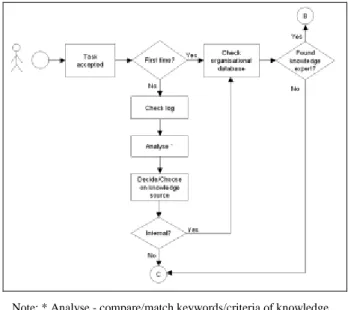
As shown in Figure 1, the most basic procedure handled by most knowledge workers is to identify knowledge sources. It is a norm or habit for a new-age knowledge worker to start by searching online, whether within the organisational network or randomly on the Internet. Based on the experience learnt, the knowledge worker may already have a pre-defined location to start looking for the expertise required. If previous experience does not exist, then the process will start from scratch.
From this scenario, an agent can be assigned to firstly identify a knowledge source. Relating to the previous experience, a log file or documentation of the previously ‘ventured’ and successfully found location may be referred to or checked first. This, of course, is totally depending on the similarity of the new task and the previous task. With this checking, if the previous experience is not found to exist in the log, then the agent ‘starts from scratch’ by roaming and searching within the existing network, i.e. organisational network followed by the Internet (WWW). If a record is found in the log, then the agent ‘analyses’ and ‘decides’ whether it is the right match, and proceeds with the location, again whether it is internal (organisational network) or external (the Internet).
Note: * Analyse - compare/match keywords/criteria of knowledge expert
Figure 1. Identify Knowledge Source.
From identifying the knowledge source (Figure 1), the agent proceeds to the next part of the task, which is roaming the Internet and merit the reputation point, as
shown in Figure 2. This is the significant part of the whole multi-agent reputation system framework, where the agent is put to test in ‘replicating’ a human’s behaviour of ‘assessing’ and ‘deciding’ on the knowledge quality, during the process of ‘learning’ the credibility of the knowledge expert’s expertise. An important note here to distinguish between this concept with other studies is that the credibility of the knowledge expertise is not based totally on the documents that the agent has found, but based on the ‘authorship’ depicted from the documents that the agent has found, and from that authorship, the knowledge expert or his/her profile is checked and analysed in terms of reputation and referral by others. This can be done via a reputation point system, derived from the positive (or negative) reviews connected to the knowledge expert and/or his/her published works, and from the appointed votes of ‘likes’ and/or reputation points given on his/her profile. The knowledge is considered as a ‘good match’ if the profile is recommended by others (i.e. reviewers or recommenders), and this entitles the ‘expert’ with reputation point.
Note: # Reputation point – merit points appointed for the knowledge expert (profile) based on each review and/or reference
by others
Figure 2.Roam the Internet and Merit Reputation Point.
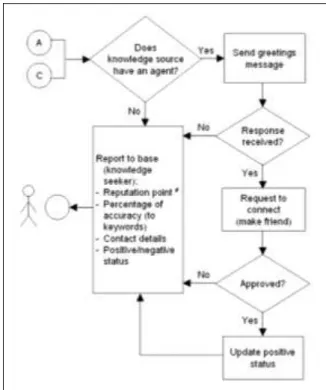
The search for knowledge expert does not end here, but continues to be evaluated in terms of the profile details, to know more about the ‘author’ before the agent can confirm that it has found the knowledge expert. Once the knowledge expert is ‘found’, the agent proceeds to the next important part of the task, which is initiating the connection (or communication) to the knowledge expert or knowledge source, as shown in Figure 3
The reason behind the need of this initiating connection process it due to the low response rate widely agreed upon by the interview respondents. If this multi-agent system can perform this part of the task, then the knowledge seeker can reduce the time wasted on trying to connect and waiting for a response before the real knowledge connection can be done. In initiating the connection process, knowledge seeker would usually send a request to the knowledge expert
for permission to proceed in asking further information on certain knowledge. If the response takes a long time to return, just to let him/her know that the expert does not want to be questioned, then it would be a waste. The task of the agent is not completed until some rate of response can be identified and reported back to the knowledge seeker. This is shown in Figure 3, where the list of items to report back is listed, after the agent checks whether there is an existing profile agent on the knowledge expert’s side.
Figure 3. Initiate connection to knowledge source.
If there is an agent on the expert’s profile, then the knowledge seeker’s agent can initiate communication in their own language, and the ‘behaviour’ of this agent is expected to be as ‘polite’ as possible, to ensure a higher possibility of agreement from the other side. There are three requests from agent to agent in this phase, starting from checking if there is an agent to communicate with, followed by a greeting, and lastly a request to connect (or make acquaintance). The responses to these requests are reported back to the knowledge seeker, for further offline follow up actions. Even with some negative responses, the report could still assist the human knowledge seeker to decide further whether to try and make connection on his/her own, or ignore the chance.
VI
DISCUSSIONS AND CONCLUSION
This paper proposes the deployment of software agents to tease out the possibility of realising the characteristics of software agents in ‘learning’, ‘assessing’, and ‘deciding’, with the explicitness of the process flow that may be required for the development of the multi-agent system. It is not without flaws, since the deployment is yet to be experimented and validated.
Among the gaps in this reputation point system framework that future studies may want to look at are the possibility of redundancy of reputation points, the agency of the knowledge experts’ profile, and the ascertaining of stop gate of looping. In terms of the redundancy of reputation points, another level of checking may be required by finding the match between the points to be given and the points already given on to the profile found. As for the agency of the knowledge experts’ profile, a further enhancement can be an additional task (to be performed by additional agent) of suggesting an auto-download of a profile agent to the knowledge experts, which a genuine knowledge-sharing believers may say ‘yes’ to. The last question is when will this looping of ‘identify-assess-connect’ end, and if there is any need to terminate the ‘roaming agent’ after the report reach certain stage – whether by using a time constraint, or a termination action to be initiated by the human knowledge seeker, or such.
Looking at the concept of knowledge management, an externalisation process is deemed important to be part of any knowledge management cycle, including human-agent knowledge management in the ‘invisible network’. Having said this, a multi-agent system can perform “the act of verifying/falsifying tacit knowledge in externalisation” (Virtanen, 2011), if the framework can be realised as planned. This paper has brought out the possibility of tapping the tacit knowledge embedded within the externalisation process, by suggesting a multi-agent system framework.
REFERENCES
Ahmed, M., Ahmad, M.S., & Mohd Yusoff, M.Z. (2009). A Collaborative Framework for Human-Agent Systems.
International Journal of Computer and Network Security, 1(2), 69-76.
Ali, G., Shaikh, N. A., & Shaikh, A. W. (2010). A Research Survey of Software Agents and Implementation Issues in Vulnerability Assessment and Social Profiling Models. Australian Journal of Basic and Applied Sciences, 4, 442-449.
Bradshaw, J.M., Carpenter, R., Cranfill, R., Jeffers, R., et al. (1997). Roles for Agent Technology in Knowledge Management: Examples from Applications in Aerospace and Medicine. AAAI Technical Report SS-97-01, 9-16.
Bohnstedt, D., Scholl, P., Rensing, C., & Steinmetz, R. (2009). Modeling Personal Knowledge Networks to Support Resource Based Learning. Proceedings of the I-KNOW'09, 309-316. Huber, F. (2011a). Contextualising the Role of Extra-Firm Personal
Networks as a Source of Work-Related Knowledge.
Proceedings of the Organisational Learning, Knowledge and Capabilities (OLKC) Conference.
Huber, F. (2011b). On the Socio-spatial Dynamics of Personal Knowledge Networks: Formation, Maintenance and Knowledge Interactions. Environment and Planning A. Ismail, S., & Ahmad, M.S. (2011a). Emergence of Social
Intelligence in Social Network: A Quantitative Analysis for Agent-mediated PKM Processes. Proceedings of the ICIMu 2011 Conference, UNITEN: Malaysia.
Ismail, S., & Ahmad, M.S. (2011b). “Modelling Social Intelligence to Achieve Personal Goals in Agent-mediated Personal Knowledge Management. Proceedings of the International Workshop on Semantic Agents 2011 (AIW 2011), MIMOS/UNITEN: Malaysia, 11-17.
Jennings, N. R., Faratin, P., Lomuscio, A. R., Parsons, S., Sierra, C., & Wooldridge, M. (2000). Automated Negotiation: Prospects,
Methods and Challenges. Proceedings of the International Journal of Group Decision and Negotiation, 1-30.
Nwana, H.S. (1996). Software Agents: An Overview. Knowledge Engineering Review, 11(3), 205-244.
Paprzycki, M., & Abraham, A. (2003). Agent Systems Today: Methodological Considerations. Proceedings of the International Conference on Management of e-Commerce and e-Government, 1-7.
Virtanen, I. (2011). Externalisation of Tacit Knowledge Implies a Simplified Theory of Cognition. Journal of Knowledge Management Practice, 12(3).