Learning Deep Features for Discriminative Localization
Bolei Zhou, Aditya Khosla, Agata Lapedriza, Aude Oliva, Antonio Torralba
Computer Science and Artificial Intelligence Laboratory, MIT
{
bzhou,khosla,agata,oliva,torralba
}
@csail.mit.edu
Abstract
In this work, we revisit the global average pooling layer proposed in [13], and shed light on how it explicitly enables the convolutional neural network to have remarkable local-ization ability despite being trained on image-level labels. While this technique was previously proposed as a means for regularizing training, we find that it actually builds a generic localizable deep representation that can be applied to a variety of tasks. Despite the apparent simplicity of global average pooling, we are able to achieve 37.1% top-5 error for object localization on ILSVRC 2014, which is re-markably close to the 34.2% top-5 error achieved by a fully supervised CNN approach. We demonstrate that our net-work is able to localize the discriminative image regions on a variety of tasks despite not being trained for them.
1. Introduction
Recent work by Zhouet al[33] has shown that the
con-volutional units of various layers of concon-volutional neural networks (CNNs) actually behave as object detectors de-spite no supervision on the location of the object was pro-vided. Despite having this remarkable ability to localize objects in the convolutional layers, this ability is lost when fully-connected layers are used for classification. Recently some popular fully-convolutional neural networks such as the Network in Network (NIN) [13] and GoogLeNet [24] have been proposed to avoid the use of fully-connected lay-ers to minimize the number of parametlay-ers while maintain-ing high performance.
In order to achieve this, [13] usesglobal average
pool-ingwhich acts as a structural regularizer, preventing
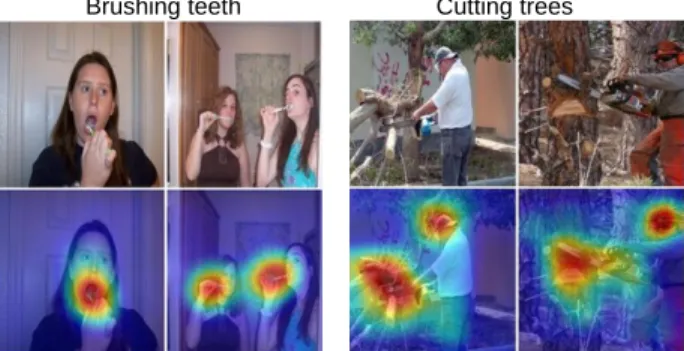
over-fitting during training. In our experiments, we found that the advantages of this global average pooling layer extend beyond simply acting as a regularizer - In fact, with a little tweaking, the network can retain its remarkable localization ability until the final layer. This tweaking allows identifying easily the discriminative image regions in a single forward-pass for a wide variety of tasks, even those that the network was not originally trained for. As shown in Figure 1(a), a
Brushing teeth Cutting trees
Figure 1. A simple modification of the global average pool-ing layer combined with our class activation mapppool-ing (CAM) technique allows the classification-trained CNN to both classify the image and localize class-specific image regions in a single
forward-pass e.g., the toothbrush forbrushing teethand the
chain-saw forcutting trees.
CNN trained on object categorization is successfully able to localize the discriminative regions for action classification as the objects that the humans are interacting with rather than the humans themselves.
Despite the apparent simplicity of our approach, for the weakly supervised object localization on ILSVRC bench-mark [20], our best network achieves 37.1% top-5 test er-ror, which is rather close to the 34.2% top-5 test error achieved by fully supervised AlexNet [10]. Furthermore, we demonstrate that the localizability of the deep features in our approach can be easily transferred to other recognition datasets for generic classification, localization, and concept
discovery.1.
1.1. Related Work
Convolutional Neural Networks (CNNs) have led to im-pressive performance on a variety of visual recognition tasks [10, 34, 8]. Recent work has shown that despite being trained on image-level labels, CNNs have the remarkable ability to localize objects [1, 16, 2, 15]. In this work, we show that, using the right architecture, we can generalize this ability beyond just localizing objects, to start identi-fying exactly which regions of an image are being used for
1Our models are available at: http://cnnlocalization.csail.mit.edu
discrimination. Here, we discuss the two lines of work most related to this paper: weakly-supervised object localization and visualizing the internal representation of CNNs.
Weakly-supervised object localization: There have
been a number of recent works exploring weakly-supervised object localization using CNNs [1, 16, 2, 15].
Bergamoet al[1] propose a technique for self-taught object
localization involving masking out image regions to iden-tify the regions causing the maximal activations in order to
localize objects. Cinbiset al[2] combine multiple-instance
learning with CNN features to localize objects. Oquab et
al[15] propose a method for transferring mid-level image
representations and show that some object localization can be achieved by evaluating the output of CNNs on multi-ple overlapping patches. However, the authors do not ac-tually evaluate the localization ability. On the other hand, while these approaches yield promising results, they are not trained end-to-end and require multiple forward passes of a network to localize objects, making them difficult to scale to real-world datasets. Our approach is trained end-to-end and can localize objects in a single forward pass.
The most similar approach to ours is the work based on
global max pooling by Oquabet al[16]. Instead of global
averagepooling, they apply globalmaxpooling to localize a point on objects. However, their localization is limited to a point lying in the boundary of the object rather than deter-mining the full extent of the object. We believe that while the maxand averagefunctions are rather similar, the use of average pooling encourages the network to identify the complete extent of the object. The basic intuition behind this is that the loss for average pooling benefits when the
network identifiesalldiscriminative regions of an object as
compared to max pooling. This is explained in greater de-tail and verified experimentally in Sec. 3.2. Furthermore, unlike [16], we demonstrate that this localization ability is generic and can be observed even for problems that the net-work was not trained on.
We useclass activation mapto refer to the weighted
acti-vation maps generated for each image, as described in Sec-tion 2. We would like to emphasize that while global aver-age pooling is not a novel technique that we propose here, the observation that it can be applied for accurate discrimi-native localization is, to the best of our knowledge, unique to our work. We believe that the simplicity of this tech-nique makes it portable and can be applied to a variety of computer vision tasks for fast and accurate localization.
Visualizing CNNs: There has been a number of recent
works [29, 14, 4, 33] that visualize the internal represen-tation learned by CNNs in an attempt to better understand
their properties. Zeileret al [29] use deconvolutional
net-works to visualize what patterns activate each unit. Zhouet
al.[33] show that CNNs learn object detectors while being
trained to recognize scenes, and demonstrate that the same
network can perform both scene recognition and object lo-calization in a single forward-pass. Both of these works only analyze the convolutional layers, ignoring the fully-connected thereby painting an incomplete picture of the full story. By removing the fully-connected layers and retain-ing most of the performance, we are able to understand our network from the beginning to the end.
Mahendranet al[14] and Dosovitskiyet al[4] analyze
the visual encoding of CNNs by inverting deep features at different layers. While these approaches can invert the fully-connected layers, they only show what information is being preserved in the deep features without highlight-ing the relative importance of this information. Unlike [14] and [4], our approach can highlight exactly which regions of an image are important for discrimination. Overall, our approach provides another glimpse into the soul of CNNs.
2. Class Activation Mapping
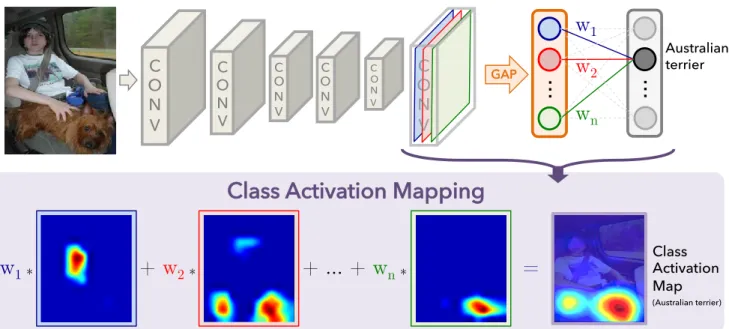
In this section, we describe the procedure for generating
class activation maps(CAM) using global average pooling (GAP) in CNNs. A class activation map for a particular cat-egory indicates the discriminative image regions used by the CNN to identify that category (e.g., Fig. 3). The procedure for generating these maps is illustrated in Fig. 2.
We use a network architecture similar to Network in Net-work [13] and GoogLeNet [24] - the netNet-work largely con-sists of convolutional layers, and just before the final out-put layer (softmax in the case of categorization), we per-form global average pooling on the convolutional feature maps and use those as features for a fully-connected layer that produces the desired output (categorical or otherwise). Given this simple connectivity structure, we can identify the importance of the image regions by projecting back the weights of the output layer on to the convolutional feature maps, a technique we call class activation mapping.
As illustrated in Fig. 2, global average pooling outputs the spatial average of the feature map of each unit at the last convolutional layer. A weighted sum of these values is used to generate the final output. Similarly, we compute a weighted sum of the feature maps of the last convolutional layer to obtain our class activation maps. We describe this more formally below for the case of softmax. The same technique can be applied to regression and other losses.
For a given image, letfk(x, y)represent the activation
of unitkin the last convolutional layer at spatial location
(x, y). Then, for unit k, the result of performing global
average pooling, Fk is P
x,yfk(x, y). Thus, for a given
classc, the input to the softmax,Sc, isPkw
c
kFkwherewkc
is the weight corresponding to classcfor unitk. Essentially,
wc
k indicates theimportanceofFk for classc. Finally the
output of the softmax for classc,Pcis given byPexp(Sc)
cexp(Sc).
Australian terrier
...
C
O
N
V
C O N V C O N V C O N V C O N V GAP...
w
1w
2w
nw
1 *+
w
2 *+ … +
w
n* ClassActivation Map (Australian terrier)=
C
O
N
V
Class Activation Mapping
Figure 2. Class Activation Mapping: the predicted class score is mapped back to the previous convolutional layer to generate the class activation maps (CAMs). The CAM highlights the class-specific discriminative regions.
bias of the softmax to0as it has little to no impact on the
classification performance.
By pluggingFk = Px,yfk(x, y)into the class score,
Sc, we obtain Sc= X k wckX x,y fk(x, y) =X x,y X k wkcfk(x, y). (1)
We defineMcas the class activation map for classc, where
each spatial element is given by
Mc(x, y) =
X
k
wckfk(x, y). (2)
Thus, Sc = Px,yMc(x, y), and henceMc(x, y)directly
indicates the importance of the activation at spatial grid
(x, y)leading to the classification of an image to classc. Intuitively, based on prior works [33, 29], we expect each unit to be activated by some visual pattern within its
recep-tive field. Thusfk is the map of the presence of this visual
pattern. The class activation map is simply a weighted lin-ear sum of the presence of these visual patterns at different spatial locations. By simply upsampling the class activa-tion map to the size of the input image, we can identify the image regions most relevant to the particular category.
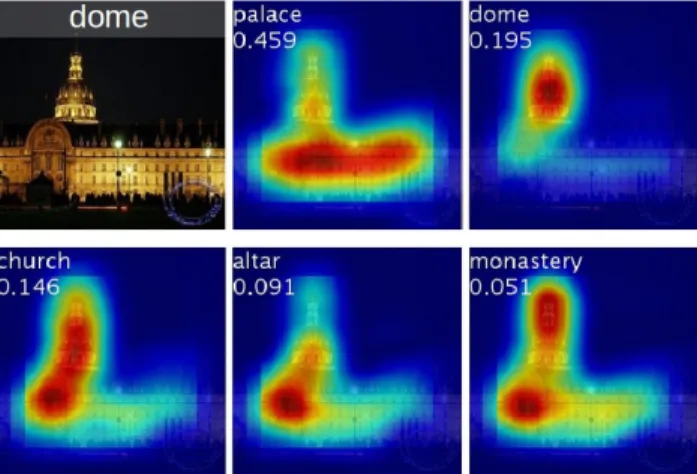
In Fig. 3, we show some examples of the CAMs output using the above approach. We can see that the discrimi-native regions of the images for various classes are high-lighted. In Fig. 4 we highlight the differences in the CAMs
for a single image when using different classescto
gener-ate the maps. We observe that the discriminative regions
Figure 3. The CAMs of four classes from ILSVRC [20]. The maps highlight the discriminative image regions used for image
classifi-cation e.g., the head of the animal forbriardandhen, the plates in
barbell, and the bell inbell cote.
for different categories are different even for a given im-age. This suggests that our approach works as expected. We demonstrate this quantitatively in the sections ahead.
Global average pooling (GAP) vs global max
pool-ing (GMP):Given the prior work [16] on using GMP for
weakly supervised object localization, we believe it is im-portant to highlight the intuitive difference between GAP and GMP. We believe that GAP loss encourages the net-work to identify the extent of the object as compared to GMP which encourages it to identify just one discrimina-tive part. This is because, when doing the average of a map,
the value can be maximized by finding all discriminative
dome
chain saw
Figure 4. Examples of the CAMs generated from the top 5 pre-dicted categories for the given image with ground-truth as dome. The predicted class and its score are shown above each class ac-tivation map. We observe that the highlighted regions vary across
predicted classes e.g.,domeactivates the upper round part while
palaceactivates the lower flat part of the compound.
the particular map. On the other hand, for GMP, low scores for all image regions except the most discriminative one do not impact the score as you just perform a max. We ver-ify this experimentally on ILSVRC dataset in Sec. 3: while GMP achieves similar classification performance as GAP, GAP outperforms GMP for localization.
3. Weakly-supervised Object Localization
In this section, we evaluate the localization ability of CAM when trained on the ILSVRC 2014 benchmark dataset [20]. We first describe the experimental setup and the various CNNs used in Sec. 3.1. Then, in Sec. 3.2 we ver-ify that our technique does not adversely impact the classi-fication performance when learning to localize and provide detailed results on weakly-supervised object localization.
3.1. Setup
For our experiments we evaluate the effect of using CAM on the following popular CNNs: AlexNet [10], VG-Gnet [23], and GoogLeNet [24]. In general, for each of these networks we remove the fully-connected layers be-fore the final output and replace them with GAP followed by a fully-connected softmax layer.
We found that the localization ability of the networks im-proved when the last convolutional layer before GAP had a
higher spatial resolution, which we term themapping
reso-lution. In order to do this, we removed several convolutional layers from some of the networks. Specifically, we made the following modifications: For AlexNet, we removed the
layers after conv5(i.e., pool5 toprob) resulting in a
mapping resolution of13×13. For VGGnet, we removed
the layers after conv5-3(i.e., pool5toprob),
result-ing in a mappresult-ing resolution of14×14. For GoogLeNet,
we removed the layers afterinception4e(i.e.,pool4
to prob), resulting in a mapping resolution of 14×14.
To each of the above networks, we added a convolutional
layer of size3×3, stride1, pad1with 1024 units, followed
by a GAP layer and a softmax layer. Each of these
net-works were then fine-tuned2 on the 1.3M training images
of ILSVRC [20] for 1000-way object classification result-ing in our final networks AlexNet-GAP, VGGnet-GAP and GoogLeNet-GAP respectively.
For classification, we compare our approach against the original AlexNet [10], VGGnet [23], and GoogLeNet [24], and also provide results for Network in Network (NIN) [13]. For localization, we compare against the
orig-inal GoogLeNet3, NIN and using backpropagation [22]
instead of CAMs. Further, to compare average pooling
against max pooling, we also provide results for GoogLeNet trained using global max pooling (GoogLeNet-GMP).
We use the same error metrics (top-1, top-5) as ILSVRC for both classification and localization to evaluate our net-works. For classification, we evaluate on the ILSVRC vali-dation set, and for localization we evaluate on both the val-idation and test sets.
3.2. Results
We first report results on object classification to demon-strate that our approach does not significantly hurt classi-fication performance. Then we demonstrate that our ap-proach is effective at weakly-supervised object localization.
Classification:Tbl. 1 summarizes the classification
per-formance of both the original and our GAP networks. We find that in most cases there is a small performance drop
of 1−2% when removing the additional layers from the
various networks. We observe that AlexNet is the most affected by the removal of the fully-connected layers. To compensate, we add two convolutional layers just before GAP resulting in the AlexNet*-GAP network. We find that AlexNet*-GAP performs comparably to AlexNet. Thus, overall we find that the classification performance is largely preserved for our GAP networks. Further, we observe that GoogLeNet-GAP and GoogLeNet-GMP have similar per-formance on classification, as expected. Note that it is im-portant for the networks to perform well on classification in order to achieve a high performance on localization as it involves identifying both the object category and the bound-ing box location accurately.
Localization:In order to perform localization, we need
to generate a bounding box and its associated object cate-gory. To generate a bounding box from the CAMs, we use a simple thresholding technique to segment the heatmap. We first segment the regions of which the value is above 20%
2Training from scratch also resulted in similar performances. 3This has a lower mapping resolution than GoogLeNet-GAP.
Table 1. Classification error on the ILSVRC validation set.
Networks top-1 val. error top-5 val. error
VGGnet-GAP 33.4 12.2 GoogLeNet-GAP 35.0 13.2 AlexNet∗-GAP 44.9 20.9 AlexNet-GAP 51.1 26.3 GoogLeNet 31.9 11.3 VGGnet 31.2 11.4 AlexNet 42.6 19.5 NIN 41.9 19.6 GoogLeNet-GMP 35.6 13.9
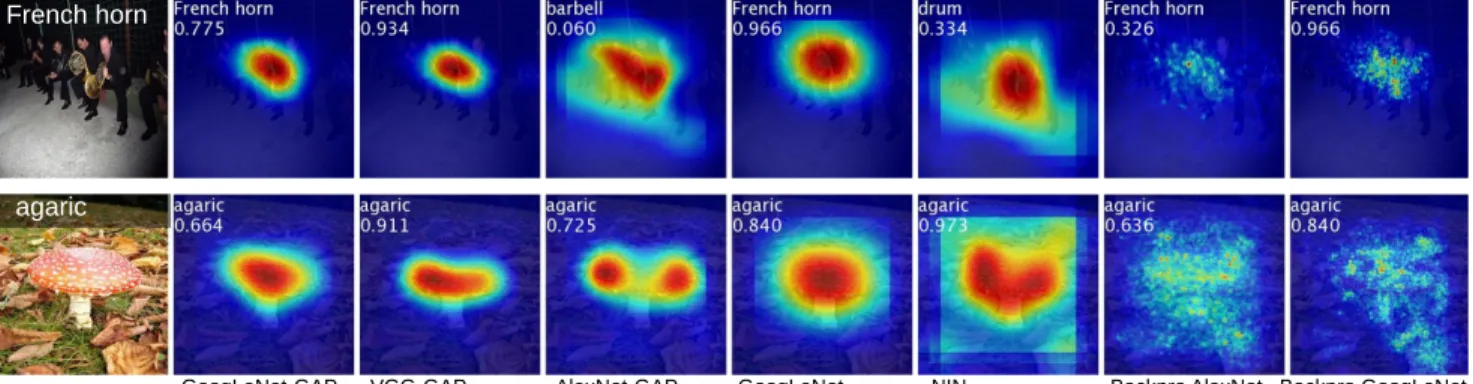
of the max value of the CAM. Then we take the bounding box that covers the largest connected component in the seg-mentation map. We do this for each of the top-5 predicted classes for the top-5 localization evaluation metric. Fig. 6(a) shows some example bounding boxes generated using this technique. The localization performance on the ILSVRC validation set is shown in Tbl. 2, and example outputs in Fig. 5.
We observe that our GAP networks outperform all the baseline approaches with GoogLeNet-GAP achieving the
lowest localization error of43%on top-5. This is
remark-able given that this network was not trained on a single annotated bounding box. We observe that our CAM proach significantly outperforms the backpropagation ap-proach of [22] (see Fig. 6(b) for a comparison of the out-puts). Further, we observe that GoogLeNet-GAP signifi-cantly outperforms GoogLeNet on localization, despite this being reversed for classification. We believe that the low
mapping resolution of GoogLeNet (7×7) prevents it from
obtaining accurate localizations. Last, we observe that
GoogLeNet-GAP outperforms GoogLeNet-GMP by a rea-sonable margin illustrating the importance of average pool-ing over max poolpool-ing for identifypool-ing the extent of objects.
To further compare our approach with the existing weakly-supervised [22] and fully-supervised [24, 21, 24] CNN methods, we evaluate the performance of GoogLeNet-GAP on the ILSVRC test set. We follow a slightly differ-ent bounding box selection strategy here: we select two bounding boxes (one tight and one loose) from the class activation map of the top 1st and 2nd predicted classes and one loose bounding boxes from the top 3rd predicted class. We found that this heuristic was helpful to improve performances on the validation set. The performances are summarized in Tbl. 3. GoogLeNet-GAP with heuristics achieves a top-5 error rate of 37.1% in a weakly-supervised setting, which is surprisingly close to the top-5 error rate of AlexNet (34.2%) in a fully-supervised setting. While impressive, we still have a long way to go when com-paring the fully-supervised networks with the same archi-tecture (i.e., weakly-supervised GoogLeNet-GAP vs fully-supervised GoogLeNet) for the localization.
Table 2. Localization error on the ILSVRC validation set.
Back-proprefers to using [22] for localization instead of CAM.
Method top-1 val.error top-5 val. error GoogLeNet-GAP 56.40 43.00 VGGnet-GAP 57.20 45.14 GoogLeNet 60.09 49.34 AlexNet∗-GAP 63.75 49.53 AlexNet-GAP 67.19 52.16 NIN 65.47 54.19 Backprop on GoogLeNet 61.31 50.55 Backprop on VGGnet 61.12 51.46 Backprop on AlexNet 65.17 52.64 GoogLeNet-GMP 57.78 45.26
Table 3. Localization error on the ILSVRC test set for various weakly- and fully- supervised methods.
Method supervision top-5 test error GoogLeNet-GAP (heuristics) weakly 37.1
GoogLeNet-GAP weakly 42.9
Backprop [22] weakly 46.4
GoogLeNet [24] full 26.7
OverFeat [21] full 29.9
AlexNet [24] full 34.2
4. Deep Features for Generic Localization
The responses from the higher-level layers of CNN (e.g.,
fc6,fc7from AlexNet) have been shown to be very
effec-tive generic features with state-of-the-art performance on a variety of image datasets [3, 19, 34]. Here, we show that the features learned by our GAP CNNs also perform well as generic features, and as bonus, identify the discrimina-tive image regions used for categorization, despite not hav-ing behav-ing trained for those particular tasks. To obtain the weights similar to the original softmax layer, we simply train a linear SVM [5] on the output of the GAP layer.
First, we compare the performance of our approach and some baselines on the following scene and ob-ject classification benchmarks: SUN397 [27], MIT In-door67 [18], Scene15 [11], SUN Attribute [17], Cal-tech101 [6], Caltech256 [9], Stanford Action40 [28], and UIUC Event8 [12]. The experimental setup is the same as in [34]. In Tbl. 5, we compare the performance of features
from our best network, GoogLeNet-GAP, with thefc7
fea-tures from AlexNet, andave poolfrom GoogLeNet.
As expected, GoogLeNet-GAP and GoogLeNet
sig-nificantly outperform AlexNet. Also, we observe that
GoogLeNet-GAP and GoogLeNet perform similarly de-spite the former having fewer convolutional layers. Overall, we find that GoogLeNet-GAP features are competitive with the state-of-the-art as generic visual features.
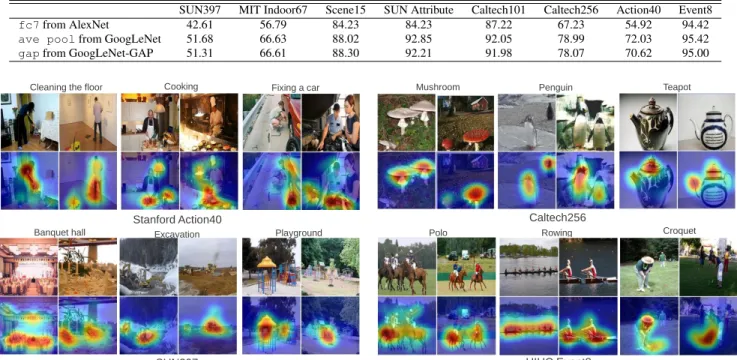
More importantly, we want to explore whether the lo-calization maps generated using our CAM technique with GoogLeNet-GAP are informative even in this scenario. Fig. 8 shows some example maps for various datasets. We observe that the most discriminative regions tend to be high-lighted across all datasets. Overall, our approach is effective
GoogLeNet-GAP VGG-GAP AlexNet-GAP GoogLeNet NIN Backpro AlexNet Backpro GoogLeNet
agaric French horn
Figure 5. Class activation maps from CNN-GAPs and the class-specific saliency map from the backpropagation methods.
b) a)
Figure 6. a) Examples of localization from GoogleNet-GAP. b) Comparison of the localization from GooleNet-GAP (upper two) and the backpropagation using AlexNet (lower two). The ground-truth boxes are in green and the predicted bounding boxes from the class activation map are in red.
for generating localizable deep features for generic tasks. In Sec. 4.1, we explore fine-grained recognition of birds and demonstrate how we evaluate the generic localiza-tion ability and use it to further improve performance. In Sec. 4.2 we demonstrate how GoogLeNet-GAP can be used to identify generic visual patterns from images.
4.1. Fine-grained Recognition
In this section, we apply our generic localizable deep features to identifying 200 bird species in the CUB-200-2011 [26] dataset. The dataset contains 11,788 images, with 5,994 images for training and 5,794 for test. We choose this dataset as it also contains bounding box annotations allow-ing us to evaluate our localization ability. Tbl. 4 summarizes the results.
We find that GoogLeNet-GAP performs comparably to existing approaches, achieving an accuracy of 63.0% when using the full image without any bounding box annotations for both train and test. When using bounding box anno-tations, this accuracy increases to 70.5%. Now, given the localization ability of our network, we can use a similar ap-proach as Sec. 3.2 (i.e., thresholding) to first identify bird bounding boxes in both the train and test sets. We then use GoogLeNet-GAP to extract features again from the crops inside the bounding box, for training and testing. We find that this improves the performance considerably to 67.8%.
Table 4. Fine-grained classification performance on CUB200 dataset. GoogLeNet-GAP can successfully localize important im-age crops, boosting classification performance.
Methods Train/Test Anno. Accuracy GoogLeNet-GAP on full image n/a 63.0% GoogLeNet-GAP on crop n/a 67.8% GoogLeNet-GAP on BBox BBox 70.5%
Alignments [7] n/a 53.6%
Alignments [7] BBox 67.0%
DPD [31] BBox+Parts 51.0%
DeCAF+DPD [3] BBox+Parts 65.0% PANDA R-CNN [30] BBox+Parts 76.4%
This localization ability is particularly important for fine-grained recognition as the distinctions between the cate-gories are subtle and having a more focused image crop allows for better discrimination.
Further, we find that GoogLeNet-GAP is able to accu-rately localize the bird in 41.0% of the images under the 0.5 intersection over union (IoU) criterion, as compared to a chance performance of 5.5%. We visualize some exam-ples in Fig. 7. This further validates the localization ability of our approach.
4.2. Pattern Discovery
In this section, we explore whether our technique can identify common elements or patterns in images beyond
Table 5. Classification accuracy on representative scene and object datasets for different deep features.
SUN397 MIT Indoor67 Scene15 SUN Attribute Caltech101 Caltech256 Action40 Event8 fc7from AlexNet 42.61 56.79 84.23 84.23 87.22 67.23 54.92 94.42 ave poolfrom GoogLeNet 51.68 66.63 88.02 92.85 92.05 78.99 72.03 95.42 gapfrom GoogLeNet-GAP 51.31 66.61 88.30 92.21 91.98 78.07 70.62 95.00
Fixing a car
Cleaning the floor Cooking Mushroom Penguin Teapot
Stanford Action40 Caltech256
Rowing Polo UIUC Event8 Croquet Playground SUN397 Excavation Banquet hall
Figure 8. Generic discriminative localization using our GoogLeNet-GAP deep features (which have been trained to recognize objects). We show 2 images each from 3 classes for 4 datasets, and their class activation maps below them. We observe that the discriminative regions
of the images are often highlighted e.g., in Stanford Action40, the mop is localized forcleaning the floor, while forcookingthe pan and
bowl are localized and similar observations can be made in other datasets. This demonstrates the generic localization ability of our deep features.
White Pelican
Orchard Oriole Sage Thrasher
Scissor tailed Flycatcher
Figure 7. CAMs and the inferred bounding boxes (in red) for se-lected images from four bird categories in CUB200. In Sec. 4.1 we quantitatively evaluate the quality of the bounding boxes (41.0% accuracy for 0.5 IoU). We find that extracting GoogLeNet-GAP features in these CAM bounding boxes and re-training the SVM improves bird classification accuracy by about 5% (Tbl. 4).
objects, such as text or high-level concepts. Given a set of images containing a common concept, we want to iden-tify which regions our network recognizes as being impor-tant and if this corresponds to the input pattern. We
fol-low a similar approach as before: we train a linear SVM on the GAP layer of the GoogLeNet-GAP network and apply the CAM technique to identify important regions. We con-ducted three pattern discovery experiments using our deep features. The results are summarized below. Note that in
this case, we do not have train and test splits−we just use
our CNN for visual pattern discovery.
Discovering informative objects in the scenes: We
take 10 scene categories from the SUN dataset [27]
contain-ing at least200fully annotated images, resulting in a total
of 4675 fully annotated images. We train a one-vs-all linear SVM for each scene category and compute the CAMs using the weights of the linear SVM. In Fig. 9 we plot the CAM for the predicted scene category and list the top 6 objects that most frequently overlap with the high CAM activation regions for two scene categories. We observe that the high activation regions frequently correspond to objects indica-tive of the particular scene category.
Concept localization in weakly labeled images:
Us-ing the hard-negative minUs-ing algorithm from [32], we learn concept detectors and apply our CAM technique to local-ize concepts in the image. To train a concept detector for a short phrase, the positive set consists of images that con-tain the short phrase in their text caption, and the negative set is composed of randomly selected images without any relevant words in their text caption. In Fig. 10, we visualize
Informative object: sink:0.84 faucet:0.80 countertop:0.80 toilet:0.72 bathtub:0.70 towel:0.54 Informative object: table:0.96 chair:0.85 chandelier:0.80 plate:0.73 vase:0.69 flowers:0.63
Dining room Bathroom
Frequent object: wall:0.99 chair:0.98 floor:0.98 table:0.98 ceiling:0.75 window:73 Frequent object: wall: 1 floor:0.85 sink: 0.77 faucet:0.74 mirror:0.62 bathtub:0.56
Figure 9. Informative objects for two scene categories. For the din-ing room and bathroom categories, we show examples of original
images (top), and list of the6most frequent objects in that scene
category with the corresponding frequency of appearance. At the bottom: the CAMs and a list of the 6 objects that most frequently overlap with the high activation regions.
mirror in lake view out of window
Figure 10. Informative regions for the concept learned from weakly labeled images. Despite being fairly abstract, the concepts are adequately localized by our GoogLeNet-GAP network.
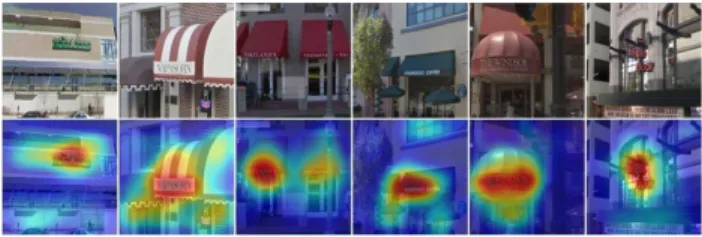
Figure 11. Learning a weakly supervised text detector. The text is accurately detected on the image even though our network is not trained with text or any bounding box annotations.
the top ranked images and CAMs for two concept detec-tors. Note that CAM localizes the informative regions for the concepts, even though the phrases are much more ab-stract than typical object names.
Weakly supervised text detector:We train a weakly
su-pervised text detector using 350 Google StreetView images containing text from the SVT dataset [25] as the positive set and randomly sampled images from outdoor scene images in the SUN dataset [27] as the negative set. As shown in Fig. 11, our approach highlights the text accurately without using bounding box annotations.
Interpreting visual question answering: We use our
approach and localizable deep feature in the baseline pro-posed in [35] for visual question answering. It has overall accuracy 55.89% on the test-standard in the Open-Ended track. As shown in Fig. 12, our approach highlights the im-age regions relevant to the predicted answers.
What is the color of the horse?
Prediction: brown What are they doing?Prediction: texting
What is the sport? Prediction: skateboarding
Where are the cows? Prediction: on the grass
Figure 12. Examples of highlighted image regions for the pre-dicted answer class in the visual question answering.
5. Visualizing Class-Specific Units
Zhouet al[33] have shown that the convolutional units of various layers of CNNs act as visual concept detec-tors, identifying low-level concepts like textures or mate-rials, to high-level concepts like objects or scenes. Deeper into the network, the units become increasingly discrimi-native. However, given the fully-connected layers in many networks, it can be difficult to identify the importance of different units for identifying different categories. Here, us-ing GAP and the ranked softmax weight, we can directly visualize the units that are most discriminative for a given
class. Here we call them theclass-specific unitsof a CNN.
Fig. 13 shows the class-specific units for AlexNet∗-GAP
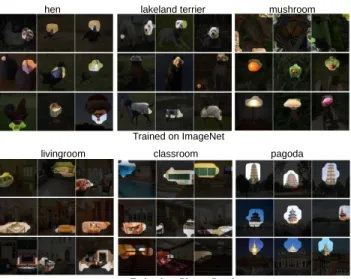
trained on ILSVRC dataset for object recognition (top) and Places Database for scene recognition (bottom). We follow a similar procedure as [33] for estimating the receptive field and segmenting the top activation images of each unit in the final convolutional layer. Then we simply use the softmax weights to rank the units for a given class. From the figure we can identify the parts of the object that are most dis-criminative for classification and exactly which units detect these parts. For example, the units detecting dog face and
body fur are important tolakeland terrier; the units
detect-ing sofa, table and fireplace are important to theliving room.
Thus we could infer that the CNN actually learns a bag of words, where each word is a discriminative class-specific unit. A combination of these class-specific units guides the CNN in classifying each image.
6. Conclusion
In this work we propose a general technique called Class Activation Mapping (CAM) for CNNs with global average pooling. This enables classification-trained CNNs to learn to perform object localization, without using any bounding box annotations. Class activation maps allow us to visualize the predicted class scores on any given image, highlighting the discriminative object parts detected by the CNN. We evaluate our approach on weakly supervised object local-ization on the ILSVRC benchmark, demonstrating that our global average pooling CNNs can perform accurate object
pagoda classroom
livingroom
Trained on Places Database Trained on ImageNet
hen lakeland terrier mushroom
Figure 13. Visualization of the class-specific units for AlexNet*-GAP trained on ImageNet (top) and Places (bottom) respectively. The top 3 units for three selected classes are shown for each dataset. Each row shows the most confident images segmented by the receptive field of that unit. For example, units detecting blackboard, chairs, and tables are important to the classification of
classroomfor the network trained for scene recognition.
localization. Furthermore we demonstrate that the CAM lo-calization technique generalizes to other visual recognition tasks i.e., our technique produces generic localizable deep features that can aid other researchers in understanding the basis of discrimination used by CNNs for their tasks.
References
[1] A. Bergamo, L. Bazzani, D. Anguelov, and L. Torresani.
Self-taught object localization with deep networks. arXiv
preprint arXiv:1409.3964, 2014.
[2] R. G. Cinbis, J. Verbeek, and C. Schmid. Weakly supervised object localization with multi-fold multiple instance learn-ing. IEEE Trans. on Pattern Analysis and Machine Intelli-gence, 2015.
[3] J. Donahue, Y. Jia, O. Vinyals, J. Hoffman, N. Zhang, E. Tzeng, and T. Darrell. Decaf: A deep convolutional
ac-tivation feature for generic visual recognition. International
Conference on Machine Learning, 2014.
[4] A. Dosovitskiy and T. Brox. Inverting convolutional
networks with convolutional networks. arXiv preprint
arXiv:1506.02753, 2015.
[5] R.-E. Fan, K.-W. Chang, C.-J. Hsieh, X.-R. Wang, and C.-J.
Lin. Liblinear: A library for large linear classification. The
Journal of Machine Learning Research, 2008.
[6] L. Fei-Fei, R. Fergus, and P. Perona. Learning generative visual models from few training examples: An incremental
bayesian approach tested on 101 object categories.Computer
Vision and Image Understanding, 2007.
[7] E. Gavves, B. Fernando, C. G. Snoek, A. W. Smeulders, and T. Tuytelaars. Local alignments for fine-grained
categoriza-tion.Int’l Journal of Computer Vision, 2014.
[8] R. Girshick, J. Donahue, T. Darrell, and J. Malik. Rich fea-ture hierarchies for accurate object detection and semantic
segmentation.Proc. CVPR, 2014.
[9] G. Griffin, A. Holub, and P. Perona. Caltech-256 object cat-egory dataset. 2007.
[10] A. Krizhevsky, I. Sutskever, and G. E. Hinton. Imagenet
classification with deep convolutional neural networks. In
Advances in Neural Information Processing Systems, 2012.
[11] S. Lazebnik, C. Schmid, and J. Ponce. Beyond bags of
features: Spatial pyramid matching for recognizing natural
scene categories.Proc. CVPR, 2006.
[12] L.-J. Li and L. Fei-Fei. What, where and who? classifying
events by scene and object recognition.Proc. ICCV, 2007.
[13] M. Lin, Q. Chen, and S. Yan. Network in network.
Interna-tional Conference on Learning Representations, 2014. [14] A. Mahendran and A. Vedaldi. Understanding deep image
representations by inverting them.Proc. CVPR, 2015.
[15] M. Oquab, L. Bottou, I. Laptev, and J. Sivic. Learning and transferring mid-level image representations using
convolu-tional neural networks.Proc. CVPR, 2014.
[16] M. Oquab, L. Bottou, I. Laptev, and J. Sivic. Is object local-ization for free? weakly-supervised learning with
convolu-tional neural networks.Proc. CVPR, 2015.
[17] G. Patterson and J. Hays. Sun attribute database:
Discov-ering, annotating, and recognizing scene attributes. Proc.
CVPR, 2012.
[18] A. Quattoni and A. Torralba. Recognizing indoor scenes.
Proc. CVPR, 2009.
[19] A. S. Razavian, H. Azizpour, J. Sullivan, and S. Carlsson. Cnn features off-the-shelf: an astounding baseline for
recog-nition.arXiv preprint arXiv:1403.6382, 2014.
[20] O. Russakovsky, J. Deng, H. Su, J. Krause, S. Satheesh, S. Ma, Z. Huang, A. Karpathy, A. Khosla, M. Bernstein, A. C. Berg, and L. Fei-Fei. Imagenet large scale visual
recog-nition challenge. InInt’l Journal of Computer Vision, 2015.
[21] P. Sermanet, D. Eigen, X. Zhang, M. Mathieu, R. Fergus, and Y. LeCun. Overfeat: Integrated recognition, localization
and detection using convolutional networks. arXiv preprint
arXiv:1312.6229, 2013.
[22] K. Simonyan, A. Vedaldi, and A. Zisserman. Deep
in-side convolutional networks: Visualising image
classifica-tion models and saliency maps.International Conference on
Learning Representations Workshop, 2014.
[23] K. Simonyan and A. Zisserman. Very deep convolutional
networks for large-scale image recognition. International
Conference on Learning Representations, 2015.
[24] C. Szegedy, W. Liu, Y. Jia, P. Sermanet, S. Reed, D. Anguelov, D. Erhan, V. Vanhoucke, and A.
Rabi-novich. Going deeper with convolutions. arXiv preprint
arXiv:1409.4842, 2014.
[25] K. Wang, B. Babenko, and S. Belongie. End-to-end scene
text recognition.Proc. ICCV, 2011.
[26] P. Welinder, S. Branson, T. Mita, C. Wah, F. Schroff, S. Be-longie, and P. Perona. Caltech-UCSD Birds 200. Technical report, California Institute of Technology, 2010.
[27] J. Xiao, J. Hays, K. A. Ehinger, A. Oliva, and A. Torralba. Sun database: Large-scale scene recognition from abbey to zoo.Proc. CVPR, 2010.
[28] B. Yao, X. Jiang, A. Khosla, A. L. Lin, L. Guibas, and L. Fei-Fei. Human action recognition by learning bases of action
attributes and parts.Proc. ICCV, 2011.
[29] M. D. Zeiler and R. Fergus. Visualizing and understanding
convolutional networks.Proc. ECCV, 2014.
[30] N. Zhang, J. Donahue, R. Girshick, and T. Darrell.
Part-based r-cnns for fine-grained category detection. Proc.
ECCV, 2014.
[31] N. Zhang, R. Farrell, F. Iandola, and T. Darrell. Deformable part descriptors for fine-grained recognition and attribute
prediction.Proc. ICCV, 2013.
[32] B. Zhou, V. Jagadeesh, and R. Piramuthu. Conceptlearner: Discovering visual concepts from weakly labeled image
col-lections.Proc. CVPR, 2015.
[33] B. Zhou, A. Khosla, A. Lapedriza, A. Oliva, and A. Torralba.
Object detectors emerge in deep scene cnns. International
Conference on Learning Representations, 2015.
[34] B. Zhou, A. Lapedriza, J. Xiao, A. Torralba, and A. Oliva. Learning deep features for scene recognition using places
database.In Advances in Neural Information Processing
Sys-tems, 2014.
[35] B. Zhou, Y. Tian, S. Sukhbaatar, A. Szlam, and R.
Fer-gus. Simple baseline for visual question answering. arXiv
![Table 2. Localization error on the ILSVRC validation set. Back- Back-prop refers to using [22] for localization instead of CAM.](https://thumb-us.123doks.com/thumbv2/123dok_us/9214527.2805545/5.918.104.399.120.268/table-localization-error-ilsvrc-validation-refers-localization-instead.webp)