ContentslistsavailableatScienceDirect
Journal
of
Hydrology:
Regional
Studies
jo u r n a l h o m e p a g e :w w w . e l s e v i e r . c o m / l o c a t e / e j r h
The
use
of
CMIP5
data
to
simulate
climate
change
impacts
on
flow
regime
within
the
Lake
Champlain
Basin
Ibrahim
Nourein
Mohammed
a,∗,
Arne
Bomblies
a,b,
Beverley
C.
Wemple
a,caUniversityofVermont,EPSCoR,23MansfieldAve,Room208A,Burlington,VT05401,USA
bUniversityofVermont,DepartmentofCivilandEnvironmentalEngineering,221VoteyHall,Burlington, VT05405,USA
cUniversityofVermont,DepartmentofGeography,208OldMill,Burlington,VT05405,USA
a
r
t
i
c
l
e
i
n
f
o
Articlehistory: Received4July2014
Receivedinrevisedform7January2015 Accepted18January2015
Availableonline24March2015 Keywords:
Hydrology Streamflow Climateimpacts
Climatechangeandvariability Ecologicalprediction Ecosystems
a
b
s
t
r
a
c
t
Studyregion:LakeChamplainBasin,northwesternNewEngland,USA. Studyfocus:Ourstudyusesregionalhydrologicanalysesandmodelingto exam-inealternativepossibilitiesthatmightemergeintheLakeChamplainBasin streamflowregimeforvariousclimatescenarios.Climatedataaswellas spa-tialdatawereprocessedtocalibratetheRegionalHydro-EcologicalSimulation System (RHESSys) model runoff simulations. The 21st century runoff simulations wereobtainedbydrivingtheRHESSysmodelwithclimatedatafromtheCoupled ModelIntercomparisonProjectphase5(CMIP5)forrepresentativeconcentration pathwaysRCP4.5and8.5.
Newhydrologicalinsightsfortheregion:Ouranalysessuggestthatmostof CMIP5ensemblesfailtocaptureboththetrendsandvariabilityobservedin his-toricalprecipitationwhenruninhindcast.Thisraisesconcernsofusingsuch productsindrivinghydrologicmodelsforthepurposeofobtainingreliablerunoff projectionsthatcanaidresearchersinregionalplanning.Asubsetoffive cli-matemodelsamongtheCMIP5ensembleshaveshownstatisticallysignificant trendsinprecipitation,butthemagnitudeofthesetrendsisnotadequately repre-sentativeofthoseseeninobservedannualprecipitation.Adjustedprecipitation forecastsprojectastreamflowregimedescribedbyanincreaseofabout30%in seven-daymaximumflow,afourdaysincreaseinfloodeddays,athreeordersof magnitudeincreaseinbaseflowindex,anda60%increaseinrunoffpredictability (Colwellindex).
©2015TheAuthors.PublishedbyElsevierB.V.Thisisanopenaccessarticle undertheCCBY-NC-NDlicense (http://creativecommons.org/licenses/by-nc-nd/4.0/).
∗Correspondingauthor.Tel.:+18026567351;fax:+18026562950.
E-mailaddresses:[email protected](I.N.Mohammed),[email protected](A.Bomblies), [email protected](B.C.Wemple).
http://dx.doi.org/10.1016/j.ejrh.2015.01.002
2214-5818/©2015TheAuthors.PublishedbyElsevierB.V.ThisisanopenaccessarticleundertheCCBY-NC-NDlicense (http://creativecommons.org/licenses/by-nc-nd/4.0/).
1. Introduction
Overthepastseveraldecades,temperatureandprecipitationhaveincreasedsignificantlyinthe northeasternUnitedStates(Hayhoeetal.,2007,2008;Huntingtonetal.,2009;Melilloetal.,2014). Understandingtheimpactsoftheseclimaticchangesonwatershedhydrologyisimportantforhuman societyandecologicalprocesses.However,theobservedclimatetrendsshowsignificantspatial vari-ability withinNew England in additionto pronouncedseasonality (Hayhoe etal., 2008).Recent disseminationofdownscaledGlobalCirculationModel(GCM)datahasmadesuchregionalanalysis tractable.Forexample,statisticallydownscaleddataproductssuchastheCoupledModel Intercom-parisonProject(CMIP5)multi-modelensembleanditspredecessorsarecommonlyappliedasdrivers ofhydrologymodels(Meehletal.,2007;Tayloretal.,2011;Meehletal.,2014).Suchdownscaleddata havegreatpotentialtoaidresearchers,resourcemanagers,andotherpolicymakersinthe assess-mentofclimatechangeimpactsonwaterandtheenvironment.However,atleasttwostudieshave documentedpoorcorrelationbetweenprecipitationobtainedfromsuchdownscaledclimatemodel productsandobservations(Stephensetal.,2010;vanHarenetal.,2013),thereforetheapplicability ofCMIP5precipitationdataforregionalhydrologicalimpactsanalysismustbevalidated.
ChangesinstreamflowregimeinthenortheasternUnitedStateshavebeenexaminedinmultiple studiesusinghistoricaldatasets(HartleyandDingman,1993;Hodgkinsetal.,2003,2005;Hodgkins
andDudley,2005,2006;Campbelletal.,2011).Theseworkssummarizedtheobservednortheastern
streamflowregimechangeastimingshifttowardearlierspringflowandamoreuniformdistribution offlowthroughoutthesnowmeltperiod(i.e.,Marchstreamflowshaveincreased,whileMayflows havedeclined).However,summerbaseflowincreasedinundammedNewEnglandriversduringthe latterhalfofthetwentiethcentury(HodgkinsandDudley,2011).
Potentialimpactsofclimaticchangesonaquaticecosystemsspecies,nutrientdelivery, tempera-turesandhydrologyhavebeendiscussedfordifferentregionsoftheUnitedStates(Melacketal.,1997;
Haueretal.,1997;Mulhollandetal.,1997;Mooreetal.,1997;Stoneetal.,2001).Naturalflowregime
playsamajorroleinsustainingnativebiodiversityandecosystemintegrityinrivers(Poffetal.,1997). Streamflowregimealterationmayalsoaffectaquaticorganisms,sedimentmovementandfloodplain interactions(Gibsonetal.,2005).Characterizationofflowregimehasbeenexaminedviametricsthat describethemagnitude,frequency,duration,timingandrateofchangeforstreamflow(Poff,1996;
Poffetal.,1997;Puckridgeetal.,1998).Thesestreamflowmetricsareusefuldeterminantsof
ecolog-icalprocessregulationinriverecosystems.Numeroussimilarstreamflowregimemetricshavebeen compiled(Richteretal.,1996;Puckridgeetal.,1998;SnelderandBiggs,2002).
TheLakeChamplainBasinisamulti-stateandbi-nationalwatershed(Vermont,NewYorkand Québec)withadrainageareaofabout21,000km2 (Stagerand Thill,2010)andservesasamajor sourceofecosystemservicesandeconomicinputstothenortheasternUnitedStates.Predicted21st centuryclimaticchangesareexpectedtoimpactarangeofenvironmentalprocessesintheBasinand thereforeraiseconcernsabouthydrological,ecologicalaswellaspoliticalconditions(StagerandThill, 2010).Therefore,anevaluationofclimatechangeimpactsonregionalhydrologywouldgreatlybenefit policymakersandotherstakeholders.Inthisstudy,weexaminethereliabilityoftheCMIP5ensemble ofsimulationsinperformingregionalhydrologicalimpactsanalysisinnorthwesternNewEngland.We alsodiscusstheuncertaintyassociatedwithclimatechangeimpactsonaVermontwatershedflow regime.WeperformsuchanassessmentintheMadRiverwatershedofVermont,andsubsequently predictfutureflowregimefortheMadRiverusingthedownscaledclimatedatausingmetricsthatare usefultopolicymakersandecologists.
2. Methods 2.1. Studyarea
TheMad RivernearMoretownis a 360km2 tributarywatershed of theWinooskiRiver(HUC 02010003)withintheVermontportionoftheLake Champlainbasin (Fig.1).Thiswatershedisa representativestudyareaforexaminingtheimpactsofclimatechangeonstreamflowregimesince themixedforested,agriculturalandvillagecenterlandcoversaretypicaloftheVermontlandscape.
Fig.1. MadRivernearMoretownwatershed(USGS#04288000)islocatedwithintheWinooskibasin(HUC02010003).The watersheddrainageareaisabout360km2.TheheadwateroftheMadRiverisGranvilleNotchFalls.MadRiverdrainsintothe WinooskiRiverwhichinturndrainsintoLakeChamplain.
Thewatershedismainlyforestedwithurbanizedtowncenters(about4%ofwatershedarea)and agriculturallands(about8%ofwatershedarea)foundmainlyonthevalleyfloor.
AlongmonitoringstreamflowdatarecordisavailablefortheMadRiverwatershedatitsoutlet.The watershedoutlet(UnitedStatesGeologicalSurvey(USGS)streamflowgauge#04288000)islocated at44◦1638Northand72◦4435West(referencedtotheNorthAmericanDatum(NAD)of1927) withintheWashingtonCounty,Vermont.Thegaugealtitudeis170mabovesealevelreferenced totheNationalGeodeticVertical Datum(NGVD)of1929.TheMadRiverflowsnorthtowardthe WinooskiRiver,whichflowstoLakeChamplain.LakeChamplainisdrainedbytheRichelieuRiverto thenorthandissituatedwithintheSt.LawrenceRiverdrainage.ThestreamflowrecordattheMad RivergaugebeginsinOctober1928.StreamflowdataforthisworkwasretrievedfromtheUSGSportal
(http://waterdata.usgs.gov/nwis/dv/?site no=04288000&agency cd=USGS&referred module=sw)
accessedon4February2014.Meanannualrunoff(Q)measuredattheoutletofthestudywatershed duringtheperiod1950–2013(wateryears)is714mm.Aprilisthehighestyieldmonthatthe water-shedoutletwithmonthlymedianrunoffof160mm,andindriermonths,occasionalfluctuationsat lowflowhaveoccurred.Meanannualprecipitation(Pcp)onthestudywatershedis1235mm.Table1
showstheannualmeanprecipitation,runoff andevapotranspiration(E)fortheyears1920–2010 overthestudywatershed.Theannualaverageevapotranspirationwascalculatedusingmassbalance (E=Pcp−Q).
2.2. Spatialdata
Adigitalelevationmodel(DEM)with30mgridresolutionforthestudyareawasobtainedfromthe NationalElevationDataset(NED)portal(http://seamless.usgs.gov/website/seamless/viewer.htm)and wasusedtoderiveslopeandaspectgridsforthemodelinput.Fig.2,panel(a)showsthetopography ofourstudywatershed,whichrangesfrom170to1240mabovesealevelwithameanvalueof491m. LanduseandvegetationdatawereobtainedfromtheNationalLandCoverDataset(NLCD2006)
(http://gisdata.usgs.net/website/MRLC/viewer.htm).We grouped vegetationand land usefor our
studywatershedintoeightcategories:coniferousforest,deciduousforest,mixedforest,grassland, novegetation,shrub,agricultureandurban.Theforestcoverdominatesabout87%ofthewatershed area(52%deciduous,23%mixed,and12%coniferforests).Thereareafewagriculturallandsandsmall urbanareaswithinvalleysandscatteredoverthewatershedarea(Fig.2,panelb).
ThewatershedsurfacesoiltexturemapwasobtainedfromtheNaturalResourcesConservation ServiceCountySoilSurveyData datasetthroughtheVermontCenterforGeographicInformation Gateway(http://vcgi.vermont.gov/).CountysoildatafortheWashington,AddisonandChittenden countieswereobtainedtocompileourwatershedsoiltexturemap.Thewatershedsoiltextureis mainlysandyclayloam(approximately80%ofthewatershedarea)whichhas34%claycontent.The meansoildepthatthevalleyfloorisapproximately1.5m.
2.3. Climatedata
Daily precipitation (Pcp), minimum and maximum air temperatures (Tmin and Tmax), and
windspeed(w)datawereobtainedfromtheSantaClara Universityportal(http://www.engr.scu.
edu/emaurer/data.shtml)(Maureretal.,2002).Thedataisatdailyand1/8thdegreeresolutionsfor
theperiod1January1949to31December2010,andconstitutesthehistoricalclimatedatasetforour
Table1
MadRivernearMoretown,Vermont(USGS#04288000)annualwaterbalanceestimates(1950–2010).Precipitation(Pcp)from Maureretal.(2002),Runoff(Q)fromtheUSGSnationalwaterinformationsystem(http://waterdata.usgs.gov/nwis)gauge number04288000.Meanannualevapotranspirationestimatedfrommassbalance.
Variable Minimum 25thpercentile Median Mean 75thpercentile Max
Pcp(mm) 851 1091 1198 1235 1361 1805
Q(mm) 332 579 671 682 786 1074
Fig.2. Spatialinputdata.(a)Digitalelevationmodel(DEM)(30mgridsize)and(b)landcover.Landcoverdataarefromthe NLCD2006dataset.
study.TheclimaticseasonalvariationforourstudywatershedisshowninFig.3.Julyisthehottest monthoftheyearwithaveragedailymaximumandminimumair temperaturesof24 and13◦C respectively.
OutputdatafromtwoscenariosofRepresentativeConcentrationPathways(RCP4.5and8.5) sim-ulationsofGCMoutputdata(dailyprecipitation,minimumandmaximumairtemperatures)were obtainedfromtheCoupledModelIntercomparisonProjectphase5(CMIP5)multi-modelensemble
(Tayloretal.,2011).Thegriddeddatasetsareallat1/8th degreeresolution,andaggregatemetrics
forprecipitation(Pcp)andairtemperatures(TminandTmax)werecalculatedfortheeightgridcells
spanningtheMadRiverwatershed.
Downscaledmodelinputsselectedwerethebiascorrectionconstructedanalogsmethod(BCCA) productsdiscussedbyMaureretal.(2010).FulldetailsabouttheclimatescenariodataareinBrekke
etal.(2013).Forthiswork,weutilizedthegriddedbias-corrected climatescenarios datafor the
2006–2100timeperiodaswellastheretrospectiveclimatedatafor1951–2005timeperiod(further detailsonclimatemodelscanbefoundatAppendixA).
A visualassessment of the CMIP5 projection ensembleshindcast data when compared with observedhistoricprecipitation(Maureretal.,2002)suggeststhattheCMIP5modelensembleshave poorlycapturedthevariabilityandtrendshistoricallyobserved.Fig.4showstheannualobserved precipitationtimeseriesoverthestudywatershedduring1951–2005wateryearsalongwiththe twenty-oneCMIPensembleswhenrunonahindcastmode.
Figs.5and6showannualprecipitationandannualairtemperatures(minimumandmaximum),
respectively,aggregatedoverourstudywatershedfromtheCMIP5subsetensemblesundertheRCP8.5
scenario.Thereisalargedifferenceintheslopebetweenhistoricalandfutureprecipitationprojections.
2.4. RHESSysmodeldescription
TheRegionalHydro-EcologicSimulationSystem(RHESSys)modeldescribedbyBandetal.(1993,
0 50 100 150 200 250 300
Jan Feb Mar Apr May Jun Jul Aug Sep Oct Nov Dec
Runoff (mm) 0 50 100 150 200 250 300 Precipitation (mm) 3 4 5 6 7 8 Wind speed (m/s) −20 −10 0 10 Min Temperature (°C) −10 0 10 20 Max Temperature (°C)
Fig.3. HistoricclimateinputdataoverthestudywatershedandmeasuredrunoffattheMadRivernearMoretownwatershed outlet(USGSgauge#04288000)during1949–2010.Boxplotsofmonthlyaveragesofminimum,maximumairtemperatures andwindspeed.Boxplotsofprecipitationandrunoffamountssummedmonthly.ClimatedataobtainedfromMaureretal. (2002).
Fig.4. AnnualhistoricprecipitationaggregatedovertheMadRivernearMoretownwatershed(USGSgauge#04288000)during 1951–2005wateryears.ObserveddataobtainedfromMaureretal.(2002)depictedassolidblackline(Maurer),whileclimate dataoftwentyoneclimatemodels(runonhindcast)wereobtainedfromtheCoupledModelIntercomparisonProjectphase5 (CMIP5)ensembles(http://gdo-dcp.ucllnl.org/downscaledcmipprojections/dcpInterface.html).
(mm)
1000 1200 1400 1600 Maurer et al BNU−ESM CESM1−BGC CNRM−CM5 IPSL−CM5A−LR NorESM1−M RCP 8.5 1950 2000 2050 2100Fig.5. Annualprecipitationaggregatedover theMadRivernearMoretownwatershed(USGSgauge#04288000). His-toricalclimatedataobtained fromMaureretal. (2002), whilescenario(RCP8.5)climatedata offiveclimatemodels wereobtainedfromtheCoupledModelIntercomparisonProjectphase5(CMIP5)ensembles(http://gdo-dcp.ucllnl.org/ downscaledcmipprojections/dcpInterface.html).
tosimulatecarbon,waterandnutrientfluxes.RHESSyscombinesbothasetofphysicallybasedprocess modelsandamethodologyforpartitioningandparameterizingthelandscapeoverspatiallyvariable terrainrangingfromtenmeterstohundredsofkilometers.TheversionofRHESSys usedforthis work(5.14.4)includesbothsurfaceandsubsurfacestorageroutingandadeepgroundwaterstore
(Tagueetal.,2008).TheRHESSysmodelisabletosimulateinteractionsbetweencarbon,waterand
nutrientfluxesandclimatepatternswithinamountainousenvironment.Waterisexplicitlyrouted betweenspatialpatches,representingspatialheterogeneityinsoilmoistureandlateralwaterflux tothestream.TheRHESSyshydrologicprocessmodelshavebeenadaptedfromseveralpre-existing
Mini
m
um
Maurer et al BNU−ESM CESM1−BGC CNRM−CM5 IPSL−CM5A−LR NorESM1−M −35 −25 −15 28 36 44 1950 2000 2050 2100 RCP 8.5°
C
Maxi
m
um
Fig.6. AnnualminimumandmaximumairtemperatureaggregatedovertheMadRivernearMoretownwatershed(USGS gauge#04288000).Historicalclimatedataobtained fromMaureretal.(2002),whilescenario(RCP8.5)climatedata of fiveclimate models were obtained from the Coupled ModelIntercomparison Project phase 5(CMIP5) ensembles (http://gdo-dcp.ucllnl.org/downscaledcmipprojections/dcpInterface.html).Maureretal.dataaredepictedinredandblue colorsformaximumandminimumairtemperaturesrespectively.
modelsandtheyincludesnowaccumulationandmelt,interception,infiltration,transpiration,soil andlitterinterception,evaporationandshallowanddeepgroundwatersubsurfacelateralflow.Most processesarerunatadailytimestep.
Forthiswork,weusedtheroutingapproachadaptedfromtheDistributedHydrologySoiland Vege-tationModel(DHSVM)(Wigmostaetal.,1994)toroutethewaterlaterally.TheDHSVMroutingmodel simulatessaturatedsubsurfaceinterflowandoverlandflowviapixel-by-pixelbasisconnectivity.An importantmodificationfromthegrid-basedroutingofDHSVMistheabilityofRHESSystoroutewater betweenarbitrarilyshapedsurfaceelements.Thisallowsgreaterflexibilityindefiningsurfacepatches andvaryingshapeanddensityofsurfacetessellation.Thenareasonableapproximationofrealityin simulatinglateralmoistureroutingatthelevelofspatialdataresolutionemployedisachieved.
RHESSyspartitionsthelandscapeintodistributedelementshierarchicallyorganizedintobasin
(watershed),zone,hillslope,patchandstratum.Inthiswork,zonesrepresentingclimateinformation havebeenpartitionedfollowingthe1/8thdegreeclimategridfromMaureretal.(2002).Thereare eightdifferentzonesspanningourstudywatershed.Hillslopesweregeneratedusingthewatershed analysisroutine(r.watershed)inGRASS(GRASSDevelopmentCoreTeam,2012)withcontributingarea thresholdof21,600m2resultingin16,560hillslopes.Weobtainedthestreamnetworkcontributing areathresholdobjectivelyfromastreamdroptestfollowingtheorydescribedinTarbotonetal.(1991,
1992).Eachhillslopewastreatedasasinglemodelelement(i.e.,patch).Stratumisusedforcanopy
informationandinheritsthepatchspatialsetting(i.e.,hillslopeinthiswork).
RHESSysusestheMountainMicroclimateSimulator(MTN-CLIM)model(Runningetal.,1987)to obtainspatiallyvariableclimateinputs.Dailyclimatedataofminimumandmaximumairtemperature aswellasprecipitationdriveRHESSysfluxestimates.TheMTN-CLIMmodelsimulatesradiation, par-titioningofrainandsnow,saturationvaporpressure,andrelativehumidity.MTN-CLIMextrapolates meteorologicalvariablesfromthepointofmeasurementstothemodelingunitofinterest(hillslope) makingcorrectionsfordifferencesinelevation,slopeandaspectbetweenthepointofmeasurements andtargets(hillslopes).Lapseratesusedinthisworktoadjustairtemperaturesanddewpointspatially are0.01and0.0015◦C/m,respectively.
Canopyheightsandspeciesspecificvegetationparameters(MyersandEdminster,1972;Kaufmann
Table2
Streamflowregimevariablesusedtoexamineclimatechangesimpacts.
Variablename Symbol Definition Streamflowclassification
Dailymeandischarge QMEAN Averagedailyflowovera
wateryear
Staticbasindescriptor
Highflowdisturbance Q1.67 Flowofmagnitudeexceedinga
returnintervalof1.67years basedonalog-normal distribution
Highflowdisturbance
Floodduration FLDDUR Theaveragenumberofdays
peryearwhenflowequalsor exceedsQ1.67
7daymaximumflow 7QMAX Theaverageannualmaximaof
7daymeansofdailymean streamflow
Baseflowindex BFI Theratiooftheannuallowest
dailyflowtotheaveragedaily flowmultipliedby100during awateryear
Lowflowdisturbance
7dayminimumflow 7QMIN Theaverageannualminimaof
7daymeansofdailymean streamflow
Coefficientofvariation DAYCV Theratioofthestandard
deviationofdailyflowstothe averageofdailyflows multipliedby100duringa wateryear
Flowvariabilityand predictability
Flowreversal R Theaveragenumberofdaily
flowreversalsperyear
ColwellindexofPredictability P Predictabilityofflowusinganindex developedbyColwell(1974)whichis basedoninformationtheory ColwellindexofConstancy C
ColwellindexofContingency M
RHESSyslibraries.Thesixvegetationcategoriesgroupedforthestudywatershedwerelinkedwith vegetationparametersfromRHESSyslibraries.
Initialleafareaindex(LAI)valuesatthehillslopelevelforourstudywatershedwerefoundby reclassifyingspecificvegetationclasseswithLAIvalues.LAIvaluesforeachvegetationclassusedfor reclassificationwereobtainedfromWhiteetal.(2014)andsuggestedliteratureoverthestudyregion
(Dingman,2002,Table7–5).TheaggregateaverageLAIoverthestudywatershedisabout4.6.
RHESSysusesmanyparameterstodescribetypicalsoil,vegetationandlandusecharacteristics. Literature-basedestimateshavebeenusedtocompileparametersforcommonvegetationandsoil types.CalibratedparameterswithinRHESSysare(1)thedecayofhydraulicconductivitywithdepth (m),(2)saturatedsoilhydraulicconductivityatthesurface(k),(3)thefractionofrechargethatbypasses theshallowsubsurfaceflowsystemtodeepergroundwaterstorage(gw1),and(4)thedrainagerate ofdeepergroundwaterstore(gw2).
2.5. Flowregime
Inthispaper,weexaminethreestreamflowclassesandhowtheychangewithclimateattheMad RivernearMoretownstreamflowgauge(watershedoutlet).Thestreamflowclassesstudiedarehigh flowdisturbance,lowflowdisturbanceandflowvariabilityandpredictability(Table2).
Highflowdisturbancestreamflowmetricsincludethreestreamflowvariables:ahighflow disturb-ancevariable(Q1.67),afloodduration(FLDDUR)variable,andaseven-daymaximumflow(7QMAX) variable.DunneandLeopold(1978)definebankfullstageas“thestagethatcorrespondstothe dis-chargeatwhichchannelmaintenanceisthemosteffective,thatis,thedischargeatwhichmoving sediment,formingorremovingbars,formingorchangingbendsandmeanders,andgenerallydoing
workresultsintheaveragemorphologiccharacteristicsofchannel.”WolmanandMiller(1960) con-cludedthatthebankfullstageisthemosteffectiveoristhedominantchannelformingflow.Thereisa wideagreementthatonaverageabankfullflowhasanaveragerecurrenceintervalof1.5years,
how-everPoff(1996)andChinnayakanahallietal.(2011)citethataflowwitha1.67yearreturnintervalis
oftenrecognizedasbankfullflow.TheQ1.67flowisdefinedasaflowofmagnitudeexceedingareturn intervalof1.67yearsbasedonfittingalog-normalprobabilitydistributiontotheannualmaximum dailyflowseriesthenselectingthevaluethathasaprobabilityofexceedanceof1/1.67(Dunneand
Leopold,1978).Historicalstreamflowdata(1955–2013wateryears)atthestudywatershedgauge
suggestthatQ1.67forthestudygaugeisabout24millimeterperday(3,587cfs).Floodduration( FLD-DUR)isusuallycalculatedastheaveragenumberofdaysperyearwhenflowequalsorexceedsQ1.67
flow.Forthehistoricalstreamflowperiodstudied,themeanflooddurationforthestudywatershed usingareturnflowof24mm/dayislessthanoneday.
Since the Mad River watershed is flashy, estimating the magnitude of daily return flow that we can use in calculating flood duration periods is quite challenging (floods last only several hours). The National Weather Service (NWS) flood stage guidelines at our watershed
(http://water.weather.gov/ahps2/hydrograph.php?wfo=btv&gage=moov1),accessedon26February
2014,indicatethatninefeetisthethresholdstageforfloodwarning.WethustaketheMadRiver nearMoretownstreamflowgaugebankfullstageasninefeet.Weextractedallthedayswhenstageat ourwatershedwasequaltoorexceeded9feetfromthehistoricalinstantaneouscrestsrecordduring 1927–2013providedbytheUSGS.Theinstantaneousfloodpeakflowsvaryfromfourto166mm/day (i.e.,530–24,300cfs).Weexaminedthedailyrunoffvaluesatthesefloodeddays.Wefoundthatthe dailyrunoffatthesefloodeddaysvariesfromabout1to44mm/day(i.e.,160–6,140cfs)with25th percentileat15mm/day(2,175cfs)and50thpercentileat24mm/day(3,575cfs).Mappinghistorical crestdataondailyflowdataismorerealisticintermsofcapturingflooddurationratherthanjust relyingontheQ1.67discussedearlier.Thethresholdusedtocalculateflooddurationperiodsforthis workwassetas15mm/day(25thpercentile).
Asimplewaytodepictadistributionistoexamineahistogram.Ahistogramcountsthe num-berofoccurrenceswithinpredefinedbins.However,identifyingmodesfromthehistogramrequires visualinterpretationandissomewhatsubjectivebecauseofthechoiceofbinwidth.Silverman(1986)
presentednonparametricdensityestimationmethodsthatcandepictthedistributionofdatamore generallyandobjectively.Kernelmethodsarepopularnonparametricapproachesthatwehaveused heretoshowdifferentfloodscenarios.Thekernelmethodsaremostsensitivetotheselectionof band-width(h).Therearemultiplemethodsthatgiveestimatesforthebandwidth(h)(Silverman,1986;
SheatherandJones,1991;Scott,1992).HereweusedtheSheatherandJonesmethodimplemented
bytheRstatisticalsoftwarepackagetoselectbandwidth(h)(RDevelopmentCoreTeam,2014)anda Gaussianfunctionforthekernel.
Seven-daymaximumflow(7QMAX)istheaverageacrossyearsof7-daymaximumstreamflow.For eachyearintheperiodofrecord,themaximum7-daymeanisfoundfromthedailymeanstreamflow andthemaximumisthe7-daymaximumflowforthatyear.A7QMAXistheaverageofthoseyearly 7-daymaximumvaluesandforthehistoricaldata;itisabout10millimetersperday(1,513cfs).
Lowflowdisturbancestreamflowmetricsincludeabaseflowindexforameasureofchangesin baseflow (BFI)variableanda7-dayminimum(7QMIN)variable.Baseflow index(BFI)istheratio oftheannuallowestdailyflowtotheaverageflowmultipliedby100.BFIisalowflowvariablethat indexesflowstabilityandsusceptibilitytodrying.Historicalstreamflowdatasuggeststhatthemedian ofBFIatthestudygaugeisabout9%.Seven-dayminimumflow(7QMIN)variableistheaverageacross yearsof7-dayminimumstreamflow.Foreachyearintheperiodofrecord,theminimum7-daymean isfoundfromthedailymeanstreamflowandtheminimumisthe7-dayminimumflowforthatyear. A7QMINistheaverageofthoseyearly7-dayminimumvaluesandforthehistoricaldata;itisabout onemillimeterperday(199cfs).
Flowvariabilityandpredictabilitystreamflowmetricsincludeacoefficientofvariation(DAYCV) variable,aflowreversal(R)variableandthreeflowvariablesdefiningtheColwellindexwhichare Predictability,ConstancyandContingency(Colwell,1974).Flowreversaleventsareoftenrelated tophysicaldisturbanceinstreamecology(Reshetal.,1988).Streamflowvariabilityexertscontrol overmanyimportantstructuralattributesinstreams(e.g.,habitatvolume,currentvelocity,channel
geomorphology,andsubstratumstability).Temporalpatternsofstreamflowareimportantin the fluctuatingphysicalandbiologicalenvironmentofrivers(Lazzaroetal.,2013).
Coefficientofvariation(DAYCV)isthestandarddeviationofdailyflowsdividedbytheaverage ofdailyflowsmultipliedby100duringayear.TheDAYCVdescribesoverallflowvariabilitywithout consideringthetemporalsequenceofflowvariation.HistoricaldatasuggeststhatthemedianofDAYCV
atthestudywatershedisabout137%,whichsuggestsahighrateofstreamflowchange(flashiness). Flowreversals(R)aredefinedfromthedailymeanstreamflowasdayswhenthetrend(increasing ordecreasing)fromthepreviousdaysisreversed.Historicalstreamflowdatafromthestudygauge givesthemedianofRasabout125days.
Flowpredictabilitymetricsweredeveloped(Colwell’sindices,Colwell,1974)toassessbiologically relevantmeasuresofflowvariability.TheprincipalvalueoftheColwellindexusedinourworkisfor comparisonoftheuncertaintyofthevariableriverenvironmentprojectedinfuture.TheColwellindex isalsousefulfortheassociationofnaturalvariationinflowregimewithaquaticmacroinvertebratetaxa richnessandcompositionwithintheecologicalcommunity(PoffandWard,1989;Chinnayakanahalli etal.,2011).Streamecologistsareofteninterestedinthistheorybecauseofthegreattemporal vari-abilitywithinandbetweenriverecosystemenvironments.Colwell(1974)procedureisanalogousto autocorrelationanalysisandtosomeaspectsofharmonicanalysis.TheColwell’spredictability(P)is thesumofconstancy(C)andcontingency(M).Constancy(C)isameasureoftemporalinvariance,and contingency(M)isameasureofperiodicity.Constancyisdefinedsimilartopredictability,exceptthat seasonalvariabilityacrossperiodsisdisregarded.Contingencyisdefinedasthedegreetowhichtime periodandvaluegrouparedependentoneachother.TheP,C,andMarescaledtorangefrom0to1 (furtherdetailsonColwellindexarepresentedatAppendixB).
CalculationofColwell’sindicesrequiresthatstreamflowvaluesbebinnedintodiscretegroups. Aswithallinformationmeasuresabsolutevaluesaredependentonthisbinning,butaconsistent binningallowsrelativecomparisons.FollowingGordonet al.(2004)andChinnayakanahallietal.
(2011),weused7bins(<0.5,1.0,1.5,2.5,3.0,>3.0),whereisequaltothemeanof
dailystreamflowvalues,todefinegroupsforeachmonth.Weusedtwelvemonthstorepresentthe seasonalcycleandcountedthenumberofoccurrencesofdailystreamflowvaluesinstatesdefinedby groups(bins)andperiods(months).AnalysisoftheMadRiverwatershedhistoricalstreamflowdata (1955–2013wateryears)usingthesemetricsindicatesthattheflowhasalowpredictability(P≈0.25) TheConstancy(C)attheobservedhistoricalpredictabilityis0.23.FishspeciesobservedattheMad Rivermouth(i.e.,warmwaterfishhabitat)areBrooktrout,Longnosedace,andSlimysculpin.Weinfer thattheobservedlowColwell’spredictabilitycalculatedissuitabletomaintaintheabove-mentioned species.
3. Results
3.1. Modelcalibrationandverification
Inthiswork,themodelwascalibratedtodailystreamflowsatthewatershedoutletduringthree dif-ferentwateryears(wet,averageanddry)inordertoassessmodelperformanceoverarangeofclimatic conditions.Thewetwateryearselectedformodelcalibrationhasannualprecipitationof1445mm. MonteCarlosimulationwasusedtogenerate5500sampleparametersetsfromindependentuniform distributionsoverthefeasibleparameterrangesdeterminedfromtheliteraturerangesform,k,gw1, andgw2parameters.Eachsampleparametersetwasusedasaninputtothemodel,andmodel per-formancewasassessedusingtheNash–Sutcliffeefficiencymetricondailyflows(NS),Nash–Sutcliffe efficiencymetriconlogdailyflows(NSlog)andtotalannualflowerror(Qerr).Werepeatedthisstep fortheremainingselectedwateryears(averageanddry)andresultswereshowninFig.7(average wateryear).Wenotethatmodelresultsweremoresensitivetochangesinvaluesofgw1andgw2
parametersthantochangesintheotherparameters.Thesaturatedsoilhydraulicconductivityatthe surface(k)parameterdepictedinFig.7isamultiplierofhydraulicconductivityatthesurfaceforboth soiltexturetypesusedinthewatershedsoiltexturemap(sandyclayloamsoilhydraulicconductivity atthesurfaceusedwasabout0.544m/day,whileclayhydraulicconductivityatthesurfaceusedwas about0.111m/day).
0 5 10 15 20 25 0.0 0 .2 0.4 0 .6 0. 8 m (meter) NSE 0 1 2 3 4 5 0.0 0 .2 0.4 0 .6 0. 8 k NSE 0 20 40 60 80 100 0.0 0 .2 0.4 0 .6 0. 8 gw1 (%) NSE 0 20 40 60 80 100 0.0 0 .2 0.4 0 .6 0. 8 gw2 (%) NSE 0 5 10 15 20 25 −0.6 −0.2 0.2 0. 6 m (meter) NSE (log−transf o rmed) 0 1 2 3 4 5 −0.6 −0.2 0.2 0. 6 k NSE (log−transf or med) 0 20 40 60 80 100 −0.6 −0.2 0 .2 0. 6 gw1 (%) NSE (log−transf or med) 0 20 40 60 80 100 −0.6 −0.2 0.2 0 .6 gw2 (%) NSE (log−transf or med) 0 5 10 15 20 25 −40 − 20 0 2 0 m (meter) Qerr (% ) 0 1 2 3 4 5 −40 −20 0 2 0 4 0 k Qerr (% ) 0 20 40 60 80 100 −40 −20 0 20 4 0 gw1 (%) Qerr (% ) 0 20 40 60 80 100 −40 − 20 0 2 0 4 0 gw2 (%) Qerr (% )
Fig.7.FivethousandandfivehundredMonteCarlosimulationsampleparametersetsovertheliteratureparameterranges forRHESSyscalibrationparameters(m,k,gw1,andgw2).Nash–Sutcliffeefficiencymetricondailyflows(NS),Nash–Sutcliffe efficiencymetriconlogdailyflows(NSlog-transformed)andannualflowerror(Qerr)metricswereusedtopickareasonableset ofRHESSyscalibrationparameters.Anaveragewateryearobservedrunoffrecordwasusedforcalibration.
0.76
0.80
0.84
NS
m (meter) k gw1(%) gw2(%) A 11.378 1.157 4 61.7 B 3.142 1.751 2.9 89.3 C 2.057 2.542 6.8 1.6 D 22.063 1.076 4.5 98.9 E 8.023 1.324 4.3 11.2 F 19.785 1.131 3.7 42.3 G 3.672 1.439 3.9 78.9 H 23.683 1.575 3.9 16.9 I 23.9 1.132 2.5 84.2Dry
Average
Wet
0.62
0.66
0.70
NSlog
−6
−2
2
6
Behavioral parameter set
Qerr (%)
A
B
C
D
E
F
G
H
I
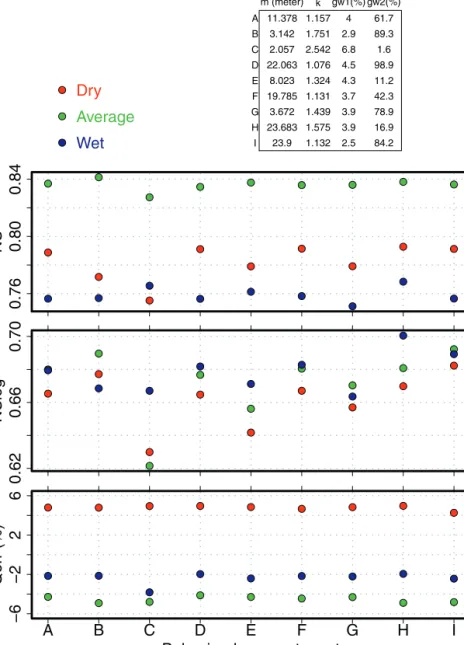
Fig.8.Selectedgroupofbehavioralparametersetsandtheircalibrationmetricsthatwereusedformodelsimulations.Anine behavioralparametersetscomprisedof(m(m),k,gw1(%),andgw2(%))wereshownintable(upperright).
Toaddresstheequifinalityconcept,whichstatesthattheremaybemanymodelsofacatchment thatacceptablyreproduceobservations,weselectedagroupofbehavioralparametersetsfromthe MonteCarlosimulations(Fig.7)thathadapercenterror(Qerr)of−5.0%≤Qerr≤5.0%,aNash–Sutcliffe efficiencyondailyflows(NS≥0.75),andaNash–Sutcliffeefficiencyonlogdailyflows(NSlog≥0.60). Ninebehavioralparametersetswereidentifiedthatsatisfiedallthethreementionedconditionsover thethreedifferentwateryearconditions(dry,averageandwet).Fig.8givesaplotofthenine behav-ioralparameterssetsselectedwithmodelperformancemetrics.InFig.8,welistattheupperright cornertheninebehavioralparameterswithvaluesofm(m),k,gw1(%),andgw2(%).Wegivethe modelperformancemetricscorrespondingtothedifferentwateryears(dry,average,andwet)for
0
100
200
300
400
0
100
200
300
400
Simulated (mm)
Observed (mm)
Fig.9.ScatterplotofmonthlyobservedandsimulatedrunoffinmmfortheMadRivernearMoretownwatershed(USGSgauge #04288000)inverificationofRHESSysduring1955to2010wateryears.RHESSysparametersusedtodrivemodelsimulations runoffresultswere:m=2.057(m),k=2.542,gw1=6.8(%),andgw2=1.6(%).
eachbehavioralparameterssetinred,green,andbluecolorsrespectively.Themodelperformance metricsshowninFig.8aretheNash–Sutcliffeefficiency(NS)fordailysimulatedandobservedrunoff, theNash–Sutcliffeefficiency(NSlog)fordailysimulatedandobservedrunoffinlog-scale,andthe per-centerror(Qerr)betweendailysimulatedandobservedrunoff.Wenotethattheaveragewateryear modelsolutionscapturemostofthevarianceobservedcomparedwithdryandwetyearsmodel solu-tions(NSaverage≈0.84).Wetwateryearmodelsolutionstotalannualflowerrorestimatesachieveda
closematchwithobservedrunoffvalues(QerrWet≈0%).
Fig.9showsmonthlyobservedandsimulatedrunoffforthestudywatershedasverificationof RHESSysmodelperformanceduring1955–2010wateryears.AsseeninFig.9,modelperformance isrobust.Theverificationperiodusedwasfromwateryear1955towateryear2010.Ingeneral,all theselectedbehavioralparametersetsareabletoexplainmorethan60%ofthevariance seenin observeddailyrunoff,andunderestimateobservedrunoffbyabout4%.Modelresultsgeneratedfrom eachoftheninebehavioralparametersetsshowthatpatternsandtrendsofsimulatedrunoffwere consistent.
Simulatedrunoffresultswithm=23.9(m),k=1.132,gw1=2.5(%),andgw2=84.2(%)parameterset (i.e.,groupIinFig.8)areabletoexplainabout79%ofthevarianceseeninobserveddailyrunoffduring thecalibrationdryyear,about84%ofthevarianceseeninobserveddailyrunoffduringthecalibration averageyear,andabout79%ofthevarianceseeninobserveddailyrunoffduringthecalibrationwet
0 5 10 15 20 25
mm/da
y
Modeled Runoff Observed Runoff (a) 0 500 1000 1500Cumulativ
e (mm)
Precipitation Modeled Runoff Actual Runoff Evapotranspiration Storage 0 5 10 15 20mm/da
y
(b) 0 200 400 600 800 1200Cumulativ
e (mm)
0 5 10 15 20Oct Dec Feb Apr Jun Aug
mm/da
y
(c) 0 200 600 1000Oct Dec Feb Apr Jun Aug
Cumulativ
e (mm)
Fig.10.Dailysimulatedversusobservedrunoff(mm)fortheMadRivernearMoretownwatershedincalibrationofRHESSys. Wet[row(a)],average[row(b)]anddry[row(c)]wateryieldyearresultsareshown.Rightpanelsgivecumulativerunoff (observedandsimulated),evapotranspirationandstoragesimulatedwithobservedprecipitationduringcorrespondingyearto theleft.
year(Fig.10).Dryyearwateryield(panela),averageyearwateryield(panelb)andawetyearwater yield(panelc)areshowninFig.10.Wealsopresentcumulativesimulatedrunoff,evapotranspiration andstorage(offsettobezeroatthestart)aswellasobservedprecipitationandrunoff.Themodel capturesmostofthevariabilityseenindailyrunoffduringspringbuttoalesserdegreeduringsummer time.ThisisshownwiththeNash–Sutcliffeefficiencyoflog-transformeddailyrunoffvaluesof0.79 (panela),0.84(panelb),and0.76(panelc).
Table3
AnnualprecipitationattheMadRiverwatershedduring1951–2005wateryearsMannKendalltrendanalysis.isthearithmetic meaninmeters,isunbiasedstandarddeviationinmeters,CViscoefficientofvariation(/),iscorrelationbetweengridded data(Maureretal.,2002)andtheCMIP5ensemble,(tau)isKendall’staucorrelationcoefficient,p-valueis2sided-test,Trend isHighlySignificantwhen(p≤0.001)andSignificantwhen(p≤0.05).
Datasource/climatemodelID CV (tau) p-Value Trend
Maureretal. 1.209 0.192 0.159 – 0.3859 0.00003 Highlysignificant
ACCESS1-0 1.192 0.104 0.087 0.011 0.0128 0.89603 Notrend BCC-CSM1-1 1.189 0.108 0.091 0.077 0.0492 0.60119 Notrend BNU-ESM 1.199 0.113 0.095 0.318 0.2162 0.02018 Significant CanESM2 1.193 0.117 0.098 0.064 0.0626 0.50421 Notrend CCSM4 1.200 0.105 0.088 −0.077 0.0303 0.74941 Notrend CESM1-BGC 1.200 0.094 0.079 0.208 0.2040 0.02835 Significant CNRM-CM5 1.193 0.111 0.093 0.180 0.1960 0.03527 Significant CSIRO-Mk3-6-0 1.203 0.133 0.111 0.126 −0.0020 0.98842 Notrend GFDL-CM3 1.200 0.101 0.084 −0.205 0.0626 0.50421 Notrend GFDL-ESM2G 1.197 0.099 0.082 0.025 0.1300 0.16337 Notrend GFDL-ESM2M 1.198 0.117 0.097 0.158 0.1582 0.08937 Notrend INM-CM4 1.189 0.107 0.090 −0.063 0.1205 0.19629 Notrend IPSL-CM5A-LR 1.201 0.111 0.092 0.168 0.2485 0.00755 Significant IPSL-CM5A-MR 1.197 0.093 0.078 0.033 0.1098 0.23958 Notrend MIROC-ESM 1.194 0.093 0.078 −0.062 0.0909 0.33066 Notrend MIROC-ESM-CHEM 1.202 0.108 0.090 −0.161 0.0653 0.48586 Notrend MIROC5 1.184 0.123 0.104 0.008 −0.0397 0.67372 Notrend MPI-ESM-LR 1.196 0.112 0.094 0.075 0.0007 1.00000 Notrend MPI-ESM-MR 1.184 0.105 0.089 0.027 −0.0478 0.61134 Notrend MRI-CGCM3 1.198 0.100 0.083 0.124 0.1407 0.13105 Notrend NorESM1-M 1.195 0.082 0.068 0.079 0.2094 0.02442 Significant
3.2. Globalclimatemodelshistoricaltrendsandvariabilities
Ananalysisoftwenty-onehindcastCMIP5modeloutputdatasetswasperformedtoassessthe variabilityandtrendofeachdatasetcomparedtotheobservedhistoricaldataofMaureretal.(2002). Theprecipitationcoefficientofvariation(CV)andtrend(representedbyKendall’stau)arepresentedin
Table3.AsnotedbythediscrepancyinKendall’staucomparedtotheobservations,noneoftheCMIP5
datasetsadequatelyreproducestheobservedprecipitationtrend.OnlyfiveCMIP5modeloutputsshow astatisticallysignificantincreasingtrend(whichisfarlowerinmagnitudethantheobserved),and thosefivearechosenasasubsetonthatbasisforfurtheranalysisinthiswork.Moreover,comparison oftheprecipitationcoefficientofvariationoftheCMIP5andobserveddatasetsshowsthatnoneof theCMIP5modelsadequatelyreproducestheobservedvariability,whichlimitstheabilitytosimulate extremeevents.
Thefailureofthehindcastclimatedatatoreproducetheobservedtrendcallsintoquestionthe validityoftheprecipitationforecastdataasanadequatedriverofhydrologymodelsforthesimulation ofclimatechangeimpacts.Therefore,foranalternatescenario,wesuperimposedtheobservedtrend inthehistoricalprecipitation(+7mm/year)ontherelativelyflatCMIP5precipitationdataforuseasa driverofthehydrologymodelpresentedinthiswork.Thisapproachassumesthattheobservedtrend willcontinueunchangedinthefuture,andallowsassessmentofthepossiblehydrologicflowregime resultingfromincreasingprecipitation.Hydrologymodelsimulationresultsusingbothalteredand unalteredprecipitationinputtimeseriesarecomparedtoemphasizetheimportanceoftrendinthe CMIP5data.TheCMIP5productsreproduceobservedtemperaturetrends,whichwereleftunaltered. TheRHESSysmodelwasruninaretrospectivemodetoproducehistoricalrunoffsimulationsusing thehistorical CMIP5climatedata(1955–2005)asaclimatedriver.Theannualrunoffsimulations (retrospectiveclimatedatafromfiveclimatemodelsundertwoscenarios)showadifferenttrendand variabilitywhencomparedtohistoricalobservedrunoffdata(Fig.11).Fig.11showsbothtimeseriesas wellasdistributions(representedbyboxplots)toillustratethesedifferencesintrendandvariability. Meanannualrunofffromallclimatemodelswasclosetoobservedrunoff.However,interquartile annualrunoffrangeofallclimatemodelstestedwaslessthanobservedannualrunoff.Notsurprisingly,
1960 1980 2000 400 600 800 1000 Runoff (mm) OBSERVED BNU−ESM CESM1−BGC CNRM−CM5 IPSL−CM5A−LR NorESM1−M
OBSERVED Trend (loess−R default)
GCMs Average Trend (loess−R default)
400
600
800
1000
Runoff (mm)
OBSERVED BNU−ESM CESM1−BGC CNRM−CM5 IPSL−CM5A−LR NorESM1−M
Fig.11. AnnualobservedandretrospectivesimulatedrunoffattheMadRivernearMoretownwatershed(USGSgauge# 04288000).Dataarerunoffforthewateryears1955–2005.RunoffsimulationswereobtainedbyhindcastingtheRHESSys modelwithfiveclimatemodelsfromtheCMIP5ensemblesdataandtheninebehavioralsetsdiscussed.Trendsshownwere obtainedusingthelocalpolynomialregressionfitting(loess)functionwithdefaultparametersinRsoftwarepackage.
climatemodel-drivenrunoffsimulationshaveclearlyunderestimatedthehistoricalobservedrunoff trendbecauseofthelackoftrendinCMIP5precipitationdata.Differencesintrendsarevisualized usinglocalpolynomialregressionfittingfunction(loess)evaluatedfromthedefaultparametersinthe
Rsoftwarepackage(Clevelandetal.,1992;RDevelopmentCoreTeam,2014).Theseresults(Fig.11) showthatclimatemodeldatahavenotsucceededinproducinghistoricalobservedrunofftrendsand variabilitieswhenappliedonaregionalscalestudy.
3.3. Modelprediction
RunoffsimulationsshowninFigs.12–15wereobtainedbydrivingtheRHESSysmodelwith ensem-blesfrom:(i)thesubsetoffiveCMIP5climatemodelsthatshowsignificanttrendinprecipitation,and (ii)thefiveclimatemodelsfromtheCMIP5withthesuperimposedtrendasdescribedearlier(Section
2.3).Inbothofthetwosetsofensembles,weconsideredthetwoclimatescenarios(RCP4.5andRCP 8.5).ThefiveclimatemodelsshowninFigs.12–15are,a:BNU—ESM;b:CESM1—BGC;c:CNRM—CM5; d:IPSL—CM5A—LR;ande:NorESM1—M.Anoticeableincreaseinnumberoffloodeddayshasbeen observed.Inaddition,arepeatedpatternoffloodoccurrencesisevidentacrossalltheclimatemodel studieswithvariationsinduration.
Fig.12showskerneldensityestimatesofthedistributionofmaximumflooddurationdaysatour studywatershed,usingthefloodthresholdof15mm/day(2,175cfs).The1964–2013lineinFig.12
isthekerneldensityestimateofflooddurationdaysusingthefloodthresholdof15mm/dayduring 1964–2013wateryears.Future(i.e.,2016–2099wateryears)kerneldensityestimatesoffloodduration dayswereobtainedbydrivingtheRHESSysmodelwithfiveclimatemodelsfromtheCMIP5ensembles (subscript1)aswellasthesuperimposedtrendensembles(subscript2)consideringthetwoscenarios (i.e.,RCP4.5andRCP8.5)andtheninebehavioralsetsdiscussed.Theestimatedbandwidththatthe
SheatherandJones(1991)methodgivesforthevariousdistributionsshowninFig.12varybetween
0.1and1.7days.Forconsistency,sothatmodedifferencesarenotduetobandwidthdifferences,Fig.12
wasplottedusingtheaveragebandwidthof0.8days.Tochecksensitivitytobandwidth,wealsoplotted densityestimateswithrangeofbandwidthsspanning0.1–1.7daysandobtainedfigures(notshown)
0
5
10
15
20
0.00
0.05
0.10
0.15
0.20
0.25
Flood Duration (Days)
Density
(1964 — 2013) (a−1) (b−1) (c−1) (d−1) (e−1)0
5
10
15
20
Flood Duration (Days)
(1964 — 2013) (a−2) (b−2) (c−2) (d−2) (e−2)Fig.12. KerneldensityestimateoftheflooddurationindaysattheMadRivernearMoretownwatershed(USGSgauge# 04288000)observedandprojectedfrommodelsimulations.Theflooddurationindaysarethenumberofdayswhenrunoff equalsorexceedsarunoffmagnitudeof15mm/day(i.e.,dailydischargeof2,175cfs).Kerneldensitylinelabeled(b-1)refers totheCESM1—BGCclimatemodelensemblesflooddurationscenario,whilekerneldensitylinelabeled(c-2)referstothe CNRM—CM5climatemodelwithsuperimposedtrendensemblesflooddurationscenario.
1960 1980 2000 2020 2040 2060 2080 2100 5 10 15 20 25 30 7QMAX (mm/d a y) (1) ● ● ● ● ● ● ● ● ● ● ● ● ● ● ● ● ● ● ● ● ● ● ●●●●●●●●●●●●●●●● ●●●●●●●●●●●●●●●● ● ● ● ● ● ● ● ● ● ● ● ● ● ● ● ● ● ● ● ● ● ● ● ● ● ● ● ● ● ● ● ● ● ● ●● ● ● ● ● ● ● ● ● ● ● ● ● ● ● ● ● ● ● ● ● ● ● ● ● ● ● ● ● ● ● ● ● ● ● ● ● ● ● ● ● ● ● ● ● ● ● ● ● ● ● ● ● ● ● ● ● ● ● ● ● ● ● ● ● ● ● ● ● ● ● ● ● ● ● ● ● ● ● ● ●
HISTORICAL CESM1−BGC IPSL−CM5A−LR
(1) 5 10 15 20 25 30 1960 1980 2000 2020 2040 2060 2080 2100 5 10 15 20 25 30 7QMAX (mm/d a y) (2) ● ● ● ● ● ● ● ● ● ● ● ● ● ● ● ● ● ● ● ● ● ● ● ● ● ● ● ● ● ● ● ● ● ● ● ● ● ● ● ● ● ● ● ● ● ● ● ● ● ● ● ● ● ● ●●●●●●●●●●●●●●●●●●●●●●●●●●●●●● ● ● ● ● ● ● ● ● ● ● ● ● ● ● ● ● ● ● ● ● ● ● ●●●●●●●●●●●●●●●●●●●● ● ● ● ● ● ● ● ● ● ● ● ● ● ● ● ● ● ● ● ● ● ● ● ● ● ● ● ● ● ● ● ● ● ● ● ● ● ● ● ● ● ● ● ● ● ● ● ● ● ● ● ● ● ● ● ● ● ● ● ● ● ● ● ● ● ● ● ● ● ● ● ● 5 10 15 20 25 30 BNU−ESM CNRM−CM5 NorESM1−M (2)
Fig.13.Seven-daymaximumflowattheMadRivernearMoretownwatershed(USGSgauge#04288000).Rightpanelsgive boxplotsofseven-daymaximum(7QMAX)dataforthehistorical(1955–2013)andsimulated(2016–2099)wateryearrunoffs. Panelsnumberedwith1refertotheCMIP5ensembles,whilepanelsnumberedwith2refertotheCMIP5withsuperimposed trendensembles.
1960 1980 2000 2020 2040 2060 2080 2100 10 20 30 40 50 BFI (%) (1) ● ● ● ● ● ● ● ● ● ● ● ● ● ● ● ● ● ● ● ● ● ● ●● ● ● ● ● ● ● ● ● ● ● ● ● ● ● ● ● ● ● ● ● ●●●●●●●● ● ● ● ● ● ● ● ● ● ● ● ● ● ● ● ● ● ● ● ● ● ● ● ● ● ● ● ● ● ● ● ● ● ● ● ● ●●●●●●●●●●●●●●●● ● ● ● ● ● ● ● ● ● ● ● ● ● ● 10 20 30 40 50 (1)
HISTORICAL CESM1−BGC IPSL−CM5A−LR
1960 1980 2000 2020 2040 2060 2080 2100 10 20 30 40 50 BFI (%) (2) ● ● ● ● ● ● ● ● ● ● ● ● ● ● ● ● ● ● ● ● ● ● ● ● ● ● ● ● ●●●●●●●● ● ● ● ● ● ● ●●●●●●●●●●●●●●●●●●●●●● ●●●●●● ● ● ● ● ● ● ● ● ● ● ● ● ● ● ● ● ● ● ● ● ● ● ● ● ● ● ● ● ● ● ● ● 10 20 30 40 50 BNU−ESM CNRM−CM5 NorESM1−M (2)
Fig.14. Baseflowindex(BFI)attheMadRivernearMoretownwatershed(USGSgauge#04288000).Rightpanelsgiveboxplots ofbaseflowindexdataforthehistorical(1955–2013)andsimulated(2016–2099)wateryearrunoffs.Panelnumberfollows namingconventionusedearlierinFig.13.
thatwereverysimilartoFig.12,withmodesatthesamelocations.Wethereforeconcludedthat interpretationswerenotsensitivetotheselectionofbandwidthintherangeresultingfromdifferent datalengths.Wealsolookedattimeseriesplotsfortheabovementioneddistributions(notshown) andfoundthatroughlyevery25yearsthereisapeakinnumberoffloodeddays.Ourresults,using
Historical Contingency Constancy 0 0.2 0.4 Predictability RCP 4.5 RCP 8.5 (a−1) RCP 4.5 RCP 8.5 (b−1) RCP 4.5 RCP 8.5 (c−1) RCP 4.5 RCP 8.5 (d−1) RCP 4.5 RCP 8.5 (e−1) Historical 0 0.2 0 .4 Predictability RCP 4.5 RCP 8.5 (a−2) RCP 4.5 RCP 8.5 (b−2) RCP 4.5 RCP 8.5 (c−2) RCP 4.5 RCP 8.5 (d−2) RCP 4.5 RCP 8.5 (e−2)
Fig.15.Colwellindex,Predictability(P),Constancy(C),andContingency(M)ofrunoffattheMadRivernearMoretown water-shed(USGSgauge#04288000).Dataaredailyrunoffforthewateryears1955–2013(historical)andsimulatedrunoffforthe wateryears2016–2099(future).PanelnumberfollowsnamingconventionusedearlierinFig.12.
asuperimposedincreasingprecipitationtrendreflectedinthehistoricalrecord,predictfourmore floodeddaysinthecomingcenturyrelativetothehindcastperiod.
UsingtheunalteredCMIP5dataasinput(RCP4.5andRCP8.5),modelresultsdonotshowa sig-nificantchangeinthehighestflows(7QMAX),despitefutureprojectionsofincreasedprecipitation intheregion(Fig.13,part1).Thismayrepresenttheroleofsoilmoistureorsnowpackdynamics. However,asignificantchangeisshownforthecaseofsuperimposedprecipitationtrendensembles. Resultssuggestthatthemedianofthesevenmaximumrunoff7QMAXwillchangeby30%inthefuture (Fig.13,part2).
Wealsoassessedclimate-inducedchangesinlowflowdisturbances.Ourresultssuggestthatboth variablesthatquantifylowflowdisturbances(BFIand7QMIN)showedasignificantincreaseinthe future.Wenotedanincrease ofaboutthree ordersofmagnitudeinthebaseflow indexvariable (Fig.14).Thisincreaseinlowflowregimeisevidentthroughtheuseofalltheclimatemodelsstudied. InFig.14,weshowboxplotsofhistoricandfuturebaseflowindicestoillustratethedegreeofincreased change.Thetimingassociatedwiththisincreaseisduringsummer(June21thtoSeptember20th).The 7-dayminimum(7QMIN)variablebehaviorhasnotbeenshownsinceitconveysthesameinformation. ThisfindingisconsistentwiththerecentobservationofHodgkinsandDudley(2011)indicatingthat thelatterhalfofthetwentiethcenturyhaswitnessedanincreaseinsummerflowsinNewEngland.
Modelpredictionsdidnotindicateasignificantchangeinflowreversaldaysunderfutureclimate scenarios.Somemodelssuggestdecreasednumberofreversaldayswhileotherssuggestincreased numberofreversaldays.Wethinkthatthequalityofourpredictionresultsdidnotsucceedtomanifest aclearflowvariabilitysignal(inputclimatedataandmodelefficiencytocapturestreamflowvariance). Theseresultsconveyalimitationofourmodelingeffortstoassessstreambanksdamagesanticipated withclimatechange.
Model outputshows a 60% increase in theColwell indexrunoff predictability metric for the 2015–2099wateryearsperiodamongallmodelstested.Bothconstancyandcontingencyareshown asbarplotsinFig.15toillustratetheColwellindexcomponents.Wenotethatthecontingencyis min-imalwhichmeansthattheprobabilityofoccurrenceofeachflowstateisindependentofthemonth (homogenousmonthlyflowtimeseries).Weinferthatexpectedrunoffatthisstudywatershedwould haveadifferentmonthlypatternordistributioncomparedtohistoricaldataobserved.Monthlyrunoff patternchangewillaffectthequalityofthewatershedhabitatandcauseecologicalconsequenceson fisheriespopulations.
4. Discussion
TheCMIP5dataproducts(Tayloretal.,2011;Meehletal.,2014)arewidelyusedforregionalclimate changeimpactsanalysis.However,forourstudyareainnorthwesternNewEngland,onlyfiveclimate modelsshowedstatisticallysignificanttrendsinprecipitationinhindcast,butthemagnitudeofthese trendsarenotadequatelyrepresentativeofthoseseeninobservedannualprecipitation.Toaddress thisdiscrepancyinhistoricalprecipitationtrend,weextrapolatedtheobservedhistoricalprecipitation trendtoprovideanupperenvelopeofpredictionsoffuturehydrologicalimpactsassociatedwith climatechange.Theuseofanextrapolatedobservedtrendcannotcaptureregionalclimatepatterns inducedbylarge-scalechangesincirculationordecadal-scaleclimaticoscillations(suchastheNorth AtlanticOscillationorArcticOscillation),andthereforefuturedatasetswithextrapolatedtrendsmust beusedwithgreatcaution.However,itisclearfromthisanalysisthatCMIP5productsareinsufficient forregionalhydrologicanalysisinVermontbecausethetrendandvariabilityareunderrepresented. Theuseofanyofthetwenty-oneCMIP5modelsavailablewouldleadtorunoffsimulationsthatshow nochangeinhighflows.Suchaconclusioncoulderroneouslybeusedasabasisfora“donothing” approachbypolicymakersforadaptationtoclimatechange,wheninfactincreasingprecipitation cancausenumerousadversehydrologicimpacts,suchasanincreasedfloodriskandexacerbated nonpointsourcepollution.WedemonstratethelargedifferenceinflowregimewhenusingtheCMIP5 datawithasuperimposedtrendcomparedtoonlyunalteredCMIP5datausingthebestfivedatasets. Thenear-term(4–5decades)predictedflowsusingthesuperimposedtrenddatasetmaybeusefulfor designandplanningasabasicscenarioforadaptationtoclimatechangeinhighgradientwatersheds innorthwesternNewEngland.
Inadditiontothelackofareproducedtrendinprecipitation,recentworkhasdescribedthefailure oftheCMIP5datatocaptureincreasedintensity,durationandfrequencyofprecipitationextremes, whichisconsistentwithourfindingofinadequaterepresentationofvariabilityintheprecipitation processinVermont(Wuebblesetal.,2013).Therefore,thechangingprobabilityoftheuppermost quantilesisnotwellrepresentedusingourapproach.Themean,variability,andskewnessoffloware allexpectedtochangewithclimatechange,butthepresentedapproachonlyallowsforchangesin thefirsttwomoments.
OurapproachtoprojectingfutureflowregimeinnorthwesternNewEnglandhasnotincorporated thenonlinearinterconnectivityandfeedbacksbetweenclimatevariablesandvegetationcover. More-over,thehydrologicalmodelusedinourapproachdidnotincludeincorporationofimpactsofincreased CO2concentrationsonstomatalphysiologyofforests,changesinspeciescompositionordistribution, andtheresponseofleafareaindextoclimatechange.Vegetationfeedbackscouldactinvariousways toexacerbateoroffsetourprojectedchangesinstreamflow.CO2fertilizationwouldbeexpectedto reducestomatalconductanceandincreasewateruseefficiency,therebydecreasing evapotranspira-tion(ET)andincreasingstreamflowduringthegrowingseason,asdiscussedbyCampbelletal.(2011), thoughtheirmodelprojectionsofstreamflowincorporatingCO2fertilizationresultedinincreasing trendsinfutureETattheHubbardBrookExperimentalForestinnearbyNewHampshire.Warmer con-ditionsinthefuturemightalternativelylengthenthegrowingseasonforforestsintheregion(Betts,
2011;Richardsonetal.,2012;Whiteetal.,2014).Afuturetrendoflengthenedleaf-onperiodwould
resultindaystoweeksofextendedET,offsettingsomeoftheincreasedfutureprecipitationand mit-igatingagainstincreasingbaseflow.Amorecomplexandyetunexaminedimpactofclimatechange onvegetation-waterrelationswouldbeassociatedwithchangesinforesthealthandspecies com-positionthatwoulddrivechangesinETdemandsandresultingstreamflow.Decliningforesthealth andassociatedreductionsinETcouldleadtoincreasesinbaseflowgreaterthanthelevelsweproject here.Thestepchangesinthebaseflowindexprojectedinoursimulationsaredrivenbytheprojected lineartrendinincreasingprecipitationanddonotincludethesemorecomplexvegetation-climate interactionsthatmayalterfuturestreamflows.Ingeneral,ourabilitytoprojectflowregimeshould beassessedconsideringthisuncertainty.
Ourresultssuggestarepeatedpatternoffloodoccurrenceswithincreasedfrequency.Somestudies havesuggestedthatthisrepeatedmodeoffloodoccurrencesinourstudyregioniscorrelatedwith climateindexoccurrencesattheregionsuchastheNorthAtlanticOscillation(NAO)(Huntingtonetal.,
2004;GriffithsandBradley,2007;Brownetal.,2010).Thisrepeatedphenomenonoffloodoccurrences
maylikelybeattributedtohemisphericscaleandpotentiallyregionalscaleatmosphericcirculation patterns,howevertheexpectedwarmedclimatemayinfluencetheseatmosphericcirculationindices themselves,hencethereisgreatuncertaintyinfuturefloodsignals(Visbecketal.,2001).
Flowvariabilityisanimportantaspectofthestreamflowregime.Thereisanongoingdiscussion withintheLakeChamplainmanagementcommunityaswellasthestateandfederalenvironmental protectionagenciesconcerningtheLakeChamplainsedimentandnutrientloads(StagerandThill, 2010).Theanticipatedfutureincreasedmaximumflowswilllikelygreatlyexceedcurrentsediment andnutrientloadingtotheLake,continuingatrendofdecliningwaterqualityinLakeChamplain(Lake
ChamplainBasinProgram,2012).
TheMadRiverwatershedphysicalhabitatisforBrownandBrooktrout,Longnosedace,andSlimy sculpinbutinsomereaches,thewaterqualitylimitsfishpopulations.Fishpopulationsinhabiting Vermontstreamsandriversingeneralhaveadaptedtoflooding(Kirn,2011).However,giventhe expectedchangesinclimate(temperatureincrease)andtheassociatedstreamflowtemporalpatterns change(Colwell’spredictabilityincrease)thefutureadaptationshouldbeconsidered.Theanticipated hydrologicalimpactspresentedhereinmayassistongoingresearchthatinvestigatestheseecological responsestoclimatechangeinLakeChamplainecosystem(Warrenetal.,2012).
ThepresentedworkcriticallyassessestheabilityoftheCMIP5ensembletoadequatelycapture thedynamicsofclimateconditionsoverthehistoricperiodatourstudyregionforuseinhydrologic impactanalysis.Ourfuturesimulationresultshighlightthesubstantialdifferencesbetweentheuseof CMIP5andtrend-extrapolatedobservations,underscoringtheneedtobeverycautiouswhenapplying climatemodelproductsforregionalanalysis.However,thepredictionresultspresentedinthiswork shouldbeviewedasbestestimatesofwhatisavailable.Understandingchangesinstreamflowregime
requiresabetterknowledgeofclimatedata,runoffmodelsparameters,andrepresentationofphysical processes.Inordertoobtainthatknowledge,extensivefieldeffortsintendedtoexaminehydrological modelsensitivitiestoclimateandhydrologicalmodelparametersarerequired.
5. Conclusions
UsingtheCMIP5climatedataforregionalhydrologicanalysistomakerunoffprojectionstoinform planningandpolicywouldbefundamentallyproblematiciftheclimatemodelsarenotadequately validatedforaregionofinterest.ManyoftheforcingCMIP5datafailtocaptureboththetrends andvariabilityobservedinprecipitationwhenruninhindcast.Thisstudyhasshownthepotential differencesinsimulatedflowmetricsiftheCMIP5dataisapplieduncritically,andshowsthatCMIP5 failstocapturetrendstowardincreasedprecipitationinVermont.
Nevertheless,whendrivenbytheCMIP5datacorrectedfortrend,thehydrologicalmodelused inthisstudypredictsanincreaseinhighflows,lowflows,andadecreaseintheuncertaintyseenin temporalpatternsofrunoffduringthe21stcenturyforcentralVermont.Thetrend-corrected sim-ulationshowsanincreaseof30%inseven-daymaximumflow,fourdaysincreaseinfloodeddays, threeordersofmagnitudeincreaseinbaseflowindex,anda60%increaseinrunoffpredictability.The above-mentionedresultsreflecttheneedtoadapttoincreasedfloodrisk,updatedfloodplain man-agement,exacerbatednonpointpollutionloadingtoLakeChamplain,andotherproblemsassociated withhigherfutureflows.
Acknowledgements
ThisworkwassupportedbytheVermontExperimental Programfor StimulatingCompetitive Research(EPSCoR)AwardnumberNSFEPSGrant#1101 1 .TheauthorsacknowledgetheVermont AdvancedComputingCorewhichissupportedbyNASA(NNX06AC88G),attheUniversityof Ver-montforprovidingHighPerformanceComputingresourcesthathavecontributedtotheresearch resultsreportedwithinthispaper.WeacknowledgetheWorldClimateResearchProgramme’s Work-ingGrouponCoupledModelling,whichisresponsibleforCMIP,andwethanktheclimatemodeling groups(listedinTableA-1ofthispaper)forproducingandmakingavailabletheirmodeloutput.For CMIP,theU.S.DepartmentofEnergy’sProgramforClimateModelDiagnosisandIntercomparison providescoordinatingsupportandleddevelopmentofsoftwareinfrastructureinpartnershipwith theGlobalOrganizationforEarthSystemSciencePortals.Theauthorsareindebtedtotwoanonymous reviewersfortheirconstructiveandthoroughreviews.
3 7
AppendixA.
TheWorldClimateResearchProgramme(WCRP)developedglobalclimateprojectionsthroughits CoupledModelIntercomparisonProject5(CMIP5).Weexaminedtwenty-oneprojectionensembles ofCMIP5downscaledbythedailybias-correctionandconstructedanalogs(BCCA)statistical down-scalingtechniqueavailableat(http://gdo-dcp.ucllnl.org/downscaledcmipprojections/)accessedon 27May2014andlistedinTableA1.MannKendalltrendanalysis(HelselandHirsch,2002)wasused toexaminewhetheranytrendsinprecipitationdatawerestatisticallysignificant.Table3givestrend analysisresultsforthehistoricobservedannualprecipitation(Maureretal.,2002)aswellastheCMIP5 projectionensembleshindcastdataoverourstudywatershed.Thistableincludesthemeanannual precipitation,,theannualstandarddeviation,,thecoefficientofvariation,CV,thecrosscorrelation betweenclimatemodelensemblesandobservedprecipitation,,theKendall’staucorrelation coeffi-cient,,aswellasthep-valueassociatedwiththeMannKendalltest.Table3showsthattheyarefive climatemodelensembleswithsignificantincreasingtrend(p<0.05)inannualprecipitation.Namely, thesefiveclimatemodelingcentersare:theCollegeofGlobalChangeandEarthSystemScience,Beijing NormalUniversity(BNU—ESM);theCommunityEarthSystemModelContributors(CESM1—BGC);the CentreNationaldeRecherchesMétéorologiques/CentreEuropéendeRechercheetFormationAvancée enCalculScientifique(CNRM—CM5);theInstitutPierre-SimonLaplace(IPSL—CM5A—LR);andthe Nor-wegianClimateCentre(NorESM1—M).Amongthetwenty-oneprojectionensemblesanalyzed,these
TableA1
CoupledModelIntercomparisonProject(CMIP5)groupsstudied.
No. Modelingcenter(orgroup) InstituteID Modelname
1 CommonwealthScientificandIndustrialResearch OrganizationandBureauofMeteorology,Australia
CSIRO-BOM ACCESS1-0
2 BeijingClimateCenter,ChinaMeteorological Administration
BCC BCC-CSM1-1
3 CollegeofGlobalChangeandEarthSystemScience, BeijingNormalUniversity
GCESS BNU-ESM
4 CanadianCentreforClimateModellingandAnalysis CCCMA CanESM2
5 NationalCenterforAtmosphericResearch NCAR CCSM4
6 CommunityEarthSystemModelContributors NSF-DOE-NCAR CESM1-BGC
7 CentreNationaldeRecherches
Météorologiques/CentreEuropéendeRechercheet FormationAvancéeenCalculScientifique
CNRM-CERFACES CNRM-CM5
8 CommonwealthScientificandIndustrialResearch Organization,QueenslandClimateChangeCentreof Excellence CSIRO-QCCCE CSIRO-Mk3.6.0 9 NOAAGeophysical FluidDynamics Laboratory NOAAGDFL GFDL-CM3 10 GFDL-ESM2G 11 GFDL-ESM2M
12 InstituteforNumericalMathematics INM INM-CM4
13 InstitutPierre-Simon Laplace
IPSL IPSL-CM5A-LR
14 IPSL-CM5A-MR
15 JapanAgencyforMarine-EarthScienceand Technology,AtmosphereandOceanResearch Institute(TheUniversityofTokyo),and NationalInstituteforEnvironmentalStudies
MIROC MIROC-ESM
16 MIROC-ESM-CHEM
17 AtmosphereandOceanResearchInstitute(The UniversityofTokyo),NationalInstitutefor EnvironmentalStudies,andJapanAgencyfor Marine-EarthScienceandTechnology
MIROC MIROC5
18 Max-Planck-InstitutfürMeteorologie(Max PlanckInstituteforMeteorology)
MPI-M MPI-ESM-LR
19 MPI-ESM-MR
20 MeteorologicalResearchInstitute MRI MRI-CGCM3
21 NorwegianClimateCentre NCC NorESM1-M
fivemodelsshowedarelativelyclosecorrelationwithobservedprecipitationdata.Weadoptedusing thesefiveclimatemodelensemblesforthiswork.
AppendixB.
FlowpredictabilityvariablesusedinthispaperareColwell’sindices(Colwell,1974).Colwell’sindices arepredictability(P),constancy(C)andcontingency(M).Constancy(C)andcontingency(M)are quan-tifiedbasedonentropymeasuresofuncertaintyfromShannon’sinformationtheoryeitheracrossall months(C),orcontingentuponaspecificmonth(M)(Jelínek,1968).Predictability(P)hastwoseparable components:constancy(C)andcontingency(M).Predictabilitycombinesconstancyandcontingency throughP=C+M.CalculationofColwell’sindicesP,CandMrequiresthatvaluesbebinnedintodiscrete groups.
Predictability(P)istheconverseofuncertainty,itisreasonablethentobasemeasuresof predictabil-ityanditscomponents,constancy(C)andcontingency(M),onthemathematicsofinformationtheory
(Colwell,1974).FollowingColwell,forafrequencymatrix(contingencytable)withtcolumns(times
phenomenonwasinstateiattimej.Definethecolumntotals(Xj),rowtotals(Yi),andthegrandtotal (Z)as: Xj= s
i=1 Nij, Yi= t j=1 Nij, andZ= i j Nij= j Xj= i Yi.Thentheuncertaintywithrespecttotimeis H(X)=− t
j=1 Xj Z log Xj Z,theuncertaintywithrespecttostateis H(Y)=− s
i=1 Yi Z log Yi Z,andtheuncertaintywithrespecttotheinteractionoftimeandstateis H(XY)=−
i j Nij Z log Nij Z .Thepredictabilityofaperiodicphenomenonismaximalwhenthereiscompletecertaintywith regardtostate(row)oncethepointintime(column)isspecified.Intermsofinformationtheory,the conditionaluncertaintywithregardtostate,withtimegiven,isdefinedas(Jelínek,1968)
HX(Y)=H(XY)−H(X).
Whenpredictabilityisatitsminimum,allstatesareequiprobableforalltimes.InthiscaseH(X)=log t,andH(XY)=logst,sothatHX(Y)=logs.Toobtainmeasureofpredictability(P)withtherange(0,1),
define
P=1−HX(Y) logs =1−
H(XY)−H(X) logs .
Constancyismaximizedwhenallrowtotalsbutonearezero;itisminimizedwhenallrowtotals areequal.SinceH(Y)variesinpreciselytheoppositeway,anditsmaximumvalueislogs,ameasure ofconstancy(C)withrange(0,1)isgivenby
C=1−H(Y) logs.
Contingency representsthe degree to which time determines state, or thedegree to which theyare dependent oneach other. In information theory, contingency is measuredby a quan-tity called average mutual information (Jelínek, 1968). Colwell (1974) cites contingency as the average amount of information about the state of the phenomenon provided by time or
I(XY)=H(Y)−HX(Y)=H(Y)+H(X)−H(XY).
Colwell(1974)givesanadjustedmeasureofcontingency(M),withrange(0,1)as
References
Band,L.E.,Patterson,P.,Nemani,R.,Running,S.W.,1993.Forestecosystemprocessesatthewatershedscale:incorporating hillslopehydrology.Agric.ForestMeteorol.63,93–126,http://dx.doi.org/10.1016/0168-1923(93)90024-C.
Band,L.E.,Mackay,D.S.,Creed,I.F.,Semkin,R.,Jeffries,D.,1996.Ecosystemprocessesatthewatershedscale:sensitivityto potentialclimatechange.Limnol.Oceanogr.41,928–938,http://dx.doi.org/10.4319/lo.1996.41.5.0928.
Betts, A.K., 2011. Vermont climate change indicators. Weather Climate Soc. 3, 106–115, http://dx.doi.org/10.1175/ 2011WCAS1096.1.
Brekke,L.,Thrasher,B.L.,Maurer,E.,Pruitt,T.,2013.DownscaledCMIP3andCMIP5ClimateProjections:ReleaseofDownscaled CMIP5ClimateProjections,ComparisonwithPrecedingInformation,andSummaryofUserNeeds.U.S.Dept.oftheInterior Tech.Rep.,BOR,Denver.
Brown,P.J.,Bradley,R.S.,Keimig,F.T.,2010.ChangesinextremeclimateindicesforthenortheasternUnitedStates,1870–2005. J.Climate23,6555–6572,http://dx.doi.org/10.1175/2010jcli3363.1.
Campbell,J.L.,Driscoll,C.T.,Pourmokhtarian,A.,Hayhoe,K.,2011.Streamflowresponsestopastandprojectedfuturechanges inclimateattheHubbardBrookExperimentalForest,NewHampshire,UnitedStates.WaterResour.Res.47,W02514, http://dx.doi.org/10.1029/2010wr009438.
Chinnayakanahalli,K.J.,Hawkins,C.P.,Tarboton,D.G.,Hill,R.A.,2011.Naturalflowregime,temperatureandthe composi-tionandrichnessofinvertebrateassemblagesinstreamsofthewesternUnitedStates.FreshwaterBiol.56,1248–1265, http://dx.doi.org/10.1111/j.1365-2427.2010.02560.x.
Cleveland,W.S.,Grosse,E.,Shyu,W.M.,1992.Localregressionmodels.In:Chambers,J.M.,Hastie,T.J.(Eds.),StatisticalModels inS.Wadsworth&Brooks/Cole,PacificGrove,CA,p.608.
Colwell, R.K., 1974. Predictability, constancy, and contingency of periodic phenomena. Ecology 55, 1148–1153, http://dx.doi.org/10.2307/1940366.
Dingman,S.L.,2002.PhysicalHydrology,2nded.PrenticeHall,UpperSaddleRiver,NJ,646pp.
Dunne,T.,Leopold,L.B.,1978.WaterinEnvironmentalPlanning.W.H.FreemanandCompany,NewYork,818pp.
Gibson,C.A.,Meyer,J.L.,Poff,N.L., Hay,L.E.,Georgakakos,A.,2005. Flowregimealterationsunderchangingclimatein tworiverbasins:implicationsforfreshwaterecosystems.RiverRes.Appl.21,849–864,http://dx.doi.org/10.1002/rra. 855.
Gordon,N.D.,McMahon,T.A.,Finlayson,B.L.,Gippel,C.J.,Nathan,R.J.,2004.StreamHydrology:AnIntroductionforEcologists, 2nded.JohnWiley&Sons,Chichester,England,429pp.
GRASSDevelopmentCoreTeam,2012.GeographicResourcesAnalysisSupportSystem(GRASS)Software,Version6.4.2. Fon-dazioneMach–CentreforAlpineEcologyCEA,Trento,Italy,Availableat:http://grass.osgeo.org/
Griffiths,M.L.,Bradley,R.S.,2007.Variationsoftwentieth-centurytemperatureandprecipitationextremeindicatorsinthe northeastUnitedStates.J.Climate20,5401–5417,http://dx.doi.org/10.1175/2007jcli1594.1.
Hartley,S.,Dingman,S.L.,1993.Effectsofclimaticvariabilityonwinter-springrunoffinNewEnglandriverbasins.Phys.Geogr. 14,379–393.
Hauer, F.R., Baron, J.S., Campbell, D.H., Fausch, K.D., Hostetler, S.W., Leavesley, G.H., Leavitt, P.R., McKnight, D.M., Stanford, J.A., 1997. Assessmentof climatechange andfreshwater ecosystemsof theRockyMountains, USAand Canada.Hydrol.Process.11,903–924,http://dx.doi.org/10.1002/(sici)1099-1085(19970630)11:8<903::aid-hyp511>3.0.co; 2-7.
Hayhoe,K.,Wake,C.,Huntington,T.,Luo,L.,Schwartz,M.,Sheffield,J.,Wood,E.,Anderson,B.,Bradbury,J.,DeGaetano,A.,Troy, T.,Wolfe,D.,2007.PastandfuturechangesinclimateandhydrologicalindicatorsintheUSnortheast.Clim.Dynam.28, 381–407,http://dx.doi.org/10.1007/s00382-006-0187-8.
Hayhoe,K.,Wake,C.,Anderson,B.,Liang,X.-Z.,Maurer,E.,Zhu,J.,Bradbury,J.,DeGaetano,A.,Stoner,A.,Wuebbles,D., 2008. Regionalclimatechangeprojectionsfor theNortheastUSA. Mitig.Adapt.Strat.GlobalChange13,425–436, http://dx.doi.org/10.1007/s11027-007-9133-2.
Helsel,D.R.,Hirsch,R.M.,2002.StatisticalMethodsinWaterResourcesTechniquesofWaterResourcesInvestigations,Book4. U.S.Geol.Sur.,Reston,VA(ChapterA3),510pp.
Hodgkins,G.A.,Dudley,R.W.,Huntington,T.G.,2003.ChangesinthetimingofhighriverflowsinNewEnglandoverthe20th Century.J.Hydrol.278,244–252,http://dx.doi.org/10.1016/s0022-1694(03)00155-0.
Hodgkins,G.A.,Dudley,R.W.,2005.ChangesinthemagnitudeofannualandmonthlystreamflowsinNewEngland,1902–2002. U.S.Geol.Surv.Sci.Invest.Rep.,2005–5135.
Hodgkins,G.A.,Dudley,R.W.,Huntington,T.G.,2005.SummerlowflowsinNewEnglandduringthe20thcentury.J.Am.Water Resour.Assoc.41,403–411,http://dx.doi.org/10.1111/j.1752-1688.2005.tb03744.x.
Hodgkins,G.A.,Dudley,R.W.,2006.Changesinthetimingofwinter-springstreamflowsineasternNorthAmerica,1913–2002. Geophys.Res.Lett.33,L06402,http://dx.doi.org/10.1029/2005GL025593.
Hodgkins,G.A.,Dudley,R.W.,2011.HistoricalsummerbaseflowandstormflowtrendsforNewEnglandrivers.WaterResour. Res.47,W07528,http://dx.doi.org/10.1029/2010WR009109.
Huntington, T.G., Hodgkins, G.A.,Keim, B.D., Dudley, R.W., 2004. Changes in the proportionof precipitation occur-ring as snow in New England (1949–2000). J. Climate 17, 2626–2636, http://dx.doi.org/10.1175/1520-0442 (2004)017<2626:CITPOP>2.0.CO;2.
Huntington,T.G.,Richardson,A.D.,McGuire,K.J.,Hayhoe,K.,2009.Climateandhydrologicalchangesinthenortheastern UnitedStates:recenttrendsandimplicationsforforestedandaquaticecosystems.Can.J.ForestRes.39,199–212, http://dx.doi.org/10.1139/x08-116.
Jelínek,F.,1968.ProbabilisticInformationTheory:DiscreteandMemorylessModels.McGraw-Hill,NewYork,609pp. Kaufmann,M.R.,Troendle,C.A.,1981.Therelationshipofleafareaandfoliagebiomasstosapwoodconductingareainfour
subalpineforesttreespecies.ForestSci.27,477–482.
Kirn,R.,2011.FloodImpactstoWildTroutPopulationsinVermont.VermontAgencyofNaturalResourcesFisheriesPrograms Rep.,VDFW,Roxbury,VT.