Unclassified DAF/COMP/GF/WD(2014)13
Organisation de Coopération et de Développement ÉconomiquesOrganisation for Economic Co-operation and Development 15-Jan-2014 ___________________________________________________________________________________________
English - Or. English DIRECTORATE FOR FINANCIAL AND ENTERPRISE AFFAIRS
COMPETITION COMMITTEE
Global Forum on Competition
COMPETITION ISSUES IN THE DISTRIBUTION OF PHARMACEUTICALS Contribution from Norway
-- Session III --
This contribution is submitted by Norway under Session III of the Global Forum on Competition to be held on 27-28 February 2014.
Ms Cristiana Vitale, Senior Competition Expert, OECD Competition Division Tel: +33 1 45 24 85 30, Email: [email protected]
JT03351125
Complete document available on OLIS in its original format
This document and any map included herein are without prejudice to the status of or sovereignty over any territory, to the delimitation of international frontiers and boundaries and to the name of any territory, city or area.
DAF/COMP/GF/WD
(2014)13
Un
cl
assi
fi
ed
Eng lis h O r. Eng lishCOMPETITION ISSUES IN THE DISTRIBUTION OF PHARMACEUTICALS -- Norway --
1. The pharmaceutical market in Norway: Introduction
1. The Norwegian Competition Authority (NCA) will in this contribution mainly focus on features of the Norwegian pharmaceutical market which is of particular interest in a competition context.
2. First there will be a presentation of the Norwegian pharmaceutical market structure. This is mainly based on a report made by the NCA in 2009: Competition in Norway ("Konkurransen i Norge"). However, the information has been brought up to date with recent developments. The issues that subsequently will be considered are the vertical relationship between wholesalers and retailers and the arrangement for pharmaceuticals that can be sold outside the pharmacies, the so-called LUA-arrangement. 3. Thereafter, some of the regulations aimed to the participants of the pharmaceutical market in Norway of particular interest in this context will be presented. The "full assortment" requirement for wholesalers and the "stepped price" model will be some of the subjects discussed.
2. The market structure of the pharmaceutical market in Norway
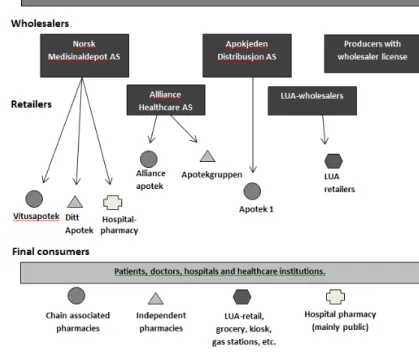
4. Figure 1 below illustrates the market structure.
Figure 1: Norwegian pharmacy market structure1
2.1 Manufactures
5. There are only a few manufactures that actually produce pharmaceuticals in Norway. Most of the participants at the manufacturer level in Norway are subsidiaries of international companies. The Norwegian subsidiaries are mainly sales and marketing units.
2.2 Wholesalers
6. The wholesale market changed in 1995 due to the Agreement on the European Economic Area (EEA Agreement), which entered into force on 1 January 1994.2 Before 1995 the only participant at the
wholesale level in Norway was the state monopoly (Norsk Medisinaldepot). Now the market consists of three main wholesalers.
7. Most of the distribution occurs through the three main wholesalers. In addition to these, there is a selection of manufacturers with permission to operate wholesale business for their own products, as well as grocery wholesalers that supply non-prescription medicines to LUA3-outlets.
8. In Figure 2 below, the market shares of the three main wholesalers are presented. Figure 2: The wholesalers' markets share based on revenues4
2.3 Retailers
9. A deregulation of the pharmacy market took place in Norway in 2001. Until 2001 the Norwegian government decided who could own a pharmacy, the location of the pharmacies and the number of pharmacies in a concessionary system. The deregulation allowed non-pharmacist to establish and own a pharmacy. This resulted in an increase in the numbers of pharmacies, especially in central districts. This is illustrated in figure 3 below.
2 The EEA Agreement brought together the EU Member States and the three EEA EFTA States— Iceland,
Liechtenstein and Norway — in a single market, referred to as the "Internal Market".
3 Information about the LUA-arrangement you can find in box 1 below. 4 Source: The Association of the Pharmaceutical Industry in Norway (2013)
0% 10% 20% 30% 40% 50% 60% 2004 2005 2006 2007 2008 2009 2010 2011 2012
Figure 3: Number of pharmacies and number of citizens per pharmacy, 2001-2013.5
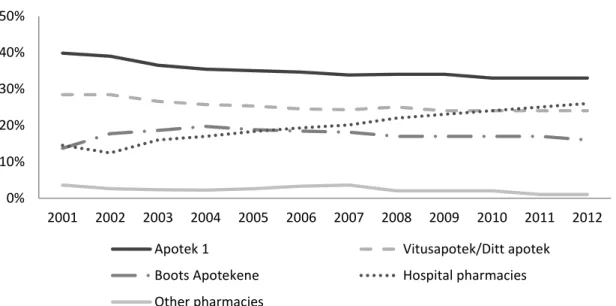
10. The three major pharmacy chains; Vitus Apotek AS, Alliance Apotek and Apotek 1, are each vertically integrated with the wholesalers Norsk Medisinaldepot AS, Alliance Healthcare AS and Apokjeden Distribusjon AS, respectively. After acquisitions of existing independent pharmacies as well as establishing new pharmacies, the three pharmacy chains now covers more than 80 % of the Norwegian pharmacy market. This is presented in Figure 4 below. The NCA consider the structure with vertically integrated pharmacy chains to be a barrier to entry the market.6
11. The chart also shows that the hospital pharmacies have had a significant growth over the last decade. However, the competition from the hospital pharmacies is not as fierce as the chart below may give an impression of. The hospital pharmacies and the regular pharmacies address different groups of consumers. The regular pharmacies offer mostly pharmaceuticals to individuals while the hospital pharmacies turnover mostly stems from the regional healthcare sector.7 Norway`s public healthcare is
divided into four units who are responsible to deliver specialized health care to their respective health region.8
5 Source: The Norwegian Pharmacy Association (2013). 6 The Norwegian Competition Authority (2009)
7 Ibid.
8 Ministry of Health and Care Services (2011).
300 350 400 450 500 550 600 650 700 750 800 6000 7000 8000 9000 10000 11000 12000 20 01 20 02 20 03 20 04 20 05 20 06 20 07 20 08 20 09 20 10 20 11 20 12 20 13 Number of pharmacies Number of citizens per pharmacy
Figure 4: Pharmacy chain market share9
12. In addition to the regular pharmacy retailers, some pharmaceuticals are sold through eg. groceries. This sale is covered by the LUA-arrangement (see Box 1 below) which sets regulations for sale of pharmaceuticals outside pharmacies.
Box 1: LUA-arrangement10
The LUA-arrangement is a scheme which allows the sale of certain non-prescription pharmaceuticals outside pharmacies; in for example grocery stores, kiosks, gas stations, etc. The purpose of this arrangement is to improve the population`s availability of pharmaceuticals, increase competition and thus push prices down. The arrangement was implemented in Norway in 2003.
The outlets that are included in the LUA-arrangement are obliged to keep a minimum range of non-prescription pharmaceuticals. They have strict restrictions on marketing and sale, ie. the LUA-products must be: “behind counter, closed cabinet or physically unavailable for customers”
According to Sakshaug et al. (2013) the sales of non-prescription top selling pharmaceuticals outside pharmacies accounted to 47 % of total sales of prescription top selling pharmaceuticals in Norway. Further, non-prescription pharmaceuticals account to 12 % of total sales of pharmaceuticals in Norway.
The NCA is of the opinion that the LUA-arrangement is positive for competition and has on several occasions advocated that this arrangement should be extended with respect to pharmaceuticals covered.
13. Every pharmacy in Norway, both private and public hospital pharmacies are members of the Norwegian Pharmacy Association (NAF), which is the Norwegian pharmacies' trade association. Because of the vertically integrated pharmacies and wholesalers, this association also acts as a trade association for the wholesalers.
9 Source: LMI`s annual Fact and figures from 2009-2012 and The Norwegian Competition Authority
(2009).
10 Source: The Norwegian Competition Authority (2009) and The Norwegian Pharmacy Association (2012).
0% 10% 20% 30% 40% 50% 2001 2002 2003 2004 2005 2006 2007 2008 2009 2010 2011 2012
Apotek 1 Vitusapotek/Ditt apotek
Boots Apotekene Hospital pharmacies
2.4 Consumers
14. In addition to individuals, the final consumers in the pharmaceutical market are hospitals and other institutions who use pharmaceuticals as part of the provision of medical treatments. The market has some special characteristics: With respect to prescription medicine, individuals' demand is based on the doctor's decision. Moreover, due to the reimbursement system, individuals only pay a fraction of the total price for medicines.
15. Norway`s reimbursement system is regulated in Regulation No. 1839 of 18 December 2009. The system has to main principles:
1. Everyone should have the same access to necessary medicines regardless of their ability to pay. 2. The reimbursement system should encourage clinically rational and cost-effective use of
medicines.
16. Some main features of the reimbursement system are that if the personal expenses of medical treatments reach a ceiling of NOK 2105 (approximately €250) per year, the state pays the exceeding amount. In addition, there is a maximum personal payment of NOK 520 (approximately €60) per prescription.
17. According to statistics provided by the Norwegian Health Economics Administration (HELFO), the Norwegian state paid MNOK 27 500 (approximately €3 267 million) in reimbursements and benefits in 2012. About a third of this is reimbursement of pharmaceuticals. 11 In total, the Norwegian state finances
about two thirds of the pharmaceutical expenses in Norway.12
3. Market regulation
18. In this section, some important regulatory features of the pharmaceutical market in Norway will be described. Firstly, the regulations aimed to support the first principle of the reimbursement system, ie. to ensure access to pharmaceuticals. Secondly, the regulations aimed to support the second principle of the reimbursement system: cost –effective use of pharmaceuticals.
3.1 Regulation to ensure accessibility13
3.1.1 Manufacturers
19. Before a manufacturer of medicines can sell its product in the Norwegian market, the pharmaceutical must be approved and receive a marketing authorization. It must be documented that the benefits of the medicine outweigh the risk of side effects. Assessment and approval is done by the Norwegian Medicine Agency (NoMA).
3.1.2 Wholesalers
20. To carry out a wholesaling business the person or the company must obtain approval from NoMA.
11 The Norwegian Health Economics Administration (2014) 12 LMI`s "Tall og Fakta 2013"
21. The wholesalers have an obligation to be able to deliver pharmaceuticals to all pharmacies all over the country during 24 hours (in some peripheral areas the time requirement is 48 hours).
22. In addition, the wholesalers are obliged to carry the full assortment of pharmaceuticals in demand in the Norwegian market - the so-called full assortment requirement14 Box 2 gives further information
about the full assortment requirement.
Box 2: Full assortment requirement15
When the state wholesaler monopoly ended in 1995 it was argued that delivery for requested medicines all over the country had to be ensured. The full assortment requirement was regulations implemented to achieve this goal.
Although LUA-wholesalers have an exception to this requirement, they have a similar requirement to carry a minimum selection of the LUA-goods. As mentioned above, there has also been made exceptions for some manufactures, but we will not get further into that.
The NCA has raised concerns over the full assortment requirement on several occasions since it constitutes a major barrier to entry. Moreover, the NCA has advocated that the full assortment requirement is not necessary to ensure that all requested pharmaceuticals are available all over the country. The NCA has argued the availability is already ensured by the pharmacies delivery obligation and the manufacturer's incentive to deliver their products.
23. The Ministry of Health and Care Services issued in 2012 a hearing which proposed a removal of the full assortment requirement. The decision to remove the requirement was made in December 2013. This will be effective from 1 January 2015.16
3.1.3 Retailers
24. Ownership and operations of pharmacies must be approved by NoMA. Doctors and pharmaceutical manufacturers are not allowed to own a pharmacy in Norway.
25. The minimum requirements for pharmacy operations are laid down in laws and regulations. The pharmacies are obligated to deliver all pharmaceuticals with a marketing permit, and to carry the pharmaceuticals most in demand.
26. To ensure sufficient supply of medicines in the rural areas, NoMA has the ability to impose the creation and operation of pharmacies or medicine outlets. In addition, they can give operational support to pharmacies which operates in areas where it is not profitable to operate.
3.2 Price regulation17
3.2.1 Regulations of patented/ prescription only medicines
27. NoMA regulates the prices of all prescription only medicines (POM) under patent by determining the pharmacies purchase price (PPP). The PPP are set through external reference pricing. They are based
14 Forskrift om grossistvirksomhet med legemidler § 4. 15 Source: The Norwegian Competition Authority (2009) 16 Ministry of Health and Care Services (2013)
on the average of the three lowest PPP in Sweden, Finland, Denmark, Germany, United Kingdom, the Netherlands, Austria, Belgium and Ireland. The pharmacy retail price (PRP) is thereafter determined by adding the regulated maximum pharmacy mark-up. This is also set by NoMA.
28. If the pharmacy manages to obtain a purchase price (PPP) lower than the maximum purchase price, the rewards of this has to be split with the final consumer. The pharmacy has to set the retail price lower than the maximum retail price, in a way that the reward is split in two.
3.2.2 Regulations of prescription only medicines with generic competition
29. When a generic is approved and on a list of substitutable pharmaceuticals, the pharmacy has the opportunity to exchange the prescribed medicine with the generic. Doctors and final consumers have, however, a possibility to opt out of this substitution.
30. In 2005, a price model called the stepped price model (Trinnprismodellen) came into effect. The purpose of the model is to reduce the prices of generics, thus reducing the state's and the patients' expenses on pharmaceuticals. The stepped price is the maximum price reimbursed by the National Insurance, or the price the patients pay for a pharmaceutical product that is incorporated in the system.
31. The model determines maximum reimbursement price for both direct and parallel imported medicines. The price of the pharmaceutical is reduced step by step by predefined rates. The price determined from the model is a percentage of the maximum retail price of the original medicine at the time generic competition started. The first price cut applies when generic competition is ascertainable stable.18 The second price cut takes place six months after the first. The third step is implemented 12 months or more after the second step. The size of the cuts depends on turnover.
32. The pharmacies are obliged to secure the capacity to deliver at least one pharmaceutical product at a retail price equal to the stepped price.
Figure 5: Price cuts in the stepped price model19
Annual turnover last 12 months before generic competition < 100 MNOK > 100 MNOK
Cut - point in time
1st. cut When generic competition 30 % 30 %
2nd cut 6 months after generic competition 55 % 75 %
Annual turnover at least 12 months after last cut > 15 MNOK >30 MNOK and < 100 MNOK
Cut - point in time
3rd cut At the earliest 12 months after last ordinary cut 65 % 80 % 85 %
33. According to data from the Norwegian Medicines Agency (Statens legemiddelverk) the state, i.e the state's health insurance scheme, and the patients save approximately MNOK 2000 annually (approximately €238 million) due to the stepped price model. Of these total savings, 25 per cent come to the benefit of the patients.20
18 According to "Legemiddelforskriften" § 12-14 is stable generic competition is considered to take place
when the pharmaceuticals are listed on the substitution list and it cannot be documented serious supply problems for generic manufacturer.
19 Source: The stepped price model, Norwegian Medicines Agency (Statens legemiddelverk). 100 MNOK is
approximately €12 million.
34. In the report A Comparison of Prescription Drug Prices in Norway with Nine Western European
Countries Brekke, Holmås & Straume (2011) find that if one isolates the pharmaceuticals that are priced
through the stepped price model, the prices are lower in Norway than the comparing countries. Similar reports based on earlier data have shown similar results regarding the low prices of pharmaceuticals in Norway. Low prices and margins in Norway can be explained by the strict regulation of prices (and margins) in the on-patent-segment combined with competition stimulating incentives in the generic segment, due to the stepped price model.
REFERENCES
Brekke, K, Holmås, T. H & Straume, O. R. (2011). A Comparison of Prescription Drug Prices in Norway with Nine Western European Countries. SNF Report;2011:11.
Festøy,H, Yu, M. L, Aanes, T, Ognøy, A. H, Gregersen, T, Schmickl, B & Andre, G. (2011).
Pharmaceutical Health Information System (PHIS) Pharma Profile Norway 2011.
Forskrift om grossistvirksomhet med legemidler. FOR-1993-12-21-1219 Forskrift om legemidler (legemiddelforskriften). FOR-2009-12-18-1839
Ministry of Health and Care Services (2011). De regionale helseforetakene. Obtained from http://www.regjeringen.no/nb/dep/hod/tema/sykehus/nokkeltall-og-fakta---ny/de-regionale-helseforetakene.html?id=528110
Ministry of Health and Care Services (2013). Åpner for økt konkurranse på legemiddelmarkedet. Obtained from http://www.regjeringen.no/en/dep/hod/Whats-new/News/2013/apner-for-okt-konkurranse-pa-legemiddelm.html?id=748126
Sakshaug, S, Strøm, H, Berg, C, Blix, H. S, Litleskare, I & Granum, T. (2013). Drug Consumption in
Norway 2008-2012" (Legemiddelforbruket i Norge 2008-2012), Oslo: Norwegian Institute of Public
Health.
The Association of the Pharmaceutical Industry in Norway (2013). Tall og fakta 2013. Obtained from http://www.lmi.no/tall-og-fakta
The Association of the Pharmaceutical Industry in Norway (2012). Fact and figures 2012. Obtained from http://www.lmi.no/tall-og-fakta
The Association of the Pharmaceutical Industry in Norway (2011). Fact and figures 2011. Obtained from http://www.lmi.no/tall-og-fakta
The Association of the Pharmaceutical Industry in Norway (2010). Fact and figures 2010. Obtained from http://www.lmi.no/tall-og-fakta
The Association of the Pharmaceutical Industry in Norway (2009). Fact and figures 2009. Obtained from http://www.lmi.no/tall-og-fakta
The Norwegian Competition Authority (2009). Konkurransen i Norge.
The Norwegian Health Economics Administration (2014a). Hva er frikort for egenandelstak 1?. Obtained from http://helfo.no/privatperson/frikort/Sider/hva-er-frikort-egenandelstak-1.aspx
The Norwegian Health Economics Administration (2014b). Utgiftsutvikling. Obtained from http://helfo.no/statistikk/Sider/utgiftsutvikling.aspx
The Norwegian Pharmacy Association (2013). Apotek og legemiddel 2013. Obtained from http://www.apotek.no/Default.aspx?ID=2833
The Norwegian Pharmacy Association (2012). Fact and figures 2012. Obtained from http://www.apotek.no/facts-and-figures.aspx