arXiv:0904.2404v1 [hep-lat] 16 Apr 2009
Andr´e Walker-Loud∗
Department of Physics, College of William and Mary, P.O. Box 8795, Williamsburg, VA 23187-8795, USA
(Dated: April 16, 2009)
In this work we propose a method for including strong isospin breaking in twisted mass lattice calculations, while preserving flavor identification. We utilize a partially quenched construction in which the sea quarks are given by the standard twisted mass lattice action while the valence quarks have an additional strong isospin breaking mass term. This construction allows for a practical use with existing twisted-mass gauge ensembles. Additionally, we construct the relevant partially quenched twisted mass chiral perturbation theory for both mesons and baryons toO(m2
q, mqa, a2). We provide explicit expressions for the pion, nucleon and delta masses, as well as the corresponding mass splittings, and discuss the resulting errors from including the strong isospin breaking in the valence sector only. Finally, we demonstrate how the application of this idea can be used, with mild approximations, to determine the values of both theupanddownquark masses.
I. INTRODUCTION
In the last few years, we have witnessed the development of twisted mass lattice QCD [1, 2] grow from its initial quenched studies [3, 4, 5, 6, 7] into a fully viable method for including two flavors of dynamical fermions [8, 9, 10, 11, 12], with more recent extensions to 2 + 1 + 1 flavors [13, 14]. The twisted mass lattice action offers the promise of automaticO(a) improvement (wherea denotes the lattice spacing), provided one can “tune to maximal twist” [15, 16, 17, 18, 19, 20]. Further, the twisted mass term protects the Wilson-Dirac operator from acquiring zero or negative eigenvalues, as the symmetry properties of the twisted mass lattice action prevent additive mass renormalization, thus allowing for a cheaper numerical push to light quark masses. In a parallel effort, twisted mass chiral perturbation theory was developed for mesons [21, 22, 23, 24] as well as baryons [25], both to aid in the understanding of the phase structure of the theory [26] and allow for a combined continuum-chiral extrapolation to the physical point. For a nice review of twisted mass lattice QCD, see Refs. [27, 28].
There are a few drawbacks however. First the action must contain an even number of fermion flavors. Second, the action at finite lattice spacing breaks parity (although it has a combined parity and flavor transformation symmetry), and thus the study of odd (even) parity states is complicated by their overlap with their lighter even (odd) parity counterparts. Third, the theory breaks the SU(2) flavor symmetry of light quarks down to U(1). As an extreme example, this allows for a mixing of theI= 2, I3= 0 andI= 0ππstates [29], complicating or rendering impractical
the calculation of the I = 0 (I3 = 0) scattering channels. Lastly, the inclusion of strong isospin breaking effects
(mu6=md) leads to a non-perturbative mixing of the quark flavors [25], thus complicating the computation of matrix
elements in which flavor identification is crucial. It is this last problem we address in this work.
The inclusion of strong isospin breaking in the twisted mass lattice action will allow for the computation of phe-nomenologically interesting and important physical matrix elements. Most notably, it will allow for a lattice deter-mination of the up and down quark masses [30]. Further, it will allow for a computation of the isospin violations in the hadron spectrum, for example as was recently done for the neutron-proton mass splitting utilizing a partially quenched framework in which the sea quarks were degenerate [31].
In this work, we propose a partially quenched extension to the standard twisted mass lattice action which introduces a strong isospin violating quark mass in the valence sector, with an average mass equal to the mass of the degenerate pair of twisted mass sea quarks. After detailing our proposed action in Sec. II, we proceed to construct the relevant partially quenched twisted mass chiral perturbation theory for both mesons, to leading order (LO) and next-to-leading order (NLO), as well as that for nucleons and deltas through next-to-next-to leading order (NNLO), Sec. III. In this section, we also discuss the vacuum alignment of the theory and the hairpin structure from the partial quenching. We then proceed to determine explicit expressions for the pion, Sec. III C and nucleon and delta masses in Sec. III D, as well as detail the mass splitting expressions. Importantly, we show in this partially quenched framework, the NLO corrections to the nucleon (and delta) masses exactly cancel. Therefore, the expansion of the nucleon mass splittings
should be as well behaved as for the pion mass itself. We then conclude in Sec. IV, showing how this method can be used to determine the values of the physical light quark masses.
II. PROPOSED ACTION
In order to prove the existence of a positive-definite quark determinant with a twisted-mass lattice action and mass non-degenerate flavors, it was shown the Pauli-matrix used for the isospin breaking must be different from that used with the twisted mass term [32]. However, as was explored in Ref. [25], with a focus on baryons, because the discretization effects in hadronic quantities are expected to be approximately the same order of magnitude as the light quark effects, this leads to a non-perturbative mixing of the upand down flavors. For example, with a quark doublet q = (q1, q2), an isospin breaking mass term implemented with τ3 would lead to the identification qu = q1
and qd =q2 while a twisted-mass term proportional to τ1 would lead to qu = (q1+q2)/
√
2 and qd = (q1−q2)/
√
2. The non-perturbative mixing of these two bases can be resolved, for example, order by order in twisted-massχPT by comparing to numerical results.1
The requirement of different Puali-matrices for the mass splitting and the twisted-mass term arises from the desire to have a positive definite fermion determinant. This restriction does not apply to the computation of fermion propagators, and naturally leads to the consideration of a partially quenched action. We begin with the target continuum theory. We propose an action for which the continuum limit is a partially quenched theory with non-degenerate valence quarks, with an average mass equal to non-degenerate pair of sea quarks. In terms of the valence-sea-ghostquark labels, the quark mass matrix is given by
mQ = m−δ m+δ m m m−δ m+δ , (1)
and the continuum Euclidean Lagrangian is given by
LP Qtm = ¯Q[D/+m1−δτ v
3]Q , (2)
with
QT = (uval, dval, usea, dsea, ughost, dghost), (3)
τ3v= diag(1,−1,0,0,1,−1). (4)
We know the continuum Lagrangian of the standard implementation of the twisted mass lattice action can be written
Ltm= ¯qeiωτ3γ5/2[D/+m1]e
iωτ3γ5/2q (5)
whereqT = (u, d) andτ
3 is the standard Pauli-3 matrix. Writing this in more standard form
Ltm= ¯q′[D/+m′1+iµτ3γ5]q
′. (6)
Therefore, the lattice action we propose can be determined from
LP Qtm = ¯Qeiωτ vs 3 γ5/2[D/+m 1−δτ v 3]eiωτ vs 3 γ5/2Q , (7) with τ3vs = diag(1,−1,1,−1,1,−1). (8)
1 This is not expected to be as much of an issue in the numerical implementation of thestrange–charmdoublet [13, 14]. This is because the mass splitting term which is used is much bigger than the typical discretization effects, which are typically on the order of the light quark masses.
At maximal twist,ω=π/2, this Lagrangian is
LP Qtm = ¯Q[D/+iµτ3vsγ5−iδPVγ5]Q , (9)
where2
PV = diag(1,1,0,0,1,1), (10)
is the valence projector. This can be thought of a pair of non-degenerate Osterwalder-Seiler valence quarks [33], with masses equal tomOS=|µ±δ|.3
From this point, there are two practical ways one can proceed, which are equivalent in the continuum limit. Option one is to add the following mass term during the calculation of the valence propagators;
−δτ3veiωτ
vs
3 γ5 =
−δeiωγ5 for theuppropagator
+δe−iωγ5 for thedownpropagator , (11) where ω is determined from the given twisted-mass lattice action withδ= 0. The second option is to add the mass term, assuming perfect maximal twist has been achieved;
−iδPVγ5=
−iδγ5 for theup propagator
−iδγ5 for thedownpropagator . (12)
While the second option may be simpler to implement numerically, the first option is slightly cleaner theoretically, although we emphasize again both are equivalent in the continuum limit. We therefore proceed assuming option one (11) has been implemented and will point out the differences if the second option were implemented.
Before proceeding, we examine the symmetry properties of this new mass operator. The standard twisted mass action has an exact combined parity and flavor exchange symmetry,P1
F, PF1: U4(x)→U4(xP), xP = (−x, t) Uk(x)→Uk†(xP), k= 1,2,3 ψ(x)→iτ1γ4ψ(xP) ¯ ψ(x)→ −iψ(x¯ P)γ4τ1 . (13)
The new mass term explicitly breaks this symmetry,
−iδQ¯PVγ5Q−→+iδQ¯PVγ5Q . (14)
Thus, for example, the twisted mass term will now receive additive corrections. However, this symmetry breaking is only present in the valence sector, and will not feed back into the gauge action. Furthermore, this breaking must vanish as δ→0, and thus in non-parity violating matrix elements, the error must be of O(δ2) or higher, including
the additive correction to the twisted mass term, or the value ofκcritical.
III. PARTIALLY QUENCHED TWISTED MASS CHIRAL LAGRANGIAN
To understand the ramifications of this lattice action, we study the low energy theory with partially quenched χPT [34, 35, 36, 37, 38, 39, 40, 41]. To begin, we must first construct the continuum Symanzik action at the quark level [42, 43], and then proceed to construct the resulting chiral Lagrangian [44]. Our proposed lattice action is given by4 S=X x ¯ ψ(x) 1 2 X ν [γν(∇∗ν+∇ν)−r∇∗ν∇ν] +m0+iγ5µ0τ3vs−δ0τ3veiωτ vs 3 γ5 ψ(x) (15) 2 Note that [τv 3, τ3vs] = [τ3v,PV] = [PV, τ3vs] = 0.
3 We thank Steve Sharpe for drawing our attention to this connection.
4 The ghost quarks are not actually computed in the numerical simulations, but are a theoretical construct to account for the lack of closed valence quark loops.
Expanding about the continuum limit, the effective continuum Lagrangian for the quarks can be written (to LO in the lattice spacing)
L= ¯qhD/+ (m−δτ3v)eiωτ vs 3 γ5+a c swiσµνFµν i q . (16)
The renormalized quark mass is defined in the standard way with m′≡mcos(ω) =Z
m(m0−mc)/a , (17)
µ≡msin(ω) =Zµµ0/a . (18)
Here,mcis the critical mass (defined up to anO(a) shift). The twisted mass term,iµτ3vsγ5, is protected from additive
mass corrections from the symmetries of the action (up to theO(δ2) corrections mentioned above). The twist angle
is defined through the ratio tan(ω) =µ/m′. Similarly, the valence isospin breaking mass term will also be protected
from additive mass renormalization (to all orders),
δ=Zδδ0/a . (19)
There are additional operators atO(a), but these are suppressed by additional powers of the quark masses and will not modify the construction of the chiral Lagrangian through NLO [24]. The resulting partially quenched meson Lagrangian is given throughO(m2
q, mqa, a2) by L(P Q)= f 2 8 str ∂µΣ∂µΣ † −f 2 8 str χ ′†Σ + Σ†χ′ −L(1P Q) str ∂µΣ∂µΣ† 2 −L(2P Q)str ∂µΣ∂νΣ†str ∂µΣ∂νΣ† −L(3P Q)str ∂µΣ∂µΣ†∂νΣ∂νΣ†+L4(P Q)str ∂µΣ∂µΣ†str χ′†Σ + Σ†χ′−L(6P Q) str χ′†Σ + Σ†χ′2 +L(5P Q)str ∂µΣ∂µΣ† χ′†Σ + Σ†χ′ −L(7P Q) str χ′†Σ−Σ†χ′2 −L(8P Q)str χ′†Σχ′†Σ + Σ†χ′Σ†χ′ +W4(P Q)str ∂µΣ∂µΣ†str ˆ A†Σ + Σ†Aˆ+W(P Q) 5 str ∂µΣ∂µΣ† ˆ A†Σ + Σ†Aˆ −W6(P Q)str χ′†Σ + Σ†χ′ strAˆ†Σ + Σ†Aˆ−W(P Q) 7 str χ′†Σ−Σ†χ′ strAˆ†Σ−Σ†Aˆ −W8(P Q)strχ′†Σ ˆA†Σ + Σ†χ′Σ†Aˆ−W′(P Q) 6 h strAˆ†Σ + Σ†Aˆi2−W′(P Q) 8 str ˆ A†Σ ˆA†Σ + Σ†AΣˆ †Aˆ. (20) Here, we have already absorbed the leading discretization effects into a redefinition ofχ[45];
χ′= 2B0 m′+iµτ3vs−δτ3veiωτ vs 3 + 2W0a ≡mˆ′+iˆµτ3vs−δτˆ3veiωτ vs 3 + ˆa ˆ A= 2W0a≡ˆa (21)
Further, we assume a power counting
p
( ˆm′+ ˆa)2+ ˆµ2∼ˆδ∼ˆa . (22)
The Lagrangian (20) is then the complete NLO meson Lagrangian relevant for our work. To extract relevant physics information, this Lagrangian must be matched to its non partially quenched counterpart. The unquenched Lagrangian is given by [24] L= f 2 8 tr ∂µΣ∂µΣ † −f 2 8 tr χ ′†Σ + Σ†χ′ −l1 4 tr ∂µΣ∂µΣ† 2 −l2 4 tr ∂µΣ∂νΣ † tr ∂µΣ∂νΣ† −l316+l4 tr χ′†Σ + Σ†χ′2 +l4 8 tr ∂µΣ∂µΣ † tr χ′†Σ + Σ†χ′ −16l7 tr χ′†Σ−Σ†χ′2 + ˜Wtr ∂µΣ∂µΣ†tr ˆ A†Σ + Σ†Aˆ−Wtr χ′†Σ + Σ†χ′ trAˆ†Σ + Σ†Aˆ−W′htrAˆ†Σ + Σ†Aˆi2 −W7tr χ′†Σ−Σ†χ′tr ˆ A†Σ−Σ†Aˆ. (23)
Here, theli are the SU(2) Gasser-Leutwyler coefficients [46]. The matching of the continuum NLO Lagrangian has
been performed [47], and here we also match the partially quenched twisted mass Lagrangian; l1= 4L(1P Q)+ 2L (P Q) 3 l2= 4L(2P Q) l3+l4= 16L(6P Q)+ 8L (P Q) 8 l4= 8L(4P Q)+ 4L (P Q) 5 l7= 16L(7P Q)+ 8L (P Q) 8 ˜ W =W4(P Q)+ 1 2W (P Q) 5 W =W (P Q) 6 + 1 2W (P Q) 8 W7=W7(P Q)+ 1 2W (P Q) 8 W′=W ′(P Q) 6 + 1 2W ′(P Q) 8 (24) A. Vacuum Alignment
To determine properties of the low energy theory, it is useful to first expand about the vacuum of the theory. In unquenched mass-degenerate twisted massχPT, it has been shown that the vacuum is given at NLO by [24]
Σ0≡ h0|Σ|0i= exp(iωτ3), (25) whereω=ω0+ǫand exp(iω0τ3) = ˆ m′+ ˆa+iµτˆ 3 ˆ m , ǫ(ω) =−f322aˆsin(ω) W + 2W′cos(ω)ˆa ˆ m , ˆ m=p( ˆm′+ ˆa)2+ ˆµ2. (26)
In the continuum limit,ǫ→0 as one would expect.
In our proposed partially quenched theory, the vacuum has a slight additional perturbation. To find the vacuum, one can either minimize the potential energy (which is slightly more complicated for a partially quenched theories [48]) or one can require all single-pion vertices to vanish. Working through NLO, one can show that the Lagrangian, as written in Eq. (20), is rotated from the vacuum by the following angle
Σ =ξmΣphξm with ξm= exp i 2(ωτ vs 3 +ǫ′τ3v+ǫ′′PV) (27) where ω=ω0+ǫ(ω), ǫ′(ω) = δˆ2 ˆ m2−δˆ2 " ǫ(ω) +16ˆasin(ω)W (P Q) 8 f2 # , ǫ′′(ω) = δˆmˆ ˆ m2−δˆ2 " ǫ(ω) +16ˆasin(ω)W (P Q) 8 f2 # , (28)
and ˆmandǫ(ω) are given by Eq. (26), and Σph= exp 2iΦ f , with Φ = ηu π+ φuj φul φuu˜ φud˜ π− η d φdj φdl φdu˜ φdd˜ φju φjd ηj φjl φju˜ φjd˜ φlu φld φlj ηl φlu˜ φld˜ φuu˜ φud˜ φuj˜ φul˜ η˜u φ˜ud˜ φdu˜ φdd˜ φdj˜ φdl˜ φd˜d˜ η˜d . (29)
Again, in the continuum limit, one finds the extra rotations of the vacuum vanish as expected. If we had usedoption 2, Eq. (12), then bothǫ′ andǫ′′ would have an additionalO(a) shift from the tuning ofω.
B. Partially Quenched HairPin Interactions
In the partially quenched Lagrangian, there are additional operators we have not written in Eq. (20), related to the singlet field Φ0 = str(Φ)/√NF, which will ultimately be integrated out of the theory. These operators can
be included to determine the structure of the hairpin interactions which give rise to the partially-quenched chiral logarithms [36, 37, 38]. When calculating properties of pions, it is convenient to use the basis of fields [49, 50],5
π0= ηu√−ηd
2 , η¯=
ηu+ηd
√
2 . (30)
One can show the propagators of these fields, which can be determined from the Appendix of Ref. [51] (this work considered a mixed action with twisted mass one of the possible types of sea quarks),
Gπ0 = 1
p2+ ˆm, Gη¯=
−δˆ2
(p2+ ˆm)3. (31)
With these propagators, one can determine the loop corrections to the pion masses and decay constants. The resulting loop corrections are given by
(δm2π)loop= ˆ m f2iI( ˆm) + ˆ mˆδ2 2f2 ∂ ∂mˆ 2 iI( ˆm), (32)
where the loop function is defined as the regulated 4d Euclidean integral iI( ˆm)≡ Z R d4q E (2π)4 1 q2 E+ ˆm , (33)
which in themodified dimensional regularization of Ref. [46] is iI¯( ˆm) = mˆ (4π)2ln ˆ m Λ2 . (34)
This expression, with the known volume corrections to the one-loop pion mass formula [52, 53] iI[F V]−iI[∞V] = m 2 π 4π2 1 mπL X ~ n6=0 1 |~n|K1(|~n|mπL), (35)
can be used to trivially determine the volume corrections from the hairpin contribution (we have made use of the consistency at NLO of replacing the leading order pion mass with the full pion mass in these expressions, ˆm→m2
π).
C. Pion Masses
Using this Lagrangian, we can now determine the pion masses. Working through O(m2
q, mqa, a2), and using the
matching relations Eq. (24), we find m2π±= ˆm 1 + mˆ (4πf)2ln mˆ Λ2 +4 ˆm f2l r 3(Λ) + ∆ 4 P Q 2(4πf)2 + 32ˆacos(ω) f2 h ˆ m(2W −W˜) + 2W′ˆacos(ω)i, m2π0=m2π±+ 4ˆδ2 f2 l7− 64W′ˆa2sin2(ω) f2 . (36)
5 Keeping the mass of the singlet explicit (m
0), these two fields are given at leading order in ˆδby π0 = ηu√−ηd
2 + ˆ δ 2m2 0 ηu+ηd √ 2 and ¯ η=ηu+ηd √ 2 − ˆ δ 2m2 0 ηu−ηd √
2 as the isospin breaking mass term allows a coupling between theπ
0andη′fields. These extra terms need not
The first non-standard term in this expression arises from the hairpin interactions, and is the remnant of the partially quenched chiral Log. Because the ¯ηpropagator has extra suppression, Eq. (31) relative to the standard version of this partially quenched propagator [49], (this happens because ˆmval= ˆmsea), the enhanced chiral logarithm has become
simply a constant. To clarify which contributions are physical, and which are partially quenched artifacts, we have introduced the term
∆2P Q= ˆδ , (37)
which we shall use in the remaining mass expressions. For ˆδ → 0 these expressions reduce to those of standard twisted mass χPT. Therefore, with multiple values of the isospin breaking mass term δ, one can determinel7 from
the charged-neutral pion mass splitting. At this order, the pion decay constants do not receive any corrections and are given by the standard form
fπ=f 1−(4πf2 ˆm)2ln ˆ m Λ2 +2 ˆm f2l r 4(Λ) + cosω 16 ˜Wˆa f2 . (38) D. Baryons
One can also include baryons in twisted massχPT [25], using an extension of the heavy baryon chiral Lagrangian formulated by Jenkins and Manohar [54, 55]. For our work, we will need the two-flavor partially quenched baryon Lagrangian, which was first developed in Ref. [41] and later extended to NNLO in Ref. [56]. Here we use the normalization conventions of Ref. [57], for which the twisted mass baryon chiral Lagrangian is given by
L(P Q)= Bv·DB +α (P Q) M (4πf) BBM+ +β (P Q) M (4πf) BM+B +σ (P Q) M (4πf) BB tr(M+) + σ(WP Q) (4πf) BB tr(W+) −(Tµv·DTµ)−∆ (TµTµ) + γ(MP Q) (4πf)(TµM+Tµ)− σ(MP Q) (4πf)(TµTµ) tr(M+)− σ(WP Q) (4πf)(TµTµ) tr(W+) + 2α(P Q) BSµBAµ + 2β(P Q) BSµAµB + 2H(P Q) TνSµAµTν+ r 3 2C TνAνB + BAνTν. (39) In this Lagrangian, ( ) denote the graded summation of flavor indices, first defined in Ref. [39]. The spurions are defined as M±= 1 4 ξχ′†ξ±ξ†χ′ξ†, W±= 1 4 ξAˆ†ξ±ξ†Aξˆ †, (40)
withχ′and ˆAdefined in Eq. (21). Here,ξ2= Σ is needed for the inclusion of the baryon fields in the chiral Lagrangian.
The axial field is defined as
Aµ= i
2 ξ∂µξ
†
−ξ†∂µξ, (41)
andSµis a spin operator [54, 55]. As with the mesons, we must match this Lagrangian to the unquenched one, given
by L=Nv·DN+ αM (4πf)NM+N+ σM (4πf)N Ntr(M+) + σW (4πf)NNtr(W+) + (Tµv·D Tµ) + ∆ (TµTµ) + γM (4πf)(TµM+Tµ) + σM (4πf)(TµTµ) tr(M+) + σW (4πf)(TµTµ) tr(W+) + 2gAN S·A N−2g∆∆TµS·A Tµ+g∆N h Tkjiµ A µ,i′ i ǫji′Nk+h.c. i . (42)
Performing the matching, one finds αM = 2 3α (P Q) M − 1 3β (P Q) M , σM =σ(MP Q)+ 1 6α (P Q) M + 2 3β (P Q) M , γM =γM(P Q) , σ¯M = ¯σM(P Q), gA= 2 3α (P Q) −13β(P Q) , g1= 1 3α (P Q)+4 3β P Q), g∆∆=H, g∆N =−C, (43) and σW =σW(P Q), σ¯W = ¯σW(P Q), (44)
for the discretization operators. Using the partially quenched Lagrangian, performing the matching with Eqs. (43) and (44), and working consistently to NLO we find the nucleon masses are given by
mp=M0− ˆ δ (4πfπ) αM 2 + m2 π (4πfπ) αM 2 +σ r M(Λ) − 3πg 2 A (4πfπ)2 m3π− 8g2 ∆N 3(4πfπ)2F (mπ,∆,Λ) +ˆacos(ω)σW (4πfπ) +3π∆ 4 P Q(gA+g1)2 8mπ(4πfπ)2 mn =M0+ ˆ δ (4πfπ) αM 2 + m2 π (4πfπ) αM 2 +σ r M(Λ) − 3πg 2 A (4πfπ)2m 3 π− 8g2 ∆N 3(4πfπ)2F(mπ,∆,Λ) +ˆacos(ω)σW (4πfπ) +3π∆ 4 P Q(gA+g1)2 8mπ(4πfπ)2 with F(m,∆,Λ) = (∆2−m2+iǫ)3/2ln ∆ + √ ∆2−m2+iǫ ∆−√∆2−m2+iǫ ! −32∆m2ln m2 Λ2 −∆3ln 4∆2 m2 . (45)
Here, we see that the NLO contributions exactly cancel inmn−mp, thus rendering the expansion of the mass splitting
on the same footing as the pion mass expansion. One can see the last term in these mass expressions is proportional to the coupling of the nucleons to the singlet field, being proportional to (gA+g1). These terms are remnants of our
partially quenched theory and would vanish if the sea quarks had an isospin breaking mass term equal to that of the valence quarks.
Similarly, one can determine the delta mass expressions. One should caution that due to the strong coupling to theπ−N system, the deltas, at lighter pion masses, have significantly larger volume dependence than the nucleons or pions [58, 59, 60]. Neglecting these issues for this work, the delta mass extrapolation formulae are given by
m∆=M0+ ∆ + ˆ δ (4πfπ) c∆γM 6 + m2 π (4πfπ) γM 2 + ¯σ r M(Λ) − 25g 2 ∆∆ 27(4πfπ)2 m3π− 2g2 ∆N 3(4πf)2F(mπ,−∆, µ) +ˆacos(ω)¯σW (4πfπ) + 5π∆ 4 P Qg∆∆2 12mπ(4πfπ)2 , (46)
where the coefficientsc∆ are given in Table I and
F(m,−∆,Λ) =
−F(m,∆,Λ)−2iπ(∆2−m2)3/2, m <|∆|
−F(m,∆,Λ)−2π(m2−∆2)3/2, m >|∆| . (47)
In the limit ˆδ →0, these expressions reduce to those in Ref. [25]. Similar to the nucleons, the NLO contributions exactly cancel from the mass splittings, and the last term in this expression arises from the partially quenched construction. Also, at this order, one sees the delta masses obey an equal spacing rule, which is violated at NNLO by one operator [56]. It is precisely the imaginary piece of thisF-function, which in finite Euclidean volume gives rise to the power-law dependence of the delta masses [59, 60].
TABLE I:Coefficients of the delta mass corrections arising from the LO term proportional to the strong isospin breaking and the NNLO discretization effect.
∆++ ∆+ ∆0 ∆−
c∆ -3 -1 1 3
˜
c∆ 1 -1/3 -1/3 1
1. NNLO
For the baryons, we can carry this prescription to NNLO (which isO(m2
q, mqa, a2)). The complete set of partially
quenched operators relevant for the nucleon and delta masses atO(m2
q) was determined in Ref. [56]. The complete
set of new twisted mass heavy baryon χPT operators at O(mqa, a2) was determined in Ref. [25]. The extension
of the twisted mass operators to the partially quenched theory is straightforward, however due to the cumbersome length, we do not detail them here. Rather we present the results of the mass corrections after the matching to the unquenched theory has been performed, and we only provide the expressions at maximal twist. For the nucleons, there are 9 relevant operators in the partially quenched theory, which reduce to four in the unquenched theory, while for the deltas there are 7 relevant operators in both,
LM = 1 (4πf)3 bM1 N¯M2+N+bM5 N N¯ tr(M2+) +bM6 N¯M+Ntr(M+) +bM8 N N¯ [tr(M+)]2 +tM1 T¯kjiµ (M+M+)ii ′ Tµ,i′jk+tM2 T¯kjiµ (M+)ii ′ (M+)jj ′ Tµ,i′j′k+tM3 T¯µTµtr(M2+) +tM4 T¯µM+Tµtr(M+) +tM5 T¯µTµ[tr(M+)]2 +bW− 1 NN¯ tr(W−W−) +t W− 1 ( ¯TµTµ) tr(W−W−) +t W− 2 T¯µkji(W−)i ′ i (W−)j ′ j Tµ,i′j′k . (48) As discussed in Refs. [4, 25], the symmetries of the twisted mass lattice action prevent the twisted mass term from splitting the nucleon masses, which is reflected in the low energy chiral Lagrangian, while the delta-multiplet splits into two degenerate pairs [25]. The corrections to the delta masses from the twisted mass discretization, at maximal twist, are given by
δM∆=− ˆ a2tW− 2 4(4πfπ)3 ˜ c∆, (49)
where ˜c∆is given in Table I.
With our particular partially quenched construction, the nucleon and delta masses will have an error at this order from one operator each, proportional to the terms with tr(M2
+). In the full theory with isospin breaking in both the
sea and valence sector, the masses would receive mass corrections δmN =b M 5 (m4π+ ˆδ2) 2(4πfπ)3 , δm∆= tM 3 (m4π+ ˆδ2) 2(4πfπ)3 , (50)
while in our partially quenched theory, these mass corrections become δmN → bM 5 (m4π) 2(4πfπ)3 , δm∆→ tM 3 (m4π) 2(4πfπ)3 . (51)
However, in the mass splittings, these contributions vanish leaving the baryon mass splittings free of strong isospin breaking errors at this order. At maximal twist, we then find the nucleon mass splittings is given through NNLO by
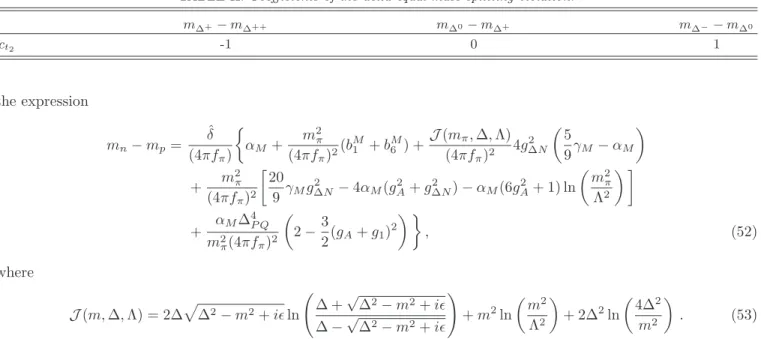
TABLE II:Coefficients of the delta equal mass splitting violation. m∆+−m∆++ m∆0−m∆+ m∆−−m∆0 ct2 -1 0 1 the expression mn−mp= ˆ δ (4πfπ) αM + m2 π (4πfπ)2 (bM1 +bM6 ) +J (mπ,∆,Λ) (4πfπ)2 4g∆2N 5 9γM−αM + m 2 π (4πfπ)2 20 9 γMg 2 ∆N −4αM(g2A+g2∆N)−αM(6gA2 + 1) ln m2 π Λ2 + αM∆ 4 P Q m2 π(4πfπ)2 2−32(gA+g1)2 , (52) where J(m,∆,Λ) = 2∆p∆2−m2+iǫln ∆ + √ ∆2−m2+iǫ ∆−√∆2−m2+iǫ ! +m2ln m2 Λ2 + 2∆2ln 4∆2 m2 . (53)
Note, the nucleon mass splitting is free of discretization errors at this order. The last term in this mass splitting expression is not physical, having arisen from our partially quenched construction with ∆2
P Q= ˆδ, Eq. (37).
Of phenomenological interest, the delta mass operator with coefficient tM
2 leads to a breaking of the delta equal
mass spacing [56]. Taking the delta mass splittings between neighboring members of the multiplet, one finds (at maximal twist) m∆−m∆′ = ˆ δ (4πfπ) γ M 3 + m2 π (4πfπ)2 tM 1 +tM2 +tM3 3 − J(mπ,−∆,Λ) (4πfπ)2 g2 ∆N(2γM −αM) 3 + m 2 π (4πfπ)2 ct2t M 2 3 − 52 81 γM 3 g 2 ∆∆− γM 3 1 +10g 2 ∆∆ 27 ln m2 π Λ2 + γM∆ 4 P Q 18m2 π(4πfπ)2 12−5g2 ∆∆ +ct2t W− 2 3 ˆ a2 (4πfπ)3 (54) where J(m,−∆,Λ) = ( J(m,∆,Λ) + 4iπ∆√∆2−m2, m <|∆| J(m,∆,Λ)−4π∆√m2−∆2, m >|∆| , (55)
andct2 is given in Table II. In the limit ˆδ→0, the delta mass splitting reduces to that in Ref. [25], m∆−m∆′ = ct2t W− 2 3 ˆ a2 (4πfπ)3 . (56) IV. DISCUSSION
In this work, we have proposed a partially quenched extension of the twisted mass lattice action which includes a strong isospin breaking mass term in the valence sector, and preserves flavor identification. Further, we developed the corresponding partially quenched twisted mass chiral perturbation theory relevant for our proposed lattice action. While this proposal does not completely incorporate the effects of the strong isospin breaking, we have demonstrated, using the partially quenched theory, that the error in this approximation is sub-leading. This method extends to the hyperon spectrum in a straightforward manner. The relevant partially quenched twisted mass χPT could be created by adding the isospin breaking mass term to the valence quarks in Refs. [40, 61, 62], and then matched to the unquenched theory [63]. Alternatively, one could develop the partially quenched version of the two-flavorχPT for
hyperons [57]. One application of this work would be the calculation of a isospin violations in the hadron spectrum utilizing twisted mass LQCD, for which these errors are even further suppressed. Combined with the physical point, this would allow for a lattice determination of the physical light quark mass splitting, 2δ=md−mu, a stated challenge
in Ref. [30].
To contribute to this proposed endeavor, we have determined the relevant chiral extrapolation formula for the mass splittings of the pions, nucleons and deltas (as well as expressions for the masses themselves). The leading non-vanishing correction to the pion mass splitting is
m2π0−m2π±= 4ˆδ2 f2 π l7− 64W′aˆ2sin2(ω) f2 π . (57)
At a fixed lattice spacing, with multiple values of the isospin breaking mass parameter, one can determine the Gasser-Leutwyler coefficient, l7. Using the physical values of the charged and neutral pion masses, after correcting for
electromagnetic interactions, this would allow for a lattice determination of the up and down quark masses. We have also provided expressions for the nucleon and delta mass splittings, and shown that throughO( ˆm2,δˆ2), these
mass splittings are free from errors arising from the degeneracy of the sea quarks. Scaling the masses byfπ, one can
perform an extrapolation of these mass splittings which requires no scale setting. The leading-order splittings (the NLO corrections exactly cancel and the full NNLO expressions are in Eqs. (52) and (54) respectively),
mn−mp fπ =αM 4π ˆ δ f2 π +O(ˆδm2 π), m∆−m∆′ fπ = γM 12π ˆ δ f2 π +O(ˆδm2π). (58)
After correcting for electromagnetic effects, these baryon mass splittings, combined with the physical mass splittings, could also be used to determine the physical mass splitting of the light quarks (perhaps we should caution that for present lattice simulations, the nucleon mass behaves linearly inmπ[64, 65], a trend which is not presently understood
theoretically, and may complicate the baryon extrapolation). Either way, one must determine the value of ˆδ, both for a given set of lattice input parameters and at the physical point. A direct lattice calculation of this quantity requires the determination of the renormalization coefficient, Zδ. However, one can make a good approximation of
this parameter by taking advantage of the fact both the twisted mass parameter as well as the isospin breaking mass parameter are protected from additive mass renormalization (actually, the explicit breaking of the parity-flavor symmetry by the proposed isospin breaking mass parameter gives rise to anO(δ2) correction toµ, but this is expected to be perturbative). From Eq. (21), one has
ˆ δ ˆ µ = Zδ Zµ δ0 µ0 , (59)
and at or near maximal twist, to a very good approximation,m2π ≃µ. If one further approximateˆ Zδ ≃Zµ, then a
conservative estimate can be made for the isospin breaking mass parameter ˆ
δ≃ µδ0
0m
2
π, (60)
whereδ0 andµ0 are the bare mass parameters of the action, Eq. (15). A determination of the physical value of this
parameter would allow a precise determination (supplemented by the approximations we have made) of theup-down quark mass splitting,
ˆ δ ˆ µ = md−mu md+mu 1 +O m2π (4πfπ)2 . (61) Acknowledgments
I would like to thank Kostas Orginos and Steve Sharpe for useful discussions on the subject. The work of AWL was supported in by the U.S. DOE OJI grant DE-FG02-07ER41527.
[2] R. Frezzotti, P. A. Grassi, S. Sint, and P. Weisz (Alpha), JHEP08, 058 (2001), hep-lat/0101001.
[3] K. Jansen, A. Shindler, C. Urbach, and I. Wetzorke (XLF), Phys. Lett.B586, 432 (2004), hep-lat/0312013. [4] A. M. Abdel-Rehim, R. Lewis, and R. M. Woloshyn, Phys. Rev.D71, 094505 (2005), hep-lat/0503007. [5] K. Jansen et al. (XLF), Phys. Lett.B624, 334 (2005), hep-lat/0507032.
[6] K. Jansen, M. Papinutto, A. Shindler, C. Urbach, and I. Wetzorke (XLF), JHEP09, 071 (2005), hep-lat/0507010. [7] K. Jansen, M. Papinutto, A. Shindler, C. Urbach, and I. Wetzorke (XLF), Phys. Lett.B619, 184 (2005), hep-lat/0503031. [8] P. Boucaud et al. (ETM), Phys. Lett.B650, 304 (2007), hep-lat/0701012.
[9] B. Blossier et al. (European Twisted Mass), JHEP04, 020 (2008), 0709.4574. [10] P. Boucaud et al. (ETM), Comput. Phys. Commun.179, 695 (2008), 0803.0224.
[11] C. Alexandrou et al. (European Twisted Mass), Phys. Rev.D78, 014509 (2008), 0803.3190. [12] B. Blossier et al. (2009), 0904.0954.
[13] T. Chiarappa et al., Eur. Phys. J.C50, 373 (2007), hep-lat/0606011. [14] R. Baron et al. (ETM), PoSLATTICE2008, 094 (2008), 0810.3807. [15] R. Frezzotti and G. C. Rossi, JHEP08, 007 (2004), hep-lat/0306014.
[16] R. Frezzotti, G. Martinelli, M. Papinutto, and G. C. Rossi, JHEP04, 038 (2006), hep-lat/0503034. [17] S. Aoki and O. Bar, Phys. Rev.D70, 116011 (2004), hep-lat/0409006.
[18] S. R. Sharpe, Phys. Rev.D72, 074510 (2005), hep-lat/0509009. [19] S. Aoki and O. Bar, Phys. Rev.D74, 034511 (2006), hep-lat/0604018. [20] R. Frezzotti and G. C. Rossi, JHEP10, 070 (2004), hep-lat/0407002.
[21] G. Munster and C. Schmidt, Europhys. Lett.66, 652 (2004), hep-lat/0311032. [22] L. Scorzato, Eur. Phys. J.C37, 445 (2004), hep-lat/0407023.
[23] S. R. Sharpe and J. M. S. Wu, Phys. Rev.D70, 094029 (2004), hep-lat/0407025. [24] S. R. Sharpe and J. M. S. Wu, Phys. Rev.D71, 074501 (2005), hep-lat/0411021. [25] A. Walker-Loud and J. M. S. Wu, Phys. Rev.D72, 014506 (2005), hep-lat/0504001. [26] F. Farchioni et al., Eur. Phys. J.C39, 421 (2005), hep-lat/0406039.
[27] A. Shindler, Phys. Rept.461, 37 (2008), 0707.4093. [28] S. Sint (2007), hep-lat/0702008.
[29] M. I. Buchoff, J.-W. Chen, and A. Walker-Loud (2008), 0810.2464. [30] F. Wilczek, Nucl. Phys. Proc. Suppl.119, 3 (2003), hep-lat/0212041.
[31] S. R. Beane, K. Orginos, and M. J. Savage, Nucl. Phys.B768, 38 (2007), hep-lat/0605014. [32] R. Frezzotti and G. C. Rossi, Nucl. Phys. Proc. Suppl.128, 193 (2004), hep-lat/0311008. [33] K. Osterwalder and E. Seiler, Ann. Phys.110, 440 (1978).
[34] C. W. Bernard and M. F. L. Golterman, Phys. Rev.D46, 853 (1992), hep-lat/9204007. [35] C. W. Bernard and M. F. L. Golterman, Phys. Rev.D49, 486 (1994), hep-lat/9306005. [36] S. R. Sharpe, Phys. Rev.D56, 7052 (1997), hep-lat/9707018.
[37] S. R. Sharpe and N. Shoresh, Phys. Rev.D62, 094503 (2000), hep-lat/0006017. [38] S. R. Sharpe and N. Shoresh, Phys. Rev.D64, 114510 (2001), hep-lat/0108003. [39] J. N. Labrenz and S. R. Sharpe, Phys. Rev.D54, 4595 (1996), hep-lat/9605034. [40] J.-W. Chen and M. J. Savage, Phys. Rev.D65, 094001 (2002), hep-lat/0111050. [41] S. R. Beane and M. J. Savage, Nucl. Phys.A709, 319 (2002), hep-lat/0203003. [42] K. Symanzik, Nucl. Phys.B226, 187 (1983).
[43] K. Symanzik, Nucl. Phys.B226, 205 (1983).
[44] S. R. Sharpe and J. Singleton, Robert L., Phys. Rev.D58, 074501 (1998), hep-lat/9804028. [45] G. Rupak and N. Shoresh, Phys. Rev.D66, 054503 (2002), hep-lat/0201019.
[46] J. Gasser and H. Leutwyler, Ann. Phys.158, 142 (1984).
[47] J. Bijnens and T. A. Lahde, Phys. Rev.D72, 074502 (2005), hep-lat/0506004.
[48] M. Golterman, S. R. Sharpe, and J. Singleton, Robert L., Phys. Rev.D71, 094503 (2005), hep-lat/0501015.
[49] J.-W. Chen, D. O’Connell, R. S. Van de Water, and A. Walker-Loud, Phys. Rev.D73, 074510 (2006), hep-lat/0510024. [50] J.-W. Chen, D. O’Connell, and A. Walker-Loud, Phys. Rev.D75, 054501 (2007), hep-lat/0611003.
[51] J.-W. Chen, D. O’Connell, and A. Walker-Loud (2007), 0706.0035. [52] J. Gasser and H. Leutwyler, Phys. Lett.B184, 83 (1987).
[53] G. Colangelo and S. Durr, Eur. Phys. J.C33, 543 (2004), hep-lat/0311023. [54] E. E. Jenkins and A. V. Manohar, Phys. Lett.B255, 558 (1991).
[55] E. E. Jenkins, Nucl. Phys.B368, 190 (1992).
[56] B. C. Tiburzi and A. Walker-Loud, Nucl. Phys.A764, 274 (2006), hep-lat/0501018. [57] B. C. Tiburzi and A. Walker-Loud, Phys. Lett.B669, 246 (2008), 0808.0482. [58] M. Luscher, Nucl. Phys.B364, 237 (1991).
[59] V. Bernard, M. Lage, A. Rusetsky, and U. G. Meissner, Eur. Phys. J.A35, 281 (2008). [60] V. Bernard, M. Lage, U.-G. Meissner, and A. Rusetsky, JHEP08, 024 (2008), 0806.4495. [61] A. Walker-Loud, Nucl. Phys.A747, 476 (2005), hep-lat/0405007.
[62] B. C. Tiburzi and A. Walker-Loud, Nucl. Phys.A748, 513 (2005), hep-lat/0407030. [63] M. Frink and U.-G. Meissner, JHEP07, 028 (2004), hep-lat/0404018.
[64] A. Walker-Loud et al. (2008), 0806.4549. [65] A. Walker-Loud (2008), 0810.0663.