"
اﻮﻠﻤﻋو اﻮﻨﻣآ ﻦ ﺬﻟا ﻻإ ﺾﻌﺑ ﻰﻠﻋ ﻢ ﻀﻌﺑ ﻲﻐﺒ ﻟ ءﺎﻄﻠﺨﻟا ﻦﻣ ًاﺮ ﺜﻛ نإو
ﺎﻣ ﻞ ﻠﻗو تﺎﺤﻟﺎﺼﻟا
“Verily many are the partners in business who wrong each other except those who
believe and work deeds of righteousness and how few are they (Sad 38: 24)
:
ﻟا ﻲﺑأ ﻦﺑ ﺚ ﺪﺣ
ﻲﻣوﺰﺨﻤﻟا ﺐﺋﺎﺴ
" :
ﻲﺒﻨﻟا ﻚ ﺮﺷ نﺎﻛ ﻧأ
)
ص
(
ﺎﻤﻠﻓ ،ةرﺎﺠﺘﻟا ﻲﻓ مﻼﺳﻻا لوأ ﻲﻓ
ﻲﺒﻨﻟا لﺎﻗ ﺢﺘﻔﻟا مﻮ نﺎﻛ
)
ص
:(
يرﺎﻤ ﻻو يراﺪ ﻻ ،ﻲﻜ ﺮﺷو ﻲﺧﺄﺑ ًﺎﺒﺣﺮﻣ
."
al-Sa’ib Ibn Abi al-Sa’ib al-Makhzumi who was a partner of the Prophet peace be upon
him in business at the beginning of Islam. On the day when the Prophet peace be upon
him conquered Mecca the Prophet said when he met Saib Welcome my brother and my
partner. He jokes not (i.e. he is serious in business) and do not argue (unnecessarily)
(Al Hakim, 2/61)
Chapter
9
CHAPTER LEARNING OBJECTIVES:
At the end of this chapter you will, insha Allah you will be able to:
i.
Explain the meaning of musharaka and how this contract is used
by Islamic banks to finance customers.
ii.
List the principles of musharaka and as well as explain the
shari’a rules.
iii.
Journalise accounting entries for musharaka
iv
Prepare the balance sheet and income statement extracts for
musharaka transactions
v
Apply shari’a and accounting principles as per FAS 4 to solve
accounting problems for complex events.
8. 1 Introduction
In this chapter, we will insha Allah, study the second partnership instrument i.e. musharaka. Musharaka is a partnership between two or more persons with a number of fiqh rules to protect the interests of all parties. Although, the Muslim world never
developed its version of the joint stock company, the sharikah al’inan is the closest to a joint stock company.
Islam leaves many of the details of the partnership to be agreed among the partner but as with all muamalat contracts, there are certain fiqh rules to be applied. Some of the distinguishing features of musharaka are:
1. At least two partners, there is no maximum
2. All partners can participate in the management, even if not to the same extent 3. Capital can be equally contributed or in different amounts
4. Proft sharing ratio must be agreed in advance.
5. Capital cannot be guaranteed by any partner, neither is interest on capital permitted. 6. Losses are shared on the capital ratio, not in the profit sharing ratio.
7 Each partner act as the agent of the other and can by himself decide to take a decision or to undertake a partnership activity, except that he is not allowed to his personal
business or expenses under the partnership umbrella.
8. Some partners, especially if they work more than others can have a profit share more than others even if they have contributed lower capital.
9. Musharaka differs from mudaraba, in that all partners must participate in the running of the business and all partners must contribute in capital (except in wujooh and ‘amal partnerships)
In contrast to the mudaraba, the bank has two advantages:
1) it has a say in the management and running of the musharaka business, this allows for control of agency costs and moral hazard problems.
2) losses are born in the capital contribution ratio, whereas in mudaraba, it is borne by the bank.as the rabbul mal.
The disadvantages are:
2) as a financial intermediary the Islamic bank might not want to get involved in the management of the business due to lack of expertise or regulatory requirements. However, in many jurisdictions, some leeway is given to Islamic banks to be more commercial as opposed to being a strictly financing institution, although this is stll a problem with many bank regulators.
8.2 Definition, types and financing model of musharaka
FAS 4, defines musharaka as follows:
8.2.1 Definition
Musharaka has been defined by AAOIFI as per FAS4 as follows:
Musharaka
A form of partnership between the Islamic bank and its clients whereby each party contributes to the capital of partnership in equal or varying degrees to establish a new project or share in an existing one, and whereby each of the parties becomes an owner of the capital on a permanent or declining basis and shall have his due share of profits. However, losses are shared in proportion to the contributed capital. It is not permissible to stipulate otherwise.
Constant Musharaka
It is a Musharaka in which the partners’ shares in the capital remain constant throughout the period as specified in the contract.
Diminishing Musharaka
It is a Musharaka in which the Islamic bank agrees to transfer gradually to the other partner its (the Islamic bank’s) share in the Musharaka, so that the Islamic bank’s share declines and the other partner’s share increases until the latter becomes the sole proprietor of the venture.
Participation
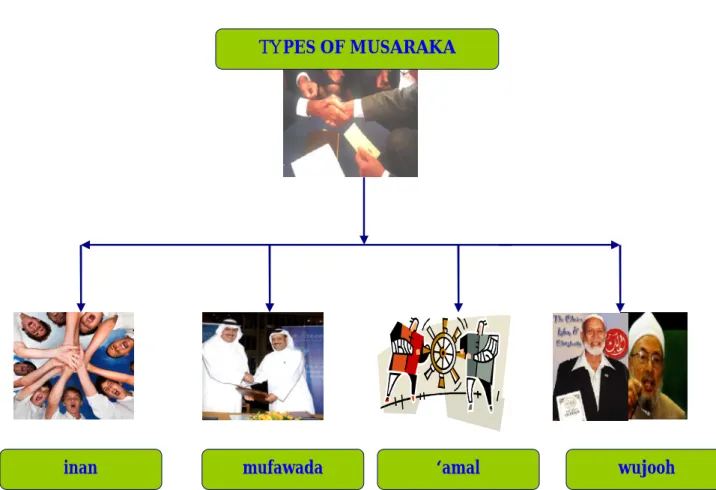
Types of Musharaka
There are various types of Musharaka viz:
1) Musharaka ‘inan (equivalent to joint stock) 2) Musharaka mufawada (flexible partnership) 3)Musharaka ‘amal (based on work done jointly)
4)Musharaka Al-Wujooh(reputation based credit partnership)
Fig 9.1 Types of Musharaka
TY
PES OF MUSARAKA
mufawada
‘amal
wujooh
According FAS4 , the characteristics of the different types of partnerships under Islam are as follows;
‘Inan partnership
It is a contract between two or more persons. Each of the parties contributes a portion of the overall fund and participates in work. Both parties share in profit or loss as agreed between them, but equality is not required either in the contribution to the fund or in work or in sharing of profit (these being subject to agreement between the parties). This type of partnership is approved by all Fuqaha.
Hanafis and Hanbalis allow any of the followings. Profits of the two parties to be divided in proportion to their contributed funds; profits may be divided equally but contributed funds may be different; and profits may be unequally divided, but contributed funds are equal. Ibn Qudamah said: “preference in profit is permissible with the existence of work, as one of them may be more knowledgeable in trade than the other and he may be stronger than the other in doing the work, and thus he is allowed to make an increase in his profit share a condition of his work”.
Malikis and Shafis make the acceptance of this type of partnership conditional on profits and losses being proportionate to the size of contributions to the overall fund because (according to them) profit in this type of partnership is considered to be return on capital(1).
Mufawada partnership
It is a contract between two or more persons. Each of the two parties contributes a portion of the overall fund and participates in work. Both parties equally divide profit or loss. It is a condition of this type of partnership that contributed funds, work, mutual responsibility and liability for debts be equally shared by the parties. Both Hanafis and Malikis have permitted this type of partnership but have stipulated many restrictions for it(2).
A’mal partnership
It is a contract between two persons who agree to accept work jointly and to share the profit from such work. For example, two persons of the same profession or craft may
(1) Sayed Sabeq, Fiqh Assunah, part 3, p. 296; Abdel Aziz Al-Khaiyaat, op. cit., part 2, pp. 30-31; Al-Kasani, Badaie’ as Sanaie’ fiTarteeb Asharaie’, Vol. 6, p.57.
(2) Kasani, op. cit., p. 56; Ibn Qudamah Al-Mughnee, Vol. 6, p. 30.
Definitions
agree to work together and to divide the profit arising from such work on an agreed basis. It is sometimes called abdan or sanaie’ partnership.
An a’maal partnership is considered permissible by Hanafis, Malikis, Hanbalis(3). It is considered valid within the same profession or otherwise. Its permissibility is based on much evidences including explicit approval thereon by the Prophet, prayers and peace be on him. In addition, it is based on agency which is permissible. This type of partnership has been used throughout without being disapproved of (4).
Al-Wujooh partnership
It is a contract between two or more persons who have good reputation and prestige and who are expert in trading. Parties to the contract purchase goods on credit from firms, depending for that on their reputation, and sell the goods for cash. They share profit or loss according to the guarantee to suppliers provided by each partner. Accordingly, this type of partnership does not require capital since it is based on credit backed by guarantee. Hence, it is sometimes called a “receivables
partnership”.
(3) Ahmed Ali Abdulla, Legal Entity in Islamic Fiqh, (Sudanese Printing Press House, Khartoum, undated), p. 217 and after.
(4) Abdel Aziz Al-Khaiyaat, part 2, op. cit., p. 37;. Ibn Qudamah, Al-Mughnee, op. cit. Vol. 5, p.6; Sayed Sabeq, Fiqh Assunah, op. cit., p. 297.
Musharaka financing model
The Islamic bank provides capital along with the customer in a joint venture of an already existing project or a new project. The profit sharing ratio (PSR) is agreed beforehand in terms of percentage of the profits (and never on capital). Losses are shared on the ratio of capital contributed. However, it is permissible to defer the allocation of losses so that in order to be compensated by profits of subsequent periods.
This is illustrated in the following illustration 9-1:
ISLAMIC BANK
MUSHARIK 2
$200,000
MUSHARIK 1:
$100,000
INVESTMENT
PSR 50:50
PROFITS
$60,000
LOSS ($60,000)$30,000
LOSS ($20,000) LOSS ($40,000)$30,000
ILLUSTRATION 9-1: MUSHARAKA FINANCING PROFIT AND LOSS SHARING
Here the Islamic Bank (Musharik 2) contributes $200,000 to the project, while the other partner (musharik 1) contributes $100, 000. The Profit sharing ratio (PSR) is 50:50 although the capital ratio is 2:1.If the venture makes a profit of $60,000, each partner takes $30,000. However, if the venture makes a loss of $60,000, Musharik 1 bears only (1/3) of the loss, hence 1/3x$60,000=($20,000) while the Bank bears 2/3 of the loss which is (2/3x$60,000) =($40,000)
Those of you who have studied partnership accounting will notice, that in English law, the partnership can enter into a Profit AND loss sharing agreed ratio, whereas in a Musharaka, you cannot enter into a loss sharing agreement ratio. It is always in relation to the capital contributed. Under English law, the same rule is applied using the legal rule in Garner Vs Murray , in the case of partnership dissolution and one of the partners is insolvent.
8.3 Musharaka principles, rules and complexities
Contracting Parties
It is a requirement that the partner should be competent to give or be given power of attorney.
Work
Participation of partners in the work of a Musharaka is a basic rule and it is not permissible for one of the partners to stipulate the non-participation of the other partner. However, equality of work is not a requirement. It is permissible that one of the partners exert more work than the other, and in that case he may require an additional share of profit for himself.
Work rules
In a partnership with a contributed capital, the partners shall provide both funds and work and each partner shall undertake work as an agent of the partnership subject to the partnership contract. This is regulated by a number of juristic rules, the most significant of which are:
Subject Matter of the Contract: (Funding and Work)
Capital contributed shall be in cash, gold, silver or their equivalent in value•
Capital may consist of trading assets such as goods, property and
equipment, etc. It may also be in the form of intangible rights, such as liens, patents and suchlike. It is considered permissible by some Fuqaha that the capital of a company can be
contributed in the form of these types of assets provided they are valued at their cash equivalent according to what the partners agree upon.
Power of attorney and disposition of funds
Any partner has the right to dispose of the partnership’s assets in the normal course of business. A partnership with a contributed capital (e.g., alanan) constitutes an entity and once the capital has been contributed it
(5) Ibn Qudamah, Al-Mughnee, Vol. 5, Kitab Al-Wakalah, p.88 and after, Sayed Sabeq, Fiqh Assunah, Vol. 3, (Agency Chapter), p. 226.
Agency in the work
Each partner carries out work in the partnership on behalf of himself and as an agent for his partner. This is governed by the general rules of agency contract in Islamic jurisprudence. Some of these rules are related to the principal and others are related to the agent and some are related to the things which are the subject of agency. All these matters should be made clear in the Musharaka contract(5).
Scope of the work
This relates to the specification of the scope of each partner’s work in the partnership in relation to the latter’s objectives and activities. The partner should perform the agreed work without negligence or misconduct. Partnership work includes management of the business (e.g., planning, policy making, development of executive programs, follow-up, supervision, performance appraisal and decision-making). A partner who undertakes work outside his agreed scope of duties is entitled to employ workers to perform the said work, and if he performs such work himself, he shall be entitled to receive remuneration similar to that paid for similar work. However, it is considered permissible by some Fuqaha that one partner may delegate full authority to another to carry out the business of the partnership if this is the most satisfactory arrangement for the partnership.
Appointment of workers
The partners may appoint workers to perform the tasks which are not within the scope of
comprises a single fund. Each partner empowers his other partner(s) to dispose of the assets and he is thus considered to be authorised to employ them in the activity of the Musharaka provided he does so with due care to the interests of his partner(s) and without misconduct or negligence. A partner is not allowed to disburse or invest the funds for his personal purposes.
Non-guarantee of capital
Neither partner can guarantee the other partner’s capital, because Musharaka is based on the principle of al gh (c) It is not permissible to agree in a
Musharaka contract that the transfer of the Islamic bank’s portion to the other partner or vice versa should be at historical cost. Normally, the transfer should take place on the basis of fair value at the time of transfer
Rules of profit
Profit should be quantifiable. If it is not, this will undermine the contractual basis of the partnership through leading to differences and disputes at the time of profit allocation or liquidation of the partnership. If the partners say that the “profit will be between us”, profit will in this case be allocated according to the share of each of them in the capital. Each partner’s profit must be a proportionate share of the whole partnership profit. No predetermined amount may be assigned to one of the partners, as in this case profit sharing will not take place and the legal basis of the partnership will be undermined.
(6) Al-Zailaei’, Tabieen Al-Haqaiq Sharh Kanz Alhaqaiq, part 5, p.30. (7) Ibn Qudamah, Al-Mughnee, Vol. 5, p. 22.
(10) Refer to: Ali Al-Khafeef, Companies in Islamic Jurisprudence, pp. 29,30; Al-Bahr Al-Zukhar Al-Gami’ Lemathahib Ulamma’ al Absar, part 4, p.82.
their individual work, and the cost of such work will be borne by the partnership. However, if a partner employs a worker to do some of the tasks which were originally assigned to him, the resulting costs will be borne by him since the partnership contract is based on both funds and work, and the earned profits are the outcome of both these elements(6). Appointment of workers is conditional upon a genuine requirement for their services and that they should receive remuneration in accordance with this.
d.Borrowing, lending, grants and charitable donations
The partner may not borrow money on account of the partnership or lend money to a third party from the funds of the partnership, donate or grant money(7) except after securing the agreement of other partners. Rules of Musharaka termination
In general, the partnership shall be terminated if one of the partners terminates the contract, or dies, if his legal competency ceases or if the partnership capital is lost.
The majority of Fuqaha, except for Malikis, are of the opinion that as partnership is one of the permissible forms of contract, each of the partners is entitled to terminate it whenever he wishes, as is the case with agency contracts. The partnership is based on agency and probity. Each of the partners is a proxy for the others and a principal at the same time. He acts in respect of his share as a principal and in respect of his partners’ shares as a proxy, i.e.,
It is permissible for one of the partners to propose that if profits exceed a certain amount, such excess or a percentage of it will be credited to him. It is stated in Bahr Zukhar Gami lemathahib Ulamma’ Al-Absar that “if one of them (partners) says that I will have ten if we gain more than that then this will be valid and the condition will be binding as there is no exigency of revocation”(10).
Rules of allocating profits among partners Fuqaha differ on the issue of allocating profits among the partners. Hereunder is a brief outline of their opinions:
First opinion
Profit should be divided among the partners in proportion to their contributed capital, whether the amount of work done by the partners is equal or not. This is the opinion of Malikis and Shafis and their argument is based on the grounds that profit is the return on capital, hence it must be proportional thereto. Preferential treatment in profit sharing combined with equality of capital contribution leads to a return on an amount that has not been committed.
Second opinion
Profit may vary between the partners if they make this a condition of the contract. This is the opinion of Hanafis and Hanbalis, and their argument is based on the proposition that profit is the
(8) Ali Al-Khafeef, Companies in Islamic Jurisprudence, op. cit., p548.
(9) Al-Ainy, Al-Benaiyah Fi Sharh Al-Hedaiyah, op. cit., part 6, p.108; Ibn Qudamah, Al-Mughnee, part 5, p.37 (The case of : Wadi’ah should be proportionate to the amount of fund).
(11) Refer to: Ibn Rushd, Bidayat al Mujtahid wa Nihayat al Muqtasid, part 2, p. 253; Al-Khateeb, Mughni Al-Mohtaj Sharh Al-Manhaj, (Dar Ehia’ Al-Turath Al-Arabi, Beirut), part 2, p. 215; Ibn Qudamah, Al-Mughnee, part 5, pp. 30,31.; Mahmoud Bin Ahmed Al-Ainy al Benaiyah Fi Sharh Al-Hedaiyah, part 6, p. 108.
as an agent. In principle, agency is one of the unanimously permissible contracts and no one party is forced to proceed with it against his will. The partnership, too, should start with an agency relationship between the partners, and this relationship provides the basis for its continuity. If the agency relationship is severed by termination on the part of one of the partners, the legal basis upon which they acted in respect of each other’s funds will be eliminated(8).
In the case of death, one of the heirs, if he is of sound mind, may replace the deceased provided that the other heirs and the other partners agree to that. This shall also be applicable in case one of the partners loses competency.
Rules of loss
Fuqaha agree that loss should be divided between the partners in proportion to their respective shares in the capital. Fuqaha call this “wadhee’ah” (loss). They support this opinion by the following saying of Ali bin Abi Talib (may Allah be pleased with him): “Profit should be according to what they (partners) stipulated, and the loss should be proportionate to both funds”. Ibn Qudamah says “we know not of any difference in this matter among the scholars”(9). In the case of on-going concerns, it is permissible to defer the allocation of loss in order to be compensated by the profits of subsequent periods.
fruit of the interaction of funds and work. This is because one of the partners may be more experienced, tactful and discrete than the other, and hence it is permissible for him to require for himself an additional share of profit in return for his extra work contribution. The Hanafis and Hanbalis support this argument by following the saying of Ali bin Abi Talib (may Allah be pleased with him): “Profit should be according to what they (partners) stipulated, and the loss should be proportionate to both funds.” This opinion assists in considering the role of experience, tactfulness, courtesy and efficiency in achieving profit”(11). Based on the second opinion the net realized profits can be divided into two parts:
a.profit is to be allocated according to the efforts of partners in doing the work. b.profit is it is to be allocated according to the share of each partner in the capital.
It is also permissible to allocate a common share of profit to a third party whenever the partners agree to that, e.g., a share for the poor and the needy or to charitable organizations. It is also permissible to allocate part of profits as a reserve to support the future position of the partnership.
8.4 Recognition of musharaka transactions and journal
entries
8.4.1.Recognition of the Islamic bank’s share in Musharaka capital at
the time of contracting
The Accounting rules for recognition and measurement for Musharaka capital is similar to those of mudaraba except for losses. The following are some of the rules.
(1) The Islamic bank’s share in Musharaka capital (cash or kind) is recognized when it is handed over to the partner or made available to the partnership under the title “Musharaka financing” in the balance sheet.
(2)If the bank’s share is in the form of trading or non-monetary assets, it should be valued at fair value and any difference between the carrying amount of the assets in the bank’s books and the fair value is recognized as profit and loss in the income statement.
(3) Normally, contracting expenses ( e.g. feasibility studies, legal expenses) are not recognized as part of the capital unless agreed by both parties.
8.4.2 Measurement of the Islamic bank’s share in Musharaka capital after
contracting at the end of a financial period
(4) In the case of constant musharaka the Islamic bank’s share in the constant Musharaka capital should be measured at the end of the financial period at historical cost (the amount which was paid or at which the asset was valued at the time of contracting).
(5)However, if the musharaka is a diminishing (musharaka mutanaqqisa), then the he Islamic bank’s share in the diminishing Musharaka should be measured at the end of a financial period at historical cost after deducting the historical cost of any share transferred to the partner (such transfer being by means of a sale at fair value). Any difference between historical cost and fair value of the portion of share sold shold be recognized as profit or loss in the Islamic bank’s income statement.
(6) If the diminishing Musharaka is liquidated before complete transfer is made to the partner, the amount recovered in respect of the Islamic bank’s share shall be credited to the Islamic bank’s Musharaka financing account and any resulting profit or loss, namely the difference between the book value and the recovered amount, shall be recognized in the Islamic bank’s income statement.
(7) If the Musharaka is terminated or liquidated and the Islamic bank’s due share of the Musharaka capital (taking account of any profits or losses) remains unpaid when a settlement of account is made, the Islamic bank’s share shall be recognized as a receivable due from the partner.
OR IN KIND: TRADING OR NON MONETARY ASSETS VALUED AT HISTORICAL COST
VAL
UED AT FAIR VALUE “MUSHARAKA APPEARS AS FINANCING” IN THE BALANCE SHEET DIMINISHING MUSHARAKA CONSTANT MUSHARAK A MUSHARAKA FINANCING AT HISTORICAL COST X LESS ALLOWANCES FORDOUBTFUL FINANCING (X)
NET X
MUSHARAKA FINANCING AT HISTORICAL COST x LESS HISTORICAL COST OF SHARE SOLD TO PARTNER (X) LESS ALLOWANCES FOR
DOUBTFUL FINANCING (X) NET X INCOME STATEMENT PROFIT/LOSS FROM MUSHARAKA X ADD/(LESS)
GAIN/LOSS FROM SALE OF MUSHARA SHARE AT FAIR VALUE X ISLAMIC BANK CONTRIBUTES CAPITAL EITHER
IN CASH
8
.4.3 Recognition of the Islamic bank’s share in Musharaka profits or losses
(8) Profits or losses in respect of the Islamic bank’s share in Musharaka financingtransactions that commence and end during a financial period shall be recognized in the Islamic bank’s accounts at the time of liquidation.
(9) In the case of a constant Musharaka that continues for more than one financial period, the Islamic bank’s share of profits for any period, resulting from partial or final settlement between the Islamic bank and the partner, shall be recognized in its accounts for that period when the profits are distributed; the Islamic bank’s share of losses for any period shall be recognized in its accounts for that period to the extent that such losses are being deducted from its share of the Musharaka capital.
(10) The same as in (9) above applies to a diminishing Musharaka which continues for more than one financial period, after taking into consideration the decline in the Islamic bank’s share in Musharaka capital and its profits or losses.
(11) If the partner does not pay the Islamic bank its due share of profits after liquidation or settlement of account is made, the due share of profits shall be recognized as a receivable due from the partner
(12) If losses are incurred in a Musharaka due to the partner’s misconduct or negligence, the partner shall bear the Islamic bank’s share of such losses. Such losses shall be recognized as a receivable due from the partner. (13) The Islamic bank’s unpaid share of the proceeds as mentioned above shall
be recorded in a Musharaka receivables account. A provision shall be made for these receivables if they are doubtful.
8.4.4 Disclosure requirements
FAS 4, requires disclosure in the notes to the financial statements if the Islamic bank has made during that period a provision for a loss of its capital in Musharaka financing transactions. In practise, however, the banks provides for this in the balance sheet itself and this is more in line with international standards on asset impairment.
8.5 Asset and Liability and income measurement
Presentation and Disclosure of Musharaka Financing
Balance Sheet
Musharaka Financing*
XX
Less: Provision for loss in Musharaka
Financing
(XX)
Net Musharaka Financing
XX
* Jointly or Self finance Assets
INCOME STATEMENT
Musharaka income
XX
No.
Transactions /Events
DR
CR.
1
Financing for Customers and
Partners provided.
Musharaka Financing Cash
2
Termination or repayment of
capital by partner
Cash
Musharaka financing
3
Profit received from Musharaka
Cash
Profit & Los Acc
4
Loss on Musharaka
Profit and Loss
Musharaka Financing
5
Profit on sale of banks share in a
diminsing musahraka
Cash
Musharak Financing
Profit and loss acc.
6
Amount outstanding from
partner at settlement
8.6 Accounting Illustration
Bank Syari’ah Malaysia Berhad has provided working capital to Tijarah
Construction Sdn. Bhd. based on the principle of Musyarakah Mutanaqisah
amounting to $400,000. Profit and loss sharing ratio as agreed by both parties
is similar to the ratio of capital contribution which is 30:70 (Bank: Customer)
at the beginning of the contract. The repayment shall be equal throughout the
contract period of four years. However, Tijarah Construction had financial
difficulties during year 2 and thus only managed to pay 50% of the agreed
repayment amount. Half of the amount outstanding in year 2 has been paid in
year 3 and another half was paid in year 4. Tijarah Construction also
experienced financial difficulties in year 4 whereby the scheduled repayment
outstanding at the end of the year was amounting to $35,000.
The profit and loss for the above project is as follows:
Year 1
Profit
RM 180,000
Year 2
Loss
RM 150,000
Year 3
Profit
RM 220,000
Year 4
Loss
RM 80,000
Required:
Prepare extract of journal entries from the beginning until the end of the contract to
record the recognition of asset and profit/loss of Musyarakah Mutanaqisah
financing provided by Bank Syari’ah Malaysia Berhad based on the following
recognition methods:
(i)Cash basis
(ii) Accrual basis
Comment on your answer in part (a) above.
(IIUM B.Acc, semester 2, 2004/2005, Q2)
a. Cash basis
Year 1
Dr. Musyarakah mutanaqisah Financing
400,000
Cr. Cash
400,000
Dr. Cash
100,000
Cr. Musyarakah mutanaqisah Financing
100,000
Dr. Cash
54,000
Cr. Profit and loss
54,000
Year 2
Dr. Cash
50,000
Cr. Musyarakah mutanaqisah Financing
50,000
Year 3
Dr. Cash (100,000 + 8,125)
108,125
Cr. Musyarakah mutanaqisah Financing
108,125
Accrual basis
Year 1
Dr. Musyarakah mutanaqisah Financing
400,000
Cr. Cash
400,000
Dr. Cash
100,000
Cr. Musyarakah mutanaqisah Financing
100,000
Dr. Cash
54,000
Cr. Profit and loss
54,000
Year 2
Dr.Cash
(1/2 agreed repayment )50,000
Dr. Profit and loss
( 150,000 x 0.225)33,750
Dr. Receivable
16,250
Cr. Musyarakah mutanaqisah Financing
100,000
Year 3
Dr. Cash ( 100,000 + 8,125)
108,125
Cr. Musyarakah mutanaqisah Financing
100,000
Cr. Receivable
8,125
Dr. Cash
33,000
Cr. Profit and loss
33,000
Year 4
Dr. Profit and loss
6,000
Dr. Cash
65,000
Dr.Receivable
( 35,000 – 6,000)
29,000
Cr. Musyarakah mutanaqisah Financing
100,000
Dr. Cash
8,125
Comments:
(i)Different basis of recognition ( i.e cash vs. accrual ) will lead to different amount of profit recognized.
(ii)Accrual basis will lead to more complex recognition of profit / income . (iii) When there is a loss, it needs to be set-off against the amount due to the financing repayment.
(iivWhen the partner faced financial problem and did not pay as scheduled, accrual basis require allocation of repayment after taking into account profit and loss for that year.
(V)Accrual basis would provide true and fair reflection of profit /loss than cash basis.
1
. According to FAS 4: Musharaka Financing, which of the following statements is
true:
a) At the time of contracting, the bank provided cash to the amount of US$5,000,000. b) At the time of contracting, the bank provided cash and assets in kind to the value of
US$5,000,000. The assets in kind were measured at fair value of the assets. c) The US$5,000,000 was not inclusive of capital expenditure undertaken prior to
commencement of the project. d) All of the above.
CIPA Multiple Choice
Questions
2.
CIPA sample question
Read the following case to answer Question 3.
Syed Alwi enters into a partnership with As-Siddiqui Islamic Bank on a project to build
science laboratories for government schools. Syed Alwi puts in US$20,000 capital while
the bank offered to cover whatever remaining expenditure with a maximum cap of
US$80,000. The bank makes internal return computations and stipulates the following
conditions in the agreement;
i) Syed Alwi shall ensure that the first instalment from the Government (tender awarding
party) shall be used to pay back the bank’s US$80,000 before distributing profits and
losses.
ii) If there are losses, the bank’s share of which will be limited to US$20,000.
iii) The bank will require Syed Alwi to provide guarantees, collaterals and performance
bonds to ensure that the risk of the bank is covered.
3. Which of the following arguments is true in verifying the validity of the contract:
a) The above contract is valid because the bank has to protect the shareholders capital anddepositors funds otherwise the entire financial system will collapse. This is in the interest of promoting greater benefit for the community.
b) The above contract is invalid because the proper Shari’a contract is not mentioned in the terms and conditions.
c) The above contract is valid because building the science laboratories for the schools is beneficial for the community.
d) The above contract is invalid because the risk and return of the partnership is not upheld resulting in an imbalanced benefit accruing to one party over the other.
Questions 4-6 refers to the following case:
Dawood, Rushdi, Waheed and Uthman enter into a partnership. Dawood contributes the
office building that he owns as the capital to the partnership. Rushdi has inherited gold
and jewelry and hence contributes them as his share of the partnership. Waheed and
Uthman both contribute cash.
4. Is the above contract compliant according to Shari’a:
a) Yes, it is considered a Musharaka contract and a further classification is ‘Inan partnership. b) Yes, it is considered Mudaraba partnership between the partners who contribute cash and
partners who contribute non-cash items.
c) No, it is not compliant to Musharaka partnership as the capital is not cash by all partners. d) No, it is not compliant as there is no such precedent in Islamic finance on such partnerships.
5. Which of the following statements is true with regards to the capital:
a) The capital is deemed to be contributed only by Waheed and Uthman and as such they will share in the profits while the others will receive the market rate for their contributions. b) The capital is not acceptable because it cannot be commingled.
c) The capital contributed by the partners is agreed by all fuqaha to be acceptable as long as it can be converted into a cash equivalent value.
d) There is no precedent in Islamic finance on this partnership.
6. Which of the following statements regarding profit sharing for the above contract
is true:
a) Profit should be divided among the partners according to contributed capital because profit is the returns on capital.
b) Profit may vary between the partners and not proportionate to capital because profit is the fruit of capital and labor.
c) The above contract is not valid hence none of the above profit sharing equations are valid. d) Statements (a) and (b) are correct and the partners will have to agree on which approach to
adopt.