San Jose State University San Jose State University
SJSU ScholarWorks
SJSU ScholarWorks
Master's Theses Master's Theses and Graduate Research
Fall 2019
The Effects of a 6-Week Group Meal Prep Program on the
The Effects of a 6-Week Group Meal Prep Program on the
Frequency of Consumption of Home-Cooked Meals
Frequency of Consumption of Home-Cooked Meals
Shannon MendezSan Jose State University
Follow this and additional works at: https://scholarworks.sjsu.edu/etd_theses Recommended Citation
Recommended Citation
Mendez, Shannon, "The Effects of a 6-Week Group Meal Prep Program on the Frequency of Consumption of Home-Cooked Meals" (2019). Master's Theses. 5073.
THE EFFECTS OF A 6-WEEK GROUP MEAL PREP PROGRAM ON THE FREQUENCY OF CONSUMPTION OF HOME-COOKED MEALS
A Thesis Presented to
The Faculty of the Department of Nutrition, Food Science and Packaging San José State University
In Partial Fulfillment
of the Requirements for the Degree Master of Science
by
Shannon Mendez December 2019
© 2019 Shannon Mendez
The Designated Thesis Committee Approved the Thesis Titled
THE EFFECTS OF A 6-WEEK GROUP MEAL PREP PROGRAM ON THE FREQUENCY OF CONSUMPTION OF HOME-COOKED MEALS
by
Shannon Mendez
APPROVED FOR THE DEPARTMENT OF NUTRITION, FOOD SCIENCE, AND PACKAGING
SAN JOSÉ STATE UNIVERSITY December 2019
John Gieng, PhD Department of Nutrition, Food Science & Packaging, San José State University
Jamie Kubota, MS, RD Department of Nutrition, Food Science & Packaging, San José State University
Adrianne Widaman, PhD, RD
Department of Nutrition, Food Science & Packaging, San José State University
ABSTRACT
THE EFFECTS OF A 6-WEEK GROUP MEAL PREP PROGRAM ON THE FREQUENCY OF CONSUMPTION OF HOME-COOKED MEALS
by Shannon Mendez
Consumption of food away from home is associated with higher caloric intake and poorer diet quality compared to home-cooked food. The advance quantity meal prep (AQMP) program is a group-based program developed to increase the frequency of consumption of home-cooked meals. The AQMP pilot study was a pre-experimental 6-week intervention aimed at analyzing the effects of the program on frequency of consumption of home-cooked meals, cooking attitudes, cooking self-efficacy, and anthropometric measures. Ten study participants met once a week at a commercial
kitchen to prepare and package lunches, dinners, and snacks for the work week. A survey was administered and anthropometric measurements were taken at three time points: pre-program, immediately post-pre-program, and 3 months post-program. The questionnaire measured: physical activity, cooking attitudes, cooking self-efficacy, and cooking behavior and consumption. Significant increases were seen in total cooking attitudes (P=0.02), cooking self-efficacy (P=0.002), and percentage of home-cooked dinner
consumption (P=0.04). Significant decreases in weight (P=0.03), body fat mass (P=0.01), and BMI (P=0.03) were reported. The present pilot study indicates that advance quantity meal prep may contribute to increased cooking attitudes, cooking self-efficacy, and consumption of home-cooked dinners. Reduced weight, body fat, and BMI may also be a
ACKNOWLEDGMENTS
Graduate school has been one of the most challenging, yet rewarding experiences of my life. This entire process has humbled and stretched me in ways I never thought imaginable. I am very proud of this accomplishment, however it would have never been achievable without the help and support of some very important people. First, my loving, supportive, and patient husband. Thank you Steve Mendez for always encouraging me and cheering me on. I am forever grateful to you for your unwavering support through this journey. Thank you to my advisors, Jamie Kubota, Dr. Adrianne Widaman, and especially Dr. John Gieng. You truly went above and beyond to guide me through this process and ensure I completed it in a timely manner. Thank you for being so generous with your time and energy. It has been an honor to learn from each of you. Thank you to Hsin Yi Tseng for all your help with data collection and helping to make my intervention run smoothly. Your help was greatly appreciated. Finally, thank you to my parents Scott and Mary Ann Taylor. You taught Leslie and I that anything is achievable if you are willing to work hard for it. I hope that we have made you proud with our scholastic and professional accomplishments.
TABLE OF CONTENTS
List of Tables………... vii
List of Figures……….. viii
List of Abbreviations………... ix
CHAPTER 1: Literature Review………. 1
Introduction……… 1
Definitions of Food Sources……….. 2
The Effects of Eating Food Away From Home………. 3
Home-Cooked Meals and Health Outcomes………. 4
Barriers to Home Cooking………. 6
Effectiveness of Group-Based Nutrition Education Interventions…… 9
Framework for Behavioral Change……… 11
Conclusion………. 13
CHAPTER 2: Journal Article……….. 14
Abstract……….. 15
Introduction……… 16
Methods………. 17
Results……… 22
Discussion……….. 26
Implications for Research and Practice………. 30
References……….. 31
CHAPTER 3: Summary and Recommendations………. 33
Summary……… 33
Recommendations……….. 34
References……….. 35
Appendices………... A. IRB Approval Letter……… 39
B. Consent Letter……….. 40
C. Survey……….. 45
LIST OF TABLES
Table 1. Nutrition Information for AQMP Meals……… 19 Table 2. Changes in Anthropometric Data Between Pre-Program,
Post-Program, and 3 Months Post-Program... 23 Table 3. Average Total Cooking Attitudes and Self-Efficacy
Scores………. 24
Table 4. ASA Dietary Recall Submissions Per Participant…………... 25 Table 5. Energy Intake and Expenditure of Participants Pre-Program,
LIST OF FIGURES
Figure 1. Average home-cooked meal consumption per week………. 24 Figure 2. Percent home-cooked meal consumption……….. 25
LIST OF ABBREVIATIONS AQMP—Advance Quantity Meal Prep
BMI—Body Mass Index CWC—Cooking with a Chef FAH—Food at home
FAFH—Food away from home HBM—Health Belief Model HEI-2010—Healthy Eating Index
Chapter One Literature Review Introduction
Obesity is one of the largest epidemics of modern times, and has been linked with several non-communicable diseases such as Type 2 Diabetes and heart disease (Expert, 2014). In the United States, the prevalence of overweight and obesity has steadily risen over the past several decades. Between 1999-2016, obesity rates rose from 30.5% to 39.8% among adults ages 20 and older (Hales, Carroll, Fryar, & Ogden, 2017). Many factors have led to this increase, one of which is the overabundance and availability of convenience foods, and another the decline in cooking skills and nutrition knowledge (Levy & Auld, 2004; Saksena et al., 2018).
Food away from home (FAFH) includes food from fast-food establishments and full service restaurants, and is found to have poorer nutritional quality compared to food prepared at home (FAH) (Saksena et al., 2018). FAFH generally contains more calories, is served in larger portion sizes, and is less nutritious (e.g., high in fat and sodium) than FAH (Guthrie et al., 2002; Mancino et al., 2010; Nielsen & Popkin, 2003). This increase in caloric intake due to higher consumption of FAFH has contributed to weight gain in the US population (Mancino et al., 2010). Studies show that eating home-cooked meals more frequently is associated with lower BMI and body fat percentage, and an overall healthier diet (Mills, Brown, Wrieden, White, & Adams, 2017; Tiwari, Aggarwal, Tang, & Drewnowski, 2017; Wolfson & Bleich, 2014). However, lack of time, nutrition
knowledge, and cooking skills are reported as powerful deterrents to cooking at home (Tiwari, et al., 2017).
Effective interventions include hands on cooking classes, nutrition education
programs, and group classes focused on menu plans, portion control, and food budgeting (Herbert et al., 2014; Jordan, et al., 2008; Keller, Amie Gibbs, Wong, Vanderkooy & Hedley, 2004; Warmin, Sharp, & Condrasky, 2012). These interventions have been shown to increase cooking skills, increase confidence with meal preparation, and reduce expenditure on takeaway or fast foods (Herbert et al., 2014; Jordan, et al., 2008; Keller, et al., 2004; Warmin, et al., 2012). Although many studies have addressed cooking skills, cooking attitudes and behaviors, and cooking self-efficacy, there is limited research on programs or methods that promote FAH while addressing time constraints. This literature review examines FAFH and FAH consumption and health, barriers to home cooking, the effectiveness of group-based nutrition education interventions, and a framework for behavioral change.
Definitions of Food Sources
For this review, food sources are classified into two main categories, defined by where the food was purchased. These categories are defined below:
Food from supermarkets, smaller grocery stores, supercenters, or other retailers is defined as food prepared at home (FAH) although it could include prepared or semi-prepared items such as rotisserie chicken or bagged salad. Food prepared away from home (FAFH) includes foods obtained from full-service restaurants with wait staff, fast-food establishments with no wait staff, food obtained at school or day care, and a catchall “other” subcategory that includes vending machines, common coffee pot/snack tray, Meals on Wheels, street vendor, etc. The definitions of FAH and FAFH are anchored on where the food was obtained. FAH food can be eaten away from home and FAFH food can be eaten at
stores and eaten as a peanut butter sandwich at home, school, or work.
Meanwhile, home delivery or takeout from a pizza parlor is classified as FAFH even if it is eaten at home. (Saksena et al., 2018)
The Effects of Eating Food Away From Home (FAFH)
The restaurant industry in the United States has grown from $43 billion in 1970 to a projected $863 billion in 2019 (National Restaurant Association, 2019). Over the years, many home-cooked meals have been replaced by restaurants, fast food, delivery, and ready-made meals (Guthrie et al., 2002; Mancino et al., 2010; Nielsen & Popkin, 2003; Saksena et al., 2018). Between 1987 and 2017 FAFH expenditure rose steadily. In 2010, for the first time in history, FAFH exceeded FAH expenditure, accounting for about 50.2 percent of total U.S. food spending for that year (Saksena et al., 2018). Between 1965 and 2008, the proportion of daily energy consumed from home food sources decreased by approximately 23 percent (Smith, Ng, and Popkin, 2013). In addition, the average American’s energy intake from FAFH consumption doubled from 17 percent in 1977-78 to 34 percent in 2013-14 (Saksena et al., 2018).
Simultaneously, obesity rates steadily increased. Many studies have shown that consumption of FAFH is associated with poor diet quality (Harnack et al., 2000; Lachat et al., 2012; Saksena et al., 2018; Tiwari et al., 2017; Todd, Mancino, & Lin, 2010). One study found that people eat more calories overall and have poorer diet quality on days when they eat at least one meal away from home, with the greatest effect being the
reduction in the number of servings of fruits, vegetables, whole grains, and dairy (Todd et al., 2010). Similar studies showed higher frequency of eating FAFH was associated with
intake, higher total fat intake, and lower micronutrient intake (Lachat et al., 2012; Tiwari et al., 2017). In general, FAFH contains more saturated fats and sodium, and less
calcium, iron and fiber than FAH does (Saksena et al., 2018).
Furthermore, findings from many research studies show a positive correlation between frequency of fast food consumption and BMI (Bhutani, Schoeller, Walsh, & McWilliams, 2018; Duffey, Gordon-Larsen, Steffen, Jacobs Jr, & Popkin, 2009; Fulkerson et al., 2011; Gillis & Bar-Or, 2003). Fast food, in particular, is associated with high energy intake, low intake of essential micronutrients, and inferior metabolic outcomes (Duffey et al., 2009; Fulkerson et al., 2011; Gillis & Bar-Or, 2003). In a study of metropolitan
communities in Wisconsin, it was found that for every 1 meal per week increase in fast-food and sit-down restaurant consumption, BMI increases by 0.8 and 0.6 kg/m2,
respectively (Bhutani et al., 2018).
The shift in consumer preferences toward FAFH does not come without a price, however. The prevalence of obesity and non-communicable diseases such as diabetes, heart disease, and some cancers continues to rise in America, and poor diet quality is a major contributing factor to this problem (Expert, 2014).
Home-Cooked Meals and Health Outcomes
Research shows that an increased frequency of consuming FAH is associated with a healthier diet, lower BMI and body fat, and improved cardio-metabolic markers (Mills et al., 2017; Tiwari et al., 2017; Wolfson & Bleich, 2014). In a cross-sectional analysis of a population-based cohort, more frequent consumption of FAH was correlated with greater likelihood of having normal range BMI and body fat percentage, improved
cardio-metabolic markers, and better overall diet quality (Mills et al., 2017). Those consuming FAH more than five times per week, compared with less than three times per week, were 28% less likely to have overweight BMI, 24% less likely to have excess percentage body fat, and consumed significantly more fruits and vegetables (Mills et al., 2017). In
addition, a higher frequency of consuming home-cooked meals was associated with markers of improved cardio-metabolic health, including lower risk cholesterol ratio and lower risk of diabetes according to HbA1c level (Mills et al., 2017).
Using the Healthy Eating Index (HEI-2010) to assess diet quality through compliance with the Dietary Guidelines for Americans, 2010 (USDA, 2011), a primary data
collection study of food environment, diets and health observed that the HEI-2010 score increased as the frequency of cooking dinner at home increased (Tiwari et al., 2017). HEI- 2010 is based on scores for 12 dietary components: total fruit, whole fruit, total vegetables, greens and beans, whole grains, dairy, total protein foods, seafood and plant proteins, fatty acids, refined grains, sodium, and empty calories (Guenther et al.,
2013). HEI scores range from 0 to 100, with higher scores indicating better diet quality. HEI scores >80 indicate a “good” diet, scores ranging from 51 to 80 reflect a diet that “needs improvement,” and HEI scores <51 imply a “poor” diet. In this study, the group who cooked dinner at home six or more times per week had a 7 point increase in HEI-2010 score compared to those who cooked dinner at home zero to three times per week (Tiwari et al., 2017). Of the HEI component subcategories, the empty calorie HEI sub-score had the strongest results between cooking at home and eating outside the home,
indicating that more frequent home cooking is linked to consumption of fewer empty calories (Tiwari et al., 2017).
Similarly, another observational study used the consumer behavior module of the National Health and Nutrition Examination Survey (NHANES) to examine the
association between cooking frequency and diet quality. In accordance to key goals of the 2010 Dietary Guidelines of America (USDA, 2011), this study considered lower overall energy, carbohydrate, fat, and sugar intake to be healthier or improved diet quality (Wolfson & Bleich, 2014). They found that people that eat dinner more frequently at home had better overall diet quality, specifically lower total energy consumption, lower carbohydrate, fat and sugar consumption, and lower consumption of convenience foods (Wolfson & Bleich, 2014).
As the current body of research demonstrates, greater consumption of FAH increases diet quality, promotes a healthy BMI and body fat percentage, and improves cardio-metabolic markers. Hence, home meal preparation and consumption has been increasingly promoted by researchers as a strategy for improving dietary quality and preventing obesity (Mills et al., 2017; Smith et al., 2013; Wolfson & Bleich, 2014).
Barriers to Home Cooking
Eating patterns of Americans have changed dramatically over the past few decades, leading to over half the US population becoming overweight or obese (Expert, 2014; Saksena et al., 2018). Many studies and programs have sought to solve the problem of obesity. What has been found is that this is a multifaceted issue that deals with
including perceived time constraints, competing priorities, social and peer pressure, and lack of desire to cook, have been identified in previous research (Macdiarmid, Loe, Kyle, and McNeill, 2013; Pelletier, & Laska, 2012).
Over the past century, the development of industry, changes in the job market,
attitudes toward family, and how people spend leisure time have shaped food preferences and eating routines (Harris & Shiptsova, 2007; Saksena et al., 2018). Rising incomes, more dual-income households, and improved affordability and access to fast food may have all contributed to growing FAFH demand (Harris & Shiptsova, 2007; Saksena et al., 2018; Smith et al., 2013). As time constraints became greater, due in part to higher educational attainment and increases in women’s participation in the labor force, less time was dedicated to meal preparation, causing a decline in FAH (Saksena et al., 2018; Smith et al., 2013).
An observational study that analyzed US dietary surveys found that from 1965 to 2007, the proportion of women who cook decreased by 24.6%. In 1965, 92.3% of females cooked and spent 112.8 minutes per day preparing food. By 2007, these numbers dropped to 67.7% and 65.6 minutes respectively (Smith et al., 2013). This downturn in time spent cooking has created a decline in cooking skills and desire to cook and is causing a gap in intergenerational transmission of cooking knowledge and skills (Lang & Caraher, 2001). Children are less likely to acquire the basic cooking skills once taught by their parents or at school (Wolfson, Frattaroli, Bleich, Smith, & Teret,
families, this research may indicate that preparing healthy meals has become less of a priority, contributing to an increase in consumption of convenience foods, which are traditionally calorie dense and nutrient deficient.
In a study designed to identify barriers to healthy eating and sustainable dietary change, it was found that competing priorities, such as work patterns, family commitments and activities, and time constraints were common barriers to eating a healthy diet (Macdiarmid et al., 2013). Shopping, preparing, and eating healthy meals was described as problematic due to lack of time, as healthy eating tended to be
associated with cooking meals from scratch, which was seen as time-consuming. Work patterns such as shift work, irregular hours, and getting home late at night also
contributed to an unhealthy diet (Macdiarmid et al., 2013). Another study evaluating barriers to healthy eating and physical activity in a workplace weight management intervention found that lack of self-control and convenience were the greatest barriers to healthy eating (Stankevitz et al., 2017). Furthermore, a study of young adults found that male college students with a heavier course and/or workload had higher perceived time constraints affecting dietary behaviors. Whereas female college students with more family responsibilities had higher perceived time constraints affecting dietary
behaviors. Although for different reasons, in both cases, as the perceived time constraints increased, healthy dietary behaviors declined (Pelletier & Laska, 2012). All of these studies indicate that promoting healthy meals with short preparation time could be
valuable and utilized by “busy” people (Macdiarmid et al., 2013; Pelletier & Laska, 2012; Stankevitz et al., 2017).
Effectiveness of Group-Based Nutrition Education Interventions
Group-based nutrition education programs are another approach that have been used to overcome barriers to healthy home cooking. Many of these programs use a hands-on approach, utilizing strategies for supporting people to learn to cook healthy meals (Flego et al., 2014; Herbert et al., 2014; Keller, Gibbs, Wong, Vanderkooy, & Hedley, 2004; Warmin et al., 2012). Group-based programs also add a social element, which is designed to create a fun and interactive learning environment.
Jamie’s Ministry of Food 10-week community-based cooking skills program, and the Cooking with a Chef (CWC) program are two hands-on cooking interventions designed to teach participants how to prepare and cook a variety of dishes, while fostering self-efficacy and long-term behavioral change regarding healthy nutrition (Flego et al., 2014; Herbert et al., 2014; Warmin et al., 2012).
Jamie’s Ministry of Food Program showed statistically significant increases in cooking confidence measures, vegetable intake, and cooking from basic ingredients (Flego et al., 2014). The program has also been shown to improve attitudes, beliefs, knowledge, and enjoyment around cooking and healthy eating, which in turn enabled participants to improve cooking and meal practices at home (Herbert et al., 2014). A unique and important aspect of this study design was the 6-month post-program follow up survey. Statistically significant increases were sustained in the intervention group, which indicates long-term behavior change (Flego et al., 2014).
(SECT), Self-Efficacy for Fruits, Vegetables, and Seasonings (SEFVS), and Knowledge of Cooking Terms and Techniques. The CWC program was found to be an effective means of delivering culinary and nutrition information and could be a viable strategy for improving college students’ diets by developing cooking skills, confidence and healthier food choices (Warmin et al., 2012).
The Senior Men’s Cooking Group, a community-based nutrition intervention, sought to increase confidence in cooking, increase cooking meals at home from scratch, and increase pleasure and satisfaction from producing and consuming meals made from scratch. The men involved in the group met once a month for 8 months to prepare and consume a meal together. In the end, the majority of participants gained cooking
confidence, increased their cooking activities at home, developed healthy cooking skills, and improved cooking variety through the program (Keller et al., 2004).
Group-based nutrition education programs have been shown to increase cooking confidence, skills, knowledge, variety, and fruit and vegetable consumption (Flego et al., 2014; Herbert et al., 2014; Keller et al., 2004; Warmin et al., 2012). The results of these studies suggest that the development and further research of group-based nutrition
education programs could be beneficial for promoting FAH (Flego et al., 2014; Herbert et al., 2014; Keller et al., 2004; Warmin et al, 2012). Successful strategies to develop confidence, skills, and desire to cook are needed to increase the diet quality of the US population. The belief is, if diet quality can be increased, then the prevalence of obesity and obesity-related diseases would decrease. Many studies show the positive effects that home cooking has on diet quality (Mills et al., 2017; Smith et al., 2013; Wolfson &
Bleich, 2014), however, currently there are a limited number of studies that examine the link between culinary classes aimed at healthy cooking and subsequent changes in FAH consumption. One study, nevertheless, does show that increasing cooking skills could lead to an increase in cooking frequency (Levy & Auld, 2004). This is a promising direction for future research.
Framework for Behavioral Change
The psychology behind food and meal preparation continues to be an area of interest for many researchers. In her article, Costa (2013), sought to conceptualize and measure the personal norms regarding meal preparation. She found that many consumers still feel a sense of duty to cook household meals on a daily basis, even though studies
consistently highlight the central role of convenience in everyday food choices (Harris & Shiptsova, 2007; Saksena et al., 2018; Smith et al., 2013). Feelings of guilt and other negative emotions arise when considering resorting to the use of alternatives such as ready-made meals. Consumers have strong positive beliefs about the effects of cooking hot meals every day, and equally strong negative beliefs about regular use of alternative meal replacements (Costa, 2013). Previous research shows that theory provides a strong foundation for interventions designed to promote healthy eating and building new habits (Michaund, 2007).
The Health Belief Model (HBM) is a psychological health behavior change model that consists of six constructs: perceived susceptibility, perceived severity, perceived benefits, perceived barriers, cues to action, and self-efficacy (Becker, 1974). This theory suggests
perceived costs. This model can be used to guide health promotion and disease prevention programs (Becker, 1974). In a Florida study, the HBM was used for a nutrition education intervention with University staff. A treatment group participated in eight 1-hour weekly nutrition education sessions in which the constructs of the HBM were integrated. The results showed an increase in perceived benefits regarding the adoption of positive dietary behaviors, nutrition knowledge significantly increased, and total energy, fat, saturated fat, and cholesterol were significantly reduced by the end of the 8-week intervention (Abood, Black, & Feral, 2003).
Self-efficacy is the belief that one can carry out the behavior necessary to reach a desired goal, and in doing so obtain a projected outcome. The subject also gains self-confidence in his or her own ability. Self-efficacy is one of the constructs of HBM that is of particular importance in nutritional behavioral change. A major premise behind self-efficacious behavior is that if the behavior produces the desired result, the behavior is more likely to be repeated (Jackson, Tucker, & Herman, 2007). The degree of self-efficacy can both result from a specific behavior and predict future frequencies of that behavior (Clark & Dodge, 1999; Jackson et al., 2007). Two studies mentioned earlier, Jamie’s Ministry of Food Program and the Cooking with a Chef program, reported significant increases in cooking self-efficacy among study participants, with Jamie's Ministry of Food participants sustaining the results 6 months after the intervention (Flego et al., 2014; Warmin et al., 2012). As researchers continue to create relevant studies regarding nutrition in the US, it is important to utilize theory-based methods in order to promote new, long-term nutrition habits.
Conclusion
This review has demonstrated the effects of FAFH, health outcomes associated with eating FAH more frequently, barriers to home cooking, and the effectiveness of group-based nutrition education interventions. The evidence shows that increased frequency of FAH is associated with a healthier diet, lower BMI and body fat, and more favorable biomarkers (Bhutani et al., 2018; Mills et al., 2017; Tiwari et al., 2017; Wolfson & Bleich, 2014). However, many barriers to home cooking exist such as lack of time, desire, cooking skills and competing priorities (Macdiarmid et al., 2012; Pelletier & Laska, 2012; Smith et al., 2014). Strategies such as meal planning and group-based nutrition education programs have been created to increase nutrition knowledge, cooking skills, and the frequency of home cooking (Ducort et al., 2017; Flego et al., 2014, Herbert et al., 2014; Keller et al., 2004; Warmin et al., 2012). Some success has been
demonstrated, however, in order to overcome the barrier of perceived time constraint, much more innovation is needed in this area. In summary, as the US population has moved away from home cooking more and more over the past five decades, the prevalence of obesity has steadily risen (Expert, 2014; Saksena et al., 2018). One possible strategy to reverse this pattern is to return to cooking and eating home-cooked meals most of the time. This may prove easier said than done, as behavioral changes must be made in order for new, long-term habits to be created.
CHAPTER 2
THE EFFECTS OF A 6-WEEK GROUP MEAL PREP PROGRAM ON THE FREQUENCY OF CONSUMPTION OF HOME-COOKED MEALS
ABSTRACT
Objective: To analyze the effects of a 6-week group-based advance quantity meal prep (AQMP) program on the frequency of consumption of home-cooked meals, cooking attitudes, self-efficacy, and anthropometric measures.
Methods: A pre-experimental research design was used. A survey was administered and anthropometric measurements were taken at three time points: pre-program,
post-program, and 3 months post-program. The questionnaire measured physical activity, cooking attitudes, cooking self-efficacy, and cooking behavior and consumption.
Results: Significant increases were seen in total cooking attitudes (P=0.01), cooking self-efficacy (P=0.002), and percentage of home-cooked dinner consumption (P=0.04). Significant decreases in weight, body fat mass, and BMI were reported.
Conclusions and Implications: The present pilot study indicates that AQMP may contribute to increased cooking attitudes, cooking self-efficacy, and consumption of home-cooked dinners. Reduced weight, body fat, and BMI may also be a benefit of the AQMP program. Comparison to a control group would strengthen our conclusions.
INTRODUCTION
Obesity is one of the largest epidemics of modern times, and has been linked with several non-communicable diseases such as Type 2 Diabetes and heart disease.1 In the
United States, the prevalence of overweight and obesity has steadily risen over the past several decades.2 Many factors such as the overabundance and availability of
convenience foods, an increase in consumption of calorically dense food from sources outside the home, and the decline in cooking skills and nutrition knowledge have contributed to this increase.1,3,4 Studies show that eating home-cooked meals more
frequently is associated with lower body mass index (BMI) and body fat percentage, and an overall healthier diet.5-7 However, lack of time, nutrition knowledge, and cooking
skills are reported as barriers to cooking at home.6 Effective interventions to overcome
these barriers include hands-on cooking classes, nutrition education programs, and group classes focused on menu plans, portion control, and food budgeting.8-11 These
interventions were shown to increase cooking skills, increase confidence with meal preparation, and reduce financial expenditure on takeaways or fast foods.8-11 Although
many studies have evaluated cooking skills, cooking attitudes and behaviors, and cooking self-efficacy, there is limited research on programs or interventions that promote home-cooked meal preparation and consumption, while addressing time constraints.
Advance quantity meal prep (AQMP) is a term created by the authors to describe the process of planning and preparing meals in bulk, ahead of time, to eat at a later date. The AQMP program is a 6-week group-based program8,10,11,20 designed to increase
and healthy cooking attitudes and behaviors. We hypothesize that an AQMP program can reduce barriers to consuming home-cooked meals, which will in turn increase the
frequency of home-cooked meals consumption and, therefore, improve BMI and body fat outcomes. The primary aim of this study was to determine if the 6-week group AQMP program increases the frequency of consumption of home-cooked meals in healthy adults; the secondary aims were to determine if the program improves anthropometric measurements, cooking attitudes, and cooking self-efficacy. The goal of this program is the long-term adoption of healthy behaviors and to maintain a high frequency of
consumption of home-cooked meals, which in turn may positively affect health outcomes.
METHODS Study design
The AQMP program was tested in a pre-experimental pilot study on healthy adult members of a fitness center in Santa Clara, CA, in early 2019. The AQMP program was developed to focus on several constructs of the Health Belief Model (HBM), specifically, perceived barriers, perceived benefits, and self-efficacy. The HBM offers a theory-based approach for behavior change in regards to nutrition12 and provides an applicable
framework for efficient food preparation and healthy eating. The AQMP program addresses the barrier of perceived time constraints, which is one of the most widely reported barriers to home-cooked meal consumption.13,14 This program also addresses
fat management. Self-efficacy was developed by allowing the participants to practice new cooking skills each week in a fun and supportive environment.
Participants met for 6 consecutive Sundays from 8am-12pm at a commercial kitchen. Collectively, the participants prepared, cooked, and packaged 5 lunches, 5 dinners, and 5 snack packs for each participant each week. The menus, recipes, and ingredients were determined and acquired by the program facilitator prior to each
meeting. Recipes were developed based on a nutritionally balanced plate with emphasis on lean meats, whole grains, and fruits and vegetables, in addition to low sugar, sodium and saturated fat, in accordance with the Dietary Guidelines for Americans, 2010.15 For
variety, three different dishes were prepared by the group each week. For example, one week included a chicken dish, a turkey dish and a beef dish. The participants received 4 chicken meals, 3 turkey meals, and 3 beef meals; it was suggested to the participants that the 10 meals be consumed for lunch and dinner during the work week, however no strict guidelines were given for the intervention.
Table 1 shows the nutrition information for each meal and snack prepared during the study. Each meal was individually packaged in a reusable plastic container and the participants were instructed to take the meals home and refrigerate them until they were consumed. During the program, each participant was assigned several preparation and cooking tasks each week to develop cooking skills and confidence. Some tasks include chopping vegetables, trimming and baking chicken breasts, preparing brown rice, and roasting potatoes. Research staff provided cooking education one-on-one to participants,
as needed. Cooking education included verbal instructions, demonstrations, and time saving techniques. Participants also shared knowledge and cooking tips with each other.
In order to determine if the AQMP program increased the consumption of home-cooked meals, the participants were assessed at 3 time points during the study: pre-program (T1), post-pre-program (T2) and 3 months post-pre-program (T3).
Table 1. Nutrition Information for AQMP Meals
Meal Energy (kcal) Fat (g) CHO (g) Protein (g) Dietary Fiber (g) Week 1 1 940 41 80 54 10 2 792 29 77 58 14 3 704 34 72 28 8 snack 396 24 35 15 6 Week 2 1 670 40 47 33 5 2 549 33 41 26 6 3 631 22 46 61 5 snack 396 24 35 15 6 Week 3 1 804 24 82 63 11 2 483 20 35 44 8 3 508 11 79 24 10 snack 396 24 35 15 6 Week 4 1 708 29 69 48 12 2 552 30 41 31 8 3 681 21 69 57 7 snack 374 24 29 15 5 Week 5 1 804 39 51 64 9 2 613 28 60 33 9 3 824 47 54 48 6 snack 374 24 29 15 5 Week 6 1 554 21 61 33 7 2 357 15 29 26 4 3 681 36 58 31 4 snack 396 24 35 15 6
Participants
Participants of the AQMP study were recruited via email and social media posts from a fitness center in Santa Clara, CA. To participate in this study, recruits had to be at least 18 years of age and be able to stand and work in a kitchen for 4 hours straight without assistance. A convenience sampling strategy was utilized for this study. Due to space limitations in the kitchen, ten was the maximum number of participants
permitted. There was also a monetary commitment for study participants. The program cost the participants $100 each per week for food, supplies, and the kitchen rental. The first ten people to respond to the recruitment email or social media post and consent to participate in the study became the study participants. The study protocol was approved (#F18138) by the Institution Review Board, and written consent was obtained by each participant prior to commencement of the experiment.
Survey
A web-based survey (Qualtrics, Provo, UT) was administered to collect physical activity, cooking and consumption behaviors, cooking attitudes, and cooking self-efficacy data. The survey was adapted from the Cooking with a Chef program, which was
validated by Michaud16 in a study with parents and caregivers of preschool
children. Questions were organized into four different sections: physical activity, cooking attitudes, meal consumption behaviors, and cooking self-efficacy. The physical activity section measured the self-reported frequency and duration of weekly activity at 3 different intensity levels: walking, moderate exercise, and vigorous exercise. The cooking attitudes section measured how respondents feel about cooking (eg, like it or not, find it
frustrating, degree of work involved). Five-point Likert responses for the cooking attitudes scale included: strongly disagree, disagree, neutral, agree, and strongly agree. Meal consumption behaviors included questions about the frequency of consumption of home-cooked breakfast, lunch and dinner per week; and cooking self-efficacy questions measured confidence in culinary skills and food preparation techniques and utilized a 5-point Likert scale that ranged from 1 (not confident at all) to 5 (extremely confident).
Anthropometrics
Several anthropometric measures were taken at T1, T2, and T3. Height was measured using a stadiometer (Seca 213, Hamburg, Germany); a digital scale was used to measure weight (Tanita BF-522W, Tokyo, Japan), and waist and hip circumference were
measured with a measuring tape (Seca 201, Hamburg, Germany). In addition, an
InBody® 570 Multi-frequency Bioelectrical Impedance Analyzer (Biospace, Inc. Seoul, Korea) was used to measure weight, skeletal muscle mass, body fat mass, body fat percentage, and BMI. InBody has been shown to be comparable, r =0.94 (p<0.001) to dual-energy x-ray absorptiometry (DXA) for measuring body composition.17
Dietary Recalls
In order to analyze nutrient intake, a total of nine 24-hour dietary recalls were
collected. Two weekdays and 1 weekend day were collected for each participant at each time point (T1, T2 and T3). A computer assisted dietary recall method, the Automated Self-Administered 24-hour (ASA24) Dietary Assessment Tool, version 2018, was used.
shown to be comparable, yet slightly less accurate than the traditional interviewer-administered Automated Multiple-Pass Method in adults (AMPM) (80% vs 83%), compared to actual intake.18
Data Analysis
The primary outcome measured in this study was frequency of consumption of home-cooked meals. The secondary outcomes included cooking attitudes, cooking
self-efficacy, and anthropometric measures. Survey data were coded for the cooking attitudes and cooking self-efficacy sections. The codebook and coding information can be viewed in the validation thesis by Michaud.16 Cooking attitudes were captured with 20 questions
in the survey. Seven cooking self-efficacy questions captured the participants’
confidence in cooking and meal preparation tasks. The combined totals for each section and time point were summed and analyzed. ASA24 data were exported to an excel file and reviewed and cleaned per ASA24 guidelines.19 Nutrient outlier cut points were based
on the 5th and 95th percentile of intakes for kcal, protein, fat, and vitamin C, from NHANES data.19 Due to the small sample size, this study did not meet the sample size
guidelines for parametric tests. Therefore, nonparametric statistical tests were used to analyze the data. A Friedman’s 2-way ANOVA was used to establish statistical
significance between any of the three time points (T1, T2, and T3). A post hoc Dunn test was used to determine which two specific time points were significantly different.
RESULTS
Demographic information was captured in the Qualtrics survey. Nine out of ten participants were female. The average age and standard deviation of the group were 46 ±
11 years. Sixty percent of participants were white, not of Hispanic origin, 30% were Asian or Pacific Islander, and 10% were Hispanic/Latino. The majority were employed full time (90%), and self-reported being overweight by at least 5-10 lbs. (90%). All participants were unmarried and at minimum had some college or technical school education.
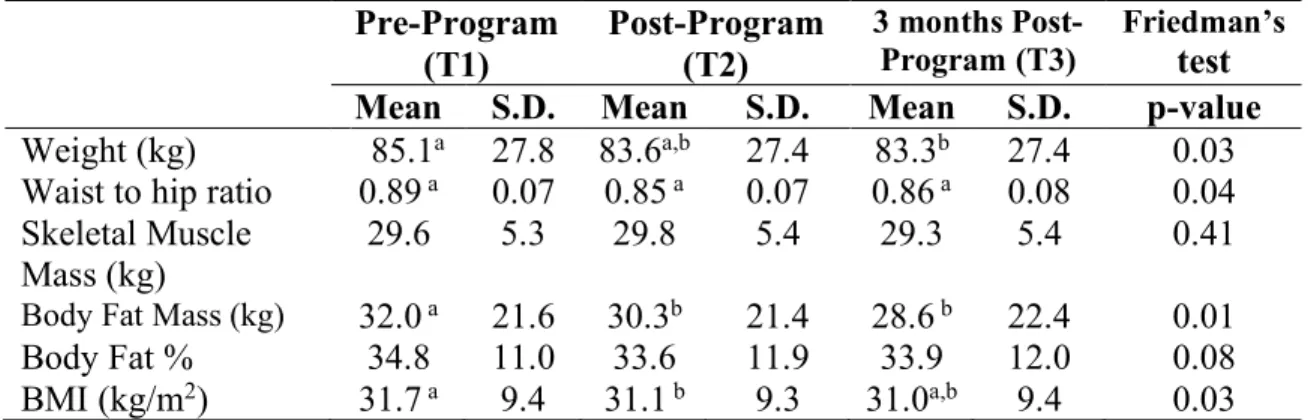
Anthropometric data (Table 2) showed a significant decrease in several of the measurements taken. Weight decreased significantly between T1 and T3, fat mass decreased significantly between T1 and T2, and T1 and T3, and BMI decreased
significantly between T1 and T2. There were no significant changes in skeletal muscle mass throughout the study.
Table 2. Changes in Anthropometric Data Between Pre-Program, Post-Program, and 3 Months Post-Program Pre-Program (T1) Post-Program (T2) 3 months Post-Program (T3) Friedman’s test
Mean S.D. Mean S.D. Mean S.D. p-value
Weight (kg) 85.1a 27.8 83.6a,b 27.4 83.3b 27.4 0.03
Waist to hip ratio 0.89 a 0.07 0.85 a 0.07 0.86 a 0.08 0.04
Skeletal Muscle Mass (kg)
29.6 5.3 29.8 5.4 29.3 5.4 0.41
Body Fat Mass (kg) 32.0 a 21.6 30.3b 21.4 28.6 b 22.4 0.01
Body Fat % 34.8 11.0 33.6 11.9 33.9 12.0 0.08 BMI (kg/m2) 31.7 a 9.4 31.1 b 9.3 31.0a,b 9.4 0.03
Note. Superscript letters indicate significant differences between groups using the post hoc
Dunn test; Statistical Significance = P<0.05
We saw increases from T1 to T3 in both familiarity (P=0.01) and confidence (P=0.02) in regards to utilizing AQMP techniques. There were increases in overall cooking attitudes from T1 to T3 (P=0.01) and overall cooking self-efficacy from T1 to T2
Table 3. Average Total Cooking Attitudes and Self-Efficacy Scores Pre-Program (T1) Post-Program (T2) 3 Months
Post-Program (T3) Friedman’s Test
Mean S.D. Mean S.D. Mean S.D. P-value
Cooking Attitudes 77.6a 10.2 76.2a,b 19.8 85.3b 12.6 0.01
Cooking Self-Efficacy 28.0 a 3.6 31.8 b 3.7 31.3a,b 4.2 0.002
Note. Superscript letters indicate significant differences between groups using the post hoc Dunn
test; Statistical Significance = P<0.05
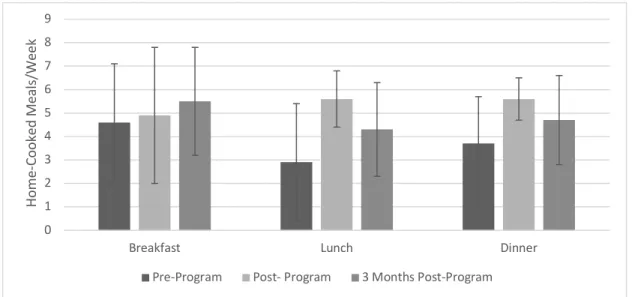
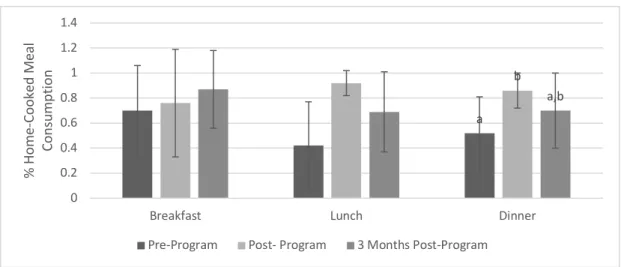
Home-cooked meal consumption (Figures 1 & 2) was captured with 6 survey questions regarding the frequency of consumption of breakfast, lunch, and dinner. Home-cooked meal percentage was calculated in order to analyze the consumption patterns of food away from home. A significant increase was seen in percent consumption of home-cooked dinners between T1 and T2 (P=0.04). AQMP frequency increased from 3.3 ± 4.9 at T1 to 7.1 ± 6.0 at T2, then decreased back to 5.4 ± 5.9 at T3 (P=0.05).
Figure 1. Average home-cooked meal consumption per week (± 1 S.D.) 0 1 2 3 4 5 6 7 8 9
Breakfast Lunch Dinner
Ho m e-Co oked M eal s/ W eek
Figure 2. Percent home-cooked meal consumption (± 1 S.D.) Letters indicate significant differences between groups using the post hoc Dunn test; Statistical Significance = P<0.05
Table 4 shows the number of completed ASA24 dietary recalls per participant. Two recalls were omitted as per ASA24 reviewing and cleaning guidelines. Both dietary recalls had total kcals lower than 600, which is the lower nutrient outlier cut point for adult women ³ 12 years old. Cut points are based on the 5th and 95th percentile of intake for NHANES data.19
Table 4. ASA Dietary Recall Submissions Per Participant
Pre-Program
(T1) Post-Program (T2) 3 Months Post-Program (T3) Participant ID Recall 1 Recall 2 Recall 3 Recall 1 Recall 2 Recall 3 Recall 1 Recall 2 Recall 3 AQMP01 x x x x x x x x x AQMP02 x x x x x x x x x AQMP03 x x x x x x x x AQMP04 x x x x x x x x x AQMP05 x x x x x x x x x AQMP07 x x x x x o AQMP08 x x x x x x x AQMP09 x x x x x o x x x a b a,b 0 0.2 0.4 0.6 0.8 1 1.2 1.4
Breakfast Lunch Dinner
% H om e-Co oked M eal Co ns um pt io n
Table 5 shows the energy intake and expenditures of the participants at T1, T2, and T3. No statistical significance was seen in any of the intake or output measurements for the study.
Table 5. Energy Intake and Expenditure of Participants Pre-Program, Post-Program, and 3 Months Post-Program
Pre-Program (T1) Post- Program (T2) 3 Months Post-Program (T3) Friedman’s Test
Mean S.D. Mean S.D. Mean S.D. P-value
Energy Intake (kcal) 1646.7 626.7 1574.0 366.6 1708.2 655.2 0.72 PRO Intake (g) 82.6 17.8 106.6 28.7 98.5 39.5 0.12 FAT Intake (g) 73.0 27.0 62.3 25.8 66.6 30.7 0.37 CHO Intake (g) 163.1 98.8 147.6 42.7 159.1 77.1 0.72 Low intensity exercise (min/week) 118.7 103.7 404.0 876.8 94.5 64.1 0.52 Moderate intensity exercise (min/week) 101.0 102.8 113.5 182.0 99.0 54.9 0.55 Vigorous Exercise (min/week) 221.0 140.5 247.4 149.1 253.0 223.0 0.91 DISCUSSION
This pilot study evaluated the effects of the novel AQMP program on the frequency of home-cooked meal consumption, cooking attitudes, cooking self-efficacy, and changes in anthropometric measurements. The results demonstrate that the group-based 6-week
attitudes, cooking self-efficacy, home-cooked dinner consumption, weight, body fat mass, and BMI. Without a control group to compare our results to, we are unable to conclude that the AQMP program was the reason for the changes in attitudes, behaviors, and anthropometric measures. The greatest changes in attitudes related to the effort and energy required to cook, suggesting that the participants found cooking to be less work and less tiring than expected at the end of the program compared to the beginning. These are similar findings to other studies that examined cooking attitudes.8,10,20 Increases in
familiarity with and confidence in utilizing AQMP techniques were also seen between baseline and the 3 month follow up. When grouped together, the sum for all 20 cooking attitudes questions significantly increased from 77.6 out of a possible 100 points, or 77.6% at baseline, to 85.3 (85.3%) three months post-program. This 7.7% increase in overall cooking attitudes indicates that the participants had a more positive attitude towards cooking 3 months after completing the AQMP program, and suggests that the participants continued to utilize AQMP techniques after the program had finished.
Similar results were seen with cooking self-efficacy. Of a possible 35 points for 7 questions, the baseline total average was 28 (80%). The total significantly increased to 31.8 (92%) immediately post-program, and then dropped slightly to 89% at the 3 month follow up. These results are inconsistent with previous studies that show cooking self-efficacy continuing to increase over time.11,20 Enrollment based on randomized sampling
would increase the generalizability of these findings. More research is needed to apply these findings to a broader population.
The data for average home-cooked breakfast, lunch, and dinner consumption looks promising, as there were sustained increases from baseline to 3 months post-program for all three meals. The percentage of home-cooked meal consumption also had sustained increases from baseline to 3 months post-program for breakfast, lunch, and dinner, with a significant increase in the percentage of consumption of home-cooked dinners from pre-program to post-pre-program (p=0.04). This implies that the participants ate more home-cooked food and less food away from home for dinners throughout the AQMP program, compared to before the program. These results correspond with similar studies in the literature that evaluate group-based nutrition programs.8,20
Home-cooked breakfast consumption increase steadily at each time point. This was surprising, as the AQMP program did not provide breakfast for the participants. The steady increases could be attributed to increased motivation to eat more home-cooked meals as a by-product of the AQMP program, as seen in previous group-based cooking studies.8,10,20 Or it is possible that the participants were consuming their prepared AQMP
meals for breakfast instead of lunch or dinner.
At baseline, the average consumption of home-cooked lunches was 2.9 per week and dinners was 3.7. After the 6-week AQMP program, the average consumption of home-cooked lunches and dinners rose to 5.6 per week, respectively. During the 3 month follow up, the consumption of home-cooked lunches fell slightly to 4.3 per week and 4.7 for dinner. This pattern corresponds with the proposed hypothesis. There are several possible reasons for this. One may be the absence of the group setting after the conclusion of the program. Group settings tend to provide more motivation and
accountability.11,21 Grocery shopping is another possible reason for the decrease in
consumption of home-cooked lunches and dinners at the 3 month follow up. During the program, the program facilitator did all of the shopping for food and supplies. Once the program ended, the facilitator no longer completed this step. The time and energy required for grocery shopping could be a deterrent to consistent AQMP.6,13
Changes in anthropometrics and body composition were also analyzed. As obesity rates continue to rise, AQMP could be a possible weight management strategy by providing higher quality, portion controlled meals compared to meals away from home. Significant decreases in weight, body fat mass, and BMI were seen. This is an interesting phenomenon, because, as demonstrated in Table 5, there were no significant changes in intake (kcal, protein, fat, and carbohydrates) or physical activity. One explanation for this could be inaccurate reporting during the dietary recalls. Despite the availability of a variety of dietary assessment techniques including 24-hour dietary recalls, food diaries, and online applications, inaccurate assessment of dietary intake is common.22-24 Our
reliance on self-reported data for the 24hr dietary recalls may bias our results due to underreporting, which may result from deliberate or inadvertent omission of consumed foods.22-24
In addition, the average energy intake for each time point was below the Dietary Guidelines for Americans recommendation of 1800-2200 kcals per day for adult females, and 2400-3000 kcals per day for adult males.25 It could be that there was a learning curve
note that our measures of diet composition, kcals, protein, fat, and carbohydrates are not conclusive indicators of overall diet quality, as vitamins, minerals and other vital
nutrients such as water are not being considered. On a population level, reducing the amount of fat, sugar, carbohydrates, and energy intake are goals of the Dietary Guidelines of America,15 but for any given individual, changes in these measures may not result in
improved diet quality. It is also important to note that, due to the absence of a control group, our results do not allow for causal inferences.
IMPLICATIONS FOR RESEARCH AND PRACTICE
To our knowledge, this was the first scientific experiment to examine the effects of advance quantity meal prep on human subjects. Therefore, it is impossible to compare our results with those of other studies. This study suggests that AQMP could increase the frequency of consumption of home-cooked meals, as well as provide benefits in body composition and weight management. This program could be used to help increase consumption of home-cooked meals among people with limited time to cook during the work week. With proper controls and a larger sample size, future experiments could build on this study and strengthen the evidence in favor of the health benefits of AQMP. Future research questions could relate to diet quality, time-savings, and/or financial implications of AQMP.
REFERENCES
1. Expert PM, Jensen MD, Ryan DH, et al. Executive summary: Guidelines (2013) for the management of overweight and obesity in adults. Obesity. 2014;22:S5-S39. 2. Hales CM, Carroll MD, Fryar CD, Ogden CL. Prevalence of obesity among adults
and youth: United states, 2015–2016. NCHS Data Brief No. 288.
https://www.cdc.gov/nchs/data/databriefs/db288.pdf. Published October 2017. Accessed December 12, 2018.
3. Saksena MJ, Okrent AM, Anekwe TD, et al. America’s Eating Habits: Food Away From Home. Economic Information Bulletin No. 196.
https://www.ers.usda.gov/webdocs/publications/90228/eib-196.pdf. Published September 2018. Accessed May 20, 2019.
4. Levy J, Auld G. Cooking classes outperform cooking demonstrations for college sophomores. J Nutr Educ Behav. 2004;36(4):197-203.
5. Mills S, Brown H, Wrieden W, White M, Adams J. Frequency of eating home cooked meals and potential benefits for diet and health: Cross-sectional analysis of a
population-based cohort study. Int J of Behav Nutr Phys Act. 2017;14(1):109. 6. Tiwari A, Aggarwal A, Tang W, Drewnowski A. Cooking at home: A strategy to
comply with U.S. dietary guidelines at no extra cost. Am J Prev Med.
2017;52(5):616-624.
7. Wolfson JA, Bleich SN. Is cooking at home associated with better diet quality or weight-loss intention? Public Health Nutr. 2015;18(8):1397-1406.
8. Herbert J, Flego A, Gibbs L, et al. Wider impacts of a 10-week community cooking skills program-Jamie’s ministry of food, Australia. BMC Public Health.
2014;14(1):1161.
9. Jordan KC, Freeland-Graves JH, Klohe-Lehman DM, et al. A nutrition and physical activity intervention promotes weight loss and enhances diet attitudes in low-income mothers of young children. Nutr Res. 2008;28(1):13-20.
10.Warmin A, Sharp J, Condrasky MD. Cooking with a chef: A culinary nutrition program for college aged students. Top Clin Nutr. 2012;27(2):164-173.
11.Keller HH, Gibbs A, Wong S, Vanderkooy P, Hedley M. Men can cook!
Development, implementation, and evaluation of a senior men's cooking group. J
Nutr Elder. 2004;24(1):71-87.
12.Becker MH. The health belief model and personal health behavior. Health Educ
Monogr. 1974;2:324-473.
13.Macdiarmid JI, Loe J, Kyle J, McNeill G. “It was an education in portion size”. Experience of eating a healthy diet and barriers to long term dietary change. Appetite. 2013;71:411-419.
14.Pelletier JE, Laska MN. Balancing healthy meals and busy lives: Associations between work, school, and family responsibilities and perceived time constraints among young adults. J Nutr Educ Behav. 2012;44(6):481-489.
16.Michaud P. Development and evaluation of instruments to measure the effectiveness of a culinary and nutrition education program. (Thesis, Clemson University). 2007. 17.Miller RM, Chambers TL, Burns SP, Godard MP. Validating InBody® 570
multi-frequency bioelectrical impedance analyzer versus DXA for body fat percentage analysis. Med Sci Sports Exerc. 2016;48(5 Suppl 1):991.
18.Kirkpatrick SI, Subar AF, Douglass D, et al. Performance of the automated self-administered 24-hour recall relative to a measure of true intakes and to an interviewer-administered 24-h recall. Am J Clin Nutr. 2014;100(1):233-240. 19.Automated Self-Administered 24-hour (ASA24) Dietary Assessment Tool, version
(2018), developed by the National Cancer Institute, Bethesda, MD. https://epi.grants.cancer.gov/asa24. Accessed January 2019.
20.Flego A, Herbert J, Waters E, et al. Jamie's ministry of food: Quasi-experimental evaluation of immediate and sustained impacts of a cooking skills program in Australia. PLoS One. 2014;9(12):e114673.
21.Wing RR, Jeffery RW. Benefits of recruiting participants with friends and increasing social support for weight loss and maintenance. J Consult Clin Psychol.
1999;67(1):132.
22.Klesges RC, Eck LH, Ray JW. Who underreports dietary intake in a dietary recall? evidence from the second national health and nutrition examination survey. J Consult
Clin Psychol. 1995;63(3):438.
23.Kristal AR, Andrilla CHA, Koepsell DT, Diehr PH, Cheadle A. Dietary assessment instruments are susceptible to intervention-associated response set bias. J Am Diet
Assoc. 1998;98(1):40-43.
24.Macdiarmid J, Blundell J. Assessing dietary intake: Who, what and why of under-reporting. Nutr Res Rev. 1998;11(2):231-253.
25.DeSalvo KB, Olson R, Casavale KO. Dietary guidelines for Americans. JAMA. 2016;315(5):457-458.
Chapter 3
Summary and Recommendations Summary
For the past few decades, a vast body of evidence has accumulated that shows that consuming home-cooked meals more often leads to a healthier overall diet and better health outcomes (Guthrie et al., 2002; Mancino et al., 2010; Mills, Brown, Wrieden, White, & Adams, 2017; Nielsen & Popkin, 2003; Saksena et al., 2018; Tiwari, Aggarwal, Tang, & Drewnowski, 2017; Wolfson & Bleich, 2014). There are fewer studies,
however, that aim to create strategies for people to prepare and consume home-cooked meal more often. In fact, studies show that the predominance of home cooking has significantly decreased in the last 50 years (Saksena et al., 2018; Smith, Ng, & Popkin, 2013), and with it, diet quality has declined and obesity rates have steadily
increased. This pilot study was created to present and evaluate a potential method for increasing the consumption of home-cooked meals. Advance quantity meal prep (AQMP), is a term invented and defined by the research team to describe the process of planning and preparing healthy meals in bulk, ahead of time, to eat at a later date. This strategy can be attractive to time-starved people who want to consume more home-cooked meals. By preparing and packaging several meals at once, people with little time during the work week now have healthy, home-cooked meals available when needed.
This study was the first to examine the effects of AQMP on home-cooked meal consumption, cooking attitudes, cooking self-efficacy, and changes in anthropometric
have contributed to sustained increases in participants’ cooking attitudes, cooking self-efficacy and home-cooked dinner consumption, and significant and sustained decreases in weight, body fat mass, and BMI. Proper controls are needed to show that the AQMP program was the reason for the changes in attitudes, behaviors, and anthropometric measures. AQMP could be a viable strategy for health conscious people to increase consumption of home-cooked meals.
Recommendations
As there are no historical data on this subject, this pilot study sought to examine the potential benefits of AQMP from a behavioral standpoint. This study aimed to increase the frequency of consumption of home-cooked meals by creating and implementing a group program designed to facilitate behavior change. The present study’s research questions were limited to home-cooked meal consumption and anthropometric measures. With proper controls, this research could be verified and strengthened with larger and more diverse samples and different research questions.
As the present study’s population was 90% female with a history of regular physical activity, this strategy could be beneficial for males, people of lower socio-economic status, adolescents and young adults, and non-exercisers. A formal education component could be added to this program to teach proper cooking techniques, basic knife skills, and food safety. Additional research questions could evaluate AQMP on diet quality, time saved on meal preparation each week, decisional fatigue in regards to food choices, and the cost effectiveness of AQMP.
References
Abood, A. D., Black, D. R., & Feral, D. (2003). Nutrition education worksite
intervention for university staff: Application of the health belief model. Journal of
Nutrition Education and Behavior, 35(5), 260-267.
doi:10.1016/S1499-4046(06)60057-2
Becker, M.H. (1974). The health belief model and personal health behavior. Ann Arbor, MI: Health Education Monographs.
Bhutani, S., Schoeller, D.A., Walsh, M. C., & McWilliams, C. (2018). Frequency of eating out at both fast-food and sit-down restaurants was associated with high body mass index in non-large metropolitan communities in
Midwest. American Journal of Health Promotion,32(1), 75-83. doi:10.1177/0890117116660772
Clark, N. M., & Dodge, J. A. (1999). Exploring self-efficacy as a predictor of disease management. Health Education & Behavior, 26(1), 72-89.
doi:10.1177/109019819902600107
Costa, A. I. d. A. (2013). Conceptualization and measurement of personal norms regarding meal preparation. International Journal of Consumer Studies, 37(6), 596-604. doi:10.1111/ijcs.12036
Ducrot, P., Méjean, C., Aroumougame, V., Ibanez, G., Allès, B., Kesse-Guyot, E., Hercberg, S., … Péneau, S. (2017). Meal planning is associated with food variety, diet quality and body weight status in a large sample of French adults. The
International Journal of Behavioral Nutrition and Physical Activity, 14(1), 12.
doi:10.1186/s12966-017-0461-7
Duffey, K. J., Gordon-Larsen, P., Steffen, L. M., Jacobs Jr, D. R., & Popkin, B. M. (2009). Regular consumption from fast food establishments relative to other restaurants is differentially associated with metabolic outcomes in young adults. The Journal of Nutrition, 139(11), 2113-2118. doi:10.3945/jn.109.109520
Expert, P. M., Jensen, M. D., Ryan, D. H., Donato, K. A., Apovian, C. M., Ard, J. D., . . . Yanovski, S. Z. (2014). Executive summary: Guidelines (2013) for the
management of overweight and obesity in adults. Obesity, 22, S5-S39. doi:10.1002/oby.20821
Fulkerson, J. A., Kubik, M. Y., Rydell, S., Boutelle, K. N., Garwick, A., Story, M., ... Dudovitz, B. (2011). Focus groups with working parents of school-aged children: what's needed to improve family meals?. Journal of Nutrition Education and Behavior, 43(3), 189-193. doi:10.1016/j.jneb.2010.03.006
Gillis, L. J., & Bar-Or, O. (2003). Food away from home, sugar-sweetened drink
consumption and juvenile obesity. Journal of the American College of Nutrition, 22(6), 539-545. doi:10.1080/07315724.2003.10719333
Guenther, P. M., Casavale, K. O., Reedy, J., Kirkpatrick, S., Hiza, H., Kuczynski, K., ... Krebs-Smith, S. M. (2013). Update of the healthy eating index: HEI-2010. Journal of the Academy of Nutrition and Dietetics,113(4), 569–580. doi:10.1016/j.jand.2012.12.016
Guthrie, J.F., Lin, B., & Frazao, E. (2002). Role of food prepared away from home in the American diet, 1977-78 versus 1994-96: Changes and consequences.
Journal of Nutrition Education and Behavior, 34(3), 140-50.
doi:10.1016/S1499-4046(06)60083-3
Hales, C. M., Carroll, M. D., Fryar, C. D., & Ogden, C. L. (2017). Prevalence of obesity
among adults and youth: United States, 2015–2016 (NCHS Data Brief No. 288).
Retrieved from https://www.cdc.gov/nchs/products/databriefs/db288.htm
Harnack, L. J., Jeffery, R.W., Boutelle, K.N. (2000). Temporal trends in energy intake in the United States: An ecologic perspective. The American Journal of Clinical
Nutrition, 71(6), 1478–1484. doi:10.1093/ajcn/71.6.1478
Harris, J. M., & Shiptsova, R. (2007). Consumer demand for convenience foods:
demographicsand expenditures. Journal of Food Distribution Research, 38 (856-2016-57845), 22-36.
Herbert, J., Flego, A., Gibbs, L., Waters, E., Swinburn, B., Reynolds, J., & Moodie, M. (2014). Wider impacts of a 10-week community cooking skills program-Jamie’s ministry of food, Australia. BMC Public Health, 14(1), 1161.
Jackson, E. S., Tucker, C. M., & Herman, K. C. (2007). Health value, perceived social support, and health self-efficacy as factors in a health-promoting lifestyle. Journal of American College Health, 56(1), 69-74. doi:10.3200/JACH.56.1.69-74
Jordan, K. C., Freeland-Graves, J. H., Klohe-Lehman, D. M., Cai, G., Voruganti, V. S., Proffitt, J. M. …Bohman, T. M. (2008). A nutrition and physical activity intervention promotes weight loss and enhances diet attitudes in low-income mothers of young children. Nutrition Research,28(1), 13-20.
Keller, H. H., Amie Gibbs, A., Wong, S., Vanderkooy, P. & Hedley, M. (2004) Men can cook! Development, implementation, and evaluation of a senior men’s cooking group. Journal of Nutrition for the Elderly, 24(1), 71-87.
doi:10.1300/J052v24n01_06
Lachat, C., Nago, E., Verstraeten, R., Roberfroid, D., Van Camp, J., & Kolsteren, P. (2012).Eating out of home and its association with dietary intake: A systematic review of the evidence. Obesity Reviews, 13(4), 329-346. doi:10.1111/j.1467-789X.2011.00953.x
Lang, T., & Caraher, M. (2001). Is there a culinary skills transition? Data and debate from the UK about changes in cooking culture. Journal of the HEIA, 8(2), 2-14. Levy, J., & Auld, G. (2004). Cooking classes outperform cooking demonstrations for
college sophomores. Journal of Nutrition Education and Behavior, 36(4), 197-203. doi:10.1016/S1499-4046(06)60234-0
Mancino, L., Todd, J.E., Guthrie, J.F., & Lin, B.H. (2010). How food away from home affects children’s diet quality (ERR-104). Retrieved from
https://www.ers.usda.gov/publications/pub-details/?pubid=44756
Macdiarmid, J. I., Loe, J., Kyle, J., & McNeill, G. (2013). "It was an education in portion size". Experience of eating a healthy diet and barriers to long-term dietary change.
Appetite, 71, 411-419. doi:10.1016/j.appet.2013.09.012
U.S. Department of Agriculture and U.S. Department of Health and Human Services. (2011). Dietary guidelines for Americans, 2010. Retrieved from
https://health.gov/dietaryguidelines/2010/
Michaund, P. (2007). Development and evaluation of instruments to measure the
effectiveness of a culinary and nutrition education program. (Thesis, Clemson
University).
Mills, S., Brown, H., Wrieden, W., White, M., & Adams, J. (2017). Frequency of eating home cooked meals and potential benefits for diet and health: Cross-sectional analysis of a population-based cohort study. International Journal of Behavioral
Nutrition & Physical Activity, 14(1), 109.
National Restaurant Association (2019). 2019 Restaurant Industry Fact book.
Pelletier, J. E., & Laska, M. N. (2012). Balancing healthy meals and busy lives: Associations between work, school, and family responsibilities and perceived time constraints among young adults. Journal of Nutrition Education and
Behavior, 44(6), 481-489. doi:10.1016/j.jneb.2012.04.001
Saksena, M. J., Okrent, A. M., Anekwe, T. D., Cho, C., Dicken, C., Effland, A., ... & Jo, Y. (2018). America’s Eating Habits: Food Away From Home (No. 281119). Retrieved from https://www.ers.usda.gov/webdocs/publications/90228/eib-196.pdf
Smith, L. P., Ng, S. W., & Popkin, B. M. (2013). Trends in US home food preparation and consumption: Analysis of national nutrition surveys and time use studies from 1965-1966 to 2007-2008. Nutrition Journal, 12(1), 45. doi:10.1186/1475-2891-12-45
Stankevitz, K., Dement, J., Schoenfisch, A., Joyner, J., Clancy, S. M., Stroo, M., & Østbye, T. (2017). Perceived barriers to healthy eating and physical activity among participants in a workplace obesity intervention. Journal of Occupational
and Environmental Medicine, 59(8), 746-751.
doi:10.1097/JOM.0000000000001092
Todd, J. E., Mancino, L., & Lin, B. H. (2010). The Impact of Food Away From Home on Adult Diet Quality (ERR-90). Retrieved from
https://www.ers.usda.gov/webdocs/publications/46352/8170_err90_1_.pdf
Tiwari, A., Aggarwal, A., Tang, W., & Drewnowski, A. (2017). Cooking at home: A strategy to comply with U.S. dietary guidelines at no extra cost. American Journal
of Preventive Medicine, 52(5), 616-624. doi:10.1016/j.amepre.2017.01.017
Warmin, A., Sharp, J., & Condrasky, M. D. (2012). Cooking with a chef: A culinary nutrition program for college-aged students. Topics in Clinical Nutrition, 27(2), 164-173. doi:10.1097/TIN.0b013e3182542417
Wolfson, J. A., & Bleich, S. N. (2014). Is cooking at home associated with better diet quality or weight-loss intention? Public Health Nutrition, 18(8), 1397-1406. doi:10.1017/S1368980014001943
Wolfson, J. A., Frattaroli, S., Bleich, S. N., Smith, K. C., & Teret, S. P. (2017). Perspectives on learning to cook and public support for cooking education policies in the United States: A mixed methods study. Appetite, 108, 226-237. doi:10.1016/j.appet.2016.10.00