• No results found

Linear Programming Makes Railway Networks Energy-efficient

N/A
N/A
Protected

Academic year: 2021

Share "Linear Programming Makes Railway Networks Energy-efficient"

Copied!
19
0
0

Loading.... (view fulltext now)

Full text

(1)

Linear Programming Makes Railway Networks

Energy-efficient

Shuvomoy Das Gupta, J. Kevin Tobin and Lacra Pavel

∗†

Abstract

In this paper we propose a novel two-stage linear optimization problem to calcu-late energy-efficient timetables in electric railway networks. The resultant timetable minimizes the total energy consumed by all trains and maximizes the utilization of regenerative energy produced by braking trains, subject to the constraints in the rail-way network. In contrast to other existing models, which areN P-hard, our model is computationally the most tractable one being a linear program. The model can be applied to any railway network of arbitrary topology using existing technology. We apply our optimization model to different instances of service PES2-SFM2 of line 8 of Shanghai Metro network spanning a full service period of one day (18 hours) with thousands of active trains. For every instance, our model finds an optimal timetable very quickly (largest runtime being less than 13s) with significant reduction in effective energy consumption (the worst case being 19.27%).

Index Terms—Railway networks, energy efficiency, regenerative braking, train schedul-ing, linear programming.

1

Introduction

1.1

Background and motivation

Efficient energy management of electric vehicles using mathematical optimization has gained a lot of attention in recent years [1, 2, 3, 4, 5]. Calculating energy-efficient timetables for trains in railway networks is a relevant problem in this regard. Electricity is the main source of energy for trains in most modern railway networks; in such networks, a train is equipped with a regenerative braking mechanism that allows it to produce electrical energy during its braking phase. In this paper, we formulate a two-stage linear optimization problem to obtain an energy-efficient timetable for a modern railway network. The timetable schedules

This work was supported by NSERC-CRD and Thales Canada Inc.

S. D. Gupta and L. Pavel are with the Edward S. Rogers Department of Electrical and

Com-puter Engineering, University of Toronto, and J. K. Tobin is with Thales Canada Inc. e-mail: ([email protected], [email protected], [email protected])

(2)

the arrival time and the departure time of each train to and from the platforms it visits such that the total electrical energy consumed is minimized and the utilization of produced regenerative energy is maximized.

1.2

Related work

The general timetabling problem in a railway network has been studied extensively over the past three decades [6]. However, very few results exist that can calculate energy-efficient timetables.

A Mixed Integer Programming (MIP) model, applicable only to single train-lines, is proposed by Pe˜na-Alcaraz et al. [7] to maximize the total duration of all possible synchro-nization processes between all possible train pairs. The model is then applied successfully to line three of the Madrid underground system. However, the model can have some drawbacks. First, considering all train pairs in the objective will result in a computationally intractable problem even for a moderate sized railway network. Second, for a train pair in which the associated trains are far apart from each other, most, if not all, of the regenerative energy will be lost due to the transmission loss of the overhead contact line. Finally, the model assumes that the durations of braking and accelerating phases stay the same with varying trip times, which is not the case in reality.

The work in [8] proposes a more tractable MIP model, applicable to any railway network, by considering only train pairs suitable for regenerative energy transfer. The optimization model is applied to the Dockland Light Railway and shows a significant increase in the total duration of the synchronization process. Although such increase, in principle, may increase the total savings in regenerative energy, the actual energy saving is not directly addressed. Similar to [7], this model too, assumes that even if the trip time changes, the duration of the associated braking and accelerating stay the same.

Other relevant works implement meta-heuristics such as simulated annealing [9] and genetic algorithm [10] and [11]. However, these models can not be applied beyond small sized train-lines. As the models use meta-heuristics, they cannot provide any guarantee of optimality of the calculated timetable. Also, the quality of the resultant timetables is heavily dependent on tuning of the parameters, which is always done manually and changes from one railway network to another.

An insightful analytical study of a simplified and periodic railway schedule appears in [12]. However the model lacks periodic event scheduling constraints [13], which are used to model cyclic timetables. As a result, if the period is strictly smaller than the duration of the railway service, which is often the case in periodic railway networks [14, pages 7-10], then the model cannot be applied, because in such railway networks trains associated with the next period enter the network while the trains associated with the first period are still running.

1.3

Contributions

(3)

• We propose a novel two-stage linear optimization problem to calculate an energy-efficient railway timetable. The first optimization model minimizes the total energy consumed by all trains subject to the constraints present in the railway network. The problem can be formulated as a linear program, with the optimal value attained by an integral vector.

• Based on the solution for the first problem, the final optimization model maximizes the transfer of regenerative braking energy between suitable train pairs, while keeping the total train energy consumption at the minimum.

• In contrast to existing relevant models, all of which are of N P-hard complexity, our optimization model is a linear program, hence is computationally the most efficient one.

• We apply our model to eleven different instances of service PES2-SFM2 of line 8 of Shanghai Metro network. The timetables span full service period of one day (18 hours) with each instance having thousands of active trains. For every instance, our model finds an optimal timetable very quickly with the largest runtime being 12.58s. In comparison with the original timetables, the final timetables produced by our model reduces the total effective energy consumption significantly, even the worst case reduc-tion being 19.27% . To the best of our knowledge, in comparison with other relevant models, ours is the only one that calculates energy-efficient railway timetable of such large scale in such a short CPU time.

1.4

Organization

This paper is organized as follows. In Section 2 we describe the notation used, and then in Section 3 we model and justify the constraints present in the railway network. The preliminary optimization model is presented in Section 4. Section 5 formulates the final optimization problem that additionally maximizes the utilization of regenerative braking energy. In Section 6 we apply our model to different instances of an existing railway network spanning a full working day and describe the results. Section 7 presents the conclusion.

2

Notation and notions

Every set described in this paper is strictly ordered and finite unless otherwise specified. The cardinality and the ith element of such a setC is denoted by |C|andC(i) respectively. The set of real numbers and integers are expressed by R and Z respectively; subscripts + and ++ attached with either set denote non-negativity and positivity of the elements respectively. A column vector with all components one is denoted by 1. The symbol stands for componentwise inequality between two vectors and the symbolstands for logical and. The number of nonzero components of a vector x is called cardinality of that vector and is denoted by card(x). The ith unit vector ei is the vector with all components zero

(4)

except for theith component which is one. The epigraph of a functionf :C R(where C is any set) denoted by epif is the set of input-output pairs that f can achieve along with anything above, i.e.,

epif ={(x, t)C×R|xC, tf(x)}.

The convex hull of any setC, denoted byconvC, is the set containing all convex combina-tions of points in C. Consequently, if C is nonconvex, then its best convex outer approxi-mation is convC, as it is the smallest set containingC.

The set of all platforms in a railway network is indicated by N. A directed arc between two distinct and non-opposite platforms is called a track. The set of all tracks is represented byA. The directed graph of the railway network is expressed by (N,A). The set of all trains is denoted byT. The sets of all platforms and all tracks visited by a traintin chronological order are denoted byNt ⊆ N andAt ⊆ A respectively. The decision variables are the train

arrival and departure times, to and from the associated platforms, respectively. Let at i and

dt

i be the arrival time and the departure time of the train t ∈ T to and from the platform

i∈ Nt.

3

Modelling the constraint set

In this section we describe the constraint set for our optimization model. This comprises the feasibility constraints for a railway network of arbitrary topology, and the domain of the decision variables. In most of the existing railway networks, the railway management has a feasible timetable; we use the sequence of the trains from that timetable. The lower and upper bound of the constraints are integers representing time in seconds.

3.1

Trip time constraint

The trip time constraints play the most important role in train energy consumption and regenerative energy production. These can be of two types as follows.

3.1.1 Trip time constraint associated with a track

Consider the trip of any traint∈ T from platformito platformjalong the track (i, j)∈ At.

The train t departs from platform iat time dt

i, arrives at platform j at time atj, and it can

have a trip time between τt

ij and τtij. The trip time constraint can be written as follows:

∀t∈ T ∀(i, j)∈ At τt

ij ≤atj−dti ≤τtij

. (1)

3.1.2 Trip time constraint associated with a crossing-over

A crossing-over is a special type of directed arc that connects two train-lines, where a train-line is a directed path with the set of nodes representing non-opposite platforms and the

(5)

set of arcs representing non-opposite tracks. If after arriving at the terminal platform of a train-line, a train turns around by traversing the crossing-over and starts travelling through another train-line, then the same physical train is treated and labelled functionally as two different trains by the railway management [14, page 41]. Let ϕ be the set of all crossing-overs, where turn-around events occur. Consider any crossing-over (i, j) ϕ, where the platforms i and j are situated on different train-lines. Let Bij be the set of all train pairs

involved in corresponding turn-around events on the crossing-over (i, j). Let (t, t′) ∈ B

ij.

Train t ∈ T turns around at platform i by travelling through the crossing-over (i, j), and beginning from platformj starts traversing a different train-line as traint′ ∈ T \ {t}. A time window [κtt′

ij, κtt

ij] has to be maintained between the departure of the train from platform

i (labelled as train t) and arrival at platform j (labelled as train t′). We can write this constraint as follows: ∀(i, j)ϕ (t, t′)∈ Bij κtt′ ij ≤at ′ j −dti ≤κtt ′ ij . (2)

3.2

Dwell time constraint

When any traint∈ T arrives at a platformi∈ Nt, it dwells there for a certain time interval

denoted by [δti, δti] so that the passengers can get off and get on the train prior to its departure from platform j. The dwell time constraint can be written as follows:

∀t∈ T ∀i∈ Nt δti dtiati δti. (3)

Every traint∈ T arrives at the first platformNt(1) in its train-path either from the depot

or by turning around from some other line, and departs from the final platformNt(|Nt|) in

order to either return to the depot or start as a new train on another line by turning around. So, the train t dwells at all platforms in Nt. This is the reason why in Equation (3) the

platform index iis varied over all elements of the set Nt.

3.3

Connection constraint

In many cases, a single train connection might not exist between the origin and the de-sired destination of a passenger. To circumvent this, connecting trains are often used at interchange stations. Let χ⊆ N × N be the set of all platform pairs situated at the same interchange stations, where passengers transfer between trains. LetCij be the set of

connect-ing train pairs for a platform pair (i, j)χ. For a train pair (t, t′)∈ C

ij, train t is arriving

at platform i and train t′ ∈ T is departing from platform j. A connection time window

denoted by [χtt′

ij, χ tt′

ij] is maintained between arrival of t and subsequent departure of t′, so

that passengers can get off from the first train and get on the latter. Let (i, j) χ. Then the connection constraint can be written as:

∀(i, j)χ(t, t′)∈ Cij χtt′ ij ≤d t′ j −ati ≤χtt ′ ij . (4)

(6)

3.4

Headway constraint

In any railway network, a minimum amount of time between the departures and arrivals of consecutive trains on the same track is maintained. This time is called headway time. For maintaining the quality of passenger service, many urban railway system keeps an upper bound between the arrivals and departures of successive trains on the same track, so that passengers do not have to wait too long before the next train comes. Let (i, j) ∈ A be the track between two platforms i and j, and Hij be the set of train-pairs who move along

that track successively in order of their departures. Consider (t, t′)∈ H

ij, and let [htt

i , h tt′

i ]

and [httj′, httj′] be the time windows that have to be maintained between the departures and arrivals of the trainstandt′ from and to the platformsiandj respectively. So, the headway

constraint can be written as:

∀(i, j)∈ A ∀(t, t′)∈ Hij

hitt′ dtidti htti hjtt′ atjajt httj′. (5) Similarly, headway times have to be maintained between two consecutive trains going through a crossing over. Consider any crossing over (i, j) ϕ and two such trains, which leave the terminal platform of a train-line ilabelled as t1 and t2, traverse the crossing over

(i, j), and arrive at platform j of some other train-line labelled as t′1 andt′2. The set of all such train quartets ((t1, t′1),(t2, t′2)) is represented by ˜Hij. Let [hti1t2, h

t1t2

i ] be the headway

time window between the departures of trains t1 and t2 from platform i and [ht

′ 1t′2 j , h t′ 1t′2 j ] be

the headway time window between the arrivals of the trains t′

1 and t′2 to the platforms j.

The associated headway constraints can be written as:

∀(i, j)ϕ((t1, t′1),(t2, t′2))∈H˜ij ht1t2 i ≤dti2−dti1 ≤h t1t2 i ∧ h t′ 1t′2 j ≤a t′ 2 j −a t′ 1 j h t′ 1t′2 j . (6)

3.5

Total travel time constraint

The train-path of a train is the directed path containing all platforms and tracks visited by it in chronological order. To maintain the quality of service in the railway network, for every traint∈ T, the total travel time to traverse its train-path has to stay within a time window [τt

P, τtP]. We can write this constraint as follows:

∀t∈ T τtP atNt(|Nt|)−dtNt(1) ≤τtP

, (7)

where Nt(1) and Nt(|Nt|) are the first and last platform in the train-path oft.

3.6

Domain of the event times

Without any loss of generality, we set the time of the first event of the railway service period, which corresponds to the departure of the first train of the day from some platform, to start at zero second. By setting all trip times and dwell times to their maximum possible values

(7)

we can obtain an upper bound for the final event of the railway service period, which is the arrival of the last train of the day at some platform, denoted by m Z++. So the domain

of the decision variables can be expressed by the following equation:

∀t∈ T ∀i∈ Nt 0ati m,0dti m. (8) In vector notation the decision variables are denoted by a = ((at

i)i∈Nt)

t∈T and d =

((dt i)i∈Nt)

t∈T.

4

Preliminary optimization model

In this section we formulate the preliminary optimization model that minimizes the total energy consumed by all trains in the railway network. The resultant timetable is critical for the final optimization model, which besides minimizing energy, will also maximize the utilization of regenerative energy produced by braking trains. The organization of this section is as follows. First, in order to keep the proofs less cluttered, we introduce an equivalent constraint graph notation. Second, we formulate and justify the preliminary optimization problem. Third, we show that the nonlinear objective of the initial optimization model can be approximated as a linear one by applying least-squares. This results in a linear optimization problem, which has the interesting property that its optimal solution is attained by an integral vector.

4.1

Constraint graph notation

Each of the constraints described by Equations (1)-(7) is associated with two event times (either arrival or departure time of trains at stations), where one of them precedes another by a time difference dictated by the time window of that constraint. This observation helps us to convert our initial notation into an equivalent constraint graph notation. All event times in the original notation are treated as nodes in the constraint graph, the set of those nodes is denoted by ¯N and the value associated with a node iN¯ is denoted by xi, which

represents the arrival or departure time of some train from a platform. Now consider any two nodes in the constraint graph; if there exists a constraint between the two in the original notation, then in the constraint graph we create a directed arc between them, the start node being the first event and the end node being the later one. The set of arcs thus created in the constraint graph is denoted by ¯A. Note that there cannot be more than one arc between two nodes in the constraint graph. With each arc (i, j) A¯we associate a time window [lij, uij] with their values determined from the Equations (1)-(7). So, each arc (i, j) ∈ A¯

corresponds to a constraint of the form lij ≤ xj −xi ≤ uij. The set of all arcs associated

with trip time constraints is expressed by ¯Atrip⊂A¯.

4.2

Formulation of the preliminary optimization model

A train consumes most of its required electrical energy during the acceleration phase of making a trip from an origin platform to a destination platform. Trip time constraints

(8)

play the most important role in energy consumption and regenerative energy production of trains. Once the trip time for a trip is fixed, an energy optimal speed profile can be calculated efficiently by existing software [15, page 3]. The electrical power consumption and regeneration of a train on a track is determined by its speed profile, so the optimal speed profile also gives the power versus time graph (power graph in short) for that trip. When a train is driven according to the optimal driving strategy, the electrical energy consumed by the train for that trip is non-increasing in the trip time [16]. Even when a train is manually driven, the average energy consumption of the train over such manual driving strategies is found empirically to be non-increasing in the trip time[17]. However, in the total railway service period there are many active trains, whose movements are coupled by the associated constraints. So, finding the energy-minimal trip time for a single trip in an isolated manner can result in a infeasible timetable. Consider an arc (i, j) A¯trip in the constraint graph,

associated with some trip time constraint. Let us denote the energy consumption function for that tripfij :R++ →R++which is non-increasing in its argument (xj−xi). The preliminary

optimization problem with the objective to minimize the total energy consumption of the trains can be written as:

minimize P(i,j)A¯tripfij(xj −xi)

subject to (i, j)A¯ lij ≤xj −xi ≤uij,

∀iN¯ 0xi ≤m,

(9) where the decision vector is (xi)i∈N¯ ∈ R|

¯

N |. The constraint set is affine, but the exact

analytical form of every component of the objective function for different trips on different tracks is not known. However, in any railway network, the amount by which the trip time is allowed to vary in Equations (1) and (2) is on the order of seconds. Thus (τt

ij−τtij) and

(κtt′ ij−κtt

ij) are on the order of seconds. In such a case, we can approximate the energy function

as an affine function. A reasonable approach is fitting a straight line through measured energy versus trip time data by least-squares. A measurement of the quality of such fittings is given by thecoefficient of determination, which can vary between 0 to 1, with 0 being the worst and 1 being the best [18, page 518]. In our numerical studies the mean coefficient of determination of the energy fittings over all the different trips of all the trains is found to be 0.9483 with a standard deviation of 0.05, which justifies our approach. For energy output observations

fij(1), . . . , fij(p) with respect to trip times (x(1)j x(1)i ), . . . ,(x(p)j x(p)i ) respectively within the allowed trip time bounds, we seek an affine function cij(xj−xi) +bij = (xj−xi,1)T(cij, bij)

where we want to determine cij, the slope of the line and bij, the intercept with the vertical

axis. The affine function approximates the measured energy in the least-squares sense as follows: (cij, bij) = argmin (˜cij,˜bij) p X k=1 ˜ cij(x(k)j −x (k) i ) + ˜bij −fij(k) 2 = argmin (˜cij,˜bij)    (x(1)j x(1)i ,1)T ... (x(p)j x(p)i ,1)T    ˜ cij ˜ bij −    fij(1) ... fij(p)    2 2 (10)

(9)

The problem above is an unconstrained optimization problem with convex objective, as it is an affine mapping applied to a norm squared, and it is differentiable. So it can be solved by taking the gradient with respect to (˜cij,˜bij), setting the result equal to zero vector and then

solving for (˜cij,˜bij). This yields the following closed form solution:

cij bij =        (x(1)j x(1)i ,1)T ... (x(p)j x(p)i ,1)T    T   (x(1)j x(1)i ,1)T ... (x(p)j x(p)i ,1)T        −1   (x(1)j x(1)i ,1)T ... (x(p)j x(p)i ,1)T    T    fij(1) ... fij(p)    (11) Using Equation (11), we can approximate the nonlinear objective of the optimization problem (9) as an affine one: P(i,j)A¯tripcij(xi−xj) +bij. We can also discard the bijs from

the objective, as it has no impact on the minimizer. Thus we arrive at the following linear optimization problem to minimize the total energy consumption of the trains:

minimize P(i,j)A¯tripcij(xj −xi)

subject to (i, j)A¯ lij ≤xj −xi ≤uij,

∀iN¯ 0xi ≤m.

(12) An important property of this optimization model is that the polyhedron associated with optimization problem has only integer vertices, so the optimal value is attained by an integral vector. A necessary and sufficient condition of integrality of the vertices of a polyhedron is given by the following theorem [19, page 269, Theorem 19.3], which we will use to prove the subsequent proposition.

Theorem 1. Let A be a matrix with entries 0,+1, or 1. For all integral vectors a, b, c, d the polyhedron{xRn |cxd, aAxb} has only integral vertices if and only if for each nonempty collection of columns ofA, denoted byC, there exist two subsets , C1 and C2

such that C1∪C2 =C, C1∩C2 =∅, and the sum of the columns in C1 minus the sum of the

columns in C2 is a vector with entries 0,1 and −1.

Proposition 1. The optimization problem (12) has an integral optimal solution.

Proof. We write the problem (12) in vector form. We construct a cost vector c, such that a

component of that vector is cij if it is associated with a trip time constraint in the original

notation, and zero otherwise. Construct integral vectors l = (lij)(i,j)∈A¯, u= (uij)(i,j)∈A¯ and

matrix A∈ {−1,0,1}|A|×|¯ N |¯ such that the (k, i)th entry of the matrix A, denoted by aki, is

associated with the kth hyperarc and ith node of the constraint graph as follows:

aki =     

1 if node i is the end node of hyperarc k,

−1 if node iis the start node of hyperarc k, 0 otherwise.

So, the vector form of the optimization problem (12) is: minimize cTx

subject to lAxu,

0xm1.

(10)

Consider any nonempty collection of columns ofAdenoted byC. TakeC1 =C andC2= ∅.

Then the sum of the columns inC1minus the sum of the columns inC2 will be a vector with

entries 0,1 and 1, because inAthere cannot exist more than one row corresponding to an arc between two nodes of the constraint graph and each such row has exactly two nonzero entries, a +1 and a 1. So, by Theorem 1 the polyhedron {xR|N |¯ :l Ax u,0x m1}has only integral vertices and optimizing the linear objective in problem (13) over this polyhedron will result in an integral solution.

After solving the linear programming problem (12), we obtain an integral timetable, which we will call the energy minimizing timetable (EMT). We denote the optimal decision vector of this timetable by ¯x in the constraint graph notation and ((¯at

i,d¯ti)i∈N)t∈T in the

original notation.

5

Final optimization model

In this section we modify the trip time constraints such that the total energy consumption of the final timetable is kept at the same minimum as the EMT. Then, we describe our optimization strategy aimed to maximize the utilization of regenerative energy of braking trains, and we present the final optimization model.

5.1

Keeping the total energy consumption at minimum

In any feasible timetable, if the trip times are kept to be the same as the ones obtained from the EMT, then the energy optimal speed profiles for all trains will be the same. As a result, the energy consumption associated with that timetable will remain at the same minimum as found in the EMT. So, in the final optimization problem, instead of using the trip time constraint, for every trip we fix the trip time to the value in the EMT, i.e.,

∀t∈ T ∀(i, j)∈ At atjdti = ¯atj d¯ti, (14) and ∀(i, j)ϕ(t, t′)∈ Bij (at ′ j −dti = ¯at ′ j −d¯ti). (15)

For all other constraints, bounds are allowed to vary as described by Equations (3)-(7). As a consequence of fixing all trip times, the power graph of every trip made by any train becomes known to us, since it depends on the corresponding optimal speed profile calculated by existing software [15, page 3].

5.2

Maximizing the utilization of regenerative energy of braking

trains

In this subsection we describe our strategy to maximize the utilization of the regenerative energy produced by the braking trains. Strategies based on transfer of regenerative braking

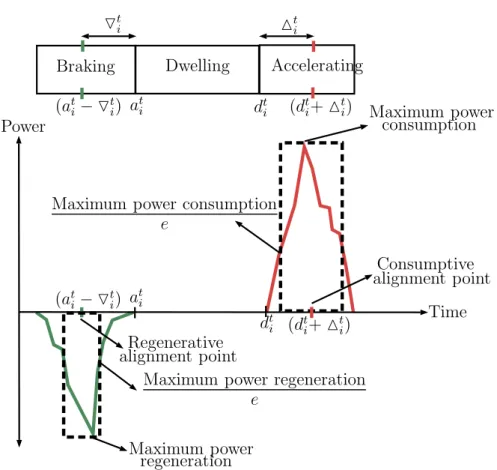
(11)

at i dti △t i ▽t i Power Time (at i −▽ti) (dti+△ti) at i dt i (at i−▽ti) (dt i+△ti) Dwelling Braking Accelerating Regenerative Consumptive alignment point alignment point Maximum power

Maximum power consumption

e

consumption

Maximum power regeneration

e

Maximum power regeneration

Figure 1: Applying 1e heuristic to power graphs

energy back to the electrical grid requires specialized technology such as reversible electrical substations [20, page 30]. A strategy based on storing is not feasible with present technology, because storage options such as super-capacitors, fly-wheels,etc., have drastic discharge rates besides being too expensive [21, page 66], [22, page 92]. A better strategy that can be used with existing technology [23] is to transfer the regenerative energy of a braking train to a nearby and simultaneously accelerating train, if both of them operate under the same electrical substation. We call such pairs of trains suitable train pairs. So our objective is to maximize the total overlapped area between the graphs of power consumption and regeneration of all suitable train pairs. To model this mathematically, we are faced with the following tasks: i) define suitable train pairs, ii) provide a tractable description of the overlapped area between power graphs of such a pair. We describe them as follows.

5.2.1 Defining suitable train pairs

We consider platform pairs who are opposite to each other and are powered by the same electrical substations. Thus, the transmission loss in transferring electrical energy between them is negligible. The set containing all such platform pairs is denoted by Ω. Consider any such platform pair (i, j) Ω, and let Ti ⊆ T be the set of all trains which arrive at, dwell

(12)

PES2 GRW2 GRW1 LXM2 LXM1 LJB2 LJB1 SXZ2 SXZ1 ZJD2 ZJD1 YHR2 YHR1 CSR2 CSR1 YSS2 YSS1 JYR2 JYR1 LZV2 LZV1 LHR2 LHR1 PJT2 PJT1 JYS2 JYS1 LHS2 LHS1 SFM2 Line 2 Line 1

Figure 2: Railway network considered for numerical study

and then depart from platformi. Suppose, t∈ Ti. Now, we are interested in finding another

train ˜t on platform j, i.e., ˜t ∈ Tj, which along with t would form a suitable pair for the

transfer of regenerative braking energy. To achieve this, we use the EMT. Among all trains going through platformj, the one which is temporally closest to t in the energy-minimizing timetable is be the best candidate to form a pair with t. The temporal proximity can be of two types with respect to t, which results in the following definitions.

Definition 1. Consider any(i, j)Ω. For every train t∈ Ti, the train ⇀

t ∈ Tj is called the

temporally closest train to the right of t if

⇀ t = argmin t′∈{x∈Tj:0¯axj+ ¯dxj 2 − ¯ ati+ ¯dti 2 ≤r} ( ¯ at i + ¯dti 2 − ¯ at′ j + ¯dt ′ j 2 ) , (16)

where ris an empirical parameter determined by the timetable designer and is much smaller

than the time horizon of the entire timetable.

Definition 2. Consider any(i, j)Ω. For every train t∈ Ti, the train ↼

t ∈ Tj is called the

temporally closest train to the left of t if

↼ t = argmin t′∈{x∈Tj:0<¯ati+ ¯dti 2 − ¯ axj+ ¯dxj 2 ≤r} ( ¯ at i + ¯dti 2 − ¯ atj′ + ¯dtj′ 2 ) . (17)

Definition 3. Consider any (i, j)Ω. For every train t∈ Ti, the train ˜t∈ Tj is called the

temporally closest train to t if

˜ t= argmin t′∈{t ,t} ( ¯ at i+ ¯dti 2 − ¯ at′ j + ¯dt ′ j 2 ) . (18)

If both ⇀t and ↼t are temporally equidistant from t, we pick one of them arbitrarily.

Any synchronization process between a suitable train pair (SPSTP) can be described by specifying the corresponding i, j, t and ˜t by using the definitions above. We construct a set of all SPSTPs, which we denote by E. Each element of this set is a tuple of the form (i, j, t,˜t). Because ˜tis unique for any tin each element ofE, we can partitionE into two sets denoted by⇀E and↼E containing elements of the form (i, j, t,⇀t) and (i, j, t,↼t) respectively.

(13)

5.2.2 Description of the overlapped area between power graphs

The power graph during accelerating and braking is highly nonlinear in nature with no analytic form, as shown in Figure 1. So, maximizing the exact overlapped area will lead to an intractable optimization problem. However, the existence of dominant peaks with sharp falls allows us to apply a robust lumping method such as 1

e heuristic [24, page

33-34] to approximate the power graphs as rectangles. The 1e heuristic is applied as follows (see Figure 1). The height of the rectangle is the maximum power, and the width is the interval with extreme points corresponding to power dropped at 1/e of the maximum. For the sharp drop from the peak, such rectangles are very robust approximations to the original power graph containing the most concentrated part of the energy, e.g., if the drop were exponential, then the energy contained by the rectangle would have been exactly equal to that of the original curve [24, page 33-34]. After converting both the power graphs to rectangles, maximizing the overlapped area under those rectangles is equivalent to aligning the midpoint of the width of the rectangles; we call such a midpoint regenerative or consumptive alignment point. These alignment points act as virtual peaks of the approximated power graphs. As shown in Figure 1, for a train t in its braking phase prior to its arrival at platform i, the relative distance of at

i from the regenerative alignment point is denoted by

▽t

i, while during acceleration the relative distance of the consumptive alignment point from

dt

i is denoted by△tj. Note that both relative distances are known parameters for the current

optimization problem.

5.3

Final optimization model

Consider an element (i, j, t,⇀t)E. To ensure the transfer of maximum possible regenerative energy from the braking train ⇀t to the accelerating train t, we aim to align both their alignment points such that dt

i+ △ti= a ⇀ t j −▽ ⇀ t

j ,or keep them as close as possible otherwise.

Similarly, for any (i, j, t,↼t)E, our objective isd↼t j + △

t

j =ati−▽ti , or as close as possible.

Let a decision vector y be defined as

y = dti+△ti a ⇀ t j +▽ ⇀ t j (i,j,t,⇀t)∈⇀E, d ↼ t j +△ ↼ t j −ati+▽ti (i,j,t,↼t)∈↼E . (19)

Then our goal comprises of two parts: 1) maximize the number of zero components of y

which corresponds to minimizing card(y), and 2) keep the nonzero components as close to zero as possible which corresponds to minimizing the ℓ1 norm of y, kyk1. Combining these

two we can write the exact optimization problem as follows: minimize card(y) +γkyk1 subject to Equations(3)(7),(14),(15),(19), ∀t∈ T ∀i∈ Nt 0at i ≤m,0≤dti ≤m , (20)

where γ is a positive weight, and decision variables are a, d and y. The objective function is nonconvex as shown next. Take the convex combination of the vectors 2e1/γ and 0 with

(14)

convex coefficients 1/2. Then, card e1 γ +γ eγ1 1 = 2> 1 2 card 2e1 γ +γ 2γe1 1 + 1 2(card(0) +γk0k1) = 1.5, and thus violates definition of a convex function. As a result, problem (20) is a nonconvex problem. Note that if we remove the cardinality part from the objective, then it reduces to a convex optimization problem because the constraints are affine and the objective is theℓ1

norm of an affine transformation of the decision variables [25, pages 72, 79, 136-137]. Such problems are often called convex-cardinality problem and are of N P-hard computational complexity in general [26]. An effective yet tractable numerical scheme to achieve a low-cardinality solution in a convex-low-cardinality problem is the ℓ1 norm heuristic, where card(y)

is replaced bykyk1, thus converting problem (20) into a convex optimization problem. This

is described by problem (21) below. The ℓ1 norm heuristic is supported by extensive

numer-ical evidence with successful applications to many fields,e.g., robust estimation in statistics, support vector machine in machine learning, total variation reconstruction in signal pro-cessing, compressed sensing etc.. In the next section we show that in our problem too, the

ℓ1 norm heuristic produces excellent results. Intuitively, the ℓ1 norm heuristic works well,

because it encourages sparsity in its arguments by incentivizing exact alignment between regenerative alignment points with the associated consumptive ones [25, pages 300-301]. We provide a theoretical justification for the use of ℓ1 norm in our case as follows.

Proposition 2. The convex optimization problem described by

minimize kyk1 subject to Equations(3)(7),(14),(15),(19), ∀t∈ T ∀i∈ Nt 0at i ≤m,0≤dti ≤m , (21)

is the best convex approximation of the nonconvex problem (20) from below.

Proof. Both problems (21) and (20) have the same constraint set, so we need to focus on the

objective only. The best convex approximation of a nonconvex function f :C R (where

C is any set) from below is given by its convex envelopeenvf onC. The function envf is the largest convex function that is an under estimator off on C, i.e.,

envf = sup{f˜:C R|f˜is convex and ˜f f},

where sup stands for the supremum, i.e., the least upper bound of the set. The definition implies, epi envf =conv epif.

From Equation (19) we see that y is an affine transformation of a and d, and from the last constraints of problem (20) we see that both a and d are upper bounded by m, i.e.,

kak mandkdk m. So there exists a positive numberP such thatkyk P. As the domain ofy is bounded in anℓball with radiusP,env card(y) = P1kyk1[27, page 321]. So,

(15)

As the coefficient (P1 +γ) is a constant for a particular optimization problem, it can be omitted, and thus we arrive at the claim.

Using the epigraph approach [25, pages 143-144], we can transform the convex problem (21) into a linear program as follows. For each (i, j, t,⇀t) E and each (i, j, t,↼t) E, we introduce new decision variablesθt⇀t

ij andθt

t

ij respectively, such thatθt

⇀ t ij ≥ |dti+△ti −a ⇀ t j +▽ ⇀ t j | and θt↼t ij ≥ |d ↼ t j + △ ↼ t

j −ati +▽ti|. Then, the convex optimization problem can be converted

into the following linear problem: minimize P (i,j,t,⇀t)∈⇀E θ t⇀t ij + P (i,j,t,↼t)∈↼Eθ t↼t ij subject to ∀(i, j, t,⇀t)E θt⇀t ij ≥dti+△ti −a ⇀ t j +▽ ⇀ t j , ∀(i, j, t,⇀t)E θt⇀t ij ≥ −dti−△ti +a ⇀ t j −▽ ⇀ t j , ∀(i, j, t,↼t)E θt↼t ij ≥d ↼ t j + △ ↼ t j −ati+▽ti , (i, j, t,↼t)E θt↼t ij ≥ −d ↼ t j −△ ↼ t j +ati−▽ti , Equations(3)(7),(14),(15), ∀t∈ T ∀i∈ Nt 0at i ≤m,0≤dti ≤m , (22)

where the decision variables are at i, dti, θt ⇀ t ij andθt ↼ t ij .

6

Numerical study

In this section we apply our model to different problem instances spanning full service period of one day to service PES2-SFM2 of line 8 of Shanghai Metro network. The numerical study was executed on a Intel Core i7-46400 CPU with 8 GB RAM running Windows 8.1 Pro operating system. For modelling the problem, we have used JuMP- an open source algebraic modelling language embedded in programming language Julia [28]. Within our JuMPcode we have called academic version of Gurobi Optimizer 6.0 as the solver. We have implemented an interior point algorithm because of the underlying sparsity in the data structure. As mentioned before, a measure of the quality of affine fittings using least-squares approach is given by the coefficient of determination, which can vary between 0 to 1, with 0 being the worst and 1 being the best [18, page 518]. In our numerical study, the average coefficient of determination of the affine fittings for energy versus trip times over all different trips and all trains is found to be 0.9483 with a standard deviation of 0.05, which justifies our approach. The service PES2-SFM2 of line 8 of the Shanghai Metro network is shown in Figure 2. There are two lines in this network: Line 1 and Line 2. There are fourteen stations in the network denoted by all capitalized words in the figure. Each station has two platforms each on different train lines, e.g., LXM is station that has two opposite platforms: LXM1 and LXM2 on Line 1 and Line 2 respectively. The platforms are denoted by rectangles. The

(16)

Table 1: Results of the numerical study Number of trains Number of con-straints Stage 1 Number of vari-ables Stage 1 Stage 1 CPU time (s) Number of con-straints Stage 2 Number of Vari-able Stage 2 Stage 2 CPU Time (s) Initial effec-tive energy consumption (kWh) Final effec-tive energy consumption (kWh) Reduction in effec-tive energy consumption 1000 91998 30060 3.24 116558 34871 6.03 250951.3 201658.7 19.64 % 1032 94944 31022 3.03 120394 36038 5.45 261994.5 208558.1 20.40 % 1066 98074 32044 3.96 124494 37290 5.62 272486.7 215896.7 20.77 % 1100 101204 33066 3.47 129284 38887 5.39 288677.5 229091.8 20.64 % 1132 104150 34028 3.15 133354 40171 6.69 308924.4 243672 21.12 % 1166 107280 35050 2.84 137322 41357 6.67 322612.7 256288.7 20.56 % 1198 110226 36012 2.96 141322 42606 7.16 329388.2 262205.6 20.40% 1232 113356 37034 4.04 145756 44025 7.61 354050.2 277536.7 21.61% 1266 116486 38056 3.84 149868 45283 8.74 368901.4 297815 19.27 % 1298 119432 39018 3.93 153480 46338 7.62 366488.4 293068.8 20.03 % 1332 122562 40040 4.22 157752 47676 8.02 379700.8 300910.1 20.75 %

platforms indicated by PES2 and SFM2 are the turn-around points on Line 2, with the crossing-overs being PES2-GRW1 and LHS1-SFM2.

The duration of the timetables is eighteen hours which is the full service period of the railway network. We have considered eleven different instances with varying average headway times and number of trains. The number of trains increases as the average headway time decreases. The results of the numerical study are shown in Table 1.

We can see that, in all of the cases our model has found the optimal timetables very quickly, the largest runtime being 12.58s. To the best of our knowledge, this model is the only one to calculate energy-efficient railway timetable spanning an entire day, the next largest being 6 hours only [8] with a much larger computation time for smaller sized problems. After we get the final timetable, we calculate the total effective energy consumption by all trains involved in SPSTPs and compare it with the original timetables. The effective energy consumption of a train during a trip is defined as the difference between the total energy required to make a trip and the amount of energy that is being supplied by a braking train during synchronization process. So, the effective energy consumption is the energy that will be consumed from the electrical substations.

The original timetables, which we compare the final timetables with, are provided by Thales Canada Inc. The energy calculation is done using SPSIM, which is a proprietary software owned by Thales Canada Inc [15], and Cubature, which is an open-source Julia

package written by Steven G. Johnson [29]. SPSIMcalculates the power versus time graphs of all the active trains for the original and optimal timetables. Cubatureis used to calculate the effective area under the power versus time graphs to determine 1) the total energy required by the trains during the trips, 2) the total transferred regenerative energy during the SPSTPs, and 3) the effective energy consumption as the difference of the first two quantities. The effective energy consumption of the optimal timetables in comparison with the original ones

(17)

is reduced quite significantly - even in the worst case, the reduction in effective energy consumption is 19.27%, with the best case corresponding to 21.61%.

7

Conclusion

In this paper we have proposed a novel two-stage linear optimization problem to calculate an energy-efficient timetable in modern railway networks. The objective is to minimize the total electrical energy consumption of all trains and to maximize the utilization of regenerative energy produced by braking trains. In contrast to other existing models, this model is computationally the most tractable one, and can be applied to any railway network using existing technology. We have applied our optimization model to eleven different instances of service PES2-SFM2 of line 8 of Shanghai Metro network. All instances span the full service period of one day (18 hours) with thousands of active trains. For all instances our model has found optimal timetables in less than 13s with significant reductions in the effective energy consumption.

Acknowledgements

This work was supported by NSERC-CRD and Thales, Inc (CRDPJ 461180 -13). The authors acknowledge helpful discussions with Professor J. Christopher Beck, Department of Mechanical & Industrial Engineering, University of Toronto.

References

[1] R. Patil, J. C. Kelly, Z. Filipi, and H. Fathy, “A framework for the integrated optimiza-tion of charging and power management in plug-in hybrid electric vehicles,” inAmerican

Control Conference (ACC), 2012, pp. 1327–1334.

[2] T. Nuesch, T. Ott, S. Ebbesen, and L. Guzzella, “Cost and fuel-optimal selection of hev topologies using particle swarm optimization and dynamic programming,” inAmerican

Control Conference (ACC), June 2012, pp. 1302–1307.

[3] R. Mura, V. Utkin, and S. Onori, “Recasting the hev energy management problem into an infinite-time optimization problem including stability,” in IEEE 52nd Annual

Conference on Decision and Control (CDC), 2013, pp. 6837–6842.

[4] S. Bashash, S. J. Moura, J. C. Forman, and H. K. Fathy, “Plug-in hybrid electric vehicle charge pattern optimization for energy cost and battery longevity,” Journal of Power Sources, vol. 196, no. 1, pp. 541–549, 2011.

[5] A. Y. Saber and G. K. Venayagamoorthy, “Intelligent unit commitment with vehicle-to-grida cost-emission optimization,” Journal of Power Sources, vol. 195, no. 3, pp. 898–911, 2010.

(18)

[6] S. S. Harrod, “A tutorial on fundamental model structures for railway timetable opti-mization,”Surveys in Operations Research and Management Science, vol. 17, no. 2, pp. 85–96, 2012.

[7] M. Pe˜na-Alcaraz, A. Fern´andez, A. P. Cucala, A. Ramos, and R. R. Pecharrom´an, “Optimal underground timetable design based on power flow for maximizing the use of regenerative-braking energy,” Proceedings of the Institution of Mechanical Engineers, Part F: Journal of Rail and Rapid Transit, vol. 226, no. 4, pp. 397–408, 2012.

[8] S. Das Gupta, L. Pavel, and J. Kevin Tobin, “An optimization model to utilize regen-erative braking energy in a railway network,” in American Control Conference (ACC), 2015, 2015.

[9] Z. Le, K. Li, J. Ye, and X. Xu, “Optimizing the train timetable for a subway system,”

Proceedings of the Institution of Mechanical Engineers, Part F: Journal of Rail and Rapid Transit, 2014.

[10] X. Yang, X. Li, Z. Gao, H. Wang, and T. Tang, “A cooperative scheduling model for timetable optimization in subway systems,” IEEE Transactions on Intelligent Trans-portation Systems, vol. 14, no. 1, pp. 438–447, 2013.

[11] X. Li and H. K. Lo, “An energy-efficient scheduling and speed control approach for metro rail operations,” Transportation Research Part B: Methodological, vol. 64, pp. 73–89, 2014.

[12] ——, “Energy minimization in dynamic train scheduling and control for metro rail operations,”Transportation Research Part B: Methodological, vol. 70, pp. 269–284, 2014. [13] P. Serafini and W. Ukovich, “A mathematical model for periodic scheduling problems,”

SIAM Journal on Discrete Mathematics, vol. 2, no. 4, pp. 550–581, 1989.

[14] L. Peeters, Cyclic railway timetable optimization. Erasmus Research Institute of Man-agement (ERIM), 2003, no. EPS-2003-022-LIS.

[15] Thales Group, “SelTracR communications-based train control for urban rail.”

[Online]. Available: https://www.thalesgroup.com/sites/default/files/asset/document/ Thales%20SelTracCBTC%20brochure.pdf

[16] I. P. Milroy, “Aspects of automatic train control,” Ph.D. dissertation, c Ian Peter Milroy, 1980.

[17] M. Pe˜na-Alcaraz, M. Webster, and A. Ramos, “An approximate dynamic programming approach for designing train timetables,” Transportation Science, in review, 2012. [18] W. Mendenhall, R. Beaver, and B. Beaver, Introduction to probability and statistics.

(19)

[19] A. Schrijver, Theory of linear and integer programming. John Wiley & Sons, 1998. [20] “Overview of braking energy recovery technologies in the public transport field.”

[Online]. Available: http://tickettokyoto.eu/sites/default/files/downloads/T2K ER overview technologies web.pdf

[21] K. S. Avinash Balakrishnan, Ed., Nanostructured Ceramic Oxides for Supercapacitor

Applications. CRC Press, 2014.

[22] B. Droste-Franke, B. Paal, C. Rehtanz, D. U. Sauer, J.-P. Schneider, M. Schreurs, and T. Ziesemer, Balancing Renewable Electricity: Energy Storage, Demand Side

Manage-ment, and Network Extension from an Interdisciplinary Perspective. Springer Science

& Business Media, 2012, vol. 40.

[23] Bombardier Inc., “Energstor wayside energy storage,” 2010. [Online]. Available: http://www.bombardier.com/content/dam/Websites/bombardiercom/ supporting-documents/BT/Bombardier-Transportation-ECO4-EnerGstor-EN.pdf [24] S. Mahajan, Street-fighting Mathematics. MIT Press Cambridge, 2010.

[25] S. Boyd and L. Vandenberghe,Convex optimization. Cambridge university press, 2009. [26] S. Boyd, “l1-norm methods for convex cardinality problems,”Lecture Notes for EE364b,

Stanford University. Available at http://www. stanford. edu/class/ee364b, 2014.

[27] G. Calafiore and L. El Ghaoui,Optimization Models. Cambridge university press, 2014. [28] M. Lubin and I. Dunning, “Computing in operations research using julia,” INFORMS

Journal on Computing, vol. 27, no. 2, pp. 238–248, 2015. [Online]. Available: http://

dx.doi.org/10.1287/ijoc.2014.0623

[29] S. G. Johnson, “The cubature module for julia.” [Online]. Available: https://github. com/stevengj/Cubature.jl

Figure

Figure 1: Applying 1 e heuristic to power graphs
Figure 2: Railway network considered for numerical study
Table 1: Results of the numerical study Number of trains Numberof con-straints Stage 1 Numberofvari-ablesStage1 Stage1CPUtime(s) Numberofcon-straintsStage2 NumberofVari-ableStage2 Stage2CPUTime(s) Initial effec-tiveenergyconsumption(kWh) Final effec-tiveen

References

Related documents

California, for example, broadly defines a resident as any individual domiciled in California as well as ‘‘every individual who is in this state for other than a temporary or

ally illustrate how VLANs restrict forwarding to use safe paths in a transitional network, we first consider a straightforward, yet impractical scheme: For every pair of SDN

In the original reservoir model, since the well geometries and well control patterns are not very complex, low load imbalance is obtained for parallel simulation based on the four

Shujaat and Abbas (2015) used augmented gravity model of trade employing panel random effect estimation technique to explain the export flow of Pakistan with 140 trading partners

12 Data Science Master Entrepreneur- ship Data Science Master Engineering entrepreneurship society engineering. Eindhoven University of Technology

Given that Ministers already have to satisfy themselves that the land is eligible land, (i.e. abandoned or neglected), and that purchase by the community body is

In this PhD thesis new organic NIR materials (both π-conjugated polymers and small molecules) based on α,β-unsubstituted meso-positioning thienyl BODIPY have been

In the case of high density TSVs, since the droplet diameter of conventional inkjet is not small enough for metallization of very narrow vias, super-fine inkjet technol- ogy (SIJ)