Contents lists available atScienceDirect
Addictive Behaviors
journal homepage:www.elsevier.com/locate/addictbeh
A systematic review into the incidence, severity and duration of
antidepressant withdrawal effects: Are guidelines evidence-based?
James Davies
a,b,⁎, John Read
c,daUniversity of Roehampton, London, United Kingdom
bAll-Party Parliamentary Group for Prescribed Drug Dependence, United Kingdom cUniversity of East London, London, United Kingdom
dInternational Institute for Psychiatric Drug Withdrawal, Sweden
H I G H L I G H T S
•
More than half (56%) of people who attempt to come off antidepressants experience withdrawal effects.•
Nearly half (46%) of people experiencing withdrawal effects describe them as severe.•
It is not uncommon for the withdrawal effects to last for several weeks or months.•
Current U.K. and U.S.A. Guidelines underestimate the severity and duration of antidepressant withdrawal, with significant clinical implications.A B S T R A C T
Introduction: The U.K.'s current National Institute for Health and Care Excellence and the American Psychiatric Association's depression guidelines state that withdrawal reactions from antidepressants are ‘self-limiting’ (i.e. typically resolving between 1 and 2 weeks). This systematic review assesses that claim. Methods: A systematic literature review was undertaken to ascertain the incidence, severity and duration of antidepressant withdrawal reactions. We identified 24 relevant studies, with diverse methodologies and sample sizes.
Results: Withdrawal incidence rates from 14 studies ranged from 27% to 86% with a weighted average of 56%. Four large studies of severity produced a weighted average of 46% of those experiencing antidepressant withdrawal effects endorsing the most extreme severity rating on offer. Seven of the ten very diverse studies providing data on duration contradict the U.K. and U.S.A. withdrawal guidelines in that they found that a significant proportion of people who experience withdrawal do so for more than two weeks, and that it is not uncommon for people to experience withdrawal for several months. The findings of the only four studies calculating mean duration were, for quite heterogeneous populations, 5 days, 10 days, 43 days and 79 weeks.
Conclusions: We recommend that U.K. and U.S.A. guidelines on antidepressant withdrawal be urgently updated as they are clearly at variance with the evidence on the incidence, severity and duration of antidepressant withdrawal, and are probably leading to the widespread misdiagnosing of withdrawal, the consequent lengthening of antidepressant use, much unnecessary antidepressant prescribing and higher rates of antidepressant prescriptions overall. We also recommend that prescribers fully inform patients about the possibility of withdrawal effects.
1. Introduction
Antidepressants are one of the most commonly used drug classes in the U.K. and U.S.A., with prescriptions and duration of use rising each year. In the U.K. usage has risen since 2000 by 170%, with over seven million adults (16% of the English adult population) being prescribed an antidepressant in England alone last year (2016–17) (DHSC, 2018), and with the number of individual annual prescriptions now topping 65 million (NHS Digital, 2017). Additionally, about half of all anti-depressant users [approx. 3.5 million people in England (8% of the population)] have been taking antidepressants for longer than two
years, (Johnson et al., 2012). In the U.S.A. almost 8% of the population aged over 12 used antidepressants (in a given month) in 1999–2002, a figure rising to almost 13% (37 million adults) by 2011–2014 (CDCP, 2017). Around one-half of antidepressant users in the U.S.A. [approx. 18 million people (7% of the population)] have been taking them for at least 5 years (Mojtabai & Olfson, 2014). An online survey of anti-depressant users in the U.K. found that 36% had been on them for at least five years and 26% expected to stay on them for life (Read, Gee, Diggle, & Butler, 2018). Furthermore, the average duration of anti-depressant use has more than doubled since the mid-2000s in both the U.K. (NHS Digital, 2017) and the U.S.A. (Mojtabai & Olfson, 2014).
https://doi.org/10.1016/j.addbeh.2018.08.027
Received 26 July 2018; Received in revised form 24 August 2018; Accepted 26 August 2018 ⁎Corresponding author.
E-mail address:[email protected](J. Davies).
Available online 04 September 2018
0306-4603/ © 2019 The Authors. Published by Elsevier Ltd. This is an open access article under the CC BY-NC-ND license (http://creativecommons.org/licenses/BY-NC-ND/4.0/).
Previous research on long-term use has estimated that a third of people in the U.K. who take antidepressants for more than two years have no evidence-based clinical indications for continuing to take them (Cruickshank, MacGillivray, & Bruce, 2008). Similar levels of un-necessary long-term prescribing have also been found in other, non-U.K. settings (Ambresin et al., 2015, Eveleigh et al., 2014,Eveleigh, 2015). If we apply the percentages of such non-indicated prescribing to today's long-term use figures, we could estimate that approximately 1.2 million long-term antidepressant users in England, and 6 million users in the U.S.A., could be taking antidepressants without clinical indica-tion and could therefore try withdrawing.
As a previous review indicates, antidepressants have been long known to induce withdrawal reactions in a large proportion of users (Haddad, 1997). While in some people such reactions may be mild, of short duration and manageable with reassurance and explanation (Haddad, 1997) in other people, even with slow withdrawal, these re-actions are severe, long-lasting and can make normal functioning im-possible (Anon, 1999). Typical antidepressant withdrawal reactions include increased anxiety, flu-like symptoms, insomnia, nausea, im-balance, sensory disturbances, and hyperarousal. Dizziness, electric shock-like sensations, brain zaps, diarrhoea, headaches, muscle spasms and tremors, agitation, hallucinations, confusion, malaise, sweating and irritability are also reported (Warner, Bobo, Warner, Reid, & Rachal, 2006, Healy, 2012). Although the aforementioned symptoms are the most common physical symptoms, there is also evidence that anti-depressant withdrawal can induce mania and hypomania, (Goldstein et al., 1999;Naryan & Haddad, 2011) emotional blunting and an in-ability to cry, (Holguin-Lew & Bell, 2013) and long-term or even per-manent sexual dysfunction (Csoka & Shipko, 2006). A recent systematic review of studies about a specific group of antidepressants (Serotonin-Norepinephrine Reuptake Inhibitors - SNRIs) concluded that ‘With-drawal symptoms occurred after discontinuation of any type of SNRI. … Symptoms typically ensued within a few days from discontinuation and lasted a few weeks, also with gradual tapering. Late onset and/or a longer persistence of disturbances occurred as well’ (Fava et al., 2018, p. 195).
Current U.S.A. clinical guidelines indicate that withdrawal reactions ‘typically resolve without specific treatment over 1–2 weeks’ (APA, 2010, p. 39), with current U.K guidelines similarly stating, that ‘[withdrawal] symptoms are usually mild and self-limiting over about 1 week, but can be severe, particularly if the drug is stopped abruptly’ (NICE, 2009, 1.9.2.1 in CG90).
The purpose of the current study, therefore, was to evaluate the accuracy and helpfulness of these guidelines by conducting a systematic review of the research literature on the incidence, duration and severity of antidepressant withdrawal.
2. Methods
The inclusion criteria for the review were any research articles published in peer-reviewed journals, in English, providing clear, com-parable data about the incidence, duration or severity of withdrawal from antidepressants. No time restriction was employed in relation to when the studies were conducted. Studies were included regardless of diagnosis, as withdrawal effects are not influenced by the problem for which they are prescribed. Individual (n= 1) case studies were noted but excluded from numerical summaries or estimates.
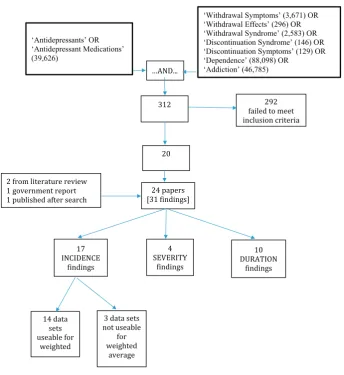
A systematic search, informed by PRISMA guidelines (Moher, Liberati, Tetzlaff, & Altman, 2009), was undertaken by one of the two reviewers using MeSH (Medical Subjects Headings) in the MEDLINE/ PubMed database. The search terms deployed were: Antidepressants OR Antidepressant Medications (39,626) AND Withdrawal Symptoms (3671) OR Withdrawal Effects (296) OR Withdrawal Syndrome (2583) OR Discontinuation Syndrome (146) OR Discontinuation Symptoms (129) OR Dependence (88,098) OR Addiction (46,785). This produced 312 papers. Reviewing the Abstracts of these 312 revealed that 20 met
our inclusion criteria. The other reviewer independently searched PsycINFO, and Google Scholar but found no additional relevant papers. Searching the bibliographies of the 20 papers also produced no further studies. However, a 2015 review identified two additional relevant studies. An additional survey addressing duration and severity (invol-ving one of the reviewers – JD) published in a recent report by the All-Party Parliamentary Group for Prescribed Drug Dependence in the U.K., was included in the review (Davies, Pauli, & Montagu, 2018b). Also included was a paper (Read, Cartwright, & Gibson, 2018), published just after the search, elaborating on the findings of a previous paper (Read, Cartwright, & Gibson, 2014) (involving the other reviewer). These four additions brought the total number of publications to 24, providing 31 sets of findings. A flow diagram for the search process (Fig. 1) shows that 17 of the findings pertained to incidence, four to severity and ten to duration.
3. Results
3.1. Study characteristics
The methodologies of the 24 studies were heterogeneous and the sample sizes ranged from three to 1367. Six of the 24 studies were drug-company funded and a further five involved researchers with conflicts of interest in relation to drug company money (seeTables 1–3). Four of the samples were in the U.K., three each in Canada and the U.S.A., two each in Italy and Japan and one each in Denmark, the Netherlands and New Zealand. The other seven used international samples. Six were published in the 1990s, eight between 2000 and 2009, and ten since 2010, indicating a consistently low research interest in antidepressant withdrawal.
3.2. Incidence
Our search revealed 17 studies providing data on incidence rates, 14 of which were deemed usable when calculating a weighted average (see Table 1). The methodologies were heterogeneous. The most common approaches to assessing withdrawal were the Discontinuation-Emergent Signs and Symptoms (DESS) checklist, covering 43 symptoms (six stu-dies, using from two to four symptoms as the cut off), and self-report based on self-definition of ‘withdrawal’ symptoms (three studies). Sample sizes ranged from 14 to 1367. Eight provided data that compared anti-depressant drugs, which are recorded inTable 1but not discussed fur-ther. Nine of the 17 studies were either drug company funded (six) or involved authors with conflicts of interest from receipt of industry funds (three).
The largest three studies, all independent of drug-company influence, were online surveys. The first, by the Royal College of Psychiatrists (RCPsych) in the U.K. found that of 817 antidepressant users, 512 (63%) experienced varying types and degrees of withdrawal reaction upon antidepressant cessation (RCPsych, 2012). This is similar to the results derived from the largest direct-to-consumer survey of antidepressant users to date. Of the 1367 New Zealand antidepressant users in New Zealand who responded to a question about withdrawal, 55% replied that they had experienced some degree of withdrawal effects (Read et al., 2014). An international survey, utilising almost identical methodology as the New Zealand study, also found that 55% (of 953 antidepressant users) reported withdrawal effects (Read & Williams, 2018). In the New Zealand cohort the percentage reporting withdrawal effects rose to 74% among those who had been on the drugs for more than three years (Cartwright, Gibson, Read, Cowan, & Dehar, 2016).
Zealand (83%) and international (65%) studies the ‘dissatisfaction bias’ concern seems minimal. (Satisfaction data was not provided in the RCPsych study).
Table 1also summarises eleven other, smaller studies, with diverse methodologies, mostly using assessment periods of just 5–14 days. A multicentre study of 86 people who had been on antidepressants for over 3 months, found that 66 (77%) exhibited withdrawal symptoms within 7 days of having the drug abruptly replaced with placebo (Hindmarch, Kimber, & Cocle, 2000). An 8-week multicentre rando-mised trial, comparing sertraline and venlafaxine XR patients with major depressive disorder, revealed withdrawal reactions in a com-bined average of 85% of 129 patients (Sir et al., 2005; Table 4). An RCT study of 95 people who abruptly stopped taking fluoxetine indicated 67% experienced withdrawal reactions, (Zajecka et al., 1998) and a case-report study of 14 people who abruptly withdrew from fluvox-amine found that 86% experienced withdrawal (Black, Wesner, & Gabel, 1993). An additional randomised clinical trial of SSRI with-drawal, covering 185 people, revealed an average withdrawal incidence of 46% (Rosenbaum, Fava, Hoog, Ascroft, & Krebs, 1998). Another study, evaluating 25 outpatients treated with escitalopram, found 14 (56%) experienced withdrawal reactions, with higher dose and lower clearance leading to higher risk of withdrawal (Yasui-Furukori et al., 2016). A further study of 28 users of venlafaxine who were randomised to a three-day or 14-day taper, indicated that 46% experienced with-drawal (Tint, Haddad, & Anderson, 2008). Finally, a small study of 20 outpatients treated with SSRIs before slowly tapering off them found that 45% exhibited withdrawal reactions (Fava, Bernardi, Tomba, & Rafanelli, 2007).
Three studies report somewhat lower rates. One, an open trial of 97 people who discontinued their SSRIs, found 27% experienced with-drawal upon discontinuation (Bogetto, Bellino, Revello, & Patria, 2002). The second, a 12-week randomised, double-blind study of par-oxetine patients, showed that of 55 withdrawing from parpar-oxetine 35% developed withdrawal reactions upon abrupt discontinuation (Oehrberg et al., 1995). The third, a randomised, double-blind, placebo-controlled study of escitalopram, found that 27% of 181 people ex-hibited withdrawal reactions following abrupt replacement with pla-cebo (Montgomery, Nil, Durr-Pal, Loft, & Boulenger, 2005).
These 14 methodologically diverse studies (comprising RCTs, nat-uralistic studies and surveys) produced incidence rates ranging from 27% to 86%. When grouping the three types of study together, the weighted average for each was: the three surveys, 57.1% (1790/3137); the five naturalistic studies, 52.5% (127/242); and the six RCTs, 50.7% (341/673). The combined median of all studies was 55%, with a weighted average of 55.7% (2258/4052).
Excluded studies
Incidence rates from a further three studies (all outliers, beyond the range of the 14 studies above) were deemed unsuitable for inclusion in the calculation of the weighted average of incidence rates but are noted for completeness. The first was a retrospective study of the medical notes of 385 people who stopped paroxetine. It found that 11% of the patients' notes recorded withdrawal (Himei & Okamura, 2006). As this study excluded any withdrawal commencing 3 days after discontinua-tion, and only assessed 9 withdrawal symptoms, lower rates may be an artefact of the study design. Furthermore it was a chart-review of medical notes, which relies on practitioners being aware of and
‘Antidepressants’ OR ‘Antidepressant Medications’ (39,626)
‘Withdrawal Symptoms’ (3,671) OR ‘Withdrawal Effects’ (296) OR ‘Withdrawal Syndrome’ (2,583) OR ‘Discontinuation Syndrome’ (146) OR ‘Discontinuation Symptoms’ (129) OR ‘Dependence’ (88,098) OR
‘Addiction’ (46,785)
312
2 from literature review 1 government report 1 published after search
24 papers [31 findings]
…AND...
292 failed to meet inclusion criteria
20
4 SEVERITY
findings 17
INCIDENCE findings
14 data sets useable for
weighted
10 DURATION
findings
3 data sets not useable
[image:3.595.126.471.52.428.2]for weighted
Table 1
Incidence of antidepressant withdrawal reactions.
STUDY and funding⁎ Antidepressant type Treatment duration Abrupt/Tapered Withdrawal
assessment period Withdrawal incidence
Montgomery et al., 2005 escitalopram 12 weeks abrupt 2 weeks 27% (49/181)1
DC
Bogetto et al., 2002 paroxetine ≥ 8 weeks mixed (67% tapered) 4 weeks 27% (26/97)2
IND fluoxetine parox 42% (22/52)
fluox 9% (4/45)
Oehberg et al 1995 paroxetine 12 weeks abrupt 2 weeks 35% (19/55)3
DC
Fava et al., 2007 fluoxetine X= 29 months tapered
(‘slowest possible’) 1 year 45% (9/20)
1
IND fluvoxamine ≥ 6 months
paroxetine citalopram sertraline
Tint et al., 2008 paroxetine ≥ 6 weeks tapered (‘brief’) 5-7 days 46% (13/28)4
CI fluoxetine parox 56% (5/8)
venlafaxine others 36% (4/11)
citalopram fluvoxamine
Rosenbaum et al., 1998 fluoxetine X= 11 months abrupt 5-8 days 46% (86/185)1
DC sertraline sertr 60% (38/63)
paroxetine parox 66% (39/59)
fluox 14% (9/63) Read et al., 2014, 2018 paroxetine median
(52%)= > 3 years mixed indefinite(online survey) 55% (750/1367) 5
IND venlafaxine parox 76% (82/108)
citalopram. venla 70% (19/27)
fluoxetine Tricyc 51% (28/55)
sertraline cital 47% (115/247)
escitalopram fluox 36% (97/273)
Tricyclics escit 33% (5/15)
sertr 18% (2/11) Read & Williams, 2018 sertraline median (62%)
= > 3 years mixed indefinite(online survey) 55% (528/953)
5
IND fluoxetine parox 69% (46/67)
citalopram Tricyc 63% (37/59)
venlafaxine fluox 62% (75/120)
paroxetine venla 60% (48/80)
escitalopram escit 56% (35/63)
duloxetine cital 55% (65/118)
fluvoxamine sertr 50% (61/121)
Tricyclics fluvo 47% (7/15)
dulox 31% (5/16) Yasui-Furukori et al., 2016 escitalopram > 6 months tapered indefinite (every
clinic visit) 56% (14/25)
6 CI
R.C.P., 2012 citalopram. unknown – real-life mixed indefinite
(online survey) 63% (512/817) 5
? fluoxetine venla 82% (89/109)
venlafaxine escit 75% (38/51)
sertraline parox 69% (20/29)
escitalopram dulox 69% (18/26)
mirtazapine sertra 62% (55/89)
paroxetine cital 60% (141/235)
duloxetine Tricyc 53% (23/43)
Tricyclics fluox 44% (76/173)
mirta 21% (8/38)
Zajecka et al., 1998 fluoxetine 12 weeks abrupt 6 weeks 67% (64/95)7
CI
Hindmarch et al., 2000 fluoxetine ≥ 3 months abrupt 4-7 days 77% (66/86)1
DC sertraline parox 100% (22/22)
paroxetine fluox 77% (17/22)
citalopram cital 70% (14/20)
recording withdrawal reactions. An earlier chart-review, of 171 out-patients who tapered off their antidepressants, found a similar overall incidence of 12%, and suffered from similar methodological limitations (Coupland, Bell, & Potokar, 1996). A large study of people taking part in a withdrawal programme using tapering strips found that 97% had experienced withdrawal during previous attempts to stop anti-depressants, but such a high rate is to be expected in this group, who are not representative of all antidepressant users (Groot & Van Os, 2018). If these three studies had been included, the weighted average would have been slightly increased (to 56.5% – 2992/5300).
In addition, two of the large surveys asked participants whether they had experienced addiction to the antidepressants. In the New Zealand survey (Read et al., 2014;Read, Cartwright et al., 2018) 27% reported addiction (with 80% describing their addiction as ‘moderate’ or severe’). In the international survey 37% reported addiction (with 62% ‘moderate’ or ‘severe’ (Read & Williams, 2018). These findings, while important in their own right, were not included in the calculation of the weighted average as addiction and withdrawal are inter-related but different phenomena.
Five other studies, all funded by drug companies, compared the average numbers of ‘discontinuation symptoms’ resulting from the funder's product and the competitors' products, typically following ar-tificially short treatment periods of eight to 12 weeks, and always using assessment periods of only five to 14 days (Baldwin, Cooper, Huusom, & Hindmarch, 2006;Judge, Parry, Quail, & Jacobson, 2002;Michelson et al., 2000; Montgomery, Huusom, & Bothmer, 2004; Montgomery, Kennedy, Burrows, Lejoyeux, & Hindmarch, 2004). Because they also failed to report incidence rates in terms of percentages, these studies could not be included inTable 1. Nevertheless some of these studies produce further evidence that withdrawal reactions are common. For example one found that after just 8 weeks on venlafaxine people ex-perienced an average of five withdrawal symptoms when they stopped taking the drug (Montgomery et al., 2004).
3.3. Severity
Our review discovered five studies reporting the severity of with-drawal effects. Four large, independently funded, studies found that nearly a half of people who have experienced withdrawal effects choose the most extreme option in the scale offered to them to describe the severity of those effects (seeTable 2).
All four studies involved surveys of antidepressant use in the real world and therefore covered broad ranges of types of antidepressant
and duration of treatment. For example, the large New Zealand study covered a range of antidepressants (seeTable 1) and 52% had taken antidepressants for more than three years. This survey found that 46% of the 750 antidepressant users who reported withdrawal effects ticked ‘severe’ and a further 32% ticked ‘moderate’, on a mild–moder-ate–severe scale. (Read et al., 2014). This was similar to the 43% (se-vere) and 25% (moderate) findings for the 528 withdrawers in the large international sample, using the same scale (Read & Williams, 2018). A recent Dutch study of people involved in a tapering programme found that of the 671 who had experienced withdrawal effects 339 (51%) reported the most extreme level of withdrawal; ‘very much’ (point 7 on a seven point sale of severity) (Groot & Van Os, 2018). In a recent in-ternational survey, 580 people who had attempted withdrawal from antidepressants responded to the question ‘how severely do you feel withdrawal has impacted upon your life’ On a scale of 0–10). The mean response was 8.35 (SD = 2.05) denoting that the majority experienced severe reactions (median = 9, mode = 10), with 249 (43%) indicating the highest level of severity on the scale (10) (Davies et al., 2018b).
Thus, the percentages selecting the most extreme level of severity on offer in these four studies ranged from 43% to 51%, with a weighted average of 45.7% (1157/2529).
Excluded study
The fifth study was a drug company funded study comparing ser-traline versus venlafaxine. After a 2 week taper, the withdrawal reac-tions of 110 patients were rated as ‘severe’ by two and as ‘very severe’ by one (Sir et al., 2005). These low severity rates would have been minimised by the treatment period being artificially short (8 weeks), compared to the four surveys of the real life experiences of people on antidepressants for months or years. Furthermore, in the drug company study severity was clinician-rated rather than the self-report used in the other four studies. Including this outlier in the weighted average would have reduced it slightly, to 43.9% (1158/2639).
3.4. Duration
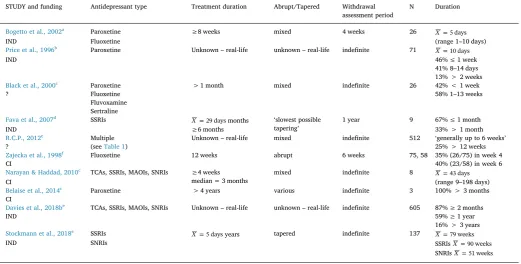
Regarding the duration of withdrawal reactions, we identified ten relevant studies (seeTable 3). Three involved conflicts of interest but none were drug-company funded.
[image:5.595.38.557.70.162.2]One open trial study of 26 patients (treated for 8 weeks or more) who experienced withdrawal effects when discontinuing under clinical supervision found that the effects lasted for an average of 5 days (Bogetto et al., 2002). Another small open trial showed that three out of nine people (33%) experienced withdrawal for longer than a month, Table 1(continued)
STUDY and funding⁎ Antidepressant type Treatment duration Abrupt/Tapered Withdrawal
assessment period Withdrawal incidence
Sir et al., 2005 sertraline 8 weeks tapered 2 weeks 85% (110/129)8
DC venlafaxine sertr 58% (39/67)
venla 71% (44 /62)
Black et al., 1993 fluvoxamine 8 months abrupt 2 weeks 86% (12/14)9
DC
WEIGHTED AVERAGE 55.7% (2258/4052)
⁎ DC = study funded by drug company; CI = conflict of interest, i.e. author(s) in receipt of drug company funding, or drug company employee; IND = independent; ? = unknown - no conflict of interest statement
1≥ 4 of the 43 symptoms in Discontinuation-Emergent Signs and Symptoms (DESS) checklist 2≥ 2 DESS symptoms
3observation or spontaneous self report of any adverse event (i.e. not specifically asked about withdrawal symptoms or administered DESS) 4≥ 3 DESS symptoms
5self defined
under the ‘slowest possible tapering’ (Fava et al., 2007). A study of spontaneous reports by U.K. doctors to a national data base found that 71 reported on duration of withdrawal effects. The effects lasted for between one and 52 days, with an average of 10.5 days. (Price, Waller, Wood, & MacKay, 1996). However, 34% of the 430 people who had had a withdrawal reaction when stopping paroxetine had reactions that were so severe and/or long-lasting that they had to be treated with a reintroduction of the drug, so the actual duration of untreated with-drawal reactions was minimised.
The RCPsych survey of antidepressant users found that for the 512 who experienced withdrawal the symptoms ‘generally lasted for up to 6 weeks’ and that ‘A quarter of our group reported anxiety lasting more than 12 weeks’ (how much longer than 12 weeks was not reported) (RCPsych, 2012). A recent international survey found that of the 580 people who had experienced antidepressant withdrawal and who
answered the question ‘How long have you experienced withdrawal symptoms?’ 86.7% responded at least 2 months, 58.6% at least one year, and 16.2% more than three years (Davies et al., 2018b).
Additionally, a recent content analysis of a population likely to have experienced withdrawal difficulties assessed the content of 137 online posts about antidepressant withdrawal in the real world. The mean duration of withdrawal symptoms was 90.5 weeks for the 97 SSRI users and 50.8 weeks for the 40 SNRI users (Stockmann, Odegbaro, Timimi, & Moncrieff, 2018).
[image:6.595.39.558.78.186.2]A randomised control trial of discontinuation from fluoxetine found that 40% of 58 people who abruptly withdrew were still experiencing withdrawal symptoms at 6 weeks after discontinuation, with no further follow up (Zajecka et al., 1998). In a study reviewing cases of ‘anti-depressant discontinuation manic states’, the eight for which duration of withdrawal reactions was known, produced a mean duration of Table 2
Severity of withdrawal effects.
STUDY and fundinga Treatment duration Type of scale Percentage choosing most extreme level of severity
Groot & Van Os, 2018 Unknown 0–7 51% (339/671)
IND
Read et al., 2014 Mode (52%) ≥ 3 years None/mild/ 46% (342/750)
IND Moderate/severe
Read & Williams, 2018 Mode (62%) ≥ 3 years None/mild/ 43% (227/528) Moderate/severe
IND
Davies et al., 2018b Unknown 0–10 43% (249/580)
IND
WEIGHTED AVERAGE 45.7% (1157/2529)
[image:6.595.38.560.415.679.2]a IND = independent.
Table 3
Duration of withdrawal effects.
STUDY and funding Antidepressant type Treatment duration Abrupt/Tapered Withdrawal
assessment period N Duration
Bogetto et al., 2002a Paroxetine ≥8 weeks mixed 4 weeks 26 X =5 days
(range 1–10 days)
IND Fluoxetine
Price et al., 1996b Paroxetine Unknown – real-life unknown – real-life indefinite 71 X =10 days
IND 46% ≤ 1 week
41% 8–14 days 13% > 2 weeks Black et al., 2000c Paroxetine > 1 month mixed indefinite 26 42% < 1 week
? Fluoxetine 58% 1–13 weeks
Fluvoxamine Sertraline
Fava et al., 2007d SSRIs X =29 daysmonths ‘slowest possible
tapering’ 1 year 9 67% ≤ 1 month
IND ≥6 months 33% > 1 month
R.C.P., 2012e Multiple Unknown – real-life mixed indefinite 512 ‘generally up to 6 weeks’
? (seeTable 1) 25% > 12 weeks
Zajecka et al., 1998f Fluoxetine 12 weeks abrupt 6 weeks 75, 58 35% (26/75) in week 4
CI 40% (23/58) in week 6
Narayan & Haddad, 2010c TCAs, SSRIs, MAOIs, SNRIs ≥4 weeks
median = 3 months mixed indefinite 8 X =43 days
CI (range 9–198 days)
Belaise et al., 2014c Paroxetine > 4 years various indefinite 3 100% > 3 months CI
Davies et al., 2018be TCAs, SSRIs, MAOIs, SNRIs Unknown – real-life unknown – real-life indefinite 605 87% ≥ 2 months
IND 59% ≥ 1 year
16% > 3 years Stockmann et al., 2018e SSRIs X =5 daysyears tapered indefinite 137 X =79 weeks
IND SNRIs SSRIsX=90 weeks
SNRIsX=51 weeks
a > 2 of the 43 symptoms in Discontinuation-Emergent Signs and Symptoms (DESS) checklist b spontaneous reports to national data base
c case studies d > 4 DESS symptoms e self-report
43 days – ranging from nine to 198 days (Naryan & Haddad, 2011). A review of three cases being treated for withdrawal with CBT, reported withdrawal duration of over 3 months for all cases (Belaise, Gatti, Chouinard, & Chouinard, 2014). A further case-report study assessed 46 cases of SSRI discontinuation, with 26 containing information on duration symptoms. In 11 of these 26 cases (42.3%), symptoms resolved in less than 1 week, while in the rest of the cases (57.7%) duration ranged from one to 13 weeks (Black, Shea, Dursun, & Kutcher, 2000). In this study the withdrawal symptoms of an additional 17 people only ended after the reintroduction of an antidepressant, meaning that only 26% (11/43) experienced spontaneous remission of their withdrawal symptoms within 1 week.
The ten studies do not permit a weighted average, because of the variety of methodologies and ways duration was reported. Seven out of the ten studies contradict the U.K. and U.S.A. withdrawal guidelines in that they found that a significant proportion of people experiencing withdrawal do so for more than 2 weeks (Belaise et al., 2014;Davies et al., 2018b;Fava et al., 2007;Narayan & Haddad, 2010;Stockmann et al., 2018;RCPsych, 2012;Zajecka et al., 1998).
For example, one study found withdrawal lasting at least 6 weeks in 40% of people (Zajecka et al., 1998) and another found it lasting at least 12 weeks in 25% (RCPsych, 2012). Many examples of longer durations, beyond a year, are reported by two recent, real life samples of people experiencing difficulties with withdrawal (Davies, Pauli, & Montagu, 2018a;Stockmann et al., 2018).
4. Discussion
Our review of the quantitative studies concludes that more than half (56%) of antidepressant users experience withdrawal, with the majority of these describing their withdrawal as moderate or severe, and nearly half (46%) as severe. Seven of the ten very diverse studies providing data on duration contradict the U.K. and U.S.A. withdrawal guidelines in that they found a significant proportion of people who experience withdrawal do so for more than 2 weeks, and that it is not uncommon for people to experience withdrawal for several months and beyond.
Furthermore, two of the studies reviewed indicate that for 40% of people who withdraw the effects last at least 6 weeks (Zajecka et al., 1998) and for 25% they last 12 weeks or more (RCPsych, 2012). Given that around 7 million individuals were prescribed antidepressants in England last year and around 37 million in the U.S.A., it is possible that around 2.8 million people in England and 14.8 million in the U.S.A. (about 5% of the U.S.A. and English populations) may experience an-tidepressant withdrawal for at least six weeks after cessation, and 1.8 million and 9 million respectively may experience withdrawal for at least 12 weeks. Additionally, and taking England alone, at least 4 mil-lion people may experience withdrawal symptoms, and over 1.8 milmil-lion may experience these as severe.
These findings differ significantly from those implied in both the U.K. (NICE, 2009) and U.S.A. guidelines (APA, 2010) on antidepressant withdrawal. Furthermore, these findings are not alone in contradicting current guidelines. For instance, a 2015 review of quantitative studies and 38 case reports, noted that in only 4 out of 18 case reports (22%) did withdrawal symptoms spontaneously remit within 2 weeks, and in two cases paroxetine withdrawal was present up to 1 year after dis-continuation. It concluded that while withdrawal reactions ‘typically occur within a few days from drug discontinuation and last a few weeks…. many variations are possible, including late onset and/or longer persistence of disturbances’ (Fava, Gatti, Belaise, Guidi, & Offidani, 2015).
4.1. ‘Discontinuation syndrome’ vs.‘withdrawal’
Given that antidepressant withdrawal is of higher incidence, severity and longer duration than current guidelines acknowledge, a number of key implications follow. Firstly, using the term ‘discontinuation
syndrome’ to characterise antidepressant withdrawal runs contrary to the evidence. While ‘discontinuation syndrome’ has been used sporadically in the literature since the 1960s, its established meaning with respect to antidepressants was first operationally defined at the ‘Discontinuation Consensus Panel’ funded by Eli Lilly in 1996 (Schatzberg, 1997; Schatzberg et al., 1997), where it was delineated as a ‘self-limiting syn-drome’ (e.g. comprising mild, transient and/or more distressing symp-toms that can lead to impairments in functioning or productivity), ‘ty-pically resolving within 2 to 3 weeks’ (Rivas-Vazquez, Johnson, Blais, & Rey, 1999) and to be distinguished from other contentious withdrawal forms such as those generated by benzodiazepines and sedative hypno-tics (Fava et al., 2015).
The panel's characterisation of withdrawal as ‘self-limiting’ and re-solving within 2–3 weeks (a position still broadly reflected in current guidelines), however, appears unsupported not only by the evidence the panel cited to substantiate the ‘self-limiting’ claim, (ADH, 1996) but by subsequent evidence on duration (such as that covered by this review). Furthermore, defining ‘withdrawal syndromes’ as those pertaining to benzodiazepines and antipsychotics, and ‘discontinuation syndromes’ to SSRIs, not only erroneously separates antidepressant withdrawal from other CNS drug withdrawals but also minimises the vulnerabilities induced by SSRIs (Nielsen, Hansen, & Gotzsche, 2012). The term ‘dis-continuation syndrome’ may further mislead as antidepressant with-drawal can occur without discontinuation (e.g. between two doses of rapid-onset and short-acting drugs and with a decrease in medication) (Fava et al., 2015), while the term ‘syndrome’ subtly medicalises withdrawal by associating it with a disorder endogenous to the person than with a non-dysfunctional reaction to the cessation of a drug. For these reasons, this review supports Fava et al. (2015) in stating that ‘discontinuation syndrome’ should be replaced with a term more con-sistent with the evidence, such as ‘withdrawal’ or ‘withdrawal reaction’. 4.2. Misdiagnosis of withdrawal
Another implication of antidepressant withdrawal being of higher incidence and longer duration than current guidelines acknowledge, is that added credence is given to concerns that many doctors are mis-diagnosing withdrawal – e.g. as relapse or treatment failure. One pre-vailing view deployed to counter this concern, is that misdiagnosis can be avoided, as it is possible to distinguish withdrawal reactions from relapse on the grounds that withdrawal usually commences within a few days after cessation and resolves quickly if the drug is reinstated, whereas relapse is uncommon in the first weeks after stopping treat-ment (Anon, 1999). This view is problematic, however, as many withdrawal variations are possible, including late onset of withdrawal and/or longer persistence of disturbances, meaning withdrawal symp-toms may be easily misidentified as signs of impending relapse (Fava et al., 2015). For example, for drugs like fluoxetine, with a longer half-life, it is possible that withdrawal may commence many days or even weeks after cessation, confounding beliefs about withdrawal's close proximity to cessation (Renoir, 2013). Furthermore, differing metabolic rates can also confound accurate predictions about the onset of with-drawal. Additionally, and crucially, re-emergent symptoms of depres-sion and anxiety are a regular feature of antidepressant withdrawal itself (Rosenbaum et al., 1998) – the RCPsych's own survey found that the withdrawal reaction rated severe by most people was increased anxiety, with approximately 25% of users experiencing anxiety for at least 3 months after stopping their antidepressant (RCPsych, 2012). As antidepressants are now widely prescribed for anxiety-related pro-blems, and as increased anxiety is a common withdrawal reaction, ig-norance of withdrawal reactions could have led, in the past, to relapse being overestimated when antidepressants were withdrawn (Anon, 1999) and could still be leading, in the present, to genuine withdrawal being misread as relapse with drugs being reinstated and a more ne-gative prognosis being issued.
respond to treatment (e.g. where covert non-adherence is mistaken as the condition worsening, leading to dose increase or drug switching); or as bipolar I or II (e.g. where ‘manic’ of ‘hypomanic’ withdrawal reac-tions are misdiagnosed as the early onset of bipolar); or as the result of switching medications (e.g. where withdrawal reactions are mis-diagnosed as side-effects of the new antidepressant) (Haddad & Anderson, 2007).
Misdiagnosing antidepressant withdrawal in the aforementioned ways would predict rising long-term antidepressant use, as many users, having their withdrawal experiences misread, would have their drugs reinstated and/or switched (and/or their dosage increased). Such rising long-term use is precisely what we find in the clinical population, with the average duration of antidepressant use more than doubling since the mid-2000s in both the U.K. (NHS Digital, 2017) and the U.S.A. (Mojtabai & Olfson, 2014).
4.3. Consistency with qualitative studies on withdrawal
Qualitative studies, where antidepressant users are either asked open questions in surveys or interviews, or have their spontaneous in-ternet postings published, are also consistent with the findings of the current review. These studies also serve to bring those findings to life. Illustrative examples of personal testimony regarding the severity of withdrawal effects follow:
I am currently trying to wean myself off of Venlafaxine, which honestly is the most awful thing I have ever done. I have horrible dizzy spells and nausea whenever I lower my dose. (Pestello & Davis-Berman, 2008).
I forgot to take my Citalopram for two days and woke up one morning with severe dizziness. It was so extreme that I fell over when I tried to get out of bed and I threw up. (Read, Cartwright et al., 2018).
The withdrawal effects if I forget to take my pill are severe shakes, suicidal thoughts, a feeling of too much caffeine in my brain, electric shocks, hallucinations, insane mood swings. ….. kinda stuck on them now coz I'm too scared to come off it. (Gibson, Cartwright, & Read, 2016).
While there is no doubt I am better on this medication, the adverse effects have been devastating – when I have tried to withdraw - with “head zaps”, agitation, insomnia and mood changes. This means that I do not have the option of managing the depression any other way because I have a problem coming off this medication. (Cartwright et al., 2016).
Testimonies relevant to the duration of the effects include: It took me 2 months of hell to come off the antidepressants. Was massively harder than I expected. (Read, Cartwright et al., 2018). It took me almost two years to get off Paroxetine and the side effects were horrendous. I even had to quit my job because I felt sick all the time. Even now that I am off of it, I still feel electric shocks in my brain (Pestello & Davis-Berman, 2008).
The difficulty of getting off has been a tough road and taken me years of trying and is something that doctors could be more knowledgeable of and supportive with. (Cartwright et al., 2016).
4.4. Clinical guidelines on antidepressant withdrawal
A final implication of the incidence, severity and duration of anti-depressant withdrawal being higher than guidelines acknowledge, is that current guidelines are misleading doctors on the nature and management of withdrawal. As current U.K. (NICE, 2009) and U.S.A.
(APA, 2010) depression guidelines are at variance with the conclusions of this research, a Freedom of Information Request was issued to NICE to ascertain the evidence base for its current statement on withdrawal – namely, that “[withdrawal] symptoms are usually mild and self-lim-iting over about 1 week” (NICE, 2009, 1.9.2.1 in CG90). NICE re-sponded that its current statement on antidepressant withdrawal was inherited from an earlier statement issued in the previous 2004 guidelines, which stated that:
There are no systematic randomised studies in this area…. If symptoms are mild, reassure the patient that these symptoms are not uncommon after discontinuing an antidepressant and that they will pass in a few days. (NICE, 2004, 4.5.2.48 in CG23 italics added).
NICE confirmed that evidence for both the above claims ‘has not been updated’ since 2004. Furthermore, this evidence was derived, at the time, from only two pieces of research (e.g.Haddad, 2001;Lejoyeux & Adès, 1997), neither of which, upon analysis, cites a single source that supports NICE's later (2009) one-week claim.
NICE's current position on antidepressant withdrawal was not only originally advanced on weak evidence, but is 14 years out of date and countered by subsequent evidence, as can be seen in this review. This raises concerns for the substantial number of antidepressant users who will experience withdrawal for a longer duration than guidelines re-cognise. Assuming doctors honour such guidelines, many of these people will likely have their antidepressant withdrawal misdiagnosed – e.g., as relapse or as a failure to respond to treatment – with anti-depressants either being reinstated, switched or doses increased as a consequence. These practices, if routinely enacted, would help partly explain lengthening antidepressant use, which has increased the number of antidepressant prescriptions.
That doctors are being misled by guidelines also legitimates con-cerns raised by affected people that their withdrawal was not properly acknowledged, understood and managed by doctors, something widely reported in survey data (Davies et al., 2018b,Cartwright et al., 2016). This is also confirmed by the two largest surveys to date, which re-vealed that fewer than 2% of antidepressant users recall being told anything by the prescriber about withdrawal effects, dependence or potential difficulties coming off the drugs (Read, Cartwright et al., 2018;Read & Williams, 2018). Illustrative personal testimonies include: I was never fully informed of all side effects, short or long-term. …. If I had been more fully informed I would not have taken the medication for a long time or at all.
I was never informed by doctors of long-term side effects or addic-tion/development of tolerance and went through extremely severe withdrawal symptoms attempting to get off. (Cartwright et al., 2016).
An additional legitimate concern regarding prescribers being unin-formed about withdrawal effects is that they may fail to engage with their patients on this issue after the initial prescription. An online survey of 752 CE users in the U.K. found that 48% did not have their drugs reviewed at least every 3 months, and 65% had never had a discussion with the prescriber about whether, or how, to come off (Read, Gee et al., 2018).
5. Limitations
limited follow up: at 3 days (Himei & Okamura, 2006), at 14 days (Black et al., 1993) at 4 weeks (Bogetto et al., 2002) at six weeks (Zajecka et al., 1998) and at 12 weeks (RCPsych, 2012). As short-term treatment will limit the occurrence of withdrawal upon discontinuation (Eveleigh et al., 2017), and as restricted follow-up will inevitably exclude post-follow-up withdrawal reactions, such delimitations will have probably led to the underestimation of both the incidence and duration of withdrawal in the studies reviewed, thus rendering our overall estimates conservative.
Other limitations concern the online surveys reviewed. Insofar as people who experience withdrawal may be more likely to respond to surveys our overall rates of duration and severity may have been af-fected. Furthermore, none of the studies reviewed determined the role of ‘nocebo’ effects – i.e. the expectation of feeling worse upon dis-continuation, which can lead to negative effects that may be misread as withdrawal effects. Although we were unable to assess what role, if any, nocebo effects played, it is probably minimal due to the nature of the withdrawal symptoms reported.
Future research must determine the extent to which the mis-diagnosis of withdrawal (leading to antidepressants being either re-instated or switched) has driven lengthening antidepressant use since the mid-2000s. While shorter antidepressant usage is associated with more successful antidepressant discontinuation, (Eveleigh et al., 2017) rising long-term antidepressant use is of serious concern. In addition to the obvious economic costs incurred, the human costs of long-term use are well documented, being linked with serious adverse effects such as increased severe side-effects, (Ferguson, 2001) the impairment of pa-tients' autonomy and resilience (increasing their dependence on med-ical help) (Kendrick, 2015), increased weight gain, (Gafoor, Booth, & Gulliford, 2018) worsening outcomes for some patients, (Hengartner, Angst, & Rössler, 2018; Shea, 1992) poorer long-term outcomes for major depressive disorder, (Vittengl, 2017) greater relapse rates, (Viguera, 1998) increased mortality (Maslej et al., 2017) and an in-creased risk of developing neurodegenerative disease, such as dementia (Richardson et al., 2018). It will also be important, therefore, to de-termine what people are told about withdrawal pre-treatment, to es-tablish how regularly and accurately they are being forewarned of likely withdrawal reactions; warnings that will impact decision-making around accepting antidepressant treatment.
Finally, given that the evidence reported here on antidepressant withdrawal severity, incidence and duration differs from what guide-lines state, future research must readdress the dependency-forming nature of antidepressants. This is particularly important as recent sur-veys reveal many antidepressant users report being ‘addicted’ to anti-depressants; for example. 37% from a sample of 943 (Read & Williams, 2018) and 27% from a sample of 1521 (Read et al., 2014). Among 493 antidepressant users 57% agreed with the statement ‘When you have taken antidepressants over a long period of time it is difficult to stop taking them’ and 56% agreed with ‘Your body can become addicted to antidepressants’ (Kessing, Hansen, Demyttenaere, et al., 2005). As withdrawal is a central criterion for dependency, underestimates of withdrawal may well have impacted on past assessments of the extent to which antidepressants are dependency-forming.
6. Conclusion
The available research indicates that antidepressant withdrawal reactions are widespread, with incidence rates ranging from 27% to 86% (weighted average of 56%), and with nearly half (46%) of those experiencing withdrawal describing these reactions as severe. Available research also indicates that current clinical guidelines in the U.K. and U.S are in urgent need of correction, in order to be evidence-based, as withdrawal effects are neither mostly ‘mild’ nor ‘self-limiting’ (i.e. ty-pically resolving over 1–2 weeks), but are regularly experienced far beyond what current guidelines acknowledge.
We therefore recommend that both sets of guidelines be urgently updated to reflect the evidence base on antidepressant withdrawal.
As a secondary recommendation we suggest that consideration be given to independent reviews of the processes by which the two bodies concerned construct clinical guidance around mental health interven-tions (e.g. how are panel members selected, by what criteria, and how is the quality of literature reviews assured). We also suggest that panel members are independent from the pharmaceutical industry, and that panels include experts-by-experience (i.e. antidepressant users) and non-medical mental health professionals.
As the lengthening duration of antidepressant use has fuelled rising antidepressant prescriptions over the same time period, we must un-derstand the drivers of such lengthening use. The evidence set out suggests that lengthening use may be partly rooted in the under-estimation of the incidence, severity and duration of antidepressant withdrawal reactions, leading to many withdrawal reactions being misdiagnosed, for example, as relapse (with drugs being reinstated as a consequence) or as failure to respond to treatment (with either new drugs being tried and/or dosages increased). This issue is pressing as long-term antidepressant use is associated with increased severe side-effects, increased risk of weight gain, the impairment of patients' au-tonomy and resilience (increasing their dependence on medical help), worsening outcomes for some patients, greater relapse rates, increased mortality and the development of neurodegenerative diseases, such as dementia.
It is of serious concern that prescribed antidepressant medications are causing withdrawal effects that are often long-lasting and severe, and that this is not being recognised by current clinical guidelines and, by extension, prescribers. It is of additional concern that such poor recognition of antidepressant withdrawal might be increasing the duration of antidepressant use and, therefore, overall rates of anti-depressant prescriptions.
Declarations of interest: none.
Conflict of interest
Prof John Read and Dr. James Davies have no conflict of interests to declare.
References
Ambresin, G., Palmer, V., Densley, K., Dowrick, C., Gilchrist, G., & Gunn, J. M. (2015). What factors influence long-term antidepressant use in primary care? Findings from the Australian diamond cohort study.Journal of Affective Disorders, 176, 125–132. American Psychiatric Association (2010).American Psychiatric Association Practice
Guideline for the Treatment of Patients with Major Depressive Disorder(3rd ed.). . Websitehttps://psychiatryonline.org/pb/assets/raw/sitewide/practice_guidelines/ guidelines/mdd.pdf, Accessed date: June 2018.
Anon, Withdrawing patients from antidepressants (1999).Drug and Therapeutics Bulletin, 37, 49–52.
Australian Department of Health. Australian adverse drug reactions bulletin. (1996).Website https://www.tga.gov.au/publication-issue/australian-adverse-drug-reactions-bulletin-vol-15-no-1#ssris(Accessed April 2018).
Baldwin, D., Cooper, J., Huusom, A., & Hindmarch, I. (2006). A double-blind, rando-mized, parallel group, flexible-dose study to evaluate the tolerability, efficacy and effects of treatment discontinuation with escitalopram and paroxetine in patients with major depressive disorder.International Clinical Psychopharmacology, 21, 159–169.
Belaise, C., Gatti, A., Chouinard, V. A., & Chouinard, G. (2014). Persistent post-with-drawal disorders induced by paroxetine, a selective serotonin reuptake inhibitor, and treated with specific cognitive behavioral therapy.Psychotherapy and Psychosomatics, 83(2014), 247–248.
Black, D. W., Wesner, R., & Gabel, J. (1993). The abrupt discontinuation of fluvoxamine in patients with panic disorder.Journal of Clinical Psychiatry, 54(4), 146–149. Black, K., Shea, C., Dursun, S., & Kutcher, S. (2000). Selective serotonin reuptake
in-hibitor discontinuation syndrome: Proposed diagnostic criteria.Revue de Psychiatrie et de Neuroscience, 25(3), 256–260.
Bogetto, F., Bellino, S., Revello, R. B., & Patria, l. (2002). Discontinuation syndrome in dysthymic patients treated with selective serotonin reuptake inhibitors: A clinical investigation.CNS Drugs, 16(4), 273–283.
Cartwright, C., Gibson, K., Read, J., Cowan, O., & Dehar, T. (2016). Long-term anti-depressant use: Patient perspectives of benefits and adverse effects.Patient Preferences and Adherence, 28(10), 1401–1407.
withdrawal.Journal of Clinical Psychopharmacology, 16, 356–362.
Cruickshank, G., MacGillivray, S., & Bruce, D. (2008). Cross-sectional survey of patients in receipt of long-term repeat prescriptions for antidepressant drugs in primary care.
Mental Health in Family Medicine, 5, 105–109.
Csoka, A. B., & Shipko, S. (2006). Persistent sexual side effects after SSRI discontinuation.
Psychotherapy and Psychosomatics, 75(3), 187–188.
Davies, J., Pauli, R., & Montagu, L. (2018a).Antidepressant Withdrawal: A Survey of Patients’ Experience by the All-Party Parliamentary Group for Prescribed Drug Dependence.Website: http://prescribeddrug.org/wp-content/uploads/2018/09/ APPG-PDD-Antidepressant-Withdrawal-Patient-Survey.pdf, Accessed date: 26 September 2018.
Davies, J., Pauli, G., & Montagu, L. (2018b).A survey of Antidepressant Withdrawal Reactions and their Management in Primary Care.Report from the All Party Parliamentary Group for Prescribed Drug Dependence.
Department of Health and Social Care (DHSC) (2018). Hansard: Prescriptions Drugs – Written Question – 128871. Websitehttps://www.parliament.uk/business/ publications/written-questions-answers-statements/written-question/Commons/ 2018-02-21/128871/, Accessed date: July 2018.
Eveleigh, R. (2015).Inappropriate long-term antidepressant use in primary care: A challenge to change (PhD thesis).Nijmegen: Radboud University.
Eveleigh, R., Grutters, J., Muskensa, E., Oude Voshaard, R., van Weel, C., Speckens, A., & Lucassen, P. (2014). Cost-utility analysis of a treatment advice to discontinue in-appropriate long-term antidepressant use in primary care.Family Practice, 31(5), 578–584.
Eveleigh, R., Muskens, E., Lucassen, P., Verhaak, P., Spiijker, J., van Well, V., ... Speckens, A. (2017). Withdrawal of unnecessary antidepressant medication: A randomized controlled trial in primary care.BJGP Open, 1(4),https://doi.org/10.3399/ bjgpopen17X101265.
Fava, G. A., Bernardi, M., Tomba, E., & Rafanelli, C. (2007). Effects of gradual dis-continuation of selective serotonin reuptake inhibitors in panic disorder with agor-aphobia.The International Journal of Neuropsychopharmacology, 10(6), 835–838. Fava, G. A., Gatti, A., Belaise, C., Guidi, J., & Offidani, E. (2015). Withdrawal symptoms
after selective serotonin reuptake inhibitors discontinuation: A systematic review.
Psychotherapy and Psychosomatics, 84, 72–81.
Fava, G., Benasi, G., Lucente, M., Offidani, E., Cosci, F., & Guidi, J. (2018). Withdrawal symptoms after Serotonin-Noradrenaline Reuptake Inhibitor discontinuation: Systematic review.Psychotherapy and Psychosomatics, 87, 195–203.
Ferguson, J. M. (2001). SSRI antidepressant medications: Adverse effects and tolerability.
Prim Care Companion J Clin Psychiatry, 3(1), 22–27.
Gafoor, R., Booth, H. P., & Gulliford, M. C. (2018). Antidepressant utilisation and in-cidence of weight gain during 10 years' follow-up: Population based cohort study.
BMJ, 361k1951.
Gibson, K., Cartwright, C., & Read, J. (2016). In my life antidepressants have been….’: A qualitative analysis of users' diverse experiences of antidepressants.BMC Psychiatry, 16, 135.
Goldstein, T., Frye, M., Denicoff, K., Leverich, S.-J. E., Bryan, A., Ali, S. O., & Post, R. (1999). Antidepressant discontinuation-related mania: Critical prospective observa-tion and theoretical implicaobserva-tions in bipolar disorder.Journal of Clinical Psychiatry, 60, 563–567.
Groot, P. C., & Van Os, J. (2018). Antidepressant tapering strips to help people come off medication more safely.Psychosis, 10(2), 142–145.
Haddad, P. M. (1997). Newer antidepressants and the discontinuation syndrome.Journal of Clinical Psychiatry, 58, 17–22.
Haddad, P. M. (2001). Antidepressant discontinuation syndromes clinical relevance.
Prevention and Management Drug Safety, 24(3), 183–197.
Haddad, P. M., & Anderson, I. M. (2007). Recognising and managing antidepressant discontinuation symptoms.Advances in Psychiatric Treatment, 13, 447–457. Healy, D. (2012).Data based medicine paper: Dependence and withdrawal.Website:http://
davidhealy.org/wp-content/uploads/2012/06/DBM-Paper-Dependence-and-Withdrawal.pdf, Accessed date: 21 February 2018.
Hengartner, M. P., Angst, J., & Rössler, W. (2018). Antidepressant use prospectively re-lates to a poorer long-term outcome of depression: Results from a prospective com-munity cohort study over 30 years.Psychotherapy and Psychosomatics, 87, 181–183. Himei, A., & Okamura, T. (2006). Discontinuation syndrome associated with paroxetine in depressed patients: A retrospective analysis of factors involved in the occurrence of the syndrome.CNS Drugs, 20(8), 665–672.
Hindmarch, I., Kimber, S., & Cocle, S. (2000). Abrupt and brief discontinuation of anti-depressant treatment: effects on cognitive function and psychomotor performance.
International Clinical Psychopharmacology, 15, 305–318.
Holguin-Lew, J. C., & Bell, L. (2013). "When I Want to Cry I Can't": Inability to cry fol-lowing SSRI treatment.Rev Colomb Psiquiatr, 42(4), 304–310.
Johnson, C. F., Macdonald, H. J., Atkinson, P., Buchanan, A. I., Downes, N., & Dougall, N. (2012). Reviewing long-term antidepressants can reduce drug burden: A prospective observational cohort study.British Journal of General Practice, 62(11), e773–e779. Judge, R., Parry, M., Quail, D., & Jacobson, J. (2002). Discontinuation symptoms:
Comparison of brief interruption in fluoxetine and paroxetine treatment.International Clinical Psychopharmacology, 17, 217–225.
Kendrick, T. (2015). Long-term antidepressant treatment: Time for a review?Prescriber, 26(19), 7–8 5th October.
Kessing, L., Hansen, H., Demyttenaere, K., et al. (2005). Depressive and bipolar disorders: Patients' attitudes and beliefs towards depression and antidepressants.Psychological Medicine, 35, 1205–1213.
Lejoyeux, M., & Adès, J. (1997). Antidepressant Discontinuation: A review of the litera-ture.Journal of Clinical Psychiatry, 58, 5–11.
Maslej, M. M., Bolker, B. M., Russell, M. J., Eaton, K., Durisko, Z., Hollon, S. D., ... Andrews, P. W. (2017). The mortality and myocardial effects of antidepressants are
moderated by preexisting cardiovascular disease: A meta-analysis.Psychotherapy and Psychosomatics, 86, 268–282.
Michelson, D., Fava, M., Amsterdam, J., Apter, J., Londborg, P., Tamura, R., & Tepner, R. (2000). Interruption of selective serotonin reuptake inhibitor treatment. Double-blind placebo-controlled trial.British Journal of Psychiatry, 176, 363–368.
Moher, D., Liberati, A., Tetzlaff, J., & Altman, D. G. (2009). Preferred reporting items for systematic reviews and meta-analyses: The PRISMA statement.British Medical Journal, 339, b2535.
Mojtabai, R., & Olfson, M. (2014). National trends in long-term use of antidepressant medications: Results from the U.S.A. National Health and Nutrition Examination Survey.Journal of Clinical Psychiatry, 75(2), 169–177.
Montgomery, S., Huusom, A., & Bothmer, J. (2004). A randomised study comparing es-citalopram with venlafaxine XR patients in primary care with major depressive dis-order.Neuropsychobiology, 50, 57–64.
Montgomery, S., Kennedy, S., Burrows, G., Lejoyeux, M., & Hindmarch, I. (2004). Absence of discontinuation symptoms with agomelatine and occurrence of dis-continuation symptoms with paroxetine: a randomized, double-blind, placebo-con-trolled discontinuation study.International Clinical Psychopharmacology, 19, 271–280. Montgomery, S., Nil, R., Durr-Pal, N., Loft, H., & Boulenger, J. (2005). A 24-week
ran-domized, double- blind, placebo-controlled study of escitalopram for the prevention of generalized social anxiety disorder.Journal of Clinical Psychiatry, 66, 1270–1278. Narayan, V., & Haddad, P. M. (2010). Antidepressant discontinuation manic states: a
critical review of the literature and suggested diagnostic criteria.Journal of Psychopharmacology, 25(3), 306–313.
Naryan, V., & Haddad, P. H. (2011). Antidepressant discontinuation manic states: A critical review of the literature and suggested diagnostic criteria.Journal of Psychopharmacology, 25(3), 306–313.
NHS Digital. Prescriptions dispensed in the community – Statistics for England, 2006–2016. (2017).Websitehttps://digital.nhs.uk/data-and-information/publications/ statistical/prescriptions-dispensed-in-the-community/prescriptions-dispensed-in-the-community-statistics-for-england-2006-2016-pas(Accessed July 6th 2018). The National Institute for Health and Care Excellence (NICE) (2009).Depression in adults:
recognition and management.Websitehttps://www.nice.org.uk/guidance/cg90/ resources/depression-in-adults-recognition-and-management-pdf-975742638037, Accessed date: July 2018.
Nielsen, M., Hansen, E. H., & Gotzsche, P. C. (2012). What is the difference between dependence and withdrawal reactions? A comparison of benzodiazepines and selec-tive serotonin re-uptake inhibitors.Addiction, 107, 900–908.
Oehrberg, S., Christiansen, P. E., Behnke, K., Borup, A. L., Severin, B., Soegaard, J., ... Manniche, P. M. (1995). Paroxetine in the treatment of panic disorder. A randomised, double-blind, placebo-controlled study.British Journal of Psychiatry, 167, 374–379. Pestello, F. G., & Davis-Berman, J. (2008). Taking anti-depressant medication: A quali-tative examination of internet postings.Journal of Mental Health, 17(4), 349–360. Price, J., Waller, P., Wood, S., & MacKay, A. (1996). A comparison of the post-marketing
safety of four selective serotonin re-uptake inhibitors including the investigation of symptoms occurring on withdrawal.British Journal of Clinical Pharmacology, 42, 757–763.
Read, J., Cartwright, C., & Gibson, K. (2014). Adverse emotional and interpersonal effects reported by 1,829 New Zealanders while taking antidepressants.Psychiatry Research, 216, 67–73.
Read, J., Cartwright, C., & Gibson, K. (2018). How many of 1,829 antidepressant users report withdrawal symptoms or addiction?International Journal of Mental Health Nursing.https://doi.org/10.1111/inm.12488.
Read, J., Gee, A., Diggle, J., & Butler, H. (2018). Staying on, and coming off, anti-depressants: The experiences of 752 U.K. adults.Addictive Behaviorshttps://doi.org/ 10.1016/j.addbeh.2018.08.021.
Read, J., & Williams, J. (2018). Adverse effects of antidepressants reported by a large international cohort: Emotional blunting, suicidality, and withdrawal effects.Current Drug Safety, 13, 1–11.
Renoir, T. (2013). Selective serotonin reuptake inhibitor antidepressant treatment dis-continuation syndrome: A review of the clinical evidence and the possible mechan-isms involved.Frontis in Pharmacology, 4, 45.
Richardson, K., Fox, C., Maidment, I., Steel, N., Loke, T. K., Arthur, A., ... Savva, G. M. (2018). Anticholinergic drugs and risk of dementia: Case-control study.BMJ, 361, k1315.
Rivas-Vazquez, R. A., Johnson, S. L., Blais, M. A., & Rey, G. J. (1999). Selective serotonin reuptake inhibitor discontinuation syndrome: Understanding, recognition, and management for psychologists.Professional Psychology: Research and Practice, 30(5), 464–469.
Rosenbaum, J. F., Fava, M., Hoog, S. L., Ascroft, R. C., & Krebs, W. B. (1998). Selective serotonin reuptake inhibitor discontinuation syndrome: A randomized clinical trial.
Biological Psychiatry, 44, 77–87.
Royal College of Psychiatrists. Coming off antidepressants. (2012).Websitehttp://www. rcpsych.ac.uk/healthadvice/treatmentswellbeing/antidepressants/
comingoffantidepressants.aspx(Accessed Feb 2018).
Schatzberg, A. F. (1997). Introduction/antidepressant discontinuation syndrome: An update on serotonin reuptake inhibitors.Journal of Clinical Psychiatry, 58(Suppl. 7), 1–5.
Schatzberg, A. F., Haddad, P. H., Kaplan, E. M., Lejoyeux, M., Rosenbaum, J. F., Young, A. H., & Zajecka, J. (1997). Serotonin reuptake inhibitor discontinuation syndrome: A hypothetical definition.Journal ofClinical Psychiatry, 58(Suppl. 7), 5–10.
Shea, M. T. (1992). Course of symptoms over follow-up.Archives of General Psychiatry, 49, 782–787.
Stockmann, T., Odegbaro, D., Timimi, S., & Moncrieff, M. (2018). SSRI and SNRI with-drawal symptoms reported on an internet forum.The International Journal of Risk & Safety in Medicine.https://doi.org/10.3233/JRS-1800182018 May 9. [Epub ahead of print].
Tint, A., Haddad, P. M., & Anderson, I. M. (2008). The effect of rate of antidepressant tapering on the incidence of discontinuation symptoms: A randomised study.Journal of Psychopharmacology, 22(3), 330–332.
Viguera, A. C. (1998). Discontinuing antidepressant treatment in major depression.
Harvard Review of Psychiatry, 5, 293–305.
Vittengl, J. R. (2017). Poorer long-term outcomes among persons with major depressive
disorder treated with medication.Psychotherapy and Psychosomatics, 86, 302–304. Warner, C., Bobo, W., Warner, C., Reid, S., & Rachal, J. (2006). Antidepressant
dis-continuation syndrome.American Family Physician, 74(3), 449–456.
Yasui-Furukori, N., Hashimoto, K., Tsuchimine, S., Tomita, T., Sugawara, N., Ishioka, M., & Nakamura, K. (2016). Characteristics of escitalopram discontinuation syndrome: A preliminary study.Clinical Neuropharmacology, 39(3), 125–127.