1
A Bifactor Model of the Polish Version of the Hare Self-Report
Psychopathy Scale
Agata Debowska1, Daniel Boduszek1, Susanna Kola1, Philip Hyland2
1
University of Huddersfield, UK
2
National College of Ireland, Ireland
2 Abstract
The 64-item Hare Self-Report Psychopathy Scale was translated into Polish with the aim to
test construct validity and dimensionality, incremental validity, and composite reliability of
the measure in a sample of working adults (N = 319). Confirmatory factor analyses revealed
that the best fitting model was the bifactor conceptualization containing six latent factors; two
general factors of psychopathy and four grouping factors represented by interpersonal,
affective, antisocial, and lifestyle latent variables (compared to a 2-factor, factor, and
4-factor with 2 hierarchical 4-factors). The scores of the Polish version of Hare SRP evidenced
good composite reliability and incremental validity in terms of predicting scores on
aggression scale. Implications for theory and future research are discussed.
Key words: Hare Self-Report Psychopathy Scale; Confirmatory factor analysis, Bifactorial
3 Introduction
Psychopathy is often presented as a complex set of dimensions which makes the disorder
extremely difficult to capture and define (Ogloff, 2006). Consequently there is much debate
in the literature with regards the underlying factor structure of psychopathy.
The most prominent and widely-used measure of psychopathy is the Psychopathy
Checklist-Revised (PCL-R; Hare, 1991, 2003). However, the PCL-R must be completed by a
highly trained clinician, which requires extensive amounts of time and access to collateral
records of the individual being assessed (Lilienfeld & Fowler, 2007). Furthermore, problems
exist with the PCL-R in terms of establishing the latent structure of the construct. Although
the scale consists of 20 items, only 18 items are identified as loading onto two factors: (1)
Interpersonal/Affective and (2) Lifestyle/Antisocial.
With these limitations in mind, a number of self-report measures of psychopathy have
been developed in recent years, one of them being the Self-Report Psychopathy Scale (SRP;
Hare, 1985). The first version of the SRP consisted of 29 items however the scale possessed
poor psychometric properties (Lilienfeld & Fowler, 2007). In order to address those issues, a
revised version of the measure was created (Hare, Harpur & Hemphill, 1989; as cited in
Williams & Paulhus, 2004). The SRP-II consisted of 60 items, 31 of which form the core of
the scale and align with the two factors of the PCL-R (Williams & Paulhus, 2004). In a
validation study of the SRP-II among a forensic sample, Hare (2003) reported a moderate
correlation between the SRP-II and PCL-R (r = .54). Nevertheless, Williams and Paulhus’
(2004) exploratory factor analysis of the SRP-II found the two-factor model upon which the
PCL-R was developed did not represent a good explanation of the data. The SRP-II was
4 antisocial behaviour, impulsivity and interpersonal manipulation subscales. The second factor
included items pertaining to affective deficits.
The newest version of the SRP, the SRP-III (Paulhus, Neumann & Hare, in press),
consists of 64 items measured on a five-point Likert scale. The instrument was reported to be
best captured by a four-factor solution, with 16 items loading on the four factors of
Interpersonal Manipulation, Callous Affect, Erratic Lifestyle, and Antisocial Behaviour. Neal
and Sellbom (2012) investigated the factor structure of the SRP-III among a sample of
undergraduate students. The authors compared four alternative models and results indicated
the four-factor model suggested by Paulhus et al. (in press) proved to be the most accurate
representation of the data, however, none of the models met acceptable model fit criteria as
measured by fit indices. The researchers suggested that the unsatisfactory results were likely
due to the large indicator-to-factor ratio and hence a parcelling technique developed by
Cattell and Burdsal (1975) was employed. Neal and Sellbom (2012) created 16 radical
parcels, each containing indicators from the same hypothesised factor. The same alternative
models were estimated for the transformed scale. The technique was successful in improving
the fit indices. As hypothesised, the instrument was best captured by the same four-factor
solution whose model fit criteria were found to be satisfactory.
The above studies reveal promising findings as to the usefulness of the SRP-III and
provide evidence that psychopathy is best conceptualised as four factorial solution. However,
based on work with the PCL-R, a variety of factorial solutions have been identified including
correlated two- (Harpur, Hakstian, & Hare, 1988; Hare et al., 1990), three- (Cooke & Michie,
2001), and four- (Hare 2003; Hare & Neumann, 2006) factor models. More recently a
number of authors have utilized an alternative model structure which may yield a
theoretically and statistically satisfactory solution to the debate. This involved the application
5 Bifactor modelling provides an empirically and conceptually distinct alternative to
traditional CFA model solutions. Bifactor modelling views covariation among observable
indicators to be explained by both “general factors” and “grouping factors” which exist at the
same conceptual level. Reise, Moore, and Haviland (2010) argue that the necessity of
creating heterogeneous item sets to capture the complexities of a psychological construct can
often produce spurious evidence of multidimensionality in instances where scales are actually
capturing a smaller number of latent factors.
Initially, Patrick, Hicks, Nichol, and Krueger (2007) investigated a number of
competing latent models of the PCL-R including a bifactorial conceptualisation. These
researchers found that a bifactor model including a single general “psychopathy” factor and
two grouping factors in-line with Hare’s original two-factor model of psychopathy
(interpersonal/affective and social deviance) was the best fit of the data. Flores-Mendoza,
Alvarenga, Herrero, and Abad (2008) subsequently investigated the latent structure of
psychopathy using the PCL-R, with the inclusion of the bifactor model suggested by Patrick
et al. (2007). This study was performed among 124 male prisoners, and results indicated that
the bifactorial solution was a better representation of the data than any other tested model.
Although these studies suggest the utility of applying a bifactorial model solution, the
results are difficult to interpret based on existing theoretical models of psychopathy.
Psychopathy has never been theorised to reflect a single latent construct as reflected in
models of Patrick et al. (2007) and Flores-Mendoza et al. (2008). Consequently, Boduszek
and Dhingra (in press) sought to examine the underlying structure of psychopathy using the
Psychopathy Checklist-Screening Version (PCL-SV; Hart, Cox & Hare, 1995). Boduszek and
Dhingra (in press) retained the use of a bifactorial procedure, however, they tested a model
in-line with theoretical formulations. This bifactorial solution included two general factors of
6 factors (Interpersonal, Affective, Antisocial Behaviour, and Erratic Lifestyle) that were
hypothesised to arise as a consequence of heterogeneous item content. This new bifactorial
model was found to be statistically superior to all other tested models. It was also consistent
with Hare’s (1991) original model of psychopathy (two factors of Interpersonal/Affective and
Antisocial/Lifestyle), while also accounting for previous results which have suggested a
greater degree of multidimensionality; namely that the presence of these additional factors is
simply a method effect.
The current study is carried out to further investigate the underlying factor structure of
the SRP-III using both traditional CFA techniques and bifactor modelling procedures. The
current study is performed on the Polish version of the SRP-III and will thus add valuable
evidence as to the scale cross-cultural applicability. It is hypothesised that a bifactorial
solution consistent with the findings of Boduszek and Dhingra (in press) will represent the
best fit of the data.
Method
Participants
The opportunistic sample consisted of 319 Polish working adults recruited at the University
of Security in Poznan (Poland). Participants ranged in age from 19 to 51 years (M = 25.16,
SD = 6.24). The sample consisted of 175 males and 144 females. Additionally, 77.4% of
participants reported being unmarried (n = 247), 20.7% being married (n = 66), 1.6% being
7 Measures
Hare Self-Report Psychopathy Scale (SRP-III; Paulhus et al., in press) is a self-report
measure modelled on the Psychopathy Checklist-Revised (PCL-R; Hare, 2003). It is
composed of 64-items which fall into four subcategories of psychopathy: Interpersonal
Manipulation (IPM - 16 items; α = .83), Callous Affect (CA - 16 items; α = .76), Erratic
Lifestyle (ELS – 16 items; α = .76), and Antisocial Behaviour (ASB - 16 items; α = .80).
Reponses are measured on a five-point Likert scale. The SRP-III used in the current study
was translated to Polish by a professional translator. In order to ensure that the meaning has
been retained, the Polish version was translated back to English. The two versions were then
presented to three experts who suggested minor changes.
The Buss-Perry Aggression Questionnaire – Short Form (BPAQ) (Bryant & Smith, 2001;
Buss & Perry, 1992). The original BPAQ consists of 29 items rated on a 5-point Likert scale.
The measure was translated to Polish by the AMITY Institute (Instytut AMITY, n.d.). It
contains all 29 items from the original version of the questionnaire, however, for the purpose
of the present research, only 12 items composing the abbreviated version of the instrument
have been used (α = .83).
Procedure
The measures were administered in groups of up to 40 individuals. Participants gave an
informed consent to take part in the study. All participants completed an anonymous, paper
and pencil questionnaire which was compiled into a booklet along with an instruction sheet
and a consent form attached to the front of the booklet. The participation was voluntary
without any form of reward.On completion, participants were debriefed on the purpose of the
8 Statistical analysis
Confirmatory factor analyses (CFA) along with the utilization of a confirmatory bifactor
modelling approach using MPlus version 6.12 were performed in order to test construct
validity and dimensionality of the Polish version of the SRP-III. Four alternative models of
the instrument were specified and estimated using robust maximum likelihood estimation.
Data was missing completely at random (less than 1%) and full information maximum
likelihood (FIML) option was selected. Goodness-of-fit indices were used to compare
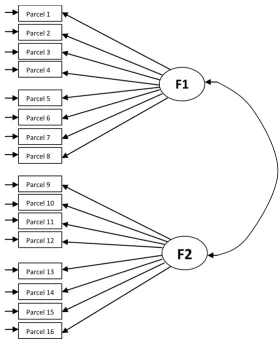
different theoretical models. The first model specified investigated psychopathy as a
two-factor phenomenon (affective/interpersonal and lifestyle/antisocial – figure 1). The second
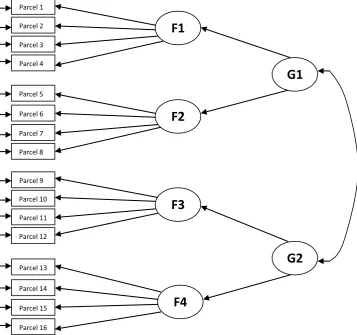
model reflected four dimensions of the measure (affective, interpersonal, lifestyle and
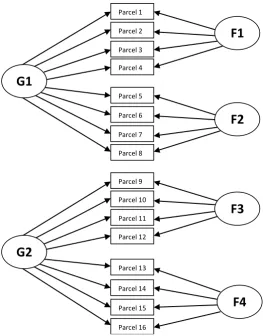
antisocial – figure 2). The third model included four latent factors with two hierarchical
factors (figure 3). The final model investigated a bifactorial solution of psychopathy as
proposed by Boduszek and Dhingra (in press) (figure 4). This model is a bifactor
conceptualization containing six latent factors; two general factors of psychopathy and four
grouping factors represented by interpersonal, affective, antisocial, and lifestyle latent
9 Figure 1. Two-factor model for SRP-III. F1 = Factor 1; F2 = Factor 2; Parcels 1-4 = items
from Interpersonal Manipulation subscale; Parcels 5-8 = items from Callous Affect subscale;
Parcels 9-12 = items from Erratic Lifestyle subscale; Parcels 13-16 = items from Antisocial
Behaviour subscale.
F2
F1
10 Figure 2. Four-factor model for SRP-III. F1 = Factor 1; F2 = Factor 2; Parcels 1-4 = items
from Interpersonal Manipulation subscale; Parcels 5-8 = items from Callous Affect subscale;
Parcels 9-12 = items from Erratic Lifestyle subscale; Parcels 13-16 = items from Antisocial
Behaviour subscale.
F4
F3
F1
F2
11 Figure 3. Four factors model hierarchical two factor model for SRP-III. F1 = Factor 1; F2 =
Factor 2; G1 = General factor 1; G2 = General factor 2; Parcels 1-4 = items from
Interpersonal Manipulation subscale; Parcels 5-8 = items from Callous Affect subscale;
Parcels 9-12 = items from Erratic Lifestyle subscale; Parcels 13-16 = items from Antisocial
Behaviour subscale.
F4
F3
F1
F2
Parcel 16 Parcel 15 Parcel 14 Parcel 13 Parcel 12 Parcel 11 Parcel 10 Parcel 9 Parcel 8 Parcel 7 Parcel 6 Parcel 5 Parcel 4 Parcel 3 Parcel 2 Parcel 1
G1
12 Figure 4. Four factors model hierarchical two factor model for SRP-III. F1 = Factor 1; F2 =
Factor 2; G1 = General factor 1; G2 = General factor 2; Parcels 1-4 = items from
Interpersonal Manipulation subscale; Parcels 5-8 = items from Callous Affect subscale;
Parcels 9-12 = items from Erratic Lifestyle subscale; Parcels 13-16 = items from Antisocial
Behaviour subscale.
F4
F3
F1
F2
Parcel 16 Parcel 15 Parcel 14 Parcel 13 Parcel 12 Parcel 11 Parcel 10 Parcel 9 Parcel 8 Parcel 7 Parcel 6 Parcel 5 Parcel 4 Parcel 3 Parcel 2 Parcel 1
G1
13 Similarly to Neal and Sellbom’s (2012) study, none of the above models met
acceptable model fit criteria with the original 64-item measure. Followed by Neal and
Sellbom’s procedure, all 64 items were computed into 16 radial parcels. Each parcel
contained four randomly chosen items from the same hypothesised factor. Again, four models
were tested.
Goodness-of-fit indices were used to compare four models of psychopathy: chi-square
(χ2), Root-Mean-Square Error of Approximation (RMSEA; Steiger, 1990) with 90%
confidence interval (90% CI), Standardized Root Mean Square Residual (SRMR), Akaike
Information Criterion (AIC; Akaike, 1973), Comparative Fit Index (CFI; Bentler, 1990),
Tucker Lewis Index (TLI; Tucker & Lewis, 1973). A non-significant chi-square (Kline,
2005) and values above .95 for the CFI and TLI, are considered to reflect a good model fit
(Hu & Bentler, 1998). A RMSEA and SRMR value less than .05 suggests acceptable errors
of approximation in the population (Browne & Cudeck, 1993). AIC values were used to
compare four specified models, with the smallest value indicating the best fitting model.
Results
Confirmatory factor analyses
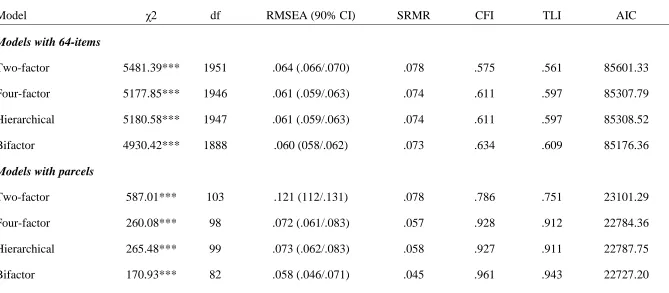
Table 1 presents the fit indices for the four alternative models of psychopathy. As can be
noted, none of the tested models, using the 64-item scale, met acceptable model fit criteria as
evidenced from all fit indices. However, as demonstrated by the lowest AIC value, the
bifactorial model has the best model fit when compared with other estimated models (χ2(1888)
= 4930.42, p < .001, CFI = .634, TLI = .609, RMSEA = .060 (90% CI = .058/.062), SRMR =
14 Table 1
Fit Indices for the Alternative Models of the Polish version of the SRP-III
Model χ2 df RMSEA (90% CI) SRMR CFI TLI AIC
Models with 64-items
Two-factor 5481.39*** 1951 .064 (.066/.070) .078 .575 .561 85601.33
Four-factor 5177.85*** 1946 .061 (.059/.063) .074 .611 .597 85307.79
Hierarchical 5180.58*** 1947 .061 (.059/.063) .074 .611 .597 85308.52
Bifactor 4930.42*** 1888 .060 (058/.062) .073 .634 .609 85176.36
Models with parcels
Two-factor 587.01*** 103 .121 (112/.131) .078 .786 .751 23101.29
Four-factor 260.08*** 98 .072 (.061/.083) .057 .928 .912 22784.36
Hierarchical 265.48*** 99 .073 (.062/.083) .058 .927 .911 22787.75
Bifactor 170.93*** 82 .058 (.046/.071) .045 .961 .943 22727.20
15 Neal and Sellbom (2012) encountered a similar problem when assessing models for the
original version of the SRP-III. They suggested that in order to evaluate model fit for the
scale, its complexity should be reduced by using the parcelling technique. In line with Neal
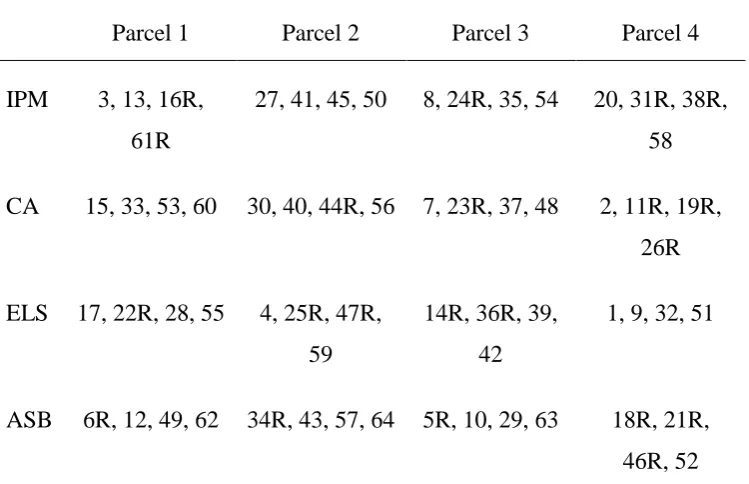
and Sellbom’s (2012) study, we assigned SRP-III items randomly into four parcels. The list
[image:15.595.69.444.344.586.2]of items in each parcel is presented in Table 2.
Table 2
Items assigned to parcels (Neal & Sellbom, 2012)
Parcel 1 Parcel 2 Parcel 3 Parcel 4
IPM 3, 13, 16R,
61R
27, 41, 45, 50 8, 24R, 35, 54 20, 31R, 38R,
58
CA 15, 33, 53, 60 30, 40, 44R, 56 7, 23R, 37, 48 2, 11R, 19R,
26R
ELS 17, 22R, 28, 55 4, 25R, 47R,
59
14R, 36R, 39,
42
1, 9, 32, 51
ASB 6R, 12, 49, 62 34R, 43, 57, 64 5R, 10, 29, 63 18R, 21R,
46R, 52
16 The same models as described before were estimated for the SRP-III after the items had been
assigned into parcels (see Table 1). Results show that reducing the complexity of the models
influenced an increase in CFI and TLI values and a decrease in RMSEA and SRMR values
for all assessed solutions. The two-factor model was rejected as a poor approximation of the
current data. The hierarchical and four-factor models were found to be an acceptable
representation, however, not the optimal solution. None of the previous studies assessing the
dimensionality of Hare SRP estimated the bifactorial model, which showed statistically
significant improvement in the chi-square value over all alternative models. The bifactorial
model showed the lowest AIC, RMSEA, and SRMR values and highest TLI and CFI values.
The adequacy of the bifactorial model can also be demonstrated by analysing its
parameter estimates (see Table 3). Factor loadings for the general factors were much weaker
and some were negative. According to Reise et al. (2010), when items load more strongly on
grouping factors than on general factors, the superiority of the grouping factors should be
assumed. Therefore, the Polish version of the SRP-III should be considered to consist of four
grouping factors, which provide the basis for creating four subscales, and two meaningful
17 Table 3
Standardized Factor Loadings for the four Grouping Factors and two General Factors of the Polish version of the SRP-III
Item IPM CA ELS ASB G1 G2
Parcel 1 .692*** .162*
Parcel 2 .779*** -.355**
Parcel 3 .741*** -.230**
Parcel 4 .764*** .066
Parcel 5 .717*** .059
Parcel 6 .786*** .201
Parcel 7 .701*** -.206**
Parcel 8 .478*** .337***
Parcel 9 .614*** .095
Parcel 10 .777*** -.088
Parcel 11 .534*** .061
Parcel 12 .820*** .058
Parcel 13 .535*** .849***
Parcel 14 .685*** .152
Parcel 15 .742*** .402***
Parcel 16 .450*** .275**
18 Incremental validity of psychopathy factors
The grouping factors were found to be associated with one another, yet most of the
correlations were not as high as to indicate that they measure the same phenomenon (Table
4). The highest correlation was between Interpersonal Manipulation and Callous Affect
subscales (.875) which can indicate a conceptual overlap between the factors.
Table 4
Correlations between latent factors
IPM CA ELS ASB
IPM - .875 .795 .640
CA - - .712 .618
ELS - - - .572
ASB - - - -
Note. IPM = Interpersonal Manipulation; CA = Callous Affect; ELS = Erratic Lifestyle; ASB = Antisocial Behaviour.
Structural equation modelling was carried out to examine the relationship between four
psychopathy facets and aggression. Aggression was regressed on all four psychopathy factors
simultaneously and the SEM model had a good fit (χ2 (94) = 207.73, p < .001, CFI = .953,
TLI = .932, RMSEA = .062, 90% CI = .050/.073, SRMR = .047). Two psychopathy factors,
ELS (β = .43, p < .001) and IPM (β = .34, p < .05) were statistically associated with
19 Importantly, CA facet was found to be negatively yet not significantly associated with overall
aggression (β = -.25, p > .05). Carmines and Zeller (1979) suggested that factors relating
differently with external variables should be considered to measure different conceptions.
This approach has already been adopted in other studies examining the dimensionality and
incremental validity of a self-report measure (e.g. Boduszek, Hyland, Dhingra & Mallett,
2013).
Composite reliability
Alpha coefficients as indicators of internal consistency have been criticised within a latent
variable modelling context due to their reliance on both the number of items tested as well as
correlations between them (see Cortina, 1993; Raykov, 1998). A more rigorous estimation of
the reliability of an instrument scores can be provided by examining the composite reliability
using the following formula:
Where ρc = reliability of the factor score, λi = standardized factor loading, and θi =
standardised error variance. Values greater than .60 are considered acceptable (Bagozzi & Yi,
1988; Diamantopoulos & Siguaw, 2000). Current results indicate that the IPM factor score
(ρc = .85), the CA factor score (ρc = .79), the ELS factor score (ρc = .79) and the ASB factor
20 Discussion
The current study was carried out with the primary purpose of evaluating the dimensionality
and construct validity of the Polish version of the SRP-III. This study represents the first
instance where the construct validity of the SRP-III has been investigated in a language other
than English. Additionally, this study assessed the incremental validity of the Polish version
of the SRP-III scores by examining the relationship between its factors and aggression.
Finally, this paper sought to determine the internal reliability through the application of
composite reliability.
Previous research with the English version of the SRP-III suggested that the latent
structure of the scale was best represented by four factors: Interpersonal Manipulation,
Callous Affect, Erratic Lifestyle, and Antisocial Behaviour. However, a limitation of previous
studies was the failure to include a bifactorial conceptualisation as a comparison model. A
number of recent studies utilizing the PCL-R and the PCL-SV have indicated that bifactorial
models represent statistically superior representations of the data than do traditional
multifactorial solutions. Boduszek and Dhingra discovered that a model which included two
primary psychopathy factors (Interpersonal/Affective and Lifestyle/Antisocial) and four
method factors (Interpersonal Manipulation, Callous Affect, Erratic Lifestyle, and Antisocial
Behaviour) was the best solution to the latent structure of the PCL-SV. It is important to note
that both the SRP-III and PCL:SV were derived from the PCL and therefore it was
hypothesised that a similar bifactorial solution would be the best fit of the data in the current
study.
This bifactorial model was indeed found to offer the best explanation of the data,
however, results of the current analysis indicated that the parcelled items of the Polish
21 Affect, Erratic Lifestyle, and Antisocial Behaviour) and two general factors
(Interpersonal/Affect and Lifestyle/Antisocial). This was demonstrated by the fact that the
standardised factor loadings for each parcel were significantly greater for the four grouping
factors than for the two general factors. As per the recommendations of Reise et al. (2010),
these results provide evidence that the Polish SRP-III is best conceptualised as measuring
four primary factors of psychopathy and two generally hidden factors.
The results of the current study considered in light of previous findings by Boduszek
and Dhingra (in press), Flores-Mendoza et al. (2008), and Patrick et al. (2007), are strongly
suggestive that the latent structure of psychopathy will vary depending upon the method of
assessment. It appears when the clinician-administered scales (PCL-R and PCL-SV) are
utilised, psychopathy is captured in terms of two correlated factors (Interpersonal/Affect and
Lifestyle/Antisocial). However, when a self-report scale is used, psychopathy is captured in
terms of four correlated factors (Interpersonal Manipulation, Callous Affect, Erratic Lifestyle,
and Antisocial Behaviour).
Further, the four grouping psychopathy factors were correlated with a measure of
reactive aggression in order to investigate the scale’s incremental validity. Results of this
analysis provided further empirical evidence in favour of conceptualising psychopathy in
terms of four factors. Erratic Lifestyle and Interpersonal Manipulation were identified to be
positively, and moderately, associated with aggression. Antisocial Behaviour and Callous
Affect did not reach the level of statistical significance, however, Callous Affect displayed a
negative association with aggression. Interpersonal Manipulation and Callous Affect were
found to exhibit differing directional relationships with aggression which indicates that,
despite the high level of correlation observed between them, these factors are unique and
distinct from each other. This result demonstrates that the suggested two-factor models of the
22 compatible with previous research indicating a strong link between behavioural aspects of
psychopathy and reactive aggression (Reidy, Zeichner, Miller & Martinez, 2007).
Callous/unemotional traits were more often associated with instrumental aggression (e.g.
Williamson, Hare & Wong, 1987) and reduced impulsivity (e.g. Snowden & Gray, 2011).
A further aim of this study was to provide a robust assessment of the internal
reliability of the scores of the Polish Version of SRP-III. Traditional approaches to
establishing internal reliability such as Cronbach’s alpha have been criticised within a latent
variable context due to their tendency to over- or under-estimate scale reliabilities (Raykov,
1998). As such, composite reliability was performed to provide a more accurate assessment
of internal reliability of a latent factor. All four subscales were found to possess good
composite reliabilities.
While the results of the current study provide supportive evidence for the construct
validity of the scores of the Polish Version of the SRP-III, this finding should be tempered by
the fact that a parcelling procedure was necessary to find an acceptable model fit. A
significant limitation associated with the SRP-III is the failure to identify an adequate
factorial solution when using individual items of the scale. This occurrence is likely due to
the very high indicator-to-factor ratio of the scale. Future research should therefore seek to
develop a psychometrically valid abbreviated version. Items for the abbreviated version could
be selected based on the theory and the strength of factor loadings within four grouping
psychopathy factors. Similar procedures have been utilised in previous efforts to develop
abbreviated versions of self-report psychological measures (Hyland, Shevlin, Adamson &
Boduszek, 2013). Another recommendation for future research is to assess whether the
factorial solution identified in the current sample remains invariant across different
23 The present research is the first to study the SRP-III within a sample of participants
whose first language is not English, and to assess a bifactorial solution of psychopathy using
the SRP-III. The results indicate that the Polish SRP-III is best conceptualised as measuring
four grouping factors and two hidden general factors. It has been shown that the four
grouping psychopathy factors have a good composite reliability and are differentially
associated with overall aggression.
References
Akaike, H. (1973). Information theory and an extension of the maximum likelihood principle.
In B. N. Petrov, & F. Csaki (Eds.), Second International Symposium on Information
Theory (pp. 267-281). Budapest: Academiai Kiado.
Bentler, P.M. (1990). Comparative fit indices in structural models. Psychological Bulletin,
217, 238-246.
Boduszek, D., & Dhingra, K. (in press). Bifactorial solution of the Psychopathy Checklist
Revised Screening Version in a sample of civic psychiatric patients. Personality and
Individual Differences.
Boduszek, D., Hyland, P., Dhingra, K., & Mallett, J. (2013). The Factor structure and
composite reliability of the Rosenberg Self-Esteem Scale among
ex-prisoners. Personality and Individual Differences, 55(8), 877-881.
Browne, M.W., & Cudeck, R (1989). Single sample cross-validation indices for covariance
structures. Multivariate Behavioral Research, 24, 445-455.
Bryant, F.B., & Smith, B.D. (2001). Refining the architecture of aggression: A measurement
model for the Buss-Perry Aggression Questionnaire. Journal of Research in
Personality, 35, 138-167.
Buss, A.H., & Perry, M. (1992). The aggression questionnaire. Journal of Personality and
24 Carmines, E.G., & Zeller, R.A. (1979). Reliability and Validity Assessment. Newbury Park,
CA: Sage Publications.
Cattell, R.B., & Burdsal, C.A. (1975). The radial parcel double factoring design: A solution
to the item-vs-parcel controversy. Multivariate Behavioral Research, 10, 165-179.
Cooke, D.J., & Michie, C. (2001). Refining the construct of psychopathy: Towards a
hierarchical model. Psychological Assessment, 13, 171-188.
Cortina, J. M. (1993). What is coefficient alpha? An examination of theory and applications.
Journal of Applied Psychology, 78, 98–104.
Flores-Mendoza, C., Alvarenga, M., Herrero, O., & Abad, F. (2008). Factor structure and
behavioural correlates of the Psychopathy Checklist-Revised [PCL-R] in a Brazilian
prisoner sample. Personality and Individual Differences, 45, 584-590.
Hare, R.D. (1985). Comparison of procedures for the assessment of psychopathy. Journal of
Consulting and Clinical Psychology, 53, 7-16.
Hare, R.D. (1991). The Hare Psychopathy Checklist-Revised. Toronto: Multi-Health
Systems.
Hare, R.D. (2003). The Hare Psychopathy Checklist-Revised (2nd ed). Toronto: Multi-Health Systems.
Hare, R.D., Harpur, T.J., & Hemphill, J.F. (1989). Scoring Pamphlet for the Self-Report
Psychopathy Scale: SRP-II. Unpublished document, Simon Fraser University,
Vancouver, Canada.
Hare, R.D., & Neumann, C.S. (2006). The PCL-R assessment of psychopathy: Development,
structural properties, and new directions. In C. Patrick (Ed.), Handbook of
Psychopathy (pp.58-90). New York: The Guilford Press.
Harpur, T. J., Hakstian, A. R., & Hare, R. D. (1988). Factor structure of the Psychopathy
Checklist. Journal of Consulting & Clinical Psychology, 56(5), 741-747.
Hart, S., Cox, D., & Hare, R. D. (1995). Manual for the Psychopathy Checklist: Screening
25 Hu, L., & Bentler, P. M. (1998). Fit indices in covariance structure modeling: Sensitivity to
underparameterized model misspecification. Psychological Methods, 3, 424–453.
Hyland, P., Shevlin, M., Adamson, G., & Boduszek, D. (2013). The factor structure and
composite reliability of the Profile of Emotional Distress. The Cognitive Behavior
Therapist, 6(15), 1-12.
Instytut AMITY (n.d.). Kwestionariusz Agresji Buss-Perry. Retrieved from http://amity.pl
Kline, R.B. (2005). Principles and Practice of Structural Equation Modeling (2nd ed.). New York: The Guilford Press.
Lilienfeld, S.O., & Fowler, K.A. (2007). The self report assessment of psychopathy:
Problems, pitfalls, and promises. In C.J. Patrick (Ed.), Handbook of Psychopathy (pp.
107-132). New York: The Guilford Press.
Neal, T.M.S., & Sellbom, M. (2012). Examining the factor structure of the Hare Self-Report
Psychopathy scale. Journal of Personality Assessment, 94(3), 244-253.
Ogloff, J. R. P. (2006), Psychopathy/antisocial personality disorder. Australian and New
Zealand Journal of Psychiatry, 40, 519-528.
Patrick, C.J., Hicks, B.M., Nichol, P.E., Krueger, R.F. (2007). A bifactor approach to
modeling the structure of the Psychopathy Checklist-Revised. Journal of Personality
Disorders, 21(2), 118-141.
Paulhus, D.L., Neumann, C.S., & Hare, R.D. (in press). Manual for the Self-Report
Psychopathy Scale. Toronto: Multi-Health Systems.
Reidy, D.E., Zeichner, A., Miller, J.D., & Martinez, M.A. (2007). Psychopathy and
aggression: Examining the role of psychopathy factors in predicting laboratory
aggression under hostile and instrumental conditions. Journal of Research in
Personality, 41, 1244-1251.
Reise, S.P., Moore, T.M., & Haviland, M.G. (2010). Bifactor models and rotations: Exploring
the extent to which multidimensional data yield univocal scale scores. Journal of
26 Raykov, T. (1998). Coefficient alpha and composite reliability with interrelated
nonhomogeneous items. Applied Psychological Measurement, 22(4), 375-385.
Snowden, R.J., & Gray, N.S. (2011). Impulsivity and psychopathy: Associations between the
Barrett Impulsivity Scale and the Psychopathy Checklist revised. Psychiatry
Research, 187, 414-417.
Steiger, J.H. (1990). Structural model evaluation and modification: An interval estimation
approach. Multivariate Behavioral Research, 25(2), 173-180.
Tucker, L.R., & Lewis, C. (1973). A reliability coefficient for maximum likelihood factor
analysis. Psychometrika, 38, 1-10.
Williams, K.M., & Paulhus, D.L. (2004). Factor structure of the Self-Report Psychopathy
scale (SRP-II) in non-forensic samples. Personality and Individual Differences, 37,