[60]Project
: Conception, Composition and Archiving.
M. ADKINS
Music Department, University of Huddersfield, Queensgate, Huddersfield, HD1 3DH, UK [email protected]
M. GATT
INA-GRM, Maison de Radio France Paris, Cedex 16, France
Abstract
The [60]Project was composed by one of the authors in 2008 in response to a commission from the Huddersfield Contemporary Music Festival to celebrate 60 years of musique concrète using sound contributions from over 60 of the worlds leading sound artists. The paper discusses the composition in the context of other related works such as Dhomont's Frankenstein Symphony (1997) and the open electronic works of Pietro Grossi. The paper also considers issues of authorship. The writings of writers such as Foucault are referenced in order to examine the work-composer relationship. The archiving methodology of the [60] project by INA-GRM is also discussed.
1. Introduction
The 60th anniversary of musique concrète in 2008 was marked in a number of ways by institutions and festivals across the
globe from the commissioning of new works to the recreation of Schaeffer’s original Concert des Bruits on October 5th
1948. The [60]Project [1] is in the former category being a newly commissioned work and is unique in that it incorporates especially composed sound materials by over sixty of the worlds leading sound artists. What links all of the sound artists chosen to participate in the project is their approach to sound regardless of genre. Schaeffer’s original dictum was that musique concrète takes its,
...point of departure [as] the objets sonore, the sound objects, which are the equivalent of visual images, and which therefore alter the procedures of musical composition completely...The concrète experiment in music consists of building sonorous objects, not with the play of numbers and seconds of the metronome, but with pieces of time torn from the cosmos. [2]
The [60]Project celebrates Schaeffer’s concept that all sounds can be used in musique concrète. It also celebrates the use of surround sound in the presentation of the work. As Schaeffer’s early work with Jacques Poulin was in 5-channels (4 fixed with an additional ‘diffused’ channel), so the [60]Project is in 7.1-channel format.
One of the most important aspects of the work was to demonstrate how Schaeffer’s music and ideas have proliferated to inform the practice of a diverse range of contemporary sound artists. This diverse heritage is exemplified in Modulations: A History of Electronic Music: Throbbing Words on Sound that states,
at the end of the nineties, the innovations that began with GRM’s founders have been fully integrated into the everyday working practice of almost all musicians working across the entire musical spectrum. The breakbeat, created entirely from the manipulation of records on turntables or from recorded segments spliced together either manually or digitally, is the epitome of musique concrète. [3]
Schaeffer’s work now means different things to different contemporary sound artists. Schaeffer is for some the founder of musique concrète and the starting point for all experimental electronic music; the first turntablist; the grandfather of electronica. In order to celebrate the inclusivity of Schaeffer’s ideas and philosophy rather than the exclusivity that is sometimes seen to surround the genre he originated, sound artists were invited from the following areas of contemporary sonic arts practice:
• acousmatic music
• laptop improvisation
• live electronics
• live electronics
• electronica
• sound art
The bringing together of such a range of artists was also motivated by a desire to investigate the similarities and differences in the sound materials each contributed, and subsequently to examine how the different sound artists processed this material.
2. Rules of Engagement
The concept of the [60]Project was to draw together a wide range of over 60 sound artists to create a sixty-minute integrated work - as such, the work differs from the 60x60 work curated by Robert Voisey[4] and Dhomont’s
Frankenstein Symphony (1997). The compositional process was split into three stages:
Stage 1: all of the participants uploaded a sound object or a short improvisation on a sound object (1-2 minutes) to a dedicated ftp site.
Stage 2: all of the stage 1 material was available for processing via the ftp site. The sound material could be combined and processed in any way to create a second set of hybrid material. No restrictions were placed on how many or how few of the sounds could be used in this stage.
Stage 3: Mixing of the [60]Project in the studios of INA-GRM.
The [60]Project started from the same set of ‘rules’ as Dhomont employed for his Frankenstein Symphony in which he sampled twenty-two composers/friend’s existing work to create,
a hybrid thing in four movements, made of cut-up pieces, pasted and assembled, sowed parts that are alike and contrasted, and that I have named, for obvious reasons, the Frankenstein Symphony.[5]
As in Dhomont’s work, manipulation of the materials used to create the final piece were limited to:
destructive editing (treating sounds as source material)
limited transposition (to allow harmonic coherence)
no further processing of sound material in any way
and in addition:
only using original material made for this project
a section/segment of every soundfile submitted was to be used at some point in the mix
the work would be 60 minutes long.
3. Composition
So as not to form any preconceptions regarding the mixing of the project or the possible grouping of materials, the author did not listen to any of the sound materials contributed for the project until arriving at the INA-GRM studios in July 2008 to mix the work. In the studios of the GRM all of the material from stage 1 and 2 were downloaded from the ftp site and sorted into various categories with regard to their gestural or spectral characteristics or concrete origin. From this a plan of eight interconnecting movements was devised. These eight movements fall into three sections: Section 1 (0’00 -8’00), (8’00-16’03) and (16’03-23’57) comprises three abstract movements combining electronic, instrumental and concrete material; Section 2 – (23’57-31’08) and (31’08-38’15) are a sea and urban soundscape respectively, incorporating strongly referential concrete material as well as gesturally linked electronic material; Section 3 – (38’15-44’12) (44’12-46’57) and (46’57-60’00) returns to an abstract interplay of sound material, comprising an ambient instrumental section, a noise study and closing with an extended vocal section.
4. Notions of Authorship
Such a project as this engenders a number of questions not least the notion of authorship. The work has been ‘composed’ or assembled by one of the authors in the manner of a sonic collage – it has the stylistic characteristics of that author’s compositional aesthetic yet uses no original sound material by that author. Hanna Bosma writing about ‘the author’ considers that,
The text has a life of its own, over which the author has no power. In this respect, the author is dead: for the reader, there is only a text, and there is no guarantee that the intentions of the author will come through. With the advent of audio and visual recording technology, performance can become a permanent, reproduce-able, authoritative text.[6]
Barthes (1968) and Foucault (1969) have both demonstrated the complexity of the notion of authorship in their writings. In the work of Foucault there are a number of concepts that are pertinent to the [60]Project. Foucault in
What is an Author considers the ‘author’ [composer] to be the entity that defines its [the text’s or composition’s] form and characterises its mode of existence. In this instance the origin of the text/sound is not considered – it is the organisation of this material that is the primary focus. This is a clear model for the ‘authorship’ of the [60]Project. Foucault’s concept of the reader as ‘producer’ puts forward the idea that the reader interprets a text not in order to either accept or reject the ideas of the text outright, but rather to appreciate the plurality of ideas that constitutes it. Connected to this is Foucault’s idea that each text [composition] possesses a set of specific discourse is useful in that it provides readers with a structure to assist them in the understanding of the ideas within a text. In the [60]Project
the ideas underpinning the work are the celebration of Schaeffer’s work and the responses of contemporary sound artists to his work. The specific discourse in the work arises from the arrangement of the work into movements that contain similar sound-types as well as the conceptual origins of the work.
The creative ownership as expressed in Foucault’s ideas that each text possesses a set of specific discourse is useful in that it provides readers with a structure to assist them in the understanding of the ideas within a text. In a normal compositional context the use by one composer of another’s work would be considered as sampling. Whilst the number of samples used and the extreme editing applied to them is reminiscent of John Oswald’s Plunderphonics the
[60]Project differs in that the sound materials were contributed willingly to the project, as such it is more an instance of ‘localized’ re-appropriation than sampling per se. Paul Miller (DJ Spooky) discusses notions of originality and sampling maintaining that,
When recorded, adapted, remixed, and uploaded, expression becomes a stream unit of value in a fixed and remixed currency that is traded via the ever -shifting currents of information moving though the networks we use to talk to one another… We live in an era where quotation and sampling operate on such a deep level that the archeology of what can be called knowledge floats in a murky realm between the real and the unreal. [7]
Miller here questions and reconsiders the ways in which we have organized composing (i.e., how we have composed authoring in media-saturated age).
Another way of discussing the authorship of the [60]Project in informed by the work of Pietro Grossi - an Italian composer, theorist and programmer who wrote some of the first open electronic music pieces. Grossi questioned the concept of musical authorship and the idea of personal artistic expression. He wrote that,
A piece is not only a work (of art), but also one of the many ‘works’ one can freely transform: everything is temporary, everything can change at any time. [8]
Although the [60]Project does have a personal artistic expression – that of one of the author’s, Grossi’s notion of the work being one of many works is interesting if one considers the [60]Project as an open work. If all of the material is considered merely as a resource to realise a work that adheres to the rules set out above, then the author’s mix is just one version of the [60]Project. Any of the contributors to the project could create their own mix that is just as valid a version of the [60]Project. In this scenario there exists the possibility of a series of iterations of the project as the work itself is reduced to its conceptual base – a series of rules and a set of sound materials.
5. Documentation of the [60]Project.
The documentation for this piece has been undertaken primarily for a European preservation project called CASPAR[9]. The main aim of this project is the long-term preservation of complex digital objects, which includes the comprehension of such objects for future generations. David Giaretta identifies the problem of preservation and representation by stating,
It could be argued that one could, for example, make a digital object by carving 1’s and 0’s in stone – a very durable way to preserve information as the ancient Egyptians knew. However, a point I will return to, is that while this may give one access (slow access but nevertheless it is access) – it will not maintain understandability. [10]
INA-GRM is one of the partners within the CASPAR project. Their work consists of research into representation based on ontologies, in conjunction with CNRS, and the investigation into what is needed for the long-term preservation and understanding of acousmatic data objects, and the performance of such music.
The documentation of the [60]Project began at the mixing stage of the composition. After the initial stereo mix was created, all of the Pro Tools session files and accompanying documentation were archived and stored at INA-GRM. The piece was then further defined in production stages, so that an entire life-cycle representation could be made. The stages listed below are a continuation of the stages presented in the Rules of Engagement chapter:
Stage 4: First stereo bounce.
Stage 5: Extraction of stem files for multiphonic version.
Stage 6: 7.1 version made for the performance of the [60]Project.
Stage 7: Performance at Huddersfield Contemporary Music Festival.
Other files relating to the [60]Project where also archived within INA-GRM, such as invitation emails and concert programs to further describe the piece.
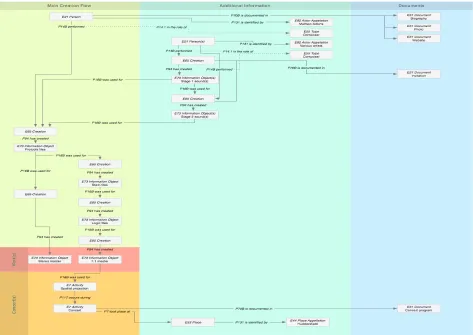
Once an understanding of how each stage was achieved, an ontological representation was created based on
CIDOC-CRM, and the previous studies undertaken by Nicolas Esposito and Yann Geslin (2008), documented in the article
Long-term preservation of acousmatic works: Towards a generic model of description [11]. Figure 1 shows an example of such a representation for the [60]Project.
The representation presented below is a reduction of all the stages within the project. It is not able to show fully which composer submitted or manipulated a particular sound. Instead, it is just used to give a general overview of the creative process of the composition. Individual data objects are further defined by separate criteria and categories. This includes:
Who created the file?
The date of creation.
How the data relates to the work, i.e. whether it was used for the creation, or if it documents the creation or performance (this is further explained in the representation above).
The type of file, i.e. final version, Pro Tools session, and subsidiary audio files.
The format of the file.
Audio used for hybrid material (specific to the [60]Project).
As more performances of the [60]Project take place further information such as its diffusion or speaker arrangements can also be added.
The focus of this short section has been only the preservation of knowledge, and not the methodology of the preservation systems. To summarise briefly, there are three main criteria needed for the knowledge preservation of an acousmatic work.
The work itself (and its other formats if applicable).
Description of the creation process.
Description of the performance ritual.
Figure 1. Example of the life cycle representation currently adopted by INA-GRM for the CASPAR proje
6. Notes
[1] ADKINS, M. (2008) [60]Project, empreintes DIGITALes, (www.electrocd.com/www.60project.com)
[2] HODGKINSON, T. (1987) Interview with Pierre Schaeffer in: Re-records Quarterly Magazine, Vol. 2
No. 1, pp. 5-9.
[3] VOISEY, R. (2003) 60x60
http://en.wikipedia.org/wiki/60x60 [accessed 21.01.09]
[4] YOUNG, R. (2000) ‘Roll Tape: Pioneer Spirits in Musique Concrète’, in: Modulations – A History of Electronic Music: Throbbing Words on Sound, ed. Shapiro, P. New York: Caipirinha Productions, pp. 11-23.
[5] DHOMONT, F. (1997) Frankenstein Symphony, Asphodel (liner note by composer)
[6] BOSMA, H. (1995) ‘Male and female voices in Computer Music’, in: ICMC’95 Proceedings. San Francisco: ICMA; Banff: ICMC’95. pp. 139-143.
[7] MILLER, P. (2004) ‘Loops of perception: sampling, memory, and the semantic web’ in: horizon (8) remix: generate/regenerate/transform internet journal:
http://www.horizonzero.ca/textsite/remix.php?file=3&is=8&tlang=0 [accessed 26.01.09]
[8] GROSSI, P. (1985) Unicum quoted on http://www.die-schachtel.com/editions/ds1.htm [accessed 24.01.09]
[9] www.casparpreserves.eu
[10] GIARETTA, D. (2007) ‘The CASPAR Approach to Digital Preservation.’ in: The International Journal of Digital
Curation, 1 (2), pp. 113-121.
[11]ESPOSITO, N and GESLIN, Y. (2008) ‘Long-term preservation of acousmatic works: Towards a generic model of
description.’ in: Electrontechnical Conference. MELECON 2008. The 14th IEEE Mediterranean, Ajaccio, France, 2008.
Compiegne: Centre de Recherches, pp. 270-274.