University of Huddersfield Repository
Vallati, Mauro, Fawcett, Chris, Gerevini, Alfonso, Hoos, Holger and Saetti, Alessandro
Generating Fast DomainSpecific Planners by Automatically Configuring a Generic Parameterised
Planner
Original Citation
Vallati, Mauro, Fawcett, Chris, Gerevini, Alfonso, Hoos, Holger and Saetti, Alessandro (2011)
Generating Fast DomainSpecific Planners by Automatically Configuring a Generic Parameterised
Planner. In: Workshop on Planning and Learning: ICAPS 2011, 13th June 2011, Freiburg, Germany.
This version is available at http://eprints.hud.ac.uk/id/eprint/15372/
The University Repository is a digital collection of the research output of the
University, available on Open Access. Copyright and Moral Rights for the items
on this site are retained by the individual author and/or other copyright owners.
Users may access full items free of charge; copies of full text items generally
can be reproduced, displayed or performed and given to third parties in any
format or medium for personal research or study, educational or notforprofit
purposes without prior permission or charge, provided:
•
The authors, title and full bibliographic details is credited in any copy;
•
A hyperlink and/or URL is included for the original metadata page; and
•
The content is not changed in any way.
For more information, including our policy and submission procedure, please
contact the Repository Team at: [email protected].
Generating Fast Domain-Specific Planners by Automatically Configuring a
Generic Parameterised Planner
Mauro Vallati
University of Brescia [email protected]
Chris Fawcett
University of British Columbia [email protected]
Alfonso E. Gerevini
University of Brescia [email protected]
Holger H. Hoos
University of British Columbia [email protected]
Alessandro Saetti
University of Brescia [email protected]
Abstract
When designing state-of-the-art, domain-independent plan-ning systems, many decisions have to be made with respect to the domain analysis or compilation performed during prepro-cessing, the heuristic functions used during search, and other features of the search algorithm. These design decisions can have a large impact on the performance of the resulting plan-ner. By providing many alternatives for these choices and ex-posing them as parameters, planning systems can in principle be configured to work well on different domains. However, usually planners are used in default configurations that have been chosen because of their good average performance over a set of benchmark domains, with limited experimentation of the potentially huge range of possible configurations. In this work, we propose a general framework for automati-cally configuring a parameterised planner, showing that sub-stantial performance gains can be achieved. We apply the framework to the well-knownLPGplanner, which has 62 pa-rameters and over6.5×1017 possible configurations. We demonstrate that by using this highly parameterised planning system in combination with the off-the-shelf, state-of-the-art automatic algorithm configuration procedureParamILS, sub-stantial performance improvements on specific planning do-mains can be obtained.
Introduction
When designing state-of-the-art, domain-independent plan-ning systems, many decisions have to be made with respect to the domain analysis or compilation performed during pre-processing, the heuristic functions used during search, and several other features of the search algorithm. These design decisions can have a large impact on the performance of the resulting planner. By providing many alternatives for these choices and exposing them as parameters, highly flexible domain-independent planning systems are obtained, which then, in principle, can be configured to work well on differ-ent domains, by using parameter settings specifically cho-sen for solving planning problems from each given domain. However, usually such planners are used with default config-urations that have been chosen because of their good aver-age performance over a set of benchmark domains, based on limited manual exploration within a potentially vast space of possible configurations. The hope is that these default con-figurations will also perform well on domains and problems beyond those for which they were tested at design time.
In this work, we advocate a different approach, based on the idea ofautomaticallyconfiguring a generic, param-eterised planner using a set of training planning problems in order to obtain planners that perform especially well in the domains of these training problems. Automated config-uration of heuristic algorithms has been an area of intense research focus in recent years, producing tools that have im-proved algorithm performance substantially in many prob-lem domains. To our knowledge, however, these techniques have not yet been applied to the problem of planning.
While our approach could in principle utilise any suf-ficiently powerful automatic configuration procedure, we have chosen the FocusedILS variant of the off-the-shelf, state-of-the-art automatic algorithm configuration procedure ParamILS (Hutter, Hoos, & St¨utzle 2007; Hutter et al.
2009). At the core of the ParamILSframework lies Iter-ated Local Search (ILS), a well-known and versatile stochas-tic local search method that iteratively performs phases of a simple local search, such as iterative improvement, in-terspersed with so-called perturbation phases that are used to escape from local optima. The FocusedILS variant of ParamILS uses this ILS procedure to search for high-performance configurations of a given algorithm by eval-uating promising configurations, using an increasing num-ber of runs in order to avoid wasting CPU-time on poorly-performing configurations. ParamILSalso avoids wasting CPU-time on low-performance configurations by adaptively limiting the amount of runtime allocated to each algorithm run using knowledge of the best-performing configuration found so far.
ParamILShas previously been applied to configure state-of-the-art solvers for several combinatorial problems, in-cluding propositional satisfiability (SAT) (Hutter et al.
param-eterised components (e.g., specific search heuristics). This can lead to more complex systems, with greater opportuni-ties for automatic parameter configuration, but also greater challenges (bigger, richer design spaces can be expected to give rise to trickier configuration problems).
One such planning system is LPG(see, e.g., Gerevini, Saetti, & Serina 2003, Gerevini, Saetti, & Serina 2008). Based on a stochastic local search procedure,LPGis a well-known efficient and versatile planner with many components that can be configured very flexibly via 62 exposed config-urable parameters, which jointly give rise to over6.5×1017 possible configurations. This configuration space is one of the largest considered so far in applications ofParamILS. In this work, we used ParamILSto automatically config-ureLPGon various propositional domains, starting from a manually-chosen default parameter setting with good per-formance on a broad range of domains.
We tested our approach usingParamILSandLPGon 11 domains of planning problems used in previous international planning competitions (IPC-3–6). Our results demonstrate that by using automatically determined, domain-specific configurations (LPG.sd), substantial performance gains can be achieved compared to the default configuration (LPG.d). Using the same automatic configuration approach to opti-mise the performance of LPG on a merged set of bench-mark instances from different domains also results in im-provements over the default, but these are less pronounced than those obtained by automated configuration for single domains.
We also investigated to which extent the domain-specific planners obtained by configuring the general-purposeLPG planner perform well compared to other state-of-the-art domain-independent planners. Our results indicate that, for the class of domains considered in our analysis,LPG.sd is significantly faster thanLAMA(Richter & Westphal 2008), the top-performing propositional planner of the last planning competition (IPC-6).1
Moreover, in order to understand how well our approach works compared to state-of-the-of-art systems in automated planning with learning, we have experimentally compared LPG.sd with the planners of the learning track of IPC-6, showing that in terms of speed and usefulness of the learned knowledge, our system outperforms the respective IPC-6 winners,PbP(Gerevini, Saetti, & Vallati 2009) and ObtuseWedge(Yoon, Fern, & Givan 2008).
Recently,LPG.sdhas been entered into the learning track of the 7th International Planning Competition (IPC-7) as ParLPG, and we give preliminary results on the competition domains in this paper.
While in this work, we focus on the application of the proposed framework to the LPG planner, we believe that similarly good results can be obtained for highly
parame-1
The version ofLAMAused in the IPC-6 competition exposes only four Boolean parameters, which its authors recommend to leave unchanged; it is therefore not suitable for studying auto-matic parameter configuration. A newer, much more flexibly con-figurable version ofLAMAhas become available very recently, as part of the Fast Downward system, which we are studying in ongo-ing work.
1. SetAto the action graph containing onlyastartandaend;
2. Whilethe current action graphAcontains a flaw or a certainnumber of search stepsis not exceededdo 3. Select a flawσinA;
4. Determine the searchneighborhoodN(A, σ);
5. Weight the elements ofN(A, σ)using aheuristic function
E
; 6. Choose a graphA0∈N(A, σ)according toEandnoisen; 7. SetAtoA0; 8. ReturnA.
Figure 1: High-level description ofLPG’s search procedure.
terised versions of other existing planning systems. In gen-eral, our results suggest that in the future development of efficient planning systems, it is worth including many dif-ferent variants and a wide range of settings for the various components, instead of committing at design time to particu-lar choices and settings, and to use automated procedures for finding configurations of the resulting highly parameterised planning systems that perform well on the problems arising in a specific application domain under consideration.
In the rest of this paper, we first provide some background and further information onLPGand its parameters. Next, af-ter a description of the parameaf-ter configuration process, we describe in detail our experimental analysis and results, in-cluding preliminary results from our IPC-7 submission. Fi-nally, we give some concluding remarks and discuss some avenues for future work.
The Generic Parameterised Planner LPG
In this section, we provide a very brief description ofLPG and its parameters. LPGis a versatile system that can be used for plan generation, plan repair and incremental plan-ning in PDDL2.2 domains (Hoffmann & Edelkamp 2005). The planner is based on a stochastic local search procedure that explores a space of partial plans represented through
linear action graphs, which are variants of the very well-known planning graph (Blum & Furst 1997).
Starting from the initial action graph containing only two special actions representing the problem initial state and goals, respectively,LPGiteratively modifies the current graph until there is noflawin it or a certain bound on the number of search steps is exceeded. Intuitively, a flaw is an action in the graph with a precondition that is not sup-ported by an effect of another action in the graph. LPG at-tempts to resolve flaws by inserting into or removing from the graph a new or existing action, respectively. Figure 1 gives a high-level description of the general search process performed by LPG. Each search stepselects a flaw σ in the current action graphA, defines the elements (modified action graphs) of thesearch neighborhoodofAfor repair-ingσ, weights the neighborhood elements using aheuristic functionE, and chooses the best one of them according to
Ewith some probabilityn, called thenoise parameter, and randomly with probability1−n. Because of this noise pa-rameter, which helps the planner to escape from possible local minima,LPGis a randomised procedure.
Domain Configuration P1 P2 P3 P4 P5 P6 P7 Total
Blocksworld 1 1 2 1 5 1 2 13
Depots 2 2 1 1 2 2 2 12
Gold-miner 2 3 0 1 4 2 1 13
Matching-BW 1 2 2 1 3 0 2 11
N-Puzzle 4 5 3 2 14 5 2 35
Rovers 0 1 0 0 0 2 1 4
Satellite 2 7 3 1 11 5 3 32
Sokoban 0 1 1 1 1 1 2 7
Zenotravel 3 5 2 3 11 5 3 32
[image:4.612.62.289.53.176.2]Merged set 0 1 0 1 5 2 2 11 Number of parameters 6 15 8 6 17 7 3 62
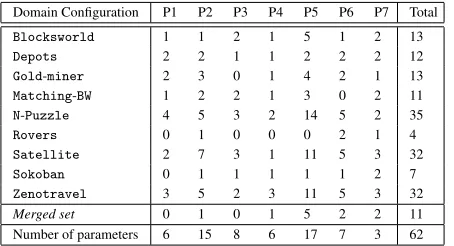
Table 1: Number of parameters ofLPGthat are changed by ParamILSin the configurations computed for nine domains independently considered (rows 2–10) and jointly consid-ered (“merged set” row). Each of the columns P1–P7 corre-sponds to a different parameter category (i.e., planner com-ponent).
distinct categories, each of which corresponds to a different component ofLPG:
P1 Preprocessing information(e.g., mutually exclusive re-lations between actions).
P2 Search strategy(e.g., the use and length of a “tabu list” for the local search, the number of search steps before restarting a new search, and the activation of an alternative systematic best-first search procedure).
P3 Flaw selection strategy(i.e., different heuristics for de-ciding which flaw should be repaired first).
P4 Search neighborhood definition (i.e., different ways of defining/restricting the basic search neighborhood).
P5 Heuristic function E(i.e., a class of possible heuristics for weighting the neighborhood elements, with some vari-ants for each of them).
P6 Reachability informationused in the heuristic functions and in neighborhood definitions (e.g., the minimum num-ber of actions required to achieve an unsupported precon-dition from a given state).
P7 Search randomisation(i.e., different ways of statically and dynamically setting the noise value).
The last row of Table 1 shows the number ofLPG’s param-eters that fall into each of these seven categories (planner components).
Experimental Analysis
In this section, we present the results of a large experi-mental study examining the effectiveness of the automated approach outlined in the introduction in terms of planning speed.
Benchmark domains and instances
In our first set of experiments, we considered problem instances from eight known benchmark domains used in the last four international planning competitions (IPC-3–6), Depots, Gold-miner, Matching-BW, N-Puzzle, Rovers,
Satellite, Sokoban, and Zenotravel, plus the well-knownBlocksworlddomain. These domains were selected because they are not trivially solvable, and random instance generators are available for them, such that large training and testing sets of instances can be obtained.
For each domain, we used the respective random instance generator to obtain two disjoint sets of instances: a training set with 2000 relatively small instances (benchmarkT), and a testing set with 400 middle-size instances (benchmarkMS). The size of the instances in training setTwas chosen such that the instances could be solved by the default configura-tion ofLPGin 20 to 40 CPU secondson average. For testing setMS, the size of the instances was chosen such that the in-stances could on average be solved by the default configura-tion ofLPGin 50 seconds to 2 minutes. This does not mean that all our problem instances can actually be solved byLPG, since we merely determined thesizeof the instances accord-ing to the performance of the default configuration, and then we used the random instance generators to derive the actual instances.
For the experiments comparing automatically determined configurations ofLPGagainst the planners that entered the learning track of IPC-6, we employed the same instance sets as those used in the competition.
Automated configuration using ParamILS
For all configuration experiments we used theFocusedILS variant of ParamILS version 2.3.5 with default parameter settings. Using the default configuration of LPG as the starting point for the automated configuration process, we concurrently performed 10 independent runs ofFocusedILS per domain, using random orderings of the training set in-stances.2 Each run ofFocusedILShad a total CPU-time
cut-off of 48 hours, and a cutcut-off time of 60 CPU seconds was used for each run ofLPGperformed during the configuration process. The objective function used byParamILSfor eval-uating the quality of configurations was mean runtime, with timeouts and crashes assigned a penalised runtime of ten times the per-run cutoff (the so-called PAR-10 score). Out of the 10 configurations produced by these runs, we selected the configuration with the best training set performance (as measured byFocusedILS) as the final configuration ofLPG for the respective domain.
Additionally, we usedFocusedILSfor optimising the con-figuration ofLPGacross all of the selected domains together. As with our approach for individual domains, we performed 10 independent runs of FocusedILS starting from the de-fault configuration; again, the single configuration with the best performance on the merged training set as measured by FocusedILSwas selected as the final result of the configura-tion process.
The final configurations thus obtained were then evalu-ated on the testing set of instances (benchmarkMS) for each domain, using a per-run timeout of 600 CPU seconds.
For convenience, we define the following abbreviations corresponding to configurations ofLPG:
2Multiple independent runs ofFocusedILSwere used, because
Domain LPG.d LPG.r
Score % solved Score % solved
Blocksworld 99.00 99 0.00 16
Depots 86.00 86 0.00 18
Gold-miner 91.00 91 0.00 19
Matching-BW 14.00 14 0.15 9
N-Puzzle 59.10 89 34.75 86
Rovers 85.81 100 31.21 53
Satellite 96.02 100 18.99 37
Sokoban 73.20 74 2.06 28
Zenotravel 98.70 100 2.47 24
[image:5.612.80.267.52.175.2]Total 702.8 83.7 89.6 32.2
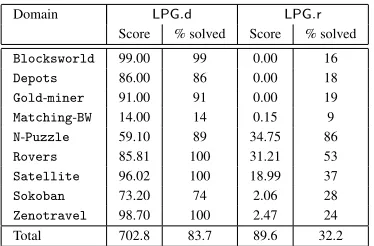
Table 2: Speed scores and percentage of problems solved by LPG.dandLPG.rfor 100 problems in each of 9 domains of benchmarkMS.
• Default(LPG.d): The default configuration ofLPG. • Random(LPG.r): Configurations selected independently
at random from all possible configurations ofLPG. • Specific (LPG.sd): The specific configuration of LPG
found byParamILSfor each domain.
• Merged(LPG.md): The configuration ofLPGobtained by runningParamILSon the merged training set.
Table 1 shows, for each parameter category ofLPG, the number of parameters that are changed from their defaults byParamILSin the derived domain-specific configurations (LPG.sd) and in the configuration obtained for the merged training set (LPG.md).
Empirical result 1 Domain-specific configurations ofLPG
differ substantially from the default configuration.
Moreover, we noticed that usually the changed parameter settings are considerably different from each other.
Results on specific domains
The performance of each configuration was evaluated us-ing the performance score functions adopted in IPC-6 (Fern, Khardon, & Tadepalli 2008). Thespeed scoreof a configu-rationCis defined as the sum of the speed scores assigned to Cover all test problems. The speed score assigned toCfor a planning problempis 0 ifpis unsolved andTp∗/T(C)p
oth-erwise, whereT∗
p is the lowest measured CPU time to solve
problempandT(C)pdenotes the CPU time required byCto solve problemp. Higher values for the speed score indicate better performance.
Table 2 shows the results of the comparison between LPG.dandLPG.r, which we conducted to assess the per-formance of the default configuration on our benchmarks.
Empirical result 2 LPG.dis much faster and solves many more problems thanLPG.r.
Specifically,LPG.rsolves very few problems in 6 of the 9 domains we considered, while LPG.d solves most of the considered problems in all but one domain. This observation also suggests that the default configuration is a much bet-ter starting point for deriving configurations usingParamILS than a random configuration. In order to confirm this intu-ition, we performed an additional set of experiments using
0.1 1 10 100 U
0.1 1 10 100 U
Figure 2: CPU time (log. scale) of LPG.sd versus LPG.d for the problems in bechmark setMS. The x-axis shows run-time ofLPG.dand the y-axis runtime of the specificLPG.sd solvers, measured in CPU seconds; U indicates runs that timed out with the given runtime cutoff.
the random configuration as starting point. As expected, the resulting configurations ofLPGperform much worse than LPG.sd, and sometimes even worse thanLPG.d.
Figure 2 shows the performance ofLPG.sdandLPG.don the individual benchmark instances in the form of a scat-terplot. We consider all instances solved by at least one of these planners. Each cross symbol indicates the CPU time used by LPG.d andLPG.sd to solve a particular problem instance of benchmarks MS. When a cross appears below (above) the main diagonal, LPG.sd is faster (slower) than LPG.d; the distance of the cross from the main diagonal in-dicates the performance gap (the greater the distance, the greater the gap). The results in Figure 2 indicate thatLPG.sd performs almost always better thanLPG.d, often by 1–2 or-ders of magnitude.
Table 3 shows the performance ofLPG.d,LPG.md, and LPG.sdfor each domain of benchmarkMSin terms of speed score, percentage of solved problems and average CPU time (computed over the problems solved by all the considered configurations). These results indicate thatLPG.sd solves many more problems, is on average much faster thanLPG.d andLPG.md, and that for some benchmark setsLPG.sd al-waysperforms better than or equal to the other configura-tions, as the IPC score ofLPG.sdis sometimes the maximum score (i.e., 400 points for benchmarkMS).3
Empirical result 3 LPG.sdperforms much better than both
LPG.dandLPG.md.
As can be seen from the last row of Table 3,LPG.md per-forms usually better thanLPG.don the test sets for the in-dividual domains. Moreover, it performs better thanLPG.d
3Additional results using, for each of the nine considered
do-mains, 2000 test problems of the same size as those used for the training, and 50 test problems considerably larger than those in the
[image:5.612.319.553.61.208.2]Domain Speed score % solved Average CPU time
LPG.d LPG.md LPG.sd LPG.d LPG.md LPG.sd LPG.d LPG.md LPG.sd
Blocksworld 21.3 74.8 400 98.8 100 100 105.3 28.17 4.29
Depots 124 164 345 90.3 99 98.5 78.1 42.4 5.7
Gold-miner 18.5 232 374 90.5 100 100 94.4 7.4 1.6
Matching-BW 9.74 72.5 375 15.8 55.3 97.8 93.8 42.3 5.6
N-Puzzle 20.1 27.0 347 85 86.3 86.8 321.0 247 31.20
Rovers 131 162 400 100 100 100 72.2 52.9 21.2
Satellite 104 111 400 100 100 100 64.0 59.2 1.3
Sokoban 26.7 191 335 75.8 94.8 96.5 24.6 6.15 1.19
Zenotravel 49.1 97.2 397 100 99.8 100 103.7 57.6 11.1
[image:6.612.125.491.52.179.2]All above 280.3 304.3 – 83.3 91.5 – 115.4 38.8 –
Table 3: Speed score, percentage of solved problems, and average CPU time of LPG.d, LPG.mdandLPG.sd for 400MS instances in each of 9 domains, independently considered, and in all domains (last row).
Domain LPG.sdvs.LAMA LPG.sdvs.PbP ∆-speed ∆-solved ∆-speed ∆-solved
Blocksworld +377.4 +52 +361.7 ±0
Depots +393.9 +381 +211.1 +54
Gold-miner +400 +400 +395.6 +319
Matching-BW +227.8 +118 +40.7 +330
N-Puzzle +255.7 +4 +279.8 −20
Rovers +392.9 +14 +313.4 +9
Satellite +388.1 +157 +253.6 +9
Sokoban +340.1 +278 −41.6 +5
Zenotravel +368.3 ±0 −282.1 +8
Total +3144 +1404 +1532 +714
Table 4: Performance gap between LPG.sd and LAMA (columns 2–3) andLPG.sdandPbP(columns 4–5) for 400 MSproblems in each of 9 domains in terms of speed score and number of solved problems.
on the sets obtained by merging the test sets for all individ-ual domains, which indicates that by using a merged training set, we successfully produced a configuration with good per-formance on average across all selected domains.
Empirical result 4 LPG.mdperforms better thanLPG.d.
Next, we compared ourLPGconfigurations with state-of-the-art planning systems – namely, the winner of the IPC-6 classical track,LAMA(configured to stop when the first solution is computed), and the winner of the IPC-6 learn-ing track,PbP. The performance gap betweenLPG.sdand these planners forMSproblems are shown in Table 4, where we report the speed score and the number of solved prob-lems (positive numbers mean thatLPG.sdperforms better). These experimental results indicate clearly that our configu-rations ofLPGare significantly faster and solve many more problems thanLAMA.
Empirical result 5 LPG.sd performs significantly better thanLAMAon well-known non-trivial domains.
Moreover, LPG.sd outperforms PbP in most of the se-lected domains: only forSokobanandZenotravel,PbP obtains a better speed score (but performs slightly worse in terms of solved problems). Interestingly, for these domains the multiplanner ofPbPruns a single planner with an
asso-Planner # unsolved Speed score ∆-score
LPG.sd 38 93.23 +59.7
ObtuseWedge 63 63.83 +33.58
PbP 7 69.16 −3.54
RFA1 85 11.44 –
Wizard+FF 102 29.5 +10.66
[image:6.612.346.533.229.303.2]Wizard+SGPlan 88 38.24 +7.73
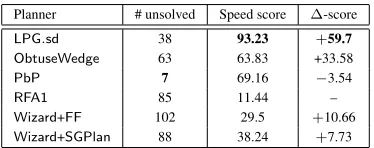
Table 5: Performance of the top 5 planners that took part in the learning track of IPC-6 plusLPG.sd, in terms of number of unsolved problems, speed score and score gap with and without using the learned knowledge for the problems of the learning track of IPC-6.
ciated set of macro-actions; these macro-actions clearly help to significantly speed up the search phase of this planner.
Empirical result 6 For the well-known benchmark do-mains considered here,LPG.sdperforms significantly better thanPbP.
Results on learning track of IPC-6
[image:6.612.70.279.230.353.2]Domain Speed score % solved Average time
LPG.d LPG.sd LPG.d LPG.sd LPG.d LPG.sd
Barman – – – – – –
BW 14.12 30 80 100 259.5 95.3
Depots 6.52 20.5 37 70 315.4 52.1
Gripper 20.36 30 100 100 77.6 27.4
Parking – – – – – –
Rovers 18.64 28 93 93 157.11 27.7
Satellite 23.67 30 100 100 70.1 24.5
Spanner 17.73 30 100 100 272.7 25.3
[image:7.612.55.301.53.167.2]Tpp – 14 – 47 – 73.29
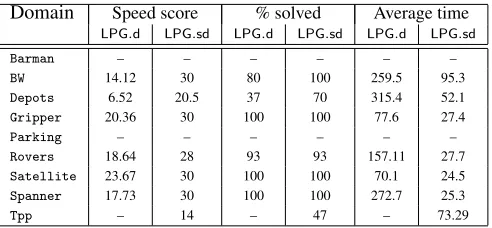
Table 6: Speed score, percentage of solved problems and average CPU time ofLPG.dand LPG.sd for 30 instances from the test sets of IPC-7 domains. BW indicates the Blocksworld domain, and “–” is used when LPG.sd or LPG.d failed to solve any of the problem instances for a given domain.
IPC-6 competition.4
Empirical result 7 According to the evaluation criteria of IPC-6, LPG.sd performs better than the winners of the learning track for speed and best-learning.
Preliminary results on the learning track of IPC-7
At the time of this writing, LPG.sd is participating in the learning track of the 7th International Planning Competi-tion (IPC-7).5 In this submission, we utilised several meta-algorithmic procedures provided by HAL, a recently devel-oped tool supporting both the computer-aided design and the empirical analysis of high-performance algorithms (Nellet al.2011). In addition to the HAL plugin for theFocusedILS variant of ParamILS, we used the plugins providing sup-port for the empirical analysis of a single algorithm’s perfor-mance. We also leveraged HAL’s built-in support for com-pute clusters and data management.For each of the 9 IPC-7 domains, ten independent runs of ParamILSwere performed using a randomly generated training set containing 60 to 70 instances solvable byLPG.d within the 900 second competition cutoff. Each run ofLPG was given a runtime cutoff of 900 CPU seconds, and the total runtime cutoff for configuration was 5 CPU days. The configuration with the best training quality as reported by a subsequent empirical analysis of theParamILSincumbents was selected as the representativeLPG.sdconfiguration for each domain.
Table 6 shows results for 900 CPU second runs ofLPG.sd andLPG.don each of these IPC-7 domains, using randomly generated test sets of 30 instances of the same size and hard-ness as those that will be used for evaluating the competing planners. Although at the time of this writing, the actual instances to be used in the competition to evaluate our sub-mission were not yet available, the competition organisers
4As observed in (Gerevini, Saetti, & Vallati 2009), the negative ∆-score ofPbPis mainly due to some implementation bugs that have been fixed in a version developed after the competition.
5
The implementation of LPG.sd used for IPC-7 is named ParLPG.
had announced in advance the instance distributions they in-tended to use.
The IPC-7 speed score for a configurationCis defined as the sum of the speed scores assigned toCover all test prob-lems. The speed score assigned toCfor a planning problem
pis 0 ifpis unsolved, and1/(1 + log10(T(C)p/Tp∗))
oth-erwise, whereTp∗is the lowest measured CPU time to solve problempandT(C)pdenotes the CPU time required byC
to solve problemp. Obviously, higher values for the speed score indicate better performance.
The results in Table 6 show that, for all but two of the IPC-7 domains,LPG.sdobtains better speed scores thanLPG.d and, on average, is considerably faster. Moreover, for three of the nine domains (Depots, Tppand Blocksworld), it solves many more problems. ForBarmanandParking, nei-therLPG.dnorLPG.sdare able to solve any of the generated test instances.
Empirical result 8 For the domains used in IPC-7,LPG.sd
performs significantly better thanLPG.d.
Conclusions and Future Work
We have investigated the application of computer-assisted algorithm design to automated planning and proposed a framework for automatically configuring a generic planner with several parameterised components to obtain specialised planners that work efficiently on given domains. In a large-scale empirical analysis, we have demonstrated that our ap-proach, when applied to the state-of-the-art, highly parame-terisedLPGplanning system, effectively generates substan-tially improved domain-specific planners.
Our work and results also suggest a potential method for testing new heuristics and algorithm components, based on measuring the performance improvements obtained by adding them to an existing highly-parameterised planner fol-lowed by automatic configuration for specific domains. The results may not only reveal to which extent new design el-ements are useful, but also under which circumstances they are most effective – something that would be very difficult to determine manually.
We see several avenues for future work. Concerning the automatic configuration of LPG, we are conducting an experimental analysis about the usefulness of the pro-posed framework for identifying configurations improving the planner performance in terms of plan quality. More-over, we plan to apply the framework to metric-temporal planning domains. Finally, we believe that our approach can yield good results for other planners that have been ren-dered highly configurable by exposing many parameters. In particular, preliminary results from ongoing work indicate that substantial performance gains can be obtained when ap-plying our approach to a very recent, highly parameterised version of the IPC-4 winner Fast Downward.
References
Blum, A., and Furst, M., L. 1997. Fast planning through planning graph analysis. Artificial Intelligence 90:281– 300.
Fern, A.; Khardon, R.; and Tadepalli, P. 2008. Learning track of the 6th international planning competition. Avail-able athttp://eecs.oregonstate.edu/ipc-learn/.
Gerevini, A.; Saetti, A.; and Serina, I. 2003. Planning through stochastic local search and temporal action graphs.
Journal of Artificial Intelligence Research20:239–290. Gerevini, A.; Saetti, A.; and Serina, I. 2008. An ap-proach to efficient planning with numerical fluents and multi-criteria plan quality. Artificial Intelligence 172(8-9):899–944.
Gerevini, A.; Saetti, A.; and Vallati, M. 2009. An auto-matically configurable portfolio-based planner with macro-actions: PbP. InProceedings of the 19th International Con-ference on Automated Planning and Scheduling (ICAPS-09), 191–199.
Gerevini, A.; Saetti, A.; and Vallati, M. 2009. Learning and Exploiting Configuration Knowledge for a Portfolio-based Planner. InProceedings of the ICAPS-09 Workshop on Planning & Learning.
Hoffmann, J., and Edelkamp, S. 2005. The deterministic part of IPC-4: An overview. Journal of Artificial Intelli-gence Research24:519–579.
Hutter, F.; Babi´c, D.; Hoos, H. H.; and Hu, A. J. 2007. Boosting verification by automatic tuning of decision pro-cedures. In Formal Methods in Computer-Aided Design, 27–34. IEEE CS Press.
Hutter, F.; Hoos, H. H.; Leyton-Brown, K.; and St¨utzle, T. 2009. ParamILS: An automatic algorithm configura-tion framework. Journal of Artificial Intelligence Research
36:267–306.
Hutter, F.; Hoos, H. H.; and Leyton-Brown, K. 2010. Automated configuration of mixed integer programming solvers. InProceedings of the 7th International Conference on the Integration of AI and OR Techniques in Constraint Programming for Combinatorial Optimization Problems (CPAIOR 2010), 186–202.
Hutter, F.; Hoos, H. H.; and St¨utzle, T. 2007. Automatic algorithm configuration based on local search. In Pro-ceedings of the 22nd Conference on Artificial Intelligence (AAAI-07), 1152–1157.
Richter, S.; Helmert, M.; and Westphal, M. 2008. Land-marks revisited. InProceedings of the 23rd Conference on Artificial Intelligence (AAAI-08), 975–982.
Yoon, S.; Fern, A.; and Givan, R. 2008. Learning control knowledge for forward search planning. Journal of Ma-chine Learning Research (JMLR)9:683–718.