Open Access
Research article
The effect of web based depression interventions on self reported
help seeking: randomised controlled trial [ISRCTN77824516]
Helen Christensen*, Liana S Leach, Lisa Barney, Andrew J Mackinnon and
Kathy M Griffiths
Address: Centre for Mental Health Research, The Australian National University, Canberra ACT, Australia
Email: Helen Christensen* - [email protected]; Liana S Leach - [email protected]; Lisa Barney - [email protected]; Andrew J Mackinnon - [email protected]; Kathy M Griffiths - [email protected]
* Corresponding author
Abstract
Background: To date, there has been very little work investigating behaviour changes induced by interventions that are designed to increase help seeking. The present paper examines the effects of two Internet depression websites on help seeking.
Methods: 414 individuals with elevated scores on a depression assessment scale were randomly allocated to a depression information website, a cognitive-behavioural skills training website (CBT) or an attention control condition. Reports of help seeking for specific treatments, from specific sources and for categories of treatments were assessed.
Results: Relative to the control, the depression information site was associated with decreases in seeking support from friends and family, the use of music and of everyday treatments and no increase in seeking evidence based interventions. The CBT site was associated with the report of help seeking for CBT, massage and exercise.
Conclusion: Methods to encourage the use of evidence-based treatments need further research to determine whether the assistance sought is evidence based and whether there are unintended effects.
Background
There is recognition from the results of representative epi-demiological surveys that most adults with mental health problems do not receive treatment [1,2].
Despite this, there has been very little research investigat-ing the effect of interventions designed to increase help seeking. Although the effects of educational pamphlets [3], voluntary screening [4] and educational programs in schools [5] on help seeking have been reported, these studies typically neither used randomised controlled
designs nor investigated the types of treatment sought. One randomised controlled study [6,7] did examine the effect on help seeking attitudes of a consumer guide to depression. This study provided information about a range of treatments with demonstrated support for effi-cacy based on a systematic review of the evidence [8]. A major weakness of this study was that the short brochure used in the control condition also provided information about evidence based treatments for depression.
Published: 05 April 2006
BMC Psychiatry 2006, 6:13 doi:10.1186/1471-244X-6-13
Received: 21 December 2005 Accepted: 05 April 2006
This article is available from: http://www.biomedcentral.com/1471-244X/6/13
© 2006 Christensen et al; licensee BioMed Central Ltd.
Using a randomised controlled trial design in which the efficacy of the active intervention arms had been estab-lished [9], the current study examined the effect of a depression information website (BluePages) on self reported help seeking. The effects were compared to those produced by a cognitive-behavioural skills training web-site (CBT) (MoodGYM) and an attention control condi-tion. The inclusion of results from the MoodGYM arm of this trial constitutes an additional active comparison group. MoodGYM has been shown to be of equal effec-tiveness to BluePages in reducing depression but it does not directly encourage participants to seek additional help.
Methods
Participants
A screening questionnaire was posted to 27,000 individu-als aged 18 to 52 randomly selected from the Canberra electoral roll. 6130 people (22.7% response rate; 24.6% excluding those returned to sender) returned the screen-ing questionnaire and 657 respondents met inclusion cri-teria. The screening questionnaire included a brief questionnaire (about two printed pages) assessing basic demographic information, education level, depression symptoms, help-seeking and internet use. Respondents were not eligible for inclusion in the trial if they; (i) scored below 12 on the Kessler Psychological Distress Scale (K10)[10], (ii) indicated they did not have Internet access at home or at work, (iii) indicated they did not wish to participate in an intervention, or (iv) were under psychi-atric or psychological care. Of those who responded, 525 participants met these criteria, returned a letter of consent, and were randomised to the interventions. 414 partici-pants provided post intervention depression scores and these individuals formed the sample analyzed here. The sample comprised 114 men and 300 women. The mean respondent age was 36.8 years (SD = 9.3), and the mean Kessler score was 17.5 (SD = 5.0) at screening.
Design
The present study used data from a recently completed randomised controlled trial of two Internet sites [9,11]. One of these Internet sites, BluePages [12], delivers infor-mation about a range of psychological, medical and alter-native treatments and recommends those supported by scientific evidence. At the time of the trial, the BluePages website reviewed 5 medical, 7 psychological and 36 alter-native treatments, recommending 3, 5 and 13 of these, respectively. The recommended therapies were based on systematic reviews of treatments [8,13]. The second site, MoodGYM, provides online cognitive behaviour therapy (CBT). The site consists of five modules that provide cog-nitive behaviour therapy, strategies to manage emotional distress, relaxation and problem solving. The site provides downloadable summary pages at the end of each module,
which provide individualized symptom scores and home-work completion outcomes. The site offers a user profile which tracks changes in anxiety, depression and dysfunc-tional thinking across modules. A control condition involved telephone contact with an interviewer but no access to the websites. Participants were randomly assigned to receive either; a) BluePages (n = 165, at end-point n = 136), b) MoodGYM (n = 182; at endend-point n = 121) or c) a control condition (n = 178, at endpoint n = 157) in which an interviewer asked open-ended questions about factors that may influence depression. Participants were randomised to interventions using the SPSS SELECT CASES random selection option. A flow chart of participa-tion in the trial is included in a previous publicaparticipa-tion [9].
Procedures
Participants completed questionnaires delivered through the mail at screening, pre-test, endpoint and at six months after the trial. Those in the BluePages and MoodGYM con-ditions were provided with a login identification number and a manual containing information about MoodGYM or BluePages. This manual outlined which sections or modules of the sites participants were to complete for each of 5 weeks. Interviewers maintained weekly tele-phone contact with participants in all conditions over the period of the intervention (a total of 6 contacts of approx-imately 10 minutes each).
Interviewers were provided with separate instruction booklets for each participant containing verbatim instruc-tions for each of the weekly contacts. Participants ran-domised to the control intervention were phoned weekly for 10 minutes to discuss lifestyle and environmental fac-tors that may influence depression. A different topic was discussed each week; 1) physical and artistic activities, 2) education and hobbies, 3) social financial and family roles, 4) work habits and stress, 5) physical health, medi-cation and pain, and 6) nutrition and alcohol. At the end of the intervention period and at six months all partici-pants were sent a questionnaire. The study was approved by the Human Ethics Committee of the Australian National University. Participants provided written informed consent.
Measures
Demographic
Age, sex, marital status, years of education and previous history of depression were assessed.
Depression
[14]. To compare to Jorm et al., [6] CES-D depression scores at pre-intervention were then grouped into five intervals 'Low' (0–9), 'Mild' (10–19), 'Moderate' (20–29), 'High' (30–39) and 'Severe' (40–60).
Help-seeking
(i) Treatments sought by participants. At post intervention and at six months respondents were asked 'We would now like you to tell us which of the following treatments or activities (if any) you have used in the past 2 months to cope with depression.' Respondents were then given a list of items and answered either 'yes' or 'no' to each item. This list of self-help and standard professional therapies was compiled from a systematic review of treatments for depression [8,13]. Only items with more than 10% endorsement rate were analysed. The list of these items contained nine evidence-based treatments: one medical professional treatment (use of anti-depressant medica-tion), two psychological treatments (CBT and self-help books) and six alternative treatments (exercise, yoga, mas-sage, relaxation, cut out alcohol, use of vitamins); and eight non-evidence based treatments: one psychological treatment (counseling), and seven alternative treatments (eating chocolate, music, being with pets, doing enjoyable things, meditation, avoiding caffeine, use of alcohol).
(ii) Seeking help from particular sources was also assessed. Participants were asked whether they had sought help from a 'general practitioner', 'counsellor or psychologist' or from 'friends or family'.
(iii) Help seeking treatments by category using the categori-zation introduced by Jorm et al [6] were also assessed. The treatments were grouped into four categories: Everyday treatments included family and friends, exercise, eating chocolate, listening to music, being with pets and doing more things you enjoy. Everyday actions were so named because they reflected activities which are not necessarily seen to be therapeutic but which are frequently under-taken or experienced in daily life. Complementary treat-ments included yoga, massage, relaxation therapy and meditation. Complementary treatments were those iden-tified through a systematic search of the literature, but which were not commonly identified in clinical practice guidelines. Dietary treatments included avoiding caffeine and drinking alcohol. Professional treatments included seeking the help of general practitioners, counselors and psychologists, anti-depressants, cognitive-behavioural therapy, counseling and reading self-help books. A previ-ously used category – non-prescription treatments (which includes painkillers, St John's wort, fish oils, vitamins and 'cut down on alcohol') – was not able to be used in the present analysis because most items were too infrequently endorsed. Two components within this category, 'vita-mins' and 'cut out alcohol'- were included in the dietary
category. Thus the everyday category had six treatments, the complementary category four treatments, the dietary category four treatments and the professional category six treatments. These categories were originally derived from a principal components analysis of a range of treatments found in the literature [6].
Statistical analysis
The first set of analyses addressed the question of whether the interventions were associated with reports of help seeking. It consisted of a series of separate logistic regres-sions assessing the impact of BluePages compared to the control condition, and BluePages compared to the MoodGYM site on help seeking for each of the specific treatments used (e.g., antidepressant medication). A sec-ond analysis assessed the effect of these the two interven-tions and the control condition on help seeking from different sources of help (professionals/family). A further set of four linear regressions examined whether those in the BluePages intervention compared to the two other interventions used different categories of treatments.
BluePages was selected as the comparison condition in preference to the control condition because we hypothe-sized it would lead to greater help seeking for evidence-based treatments than the other two conditions. Supple-mentary analyses addressed the question of whether the reported seeking of help from a specific treatment or source was associated with a reduction in depressive symptoms. Separate linear regressions were used to exam-ine the reported use of each specific treatment and its association with depression (CES-D scores) at post inter-vention and at six months. A further four linear regres-sions examined whether the category types of treatment predicted depression. A second set of supplementary anal-yses investigated the relationship between the severity of depression and the reported uptake of specific treatments or sources, controlling for intervention type. A series of separate logistic regressions were used to assess the effect of the severity of depression (CES-D scores) at pre-inter-vention on the use of each treatment. Four linear regres-sions were used to examine the impact of depression on the number of every day, complementary, dietary and professional treatments used. No formal adjustment was undertaken for the number of comparisons that were tested. However, the majority of effects reported would remain significant even if correct using a extremely con-servative approach such as the Bonferroni method. Never-theless, the possibility of inflated Type I error arising from evaluating multiple treatments should be borne in mind.
Results
Demographic characteristics
[9,11]. Participants who completed the post-intervention questionnaire did not differ in age, sex or years of educa-tion or the CES-D at endpoint in comparison to those who did not return the questionnaire, although the drop-outs had higher depression scores at baseline (F (1,523) = 5.15, p = 0.24).
Effects of the sites on depression symptoms
Both BluePages and MoodGYM significantly reduced depression symptoms at post intervention relative to the control condition. Scores reduced 4.5 points (1.8 to 7.3) (95% confidence interval) for MoodGYM and 3.6 points (1.0 to 6.3) for BluePages relative to the control condi-tion.
Effects of the interventions on help seeking
[image:4.612.57.555.97.488.2]Frequencies for the reported use of each treatment are shown in Table 1. The results for the logistic and linear regressions are also displayed. Compared to BluePages, MoodGYM participants were more likely to report using cognitive behavioural therapy, exercise and massage. Both MoodGYM and control participants were more likely to report listening to music than were BluePages partici-pants. Compared to BluePages, the control group was more likely to report seeking the help of family and friends. Both MoodGYM and the control condition were associated with the reported use of more everyday treat-ments. MoodGYM was also associated with the seeking of more complementary and professional treatments. These analyses were repeated as six months (Table 2). A number Table 1: Treatment use percentages for each condition and summary of regressions predicting treatment use from intervention type
BluePages Control MoodGym Control – BluePages MoodGym – BluePages
Specific Treatments (N = 136) (N = 157) (N = 121) OR p 95%CI OR p 95%CI
Evidence based
Antidepressants 27.9 25.5 24.8 .88 .634 .53 – 1.48 .85 .568 .49 – 1.48
CBT 11.0 7.6 28.9 .67 .320 .30 – 1.48 3.28 .000** 1.69 – 6.38
Self-help books 23.5 19.7 27.3 .80 .432 .46 – 1.40 1.22 .491 .69 – 2.14
Exercise 56.6 63.7 68.6 1.34 .217 .84 – 2.15 1.67 .049* 1.01 – 2.79
Yoga 9.6 9.6 13.2 1.00 .999 .46 – 2.18 1.44 .356 .66 – 3.14
Massage 13.2 15.9 24.0 1.24 .517 .65 – 2.39 2.07 .028* 1.08 – 3.95
Relaxation therapy 12.5 7.6 18.2 .58 .169 .27 – 1.26 1.57 .207 .78 – 3.09
Cut out alcohol 14.0 19.0 19.0 1.22 .540 .64 – 2.32 1.45 .277 .74 – 2.81
Use vitamins 10.3 15.9 14.9 1.65 .160 .82 – 3.32 1.52 .269 .72 – 3.21
Non-evidence based
Counselling 8.1 14.0 11.6 1.85 .114 .86 – 30.97 1.49 .349 .65 – 30.14
Eating chocolate 19.9 22.9 27.3 1.20 .523 .69 – 2.11 1.51 .162 .85 – 2.71
Listening to music 42.6 59.9 56.2 2.01 .003** 1.26 – 3.20 1.73 .031* 1.05 – 2.83
Being with pets 41.9 52.9 50.4 1.56 .062 .98 – 2.47 1.41 .173 .86 – 2.31
Doing things you enjoy 57.4 60.5 59.5 1.14 .584 .71 – 1.82 1.09 .727 .67 – 1.80
Meditation 13.2 12.7 19.0 .96 .900 .48–1.89 1.54 .209 .79–3.01
Avoiding caffeine 11.0 10.2 11.6 .92 .816 .44–1.93 1.06 .891 .49–2.29
Use alcohol 18.4 23.6 19.0 1.37 .280 .78-.242 1.04 .898 .56–1.95
Sources of Help
GP 22.1 22.3 28.1 1.01 .962 .58 – 1.76 1.38 .265 .78 – 2.43
Counsellor/psychologist 10.3 15.9 18.2 1.65 .160 .82 – 3.32 1.93 .072 .94 – 3.98 Family and friends 56.6 71.3 64.5 1.91 .009** 1.18 – 3.10 1.39 .200 .84 – 2.30
Categories of Treatments Mean (SD) Mean (SD) Mean (SD) B p 95% CI B p 95% CI
Professional treatments (Scale: 0–6) 1.03 (1.25) 1.05 (1.37) 1.39 (1.47) .16 .893 -.29 – .43 .36 .036* .02 – .69 Everyday treatments (Scale: 0–4) 2.75 (1.65) 3.31 (1.68) 3.26 (1.60) .19 .004** .18 – .94 .51 .013* .11 – .92 Complementary treatments (Scale: 0–4) 0.49 (0.81) 0.46 (0.77) 0.74 (0.94) .10 .786 -.22 – .17 .26 .014* .05 – .46 Dietary treatments (Scale: 0–6) 0.54 (0.78) 0.66 (0.83) 0.64 (0.89) .10 .198 -.07 – .32 .11 .360 -.10 – .31
of the differences between the intervention groups were no longer significant. However, MoodGYM participants were still more likely to say they had used cognitive-behavioural therapy than those in BluePages (OR = 2.73; p = 0.011), and to use everyday treatments (B = .48, p = .044). After six months those in the control group were still more likely to have listened to music than those in the BluePages intervention (OR = 2.10, p = .005), and were now more likely to report the use of pets as a form of treat-ment than those in BluePages (OR = 1.86, p = .018). Both MoodGYM participants and the control group were more likely to use alcohol as a form of treatment at six months, than those in BluePages (OR = 2.26, p = .031, OR = 2.13, p = .037).
Associations between actions taken and symptom reduction
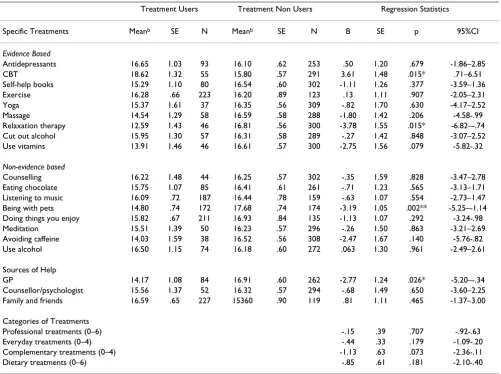
Table 3 shows the mean depression scores at post inter-vention for the users and non-users of each individual treatment. These analyses include individuals from the three intervention conditions combined. Table 3 also lists the results of the linear regressions used to assess the effect of the reported use of each specific treatment, sources of help and treatment categories on depression. Intervention condition and depression at pre-test were controlled for in these analyses. Users of relaxation and those reporting "doing things that they enjoyed' were less depressed. Use of alcohol and the number of professional treatments used were associated with higher levels of depression. These analyses were repeated at six months. There were no major differences in findings at 6 months compared to
immediately post-intervention for most of the relation-ships (Table 4). However, the number of professional treatments used, doing enjoyable things and drinking alcohol, were not longer significant predictors of CES-D scores after six months. Relaxation therapy continued to be associated with lower CES-D scores (B = -.378, p = 0.015). New associations after six months were that CBT was now significantly associated with higher CES-D scores (B = 3.61, p = 0.015), seeing a GP was significantly associ-ated with lower CES-D scores (B = -.2.77, p = .026), and being with pets was associated with lower CES-D scores (B = -3.19, p = .002).
[image:5.612.88.265.103.247.2]Severity of depression and its impact on actions taken
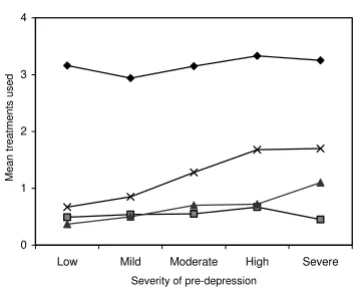
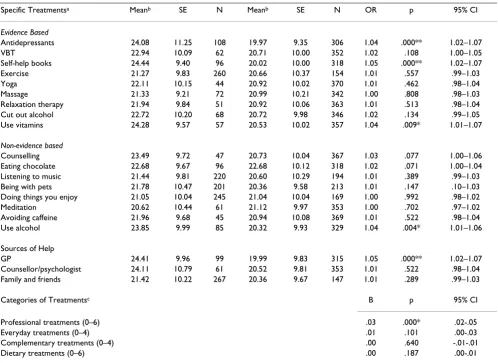
Table 5 shows the mean depression scores at pre-interven-tion for the users and non-users of each treatment, includ-ing non-evidence based treatments. Table 5 lists the results for the logistic and linear regressions used to assess the effect of depression severity at pre-intervention on the likelihood of using each individual treatment, and on the number of every day, complementary, dietary and profes-sional treatments used. Frequently adopted actions were seeking out family and friends, exercise, listening to music, engaging in pleasant events and being with pets. Taking antidepressants, reading self-help books for depression, using vitamins and using alcohol were associ-ated with higher pretest depression scores. Seeking help from counsellors/psychologists and general practitioners was also associated with higher baseline depression scores, as was the total number of professional treatments. Following Jorm et al. [6] the mean number of treatments used pre-intervention in each category was examined across depression severity (Figure 1). While there was little change in the use of every day, complementary and die-tary treatments across severity, the number of professional treatments used increased with increasing severity.
Discussion
The present study found that use of BluePages was associ-ated with different reports of help seeking behaviours rel-ative to the control condition and MoodGYM. For specific treatment types, compared to MoodGYM, Bluepages use was associated with fewer reports of having taken up CBT, exercise, massage or music. Participants also had lower use of professional treatments, and everyday and comple-mentary categories of treatment. BluePages was associated with decreased use of music, decreased help seeking from friends and family and decreased use of everyday treat-ments compared to the control condition. Specific self reported actions of participants over the trial period were associated with reduced depression symptoms at end-point for the use of relaxation, and doing more enjoyable things, but not for other evidenced based and non-evi-denced based treatments. Taking antidepressants, reading self-help books for depression, using alcohol and seeking
Mean treatments used across severity of depression at pre-intervention
Figure 1
Mean treatments used across severity of depression at pre-intervention.
0 1 2 3 4
Low Mild Moderate High Severe
Severity of pre-depression
M
ean t
reat
m
ent
s
us
ed
professional treatments were associated with higher base-line depression scores.
Frequency with which treatments were sought and types of treatments sought
In some respects, these findings are similar to those reported in the recent help seeking literature. First, there is a low level of seeking help from mental health profession-als and a preference for everyday treatments, rather than evidence-based treatments. Although figures might be better gauged from representative samples of the popula-tion rather than from a sample with high symptoms, only approximately 24% of participants in this study with ele-vated depression reported seeking the help of a GP. This
[image:6.612.57.551.110.495.2]concords closely with findings by Oliver et al., in the UK that 28% of individuals with high GHQ scores sought help from a general practitioner, and findings in Australia, that 33% of adults with an affective disorder and 56% of those with anxiety disorder did not seek help for their dis-order in the last 12 months. A recent study [1] reported that 49% of individuals with a mood disorder perceived the need for care, but only 13% sought help from a mental health professional. Our findings also accord with others that demonstrate that many individuals seek complemen-tary and non-traditional treatments [15,16] rather than treatment through formal mental health services. The most preferred 'treatments' were exercise, doing things you enjoy, listening to music, and being with pets. Table 2: Treatment use percentages at six month follow-up for each condition and summary of regressions predicting treatment use from intervention type
BluePages Control MoodGym Control – BluePages MoodGym – BluePages
Specific Treatments (N = 114) (N = 130) (N = 102) OR p 95%CI OR p 95%CI
Evidence based
Antidepressants 25.4 26.2 28.4 1.04 .899 .58–1.85 1.16 .620 .64–2.13
CBT 9.6 6.9 22.5 .70 .441 .28–1.75 2.73 .011* 1.26–5.92
Self-help books 24.6 22.3 15.7 .88 .678 .49–1.60 .57 .108 .29–1.13
Exercise 54.4 56.9 64.7 1.11 .691 .67–1.84 1.54 .124 .90–2.66
Yoga 13.2 10.8 8.8 .80 .566 .37–1.73 .64 .314 .27–1.53
Massage 16.7 15.4 18.6 .91 .785 .46–1.80 1.15 .706 .57–2.31
Relaxation therapy 12.3 6.2 10.8 .47 .102 .19–1.16 .86 .732 .37–2.00
Cut out alcohol 13.2 15.4 15.7 1.20 .621 .58–2.47 1.23 .597 .57–2.63
Use vitamins 11.4 15.4 12.7 1.41 .366 .67–2.99 1.14 .762 .50–2.58
Non-evidence based
Counselling 11.4 12.3 11.8 1.09 .828 .50–2.38 1.04 .934 .45–2.39
Eating chocolate 21.1 23.8 30.4 1.17 .60 .64–2.15 1.64 .117 .88–3.04
Listening to music 47.4 65.4 53.9 2.10 .005** 1.25–3.51 1.300 .337 .76–2.22
Being with pets 38.6 53.8 45.1 1.86 .018* 1.11–3.09 1.31 .334 .76–2.25
Doing things you enjoy 56.1 55.4 67.6 .94 .906 .58–1.61 1.63 .084 .94–2.85
Meditation 12.3 8.5 16.7 .66 .329 .29–1.52 1.43 .360 .67–3.07
Avoiding caffeine 8.8 12.3 8.8 1.46 .374 .63–3.36 1.01 .989 .39–2.58
Use alcohol 11.4 21.5 22.5 2.13 .037* 1.05–4.35 2.26 .031* 1.08–4.75
Sources of Help
GP 26.3 21.5 29.4 .77 .382 .43–1.39 1.17 .612 .64–2.12
Counsellor/psychologist 11.4 16.9 17.6 1.58 .222 .76–3.31 1.67 .194 .77–3.60
Family and friends .92 .757 .55–1.54 1.62 .094 .92–2.86
Categories of Treatments Mean (SD) Mean (SD) Mean (SD) B p 95% CI B p 95% CI
Professional treatments (Scale: 0–6) 1.09 (1.25) 1.06 (1.36) 1.25 (1.49) -.03 .832 -.34-.27 .15 .374 -.18-.47 Everyday treatments (Scale: 0–4) 2.77 (1.66) 3.13 (1.75) 3.32 (1.50) .27 .226 -.17-.71 .48 .044* .01-.94 Complementary treatments (Scale: 0–4) .54 (.86) .41 (.76) .55 (.87) -.12 .197 -.30-.06 .01 .943 -.19-.20 Dietary treatments (Scale: 0–6) .45 (.70) .65 (.87) .60 (.73) .16 .064 -.01-.33 .13 .162 -.05-.31
The effect of the specific interventions on reports of help seeking
Jorm et al., [7] demonstrated that the provision of an evi-dence-based guide led to greater attitudinal change than a short brochure, with those reading the guide more likely to affirm that the endorsed treatments are more likely to be helpful. Those receiving the self help guide were more likely to report that they had tried a self help treatment, and to give advice to someone about it. However, the present study has failed to find strong evidence that the information website BluePages led to the reported initia-tion of evidence-based treatments either during the inter-vention or at six months. Compared to the control condition, BluePages participants were no more likely to report having sought any evidence-based specific treat-ment. Nevertheless, depression improved in the BluePages intervention relative to the control condition at
post test [9] and at 6 months. BluePages was associated with a reduction in the use of music, the use of family and friends for support and the use of everyday treatments. We postulated that BluePages might exert its effect through the initiation of self help for evidence based treatments. However, the findings of the study suggest that the help seeking influence of BluePages may be to decrease the use of non-evidence based interventions. For example, seek-ing support from friends and relatives may be unneces-sary, unhelpful, even toxic under certain circumstances and the website may have served to reduce inappropriate help seeking actions. This accords with some adolescent literature that reports that help seeking from younger friends may not be helpful. Moreover, it is possible that BluePages served as a partial substitute for the support and reassurance that might normally be sought from family and friends. The mechanism by which the psychoeduca-Table 3: CES-D scores at post intervention as a function of treatment use and summary of regressions predicting CES-D scores at post intervention
Treatment Users Treatment Non Users Regression Statistics
Specific Treatments Meanb SE N Meanb SE N B SE p 95%CI
Evidence Based
Antidepressants 18.46 .86 108 16.90 .50 306 1.58 .98 .106 -.34 – 3.50
CBT 17.99 1.12 62 17.18 .47 352 1.97 1.23 .108 -.44 – 4.38
Self-help books 17.25 .91 96 17.32 .50 318 .24 1.02 .812 -1.77 – 2.25
Exercise 17.30 .55 260 17.31 .71 154 .00 .88 .998 -1.73 – 1.73
Yoga 17.48 1.33 44 17.28 .46 370 .41 1.38 .766 -2.29 – 3.11
Massage 16.19 1.04 72 17.54 .48 342 -1.12 1.12 .997 -3.33 – 1.09
Relaxation therapy 13.38 1.22 51 17.86 .46 356 -3.83 1.29 .003* -6.35 – -.30
Cut out alcohol 17.68 1.07 68 17.23 .47 346 .48 1.15 .677 -1.78 – 2.73
Use vitamins 16.57 1.17 57 17.42 .47 357 -1.10 1.24 .378 -3.53 – 1.34
Non-evidence based
Counselling 19.54 1.28 47 17.02 .46 367 2.17 1.34 .105 -.46 – 4.81
Eating chocolate 16.91 .90 96 17.42 .49 318 -.45 1.01 .659 -2.43 – 1.54
Listening to music 17.61 .59 220 16.95 .63 194 .33 .86 .703 -1.36 – 2.02
Being with pets 16.73 .62 201 17.85 .60 213 -1.35 .85 .114 -3.02 – .32
Doing things you enjoy 15.72 .55 245 19.6 .66 169 -3.95 .84 .000** -5.60 – -2.31
Meditation 16.42 1.13 61 17.46 .47 353 -.75 1.20 .531 -3.10 – 1.60
Avoiding caffeine 15.88 1.31 45 17.48 .46 369 -1.49 1.36 .273 -4.16 – 1.18
Use alcohol 19.35 .96 85 16.78 .48 329 2.29 1.05 .030* .22 – 4.37
Sources of Help
GP 18.20 .90 99 17.02 .50 315 1.35 1.01 .183 -.64 – 3.33
Counsellor/psychologist 19.14 1.13 61 16.07 .47 353 2.09 1.20 .083 -.28 – 4.46
Family and friends 17.83 .54 267 16.35 .72 147 1.10 .89 .281 -.65 – 2.85
Categories of Treatments
Professional treatments (0–6) .74 .32 .021* .11 – 1.37
Everyday treatments (0–4) -.39 .26 .133 -.87 – .12
Complementary treatments (0–4) -.89 .51 .079 -1.88 – .10
Dietary treatments (0–6) .24 .52 .646 -.78 – 1.23
[image:7.612.57.556.109.484.2]tion website exerts it influence on depression symptoms needs further investigation.
The increase in the reported use of CBT in the MoodGYM condition is to be expected since CBT formed the core of the intervention and participants knew CBT was offered in their intervention. The reasons for the increased reporting of massage and exercise are less clear. Neither exercise nor massage was directly encouraged by the MoodGYM site although one of 29 self help exercises mentioned the use of physical activities as a means of rewarding positive thinking. One explanation is that massage and exercise arose a consequence of a reduction in depression symp-toms. More generally, this explanation predicts that help seeking is linked to depression improvement across both MoodGYM and BluePages sites. However, although both MoodGYM and BluePages were equally effective in
reduc-ing depression symptoms, only MoodGYM was associated with reported increases in these activities.
Relationships between help sought and a reduction in depression symptoms
The present study found that relaxation therapy, doing enjoyable things, and not using alcohol were associated with lower depression symptoms at post test. These rela-tionships were found controlling for both baseline levels of depression and intervention type. Taking specific evi-denced based treatments such as anti-depressant medica-tion (reported by one quarter of the participants) did not predict improvement in depression outcomes. Interpreta-tions of these associaInterpreta-tions must consider the correlational nature of these relationships as well as the complexity of tracking the uptake of a range of treatments. For example, there may be a number of reasons for failing to find a rela-Table 4: CES-D scores at six month follow-up as a function of treatment use and summary of regressions predicting CES-D at six month follow-up
Treatment Users Treatment Non Users Regression Statistics
Specific Treatments Meanb SE N Meanb SE N B SE p 95%CI
Evidence Based
Antidepressants 16.65 1.03 93 16.10 .62 253 .50 1.20 .679 -1.86–2.85
CBT 18.62 1.32 55 15.80 .57 291 3.61 1.48 .015* .71–6.51
Self-help books 15.29 1.10 80 16.54 .60 302 -1.11 1.26 .377 -3.59–1.36
Exercise 16.28 .66 223 16.20 .89 123 .13 1.11 .907 -2.05–2.31
Yoga 15.37 1.61 37 16.35 .56 309 -.82 1.70 .630 -4.17–2.52
Massage 14.54 1.29 58 16.59 .58 288 -1.80 1.42 .206 -4.58-.99
Relaxation therapy 12.59 1.43 46 16.81 .56 300 -3.78 1.55 .015* -6.82–-.74
Cut out alcohol 15.95 1.30 57 16.31 .58 289 -.27 1.42 .848 -3.07–2.52
Use vitamins 13.91 1.46 46 16.61 .57 300 -2.75 1.56 .079 -5.82-.32
Non-evidence based
Counselling 16.22 1.48 44 16.25 .57 302 -.35 1.59 .828 -3.47–2.78
Eating chocolate 15.75 1.07 85 16.41 .61 261 -.71 1.23 .565 -3.13–1.71
Listening to music 16.09 .72 187 16.44 .78 159 -.63 1.07 .554 -2.73–1.47
Being with pets 14.80 .74 172 17.68 .74 174 -3.19 1.05 .002** -5.25–-1.14
Doing things you enjoy 15.82 .67 211 16.93 .84 135 -1.13 1.07 .292 -3.24-.98
Meditation 15.51 1.39 50 16.23 .57 296 -.26 1.50 .863 -3.21–2.69
Avoiding caffeine 14.03 1.59 38 16.52 .56 308 -2.47 1.67 .140 -5.76-.82
Use alcohol 16.50 1.15 74 16.18 .60 272 .063 1.30 .961 -2.49–2.61
Sources of Help
GP 14.17 1.08 84 16.91 .60 262 -2.77 1.24 .026* -5.20–-.34
Counsellor/psychologist 15.56 1.37 52 16.32 .57 294 -.68 1.49 .650 -3.60–2.25
Family and friends 16.59 .65 227 15360 .90 119 .81 1.11 .465 -1.37–3.00
Categories of Treatments
Professional treatments (0–6) -.15 .39 .707 -.92-.63
Everyday treatments (0–4) -.44 .33 .179 -1.09-.20
Complementary treatments (0–4) -1.13 .63 .073 -2.36-.11
Dietary treatments (0–6) -.85 .61 .181 -2.10-.40
[image:8.612.56.557.109.483.2]tionship for anti-depressant medication. First, improve-ment in mood might be associated itself with the discontinuation of depression medication or the choice not to investigate this option. Other possible explanations are that participants might be unlikely to take antidepres-sants if they have engaged in online treatment, or the anti-depressant effect for those already on antianti-depressants at commencement of the trial may have stablized at the time of enrolment in the trial. Conversely, the anti-depressant effect may be too small to detect over a six week period if this intervention is taken up later in the course of the trial. Finally, the medication may have been discontinued or used inappropriately and the use of medication might be combined with a number of positive or negative other treatments. These findings however, do also accord with recent data from the UK [3,17] which show that increases in the use of anti-depressant medication for community
depression is not associated with improvement in mental health outcomes. A range of methodological problems may be responsible for the absence of these effects, which require tracking longitudinally over a number of data points.
The findings are also interesting in view of the recent NICE guidelines for the management of depression in pri-mary and secondary care which promote the use of guided self help, computerized CBT, and exercise in mild depres-sion, but the use of medication and combined treatments in those with treatment resistant or severe depression [18].
Depression severity and outcomes
[image:9.612.58.556.108.471.2]A set of analyses controlling for treatment intervention examined the effect of depression severity on different Table 5: CES-D scores at pretest as a function of treatment use and summary of regressions predicting treatment use from CES-D at pre-intervention
Specific Treatmentsa Meanb SE N Meanb SE N OR p 95% CI
Evidence Based
Antidepressants 24.08 11.25 108 19.97 9.35 306 1.04 .000** 1.02–1.07
VBT 22.94 10.09 62 20.71 10.00 352 1.02 .108 1.00–1.05
Self-help books 24.44 9.40 96 20.02 10.00 318 1.05 .000** 1.02–1.07
Exercise 21.27 9.83 260 20.66 10.37 154 1.01 .557 .99–1.03
Yoga 22.11 10.15 44 20.92 10.02 370 1.01 .462 .98–1.04
Massage 21.33 9.21 72 20.99 10.21 342 1.00 .808 .98–1.03
Relaxation therapy 21.94 9.84 51 20.92 10.06 363 1.01 .513 .98–1.04
Cut out alcohol 22.72 10.20 68 20.72 9.98 346 1.02 .134 .99–1.05
Use vitamins 24.28 9.57 57 20.53 10.02 357 1.04 .009* 1.01–1.07
Non-evidence based
Counselling 23.49 9.72 47 20.73 10.04 367 1.03 .077 1.00–1.06
Eating chocolate 22.68 9.67 96 22.68 10.12 318 1.02 .071 1.00–1.04
Listening to music 21.44 9.81 220 20.60 10.29 194 1.01 .389 .99–1.03
Being with pets 21.78 10.47 201 20.36 9.58 213 1.01 .147 .10–1.03
Doing things you enjoy 21.05 10.04 245 21.04 10.04 169 1.00 .992 .98–1.02
Meditation 20.62 10.44 61 21.12 9.97 353 1.00 .702 .97–1.02
Avoiding caffeine 21.96 9.68 45 20.94 10.08 369 1.01 .522 .98–1.04
Use alcohol 23.85 9.99 85 20.32 9.93 329 1.04 .004* 1.01–1.06
Sources of Help
GP 24.41 9.96 99 19.99 9.83 315 1.05 .000** 1.02–1.07
Counsellor/psychologist 24.11 10.79 61 20.52 9.81 353 1.01 .522 .98–1.04
Family and friends 21.42 10.22 267 20.36 9.67 147 1.01 .289 .99–1.03
Categories of Treatmentsc B p 95% CI
Professional treatments (0–6) .03 .000* .02-.05
Everyday treatments (0–4) .01 .101 .00-.03
Complementary treatments (0–4) .00 .640 -.01-.01
Dietary treatments (0–6) .00 .187 .00-.01
Notes: a: Logistic regressions adjusting for condition.
types of reported help seeking. These findings accord to some degree with those of Jorm et al., [6] who reported that some actions such as taking antidepressants and see-ing a doctor became increassee-ingly prevalent with greater severity of symptoms while other actions were less preva-lent at higher levels of severity, such as undertaking every day activities, for example, engaging in physical activity.
Limitations of the findings
There are a number of limitations of the present analysis and design of the study. The major limitation is that the help seeking data are based on self-report. We do not have data on the actual activities undertaken. Secondly, the sample was restricted to that community subgroup of par-ticipants who was prepared to participate in a randomised controlled trial of Internet websites. These individuals may have specific preferences for types of treatment not shared by the general community. By virtue of the popu-lation from which they were selected, they are likely to be from higher socio-economic groups. Evidence from other work indicates that higher education is associated with the uptake of complementary and alternative treatments [18]. The screening questionnaire was completed by 22.7% of those approached. This level of response is lower than that achieved by US based surveys using the telephone (40%) [16] or surveys with reminders or multiple reminders, or those incorporating participants from established cohort studies. Nevertheless, the rate was consistent with earlier postal surveys of mental health using the electoral roll in Canberra [7]. This lower rate may be due to the lack of personal approach as our broader epidemiological studies of the region yield higher response rates (approximately 60% when telephoned or home visited) [19]. The analy-ses investigating depression severity and treatments sought are correlational and may reflect differences in the uptake of treatments as a function of changes in depres-sion rather than the influence of particular interventions on the improvement of depression symptoms. The drop out rate was greater in the MoodGYM condition. The increased use of professional, everyday and complemen-tary treatments in the MoodGYM condition may be due to the additive effect of increased use of a number of the individual specific treatments.
Despite these shortcomings the present paper has a number of strengths over previous reports of help seeking in mental health. It is one of the first trials to examine the effect of interventions on both evidence-based and non-evidence based help seeking using adequate comparison groups. The significant findings are that exposure to one internet site results in significantly greater increased help seeking of evidence based treatments (CBT, massage and exercise), and an increase in a range of help seeking. Expo-sure to BluePages reduces what may be unhelpful responses to mental health problems – seeking support
from family and friends. It also confirms severity of depression as a risk factor for help seeking, and reveals the complexity of the relationship between self reported help and treatment outcomes.
Conclusion
Models of 'pathways to care' are often limited because they fail to account for the large numbers of consumers who do not have access to health care or those who have preferences not to use traditional health services. These models typically consider only the health services that are within the embrace of service providers, excluding self-care and self-care provided by the not for profit sector and other community agencies. There is clearly the opportu-nity to pursue broader models of how help seeking may result in better outcomes of those with mental health problems. More needs to be understood about the prefer-ences the community has for various types of treatments (see for example [20,21]) the ways in which people with mental health problems seek both traditional and non-traditional help [10], and the methods which may prove effective in improving the rate and type of help seeking. Further randomised controlled trials are required which examine the effect of various interventions on the actual uptake of help seeking for evidence-based treatments.
Competing interests
The author(s) declare they have no competing interests.
Authors' contributions
HC and KG conceived and designed the study. HC drafted the article and KG revised it critically for content. LL undertook the data analyses, drafted method and results sections and contributed comments to the final draft. AM critically revised the content of the paper and its analyses, and LB contributed to intellectual content and data inter-pretation. All gave final approval of the final manuscript to be published.
Acknowledgements
This research was supported by NHMRC Program Grant 179805
References
1. Mojtabai R, Olfson M, Mechanic D: Perceived need and help-seeking in adults with mood, anxiety, or substance use disor-ders. Arch Gen Psychiatry 2002, 59:77-84.
2. Meltzer H, Bebbington P, Brugha T, Farrell M, Lewis G: The reluc-tance to seek treatment for neurotic disorders. Journal of Mental Health 2000, 9:319-327.
3. Brugha D, Hicks MH: Effect of an educational pamphlet on help seeking attitudes for depression among British South Asian women. Psychiatr Serv(Chic) 2004, 55:827-829.
4. Greenfield SF, Reizes JM, Magruder KM, Muenz LR, Kopans B, Jacobs DG: Effectiveness of community based screening for depres-sion. A J Psychiatry 1997, 154:1391-1397.
5. Nicholas J, Oliver K, Lee K, O'Brien M: Help-seeking behaviour and the Internet: An investigation among Australian adoles-cents. Australian e-Journal for the Advancement of Mental Health 2004,
Publish with BioMed Central and every scientist can read your work free of charge
"BioMed Central will be the most significant development for disseminating the results of biomedical researc h in our lifetime."
Sir Paul Nurse, Cancer Research UK
Your research papers will be:
available free of charge to the entire biomedical community
peer reviewed and published immediately upon acceptance
cited in PubMed and archived on PubMed Central
yours — you keep the copyright
Submit your manuscript here:
http://www.biomedcentral.com/info/publishing_adv.asp
BioMedcentral 6. Jorm AF, Griffiths KM, Christensen H, Parslow RA, Rogers B:
Actions taken to cope with depression at different levels of severity: a community survey. Psychol Med 2004, 34:293-9. 7. Jorm AF, Griffiths KM, Christensen H, Korten AE, Parslow RA,
Rog-ers B: Providing information about the effectiveness of treat-ment options to depressed people in the community: a randomized controlled trial of effects on mental health liter-acy, help-seeking and symptoms. Psychol Medicine 2003, 33:
1071-1079.
8. Jorm AF, Christensen H, Griffiths KM, Rodgers B: Effectiveness of complementary and self-help treatments for depression.
Med J Aust 2002, 176(Suppl):S84-S95.
9. Christensen H, Griffiths KM, Jorm AF: Delivering interventions for depression by using the internet: randomised controlled trial. BMJ 2004, 328:265 [http://bmj.bmjjournals.com/cgi/content/ full/328/7434/265#otherarticles].
10. Andrews G, Slade T: Interpreting scores on the Kessler Psycho-logical Distress Sclae (K10). Aust N Z J Public Health 2001, 25:
494-497.
11. Griffiths KM, Christensen H, Jorm AF, Evans K, Groves C: Effect of web-based depression literacy and cognitive-behavioural therapy interventions on stigmatising attitudes to depres-sion: randomised controlled trial. BrJ Psychiatry 2004, 185:
342-349.
12. BluePages [http://www.bluepages.anu.edu.au]
13. Jorm AF, Christensen A, Griffiths K, Parslow RA, Rodgers B, Blewitt KA: Effectiveness of complementary and self-help treat-ments for anxiety disorders. Med J Aust 2004, 181(Suppl):
S29-S46.
14. Randolf LS: The CES-D scale: a self-report depression scale for research in the general population. Appl Psychological Measure-ment 1977, 1:385-401.
15. MacLennan AH, Wilson DH, Taylor AW: The escalating cost and prevalence of alternative medicine. Prev Med 2002, 35:
166-173.
16. Kessler RC, Davis RB, Foster DF, Van Rompay MI, Walters EE, Wilkey SA, Kaptchuk TJ, Eisenberg DM: Long-term trends in the use of complementary and alternative medical therapies in the United States. Annals of Intern Med 2001, 135:262-268. 17. Brugha TS, Bebbington PE, Singleton N, Melzer D, Jenkins R, Lewis G,
Farrell M, Bhugra D, Lee A, Meltzer H: Trends in service use and treatment for mental disorders in adults throughout Great Britain. Br J Psychiatry 2004, 185:378-84.
18. National Institute for Clinical Excellence: Depression. Manage-ment of depression in primary and secondary care. Guideline 23 2004 [http://www.nice.org.uk/CG023NICEguideline].
19. Jorm AF, Korten AE, Christensen H, Jacomb PA, Rodgers B, Parslow RA: Association of obesity with anxiety, depression and emo-tional well-being: a community survey. Aust NZ J Public Health
2003, 27:434-40.
20. Riedel-Heller SG, Matschinger H, Angermeyer MC: Mental disor-ders- who and what might help? Helpseeking and treatment preferences of the lay public. Soc Psychiatry Psychiatr Epidemiol
2005, 40:167-174.
21. Jorm AF, Korten AE, Jacomb PA, Christensen H, Rodgers B, Pollitt P:
Mental health literacy; a survey of the public's ability to rec-ognise mental disorders and their beliefs about the effective-ness of treatment. Med J Aust 1997, 166:182-186.
Pre-publication history
The pre-publication history for this paper can be accessed here: