R E S E A R C H A R T I C L E
Open Access
Depression in the elderly in Karachi, Pakistan:
a cross sectional study
Mehreen Anwar Bhamani
1*, Mehtab S Karim
1and Murad Moosa Khan
2Abstract
Background:Depression in elderly is a major global public health concern. There has been no population-based study of depression in the elderly in Pakistan. The aim of the study was to estimate the prevalence of depression and its association with family support of elderly (age 60 years and above) in Karachi, Pakistan.
Methods:A population based cross-sectional study was carried out in Karachi from July-September 2008. Questionnaire based interviews were conducted with individuals (n = 953) recruited through multi-stage cluster sampling technique, using the 15- item Geriatric Depression Scale (GDS).
Results:Prevalence of depression was found to be 40.6%, with a higher preponderance in women than men (50% vs. 32%). Elderly currently not living with their spouses were 60% more depressed than those living with their spouses (Adjusted OR = 1.6, 95% CI = 1.3-2.1). Elderly who did not consider their children as future support were twice as likely to be depressed as those considering their children to be old age security (Adjusted OR = 2.1, 95% CI = 1.4-3.1). An increase in one male adult child showed 10% decrease in depression after adjusting for other variables (Adjusted OR = 0.9, 95% CI = 0.8-0.9).
Conclusion:A relatively high prevalence of depression was found in the elderly in Karachi. There appeared to be a strong association between depression and family support variables such as living with spouse, considering children as future security and number of male adult children in the sample studied. Mental wellbeing of the elderly in Pakistan needs to be given consideration in the health policy of the country. In collectivistic societies like Pakistan family support plays an important part in mental health of the elderly that needs to be recognized and supported through various governmental and non-governmental initiatives.
Keywords:Psychiatric problems, Depression, Elderly, Aging, Geriatric, Prevalence
Keypoints:Assessment of depression in elderly, Cross-sectional study in Karachi-Pakistan
Background
Globally, evolving knowledge and practices coupled with socio-economic development has led to increase in aver-age life expectancy on the one hand and a substantial decline in fertility rates on the other. These changes have given rise to population aging, defined as a shift in the average age of population from younger to older [1,2]. An aging population leads to increased burden of chronic diseases, physical disabilities, mental illnesses and other co-morbidities [3]. Health care systems throughout the world face major challenges to improve
the overall health and quality of life of their elderly population [4,5]. Assessing the needs and problems of the elderly therefore becomes an important first step in the process of addressing this. This task is more challen-ging for lower and middle income (LAMI) countries where population aging has been much faster [6-8] but resources are severely constrained. United Nation 2008 estimates suggest that the growth rate of the elderly population in developing countries (3%) is approximately twice that of developed countries (1.9%) [9].
Pakistan is a South Asian Islamic developing country with a current estimated population of 180 million [1]. It has a dependency ratio of 0.75 [10] and is already facing a challenge of chronic disease burden that are projected to account for 42% of all deaths [11]. WHO estimates
* Correspondence:[email protected] 1
Department of Community Health Sciences, Aga Khan University, Stadium Road, P.O. Box 3500, Karachi 74800, Pakistan
Full list of author information is available at the end of the article
that the health workforce in Pakistan of 8.1 physicians and 5.9 nurses/midwives per 10,000 population is quite low compared to the regional average of 10.9 and 15.6 per 10,000 population respectively [12]. The country is therefore, faced with a major deficit in healthcare re-sources to meet the healthcare demands of the growing population. In this context the elderly population (60+ years) in Pakistan, estimated to increase from 6.1% in 2009 to 14.9% by 2050 [9] highlights the inadequacy of the country’s health system to deal with the increased burden of diseases of the aging population [13,14]. Hence, it has become important to identify the magni-tude of problems of the elderly to inform policy to cater to the health problems (both physical and mental) in this neglected but important group of population.
Depression, a major global public health problem is common in the elderly [15-20]. In both high income and LAMI countries, depression in elderly carries a huge burden, contributing to approximately one- sixth of all disability adjusted life years (DALYs) [21]. There has been no population-based study of depression in the el-derly in Pakistan. Two previous health centre-based studies on elderly patients reported prevalence of de-pression as 20% -23% [22,23].
Of the various risk factors, family support has a strong association with depression in the elderly.
Families play a prominent role in the life of an elderly especially in Asian culture as most Asian countries have a joint family system [24]. Although rapidly evolving urbanization has affected the Asian family structure, in countries like Pakistan, the family continues to be a sig-nificant source of security and support to the elderly [25,26]. The elderly hold an authoritative place in a fa-mily and their position demands great respect and ad-miration [24]. Besides relying on their spouse, the elderly also seek support from their children especially male children as females usually leave their parent’s place after getting married [24]. This includes social, fi-nancial, physical as well as emotional support and has been reported by several studies to be associated with their mental health [27,28].
Based on these observations, the objectives of our study was to determine the prevalence of depression and its association with family support in elderly population (age 60 and above) in Karachi, Pakistan.
Methods
Study design and setting
This cross-sectional study was conducted from July to September 2008 in Karachi, Pakistan’s largest city and its main economic and cultural hub. Karachi’s current population (estimated on population census of 1998) is approximately 15 million [29]. For administrative pur-poses, the city is divided into 18 towns. Karachi has a
culturally and ethnically diverse population as people from different parts of the country come here to seek employment.
Study participants
Persons 60 years and above of both genders from study areas of Karachi, who gave consent to participate were included in the study. Our exclusion criteria included elderly people suffering from mental retardation, those with cognitive impairment and those with serious co-morbid medical conditions like cancer, advanced heart failure or terminal renal failure etc. For screening pur-pose, the Mini Mental State Examination (MMSE) was performed to assess cognitive impairment [30]. The pur-pose of performing cognitive function assessment was that the Geriatric Depression Scale (GDS) is not valid for cognitively impaired individuals [31]. Those scoring less than 23 (for literate) or 21 (for illiterate) were la-beled to have cognitive impairment and therefore, were excluded from the study [32-34]. Participants with ser-ious co-morbid conditions were excluded. This was based on their current medical reports, physical condi-tions and their response to specific quescondi-tions about their ability to interact with an interviewer for more than half an hour.
Study sample and recruitment
The sample size was calculated using Epi info version 6. We took prevalence of depression as 20% (based on a previous health center based study of elderly depression in Karachi) [22] and assumed the proportion of elderly not having family support as 50%. Taking into account 95% confidence intervals, 80% power and odd ratio of 2:00 (for design effect using a multistage cluster sam-pling) [35] and an anticipated non-response rate, we obtained the final sample size of approximately 950.
The sample was drawn with the help of a population-based representative sample survey using multi-stage cluster sampling technique. The sampling frame was based on the data generated from the most recent popu-lation census as updated by Federal Bureau of Statistics (FBS). FBS has divided the city of Karachi into 4000 blocks. Each block comprises of minimum 250 to ma-ximum of 350 households.
of 950. Systematic sampling involves a random selection
of a house and sampling every Kthhouse (where K
rep-resents the constant sampling interval based on the number of households to be sampled from total house-holds in each block). Only one elderly person from each household was enrolled in the study. In the presence of two or more eligible elderly persons in a household, balloting was done to select one of them.
Once identified, the study subject was screened for eli-gibility criteria. Those who met the criteria and agreed to participate were introduced to the study, its objec-tives, procedures and possible consequences. All study subjects were interviewed by trained interviewers.
The data collection team consisted of six interviewers and two field supervisors, all of whom were fluent in Urdu and were well-trained for the purpose. Confidenti-ality was assured at the time of data collection and ran-dom spot checks were performed by the principal investigator to ensure data quality.
Questionnaire
A detailed questionnaire was used as a data collection tool. The questionnaire was developed in English lan-guage, translated into Urdu and back translated in Eng-lish by experts proficient in both languages, and checked for consistency. Since Urdu is the most widely spoken and understood language in Karachi, we used the ques-tionnaire in Urdu. A manual of operation was prepared for the interviewers to ensure uniformity in the data col-lection process. The questionnaire was pre-tested on 50 elderly individuals (5% of the sample size) to assess the flow and clarity of questions. Changes were made ac-cordingly in the final questionnaire.
The final questionnaire included information regard-ing socio-demographic characteristics, functional status and physical activity levels, family support profile, and depression status of study participants. Refer additional questionnaire file for more details [see Additional file 1].
Study variables
“Depression Status”was considered as a dependent vari-able and was included in the analysis as binary varivari-able [yes, no]. The variable was assessed with the help of 15-item version of Geriatric Depression Scale (GDS) [36,37]. This is the most widely used scale to assess de-pression in elderly both for clinical and research pur-poses [31]. The scale has not been validated in our elderly population however, it has been used in two pre-vious health centre-based studies on elderly in Karachi [22,23]. GDS-15 has been validated in many different languages though not in Urdu. The scale was translated in Urdu, back translated into English and checked for consistency with the help of subject experts. It was pre-tested in 50 subjects (about 5% of the sample) and
changes made accordingly. Elderly, scoring 5 and above on GDS were considered to have depression, as this cut-off is reported to have high sensitivity and specificity in previous studies [22,23].
Socio-demographic information of elderly included age, gender [men, women], employment status [working, not working], level of education [illiterate, informal edu-cation, primary to matriculation, above matriculation], ethnicity [Urdu speaking, Punjabi, Pashto, Sindhi/Balo-chi] and place of birth [India, within Pakistan but out-side Karachi or within Karachi].
Functional status (ability to perform activities of daily living) was assessed using the 15-item Activities of Daily Living (ADL) scale [38,39]. The ADL scale has 10 ques-tions related to non-instrumental and 5 quesques-tions related to instrumental activities of daily living (IADL). The ADL has been used in several studies to assess disability among elderly population [38,39]. The ADL involves questions re-lated to self-care and daily routine including dressing, bathing, eating, toileting etc. The IADL includes things that people do to maintain their own independent lifestyle e.g.: shopping, housekeeping, using telephone etc. IADL are considered to be more difficult than ADLs because they require both physical and cognitive abilities [38,39].
The response to all 15 items was divided into “yes” and
“no”. Each“yes” response was given score one out of fif-teen. Since the scale has not been validated in our setting, no particular cutoffs are available to differentiate between disabled and non-disabled individuals. Hence, the variable is taken in a continuous form based on its scale analysis.
For assessing the level of physical activity, the amount of time spent by the subject in walking, lifting weights (up to 5 kg), meeting friends, purchasing items or other leisure activities was inquired. The larger the amount of time spent in such activities the higher the level of activity. The variable was divided into categories of “0-120 min/week”, “>120-310 min/week”and “>310 min/ week”based on its scale analysis.
Family support variables included, marital status [living with spouse, not living with spouse], family structure [alone, nuclear, extended with children/relative], number of adult male and female children alive, and perception of the elderly about children as their future security [yes, no] [40,41], defined in terms of both economic and social support.
Ethical considerations
Statistical analysis
Data was entered in Epi data version 3.1 and was ana-lyzed using Statistical Analysis System (SAS), version 9.1. Since multi-stage cluster sampling technique was applied in which each cluster (block) was of different size, weighted analysis was performed by giving weights to each cluster (block) in proportion to its size [42,43]. The weights were allocated to each cluster (block) using the below formula:
W¼NM=nm
Where“N”denotes the total number of clusters/blocks
in Karachi.
“n”denotes the number of clusters/blocks sampled for
study.
“M” denotes the total number of household in each
sampled cluster/block.
“m” denotes the number of sampled households from
each sampled cluster/block.
Data analysis was carried out in two steps
Descriptive statistics Descriptive statistics were used to show the prevalence of depression in elderly. Weighted means and standard deviations for continuous variables and weighted frequencies/percentages for all categorical variables were estimated.
Univariate and multivariable analysis Based on
sco-ring of GDS, the dependent variable of “depression
sta-tus” was created as a binary variable having categories
‘Yes’and ‘No’. Data was analyzed using Binary Logistic Regression.
Univariate analysis was performed to study the effect of family support profile and other socio-demographic variables on the depression status. Assessment of family support was based on four variables: marital status, fam-ily structure, number of living adult male children and consideration of children as future security.
In addition, all other co-variates were regressed sepa-rately with the depression status in univariate analysis to get the crude estimates of their ORs and CIs. Among these covariates, level of education, self perception of health status, total time spent per week in physical acti-vity were categorical variables whereas, score of ADL and IADL was included as a continuous variable in the analysis.
Multivariable analysis was carried out to study the in-dependent association of family support with depression. Co-variates that showed p-value of < 0.25 at univariate level were included in the multivariable analysis for adjustment.
To develop a final multivariable model, we entered the variables in the model one by one. The final model
included variables that were significant at p < 0.05. Ta-bles were created for comprehensive viewing of results.
Results
A total of 1023 subjects who fulfilled our inclusion cri-teria were contacted, of which 966 agreed to participate in the study. 13 individuals were found to be cognitively impaired on the MMSE and hence, excluded from the study. Thus, a total of 953 subjects were recruited and interviewed.
Prevalence of depression was found to be 40.6%, with a higher preponderance in women (50%) as compared to men (32%). All means and standard deviations for con-tinuous variables and frequencies for categorical vari-ables illustrated in the tvari-ables are weighted.
[image:4.595.303.538.341.733.2]Table 1 shows the socio-demographic characteristics of participants. 53% were men. Majority were Muslims and Urdu speaking. Slightly over one-fourth of men
Table 1 Socio-demographical profile of the elderly in Karachi
Men Women
n = 506 n = 447
N (weighted%) N (weighted%)
Age (weighted mean ± SD) 67.8 (0.4) 66.2 (0.3)
Religion
Muslims 452 (89.3) 401 (89.7)
Non-Muslims 54 (10.7) 46 (10.3)
Employment status
Not Working 371 (73.3) 411 (91.9)
Working 135 (26.7) 36 (8.1)
Marital status
Living with spouse 327 (64.6) 151 (33.8)
Not Living with spouse 179 (35.4) 296 (66.2)
Level of education
Illiterate 220 (43.5) 304 (68.0)
Informal Education 44 (8.7) 55 (12.3)
Primary to Matriculation 177 (35.0) 75 (16.8)
Above Matriculation 65 (12.8) 13 (2.9)
Ethnicity
Urdu Speaking 327 (64.6) 280 (62.6)
Punjabi/ Saraiki/Rajhistani 87 (17.2) 73 (16.3)
Pashto/Hindko 58 (11.5) 37 (8.3)
Sindhi/Balochi 34 (6.7) 57 (12.8)
Place of birth
India 219 (43.3) 179 (40.0)
Within Pakistan other than 174 (34.4) 150 (33.6)
Karachi
were employed as compared to one-twelfth of women. There were more women (68%) compared to men (44%) with no formal education. 55% of the participants born outside Karachi had immigrated to Karachi from differ-ent parts of India (Pakistan came into being in August 1947 with the end of British rule and division of India).
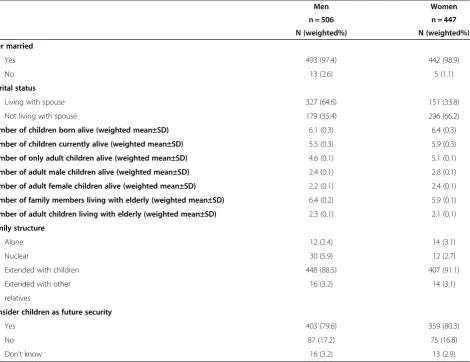
Table 2 indicates the social support available from im-mediate family members. More elderly men as compared to women were living with spouse (64.6% vs 33.8%). Moreover, most study participants had good family sup-port with 92% males and 94% females living with either their children or other relatives. A small percentage was living alone. On average, our study participants had close to 5 living children and most of them were adults. Around 80% of elderly persons considered children as their future security.
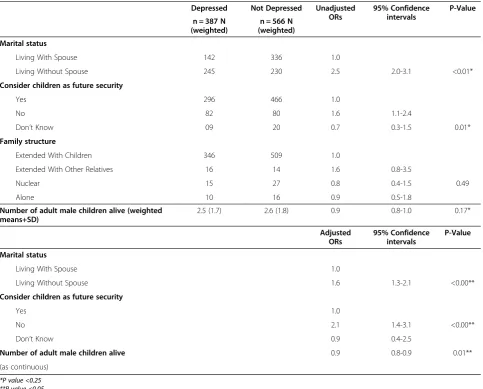
Table 3 indicates the association of family support with depression on univariate and multivariable analysis. Those subjects not currently living with their spouses were 60% more likely to be depressed than those living with their spouses (Adjusted OR = 1.6, 95% CI = 1.3-2.1).
Moreover, the increasing number of male children showed a protective association with depression. Thus, an increase in one male child showed 10% protective odds against depression after adjusting for other variables (Adjusted OR = 0.9, 95% CI = 0.8-0.9). Elderly not considering children as their future support were twice likely to be depressed than those considering their children to be old age security (Adjusted OR = 2.1, 95% CI = 1.4-3.1).
The variables adjusted in the final multivariable model were level of education, self perception of health status, functional status and physical activity level.
Discussion
To our knowledge, this is the first study that has esti-mated the prevalence of depression in the elderly popu-lation using a community based sample in Pakistan.
[image:5.595.68.539.371.733.2]Our results show that approximately 40% of elderly population living in Karachi is suffering from depression, with higher rates in women than men. Elderly not living with spouse and not considering their children as future security were more likely to be depressed. Conversely,
Table 2 Social support available to the elderly in Karachi from immediate family members
Men Women
n = 506 n = 447
N (weighted%) N (weighted%)
Ever married
Yes 493 (97.4) 442 (98.9)
No 13 (2.6) 5 (1.1)
Marital status
Living with spouse 327 (64.6) 151 (33.8)
Not living with spouse 179 (35.4) 296 (66.2)
Number of children born alive (weighted mean±SD) 6.1 (0.3) 6.4 (0.3)
Number of children currently alive (weighted mean±SD) 5.5 (0.3) 5.9 (0.3)
Number of only adult children alive (weighted mean±SD) 4.6 (0.1) 5.1 (0.1)
Number of adult male children alive (weighted mean±SD) 2.4 (0.1) 2.8 (0.1)
Number of adult female children alive (weighted mean±SD) 2.2 (0.1) 2.4 (0.1)
Number of family members living with elderly (weighted mean±SD) 6.4 (0.2) 5.9 (0.1)
Number of adult children living with elderly (weighted mean±SD) 2.3 (0.1) 2.1 (0.1)
Family structure
Alone 12 (2.4) 14 (3.1)
Nuclear 30 (5.9) 12 (2.7)
Extended with children 448 (88.5) 407 (91.1)
Extended with other 16 (3.2) 14 (3.1)
relatives
Consider children as future security
Yes 403 (79.6) 359 (80.3)
No 87 (17.2) 75 (16.8)
elderly having male children showed protection against depression. Although the cross-sectional design of the study could not establish the temporal relationship be-tween family support and depression, the findings of our study provide important insights into the connection of family support with the mental health of elderly.
Given the fact that we used a population-based ap-proach on a representative sample, our findings could be generalized to the elderly population of Karachi, though not to the country as a whole.
The household survey design made it impractical to access homeless elderly, those living at old peoples’ homes (there are a small number in Karachi) and se-verely depressed elderly admitted in hospitals. Similarly, the exclusion of those elderly who were cognitively im-paired and those with severe medical co-morbidities might have underestimated the observed prevalence. In addition, there may have been bias associated with
self-reporting and use of non-validated scales to assess de-pression and functional status.
[image:6.595.57.541.99.488.2]The prevalence estimated by our study is approxi-mately twice that of two previous studies on elderly at-tending a tertiary healthcare facility in Karachi, using the same scales and cutoff points [22,23]. The observed dif-ference may partly be explained by the design of the pre-vious studies: subjects including patients and attendees were recruited from an out-patient clinic of a private, fees-for-service health care facility which was accessed by patients from a relatively higher socio-economic strata and better health seeking behavior. On the other hand, people in community may have depression that is unrecognized or they may not have the resources to seek help. Furthermore, studies have reported that psychometric properties of GDS are weaker for cogni-tive impaired individuals [31] however; neither of the pre-vious studies screened their participants for cognitive Table 3 Association of family support with depression in Elderly of Karachi on Univariate and multivariable analysis
Depressed Not Depressed Unadjusted ORs
95% Confidence intervals
P-Value
n = 387 N (weighted)
n = 566 N (weighted)
Marital status
Living With Spouse 142 336 1.0
Living Without Spouse 245 230 2.5 2.0-3.1 <0.01*
Consider children as future security
Yes 296 466 1.0
No 82 80 1.6 1.1-2.4
Don’t Know 09 20 0.7 0.3-1.5 0.01*
Family structure
Extended With Children 346 509 1.0
Extended With Other Relatives 16 14 1.6 0.8-3.5
Nuclear 15 27 0.8 0.4-1.5 0.49
Alone 10 16 0.9 0.5-1.8
Number of adult male children alive (weighted means+SD)
2.5 (1.7) 2.6 (1.8) 0.9 0.8-1.0 0.17*
Adjusted ORs
95% Confidence intervals
P-Value
Marital status
Living With Spouse 1.0
Living Without Spouse 1.6 1.3-2.1 <0.00**
Consider children as future security
Yes 1.0
No 2.1 1.4-3.1 <0.00**
Don’t Know 0.9 0.4-2.5
Number of adult male children alive 0.9 0.8-0.9 0.01**
(as continuous)
*P value <0.25 **P value <0.05
impairment which could have influenced their find-ings [22,23].
Previous literature has reported that elderly are more prone to depression than general population [15-20]. A systematic review showed that the burden of depression in general population in Pakistan is 34% [44]. The find-ings of our study substantiate the literature of higher prevalence of depression in elderly than the general population of Pakistan.
We calculated our sample size based on prevalence of 20% reported by the two previous studies [22,23], which might had resulted in underestimated sample size. How-ever, our final sample size, after incorporating the propor-tion of family support, was much higher than what had been required at prevalence of 50%. Thus, the sample size was adequate to fulfill the objectives of the study.
With regard to family support, it is important to emphasize that Pakistan is a collectivistic society and family play a significant part in the life of elderly. Joint and extended family are traditionally well established and accepted norms. The elderly in Pakistan rarely live alone or fend for themselves after retirement. Most eld-erly not only expect to be looked after by their families but the families also consider this as their religious, so-cial and moral obligation. Families provide economic as well as physical support to their retired parents [24-26]. In Pakistan, there is no state support for the elderly, who have to rely on their families for their social and eco-nomic needs [22,25].
One of the greatest needs of elderly is to have a com-panion and support of a life partner. On the contrary, the loss of spouse due to death, separation or divorce greatly reduces their capacity to face the challenges of life. The loss of a spouse can affect the psychosocial health as well as the survival of an individual at any stage of life. However, the elderly are particularly vulner-able as their dependency on a spouse increases with age [22,45,46]. A community based study conducted in Japan revealed that, separated or widowed elderly people had higher odds for depression as compared to their married counterparts. The results were similar for both elderly men and women [46].
In Pakistan, children (especially adult male children) become important sources of support for the older people [22,24,25]. Lack of children’s support can create a sense of insecurity and hence, increase their vulnerability to depression [22,27].
Several studies have reported the association of
‘per-ception of a supportive family’ and mental health
[27,28]. A study conducted in a primary care setting in New York, USA revealed that insufficient family support was associated with increased psychological symptoms among elderly [27]. Another study in USA showed that perception of social support is associated with the
overall functioning of depressed elderly [28]. This is in line with the findings of our study.
Conclusion
Our study results estimated 40.6% of elderly in Karachi to be suffering from probable depression, with higher prevalence in women. Family support status was found to have a strong association with the mental health of elderly. There is need for further research in this import-ant but neglected group of the population. There is also need for similar studies from other cities of Pakistan, so that a national picture of mental health of the elderly in Pakistan can be obtained. The findings of such studies can be used to inform policy and develop relevant pre-ventative and intervention programs.
Additional file
Additional file 1:Questionnaire used for data collection.
Abbreviations
WHO:World Health Organization; GDS: Geriatric depression scale; LAMI: Low and middle income; DALYs: Disability adjusted life years; MMSE: Mini-mental state examination; FBS: Federal Bureau of Statistics; ERC-AKU: Ethical Review Committee-Aga Khan University; ADL: Activities of daily living;
IADL: Instrumental Activities of daily living; AKU: Aga Khan University; SAS: Statistical analysis system; OR: Odd ratio.
Competing interests
The authors declare that they have no competing interests.
Authors’contributions
MB contributed in conception, design, conduct, analysis and preparation of the manuscript. MSK provided valuable feedbacks in the conduct and implementation of study as well as in finalizing the manuscript. MMK as subject expert critically reviewed and contributed to manuscript writing. All authors read and approved the final manuscript.
Acknowledgement
The authors express appreciation to Dr. Sarah Saleem, Dr. Syed Ahmer, Mr. Iqbal Azam and Dr. Naveed Janjua of The Aga Khan University, Karachi-Pakistan, for their valuable assistance in this research.
Grant
University Research Council of Aga Khan University, Karachi, Pakistan URC Project ID: 08GS009CHS.
Author details
1Department of Community Health Sciences, Aga Khan University, Stadium Road, P.O. Box 3500, Karachi 74800, Pakistan.2Department of Psychiatry, Aga Khan University, Karachi, Pakistan.
Received: 14 April 2012 Accepted: 25 June 2013 Published: 3 July 2013
References
1. Hashmi SMH:Ageing of the population.InPopulation of Pakistan.Edited by Kamal AR, Irfan M, Mahmmod M. Islamabad: Pakistan Institute of Development Economics; 2003:313–326.
2. Gavrilov LA, Heuveline P:Aging of population.InThe Encyclopedia of Population.Edited by Demeny P, McNicoll G. New York: Macmillan Reference USA; 2003:32–37.
4. Knickman JR, Snell EK:The 2030 problem: Caring for aging Baby Boomers.
Health Serv Res2002,37(4):849.
5. Rechnitzer PA:Ageing, fitness and morbidity.Can Med Assoc J1983,
128(7):791–792.
6. CEDA:Australia’s Ageing Population: Meeting the Challenge.2004. http:// www.ceda.com.au/media/5519/ageing_policy_statement.pdf.
7. Health Canada in collaboration with the interdepartmental Committee on Aging and Seniors:Canada’s Aging Population.2002. http://publications.gc. ca/collections/Collection/H39-608-2002E.pdf.
8. Censusscope:United States an aging population.2000. http://www. censusscope.org/us/map_65plus.html.
9. United Nation:World Population Prospects The 2008 Revision: Highlights. New York: Department of Economic and Social Affairs, Population Division; 2009.
10. Population, Labor force and Employment: Economic Survey 2009–10.http:// www.finance.gov.pk/survey/chapter_10/16_Population.pdf.
11. WHO:Facing the Facts: The Burden of chronic disease in Pakistan.http:// www.who.int/chp/chronic_disease_report/media/PAKISTAN.pdf. 12. Pakistan Health Profile.2012. Updated on May 2012 [http://www.who.int/
gho/countries/pak.pdf]
13. Dutt D:Care for the growing number of elderly people in developing countries needs to be addressed.BMJ1998,516:1387.
14. Zafar SN, Ganatra HA, Tehseen S, Qidwai W:Health and needs assessment of geriatric patients: results of a survey at a teaching hospital in Karachi.
JPMA J Pak Med Assoc2006,56(10):470.
15. Blazer DG:Psychiatry and the oldest old.Am Psychiatric Assoc2000,
157:1915–1924.
16. Biderman A, Cwikel J, Fried AV, Galinsky D:Depression and falls among community dwelling elderly people: A search for common risk factors.
J Epidemiol Community Health2002,56:631–636.
17. Rodriguez H, Brathwaite D, Dorsey S:Depression and social support in the elderly population: A study of rural South African elders.ABNF J2002,
13(2):45–48.
18. Sherina MS, Rampal L, Aini M:The prevalence of depression among elderly in an urban area of Selangor, Malaysia.Int Med J2005,4(2):57–63. 19. Khattri JB:Study of depression among geriatric population in Nepal.
Nepal Med Coll J2006,8(4):1–4.
20. Lyness JM, Caine ED, King DA, Cox C, Yoediono Z:Psychiatric disorders in older primary care patients.J Gen Intern Med1999,14(4):249–254. 21. WHO, World Bank:The global burden of disease: A comprehensive
assessment of mortality and disability from diseases, injuries, and risk factors in 1990 and projected to 2020. InGlobal Burden of Disease and Injury Series.Edited by Murray CJL, Lopez AD, Mundial B. Cambridge, MA: Harvard University Press; 1996:1–43.
22. Taqui AM, Itrat A, Qidwai W, Qadri Z:Depression in the elderly: Does family system play a role? A cross-sectional study.BMC Psychiatry2007,7(1):57. 23. Ganatra HA, Zafar SN, Qidwai W, Rozi S:Prevalence and predictors of
depression among an elderly population of Pakistan.Aging Ment Health 2008,12(3):349–356.
24. Kramer EJ, Kwong K, Lee E, Chung H:Cultural factors influencing the mental health of Asian Americans.West J Med2002,176(4):227. 25. Mason KO:Family change and support of the elderly in Asia: What do
we know?Asia Pac Popul J1992,7(3):13–32.
26. Bongaarts J:Household Size and Composition in the Developing World in the 1990s.Popul Stud2001,55:263–279.
27. Cano A, Scaturo DJ, Sprafkin RP, Lantinga LJ, Fiese BH, Brand F:Family support, self rated health and psychological distress : Primary care companion.J Clin Psychiatry2003,5:111–117.
28. Marino P, Sirey JA, Raue PJ, Alexopolous GS:Impact of social support and self efficacy on functioning in depressed older adults with chronic obstructive pulmonary disease.Int J COPD2008,3(4):713–718. 29. Karachi.2008. Cited 2008 [en.wikipedia.org/wiki/karachi]
30. Kurlowicz L:The Geriatric Depression Scale: Best practice in nursing care to older adults. Revised. InBest Practices in Nursing Care to Older Adult, Issue 2.Edited by Boltz M, Greenberg SA. NYU College of Nursing; 2007. 31. Montorio I, Izal M:The Geriatric Depression Scale: A review of its
development and utility.Int Psychogeriatr2005,8(1):103–112. 32. Katzman R, Zhang MY, Zhang MY, Ouang-Ya-Qu, Liu WT, Yu E,et al:A
chinese version of the mini-mental state examination: Impact of illiteracy in a Shenghai dementia survey.J Clin Epidemiol1998,
41(10):971–978.
33. Tangalos EG, Smith GE, Ivnik RJ, Petersen RC, Kokmen E, Kurland LT,et al:
The mini-mental state examination in general medical practice: Clinical utility and acceptance.Mayo Clin Proc1996,71(9):829–837.
34. Gupta R, Solanki RK, Midha P, Dubey V, Pathak V:Association of hypertension and its treatment with dementia and cognitive functioning.Indian Heart J2006,58(4):336–340.
35. World Health Organization:WHO ear and hearing disorders survey protocol for a population based survey of prevalence and causes of deafness and hearing impairment and other ear diseases.1999. http://whqlibdoc.who.int/ hq/1999/WHO_PBD_PDH_99.8(1).pdf.
36. Oliveira DA, Gomes L, Oliveira RF:Prevalence of depression among the elderly population who frequent community centers.Rev Saude Publica 2006,40(4):734–736.
37. Weintraub D, Katherine AO, Katz IR, Stern MB:Test characteristics of the 15-item geriatric depression scale and Hamilton depression rating scale in Parkinson disease.Am J Geriatr Psychiatry2006,14(2):169–175. 38. Katz S:Assessing self-maintenance: Activities of daily living, mobility and
instrumental activities of daily living.J Am Geriatr Soc1983,31(12):721–726. 39. Lawton MP, Brody EM:Assessment of older people: Self-maintaining and
instrumental activities of daily living.Gerontologist1969,9:179–186. 40. Calverton OM:Model questionnaire with commentary. Measure DHS basic
documentation.2006. http://www.measuredhs.com.
41. akistan Reproductive Health and Family Planning Survey questionnaire.http:// www.pakistan.gov.pk/divisions/population-division/media/chapter1.pdf. 42. Maletta H:WEIGHTING.2006. http://www.spsstools.net/Tutorials/WEIGHTING.
pdf.
43. Jennings K:Sampling and Survey techniques.http://www.stat.purdue.edu/ ~jennings/stat522/notes/topic5.pdf.
44. Mirza I, Jenkins R:Risk factors, prevalence, and treatment of anxiety and depressive disorders in Pakistan: Systematic review.Br Med J2004,
328:794.
45. Markides KS, Farrell J:Marital Status and depression among Mexican Americans.Soc Psychiatry1985,20:86–89.
46. Murata C, Kondo K, Ojima T, Saito Y, Suemori K, Hirai H:Marital quality and depression among the elderly in Japan [Abstract]. InInternational Health and Aging: The 135th APHA Annual meeting and exposition.Washington DC: American Public Health Association; 2007.
doi:10.1186/1471-244X-13-181
Cite this article as:Bhamaniet al.:Depression in the elderly in Karachi,
Pakistan: a cross sectional study.BMC Psychiatry201313:181.
Submit your next manuscript to BioMed Central and take full advantage of:
• Convenient online submission
• Thorough peer review
• No space constraints or color figure charges
• Immediate publication on acceptance
• Inclusion in PubMed, CAS, Scopus and Google Scholar
• Research which is freely available for redistribution